Friday, July 21, 2017

Introduction to adult food can be a big turning point in a child's nutritional health; program in 22 counties helps poor get local food

By Melissa Patrick
Kentucky Health News

Taste preferences are established early, and that's why those early bites of ice cream matter.
A program that helps low-income families who use food-assistance programs to get locally produced food gets additional funding.
A group in Louisville is working on opening a community-owned grocery store.

These were just some of the topics discussed during the July 12 "Food in Kentucky" webinar, sponsored by the Foundation for a Healthy Kentucky.

Ana Chang, founder of Concept Hatchery, a California consultancy, opened the webinar with findings from her company's research with the 1,000 Days project, which looks at the nutritional health of mothers and their children during the 1,000 days from pregnancy to a child's second birthday.

Chang said her research involved 19 mothers from Kentucky, California and Mississippi, with varying levels of income levels. The study looked at what the children ate and how the mothers decided what to feed them, through food journals and in-person evaluations during meal and snacks.

All of the children started out on equal footing because they were all fed either formula or breast milk, Chang said, but the nutritional value of their food changed quickly when they started eating adult food.

"The first taste of food that babies get are really often what the family eats; they are not specialized for babies. And so the taste preferences are established really early. Even as young as four months or younger, babies might be given a finger that's been dipped in soup that the family is having, or a lick of ice cream," she said. "So how well that family ate, that's how well that baby is going to eat as it starts growing up."

Chang noted that one of the Kentucky families in the study was part of a diabetes-prevention program that provided fresh produce to the whole family, even though only one family member had been diagnosed with the disease. "That is the kind of intervention that we need to start thinking about," she said, "because once food is brought into a family kitchen, it becomes available for everybody."

Chang noted some nutrition challenges for the low-income families in the study, including: lack of access to fresh fruits and vegetables, transportation barriers, lack of a safe place to store foods, and a lack of a cooking space. She said almost every family in the study struggled with food bounty and scarcity issues which were tied to the arrival of their paychecks and food stamps.

Martin Richards, executive director of the Community Farm Alliance, said his 32-year-old group focuses on agriculture and family farming policy because policy can affect the most people, but also supports non-legislative initiatives that reinforces the bills they are trying to pass.

Click on the image to view a larger version.
One of those projects is Kentucky Double Dollars, a program that allows low-income families who use food-assistance programs to double their purchasing power at participating farmers' markets and retail stores in 22 Kentucky counties.

The program allows those on food stamps (now called the Supplemental Nutrition Assistance Program) or the Women, Infants and Children program to double the value of their SNAP or WIC dollars to buy Kentucky-grown produce, meats, eggs and dairy products. The double dollars program is also available to seniors who are part of the Senior Farmers Market Nutrition Program for Kentucky-grown produce only.

"We saw the huge amount of money that comes into Kentucky from federal food nutrition programs and we saw this as a way to get that money to support local and regional food systems," Richards said, adding that the program recently received an additional $1.4 million from federal, state and private-sector funding to help sustain it. (The program was formerly called "Double Dollars," but recently changed its name to Kentucky Double Dollars after it merged with the Bluegrass Farm to Table and the "Bluegrass Double Dollar" programs in Lexington.)

This season, 27 Kentucky farmers’ markets, 12 Fresh Stop Markets in Lexington and Louisville, and Good Foods Co-op in Lexington and Lexington Market East End, are participating in Kentucky Double Dollars.

Other CFA initiatives include a program that gives children vouchers to use at participating farmers' markets; a program that allows health-care providers to prescribe fruits and vegetables as part of a treatment plan; a program that provides food to children in the summer; a walking program that links farmers' market vouchers to community exercise goals; a school-based program that encourages students to drink water; and healthy cooking classes.

The CFA also offers technical and financial support through a 50-50 cost-sharing arrangement to communities that want to create a farmers' market. "When a farmers' market has somebody dedicated to help making that market run, even if it is just part time and seasonal, it makes a huge difference to that market," Richards said.

In another part of the webinar, Cassia Herron of the Louisville Food Co-op said her group is working to open a community-owned grocery store in one or more of the neighborhoods in Louisville's urban core. She said this group is working to hire a project manager who will lead and launch a capital campaign for this project, which they hope will come to fruition within the next two years.

Thursday, July 20, 2017

In a region blessed with nature's hidden splendor, organized hiking could be a way to improve the health of Central Appalachia

Breathitt County Hiking Club walks the Copperas Creek Trail
in the Red River Gorge. (Outside photos by Josh Mauser)
An Eastern Kentucky man is working to improve the health of his county one person at a time through a monthly hiking club, Lyndsey Gilpin of Louisville reports for Outside.

Stephen Bowling, Breathitt County's 45-year-old library director, told Gilpin that he created the Breathitt County Hiking Club to get people in and around Jackson out into nature in hopes of improving their health and alleviating the sense of fatalism that is pervasive in the community. The trips usually attract around 20 people.

“A little bit here, a little bit there. We’ll get them moving,” Bowling told Gilpin.

Appalachia is "isolated geographically and culturally" and is a "prime example of the rural-urban wellness divide," Gilpin writes, noting that one in four people in Eastern Kentucky live below the poverty line; that nearly half of the 14,000 people who live in Breathitt County are obese; that about a third of them smoke; and that a third of them are physically inactive. The unemployment rate is almost 12 percent.

Those factors give Breathitt and surrounding counties some of the country's lowest health rankings, along with low life expectancy driven by unemployment, relatively low education levels, limited physical activity and poor access to health care and healthy foods, according to the annual Robert Wood Johnson Foundation County Health Rankings Report.

“It’s a depressed area economically, but also emotionally and physiologically,” Bowling told Gilpin. “We’re told constantly that we’re the least healthy people, we are this, we are that, and people don’t feel empowered to change that. Some people aren’t willing, and some people aren’t able.”

So Bowling, who has hiked hundreds of miles on the Appalachian Trail and in the Southeast, decided to share his love of backpacking with others in his community through a hiking club, which meets once a month on a Sunday, always after church.

He told Gilpin that he the club isn't a "one-and-done solution to all the public health woes facing Breathitt County," but added, "If we solve one problem at a time, or help someone get in shape one person at a time, we’ve completed our goal.”

Stephen Bowling helped rookie hikers on the trail.
Gilpin met up with Bowling and his hiking club in early June when he and a group of 14 hikers, most with no hiking experience, headed off to Copperas Creek Trail in the Red River Gorge, about 40 minutes away.

“Wow, this is just amazing,” said 47-year-old Julie Stamper, one of the hikers, as she put her cigarette out and stuffed the butt into her backpack. “I’ve never been to a place like this before.”

Bowling and others believe more access to public lands and increased opportunities for physical activity can help address some of these health problems and research supports this idea, Gilpin reports.

"Ironically, rural communities tend to be cut off from public land, leaving them with the fewest choices for outdoor activity and exercise," Gilpin writes, reporting that most Southeastern states have less than 5 percent federal public land and in Kentucky it's even less at 4 percent.

For example, Gilpin writes, "Only 17 percent of Breathitt county residents live within a half-mile of a park or within three miles of an accessible recreational facility; meanwhile, 98 percent of New York county residents and 100 percent of San Francisco county residents have such access to a park within a half-mile or a recreational facility within just one mile."

The Red River Gorge is part of the Daniel Boone National Forest, which is vast but is at least a half-hour from Jackson. With few places to exercise, “Many people rely on the local high school to keep its running track unlocked and open to the public,” Mark Holmes, director of the North Carolina Rural Health Research and Policy Analysis Center, told Gilpin.

Gilpin notes that rural Southern regions are looking at North Carolina and Colorado for ways to make public lands profitable and accessible, and that the state recently created the Kentucky Mountain Regional Recreation Authority, "a group run by community members from around the state that will develop, maintain, monitor, and promote local trails."

State Representative Chris Fugate, who sponsored the bill, told Gilpin that his goal is to connect 17 counties through a trail system. “Some of the most beautiful places are hidden away,” Fugate said. “We haven’t done a good enough job of promoting and taking care of ourselves here.”

Gilpin writes, "How these types of local programs fare and how public lands prove to help the situation could inform the conversations of policymakers moving forward."

Wednesday, July 19, 2017

Owensboro Health is sixth hospital to join UK's Markey Cancer Center Research Network; will bring clinical trials to patients

Patients at Owensboro Health will have easier access to clinical research studies through the hospital's new partnership with the University of Kentucky Markey Cancer Center.

Markey Cancer Center is a National Cancer Institute-designated cancer center, which will open the hospital to up NCI-led trials in addition to other trials in Markey's research network. "Cancer care is constantly improving, due in part to the groundbreaking work being done in clinical research," Dr. Tim Mullett, medical director of the research network, said in a news release.

"Our state has some of the worst cancer incidence and survival rates in the entire country, and we at Markey have an obligation to address this devastating disease. By increasing access to many of our current clinical trials through the Markey Cancer Center Research Network, we have an opportunity to make real progress in improving cancer statistics in Kentucky."

Owensboro Health is now one of six research sites in the network, and the first in Western Kentucky. The hospital's Mitchell Memorial Cancer Center sees more than 1,000 cancer patients annually and serves nearly 400,000 people from 14 counties in Western Kentucky and Southern Indiana.

The research will include "epidemiology, prevention and early detection of cancer," and will target cancers with the highest incidence and mortality rates in Kentucky, including lung, colorectal and cervical cancers, the hospital said.

"Clinical trials represent the latest, best treatment options for most patients, and being able to participate in major national and regional clinical trials right here in Owensboro means that patients are able to stay closer to their own support systems at home and under the direct care of their doctors here," Dr. Mark Evers, director of the UK Markey Cancer Center, said in the release.

The network also includes Hardin Memorial Hospital, Elizabethtown; King's Daughters Medical Center, Ashland; St. Claire Regional Medical Center, Morehead; Tri-State Regional Cancer Center, Ashland; and St. Mary's Regional Cancer Center, Huntington, W.Va.

Tuesday, July 18, 2017

Opponents dominate public hearing on Kentucky's revised proposal for changes in state Medicaid program

By Melissa Patrick
Kentucky Health News

FRANKFORT, Ky. – Only three of the 17 Kentuckians who spoke at the final public hearing on changes to the state's Medicaid proposal supported it. The advocates said the work requirements "will make their lives better" and cited personal responsibility as reasons for their support.

Opponents, however, said the changes create a barrier to care for some of the state's most vulnerable citizens, and called the waiver "cruel, irresponsible and wasteful" "reprehensible and immoral" and likened the recent changes to "putting lipstick on a pig."

The changes have stronger work and volunteer requirements and a six-month "lock-out" for those who fail to report changes in their work and employment status.

The original proposal for a waiver to make changes to Medicaid was submitted to the Centers for Medicare and Medicaid Services about 10 months ago. The proposal targets "able-bodied adults" without dependents who qualify for Medicaid through the expansion of the program to those who earn up to 138 percent of the federal poverty level, under the Patient Protection and Affordable Care Act.

If federal officials approve the revised waiver, as expected, the state estimates that 95,000 fewer Kentuckians will be on Medicaid in five years than if the proposal is not accepted. Kentucky has 1.4 million Kentuckians on Medicaid, 470,000 of them through the expansion.

More than half of Kentuckians who have coverage because of the expansion work at low-income jobs that typically don't provide health insurance.

Andrea Welker, a lawyer with the Child Advocacy Today legal clinic in Lexington, said her mother falls into this category and that she was there to speak on her behalf about her concerns that she might lose her health insurance, which has been a "blessing," because her work hours vary so much from week to week.

“So when she goes to work, she gets there that day wondering if they are going to send her home four hours early and if she's going to be able to work her full shift. And at the end of the day, at the end of the week, is she going to be able to make her bills," said Welker.

Harriett Seiler of Louisville, a longtime advocate of single-payer health care, said the changes to the waiver were like "putting lipstick on a pig," saying they did nothing to improve it. She added that she "objects strongly" to the waiver's "patriarchal concept" of teaching people how to be "good employees, good purchasers of private insurance."

Rev. Rachel Small-Stokes, an associate pastor at Union Church in Berea, talked about the transportation challenges people in her community have to work, also noting that often they get to a workplace and are told they aren't needed. She added that "out of the goodness of their heart," the transportation burdens will likely fall to community members to get these people to and from their newly required work and volunteer requirements.

“And I actually wonder if maybe the underlying goal of this is for people not to get health care," she said. "And if that is the case, then it is absolutely immoral and so I urge you please re-look at this."

Beverly May, a family nurse practitioner from Floyd County, described the plan as "cruel, irresponsible and wasteful." She said the expansion has doubled the percentage of Kentuckians with a medical home and the uptake of preventive services, like breast and colorectal cancer screenings. She said the proposed changes in the waiver simply provide "unnecessary barriers" to care.

Some favor the changes

Amy Luttreel, chief executive officer of Goodwill Industries of Kentucky and also a spokeswoman for the Kentucky Workforce Innovation Board, said both organizations endorse the bill, primarily because of the work requirements, which “will make their lives better.”

“We also see this waiver as something that brings new tools to help people who are not in the workforce, but who could be in the workforce -- to help them to achieve more stability in their lives and to also gain the skills that would allow them to be competitive in today's labor market,” Luttreel said.

Johnny Pittman of Louisville spoke about personal responsibility, saying he had been on disability and Medicaid at times due to multiple sclerosis, he is now able to work and that it was his responsibility to do so. He works at Oxmoor Auto Group in Louisville.

“Disability and Medicaid worked great for me,” he said. “It was a program and a vehicle to get me to a point where I needed to be.”

One speaker who favored the waiver said administrative difficulties at the Department for Community Based Services need to be fixed before the work and volunteer requirements are put in place.

Dylan Gorski, a law clerk at the Child Advocacy Today legal clinic, said he was “totally in favor of the waiver,” but implored the Bevin administration to make sure DCBS was ready to handle the additional administrative responsibilities that would come with the waiver's proposed community engagement requirements.

He cited several examples where his clients had lost coverage because of administrative and system errors and said the waiver needs an “agency error exception” to keep Kentuckians from being locked out of their health insurance because of any agency error.

The modifications would require able-bodied adults who are not medically frail or a caretaker to work or volunteer 20 hours a week, or 80 hours a month, instead of the original proposals plan to gradually increase the number of hours required, until the participant reached the maximum of 20.

The updated proposal also includes a provision to "lock out" for six months any participant who fails to report a change in circumstances, such as income, employment and community status, which are used to determine eligibility.

Kent Gilbert, pastor and president of the executive board of the Kentucky Council of Churches, called the changes “reprehensible and immoral.”

Health Secretary Vickie Yates Brown Glisson, asked after the meeting to reply, said " I understand their position. . . . But I likewise feel very strongly that we are doing the right thing for Kentucky. So I'm very comfortable with that."

About 45 opponents showed up to speak, filling up an overflow room next to the legislature's Interim Joint Committee on Health and Welfare meeting that started at 10 a.m. and ended at 12:15 p.m.. The hearing was scheduled to follow the committee meeting, which ended up having 10 weighty items and several speakers. Many who came to speak at the hearing left before it even began.

“I think it was planned to put so many things on the agenda,” Rep. Mary Lou Marzian, D-Louisville, told Ronnie Ellis of CNHI News Service. “They don’t want people to know how callous they are.”

Committee Chairman Addia Wuchner, R-Burlington, told Marzian during the meeting that everyone would have the opportunity to speak after the meeting and noted that all of the agenda items were important issues that needed to be considered as they prepared for the 2018 legislative session.

Glisson said the remarks would be transcribed and attached to the waiver request sent to Washington. She also noted that the state was "still in a process of negotiation."

The state and CMS will continue to take written public comments through Aug. 2 at 11:59 p.m. 

Monday, July 17, 2017

After fellow Republicans kill his bill, McConnell adopts an idea he had dismissed: repeal Obamacare now, replace it later

Sen. Mitch McConnell (Getty Images)
By Al Cross
Kentucky Health News

With his health-insurance bill killed by fellow Republicans late Monday, Senate Majority Leader Mitch McConnell quickly adopted a version of idea he had dismissed: repealing the Patient Protection and Affordable Care Act, but with a two-year delay.

But that strategy quickly fell apart, as Republican senators from West Virginia, Maine and Alaska said they couldn't support it. That could make operative the warning McConnell gave Republicans last month, that if they couldn't pass a comprehensive bill on their own, they would have to join with Democrats to stabilize the market for private health insurance.

But John Bresnahan and Burgess Everett of Politico reported that McConnell "is wary of following Sen. Lamar Alexander (R-Tenn.) and other Republicans into bipartisan negotiations to save the insurance markets, according to GOP sources."

After Republican Sens. Jerry Moran of Kansas and Mike Lee of Utah said in a joint announcement Monday night that they couldn't support McConnell's revised bill, he said he would use the House passed May 4 as a vehicle for a repeal-now, replace-later strategy like that advocated by his Kentucky seatmate, Republican Rand Paul. President Trump had also suggested that strategy, and did it again Monday night.

McConnell had said the strategy wouldn't work, but around 10:45 p.m. Monday, he issued this statement: “Regretfully, it is now apparent that the effort to repeal and immediately replace the failure of Obamacare will not be successful. In the coming days, the Senate will vote to take up the House bill with the first amendment in order being what a majority of the Senate has already supported in 2015 and that was vetoed by then-President Obama: a repeal of Obamacare with a two-year delay to provide for a stable transition period to a patient-centered health care system that gives Americans access to quality, affordable care.” He declined to be more specific about “the coming days.”

Sens. Jerry Moran, Mike Lee (N.Y. Times)
Around 9 p.m., Lee and Moran had joined Paul and moderate Republican Susan Collins of Maine in publicly opposing McConnell's revised bill. That left the majority leader two votes short of the 50 he needed from Republicans to advance the bill.

Asked June 30 about the idea of repealing now and replacing later, McConnell said he would "stick to" his strategy of passing a comprehensive repeal bill only with Republican votes.

McConnell said in early June that he wasn't working with any of the 48 Democrats because "They're not interested in doing anything we're interested in doing" on health care, but in late June he warned Republicans that if they couldn't pass a comprehensive overhaul on their own, they would have to join with Democrats to stabilize the market for private health insurance, including taxpayer-subsidized plans.

"My suspicion is in any negotiation with Democrats will include none of the reforms that we would like to make on the market side and the Medicaid side," McConnell said then.

Before McConnell's late-night announcement, Senate Democratic Leader Chuck Schumer of New York called for a bipartisan effort. “This second failure of Trumpcare is proof positive that the core of this bill is unworkable,” Schumer said. “Rather than repeating the same failed, partisan process yet again, Republicans should start from scratch and work with Democrats on a bill that lowers premiums, provides long-term stability to the markets and improves our health-care system.”

McConnell had promised a vote on his bill this week, but had to back off when Sen. John McCain of Arizona was sidelined by surgery. Paul said Sunday that the delay would give conservatives time to realize that the bill wasn't what they want.

McConnell had hoped to get Lee's vote by allowing insurance companies to sell the sort of low-cost, low-coverage plans that the 2010 law prohibited. (Insurance companies said the language would split the insurance market between the health and not so healthy, driving up costs for the latter.)

Sweeteners that McConnell added to the bill to get moderates, such as more money to treat opioid addiction and a one-year delay in the phase-out of Medicaid expansion, forced him to keep Obamacare's taxes in the bill, and Lee objected to that.

Also, The Associated Press reports, Lee said the bill didn't "go far enough in lowering premiums for middle class families" or "create enough free space from the most costly Obamacare regulations." Moran said the bill "fails to repeal the Affordable Care Act or address health care's rising costs."

"Moran faced pressure at home about how the bill would affect Kansas, including its rural hospitals," The New York Times noted, "The Kansas Hospital Association said last week that the latest version “comes up short, particularly for our most vulnerable patients.”

The Kentucky Hospital Association likewise opposed McConnell's plan to phase out federal funding for expansion of Medicaid, which has boosted many Kentucky hospitals. It said that if the expansion was phased out, Congress should restore the 2010 law's cuts in special reimbursements to rural hospitals for care of Medicare patients.

"The collapse of the Senate Republican health bill — and the failing struggle to find yet another alternative —highlighted a harsh reality for Senate Republicans: While Republican senators freely assailed the health law while Mr. Obama occupied the White House, they have so far not been able to come up with a workable plan to unwind it that would keep both moderate Republicans and conservatives on board," writes the Times' Thomas Kaplan.

Sunday, July 16, 2017

Opioid painkiller prescriptions are down statewide, but remain high, and some counties' rates increased from 2010 to 2015

The number of Kentucky prescriptions for opioid painkillers has gone down since 2010, but "several counties remained near the top nationally in 2015," Bill Estep reports for the Lexington Herald-Leader, on a study by the federal Centers for Disease Control and Prevention.


The opioid-prescription rate declined in 74 of the state's 120 counties, reports Melissa Healy of the Los Angeles Times, but it increased in at least 19 counties.
The CDC report "found big differences among counties in the amount of opioids prescribed per person. The per-capita amount prescribed in the top counties averaged six times the amount in the lowest counties, the report said. Some Kentucky counties were in the top category nationally," Estep reports.

"Some of that difference could be explained by having a large number of people with conditions such as arthritis, but that would account for only a fraction of the disparity, the report said. The variations suggest 'inconsistent practice patterns' and a lack of consensus about appropriate opioid use, and shows the need for better use of guidance and standards on prescribing the powerful medication, the CDC said."

While the national rate went down, it went up in more than half of U.S. counties, showing a worsening of the opioid epidemic in rural areas. And the overall rate was still three times as it was in 1999, reflecting how OxyContin and other prescription opioids became more commonly prescribed, and abused.

“There’s still a lot of pills out there,” Van Ingram, head of the Kentucky Office of Drug Control Policy, told Estep, who notes, "Overdose deaths have not gone down in Kentucky, even as deaths from oxycodone and hydrocodone have tapered off. Rising abuse of heroin and a far more powerful drug called fentanyl — which also are opioids — has caused even more deaths." Heroin is illegal and fentanyl is rarely prescribed.

Flood of opioid-addicted babies prompts UK, other hospitals to try a new strategy of keeping them with their mothers in the hospital

Jay'la Cy'anne Clay was transferred from Richmond to the
University of Kentucky hospital. (NYT photo by Ty Wright) 
A flood of opioid-addicted babies in Kentucky and other states have prompted doctors and hospitals to rethink their strategy of sending the newborns to specialty hospitals that their mothers often have difficulty visiting, Catherine Saint Louis of The New York Times reports from Madison County. She begins with the harsh reality for one baby:

"Convulsions rocked her tiny body as she lay under warming lights in the nursery of the Baptist Health Richmond hospital. She vomited and made strange, high-pitched cries. The infant was going through opioid withdrawal. For more than a decade, her mother, Jamie Clay, 28, had been hooked on oxycodone. For six months now, she had been in a recovery program, taking another opioid that eased her addiction but put her baby at risk for withdrawal."

Fifteen of every 1,000 Kentucky babies are addicted to opioids, and those "with the worst withdrawal symptoms are routinely separated from their mothers and whisked by ambulance, at great expense, to hospitals hours away, filling up beds intended for newborns who have even more serious problems, like heart defects, Saint Louis reports.

"Urban medical centers nationwide are scrambling to expand neonatal intensive care units or to build separate facilities to accommodate a tide of opioid-exposed babies arriving from rural communities. The result, many experts say, is an exercise in good intentions gone awry. After their babies are moved, many new mothers, poor and still struggling with addiction, cannot find transportation or the resources to visit."

But babies need their mothers. "Separating newborns in withdrawal can slow the infants’ recovery, studies show, and undermine an already fragile parenting relationship. When mothers are close at hand, infants in withdrawal require less medication and fewer costly days in intensive care," Saint Louis reports.

"The standard treatment is to drip tiny doses of morphine into the mouth with a syringe to make the newborn comfortable enough to eat and sleep. Then, over two to 12 weeks, the infant is weaned off morphine. But community hospitals in rural areas rarely have neonatal intensive care units in which staff can administer morphine. So, after a brief period of observation, infants in withdrawal are transferred to more sophisticated facilities. . . . Increasingly, experts fear that babies are being removed from mothers they need so they can get morphine they do not. Now some researchers are urging hospitals to pursue a new strategy."

One alternative is "rooming in," in which mothers and babies stay together, not in the neonatal intensive care unit, which typically has bright lights and noise. "A baby in withdrawal needs a quiet and dark environment without too many stimuli," Saint Louis writes. "Rooming in" and similar strategies have reduced the average length of hospital stays and, even more, costs.

At UK's Kentucky Children's Hospital, “When we keep babies and mothers together the entire time, we almost never have to treat” with drugs, and infants who don't need medication stay four or five days, while babies who do stay 22 or 23 days,neonatologist Dr. Lori A. Shook, told Saint Louis.

"Soon, a unit with eight private rooms for babies with neonatal abstinence syndrome and their mothers will open," Saint Louis reports. "The infants will be kept out of intensive care and with their parents."

Children's Hospital has a "Kentucky Kids Crew" that "picks up babies in severe withdrawal from 20 hospitals in rural towns across Southern and Eastern Kentucky," Saint Louis notes. "In 2015 and 2016, this unit was over capacity almost half the time. Nearly 60 babies in withdrawal had to be diverted to other hospitals, because there were infants with even more pressing needs, like life support or breathing assistance."

Paul explains his opposition to McConnell's health-insurance bill on two national Sunday talk shows

Paul was on "Face the Nation" and "Fox News Sunday."
By Al Cross
Kentucky Health News

His Kentucky seatmate and fellow Republican has been making most of the news on the health-insurance bill in the U.S. Senate, but Sen. Rand Paul took a higher profile Sunday, explaining his opposition to Senate Majority Leader Mitch McConnell's bill on two national-television interview programs.

“We won four elections on repealing Obamacare … but this doesn’t,” the Bowling Green ophthalmologist said on "Fox News Sunday."

Paul has long opposed a basic function of the 2010 law, which subsidizes private health insurance that the law made more expensive by requiring broad coverage. McConnell's bill would keep the Obamacare taxes on higher incomes in order to shore up the subsidized insurance market for individuals, which companies are leaving, saying they are losing money in it.

“That is not a Republican idea, to give taxpayer money to a private industry,” Paul said. “The Republican plan doesn’t fix the death spiral of ObamaCare, it merely subsidizes it.”

Paul also said he doesn't think McConnell has the votes to pass the revised bill the leader rolled out last week. Paul and moderate Republican Sen. Susan Collins of Maine have announced against it, leaving McConnell no votes to spare among the Senate's 52 Republicans.

“I still think the entire 52 of us can get together on a more narrow, clean repeal,” Paul said. McConnell has declined to work with Democrats, saying they don't want to do anything Republicans want to do, but has warned that if his bill doesn't pass, they will have to work together to stabilize the Obamacare-subsidized individual insurance market.

On CBS's "Face the Nation," Paul argued that Obamacare's requirements "cause the prices to rise, which chase young, healthy people out of the marketplace, and leads to what people call adverse selection, where you have a sicker and sicker insurance pool and the premiums keep rising through the roof."

When host John Dickerson noted that proponents of the system say some sort of transition is needed to limit cost increases for sicker people, Paul said, “Insurance companies make about $15 billion in profit every year. I'm not for any taxpayer money going to … an industry that makes $15 billion a year. I think it's absolutely wrong. It's not at all consistent with conservative principles, free market principles or being a Republican. It also has nothing to do with repeal. I mean, we promised the voters for four elections. They elected us to repeal Obamacare. And now we're going to keep most of the taxes, keep the regs, keep the subsidies and create a giant bailout super fund for the insurance companies. I just don't see it.”

Asked how he would address the issue, Paul said people in the individual market should be allowed to form groups to share risk. “Right now, the insurance companies have gamed the system such that they get enormous profit from the group plans. And then they lose money in the individual markets and they whine and they come to Washington. They write the bill and they get bailed out. It's a terrible situation.”

Dickerson said, "The complaint about that is that people will associate with healthier people. Their premiums will be low. The sicker will be stuck in their association of sick people and the premiums will be high."

Paul said that won't happen because current rules say anyone in a group has to be covered. "The insurance companies love this game. They get all the healthy people and they reap enormous profits. And then if you get sick, you leave employment, you don't have insurance. Then they gouge you, drop you."

McConnell has said that Paul's plan can't be part of the Senate bill because it does not relate directly to federal taxes or spending, a requirement under the budget-reconciliation rules that Republicans are using to pass the bill because they don't have enough votes to stop a Democratic filibuster.

Saturday, July 15, 2017

McConnell tries to sell 'Medicaid Republicans' from Ohio, W.Va., 3 other states on new health-insurance bill; Paul remains opposed

Kentucky Health News

“By most measures,” writes Paul Kane of The Washington Post, Senate Majority Leader Mitch McConnell and his Republican allies “face a nearly impossible task of finding enough votes to pass their long-promised repeal of the Affordable Care Act,” because Sen. Rand Paul and the Senate's most moderate Republican say they oppose the bill, and that leaves McConnell with no votes to spare.

“Yet by one measure,” Kane adds, “Republicans have never been closer to actually repealing large chunks of what they dismiss as ‘Obamacare.’ Within two short weeks, the party will probably either be reveling in its unexpected victory or mired in deep infighting over the party’s failure to live up to a pledge it has made over the past seven years.”

That time frame may be extended a week. On Saturday night, McConnell postponed action on the bill by a week because Sen. John McCain is recuperating in Arizona from surgery to remove a blood clot above an eye.

McConnell is trying to pass the bill through "budget reconciliation," one exception to the Senate's 60-vote filibuster policy, because Republicans hold only 52 of the 100 Senate seats. But with Paul and Maine Sen. Susan Collins publicly opposed, McConnell needs to get every other Republican and a tie-breaking vote from Vice President Mike Pence.

"Some Republicans remain optimistic" that McConnell "can pull off the negotiating tricks necessary, but he still faces an uphill fight in winning the votes to pass the Better Care Reconciliation Act by his tentative deadline of Friday," July 21. Key House members told Kane that if the Senate passes the bill, their chamber would pass it and send it to President Trump.

Senate Majority Leader Mitch McConnell answered reporters'
questions in Bowling Green. (AP photo by Austin Anthony)
Trump put more pressure on McConnell July 12, saying "Mitch has to pull it off. He's working very hard. He's got to pull it off." If not, "I will be very angry about it."

Late Friday, July 14, McConnell met with five Republican senators who haven't agreed to his revised bill because it still phases out federal funding for the expansion of Medicaid and sets long-term Medicaid spending limits that would keep the program from keeping pace with health-care costs and force states to make cuts. Kentucky is one of the most Medicaid-dependent states.

"Dean Heller of Nevada, Lisa Murkowski of Alaska, Rob Portman of Ohio, Shelley Moore Capito of West Virginia and John Hoeven of North Dakota" asked McConnell "to rework proposed changes to Medicaid in exchange for their 'yes' votes," Fox News reported.

The Post reported earlier that McConnell told Capito and Portman that future Congresses are likely to block the cuts. That report concerned Wisconsin Sen. Ron Johnson, who said it put "in jeopardy" his vote for the motion to proceed with the bill.

The proposed Medicaid changes also concern hospitals, but "One hospital industry lobbyist said there has been no attempt by Republican leadership to have a serious discussion with industry lobbyists or leaders about how to change the bill to win their support," reports Yasmeen Abutaleb of the Reuters wire service. Likewise, when the six major physicians' lobbies made their first joint plea, against the bill, they didn't get to meet with McConnell, the Post reported.

An unnamed senator told Fox that McConnell was unlikely to relax the Medicaid spending formula but might give the holdout senators assurances about how $70 billion in insurance subsidies that he added to the bill would help "lower-income Americans buy insurance." Under the bill, people earning more than about $42,000 a year "would face sharp premium increases," The New York Times' Margot Sanger-Katz reports.

The private insurance market is a greater concern than ever because McConnell, to get support from Texas Sen. Ted Cruz and perhaps some of his ardently conservative allies, added to the bill a provision that would allow insurance companies sell low-cost, low-coverage policies, something Obamacare outlawed in order to help the companies cover people with pre-existing conditions and deal with other facets of the law.

The two largest groups in the health-insurance industry called the Cruz amendment "simply unworkable," saying it would jack up costs for sick or vulnerable people and limit options for those who buy individual plans.

The CEOs of America's Health Insurance Plans and the Blue Cross Blue Shield Association told McConnell and Minority Leader Chuck Schumer of New York) Friday that the amendment "would undermine protections for those with pre-existing medical conditions, increase premiums and lead to widespread terminations of coverage for people currently enrolled in the individual market," and would create "two systems of insurance for healthy and sick people. As healthy people move to the less-regulated plans, those with significant medical needs will have no choice but to stay in the comprehensive plans, and premiums will skyrocket."

Kathryn Watson of CBS News notes, "The letter could be dismissed by Republicans, however, as the current head of AHIP is Marilyn Tavenner, who helped implement Obamacare as the head of the Center for Medicare and Medicaid Services."

Other major changes McConnell made in the bill would allow pre-tax income to be used to pay premiums through health savings accounts, used largely by those with above-average incomes, and add $45 billion for opioid-addiction treatment, a major concern in Kentucky, Ohio and West Virginia.

To pay for that and the insurance subsidies, McConnell dropped from the bill a planned repeal of three taxes that help finance Obamacare: a 3.8 percent levy on net investment income, a 0.9 percent Medicare payroll tax on people making $200,000 a year or couples earning $250,000, and a tax on highly paid health-insurance executives. "Lawmakers such as Sen. Bob Corker (R-Tenn.) said repealing those taxes would give too much relief to the wealthy at the expense of the poor," the Post reported.

McConnell could have room to add more money to the bill after Monday, July 17, when the Congressional Budget Office will estimate the measure's effect on revenue and spending.

Sen. Rand Paul
Meanwhile, Paul said McConnell's latest bill has nothing "remotely resembling repeal." Last week, he said he and his Kentucky Republican seatmate have had no negotiations about it.

Gov. Matt Bevin, speaking at the National Governors Association's summer meeting, "sharply criticized his party’s decision not to eliminate a pair of taxes on high earners," Jonathan Martin of the Times reports. “They’re going to lose as many votes as they’re getting,” Bevin said, adding that there had been an “understanding that those two taxes were going to be gone.”

McConnell has said that if Republicans can't pass a bill with their own votes, they will have to work with Democrats to stabilize the private insurance market.

"Across the country, Americans are losing choice and access under Obamacare," McConnell said in a speech on the Senate floor as he rolled out his revised bill. "Things are not likely to turn around unless we act."

Thursday, July 13, 2017

Ky. has 6 of top 10 counties for adults on Medicaid; Bell is 9th for children; Trump carried all in state with more than half of kids on it

Of the top 10 rural counties in the United States where adults are most dependent on Medicaid for their health care, Kentucky has six.

They are Wolfe, ranking first with 45 percent of its adults on Medicaid; Bell, with 44 percent; Breathitt and Owsley, 43 percent each; Lee, 42 percent; and Harlan, 40 percent.

The figures come from the Rural Health Policy Project of the Center for Children and Families in the Georgetown University Health Policy Institute.

The project also identified the top 10 counties for children on Medicaid or the related Children's Health Insurance Program; Bell County ranked ninth, with 74 percent.

The Los Angeles Times overlaid the data with the presidential election results and "found that 617 of the 780 counties in rural areas or small towns where over half of the children were covered by Medicaid or CHIP voted for President Trump," the project reports. He carried all such counties in Kentucky.

The Times notes, "As a candidate, Trump said he wasn’t going to cut Medicaid but he has supported the Medicaid cuts approved by the House and pending in the Senate." Medicaid spending would increase with those bills, but its purchasing power would decline because new spending limits would not allow it to keep up with health-care inflation.

The Times has an interactive map with data for all 780 counties where most children are on Medicaid or CHIP. Here's a screenshot, showing Kentucky counties and using Bell as the example:
Counties in red were carried by Donald Trump. Hillary Clinton carried those in blue.
States in gray expanded Medicaid under the Patient Protection and Affordable Care Act.

Wednesday, July 12, 2017

Whitesburg clinic shows rural lag in colon-cancer screening can be erased by overcoming the reluctance to talk about it

Screening for colorectal cancer isn't as common in rural areas as it is in metropolitan areas, partly because rural people seem to have trouble talking about it. Whatever the reason, the rural death rate from it is higher, and the disease is more common in Kentucky than any other state.

Dr. Van Breeding talks with a patient. (WEKU-FM photo)
When Dr. Van Breeding of Whitesburg found that only 19 percent of patients at Mountain Comprehensive Health Corp. had been screened, he said, "That's horrible! We've got to do better than that!" reports Dr. Kay Miller Temple for The Rural Monitor's Rural Health Information Hub: "He said their effort started with everyone in their clinic talking about it, from check-in personnel to lab team members to providers — everyone started talking about colorectal cancer screening." Breeding told her, "We got everyone who had contact with the patient to talk about it, starting with a simple question: ‘Have you ever been screened for colon cancer?’" Breeding says the rate is now 73 percent, in "an area where its incidence and death rates are the highest in the country," Temple notes.

Temple reports that a similar approach was used at Clearwater Valley Hospital and Clinics and St. Mary’s Hospital and Clinics in Idaho. "Using an electronic record indicator, providers were reminded to talk to unscreened patients during any appointment scheduled for any reason," Temple reports. "In addition to talk, they mailed reminders to patients" and did community outreach.

The screening rate at the Idaho facilities was much better, 52 percent, but their quality-improvement director, Heather Hodges, said their goal was 70 percent. They are now at 69 percent and have set a new goal of 75 percent. The national rate is 60 percent; the rural rate is 58 percent and the metro rate is 63 percent. Kentucky's statewide rate is 68 percent. The National Colorectal Cancer Roundtable’s 2018 goal is 80 percent, which acknowledges that some patients will always choose not to be screened.

"Hodges said the subject of CRC screening is a bit distasteful, but this can’t prevent healthcare organizations from doing community outreach," Temple reports. Such outreach includes a much-latger-than-life-size colon, through which people can walk. Here's a video:

“Screening rates are lower in rural areas, where geography causes barriers like lack of access to providers and lack of specialists or access to those specialists,” Dr. Djenaba Joseph, medical director for the federal Centers for Disease Control and Prevention’s Colorectal Cancer Control Program, told Temple. “In some states, there are hundreds of miles between the patient and the nearest endoscopist. But, regardless of location, I tell everyone, rural and urban, you can improve rates by knowing your population. Know the number of endoscopists in your area, know the population you are trying to reach, know the income limits, and know insurance status.”

Temple writes, “A recent American Cancer Society survey showed that 'nearly all unscreened people knew they should be screened.' Many who hadn’t completed screening assumed if they had no family history, they were at no risk for the disease. Others perceived the test was expensive, complicated, painful, embarrassing, and only needed for worrisome symptoms. With information like this, many providers feel that talking about CRC screening seems not only delicate, but time-intensive in order to dispel myths about screening, especially when discussions around other cancer screenings are often as simple as 'It’s time for you to make an appointment for a pap smear, mammogram or prostate check.'”

In Whitesburg, "as the CDC’s Joseph suggested, success came from knowing the population," Temple reports. "Breeding said they talked to their area insurance carriers about ensuring colonoscopy coverage. They also discovered that patients without insurance could get assistance from the health department due to the area’s high risk. Next, the local hospital decided to improve the endoscopy area, and the area’s surgeons, who performed the colonoscopies, immediately accommodated a structured approach to direct screening. Mondays and Fridays became designated testing days to accommodate prep and recovery times."

Breeding told Temple that one of the most powerful factors in his clinic's huge increase in screening "was a new dynamic that emerged in their tight-knit community: when community members looked into the face of a family member, a friend, a neighbor, and realized that person was living in an area of high colorectal cancer incidence and death rates, they encouraged one another to get screened. With this effort, Breeding shared that more than 30 lives have been saved. Their new screening goal — their community’s goal? It’s now 100%. Among the many lessons learned in this effort was patients’ understanding that the clinic was not just a place to come when sick, but a place to come to get, and stay healthy."

Survey of Kentucky 10th graders finds less use of drugs, alcohol and electronic cigarettes, but use of tobacco remains high

By Melissa Patrick
Kentucky Health News

Kentucky 10th graders are reporting less use of drugs and alcohol, but continue to smoke cigarettes and use smokeless tobacco at a "significantly higher" rate than their national counterparts.

Those are among the findings of a recent survey, which also found that suicide rates among the state's high-school sophomores are slightly higher than they were in 2014.

The biennial "Kentucky Incentives for Prevention" survey is given to students across the state in even-numbered grades starting in the sixth grade, but the report says it only offers statistics from 10th graders "since this is likely the most accurate indicator of levels of use for high-school students."

The 2016 survey includes information from about 28,000 students in 149 of the state's 173 public school districts, but did not include the state's two largest districts. In addition to the Jefferson and Fayette county schools, Meade, Warren, Morgan, Laurel and Martin counties did not participate.

The report found that 13.1 percent of Kentucky high-school sophomores reported smoking cigarettes one or more times in the 30 days prior to the survey, compared to 4.9 percent nationally.

These rates ranged from a high of 16.5 percent in the Kentucky River region (Breathitt, Knott, Lee, Leslie, Letcher, Owsley, Perry and Wolfe counties) to  9.7 percent in the so-called Centerstone region (Bullitt, Henry, Oldham, Shelby, Spencer and Trimble counties).

Smokeless-tobacco use among 10th graders was nearly three times higher than the national rate, 9.7 percent compared to 3.5 percent nationally. However, electronic-cigarette use among saw a decrease, dropping to 11.4 percent in 2016, down almost 5 percentage points from 2014.

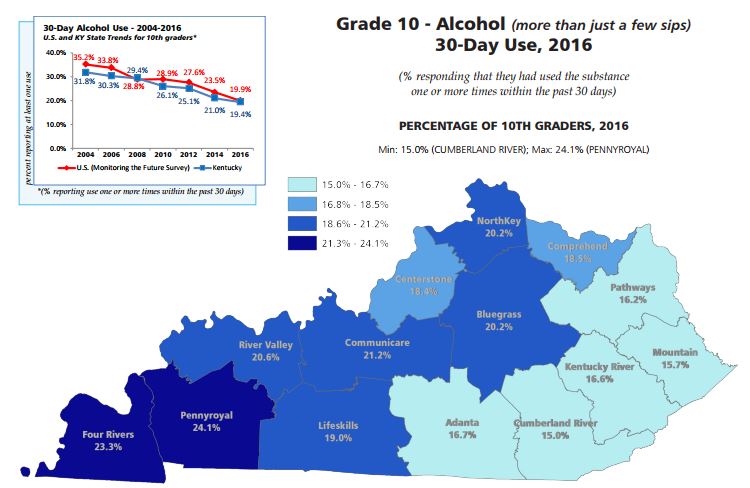
Other good news: Alcohol use among Kentucky sophomores continues to drop, although it continues to be the controlled substance they most often use. In 2016, 19.4 percent reported drinking alcohol in the 30 days prior to the survey, down from 21 percent in 2014.

Alcohol use among 10th graders is higher in Western Kentucky. The Pennyroyal region (Caldwell, Christian, Crittenden, Hopkins, Lyon, Muhlenberg, Todd and  Trigg counties) had the highest rate, 24.1 percent, followed by 23 percent in the Four Rivers region (Ballard, Calloway, Carlisle, Fulton, Graves, Hickman, Livingston, Marshall and McCracken counties).

Those western regions also had the highest rates for binge drinking, defined as drinking five or more drinks in a row at one or more times in the two weeks prior to the survey. In Four Rivers it  was 13.2 percent, in the Pennyroyal 12.4 percent.

Statewide in 2016, the rate for binge drinking was 10.4 percent, down from 12 percent in 2014. The poll found that almost 10 percent of the 10th graders in the 2016 survey had gone to school drunk or high at least one time in the year prior to the survey.

Marijuana use among Kentucky sophomores has been declining since 2010, but pot remains the most widely used illegal substance by this age group. The poll found 11.3 percent said they had used marijuana one or more times within the 30 days prior to the survey. The Pennyroyal region, at 14.7 percent, had the highest rate.

The rate of Kentucky 10th graders who abused prescription drugs (using them without a prescription) 30 days prior to the survey dropped to 2.7 percent in 2016, from 3.6 percent in 2014. The Pennyroyal region, which had the highest rate for this measure in 2016, was almost double this rate at 4.8 percent.

Overall, sophomores' use of heroin, cocaine, methamphetamines and ecstasy dropped slightly from 2014 to 2016. Fewer than 1 percent of the state's 10th graders reported using any of the drugs last year.