Friday, January 21, 2022

Senate floor leader, citing governor's handling of pandemic, says Beshear 'does not know how to govern' and 'hates the legislature'

By Al Cross
Kentucky Health News

Gov. Andy Beshear "does not know how to govern," the majority floor leader of the state Senate said at Kentucky newspapers' annual convention Friday.

"This guy hates the legislature, wants to run the government like a monarchy," Republican Sen. Damon Thayer of Georgetown said of the Democratic governor. "I have very little respect for him."

Sen. Damon Thayer
Thayer spoke at the Kentucky Press Association convention in Jeffersontown, during a discussion of legislative issues with Senate Minority Leader Morgan McGarvey, D-Louisville. The final question from the audience was about the heavily Republican legislature's relationship with Beshear, who was narrowly elected in 2019 and is seeking re-election in 2023.

Thayer began his answer by comparing Beshear to his father, Steve Beshear, who was governor from 2007 to 2015. In those years, Republicans controlled the Senate but not the House.

"He was very good at communicating with us," Thayer said. "I had his cell phone, he had mine; he called me, I called him; he texted me, I texted him; he invited me to his office to talk; he invited me to the governor's office for lunch. None of that has happened with Andy Beshear."

Thayer said the most troubling example was the lack of contact about what to do with the pandemic.

"He never communicated with the leadership of the General Assembly on what he was gonna do, how he was gonna do it, when he was going to do it, until a Zoom call right before the second shutdown, which happened right before Thanksgiving of 2020," Thayer said.
 
He said he asked on that call, "Governor, why have you waited until now to have this meeting to inform us? He said, 'This is why we can't have good communication,' cut off the call, and basically haven't heard from him since, except on the Ford plant incentives, which I co-sponsored . . .

"The man does not know how to govern. He does not know how to be collaborative. There are only two or three people in his inner circle that he talks to on a regular basis, and he does not know how to be governor, unlike his father. The apple has fallen far from the tree."

After the crowd reacted with surprise at Thayer's bluntness, he added, "I have very little respect for him. I think he's an accidental governor, and he's governing like some guy who got 70 percent of the vote when more people voted against him than voted for him, because he won a plurality."

McGarvey, who leads a small minority, joked, "I'm just happy when anybody calls." He said there is "a natural, inherent tension no natter which party's in charge of the legislature and which party's in charge of the governor." He noted the problems Republicans had with Republican Gov. Matt Bevin.
 
"I have kids, and something I say at lot at home is, 'I don't care who started it'," McGarvey said. "When the governor has reached out to the legislature, those efforts have not always been returned."

Thayer acknowledged there is natural legislative-executive tension, which was greater with Bevin, "but this is different, This is different. This guy hates the legislature, wants to run government like a monarch, and that's just not the way it goes."

McGarvey said that soon after Beshear took office, Republicans "attacked" him with legislation to make appointment of future transportation secretaries subject to legislative confirmation, and "I think the governor has reached out a lot more than has been given credit."

Beshear's communications director, Crystal Staley, was asked to comment on Thayer's remarks. She said in an email, "The governor is focused on bringing folks together to build a better Kentucky for our families. He has worked with the General Assembly on everything from broadband expansion and cleaner water and sewer projects to legislation that helped him land the largest economic development project in our commonwealth’s history as well as historical horse racing legislation. Gov. Beshear believes in setting a good example in Frankfort, which means treating everyone, including Senator Thayer, with dignity and respect and not engaging in this type of attack or name-calling."

House sends Senate a budget bill with many provisions dealing with health issues, several with less than Beshear proposed

By Melissa Patrick
Kentucky Health News

The state House of Representatives passed a two-year state budget Thursday that includes a number of provisions for health, including many that were in Gov. Andy Beshear's budget proposal, but with some variations in amounts and sources of money. 

And the House budget has no money for retention and recruitment of nurses, nor the governor's plan to use $400 million in federal relief money to reward "essential workers" who worked throughout the pandemic.

Another difference is that the House budget has 100 new slots, rather than Beshear's 500, for the "Michelle P. waiver" program for people with intellectual or developmental disabilities. Both budgets would add 100 more slots to the Supports for Community Living waiver program for similar beneficiaries. Both programs have thousands of Kentuckians are on their waiting lists. 

The budgets have huge differences in the amounts allocated for domestic-violence shelters, rape crisis centers and child-advocacy centers. Beshear proposed a 36% increase for each type of organization: $2.5 million, $1.78 million and $1.3 million, respectively, in each fiscal year. The House adds $500,000 for each category. 

Another difference is that Beshear wants to fund 350 more social workers while the House budget would pay for an additional 200 . 

The House budget is in House Bill 1, with a committee substitute. It passed out of committee and the full House on the same day, on an 85-8 vote. It is now in the Senate. 

Here are some of the health-related provisions in the House budget. 

From the Tobacco Settlement Fund:
  • $500,000 for the Kentucky Rural Mental Health, Suicide Prevention and Farm Safety Program, titled the "Raising Hope Initiative."
  • $1.4 million in each fiscal year for substance-abuse prevention and treatment for pregnant women with a history of substance-use disorders;
  • $7 million in each fiscal year for the Health Access Nurturing Development Services Program (HANDS) for poor families with young children;
  • $900,000 in each fiscal year for the Healthy Start initiatives;
  • $900,000 in each fiscal year for early childhood mental health;
  • $900,000 in each fiscal year for early childhood oral health; 
  • $2 million in each fiscal year for smoking cessation;
  • $500,000 in the first year and $493,500 in the second year for spinal-cord and head-injury research; and 
  • $6.25 million in each year for cancer research and screening
From the General Fund:
  • $6.25 million in each year for cancer research and screening.
  • $93,700 each for grants to the Brain Injury Association of America, Kentucky Chapter and the Epilepsy Foundation of Kentuckiana to help veterans who have experienced brain trauma;
  • $500,000 for the Kentucky Colon Cancer Screening Program;
  • $100,000 in each fiscal year for The Hope Center of Lexington for addiction recovery;
  • $900,000 each fiscal year for The Healing Place, a Louisville recovery program;
  • $17.68 million in first fiscal year and $19 million in second fiscal year to support the costs of workforce and operation for the local health departments.
  • $12.4 million in the first fiscal year and $17.6 million in the second year to support the establishment of additional mobile crisis units and to implement the new 988 crisis support line, a three digit number set to replace the National Suicide Prevention Lifeline in July 2024. 
  • $7.2 million in the first year and $14.48 million in the second year for expansion of senior citizens' meal programs (Beshear proposed to pays for this with federal relief dollars);
  • $2.5 million in each fiscal year to the Kentucky Pediatric Cancer Research Trust Fund (Beshear's proposal provided $3.75 million in each fiscal year); and
  • $750,000 in each fiscal year for the Kentucky Poison Control Center, unless federal emergency relief funds become available; 
  • $500,000 in each fiscal year for the Ovarian Cancer Screening Outreach Program at the University of Kentucky; and
  • Federal and state monies are allocated for fiscal years 2021 through 2024 to support an additional Medicaid reimbursement of $29 per day per Medicaid patient in nursing homes, which was established because of the pandemic. 
  • Money is provided to support expansion of Tim's Law to additional locations as a way to ensure statewide access. Tim's Law allows judges to order assisted outpatient treatment for people who have been involuntarily hospitalized, aimed at stopping the revolving door of these individuals in and out of jails and state psychiatric hospitals.

Thursday, January 20, 2022

Pandemic keeps growing in Ky., but Beshear sees a peak in 10-14 days; Harlan County ball games called 'super-spreader events'

The governor used this graph to show that very few fully vaccinated Kentuckians under 60 have died of Covid-19 since the Omicron variant began raising numbers in July. (Screenshot; click to enlarge) 
By Al Cross
Kentucky Health News

Kentucky reported its second-highest daily number of new coronavirus cases Thursday, raising the seven-day rolling average to a new record. The percentage of Kentuckians testing positive for the virus also set a record.

The state reported 13,614 new cases, boosting the seven-day average by 620, or 5.8%, to 11,385, 241% higher than three weeks ago. Cases among Kentuckians 18 and younger remained high; they were 26.5% of the total.

The positive-test rate for the last seven days is 31.37%, nearly double what it was three weeks ago.

“Omicron is continuing to spread at a rapid rate,” said Gov. Andy Beshear, referring to the dominant variant of the virus. “We expect this week to probably be our highest week ever,” presumably meaning the number of new cases.

“We think we are a week and a half to two weeks to seeing the peak of Omicron. Please protect yourself, and know it’s gonna be a couple of weeks where there’s still a whole lot after that, even if the numbers are going down.”

Beshear also noted the rising number of hospital patients with Covid-19,which he said should be “of great concern” to everyone because they might not be able to get the medical care they need when they need it.

Kentucky hospitals reported 2,298 Covid-19 patients, 42 more than Wednesday, with 434 of them in intensive care (down 21) and 271 on mechanical ventilation (up 19). Nine of the 10 hospital regions reported more than 80% of intensive-care beds in use, with four above 90%. Northern Kentucky was at 100%.

“We are getting close to the levels of Delta hospitalization, when we were overrun,” Beshear said. “We are struggling in that hospital capacity, and we need everybody’s help.” At the peak of last summer's surge caused by the Delta variant, on Sept. 10, hospitals had 2,541 Covid-19 patients.

Beshear said the way to stay out of the hospital, or dying of Covid-19, is to get vaccinated and get a booster shot.

“People boosted have an incredibly low chance of going to the hospital,” he said, adding that deaths since Omicron arrived are almost entirely among unvaccinated people. “Almost everyone under 60 who has passed away from Covid has been unvaccinated, he said. “If you are under 60, this is the challenge to surviving this pandemic.”

The state attributed 20 more deaths to Covid-19 Thursday, raising Kentucky's pandemic death toll to 12,659.

The governor also promoted testing, now available with free, at-home tests that can be ordered from the covidtests.gov website.

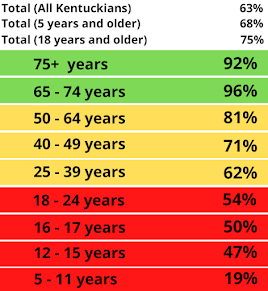
State table shows percentages of age groups
with at least one dose of a Covid-19 vaccine.
He said you need a test “if you have symptoms, or within five days after coming into close contact with someone who has Covid, or if you are going to gather with a group,” especially one with vulnerable people.

“Testing is one step, and only one step, to protect yourself,” he said. “The best step: getting vaccinated ad boosted; wearing a well-fitted mask when gathering indoors; and continuing to wash your hands often and practice social distancing.”

Beshear said at least 1,000 Kentuckians a day are getting newly vaccinated, but “5-to-11-year-olds [are] still way too low.” Only 19% of that age group have received even one dose of a vaccine.

In other pandemic news:
  • The Harlan County Health Department said Wednesday afternoon that it was “overwhelmed” with more than 200 coronavirus cases that had not yet been reported publicly and “pointed to recent basketball games as the source,” calling them “super-spreader events,” reports Bill Estep of the Lexington Herald-Leader. “County Judge-Executive Dan Mosley said the health department didn’t have enough staff to quickly contact everyone who tested positive after the ball games, so wanted to alert people to monitor for Covid symptoms and get tested."
  • Fourth District U.S. Rep. Thomas Massie, a "frequent critic of Covid-19 mitigation efforts," has tested positive for the virus, reports the Herald-Leader's Austin Horn. "Massie announced his positive test on Twitter this Thursday, saying he had 'cold/allergy symptoms' for a day but seems to be 'over it' now. Massie shared that he has not been vaccinated against the virus at all, but guessed that his symptoms were mild due to a previous infection two years ago." Massie wrote, “Seek doctors advice if you find yourself sick, because every case is unique and some cases are very serious. I will not be voting, meeting in person, or making public appearances until next week. I am not vaccinated or boosted. If trolls or media have other questions about my health status, the answer is most likely, ‘NUNYA’,” presumably meaning "none of your business."
  • Lexington Mayor Linda Gorton said she and her husband had tested positive and were having mild symptoms, after having been fully vaccinated and boosted. "Gorton, a registered nurse, also wears masks in public settings," reports the Herald-Leader's Beth Musgrave.
  • About 50 students, campus workers and faculty members "entered a University of Louisville Board of Trustees meeting Thursday to deliver a petition to school leaders . . . demanding stricter safety precautions against Covid-19 and flexibility for remote work," reports Billy Kobin of the Courier Journal. One student was allowed to speak early in the meeting.

CBO report issues report Yarmuth requested on health-care costs; he says Congress must do more to ease the burden

Yarmuth (WBKO image)
The Congressional Budget Office has issued a report requested by Democratic Rep. John Yarmuth of Louisville on the major drivers of increases in health-care spending and the variation in health-care prices and costs. It is stull working on a study Yarmuth sought of mechanisms to hold down growth in spending.

The report, “The Prices That Commercial Health Insurers and Medicare Pay for Hospitals’ and Physicians’ Services,” examines potential reasons that the prices paid by commercial health insurers for hospitals’ and physicians’ services are higher, rise more quickly, and vary more by area than the prices paid by the Medicare fee-for-service program, Yarmuth's office said in a press release.

Yarmuth said in the release, “We know that our country and our economy are stronger when every American has access to quality, affordable health care. But CBO’s report finds that inefficiencies in our health-care system and market consolidation are driving up prices, forcing Americans to either forgo necessary coverage or face higher premiums and out-of-pocket costs, reduced benefits, or lower wages. Congress must do more to reduce this unacceptable burden on American families.”

Earlier, the CBO issued Yarmuth-requested reports on "Policies to Achieve Near-Universal Health Insurance Coverage" and "Key Design Considerations for Establishing a Single-Payer Health Care System."

Beshear sees 'major outbreak' of Covid-19 among legislators, says more need to mask up; House speaker disputes him

Two of the nine in-person legislators visible in this screenshot of the House Appropriations and Revenue Committee Thursday were wearing masks. At least one member participated remotely. (KET)
By Al Cross
Kentucky Health News

Saying he believes the General Assembly is having "a major outbreak" of coronavirus cases, Gov. Andy Beshear said Thursday that legislators need to take more preventive precautions.

“I think everybody should be wearing a mask,” Beshear said when asked at a press conference if lawmakers should do more. “I think a ton of legislators have had Covid in the last week or so, based on the numbers of folks that are voting remotely, based on them having to take a day off from the General Assembly because so many people had Covid.

“I mean, dear Lord, put on mask if you know a bunch of people around you have Covid. It’s just basic protections. We don’t have to be tougher than the person next to us. Nobody is watching us to see how scared or not scared that we are. This isn’t some test of masculinity. I mean, it is a virus; wear a mask. It protects you, but hey, if you’ve got it and even if you don’t know it, you wanna spread it to the person next to you that might have a terrible reaction to it? It’d be terrible to be in the legislature and to lose a seatmate to your right or to your left.”

Beshear noted that he has made testing available to everyone in the Capitol. “If they’re unwilling to wear a mask, at least get tested every day so you know that you’re not potentially exposing people around you,” he said. “But remember, if the person next to you hasn’t been tested, you need to wear a mask to make sure you have all of that protection.”

Noting that his Executive Branch is masked up, the Democratic governor said, “We have not had major outbreak that I think they’re seeing on the legislative side. That’s because masks work.”

House Speaker David Osborne told Kentucky Health News, “While we do not comment on the private health status of individual legislators, I would caution the governor and anyone else who makes an assumption based on the use of remote voting and a change in our legislative schedule. Assumptions are dangerous and contribute nothing.

“In fact, the decision to change the legislative calendar was made when we decided to meet on Saturday, Jan. 8 but was contingent on the governor presenting his budget recommendations. Let me also stress that we have used remote learning and other methods since the beginning of the pandemic and will continue to do so at our discretion.”

Many state legislatures are taking a more relaxed attitude, reports Sean Scully of States Newsroom: "In many states you’d hardly know that we were entering the third year of a pandemic."

Wednesday, January 19, 2022

Low Covid-19 vaccination rates are associated with high death rates; map shows your county's rate of deaths from Covid-19

Graph by University of Kentucky College of Public Health has one dot for each Kentucky county, except the six counties that have had fewer than 20 deaths, which were omitted for statistical stability.

By Al Cross
Kentucky Health News

If you live in a Kentucky county where a low percentage of the population has been fully vaccinated for Covid-19, more of your neighbors are likely to have died from the disease. And if you live in a county with a high full-vaccination rate, it is likely to have a low death rate.

That is proven by a comparison of Kentucky counties' Covid-19 death and vaccination rates as compiled by the state Department for Public Health. The department provided the previously unreleased death rates, as of Jan. 11, to Kentucky Health News at its request.

The statistics were compared by the College of Public Health at the University of Kentucky. Donna Arnett, dean of the college, said the comparison showed that "non-vaccination rates were statistically associated (at the county level) with increasing death rates," and that the association was significant.

The correlation is moderate, not strong, said Bruce Maples of the online publication Forward Kentucky, who has previously performed research and statistical analysis for Kentucky Health News. He found a slightly lower, but still moderate, correlation with partial vaccination rates.

Many factors enter into death rates, including the extent of other preventive measures such as mask wearing and social distancing, the effectiveness of local health agencies, the underlying health status of the population and the presence of nursing homes that have had deadly Covid-19 outbreaks.

Most Kentucky counties with low death rates are in the state's metropolitan areas, which have high health status; and most with high rates are rural, but there are exceptions.

For example, tiny Gallatin County is part of the Cincinnati metro area but has one of the highest death rates, 496 per 100,000 residents. (It has had 44 Covid-19 deaths and its 2020 census population was 8,690.) But it has low vaccination rates, 43% with one dose and 40% fully vaccinated.

Perry County, in southeastern Kentucky, has one of the state's higher vaccination rates but also one of the higher death rates, 520 per 100,000 residents. (It has had 138 Covid-19 deaths and its 2020 census population is 28,473. Its county seat is Hazard.)

Only three counties in the East Kentucky Coalfield – Elliott, Morgan and Wolfe – have full-vaccination rates in the top one-fifth of the state.

Spencer County, part of the Louisville metro area, has the lowest vaccination rate reported by the state, 33%, but one of the lower death rates. Local officials have questioned the state's data gathering and methodology, saying that many Spencer County vaccinations are credited to adjoining counties.

Generally, though, urban counties tend to have high vaccination rates and low death rates, and rural counties tend to have higher death rates and lower vaccination rates.

The biggest cluster of counties with high death rates is in Southern Kentucky. It includes Monroe County, which has the state's second-highest death rate, 648 per 100,000. Other counties in the cluster are Barren, Hart, Metcalfe and Adair.

The county with the highest death rate, Robertson, also has Kentucky's smallest population, 2,108, so its rate can be significantly affected by a small number of deaths. The county has had 19 deaths attributed to Covid-19, according to the state health department's latest daily report.

Kentucky Health News map, from Jan. 11 state Department for Public Health data; click it to enlarge.
For clarity, rates above 415 deaths per 100,000 residents are rounded to the nearest whole number.
The state average is in the second-lowest group due to many small counties having high death rates. 

Positive-test rate, 7-day new-case average set new records in Kentucky; more than one-fourth of new cases are in children

Ky. Health News graph; cases are from initial, unadjusted state reports. (Click on it to enlarge.)
Kentucky Health News graph; click to enlarge.
By Melissa Patrick
Kentucky Health News

The Omicron variant continues to rage through Kentucky, with nearly one in three Kentuckians testing positive for the coronavirus and 26 percent of Wednesday's new cases among those 18 and younger. 

The share of Kentuckians testing positive for the virus in the past seven days rose about half a percentage point Wednesday to 30.77%, a new record.

Kentucky reported 12,583 new cases of the coronavirus, the third most on a single day. That raised the seven-day rolling average by nearly 200 daily cases to another record, 10,765. It's 88% higher than it was 14 days ago.

More than a fourth of new cases, 3,320 (26.4%), were in Kentuckians 18 and younger.

As cases among Kentucky's children increase, there's still a lot of opportunity to get more of them vaccinated. Only 50% of 16- and 17-year-olds, 47% of those 12 to 15, and 19% of those 5 to 11 have received at least one dose of a Covid-19 vaccine. And research shows that immunity against Omicron requires three doses, including a booster shot, of the Pfizer or Moderna vaccines.

The latest American Academy of Pediatrics weekly Covid-19 report says that Covid-19 cases among children have "spiked dramatically" across the United States, with nearly 1 million cases reported in the week ended Jan. 13, four times the rate of the peak of last winter's surge.

"This number is a 69% increase over the 580,000 added cases reported the week ending January 6th and a tripling of case counts from the two weeks prior," says the report.

Recent guidelines from the Centers for Disease Control and Prevention, updated Jan. 13, say "high risk sports and activities" should be canceled or held virtually in areas with high levels of coronavirus transmission "unless all participants are fully vaccinated." High-risk activities include sports that require close contact as well as those that involve "increased exhalation," like singing, shouting, band or vigorous exercise, especially when conducted indoors.

Bu far, every county in Kentucky has a high level of virus transmission, defined as more than 25 cases per 100,000 residents. The statewide infection rate is 217.3 daily cases per 100,000. Five counties are above 300 cases per 100,000: Carroll, 392.4; Warren, 324.7; Henderson, 317.2; Fayette, 306.2; and Simpson, 302.3.

The New York Times ranks Kentucky's statewide rate 18th among the states, a jump of 26 slots from Tuesday, when it ranked 44th.

Kentucky hospitals reported 2,256 Covid-19 patients Wednesday, 56 more than Tuesday. Of those, 455 were in intensive care, up 24; and 252 were on mechanical ventilation, up 8. 

Nine of the state's 10 hospital readiness regions continue to use at least 80% of their intensive-care beds, with five of them above 90% and Northern Kentucky at 100%.

The state attributed 25 more deaths to Covid-19, bringing Kentucky's pandemic death toll to 12, 639.

Tuesday, January 18, 2022

Omicron keeps setting records; tests are over 30% positive, not counting home tests; hospitals adopt crisis standards for staffing

Ky. Dept. for Public Health graph, adapted by Ky. Health News; to enlarge, click on it.
By Melissa Patrick
Kentucky Health News

As the Omicron variant of the coronavirus continued to set new records in Kentucky and Covid-19 hospitalizations accelerated, some hospitals moved into what is called "crisis standards for staffing."  

Kentucky reached a new high for the number of Covid-19 cases reported in a Monday-to-Sunday reporting week, 72,165. That's more than double the records set during the Delta surge, said Gov. Andy Beshear.

On Saturday, the state reported 14,896 reported new cases, a record for one day. More than 1 million Kentuckians (1,014,703) have now had a confirmed case. Of today's 8,742 new cases, 27.8% were in people 18 and younger.

Another record: the share of Kentuckians testing positive for the virus in the past seven days hit yet another, 30.25%. "We never dreamed that almost one out of every three people being tested would be positive," Beshear said. 

Those numbers do not include any at-home tests, and the case numbers do not indicate any positive test results, which may not be accompanied by symptoms.

The state's daily report was the first since Friday, due to the Martin Luther King holiday. The seven-day rolling average of new cases surged to a record 10,673 on Monday but dropped slightly Tuesday, to 10,572.

The statewide daily incidence rate is 213 cases per 100,000 residents. The rate in 41 of the state's 120 counties is above 200 cases per 100,000, and every county has more than 25 cases per 100,000, considered a high level of transmission, putting all of them in red on the state infection map. 

Despite the big increases, most other states are in worse shape. The New York Times ranks Kentucky's rate 44th among the states, with a 47% increase in cases in the last 14 days. 

Dept. for Public Health graph, adapted by Ky. Health News
But hospital numbers continue to go up, causing some to instigate "crisis standards for staffing," which give them to have latitude for bringing staff back from quarantine or isolation. State Health Commissioner Steven Stack said more than 450 National Guard members continue to support the state's health-care facilities. 

"It is a tough time to work in a hospital," Stack, an emergency-room physician by trade, said as he thanked them for their service.

Hospitals reported 2,200 Covid-19 patients on Tuesday; 431 of them in intensive care and 244 on mechanical ventilation.

Recently, public-health experts in major cities have noted that many patients with Covid-19 were admitted with other conditions but were identified as such after they tested positive for the virus, Beshear said hospitals are not breaking down those patients into different categories. 

Asked about the U.S. Supreme Court's decision that allows the federal government to require vaccination of employees at health-care facilities that get federal money, Beshear said he expects very few workers in such facilities to refuse vaccination, so it should not have any significant impact on their workforces. 

Nine of the state's 10 hospital regions are using at least 80% of their intensive care beds, and five of them are above 90%. Northern Kentucky is at 100%. 

With hospital capacity so stretched across the state, Beshear again encouraged Kentuckians to get vaccinated. "Get vaccinated, get boosted and you're very unlikely to end up in the hospital for Omicron," he said. 

Three-fourths of of Kentuckians 18 and older have received at least one dose of a vaccine, but health experts say three doses of the Pfizer of Moderna vaccines, including a booster shot, are needed for Omicron immunity.

Both the percentage of adults and children 5-11 who have been vaccinated increased by one percentage point recently, but only 19% of those children have had a shot, With schools reopening, Beshear said, "We have to do better." 

So far, 2.8 million Kentuckians have gotten at least one dose of a Covid-19 vaccine, or 63% of the total population; 2.4 million are fully vaccinated, or 55% of the total. Among the fully vaccinated population, 959,754, or 39%, have been received a booster shot.

In yet another push for shots as a way to stay out of the hospital or to have less severe symptoms,  Beshear said, "If you are unvaccinated, it hits you like a Mack truck and we see people in the hospital and dying from Omicron because of that failure to get vaccinated."

Addressing unvaccinated people who think they can get monoclonal-antibody treatment or an anti-viral pill if they get sick, Stack said there is not enough of the anti-viral medications available to meet demand. 

"The bottom line is that you can't rely on finding these medications reliably, no matter how we distribute them, and this won't change before the Omicron surge recedes," Stack said. "Vaccines though remain abundant and are highly effective in preventing severe and life-threatening disease." 

Stack noted President Biden’s plan to make 1 billion at-home tests directly available to the public. You may order four at-home tests per household at COVIDtests.gov.

Besehar said 294 state prison staff and 392 inmates have tested positive in the current outbreak but no inmates have been hospitalized. He said the Eastern Kentucky Correctional Complex, the Kentucky State Reformatory and the Kentucky Correctional Institution for Women have been quarantined and 85% of all inmates have been vaccinated, with 55% of them boosted. 

Beshear also listed state veterans' centers with cases: one at the Eastern Kentucky Veteran Center, one at Radcliff Veterans Center; two at Thompson-Hood Veterans Center in Wilmore; and five cases at Western Kentucky Veterans Center. 

Beshear said he had not heard of any outbreaks in Kentucky nursing homes. 

The state has reported 131 more Covid-19 deaths since Friday, with one of the deaths a 28-year-old, three of them in their 30s, and 10 of them in their 40s. The pandemic death toll in Kentucky is 12,614. 

"If you are in your 40s, this thing is killing you right now," said Beshear. "Please get vaccinated."

Sunday, January 16, 2022

13% more Kentuckians used prescription drugs for mental health in October than in January, as the pandemic added to stresses

Quote Wizard map, adapted by Ky. Health News, shows increases in adjoining states and Southeast.
By Melissa Patrick
Kentucky Health News

Kentucky is one of 28 states that saw an increase of more than 10 percent in the number of adults taking prescription mental-health medications last year, which is largely attributed to the prolonged impact of the pandemic, according to an analysis of Centers for Disease Control and Prevention data. 

"Covid-19 hasn’t just affected people’s physical health. The pandemic has also had a profound and prolonged impact on people’s mental health. Over the last year, more and more people have reached out for help dealing with stress, anxiety or depression," says the report from Quote Wizard, based on Pulse survey data from the Centers for Disease Control and Prevention from January 2021 to Oct. 15, 2021.

The figures show that 29% of Kentucky adults are taking prescription mental-health medications. That amounts to about 1 million people, 13% more than in January 2021.

Kentucky's rate of increase was less than the national increase of 20%, but the percentage of Kentucky adults taking prescription mental-health drugs remains above the national rate of 24%.  

Sheila Schuster, a psychologist and executive director of the Kentucky Mental Health Coalition, said she was "delighted" to see more Kentuckians seeking mental-health care, especially during the pandemic, when every age group is struggling with issues that exacerbate anxiety and depression. 

"I think Covid has had potentially devastating effects on the mental health of all ages in Kentucky," Schuster said. "So I'm delighted actually to see that there has been an increase in contact with mental-health providers. . . . You know, we really want people to reach out, to get some help before things get into a state of multiple, serious mental-health concerns."  

Schuster pointed out some challenges brought on by the pandemic: feelings of not being in control, economic uncertainty, social isolation, remote learning challenges, a shutdown of peer-support services for people with substance-use disorder, and an uptick in domestic violence. Add to that, she said, the racial tension sparked by the Breonna Taylor case in Louisville and the natural disasters that have plagued several other parts of Kentucky. 

"Some people are really dealing with what must feel to them like an unbearable amount of stress and grief and loss compounded with this anxiety and depression so, you know, our message has been over and over to reach out for help," she said. 

What is often most effective, particularly for more serious stages of depression or anxiety, Schuster said, is a combination of talk therapy with some medication. To that end, she said the Kentucky Mental Health Coalition, Mental Health America Kentucky and the Kentucky Psychological Association have been writing op-eds and holding public forums to alert people that what they are feeling is not unusual and to encourage them to reach out for some additional help if they need it. 

"I think actually we're going to be seeing the aftermath of Covid for the next four or five years," she said.  

MHA Kentucky Executive Director Marcie Timmerman said MHA has seen a significant increase of interest in mental health and wellness during the pandemic, noting a 265% increase in voluntary mental-health screenings from 2019 to 2021, with 4,770 screenings in 2019 and 17,419 in 2021.

"It makes sense to me, with the increase in talking about mental health that has accompanied Covid-19, that we see an increase in forms of treatment like medications," Timmerman said. 

MHA ranked Kentucky 23rd for prevalence of mental-health illness in 2021, based on six mental-health measures that included both youth and adults. 

Timmerman encouraged Kentuckians to keep talking to their health-care providers about their mental health, and reminded providers to remember "that prescriptions are most effective when paired with therapy."

Schuster added that other than your family doctor, ministers, friends who use mental health care, professional mental-health organizations, like MHA, and community mental-health centers, which serve every Kentucky county, are also good resources to help you find mental health care providers in your area. 

The report notes that most insurance plans cover some form of mental-health care, including Medicare and all Affordable Care Act plans. 

Feds say Covid-19 home tests will ship directly to users starting Wed., same day they plan to put online the website to order them

The Biden administration says it will begin mailing Covid-19 tests directly to Americans on Wednesday, Jan. 19. That's also the same day it plans to put online the U.S. Postal Service website where they can order the tests.

Administration officials "did not state a specific time on Wednesday when orders could begin," Kelly Lienhard of Inside Health Policy reports. "The officials said the government currently has over 420 million tests under contract and they are confident the government will be able to procure the remaining 80 million by Wednesday." The estimated cost is $4 billion.

The tests are rapid at-home tests that have been granted emergency-use authorization by the Food and Drug Administration. Federal studies "have confirmed the tests can detect the Omicron variant," Lienhard reports.

"Americans can expect to receive the tests within seven to 12 days of placing an order through the website. The government is working with USPS to ship the tests for free to all 50 states and U.S. territories through priority mail. Administration officials said they projected the timing based on typical shipment times, but they anticipate it will be quicker as the program matures."

Orders will be limited to four tests. "Administration officials stressed that the Covid-19 test mailing initiative is only part of its testing strategy and added that there are myriad other ways to be screened for the virus, including through pharmacies and community health centers," Lienhard reports.

President Biden announced Thursday that he had directed the government to procure 500 million more tests. Republican Maryland Gov. Larry Hogan said on CBS's "Face the Nation" Sunday that the federal government was "hijacking" supplies of tests that had been ordered by Maryland and other states.

The world will probably wind up living with the coronavirus, but that approach poses risks, some medical experts warn

"Nations around the planet are making a subtle but consequential pivot in their war against the coronavirus: Crushing the virus is no longer the strategy," reports Joel Achenbach of The Washington Post. "The phrase often heard now in the United States and many other nations is “live with the virus.” That new stance is applauded by some officials and scientists, and welcomed by people exhausted with the hardships and disruptions of this global health emergency entering its third year.

"But there are also disease experts who fear the pendulum will swing too far the other way. They worry that many world leaders are gambling on a relatively benign outcome from this omicron variant surge, and sending messages that will lead people who are normally prudent to abandon the social distancing and mask-wearing known to limit the pathogen’s spread. Epidemiologists say the live-with-it strategy underestimates the dangers posed by omicron."

The consensus among experts is that "Omicron is essentially unstoppable but of limited threat to individuals even as it causes societal chaos," Achenbach reports. "Ali Mokdad, an epidemiologist at the University of Washington’s Institute for Health Metrics and Evaluation, said he believes that about half of the U.S. population will be infected with omicron during the next three months, with most cases asymptomatic." But it will keep sickening and killing people.

The coronavirus has killed more than 5.5 million people, including 850,000 Americans and 13,500 Kentuckians, but the virus and the Covid-19 disease it causes "are now so familiar, they have lost some of their early spookiness," Achenbach writes. "Many nations continue to impose mask requirements, vaccination mandates and travel restrictions, but few leaders in democratic societies have the political capital to take harsh measures to suppress transmission."

So, in the absence of further prevention, what can we expect?  "In the ideal scenario, omicron’s alarming wave of infections will spike quickly, leaving behind a residue of immunity that will keep a broad swath of the population less vulnerable to future infections," Achenbach writes. "This would be the last major, globally disruptive wave of the pandemic. The virus would still be around but would no longer be in a special category apart from other routinely circulating and typically nonfatal viruses such as influenza."

But ideal scenarios often involve wishful thinking. Scientists don’t know how long immunity from having omicron will lasts, and "The virus keeps mutating," Achenbach notes. "Slippery variants packing a more powerful punch could yet emerge, and virologists say that, contrary to what has sometimes been conjectured, viruses do not inexorably evolve toward milder strains."

Some of the doctors "who advised President Biden during the presidential transition have urged a reset of the strategy to recognize the 'new normal' of the virus, which has little chance of being eradicated and will probably continue to cause typically mild illness and require vaccination boosters at a frequency yet to be determined," Achenbach reports.

But others say that approach has risks. James Lawler, co-director of the University of Nebraska’s Global Center for Health Security, told Achenbach, “If we just completely let everything go and allow the omicron epidemic to run its natural course, we’ll completely overrun our health system and be left in a situation potentially worse than what we experienced in early 2020.”

Lawler worries about the lack of precautions among the public. "Earlier this week, he went to a grocery store and was virtually alone in wearing a mask," Achenbach reports. "That’s the norm, he said, in Omaha." Lawler said, “We should have learned by now the only way to get high levels of compliance like this is to make it mandatory. That’s what happened with seat belts.”

Around the world, Achenbach writes, "There is fatalism mixing with pandemic fatigue and, in some countries, science denial or ideological rejection of the restrictions and mandates that many public-health experts consider to be common sense measures in a pandemic. And anecdotally, people may rationally feel the battle is lost, the virus has won.

"Public health officials warn that this is a dangerous attitude. It’s true that for an individual, risk might be low. But when a virus spreads as quickly as omicron does, the equation suddenly spits out alarming results — millions of people sick at once, many of them with underlying conditions that have already put them on the edge of a cliff and vulnerable to a shove."

Saturday, January 15, 2022

Flu cases in Kentucky remain steady, but cases are increasing in most counties; season runs through May, so shots still help

U.S. Department for Health and Human Services
By Melissa Patrick
Kentucky Health News

For the second week in a row, state data shows flu cases are increasing in most Kentucky counties, but the weekly number of new, lab-confirmed influenza cases in Kentucky remained below 300.

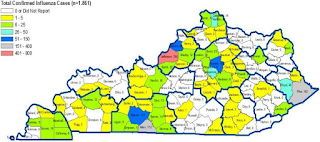
The latest weekly report from the state Department for Public Health shows that in the week ended Jan. 1, Kentucky counted 258 new flu cases. The state has recorded 1,861 cases this season and not reported any flu-related deaths. 

Most lab-confirmed flu cases continue to be in people between 1 and 30, with the highest rate among those 11 to 20. 

Health officials continue to encourage everyone six months and older to get a flu shot, because it's the best defense in fighting the flu. 

It's also important to  remember that it takes about two weeks after vaccination for antibodies to develop in the body to provide protection against the flu virus, which is why it's important to get vaccinated before the virus starts to spread in your community. 

A 2021 National Foundation for Infectious Diseases survey, of 1,126 adults last August found that the top reason they cited for not getting a flu shot was that they thought it doesn't work very well. 

Effectiveness of the flu vaccine varies from year to year depending on whether the circulating strain of the virus is a good "good match" with the composition of the flu vaccine, but the Centers for Disease Control and Prevention says it's still important to a shot each year because it prevents millions of illnesses and studies show it reduces severity of illness and reduces the risk of being hospitalized. 

Survey respondents also said they would not get a flu shot because they never get the flu; had concerns about side effects; did not think the flu caused serious illness; and worried about getting flu from the vaccine. 

"A flu vaccine cannot cause flu illness," says the CDC. That's because the vaccines are either made with an inactivated, non-infectious virus or with proteins from a flu virus.

Side effects from a flu vaccine are usually mild and short, and include soreness or redness at the injection site, mild headache, fever, muscle aches, nausea and fatigue. 

Influenza is worse. It may cause bad cold-like symptoms, like sore throat, runny nose, sneezing, hoarseness, and cough. But it can also lead to more serious illness and even death. 

State Department for Public Health map; click to enlarge
The CDC's 2021-22 preliminary in-season flu burden estimates, which run from Oct. 1 through Jan. 8, show that the U.S. has had between 16,000 and 33,000 flu hospitalizations and between 970 and 2,900 flu deaths.

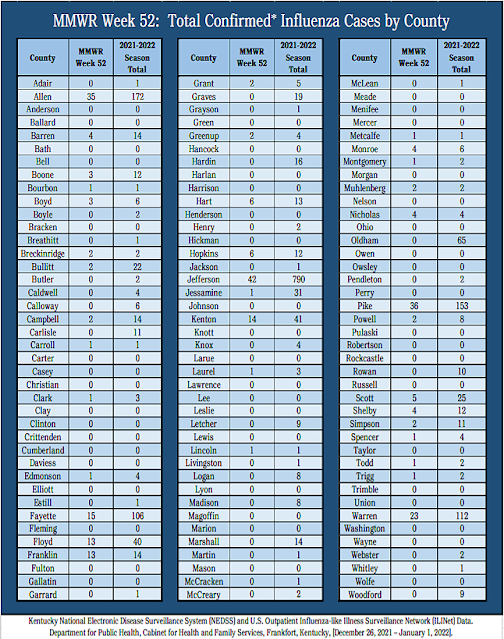
Jefferson County, Kentucky's most populous, typically has the most new cases each week. It reported 42 in the week ended Jan. 1. Other counties with significant numbers of cases that week were Pike, 36; Allen, 35; Warren, 23; Fayette, 15; Kenton, 14; Floyd, 13; and Franklin, 13. 

The flu is considered to be widespread in Kentucky, a classification that is applied when increases in flu cases have been confirmed in at least half of the state's 16 regions. In the week ended Jan. 1, the flu had been detected in 12 of the state's 16 regions. Flu season runs through May.
State table via Morbidity and Mortality Weekly Report from the CDC