Wednesday, December 7, 2022

E-cigarette maker Juul Labs to pay Kentucky $14 million and stop marketing to youth in order to settle lawsuit by 34 states

Juul products (Photo by Bill O'Leary, The Washington Post)
Juul Labs
, once the leading manufacturer of electronic cigarettes, will pay Kentucky and 33 other states $435 million to settle a lawsuit by their attorneys general alleging deceptive marketing and sales practices by the company.

Kentucky will get $14 million from the settlement, with the first payment of $1.3 million due by Dec. 31, Attorney General Daniel Cameron announced Wednesday. He said Juul has also agreed “to cease    marketing their products to underage youth” and depicting anyone under 35 in marketing materials.

The agreement also bans Juul from selling flavored products not approved by the Food and Drug Administration, making misleading statements about its products' nicotine content, and
allowing website access without age verification on the landing page.

Other states in the case were Alabama, Arkansas, Connecticut, Delaware, Georgia, Hawaii, Idaho, Indiana, Kansas, Maryland, Maine, Mississippi, Missouri, Montana, North Dakota, Nebraska, New Hampshire, New Jersey, Nevada, Ohio, Oklahoma, Oregon, Puerto Rico, Rhode Island, South Carolina, South Dakota, Tennessee, Texas, Utah, Virginia, Vermont, Wisconsin, and Wyoming.

Tuesday, December 6, 2022

Epidemiologist says the dreaded triple-demic is here, with RSV, flu and Covid-19 cases all rising together

Centers for Disease Control and Prevention map

With national rates of influenza, Covid-19 and respiratory syncytial virus rising together, the "dreaded and much anticipated triple-demic is finally here," epidemiologist Katelyn Jetelina writes in her newsletter, Your Local Epidemiologist. 

RSV is a common virus that usually causes mild, cold-like symptoms. And while most people recover in a week or two, it can be serious for infants and older adults.

The weekly Centers for Disease Control and Prevention influenza-like illness (ILI) surveillance, which includes a tally of patients that go to the doctor with a fever and a cough and/or a sore throat is a general indication of the climate of respiratory health in the United States. The report does not include laboratory-confirmed flu cases. 

The ILI map for the week ending Nov. 26 shows that every state but four have a high or a very high ILI activity level. The CDC puts Kentucky's ILI activity level among the very highest. 

Jetelina writes of the national map, "This level is truly unprecedented; we’ve never seen such high levels of ILI activity at this time of year."

Hospitalizations for respiratory illness are also on the rise. CDC Director Rochelle Walensky said Monday, “Hospitalizations are the highest now than they have been in the past decade.” 

In Kentucky, Covid-19 hospitalizations increased for the second week in a row, taking a big jump in this week's Covid-19 report. Hospitals reported 383 Covid-19 patients Monday morning, an increase of 102 over the prior Monday. That same report showed that nearly 80% of the state's inpatient beds and 81% of its intensive-care beds were occupied. 

Jetelina points out that while ILI surveillance offers an overall view of respiratory illness in the U.S, surveillance for specific diseases also exist, but is imperfect. 

RSV: CDC data shows that RSV continues to rise, although we may be seeing the first signs of peaking on a national level, Jetelina reports. She adds that this is expected given that the positivity rate for RSV tests have already clearly peaked. 

Flu: "Flu cases are increasing and increasing fast," Jetelina writes. She notes that flu hospitalizations are lagged, but increasing. "We expect hospitalizations to continue to rise in weeks to come," she writes. 

Kentucky's latest flu report shows that flu activity in Kentucky continues to rise. In the week ending Nov. 26, the state confirmed 6,378 cases of the flu, up from 3,470 the prior week. So far, the total number of confirmed cases during this flu season is 15,909. 

As Inside Medicine reported, for the first time during the pandemic, flu hospitalizations overtook Covid-19 hospitalizations last week. "This may be a one-off occurrence since Covid-19 hospitalizations are increasing now, too, but it is noteworthy," she writes. 

Jetelina adds that epidemiologist are hopeful that the U.S. flu season will follow what has happened in the Southern Hemisphere (Australia specifically) where there has been a high number of flu cases but a moderate level of hospitalizations. 

Covid-19: "Covid-19 is on the rise across the globe due to the combination of seasonal changes, behaviors changes, and the variant soup. In the U.S., all signs point to the beginning of a wave. For example, SARS-CoV-2 in wastewater is rapidly increasing across all regions," she writes. 

In Kentucky, the state Department for Public Health reported 5,751 new coronavirus cases last week, or an average of 821 per day. That's a nearly 49% jump over the week before, when the state reported 3,866 new cases. But that number that was 43% lower than the week before, indicating that Kentucky continues to be on a rough plateau. 

"One major concern is the rapid rise in hospitalizations among older adults, which has exponentially increased 28% in the past two weeks," Jetelina writes. "This is partly (or wholly) due to abysmal vaccination rates—only 1 in 3 adults over the age of 65+ have their fall Covid-19 booster. A public health failure. Without a recent booster, many people are technically vaccinated but not protected." 

Bottom line, she concludes, "This viral season is like no other. . . .  I’m especially concerned for hospital systems, kids under 5, and adults over the age of 65, as they are at highest risk." 

She adds, "There’s a lot we can do: mask, test before seeing loved ones, get that airflow moving, stay home when you’re sick. The least you can do for a healthy season is get a flu and fall Covid-19 booster. If you haven’t gotten one yet, it’s never too late." 

Jetelina is a California epidemiologist and biostatistician who says she writes the newsletter on Substack as a way to translate public-health science for everyday use, helping people to make evidence-based decisions. She is also a consultant to a number of organizations, including the CDC.

Monday, December 5, 2022

Covid-19 hospitalizations, positivity rate and new coronavirus cases jumped up last week, while death rate went down

New York Times chart, adapted by Kentucky Health News; for original version, click here.

By Melissa Patrick

Kentucky Health News

While Covid-19 hospitalizations and cases in Kentucky took a big jump last week, the number of Kentuckians who died from the virus in that seven-day period dropped 37 percent. 

After reporting an average of 45 people dying each week in the last four weekly reports, the state reported on Monday that that number had dropped to 28 last week, a trend that is being seen across the nation. Kentucky's pandemic death is 17,530. The New York Times reports that the average number of deaths across the nation has fallen by 7% in recent weeks, to around 260. 

The state Department for Public Health reported 5,751 new coronavirus cases last week, or an average of 821 per day. That's a nearly 49% jump over the week before, when the state reported 3,866 new cases. But that number that was 43% lower than the week before, so cases in Kentucky continue to be on a rough plateau. 

Of last week's new cases, 11% were in people 18 and younger. 

The share of Kentuckians testing positive for the virus also ticked up.  Last week that rate was 8.14%, which was up from 7.03% the week before and 6.73% the week before that. The figures do not include at-home tests. 

Covid-19 hospitalizations increased for the second week in a row, taking a big jump in this week's report. Hospitals reported 383 Covid-19 patients Monday morning, an increase of 102 over the prior Monday; 59 were in intensive care, 19 more than the week prior; and 29 were on mechanical ventilation, up 20. 

The weekly new-case incidence rate was 16.29 cases per 100,000 residents, up from 10.61 the week prior. Bath County, with 33.1 new cases per 100,000, was tops, followed by Pendleton, 29.4; Henry, 28.3; Nelson, 26.9; Pike, 25.2; Calloway, 24.2; McCreary, 24.0; Warren, 23.9; Mercer, 23.4; and Johnson, 23.2.

The Times ranks Kentucky's infection rate 24th among states, with a 10% increase in cases over the last two weeks. 

In its evaluation of the national data, the Times voices concerns that hospitalization and test positivity rates are increasing: "Daily case and death data are subject to fluctuations around Thanksgiving that do not affect other metrics. It is therefore particularly concerning to see hospitalizations and test positivity — the most reliable data at this time of year — rising sharply." 

Flu cases in Kentucky keep rising; at least one hospital system in the state saw more flu patients than Covid-19 patients last week

Kentucky Department for Public Health graph
This story was updated Dec. 6 with a new state report that was issued after the story was written. 

By Melissa Patrick
Kentucky Health News

Influenza continues to slam Kentucky, with one hospital system saying last week's flu admissions were greater than Covid-19 admissions and another seeing about equal admissions of both. 

Last week, among all nine Baptist Health hospitals there were 155 flu admissions and 92 Covid-19 admissions, according to Kit Fullenlove, public relations director for Baptist Health. 

"Over our entire system, flu and Covid cases have been pretty much neck and neck until late this week," Fullenlove said in an e-mail.

One of the nine Baptist Health hospitals is in southern Indiana and is considered part of the Metro Louisville market; it accounted for 23 of the flu admissions and eight of the Covid-19 admissions. 

On Nov. 30, a spokesperson for UK HealthCare said the hospital had a total of 47 flu patients, with 41 of them adults and six of them children, and 45 adult Covid-19 patients and less than five pediatric Covid-19 patients. 

The hospitals are seeing fewer RSV patients. Baptist Health said it had fewer than 10 RSV admissions and UK HealthCare had a total of 24 such patients, 18 of them children and six of them adults.  

RSV, or respiratory syncytial virus, is a common virus that usually causes mild, cold-like symptoms. And while most people recover in a week or two, it can be serious for infants and older adults.

The state's latest flu report shows that flu activity in Kentucky continues to rise. In the week ending Nov. 26, the state confirmed 6,378 cases of the flu, up from 3,470 the prior week. So far, the total number of confirmed cases during this flu season is 15,909. Thirteen Kentucky adults and one person under the age of 18 has died from the flu this season, which runs from October to May. 

Most of the cases have been in Kentuckians under the age of 20. 

Fullenlove added that the larger flu impact in the Baptist Health system is being seen in its emergency rooms and urgent care centers 

"For November, we saw a 10 percent increase in ER visits, with the bulk of those patients coming in with respiratory symptoms. In the last seven days, those numbers escalated about 20 percent," she said.

Further, she noted that in November, five of the Baptist Health hospitals hit an all-time high in the history of that hospital for the number of patients being seen in the ER in a single day: Corbin, Hardin, La Grange, Lexington and Louisville. 

"An annual flu vaccine is the best way to protect against flu. Vaccination helps prevent infection and can also prevent serious outcomes in people who get vaccinated but still get sick with flu," says the Centers for Disease Control and Prevention. "CDC recommends that everyone ages 6 months and older get a flu vaccine annually. Now is a good time to get vaccinated if you haven’t already." 

All 16 of Kentucky's health regions have confirmed flu cases, and all 16 are reporting that their rates are increasing. 

Some of the counties with the highest number of confirmed flu cases in the week ended Nov. 26 were Allen, 78; Barren, 190; Bell, 64; Boone, 162; Breathitt, 76; Campbell, 96; Clark, 98; Fayette, 311; Floyd, 104; Grant, 61; Harlan, 138; Hopkins, 134; Jefferson, 2,327; Jessamine, 77; Kenton, 236; Knox, 91; Laurel, 86; Letcher, 105; Madison, 72; McCracken, 67; Monroe, 62; Nelson, 65; Oldaham, 66;  Pike, 232; Shelby, 68; Simpson, 59; Warren 168; Whitley, 107; and Wolfe, 58. 

Sunday, December 4, 2022

After 30 years of hiding it, a small-town mayor says he can talk about his misunderstood, maligned mental illness: OCD

Grayson Vandegrift
By Grayson Vandegrift

I feel more freedom today to share something I’ve been hiding from the public for nearly 30 years. I have Obsessive-Compulsive Disorder, a mental health diagnosis that I was given at age 12 but which began around age 8.

In popular culture, OCD is referred to as a joke. People think of it as the clean-freak disorder, or the thing that makes you want to straighten everything. I don’t straighten anything and I barely ever clean much at all. OCD is in reality a horrifying and complicated disorder that, in its best oversimplification, can be thought of as “uncertainty intolerance.” A person with OCD becomes fixated on things personal to them — it tends to attack the things you care about most — and causes an overwhelming anxiety that the brain says can be fixed by completing compulsive rituals.

It’s a lie, of course. While the compulsions bring momentary relief, what they are really doing is creating a harmful feedback loop that only makes the obsessions worse in the long run. I’ve watched my kids breathing at night to make sure they’re ok, all the while performing a mental ritual to convince myself it’s ok and that I can go to sleep myself.

I’ve washed a kid’s spoon over and over because I’m afraid it’s been contaminated and could hurt one of my children. For eight years, I’ve loved being mayor of Midway, Kentucky, so much that I feared that I would — or did — resign the position without meaning to.

As preposterous, and probably funny as that may sound, the fear would consume me so much that I would spend hours, days, and sometimes weeks on end (not constantly, but the breaks in between were extremely short) checking news articles or looking at my name plate at city hall over and over again.

There were times I became so overwhelmed by it that I would break down into a type of despair and anxiety that makes it hard to get out of bed. One of the saddest things about OCD is that we know it’s ridiculous, and yet we’re compelled to engage in it.

The point of my saying this now is that OCD, and mental health in general, is horribly misunderstood in our society. I only know about OCD, but after 32 years of my 40 years on earth having had it, and most of those years taking prescribed SSRI’s and going through cognitive-behavioral therapy, I can truly call myself an expert on it.

My suggestion to people is to please stop using OCD as a punchline. We with OCD suffer mostly in silence — thank God for family — and hearing someone use “OCD” as an adjective is extremely hurtful. But we don’t have a community, there are no support groups that I know of and there’s no movement for people to understand this often debilitating disorder.

I even recently heard a doctor that I respect very much making light of OCD. He referred to it as if it was an advantage because he thought it made people pay more attention to detail. It’s actually the opposite. People with OCD have a full time job that pays nothing, that no one sees, and creates disadvantages to health and happiness.

In my whole life I’ve only known two other people who have OCD. This is alarming. Statistics indicate that 1 in 100 Americans are afflicted with it. I have heard many people claim to have it, almost as if it’s cool, but I can tell from the carefree way they speak about it that they really don’t have it and that they’ve made a self-diagnosis based on their understanding from pop culture. But there are many people out there, suffering in silence. Sadly, they often never seek help.

Even more distressing, it’s not easy to find a therapist who specializes in OCD. When my therapist retired, all that was available to me was tele-health visits with therapists in other states, or a wait list of months and months. I’ve been managing it myself since his retirement, the best I can. I’ve had a lot of training at it and can manage it on my own now, but it never goes away, and it never will. If you or someone you know might be suffering from OCD, it doesn’t have to define you. My therapist used to tell me he was amazed that I chose to get into politics — one of the most uncertain things ever!

One can manage OCD to a point where it no longer consumes you. But you have to have help to do that. The most recommended approach is a combination of therapy and medication that can help regulate the serotonin deficiency (that seems to be the best understanding in medical science of why OCD happens — some kind of misfiring of serotonin in the brain not making it to the synapses as intended).

Cognitive behavioral therapy is the most recommended therapy, eventually leading up to something called exposure and response prevention. That is a very difficult process but in time it retrains your brain to ignore the obsessions, rather than engaging them with compulsive behavior. I still have good days and bad days with it.

Sometimes in exasperation I’ll tell my wife, “It’ll never end until I’m dead.” While it’s sad that this is true, I hope that more people who have this awful thing know that it can get better, and you can be happier.

If you have OCD, I love talking about it to fellow sufferers (well, there’s only been one friend in my life who also has it, but it helps me to talk to him about his.) But I’m not a therapist, and therapy and talking alone won’t be as successful as a combination of a clinical prescription and talking to a licensed therapist.

My hope is that our culture will begin to take time to understand this mysterious and horrifying disorder and in turn, stop talking so callously about it. While I have hardly ever been mad at a person who does that — I understand they’ve been misled by popular culture — it is extremely painful to watch your most debilitating feature be lampooned.

Either way, I got something off my chest that I’ve been carrying a long time. OCD has no cure, it provides no upsides, and it is constant. But it’s not death. It’s a challenge you have to do your best to overcome if you have it. I hope those who don’t will begin to take a little more care with how it’s spoken about in our culture. But if you do hear someone making fun, there’s no need to make them feel bad, and it’s certainly nothing worth “canceling” someone over.

The brain is a wonderful and mysterious thing, and as Milton once wrote, “can make a heaven of hell or a hell of heaven.” Mental health is the hidden crisis in our world. Only understanding can make it better.

Grayson Vandegrift is mayor of Midway. After two terms, he did not seek re-election but ran, unsuccessfully, for the state House. This was first published in the Lexington Herald-Leader.

Saturday, December 3, 2022

Bogus anti-vaccine video goes viral, says a FactCheck.org report

By FactCheck.org

There have been more than 13 billion doses of Covid-19 vaccines administered worldwide, including more than 600 million in the United States. The vaccines have saved an estimated tens of millions of lives. Yet, there seems to be no end to disinformation about these life-saving vaccines.

The latest example is an hour long video called "Died Suddenly" from the mind of Stew Peters, who once claimed that Covid-19 was caused by snake venom secretly injected into the water supply by the Catholic Church and government agencies. Spoiler alert: That's not true.

Peters' latest video is racking up millions of views across major social media platforms, such as Facebook and YouTube, and niche platforms, such as Rumble and Gab. It’s also been promoted by high-profile anti-vaccine campaigners, including Robert F. Kennedy Jr.’s Children’s Health Defense and U.S. Rep. Marjorie Taylor Greene, R-Ga.

But the video provides no support for its theory that people are dying suddenly from Covid-19 vaccines, as FactCheck.org staffers Saranac Hale Spencer, Jessica McDonald and Catalina Jaramillo found out after teaming up to review the video.

A central claim in the video is that embalmers have been noticing unusual clots in dead people. But there is no evidence that the clots are related to vaccination, nor are they necessarily abnormal. Many of the clots shown, in fact, appear to be postmortem clots, or blood clots that form after death, which would have nothing to do with vaccination or why someone died.

The video also repeats numerous falsehoods that have been previously debunked, including claims that athletes are dropping dead and pilots are causing plane crashes because of Covid-19 vaccination.

Read the full story, "‘Died Suddenly’ Pushes Bogus Depopulation Theory."

FactCheck.org is a nonpartisan, nonprofit that aims to reduce the level of deception and confusion in U.S. politics. It is a project of the Annenberg Public Policy Center of the University of Pennsylvania.

Friday, December 2, 2022

Taxpayers pay malpractice awards involving federally qualified health centers; in Kentucky, $7.7 million was paid in 2018-2021

By Melissa Patrick and Al Cross
Kentucky Health News

Federally qualified health centers, or FQHCs, are very important parts of the health-care delivery system for the poor in Kentucky, largely because they can't turn anyone away and charge patients based on their income. In return, they get an annual grant and higher reimbursements from Medicaid and Medicare — and, for the vast majority of clinics, financial immunity from malpractice lawsuits.

The centers can still be sued for malpractice, but the federal government becomes the defendant and pays any settlements or judgments. That little-known aspect of FQHCs is examined in a story by Phil Galweitz and Bram Sable-Smith of Kaiser Health News, along with a list of the 485 payouts made on the centers' behalf from 2018 through 2021, totaling $410 million. 

Over that four years, Kentucky had nine payouts totaling $7,718,629, made on behalf of six health centers. Most of that, $5 million, was to settle a claim involving Sterling Health Solutions, based in Mount Sterling. The second largest, $2,082,337, was a judgment involving Big Sandy Health Care of Prestonsburg.

Both cases involved women's health care, which is often the object of high-dollar malpractice claims. Doctors say the cost and availability of malpractice insurance discourages opening such practices, especially in rural areas. 
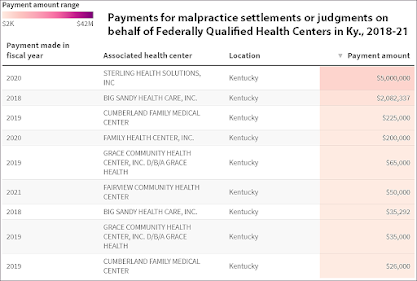
Screenshot of Kaiser Health News' Kentucky list, adapted by Ky. Health News
"Malpractice lawsuits are a risk for all health-care providers and are just one barometer of quality of care," Kaiser Health News says. "The settlements and court judgments against the health centers don’t measure the clinics’ overall performance."

The clinics fill many needs. "Nearly half of the centers’ patients are covered by Medicaid, and 20 percent are uninsured," Kaiser reports. "Even lawyers who have sued on behalf of health center patients acknowledge the importance of the facilities. Rhode Island plaintiff attorney Amato DeLuca said that the health centers serve a vital role in the health industry and that he had found “a lot of really wonderful, extraordinarily capable people that do a really good job” at the centers. Yet everyone must be held accountable for mistakes, DeLuca said."

The biggest payments

Kentucky's biggest payment in 2018-21, $5 million, settled a $42 million claim by Rebecca Anderson and Randy Brooks of Montgomery County that their son, known in court documents as G.B., suffered severe and permanent injuries during and after his birth in 2015 because Dr. Byram Ratliff of Sterling Health Solutions failed to respond to fetal distress as evidenced on the fetal heart monitor strips prior to delivery. "Dr. Ratliff failed to institute prompt and proper medical care resulting in severe permanent injury," they alleged. "As a result, G.B. will require a lifetime of medical care and treatment."

A bench trial of the case was recessed for negotiations that resulted in a settlement, comprising $2.5 million of "upfront cash" to be held in escrow until all liens and claims in the case were resolved, and a $2.5 million trust fund for future medical care. The plaintiff's attorneys were awarded case expenses of $281,873 and fees of $1,250,000. Attorney fees in such cases are limited to 25% of the award. 

A document titled "Stipulation for compromise settlement and release" says the settlement is in no way an admission of "liability or fault."

Big Sandy Health Care was connected to the second largest amount paid in Kentucky during the four-year period, $2,082,337. This case was a medical negligence claim by Lisa Ann Crispen against Dr. Joanna Santiesteban, Dr. Enrico Ascani and Big Sandy Health Care for failure to diagnose uterine cancer. 

After a bench trial, Chief U.S. District Judge Karen Caldwell awarded the judgment, writing, "Chrispen proved by a preponderance of the evidence that Big Sandy's negligence in evaluating, diagnosing, and treating Chrispen's cancer caused her to suffer past and future lost wages, past and future medical expenses, past and future physical pain and suffering, and past and future emotional pain and suffering." 

The Kaiser list shows that another federal payment involving Big Sandy Health Care was made during the four-year period, in 2018 for $35,292.

Burkesville-based Cumberland Family Medical Centers was involved in the third largest payment, $225,000. This was in a case filed by Judy and John Courtier of Monroe County, alleging that the Tompkinsville center incorrectly transcribed a prescription from a rheumatologist, resulting in Judy Courtier taking a toxic amount of methotrexate (2.5 milligrams twice a day instead of two 2.5 milligrams tablets once a week), causing conditions that required hospitalization. The parties reached a settlement in October 2018.

The Kaiser list shows another federal payment involving Cumberland Family Medical Centers was made during the four-year period, in fiscal 2019 for $26,000.

The chain of clinics is Kentucky's largest federally qualified health center. It had gross revenues of $83 million in 2019, according to the Form 990 for tax-exempt nonprofits that it filed with the Internal Revenue Service. Kentucky nonprofits must also file the forms with the state attorney general's office.

Sterling reported 2019 revenues of $13.6 million. The latest filing at the attorney general's office from Big Sandy, for 2016, showed revenues of $19.5 million.

Family Health Centers of Louisville, which had 2019 revenues of $45 million, was involved in the fourth largest payment in 2018-21, $200,000. It settled a claim by Carolyn Boerste alleging failure to tell her that a radiology report noted she had a 12-inch-by-12-inch laparotomy sponge that snaked through her small intestine for 19 months before it was removed. 

Kentucky Health News offered the four health centers the opportunity to comment, but none did.

Other Kentucky payments in the four-year period involved Grace Community Health Center of Corbin, also called Grace Health; and Fairview Community Health Center of Bowling Green.

Why do taxpayers pay these settlements? 

To win congressional protection in the 1990s, federally qualified health centers "argued their revenues were limited and malpractice insurance would divert money that could better be used for patient care," Kaiser Health News reports. About 86% of the 1,375 clinics have this protection, which comes with a list of requirements. 

To get the protection, a clinic "must have quality- improvement and risk-management programs and must show regulators that they’ve reviewed the professional credentials, malpractice claims, and license status of their physicians and other clinicians," Kaiser reports. "Ben Money, a senior vice president for the National Association of Community Health Centers, said the process improves care and directs scarce operating dollars toward the needs of patients, versus costly malpractice coverage."

Patients who want to claim malpractice by a health center must file a claim with the U.S. Department of Health and Human Services, which can make a settlement offer or deny the claim. "If the claim is denied or not settled, or a six-month review period expires, the patient may sue in federal court under the Federal Tort Claims Act," Kaiser reports.

Here's a map showing the centers' locations in Kentucky (click on it to enlarge):
Map from the Kentucky Primary Care Association; to enlarge any image, click on it.


Pandemic stress caused premature aging in teenagers' brains; long-term effect uncertain, but some parents say impact will last

Shutterstock photo
American teenagers' brains prematurely aged by three years during the pandemic due to the stress of lockdowns, a study has found.

The researchers found changes similar to those seen in "children who have faced chronic stress and adversity," reports Katherine Reynolds Lewis of The Washington Post.

"The study, published Thursday in Biological Psychiatry: Global Open Science, was the first to compare scans of the physical structures of teenagers’ brains from before and after the pandemic started, and to document significant differences, said Ian Gotlib, lead author on the paper and a psychology professor at Stanford University."

Axios, citing Gotlib, reports, "Accelerated aging of the brain itself is not necessarily a bad thing," and quotes him: "These are 16-, 18-year-olds. They're not atrophying in the alarmist sense. For me, the cause for concern is their higher rates of depression and anxiety and sadness … it makes it even more important that we address that."

Gotlib had pre-pandemic images because he and his colleagues started the work eight years ago, with the goal of "better understanding gender differences in depression rates among adolescents," Lewis reports. "The researchers recruited 220 children ages 9 to 13, with a plan to take MRI scans of their brains every two years."

Then the pandemic hit, interrupting the third set of scans, but presenting an opportunity. Gotlib said they knew teens had higher “levels of depression, anxiety and fearfulness” than “before the pandemic. But we knew nothing about the effects on their brains. We thought there might be effects similar to what you would find with early adversity; we just didn’t realize how strong they’d be.”

The researchers "compared MRI scans of a group of 128 children, half taken before and half at the end of the first year of the pandemic, the researchers found growth in the hippocampus and amygdala, brain areas that respectively control access to some memories and help regulate fear, stress and other emotions," Lewis reports. "They also found thinning of the tissues in the cortex, which is involved in executive functioning. These changes happen during normal adolescent development; however, the pandemic appeared to have accelerated the process, Gotlib said."

Premature aging of children’s brains can make them more vulnerable as adults "to depression, anxiety, addiction and other mental illnesses, they can raise the risk of cancer, diabetes, heart disease and other long-term negative outcomes," Lewis notes. "Prior research has found dramatically higher levels of anxiety, depression, suicidality and other mental illnesses in adolescents since the onset of the pandemic."

Gotlib said, “The takeaway for me is that there are serious issues with mental health and kids around the pandemic Just because the shutdown ended doesn’t mean we’re fine.”

Jason Chein, professor of psychology and neuroscience and the director of the Temple University Brain Research & Imaging Center, said the study is important but he "cautioned against making broad interpretations based on the changes the researchers observed," Lewis reports. "brain regions can show nonlinear patterns of growth, so simply seeing a thinner cortex or larger amygdala volume doesn’t necessarily indicate an older brain, he said."

But there are anecdotal examples. "Stacy Gittleman, 54, of West Bloomfield, Mich., saw the pandemic derail one of her children," Lewis writes. "An aspiring musical theater actor, he was a junior in high school when school and theater shut down." Gittleman said, “So much of how my son thrives depends on moving, acting, doing hands-on work and interacting with others. He spent much of his time in bed, which was very painful as parents to watch, as my son before the pandemic was so lively and social.”

While "managing his mental health will be a lifelong task, she said," her son's older siblings, now 24 and 26, weren't as affected by the pandemic. “In the long term, the adversity thrown at the feet of our teenagers I believe will make them stronger and more resilient,” she said.

"Other parents aren’t so sure," Lewis writes, quoting Meg Martin, 55, of Gaithersburg, Md., whose son intended to apply to a four-year residential college, but now feels unmotivated and disengaged from school after years of online and hybrid learning: “I really think the way his high-school years unfolded are going to have ripple effects for years to come.”

Building trust in public health for the next time: 'If a pandemic can’t bring us together around the common purpose, what can?'

Protest at state Capitol against pandemic restrictions, Aug. 28, 2021 (Photo by Jon Cherry, Getty Images)
By Sarah Ladd
Kentucky Lantern

Even as Kentucky reels and recovers from Covid-19 in what some have touted as the “new normal,” experts say there are systemic steps we could take now to prepare for the next big health crisis.

Chief of all, experts told the Kentucky Lantern, is building trust between the general public and health officials, the shortage of which during this pandemic has led to a myriad of misinformation spread through social media and otherwise.

At the 100-year anniversary of the 1918 flu pandemic, the Centers for Disease Control and Prevention issued a report examining gaps in pandemic preparedness. Those gaps included scarce surveillance of birds and pigs, not enough access to ventilators, worries that the health care system would be overrun in a flu-like pandemic, lack of a universal vaccine, shortage of pandemic plans in many countries, and more.

Two years later, when the Covid-19 pandemic hit, those predictions held true.

Though vaccines were produced relatively quickly, roughly 2,000 Kentuckians died from the virus before the lifesaving shots came out in late 2020. Even after they arrived, many Kentuckians were reluctant to roll up their sleeves. Covid-19 deaths in Kentucky as of last week totaled 17,555 people.

Supplies like personal protective equipment, ventilators and masks were in short supply in the early months. Hospitals were overrun with sick people, field hospitals went up to handle overflow, and National Guard members were deployed to help stretched medical staff.

During all this, Kentucky contended with a nursing shortage exacerbated by pandemic-induced burnout.

“One of the difficult lessons that we have learned in this pandemic is that the public-health infrastructure of this country has been under tremendous stress and they have suffered, I think, through this pandemic, in a number of different ways,” said Ben Chandler, president and CEO of the Foundation for a Healthy Kentucky.

Kentucky is also vulnerable to pandemics because of our high rates of comorbidities, when two or more diseases or medical conditions are present in a patient at the same time, Chandler added. The state ranks high for risk factors such as diabetes, kidney disease and cancer, and “all of those things cause people to be much more vulnerable to viruses.”

Pandemic politics  

In addition to a lack of resources early on in the pandemic, Chandler added, public-health experts had to battle constant misinformation and distrust.

“When you have a pandemic, it’s a pandemic generally because whatever you’re facing is novel, it’s new,” Chandler explained. “And there will always be questions and uncertainties about exactly how to handle it. It’s not always clear what the right thing is because the science isn’t yet entirely clear on what the society is dealing with.”

Ben Chandler
Partisan politics added to the problem, said Chandler, a Democrat who served in Congress in 2004-12 and was Kentucky's attorney general in 1996-2004.

“We have sort of … retreated to armed camps,” he said. “And we’ve got to somehow figure out how to bridge those gaps, and I don’t know what it will take because you would think that if anything could cause you to bridge the gaps and have people come together, it’d be a pandemic. If a pandemic can’t bring us together around the common purpose, what can?”

Jennifer Hancock, president and CEO of Volunteers of America Mid-States, agreed. “By design, public health is political,” she said. But, there’s a need going forward, she added, to make sure those decisions are transparent and all voices have a chance to sit at the decision-making tables.

“If you feel like you’re not at the table, then you’re on the menu,” Hancock said. “Then, it immediately promotes defensiveness and mistrust.” (Republicans who run the legislature criticized Democratic Gov. Andy Beshear for not consulting them about his anti-pandemic measures.)

Historical racism has also exacerbated mistrust of the medical community. Oluwasegun Abe, a member of the Kentucky Nurses Association who works in Louisville as a hospitalist, said “the first thing” we need to work on “is to repair the distrust between the health-care system and the different races.”

Abe spent more than a year of the pandemic volunteering with the Louisville Metro Department of Health and Wellness. As he vaccinated people all over the city, he repeatedly heard people’s mistrust, much of it based on the notorious study in which medical researchers and providers withheld treatment from about 400 Black men in Tuskegee, Alabama, from 1932 to 1972 in order to study the course of untreated syphilis.

“We continue to just distrust each other,” Abe said. One solution to that distrust is investing in more diversity, he said, so people can see themselves represented in health-care professions.

Delanor Manson
Delanor Manson, CEO of the Kentucky Nurses Association, said, “What we’ve learned over the last three years is that the community must trust the professionals that are providing the information” in order for it to be effective. That means showing up for people, listening to their concerns and answering the hard questions.

“I think a lot of the ways to build that trust include being present,” said Manson. “And what I mean by that is being present when there isn’t a pandemic, when there isn’t an epidemic, but being present in the community to establish the relationship that there is support, caring, and we have that all the time, not just when there’s a problem.”

She added: ‘If you’re not there when things are stable, then you don’t have that relationship to build on when things are not going well.”

Fear breeds distrust

“My experience has been: whether it’s someone in Eastern Kentucky or someone in West Louisville,” mistrust is “really based in fear,” Hancock said.

Manson said another way to build trust, particularly when thinking about vaccinations, is to normalize that in childhood, a job that often falls to parents.

Hancock, who required vaccines for VOA workers early in the pandemic, said the model of internal quick and clear communication about the shots and the risk factors of Covid-19 can be of use for employers in the future.

“The fear and anxiety we had regarding people being pushed out of our organization or feeling pushed out of our organization because of that decision (to require vaccines) was never realized,” Hancock said, pointing out her 95% employee-retention rate.

Manson said Kentucky must also prioritize not just recruiting nurses to fix the current shortage but also strive to retain staff. Nurse retention starts with including nurses in the decision-making process, from the shifts they work to the laws that impact them, she added.

“What most nurses want more than anything else,” Manson, herself a nurse, said: “They want to be heard.”

Hancock said authentic conversations are a must.

“If we have that same spirit and approach where we are really seeking to have the most inclusive table where all voices get to be respected and represented, then it diffuses some of the rhetoric that otherwise gets the headlines,” she said. “And that’s what we’ll continue to do. And we’re very, very committed to that.”

Ashland hospital system, with 465 beds, is now part of UK

Main hospital of King's Daughters in Ashland
King's Daughters Hospital in Ashland is now fully incorporated into the University of Kentucky's health-care enterprise.

The hospital, one of Kentucky's largest and northeastern Kentucky's largest employer, became part of UK HealthCare Thursday, Dec. 1.

"UK and King’s Daughters have been working together for nearly two years," UK's Kristi Willett notes. "During this time, King’s Daughters has experienced significant growth in employees and revenues and has begun to build and expand important infrastructure to improve access and care for people in the region. In October 2022, the UK Board of Trustees approved plans for the KD to become part of UK."

Kristie Whitlatch remains president and CEO of King’s Daughters. "When the partnership was established, UK and King’s Daughters intentionally positioned King’s Daughters to keep its identity and continue to make decisions locally," Willett writes.

King's Daughters serves a 16-county region in Kentucky, Ohio and West Virginia and has more than 5,000 employees. "Its health system is comprised of two acute-care hospitals totaling 465 licensed beds; an integrated network of more than 600 physicians and advanced practitioners; more than 50 ambulatory centers and practice locations; a long-term care facility; medical transport company; and six urgent care centers," Willett reports.

Study of 40 first-time fathers finds that fatherhood changed their brains in ways that could help them be better parents

Centers for Disease Control and Prevention photo
A growing body of research finds that children with engaged fathers do better on a range of outcomes, including physical health and cognitive performance, and a new study finds that fatherhood causes changes in the brain in ways that could influence their parenting, Darby Saxbe and Magdalena Martinez Garcia report for The Conversation, a platform for journalistic writing by academics.

Garcia, who works at the Instituto de Investigación Sanitaria Gregorio Marañón in Madrid, Spain, was the lead author on the study. Saxbe, of the University of Southern California in Los Angeles, contributed to the research.

Despite fathers' increasing participation in child care, they note, there is surprisingly little research about how fatherhood affects men, and even fewer studies focus on the brain and biological changes that might support fathering. Since pregnancy-related hormonal changes help explain why a new mother's brain might change, they explored whether fatherhood also reshapes the brains and bodies of men, in a study of first-time fathers in Spain and California.

Spanish researchers had scanned first-time mothers before conception and two months after delivery, and found that compared to childless women, "The new mothers’ brain volume was smaller, suggesting that key brain structures actually shrank in size across pregnancy and the early postpartum period," Saxbe and Garcia report. "The brain changes were so pronounced that an algorithm could easily differentiate the brain of a woman who had gone through a pregnancy from that of a woman with no children." They also found changes across the brain's gray matter, the layer that is rich in neurons, and changes in the cortex, which is linked to thinking about others, and the subcortex, which is linked to more primitive functions, including emotion and motivation.

The authors say experience-induced brain plasticity happens when you learn a new language or master a new musical instrument, and suggest that this could also happen with the new experience of caring for an infant. They note that there is a small, but growing body of research being done on this topic. 

To learn more about plasticity in new dads’ brains, the researchers studied 40 expectant fathers who were put into an MRI scanner twice: during their partner’s pregnancy, and after their baby was 6 months old. The study also included a control group of 17 childless men.

"We found several significant changes in the brains of fathers from prenatal to postpartum that did not emerge within the childless men we followed across the same time period," they report. "In both the Spanish and Californian samples, fathers’ brain changes appeared in regions of the cortex that contribute to visual processing, attention and empathy toward the baby." They offer the possibility that the brain plasticity in fathers may be tied to how much they interact with their baby, and say that raises the question of whether family policies that increase the amount of time a father can spend with their child during the early postpartum period could help to support the development of the fathering brain. 

"Spanish fathers, who, on average, have more generous paternity leaves than fathers have in the U.S., displayed more pronounced changes in brain regions that support goal-directed attention, which may help fathers attune to their infants’ cues, compared with Californian fathers," they write. However, men who show more remodeling of the brain and hormones may be more motivated to participate in hands-on care. The authors called for more research, noting that future studies with more detailed measures of postpartum caregiving can reveal more about parental brain plasticity in both men and women.

Thursday, December 1, 2022

The number of Kentucky counties with high and medium Covid-19 risk on the federal risk map made a big jump this week

Centers for Disease Control and Prevention map
By Melissa Patrick
Kentucky Health News

Covid-19 cases in Kentucky appear to be on a rough plateau overall, but the number of counties with high and medium risk of transmission on the weekly federal risk map made a big jump Thursday afternoon. 

The latest Centers for Disease Control and Prevention risk map, which looks at both cases and hospital data to determine risk of transmission, shows 10 Kentucky counties at high risk, up from three the week before. High-risk counties are shown in orange on the map; all are in West Kentucky except Robertson.

In high-risk counties, the CDC continues to recommend that you wear a well-fitting mask in public indoor spaces, and if you are at high risk of getting very sick, consider avoiding non-essential indoor activities in public where you could be exposed.

Medium-risk counties, shown in yellow, increased to 48 this week, up from 15 on the prior week's map, which was issued Monday due to the Thanksgiving holidays. They are mainly in Central and Eastern Kentucky, as well as the Owensboro and Glasgow areas. Barely a majority of the state's 120 counties (62) are still estimated to have a low risk of Covid-19, shown in green.

The New York Times ranks Kentucky's new-case infection rate over the last seven days 25th among the states.

At his weekly news conference Thursday morning, Gov. Andy Beshear again asked Kentuckians to get an updated Covid-19 booster shot, noting that it offers significant protection from the virus. He also encouraged immunocompromised people to wear a mask. 

Asked how Kentuckians should protect themselves against "long Covid," which is reported to occur in about 30% of cases, Beshear first encouraged Kentuckians to get vaccinated and to get boosted. Asked about masking, he said what he has said before, that we are at a point where individuals can make informed decisions about what levels of protection they want to take. 

"Our country has moved past widespread masking, that's just where we are," Beshear said. "But, what I want to make sure [of] is that we give the space for individuals who make that decision, and that they are not judged, and that they are in fact, encouraged. And I see a lot of individuals choosing to do that." 

If you live in a medium or high-risk county, the CDC advises those who are at high risk of getting very sick to wear a well-fitting mask when indoors and in public and to consider getting tested before having social contact with someone at high risk for getting very sick and consider wearing a mask when indoors when you are with them.

Centers for Disease Control and Prevention map
The CDC also has a transmission-level map that shows the level of virus spread in each county, at one of four levels. The latest map is redder than the previous version.

The map shows that Todd County is the only one with a low level of transmission and 16 counties have moderate levels. The rest have either substantial or high levels of transmission. This data is largely used by researchers and health-care facilities. 

State officials have encouraged Kentuckians to use the other CDC map to guide their preventive measures.