Showing posts with label Centers for Disease Control and Prevention. Show all posts

Sunday, February 18, 2024

Respiratory illness in Ky. resurged in the week ended Feb. 10, with 5-to-17-year-olds having an 84% jump in ED visits for the flu

State Department for Public Health graphs, adapted by Kentucky Health News
By Melissa Patrick
Kentucky Health News

After weeks of overall decline, three major respiratory illnesses increased in Kentucky during the week ended Feb. 10, with children between the ages of 5 and 17 getting hit hard by influenza.  

The Kentucky Department for Public Health's weekly report says flu and Covid-19 activity is elevated and increasing and hospitalizations for respiratory illnesses are considered high.  

Emergency-department visits for the three respiratory viruses tracked by the state -- flu, Covid-19 and respiratory syncytial virus (RSV) -- increased nearly 16% in the week ended Feb. 10, to 3,583.  

This increase was driven by a 16% increase in visits for flu, to 2,745, and a 26% increase in Covid-19 visits, to 740. RSV visits dropped 26%, to 98. 

In the same week, Kentucky hospital admissions for the respiratory diseases increased 6% from the previous week, to 509. Flu was the only one of the tracked viruses to see an increase in hospital admissions in the week ended Feb. 10, with a 17% increase to 288. Covid-19 and RSV admissions had slight drops.  

Four northeastern Kentucky counties had high rates of Covid-19 hospital admissions in the week, according to the Centers for Disease Control and Prevention, which considers high to be 20 or more admissions per 100,000 residents. Rowan, Morgan, Menifee and Elliott counties had 27 Covid-19 admissions per 100,000. 

Ten Kentucky counties had admission rates between 10 and 19.9 Covid-19 admissions per 100,000, a rate the CDC considers "medium." They were Pike County, in far Eastern Kentucky, and McCracken, Marshall, Lyon, Livingston, Hickman, Graves, Crittenden, Carlisle, and Ballard counties, in far Western Kentucky. 

Children between the ages of 5-17 saw an 84% jump in emergency-department visits for respiratory illness in the week ended Feb. 10, to 970. This was driven by flu-related visits, which were up 82% over the previous week, to 876. Hospital visits for this age group dropped to 15 in that week, down from 22 the prior week. 

In the week ended Feb. 10, the state reported 3,912 laboratory-confirmed cases of the flu, up 17% from the prior week. It reported 2,459 laboratory-confirmed cases of Covid-19, up 16% from the week prior. 

Since the respiratory-illness season began the first week in October, 327 Kentuckians have died from Covid-19, and 28 from the flu, the health department says. One Covid-19 victim and one flu victim have been children.

Sunday, January 8, 2023

Opinion: Covid-19 is mutating and apparently winning, so we need to take preventive measures well beyond vaccinations

Graphs by the New York Times, adapted by Kentucky Health News
By Kevin Kavanagh


There is no such thing as “herd immunity” for Covid-19. In this context it is a concept as antiquated as “the Earth is flat.”

The theory was based upon the work of William Farr in 1840 who proposed a bell-shaped curve which illustrated the body’s ability to mount a lasting response to an unchanging pathogen. As stated by one “herd immunity” supporter in the comments section of my previous article on this point, “The disease dies out because enough people have been exposed and developed relative immunity or died that the disease has no means of propagating itself on a large scale.”

That concept was formulated before science knew what viruses and mutations were, and that many biological systems are highly dynamic and constantly adapting. This is eloquently described in Steffanie Strathdee and Thomas Patterson’s book The Perfect Predator. It describes the biological dance between viral phages and their bacterial prey, each one adapting and re-engaging in a duel, the outcome of which is uncertain. With the exception of smallpox, no pathogen has ever been eradicated from the earth and with smallpox, eradication was achieved with a highly effective long-lasting vaccine.

With mutating RNA viruses such as SARS-CoV-2 (which causes Covid-19), “herd immunity” is an extinct construct. Unlike the relatively stable DNA virus of smallpox, RNA viruses have a much higher mutation rate.

The U.S. epidemiological curve of SARS-CoV-2 is a colliding roller coaster and nowhere near a bell curve. We have been hit with variant after variant; Delta infections transitioned to Omicron; and now we are struck by a soup of variants, composed of pathogens harboring a plethora of different immune-avoiding mutations, making the concept of “herd immunity” next to useless.

Unfortunately, SARS-CoV-2 appears to be the most adaptive and dynamic foe we have ever faced. Hoping that the antiquated concept of “herd immunity” will save the day, causing SARS-CoV-2 to “miraculously (go) away,” is just pure fantasy.

SARS-CoV-2’s high mutation rate is amplified by its extremely high infectivity. The CDC estimated that the Delta variant was as infectious as chickenpox, which has an R0 of 10 to 12. That means an average person infected with Delta infected 10 to 12 other people. Newer variants have evolved into some of the most infectious pathogens known to man. As the virus spreads it mutates. And as it mutates, it increases its ability to infect, evade our immunity and even attack our immune system.

Evidence is mounting regarding the immune dysfunction caused by SARS-CoV-2. We are seeing a dramatic rise in hospitalizations for the seasonal flu, respiratory syncytial virus (RSV) and even scarlet fever. The increase in RSV hospitalizations has been blamed on immunological weakening during the pandemic due to preventive measures such as masking. However, through November, the United States had correspondingly fewer RSV infections than in 2021, when an RSV surge was also seen. Germany also had a surge in RSV hospitalizations last winter, and now is seeing overwhelming RSV hospitalizations.

Not only does SARS-CoV-2 evade and attack our immunity, but the immunity is fleeting. The virus also resides in a variety of animal hosts where it can mutate and then reinvade the human population. Transmission of a mutated virus from whitetail deer to humans has been documented and there is evidence that Omicron originated in rodents then jumped to humans in South Africa.

The dangers of long Covid, persistent cardiovascular disease, blood clots and a plethora of mental problems caused by Covid-19, are real, and are adversely affecting the health of our workforce and our communities.

Our goal must be to decrease pathogen spread so society can function, with infections decreasing to a level that we can live with the virus. In this regard, it appears the virus is currently winning.

We need to embrace vaccinations, the use of N95 masks in crowded venues, along with home delivery, curbside pickup and outside dining. Indoor air quality must be improved to the point where it is safer indoors than it is outdoors.

If we continue to be a society focused on individualism rather than community or public health, I am afraid we will lose this fight. We need a paradigm shift in the way we strategize to control Covid-19, away from “herd immunity” and towards adapting our lives to live with this highly dynamic and constantly adapting foe.

Kevin Kavanagh is a retired physician from Somerset and chairman of Health Watch USA. This is an edited version of his original article, published in the Courier Journal.

Thursday, October 6, 2022

CDC map shows 75 counties with low risk of Covid-19 transmission; only 8 remain at high risk, just 3 rose to medium risk

Centers for Disease Control and Prevention map
By Melissa Patrick
Kentucky Health News

The latest federal risk map says most of Kentucky has a low risk of Covid-19 transmission, with only only eight counties at high risk and just three others moving into a higher risk category from last week. 

Counties that remain at high risk, shown in orange on the Centers for Disease Control and Prevention risk map, are Johnson, Magoffin, Floyd, Knott, Letcher, Perry, Leslie and Owsley. 

Adjoining Morgan, Elliott and Rowan counties moved to a medium risk of transmission, shown in yellow, from a low risk, shown in green.

The CDC showed three fewer counties in the high risk category than last week. It rated 37 counties at medium risk, 14 fewer than the week before, and 75 at low risk, up by 17. 

In high-risk counties, the CDC continues to recommend  that you wear a well-fitting mask in public indoor spaces, and if you are at high risk of getting very sick, consider avoiding non-essential indoor activities in public where you could be exposed.

If you live in a medium or high-risk county, the CDC advises those who are at high risk of getting very sick to wear a well-fitting mask when indoors and in public and to consider getting tested before having social contact with someone at high risk for getting very sick and consider wearing a mask when indoors when you are with them.

The CDC also has a transmissions levels map that shows the level of virus spread in each county, at one of four levels. This map shows Todd and Lewis counties with low transmission levels and 22 counties with moderate levels. The rest have either substantial or high levels of transmission. 

This data is largely used by researchers and health-care facilities, but it also shows why Kentucky's infection rate continues to be one of the highest in the nation, ranking fifth on Oct. 6,  according to The New York Times.

State officials say Kentuckians should use the risk map, which is based on new coronavirus cases, hospital admissions and hospital capacity, to guide their preventive measures.

Friday, September 2, 2022

CDC risk map shows 93% of Ky. counties with high or medium risk of Covid-19 infection, increased risk in Bowling Green area

Centers for Disease Control and Prevention map
By Melissa Patrick
Kentucky Health News

Kentuckians in general have about the same risk of catching Covid-19 as they did a week ago, with 93% of the state's counties at a high or medium risk of transmission and The New York Times ranking Kentucky second among the states for new coronavirus cases in the last seven days. 

Last week, 92% of the state's counties were at high or medium risk. And even though the latest Covd-19 risk map, issued Thursday by the Centers for Disease Control and Prevention, shows some shift among counties moving to a lower level of risk of Covid-19, most of the state's counties remain in the high- and medium-risk groups.

Some of those in which the risk grew were Warren, site of Bowling Green, the state's third-largest city; Hardin, another very populous county; and every county adjoining Warren: Butler, Edmonson, Barren, Allen, Simpson and Logan.

The CDC map, which is based on new coronavirus cases, hospital admissions and hospital capacity, shows 70 Kentucky counties in orange, at high risk, four fewer than a week ago; 42 in yellow, at medium risk, six more than a week ago; and eight in green, at low risk, two fewer than the week before. 

In high-risk counties, the CDC recommends that you wear a well-fitting mask in public indoor spaces, and if you are at high risk of getting very sick, consider avoiding non-essential indoor activities in public where you could be exposed.

If you live in a medium or high-risk county, the CDC advises wearing a well-fitting mask when indoors and in public and to consider getting tested before having social contact with someone at high risk for getting very sick and consider wearing a mask when indoors when you are with them.

The CDC also publishes a map showing levels of community transmission, Every county in Kentucky is ranked high except Ballard, Lyon, Edmonson, Metcalfe and Robertson, all small counties. State officials say the other map, estimating risks, is the best one to guide preventive actions,

At his weekly news conference Wednesday, Gov. Andy Beshear again urged Kentuckians to stay home if they are sick, consider wearing a mask until you know you don't have Covid-19, get tested if you think you have been exposed, and treatment if the test is positive, and get vaccinated and boosted. 

"We continue to recommend that everyone six months of age or older stay up to date on their vaccinations and receive any booster doses," he said.

His advice comes as a new, updated Covid-19 booster shot that targets the original strain of the coronavirus and major Omicron subvariants has been approved. Beshear said the new booster could be available to Kentuckians as early as next week. 

So far, state data shows that fewer than half (46.6%) of the 2.6 million fully vaccinated Kentuckians have been boosted.

Thursday, August 11, 2022

CDC eases some Covid-19 guidelines, says 89 Ky. counties are at high risk of Covid-19; state's infection rate is highest in U.S.

CDC map estimates ranges of risk for contracting Covid-19.
By Melissa Patrick
Kentucky Health News

As the Centers for Disease Control and Prevention loosened some of its Covid-19 recommendations, even more Kentucky counties moved into the high-risk category for coronavirus transmission on the CDC's weekly risk map.

And The New York Times reports that Kentucky has the highest infection rate among the states.

The number of Kentucky counties in the high-risk category, orange on the CDC map, increased to 89, from 80 in last Thursday's report. The number of yellow counties, indicating a medium risk of Covid-19, dropped to 20, down from 31.    

The good news is that for the second week in a row, the state still has green counties on the map, indicating a low risk of Covid-19 transmission. The number of low-risk counties increased by two, to 11: Fulton, Calloway, Simpson, Logan, Butler, Edmonson, Green, Taylor, LaRue, Fleming and Bracken. 

In the high-risk counties, the CDC recommends that you wear a well-fitting mask in public indoor spaces, and if you are at high risk of getting very sick, consider avoiding non-essential indoor activities in public where you could be exposed. If you live in a medium or high-risk county, the CDC advises wearing a well-fitting mask when indoors and in public and to consider getting tested before having social contact with someone at high risk for getting very sick and consider wearing a mask when indoors when you are with them.

The CDC's new guidance says people who are exposed to the virus no longer need to quarantine at home, regardless of vaccination status, although they should wear a high-quality mask for 10 days and get tested on day five. It also not longer recommends routine surveillance testing for people without symptoms and says contact-tracing is only necessary in health care settings or high-risk congregate settings. 

With schools starting, the CDC made several changes in its recommendations for schools, no longer mentioning its "test-to-stay" option and no longer recommending routine testing, unless it is in response to high-risk activities during high Covid-19 community transmission or in response to an outbreak. 

Masks continue to be recommended only in areas where community transmission is high, or if a person is at high risk of severe illness. The CDC publishes maps showing the level of community transmission in each county; all Kentucky counties but four (Hickman, Lyon, Todd and Metcalfe) have high levels. 

One CDC recommendation that remains the same is that people with Covid-19 should isolate for at least five days as long as they are without a fever for 24 hours without the use of fever-reducing medication and all other symptoms have improved. They should then wear a mask through day 10, or test negative twice over 48 hours before they stop wearing a mask. 

Beshear's view: At his weekly news conference, Gov. Andy Beshear said that with the state's weekly coronavirus cases going up and down, the hope is that we are heading toward a plateau. He said cases increasing for a while and then going down is what some experts see going forward. 

Beshear noted that hospitalizations continue to go up and while they are still relatively low, he said, "That's still a lot of people in the hospital, folks, so make sure you get vaccinated . . . Make sure you get boosted as well and if you are over 50, get that second booster."  

He added, "Everybody now has all the information on how Covid spreads, what you can do to stop it. Please try to make the best decisions for you knowing that at this point, we all know how this thing works and how we can protect ourselves." 

The data shows that the pandemic is clearly not over, even though 31.7% of Kentuckians think it is, and 53% of them say it is over for them, according to a Foundation for a Healthy Kentucky poll taken June 4-July 13. 

Asked what can be done to persuade Kentuckians that the pandemic is not over,  Beshear said Kentuckians are tired of it, and of wearing masks, then said the most important thing we can do is to get more people vaccinated and boosted. He also said Kentucky will keep sharing pandemic information with Kentuckians even as other states quit. 

He said that at this point in the pandemic, Kentuckians need to recognize that they will just need to change their behaviors, like wearing masks, for a few weeks at a time, instead of forever. 

Beshear spoke as the CDC was relaxing its guidance, while sharing a similar message as the governor. 

“We’re in a stronger place today as a nation, with more tools—like vaccination, boosters, and treatments—to protect ourselves and our communities, from severe illness from Covid-19,” CDC epidemiologist Greta Massetti said in a news release. “We also have a better understanding of how to protect people from being exposed to the virus, like wearing high-quality masks, testing, and improved ventilation. This guidance acknowledges that the pandemic is not over, but also helps us move to a point where Covid-19 no longer severely disrupts our daily lives.”

Thursday, June 9, 2022

CDC estimates that Covid-19 risk level is high in 19 Kentucky counties, up from 7 last week; level is medium in 28, up from 21

Centers for Disease Control and Prevention map, adapted by Kentucky Health News
By Melissa Patrick
Kentucky Health News

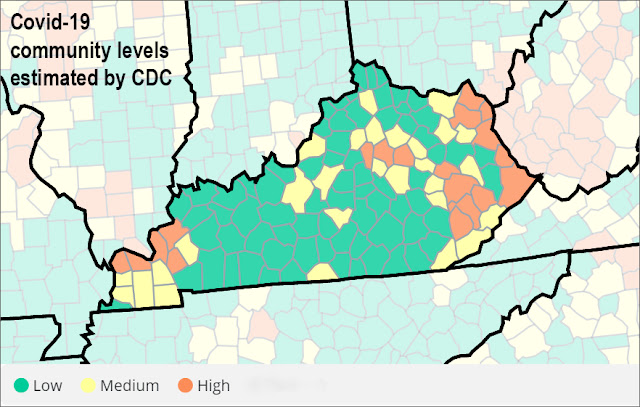
The federal government's coronavirus map for Kentucky shows a higher level of virus transmission and an increased risk of the Covid-19 disease.

Nineteen Kentucky counties are red on the latest Centers for Disease Control and Prevention national Covid-19 risk map, indicating a high level of coronavirus transmission. Last week, only seven were red.

Twenty-eight Kentucky counties are yellow, indicating a medium level of transmission. Last week, 21 were yellow. The rankings are based on new virus cases, hospital admissions and hospital capacity.

The red counties are Ballard, McCracken, Livingston, Crittenden and Lyon, in Western Kentucky; Woodford, Fayette and Clark in Central Kentucky; Carter, Greenup, Boyd and Lawrence in the northeast;  and  Martin, Pike, Wolfe, Breathitt, Knott, Perry and Leslie in Eastern Kentucky. 

Six of the seven red counties from last week's map are red again this week, including McCracken, Crittenden, Pike, Greenup, Carter, and Boyd. 

In red counties, state guidelines call for wearing masks in indoor public spaces, limiting in-person gatherings, limiting the size of gatherings, and social distancing.

"When your county is red, you need to really think about stepping up the things you do to keep yourself from getting Covid," Gov. Andy Beshear said at his weekly news conference Thursday, a few hours before the release of the new map. His warning was mild, but still contrasted with what he said at last week's news conference: "This is the safest we have been in this pandemic."

The 28 yellow counties are Hickman, Carlisle, Graves, Marshall, Calloway, Caldwell, Monroe, Taylor, Hardin, Nelson, Jefferson, Grant, Franklin, Scott, Bourbon, Montgomery, Powell, Jessamine, Madison, Owsley, Lee, Magoffin, Letcher, Harlan, Bell, Lewis, Rowan and Elliott.

The CDC says people in yellow counties who are immunocompromised, or at high risk for severe illness from the virus, should talk to a health-care provider about whether they need to wear a mask or take other precautions.

Beshear opened his weekly Covid-19 update by noting a figure from the state's weekly report, issued Monday: 16,004 deaths in Kentucky attributed to the disease. He acknowledged their loved ones' grief and encouraged them to seek mental-health care if in need. 

"These are 16,004 children of God who will be missed by their communities, whose families are still mourning whether it happened the first day of Covid or is the most recent death," he said. "Let's remember that people are still out there hurting."

State Dept. for Public Health graph, adapted by Ky. Health News; for a larger version, click on it.

Again, Beshear said the good news is that Kentucky is no longer seeing the deaths and serious illness that we saw earlier in the pandemic, even as cases and the positivity rate have gone up more than they were a month ago.

"One of the best pieces of news is it's no longer directly proportional to the number of cases or the positivity rate," he said. "But that doesn't mean it can't cause severe illness in some and it also causes real and significant disruption that all of you have seen either in your business or in your home life." 

State Dept. for Public Health graph, adapted by Ky. Health News; to enlarge, click on it.
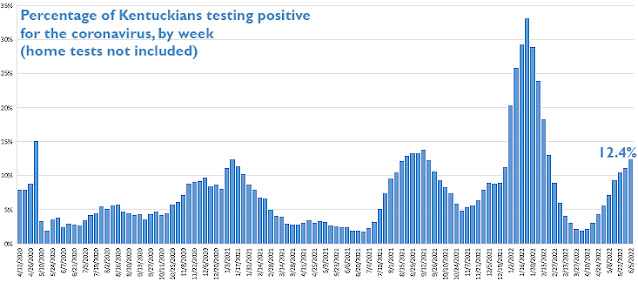
Monday's weekly report showed Kentucky had an average of 1,394 new cases a day last week, up 37% from the week before, the weekly Covid-19 death rate had increased a bit and hospitalization numbers remained low. The positive-test rate increased to 12.42% from 11.2% the week before.

Beshear reiterated that the best way to keep Covid-19 numbers low is to get fully vaccinated and boosted. In Kentucky, 61.4% of the eligible population, 5 and older, have been fully vaccinated and 44.9% of fully vaccinated people have received a booster shot, according to The Washington Post

Vaccine advice from Dr. Stack

With the news that Moderna has an experimental "bivalent" vaccine combining its original shot with protection against the Omicron variant, with preliminary data showing it appears to work, should Kentuckians over 50 should delay further Covid-19 vaccination until this fall, when it is likely to be available?

Stack, a physician, said it depends: "If you're over 60, if you are have multiple medical problems [and] on medications, you should seriously consider going out and getting that fourth dose. Cases are rising and you want to keep your protection as high as you can. If you're otherwise young and healthy and even if you're probably in your 50s, and you have no major medical problems, it's reasonable to talk with your personal physician if you would like and ask what their opinion is."

He noted that the definition of being fully vaccinated is having received two initial doses of the Covid-19 vaccination plus the first booster, and that the fourth shot is recommended for people 50 and older. 

He encouraged everyone to get boosted this fall if they choose to wait because once people move back indoors, we will need added protection against the virus. 

PBS NewsHour reports that the U.S. Food and Drug Administration has set a meeting in late June to evaluate data from the new vaccine formulas. Pfizer is also working on a combination shot, with some data expected later this month.

Thursday, May 12, 2022

CDC says 12 Kentucky counties have medium levels of coronavirus as cases and positivity-rates creep up across state

Centers for Disease Control and Prevention map
By Melissa Patrick
Kentucky Health News

Twelve Kentucky counties, most of them in Eastern Kentucky, are in yellow, indicating a medium level of coronavirus transmission on the latest national Covid-19 risk map from the federal Centers for Disease Control and Prevention. 

Union and Henderson counties in Western Kentucky are yellow for the third week in a row. Also yellow are Jefferson County, the state's most populous, and nine Eastern Kentucky counties: Greenup, Carter, Boyd, Lawrence, Johnson, Magoffin, Floyd, Martin and Pike. They are part of a cluster that includes part of West Virginia and one county in southeastern Ohio.

Twelve is the highest number of Kentucky counties with only low and medium levels of virus on the CDC risk map since the March 31 report, when the state had six yellow counties, and it comes as the state's positive-test rate and new cases are ticking up. 

The state's weekly report showed a 16.5 percent increase in new cases from the prior week, to an average of 565 new cases per day. It showed a seven-day positive-test rate, not including results of home tests, of 7.19%. That was up from 5.67% the week before. 

The U.S. Food and Drug Administration has warned to avoid using the Skippack Medical Lab SARS-CoV-2 Antigen Rapid Test (Colloidal Gold) at-home Covid-19 test because it could give a wrong result, the Lexington Herald-Leader reports. SML Distribution LLC has recalled more than 209,000 of the tests. The company has not given “adequate data to show the test works correctly,” according to the federal Food and Drug Administration.

Gov. Andy Beshear noted that Kentucky's positive-test rate, while increasing, "is not the same indicator that it used to be" because it no longer means that our hospitals could get overrun, as was true earlier in the pandemic. 

Beshear explained that even as Covid-19 cases are slowly increasing, low hospitalization rates show that the coronavirus is not causing severe illness. 

"So am I a little concerned right now? Sure. I'm wary, I'm watching," Beshear said at his weekly news conference Thursday. "But I don't think there is cause for alarm yet. We are right to notice it, to watch it and to be ready for whatever is to come." 

Beshear again encouraged Kentuckians to get vaccinated or boosted, noting that in addition to lost productivity, the disease is still a major risk for some people. Kentucky lost an average of about 24 people per day to the virus last week.

"There's no question that each shot that you get helps you, helps prevent serious illness and only about 25% of our population is boosted at the moment," Beshear said. "That is one easy thing you can do right now to protect yourself as we're starting to see some of those numbers tick up." 

The CDC says people in yellow counties who are immunocompromised, or at high risk for severe illness from the virus, should talk to a health-care provider about whether they need to wear a mask or take other precautions.

The weekly ratings are based on new virus cases, Covid-19 hospitalizations and the percentage of staffed inpatient beds occupied by Covid-19 patients.

Nationwide, the number of counties with medium and high levels of the virus have gone up in this weeks report . The CDC says 81.6% of counties or county equivalents have a low level of the virus, down from 87.7% last week; 14.15% have a medium level, up from 9.9% ; and 4.25% have a high level of the virus, up from 2.4%.

Thursday, May 5, 2022

CDC says Union, Henderson and McCracken counties have medium levels of virus, so high-risk people there need masks

Centers for Disease Control and Prevention map

By Melissa Patrick
Kentucky Health News

Three Western Kentucky counties are yellow on the national Covid-19 risk map, for counties with a medium level of virus, according to the Centers for Disease Control and Prevention.

Union and Henderson counties are yellow for the second week in a row, and McCracken County moved from green to yellow on this week's risk map. The rest of the state is green, considered to have a low level of the virus. 

The CDC says people in yellow counties who are immunocompromised, or at high risk for severe illness from the virus, should talk to a health-care provider about whether they need to wear a mask or take other precautions.

The weekly ratings are based on new virus cases, Covid-19 hospitalizations and the percentage of staffed inpatient beds occupied by Covid-19 patients.

Nationwide, the CDC reports that 87.7% of counties or county equivalents have a low level of the virus; 9.9% have a medium level; and 2.45% have a high level. 

These low transmission rates are welcomed as the state moves into Kentucky Derby weekend. 

"I'm looking forward to people being able to get out and really enjoy," Gov. Andy Beshear said at his weekly news conference. "We have asked a lot from people over these last couple of years. We asked for a lot of sacrifices and with where we are in Covid, while it hasn't gone away, it's okay to celebrate. With everything that we've given up for a period of time, I want people to enjoy, have a good time and I am really looking forward to feeling that energy and to watching everybody else be able to have a good time." 

Beshear said he and his family will be taking masks with them to the Derby and will use them if they feel they are needed. 

Thursday, April 28, 2022

CDC says certain people in Bourbon, Henderson, Nicholas and Union counties should mask up in indoor public spaces

CDC map shows Union, Henderson, Bourbon and Nicholas counties with a medium level of Covid-19.
By Al Cross
Kentucky Health News

Four Kentucky counties are back in yellow on the national Covid-19 risk map, meaning certain people there are advised to wear masks in indoor public spaces, says the Centers for Disease Control and Prevention.

The latest weekly CDC map shows a medium level of the coronavirus in Union and Henderson counties in northwestern Kentucky and in Bourbon and Nicholas counties in the eastern Bluegrass region.

The CDC says people in those counties who are immunocompromised, or at high risk for severe illness from the virus, should talk to a health-care provider about whether they need to wear a mask or take other precautions.

The weekly ratings are based on new virus cases, Covid-19 hospitalizations and the percentage of staffed inpatient beds occupied by Covid-19 patients.

The report accompanying the map shows that the percentage of Kentuckians testing positive for the virus continues to increase, approaching 8 percent. It says the positive-test rate for the last week was 5% to 7.9%, with an average of 350 cases per day.

The state's latest weekly report, which was issued Monday, said the positive-test rate for the week ended Sunday was 4.35%, with an average of 428 new cases per day. Thursday's CDC report said the latest seven-day total was 2,450 cases, an average of 350 cases per day.

The CDC report shows several Kentucky counties have high levels of virus transmission, but low or moderate levels of Covid-19, perhaps indicating local effectiveness of preventive measures such as vaccinations, social distancing and masking.

Centers for Disease Control and Prevention map

Saturday, April 23, 2022

Latest CDC map shows all of Kentucky has low level of Covid-19

CDC map shows all of Kentucky in green, for low levels of Covid-19 transmission. 

By Melissa Patrick
Kentucky Health News

Every county in Kentucky has a low level of coronavirus transmission, according to the latest weekly analysis of risk based on cases and hospital capacity by the Centers for Disease Control and Prevention. 

The CDC ratings are based on new coronavirus cases, Covid-19 hospitalizations and the percentage of staffed inpatient beds occupied by Covid-19 patients. Its color-coded map uses green for counties with low risk of transmission, yellow for counties with medium risk and red for counties with high risk. 

The latest map shows that the whole state is in the green, a level that comes with recommendations to stay up to date with your Covid-19 vaccines and to get tested if you have symptoms. 

The CDC reports that 91.7% of counties and county equivalents in the U.S. have a low level of Covid-19. 

The latest ratings came as Kentucky's Covid-19 cases and the share of Kentuckians testing positive for the virus in the previous week  ticked up a bit, while hospital numbers continued to decline.

"So we're gonna keep taking a look at at where the numbers of cases and positivity are, but [we're] not concerned because of where these [hospital] graphs are, which is in such a good place," Gov. Andy Beshear said at his weekly news conference on Thursday, before the new CDC map was released. 

The slight uptick also comes as Kentucky gears up for what Beshear said would be record crowds at this year's Kentucky Derby on Saturday, May 7, which he said he plans on attending. 

"We are in the best shape that we have been since the start of the pandemic, with all factors considered to host the Kentucky Derby," he said. "And how exciting is that?"

Thursday, April 14, 2022

Floyd, Magoffin and Johnson only counties in Kentucky where CDC advises higher-risk residents to wear masks in public

CDC map shows, in yellow, counties where higher-risk residents are advised to wear masks in public.
By Melissa Patrick
Kentucky Health News

The latest Centers for Disease Control and Prevention map of counties that pose the greatest risk of Covid-19 shows three adjoining Eastern Kentucky counties with a medium level of coronavirus transmission: Floyd, Magoffin and Johnson. The rest of the state has a low level of the virus.

The new CDC map hadn't been released at the time of Gov. Andy Beshear's Thursday news conference, but he said he was pleased that last week's map was largely green, indicating a low level of transmission. One county, Anderson, was in yellow; officials there said that was due to slow reporting.

Beshear also noted that Kentucky's weekly coronavirus cases and hospital numbers had dropped again, even though the share of Kentuckians testing positive for the virus ticked up to 2.27% from 1.97%.

"Covid continues in a general decline across Kentucky," he said, adding later, "This ought to make us all pretty happy. Enjoy being together, do make good decisions, and make decisions that you are comfortable with about whether to wear a mask or not. But it looks like it's going to be a pretty good spring and I hope everybody enjoys it and doesn't take it for granted."

The CDC says people in Floyd, Magoffin and Johnson counties who are immunocompromised or at high risk for severe illness from the virus should talk to a health-care provider about whether they need to wear a mask or take other precautions. 

The three counties are among 175 counties and county equivalents in the nation at the medium-transmission level, up from 123 in last week's report. 

The CDC determines risk based on cases and health care capacity. Its color-coded map uses green for counties with low risk of transmission, yellow for counties with medium risk and red for counties with high risk. The ratings are based on new coronavirus cases, Covid-19 hospitalizations and the percentage of staffed inpatient beds occupied by Covid-19 patients.

Some pain patients and their doctors worry that the CDC's revised opioid-prescription guidelines won't help patients enough

Opioid prescriptions in the U.S. have fallen more than 40 percent over the past decade in response to the opioid overdose and addiction crisis. The Centers for Disease Control and Prevention has played a role in that by encouraging doctors to prescribe fewer painkillers, but that has made it more difficult for patients with chronic pain to get the medication they need. The CDC has drafted a new version, on which the public-comment period just ended, "but some worry it doesn't protect patients enough," Will Stone reports for NPR.

New CDC guidelines in 2016 encouraged doctors to be wary of opioid addiction and advised them to start at a low dose and avoid prescribing high doses. Amanda Votta, a Rhode Island graduate student who has rheumatoid arthritis, told Stone that it became much harder for her to get any kind of opioid prescription at all, and that she was often in great pain.

"There's broad agreement now that the 2016 guidelines were misapplied to pain patients like Votta," Stone reports. Dr. Roger Chou, who helped write the 2016 guidelines, told Stone the guidelines were only meant to guide doctors, not stop them from prescribing appropriate medication to patients with chronic pain.

The CDC's new prescribing guidelines show promise, some experts say. "The top-line recommendations no longer include specifics about the dose or duration a patient shouldn't exceed when taking opioids. The draft also warns up front that the guidelines should not be used as inflexible standards of care," Stone reports. But the lack of specific guidance could make some doctors uncomfortable and cause them to stop prescribing opioids at all, another expert said.

Tuesday, March 15, 2022

Rand Paul's resolution to end the federal mask mandate in public transit passes Senate, but not by enough to overcome a veto

The federal rule applies to transport hubs and conveyances. (Photo by Brandon Bell, Getty Images)
By Al Cross
Kentucky Health News

The U.S. Senate passed Kentucky Sen. Rand Paul's legislation to end the mask mandate in public transportation, but not by a margin large enough to overcome a threatened veto by President Biden.

Paul's resolution passed 57-40 Tuesday but it takes a two-thirds vote (67 in the Senate) to override a veto, and the Democrat-controlled House could bottle up the resolution, relieving Biden of the burden of vetoing it. The rule had been set to expire Friday, March 18, but the administration extended it to April 18.

Biden's Office of Management and Budget said requiring masks in public conveyances and in transportation hubs had prevented the spread of Covid, "saving lives." It called them "places where people across communities congregate, often for extended periods and in close quarters. The determination of the timeline and circumstances under which masks should be required in these settings should be guided by science, not politics."

Paul, in a press release, called the rule an "anti-science, nanny state requirement" that is ineffective. "As the entire world is learning to live with Covid, the federal government still uses fear mongering to stubbornly perpetuate its mandates, rather than giving clear-eyed, rational advice on how to best protect yourself from illness."

The rule was issued by the Centers for Disease Control and Prevention in January 2021. On Feb. 25, 2022, it exempted school buses, in conjunction with relaxed guidance for mask wearing in schools. "Travel contributes to interstate and international spread of Covid-19," the CDC says. "Wearing masks that completely cover the mouth and nose reduces the spread of Covid-19."

Tuesday's vote was largely along party lines. Minority Leader Mitch McConnell of Kentucky and all other Republicans except Mitt Romney of Utah voted for the resolution, as did Democrats Mark Kelly and Krysten Sinema of Arizona, Michael Bennet of Colorado, Jon Tester of Montana, Jacky Rosen of Nevada, Maggie Hassan of New Hampshire and Joe Manchin of West Virginia.

Paul and 16 other Republicans in Congress, led by Rep. Thomas Massie of Kentucky's Fourth District, are taking another tack to end the mask mandate: a lawsuit against the CDC, alleging that it lacks the authority to impose such a rule.

Friday, March 4, 2022

Most counties are still at high risk for coronavirus infections, but new CDC map is a lot more yellow, and even has some green

State Department for Public Health version of CDC map, adapted by Kentucky Health News
By Al Cross
Kentucky Health News

Most Kentucky counties are still in the high-risk category that calls for the general public to wear masks in indoor public spaces, according to the latest ratings by the federal Centers for Disease Control and Prevention.

Of the 120 counties, 65 are in the high-risk zone and 47 are in medium risk, in which the CDC says residents who are immunocompromised or at high risk for severe illness should talk to a health-care provider about "additional precautions, such as wearing masks or respirators indoors in public. If you live with or have social contact with someone at high risk for severe illness, consider testing yourself for infection before you get together and wearing a mask when indoors with them."

Only eight counties are rated at low risk, but none were in that category last week, the first week of CDC's new rating system. Last week, only 18 counties were medium risk and 102 were high risk.

Even in low-risk counties, CDC recommends residents "stay up to date with Covid-19 vaccines and boosters" and "maintain improved ventilation throughout indoor spaces when possible."

Kentucky is 5 percentage points below the national vaccination rate, with 60 percent of the eligible population (5 and older) fully vaccinated, and 43 percent of those with booster shots, which research shows are needed against the dominant Omicron variant of the coronavirus.

The pace of vaccinations continued to slow Friday, with the seven-day average falling to 1,772 per day, the lowest since vaccines became widely available.

But the measures of the pandemic in Kentucky continued to fall. The share of Kentuckians testing positive for the virus in the last seven days dropped for the 40th straight day, to 6.49%.

The state reported 2,076 new virus cases Friday, lowering the seven-day average to 1,747, half what it was 11 days ago. Almost 23 percent of the new cases were in Kentuckians 18 and younger.

NYT map, adapted by KHN; click on it to enlarge.
Kentucky's seven-day infection rate is 19.5 daily cases per 100,000 residents, less than half what it was just eight days ago. But the rate remains the fifth highest among the states, and the state's hospitalization rate is third, trailing only West Virginia and Georgia, according to CDC data ranked by The New York Times.

Kentucky hospitals reported 782 patients with Covid-19, down 75 (almost 9%) from Thursday, with 155 of them in intensive care and 75 on mechanical ventilation. One of those was former Louisville radio host Wayne Perkey, according to a Facebook post by his former colleague, Steve Lee Cook.

UPDATE, March 6: Perkey, 84, died though his family said he "had been vaccinated, received a booster shot and had been cautious about exposure," the Courier Journal reports.

Intensive-care units in five of the 10 hospital regions were more than 80% full, but few of those ICU beds were occupied by Covid-19 patients, except in the easternmost region (Lee to Pike counties), where 34 Covid patients occupied 28% of the ICU beds. That was the same number of ICU Covid patients as in the Lexington area, and just three fewer than in the Louisville region.

The CDC rankings are driven by new virus cases, Covid-19 hospital admissions and the share of staffed inpatient beds occupied by patients with the disease. Thus, while new-case rates are high in some counties, their relatively low hospital numbers keep them out of the high-risk category.

The state attributed 45 more deaths to Covid-19, pushing its pandemic toll to 14,018. In the last seven days, the state has reported more than 37 deaths per day, about 50% higher than the average was a month ago. Deaths are a lagging indicator of the pandemic, and Gov. Andy Beshear said Thursday that deaths will "tail off," just as other pandemic metrics have.

Sunday, February 13, 2022

Proposed new CDC guidelines for treating pain would encourage use of non-opioid therapies first, avoid one-size-fits-all approach

Centers for Disease Control and Prevention map, adapted by Ky. Health News, shows opioid-prescribing rates in counties that ranked highest and those surrounded or nearly surrounded by them.
By Melissa Patrick
Kentucky Health News

The Centers for Disease Control and Prevention has proposed new guidelines that would move away from a one-size-fits-all approach to managing pain, to one that encourages doctors to use their best judgment when prescribing opioid painkillers and encourage them to use "non-opioid therapies" first.

The guidelines are especially important in Kentucky, a smaller-than-average state that ranks fifth in the nation for opioid prescriptions and saw an increase of 49% in overdose deaths in 2020, the last year reported. 

In addition to prioritizing non-opioid therapies such as ibuprofen and other non-steroidal anti-inflammatory drugs, the proposed guidance drops previous recommended limits for dosing and encourages the use of immediate-release opioids, as opposed to long-acting ones, when possible.

It also offers extensive guidance for how to treat acute and chronic pain and how doctors should address patients who test positive for illicit substances.

"This clinical-practice guideline provides recommendations only," the proposal says. "It does not replace clinical judgment and individualized, patient-centered decision-making."

The guidelines, which are still in draft form, would update the 2016 CDC Guideline for Prescribing Opioids for Chronic Pain, which were designed to slow the prescribing of opioids like OxyContin, which fueled the opioid epidemic.

Synthetic opioids like the rarely prescribed fentanyl and its analogues in the illegal drug supply now fuel most of the drug-overdose deaths in Kentucky, but the state ranks high in opioid prescriptions. Stroudwater Associates reported that Kentucky had the fifth highest opioid prescribing rate in the nation in 2020, with Perry, McCracken, Clark, Owsley, Whitley, Bell, Floyd, Pike, Clay and Fayette counties making up the top 10. Stroudwater is a health-care consultancy that says it focuses on rural and community hospitals, health-care systems and large physician groups.

The new CDC guidance was prompted by unintended consequences of the 2016 recommendations, which created barriers for care of people with chronic or severe pain, many of whom relied on opioid doses far higher than the recommended amount. The 2016 guidance also resulted in some people who no longer had access to these painkillers switching to heroin, and some physicians stopped caring for pain patients for fear of criminal and civil penalties.

The report on the guidelines adds that other misapplications of the 2016 rules included extension of them to patients not covered in the guidelines, like those with cancer or palliative care; the abrupt discontinuation of the drugs in some patients; duration limits by insurers and pharmacies; and patient dismissal and abandonment.

"These actions are not consistent with the 2016 CDC Guideline and have contributed to patient harm, including untreated and undertreated pain, serious withdrawal symptoms, worsening pain outcomes, psychological distress, overdose, and suicidal ideation and behavior," the report says.  It notes that many states have passed laws based on the 2016 guidance, even though the rules were meant to "support, not supplant, individualized, patient-centered care." 

The Kentucky General Assembly has passed several opioid-control laws in recent years, including one to limit opioid prescriptions for acute pain to a three-day supply, with exemptions. 

The new guidelines recognize the dangers associated with opioids, but also recognize their value in treating pain. It offers 12 recommendations for clinicians who are prescribing opioids for adult outpatients with pain. They do not apply to patients suffering pain from cancer or sickle-cell disease, or those in end-of-life or palliative care.   

The report says the recommendations are "based on a systematic review of the available scientific evidence while considering benefits and harms; patients’, caregivers’, and clinicians’ values and preferences; and resource allocation."

The first guideline recommends that providers use non-opioid alternatives whenever possible, stating, "Clinicians should only consider opioid therapy for acute pain if benefits are anticipated to outweigh risks to the patient." 

Non-opioid treatments include things like over-the-counter medications like ibuprofen and acetaminophen; prescription medications like gabapentin; physical therapy; massage, and acupuncture. 

After weighing the benefits and the risk of using an opioid to treat pain, the draft guidance says the provider is encouraged to start with the lowest effective dose and to prescribe them for only as long as the patient is experiencing "pain severe enough to require opioids." 

The report says, "It is imperative that people with pain receive the most appropriate and effective pain treatment with careful consideration of the benefits and risks of all treatment options."

It also discourages clinicians from abruptly discontinuing opioids in patients already receiving high doses of the drugs, or dismissing such patients from their care; and urges them to ensure appropriate care if the patients has an opioid-use disorder.

The CDC is seeking public comment on these changes through April 11. “This comment period provides another critical opportunity for diverse audiences to offer their perspective on the draft clinical practice guideline. We want to hear many voices from the public, including people living with pain and the health care providers who help their patients manage pain," Christopher M. Jones, director for the National Center for Injury Prevention and Control, said in a news release.

He added, "The ultimate goal of this clinical practice guideline is to help people set and achieve their personal goals to reduce their pain and improve their function and quality of life. Getting feedback from the public is essential to achieving this goal." 

Submit your comments at https://www.federalregister.gov/public-inspection/2022-02802/proposed-2022-clinical-practice-guideline-for-prescribing-opioidsexternal icon.

Tuesday, October 19, 2021

Pandemic declining in Ky. faster than most other states; New York Times ranks state's infection rate 16th, after weeks in the top 10

State Department for Public Health map, adapted by Kentucky Health News; to enlarge, click on it.
By Melissa Patrick
Kentucky Health News

After weeks of being one of the top 10 states for its coronavirus infection rate, Kentucky took a plunge to No. 16 in The New York Times rankings Tuesday, as the state's case numbers and positive-test rate kept falling. 

The state reports Kentucky's seven-day infection rate to be 30.25 daily cases per 100,000 residents, down from 31.67 cases Monday. Counties with rates more than double that rate are Owsley, 87.4; Powell, 78.6; Cumberland, 77.8; and Mercer, 61.2.

Counties with more than 50 daily cases per 100,000 residents -- double the rate needed to put a county in the red on the state's map -- are Floyd, Grayson, Harrison, Jackson, McLean, Caldwell, Trimble, and Rockcastle. 

The Times, using Centers for Disease Control and Prevention data, says Kentucky has seen a 39% drop in its infection rate in the last 14 days. Only six states saw faster drops in the period. (The Times's rates and the state's rates vary due to methodology; the example cited by the state is that it removes duplicate test results.)

Four of Kentucky's 120 counties are in the yellow category, for average daily case rates between 1 and 10 per 100,000 residents: Menifee, 2.2; Elliott, 7.6; Morgan, 9.7; and Hickman, 9.8. 

Thirty-four counties are in the orange category, with 10 to 25 daily cases per 100,000; 82 are in the red category, for counties with more than 25 cases per 100,000 residents. 

Kentucky reported 1,786 new coronavirus cases Tuesday, lowering the seven-day average by 82, to 1,676. Of the new cases, 24% were in people 18 and under. 

The percentage of Kentuckians testing positive for the virus in the past seven days is 7.17%, down from 7.36% on Monday.

All of the hospital numbers were up Tuesday, reflecting a typical early-week trend of hospitals trying to get healthier patients home on the weekend and admissions perhaps being delayed by the weekend. Hospitals reported 1,202 Covid-19 patients at midnight Monday, an increase of nine; 355 intensive-care patients, up 18; and 226 patients on mechanical ventilation, up seven. 

Eight of the state's 10 hospital regions are using at least 80% of their intensive-care beds. Northern Kentucky is at 100% and three others are above 90%: Barren River, at 95%; and Bluegrass and Lake Cumberland, at 92%. 

The state reported 29 more Covid-19 deaths. The death toll is 9,425. Kentucky continues to average reporting about 35 Covid-19 deaths per day.

Tammy and Carl Clark (Image from WLKY)
Vaccinations vs. hospitalization and death:
 Tammy Clark of Shelbyville lost her mother-in-law and her husband of 41 years to Covid-19 while battling the disease herself. Out of hospital for about a month, the 61-year-old told Sarah Ladd of the Louisville Courier Journal that she wishes she'd been vaccinated: "I was afraid of it. But then look what I went through."

Her husband, Carl Clark, was partially vaccinated, WLKY-TV reports. "You can still get Covid while being vaccinated, but it will be less severe and your odds of surviving and surviving without limitation are significantly higher," Dr. Greg Pfister, who treated Clark and her family, told Ladd. "And it's just unbelievable that people are denying that level of protection."

So far, 2,765,473 Kentuckians have received at least one dose of a vaccine, or 62% of the total population. The fully-vaccinated rate is 54%, which ranks 25th among the states, just barely behind Illinois, and ahead of all other bordering states except Virginia, which ranks 12th.

There's still a lot of room to get more students vaccinated, especially as Kentucky schools begin to loosen mask requirements. Among youth 12 and older, the only ones who can get be vaccinated at this time, 47% of those 12 to 15 and 52% of those 16 and 17 having received at least one shot. 

The importance of vaccinations to protect youth against severe Covid-19 was reinforced by a CDC study of U.S. Covid-19 patients 12 to 18 from June to September. It found that two doses of the Pfizer vaccine were 93% against hospitalizations. 

Centers for Disease Control and Prevention chart; to enlarge, click on it.

Thursday, August 19, 2021

Paul and Massie repeatedly use Twitter to cast doubt on public-health experts' opinions on vaccination and masking, CJ reports

Massie and Paul (Huntington Herald-Dispatch photo)
U.S. Sen. Rand Paul and Fourth District Rep. Thomas Massie have made repeated posts in Twitter "casting doubt on public health experts' consensus that people should mask up and get vaccinated to fight Covid-19," reports Morgan Watkins, political writer for the Louisville Courier Journal.

"The libertarian-leaning congressmen have delivered a one-two punch of vocal and intense skepticism about those recommendations lately, even as the coronavirus' super-contagious Delta variant rips through their home state and Covid-19 patients are being hospitalized at near-record levels," Watkins writes.

"The duo, especially Paul, have inaccurately claimed masking is ineffective, and they've suggested people who previously caught Covid-19 won't benefit from getting vaccinated, even though experts widely advise they do so. Massie also has questioned the vaccines' efficacy and necessity more broadly, despite medical and public health professionals' consensus that they remain safe and effective, especially at preventing hospitalization and death."

Yotam Ophir, an assistant professor of communication at the State University of New York's University at Buffalo, who researches misinformation on vaccines and other topics, "said some of the statements from Paul and Massie qualify as misinformation and can have real consequences for the people listening," Watkins reports.

Ophir said, "In a polarized society where people are too trusting of their own side and too dismissive of the other side, what our favorite politicians are saying matters a lot. And some people will take their words over whatever the scientific community is saying." But it's unclear how often that happens, Watkins reports.

Stanford University medical professor Robert Kaplan told Watkins that research indicates "most people are not that affected by new information" about vaccination.

"Paul and Massie have depicted the Centers for Disease Control and Prevention — the nation's public health agency — as untrustworthy and have railed repeatedly against mandating masks or vaccines," Watkins reports. "However, they maintain their opposition to requiring vaccination and other comments about Covid-19 vaccines doesn't mean they're anti-vaccine."

Watkins notes that Massie "has posted repeatedly about potential but rare side effects of the vaccines, such as myocarditis, suggested "millions of people don't need" vaccination and questioned the vaccines' efficacy for the Delta variant." He and Paul have made "misinformation by omission," or cherry-picking, Ophir said: "They seem to cherry-pick tidbits of information that are congruent with their point of view … while ignoring information that is inconvenient for them."

Tuesday, July 27, 2021

CDC recommends universal masking in schools, and in high-transmission areas indoors; school boards start making decisions

State Dept. for Public Health map, relabeled by Ky. Health News; to enlarge, click on it.

By Melissa Patrick

Kentucky Health News

Federal officials offered new guidance Tuesday recommending that everyone in schools wear masks, even those who have been vaccinated; and that people living in areas with widespread transmission of the coronavirus wear masks indoors when away from home. 

Photo from USNews.com
Centers for Disease Control and Prevention  Director Rochelle Walensky said at a news conference that the new guidance was prompted by new research that found vaccinated people who contract the much more contagious Delta variant of the virus can spread it to others. 

"This new science is worrisome," she said. 

The guidance comes as the virus surge in Kentucky increased and school boards wrestled with the contentious masking issue -- and just one day after Gov. Andy Beshear announced the state's recommendations for in-school masking, which did not go as far as the CDC now has. 

The state recommended that unvaccinated students and staff wear masks in schools, and schools that want to "optimize safety" should require everyone to mask up. 

Beshear's guidance followed CDC recommendations earlier this month that said fully vaccinated people did not need to wear mask in schools. Not long after that announcement, the American Academy of Pediatrics called for everyone older than 2 to wear a mask, regardless of their vaccination status. 

A spokeswoman for the Kentucky Department of Education, Toni Konz Tatman, said the agency would review the CDC's latest guidance "in consultation with our partners at the Kentucky Department for Public Health, and will share it with our districts and families."

Mask requirements in Kentucky schools vary

On Monday, Lexington-Fayette County Public Health Commissioner Kraig Humbaugh recommended universal masking for staff and students in schools that have students under 12, because they are not yet eligible for vaccinations, Valarie Honeycutt Spears reports for the Lexington Herald-Leader. 

Honeycutt Spears reports that 17 people signed up to speak at the county school board meeting Monday, mostly to oppose mask wearing and other restrictions in schools. The school board met with the health department Tuesday to discuss plans for the fall, WKYT-TV reports.

Jefferson County Public Schools Supt. Marty Pollio said he would recommend to his board Tuesday that it require universal masking, and WLKY-TV reported Monday that four of the seven members agree with him. Tuesday night, the boar voted unanimously to accept his recommendation.

The board of Frankfort Independent Schools, meeting Monday, accepted Supt. Houston Barber's recommendation to begin the school year with universal masking, Linda Younkin of The State Journal reports. Barber said he would revisit the issue every two weeks, with decisions based on data.

Last week, Boone County Schools said it would not mandate masks for students and staff, though they are recommended regardless of vaccination status. The school board said it reserved the right to change its mind based on the levels of infection in the school and community, Fox19 Now reports.

The Bowling Green Independent Schools and the surounding Warren County Pubic Schools will also not require masks for students, Aaron Mudd reports for the Bowling Green Daily News. Logan County Schools say likewise, though the county has a high infection rate and is only 40% vaccinated.

Statewide, just over half of Kentucky's population has received at least one dose of a vaccine. Vaccinations are picking up, rising to 7,579 per day over the last seven days. That's a 28% increase from the previous week, according to CDC data processed by The Washington Post.

Daily numbers keep rising

Vaccinations aren't rising as fast as cases of the virus. Kentucky reported 1,273 new cases Tuesday, the biggest daily number since Feb. 23, when the winter surge was winding down. That raised the seven-day average to 918, the highest since March 5. The positive-test rate is 8.11%, the highest since Feb. 5.

Kentucky hospitals reported 520 Covid-19 patients, the most since March 12; 175 are in intensive care and 83 of those are on mechanical ventilation.

The number of counties in Kentucky with transmission rates considered critical has been increasing daily; 28 of the 120 counties are in the "red zone," for counties with more than 25 daily cases per 100,000 residents over the last seven days.

Vaccines still offer much protection

While vaccinated people can get infected and spread the virus to others, many more infections are in unvaccinated people, Walensky said. 

"The highest spread of cases and severe outcomes is happening in places with low vaccination rates and among unvaccinated people," she said, making it more important than ever for people to get vaccinated.

The CDC eased masking rules in May, saying fully vaccinated people no longer needed to wear a mask in most settings. But the  new guidance says in areas of high transmission, fully vaccinated people do need to mask up. 

Walensky noted that the Delta variant only represented 1% of cases in May, but now represents at least 83% of them. The guidance issued in May was also made at a time when cases were dropping and more people were getting vaccinated. 

The CDC's latest guidance also recommends that community leaders encourage vaccination and mask-wearing to prevent further outbreaks in areas of substantial and high transmission. 

Wednesday, May 19, 2021

CDC urges health-care providers to open coronavirus vaccine vials even if doses will go to waste; it's a boon for rural areas

"Now that the Pfizer Covid-19 vaccine has been approved for adolescents, hundreds of thousands of parents likely are searching for a place to get their kids vaccinated. Many are expected to call their pediatricians only to find they don’t have vaccines in stock, partly because doctors have been worried about wasting doses," Christine Vestal reports for Stateline. "But new guidance from the federal Centers for Disease Control and Prevention aims to persuade more doctors to stock the vaccine by assuring them that wasting some doses is an acceptable price to pay for inoculating their patients as quickly as possible. The guidance on vaccine waste is a major policy shift for the agency."

The news is good for rural areas, where physicians in small practices may not have enough patients during a day to use up the doses in a vial before its post-opening shelf life expires.

"Most state and local health departments say they’re preparing to shift more vaccines away from large venues such as hospitals and mass vaccination sites, where demand has plummeted, to the pediatricians and other doctors it’s expected many Americans will contact this week to get Covid-19 shots for their teens and preteens," Vestal reports. "But if pediatric practices and other doctor’s offices aren’t already giving their patients shots, it may take some time for them to gear up. . . . That’s why many state and local health agencies are relying on existing vaccine venues such as pharmacies and schools that already are vaccinating older children and adults."