Showing posts with label sex education. Show all posts

Friday, April 12, 2024

Kentucky's rate of teenagers having children is fourth in nation

Centers for Disease Control and Prevention chart, adapted by Kentucky Health News
By John McGary, WEKU

Kentucky has the fourth-highest teenage birth rate in the U.S., according to the latest figures from the Centers for Disease Control and Prevention, which show Kentucky’s teen birthrate to be 38 percent higher than the U.S. average.

At the same time, teen-birth rates are declining in Kentucky and the nation. The state's rate was 22.8 per 1,000 females aged 15 to 19 in 2019-21, down from 31.7 in 2014-16. This rate has decreased steadily since 2014-16 when that rate was 31.7 teen births per 1,000 females 15-19.

In 2020, Christian County had Kentucky's highest rate of birth to teens, 55 per 1,000 females aged 15-19. County-by-county teen birth rates since 2003 are available at https://www.cdc.gov/nchs/data-visualization/county-teen-births/.

Tamarra Wieder, state director for Planned Parenthood Alliance Advocates, said what children don’t learn in school is one reason Kentucky ranks high in teen births: “We're not having conversations around comprehensive sex education, and empowering our youth to know that they can say no to sex, that they can empower them to talk to their providers around birth control.”

Wieder said another reason for the high teen birthrate is a lack of proper medical care in many areas. She said 73 of the state's 120 counties have no practicing obstetrician-gynecologists, and "When you're already not having the these conversations in the classroom, and then you don't have access to providers, this is a huge problem for the commonwealth.”

Wieder said surveys show 83 percent of Kentuckians support comprehensive sex education supported by science and legitimate groups like the American College of Obstetricians and Gynecologists.

Saturday, September 23, 2023

State doctors' group calls for more gun control, repeal of Second Amendment 'sanctuary' law; passes resolutions on many topics

By Melissa Patrick
Kentucky Health News

The Kentucky Medical Association called mass shooting and gun violence "a public-health crisis" and called for more gun control in one of nine resolutions on the topic at its annual convention.

Voting delegates representing the state's doctors also adopted resolutions addressing sex education, abortion care and more at their meeting Aug. 25-27 in Louisville.

Kentucky has the “14th-highest rate of gun deaths” in the nation, according to one of the resolutions.
 
KMA joined several other groups in declaring the public-health crisis, in a resolution that supports "A ban of assault (semi-automatic) weapons and killing-enhancement features, including high-capacity magazines, rapid-fire increases ('bump stocks'), silencers, and guns without serial numbers ('ghost' and 3-D printed guns)."

The resolution also calls for background checks without loopholes, waiting periods and safety training on all firearm transfers (retail, internet, gun-show purchases, lending and gifts); and extreme-risk protective orders ('red flag' laws) "to disarm persons who pose risks of gun violence to self or others."

Before the convention, Alex Acquisto of the Lexington Herald-Leader talked to KMA Executive Vice President Patrick Padgett about how KMA passes resolutions and what it means. 

Padgett said the association, by definition, is an advocacy organization to promote the well-being of patients, doctors and the community at large, and the resolutions represent the consensus of an organization that represents thousands of doctors statewide. Padgett said KMA members regularly conduct grassroots advocacy with legislators about health-related bills.

The group's rules say any KMA member can propose a policy change, which is then reviewed by a group of more than 100 doctors in KMA’s House of Delegates, which votes on resolutions in deliberations that are closed to the public. KMA is a private organization, not a public agency coveregd by the state Open Meetings Act.  

Acquisto notes that the KMA's suggested firearm legislation goes against the long-prevailing views in the General Assembly. 

Other resolutions support creation of a statewide gun-safety office to reduce firearm-related deaths;  eliminating ghost-gun loopholes; supporting legislation that promotes the implementation of "domestic violence prohibition laws;" screening during medical visits for presence of guns in the home; and research and educational campaigns about firearms, including safe storage.

"Gov. Andy Beshear, a Democrat, has called for the legislature to pass  to this end multiple times since he became governor — as far back as 2019 after two mass shootings in El Paso, Texas, and Dayton, Ohio, left dozens of people dead, and again this year, after a gunman in downtown Louisville killed five people," Acquisto reports.

Such laws are not popular "in a state that has historically championed the proliferation of and freedom to possess firearms," she adds. "Beshear’s predecessor, Republican Gov. Matt Bevin, said in 2019 that red flag laws are an 'erosion of our constitutional rights' and signed" into a law a bill repealing the requirement for a separate permit or training to carry a concealed deadly weapon.

"In 2020, a bipartisan bill to enact a red-flag law in Kentucky failed to get traction," Acquisto notes. "Earlier this year, legislators enacted a law making Kentucky a 'Second Amendment Sanctuary' state."

The legislation, which Beshear allowed to become law without his signature, says local and state officials and their employees shall not "enforce, assist in the enforcement of, or otherwise cooperate in the enforcement of a federal ban on firearms, ammunition, or firearm accessories."

One of the KMA resolutions calls for Kentucky to repeal the law, saying it and one to ban local gun laws "substantially weaken protection of our schoolchildren, citizens and police officers from mass shootings and gun violence." 

Abortion resolutions

Last year's KMA meeting, two months after the U.S. Supreme Court overturned federal abortion protections, allowing Kentucky's trigger law banning abortion except to save the life of the mother to become law, "could not reach consensus to take a bold stance in opposition to state laws restricting it," Acquisto reports. 

Five abortion-related resolutions were proposed at that meeting, and most were not adopted. This year, the KMA House of Delegates passed two of three abortion-related proposals. 

The first one "supports the protection of OB/GYN residents in Kentucky to have comprehensive education and training in obstetrics and gynecology," stating that without such training, "residents will compromise the future of OB/GYN health care and failure to incorporate abortion training in the resident curriculum will lead to a generation of physicians ill-equipped to fulfill their duty to care for patients." 

The other resolution calls for "revisions to relevant state statutes that restrict access to abortion-inducing medications for women who experience underlying medical conditions concurrently with life-threatening pregnancies."

That is aimed at 2022 House Bill 3, which "prohibits doctors from providing abortion-inducing medication to patients with certain medical histories, including if they have a history of ectopic pregnancies, are taking steroid hormones for rheumatoid arthritis, or are on a blood thinner medication for a heart condition, for example," Acquisto writes.  

The resolution says “The unintended consequences of HB 3 could adversely impact women and risk their lives during a life-threatening pregnancy.” 

A resolution to support comprehensive reproductive health care for women, including the opportunity to choose a medical or surgical abortion, was not adopted. 

Transgender health care and sex education 

Acquisto reports that last year, before most Republican-controlled states "began outlawing gender-affirming care for transgender youth, KMA adopted a policy supporting access to hormones and puberty blockers, and the preservation of the doctor-patient relationship in such settings, devoid of political tampering. According to the current policy handbook, KMA 'advocates against any prohibition of physicians or other health care providers (from) socially affirming gender identity or discussing evidence-based therapies for management of gender dysphoria with their patients and their parents.' The association also supports behavioral-health options and "non-surgical treatment provided to youth by appropriately trained and experienced health-care providers."

This year, the General Assembly passed Senate Bill 150, outlawing all forms of gender-affirming medical care for trans youth, contradicting the advice of the KMA and all oyther major U.S. medical associations.

None of this year's KMA resolutions addressed gender-affirming care, but two dealt with sex and health education in direct response to SB 150. One says "KMA supports legislation to remove age limits for health education in schools."

The other says "SB 150 . . . has raised the question of whether teaching students human health-related curriculum, including puberty and menstrual health education, is permitted in Kentucky before 6th grade." It amended KMA policy to say the group opposes the sole use of "abstinence-only education by providing information about condoms, birth control, and other means of preventing pregnancy and sexually transmitted diseases," and "supports age-appropriate anticipatory education related to menstruation and puberty for elementary school students," as well as "age-appropriate sexual education in schools to include information on sexual assault, consent communication, and dating violence prevention" and "age-appropriate sexual education in schools to include reference to non-traditional (LGBTQIA) practices for safe sex, in the interests of equality and prevention of sexually transmitted disease."

The resolution says KMA "will work with appropriate agencies, including but not limited to the public-school system, to ensure that sex education is age-appropriate, evidence-based, led by well- trained individuals, and subject to periodic evaluation and improvement." 

Other resolutions 

The House of Delegates also adopted resolutions to :
  • Encourage swimming lessons for children, promotion of fences around swimming pools and direct supervision of children around water by a responsible individual, amid increased focus on an increased drowning risk of children with autism.
  • Encourage caution in pediatric melatonin consumption and to promote physician-led education to caregivers regarding pediatric use of melatonin. 
  • Increase skin cancer prevention, noting that "from 2016 to 2020, Kentucky was in the top 10 states with incidence rates of melanoma." 
  • Support efforts to educate health care professionals and the public about the frequency and severity of eating disorders and weight stigma, and stated that it supports evidence-based treatment for eating disorders and the removal of insurance barriers designed to deny or restrict such treatment. 
  • Promote efforts to decrease the rate of physicians' moral injury in Kentucky, defined as “the challenge of simultaneously knowing what care patients need but being unable to provide it due to a variety of constraints that are beyond a physician’s control.”
  • Support improvements in mental health care services for the postpartum period to improve maternal and infant health outcomes; and supports advocating for funding of programs that aid postpartum depression research.
  • Support use of anti-obesity medications if they are safe, effective and have a sustained impact with lifestyle modifications; and to advocate for better access to anti-obesity medications for all patients appropriately prescribed those medications.
  • Urge an increase research on the safety and efficacy of Kratom and to support increased regulation on the sale and purchase of Kratom. The resolution states that while Kratom is legal to buy, sell and own in Kentucky, "The opioid and stimulant properties of Kratom make it an option for treating opioid withdrawal, but subsequently comes with risk for abuse, addiction, and overdose." It also supported a resolution to ban over-the-counter sales of Kratom in Kentucky and that it supports increased education regarding its misuse and negative health effects.
  • Encourages and support expanding representation of darker skin tones in medical education, especially in printed texts and textbooks. 
Click here for a list of the adopted resolutions and for the "Kentucky Medical Association Gun Violence and Firearm Safety Work Group Report to the 2023 KMA House of Delegates."

Thursday, March 30, 2023

Mostly along partisan lines, legislature overrides governor's veto of bill that would ban gender-affirming care to minors in Kentucky

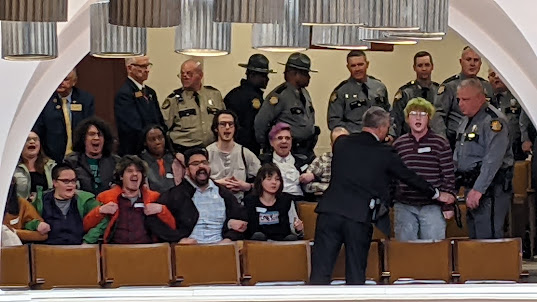
Nineteen protesters opposing Senate Bill 150 in the gallery were arrested as the House voted to override the veto of a bill to ban gender-affirming care for Kentucky's youth. (Photo by Melissa Patrick)
By Melissa Patrick
Kentucky Health News

Republicans in the Kentucky House and Senate voted Wednesday to override Democratic Gov. Andy Beshear's veto of Senate Bill 150, which bans gender-affirming care for trans youth and sets rules around how issues of sexuality should be addressed in schools. 

The Senate voted 29-8 to override the veto, with one Republican voting against the override and one Democrat changing her vote. Soon after, the House voted 76-23 for the override, with four Republicans voting against the measure and one Democrat voting for it. 

Protesters were chanting loudly from the halls while the Senate overrode the veto. In the House,  protesters in the gallery yelled, "Henry, Zachee -- they should be with us today." 

This chant was in reference to Sen. Karen Berg's 24-year-old transgender son, Henry, who died by suicide in December and the shooting death of a Louisville transgender woman, Zachee Imanitwitaho. 

Kentucky State Police arrested 19 of the protesters, according to the Lexington Herald-Leader. 

"KSP gave each individual the option to leave without any enforcement action or be placed under arrest,” Capt. Paul Blanton, a KSP spokesperson, told the Herald-Leader in a prepared statement.

Earlier that morning, hundreds of LGBTQ+ youth and their supporters rallied to ask the lawmakers to not override Beshear's veto. 

Before being removed, the protesters in the House were so loud that it was difficult to hear the lawmakers explaining their "no" votes during the veto override, even with their efforts to be heard. 

Senate Bill 150, sponsored by Sen. Max Wise, R-Campbellsville, would ban gender-affirming treatment for Kentuckians under 18, including surgeries and puberty-blocking hormones, even if parents want the treatment for their children.

It would bar schools from requiring teachers to use a transgender student's preferred pronouns, keep trans students from using bathrooms that fit their gender identity, and bans instruction that explores "gender identity, gender expression or sexual orientation," among other sex-education requirements.

Wise focused his comments on the school-related requirements, with little said about the bans on gender-affirming care for trans youth. 

"The goal is to strengthen parental engagement and communication in children's education while protecting the safety of our children," he said while explaining the bill on the Senate floor. 

“I’ve had countless number of people coming up to me from both sides of the aisle to say, ‘Thank you for standing up for common sense. Thank you for standing up and being willing to stand in that gap, to be willing to take whatever it is thrown our way,’’ Wise said on the Senate floor while explaining the bill. “If it’s hit jobs from newspaper activists, if it is for standing up for parents, for those that do not show up here in committee meetings to testify because they’re working and because they are also dependent upon us in a representative democracy, that we can make common sense decisions here that protect our children.”

Berg opened her remarks by reading the words her son, Henry Berg-Brousseau, wrote for the Human Rights Campaign that was published the day before he took his life.  

"To say this is a bill protecting children is completely disingenuous. And to call this a parent rights bill is an absolute despicable affront to me personally," she said. "We are denying families their physicians and their therapists the right to make medically informed decisions for their families. Not a single reputable society, National Medical Society in this country, supports what we are doing today. The data at this point is unequivocal.  The misinformation is appalling. Appalling that you allow this information to stand." 

Sen. Danny Carroll of Benton was the only Republican to vote against the measure. He said it was an "uncomfortable place to be" to go against his entire caucus, but he was convinced it was the right thing to do, later adding that if having access to puberty-blocking hormones saved just one child's life, they should be available to them. 

"My fear and my no vote is for those kids that are being left you Those kids that may be contemplating suicide, that may need to delay puberty, that that could have a huge impact on them. We're taking away an option that a family that a doctor would have -- we're not doctors, with the exception of a couple of us, we're not doctors, I trust them to make the right decisions when they are dealing with those kids in those specific instances." 

Sen. Robin Webb, D-Grayson,  initially voted in favor of the bill but said after further "reflection and evaluation" she voted against voting to override Beshear's veto of SB 150. Over and again, she called the bill a "bad product." She said there were parts of the bill that she could support and that the amendment offered by Carroll that was not called up for a vote was " a rational solution and a much better product." Further, she said the bill had "legitimate constitutional issues" and contradictions. 

"This discussion is not over," she said. "We will get to revisit this I'm sure once it gets through the courts. And I'm going to serve with the senator from McCracken in making sure that we achieve what the intention of this legislation is and to better perfect the provisions of it that I personally support." 

While explaining his "yes" vote, Sen. Chris McDaniel, R- Ryland Heights, said, "The bill is intended to balance the needs and desires of families with children who are following a conventional path of human sexuality, while making reasonable accommodations for those who have a different path." Later adding that the bill strives for a balance for all citizens "while protecting the rights of the minority, while respecting the will of the majority." 

It is unclear what majority McDaniel is referring to. A Mason-Dixon poll by the Fairness Campaign, a pro-LGBTQ+ rights advocacy group that paid for the poll question, showed 71 percent of respondents oppose laws letting state leaders overrule parents' wishes for gender-affirming care for their child.

In the House, 16  of the 20 Democrats stood to passionately explain their "no" votes, as there was no discussion allowed on the measure before the vote because of the protesters. No one stood to explain their yes vote. 

"This is dangerous policy, passed by poor process, supported by junk science," said Josie Raymond, D-Louisville, "We should not override this veto." 

Minority Leader Derrick Graham of Frankfort said, "Over my 21 years, this is the worst bill I've had to vote for on this floor. . . .  For over 40 years, you want limited government, you want local control, you believe in individual responsibilities, and government intervention is not the real answer to solving our problems. Well, all of those four things that I just went off and talked about, you've done. You've invaded on the rights of the parents, you've invaded on the rights of the individuals who were here today." 

The four House Republicans who voted against the veto override were Reps. Killian Timoney, Kim Moser, Kim Banta and Stephanie Dietz. Rep. Ashley Tackett Laferty was the only Democrat to support the measure.

The bill is expected to face a legal challenge. 

"To all the trans youth who may be affected by this legislation: we stand by you, and we will not stop fighting. You are cherished. You are loved. You belong," the American Civil Liberties Union of Kentucky said in a statement. "To the commonwealth: we will see you in court."

The ACLU has called this bill the most extreme anti-trans bill in the United States.

The Family Foundation of Kentucky praised the override. 

"SB 150 will protect the lives of Kentucky children by setting policy in alignment with the truth that every child is created as a male or female and deserves to be loved, treated with dignity, and accepted for who they really are," Family Foundation executive director David Walls said in a statement.

Friday, June 22, 2018

In a region and state with many teen births, E. Ky. program helps young women teach sex education outside the classroom

All Access EKY trains young Eastern Kentucky women to
push reproductive health. (Photo by Hero Images/Getty Images)
A group called All Access EKY is hiring young women between 17 and 22 to create media campaigns for reproductive health, with a focus on increasing access to a full spectrum of birth-control options in Eastern Kentucky, Ivy Brashear reports for Yes! Magazine.

Barriers to getting birth control in Eastern Kentucky are "profound," Brashear reports, and extend way beyond the ordinary obstacles of cost and access to care, to things like having access to reliable transportation (there is no public transportation), knowing if the employees at the clinic go to the same church as your parents, or simply finding a doctor who is willing to prescribe it.

"This is all assuming she knows anything about her birth-control options in the first place," Brashear writes, adding that many young women in Eastern Kentucky "must battle abstinence-only sex education in their schools and a cultural veil of secrecy about their bodies in order to fully understand their options."

She reports that only six of the 19 health departments and federally qualified health clinics in All Access EKY's seven counties offer the full range of birth-control options, and have only four nurse practitioners at public health clinics who are qualified to insert intrauterine devices (IUDs).

All Access, which began in 2016, is working to overcome these barriers by offering young women from the region an eight-week paid fellowship to create educational films that focus on birth control, with interviews of local women about their reproductive health experiences.

The women have also produced social-media campaigns, set up tables at local festivals, and distributed printed materials through clinics and local businesses, Brashear reports in her story, titled "Where Birth Control is Scarce, Young Women Create Sex Education Outside the Classroom."

All Access is a collaboration between the Kentucky Health Justice Network, the national nonprofit Power to Decide, and Appalshop, the media and arts organization in Whitesburg, where the project is housed.

Project director Stacie Sexton told Brashear that All Access works to bridge the reproductive health information gap between the publicly funded health-care providers and community members and helps clinics educate providers about birth control, using materials created by the fellows.

“That’s what makes this project unique,” Sexton told Brashear. “It’s community-centric rather than focusing on just the media side of it, or just the institutional side of it.”

Brashear reports that All Access has completed two eight-week fellowships, hired 13 fellows, and produced 20 media pieces. This summer, seven are in a six-week media workshop in partnership with Appalshop’s youth media program, Appalachian Media Institute.

“We’re trying to build some of these bridges in our communities so it’s not just teenage girls on an island and health care providers on an island and educators on an island,” All Access Media Director Willa Johnson told Brashear. “They all need to be working together to give young people a better opportunity.”

Johnson added that the program has allowed the fellows to explore a career path other than nursing or education, and that many of them have provided birth control education outside of the fellowship.

The program has also worked with policymakers on this issue. Sexton noted that Rep. Chris Harris, a Democrat from Pikeville, sponsored a bill to make it easier for women to get their birth control, and even though it didn't pass, she said their work with him was important.

She said they have also worked to find ways to work with Sen. Brandon Smith, a Republican from Hazard, who sponsored a successful bill in 2017 to ban abortions after 20 weeks. She told Brashear that his political views don't deter her from reaching out to him, stating that that would be a disservice to the the region to not work with as many people as possible to increase access to birth control.

“At the end of the day, if [Smith] wants to increase access [to birth control] to reduce abortions, we have a common goal,” Sexton told Brashear. “We come from different places, but I think we both have our hearts in the right place based on our personal value systems. He’s doing what he thinks is right; I’m doing what I think is right, but we do have a shared interest in increasing access to birth control. I can work with that.”

Why does it matter?

The 2017 Youth Risk Behavior Survey found that 38 percent of Kentucky's high-school students report that they'd had sex, and 29 percent reported being sexually active, defined as having had sexual intercourse with at least one person during the three months prior to the survey.

Of the 29 percent who were sexually active, 16.5 percent of them reported not using any method of birth control the last time they had sex; and nearly 89 percent of them didn't use both a condom and another method of birth control as is recommended.

The survey also showed that Kentucky's sexually active teens aren't using the most reliable forms of birth control; 75.5 percent reported that they did not using birth control pills the last time they had sex; 92.3 percent did not use an IUD or an implant; 94 percent did not use a patch, birth control ring or get a shot; and 51.3 percent of them did not use a condom.

And while teen birth rates in Kentucky continue to drop, to an average of 34.6 per 1,000 between 2013 and 2015, down from 37.9 between 2012 and 2014, and 48.9 five years ago -- Kentucky's teen pregnancy rate continues to be significantly higher than the national average of 22.3 per 1,000, according to the 2017 Kentucky Kids Count report.

The report also found that 16 Kentucky counties had teen-birth rates of 60 or more per 1,000, with Wolfe County leading the way at 80.9 per 1,000. That's up significantly from 68.2 five years ago. The report shows teen birth rates for every Kentucky county.

Brashear reports that out of all the pregnancies in Kentucky, 47 percent are unplanned.

A much debated bill about sex-education standards, passed during the past legislative session, requires any Kentucky school that offers sex ed to include instruction that says abstinence is the desirable goal for children, that abstinence is the only certain way to avoid unintended pregnancy or getting a sexually transmitted disease, and to teach students that the best way to avoid sexually transmitted diseases is to establish a "permanent, mutually faithful, monogamous relationship."

The new law does not require abstinence-only education, but opponents say it should have required comprehensive sex education in Kentucky schools, and by that omission sends a message to schools to teach abstinence-only curriculums, which the critics say have been proven ineffective.

Kentucky has no specified standards for sex education curriculums, though the state Department of Education has said that it is working on them. That was before the recent ouster of the department's commissioner.

Sunday, April 15, 2018

Legislature tosses health departments and mental-health centers a budget lifeline; bills on disposal of opioids become law

By Al Cross
Kentucky Health News

FRANKFORT, Ky. – As it wrapped up its business, the Kentucky General Assembly threw a financial lifeline to health departments and mental-health centers, passed a telehealth bill without an amendment favored by insurance companies, and overrode the governor's veto of a drug-disposal bill.

Budget: In a revision of the budget it passed earlier, the legislature froze for one year the pension contributions of health departments and 11 of the state's 14 community mental health centers, which were facing increases in pension payments of 49.5 to 83.4 percent, averaging 69 percent.

That would have been a double whammy with the 6.25 percent across-the-board cut proposed by Gov. Matt Bevin and included in the budget, which is likely to force cuts in personnel and services.

Bevin could veto the revision bill, but he suggested Friday evening that it was making the budget better. And he indicated that he would still have to make cuts because the budget will be unbalanced. Legislative leaders have disputed that.

Home care for the disabled: In a rare gain among programs, the budget adds $10.5 million to the General Fund to generate an extra $24.6 million in federal Medicaid money each fiscal year for the Supports for Community Living program, which enables developmentally and intellectually disabled Kentuckians to receive care in homes rather than health-care facilities.

The money will "raise reimbursement rates to SCL service providers who have not seen an increase since 2004, even as costs have risen 27 percent through inflation since that time," says the Kentucky Center for Economic Policy. "The stagnant payment rates have contributed to a 45 percent turnover rate among providers and a 41 percent decrease in services offered to intellectually and developmentally disabled Kentuckians."

Telehealth: By a vote of 65-20, he House gave final passage to SB 112, aimed at increasing access to health care and saving money by requiring the state to develop policies on health care by telecommunication –including a reimbursement model, with similar expectations for the public insurance market. The House did not consider an insurance-company floor amendment filed by Rep. Jim Gooch, R-Providence, that would have removed a key provision, requiring telehealth visits to be paid for at same level as regular visits unless otherwise negotiated. Bevin could still veto the bill.

Drug disposal: The legislature overrode Bevin's veto of House Bill 148, sponsored by Rep. Addia Wuchner, R-Florence, to shift ownership of controlled substances from deceased hospice patients to the hospice for disposal. Bevin's veto message said the bill was contrary to federal law and U.S. Drug Enforcement Agency policy, but Senate President Robert Stivers cited a DEA memo that cleared the way for the bill.

Bevin allowed to become law without his signature Senate Bill 6, sponsored by Sen. Alice Forgy Kerr, R-Lexington, to make pharmacists tell customers how to safely dispose of unused opioids and other controlled substances, and either provide or offer to sell them a product designed to neutralize drugs for disposal, or provide on-site disposal. More than 70 percent of all opioid addictions result from misuse of prescription drugs.

Other health bills: In the days before the legislature reconvened to consider vetoed bills and pass others, Bevin signed several health-related bills into law, including:

SB 5, sponsored by Sen. Max Wise, R-Campbellsville, to put the Medicaid program in charge of reimbursement rates for pharmacists. Rates are now set by pharmacy benefit managers, firms hired by managed-care organizations (mainly insurance-company subsidiaries). The bill sets reporting requirements for PBMs and MCOs and the $1.7 billion a year they get from the state. It also would allow the Medicaid program to approve contracts and fees between MCOs, PBMs and pharmacists.

HB 463, sponsored by Rep. Michael Meredith, R-Brownsville, to prohibit PBMs from requiring clients to make a co-payment that is higher than a lesser cash-payment amount, and keep them from penalizing a pharmacy for telling patients if that option is available. It is called the "clawback" bill, because PBMs "claw back" the difference between the higher co-pay and the lower price of the drug.

SB 71, sponsored by Sen. Steve Meredith, R-Leitchfield, would require the inclusion of abstinence only education in any sex-ed classes taught in Kentucky. Kentucky has no comprehensive sexual health education standards; the state Department of Education is reviewing proposed rules.

Failed bills: Health-related bills that were poised for passage but did not make it included SB 95, sponsored by Kerr, to require health insurers to cover standard fertility preservation services for patients who have become infertile by means of surgery, radiation, chemotherapy or any other medical treatment affecting reproductive organs and processes; and SB 149, sponsored by Sen. Julie Raque Adams, R-Louisville, chair of the Senate Health and Welfare Committee, to establish an advisory council for palliative care, given to make patients with incurable illnesses more comfortable.

Kentucky Health News is an independent news service of the Institute for Rural Journalism and Community Issues, based in the School of Journalism and Media at the University of Kentucky, with support from the Foundation for a Healthy Kentucky.

Wednesday, March 21, 2018

Sex-ed bill to require abstinence and monogamy be taught nears final passage; foes want comprehensive curriculum

By Melissa Patrick
Kentucky Health News

A Senate bill to require Kentucky schools to teach abstinence and monogamy in sex-education programs moved out of the House Education Committee March 20, with changes that removed all references to marriage. It was scheduled for a vote in the full House March 22, but was not called up for a vote.

Sen. Stephen Meredith
Senate Bill 71, sponsored by Sen. Stephen Meredith, R-Leitchfield, originally called for teaching that abstinence from sex "outside of marriage" is the expected standard for school-age children, but the House changed it to say that educators must teach that abstinence is the desirable goal for such children.

The amended bill also requires Kentucky's students to be taught that abstinence is the only certain way to avoid unintended pregnancy or getting a sexually transmitted disease. The original language referred to "out-of-wedlock" pregnancy.

It would also require students to be taught that the best way to avoid sexually transmitted diseases is to establish a "permanent, mutually faithful, monogamous relationship." That language replaced the original wording, "in the context of marriage."

The bill says "instruction shall include, but not be limited to" the content it specifies. Kentucky has no specified curriculum for sex education, though the state Department of Education is working on one.

Meredith spent a good deal of time talking about the push-back he has received from opponents of the bill, singling out Planned Parenthood, which he said opposes abstinence education because it has a "hidden agenda" to advance its "business model." He made similar comments on the Senate floor in January.

"They don't want our children just to be sexually aware. They want them to be sexually active, as early as possible," Meredith, a former hospital administrator, told the panel. "Planned Parenthood doesn't make money from abstinence and monogamy. They make their money from treating sexually transmitted disease, selling contraceptives and abortions."

Senate Democratic Leader Ray Jones of Pikeville called out Meredith in the chamber in January for similar comments, saying it was "preposterous" to suggest that any group wanted children to be harmed or abused. Jones voted for the bill.

Tamarra Wieder, director of external affairs at Planned Parenthood Advocates of Indiana and Kentucky, said after the committee meeting, "Planned Parenthood is a health-care provider. We want to make sure that everybody has access to information regarding their body so that they can make healthy choices, and that includes education that goes beyond abstinence only."

Other foes of the bill disputed Meredith's assertion that they don't want abstinence and monogamy to be taught as part of a comprehensive curriculum. "Abstinence is taught in every comprehensive sexuality education curriculum," Rev. Dawn Cooley of Louisville told the panel, and suggested that a comprehensive curriculum is what they should be voting on.

Sen. Denise Harper Angel
The Senate had an opportunity to do just that in a floor amendment filed by Sen. Denise Harper Angel, D-Louisville, in January, but the lawmakers  voted it down with a rousing "no" voice vote. The bill passed 32-5.

Harper Angel's amendment would have required Kentucky's health education standards to line up with national standards that call for "medically accurate, age-appropriate information on a broad set of topics, including and related to human development, relationships, decision making, as well as abstinence, contraception, and disease prevention."

Harper Angel told senators, "If the General Assembly is going to mandate certain standards, these standards need to be comprehensive health standards, not moral standards."

In committee, Rep. Attica Scott, D-Louisville, told Meredith that his bill was driven by a personal belief that he was trying to codify, and asked him why this was a political issue.

"There is a definite benefit to society," Meredith replied. "You see that many of the things that we are struggling with in our country is because those relationships aren't there. You look at the number of children who are raised by single parents today and we know immediately they are placed into a position of financial disadvantage that children who are born in a relationship with two people don't face. So I think this is a definite benefit to society and can't be discounted, shouldn't be discounted."

Scott responded, "As a single parent I disagree with you." That drew applause.

Retiring Rep. Gerald Watkins, D-Paducah, said in support of the bill that because more than half the people below the federal poverty level are single mothers, abstinence education must be part of the curriculum.

Opponents of the bill said its mandate-only approach, instead of mandating a comprehensive curriculum, sends a strong message to schools to teach abstinence-only curriculums -- which they say have been proven ineffective.

Kristen Mark, an associate professor in health education at the University of Kentucky, noted that Kentucky has the  seventh highest unintended-pregnancy rate in the U.S. and 58 percent of Kentucky high-school students report they have had sex by the 12th grade.

"Comprehensive sex education -- where abstinence is absolutely encouraged and is absolutely included, despite what might have been said in the last panel -- has worked in lowering unintended pregnancy, decreasing sexually transmitted infection rates and postponing sexual involvement among young people," Mark said. "These are goals we can all agree on. The data are very clear here."

Mark told the committee that it's important for Kentucky's children to grow up knowing how to navigate sexual experiences in a healthy way, and emphasizing abstinence doesn't do that.

"We really shouldn't be surprised by the MeToo movement," she said, referring to the campaign against sexual harassment. "We shouldn't be surprised that girls and women and boys and men don't know how to navigate consent, even in the best of sexual situations. We should not be surprised that victims of sexual assault are often very reluctant to ask for help. This is a result of shame-based, abstinence-only sex education, the kind that this bill supports."

Two supporters of the bill who spoke were from Lifehouse Maternity Home in Louisville. Its website says it is "designed to help women discover God's love for them and their children."

Michelle Bourke, donor-relations director for the home and a former teacher, said that with "our schools passing out birth control and condoms like candy," it's important for Kentucky's children to also be taught about abstinence, and stressed that the only way to prevent pregnancy and sexually transmitted diseases is through abstinence.

Monica Morgan, a resident of the home, told the panel that her decision to become "secondarily abstinent" allowed her to live a life of not worrying about sexually transmitted infections or becoming pregnant again. She stressed the importance of letting children know there are often unintended consequences of having sex, and that the only way to avoid them is to abstain.

The bill passed the committee 15-3 vote and now heads to the House floor for a vote. Scott and Reps. Mary Lou Marzian and Reginald Meeks, also of Louisville, voted no.

Saturday, January 13, 2018

Bill requiring sex-ed classes to teach abstinence until marriage clears first committee; critics want comprehensive curriculum

A bill requiring sex education classes in Kentucky to include abstinence until marriage passed out of a Senate committee, despite the pleas of four women who urged the legislators to create a more comprehensive bill.

Atherton High School senior Sophia Letson-Ettin told the Education Committee Jan. 11 that she had no objections to abstinence and monogamy being part of the curriculum, but said it should also be required to include discussions about sexual abuse, consent, contraception and healthy relationships, Deborah Yetter reports for the Courier Journal.

"I hope you will join us in support of a comprehensive sex education program," said Letson-Ettin, 18.

Sen. Steve Meredith
The bill, sponsored by Sen. Stephen Meredith, a Leitchfield Republican, says that sex education classes in Kentucky would be required to teach: "Abstinence from sexual activity outside of marriage is the expected standard for all school-age children."

Meredith argued that his bill does not say schools can't teach a comprehensive sex-ed program, only that it must teach this component. The bill passed on a 7-2 vote, with seven men on the committee voting for it.

The only woman at the hearing, Sen. Julie Raque Adams, R-Louisville, voted no. She said after the meeting that she had been assured that abstinence was already being taught in these classes.

Sen. Reginald Thomas, D-Lexington, voted no, and said a better bill would be one that offers a comprehensive set of sex-ed guidelines for the state. Sen. Gerald Neal, D-Louisville, passed, saying the panel needed more information about the current requirements and what is already being taught.

State law currently has no requirements for sex education, and curriculum on the topic is determined by each school-based decision-making council. A representative from the state Department of Education told the committee that it is working on guidelines for such classes.

Sen. Danny Carroll, a Paducah Republican who voted for the bill, said teaching abstinence and monogamy until marriage is important, "arguing that societies that don't set standards are doomed to fail," Yetter reports.

Critics of the bill said it doesn't take into account the realities of modern society.

Sara Choate, a Louisville sex educator who works with students, pointed out that most high-school students have had sexual relations by their senior year, and many have been sexually abused, Yetter reports: "Lecturing them to abstain from sex does not provide the help or information they need, she said."

Rev. Lauren Jones Mayfield, a pastor at Highlands Baptist Church in Louisville, added that the bill doesn't account for people with different faiths and sexual orientations or those who have different views about sex outside of marriage. "This assumes sex is between a married man and woman in a Christian home," she said.

Several foes of the bill noted that efforts to promote abstinence and monogamy often end up shaming or blaming women for engaging in sex, without the same consequences for their male partners.

Men on the committee said the bill was not intended to shame anyone. Mayfield said this concern is likely something the men on the panel don't understand.

"As four women sitting here saying shame is very much a part of this, you as men are so confident saying that's not the intent," she said, drawing applause from the audience. "I feel like our realities are different from yours because that hasn't been your experience."

Tuesday, November 22, 2016

Teen birth rates are declining faster in urban counties than rural ones, nationally and in Kentucky

By Melissa Patrick
Kentucky Health News

Kentucky's teen birth rates are dropping faster in its urban counties than in its rural counties, a trend that has also been found across the nation, according to the federal Centers for Disease Control and Prevention.

A CDC report looked at the differences between teen birth rates in rural and urban areas from 2007 to 2015 and found that among teens ages 15 to 19, birth rates in Kentucky's urban counties dropped 43.9 percent, and 31.8 percent in its rural counties. Both lagged the national decreases; teen births in the U.S. dropped 47.6 percent in urban counties and 37.1 percent in rural ones during the period.

In Kentucky, the teen birth rate in urban counties was 26.4 births per 1,000 females in 2015, a reduction of 44 percent from the 47.1 reported in 2007. The state's rural teen birth rate was 40.9 per 1,000 in 2015, a 33 percent reduction from the 60 per 1,000 in 2007.

While teen birth rates have dropped significantly in Kentucky in recent years, they remain higher than the national average. Kentucky's teen birth rate in 2015 was 32.4 per 1,000, almost half again as much as the national average of 22.3 per 1,000.

Nationally, in large urban counties teen birth rates fell 50 percent between 2007 and 2015, 18.9 births per 1,000. The rate dropped 44 percent in small to medium-sized urban counties, to 24.3 births per 1,000; and 37 percent in rural counties, from 49.1 to 30.0 per 1,000.


The report didn't explain why teen birth rates have decreased more in urban areas, but in 2015 the National Campaign to Prevent Teen and Unplanned Pregnancy issued a report that tried to explain the disparities, Sarah Frostenson reports for Vox.

It found that teens in rural areas have reduced access to health services that offer contraception, have fewer college opportunities, have higher uninsured rates, have higher poverty rates and have fewer "positive recreational outlets," which is associated with increased risk taking.

"Disparities in the teen birth rate, which we believe mirror disparities in the teen pregnancy rate, are largely explained by differences in economic opportunities and access to health care, including access to contraceptive services," says the report.

In Kentucky, teens in rural counties have access to contraception at local health departments, which can provide a broad range of contraceptive choices to teens without parental consent. However, the National Campaign report found that rural teens often face transportation barriers.

"All adolescents receiving family planning services in the local health department receive counseling on family involvement in decision making (regardless if a parent is present or not), avoiding sexual coercion and abstinence as the healthiest contraceptive choice for teens," according to an e-mail from the Department for Public Health's Division of Women's Health.

Another challenge facing Kentucky teens is a possible lack of reliable information about sex because the state only requires abstinence be taught in the classroom during mandated sex education classes (an approach that has been proven ineffective) and doesn't require a set curriculum for fact-based, comprehensive sex education.

The CDC report also showed disparities by race and geographic location.

It found that in 2015, birth rates among white teens was lowest in large urban counties, but about 2.5 times higher in rural counties than in large urban ones (10.5 and 26.8 per 1,000 respectively). It found that teen birth rates among Hispanic teens (34.1 per 1,000) and black teens (29.1 per 1,000) were higher than the white teen rate and that birth rates for both of these groups were even higher in rural counties, 39.6 per 1,000 births for black teens and 47 per 1,000 for Hispanic teens.

Tuesday, May 3, 2016

Studies conclude that abstinence pledges do little to cut youth sexual activity, pregnancies, sexually transmitted diseases

Abstinence pledges—sometimes called purity pledges—don't keep young people from engaging in sex, contracting sexually transmitted diseases or avoiding pregnancy, according to a pair of studies, Denise-Marie Ordway reports for Journalist's Resource. The main problem is that students are not receiving enough sex education. A federal Centers for Disease Control and Prevention report from December 2015 found that "fewer than half of high schools and only a fifth of middle schools teach all 16 topics recommended by CDC as essential components of sexual health education."(CDC graphic)

A 2005 study by Yale and Columbia universities found that 88 percent of youth who take the abstinence pledge engage in pre-marital sex, Ordway writes. "The study found that pledgers were just as likely to get STDs as those who never made a pledge of virginity."

A more recent study, published in April in the Journal of Marriage and Family, found that among students in grades 7 to 12, "as a whole, young women who did not take abstinence pledges and those who did but broke them were equally likely to acquire HPV, a common STD," Ordway writes. "Approximately 27 percent of each group tested positive for HPV. Of the young women who had two or more sex partners, pledge breakers were more likely to have HPV. The difference was largest among women who had between six and 10 sex partners. One-third of women who had not taken a pledge and had six to 10 sex partners tested positive for HPV. Meanwhile, 51 percent of pledgers who had six to 10 sex partners acquired HPV. About 30 percent of pledgers and 18 percent of non-pledgers became pregnant within six years after they began having sexual intercourse outside of marriage."

"In the U.S, the teen pregnancy rate is higher than in any other western industrialized country, according to the CDC," Ordway writes. "At the same time, a growing number of American teens and young adults have been diagnosed with sexually transmitted diseases (STDs). While individuals aged 15 to 24 make up 27 percent of the U.S. population that is sexually active, the CDC estimates that they account for half of the 20 million new infections occurring annually."

Thursday, April 14, 2016

Teens who talk to their parents about sex make the best choices; Clark County will offer parenting classes on sex communication

In an average Kentucky high school class of 30 students, almost 13 of the teenagers say they have had sexual intercourse at least once, but many of them have never discussed sex with their parents.

And while Kentucky parents may think their children are learning about sex in the classroom because Kentucky mandates sex education, they may not realize that the state has no set curriculum for fact-based, comprehensive sex education, and the only thing required to be taught is abstinence -- an approach that has been proven ineffective, Aaron Yarmuth reports for Leo Weekly in an in-depth article about sex education in the state.

This lack of parent-teen communication about sex has prompted a study in Clark County that will include classes to help parents become more comfortable talking about sex with their children, Whitney Leggett reports for The Winchester Sun.

The classes will be led by Shannon Phelps of Winchester as part of her research to earn a doctorate in interdisciplinary education sciences from the University of Kentucky, Leggett reports. It is funded by a $15,700 grant from the Clark County Community Foundation.

“Because the subject matter is not one that many people are comfortable with, part of the objective is to help increase parents’ comfort in discussing sexual health topics so they will be more likely to address those topics with their children,” Phelps told Leggett.

"The overall goals of the program are to increase frequency and quality of parent-child sexual health communication, improve parents’ comfort and confidence in their communication with their children about sexual health topics and increase openness of sexual communication between parents and their children," Leggett writes. "Topics will range from abstinence to safe sex, contraception, resisting peer pressure and communicating with potential partners, among others."

Phelps said the six week courses will promote parent-child sexual health communication, which is associated with better sexual health outcomes for young people.

“Research tells us that children, especially adolescents, who have parents who communicate with them about sexual health topics have better sexual health outcomes,” Phelps told Leggett. “That follows logic... Sometimes parents are hesitant to talk to their children for fear that they’ll go and have risky sexual behaviors, but research tells us the opposite.”

Phelps told Leggett that studies show that when parents talk to their children about sex, "it can delay the onset of sexual behaviors and reduce unintended outcomes like sexually transmitted infections and unintended pregnancies," Leggett writes.

For more information email Phelps at shannon.phelps@uky.edu, or call 859-621-1065.

A study published in the Pediatric Journal of the American Medical Association found that nearly one-fourth of youth report that they have not discussed sexual topics with their parents, and even fewer report that they have had meaningful, open conversations with them about this subject. The study attributes this poor communication to parental embarrassment, parents' lack of accurate knowledge of the subject, and poor self-efficacy.

It's a topic that needs discussion in Kentucky because almost 10 percent of the state's middle-school students have had sexual intercourse and almost one-third of its high school students are sexually active, according to the 2015 Kentucky Middle and High School Youth Risk Behavior Survey.  The survey found that overall, 41.7 percent of Kentucky's high school students have had sexual intercourse at least once.

And there is an obvious disconnect related to birth control. Kentucky ranks seventh in teen births, at 39.5 births per 1,000 females aged 15 to 19, according to America's Health Rankings. The 2015 YRBS found that 14.5 percent of high school students did not use any birth- control during the last time they had sexual intercourse.

Sunday, April 10, 2016

Is pervasive pornography the newest public-health crisis?

Gail Dines, a professor of sociology at Wheelock College in Boston and author of Pornland: How Porn has Hijacked our Sexuality, argues in an essay for The Washington Post that "porn is a public health crisis rather than a private matter."

The internet has made pornography generally accessible, to the point that porn sites get more visitors than Netflix, Amazon and Twitter combined" (a Huffington Post headline from 2013), some researchers estimate the average age of first viewing porn at 11, and "free and widely available pornography is often violent, degrading and extreme."

Gail Dines
Dines notes studies that have found correlations between porn viewing and sexual harassment and toleration of sexual assault, and that college-age women whose partners use porn "suffered diminished self-esteem, relationship quality and sexual satisfaction."

"As the evidence piles up, a coalition of academics, health professionals, educators, feminist activists and caregivers has decided that they can no longer allow the porn industry to hijack the physical and emotional well-being of our culture," Dines writes. "Culture Reframed, an organization I founded and currently chair, is pioneering a strategy to address porn as the public health crisis of the digital age. We are developing educational programs for parents, youth and a range of professionals that aim to help shift the culture from one that normalizes a pornographic, oppression-based sexuality to one that values and promotes a sexuality rooted in healthy intimacy, mutual care and respect."

Dines concludes, "Parents and educators at every level need to know that if porn is not discussed in a research-based, age-appropriate sexual health curriculum, its effects will surely show up as sexual harassment, dating violence and inadvertent “child pornography” on students’ phones. Pornography can cause lifelong problems if young people are not taught to distinguish between exploitative porn sex and healthy, safe sex. As the research shows, porn is not merely a moral nuisance and subject for culture-war debates. It’s a threat to our public health."

Monday, November 23, 2015

Talking to teens about sex makes them (especially girls) have safer behavior, here's expert advice on how to talk about it

As uncomfortable as it may be to talk about safe sex with a teenager, it can have a positive impact, especially for girls, according to a new study published in the Pediatric Journal of the American Medical Association.

"Sexual communication with parents, particularly mothers, plays a small protective role in safer sex behavior among adolescents; this protective effect is more pronounced for girls than boys," says the study report.

The study examined the link between parent-adolescent communication about sex and safer sex practices among youth. It analyzed 52 studies on the topic from more than 30 years of data and included more than 25,000 adolescents.

"Our results confirm that, across more than 50 studies, parent-adolescent sexual communication is positively associated with adolescents' use of contraceptives and condoms regardless of communication topic or format," says the report.

It is a message many Kentucky teens need to hear.

According to the 2013 High School Youth Risk Behavior Survey, 44.7 percent of Kentucky's students have had sex at least once, and almost one-third (31.7 percent) of them are sexually active. Almost half of them (46.9 percent) did not use a condom during their last sexual intercourse and 15.1 percent of them did not use any method to prevent pregnancy. And while Kentucky's teen pregnancy rate is at an all time low of 39.5 per 1,000 girls between 15 and 19, it's still much higher than the national rate of 26.6 per 1,000, according to the federal Centers for Disease Control and Prevention.

In addition, young people between the ages of 15 and 24 account for about half of all new cases of sexually transmitted diseases in the U.S. each year, says the CDC.

Despite the risk of disease and pregnancy, nearly one-fourth of youth report that they have not discussed sexual topics with their parents, and even fewer report they have meaningful, open conversations with them about this subject, the study found.

The study attributes this poor communication to parental embarrassment, parents' lack of accurate knowledge of the subject, and poor self-efficacy. It suggest physicians and other health care professionals should encourage these discussions and encourages parents to seek formal instruction on how to discuss safe sex practices with their children.

CBS News asked several experts for some do's and dont's to help parents talk about sex with their teens.

Dr. Anna-Barbara Moscicki, chief of Adolescent and Young Adult Medicine and professor of pediatrics at Mattel Children's Hospital UCLA, told CBS that parents should start talking about sex early "so it's never awkward." She said parents should answer all their children's questions about sex, but "keep it age-appropriate." She reassured parents that "talking about sex does not make your kid want to have sex."

Moscicki also advised that you should never confront a teen with questions such as, "Are you having sex? Are you using condoms?" Instead, she says you should be a resource and ask, "Do you know where to get condoms or get birth control?"

Dr. Leslie Walker, division chief of adolescent medicine at Seattle Children's Hospital, told CBS that "parents need to be informed before they talk with their kids about sex," including accurate information about modern and efficient methods of birth control than weren't available when they were younger.

She said parents should not be afraid to share their family values and that talking about safe sex should not be a "one time chat," but instead an ongoing conversation.

Walker also said that parents need to push through the awkwardness of the conversation and not be judgmental or punitive, which she said will allow teens to know they can rely on their parents for help if something were to happen, like an unplanned pregnancy or a sexual assault.

"Don't shut kids down," Walker told CBS. "Don't shut down the lines of communication, like saying, 'If you ever do this, then you're out of the house.'"

Both experts agreed that parents shouldn't overshare. Walker said, "Kids don't want to know about their parents' sex life, or what happened to you when you were a teen." But they might if you lecture them about their behavior and make them defensive.

Monday, April 21, 2014

Berea students' second health fair tackles touchy topics

Della Walters tries to walk straight while wearing "drunk goggles" at
the Berea health fair. (Richmond Register photo by Crystal Wylie)
Student-run health fairs are becoming more popular across Kentucky, and some of them are touching on touchy topics. At their second health fair recently, for middle- and high-school students, Berea Community High School health students "handled more mature issues" than at their first, for elementary-school students. reports Crystal Wylie of The Richmond Register.

"Although students had their pick of topics ranging from sexually transmitted diseases, drunk driving, smoking, mental health, sugary drinks, learning disabilities and fitness," health teacher Cathy Jones said some students wanted to include 'sexting,' sexually oriented text messages. She allowed their presentation to pair the topic with cyber-bullying; students asked their classmates to sign a pledge against doing both.

“It’s a hot topic and something teenagers encounter,” Jones told Wylie. “They thought it was important to cover.” Jones said she plans to hold a fair twice a year. Meanwhile, Eastern Kentucky University professor Laurie Larkin and her public-health students conducted a health fair at Clark-Moores Middle School, Wylie reports. (Read more)