Showing posts with label poverty. Show all posts

Thursday, June 13, 2024

Deaths from colorectal cancer in Appalachian Kentucky have declined, but far less than in the rest of the nation, UK study says

County rates per 100,000 are seen in five ranges or quintiles.(Map adapted by Kentucky Health News)
Kentucky Health News

Deaths from colorectal cancer in Appalachian Kentucky declined from 1999 to 2020, but far less than the rate of decline in the rest of the nation.

That's the upshot of a University of Kentucky study analyzing death data.

It found that in the 54 Kentucky counties served by the Appalachian Regional Commission, the mortality rate fell from 31.24 deaths per 100,000 residents in 1999 to 24.46 per 100,000 in 2020. But the national rate dropped by almost half, from 27 deaths per 100,000 Americans in 1999 to 14.81 in 2020. In non-Appalachian Kentucky, the rate dropped from 27.6 to 17.1.

During the entire 21 years covered by the study, the colorectal-cancer death rate in Appalachian Kentucky was 25.8 per 100,000 residents. In the 66 non-Appalachian counties, the rate was about 22 per 100,000. The national rate was 19.43 deaths per 100,000. Kentucky has the fourth highest death rate. 

The Kentucky county with the highest age-adjusted rate from 1999 through 2020 was Fleming, at 39.6 deaths per 100,000 residents. The next highest were Harlan, 34.4; Bath, 33.2; Pike, 32.1; Breckinridge, 31.6; Henry, 31.5; Todd, 31.1; Carter, 30.7; Lewis, 30.7; Cumberland, 30.6; Mason, 30.5; Lawrence, 30.4; Morgan, 30.4; Clay, 30.2; Letcher, 29.7; Washington, 29.4; Nicholas, 28.6; Breathitt, 28.5; Perry, 28.5; Floyd, 28.3; Monroe, 28.3; Powell, 28.2; and Nelson, 27.9 (all in dark blue on the map).

The counties with the 10 lowesr rates were Lyon, 14.9 per 100,000; Trimble, 16.97; McCracken, 17.7; Jessamine, 18.2; Shelby, 18.3; Madison, 18.4; Bullitt, 18.7; Trigg, 18.8; and Owen, 18.8.  Rates for Hickman and Robertson counties were not reported due to small case numbers.

The study, in the journal Gastroenterology, used data from the Centers for Disease Control and Prevention on the causes of death for Americans 15 or older. Its lead author is Dr. Syed Hassan, a research coordinator and clinical research scientist in UK's Department of Internal Medicine.

Hassan "said efforts to enhance screening rates should be improved and more education on colorectal cancer is needed," according to a UK news release.

He noted that In Appalachian Kentucky, nearly 41% of the colorectal cancer deaths occurred at home, suggesting that many victims might not have been seen by a doctor until the cancer had significantly advanced.

“That’s concerning, in my opinion,” Hassan said. “Access to health care, lifestyle related modifiable risk factors and education are important factors we should further work upon.”

Hassan also said anxiety about colonoscopies and other cancer screenings, and lack of education about the disease, may also play a role: “Many of these patients might’ve believed that they probably wouldn’t be able to afford as much care due to their socioeconomic status.”

Screening for colon cancer is recomended to start at age 45, because cancers of the colon and rectum tend to occur after age 40, but recent studies have shown increases in younger people, especially those with risk factors.

These cancers tend to run in families; studies show that if a close relative has had colorectal cancer, you can be predisposed to polyps — pre-cancerous lesions that can lead to the development of the cancer,

Other risk factors include age and lifestyle factors such as smoking, sedentary living, obesity, a diet rich in red meat, salt and saturated fats or a low-fiber diet.

Friday, January 19, 2024

Bipartisan 'momnibus' bill aims to improve health of mothers, kids

State Rep. Kim Moser, a Republican from Taylor Mill in Northern Kentucky, spoke with other female legislators at a press conference Wednesday to announce their "Momnibus" bill. (Legislative photo)
Kentucky Health News

Legislators are accustomed to seeing "omnibus" bills that deal with many subjects, sometimes related, sometimes not. Now the Kentucky General Assembly has a "momnibus" bill intended to improve the health of children and mothers, including expectant ones.

House Bill 10 was developed by an informal, bipartisan group of female legislators concerned about the state's poor maternal health, said its main sponsor, Rep. Kim Moser, R-Taylor Mill.

"Addressing Kentucky's high maternal mortality rate and saving mothers and babies is obviously a priority for all of us," Moser said at a Wednesday press conference. Kentucky had the nation's sixth highest maternal death rate, 38.4 deaths per 100,000 live births, from 2018 through 2021. The national rate for that period was 23.5 per 100,000.

More than 90% of the state’s maternal deaths are preventable, Dr. Jeffrey M. Goldberg, legislative advocacy chair of the Kentucky chapter of the American College of Obstetricians and Gynecologists, told a state Senate committee last year. Just over 14 percent of Kentuckians lack access to adequate prenatal care, according to the March of Dimes.

Moser, a mother of five who was a neonatal intensive-care nurse, spoke from her own experiences: “I’ve really worked with mothers and babies and sick newborns, in their newborn phase, oftentimes through their first year, and I was able to really see some of the reasons for poor health disparities, especially in our poor areas of our state.”

Citing the advocacy group Every Mother Counts, Moser said “The leading causes of maternal death in the U.S. [are] lack of access to health care, including a shortage of caregivers, a lack of insurance, inadequate postpartum supports and certainly socioeconomic disparities, including the stress of racism and discrimination.” In Kentucky, she added, the risks are greater because of the prevalence of heart disease and diabetes.

HB 10 would:

  • Add pregnancy to the list of "qualifying life events" that allow people to get health-insurance coverage outside normal enrolment, which could encourage more prenatal care.
  • Create the Lifeline for Moms Psychiatry Access Program, for which Kentucky has received a $750,000 grant. Moser said she will also ask for an appropriation in the state budget “to make sure that’s a sustainable program.” It would be required to operate a hotline from 8 a.m. to 5 p.m. Mondays through Fridays.
  • Expand the HANDS (Health Access Nurturing Development Services) home-visitation program for new and expectant parents to include breastfeeding counseling and assistance, education on safe sleep, as well as expanding the program to include telehealth, which Moser said she believes will help “reach moms in underserved areas or areas where she may have a transportation issue.”
  • Require the Cabinet for Health and Family Services to study and make recommendations about the role of doulas, who provide assistance with the birth experience. 
  • Strengthen an advisory council that provides policy guidance to increase collaboration, improve data collection, and suggest additional improvements.

Some Kentucky Republican legislators began paying more attention to such issues after the U.S. Supreme Court eliminated the federal right to abortion, activating a state "trigger law" that bans abortion except to save the mother's life or prevent permnent damage to a life-sustaining organ. 

"The wide gulf between abortion-rights and anti-abortion lawmakers was felt when Moser invited Addia Wuchner, executive director of the Kentucky Right to Life Association, to speak at the end of the press conference," reports Rebecca Grapevine of the Courier Journal. "That prompted most of the assembled Democratic lawmakers . . . to quietly walk out of the room."

State Rep. Sarah Stalker
One Democrat who remained, Rep. Sarah Stalker of Louisville, told the Courier Journal, "If we're going to force people to have children when they are not prepared to, when they are not ready to, when they are not interested in the family, it is critical that we give them the access to the health insurance . . . It doesn't help me and it doesn't help Kentucky, you know, Kentuckians at large and particularly women, to dig in my heels."

The second listed sponsor of the bill is Rep. Nancy Tate, R-Brandenburg, a leading anti-abortion legislator. Other Republican sponsors are Reps. Danny Bentkey of Russell, Emily Callaway of Louisville, Stephanie Dietz of Edgewood, Robert Duvall of Bowling Green, Ken Fleming of Louisville, Mark Hart of Falmouth, Kiom KIng of Harrodsburg, Amy Neighbors of Edmonton, Rebecca Raymer of Morgantown, Tom Smith of Corbin, Nick Wilson of Williamsburg and Susan Witten of Louisville.

Besides Stalker, the bill's Democratic sponsors are Reps. Lindsey Burke and Cherlynn Stevenson of Lexington. Democratic Reps. Lisa Willner of Louisivlle and Rachel Roberts of Newport initially attended the press conference but left and are not listed as sponsors.

Information for this story was also provided by the Kentucky Lantern.

Thursday, December 14, 2023

Travel for abortions, mainly from states like Kentucky, has doubled following Supreme Court decision, and can pose many difficulties

OPINION By Katelyn Jetelina
Your Local Epidemiologist

This week, Kate Cox got an abortion, but had to leave Texas, where she lives, to get it. She joined more than 9.3 million Americans who got a legal abortion in the past 10 years, of which 8,300 (0.9%) got one after 20 weeks of gestation. (Texas and Kentucky have similar, near-total bans on abortion.—Editor.)

I’ve seen many on social media wonder: What’s the big deal? She found the health care she needed after all; and this cross-state journey is rare, right?

Forced abortion travel has doubled following the U.S. Supreme Court's Dobbs ruling. And if you’re one of the lucky few who can travel, this journey isn’t without very real challenges that may not be apparent to the unseen eye.

The journey for an abortion looks very different depending on who you are. In general, though, many challenges could be prevented if we, as a society, accepted abortion as health care.

First, many people’s journeys stop before they begin. It can take a lot of cash—plane tickets, rental car, hotel rooms, food, and procedure. This adds up to about $10,000 to $30,000. As you can imagine, many people can’t afford this, and often, insurance doesn’t cover it. Half of all abortion seekers live below the federal poverty level—an income of less than $13,000 a year. This is especially true for adolescents and teens (who make up a big number of later abortion patients), undocumented people, and parents.

If they make the journey, it’s not without other hard realities:
  • Pain meds are available. For those later in pregnancy, though, it doesn’t do much. You may not have access to an epidural, depending on the state’s regulations, because you’re at an outpatient clinic. This is unimaginable pain—in all senses of the word.
  • Your partner can’t be there to support you during labor, like hold your hand, or coach you through pain. You can’t have a phone, either. Tight security is required at abortion clinics. In the same vein, you walk past protesters yelling at you every morning and every night for a week. You wish, with all your heart, you could enjoy the same level of ignorance.
  • Recovering in a hotel room means a cold, unfamiliar place. Without your slippers, without your bed, without your cat, and without access to the comfort food you crave. All you want to be is at home.
  • The journey means needing time off from work and getting your Family Medical Leave Act form signed by a physician in another state. All you hope is that your employer won’t ask questions because you don’t have any energy to explain.
  • The journey may include carrying the baby’s ashes on an airplane. This requires holding back a flood of emotions in public—exhaustion, grief, anxiety, pain, a strong desire for privacy.
  • People who have abortions are no more likely to struggle with mental health than the people who do not—in fact, not getting a needed abortion has been found to increase anxiety and depression in the first 12 months. But there are emotional costs in needing to travel, and much of that is driven by stigma and ostracization of abortion care. Also, recognizing when you need help (remember you don’t have a follow-up appointment with your OB) and finding the right clinician or therapist, given the unique circumstances and the trust required, is hard.
Two things help. First, confidence in making the right decision: 95% of people who have an abortion say it was the right decision for them. The most common emotion reported afterward is relief. Second, health-care workers—literally angels on earth—at the abortion clinic ensure moments of human connection, empathy, and support. You feel cared for, which helps tremendously. And the rare souls you trust with your story like family, friends, and clinicians thereafter also help tremendously.

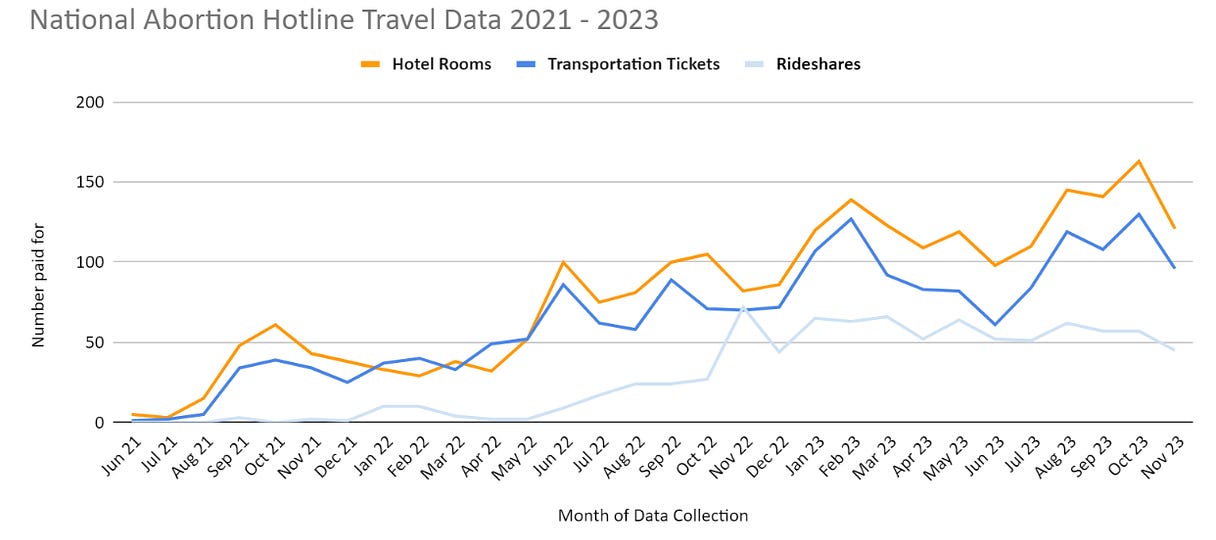
This journey is becoming more common. Before Dobbs, 1 in 10 women having abortions had to travel. Now the rate has doubled, to 1 in 5. We see increased travel from many angles. While the number of abortions across states has greatly shifted post-Dobbs, the national average hasn’t budged.
Calls to the National Abortion Hotline for travel services, like hotel rooms and plane tickets, have tripled post-Dobbs and remain high.

Map from National Abortion Federation, based on data from its National Abortion Hotline
Scientists who measured distance to abortion facilities found average travel time also tripled post-Dobbs.

This speaks to why we see increases in self-managed abortion (i.e., medication abortion). It’s also why colleagues in Latin America, for example, have been supporting people to self-manage with pills up to 24 weeks of pregnancy, which is safe and effective.

An increasing number of women are traveling out of state for reproductive health care. This journey isn’t without very real obstacles. The most tragic part is much of the associated trauma is preventable if we had access to local health care.

It may be hard to understand, but it’s harder for people to live through. Trust women. Listen to their stories. Trust their voices. It is, after all, their lives and their livelihoods.

(A big "thank you" to Dr. Heidi Moseson, a reproductive epidemiologist who helped immensely with much of this piece’s research.)

If you want to support travel for abortions, here are some great options: The Brigid Alliance supports people who are traveling for abortions at 15+ weeks. The National Network of Abortion Funds a collective of over 100 abortion funds across the U.S.

“Your Local Epidemiologist” is written by Dr. Katelyn Jetelina, MPH, Ph.D.—an epidemiologist, data scientist, wife, and mom of two little girls. During the day, she works at a nonpartisan health policy think tank and is a senior scientific consultant to a number of organizations. At night she writes this newsletter. Her main goal is to “translate” the ever-evolving public health science so that people will be well-equipped to make evidence-based decisions.

Sunday, August 27, 2023

State and advocates try to keep eligible Kentuckians on Medicaid

State employees staffed a booth at the Kentucky State Fair to help people understand Medicaid changes and how to apply for the program or other coverage. (Ky. Lantern photo by Deborah Yetter)
By Deborah Yetter
Kentucky Lantern

Some patients find out they’ve been dropped from Medicaid when they come in to pick up a prescription. Others, when they arrive for a doctor’s appointment.

And some are struggling to cope with paperwork or documentation required to prove eligibility for Medicaid under new rules that require such information for the first time in three years.

Ashley Shoemaker, director of outreach for the Family Health Centers in Louisville, recalls the relief one man expressed when he was contacted as part of an effort to alert patients about the Medicaid changes.

“He said, ‘I’ve been trying to do this on my own and I don’t know where to start,’” Shoemaker said. “He’s eligible; he just didn’t know where to begin.” Staff helped him complete his application.

But around 70,000 people in Kentucky have been terminated from the health plan for low-income and disabled individuals through June, the latest numbers available from the state.

Mosyt lost coverage for not responding to paperwork, or not properly completing it.

How to renew your Medicaid

What’s going on with the program? If you get health coverage through Medicaid, you may have to resume the annual process of proving you are still eligible for the federal-state health plan for low income and disabled individuals. The requirement was suspended for three years during the Covid-19 pandemic but in Kentucky, resumed in May.

What do I need to do? Watch for a notice in the mail from state Medicaid officials, and be sure to read it and return it with any information requested. If your address has changed in the past three years, make sure the state has your current address either by notifying the state Department for Community Based Services in your county or by calling 1-855-306-8959.

If you have an account through kynect, the state’s online health insurance site, you can log in and update your information and check to see whether you have any messages requiring action. The kynect phone number is 1-855-4kynect (459-6328).

Where can I get help? If you don’t apply by mail or online, you can visit any Department for Community Based Services office; there’s one in every county.

You also can call the kynect hotline listed above to ask help finding a kynector — workers trained to help people get health coverage. They are located at agencies, clinics and other sites.

What if I no longer qualify for Medicaid? Visit the kynect site or meet with a kynector or local insurance agent to look for other options. A number of low-cost health plans are available with federal subsidies that make them affordable.

Health advocates in Kentucky — as well as nationwide — are watching and working to ensure people who are eligible remain insured as states transition back to yearly recertification for Medicaid. The state began sending the first round of notices in May, based on a member's renewal month.

“For three years, people didn’t need to respond to notices they received because their coverage was going to continue,” said Emily Beauregard, executive director of Kentucky Voices for Health, which is closely monitoring the situation.

During the pandemic that began in 2020, the federal government suspended the annual requirement that people prove they are eligible for the coverage which is based largely on income.

Kentucky’s $15 billion-a-year Medicaid program covers 1.6 million people, including adults, children and individuals in nursing homes, with the federal government covering 70% to 80% of the costs.

With the recent decision to lift the federal public health emergency, the states must again begin requiring annual renewal by members.

And that’s proving difficult among people who aren’t used to the annual requirement, may not understand the process or don’t have access to technology required to complete online applications and upload documents, such as income verification, advocates said.

“It’s hard to know if people understand what they need to do and are taking those steps,” Beauregard said.

70,000 Kentuckians terminated through June

Molly Lewis, CEO of the Kentucky Primary Care Association, said she worries that people who have benefited from expanded mental-health and addiction treatment in recent years could suffer if they inadvertently lose Medicaid coverage.

“I am most concerned about all those who have benefited from behavioral-health services,” said Lewis, who represents a network of clinics that see about one million patients a year.

Through June, 70,000 of the around 900,000 Kentucky adults covered by Medicaid have been dropped from the health plan, most losing coverage for “procedural reasons,” such as failing to respond to a renewal notice sent by the state.

Other states are posting similar numbers, with 75% of disenrollments nationwide due to procedural reasons, according to the Kaiser Family Foundation, a non-partisan health policy organization which offers a Medicaid enrollment tracker on its website.

That doesn’t mean all Kentuckians who lose Medicaid lack health coverage.

Eric Friedlander, secretary of the state Cabinet for Health and Family Services, which administers Medicaid, said Kentucky structured its 12-month recertification plan to first target those who are most likely to have obtained other health coverage. That includes up who people 65 and qualify for Medicare, the government plan for older Americans, or who have obtained coverage through employment.

Advocates agree with the approach but still worry that too many people who are eligible are losing coverage for failing to receive or respond to notifications from the state. With only a few months of data available, it’s hard to tell, said Beauregard.

“At this point, it’s too soon to know how many people are walking around uninsured and either don’t know it or think they are not eligible,” she said.

Preliminary numbers show as many as 40% of those losing Medicaid coverage may have obtained other health insurance. And about 3,000 people who lost coverage have been reinstated once they provided applications or documentation, such as proof of income or address, Friedlander said.

Meanwhile, about half of those targeted each month for Medicaid recertification don’t have to do anything at all. They are deemed eligible through “passive” renewal, in which the state is able to validate information such as income and household size by checking state and federal databases.

And those whose income has increased, making them no longer eligible for Medicaid, may be eligible for low-cost, federally-subsidized private plans through kynect, Kentucky’s online health insurance exchange, Medicaid Commissioner Lisa Lee said: “There really is something for everyone.”

Stakes high for kids

Kentucky's approach means thatg it has avoided cutting children from Medicaid. Advocates have sounded sound the alarm about other states where high numbers of children are losing coverage — most often for procedural reasons.

The tens of thousands of children losing coverage in some states prompted one group that monitors Medicaid to suggest states suspend terminating kids to determine what’s going wrong.

In Idaho, for example, around 23,000 children have been removed for failing to return recertification forms, according to the Idaho Capital Sun. Arkansas also has moved aggressively to cut people, including children, from Medicaid.

“The stakes are high,” said a blog post on the Georgetown University’s Health Policy Institute Center for Children and Families. “Gaps in coverage are problems for anyone — but especially for children, who, while not expensive, are regular users (or should be) of health care.”

Children and adults in rural states including Kentucky are especially dependent on Medicaid for health care, the center reported.

Nationwide, seven rural counties have half or more of their adults covered by Medicaid and six of those counties are in Kentucky, it said.

Around 600,000 Kentucky children have health coverage through Medicaid or the Children’s Health Insurance Program, known as CHIP, a Medicaid program for children whose parents earn too much to qualify but are still considered low-income.

That’s more than half the state’s children.

They will be among the last to be recertified under the 12-month process Kentucky began in May, Friedlander said.

‘Health care is expensive’

Meanwhile, state officials, advocacy groups, community clinics and others are working to alert Medicaid patients to the changes through notices, fliers, mail, phone calls, text messages and other means.

State officials set up an exhibit at the Kentucky State Fair to inform the public about changes, with private booths where state workers helped people apply for or renew coverage.

Advocates are especially concerned about those who might unknowingly lose coverage by not receiving or responding to a notice.

“It is important that individuals have insurance coverage because health care is expensive,” Lewis said. “A medical bill for something that’s not covered can be really debilitating.”

It could also affect community clinics that serve a high percentage of Medicaid patients and operate on tight budgets.

“It definitely can affect us from the bottom-line standpoint,” said Kirstie Matzek, CEO of the Shawnee Christian HealthCare Center, a federally authorized community health service in Louisville.

Matzek said her clinic staff has been attending events such as festivals and church picnics to hand out information. Staff also has been notifying patients about the Medicaid changes, she said.

“I know there’s a level of responsibility for the patient,” Matzek said. “But I think we have a responsibility as well.”

Saturday, May 13, 2023

The sickest rural Americans may be the least able to afford care

Photo by Charles Deluvio, Unsplash
A new study by the University of Southern Maine shows that in the two years prior to the pandemic, rural residents who were the most in need of medical care often did not seek it because of costs, reports Liz Carey of The Daily Yonder. The study revealed a disturbing lack of care-seeking among ill rural residents; its abstract says: "Rural adults (18-64) were more likely than their urban counterparts to report problems paying, or being unable to pay, their medical bills. They were also more likely to delay or go without care because of the cost. Compared with urban adults, those in rural areas were more likely to engage in prescription drug cost-saving measures such as skipping doses, delaying refills, or taking less medication than prescribed."

"Most concerning, said Erica Ziller, one of the study’s authors, was that rural adults with the worst health were more likely to report not getting the care they needed because of the cost," Carey writes. Ziller told her, "It's almost like a grotesque Catch-22, right? We're talking about the people who need health care the most, presumably, and also who are experiencing the most difficulty in getting the services they need."

Researchers used National Health Insurance Survey data from 2019-20 and "examined rural-urban differences in affordability of care and cost-saving strategies among . . . 36,000 adults between the ages of 18 and 64 with nearly 5,000 of whom lived in a rural county," Carey reports. "The study found that nearly a fifth of the rural residents (18%) said they were uninsured and 13% said they delayed getting care or went without because of the cost. . . . Ziller said the research showed that women were more likely to report that they had trouble paying for medical care. . . . Rural residents are more likely to have trouble regardless of their income, she said."

Since data were collected mainly outside pandemic years, there are more questions to be researched. Carey writes, "The study results are concerning, Ziller said, for what will happen when emergency pandemic measures to make healthcare more affordable expire." Ziller told Carey, "This is an important thing to be thinking about as we go into ending the public-health emergency because certainly people who have been relying on Medicaid, once the continuous eligibility provisions go away, we're going to see a rise in the number of uninsured. . . Whether that's going to be more dramatic in rural or urban places, I don't think we know. . . . But, I'm certainly concerned for people in rural America who are struggling with the cost of inflation and then facing the prospect of losing health insurance benefits."

Sunday, March 12, 2023

With pandemic benefits long gone, and inflation pushing up food prices, lines for free food can stretch for a mile in Hazel Green

By arriving at 4 a.m., Danny and Flora Blair got the first spot in the line at the Hazel Green Food Project. The line became a mile long. (Photos by Reshma Kirpalani, The Washington Post)
By Tim Craig
The Washington Post, March 4

HAZEL GREEN, Ky. — As he claimed the first spot in a mile-long line for free food in the Appalachian foothills, Danny Blair vividly recalled receiving the letter announcing that his pandemic-era benefit to help buy groceries was about to be slashed.

Kentucky lawmakers had voted to end the state’s health emergency last spring, which by default cut food stamp benefits created to help vulnerable Americans like Blair weather the worst of Covid-19. Instead of $200 a month, he would get just $30. He crumpled up the letter and threw it on the floor of his camper.

“I thought, ‘Wow, the government is trying to kill us now,’” said Blair, 63, who survives on his Social Security disability check and lives in a mobile home with his wife after their house burned down five years ago. “They are going to starve us out.”

Blair and his wife hop into their truck twice a month at 4 a.m. to ensure they get a few staples at the Hazel Green Food Project’s giveaway. On a recent Friday, they waited nine hours until local prisoners on work duty started loading bags of meat and vegetables, potato chips and cookies into vehicles in one of the nation’s most impoverished communities.

Hazel Green is in Wolfe County. (Wikipedia map)
From the front to the back of the line, the sea of despair and hardship along this desolate Kentucky highway foreshadowed what may be in store for millions of Americans as the federal government ended the remaining pandemic increase in monthly food stamp benefits this week.

The latest cuts to one of the nation’s vital social- safety-net programs will limit how much food an estimated 31 million Americans will be able to afford each month, testing whether the Biden administration and state leaders can take away assistance without exacerbating a growing food insecurity crisis.

Over the past year, 18 states, including Kentucky, ended official states of emergency and rescinded the Covid food benefit. For the other 32 states as well as the District of Columbia, the U.S. Virgin Islands and Guam, Congress mandated in December that the extra help sunset in March.

The pullback of federal Supplemental Nutrition Assistance Program benefits [formerly called food stamps] is part of a broader effort by the government to unwind some of the billions of dollars spent to help protect jobs or boost incomes for Americans during the pandemic. Over the past 18 months, the federal government has halted enhanced unemployment benefits and ended pandemic-era child tax credits. It is in the process of rolling back an adjustment to Medicaid that boosted enrollment, putting millions of Americans at risk of losing coverage.

Collectively, the return to pre-pandemic policies could pose a setback to President Biden’s efforts to slash poverty while building a healthier and more sustainable middle class.

“We saw positive benefits from this and less hardship, including for families with children,” said Dottie Rosenbaum, a senior fellow at the nonpartisan Center on Budget and Policy Priorities, who noted there was a steep decline in childhood poverty rates in 2021. “We can expect that to reverse now.”

For those waiting in line for food in Kentucky, the last year has been jarring. Some said they can now only afford to eat once a day. Others limit expensive items like meat for specific family members like growing teenage boys. All described feeling hunger.

‘Could not be coming at a worse time’

Authorized by Congress in the early months of the Covid crisis, the emergency SNAP allotments allowed 41 million recipients to receive an increase in food stamp benefits, helping families at a time when businesses were shuttering, schools closed and uncertainty abounded.

The extra cash for groceries varied based on considerations such as income level and amount of aid received before the pandemic hit, but all were entitled to the maximum allowance for their particular situation. For many families, that translated to significantly fuller grocery carts. Even recipients receiving the largest monthly benefit available before the pandemic were granted an extra $95 a month.

Many senior citizens on food stamps in Kentucky saw their monthly food benefit drop from $281 to $22 last year after the state emergency ended in May, according to Feeding Kentucky, a network of local food banks.

With Kentucky serving as a warning beacon, social services agencies and charities across the country are now preparing for a summer of misery as food prices continue to soar due to inflation.

“We are bracing, and our agencies, member food banks, food pantries and soup kitchens are not prepared for what is about to hit them,” said Lisa Hamler-Fugitt, executive director of the Ohio Association of Foodbanks, which includes about 3,600 charities. “This reduction, and end of the public health emergency, could not be coming at a worse time.”

In Kentucky, Republican lawmakers in the state House and Senate argued in March 2022 that the immediate impacts of the pandemic had waned and that it was time for a return to normal. Democratic Gov. Andy Beshear vetoed the measured to end Kentucky’s Covid emergency, saying it would effectively “take food off the table” for more than a half-million people. But Republicans, who hold a majority in both chambers, voted to override his opposition.

The sponsor of the resolution, Sen. Donald Douglas of Nicholasville, did not return a request for comment, but contended during debates that it was not practical to live “under a constant state of emergency.”

“Let’s ask yourself, should SNAP benefits be a way of life?” he asked. "Now we know it is for some. Should it be a way of life for adults?”

A sudden surge in need

In a state that has been hit particularly hard by the collapse of the coal industry, entrenched poverty and hunger have been generational problems that state and federal officials have struggled for decades to address.

But during the pandemic, state officials and charities say the influx in federal assistance for the poor — including expanded unemployment benefits, stimulus checks, child tax credits and an increase to maximum SNAP benefit allotments — helped lift scores of families out of hardship.

Federal data shows about two-thirds of SNAP recipients are families with children. More than 41 percent are working households. The gross monthly income to qualify in 2022 was at or below $2,379 for a three-person family.

In Fayette County, Kentucky’s second-most populous, the number of individuals and families seeking assistance from food pantries declined during the height of the pandemic even as unemployment soared, said Michael J. Halligan, chief executive of God’s Pantry Foodbank, which operates in 50 counties in Central and Eastern Kentucky.

But since Kentucky halted its emergency SNAP benefits in May, Halligan said food pantries in the state have seen about a 20 percent increase in need. God’s Pantry Foodbank now distributes or serves the equivalent of 100,000 meals per day, Halligan said.

“The message I have shared with colleagues all across the country is here’s what we experienced when the emergency health declarations were rescinded,” Halligan said. “You should expect the same thing. You will see it within 30 to 60 days after those benefits sunset.”
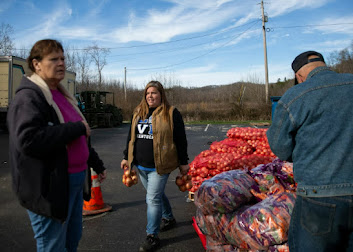
Nicky Stacy, left, runs the Hazel Green Food Project.
Nicky Stacy initially launched the Hazel Green Food Project in February 2021 in response to a series of devastating flash floods in Eastern Kentucky.

A town of just a few hundred residents, Hazel Green was a hub of commerce and tourism in the early 20th century as people flocked to bottle mineral water from natural springs believed to have therapeutic benefits. Today, Hazel Green and the surrounding parts of Wolfe County — where 30 percent of residents live in poverty — mostly consists of agricultural land and weather-worn farmhouses.

After Kentucky’s emergency food benefits expired, Stacy said interest in the Hazel Green Food Project’s bimonthly giveaways soared as residents from Wolfe County and surrounding communities realized they had less money to buy food.

“They never even gave these people any warning,” Stacy said. “It was just like, ‘Damn, it’s gone.’”

Memories of ice cream

At the food giveaway on Feb. 24, the mile-long line of vehicles snaked down Kentucky Route 205, a stretch of highway that also includes a Dollar Store, Uncle Sam’s Gun & Pawn Shop and Bites and Bargains homestyle restaurant.

Inside many of the vehicles, motorists blamed the reduction in SNAP benefits for their desperation. Further down the line from the Blairs, Elizabeth Conley sat coughing in a rusted truck where the gas pedal was wrapped in duct tape and wires dangled from the dashboard. She said her monthly SNAP benefit was cut from $398 to $84 last year. Conley, 45, also receives $914 in Social Security disability benefits because she suffers from lupus and fibromyalgia.

The mother of three — a 21-year-old son in college and two teenagers at home — recounted how quickly she spent her February SNAP benefits.

“I went to the store and I come [home] with like five items — milk, cereal, eggs and some meat that the kids will eat,” Conley said.

“I have teenage boys,” Conley added, her voice rising with exasperation. “People don’t understand boys eat quite a bit, especially teenage boys, and I am not going to let the kids starve.”

Three days after Conley went to the grocery store, the food was gone.

“That is when we knew we needed to come here,” said Conley, who was joined by her boyfriend, who has two teenage boys and saw his monthly SNAP benefits reduced from $396 to $228 last year. “We just need food, and we don’t have any.”

A few cars away, Courtney and Beatty Stone parked in the line around 10 a.m. and settled in for a three-hour wait.

Courtney, 68, and Beatty, 64, were both hooked up to mobile oxygen tanks and said their monthly food stamp benefit dropped last year from $350 to $140.

As they puffed on cigarettes and their oxygen machines chirped with each breath, the former tobacco farmers recalled how the increased benefits during the pandemic allowed them to occasionally buy some comfort food.

“When we had $350, we could buy some ice cream sometimes. And some pop and chips,” said Courtney Stone, referring to a slang for soda.
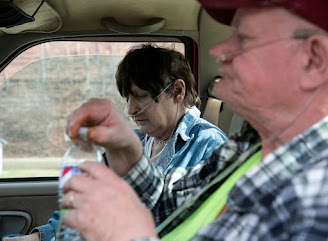
Betty and Courtney Stone arrived at 10 and waited three hours.
Now, the couple said they struggle to afford even their monthly supply of what they consider to be staple foods.

“By the time you buy your mayonnaise, ketchup, salt and pepper and eggs, oh the [price of] eggs, they went crazy … we might have only $5 left on our SNAP card,” Beatty Stone said.

As the couple passed the time by listening to a Christian radio station, Courtney Stone said he feels betrayed by the government. The couple — each of whom also collect $680 a month in Social Security benefits — said they are most upset about not being able to go to church as often because they cannot afford the price of gas.

“How can you give something and then take it away?” he asked. “They didn’t lower taxes. They didn’t lower the price of everything else.”

But as he took another hit of his cigarette, Courtney said he was slowly coming to accept his predicament.

“The thing is, you were born to die,” he said.

Ryan Quarles, a Republican who serves as Kentucky’s agriculture commissioner, also hopes Congress weighs in on ways to alleviate hardship, although he added he’s not ready to endorse a return to pandemic-era benefit amounts.

“Food insecurity in Kentucky has reached catastrophic levels,” said Quarles, a candidate for the GOP nomination for governor. “There is no excuse for a state that produces so much food to have any Kentuckian go to bed hungry.”

But outside the Hazel Green Volunteer Fire Station last week, the line for free food kept growing. The number of people in line easily eclipsed the total population of Hazel Green before the pantry opened, reflecting how the donation program has become a source of food for people throughout western Kentucky.

As 74-year-old Martha Miller and her daughter, Mary, waited in line, they said they’ve started using centuries old Appalachian Mountain cooking tips to save on food costs.

If a recipe calls for eggs, use shortening instead. A can of cream and two cups of water can make the equivalent of 1 percent milk. And save bacon grease to use later as shortening.

“I don’t buy fresh vegetables anymore. I can’t afford them,” Martha Miller said. “I don’t buy eggs anymore. I can’t afford them.”

But for some people in line, even food conservation is not enough to keep them fed all month.

About an hour after the 1 p.m. food giveaway began, Henry Tolsen pulled his 30-year-old pickup truck to the back of the line. He settled in for an anxious three-hour wait, worrying whether any food would be left for him.

Tolsen, a tobacco and corn farmer who went bankrupt after a flood took out his crops in 1997, saw his monthly food stamp benefit reduced last year from $240 to $30 a month.

He also receives $1,000 a month in Social Security benefits to help pay his bills and keep gas in his truck. But Tolsen, 58, who is divorced and lives alone with his pet chiweenie, said he’s starting to eat just one meal a day.

“Yesterday, I only ate a bowl of cereal and a can of peaches,” said Tolsen, as he turned off his truck to save gas until the line started moving again. “I would like to be able to eat bacon and eggs, biscuits and gravy for breakfast, a decent lunch, and a homegrown supper like I used to.”

Although the Hazel Green Food Project hands out food until they run out, there is usually little to offer those at the back of the line, which was not lost on Tolsen.

“If they run out, I go home empty-handed,” Tolsen said. “Let’s just pray and thank the good Lord I will get my disability check.”

At about 5 p.m., Tolsen reached the front of the line. Volunteers handed him three venison steaks, two heads of cabbage and three bags each of potatoes, carrots and fried pork rinds.

Although Tolsen had food again, he drove away questioning whether his government really cared about him.

“I know everyone was happy to get that stimulus, but they didn’t realize there is going to be a payday, and we are paying for it now,” he said. “How did the government give us anything when they let inflation get so high we can’t live and we are going to starve out?”

Monday, August 1, 2022

Annual policy forum will focus on role of education in health

Individual and public health are influenced by many things, including the educational characteristics of people and their communities. Education will be the focus of the Foundation for a Healthy Kentucky’s 2022 Howard L. Bost Memorial Health Policy Forum, to be held virtually from 9:30 a.m. to 4:30 p.m. Oct. 17.

The forum will look at the connection between educational opportunities and health outcomes of Kentuckians, as one of the social determinants of health. Presenters and panelists will consider education as a cornerstone of Kentucky’s health outcomes. It is offred free of charge. Register here.

“Education is more than what happens between the four walls of a school building,” said Ben Chandler, president and CEO of the foundation. “Educational factors that influence health outcomes include everything from life skills — mental health, emotional literacy, financial literacy, and nutritional literacy — to local community programs, such as out-of-school care and workforce training, to equity issues. It’s important we consider all the factors of health to find ways to make a positive impact.”

Looking beyond the K-12 education system, panelists and presenters will discuss programs that can enhance education and provide more equitable access, while leading to better health outcomes for individuals and communities. Attendees will learn about replicable community-oriented collaborations and coordination between sectors that have led to improved health overall.

The 2022 Kentucky Teacher of the Year, Willie Carver, will give the keynote address. Sessions will include:
  • Making the Case for Funding, in Education and Beyond: Considering education as a social determinant of health, panelists will discuss school funding, social safety net programs’ impact on education, and real examples from urban and rural schools.
  • Literacy for Life (Critical Lessons for Positive Health): They’re lessons most don’t receive in school but can mean the difference between addressing and overcoming life’s challenges or becoming overwhelmed. Panelists will discuss mental health and emotional literacy, financial literacy and navigating systems, and how nutrition education impacts hunger long-term.
  • Linked but Addressable; Helping Families Overcome Obstacles: A look at how family income plays a critical role in the academic outcomes of students, and therefore, the lifelong health of individuals.
  • Breaking Down Barriers; Real Examples of Kentucky Communities Making Positive Change: Learn how local communities are lifting up families. Panelists will share about connecting families with early childhood intervention services; public schools and public health collaborating on mental health services; and, how a community is working to chart paths for non-traditional career building.
The forum is designed to raise awareness of the health issues impacting Kentuckians and highlights model strategies and policy opportunities to improve Kentucky’s health. The foundation created it to honor Dr. Howard L. Bost, a notable health economist and a founding member of the foundation’s board of directors. It welcomes a range of audiences, inside and outside the health industry – including health care advocates, providers and educators, business professionals, civic leaders, policy makers and more.

Updates on the forum are at Healthy-KY.org/bost-forum-2022.


Wednesday, March 23, 2022

Bill Wagner, who headed group of health clinics for disadvantaged in Louisville, wins Gil Friedell Memorial Health Policy Award

Wagner, left, with Foundation President and CEO Chandler
William Wagner, retired CEO of Family Health Centers of Louisville, is the latest winner of the Foundation for a Healthy Kentucky's Gil Friedell Memorial Health Policy Award, for his work expanding access to care and coverage.

“Bill’s passion for bettering the health of Kentuckians is a perfect reflection of the spirit of the Gil Friedell Memorial Health Policy Award,” said Ben Chandler, the foundation's president and CEO. “Dr. Friedell was a passionate advocate for access to health care. Bill’s 40-year career is a testament to his commitment to serving others by expanding opportunities for health-care coverage and bringing medical care to underserved areas in rural and urban communities. He has made a profound impact on the health and wellness of countless Kentuckians.”

Wagner established primary-care centers focused on people who are low-income, homeless, immigrants and refugees, then expanded them to include dental, behavioral health, pharmacy services, health education, outreach and enrollment services.

He was influential in the evolution of Kentucky’s Medicaid program, helping develop the nonprofit Passport Health Plan for managed care of Medicaid patients and the Children’s Health Insurance Program, providing medical services for hundreds of thousands of children and adults in Kentucky.

He also helped shape the next generation of social workers and public-health professionals through his work with the Kent School of Social Work and the College of Public Health at the University of Louisville.

“It's an honor to receive the award,” Wagner said. “I accept it on behalf of all the health care providers who work so hard to provide medical care access in underserved areas of Kentucky – urban and rural. They’re the real heroes. I have great respect for them and working with them made my job so fulfilling.”

Wagner retired at the end of 2021, something he delayed due to the pandemic. During it, he worked with non-English-speaking communities to provide testing and education. When vaccines rolled out, Wagner was at the forefront, helping with logistics, outreach, and education, most notably with the homeless.

The Memorial Health Policy Award is named for Gil Friedell, first director of the Markey Cancer Center at the University of Kentucky and cofounder of the Kentucky Cancer Registry. He helped launch a nonprofit advocacy education organization in 2005 that later became the Friedell Committee for Health System Transformation. The Foundation created the award when it united with the Friedell Committee in 2018.

Wagner and Friedell worked in the mid-1990s to create a community partnership for breast and cervical cancer screening in Louisville’s West End, which had extremely high death rates from those diseases.

The foundation makes a $5,000 grant to a Kentucky nonprofit working to improve health policy in the commonwealth in honor of the Friedell Award winner. Wagner selected Kentucky Voices for Health, a nonpartisan coalition that amplifies the voices of individuals, families, and communities in the decisions that affect the health and well-being of all Kentuckians.

Wagner said he selected KVH because of his concern that many Kentuckians could lose the Medicaid coverage to which they gained access in the pandemic. “Having health-care coverage is key to having access to medical care and living a healthier life,” he said. “I’m concerned when the emergency measures for expanded Medicaid expire, we will have many folks who aren’t sure how to recertify or apply through Kynect. KVH can help fill those gaps.”

Wagner was selected from the foundation's 2021 Healthy Kentucky Champions, Kentuckians honored for making a difference in the health of their communities or the state. Nominations for the 2022 awards are due by May 20. For more information and to nominate someone, visit Healthy-KY.org.

Wednesday, March 16, 2022

Beshear vetoes resolution that would end state of emergency and apparently reduce $243 monthly SNAP food benefit by $100

Beshear signing veto (Still image from Facebook video)
By Al Cross and Melissa Patrick
Kentucky Health News 

Gov. Andy Beshear has vetoed legislation that would end the state's Covid-19 state of emergency if the General Assembly overrides his veto. Beshear says the resolution would end the $100-a-month pandemic boost in federal food aid, but legislators say that isn't their intent and that he's off base.

“Given that we have zero statewide restrictions, and we haven’t for six months, all this does is hurt these folks by cutting off this extra food aid while doing absolutely nothing else,” Beshear said in a Facebook video in which he signed the veto and asked the legislature not to override it, which it could easily do.

The Kentucky Center for Economic Policy says the average monthly benefit of $243 in the Supplemental Nutrition Assistance Program, once called food stamps, would drop by about $100. The state Cabinet for Health and Family Services said that would affect 544,000 Kentuckians.

Senate Joint Resolution 150 says "It is not the intention of the General Assembly that this resolution should impair or delay the ability of the Commonwealth to receive any federal stimulus or pandemic-related funds or services."

The federal law at issue, highlighted by the Beshear administration
The Beshear administration says that won't work around a federal law that requires "an emergency or disaster declaration by a state based on an outbreak of Covid-19" for the extra benefits.

The legislature has barred Beshear from declaring another Covid-19 emergency without its permission. It is unclear whether he could declare a disaster. Senate President Robert Stivers said late Wednesday that he believes Beshear could meet the requirements by issuing an emergency administrative regulation.

“We have yet to be shown the language that they can't draw down that with an emergency reg. We have asked for specific language to send to us,” Stivers said. “I believe somebody said he made a comment there were two emails. We do not have any record of any emails being sent to us with this.”

Cabinet spokeswoman Susan Dunlap said the agency advised the chairs of the House and Senate health committee the week of Feb. 28. “COVID continues to impact many families and it is indefensible to take food benefits away from Kentuckians — especially our most vulnerable seniors and children — who already go hungry at a rate higher than the national average,” Dunlap told Austin Horn of the Lexington Herald-Leader.

Kentucky Health News asked Dunlap if the administration believes that the new law prohibiting another Covid-19 emergency declaration without the legislature’s approval means that the legislature would have to expressly authorize the declaration of an emergency that would meet the federal requirement.

Dunlap said Beshear asked the legislature to extend his original emergency order "until at least the April 16, 2022, expiration of the HHS public health emergency declaration and until the later date that HHS may extend its declaration. During this legislative session, the governor requested the General Assembly extend the state of emergency until Jan. 15, 2023, and the General Assembly responded by extending it to April 14, 2022."

Stivers, told that the federal law requires the state to declare an emergency, "Well, we would like to have that discussion with him to see if there aren't any other avenues. We've been able to work on the Ford deal and several other things, but it seems he wants to talk to you all. We're right here. He knows where we are every day."

The House passed SJR 150 overwhelmingly on March 10 despite warnings from Democratic legislators about SNAP benefits. “I'm not really interested in continuing to draw federal funds if they're not deserved or needed,” said Rep. Thomas Huff, R-Shepherdsville, who managed the bill in the House.

Stivers noted Wednesday that Beshear signed the bill ending the emergency in mid-April and said, "If there is no emergency, and he apparently doesn't believe there is one either, is it appropriate to be requesting emergency funds when there is no emergency? Take all our arguments off the table. When there's no emergency, why do you request emergency funds? It's almost fraudulent to do that. The emergency is over."

Beshear, a Democrat battling with a Republican legislature, said Wednesday, “It comes down to this simple question: do you want our struggling seniors and kids to be able to afford enough food as we navigate out of this pandemic.” He called SJR 150 “a callous act.” Earlier, he called it “politics at its worst.”

The resolution was filed by newly elected Sen. Donald Douglas, R-Nicholasville, who is opposed in the May 17 primary election by Andrew Cooperrider, a leader of protests against pandemic restrictions. He has said the resolution is intended to help Douglas, who was elected in a special election for which party officials chose the nominees and which was held before the legislature redrew its districts.

Stivers said the resolution was intended to tell Beshear, "Show us what you need. We have said file emergency regs if needed. Let us look at them. Tell us what you need in budget language, you know, what are the things [you] need not to discuss through the press? . . . We are here."

Saturday, February 5, 2022

Tornado cleanup is more than physical; loss and suffering take emotional and psychological tolls that can be harder to deal with

Downtown Mayfield is pictured on Feb. 2. (Photo by William Widmer for The New York Times)
About 40 percent of the debris from the gigantic tornado that plowed through 200 miles of Western Kentucky Dec. 10 has been picked up, but Rick Rojas of The New York Times reports, "Communities along that path are now confronting another form of devastation that is less tangible but just as staggering: the emotional and psychological toll that comes from enduring so much loss and suffering."

Rojas adds, "The long and unforgiving reach of the storm is evident in nights that are sleepless or disrupted by harrowing dreams, unexpected bursts of tears, flashes of anger, fuzzy memories, a diminished appetite — the multitude of ways that trauma can manifest itself after a disaster. Now, more than a month after the storm, some — because of resources or simple luck — have been able to emerge from the shock of the storm. On the other side of a growing gulf, though, are the many others whose lives were upended and are still being whirled by turbulence. For them, mental health experts warn, the sense of security and calm integral to recovery remains elusive."

The focus of Rojas's story is Mayfield, a town of 10,000 "walloped by the initial shock of seeing entire stretches pulverized by the worst of the storm. Downtown remains mangled," he writes. "People point to piles of debris and refer to them by what they used to be: a church, a shop, a family home."

Steven Elder, the president of the Mayfield Community Foundation, which is raising money to help residents recover, told Rojas that it has been hardest for people who were already disadvantaged: “People were hurting long before Dec. 10. That’s the disaster that’s going to set these people back a lifetime. They’ve fallen into a hole they’ll never get out of.”

Rojas focuses on several victims, primarily Isaiah Holt, who "sustained nerve damage while trapped in the rubble of the candle factory where he worked and fears it will be permanent. His skin is etched with cuts and chemical burns. A strong gust of wind or an exploding building in an action movie can unleash in him a rush of terror. Lately he has spent $400 on DoorDash deliveries, as the pain — physical but also psychological — makes it difficult to venture outside."

“I felt good today,” Holt told Rojas after making phone calls and taking a shower, but "He confessed that it was only the second one he had taken in 2022."

“That’s what ‘feeling good’ means, just be feeling normal,” Holt said. “What makes it hard is I have nothing to do right now. I’m single with no kids, and I have no job.” So, Rojas writes, "He sits and he stews."

Holt was "pinned under the rubble for hours," Rojas reports. "He drained the battery on his cellphone posting videos on Snapchat, desperate to tell his family and friends he loved them. He feared he would not make it out. He feared for his brother, who worked there too and was similarly trapped. Weeks later, Mr. Holt is grateful to be alive and for the company of his brother, who spent several days in a coma but is now recovering at home. But he is also depressed and saddled with new fears."

Holt "lost 20 pounds in the hospital and feels out of shape. He is even more concerned about his mental health," Rojas writes, quoting him: “An able mind is 10 times better than an able body.” Holt has already had post-traumatic stress, after serving in the Army as a door gunner on a helicopter.

"Before he started at the candle factory about three months ago, Mr. Holt was working with young people, coaching them in sports and taking them on college tours," Rojas reports. "In a way, he is still coaching. He is often on the phone with his candle factory co-workers, trying to help them deal with the trauma. “Instead of sugarcoating,” he said, “I’m just letting them know: There are going to be bad days.”

Family members of the injured are affected, too: "Darryl Johnson, whose sister was killed at the factory, has checked in just about every day with his nieces and nephew — her grown children. He was trying to give his brother-in-law some space. He could tell he needed the room to grieve," Rojas reports.

“Eventually, it got to me,” Johnson told him. “I’m a fisherman. I was at the lake one day. I turned into the lake — that’s how hard I cried. You cry so hard your throat gets sore and you can’t speak, and finally, it was over. I just put my feet on the ground and said, ‘Get back to work. You’ve got a job to do.’”

Monday, June 21, 2021

Kentucky still ranks 37th in well-being of children in latest Kids Count Data Book, but isn't progressing as much as other states

By Melissa Patrick
Kentucky Health News

The annual Kids Count Data Book on children's well-being, released June 21 by the Annie E. Casey Foundation and Kentucky Youth Advocates, again ranks Kentucky 37th in the nation for the overall well-being of its children. 

The latest data are for 2019, and are largely compared with data from 2010. The report rates children's overall well-being through 16 indicators in four major domains: health, economic security, education and family and community. 

Overall, Kentucky saw improvement in 11 of the 16 indicators, did worse in three of them and stayed the same on one. One measure did not show a comparison. 

“Though the commonwealth made progress on a number of indicators of child well-being between 2010 and 2019, rankings show we are not making progress as quickly as other states – and that progress is in jeopardy unless federal and state policymakers act boldly to sustain the beginnings of pandemic recovery efforts,” Terry Brooks, executive director of Kentucky Youth Advocates, said in a news release. 

Nearly one in four Kentuckians are children. Here's a look at each domain.

Charts from Kids Count Data Book; to enlarge any one of them, click on it.
Health:
Kentucky's health ranking improved this year, to 35th. Last year's report ranked Kentucky 42nd after changing one of the domain's indicators to measure childhood obesity instead of youth alcohol and drug abuse. The last report to use the original indicator was in 2019, when the state ranked 25th for health. 

The report says 37 percent of Kentucky's children were either overweight or obese in 2018-19, the same as in 2016-17. The national rate is 31%. Kentucky has the highest childhood obesity rate in the nation. 

Kentucky continues to have a low rate of children without health insurance, 4%. The national average is 6%. The news release reports that about  45,000 Kentucky children remain uninsured.

Another indicator of children's health is the rate of babies born weighing less than 5.5 pounds. That is 8.7% in Kentucky, where it has hovered for years. 

Education:
Kentucky ranked 30th in the report's Education domain, down from 27th last year. 

The best news in this category is that 91% of Kentucky high-school students graduate on time. 

The bad news is that the share of preschool-age children not in preschool increased to 60% in 2017-19, from 57% in 2009-11. And the share of fourth-graders not proficient in reading inched up to 65% in 2019, from 64% in 2009. 

And though the share of eighth graders who are not proficient in mathematics improved to 71% in 2019, from 73% in 2009, that still means only 29% of the state's eighth graders are proficient in math. 

Economic well-being
: Kentucky ranks 40th in economic well-being, with all four indicators showing improvement since 2010. 

The percentage of Kentucky children in poverty dropped to 22% in 2019, from 26% in 2010; children whose parents lack secure employment dropped to 31% from 37%; and teens who are not in school and not working dropped to 8% from 11%. 

Also, the percentage of children living in households with a high housing cost burden dropped to 23% in 2019 from 32% in 2010.  A high housing-cost household is defined as one where more than 30% of monthly household pre-tax income is spent on housing-related expenses, including rent, mortgage payments, taxes and insurance.

Family and Community
: Kentucky ranked 43rd in the family and community domain, down from 41st in last year's report. 

Kentucky improved in three family-and-community indicators, including children living in high-poverty areas (15%), children living in families where the household head lacks a high school diploma (11%) and teen births.

The number of teen births in Kentucky continues to drop. In 2019, there were 25 births per 1,000 females aged 15-19. In 2010, that number was 46 per 1,000. The national average is 17 per 1,000. 

The percentage of children living in single-parent homes increased to 36% in 2019, from 35% in 2010. 

Impacts of the pandemic

"We cannot talk about child well-being in any meaningful way in this moment — or address the considerable challenges America’s children and families now face — without discussing the effects of the coronavirus," Lisa M. Hamilton, president and CEO of The Annie E. Casey Foundation, writes in the foreword to the report. 

To capture the impact of the last year, the Data Book takes a look at information collected in the Household Pulse Survey, which the report says was conducted in multiple waves since the onset of the pandemic by the Census Bureau and is the only source of robust national and state data related to the pandemic. 

“The supplemental pandemic-era survey data highlighted in the Data Book gives us a clearer picture of how families are faring today, including the disproportionate impact the pandemic has had on families of color," said Brooks. 

Key findings about Kentucky children in the supplemental report include: 
  • In 2020, one in five (20%) Kentucky adults with children in their household had little or no confidence in their ability to make their next rent or mortgage payment, with the highest rates experienced by Black families (40%) and Latinx families (30%). By March 2021, the statewide rate was at 15%, suggesting the beginnings of a recovery. 
  • 15% of Kentucky households with children reported sometimes or often not having enough food to eat throughout 2020 – a family stressor that hit Black households (26%) and a combination of smaller racial groups (American Indian, Alaska Native, Pacific Islander, Native Hawaiian and those of more than one race) the hardest (29%). This statistic only slightly improved overall in March 2021 to 13%.
  • More than one in four (26%) Kentucky adults living in households with children felt down, depressed, or hopeless in 2020, with only slight improvement (22%) by March 2021.
Brooks, of Kentucky Youth Advocates, said, “The commonwealth can and will bounce back from the ripple effects of the pandemic, and a key component of that is ensuring kids and families have the resources to meet basic needs and overcome daily challenges.”

Brooks praised the state's leaders for supporting children during the pandemic, by supporting child care, using federal funds to address the pervasive "digital divide," and ensuring schoolchildren have access to food while learning at home through the pandemic EBT program. 

KYA wants Congress to make the expansion of the child tax credit permanent, and wants Kentucky to enact its own refundable earned-income tax credit; to focus on increasing access to high-quality child care; to use federal funds to improve school-based mental-health supports for students; to expand school-based nutrition programs; to allow state employees 12 weeks of paid family leave after the birth or adoption of a child; and to double down on efforts to support families involved in the child welfare system. 

The Kids Count Data Center provides current and trend data for child well-being indicators related to each of the four domains in the report, at both a state and county level. It also offers a feature to create customized tables, maps, bar charts and graphs.