Showing posts with label tobacco-free. Show all posts

Sunday, May 19, 2024

Kentucky tobacco-free advocates win Campaign for Tobacco-Free Kids' national Group Youth Advocates of the Year award

The Campaign for Tobacco-Free Kids named the #iCANendthetrend Youth Advisory Board Group Youth Advocates of the Year. Front, from left: Saumya Sikhwal, Jasmin Hernandez, Sarah Larkin and Philena Ash. Back: Jordan Joslin, Chloe Brady, Ksenia Miller, Relena Aispuro and Olivia Hardigree.
By Melissa Patrick
Kentucky Health News

The University of Kentucky's #iCANendthetrend Youth Advisory Board has been named the Campaign for Tobacco-Free Kids' 2024 Group Youth Advocates of the Year.

The Campaign for Tobacco-Free Kids says it is the leading advocacy organization working to reduce tobacco use in the United States and around the world. 

The group was recognized for its advocacy summit at the state Capitol, where over 100 youth came together to push for stronger enforcement of Kentucky’s law prohibiting the sale of tobacco products to anyone under the age of 21. This event was held Feb. 15, following its second Kentucky Youth Tobacco Control Conference the day before. 

The #iCANendthetrend Youth Advisory Board is made up of high school students from across the state who applied to join the group, which works on empowering young people to prevent tobacco and e-cigarette use.

The board is part of UK's #iCANendthetrend program, which utilizes college-student facilitators who offer presentations in schools across the state about the dangers of tobacco and electronic-cigarette use.

The program was started in 2019 and the students found such passion from the high-school students that they created a program for them in 2021, said Griffin Nemeth, the group's coordinator and a student  at UK's College of Pharmacy.

Board member Saumya Sikhwal, a senior at South Warren High School, said one of the board's biggest projects this year was to advocate for compliance checks and enforcement of the law barring sales to those under 21. 

"So my main thing was to advocate for having stricter policies and compliance checks . . . holding retailers accountable for selling nicotine products to underage youth," Sikhwal said. 

She said that for most of the students, including herself, it was the first time they had talked directly to the legislators and that they got both positive and negative feedback to their requests. 

Board member Ksenia Miller, a freshman at Villa Madonna Academy in Kenton County, said students at the conference were educated about the tobacco laws in Kentucky and how they are enforced and were then able to talk with legislators the next day "about putting in more laws to further enforce the laws."

"It was a really, really big project to work on," she said. "But it was definitely a fun one."

The students who attended the awards ceremony in Washington, D.C. and accepted the award on behalf of the group, spoke about their work in a video. Sikhwal and Miller were joined by board member Jasmin Hernandez, a junior from Casey County High School.

Asked about their experience, Miller said she enjoyed sharing the hard work that the Youth Advisory Board did and meeting fellow advocates. "It was a really great experience," she said. 

Sikhwal agreed. "It was definitely not just an award, it was more of an experience where you get to learn from others," she said. " I did not know how big Campaign for Tobacco Free Kids was. Just seeing people from across the world being there and advocating for tobacco prevention was really eye opening for me, and more inspiring. And it motivated me to do more advocacy work as I go into my next college years. " 

Sikhwal added that she was moved by Campaign for Tobacco-Free Kids' President and CEO Derrick Johnson's words, when he said we should put "people above the profits."

She said, "I will remember that for a long time."

Nemeth said, "It really just goes to show the amazing work of all the young advocates."

Thursday, October 29, 2020

97% of school districts have tobacco-free policies, including e-cigs


By Melissa Patrick
Kentucky Health News

Only five of Kentucky's 172 school districts have not passed a tobacco-free policy to line up with a state law that went into effect July 2020, according to the Foundation for a Healthy Kentucky. 

The law, for which the foundation campaigned, bans use of all tobacco products, including electronic cigarettes, on school-owned property and school-sponsored events in all public schools. It includes an opt-out provision that allows school boards three years to opt out of the ban, which is why five school districts don't have it. 

"Our goal was not only to encourage more school districts to adopt tobacco-free campus policies, but to help change the culture of Kentucky's school environment to a place where tobacco use is simply not the norm, no matter what time, what day of the week, or what event is happening on campus," Ben Chandler, president and CEO of the foundation, said in a news release. 

The districts that have opted out are in Union, Clay, Leslie, Knott and Bell counties. The two independent districts in Bell County, Pineville and Middlesboro, adopted the tobacco-free policy after the law was passed. 

When the bill became law on April 9, 2019, only 74 of the 172 districts, or 42%, were fully tobacco-free. Now 97% are.

Bonnie Hackbarth, the foundation's vice-president for external affairs, told Kentucky Health News that the foundation is trying to work with the five holdouts and encourage them to pass tobacco-free policies. "Our hope is that they will do so soon," she said. "Going from 42% to 97% is a huge victory, but we definitely don't want to leave out those students in those five counties that remain and so we just encourage them to look at the benefits of making tobacco use not the norm on campus." 

Hackbarth said the most common reason they get for not yet passing the policy is that school districts say they need to give the adults in their communities time to get used to the idea of not being able to smoke at events where they've always smoked, like football games. 

"But it's what's right for our kids," she said. "And it improves the health of everyone by reducing exposure to tobacco. The research shows these policies work." 

The law also requires schools to post signs, but provided no money for the signage. To help with this, the health foundation, the Kentucky Medical Association and the Kentucky Foundation for Medical Care created signs in consultation with the Kentucky School Boards Association and gave them away for free.

As a result of this effort, schools in 101 districts and 51 state operated technology centers across Kentucky are now displaying a total of nearly 12,000 metal signs and window or door stickers announcing that their campuses are tobacco-free, according to the release. 

The schools and centers were also provided with more than 20,000 small cards with a reminder of the new tobacco-free campus policy that districts could hand out in car pool lines and at school events. 

"We know that tobacco-free laws work by reducing not only the number of users, but by reducing the effects of secondhand smoke as well," said KMA President Dr. Dale Toney. "These new signs will help improve compliance with the new policy and prevent thousands of Kentucky youth from becoming addicted to tobacco products. We’re excited that our communities will become healthier as a result of this initiative." 

KFMC President Shawn Jones noted that while fewer teens are smoking traditional cigarettes, there has been a sharp uptick in new users of e-cigarettes. Jones said he hopes the increase in schools with tobacco-free policies and the signage will help curb this uptick. 

According to the 2019 Youth Risk Behavior Surveillance System, which has the latest Kentucky data available, 26.1% of high schoolers in the state said they currently used e-cigarettes, meaning they vaped at least one day in the month prior to the survey; 11.1% vaped on 20 or more days prior to the survey; and 8.7% of them vaped daily. As for cigarettes, the survey found that 8.9% of high school students currently smoke cigarettes; 3% smoked cigarettes on 20 or more days in the month prior to the survey; and 2.2% of them said they smoked daily. 

The 2019 survey found that 17.3% of Kentucky's middle-school students used e-cigarettes or similar products; 2% of them vaped on 20 or more days prior to the survey; and 1.2% of them vaped daily. As for cigarettes, 4.3% currently smoke them; .6% smoked cigarettes on 20 or more days in the month prior to the survey; and .6% of them smoked cigarettes daily. 


Friday, October 4, 2019

91% of Kentucky's school districts are now tobacco-free; foundation expects that the other 9% will soon follow

 Districts in white are not tobacco-free. For a larger map, click on it.
Only 15 of Kentucky's 172 school districts, or 8.7 percent, have not passed a tobacco-free policy to match a state law that will take effect July 1, 2020, according to the Foundation for a Healthy Kentucky, which says it expects nearly all of districts to enact the policy before they have to.

The law, for which the foundation campaigned, will ban use of all tobacco products, including electronic cigarettes, on school-owned property and school-sponsored events in all public schools. The law allows school boards to opt out of the ban, but it appears to be prompting them to opt in.

When the bill became law April 9, only 74 of the 172 school districts, or 42%, were fully tobacco-free. As of Oct. 3, that number was up to 157, or 91%, with more to be added soon.

The law also requires schools to post signs, but provides no funding for signage. The health foundation, the Kentucky Medical Association and the Kentucky Foundation for Medical Care have created signs in consultation with the Kentucky School Boards Association. and are offering them to districts that adopted tobacco-free policies after the law passed.

Districts that adopted tobacco-free policies after the bill became law can get the indoor, outdoor and vehicle signs on a first-come, first-serve basis.

In January 2020, if supplies remain, the signage will be offered to all school districts, including those that had previously passed tobacco-free school policies. An order form and information about the signage can be found on the Tobacco-Free for Students website, www.tobaccofreestudents.org.

Wednesday, August 28, 2019

86 percent of Kentucky's school districts have already adopted tobacco-free polices, ahead of state law with opt-out provision

Only 24 of Kentucky's 172 school districts, or 14 percent, have not passed a tobacco-free policy that mirrors a new state law that will take effect next July 1, according to the Foundation for a Healthy Kentucky, which says more districts are expected to enact the policy soon.

The law gives districts the ability to opt out of the law during its first three years, but it seems to have prompted them to opt in. Half of the districts with the policy have enacted it since Gov. Matt Bevin signed the law April 9, the foundation's Bonnie Hackbarth said. When it was signed, only 74 of the state's 172 school districts, or 42 percent, were fully tobacco-free.

Many of the adopters since Aug. 9 were in a swath of counties in the Pennyroyal regions of Southern Kentucky, from Taylor and Cumberland in the east to Lyon in the west; tobacco production remains common in the region, and there is a smokeless tobacco plant in Hopkinsville, the seat of Christian County, which has not adopted the policy. Here are maps showing the increase since April:

Friday, August 23, 2019

Tobacco-free-schools law for 2020 prompts 57 more districts to adopt policy, making a strong majority; newbies can get free signs

By Melissa Patrick
Kentucky Health News

FRANKFORT, Ky. -- A statewide smoking ban in Kentucky schools is still almost a year away, but passage of it appears to have prompted most school districts to go ahead and adopt tobacco-free policies. And they're getting some help in telling students, teachers and campus visitors about it.

The law passed this year prohibits the use of all tobacco products, including electronic cigarettes, on school-owned property and school-sponsored events in all Kentucky schools, effective July 1, 2020. School boards have three years to opt out of the ban, but the law appears to be making them opt in.

When the bill became law, only 72 of the state's 172 school districts, or 42 percent, were fully tobacco-free. As of Aug. 9, that number was up to 129, about 75% of the districts and 79% of students, with more to be added soon.

The law also requires schools to post signs, but provides no funding for signage. The Kentucky Medical Association, the Kentucky Foundation for Medical Care and the Foundation for a Healthy Kentucky have created signs in consultation with the Kentucky School Boards Association. and are offering them to districts that adopted tobacco-free policies after the law passed.

"We know that placing readily recognizable tobacco-free signs on campuses across this state will remind students, staff and entire communities that tobacco use has no place anytime or anywhere at school," Ben Chandler, president and CEO of the health foundation, said at a Frankfort news conference.

Chandler said districts that adopted tobacco-free policies after April 9, when the bill became law, can get the indoor, outdoor and vehicle signs on a first-come, first-serve basis.

In January 2020, if supplies remain, the signage will be offered to all school districts, including those that had previously passed tobacco-free school policies.

The focus of concern about students and tobacco has shifted from traditional cigarettes to electronic cigarettes. More than one in four high-school seniors in Kentucky reported last year that they had used e-cigarettes, and experts say that is part of a national epidemic.

Testimony from students during the legislative session helped persuade many of the lawmakers about the need for a tobacco-free school law, and two students reiterated that at the news conference.

"This is a very real problem," said Abbi Stratton, a senior at Graves County High School in far Western Kentucky. "It has definitely increased over the course of my freshman to my senior year."

Stratton and another senior, Kendall Tubbs, said Graves County passed its tobacco-free school policy after Aug. 9, making it the 130th district to do so.

"Usage has become a social norm," he said. "Even when class is going on, kids are always vaping."

"Vaping" is a term popularized by the electronic-cigarette industry. Actually, e-cigarettes produce an aerosol, which is a suspension of particles in a gas; a vapor is "a substance in the gaseous state as distinguished from the liquid or solid state," the Merriam-Webster dictionary says.

Kendall Tubbs, Abbi Stratton and Ben Chandler spoke
about a program to provide free signage to schools that
adopted tobacco-free policies after passage of the law.
"E-cigs are chock-full of nicotine and poisons that are addicting and sickening our kids," Chandler said. "So let's call them what they are -- tobacco products -- and let's keep them away from our kids."

KMA President Bruce Scott said the surge of e-cigarette use among Kentucky's teens is creating a new generation of nicotine addicts.

"When you consider the fact that 90 percent of adult smokers started smoking before age 18, we have an imperative to make sure that we stop smoking and convince every high school student never to pick up a cigarette or tobacco product in the first place," he said.

An order form and information about the signage can be found on the Tobacco-Free for Students website, www.tobaccofreestudents.org.

Thursday, July 11, 2019

Perry County becomes the 35th Kentucky community with a comprehensive anti-smoking ordinance; Hazard keeps partial ban

The Perry County Fiscal Court unanimously passed a comprehensive smoke-free ordinance on June 18, becoming the 35th community in Kentucky to do so.

The law, which took effect immediately, bans smoking, including the use of electronic cigarettes, in all places of employment and public buildings. It also prohibits smoking within 15 feet of any public door, window or ventilation system, as well as any public outdoor seating and recreational areas.

Perry County (Wikipedia map)
The county seat of Hazard will continue to operate its own smoke-free ordinance, which was implemented in 2016. The county ordinance "does not affect property within the City of Hazard," Katie Kelley of the Hazard Herald reports. The city's ban is considered only partial because it doesn't include all workplaces, says the Kentucky Center for Smoke-Free Policy.

The county ordinance will be enforced by the county Code Enforcement Board, with a possible fine  for violators of up to $50. Fines have also been set for business owners and employers who fail to comply with the ordinance. Business owners and employers are required to post "no smoking" signs.

At 28 percent, smokers are more prevalent in Perry County than the rest of the state, where that rate is 25%, but Emily Bennett with Hazard's WYMT-TV reports that most there are pleased with the ban.

Local diners at Frances' Diner, a restaurant that used to allow smoking, told Bennett that they are now able to eat without worrying about their health.

Matthew Combs, who works in Hazard, told her that he suffered from allergies and asthma and that being able to eat in a smoke-free environment is "wonderful."

One local health official pointed out the dangers of secondhand smoke, especially for employers who are exposed to it all day.

 "If it's a smoking venue, it is the equivalent to them having a pack a day habit themselves for a non-smoker having to work in a smoking environment where that is allowed," Scott Lockard, the public health director for the Kentucky River Regional Health Department, told Bennett.

Another told Bennett that such policies eventually create a "new norm."

Sherrie Stidham, a health educator, told Bennett, "We're wanting to set a new norm. We don't want children to get used to seeing everybody in these places and smoking and think it's an okay thing to do."

Sunday, April 21, 2019

Smoke-free advocates say the policy can be more palatable if part of a wellness campaign; also say to include smokers at the table

By Melissa Patrick
Kentucky Health News

If you're trying to win passage of smoke-free policies in communities that have been resistant to such efforts, you should focus on the broad issue of improving the health of those communities. That's what one told more than 250 attendees at a conference, saying that efforts to make a community healthier naturally lends itself to policies that minimize exposure to second-hand smoke.

Onjewel Smith of the Southern States Regional Project of
the American Nonsmokers' Rights Foundation discussed
smoke-free campaigns in rural communities at the 2019
Kentucky Tobacco Conference. (Photo by Melissa Patrick)
Onjewel Smith, who works for the American Nonsmokers' Rights Foundation Southern States Regional Project, offered examples of how rural communities in Mississippi and Louisiana have successfully passed smoke-free laws by focusing on "healthy community initiatives." She told the group that these strategies have worked because advocates have framed smoke-free in a way that matters to these communities.

"It's about getting people to think about wellness and not necessarily smoke-free," she said. Later adding, "I don't care what the motivation is. I really don't. At the end of the day we want these policies in place. We want people protected. "

She also reminded the group that getting folks ready for a smoke-free policy requires a whole lot of community engagement to bring awareness to the issue. "We can't ask for change until people understand there is a problem," she said.

As of April 1, 35.5% of Kentuckians are protected by smoke-free laws covering all indoor workplaces and public places.

The 2019 Kentucky Tobacco Conference "Envisioning a Smoke-Free Future" was held April 16 and 17 in Lexington. It was hosted by the Kentucky Center for Smoke-Free Policy, the Kentucky Department for Public Health, the University of Kentucky College of Nursing and the Kentucky Tobacco Prevention and Cessation Program.

Another recurring theme at the conference was to make sure people who would be most affected by a smoke-free policy are included at the table. Speakers at a harm-reduction summit shared a similar message last week, stressing the importance of partnering with drug users to make syringe exchanges truly successful.

For example, the speakers said African Americans, people from the LGBTQ community, people in addiction and recovery, and people from low socioeconomic status, all need to be involved in policy making. These groups were mentioned because they tend to use tobacco products at high rates, largely because they have been targeted by the tobacco industry.

Vivian Lasley-Bibbs, acting director of the Office of Health
Equity at the state Department for Public Health, engaged
with the advocates at the conference. (Photo by Melissa Patrick)
Vivian Lasley-Bibbs, acting director of the Office of Health Equity at the state health department, talked about the importance of looking at tobacco policies from the lens of health equity, which she said requires us to think about how a policy, decision or practice is unfair to one group or another.

She asked, "How many times have you worked around an issue or gone into a community and sat around the table where those who are impacted aren't there?"

Dr. Valerie Yerger, an associate professor of health policy at the University of California, San Franscisco, had a similar message as she spoke about the tobacco issue: "Look around; if you are dealing with an issue that affects marginalized people, make sure that they are there and let them participate. And think in terms of how you can make the work very, very relative to them."

Another hot topic at the conference was use of electronic cigarettes among teenagers, which has increased nearly 80 percent in the last year among high-school students.

Mindy Ickes, an associate professor at UK and the director of several programs that promote tobacco-free college campuses, told the group that Kentucky data shows that e-cigarette use is as high as 75% among students in some Kentucky high schools.

Jelaine Harlow, a Lake Cumberland District Health Department health educator who works with youth in Casey and Adair counties, said they have largely focused on e-cigarette education with teachers and youth this year, adding that they have even had to deal with a first-grader on the school bus with a Juul, which is the most popular e-cigarette device among teens.

"Juuling has consumed us," she said. "Our kids are using them and they are using them tremendously, it's unbelievable."

Awards were also given for work in several categories, including:

The city of Williamstown was one of six Kentucky cities to be
recognized for success in enacting a smoke-free workplace
ordinance. Mayor Rick Skinner (far left) was also the recipient
of the Smoke-free Advocate of the Year award. (UK photo) 
The city of Elizabethtown received the Smoke-free Excellence in E-Cigarette Policy Award for expanding its smoke-free ordinance to include e-cigarettes.

The Lee T. Todd Jr. Smoke-free Hero Award recipient was Liz Burrows, health educator for Oldham County Health Department, for her commitment to smoke and tobacco free environments in the face of adversity.

The Timothy W. Mullett M.D. Lung Cancer Prevention Award recipient was Ashley Gibson, research coordinator for St. Claire Healthcare in Morehead, for her devotion and passion for preventing lung cancer through education, advocacy and policy change.

David Nunery received the Brian Early Mattone Esq. Legal Counsel Smoke-free Support award for outstanding smoke-free legal service.

The Smoke-free Youth Advocate Award recipient was Monroe County CARES Youth Prevention Ambassadors for excellence in promoting secondhand smoke education and smoke-free policy.

The Smoke-free Indoor Air Excellence Award recipients were the cities of La Grange, Martin, Murray, Paducah, Stanford and Williamstown, and Hardin and Oldham counties.

The recipient of the David B. Stevens M.D. Smoke-free Advocate of the Year, for promoting the secondhand smoke education and smoke free policy, was Rick Skinner, mayor of Williamstown.

Saturday, April 13, 2019

Bevin signs bill making all Ky. school property and events free of tobacco and e-cigs by July 2020, unless school boards opt out

By Melissa Patrick
Kentucky Health News

Gov. Matt Bevin has signed into law to ban the use of tobacco products in all Kentucky public schools and events, a policy that has taken several years to pass. It will take effect July 1, 2020.

Rep. Kim Moser
"It's not only going to help kids become less addicted in the future and improve overall health, but I think it will actually improve the light in which Kentucky is looked upon as a healthy state," said state Rep. Kim Moser, the bill's sponsor. "I really feel like this is a step in the right direction and I just think the messaging is so critical, especially for kids."

Moser, a Republican form Taylor Mill in Northern Kentucky, said it's important to recognize that e-cigarettes and other tobacco products not only create what are often life-long addictions to the nicotine, they also can prime the adolescent brain for addiction to other drugs.
.
Moser and Sen. Ralph Alvarado, Bevin's running mate for lieutenant governor and a longtime advocate for tobacco-free schools, said the alarming increase in teenagers' electronic cigarette use in the last year was likely the main reason the bill was able to pass this year.

"The more people started realizing what a problem this is, I think that really shed a lot of light on this whole tobacco-use issue," Moser said.

Sen. Ralph Alvarado
Alvarado, a Winchester physician, credited a group of Johnson County Middle School students for educating legislators on the rampant use of e-cigarettes in schools. Among other things, they told them that some students have become so addicted to the nicotine that they can't even make it through one class without going to the bathroom to use a device.

The most popular device for teens, made by Juul Labs, is easy to hide because it looks like a large computer flash drive. One Juul pod has the equivalent of a pack of cigarettes, and some kids are going through about eight a day, Alvarado told lawmakers on the Senate floor.

The students were actually pushing a Senate bill that would have created an anonymous hotline for students to report concerns about e-cigs and tobacco use . The bill made it all the way to the House floor, but wasn't called up for a vote. Alvarado, who presented the tobacco-free schools bill in the Senate, said he planned on inviting the students to the ceremonial signing of the bill because of the role they played in getting it passed.

"I think they gave everybody a little insight on what happens in the classroom, what happens on school grounds," he said. "I think they also had an instrumental part in being able to open some folks eyes in terms of how big this problem is becoming with vaping and tobacco use in our schools."

The tobacco-free schools measure, House Bill 11, prohibits the use of all tobacco products, including electronic cigarettes, on school-owned property and school-sponsored events in all Kentucky schools. Tobacco use will be permitted on field trips that are off school property if students are not present.

The bill does not ban the possession of tobacco products, just their use. Enforcement is also left up to individual school boards. School boards have also been given three years to opt out of the ban.


As of July 2018, only 42 percent of the Kentucky's 173 school districts have 100% tobacco free school policies, covering 57% of the state's students, and many of them have not updated their policy to meet new standards for electronic cigarettes.

"Up to 225,000 more Kentucky students will be protected from secondhand cigarette smoke and e-cigarette aerosol at school thanks to the tobacco-free schools bill," Bonnie Hackbarth, vice-president of external affairs for the Foundation for a Healthy Kentucky, said in a news release.

Moser said it took "many voices' to get this "positive piece of legislation" passed, and expressed her gratitude for them all. "I'm just excited for Kentucky," she said. "Looking forward, I think every step we take toward improving our health is a good step for Kentucky."

Friday, February 8, 2019

Tobacco-free school bill moves to full House; passage expected

By Melissa Patrick
Kentucky Health News

FRANKFORT, Ky. — A bill to make Kentucky school properties tobacco-free passed unanimously out of the House health committee on Feb. 7 and was posted for passage on the consent calendar in the House on Monday, Feb. 12. UPDATE: It is now awaiting passage in the House's regular orders.

House Bill 11, sponsored by Rep. Kim Moser, R-Taylor Mill, would ban the use of tobacco and electronic cigarettes on all school-owned properties, including all school events on such property. The bill does not prohibit the possession of tobacco and e-cigarette products, just the use of them. Enforcement rules would be left up to individual school boards.

"This is a reasonable and workable bill. . . . and it's a good place to stop addiction where it starts," said Moser, who is also the new chair of the House Health and Family Services committee.

Fewer than half of Kentucky school districts have enacted such policies. As of November, 74 of the 173 districts had adopted 100 percent tobacco-free policies, covering 740 schools and 58 percent of the state's students. Federal law only prohibits smoking inside schools that receive federal funding.

The Senate passed a bill similar to Moser's in 2017, but it died in the House and such bills weren't even heard in the House and Senate education committees last year.

But this year could be the year the measure passes, especially given the recent surge of e-cigarette use by teens. Since the last legislative session, their e-cig use has become so widespread that the U.S. surgeon general has called it an epidemic.

Federal research showed a 78 percent increase in "vaping" among high-school students between 2017 and 2018, with the number of vapers surpassing 3 million. The same report showed an increase of 48 percent among middle schoolers. And though state-level data hasn't been released, focus groups led by Kentucky Youth Advocates showed a similar uptick in the state.

Jack Patty, an 18-year-old senior at Mayfield High School, told Moser's committee that e-cigarette use in his school is rampant — especially the Juul, which looks like an oversized flash drive and is easy to hide.

"Whenever my teacher leaves the room you can usually see these flying through the air," Patty said while holding up a Juul device. "The kids have to get their nicotine hits while no-one is watching."

Patty added, "It's just hypocrisy" for teachers to teach students about the harms of tobacco use, then step outside for a smoke break. Mayfield's school district has a limited smoke-free policy that does not include smoking outdoors or at school events.

Dr. Patrick Withrow, with huge replicas of a
cigarette and a Juul, urged lawmakers to
 pass a statewide tobacco-free school law.
Dr. Patrick Withrow, a retired cardiologist from Paducah who now educates Kentucky teens about the dangers of cigarettes and e-cigarettes, said one Juul pod has as much nicotine as a pack of cigarettes, and that he has met teens who can empty one pod in three hits. Further, he said he finds that teens have no idea that e-cigarettes are more addictive than cigarettes.

Withrow said the industry has a "three-prong strategy" to get kids hooked. He said they make e-cigs cool and easy to hide; they add a product that makes them "smooth" on the throat, as well as flavorings that appeal to children; and they add high levels of nicotine to create an addiction.

"We could be erasing literally decades of progress [in reduction of nicotine use]. The time for this bill is this session," said Bonnie Hackbarth, vice-president for external affairs with the Foundation for a Healthy Kentucky and the lead staff person for the Coalition for a Smoke-free Tomorrow. 

Moser said the bill also has the support of Kentucky School Boards Association, the Kentucky Association of School Superintendents, the tobacco industry and even the Juul corporation. If passed, it would take effect July 1, 2020; normally, new laws take effect 90 days after the legislature adjourns.

In addition, the measure has the support of 87 percent of Kentucky adults in a statewide poll and the lobbying support of the coalition, which comprises about 180 groups across the state.

The superintendent of Franklin County schools, Mark Kopp, told the committee that his district adopted such policies in 2011 and have since seen a "large decrease in the percentage of and the amount of tobacco usage."

"It has been one of the best things for us in terms of giving us teeth to be able to build into our discipline policy as well as our code-of-conduct," Kopp said. He added, "Speaking on behalf of my fellow superintendents who do not have this policy in place, please, please pass this piece of legislation."

Tuesday, January 22, 2019

Is this the year Ky. lawmakers throw tobacco and e-cigarettes out of schools? Advocates see more hope, and rally for their bill

Rep. Kim Moser spoke at the tobacco-free-schools rally.
(Photo by Charles Bertram, Lexington Herald-Leader)
At a Jan. 22 rally in the state Capitol, students, educators and health advocates asked Kentucky lawmakers to pass a law to make all schools in the state 100 percent free of tobacco and electronic cigarettes.

Terry Brooks, executive director of Kentucky Youth Advocates, said passing such a law should be a "no-brainer" for state elected officials who are committed to kids.

"Many issues that confront the Kentucky General Assembly are complex and complicated; the issue of tobacco-free schools is not one of them," Brooks said in a news release."Every young person deserves protections against exposure to secondhand smoke and to the dangerously high nicotine levels of e-cigarettes. Strong school campus policies on a statewide basis deliver those kinds of safeguards for all kids in every school."

Kentucky's high-school students smoke at a much higher rate than their peers across the nation, 14.3 percent compared to 8.8 percent. Almost as many, 14.1 percent, use e-cigarettes, which is a bit above the 13.2 percent nationally, according to the 2017 Youth Risk Behavior Survey, a national poll.

Health experts have warned that the e-cigarette rates are probably higher now because Juul sales have surged since the survey. A federal report released in November found that in 2018, one in five high school students and one in 20 middle school students are now using e-cigarettes in the U.S, representing a a 78 percent increase for high schoolers and a 48 percent increase among middle schooers in less than a year.

Passing a statwide tobacco-free school law could stop nearly one in three Kentucky students from smoking, according to the advocates. "This is an issue that should move ahead with speed, ease and consensus," Brooks said. "There is no excuse or rationale for any other outcome."

Two bills have been filed to make all Kentucky schools tobacco-free: House Bill 11, sponsored by Rep. Kimberly Moser, R-Taylor Mill, and Senate Bill 27, sponsored by Sen. Ralph Alvarado, R-Winchester and co-sponsored by Sen. Stephen Meredith, R-Leitchfield. Both would bar the use of tobacco products, including e-cigarettes, on all school properties and at all school events that are on school-owned property.

"Tobacco-free schools policies set a healthy example for students by de-normalizing tobacco use at school, where our children and teens spend a third of their waking hours," said Moser. "In one Juul we have about the same amount of nicotine as one pack of cigarettes. That is crazy."

Alvarado, a physician, said, "Most tobacco use starts while kids are still school-aged, a time when their brains are still developing and nicotine can hinder that development and cause lasting damage."

He added, “The tobacco-free schools bill we’ve introduced is all about prevention,” stating that 90 percent of tobacco use starts before the age of 18, reports The Lane Report.

Fewer than half of Kentucky school districts have enacted such policies. As of July, 72 of the 173 districts had adopted 100 percent tobacco-free school policies, covering 734 schools and 57 percent of the state's students. Federal law only prohibits smoking inside schools that receive federal funding.

In past legislative sessions, bills to require all school properties and school events to be tobacco-free have gained little to no traction. Two were introduced in the last session, but were not called up in the legislature's education committees. The Senate passed one in 2017, but it died in the House.

Prospects look better this year. The House version of the bill has already been posted in the House Health and Family Services Committee, which Moser chairs. The bill also has the "newfound support" of the The Kentucky School Boards Association and the Kentucky Association of School Superintendents, says the news release.

"We have cautiously waited to see how effective and workable these policies have been in the numerous districts that have adopted them. We believe the policies are working because enforcement has been crafted to fit each district's needs, an approach which will continue with HB 11 and SB 27," Kerri Schelling, executive director of the school boards association, said in the release.

Such a bill also has the support of 87 percent of Kentucky adults, according to the most recent Kentucky Health Issues Poll, which has shown consistent support for such policies since 2013.

And it also has the lobbying support of the Coalition for a Smoke-Free Tomorrow, which is made up of about 180 organizations across the state. The coalition has made a statewide tobacco-free school law its highest priority this year, says the release.

Ben Chandler, the coalition's chair and the president and CEO of the Foundation for a Healthy Kentucky, stressed that it's important to pass this law now to recover the progress that has been made in reducing teen tobacco use that is steadily being lost because of the explosion in teen vaping.

"We're coming up on half of Kentucky's school districts that already have enacted these policies to reduce tobacco use by teens and to protect them from the significant health dangers of secondhand smoke and e-cigarette aerosol," he said in the release. "Now is the time to extend those protections statewide, before we lose any more ground."

Tuesday, January 1, 2019

Williamstown is first city in Northern Kentucky to implement comprehensive workplace and public-place smoking ban

On Jan. 1, the Grant County seat of Williamstown became the first place in Northern Kentucky to implement a comprehensive ban with smoking ban. Kenton County has significant exemptions, meaning it does not have a comprehensive smoke-free policy.

The ordinance, which passed in September, bans smoking, including the use of electronic cigarettes, in all buildings and places of employment, as well as in public outdoor patios. The new law allows for an exception for private clubs, unless it is being used for a function where the general public is invited.

Parks in the city of Williamstown have been tobacco-free since July 2017.

The new law also requires smokers to be 25 feet away from all entrances and windows that open and ventilation systems.

The Northern Kentucky Health Department will be responsible for enforcing the law and investigating any complaints.

"We congratulate the Williamstown City Council in taking this important step to improve the health of the community,” department Health Director Lynne Saddler said in a news release.

Williamstown is the 33rd city in Kentucky to implement a comprehensive smoke-free law, according to the news release.
On Oct. 1, 35 percent of Kentuckians were covered by comprehensive smoking bans for indoor
workplaces and public places. Williamstown's took effect Jan. 1. (Kentucky Center for Smoke-Free Policy)

Friday, November 9, 2018

Study shows e-cigs don't keep teens from smoking cigs; health foundation calls for smoke-free schools; FDA to act on e-cigs

By Melissa Patrick
Kentucky Health News

Teens who use electronic cigarettes end up smoking traditional cigarettes at about the same rate as teens who first start with the traditional smokes, according to a recent study based on surveys in California and Connecticut.

“The findings show that e-cigs do nothing to deter the amount of combustible smoking in youth,” Jessica Barrington-Trimis, an assistant professor of preventive medicine at the University of Southern California and the study’s lead author, said in a news release. “On the contrary, they increase the likelihood that vaping teens will start smoking.”

The study, published in the medical journal Pediatrics, is based on surveys of 6,258 high-school students in three studies, including two from the Children's Health Study and Happiness and Health Study in Southern California and a Yale University survey in Connecticut. Participants were re-surveyed again six to 16 months later.

During the study period, 7 percent of the students initially identified as never-smokers, and 21 percent of those who were using e-cigs, began smoking traditional cigarettes. And once they started smoking them, the amounts the two groups smoked were similar.

The study also found that students who only smoked cigarettes, or used both products, were more likely to continue using cigarettes than they were to switch to e-cigs only, or to quit smoking altogether.

The report notes that numerous studies show that young people who use e-cigarettes are more likely to start smoking.

"Because e-cigarettes are used by at least some youth who likely would not ever have begun smoking without having been exposed to e-cigarettes, the potential negative impact of e-cigarettes on the health of youth via the effect of e-cigarettes on smoking uptake is concerning," the report says.

It called for policies to reduce teen use of both products "to prevent progression to more frequent tobacco-use patterns, and to reduce combustible cigarette use (with or without concurrent e-cigarette use) to lessen the adverse public health impact of e-cigarettes."

Coalition for a Smoke-Free Tomorrow chart
Ben Chandler, president and CEO of the Foundation for a Healthy Kentucky, said in a news release that it's time to make local and state tobacco controls include e-cigarettes and other vaping products, since research continues to show e-cigarettes are a "gateway to smoking for youth and young adults."

"Our tobacco-control policies at the national, state and local levels must be updated to reflect that youth e-cigarette use has risen to epidemic levels, potentially reversing all the progress we've made in reducing smoking rates over the past 50 years," Chandler said. "At a minimum, that means enacting tobacco-free school policies that prohibit the use of all tobacco products -- including combustible cigarettes as well as vapes, e-cigarettes and other electronic nicotine delivery systems, or ENDS -- on or in school property. And it means including these products in smoke-free community policies."

The latest Kentucky Health Issues Poll showing 87 percent of Kentucky adults support 100 percent tobacco-free schools, but state legislation to do that has failed, and as of July, only 42 percent of the state's 173 school districts were covered by 100 percent tobacco-free policies.

About the same number of Kentucky high-school students smoke cigarettes as use e-cigs, 14 percent. Nationally, 8.8 percent of teens smoke and 13.2 percent use e-cigarettes.

FDA action coming

The U.S. Food and Drug Administration has been cracking down on the sale of e-cigarettes and other vaping products to minors, and is expected to impose severe restrictions on their sale as early as next week, Laurie McGinley reports for The Washington Post.

Citing senior agency officials, the Post says FDA Commissioner Scott Gottlieb is expected to announce a ban on the sale of most flavored e-cigs in convenience stores and gas stations, impose age-verification requirements for online sales, and propose banning menthol in regular cigarettes.

"The FDA’s initiatives on vaping are spurred by preliminary government data that show ­e-cigarette use rose 77 percent among high schoolers and nearly 50 percent among middle schoolers in 2018. That means 3.5 million children were vaping in early 2018, up 1 million from 2017," McGinley reports.

Six organizations that have been on the front lines in the fight against tobacco asked Gottlieb in a letter Nov. 10 for "action that will ensure that we don’t addict another generation of American youth." The letter from the American Academy of Pediatrics, the American Cancer Society, the American Heart Association, the American Lung Association, the Truth Initiative and the Campaign for Tobacco-Free Kids lists "core principles essential to reducing tobacco use:"

Voluntary action by the industry, including the electronic cigarette industry, is insufficient. Industry-wide regulatory action is essential; FDA’s approach must be comprehensive and not be limited to sales restrictions to prevent illegal sales to youth. and it is essential to address the problem of youth use of other tobacco products as well as e-cigarettes.

The groups called for FDA to take specific actions, including immediate removal of all flavored tobacco products that have not been thoroughly vetted in advance by FDA to assess their public health impact; restrictions on e-cigarette marketing, including on social media, that are at least as stringent as those applied to cigarettes; restriction of online sales and continued aggressive enforcement of the law against sales to minors; and enforcement of the legal requirement for pre-marketing review of products that were not commercially marketed as of Aug. 8, 2016.

Friday, August 10, 2018

UK Markey Cancer Center named national cancer center for 5 more years; director pledges to halve Ky.'s cancer rate in 10

By Melissa Patrick
Kentucky Health News

Kentucky leads the nation in the percentage of residents who get cancer and those who die from it, and the University of Kentucky Markey Cancer Center is pledging to cut those rates in half in the next five to 10 years.

Dr. Mark Evers speaks Aug. 10 about
the UK Markey Cancer Center's 5-year
renewal of National Cancer Institute
status. (Photo by Melissa Patrick)
"This goal for reducing cancer rates in our state will not be easy, but big, bold goals are what Kentucky needs," Mark Evers, director of the center, said at an Aug. 10 news conference at the UK Chandler Hospital.

The numbers are grim. An estimated 26,000 Kentuckians are newly diagnosed with cancer each year, and about 11,000 of them will die from it, according to the American Cancer Society.

There are bright spots. "In the past five years, Kentucky’s colon cancer rate has gone from first in the country to fifth, and lung cancer rates appear to be going down." Linda Blackford reports for the Lexington Herald-Leader. "There’s still a long way to go, but Evers says he’s optimistic."

“If we can move the needle so we’re no longer number one, that would be huge for Kentucky,” Evers told Blackford. “That would be a sea change for Kentucky. It’s all about changing the culture.”

Kentucky has a strong tobacco heritage, and a new report from the American Cancer Society says the state is doing poorly when it comes to policies to fight cancer, especially those related to tobacco. The report says Kentucky is "falling short" in the areas of smoke-free laws, tobacco-prevention funding, and indoor tanning device restrictions; and offers "no funding" for breast and cervical cancer early detection.

"The fact is most of Kentucky's biggest cancer killers, lung, colon and cervical cancers, are largely preventable," he said.

Asked if it would be possible to meet the goal of cutting cancer rates in half without cutting the state's smoking rates, Evers said that while smoking cessation is a "huge priority," he added that prevention "runs the whole gamut" and must also include efforts to decease colon and cervical cancers.

Smoking causes about one-third of all cancers in Kentucky and Kentucky has the second highest smoking rate in the nation, 24.5 percent.

The news conference was held to announce that the Markey center has won its second five-year designation as a National Cancer Institute center, one of just 70 in the nation and the only one in Kentucky.

The NCI renewal includes a grant of nearly $11 million for research, recruitment, screening, education and clinical trials.

Evers said that since the center's first designation in 2013, the center's affiliate network has grown from eight sites to 20, and that now nearly 60 percent of the state's new cancer cases are either directly or indirectly treated by the center. This increase allows Kentuckians to be treated closer to their homes.

Among a long list of accomplishments, a center fact sheet says NCI research funding has increased 24 percent in the past year and that one-third of Markey's research projects focus on cancer disparities in the Appalachian region of the state, where cancer rates are often the highest.

Evers said that while most of the NCI funding will be used to support "translational clinical research," there is also money allotted to work on significant preventive measures around smoking cessation, colon cancer screenings and human papillomavirus vaccinations, which is known to cause cervical cancer.

"Kentuckians have suffered far too much from the enormous burden of cancer," Evers said. "We at Markey are determined to conquer cancer in the Commonwealth."

Wednesday, February 14, 2018

With nearly nine in 10 Kentucky adults wanting schools to be tobacco-free, will this be the year for a statewide law?

By Melissa Patrick
Kentucky Health News

Most Kentucky adults, by far, want schools to be tobacco-free -- and bills to do just that have been introduced in the Senate and the House.

The latest Kentucky Health Issues Poll, taken Oct. 24 to Dec. 2, found that 87 percent of Kentucky adults favor tobacco-free campuses. Support was strong across party lines, with 89 percent of Democrats, 87 percent of Republicans and 82 percent of independents. The poll also found strong support among those with and without children in their homes: 90 percent and 85 percent, respectively.

The poll has shown consistent support for tobacco-free school policies since 2013, but only 39 percent of the state's school districts (with 55 percent of the state's total students) are covered by comprehensive tobacco-free school policies, according to the state Department for Public Health's Tobacco Prevention and Cessation Program.

Smoke-free school policies are decided by local school boards, but that would change with enactment of Senate Bill 51 or House Bill 318, which would prohibit tobacco products on school properties and at school events. Both bills are still in each chamber's education committee.

The Kentucky School Boards Association told Kentucky Health News in November that it would support any legislation that proposes a statewide tobacco-free school law in the 2018 legislative session, because 81 percent of their members support it.

Last year, the Senate bill's main sponsor, Republican Sen. Ralph Alvarado of Winchester, introduced a bill that passed the Senate but died in the House Education Committee.

Alvarado said Senate leaders have told him that the bill needs to pass out of the House first this year, and if it does, he said he thinks it will pass in the Senate.

"My question is, who are the 13 percent who don't support this?" he asked."That's what it comes down to."

Rep. Kim Moser, R-Taylor Mill, who is sponsoring the House version of the bill, said in an e-mail that she has asked Education Committee Chair Rep. John "Bam" Carney, R-Campbellsville, if she can get HB 318 heard, but hasn't heard back from him.

According to the 2017 Youth Risk Behavior Survey, 26 percent of Kentucky high school students regularly (defined as at least one day during the past 30 days) use either cigarettes, electronic cigarettes, cigars or smokeless tobacco, with about 14 percent each using using cigarettes and e-cigs. The numbers are much higher, 40.5 and 44.5 percent, respectively, when students are asked if they have "ever" used e-cigs or cigarettes. The survey found that 45.8 percent of Kentucky high-school students who used any kind of tobacco product, including e-cigarettes, said they had tried to quit. Research shows that strong tobacco-free school policies can discourage youth from smoking and can also help those who want to quit.

Recent studies also show that e-cigarette use among youth can lead to smoking cigarettes.

"We were making great headway in reducing youth smoking until e-cigarettes made tobacco use somewhat socially acceptable again," said Ben Chandler, president and CEO of the Foundation for a Healthy Kentucky, which co-sponsored the poll. "It is imperative that we send the message to Kentucky's youth that using tobacco of any kind is dangerous. We can reinforce that message by ensuring that students don't see their peers, teachers and role models smoking and using tobacco on school grounds."

The poll, co-sponsored by Cincinnati's Interact for Health, interviewed 1,692 Kentucky adults by landlines and cell phones. The margin of error for each result is plus or minus 2.4 percentage points.

Tuesday, November 21, 2017

Kentucky School Boards Association says it will support any legislation to make all schools in state tobacco-free

By Melissa Patrick
Kentucky Health News

Usually opposed to statewide mandates on schools, the Kentucky School Boards Association says it will support any legislation that proposes a statewide tobacco-free school law in the 2018 legislative session, because the majority of its members support such a law.

"We really try to protect local decision-making on these things," Eric Kennedy, director of governmental relations for the association, said in a telephone interview. "But on this, where so many districts have already adopted these policies locally, and I think the health issue for students and staff also being tied into it, this is one of those rare instances where KSBA will support the General Assembly putting in a statewide policy like this."

An August survey of more than 1,000 KSBA members on various legislative issues asked, "Should the General Assembly ban all tobacco products and electronic cigarettes/vapor products on school property?" Among the nearly 300 respondents, 81 percent said yes, Kennedy said, adding that members at 12 regional meetings across the state also voiced their support.

"Because our membership has said they are in such support of it, we will be supportive of any kind of smoke-free school legislation this year," Kennedy said.

Sen. Ralph Alvarado, a physician from Winchester, introduced a bill to require all Kentucky schools to be 100 percent tobacco-free in the 2016 legislative session. It passed easily out of the Republican-run Senate but couldn't garner enough support to be called up for a vote in the House, which was then controlled by Democrats but now has a Republican majority.

Alvarado, a Republican, told Kentucky Health News in September that he plans to sponsor the bill again in the upcoming session, and anticipates a similar one to be introduced in the House. Kennedy indicated he had been told likewise.

Kennedy said that as of August, 74 of Kentucky's 173 school districts had some form of a tobacco-free policy in place, and KSBA knew of at least two more considering one.

Map from 100 Percent Tobacco Free Schools website
The "100 Percent Tobacco Free Schools" website reports only 68 districts with such policies, because its requirements for inclusion are more stringent than KSBA's. While that number is only 39 percent of districts, those districts have 55 percent of the state's students.

To be listed on the site, schools must ban use of all tobacco products, including vapor products, by staff, students and visitors at any time on school-owned property and during school-sponsored events. The site notes that some schools need to update their policies to meet new vapor-product standards.

“Passing a 100 percent tobacco-free school policy sends a strong message to young people that tobacco use is not normal and not accepted," Elizabeth Anderson-Hoagland, youth tobacco specialist for the state Department for Public Health, said in an e-mail. "We know that students in districts with tobacco-free policies that are strongly enforced are less likely to start using tobacco."

Six school districts have passed 100 percent smoke-free policies in Kentucky this year, compared to 12 in 2016. This year's additions are the West Point and Covington independent school districts and the Nelson, Hopkins, Monroe and Owen county districts.

KSBA recently became a member of the new Coalition for a Smoke-Free Tomorrow, spearheaded by the Foundation for a Healthy Kentucky. The coalition has three goals: to help localities enact comprehensive smoking bans; to educate the public and providers about a new law that requires health insurers to cover all federally approved tobacco-cessation medications and programs; and to raise the state's cigarette tax by $1 or more per pack.

The coalition has said raising the cigarette tax would initially generate $266 million a year for the state, decrease healthcare costs, improve employer productivity, improve the overall health of Kentuckians and would prevent Kentucky's youth from ever starting the habit.

Kennedy said KSBA supports both the health and revenue missions of the coalition.

"We at KSBA for many years have advocated strongly for comprehensive state tax-reform to bring in additional revenue to support our schools, and so it fits perfectly in line with that," he said.

New data from the Youth Risk Behavioral Surveillance System survey shows the number of high school students who are smokers has dropped again, from 16.9 percent to 14.3 percent. The numbers also dropped for electronic cigarettes, dropping from 23 percent to 14.1 percent. The national rate for smoking is 8 percent and 11.3 percent for electronic cigarettes, according to the federal Centers for Disease Control and Prevention.

Wednesday, October 18, 2017

Broad anti-smoking coalition launches with a lofty goal: adding $1 to cigarette tax in next legislative session

By Melissa Patrick
Kentucky Health News

FRANKFORT, Ky. -- More than 100 people representing at least 84 groups gathered at the state Capitol Annex Oct. 18 to launch the Coalition for a Smoke-Free Tomorrow, with its leader boldly stating they hope to add $1 to Kentucky's 60-cent-per-pack cigarette tax in the 2018 legislative session.

"We hope that we can make some progress on this cigarette tax in this session that is coming up," Ben Chandler, chair of the coalition and president and CEO of the Foundation for a Healthy Kentucky, said. Noting that the big news of the day was a plan for the state's expensive pension crisis, he said, "We have one of the answers," revenue from the tax.

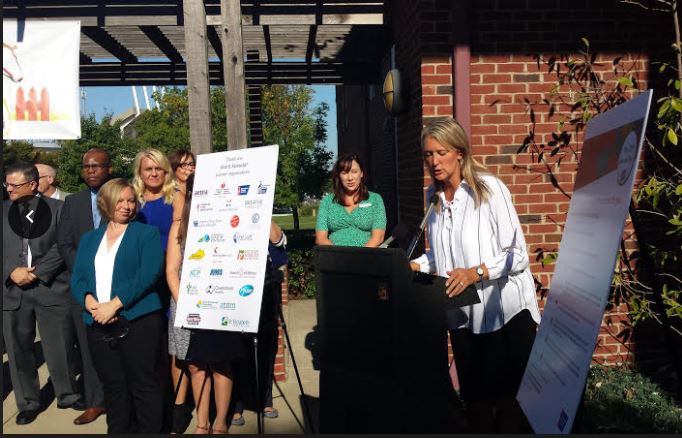
Coalition supporters displayed signs. (Photos by Melissa Patrick)
The foundation recently adopted smoke-free advocacy as its leading cause and is coordinating the coalition -- to the extent of lending it a modified version of its logo, which advocates held up during the launch.

Ellen Hahn, director of the University of Kentucky's Kentucky Center for Smoke-free Policy and a long-time advocate for a statewide ban on smoking in enclosed public places, said after the meeting that the Foundation is a "bully pulpit" that will speak for all of the advocates, and the coalition represents the federal Centers for Disease Control and Prevention's best practices for tobacco control -- increased taxes to discourage smoking, smoke-free policies, and helping people who want to quit.

"It's nice to have a fresh voice," she said. "I've said for years we need a bully pulpit. We need somebody who will speak up and say we need to do this."

At 24.5 percent, Kentucky has the second highest smoking rate in the nation, barely behind West Virginia's 24.8 percent. The national average is 15.1 percent. Almost 17 percent of Kentucky's high-school students are smokers, more than double the national average of 8 percent. Nearly 9,000 Kentuckians die from cancer or another smoking-related illness each year, and the state spends about $2 billion annually on smoking-related health care.

"Welcome to the cancer capital of the nation," Chandler said, noting that cancer hasn't declined as much in Kentucky as it has nationally, and cancer rates are increasing in parts of the state. He said the high smoking rate is partly to blame.

The coalition has set three goals: the $1 increase in the cigarette tax, with parallel increases in taxes on other tobacco products; helping counties and cities enact comprehensive smoking bans; and educating the public and health-care providers about a new law that requires health insurers to provide barrier-free coverage for all federally approved tobacco-cessation medications and programs.

Ben Chandler, president/CEO, Foundation for a Healthy Ky.
"These are proven laws and policy changes that will reduce our smoking rates, that will reduce our health care costs, that will in fact improve our health," Chandler said. "What's more, these policy changes don't cost an arm and a leg. In fact, they can dramatically improve Kentucky's troubling budget situation."

Chandler said Republican Sen. Stephen Meredith, a retired CEO of Twin Lakes Regional Medical Center in Leitchfield, has told him he plans to pre-file a bill to raise the cigarette tax by $1.

The current 60-cent tax is about a third of the national average of $1.71 per pack. The coalition projects that a hike to $1.60 a pack would bring in $266 million the first year.

Republican Sen. Ralph Alvarado, a Winchester physician who has sponsored several unsuccessful smoke-free bills, including one last session to make schools and school activities smoke-free, says he thinks the timing could be ripe to pass a cigarette tax because the pension system needs more money and Gov. Matt Bevin wants to reform the state's tax system.

Sen. Ralph Alvarado, R-Winchester
"The governor has charged that everything will be on the table when it comes to this tax proposal, so consequently now is the time to start looking at proposals that by themselves maybe would not pass, but as part of a larger reform has a chance to become law," Alvarado said.

Chandler said anything less than a $1 increase wouldn't work because it could be absorbed by the tobacco companies through things like temporary price cuts or other promotional discounting. He also noted that it has to be high enough to make people want to quit. "Otherwise it's just a tax increase with no health benefits, and what we care about are the health benefits,"he said.

Skeptics of a cigarette-tax increase say its revenue would decline as more people stop smoking, but Chandler said "We don't think it'll decline a whole lot," based on other states' experience. "Of course, the more it declines, the better. Any decline that does take place in the revenue the state receives is more than made up in savings on health-care cost. Anyway you look at it, it is a win for the state budget."

David Adkisson, president and CEO of the Kentucky Chamber of Commerce, said 90 percent of the chamber's members support a statewide smoking ban and legislation that would increase the cigarette tax. He added that the the costs of smoking to employers, in extra health care costs and reduced productivity, is almost $6,000 per smoking employee each year.

Jacob Steward of Bourbon County High School won applause.
"Our smoking situation in Kentucky is not only killing us, it's bankrupting us," he said.

Jacob Steward, a sophomore at Bourbon County High School and a member of a group called Students Making a Community Change, said he thought the additional tax would "significantly help" teenagers quit smoking because they would no longer be able to afford them, but he also suggested that it's also important to figure out why they ever started smoking in the first place.

"I think that one thing that should come out of this is maybe better outreach for those students. For people to actually empathize with them and understand why they started smoking to begin with," he said to a room full of applause.

Dr. Patrick Withrow, a cardiologist and director of public outreach for Baptist Health Paducah, held up a huge model of a cigarette and called it one of the most effective drug-delivery devices.

"Raising the price of cigarettes is the single most effective thing we can do to decrease smoking in Kentucky. If we decrease smoking in Kentucky, we decrease smoking disease, we decrease smoking death, and we improve quality of life," he said.

Chandler said the coalition will work systematically to help communities across the state become smoke free, with the long-term goal of passing a statewide smoke-free law. "Ultimately the goal is to get a critical mass of communities," he said. "We have 33 percent of the population covered right now; we'd like to raise that considerably and at that point maybe the state legislature might be ready to pass a statewide law."

The state House passed a smoking ban in 2014, but the bill died in the Senate, and Bevin, who took office in 2015, says smoking bans should be a local issue.

Chandler, who ran for governor as attorney general in 2003 and was 6th District U.S. representative from 2004 through 2012, was asked how hard politically it would be to pass the $1-a-pack tax increase.

"We are not overly sanguine about it. We do live in Kentucky and I think we all understand that, but things are changing in Kentucky," he said, noting that there are only 4,500 tobacco farmers in the state, down from almost 60,000 in 1992. "You are seeing a lessening of the economic impact, a lessening of the number of people who benefit from tobacco, and I think all of those things ought to come together to make this a more propitious time to get these things done."

Alvarado said opponents of the tax acknowledge that its day will come. He noted the state's budget problems and said,"It will be an accomplishment with the largest health impact for our state, and that's why we have to keep chasing the prize as a group."

Chandler concluded, "Folks, we are not going away until we succeed. We are not going away until Kentucky's smoking rate is no longer the highest in the nation. We are going to keep at it until we win this battle because our work is a win for public health, it's a win for Kentucky's budget and it's a win for Kentucky businesses."

Thursday, September 28, 2017

'Kick It, Kentucky' spends week encouraging smoking cessation in a state with the nation's highest smoking rate


By Melissa Patrick
Kentucky Health News

Kentuckians who want to stop smoking can take advantage of the many cessation tools offered by the state, including a new law that requires insurance companies to cover smoking-cessation treatments and counseling without imposing barriers.

That was the message at the Sept. 27 announcement of the first ever "Kick It, Kentucky" week, where more than two dozen organizations gathered in Lexington to promote smoking cessation.

"More adults in Kentucky smoke than in any other state in the nation and we also have the second-highest youth smoking rate in the country, but the good news is there has never been a better time to quit," said Erica Palmer Smith, Kentucky government relations director for the American Cancer Society's Cancer Action Network, one of the supporting organizations.

Several of the health advocates noted a long list of health benefits that come to a person who stops smoking: Within 20 minutes of quitting, a person's heart rate and blood pressure drop; within a couple of weeks, their lung function improves; and within a year, their risk of a heart attack drops by half. These benefits are listed on a poster that will be placed in doctors' office waiting rooms and public buildings as part of the Kick It, Kentucky effort.

Sen. Julie Raque Adams
Sen. Julie Raque Adams, R-Louisville, who was the primary sponsor of the smoking-cessation bill, told the group that smoking kills more than 9,000 Kentuckians a year, and stressed that "tobacco continues to be the leading cause of preventable death in the commonwealth."

The new law requires all insurance policies sold in Kentucky, and Medicaid, to cover all smoking-cessation treatments and counseling approved by the U.S. Food and Drug Administration with no barriers to access. For example, the law bans co-payments or deductibles for cessation products.

"There's never been a better time to quit," said Adams, who is also the chairwoman of the Senate Health and Welfare Committee. "Kentuckians who decide to quit will reap immense and immediate health benefits."

The president and CEO of the Foundation for a Healthy Kentucky, Ben Chandler, told the group that in addition to leading the nation in cancer and deaths from it, Kentucky ranks near the bottom of states for heart disease deaths, adult asthma and chronic obstructive pulmonary disease (COPD) -- which are all related to smoking.

"Therefore, I submit to you that the single most effective thing that we can do to improve the health of the people in this commonwealth is to reduce those smoking rates," he said. "Ladies and gentlemen,we've just simply got to do it. We've got to do it. It's a crisis and the need is dire."

He noted that this can be accomplished on a community and statewide level through smoke-free laws and raising the cigarette tax, or on an individual level, as Cheryl Weiss did.

Weiss, 36, said she smoked 20 years before quitting this year. "I got to where smoking was taking my time, my money and my energy," she said.

The Lexington woman credited her decision to quit smoking to an incentive program at her work that directed her to an eight-week smoking cessation program called "Freedom from Smoking" through the American Lung Association.

She said that by not smoking, she will save $26 every two weeks on her health insurance, plus the savings from not buying cigarettes -- and she said, "I feel healthier."

Other resources to help quit smoking can be found at www.quitnowkentucky.org and www.smokefreetomorrow.org. Kentucky's Tobacco Quitline is 1-800-QUIT-NOW (1-800-784-8669). In addition, many local health departments offer smoking cessation classes.