Showing posts with label Patient Protection and Affordable Care Act. Show all posts

Wednesday, June 26, 2024

Rural Tennessee hospitals near Kentucky border remain closed as the Volunteer State keeps spurning expansion of Medicaid

Jellico Medical Center is defunct. (KFF News photo by Taylor Sisk)
By Taylor Sisk
KFF Health News

JELLICO, Tenn. — In March 2021, this town of about 2,000 on the Kentucky border in the shadow of Pine Mountain lost its hospital. It's in Campbell County, which ranks 90th of Tennessee’s 95 counties in health outcomes and has a poverty rate almost double the national average, so losing its health care cornerstone sent ripple effects through the region.

“That hospital was not only the health-care lifeline to this community,” said Tawnya Brock, a health-care quality manager and a Jellico resident. “Economically and socially, it was the center of the community.”

Since 2010, 149 rural U.S. hospitals have closed or stopped in-patient care, according to the Cecil G. Sheps Center for Health Services Research at the University of North Carolina. Tennessee has had the second-most closures of any state, with 15, and the most closures per person. Texas has the most, with 25. Neither state has expanded Medicaid under the Patient Protection and Affordable Care Act, as has Kentucky, where only four hospitals have closed.

Jellico Medical Center was a 54-bed, acute-care facility. When it closed, some 300 jobs went with it. Restaurants and other small businesses in Jellico also have gone under, said Brock, who is a member of the Rural Health Association of Tennessee’s legislative committee. And the town must contend with the empty husk of a hospital.

Dozens of small communities are grappling with what to do with hospitals that have closed. Sheps Center researchers have found that while a closure negatively affects the local economy, those effects can be softened if the building is converted to another type of health care facility.

In Jellico, the town owns the old hospital building, and Mayor Sandy Terry said it is in decent condition. But the last operator, Boa Vida Healthcare of Indiana, holds the license to operate a medical facility there and has yet to announce its plans for the building, leaving Jellico in limbo. Terry said local officials are talking with health-care providers that have expressed interest in reopening the hospital. That’s their preferred option. Jellico does not have a Plan B.

“We’re just in hopes that maybe someone will take it over,” Terry said. Meanwhile, the nearest emergency rooms are a half-hour drive away in LaFollette, Tenn., and in Corbin, Ky.

MapQuest map, adapted by Kentucky Health News
An hour and a half away in Fentress County, the building that once housed Jamestown Regional Medical Center has been empty since June 2019, when Florida-based Rennova Health — which also previously operated Jellico Medical Center — locked it up.

County Executive Jimmy Johnson said Rennova’s exit from Jamestown was so abrupt that “the beds were all made up perfectly” and IV stands and wheelchairs sat in the halls. About 150 jobs evaporated when the center closed.

Rennova still owed Fentress County $207,000 in taxes, Johnson said, and in April the property was put up for auction. A local business owner purchased it for $220,000. But Rennova was granted a year to reacquire the building for what it owed in back taxes, plus interest, and did so within a few days.

Abandoned hospital buildings dot the map in Middle and East Tennessee. In West Tennessee, some shuttered hospitals have found new life.

The closing of McKenzie Regional Hospital in 2018 was a blow to the local economy. But Baptist Memorial Health Care, which operates a hospital in nearby Huntingdon, bought the assets — including the building, land, equipment, and ambulance service — and subsequently donated the building to the town of McKenzie.

Cachengo, a technology company, ultimately took over the space. Because of hospitals’ electrical infrastructure, the site was a perfect fit for a business like his, said Ash Young, Cachengo’s chief executive. Young said Cachengo is now looking into repurposing abandoned hospitals across the country.

Jill Holland, McKenzie’s former mayor and a local-government and special-projects coordinator for the Southwest Tennessee Development District, believes the town can become a technology hub. “It’s opening a lot of doors of opportunity for the youth in the community,” she said.

But in Jamestown, the vacant hospital is “deteriorating,” said Johnson, the county executive. “It could have been used to save lives.” Rennova did not respond to a request for comment.

The University of Tennessee Medical Center opened a freestanding emergency room elsewhere in Jamestown, sparing residents a half-hour drive to the closest ER. Johnson believes the old hospital building could serve the community as housing for those who are homeless or as a facility to treat substance use disorder.

Brock, the health-care quality manager, thinks things will get better in Jellico, but the community has had its hopes dashed more than once.

Brock believes a freestanding emergency room could be a viable solution. She urges her community to be responsive to “a new day” in rural health in America, one in which a hospital must focus on its community’s most urgent needs and be realistic about what that hospital can provide.

“Maybe it is just the emergency room, a sustainable emergency room, where you could hold patients for a period of time and then transfer them,” Brock said. “And then you build upon that.”

She added, “There are options out there.”

KFF Health News, part of the Kaiser Family Foundation, is a national nonprofit newsroom producing in-depth journalism about health issues.

Wednesday, April 24, 2024

National report on health-system performance ranks Kentucky low, but disparities among its racial and ethnic groups are also low

Commonwealth Fund graph (click to enlarge) shows Kentucky with low performance but low disparity.
By Melissa Patrick
Kentucky Health News

A new report from The Commonwealth Fund, a New York-based foundation, shows racial and ethnic disparities persist in health-care access, quality, and outcomes in Kentucky and across the nation.

"In every state we find wide disparities in health and health-care experiences for people of different racial and ethnic backgrounds," David Radley, a senior scientist for The Commonwealth Fund, said during an online press conference. "And that health system performance is markedly worse for people of color when compared to the experience of white people." 

The Commonwealth Fund, which says it aims to promote a high-performing health-care system, issued its 2024 State Health Disparities Report on April 18. 

The report used 25 measures to determine health-system performance, evaluating states on health-care access, quality, use of services, and health outcomes for people of different races and ethnicities in each state. It then gave a health-system performance “score” for each racial and ethnic group.

In Kentucky, white people had the highest score,in the 52nd percentile among all population groups nationally, making them about average. Hispanic Kentuckians had the state's lowest health-system performance, scoring in the 22nd percentile. Black Kentuckians scored in the 32nd percentile.

Despite those health disparities, when compared to other states in the Southeast, Kentucky has smaller disparities among its racial and ethnic groups. That's largely because Kentucky's whites rank lower than whites in all states except Wyoming, Arkansas, Oklahoma, West Virginia and bottom-ranking Mississippi.

The report says health disparities are influenced by a number of factors, including a lack of affordable, quality health-care options, and whether a person has health insurance or a primary-care provider. It is also influenced by social determinants, such as whether a person lives in an area of high crime, has access to transportation or lives in poverty. And it is also influenced by whether they have to deal with racism and discrimination in healthcare settings. 

“Where a person lives matters, and this is especially true for people of color,” Radley said. “We also see big differences in people’s abilities to access care. Not only do uninsured rates vary from state to state, we also find big differences within states where we see large coverage gaps between people from different racial and ethnic groups.”

The researchers said their work points out that only looking at how a state performs overall can mask the "profound inequities" that many people experience. 

Dr. Laurie Zephyrin, senior vice president for advancing health equity at The Commonwealth Fund, said improving health equity will require policy action and health system action. 

"One key area is around insurance coverage and affordability. Insurance coverage is a key part of this. It is however the floor in terms of ensuring that everyone has access to health care. And it is really critical," Zephyrin said. "When we look at the data about 25 million people in the United States are still uninsured, and they're disproportionately people of color. And even for people who are insured about a quarter of working age adults are underinsured." 

Kentucky made a big policy decisions to increase access when it expanded Medicaid in 2014 to people with incomes up to 138% of the federal poverty line under the Patient Protection and Affordable Care Act. 

Nevertheless, 28% of Hispanic adults in Kentucky have no health coverage, compared to 8% of Black adults and 6% of white adults. Having no insurance, or having plans that require high out-of-pocket costs relative to a person's income, cause people to not seek care when they need it.

Two of the nine health-outcome measures that the researchers looked at were premature treatable and preventable deaths before the age of 75.

In Kentucky, Blacks had the highest death rate for treatable conditions,171 per 100,000 people. This was followed by Whites with 119 deaths per 100,000, Hispanics with 57 per 100,000, and Asian American, Native Hawaiian and Pacific Islander (AANHPI), with 58 per 100,000.  

Black Kentuckians also led the state for deaths before the age of 75 from preventable causes per 100,000 people, with 402 deaths per 100,000. This was followed by whites, at 328; Hispanics, 173; American Indian and Alaska Native, 111; and AANHPI, 104. 

"Premature preventable mortality rates are higher for both Black and White residents in several Southern and South Central states — Arkansas, Mississippi, Louisiana, Tennessee, Kentucky, and Missouri — compared to most other parts of the country," says the report.  

Compared to other states, Kentucky's health system performance for Black people was better than average, ranking 18th of the 39 states where calculation of a Black rate was statistically reliable. 
 
Kentucky's health-system performance was ranked worse than average for Hispanics, ranking 29th of 47 states.

And with a ranking of 46th of 51 states, Kentucky's health system performance for white people was considered among the worst compared to other states. 

The researchers said the hope is that policymakers, health system leaders and community stakeholders will use this information to inform future policy that will ensure a more equitable health care system in the future. 

The report offered four policy options toward this goal, with detailed suggestions for each of them on how to accomplish them. The policy options would ensure universal, affordable and equitable health coverage; strengthen primary care and improving the delivery of services; reduce inequitable administrative burdens affecting patients and providers; and  invest in social services.

"This analysis will give policymakers and health-care leaders a critical roadmap to enact targeted policies and make the key investments to eliminate disparities and achieve health equity," said Dr. Joseph Betancourt, president of The Commonwealth Fund. "Just as deliberate choices have been made that have put us in the situation, we can now be deliberate about promoting high quality equitable health care for all. This undoubtedly will create healthier, more resilient communities that would ultimately benefit the entire nation." 

Tuesday, April 2, 2024

Republicans talk about making Obamacare better, not repealing it, so it is 'becoming a politically untouchable part' of the safety net

Washington Post graph from Kaiser Family Foundation polling data
Kentucky Health News

"A law once derided as 'Obamacare' and demonized as a big-government power grab is becoming a politically untouchable part of the American safety net, like Social Security and Medicare before it," writes Dan Diamond, lead health reporter for The Washington Post.

As evdience, Diamond cites President Joe Biden's "celebration" of the Patient Protection and Affordable Care Act as he runs for re-election, and former president Donald Trump's "grudging acceptance" of the 2010 law: he no longer wants to repeal it, just "make it better."

In Kentucky, where then-Gov. Steve Beshear embraced Obamacare by expanding Medicaid to the point that it covers every third person in the state, Republicans have realized its political appeal and have not pushed to replicate the failed efforts of Republican Matt Bevin, governor in 2015-19, to impose work requirements on Medicaid beneficiaries.

Nationally, "More than 45 million people now rely on the ACA and its provisions for health coverage, according to a federal report released last week, and the law’s protections for people who have pre-existing conditions have transformed many Americans’ experience of health care. Yet for nearly a decade, Republicans like Trump successfully ran on pledges to 'repeal Obamacare' — and Democrats sometimes ran from it, scarred by the law’s bumpy rollout, the constant political attacks and the struggle to communicate its benefits," Diamond notes. "But when Trump and his Republican allies nearly repealed the ACA — falling one senator short in July 2017 — it sparked passionate efforts to defend it and catalyzed new, long-lasting support."

Between the time Trump was elected and took office, outgoing Health and Human Servcies Secretary Sylvia Burwell "rolled out a 70-day crash plan to shore up support for the health law, developing targeted maps to show members of Congress how the law was affecting their communities," Diamond reports. "She worked the phones to reach GOP lawmakers and governors, seeking promises that they would not cut the protections for people with pre-existing conditions — one of the most beloved parts of the law, and one of the most integral. Burwell knew preserving that provision would complicate the ability to repeal the broader ACA. . . . Ultimately, Sen. John McCain (R-Ariz.) blocked the repeal in a dramatic late-night vote," killing a so-called "skinny repeal" bill sponsored by Republican Leader Mitch McConnell of Kentucky.
As Sen. Mitch McConnell watched, Sen. John McCain turned thumbs down and voted "no" on the bill.
"Today, more Americans than ever have health coverage, with about 21 million insured through the ACA’s private health plans, up from 12 million when Biden took office, according to a federal report released last week," Diamond reports. "Another 23 million gained coverage through the law’s expansion of the Medicaid program."

Wednesday, March 13, 2024

Contrary to Trump's musings, McConnell says efforts to repeal the 2010 Patient Protection and Affordable Care Act are 'largely over'

Senate Republican Leader Mitch McConnell waited for President Biden to arrive for the State of the Union speech Thursday, March 7, in the House chamber. (Pool photo by Shawn Thew, via Associated Press)
Kentucky Health News

Obamacare, now into its second decade, is pretty much here to stay.

So says Senate Republican Leader Mitch McConnell of Kentucky, contradicting former President Trump’s comments that he is still looking at ways to repeal and replace the 2010 law.

“We had a fight over that a few years ago,” McConnell told reporters Tuesday, referring to how Republicans fell short of doing that in 2017 because a few of them opposed the reversal.

“If he can develop a base for revisiting that issue, obviously we’d take a look at it, but it seems to me that’s largely over,” McConnell said of the repeal-and-replace effort, which never had a replacement measure.

McConnell's statement "gave voice to the view shared by many Republican senators that the Affordable Care Act, also known as Obamacare, will be the law of the land for the foreseeable future," writes Alexander Bolton of The Hill.

McConnell endorsed Trump last week, despite their serious differences over more than three years. He said Tuesday, “I’m going to leave the issue development in the presidential campaign up to the campaign.”

Trump said he is “seriously looking at alternatives” if he is elected and Republicans keep control of the House and regain control of the Senate.

“The cost of Obamacare is out of control, plus, it’s not good Healthcare. I’m seriously looking at alternatives,” Trump wrote on his Truth Social site last year. “We had a couple of Republican senators who campaigned for six years against it, and then raised their hands not to terminate it. It was a low point for the Republican Party, but we should never give up!”

Trump exaggerated or misstated the campaign positions of Sens. Susan Collins (R-Maine), Lisa Murkowski (R-Alaska) and the late Sen. John McCain (R-Ariz.), who "voted with Democrats to defeat a narrowed-down proposal to repeal the Affordable Care Act without putting a new health care subsidy program into effect," Bolton notes.

President Biden defended the law during last week's State of the Union speech.

“Over 100 million of you can no longer be denied health insurance because of a preexisting conditions. But my predecessor and many in this chamber want to take — the prescription drug away by repealing the Affordable Care Act. I’m not going to let that happen. We stopped you 50 times before, and we’ll stop you again.”

The main impact of the law in Kentucky has been the expansion of Medicaid to households with annual incomes up to 138 percent of the federal poverty threshold. In February, 1.56 million Kentuckians, more than a third of the state's population, were enrolled in the federal-state program. For details, with county-by-county numbers, go to https://www.chfs.ky.gov/agencies/dms/stats/KYDWMMCC20240215.pdf.

Tuesday, February 14, 2023

Medicaid isn't off the budget-cutting table, but seems resilient because it covers so many and is vital for rural hospitals

Protesters in 2017 (Photo by Drew Angerer, Getty Images)
Now that President Biden and Republicans agree they won't cut Medicare and Social Security, the federal-state Medicaid program will be on the table as Republicans try to get concessions for raising the national debt ceiling. But "Medicaid is politically better positioned to weather the storm than ever," Politico's Joanne Kenen reports.

While the House Republican platform for midterm elections was vague about cuts, "and even more vague on health policy, the conservative Republican Study Group’s budget blueprint for the current fiscal year would have restructured Medicaid entirely and cut $3.6 trillion over a decade compared to the current spending trajectory — but there’s no way that Democrats (or even some more establishment Republicans) would accept that," Kenen writes.

Medicaid has "a much stronger constituency" these days because it covers many more people, 90 million, including 1.7 million in Kentucky, more than a third of the state's population.

The program is "the largest payer of nursing-home care in the U.S, and it’s a lifeline for disabled kids and their families, both very politically sympathetic populations," Kenen reports, citing Larry Levitt, executive vice president for health policy at the Kaiser Family Foundation. “Medicaid now is touching the majority of families in the country,” Joan Alker, executive director of the Center for Children and Families at Georgetown University in Washington, D.C., told Kenen.

"As if all that wasn’t enough, Medicaid keeps safety net hospitals afloat," Kenen notes." And those hospitals, which treat a large share of poor people in both rural and urban settings, are in an even more precarious financial position than usual after the pandemic. . . . Tom Miller, a health expert at the center-right American Enterprise Institute who has written extensively on what he sees as more realistic conservative approaches to improving Medicaid, including broader use of federally-approved waivers for states, expects conservative Republicans to try again this year — and again overreach and fail."

Sunday, May 15, 2022

Legislature funds health insurance for Kentuckians who make too much to qualify for Medicaid but too little to buy private coverage

Kaiser Health News graphic
Kentucky Health News

Kentucky is taking advantage of a little-used provision of the 2010 Patient Protection and Affordable Care Act to create a health-insurance plan for Kentuckians who make too much to qualify for free Medicaid coverage but not enough to pay for private insurance. 

The policy, known as the basic health program, was included in the ACA, but only Minnesota and New York took advantage of it. Kentucky and Oregon are now pursuing this option, Megan Messerly reports for Politico. 

The move comes "amid growing concern that the looming end of the Covid-19 public health emergency could result in millions of people being kicked off Medicaid and fear that Obamacare subsidies that helped millions of people buy coverage will expire at the end of 2022," Messerly writes. 

The Kentucky General Assembly, led by supermajorities Republicans, approved $4.5 million in state funds and $4.5 million in federal funds in the 2022-24 state budget to set up the program.

Messerly reports that at least 37,000 Kentuckians will be eligible to enroll in the program's plans as soon as next year. 

A basic health program offers low-cost insurance for people who make up to twice the federal poverty level – about $55,000 for a family of four – and do not qualify for Medicaid. New York and Minnesota offer plans with little or no premiums, co-pays or deductibles.

While the expansion of Medicaid under the ACA to Kentuckians making up to 138% of the federal poverty line has been criticized by some Republican legislators, this program offers more appeal to them because it is seen a a way for low-wage workers to work more without fear of losing their health insurance because they would no longer qualify for Medicaid. 

“Kentucky is not known for our great health metrics, and we’re doing our best to really address some of the gaps and the barriers in the system,” Rep. Kim Moser, R-Taylor Mill, told Messerly. “We know that this is the group of people who churn in and out of health coverage.”

Kentucky health advocates have pushed for a basic health plan for years and it's finally gaining some traction. 

The plan came form a work group the legislature created to explore establishing a "bridge" insurance plan. The group said a basic plan would “allow individuals who would otherwise lose their health care coverage through Medicaid to be able to accept work and pay raises and take away the disincentive to accept increased pay or work.”

Emily Beauregard, executive director of Kentucky Voices for Health, told Messerly, “It’s clear to see where the gaps lie, and which populations technically have coverage options, but not coverage options that work for them.” 

A spokesperson for the Cabinet for Health and Family Services told Messerly that  the goal is to enroll people this fall for coverage starting in January.

Critics of the plan say states should focus on making coverage in federally subsidized plans ("Obamacare") more affordable. Kaiser Permanente told the federal Centers for Medicare and Medicaid Services that the basic plans could undermine the Obamacare program, and hospitals are worried about the plans' reimbursement rates.

The legislature also recently passed House Bill 708, sponsored by Rep. Jonathan Dixon, R-Corydon, that requires the health cabinet to develop a proposal for the establishment of a "benefits cliff" calculator and an online job posting database to help Kentuckians who want to explore the impact on their health insurance benefits of taking a job that offers more money.

A benefit cliff is the loss of eligibility for public assistance due to a wage increase. The law also creates the Benefits Cliff Task Force to examine the impacts of the cliff on workforce participation, employment, wages and other employment issues.

Sunday, August 1, 2021

Special enrollment period for health insurance on healthcare.gov ends Aug. 15; subsidies are bigger, and more people qualify

By Melissa Patrick
Kentucky Health News

Time is running out to sign up for low- or no-cost health insurance through the federal marketplace under the special enrollment created by Congress and President Biden. The deadline to sign up on healthcare.gov is Aug. 15. 

AARP illustration
The president reopened the marketplace in mid-February under the American Rescue Plan Act, for people who needed coverage during the pandemic, and later extended the deadline to Aug. 15. 

The special enrollment is open to both new and existing customers, including the thousands of Kentuckians who got temporary Medicaid coverage during the pandemic through the state's "presumptive eligibility" program. 

About 120,000 Kentuckians lost that temporary Medicaid coverage in July, according to Brice Mitchell, a spokesman for the state Cabinet for Health and Family Services.  

Mitchell said the state has told some of those people they would be losing their coverage and encouraged them to check kynect.ky.gov to see if they qualify for traditional Medicaid, or go healthcare.gov to apply for a federally subsidized plan. He said state Kynectors, who help people enroll, will continue the outreach through August. 

Dustin Pugel, senior policy analyst at the Kentucky Center for Economic Policy, encouraged Kentuckians who recently lost their temporary Medicaid coverage and are not covered by work or traditional Medicaid to "Run, not walk, to the marketplace to find an affordable option." 

Priscilla Easterling, the outreach coordinator for Kentucky Voices for Health and a Kynector, also encouraged Kentuckians without health coverage to explore their options on healthcare.gov, especially those who looked at plans in the past and found them unaffordable at that time.

"With the increased subsidies that the American Rescue Plan included . . . we have seen so many people save a surprising amount of money," Easterling said. "It is 100-percent worth just checking it out. . . . It's a totally different ballgame."

A federal report says 34% of those who got a subsidized plan since April 1 paid $10 or less a month for their coverage, thanks to the American Rescue Plan's premium reductions. In Kentucky, 32% of new customers and 19% of returning customers were able to find a plan for $10 or less per month. 

In the special enrollment period, plans are more affordable due to bigger premium subsidies through tax credits, and no repayments are required if a tax return shows they didn't qualify for the tax credit. Also, more people eligible for the subsidies, and costs are limited to no more than 8.5% of income, down from nearly 10%.

For the first time, the new rules allow those earning more than 400% of the federal poverty level -- about $51,000 for an individual and $104,800 for a family of four in 2021 -- to get a subsidized plan. 

This change is especially helpful to older adults with incomes above 400% of the poverty level, because unlike traditional health plans, which are allowed to charge more based on age, special-enrollment premiums are capped at 8.5% of income.

"Compared to current premium payments, a 60-year-old with a $55,000 income would pay 77% less for a bronze plan ($146 vs. $634 per month), 56% less for a benchmark silver plan ($390 vs. $887 per month), and 52% less for a gold plan ($453 vs. $951 per month), on average," says the Kaiser Family Foundation.

Also benefiting from this expansion to 400% of the poverty line are self-employed people who have not had access to affordable health insurance. "As wonderful as the Affordable Care Act was to open up affordable coverage for so many people," Pugel said. "It really did leave that group of folks out." 

Through the end of June, 13,773 Kentuckians had signed up for health insurance during the special enrollment period, according to a federal report. That's an increase from the special enrollment periods in 2020 and 2019, when 6,747 and 7,041 signed up, respectively. 

But fewer than 10% of eligible Kentuckians have taken advantage of the opportunity. Easterling said about 115,000 Kentuckians who qualify for a subsidy under the special enrollment period have not yet signed up.

Nationwide, more than 2 million have signed up.

Open enrollment is usually in effect only six weeks at the end of a year, except for those who experience a "qualifying life event," like getting married or losing a job. After the special enrollment period closes on Aug. 15, open enrollment will re-open Nov. 1.

Biden's American Families Plan would make some of these measures permanent, including the bigger tax credits, coverage to those who earn 400% and above the federal poverty level, and the premium cap of 8.5% of household income. Those measures will stop at the end of 2022 unless Congress makes them permanent.

Sunday, June 20, 2021

Temporary Medicaid ending; special marketplace enrollment period ends Aug. 15; premium-free COBRA ends in September

Families USA graphic; for a larger version, click on it.
By Melissa Patrick
Kentucky Health News

Kentuckians have about two more months to buy reduced-cost health insurance on the federal marketplace under the special enrollment period. The deadline to sign up on healthcare.gov is Aug. 15. 

The Biden administration reopened the marketplace in mid-February under the American Rescue Plan Act, for people who needed coverage during the pandemic, and later extended the deadline to Aug. 15. 

The special enrollment is open to both new and existing customers, including the thousands of Kentuckians who qualified for temporary Medicaid coverage during the pandemic through the state's "presumptive eligibility" program. The PE program will end for some of them on June 30.

"Kentuckians who will be losing their PE coverage at the end of this month, should contact a kynector to learn more about regular Medicaid and Marketplace options," Kentucky Voices for Health said June 15. 

KVH said Kentuckians who have been enrolled in PE coverage since January will be disenrolled on June 30. Those who enrolled after January may have a different end of coverage date.  

The special enrollment period includes provisions that make the plans more affordable, including enhanced premium subsidies, also known as tax credits, to help offset the cost of insurance. It also makes more people eligible for the subsidies, limits costs to no more than 8.5% of income, down from nearly 10%, and eliminates repayments that may be required when people reconcile their tax return with the tax credit they received. 

“Four of five enrollees will be able to find a plan for $10 or less per month after premium tax credits, and over half will be able to find a Silver plan with a zero-dollar premium," Carrie Banahan, deputy secretary of the state Cabinet for Health and Family Services, said in a news release. 

Silver plans have the the second-lowest costs and are the benchmarks used to calculate the tax credits. They are the most common choice of marketplace shoppers, said Banahan.

State officials said premiums will decrease on average by $50 per person per month, or by $85 per policy per month, although the savings will vary per individual. 

Through the end of May, just over 10,000 Kentuckians signed up for health insurance during the special enrollment period, according to a federal report. 

That's an increase in enrollment from the same period in 2020 and 2019, when 5,550 and 5,789 signed up, respectively. Open enrollment is usually in effect only six weeks at the end of a year, except for those who experience a "qualifying life event," like getting married or losing a job.

Nationwide, more than 1.2 million people have signed up. 

New premium-free COBRA options until September

If you had health insurance through your job until you lost hours or lost employment, you and your family may qualify for health coverage through premium-free COBRA (which stands for the Consolidated Omnibus Budget Reconciliation Act of 1985, which instituted the provision). 

The American Rescue Plan also requires the federal government to pay 100% of COBRA insurance premiums for eligible employees who lose their jobs (and for their covered relatives) through September, allowing them to stay on their company-sponsored health plans.

Families USA offers a fact sheet that answers a variety of questions about eligibility, enrollment process and other topics. It also features a list of local, state and national resources. 

Families USA also warns consumers that COBRA is only available through their former employer or health plan, and not through a website. 

President Biden has proposed in his American Families Plan to make some of these pandemic changes permanent, including the premium tax credits, expanded coverage to those who earn 400% and above the federal poverty level, and the 8.5% household income cap on the monthly amount a person would pay for their policy.

Thursday, June 17, 2021

Beshear says Supreme Court ruling upholding Obamacare should end challenges to law that let his father expand Medicaid in Ky.

By Al Cross
Kentucky Health News

Gov. Andy Beshear said Thursday that the latest U.S. Supreme Court ruling upholding the Patient Protection and Affordable Care Act was the most important lawsuit in which he has been involved, and that the 7-2 decision may shut the door to further legal challenges to the 2010 federal law.

When he was attorney general, Beshear and his Democratic counterparts intervened to defend the "Obamacare" law in a Texas federal court when Donald Trump's Department of Justice did not. The judge ruled against them, in a suit by Republican attorneys general, but the Supreme Court ruled that the states did not have legal standing to sue because the hadn't shown how the law harmed them.

Beshear said, "I've been involved in a lot of lawsuits since I became attorney general or before. This is probably the most consequential. . . . I hope that this will fully and finally end attacks on a health-care system that, during a once-in-a-lifetime pandemic, was absolutely necessary in keeping people alive." 

While the decision was based on lack of standing, "I think in many ways it will preclude further suits," Beshear said. NBC News legal analyst Pete Williams agreed, saying, "It makes it pretty hard for somebody else to come along and make a similar challenge, so it's a big victory for Obamacare."

Department of Health and Human Services Secretary Xavier Becerra, who as California attorney general worked with Beshear to lead the Democrats' legal fight, noted that the decision is the third from the high court to uphold the law: "If we were playing baseball, we'd say three strikes, you're out."

A slide Beshear displayed at his press conference
Beshear said he intervened as attorney general on behalf of 1.8 million Kentuckians who have pre-existing conditions, to whom the law guarantees coverage; to keep allowing people up to age 26 to be covered by their parents' insurance; to help fight the opioid epidemic; and to preserve coverage under the expansion of Medicaid allowed under the law.

Beshear was elected in November 2019 over incumbent Republican Matt Bevin, who said he would end the Medicaid expansion unless he was allowed to add a work requirement for many beneficiaries. Federal courts blocked that.

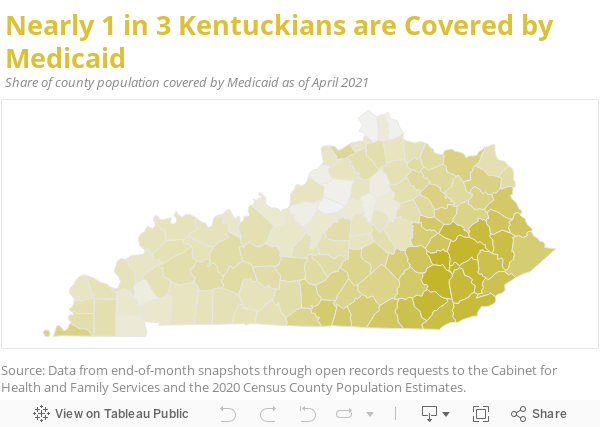
Beshear's father, then-Gov. Steve Beshear, expanded Medicaid in 2014 to people with household incomes up to 138 percent of the federal poverty line. During the pandemic, many people who lost their jobs went on Medicaid, boosting its rolls to 1.64 million, 36.6 percent of Kentuckians. In many Appalachian counties, it covers more than half the population.

Friday, May 28, 2021

Research finds declines in drug-overdose death rates in eight Eastern Kentucky counties and explores the many reasons for it

From "Understanding Declining Rates of Drug Overdose Mortality in Eastern Ky.;" click it to enlarge
By Melissa Patrick
Kentucky Health News

A decline in drug-overdose deaths in several Eastern Kentucky counties in the last decade was likely the result of state policies and strategies, stakeholders in the region told researchers for a newly published study. 

“The findings of this study are very encouraging, as eight counties in Eastern Kentucky were among the 10 counties nationally with the greatest decline in drug-overdose mortality,” Fran Feltner, director of the University of Kentucky Center for Excellence in Rural Health, said in a news release. "Of the top 20 counties nationally, 14 were in Eastern Kentucky.”

The study looked at the two five-year time periods between 2008 and 2017, using data from an opioid mapping tool from the Walsh Center for Rural Health Analysis in the National Opinion Research Center at the University of Chicago and drug-overdose death data from the Centers for Disease Control and Prevention's National Center for Health Statistics. 

The eight Eastern Kentucky counties with the greatest decline in overdose death rates between 2008-12 and 2013-17 were Clay, Johnson, Floyd, Magoffin, Breathitt, Bath, Powell and Letcher, according to the report. 

The researchers from UK and NORC noted that the declines in overdose death rates in those Eastern Kentucky counties happened even as overdose rates went up across the nation, in the state as a whole, and in the Appalachian regions of neighboring states such as Ohio and West Virginia. 


This prompted them to try to find out why, by asking key stakeholders in the Eastern Kentucky region what they thought was driving those declines. The stakeholders included representatives from criminal justice, prevention and education, economic development and recovery, substance use treatment, state and local health departments, health care and harm reduction. 

The report details some policies, programs and interventions that key informants gave as reasons for why the region saw such declines. They include: 

Shifts in drug-use patterns: "Across all sector types, interview respondents described the increased use of methamphetamines, in particular, as a primary contributing factor to reduced opioid mortality rates as access to prescription opioids declined," says the report. 

Improving prescribing behaviors:  "Many interview respondents indicated that less access to prescription opioids is likely contributing to the declines in drug-overdose mortality," the report says. 

In 2012, the General Assembly required health-care providers who prescribe controlled substances to use the prescription-drug monitoring program that the state created in 1998.

The legislature also limited who could own and invest in a pain clinic to being "only a physician having a full and active license to practice medicine." A representative from the state Office of Drug Control Policy told the researchers  that “from 2011 to 2018, 100 million fewer dosage units of opioids a year were prescribed …we got rid of 36 pain clinics. Low-hanging fruit with that 2012 legislation.”

Increasing access to substance-use treatment: One of the major reasons given for the decreased overdose deaths in the region was the increased access to treatment for substance-use disorder that came from the Patient Protection and Affordable Care Act, fully implemented in 2014. 

Prior to the ACA, Kentucky did not cover drug treatment for Medicaid enrollees, and any such treatment had to be individually approved by the federal Centers for Medicare and Medicaid Services. Under the ACA, Kentucky added a wide range of treatments to its Medicaid, which was expanded to those with household incomes up to 138% of the federal poverty level. 

"The number of enrollees in Kentucky’s Medicaid expansion program receiving substance-use services increased by more than 700 percent between the first quarter of 2014 and the second quarter of 2016, from approximately 1,500 to more than 11,000 care encounters," says the report. 

Some respondents also noted the wide range of ways that people could access treatment in the region, whether from referrals from judges, law enforcement, harm-reduction sites or community organizations. 

Focus on individuals in recovery: Several respondents said a focus on helping people in recovery gain work and housing, along with peer support, has contributed to the region's decreased overdose death rate.

A stakeholder from the criminal-justice field noted that the Kentucky Chamber of Commerce's efforts in this area, and another respondent said, "The willingness of employers to hire people with a record or a history of addiction has helped keep people in recovery, which ultimately would contribute to the decline in mortality rates.”

Evolving approach to criminal justice: Law-enforcement stakeholders told researchers that there has been a shift in how police officers interact with people who use drugs, noting that many of them now try to refer them to treatment, instead of immediately arresting them. The State Police Angel Initiative, started in 2016, allows anyone with substance-use disorder to come to a KSP post and get help to find treatment. 

Others pointed out that judges across Eastern Kentucky have shifted from sentencing people who use drugs to prison, to sending them directly to treatment. A representative from Operation UNITE said every county in the Fifth Congressional District operates a drug court, as do 113 of the state's 120 counties. Some noted that the effectiveness of these programs vary by county. 

Expansion of syringe exchanges: Interviewees also attributed the low death rates to syringe-exchange programs, which they said provide a safe place for individuals who use drugs to learn about the resources available to help them.

As of October 2020, the report says Kentucky had 74 such harm-reduction sites, mostly in the eastern part of the state. The report notes that number was more than all neighboring states combined.

Longstanding political commitment:  Respondents described the "consistent and bipartisan" political support of state leaders as one of the reasons for the declining death rates. In particular, respondents said Fifth District U.S. Rep. Hal Rogers' longstanding commitment to the issue was a reason for the decline. Rogers launched Operation UNITE in 2003. 

"Prior to Medicaid expansion, Operation UNITE’s treatment vouchers were one of the main sources of funding for treatment and recovery services, making UNITE an essential stakeholder supporting Kentucky’s longstanding history of addressing addiction concerns," says the report.

Stakeholders also pointed to former Gov. Ernie Fletcher's efforts to facilitate continued growth of the recovery housing community in Eastern Kentucky and former Gov. Steve Beshear's support of the ACA and his role in expanding Medicaid to more people in Kentucky. 

Increased distribution of naloxone: Some respondents pointed to increased distribution of naloxone, which blocks an overdose, as one of the reasons for the region's decreased overdose-death rates. However, others said the notable increase in naloxone distribution has occurred more recently and may not have played a significant role by 2017.

Appalachian culture: Some stakeholders credited the resiliency of the Appalachian people, and others noted the importance of local coalitions and grassroots efforts to address substance use, as reasons for the decline in overdose deaths. Some of the respondents also talked about how reduced stigma has increased enrollment in treatment. 

While the study acknowledges that the key respondents' findings are based on their thoughts and opinions, it notes that many of the strategies thought to be successful in reducing overdose mortality in the region could be adapted and leveraged elsewhere. 

“This story of success and progress in Eastern Kentucky highlights the strength and resilience of the Appalachian people, and shows what can be accomplished with collaboration, bipartisan support and a longstanding commitment to addressing substance use across the region,”  Michael Meit, NORC project manager and senior fellow, said in the news release.

Saturday, March 27, 2021

Special open enrollment period for government-subsidized health insurance extended to Aug. 15; new rules expand who qualifies

By Melissa Patrick
Kentucky Health News

The special open enrollment period for people to buy government-subsidized  health insurance on the federal marketplace has been extended by three months to Aug. 15. 

Kaiser Family Foundation graphs; for a larger version of any image, click on it.
President Joe Biden announced the extension March 23, the 11th anniversary of the Patient Protection and Affordable Care Act becoming law. The special enrollment period was set to end May 15. 

The special enrollment period includes enhanced premium subsidies, also known as tax credits, to help offset the cost of the marketplace's health insurance plans. It also makes more people eligible for the subsidies and eliminates repayments that may be required when people reconcile their tax return with the tax credit they received.

The enhanced subsidies, along with several other health-related provisions, were authorized under the  $1.9 trillion relief-and-stimulus law and are aimed at making coverage more affordable for people who already have marketplace coverage, who are uninsured or have lost their employer coverage.

Open enrollment is usually open for only six weeks at the end of a year, except for those who experience a "qualifying life event," like getting married or losing a job. 

Under the American Rescue Plan, subsidized premiums will drop an average of $50 per person per month, according to a federal fact sheet. It also says four out of five enrollees will be able to find a plan for $10 or less per month after the tax credit, and most will be able to find a "silver" plan for $10 or less. Silver plans have the the second-lowest costs and are the benchmarks used to calculate the tax credits. 

Under the ACA, only people with incomes between 100% and 400% of the federal poverty level  were eligible for a tax credit to reduce their premiums for marketplace coverage. 

The American Rescue Plan removes that cap for two years and allow people with incomes above 400% of the poverty level ($51,040 for an individual) to be eligible for the enhanced subsides. 

It also limits the amount a person would pay for a plan to 8.5% of household income, down from 9.83%. The federal government picks up the slack.

For example, Kaiser Health News reports that a typical single person who makes $30,000 a year will pay $85 per month for a silver plan instead of $195, according to an analysis by the Center on Budget and Policy Priorities. A family of four making $75,000 will pay $340 rather than $588 per month for similar coverage, the analysis found.

The Kentucky Center for Economic Policy reports that the American Rescue Plan's provisions mean that many who earn between 139% of the poverty level ($17,900 for an individual) and 150% of the federal poverty level ($19,320 for an individual) can find plans with zero premiums.

In Kentucky, anyone earning up to 138% of the federal poverty line qualifies for Medicaid, which is free of charge. 

The savings are available to both new and existing enrollees and will start on April 1. They will be available for two years. They will help the 77,800 Kentuckians who are already covered by marketplace plans, and open enrollment to more Kentuckians.

Kaiser Health News has a list of things to do to determine whether you qualify for an enhanced subsidy:
  • People with marketplace coverage through healthcare.gov should update their applications and reselect their current plan to get details about their subsidies that will start on April 1. 
  • The more generous premium tax credits may mean that a person can switch to better coverage with lower cost sharing for the same contribution, although Kaiser Health News cautions that switching plans may mean any money paid toward a deductible under the current plan could be lost -- so check with your insurer before making a switch. 
  • People who have already bought a 2021 plan on the marketplace that didn't qualify for a premium tax credit under the ACA will need to enroll again to get the new premium tax credit.
  • Recipients of unemployment insurance benefits in 2021 are urged to enroll in a marketplace plan now. Under the new law, unemployed workers can get a zero-premium plans in 2021. 
The Kaiser Family Foundation offers a Health Insurance Marketplace Calculator to help people estimate how much their marketplace coverage would cost with the relief bill's changes.  

The ARP also requires the federal government to pay 100% of COBRA insurance premiums for eligible employees who lose their jobs (and for their covered relatives) through September, allowing them to stay on their company-sponsored health plans. This provision is especially important for people with medical conditions because it allows them to keep their coverage and existing providers.

Friday, December 4, 2020

Dec. 15 is the deadline to sign up for federally subsidized health insurance; Kentucky enrollment is running behind last year's


By Melissa Patrick
Kentucky Health News

The deadline to enroll in federally subsidized health insurance for 2021 is fast approaching, with the last day Tuesday, Dec. 15 to sign up for coverage that starts Jan. 1.  

And while anyone already enrolled will automatically be re-enrolled in a 2021 marketplace plan, it is highly recommended that you check out other options to make sure your current plan still meets your needs. 

“It’s very important for individuals to update their applications, even if they were covered last year, so they can review the most current information on what savings are available and to find a plan that best meets their needs,” Kentucky Health Benefit Exchange Director Edith Slone said in a news release.  

Some things to consider when choosing coverage are whether the number of people in your household has changed, whether your income or medical needs have changed -- which is especially important this year because of the pandemic -- and whether the plan includes your providers or their formularies include your prescriptions.

Consumers are also encouraged to not only look at premium costs, but to also look at annual deductibles, which must be met before much of the coverage will kick in. 

And don't assume you can't afford coverage. The Cabinet for Health and Family Services says about 80 percent of Kentuckians who sign up on healthcare.gov will qualify for a tax credit or subsidy to reduce their monthly payments. 

Under the 2010 Patient Protection and Affordable Care Act, subsidies to offset premium costs are available on a sliding scale for people who earn between 100% and 400% of the federal poverty level. That range next year is $12,760 to $51,040 for an individual and $26,200 to $104,800 for a family of four, says Kaiser Health News, in an article that addresses how to choose a plan if you've had covid-19 and are worried about possible long-term complications.

Map shows Anthem marketplace plan availability by county.
In addition, many Kentuckians will have more choices this year, probably at a slightly higher cost, since Anthem Health Plans and CareSource both expanded their coverage areas, giving 94 of the state's 120 counties more than one company to choose from. This year, only 56 counties had two insurers on the healthcare.gov marketplace. 

Anthem is offering at least one of its 13 plans in all 120 counties in 2021, up from 93 in 2020. CareSource is offering all 12 of its plans in 94 counties, up from 83 in 2020.

Through the end of November, 2,939 fewer Kentuckians had enrolled on the federal exchange than at the same time last year. That was 12.2% less than at this time last year, but because of calendar procession, this year's tally had two fewer days, or 6.7% fewer. Nationally, more people had signed up compared to last November. 

Map shows CareSource plan counties in blue.
As of Nov. 28, Kentucky's enrollment on the federal exchange was 24,043, compared to 26,982 last year, according to the Centers for Medicaid and Medicare Services. None of these numbers reflect any automatic re-enrollments.

"We expected numbers would be less this year due to the pandemic," Susan Dunlap, spokeswoman for the health cabinet, said in an e-mail. " More are qualifying for presumptive-eligibility Medicaid coverage and traditional Medicaid coverage due to loss of income" in the coronavirus pandemic.

Another challenge may be a lack of awareness about the Affordable Care Act coverage on the marketplace, which is most widely known as Obamacare. The Kaiser Family Foundation reports that its polling found public awareness about the 10-year-old law is falling, compared to a decade ago.

"For example, 59% of the public knows the ACA offers subsidies for marketplace health plans, compared to 75% ten years ago," the foundation reports. "Among uninsured consumers today, understanding of ACA options and enrollment rules is more limited. Less than half (43%) know open enrollment is the time to sign up for marketplace plans; and 14% of uninsured individuals living in states that have expanded Medicaid eligibility under the ACA know about this expansion. KFF also finds many consumers are unsure about the current status of the ACA; as of this spring, just 22% of the uninsured know the law remains in effect. Uncertainty may result in part due to public debate and news coverage about a pending Supreme Court case to overturn the law." 

The health cabinet said it is reaching out to current and potential enrollees via direct mail, emails, phone calls, and community outreach events held by local Kynectors, who help people enroll.  

The foundation says the importance of health coverage is greater than ever because of the surge of new coronavirus infections, which can cost upwards of $10,000 for a mild-infection and tens of thousands of dollars for more severe cases. 

"At the very least, people with ACA-compliant private insurance are protected by out-of-pocket maximums, limiting how much enrollees must pay for a hospitalization. There is currently no guarantee that hospitals waive covid-19 treatment costs for uninsured patients, meaning those without coverage could be on the hook for large medical bills," the foundation reports.

It's important to not miss the Dec. 15 deadline because unless you qualify for a special enrollment period, you won't get another chance until next year. 

Where can I find help?

The state-based call center is available at 855-459-6328 to assist Kentuckians with questions about  where to go for coverage, answer questions and pre-screen for eligibility. The Healthcare.gov customer service center (800-318-2596) is also available 24 hours a day, seven days a week, excluding holidays.

Click here to find a Kynector, who can provide in-person help with applying for health coverage at no cost. Click here for information on how to assign an authorized representative to apply for or manage your benefits, Kynectors, and insurance agents, who can also help you sign up for benefits. 

Healthcare.gov provides a shopping tool to allow you to preview 2021 plans and estimated prices before you log in.

Healthinsurance.org also offers an Open Enrollment 2021 Guide.

The Kaiser Family Foundation also offers a Health Insurance Marketplace Calculator to provide estimates of health insurance premiums and subsidies for people purchasing insurance on their own on Healthcare.gov. It allows you to enter your income, age and family size to estimate your eligibility for subsidies and how much you should spend on health insurance. It will also allow you to see if you qualify for Medicaid.


Sunday, November 15, 2020

Broker says Anthem's new short-term plan will undermine Obamacare; Anthem says it's designed to complement ACA plans

Screenshot of Anthem Enhanced Choice website
By Melissa Patrick
Kentucky Health News

This story has been updated to reflect that the Anthem Enhanced Choice plans cover all 10 of the required Essential Benefits that are included in the Affordable Care Act. .

Anthem Blue Cross Blue Shield is offering a new, short-term health plan that one insurance broker says could lead to destruction of the Patient Protection and Affordable Care Act, often called Obamacare.

Joel Thompson, a longtime independent broker at LessSellingMoreHelping.com, says six new Anthem plans called "Enhanced Choice" are being marketed as an alternative to ACA plans for healthy people who make too much money to qualify for financial assistance through a tax credit on an ACA plan. 

"What this could have the effect of doing," Thompson said, "is to draw the healthy people out of the ACA insurance pool and take us a step closer to the dreaded death spiral, as far as only the unhealthy being given coverage through the ACA."

Anthem disagreed, and said its new plan is offered as a complement to its ACA marketplace plans, not as a replacement. 

"Anthem offers 2021 ACA marketplace options in every county in Kentucky and is committed to the individual market," Anthem spokesman Jeff Blunt said in an e-mail. "We also know that one size does not fit all in health care. Marketplace plans are a great option for many, but not all." 

He said the plans "were designed as an option for those who don’t qualify for a federal subsidy or have access to employer-sponsored health plans: the working uninsured, for example. Especially now, in the wake of the pandemic, we must find new ways provide more Kentuckians affordable access to care."

Anthem, the nation's second largest health insurer, is offering Enhanced Choice in Kentucky, Indiana, Ohio, Missouri, Wisconsin and Georgia. 

Open enrollment runs through Dec. 15 on healthcare.gov for ACA plans that will take effect on Jan. 1. Short-term plans like Enhanced Choice are not sold on the marketplace and can be bought at any time. 

On its website, Anthem calls the new plan a budget-friendly option for people without health coverage who do not qualify for ACA subsidies. It notes that "Coverage and cost varies based on where you live, the plan you choose, your age, gender, medical history and tobacco usage." 

Thompson said, "The bottom line -- this is pre-existing conditions being snuck into the system by Anthem. It's like a fly in the oatmeal. It's something they are hoping people don't see, but it has the potential to being the first step toward destroying the ACA marketplace." 

The Anthem website that offers details of the Enhanced Choice plan says it is not required to comply with certain federal market requirements for health insurance, principally those contained in the ACA, and that consumers need to "check your policy carefully to make sure you are aware of any exclusions or limitations regarding coverage of pre-existing conditions or health benefits."

Blunt said the plan covers the 10 essential benefits required by the ACA, including hospitals, prescriptions, office visits to physicians and specialists, urgent and emergency care and 100% payment for preventive care, pregnancy, maternity, and newborns; mental health and substance use disorder treatment;  rehabilitative and habilitative services; laboratory services; and pediatrics. It also covers telehealth visits, which have become increasingly common during the coronavirus pandemic. 

The Anthem website notes that Enhanced Choice may have limits on lifetime and/or annual dollar limits on health benefits. That appears to be $1 million per member, per benefit period, according to the website. Expiration or loss of eligibility for coverage could result in having to wait until the next open enrollment period begins to get other coverage. 

Thompson, who is based in Ceredo, W.Va., near Ashland, said Anthem has made the plan attractive to Kentucky consumers by offering a network of providers for it that is wider than those for its ACA plans. 

And, he said, they have made it more enticing for brokers by paying twice as much commission on sales of the plan than what it pays for selling an ACA plan. Anthem says that this added commission is offered to accommodate a more laborious enrollment process than is required with ACA plans. 

The Enhanced Choice plan also allows a consumer to apply only once for nearly 36 months of continuous coverage.

Blunt said the plan is already generating a lot of interest: "In just the first two weeks of Anthem Enhanced Choice availability in Kentucky, we’ve seen a tremendous response both in terms of consumer interest and enrollment."

Thompson recognized the attractiveness of this new plan for healthy Kentuckians who make more than 400 percent of the federal poverty level, which is the cut-off for a marketplace subsidy. Without a subsidy, Thompson said, ACA plans can be "quite expensive."

In order to get the tax credit for ACA coverage starting in 2021, an enrollee must make between 100% and 400% of the poverty level. "In 2021, the subsidy range in the continental U.S. is from $12,760 to $51,040 for an individual and from $26,200 to $104,800 for a family of four," according to the Kaiser Family Foundation.  

Thompson said, "Frankly, if I'm in the best interest of the consumer, there's no way I would not show them this plan, even though I totally oppose its existence, because my role is to always work in the best interest of the consumer." 

Nevertheless, he added, "It's not something that I think needs to be or should be competing with the ACA."

Thompson said the ACA works because all the underwriting differences have to be uniform across all carriers. "What Anthem is doing here is saying, 'Hey, we're going to be offering something that's off the market,' but it has the severe potential of disrupting the market, especially if it catches on," he said. "This is more of a threat to the ACA than what's in the Supreme Court, by far."

The court heard arguments last week in a challenge to the ACA's constitutionality, but justices' comments indicated that they were unlikely to throw out the law.

Friday, October 9, 2020

More counties will have two insurers to choose from when open enrollment for federally subsidized health plans starts Nov. 1

Kentucky Health News map, based on CareSource information. It will offer all of its 12 health-insurance plans in other counties; Anthem will offer at least one of its 13 plans in every county.

By Melissa Patrick

Kentucky Health News

Many Kentuckians will have more choices, probably at slightly higher cost, when enrolling for federally subsidized health insurance Nov. 1 through Dec. 15.

Anthem Health Plans and CareSource both expanded their coverage areas, giving 94 of the state's 120 counties more than one company to choose from. This year, only 56 have two insurers on the healthcare.gov marketplace.

State Department of Insurance table; for a larger version, click on it.

Anthem will offer at least one of its 13 plans in all 120 counties in 2021, up from 93 in 2020.

CareSource said it will offer all 12 of its plans in 94 counties, up from 83 in 2020.

The cost of Anthem policies will average 5.7 percent higher than this year's plans. That's about a third of the 16.6% overall hike the company requested.

CareSource plans will average 4% more than this year, which is about a fourth less than the 5.3% increase the insurer requested.

Anthem's filing summary said its request was driven by increases in the cost of care and an increase in member use, plus an expected increase in cost due to the pandemic, including an expected resurgence of elective procedures that were deferred in 2020. Anthem said it expects the pandemic's impact on the individual market to increase in 2021 due to uncertain economic conditions and loss of income and group coverage.

CareSource's filing summary was less certain about the pandemic's impact, saying it saw "substantial uncertainty" about "whether the pandemic will increase or decrease costs in 2021."

The state allowed Anthem and other insurers offering plans for small groups under the Patient Protection and Affordable Care Act to raise premiums an average of 9.68%. Individual premiums will vary, depending on whether individuals smoke, how old they are and where they live.

Detailed rate filings are at http://insurance.ky.gov/PPC/Ratefil/default.aspx.

Kentuckians will need to sign up for the upcoming open enrollment period on healthcare.gov. Click here for a list of what is needed to apply.

Next year, Kentuckians will apply for their federally subsidized plans on Kynect, a state portal that Gov. Andy Beshear relaunched Oct. 5 as a one-stop shop for health coverage and other benefits. Kynect will replace a state site called Benefind.

Kynect was created by Beshear's father, then-Gov. Steve Beshear, in 2013 under the Affordable Care Act. It was dismantled in 2017 by Republican Gov. Matt Bevin, who served between the Democrats and said the site was too expensive to maintain and was redundant. However, Beshear said the return to the state-based exchange is expected to save Kentuckians about $15 million a year.

For now, the kynect.ky.gov portal offers access to the federal exchange, where subsidized plans are available, and state enrollment for Medicaid, the Kentucky Children’s Health Insurance program and the Kentucky Integrated Health Insurance Premium Payment program.

Qualified families can also access Supplemental Nutrition Assistance Program benefits (formerly food stamps) and family and child-care assistance programs through the Kynect portal. It will also provide additional resources including support for job training, foster care, elder care and addiction, as well as support for veterans with disabilities, immigrants and refugees, and homeless Kentuckians. It can also connect people with services in their communities.