Showing posts with label public safety. Show all posts

Friday, June 28, 2024

Fireworks are fun, but they can be dangerous

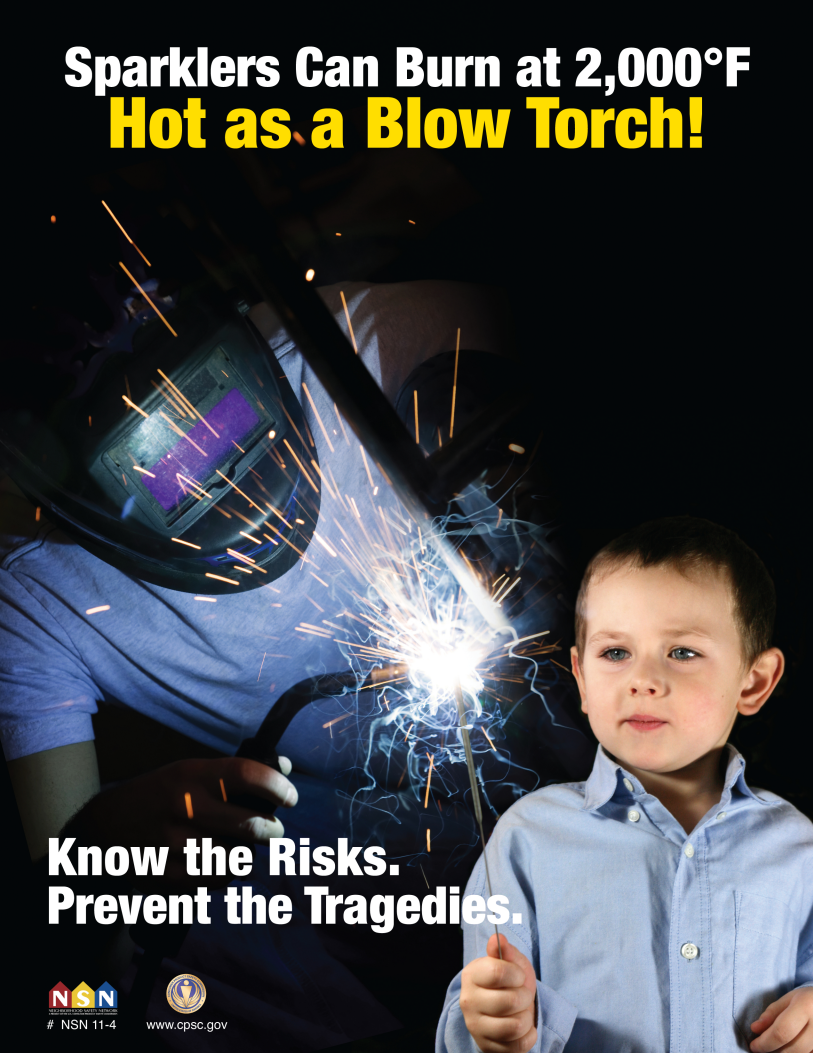
U.S. Consumer Product Safety Commission graphic; click on it to enlarge
By Melissa Patrick
Kentucky Health News

While it wouldn't feel like the Fourth of July without fireworks, it's important to remember that all fireworks, even sparklers, can be dangerous.

"The safest way to view fireworks is to watch professional displays,”  Consumer Product Safety Commission Chair Alex Hoehn-Saric said in a news release. “If you choose to light your own, make sure you only buy legal fireworks intended for consumer use from a reputable retailer."

A new CPSC report says that in 2023, the commission received reports of eight deaths and an estimated 9,700 injuries involving fireworks. Out of the eight deaths, five were associated with firework misuse, two with a device malfunction, and one involved unknown circumstances.

A CPSC analysis of the injury data found that in the four weeks leading up to and including Independence Day in 2023, teens aged 15-19 had the highest estimated rate of emergency-department visits visits for fireworks-related injuries, followed by children aged 5-9.

Of those ED visits, the analysis found that an estimated 800 of the injuries were associated with firecrackers and 700 were associated with sparklers. The report says sparklers accounted for 51% of the total estimated injuries in children under the age of 5. 

"Never allow children to play with or ignite fireworks, including sparklers. Sparklers burn at temperatures of about 2,000 degrees Fahrenheit -- hot enough to melt some metals," says the release.  

For using sparklers, here are safety tips from Michigan Medicine
  • Hold sparkler away from face.
  • Wear shoes when using sparklers.
  • Only use one sparkler at a time.
  • Stay six feet apart from others.
First-aid tips for burns, from Michigan Medicine: 
  • Be prepared to use first aid. For a minor burn, place a towel soaked in cool water over the area for about five minutes. Then cover with a clean bandage and give your child acetaminophen to reduce pain and swelling.
  • For a major burn, or if the burn involves eyes, take the child to the emergency room promptly.
Here are some overall safety tips from the Kentucky state fire marshal: 
  • Use fireworks outdoors only.
  • Obey local laws. If fireworks are not legal where you live, do not use them.
  • Always keep a bucket of water or a working water hose nearby.
  • Only use fireworks as intended. Don't try to alter them or combine them.
  • Never relight a "dud" firework. Wait 20 minutes and then soak it in a bucket of water.
  • Use common sense. Spectators should keep a safe distance from the shooter and the shooter should wear safety glasses.
  • Alcohol and fireworks do not mix. Have a "designated adult operator."
  • Do not use homemade fireworks or illegal explosives -- they can kill you!
  • Report illegal explosives to the fire or police department in your community.
  • Never allow children to play with or ignite fireworks.
  • Read and follow all instructions on the label.

Saturday, June 25, 2022

National poll shows some parents need to enforce better safety rules on fireworks; children's sparklers can be dangerous, too

By Melissa Patrick
Kentucky Health News

As communities and families prepare to celebrate the Fourth of July, some parents overlook the risks of burn and injury that fireworks pose for children, according to a national study. 

A national poll by the children's hospital at the University of Michigan found that one in five parents said their children were less than 100 feet, the recommended distance, from where fireworks were set off.  

Kentucky law prohibits igniting fireworks within 200 feet of homes, vehicles, structures or other people, and cities and counties have ordinances that apply even if they are more stringent than state law. 

Why keep your distance? Because fireworks are unpredictable, poll co-director Sarah Clark said in the news release: "It’s essential that parents keep children far away from where those fireworks are set off.”

The poll also found that over a third of parents said their children or teens helped set off fireworks in the past two years, with one in five parents saying they’d allow a child 10 or younger to help. Another third said they’d let kids ages 11-15 help, and more than a quarter said they’d let older teens get involved, the release said.

“Parents differ on what age they would allow their child to be part of setting off fireworks,” Clark said. "But parents need to ensure children are at the right age and maturity level to understand the dangers involved and importance of carefully following all safety rules. If the child is not ready to do these things, their risk of burns, eye injuries and other accidents is increased.”

Kentucky law says you must be 18 or older to buy or set off fireworks. 

Sparkler safety

Sparklers pose an extra risk, because parents often perceive sparklers as a safe option for kids, not realizing that they can burn at temperatures of about 2,000 degrees Fahrenheit, which is hot enough to melt some metals, according to the U.S. Consumer Product Safety Commission.

The poll found that two in three parents say their children always follow the rules when using sprinklers, and a majority said they enforce the rules. However, just half of parents said they have sand or water nearby to dispose of used but still-hot sparklers.

Most parents also said they talk to their children about safety rules for fireworks, and more mothers than fathers said the believe they are always careful about supervision, the release said.

"Sparklers are only safe if parents enforce all safety measures and children follow them," said Clark. 

About 15,600 people went to emergency rooms because of fireworks injuries in 2020, a 56 percent increase from the 10,000 injured in 2019, according to the latest annual report from the Consumer Product Safety CommissionThe report says that in 2020, 18% of the estimated fireworks injuries were in children younger than 15. 

“Our poll suggests that some parents may need to be more diligent to ensure a safe environment that minimizes these risks and protects children from firework injuries," said Clark.  

Michigan Medicine offered tips for safe Fourth of July celebrations: 
  • Stay at least 100 feet away from where any fireworks are set off.
  • If setting off your own fireworks, purchase legal ones that are clearly labeled for consumer use and follow directions and safety guidelines carefully.
  • Never use fireworks while impaired by alcohol or drugs.
  • Never point or throw fireworks, including sparklers, at anyone.
  • Wear safety goggles or other eye protection if setting off fireworks yourself.
  • Keep a bucket of water or a garden hose nearby in case of a fire.
  • Douse all used fireworks with water before discarding to avoid trash fires. 
  • Only light one firework at a time and don’t try to relight the duds.
  • Wait until fireworks cool before picking them up, possibly even the next day.
Sparkler safety: 
  • Consider your child’s age and maturity level, including their ability and willingness to follow rules, before allowing them to use sparklers.
  • If using sparklers, teach children how to hold them below the point where they will burn down and to put the sparkler in a water bucket after use.
  • Check the area for rocks, toys or other objects to prevent children from tripping when it’s dark. The space should also be far from trees, homes, and fire hazards.
  • Make sure children are at least six feet apart when using sparklers.
  • Make sure children know to hold the sparkler away from their face. 
  • Use only one sparkler at a time. 
  • Ensure children wear shoes to prevent burns if they accidentally step on a used sparkler.
First aid tips for burns: 
  • Be prepared to use first aid. For a minor burn, place a towel soaked in cool water over the area for about five minutes. Then cover with a clean bandage and give your child acetaminophen to reduce pain and swelling.
  • For a major burn, or if the burn involves eyes, take the child to the emergency room promptly.

Sunday, March 29, 2020

Methamphetamine returns to Appalachian Kentucky, in a more deadly form, and it's causing fear and division in communities

Dakota Scott, with her two-week-old daughter, fights meth addiction at Karen’s Place Maternity Center in Ashland, a facility for women in addiction recovery (Photo by Hilary Swift for The New York Times)
Timothy Williams of The New York Times reports from Louisa: "Home deliveries from the local food bank now require a police escort. A shop owner has started to carry her gun to work. And the local constable, who rarely had to pull his weapon in the past, has drawn it a dozen times over the past year. All because people hooked on methamphetamine have threatened them. . . . A very public push to end opioid abuse has unwittingly ushered in the return of crystal meth."

Officials have warned for a year or more that meth was making a comeback even as the opioid epidemic continued in Appalachia. It returned in "a powerful new form," Williams notes, and that "has brought a sharply different set of problems . . . If pain pills left residents struggling to help many family members deal with the risk of overdose, methamphetamine has bred fear and division."

Referring to homeless meth users, Louisa Mayor Harold Slone told the Times, “Half the people want to take them to the river and tie something around their neck. We hadn’t seen that level of anger before.” State police told Williams that in some places, about three-fourths of arrests are related to meth crimes — "mostly shoplifting, burglary or assault, but occasionally attempted murder."

Much as a crackdown early in the last decade on prescription opioids led to a surge in heroin, the latest crackdown and increased awareness of the epidemic has "unwittingly accelerated the switch to methamphetamine," Williams writes.

"Opioid users, increasingly fearful about overdosing on heroin and fentanyl, have been desperate for a substitute. A powerful Mexican organized crime syndicate, the Sinaloa drug cartel, has sought to fill the vacuum by targeting Appalachia, federal drug officials say. . . . The new Mexican variant is often mixed with cocaine, and increasingly, with fentanyl. Law-enforcement officials said cartels mix in those ingredients because fentanyl is inexpensive to produce, enhances the effects of meth and appears to cause faster addiction. Meth users around Louisa sometimes add their own dangerous ingredients, including wasp repellent, which users say produces a more intense high."

Friday, September 6, 2019

National Preparedness Month's theme is 'Prepared, Not Scared. Be Ready for Disasters.' Here are tips to help you be prepared.

Because emergencies and disasters can happen without notice, the state Department for Public Health is offering tips on how to always be prepared in a campaign called "Prepared, Not Scared. Be Ready for Disasters" during National Preparedness Month, which falls in September.

“Emergencies and disasters can happen anytime and anywhere, often without notice and can leave us scared and confused,” Jim House, manager of the department's preparedness branch, said in a news release. “By taking the time to follow the ten steps outlined below, we all can better prepare ourselves and our communities should emergencies or disasters strike.” The state campaign encourages households, businesses and organizations to take the following 10 steps to prepare for a disaster:
  • Assemble a "Go Bag" packed with essential items to have in the event of an emergency evacuation of your home. Go to ready.gov/build-a-kit for a list of what to put in a go-bag.
  • Prepare digital forms of important documents for an emergency, including your ID and passport. You could also make copies of these documents and put them in a waterproof pouch or zip-lock bag.
  • Have extra supplies in case of an emergency.
  • Download the Federal Emergency Management Agency app (https://www.fema.gov/mobile-app) to provide emergency information about disaster resources, weather alerts and safety tips.
  • Have an alternative power source for devices during emergencies.
  • Set up an In Case of Emergency (ICE) emergency contact in your cell phone.
  • Choose an emergency contact when out of town.
  • Find a local, pet-friendly evacuation center.
  • Update your social media to tell loved ones you are safe during an emergency.
  • Text, don’t call, in an emergency. Phone lines will be clogged with calls reporting important information.
FEMA also offers a wealth of information to help people prepare for a disaster, including a "Family Emergency Communication Plan" form. FEMA suggests keeping some cash on hand in case of emergencies, since ATMs and credit card readers won't always be available; small bills are best.

Centers for Disease Control and Prevention graphic; click it to enlarge
The Centers for Disease Control and Prevention offers tips to address health needs during a disaster, including: gathering enough food, water and medical supplies to last at least 72 hours; preparing a seven- to 10-day supply of prescription medications; making copies of important documents and medical records, including an up-to-date list of all prescription drugs for each person in the household, with dosage and a list of each person's known allergies; and learning life-saving skills, such as cardiopulmonary resuscitation (CPR) to use until help arrives.

In addition, don't forget to prepare for pets' needs, including making sure they wear their collars and tags with up-to-date information or are microchipped to increase the chances that you will be reunited if you are separated.

And most importantly, make sure everyone, including children, knows what the disaster plan is since you might not be together when the disaster happens. The CDC offers "Ready Wrigley," a children's activity book series, to help parents talk to children about disasters.

"Remember that preparedness is a shared responsibility - it takes a whole community to prepare and respond to emergencies," said House.

National Preparedness Month was started after Sept. 11 and is organized by the U.S. Department of Homeland Security. For more information about preparing for and responding to emergencies, visit http://www.ready.gov.

Thursday, June 28, 2018

Kentuckians are encouraged to let the pros handle the fireworks; even sparklers, firecrackers and bottle rockets are dangerous

By Melissa Patrick
Kentucky Health News

Fireworks are often synonymous with the Fourth of July, but they are also a common cause of injury, so the state Division of Fire Prevention recommends attending a community firework event instead of celebrating with fireworks at home.

"Let the professionals entertain your family," Mike Haney, state fire marshal and director of fire prevention for the Department of Housing, Buildings and Construction, said in a news release. "By celebrating at a public event instead of at home, you reduce the risk of injury and property damage. You may also avoid violating the law."

Consumer Product Safety Commission graphic, using data from the 2017 Fireworks Annual Report
The latest U.S. Consumer Product Safety Commission fireworks report found that in 2017, 12,900 consumers were treated in U.S. emergency rooms for fireworks-related injuries and eight people died from them, with  victims ranging from age four to 57. Seven of the deaths were a result of direct impact from fireworks and one of them was the result of a house fire caused by misusing a firecracker.

The report adds that children between the ages of 10 and 14 were seen most often in emergency rooms for fireworks injuries, followed by young adults between the ages of 20 to 24.

Haney also reminded Kentuckians to pay attention to state and local fireworks laws.

For example, state law prohibits people under 18 from buying fireworks, and from selling them unless supervised by a parent or guardian. The law bans fireworks from being used within 200 feet of a structure, vehicle or other person; and fireworks cannot be sold to anyone who is under the influence of drugs or alcohol.

"Local governments set their own firework ordinances, so be aware of the regulations in your own town," Haney said.

Here are some safety tips from the National Council on Fireworks Safety:

 * Read and follow the instructions on the label.
 * A responsible adult should supervise all firework activities.
 * Never allow children to play with or ignite fireworks.
 * Alcohol and fireworks do not mix. Have a "designated adult shooter."
 * Wear safety glasses when shooting fireworks.
 * Light one firework at a time and then quickly move away.
 * Never light fireworks in a container, especially a glass or metal container.
 * Use fireworks outdoors in a clear area away from buildings and vehicles.
 * Always have a bucket of water and charged water hose nearby.
 * Never relight a "dud" firework; wait 20 minutes and soak in a bucket of water.
 * Do not experiment with homemade fireworks.
 * Wet down used fireworks and place them in a metal trash can.
 * Place disposed of fireworks away from buildings or combustible materials.
 * Report any illegal explosives to the fire or police department.

The CPSC report says that on average,  280 people went to the emergency room every day with fireworks-related injuries in the month around the July 4th holiday in 2017, with about 1,200 of those visits related to sparkler injuries, 800 of them relate to firecrackers and 300 related to bottle rockets.

Michael Spencer, a pilot from Bowling Green, told attendees of a CPSC fireworks event about the dangers of fireworks, having lost several fingers on both hands in 2015 from a shell-and-mortar style firework device. Spencer is now committed to making sure this doesn't happen to anyone else, CPSC writes in a news release about its latest fireworks report, released June 27.

 “Fireworks can be extremely dangerous, even if they are legal,” Spencer said in the release.“My advice would be to leave them to the professionals.”

KidsHealth also stresses that kids should "never play with fireworks," writing that this includes "firecrackers, rockets and sparklers" because they are "just too dangerous."

"If you give kids sparklers, make sure they keep them outside and away from the face, clothing and hair," they write. Sparklers can burn at nearly 2,000 degrees Farenheit and bottle rockets are known to stray off course or to throw shrapnel when they explode.

If a person is injured by fireworks, KidsHealth says to immediately seek medical care.

If the injury is to an eye, KidsHealth says not to rub it, since that may cause more damage; don't flush the eye with water or to put any ointment on it. Instead, cut out the bottom of a paper cup, place it around the eye, and get medical care right away, because your eyesight may depend on it.

If a person is burned, KidsHealth recommends removing the clothing from the burned area and to call your doctor immediately.

Thursday, January 4, 2018

Tips on how to avoid hypothermia and carbon monoxide poisoning, and how to keep your sleeping baby safe in the winter

With temperatures in Kentucky falling below freezing for days and several months of cold weather in front of us, the state Department for Public Health offers tips on protecting yourself from getting hypothermia, how to avoid carbon-monoxide poisoning, and also offers safe-sleep suggestions for families with babies that will also keep them warm.

Hypothermia

Hypothermia happens when your body loses heat faster than it can produce heat, causing a dangerously low body temperature. If left untreated, it can eventually affect the brain, making the victim unable to think clearly or move well. It can also lead to heart and lung failure, and even death.

Hypothermia is often caused by immersion in cold water, but can also be a result of exposure to extremely cold temperatures. The federal Centers for Disease Control and Prevention adds that it can also happen during cool temperatures (40 degrees) if a person is wet (from rain, sweat or cold water) and becomes chilled.

According to the CDC, older adults with inadequate provisions, babies sleeping in cold bedrooms, people who are outdoors for long periods of time, and people who drink alcohol or use illicit drugs are at the most risk of getting hypothermia.

Symptoms include shivering, an altered speech pattern, abnormally slow rate of breathing, cold pale skin and lethargy. In infants, the symptoms include bright red or cold skin and very low energy levels. The Department for Public Health advises that you seek medical attention if you or a loved one experiences the signs of hypothermia.

Here are the health department's tips tips to prevent hypothermia:
  • Wear appropriate clothing, including layers of synthetic and wool fabrics, hats, coats, scarves and gloves. The best outerwear is water-resistant.
  • Avoid consuming alcohol if outdoors, which can speed the loss of heat from the body.
  • Avoid activities that cause excessive sweat, which leads to damp clothing, and chilling.
  • Stay as dry as possible
  • The CDC recommends making a car emergency kit that among other things includes extra hats,coats and mittens, blankets, a cell phone and portable charger, water, snacks and jumper cables.
Carbon Monoxide Poisoning

The department warns Kentuckians that portable generators, propane gas stoves, and ovens heated with gasoline, which have all been used as heat sources indoors, can lead to carbon-monoxide poisoning.

Carbon monoxide is an odorless, invisible gas produced when gasoline, natural gas, propane, kerosene and other fuels are not completely burned during use. Breathing in carbon monoxide fumes prevents the body from using oxygen normally and can result in death.

Consumer Reports graphic
The CDC reports that each year more than 400 Americans die from unintentional carbon monoxide poisoning, more than 20,000 visit the emergency room and more than 4,000 are hospitalized.

Early symptoms of carbon-monoxide poisoning include headache, nausea, vomiting and fatigue. If you are experiencing symptoms or if you have questions, call the Poison Control Hotline at (800) 222-1222.

Here are tips for avoidng carbon-monoxide poisoning:
  • Install a battery-operated carbon-monoxide detector in your home and replace the battery when you change the time on your clocks each spring and fall. Replace the device every five years.
  • Don’t use a generator, charcoal grill, camp stove or other gasoline or charcoal-burning device inside your home, basement or garage or near a window.
  • Don’t run a car or truck inside a garage attached to your house, even if you leave the door open.
  • Don’t burn anything in a stove or fireplace that isn’t properly vented. Have your chimney checked or cleaned yearly.
  • Don’t heat your house with a gas oven.
  • Seek immediate medical attention if you suspect carbon monoxide poisoning

Infant Safe Sleep

In general, parents and caregivers should follow the ABCs of safe sleep to prevent injury or infant deaths -- Alone, on their Back, and in a Clean Clear Crib.

schoolworkhelper.net
However, Department of Public Health officials warn that winter months present a different – but very serious – threat for babies when parents and caregivers resort to using unsafe sleep practices in an effort to keep babies warm.

The state health department offers these safe-sleep tips for babies in the winter months:
  • For added warmth, dress baby in a one-piece pajama or wearable blanket, and layer with an undershirt of a onesie. They also offer a warning to make sure your baby doesn't get too hot.
  • Keep the baby’s room at a comfortable temperature and don't overheat the room.
  • Don't put a hat on your baby to sleep; there is a risk the hat could slip down, covering the baby’s face.
  • If a blanket must be used to keep a baby warm, make sure the baby’s feet are at the bottom of the crib and the blanket is tucked in around the mattress. The blanket should be no higher than the baby’s chest with the baby’s arms out.
  • Keep all portable heaters away from the baby and baby’s sleep area. The baby can overheat if too close to a heater, receive burns or become tangled up in cords of small electric heaters.
For more information about safe sleep practices, click here for the SafeSleep Kentucky website and for more information about hypothermia and carbon monoxide poisoning , click here for the Kentucky Health Alerts website.

Wednesday, May 25, 2016

Woman stuck by needle faces up to one year of testing for HIV and hepatitis; dirty needles becoming common in public places

By Melissa Patrick
Kentucky Health News

A Monroe County woman was stuck by an insulin needle found in a pair of sweatpants she purchased at the Walmart in Tompkinsville and now faces up to a year of testing to make sure she hasn't been infected with HIV or hepatitis, Jacqueline Nie reports for WBKO-TV in Bowling Green.
Insulin syringes are commonly used by IV drug abusers

"I had to be tested for HIV and hepatitis and a drug screening," said Mary Crawford, who was stuck by the needle. "I have to go back from that in 30 days and be tested again, and again in 6 months from that 30 days."

"Crawford says through at least these next 7 months, she cannot share anything with her husband or children," Nie repports. Crawford warned others to be careful: "It could happen to anybody, anywhere."

The latest Kentucky Health Issues Poll found that 13 percent of Kentuckians said they knew someone with heroin problems. And insulin syringes and needles are commonly used to inject it.

Clark County Public Health Director Scott Lockard said that while this was the first time he had heard of a needle being placed in an article of clothing in a department store, he said it is not unusual for dirty needles to be found in public.

"Unfortunately it is becoming more common for used needles to be found by the public," Lockard said in an e-mail. "I have had reports of needles being found locally on streets, in parks, public parking lots, unoccupied buildings, and in restrooms in public venues."

The problem is so bad in Northern Kentucky, where 35 percent in the poll said they knew someone with a heroin problem, that they released public service announcements before Easter to remind children to look for needles before eggs. The Northern Kentucky Heroin Impact Response Taskforce organized police and egg-hunt organizers to search parks for needles prior to the hunts, and said it will continue to search public places for needles throughout the summer, Ben Katko reported for WXIX-TV (Fox 19).

One way to keep dirty needles off the street is through needle exchanges, which allow intravenous drug users to exchange dirty needles for clean ones. These programs were authorized in Kentucky by the 2015 anti-heroin bill, but require both local support and funding.

So far, only 14 counties in Kentucky have either approved or are operating needle exchanges: Jefferson, Fayette, Jessamine, Franklin, Clark, Kenton, Grant, Harrison, Pendleton, Carter, Boyd, Elliott, Pike and Knox. Some jurisdictions have rejected exchanges, saying they encourage drug use, despite pleas from experts who say that's not true and the programs lead users to treatment.

"Needle exchanges work," former state health commissioner William Hacker said. "It decreases the spread of infectious diseases. It takes dirty needles off the street. It is safer for the law enforcement and EMS. It also provides an opportunity to interact with people and divert them to effective treatment."


Thursday, March 10, 2016

Bill to keep dirty needles out of landfills hijacked with amendment to require needle-exchange programs to be one-for-one

By Melissa Patrick
Kentucky Health News

A House bill to educate the public about how to safely dispose of hypodermic needles easily passed was hit with a surprise amendment that would require a one-for-one needle exchange at needle exchange programs.

Rep. Mike Denham
The amended bill, which passed at the March 9 Senate Health and Welfare Committee meeting and now goes to the Senate floor, didn't set well with its sponsor, who said the amendment took him by surprise.

"At first blush, I have real problems with it," Rep. Mike Denham, D-Maysville, said in an interview. He said the amended bill would likely not pass in the House, but said he would review it and then decide whether to concur or not. He said he had already received emails and texts from his constituents telling him they did not support the committee substitute.

The original bill, House Bill 160, would require the state Department for Public Health to establish guidelines for disposal of hypodermic syringes, needles and other sharps used for home medical purposes and disseminate educational materials to pharmacies and the public. It was written to increase the safety of landfill workers who are at constant risk of being stuck by improperly disposed of needles.

Sen. Denise Harper Angel, D-Louisville, while supporting the original bill, voted no on the substitute and told the committee that the Louisville needle exchange program does not have a one-to-one requirement and is working well. "The effort here is to diminish disease," she said.

Sen. Ralph Alvarado
Needle exchanges were approved as part of an anti-heroin bill in 2015. Republican Sen. Ralph Alvarado, a Winchester physician, who voted for the substitute, said in an interview that the intent of the law was to only allow a one-to-one needle exchange. He said many senators would have voted against that measure if they had known exchanges did not have to be one-for-one.

The Office of the Attorney General released a formal opinion Dec. 18 that said needle-exchange programs in the state do not have to have a one-for-one exchange. The opinion was requested by state Senate President Robert Stivers of Manchester, who along with other Republicans, also say that the intent of the law was a one-for-one exchange.

Alvarado criticized then-Attorney General Jack Conway's opinion: "That wasn't how it was presented originally to the state." He added, "The one-for-one encourages more interaction, more opportunity for involvement for the provider to provide treatment for their disorders, to test them for communicable diseases and that sort of thing."

Dr. Sarah Moyer, the interim director of the Louisville Metro Department of Public Health and Wellness, said in an e-mail that not requiring a one-to-one exchange has been proven to reduce the spread of HIV and hepatitis C, which is the intent of the program. Kentucky leads the nation in hepatitis C and suffers more than 1,000 drug overdose deaths a year.

“A one-to-one syringe exchange implies that no needle sharing is occurring," Moyer wrote. "We know that is not the case. The ‘needs-based negation model’ is a best practice across the country. Our goals are to prevent the spread of HIV and hepatitis C in our community and to stop intravenous drug users from sharing and reusing needles. The program is working! Participants continue to return used and potentially infected syringes for sterile ones."

She added, "Our latest figures indicate that one syringe is being returned for every 1.3 syringes distributed among returning clients. Overall the rate is 1 to 1.7. We have more than 2,000 participants and the number continues to grow. We’ve tested approximately 500 for hepatitis C and HIV and referred those who test positive to medical treatment. We’ve also referred 143 individuals to drug treatment."

Alvarado said, "Even if the health departments want to do it this way now, that is not how the law was intentionally meant to be passed."

Needle-exchange programs operating or approved in the state are in Jefferson, Fayette, Grant, Pendleton, Carter, Elliott, Franklin and Jessamine counties.

Wednesday, September 16, 2015

Surgeon general says Americans need to walk more, and U.S. needs more walkable neighborhoods

Americans should spend more time walking, and communities should be equipped with walking areas to make that possible, U.S. Surgeon General Vivek Murthy said in a report released on Wednesday.

"Maybe this sounds like obvious advice, a health tip right up there with admonitions to eat right and wear sunblock," Emily Badger writes for The Washington Post. "But for much of the last century, the federal government has backed a different idea—cars running on cheap fuel and fast asphalt should carry us everywhere—that has largely proved incompatible with walking." (Library of Congress photo: Thomas Circle in Washington, D.C., in 1920, when most of the traffic was pedestrian)

The University of Virginia's Peter Norton, who has studied the history of transportation, told Badger, "If the surgeon general had called for people to exercise more, that would be just another predictable announcement. But he called for walking. That puts him up against a long history of official discouragement of walking."

One of the main problems is that nearly one-third of Americans live in neighborhoods that lack sidewalks, Badger writes. "The federal government subsidized the construction of postwar suburban subdivisions so heavily dependent on the car they had little use for sidewalks. The government paved the highways that enabled people to live there, and kept low the gas taxes that made commuting 30 miles a day affordable. Government engineers came, over time, to think of roads as the domain solely of automobiles—and of pedestrians as an impediment to them."

Another problem is that many people live far enough away from work, grocery stores and other conveniences that walking is not possible, Badger writes. Also, narrow rural roads can discourage walkers. In an age where cars take people everywhere they need to go, many people have grown out of the habit of having to walk much more than 300 to 400 feet to get anywhere.

Murthy told reporters, "In the last few decades we have lost touch with physical activity." Badger writes, "This is true in many ways, in school days that no longer include recess, or in jobs that no longer demand physical labor. But it is primarily true in how we've built (or rebuilt) the world around us. And research is starting to show the health consequences. Communities designed around more compact, walkable street grids—places that have what the surgeon general calls 'connectivity'—have been correlated in research with reduced rates of obesity, high blood pressure and heart disease (they also have fewer fatal car crashes, another public health problem). One study of a million residents in Toronto found that people in less walkable neighborhoods were more likely to develop diabetes."

Monday, September 16, 2013

Study says obese children (Kentucky's a leader in that) may have quadruple the risk of having high blood pressure as adults

By Molly Burchett
Kentucky Health News

A new study shows that being obese in childhood may quadruple the risk of having high blood pressure risk as an adult, highlighting the need for Kentucky to curb its high rate of childhood obesity.

Eighteen percent of Kentucky high schoolers are obese, tying Mississippi for the highest percentage among the states, says a report by Kentucky's Task Force on Childhood Obesity. In the age range of 10 to 17, Kentucky trails several other states but remains a national leader.

One in three U.S. children and teens are overweight or obese, meaning their body mass index is at least the 85th percentile or at least the 95th percentile for their age and gender, respectively, says the American Heart Association. And, even more children are at-risk of becoming obese adults by the year 2030, says new report from Trust for America’s Health and the Robert Wood Johnson Foundation.

This study adds to concern about the long term impact of childhood obesity by linking it with increased risk for high blood pressure. High blood pressure, if left untreated, can damage the heart and coronary arteries that can ultimately lead to a heart attack, heart disease or congestive heart failure, says the AHA.

The findings, which were presented at the American Heart Association High Blood Pressure Research Scientific Sessions 2013, are also part of the growing body of evidence that heart disease may start in childhood, said Dr. Sara E. Watson, study author and a pediatric endocrinology fellow at Riley Hospital for Children at Indiana University in Indianapolis.

Study researchers tracked the growth and blood pressure of 1,117 healthy adolescents from Indianapolis for 27 years, starting in 1986, finding that 6 percent of normal weight children and 26 percent of obese children had high blood pressure as adults.

“It is important that pediatricians counsel patients on the risk of high blood pressure associated with overweight and obesity, and stress that a healthy diet, including reducing salt intake and exercise, may help reduce this risk,” Watson said. “Interventions to prevent and treat obesity will play an important role in decreasing the significant burden of high blood pressure in adulthood.”

Wednesday, September 4, 2013

Join high schoolers around the state on Sept. 19 in taking the 'It Can Wait' pledge not to text while driving

In preparation for its national day of action, the "It Can Wait" campaign teamed up with state legislators in four schools across Kentucky to increase awareness about the risks of texting while driving. Become an advocate too by taking the pledge not to text and drive on Sept 19. 

State Rep. Rick Nelson of Middlesboro, Sen. Brandon Smith of Hazard and AT&T partnered to provide a simulation for students at Bell County High School to learn about dangers of texting while driving. The simulator subjected the participants to a variety of real-life traffic conditions, like driving alongside a bus, showcasing the real-life dangers of texting.

“As a father to teenagers with driver’s licenses, I am personally devoted to spreading awareness of the dangers of texting while driving, Smith told the Middlesboro Daily News. “Drivers who send text messages while driving are 23 times more likely to be in a crash, so it is critical to spread the word that when it comes to texting and driving — it can wait.”

The tour, which is also sponsored by Verizon, Sprint and T-Mobile, also stopped in Central Kentucky, where about 200 Scott County High School students participated in the simulation, along with Rep. Ryan Quarles and Sen. Damon Thayer, both of Georgetown. Quarles crashed and Thayer was stopped for driving too slow in the “busy thoroughfare,” reports Dan Adkins of the Kentucky Press News Service. Click here to try the simulator.

The “No Texting While Driving” law has been in place in Kentucky for two years and forbids anyone to send text messages while driving a motor vehicle. The law also forbids any use of a cell phone for driving under 18.

Take the pledge not to text and drive by joining the "It Can Wait" campaign. Click here for more information. You can also download the AT&T DriveMode app that automatically sends a customizable reply to incoming messages to let people know that you'll get back to them at another time.

Monday, May 20, 2013

Don't get burned, bitten or bamboozled this summer; here are safety tips for dealing with the sun, insects and sales pitches

By Molly Burchett
Kentucky Health News

Summer is finally here, and after one of the coldest Kentucky springs, who doesn't want to be outside swimming, skiing, fishing, barbecuing or soaking up rays on the beach? While summer may bring much-anticipated fun in the sun, it's important to take some  safety precautions to make sure you and your family are not getting too much of a good thing.

Sunscreen can protect you from cancer, but don't spray it

The sun is bad for your skin, and exposure to its harmful ultraviolet (UV) rays can increase your risk for skin cancer, which is the most common cancer in the U.S., says the federal Centers for Disease Control and Prevention. It's critical to protect yourself and your children from sun damage because just one blistering sunburn in childhood more than doubles the odds of developing skin cancer later in life, says the Mayo Clinic.

Fortunately, it’s never too late or too early to lessen your risk of sun damage by using sunscreen, and the Environmental Working Group has recently released its 2013 Guide to Sunscreens, which rates more than 1,400 sunscreens, lip balms, and SPF moisturizers and cosmetics for safety and effectiveness.

This year, EWG says 184 sunscreens, 25 percent of those on the market, met its criteria of offering adequate UV protection and posing few safety concerns. You can click here to view that product list, or here to check out the EWG findings for moisturizers, lip balm and makeup.

EWG also created a somewhat surprising list of things NOT to bring on vacation because they are unsafe or do not provide adequate UV protection:
  • Spray sunscreen: These sprays may pose serious inhalation risks, and they make it too easy to not apply enough sunscreen or to miss a spot.
  • High-SPF sunscreens: These products may tempt people to stay in the sun too long, which can increase the risk of other kinds of skin damage, and EWG recommends that consumers avoid products labeled higher than SPF 50.
  • Oxybenzone: Used in half of sunscreen products, this chemical penetrates the skin and can adversely impact health in several ways; in the body, it acts like the female hormone estrogen and can cause allregic reactions.
  • Loose powder sunscreen: Tiny zinc particles in these products can also end up in your lungs when you breathe them in during application, which irritates the lungs.
  • Retinyl palmitate: Some sunscreens contain this chemical, which is a form of vitamin A, but when applied to sun-exposed skin, it may speed development of skin tumors and lesions.
  • Combined sunscreen/bug repellents: Studies show this combination leads to increased skin absorption of the repellent ingredients.
  • Sunscreen towelettes: Whether they really work is unknown.
  • Tanning oils: They are simply a bad idea and can ultimately lead to behavior that increases risk of developing skin cancer.
So, check the ingredients for your sunscreen, avoid high-SPF's or sprays and make it a habit to wear sunscreen during sports or whenever you're outside. Be sure to reapply often to ensure UV protection, particularly if you get wet or sweaty. Click here to read EWG's "Nine Surprising Facts about Sunscreen."

Hats and clothing: Choose the right kind

Children are more vulnerable to sun damage, so in addition to actual sunscreen, the best sun protections for them are a hat and shirt (which also protect adults). The CDC recommends avoiding straw hats that let sun through the holes, and to wear a hat with UV protection or a wide brim to shield the face, head, ear and neck. If you do chose to wear a baseball cap, protect your ears and neck with clothing, sunscreen (with at least SPF 15) or spend lots of time in shade.

Wear clothing to protect exposed skin. The CDC says loose-fitting long-sleeved shirts and long pants made from tightly woven fabric offer the best UV protection. Darker colors may offer more protection than lighter colors, and a wet t-shirt offers much less UV protection that a dry one.

Sunburn treatment: People with fair skin or light-colored hair are more likely to be sunburned. If you get sunburned, remember that "The skin heals but is forever damaged," writes University of Kentucky nursing Professor Mollie Aheshire. "The more frequent and more severe the burns, the more damage there is," along with risk for cancer and premature aging. "If a sunburn is blistering and covers a large portion of your body; is accompanied by a high fever, extreme pain, confusion, nausea or chills; or does not respond to at-home treatment within a few days . . . see a health-care provider." Mild sunburns can be treated with over-the-counter pain relievers, cold compresses and moisturizing creams — aloe vera or hydrocortisone lotions. "If blisters form, do not break them," Aheshire writes. "Drink plenty of fluids to prevent dehydration. Treat peeling skin gently. Stay out of the sun until redness and pain resolve." (Read more)

Sunglasses: Not just to help you see now, but to keep you seeing longer

Besides being dangerous for your skin, UV rays are dangerous to your eyes and can cause vision disorders, premature aging of the eyes or even blindness. It is important to wear sunglasses to protect eyes from sun damage, although a new survey from the American Optometric Association shows that only 40 percent of consumers cite this protection as the primary reason for wearing sunglasses, says a Kentucky Optometric Association press release.

To help reduce the risks of harmful UV exposure on the eyes, children and adults should start wearing protective sunglasses as as early as possible, and parents should ensure that babies are protected by sunglasses too, says the release. When choosing sunglasses or protective contact lenses, make sure that they block more than 95 percent of UV-A and more than 99 percent of UV-B radiation, says the KOA, and sunglasses should have a frame that fits close to the eyes so the UV rays can't sneak around the sides.

Insect repellent: Bugs can bug you, but don't over-react to them

Although nothing can ruin a relaxing summer picnic faster than bugs, take precautions to ensure you're using the right type of bug repellent-- one that's been approved by the Environmental Protection Agency -- and that you're using it wisely.

Not only are bugs annoying, they can also carry dangerous diseases, and for the safe and effective use bug repellents, always read the product label before using the product, EPA says. It says to follow these bug-repellent safety tips:
  • Repellents should be applied only to exposed skin and/or clothing. Do not use them under clothing.
  • Store insect repellents safely out of the reach of children.
  • Do not apply near eyes and mouth, and be use sparingly around the ears.
  • When using sprays, spray on the hands first and then apply to the face, not directly to the face.
  • Never use repellents over cuts, wounds or irritated skin.
  • Do not spray in enclosed areas and avoid spraying near food.
  • After returning indoors, wash treated skin and clothes with soap and water.
  • Do not use any product on pets or other animals
  • Most insect repellents do not work on lice or fleas. 
  • Click here to search for a repellent that's right for you.
Beware if you want to use a wearable repellent that's not sticky and has to be continuously resprayed, such as Off!'s clip-on mosquito repellent. It works once the cloud of mosquito protection is built around the wearer, says Brighid Moret of The Washington Times, but it's not a good option for an active or young child. The manufacturer warns on the label that a chemical on the product's enclosed disk is harmful if swallowed, directly inhaled or absorbed through the skin, and young children should not wear it.

Whether you're going on vacation or a "stay-cation," these tips can help protect you and your family from the sun and bugs in order to safely make the most of your summer. Click here for more sun safety tips from EWG.

Friday, June 22, 2012

New report lists contaminant, treatment violations at Kentucky's 461 public water systems

Reporters can now find out if their local public water systems were recently cited with violations related to contaminants in the water or inadequate treatment.

The Kentucky Division of Water's annual compliance report was released last week. Statewide, it shows that maximum contaminant level and treatment violations decreased from 116 in 2010 to 96 in 2011. "The majority of violations at Kentucky's public water systems last year involved administrative infractions rather than problems with water treatment," said Julie Roney, coordinator of the DOW Drinking Water Program. "These results are encouraging."

There are 461 public water systems in Kentucky, which are tested on a regular basis for bacteria, nitrate and other inorganic chemicals, radiological elements and more than 100 industrial chemicals and pesticides.

The report is detailed and quite dense. Reporters can call Natalie Bruner at 502-564-3410, ext. 4987 for help interpreting the results for their water systems. (Read more)

Tuesday, June 19, 2012

With more than 2,000 product recalls in 2011 alone, consumers may be suffering from 'recall fatigue'

Regulators, retailers and manufacturers are getting worried that the public is suffering from "recall fatigue."

Last year, there were 2,363 recalls, according to data from the U.S. Food and Drug Administration, the Department of Agriculture and the Consumer Product Safety Commission. That's a 14 percent increase over 2010 when there were 2,081 recalls. In 2007, there were 1,460.

"We have this growing concern for safety, but with there being so many recalls going on, [is the public] paying attention to them and responding to them in a manner that is necessary for the recalls to be handled effectively?" asked Mike Rozembajgier, a vice president of Stericycle ExpertRecall.

There have already been hundreds of recalls this year. Pfizer recalled birth-control pills after it was discovered they could have been packaged out of sequence, increasing chances for pregnancy. Nearly 170,000 Ikea customers were asked to return high chairs after it was found the restraint buckle opened unexpectedly. Today, Samsonite recalled suitcases because they were made with high levels of compounds linked to cancer.

Experts believe "the increase is the result of a combination of greater oversight by regulators, better testing procedures and the use of social media where consumers can quickly point out and discuss problems with other people," reports Christopher Doering of the Des Moines Register. (Read more)

Monday, June 18, 2012

Black lung affects Kentucky surface miners more than those in other states, CDC study finds and Courier-Journal reports

Photo by Getty Images.
Nearly 4 percent of surface coal miners who work in Central Appalachia who were tested for a study by the Centers for Disease Control and Prevention have black lung disease, compared to 2 percent of all U.S. surface miners and 3.2 percent of underground coal miners.

Though the study didn't test Kentucky separately from the 14 other states assessed, Laura Ungar of The Courier-Journal in Louisville asked about it and found that "13 of 230 Kentucky surface miners tested — or 5.7 percent — had black lung," she reports, quoting Cara Halldin, a CDC epidemic intelligence service officer, as calling that number " a disproportionate burden."

It's not clear why the incidence is higher in Central Appalachia than other parts of the country, but Halldin suspects it has to do with "more years spent mining, area geology or the safety culture at mines," Ungar reports. One study showed miners who work in Central Appalachia typically work 28 years in the mines while non-Appalachian miners work average 20 years.

Black-lung disease, or coal workers' pneumoconiosis, is the result of miners repeatedly inhaling the dust that comes from extracting coal. That dust occurs whether the miner is under- or above-ground. "Coal mining is really, really dusty. Don't matter what you do, you're in the dust," said John Bud Ritchie, a retired surface miner who has black lung disease. "It's real rough. You can't hardly keep the dust down on hot days."

The federal exposure limit for "respirable dust" in underground and surface mines is 2 milligrams of coal dust per cubic meter of air. That limit was set in 1969, along with a law that set up "a surveillance system for assessing prevalence of black lung among underground coal miners," Ungar reports. "But the requirement for surveillance doesn't extend to surface miners." Haldin said, "Industry should recognize this is a problem and their workers are at risk and bring down the levels." (Read more)

States with helmet laws have far fewer motorcycle-related deaths; Kentucky doesn't require bikers to wear protective headgear

Petersburg (Tex.) Volunteer Fire Dept. photo
“Fewer motorcyclists die in states that require helmets, and the costs to society are lower too,” reports Mike Stobbe for The Associated Press. About five times as many no-helmet biker deaths occur in states with less restrictive laws.

Kentucky once had a helmet law for motorcyclists, but repealed it several years ago. Nationwide, 20 states had universal motorcycle helmet laws in 2010, but Michigan has since reversed course and allowed helmets to be optional for riders over 21.

The study, conducted by the Centers for Disease Control and Prevention, looked at 14,283 motorcycle-related deaths from 2008 to 2010. Of those, 6,027 bikers did not wear a helmet. “Only about 12 percent of those deaths occurred in the 20 states that required everyone on motorbikes to wear helmets,” Stobbe reports.

The study also found that helmet use saved $3 billion in U.S. medical expenses. Another $1.4 billion could have been saved if all states had helmet laws, the CDC concluded. Motorcycles account for about 3 percent of vehicles on the road, but 14 percent of deaths caused by traffic accidents. (Read more)