Showing posts with label sleep. Show all posts

Thursday, May 30, 2024

Expert panel finds screen use impairs the sleep health of youth; National Sleep Foundation offers advice to reduce impact

Getty Images photo via Stony Brook University
Kentucky Health News

An expert look at research around screen use at bedtime, which has ballooned since the emergence of smartphones in 2007, found that pre-bedtime use of the devices impairs the sleep health of children and adolescents. 

The international panel of sleep experts, led by Professor Lauren Hale of Stony Brook University in New York, were selected by the National Sleep Foundation. After assessing 574 peer-reviewed published studies on screen time and its effects on children, adolescent and adult sleep, the panel created a consensus statement about digital screen use and sleep, says a university news release. 

The consensus statement, titled “The Impact of Screen Use on Sleep Health Across the Lifespan: A National Sleep Foundation Consensus Statement,” is published in Sleep Health, the journal of the NSF. 

The release said the consensus found that "on general, screen use impairs sleep health among children and adolescents; the content of screen use before sleep impairs sleep health of children and adolescents, and behavioral strategies and interventions may attenuate the negative effects of screen use on sleep health." 

“Upon review of the current literature, our panel achieved consensus on the importance of reducing pre-bedtime digital media to improve sleep health, especially for children and adolescents,” Hale said in the release. “We also identified the gaps in the literature and the need for future research.”

The NSF offers recommendations for best practices to reduce the impact of screen use on sleep, including: 
  • Near bedtime, avoid material thay is stimulating or upsetting
  • Have early, regular, and relaxing bedtime routines without screens
  • Set time limits on screen use, especially in evening and at night
  • Talk with kids about how using tech and screens can impact sleep
  • Model appropriate nighttime screen use for children

Monday, March 11, 2024

State health chief says measles risk stems from pandemic's anti-vaccine 'ideologies'; discusses how to lose weight, need for sleep

WKYT news anchor Bill Bryant, left, interviews state Health Commissioner Steven Stack, M.D.
This story has been updated.
By Al Cross
Kentucky Health News

In a wide-ranging TV interview, state Health Commissioner Steven Stack warned Kentuckians that not enough of them are vaccinated for measles, which he said is an outgrowth of reaction to the Covid-19 pandemic and the measures taken against it.

Stack reflected on his work in the pandemic and talked about other health concerns, including the opioid epidemic, weight-loss drugs and the need for Kentuckians to get more sleep, in an interview that aired Sunday, March 10, on WKYT's "Kentucky Newsmakers" with Bill Bryant.

As of March 7, the Centers for Disease Control and Prevention had recorded 45 cases of measles in 17 states: Arizona, California, Florida, Georgia, Illinois, Indiana, Louisiana, Maryland, Michigan, Minnesota, Missouri, New Jersey, New York, Ohio, Pennsylvania, Virginia and Washington.

Stack said measles was declared elimiated in the U.S. in 2000, but it has returned because vaccination rates have dropped to 90 percent. The disease may be the most contagious, and epidemiologists say 95 percent of a population needs to be vaccinated to protect those who can't or won't get the shot.

Stack said the measles-mumps-rubella (German measles) vaccine has been used since 1971, and is very effective. "We’ve got to get the public I hope, to accept that these tools help to prevent us from having far worse problems, like little babies who can't get vaccinated getting seriously ill." Children younger than 6 months are ineligible for vaccination.

Pew Research Center graph, based on Pew polling by party
Why have vaccination rates for contagious diseases dropped? "It's all gotten caught up in the Covid pandemic, in the narrative, in the ideologies that have unfortunately become associated with public health and medical science," said Stack, a physician.

Asked if he and Gov. Andy Beshear made the right calls in the pandemic, he said "I think we did the best we could with what we knew at the time." He said Kentucky outperformed most other states, considering its lower health status, which made it more vulnerable.

Stack said he and Beshear "balanced saving the most poeple [with] other harms that are worse than what you're trying to prevent." He said Kentucky's death toll of 20,000 was "far from what it would have been had we not intervened," noting that an intiial estimate was it could lose 1 to 2 percent of its population: 45,000 to 90,000 people.

Looking ahead, Stack said people 65 and older and those with other risk factors should get a Covid-19 booster this spring, and everyone should get an annual booster, much like has long been done for influenza.

Other health issues

Kentucky leads the nation in the percentage (about 2.1%) of population that has received a prescription for one of the new drugs created to fight obesity and diabetes, which can also aid weight loss.

"Overweight and obesity is a big problem in Kentucky," Stack said, noting that 38% of Kentuckians weigh too much. "That leads to diabetes, it increased your risk of cancer and cardiovasculat disease, like stroke and heart disease. It's really a major issue for us to address."

As for the drugs, "People are understandably desperate to find ways to get it under control," he said. "It's really too early to say what the long-term outcome of those medications will be. Some people have had wonderful benefits from it, have lost a lot of weight and improved their overall performance. Some individuals have had a difficult time tolerating it: persistent nausea, vomiting, or an unlucky small number with pancreatitis, so time will tell on those.

"Right now I think what we really need to do is try to think about ways to improve our environment so it's easier to eat healthier -- fresh fruits and vegetables -- and do mild things, like just go for a walk three or four days a week for 35 to 45 minutes; if you could do simple things like that, most of us could actually lose the small weight that we have to avoid becoming diabetic."

Kentucky is also one of the states most affected by the opioid epidemic. Stack said it has evolved because "The criminals keep getting more creative in the cocktails they put together and they're becomeing more and more lethal for people."

Speaking on the weekend that the nation moved its clocks to daylight saving time, Stack said lack of sleep is also a major health issue, especially for teens, who need more of it.

He said teens and adults "disrupt our sleep" with big and small screens, on TVs and smartphones. "We’ve got to get better sleep hygiene," he said, "and set out the time we need to get that eight hours of sleep."

Sunday, March 3, 2024

Don't forget to turn your clocks ahead March 10; sleep experts say sticking with standard time would be best for health, safety

CDC illustration
By Melissa Patrick
Kentucky Health News

It's almost time to "spring forward" one hour into daylight saving time, which sleep experts don't support because they say it doesn't align with humans' internal circadian rhythms. Daylight saving time begins Sunday, March 10 at 2 a.m. local time. 

The American Academy of Sleep Medicine says "The United States should eliminate seasonal time changes in favor of permanent ST [standard time], which aligns best with human circadian biology. Evidence supports the distinct benefits of ST for health and safety, while also underscoring the potential harms that result from seasonal time changes to and from DST." The AASM published its position statement in the Journal of Clinical Sleep Medicine. 

The authors explain that human activities are affected by three clocks: the internal biological rhythm, also known as the circadian clock; the solar clock; and the social clock. When these three clocks align, the authors write that this allows for optimal health and performance. 

But when the solar clock is misaligned with the other two, they write, that causes a desynchronization between the internal circadian rhythm and the social clock -- and that happens with the change to daylight saving time. 

"The yearly change between ST and DST introduces this misalignment, which has been associated with risks to physical and mental health and safety, as well as risks to public health," says the statement. 

The AASM statement has links to several studies that show the adverse physical and mental health outcomes that come from moving clocks forward in the spring, including a surge of heart attacks, strokes and car crashes, to name a few.

A new study of the heart-health effects by the Mayo Clinic "suggests that the impact is likely minimal," says a release from the clinic.

Federal law allows individual states to exempt themselves from observing daylight time, and Kentucky has a bill to do that. However, House Bill 674, sponsored by Rep. Steven Doan, R-Erlanger, has not even been assigned to a committee.

Saturday, September 23, 2023

State doctors' group calls for more gun control, repeal of Second Amendment 'sanctuary' law; passes resolutions on many topics

By Melissa Patrick
Kentucky Health News

The Kentucky Medical Association called mass shooting and gun violence "a public-health crisis" and called for more gun control in one of nine resolutions on the topic at its annual convention.

Voting delegates representing the state's doctors also adopted resolutions addressing sex education, abortion care and more at their meeting Aug. 25-27 in Louisville.

Kentucky has the “14th-highest rate of gun deaths” in the nation, according to one of the resolutions.
 
KMA joined several other groups in declaring the public-health crisis, in a resolution that supports "A ban of assault (semi-automatic) weapons and killing-enhancement features, including high-capacity magazines, rapid-fire increases ('bump stocks'), silencers, and guns without serial numbers ('ghost' and 3-D printed guns)."

The resolution also calls for background checks without loopholes, waiting periods and safety training on all firearm transfers (retail, internet, gun-show purchases, lending and gifts); and extreme-risk protective orders ('red flag' laws) "to disarm persons who pose risks of gun violence to self or others."

Before the convention, Alex Acquisto of the Lexington Herald-Leader talked to KMA Executive Vice President Patrick Padgett about how KMA passes resolutions and what it means. 

Padgett said the association, by definition, is an advocacy organization to promote the well-being of patients, doctors and the community at large, and the resolutions represent the consensus of an organization that represents thousands of doctors statewide. Padgett said KMA members regularly conduct grassroots advocacy with legislators about health-related bills.

The group's rules say any KMA member can propose a policy change, which is then reviewed by a group of more than 100 doctors in KMA’s House of Delegates, which votes on resolutions in deliberations that are closed to the public. KMA is a private organization, not a public agency coveregd by the state Open Meetings Act.  

Acquisto notes that the KMA's suggested firearm legislation goes against the long-prevailing views in the General Assembly. 

Other resolutions support creation of a statewide gun-safety office to reduce firearm-related deaths;  eliminating ghost-gun loopholes; supporting legislation that promotes the implementation of "domestic violence prohibition laws;" screening during medical visits for presence of guns in the home; and research and educational campaigns about firearms, including safe storage.

"Gov. Andy Beshear, a Democrat, has called for the legislature to pass  to this end multiple times since he became governor — as far back as 2019 after two mass shootings in El Paso, Texas, and Dayton, Ohio, left dozens of people dead, and again this year, after a gunman in downtown Louisville killed five people," Acquisto reports.

Such laws are not popular "in a state that has historically championed the proliferation of and freedom to possess firearms," she adds. "Beshear’s predecessor, Republican Gov. Matt Bevin, said in 2019 that red flag laws are an 'erosion of our constitutional rights' and signed" into a law a bill repealing the requirement for a separate permit or training to carry a concealed deadly weapon.

"In 2020, a bipartisan bill to enact a red-flag law in Kentucky failed to get traction," Acquisto notes. "Earlier this year, legislators enacted a law making Kentucky a 'Second Amendment Sanctuary' state."

The legislation, which Beshear allowed to become law without his signature, says local and state officials and their employees shall not "enforce, assist in the enforcement of, or otherwise cooperate in the enforcement of a federal ban on firearms, ammunition, or firearm accessories."

One of the KMA resolutions calls for Kentucky to repeal the law, saying it and one to ban local gun laws "substantially weaken protection of our schoolchildren, citizens and police officers from mass shootings and gun violence." 

Abortion resolutions

Last year's KMA meeting, two months after the U.S. Supreme Court overturned federal abortion protections, allowing Kentucky's trigger law banning abortion except to save the life of the mother to become law, "could not reach consensus to take a bold stance in opposition to state laws restricting it," Acquisto reports. 

Five abortion-related resolutions were proposed at that meeting, and most were not adopted. This year, the KMA House of Delegates passed two of three abortion-related proposals. 

The first one "supports the protection of OB/GYN residents in Kentucky to have comprehensive education and training in obstetrics and gynecology," stating that without such training, "residents will compromise the future of OB/GYN health care and failure to incorporate abortion training in the resident curriculum will lead to a generation of physicians ill-equipped to fulfill their duty to care for patients." 

The other resolution calls for "revisions to relevant state statutes that restrict access to abortion-inducing medications for women who experience underlying medical conditions concurrently with life-threatening pregnancies."

That is aimed at 2022 House Bill 3, which "prohibits doctors from providing abortion-inducing medication to patients with certain medical histories, including if they have a history of ectopic pregnancies, are taking steroid hormones for rheumatoid arthritis, or are on a blood thinner medication for a heart condition, for example," Acquisto writes.  

The resolution says “The unintended consequences of HB 3 could adversely impact women and risk their lives during a life-threatening pregnancy.” 

A resolution to support comprehensive reproductive health care for women, including the opportunity to choose a medical or surgical abortion, was not adopted. 

Transgender health care and sex education 

Acquisto reports that last year, before most Republican-controlled states "began outlawing gender-affirming care for transgender youth, KMA adopted a policy supporting access to hormones and puberty blockers, and the preservation of the doctor-patient relationship in such settings, devoid of political tampering. According to the current policy handbook, KMA 'advocates against any prohibition of physicians or other health care providers (from) socially affirming gender identity or discussing evidence-based therapies for management of gender dysphoria with their patients and their parents.' The association also supports behavioral-health options and "non-surgical treatment provided to youth by appropriately trained and experienced health-care providers."

This year, the General Assembly passed Senate Bill 150, outlawing all forms of gender-affirming medical care for trans youth, contradicting the advice of the KMA and all oyther major U.S. medical associations.

None of this year's KMA resolutions addressed gender-affirming care, but two dealt with sex and health education in direct response to SB 150. One says "KMA supports legislation to remove age limits for health education in schools."

The other says "SB 150 . . . has raised the question of whether teaching students human health-related curriculum, including puberty and menstrual health education, is permitted in Kentucky before 6th grade." It amended KMA policy to say the group opposes the sole use of "abstinence-only education by providing information about condoms, birth control, and other means of preventing pregnancy and sexually transmitted diseases," and "supports age-appropriate anticipatory education related to menstruation and puberty for elementary school students," as well as "age-appropriate sexual education in schools to include information on sexual assault, consent communication, and dating violence prevention" and "age-appropriate sexual education in schools to include reference to non-traditional (LGBTQIA) practices for safe sex, in the interests of equality and prevention of sexually transmitted disease."

The resolution says KMA "will work with appropriate agencies, including but not limited to the public-school system, to ensure that sex education is age-appropriate, evidence-based, led by well- trained individuals, and subject to periodic evaluation and improvement." 

Other resolutions 

The House of Delegates also adopted resolutions to :
  • Encourage swimming lessons for children, promotion of fences around swimming pools and direct supervision of children around water by a responsible individual, amid increased focus on an increased drowning risk of children with autism.
  • Encourage caution in pediatric melatonin consumption and to promote physician-led education to caregivers regarding pediatric use of melatonin. 
  • Increase skin cancer prevention, noting that "from 2016 to 2020, Kentucky was in the top 10 states with incidence rates of melanoma." 
  • Support efforts to educate health care professionals and the public about the frequency and severity of eating disorders and weight stigma, and stated that it supports evidence-based treatment for eating disorders and the removal of insurance barriers designed to deny or restrict such treatment. 
  • Promote efforts to decrease the rate of physicians' moral injury in Kentucky, defined as “the challenge of simultaneously knowing what care patients need but being unable to provide it due to a variety of constraints that are beyond a physician’s control.”
  • Support improvements in mental health care services for the postpartum period to improve maternal and infant health outcomes; and supports advocating for funding of programs that aid postpartum depression research.
  • Support use of anti-obesity medications if they are safe, effective and have a sustained impact with lifestyle modifications; and to advocate for better access to anti-obesity medications for all patients appropriately prescribed those medications.
  • Urge an increase research on the safety and efficacy of Kratom and to support increased regulation on the sale and purchase of Kratom. The resolution states that while Kratom is legal to buy, sell and own in Kentucky, "The opioid and stimulant properties of Kratom make it an option for treating opioid withdrawal, but subsequently comes with risk for abuse, addiction, and overdose." It also supported a resolution to ban over-the-counter sales of Kratom in Kentucky and that it supports increased education regarding its misuse and negative health effects.
  • Encourages and support expanding representation of darker skin tones in medical education, especially in printed texts and textbooks. 
Click here for a list of the adopted resolutions and for the "Kentucky Medical Association Gun Violence and Firearm Safety Work Group Report to the 2023 KMA House of Delegates."

Friday, June 9, 2023

Kentucky is one of the most sleep-deprived states; Appalachian Ky. is even more so, and that affects people's health and safety

Screenshot of interactive map; for the interactive version, with county-by-county figures, click here.
Kentucky is one of the leading sleep-deprived states, ranking fourth in the percentage of adults reporting that they get less than seven hours of sleep per day, 40.5 percent. So says the 2020 Behavioral Risk Factor Surveillance System survey, a continuing national poll by the Census Bureau. The U.S. rate was 34.8%.

Even fewer adults in Kentucky's Appalachian counties are getting enough sleep. CDC data from 2018 shows that between 40.6% to 49.1% of people living in the region reporting they get less than seven hours of sleep per day. McCreary County's 49.1% was the highest in the nation.

The American Academy of Sleep Medicine and the Sleep Research Society recommend that adults sleep at least seven hours a night. 

The CDC reports that the percentage of adults who had trouble falling asleep most days or every day in the past 30 days was highest outside metropolitan areas (17.1%). Adults in nonmetro areas also had the highest rate for having trouble staying asleep (22.4%). 

Dr. Kay Miller Temple took a look at the impact of sleep on rural America's health and safety for The Rural Monitor, published by the Rural Health Information Hub. Rural doctors told her that while sleep problems presented as a primary concern for many of their patients, their trouble sleeping was often related to other conditions, both physical and mental. 

“Sleep also shows up as ‘incident to’ other presenting complaints,” Dr. Jennifer Brull, a recently retired family medicine physician from Plainville, Kansas, told Temple. “For example, when you’re working with a patient on addressing blood pressure that’s too high, or diabetes that’s poorly controlled, or mental health conditions like depression and anxiety, a sudden change in the stability of chronic conditions is often linked to sleep patterns.”

Talking about sleep is a great way to open the discussion about other sensitive topics, like substance use disorder and mental health, board-certified clinical psychologist Tess M. Kilwein, who operates a teletherapy practice with 75% of her patients located in rural areas of four states, told Temple. 

Dr. Lois Krahn, a psychiatrist, sleep medicine specialist and medical educator, told Temple that sleep deprivation can result in people being "really unhappy, irritable, reactive, and just overall miserable." She said people in rural areas might only get three hours of sleep during harvest time or if they do shift work.

One challenge for rural people who are sleep-deprived is that they have to drive longer distances in an unchanging landscape to do anything, and that often includes commuting long distances to do shift work, Brull told Temple.

“We know from the National Highway Traffic Administration that drowsy-driving crashes and fatalities are more common in rural areas,” Anne Wheaton, deputy associate director for Science in the Division of Population Health at the CDC, told Temple. 

One reason seniors in rural areas fall asleep so often is because they are bored or because they don't have any social interaction, Dr. Evin Jerkins told Temple. 

"If they live an hour out on a country road, there are no local activities to attend, so I find out when they’re most likely to fall asleep, and together we figure out a practical activity to slot into that time, like calling friends and family," said Jerkins. 

And an unexpected reason that is contributing to people getting less sleep is climate change, Kasha Patel reports for The Washington Post. 

Researcher Nick Obradovich, principal investigator at the Max Planck Institute for Human Development in Germany, and his colleagues found that "humans are already losing shut-eye in warm environments, especially at the beginning of the night. Models predict a solid sleep will further decrease as temperatures rise, especially in lower-income and elderly communities," Patel reports..

The study looked at 47,000 adults in 68 countries and found there were "notable change in sleep duration when nighttime temperatures rose above 50 degrees (10 degrees Celsius). On nights above 86 degrees, people slept about 14 minutes less on average," Patel writes.

This story has been fixed to reflect the correct publisher of The Rural Monitor.

Friday, June 2, 2023

As a whole, Kentucky seniors are the third most unhealthy in the nation, ranking better than only Louisiana and Mississippi

Photo from Getty Images via Kentucky Lantern
By Sarah Ladd
Kentucky Lantern

New data shows Kentucky among the worst states for key health points among senior citizens, including tooth extractions, food insecurity, insufficient sleep and more.

The statistics, published in the America’s Health Rankings Senior Report in May, show Kentucky seniors have the most tooth extractions.

As a whole, Kentucky seniors rank second for insufficient sleep, exercise and cognitive difficulties; third for food insecurity, and sixth for obesity.

As a whole, Kentucky seniors are the third most unhealthy, healthier only than their counterparts in Louisiana and Mississippi.

Dr. Michael Stockman, a geriatric physician based in Minnesota, said there is a “bright side” of the report: Older Kentuckians, generally, don’t drink too much or have severe housing insecurities, and they consume sufficient fruits and vegetables.

For older Kentuckians not to drink excessively “is great because excessive drinking can lead to things like liver disease, diabetes,” said Stockman, who works for UnitedHealthcare. “It can also interfere with the medications that people are taking as well.”

The United Health Foundation released the report, which examines the health of older adults with 52 measures including social and economic status, physical environment, clinical care, behaviors and more. The rankings are based on data available up to March 8.

Kentucky had higher rates of physical inactivity than the national average, the report showed, which Stockman said can itself lead to poor health.

Nationally, 31% of seniors 65 and older are physically inactive, while the number jumps to 37% in Kentucky.

“It’s important to do those simple daily things like walking 30 to 45 minutes a day to really make a positive impact on overall health and well being,” Stockman explained.

Exercises like walking, stretching, yoga and tai chi can all help strengthen the body and prevent falls, which can lead to fractures, he said.

Social isolation

Kentucky seniors are at high risk of social isolation, the report says, a fact exacerbated by the Covid-19 pandemic. The report ranks Kentucky ranks fifth in social isolation among older adults.

“The pandemic did really create a social isolation amongst all of us. I think seniors were disproportionately affected and it … worsened during that pandemic,” Stockman said. “Being socially isolated puts people in a very vulnerable situation, particularly as they’re going through stressful life events common with aging, such as losing maybe a close friend or a family member, or as they move into retirement. Being socially isolated can lead to, really, a decline in a person’s cognitive functioning. It can increase the risk of depression and decrease the overall quality of life of older adults.”

The bright side to that point, though, is that there are more households now with access to high-speed internet than in 2019. The internet can help seniors gain access to telehealth appointments, stay in contact with family and friends and participate in social activities.

Kentucky seniors seem to be closing the gap in high-speed internet. From 2019 to 2021, 9 percent more of them used broadband, while the national increase was 7 percent.

Monday, April 3, 2023

Foundation for a Healthy Kentucky and state agency start effort to encourage Kentuckians to improve immunity and overall health

One of the graphics used to promote the campaign
A new campaign encourages Kentuckians to boost their overall health and immunity to combat chronic conditions and Covid-19, the effects of which are still being felt across the state.

“Raise Your Guard, Kentucky” is a partnership between the Foundation for a Healthy Kentucky and the state Cabinet for Health and Family Services to encourage Kentuckians to adopt habits that will improve their health and reverse negative health impacts.

Since the pandemic began about three years ago, chronic conditions such as diabetes, obesity and cardiovascular disease have increased in Kentucky, especially among African Americans. 

“Kentuckians have long struggled with chronic conditions, but the pandemic has certainly made it worse,” said Ben Chandler, president and CEO of the foundation. “We don’t have to accept this as status quo. We can take action to help our bodies be in better condition to fight off the next virus – whether that’s a new Covid-19 variant, the flu, or another illness, as well as combat chronic disease.”

“Raise Your Guard, Kentucky” encourages people to:
  • Eat well: Emphasize fruits and vegetables, lean protein, whole grains and low-fat or fat-free dairy. Limit saturated fats, cholesterol, salt and added sugars.
  • Move more. Physical activity is one of the most important aspects of overall health.
  • Stay up to date on all immunizations. Children and adults need protection from vaccine-preventable diseases including measles, shingles, flu, and Covid-19.
  • Schedule annual check-ups and screenings: Preventive check-ups with your health-care provider and dentist can catch potential issues in the early stages. Get recommended screenings, including mammograms, colonoscopies, bone density and lung cancer screenings.
  • Maintain a healthy weight: Excess weight can affect how your body functions. It can also lower vaccine effectiveness for numerous diseases including influenza, hepatitis B and tetanus.
  • Drink lots of water: Getting enough water every day is important to prevent dehydration, a condition that can cause unclear thinking, mood change, your body to overheat, and lead to constipation and kidney stones.
  • Get enough sleep: Studies show not getting enough sleep can negatively affect the immune system and is linked with many chronic diseases and conditions.
  • Quit smoking and vaping. They harm the immune system and can make the body less able to fight off disease.
  • If you drink alcohol, drink in moderation. Over time, excessive alcohol use can weaken the immune system and lead to various short- and long-term health impacts such as heart disease, cancer, and increased risk of getting sick from a cold or virus.
  • Try to minimize stress. Long-term, stress promotes inflammation and an imbalance of immune cell function. Learning to cope with everyday stressors and challenges is vital for success in life, school and work.
  • Wash your hands. Good personal hygiene can prevent the spread of infection.
“Small healthy choices add up to a big positive impact to ensure that every Kentuckian has the opportunity to reach their full human potential,” said Dr. Steven Stack, commissioner of the state Department for Public Health. “Working together, we can create the conditions that enable every Kentuckian to thrive.”

The “Raise Your Guard, Kentucky” campaign includes a video series featuring everyday people from across the state who share why and how they stay healthy:
  • Lacretia Dye, an associate professor at Western Kentucky University, hosts a community yoga class each week.
  • Fannie Callahan, a Beattyville retiree, walks every day to prevent diabetes and improve her overall health.
  • Kota Young, the Caldwell County judge-executive, has a passion for his community. He shares how he stays healthy so he can better serve.
  • Harlan Holmes, a Bowling Green man who learned at 25 that his blood pressure was alarmingly high. He began a “couch to 5K” program, reduced his blood pressure to healthy levels, and has continued running to maintain his health.
  • Bethany Pratt of Louisville, an urban farmer, teaches others how to grow their own food, even with limited space.
  • Mike Wilkinson of Lexington visits Red River Gorge to climb and hike for physical and mental stress relief.
Kentucky organizations are encouraged to download the videos, graphics, and other educational materials to share with their contacts and use on social media. Materials may be downloaded for free here. Additional videos will be added.

The foundation says it has engaged with nearly 2,000 Kentuckians through focus groups, surveys and polls to learn their perspectives on Covid-19 vaccines and boosters, as well as the pandemic, in general. “Raise Your Guard, Kentucky” messages and delivery vehicles reflect the insights gleaned from this input and are culturally relevant and responsive to the audience. The campaign's resources are available in English, Spanish and Swahili. Learn more at RaiseYourGuardKY.org.

Thursday, December 29, 2022

Kentuckians' sense of well-being, as measured by analysis of Gallup polls from 2008 to 2017, was second lowest in U.S.

By Al Cross
Kentucky Health News

Kentuckians' sense of well-being from 2008 to 2017 was the worst of any U.S. state except West Virginia, according to a research paper that uses polling data to compare life satisfaction, enjoyment, smiling and being well-rested along with the negative affects of pain, sadness, anger and worry. 

The research also looks at 163 other nations, and ranks them along with U.S. states. In those rankings, Kentucky is 89th, just below Russia and Uruguay and just above South Korea and Belgium. West Virginia is 101st, just below Sri Lanka and just above Mauritania.

The research is being done by economics professor David G. Blanchflower of Dartmouth College in New Hampshire and the University of Glasgow in Scotland, and social-science professor Alex Bryson of University College London. It is published as a working paper by the National Bureau of Economic Research, a nonprofit organization that says it is "committed to undertaking and disseminating unbiased economic research among public policymakers, business professionals, and the academic community."

The researchers write that their four positive measures aren't just the flip side of the negative measures: "It seems they are, at least to some extent, measuring different things. . . . The implication is that we might need more than life satisfaction alone to obtain a robust assessment of state rankings on well-being."

The four negative questions in the Gallup Inc. polls asked respondents if they had experienced physical pain, sadness, worry or anger "during a lot of the day yesterday." The four positive questions were:

  • Please imagine a ladder with steps numbered from zero at the bottom to 10 at the top. Suppose we say that the top of the ladder represents the best possible life for you and the bottom of the ladder represents the worst possible life for you. If the top step is 10 and the bottom step is zero, on which step of the ladder do you feel you personally stand at the present time?
  • Did you experience the following feelings during a lot of the day yesterday? How about enjoyment?
  • Did you smile or laugh a lot yesterday?
  • Now, please think about yesterday, from the morning until the end of the day. Think about where you were, what you were doing, who you were with, and how you felt. Did you feel well-rested yesterday?
Kentucky's highest rank among the states and nations, 62nd, was for enjoyment the previous day. It ranked 71st in the ladder of life, 88th in smiling or laughing, and 138th in being well-rested.

Among the negative questions, with stronger responses resuilting in a lower ranking, Kentucky did best with anger, ranking 80th. It was 103rd in pain, 113th in sadness and 118th in worry.

The top state in the rankings was Hawaii, followed by Minnesota, North Dakota, South Dakota, Iowa, Nebraska, Kansas, Alaska and Wisconsin. The bottom 10, starting with No. 41, were Rhode Island, Nevada, Oklahoma, New Jersey, Ohio, Tennessee, Arkansas, New York, Kentucky and West Virginia.

Friday, December 23, 2022

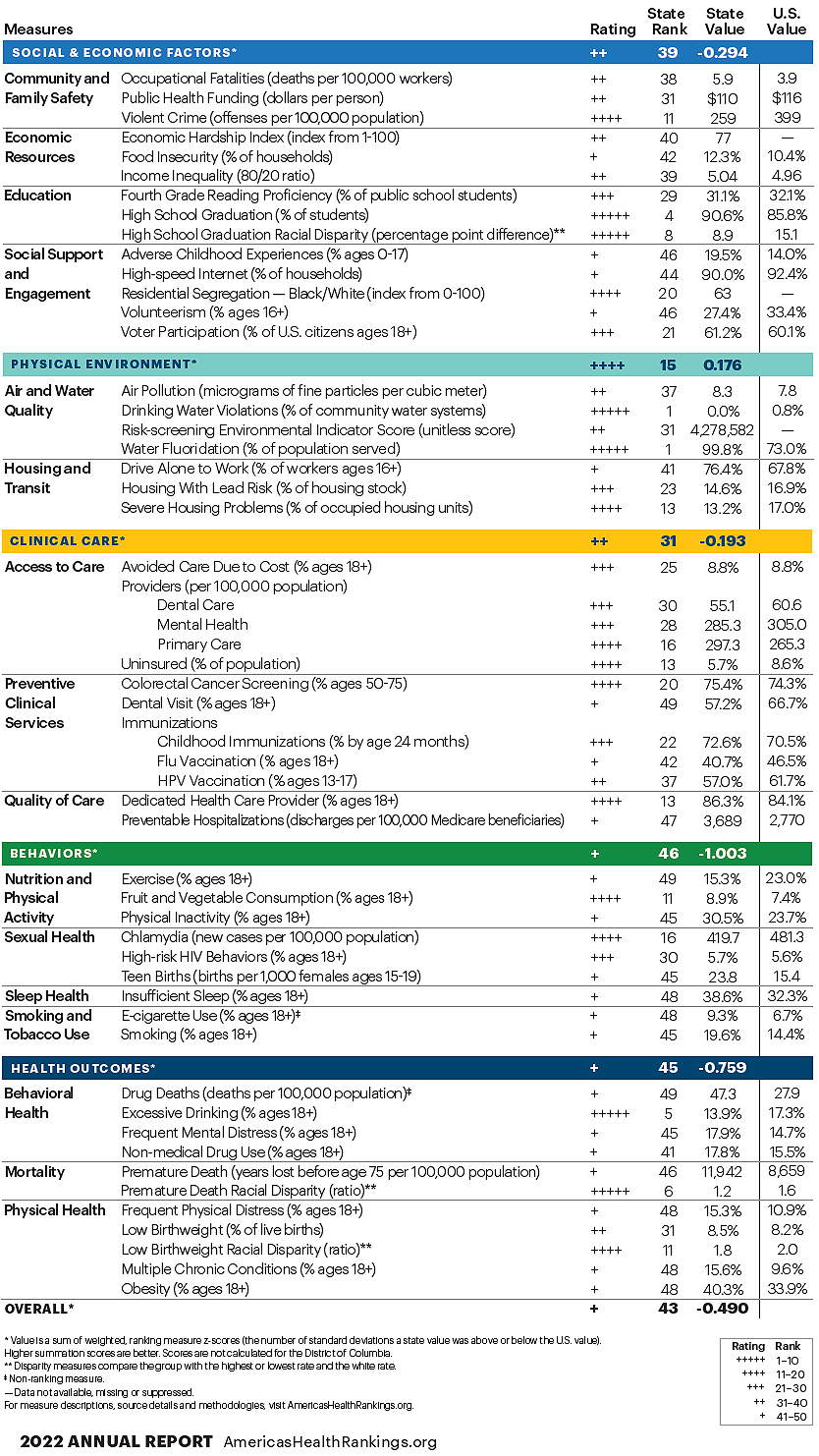
Kentucky again 43rd in America's Health Rankings, scoring lowest in behavior and health outcomes, high in having a care provider

By Melissa Patrick
Kentucky Health News

After not ranking states for two years due to the pandemic, America's Health Rankings again placed Kentucky among the 10 unhealthiest states, ranking its healthiness 43rd, the same slot it had in the last rankings, in 2019. 

Kentucky has found itself among the bottom 10 unhealthiest states since the rankings were first released in 1990, with the exception of 2008, when it ranked 39th. 

The rankings by the United Health Foundation are meant to help state leaders determine health benchmarks that can help them inform actions as they work to improve the health of their communities. 

The report examines a number of measures that influence health, broken into four categories: social and economic factors, physical environment, clinical care, behaviors, and health outcomes. 

Kentucky ranked lowest, 46th, among states in the behaviors category. 

Two measures in this category show that Kentucky adults don't get enough exercise, with only 15.3% of them saying they meet the federal guidelines for exercise in the past 30 days and 30.5% saying they didn't get any physical activity beyond their regular job in the past 30 days. For these measures, Kentucky ranked 49th and 45th, respectively. 

In the same category, Kentucky continues to have some of the highest teen birth rates in the nation at 23.8 teen births per 1,000 females aged 15 to 19; the national average is 15.4. In rankings that put the highest numbers at the bottom, Kentucky ranked 45th for this measure. 

Likewise, the state also continues to be a national leader in vaping and smoking, ranking 48th for adult use of electronic cigarettes and 45th for cigarettes (again, with higher numbers at the bottom). The rankings say 9.3% of Kentucky adults reported using e-cigarettes and 19.6% said they are regular smokers. 

Kentucky also ranked 48th in sufficient sleep, with 39.6% of adults reporting that they get, on average, fewer than seven hours of sleep in a 24-hour period. 

One of the Kentucky's better rankings in the behavior category was 11th for fruit and vegetable consumption.

In the health outcome category, Kentucky ranked 45th. With higher numbers at the bottom, it scored in the bottom 10 states for drug deaths (49th), frequent mental distress (45th), non-medical drug use (41st), premature death (46th), frequent physical distress (48th), multiple chronic conditions (48th) and obesity (48th). 

Though Kentucky ranked among the worst states in health outcomes, it does have a low prevalence of excessive drinking (fifth, with lower numbers at the top) and a low racial disparity in premature death (sixth). 

In social and economic factors, the state ranked 39th, with some of its worst scores in food insecurity (42nd), adverse childhood experiences (46th), access to high-speed internet (44th) and volunteerism (46th). 

The good news in this category is that Kentucky ranks fourth in the percentage of students who graduate from high school in four years and eighth in the difference between the high school graduation rates of white students and the racial/ethnic group with the lowest rate. 

In the clinical-care category, where it ranked 31st, Kentucky was in the bottom 10 states for dental visits (49th), flu vaccinations (42nd) and preventable hospitalizations (47th). 

Kentucky did not get any top-10 rankings in clinical care, but got top-20 rankings for its number of primary-care providers (16th), percent of uninsured population (13th), colorectal-cancer screenings (20th) and having a dedicated health care provider (13th). 

The physical environment category was the state's highest ranking, 15th, largely because it ranked first in two categories: drinking water violations and water fluoridation.


Friday, October 28, 2022

Don't forget to turn your clock back one hour Nov. 5-6; sleep experts say standard time is the better one for health and safety

Cincinnati Enquirer photo
By Melissa Patrick
Kentucky Health News

It's almost time to "fall back" one hour into standard time, which sleep specialists say is better for our health because it more closely matches our body's internal clock. Standard time officially begins on Sunday, Nov. 6. 

“Daylight saving time disrupts the body’s natural circadian rhythms and impacts sleep,” Jennifer Martin, president of the American Academy of Sleep Medicine, said in a news release. “Standard time provides a better opportunity to get the right duration of high-quality, restful sleep on a regular basis, which improves our cognition, mood, cardiovascular health, and overall well-being.”

Why is standard time better for our health? "The daily cycle of natural light and darkness is the most powerful timing cue to synchronize our body’s internal clock," the sleep-medicine academy says. "When we receive more light in the morning and darkness in the evening, our bodies and nature are better aligned, making it easier to wake up for our daily activities and easier to fall asleep at night. Daylight saving time disrupts our internal clock, leading to sleep loss and poor sleep quality, which in turn lead to negative health consequences." 

Polling shows that most Americans want to stop changing their clocks twice a year, and the U.S. Senate has unanimously passed legislation (without debate) to do just that. But it wants the national, fixed, year-round time to be daylight saving time. 

The bill, called the Sunshine Protection Act, is stalled in the House. But as the House considers the legislation, the sleep-medicine academy has implored its members to evaluate the evidence that supports the adoption of year-round standard time. 

The academy argues that in addition to matching our body's internal clock, standard time means more light and thus safety in mornings, especially for commuters and children heading to school. It says daylight time disproportionately affects those in the northern part of the country because of late sunrise times, especially in the winter. The academy also points to studies that show that seasonal time changes are risky to people's health.

The academy also notes that Congress tried permanent daylight time in 1973 to reduce energy consumption, but reverted back to standard time eight months into the two-year plan due to massive complaints. 

“By eliminating the seasonal time change and adopting standard time permanently on a national scale, we can all reap the benefits of better overall health and an enhanced sense of safety for ourselves and our families," Martin concluded. 

An Associated Press poll last fall found that three-fourths of Americans supported having the same time year-round, but they were divided on which one, with 43% saying standard time and 32% daylight time.

Wednesday, September 28, 2022

Bedbugs, long thought to pose no risk to human health, produce large amounts of inflammatory histamines, UK researchers find

Bedbugs in an entomology lab (Photo by Matt Barron, UK)
By Haley Simpkins
University of Kentucky

Bedbugs produce large amounts of histamine that may pose risks to humans, entomologists at the University of Kentucky and North Carolina State University have discovered in a study. 

Histamines are naturally produced chemical compounds that may cause inflammation and alert the immune system to threats. They can cause allergic reactions, rashes and respiratory problems. A previous study showed links between excess histamines and headaches, gastrointestinal issues, irregular heart rate and asthma, especially in people with histamine intolerance.

Sudip Gaire, a post-doctoral scholar in the UK Department of Entomology, and Zach DeVries, assistant professor of entomology, led the latest study. It looked at levels of histamines excreted by bedbugs across the bugs’ different life stages, different populations and varying lengths of time, and the effects that feeding on blood had on the bugs’ histamine production levels.

The study, recently published in The Journal of Medical Entomology, showed bedbugs can produce large amounts of histamine. It found that a hypothetical infestation of 1,000 bugs could produce up to 40 milligrams a week, more than 2 grams per year without even considering natural population growth of the infestation.

“That's an amount you can actually see, and we don't see that with any other containment,” DeVries said. “When we talk about pesticides, allergens, any other thing in our home that some invading organism is producing, it's always on microscopic levels, not something where you could actually hold it in your hand.”

Scientists typically haven't considered bedbugs a great risk to human health, aside from their bites, because they are not known to carry pathogens. However, high-level histamine production reveals a potential risk. While scientists don’t know the specific health impacts of histamine produced by non-human animals, DeVries, Gaire and their fellow entomologists do suspect that it may have negative clinical effects.

“It’s not only the fact that they’re producing histamine, but they’re producing it right next to where you spend the most time, generally speaking, within our homes, which is in our beds or sleeping areas,” DeVries said.

The research also has social-justice implications, DeVries said: “Anybody can get bedbugs, but it’s only those who have the means and resources who can actually get rid of the problem. There is a significant portion of the population who either don't have the money or the resources to do this, and so they're left to deal with bed bugs on their own. So, we have disadvantaged communities, who are not only having to deal with bed bugs, but maybe dealing with the health ramifications of them as well.”

One important discovery of the study was that blood-fed bed bugs produced “significantly higher” amounts of histamine than those feeding on saline or those that were starved. “Blood is the primary factor for histamine production, but we don’t know how exactly they are producing the histamine,” Gaire said.

Gaire said close exposure to histamine is also a concern for agriculture. Bedbugs are common in poultry houses, and previous studies have found histamines reduce egg production.

DeVries and Gaire said that while their study answered important questions, scientists need to do more research before sounding an alarm. DeVries received funding for the study through his 2019 National Institutes of Health Director’s Early Independence Award, which will fund similar future studies through 2024.

Thursday, June 9, 2022

UK gets $3.7 million grant to find out why Appalachian Kentucky is so sleep-deprived, part of 'public-health epidemic' cited by CDC

By Elizabeth Chapin
University of Kentucky

The University of Kentucky has received a $3.7 million grant from the National Institutes of Health to find out why people in the Appalachian region of Kentucky have such consistently poor sleep outcomes.

Poor sleep is linked to a wide range of medical issues, including hypertension, diabetes, depression, obesity and cancer. With more than a third of U.S. adults reporting insufficient sleep, the Centers for Disease Control and Prevention calls a "public-health epidemic."

Kentuckians are some of the nation’s most sleep-deprived, particularly in the state's Appalachian counties, where 25% to 58% of adults report insufficient sleep, defined as less than six hours a day.

Over five years, the team will track the sleep of 400 adults from Appalachian Kentucky, along with health information such as heart rate, physical activity, blood sugar levels, and immune function. Participants will also report their daily experiences including stress and substance use.

Participants will come from 12 Appalachian counties: six coalfield counties that have been identified as insufficient sleep hotspots (Pike, Knott, Perry, Letcher, Bell and Whitley), and six non-coal counties that are not considered hotspots (Jackson, Lincoln, Russell, Adair, Rockcastle and Estill) even though they have comparable economic distress, rurality, and demographics.

Researchers will look for what drives sleep deficiencies and health outcomes over time, how factors linked to sleep deficiencies differ between hotspot and non-hotspot counties, and the degree to which daytime distress affects sleep.

Ph.D.s Christal Badour and Mariead Moloney
The study, titled "Researching Equitable Sleep Time in Kentucky Communities (REST-KY)," is led by Associate Professors Mairead Moloney and Christal Badour.

It aims to provide answers to longstanding questions about the causes and consequences of sleep deficiencies in rural populations, not just Appalachia. But the new knowledge will inform interventions to reduce sleep disparities among people in Appalachia, who also experience severe health inequities including higher mortality rates for many conditions including diabetes, heart disease and cancer.

“Sleep is the critical pivot point for understanding ways in which people in this region experience health disparities,” said Badour. “If we can understand why people are getting poor sleep, we can then identify interventions that can help them sleep better, which would have cascading benefits for many aspects of their health.”

The REST-KY team includes experts across four UK colleges: Badour, Moloney, Suzanne Segerstrom and Lauren Whitehurst from the College of Arts and Sciences, Daniela Moga from the College of Pharmacy, Nancy Schoenberg from the College of Medicine, and Emily Slade from the College of Public Health.

“This collaboration of experts across so many disciplines will enable us to get a holistic look at the biological, behavioral, emotional, and social contributions to sleep health,” Moloney said.

The REST-KY grant is one of NIH’s prestigious “R01” awards. It builds on the team’s previous interdisciplinary research, including a 2018 intervention study to address insomnia among women in Appalachian Kentucky.

Saturday, May 28, 2022

Reducing screen time can help children be more physically active

Illustration by Becky Wright, Happiful
Reducing screen time seems to encourage children to be more physically active, but it's unclear whether it can help them get better sleep.

A study by researchers at the University of Southern Denmark involved 89 families from 10 municipalities in the region. The researchers assigned each family to one of two groups: 45 families (including 86 children and 82 adults) were assigned to the intervention group and told to limit the amount of time they spent using electronic devices, and 44 families (95 children and 82 adults) were assigned to a control group and told to continue using electronic devices as usual. In the intervention group, some of the adults could not give up their smartphones because of work, but in each family, at least one adult was able to relinquish their smartphone and replace it with a non-smartphone. The participants in the intervention group were allowed up to 30 minutes of necessary screen time a day for activities such as coordinating appointments.

The intervention lasted two weeks. The researchers determined that was long enough for the participants to adapt to a life with less screen time while still remaining compliant with the study. To be considered compliant, participants had to have no more than seven hours of screen media use during the period. Screen media use was measured with noncommercial apps and a television monitor developed in-house and installed by a research team member. The study is published in JAMA Network.

After the two weeks, the researchers noticed a significant difference in rates of physical activity between two groups. Children in the intervention group averaged 45 more minutes of moderate to vigorous physical activity, while children in the control group averaged just 1 minute more. There was also a far greater difference in how much time children in the intervention group engaged in leisure, non-sedentary activities than in children in the control group.

No significant difference was found in adults between the groups. Nor was there a significant difference in any of the children's or adults' sleeping habits, including total sleep duration, sleep onset latency, wake after sleep onset in children and adults, or the duration of stage of sleep lasts in children or adults. The researchers noted how the results for sleep parameters in children are not consistent with evidence from a systematic review of trials targeting screen media use (often in combination with co-interventions). 

The researchers said the large effect on physical activity suggests that the high levels of recreational screen media use seen in many children should be a public health concern and emphasizes the importance of developing and implementing measures to balance recreational screen media use to prevent physical inactivity in children.

Friday, December 3, 2021

Feeling older than you are? You may not be getting enough sleep

Shutterstock
Getting plenty of sleep is important not just for physical health but also for your own perception of your health.

A study led by the University of Exeter in England found that people who rated their sleep the worst felt older and perceived their own physical and mental aging more negatively.

Researchers surveyed 4,482 people 50 and over in an online study in which participants take regular cognitive tests and complete lifestyle questionnaires. The study aims to understand what helps people stay cognitively healthy.

Lead author Serena Sabatini said, “Our research suggests that poor sleepers feel older, and have a more negative perception of their aging. We need to study this further – one explanation could be that a more negative outlook influences both. However, it could be a sign that addressing sleep difficulties could promote a better perception of aging, which could have other health benefits.”

The research team noticed that many participants were commenting on their relationship with sleep as part of standard questionnaires within the study. Comments included: “How I feel fluctuates widely depending on my sleep. I feel great if I get six hours, so about half the time I feel younger and half the time I feel older!”

Prompted by such comments, the team offered a questionnaire looking specifically at sleep. Participants were asked whether they had experienced a list of negative age-related changes, such as poorer memory, less energy, increased dependence on the help of others, decreased motivation, and having to limit their activities. They also rated their quality of sleep. The participants completed both questionnaires twice, one year apart. The research was published in the journal Behavioral Sleep Medicine, 

Friday, September 4, 2020

Coronavirus cases top 800 for 4th straight day; as another surge threatens, Beshear urges people to follow the rules and be careful

Department for Public Health map, labeled by KHN; for a larger version, click on it. Get update here.
By Melissa Patrick
Kentucky Health News

Gov. Andy Beshear announced 809 new cases of the novel coronavirus Friday, the first time Kentucky has seen four days in a row with more than 800 new cases each day. And his announcement of 11 more deaths made this week's death count the highest yet, 66 since Sunday. 

Beshear again implored Kentuckians to keep their social gatherings small and follow public-health guidelines as the state heads into the Labor Day weekend and the running of the 146th Kentucky Derby -- without fans at Churchill Downs, but perhaps at many Derby parties. 

Kentucky has been on an elevated, rough plateau of cases for several weeks, and it got there following a surge after the last big holiday, July 4.

“I know this is a big weekend: Derby weekend, even though it’s September, and Labor Day weekend,” Beshear said in a news release. “Traditionally, we’d get together with a lot of people over this weekend. This year, I need you to do it a little differently. Just this one time, probably in your entire life, please keep your gatherings small, 10 people or fewer.”

Today's new cases created new records. The state's unadjusted seven-day total of daily new cases is 5,006, the first seven-day period above 5,000 cases. The seven-day rolling average is 715. 

The good news continues to be that the share of Kentuckians testing positive in the last seven days continues to be under 5 percent, a key threshold for suppressing the virus. Today's positive test rate is 4.70%. It has remained under 5% for 10 days. 

Of today's new cases, Beshear reported that 98 are age 18 and younger, and of those, eight were 5 and under. The youngest was a 2-month-old baby from Jefferson County.

“We’re trying to keep our businesses open and get our economy to bounce back,” said Beshear. “We’re going to get our kids back in school later this month. We’re trying to get high school sports up and going and keep them going. So we really need you to help us on all the other things like wearing a mask, washing your hands frequently and social distancing.”

Friday's deaths were a 61-year-old man from Barren County; an 88-year-old woman from Carroll County; an 82-year-old man from Clinton County; an 82-year-old woman from Hardin County; two men, 72 and 77, from Jefferson County; a 77-year-old woman from Kenton County; a 67-year-old woman from Marion County; a 75-year-old man from Owsley County; a 79-year-old woman from Rockcastle County; and a 64-year-old woman from Warren County.

“I know how much we all want to see our families and friends for this holiday, but for one year, we need to prioritize making sure every person we care about is around to celebrate with us next year,” said Beshear. “We have already lost so many Kentuckians, and I don’t want that loss to be even greater. It will be if we have a spike in cases.”

Beshear extended several health-related executive orders, including his mask mandate and an order that allows pharmacists to dispense 30-day refills. 

Counties with more than 10 new cases Friday were Jefferson, 249; Fayette, 56; Pulaski, 36; Daviess, 26; Madison, 23; Warren, 22; Union, 21; Henderson, 20; Laurel, 16; Boone, 15; Greenup, 14; Kenton, 14; Grayson, 13; Bullitt, 12; Nelson, 12; Hardin, 11; and Shelby, 11.

Hospitalizations for covid-19 in Kentucky remained stable, at 574, with 132 of them in intensive care. Each figure was up six from Thursday.

In long-term-care facilities, 51 more residents and four more employees were found to be infected. At least 310 facilities statewide have had at least one case, and there active cases among 585 residents and 352 employees.

In K-12 schools, the daily report showed 27 new cases among students, raising the active-case total to 300. Seven more employees were added to the case list, making 109 active cases. The total cases reported so far are 459 students and 128 employees.

Kentucky Kernel graph, labeled by Ky. Health News; click it to enlarge
At Kentucky colleges and universities, the state added 51 more students and four more employees to its list, making active-case totals of 710 and 27, respectively. The report was incomplete, or not up to date, or both; for example, no new cases were reported at the University of Kentucky, but the Lexington-Fayette County Health Department, which reports on a different schedule, reported 111 new cases, 50 of them at UK. The state report said UK has 390 active cases, but UK's own site, which had date through Tuesday, Sept. 1, said it had 459 active cases.

UK has started testing dormitories' wastewater to detect infection by the virus. "Increasing levels in wastewater could be an early indicator of an outbreak or increased prevalence," UK President Eli Capilouto said in a campus-wide email.

In other covid-19 news Friday:

  • The Christian County Board of Education voted 4-1 to approve Supt. Chris Brentzel's recommendation that in-person classes begin Tuesday, while allowing students to opt out, Hoptown Chronicle reports: "Elementary school students will be on a traditional schedule and attend in-person classes five days a week. Middle- and high-schoolers will be on a hybrid schedule. They will be in class two days and have virtual learning the remainder of the week."
  • "The pandemic has heightened stress and upset routines" so much that "physicians and researchers are seeing signs it is doing deep damage to people’s sleep," The Washington Post reports. “Coronasomnia,” as some experts call it, could "have profound public-health ramifications — creating a massive new population of chronic insomniacs grappling with declines in productivity, shorter fuses and increased risks of hypertension, depression and other health problems."
  • The Louisville Courier Journal reports on what happens to public health when a city has "uncontrolled spread" of the coronavirus. Dr. Sarah Moyer, the city's chief health officer, told Grace Schneider that like a wildfire, extinguishing the spread is nearly impossible "after we have the wildfire going." Louisville Metro's public health officials encourage people who have tested positive for the virus to go ahead and do their own contact tracing by alerting those they were within six feet of for at least 15 minutes in the days before they began to feel symptoms. 
  • The Courier Journal's Deborah Yetter tells the story of covid-19 from the perspective of people who have recovered: the administrator of a nursing home that had a big covid-19 outbreak in May that resulted in the loss of 16 residents and one staff member to the disease; a nurse who works on a covid-19 ward; and a physician. Dr. Briones-Prior of U of L Health told Yetter that she is seeing whole families affected by the disease, instead of just the frail and elderly: "It gets into the household, and the whole household gets it."
  • University of Louisville Physicians offer tips on how to increase your activity during the pandemic, saying that adding an extra 2,000 steps a day and reducing calories by 100 a day will help you achieve an energy balance that can stop weight gain. 

Saturday, September 22, 2018

65 kids a day are abused or neglected in Ky., third in nation; officials urge safe sleep practices, care about who provides care

By Melissa Patrick
Kentucky Health News

FRANKFORT, Ky. – When it comes to keeping babies safe, three of the most important things are safe sleep practices, recognizing that bruising in non-mobile infants is not normal, and choosing an appropriate caregiver.

So said members of the state's Child Fatality and Near Fatality External Review Panel, who told legislators at the Sept. 19 joint health committee meeting that three-fourths of cases they reviewed in 2017 were "potentially preventable."

They lawmakers also heard the executive director of Prevent Child Abuse Kentucky say the state ranked No. 3 for "child maltreatment" in 2016. Jill Seyfred added that 23,827 Kentucky children were confirmed victims of child abuse or neglect in 2017, about 65 a day.

The ABCs – and D – of safe sleep

Dr. Jaime Pittenger, a review-panel member and the president of Prevent Child Abuse Kentucky, told the committee that 39 percent of the deaths the panel reviewed in 2017 involved sudden unexpected deaths in infancy, or SUDI, a broad term that covers both sudden infant death syndrome and other fatal sleeping accidents. That number is "on the rise this year," she warned.

Pittenger, who heads the pediatric residency program at the University of Kentucky, stressed the importance of following the ABC's of safe sleep to prevent injury or infant deaths – Alone, on their Back, and in a Clean, Clear Crib.
Safe Sleep Kentucky website graphic; for a larger version, click on it
And because so many of the fatalities or near-fatalities are connected to substance abuse, Kentucky has added a D to that list to point out the Danger of sharing a bed with a child, especially when under the influence of alcohol or other drugs.

Almost two-thirds of last year's SUDI cases in Kentucky involved an impaired caregiver who slept with their baby and the baby died from suffocation or asphyxiation, the review panel found.

Pittenger pointed out that many Kentucky infants don't have a safe place to sleep: "We can make it sound like everybody has a bassinet, a crib, but they don't."

Rep. Joni Jenkins, D-Louisville, suggested that the state look into providing children who don't have a crib with a "baby box" with instructions on safe sleep, as some other states and countries do.

"Some years ago we decided that every child that left the hospital ought to have the appropriate car seat," Jenkins said. "It seems to me that a logical [solution] is that every child that leaves the hospital after birth should have an appropriate place to sleep as well."

CDC photo
"Those who don't cruise, don't bruise": Pittenger offered this rhyme as a way to remember that bruising in infants not old enough to be mobile "is not normal." She was quick to point out that bruising doesn't always mean abuse, but "should raise a red flag to make you ask questions."

Paula Sherlock, a retired Family Court judge, stressed the importance of reporting bruising in non-mobile infants: "We don't want to think that our kids are abusing our grandkids, so we believe things that we shouldn't believe."

"Don't leave your child with someone you wouldn't leave a puppy with": This was Sherlock's advice for choosing a caregiver. She added, "People who have violent tempers, who have histories of domestic violence, should not be left in a care-giving role with children who can't defend themselves or tell anybody what happened," she said. "The vast majority of the kids we see are under the age of 4 and a huge portion of them are under the age of 2."

Happiest Baby blog photo
Sherlock said 41 percent of Kentucky children determined to have abusive head trauma in 2017 were left with a caregiver to whom they were not related. "Typical of that is the boyfriend who is watching the baby while mom goes to work," she said. "Mom has no affordable daycare, she has no good support system and so a completely inappropriate person is left with the child, who is not his child. We see a really startling number of these cases."

Abusive head trauma is also called "shaken baby syndrome." It can be caused by a direct blow to the head, dropping or throwing a child, or shaking a child resulting in an injury to the child's brain.

Seyfred said the top risk for these children are substance abuse and family violence. "Substance abuse was documented as a risk factor in 65 percent of the reports, with family violence as a risk factor in 42 percent," she said.

There are other dangers. Pittenger said people who have a history of crime or mental illness have also been connected to the majority of these abused and neglected children. The panel report found that 85 percent of the 2017 cases reviewed had a prior history with child protective services.

What's Kentucky doing to protect its children?

Sherlock and others stressed the importance of the review panel, which she said works to identify gaps in the system and to find ways to fix them.

She also stressed the need to get quick, efficient, affordable and non-punitive help for Kentucky parents who are suffering from addiction.

"These parents need help," she said. "These kids are very vulnerable and if they are being born to drug-addicted parents and then going home to be cared for by these parents, that is a recipe for disaster." Sherlock said, "My experience in court: drug addicted parents did not by and large beat their children to death . . . but the neglect is so gross and so widespread that these children are not fed, they are not supervised."

Rep. Kim Moser, R-Taylor Mill, and Sen. Reginald Thomas, D-Lexington, praised the HANDS program as a tool to help at-risk families learn how to better care for children. HANDS, for Health Access Nurturing Development Services, is a home-visitation program for new and expectant parents that works toward healthy pregnancies and births, healthy child growth and development, safe homes and self-sufficient families.

Thomas said he thought every parent would benefit from this program, but especially those at high risk. "The reality is that children don't come with a how-to manual," he said.

Moser also praised the START program, which integrates addiction services and other wrap-around services to families with at least one child under 6 years of age who is in the child-welfare system and has a parent with a substance-use disorder that puts that child at risk. START stands for Sobriety Treatment and Recovery Team. Moser said she would love to see both of these programs expanded.

Seyfred told the panel that Prevent Child Abuse Kentucky had recently partnered with WellCare and the Kentucky Hospital Association to create a video focusing on safe sleep, abusive head trauma, and choosing an appropriate caregiver to show new parents before they leave the hospital.

Pittenger spoke to the importance of this education: "One of the saddest stories I ever heard was a dad who just didn't understand that shaking would hurt his child. He never knew, he never thought that what he was doing when he lost his temper would hurt the child. Some people just don't know."

Kentucky has also passed laws to require caregivers and professionals who serve children to receive training on pediatric abusive head trauma.

Sen. David Givens, R-Greensburg, charged everyone at the meeting to tell at least one person with a newborn or who is pregnant about what they had learned about the importance of safe-sleep practices and quality caregivers.

"We could save one child's life just through that conversation," he said. "So let's do that. Let's all leave here today charged in the course of the next two weeks to have that conversation with at least one person. We may make a difference."

To report suspected child abuse in Kentucky, call 877-KYSAFE1 (597-2331) or online at https://prd.chfs.ky.gov/ReportAbuse/OutofHours.aspx. The national abuse hotline can be reached at 1-800-422-4453.