Showing posts with label holidays. Show all posts

Friday, January 12, 2024

'Blue Monday' is a myth, but Seasonal Affective Disorder is not

Blue Monday candy is a product of
Ruth Hunt Candies of Mount Sterling.
Kentucky Health News

Monday, Jan. 15, is considered by some to be “Blue Monday,” the most naturally depressing day of the year as people feel “blue” from holiday bills, bleak weather and forsaking their New Year resolutions, says Hackensack Meridian Health of New Jersey in a press release.

It’s common for all these factors to have a compounding effect on mental health, but point out that sadness or depression don’t follow a calendar and can happen at any time, say the hospital group's psychiatrists and psychologists. "Understand you are not alone and talk to others about your stressors and, most importantly, seek help if the symptoms of depression are severe or persist," the release says.

“It is OK if you haven’t succeeded at your resolution yet. Start now. Don’t attach your success to the calendar,” said psychiatrist Dr. Rehan Aziz. “Make sure your resolution is measurable and manageable, with small steps.When starting new habits, set reasonable expectations.“

“Blue Monday” is a myth, but is emblematic of feelings of depression at this time of year, experts say. “Although the most difficult time of year may vary for each person, any time with higher stress, less sunlight, feeling lonely, or barriers to enjoyable activities can take a toll on our moods,” said psychologist Heather Derry-Vick. “For many people, wintertime checks a lot of those boxes,”

Seasonal affective disorder (SAD) is a type of depression that usually happens in fall and winter, when less daylight triggers chemical changes in the brain. SAD can be trated with therapy using light and and antidepressants.

“Some researchers believe that SAD can be linked to a reduction in serotonin production, a chemical in the brain that helps to regulate mood; or a vitamin D deficiency, which can occur due to changes in exposure to sunlight,” psychiatrist Dr. Yolanda Picket said. “Some also believe that there is a link to increased melatonin production, which may be triggered by the darker days in fall and winter seasons.”

Treatment options that may help patients with depression or SAD include:
  • Talk therapy, such as cognitive behavioral therapy
  • Medication
  • A combination of talk therapy plus medication
Lifestyle changes that may help patients with depression or SAD include:
  • Getting exercise regularly
  • Socializing with friends regularly
  • Participating in activities that you typically enjoy regularly
Other treatments that may help patients with winter-pattern SAD include:
  • Light box therapy – exposure to a certain type of bright light
  • Vitamin D supplements, if they’re recommended by a doctor
Lifestyle changes that may help patients with winter-pattern SAD include:
  • Regulating sleep patterns, to avoid sleeping too much
  • Regulating diet, to avoid overeating or craving carbs
Even though the data may not support the idea of Blue Monday, it can be a good reminder to do a personal mood check.

“Have you been feeling down or having a hard time getting going most days, for a few weeks or more? Is that making it more difficult to do the things you normally do? If so, Blue Monday is as good of a day as any to reach out to your primary doctor or to a mental health professional for an assessment,” Derry-Vick said. “They can help you to figure out steps to improve your mood.”

Monday, November 27, 2023

Over the holidays, encourage picky eaters to try something new

Photo illustration from PureWow.com
By Dr. Rhya Strifling
UK HealthCare

During the holiday season, there are all kinds of foods on the table. But for parents and caregivers, even the most joyous of family gatherings can be stressful when you're dealing with a picky eater.

Sometimes what parents think is picky eating isn't actually picky eating. Some parents might be under the impression that their kids are picky eaters if they don't eat much, but children ages 2 to 5 have a slower rate of growth and therefore have smaller appetites.

It's normal for children to eat small amounts of food at one meal — sometimes just a few bites — and then a larger amount at a later meal or the next morning. They learn to regulate how much to eat and won't starve themselves. If they are growing well on their growth curves, don't worry about how much they are eating.

Keep mealtimes relaxed. The best way to prevent a child from becoming a picky eater is to make mealtimes enjoyable with a variety of small portions of healthy foods. Mealtimes should be relatively short, and children should not be made to "clean their plates." Some children will exert their independence by refusing to eat if you force them, punish them or bargain with them. The more you make them eat, the more they might begin to refuse.

Provide your child with a variety of healthy food choices in small, tablespoon-sized portions, then relax and focus on your own meal. The less focus you put on what your kid eats, the better they will eat. If they say they don't like what you have prepared, tell them that's OK and give them the same food options as the rest of the family, then return to your own meal. They will either eat, or catch up at the next meal.

Encourage your child to try new foods. A child might try a new food 10 to 15 times before realizing they actually like it. Don't be afraid to try new foods, but don't get frustrated if your child rejects them. The best way to get children to try new foods is to eat them yourself. Be sure to give them lots of praise and encouragement for taking even the smallest bite of a new food.

To help children eat better at mealtimes, follow some of these tips:
  • Try to limit beverages prior to meals.
  • Schedule snack time instead of letting them "graze" throughout the day.
  • Serve as a role model, because children learn to feed themselves by experimenting with new foods.
  • Sit at the table as a family to demonstrate healthy eating choices and habits.
Rhya Strifling, M.D., is a physician at Kentucky Clinic South.

Thursday, November 16, 2023

A warning for the holidays: The risk of getting Covid-19 in a crowded indoor setting is still very high, state health chief says

The novel coronavirus, Covid-19, is not so novel anymore, but it remains the fifth leading cause of death in the United States and will be a threat as families gather indoors on what is forecast to be a cold Thanksgiving weekend, says Kentucky's public-health commissioner.

Dr. Steven Stack (WEKU photo)
Dr. Steven Stack says Kentuckians should keep practicing what he calls “the golden rule”: If you’re sick, stay home. And remmeber that even if you are up to date on your vaccinations, the risk of getting Covid in a crowded indoor setting is still very high.

“Since we’re standing close in the shopping line now, if you have people over for parties, if you go to a restaurant and you sit in a packed restaurant. It’s loud where people are talking and laughing and having a good time,” Stack told Stu Johnson of WEKU. “If you do that stuff on and off over a week you should just assume you’re being exposed multiple times to Covid.”

The disease doesn’t carry near the impact it once did, because of vaccinations and immunity from past infections, but Stack said it still serious, "especially for the medically frail, with more than 40 deaths a week" in Kentucky, Johnson reports.

"For the very young, vaccine availability can be an issue. Stack said most pediatricians can’t afford to have a large inventory of the costly vaccine, since it has a relatively short shelf life."

Stack said, “There have been some challenges for the youngest children because the only folks that would likely vaccinate really young children are pediatricians or clinics or doctors' offices that routinely take care of children.” In such cases, Stack suggests a commercial retail pharmacy, health department, or university medical center. Covid vaccinations are suggested for babies at six months of age.

State graphs, adapted
by Kentucky Health News
Weekly respiratory illness update


The state Department for Public Health's weekly respiratory illness update, released Nov. 16, shows that Covid-19 activity remains moderate, but influenza and respiratory syncytial virus are increasing. And, hospitalizations for Covid-19 and flu are low, but increasing and RSV hospitalizations in children continue to increase.

The report shows that in the week ended Nov. 5, emergency-department visits for respiratory illness in Kentucky increased again, to 2,811. Of those, 1,202 were for flu, 1,105 were for Covid-19 and 504 were for RSV.

Among children, ED visits increased to 1,302, up from 975 the prior week. Of those, 691 were related to flu, 450 for RSV and 161 for Covid-19.

Hospitalizations for respiratory illness in Kentucky for the week ended Nov. 5 also increased, to 420, up from 318 the prior week. Of those, 278 were related to Covid-19, 84 for RSV and 58 for flu.

Among children, hospitalizations for respiratory illness also increased, to 86, up from 60 the week prior. Of those, 65 were for RSV, up from 45 the prior week; 11 were for flu, down from 13; and 10 were for Covid-19, up from two.

In the week ended Nov. 5, Kentucky reported 3,064 laboratory-confirmed tests for Covid-19, up from 2,430, and 332 positive laboratory tests for the flu, up from 187 the prior week.

Deaths:  In the week ended Oct. 15, the state reported three Covid-19 deaths and in the week ended Oct. 22, the state reported three Covid-19 deaths.

Saturday, November 4, 2023

At upcoming holiday celebrations, focus on social connections, not on the food; eat mindfully to avoid celebration guilt

Photo by iStock from "How to eat healthy during a holiday celebration," by Hola 
By Patty Craig
Beech Tree News, Morgantown

We will soon enter the holiday celebration season. Our culture promotes celebrating with food – despite staggering obesity statistics. Anticipating those celebrations, how might health-minded people celebrate?

First, carrying extra weight is a real problem. The Centers for Disease Control and Prevention website reports: “The obesity prevalence was 39.8% among adults aged 20 to 39 years, 44.3% among adults aged 40 to 59 years, and 41.5% among adults aged 60 and older.”

Obese children may have to deal with psychological problems such as anxiety and depression, low self-esteem and lower self-reported quality of life, social problems such as bullying and stigma, and obesity as adults.

Obese adults face high blood pressure and high cholesterol, Type 2 diabetes, breathing problems, joint problems, gallstones and gallbladder disease. Additionally, “adults with obesity have higher risks for stroke, many types of cancer, premature death, and mental illness such as clinical depression and anxiety.”

Patty Craig
Why, then, is food a part of life’s celebrations? The Cultural Awareness International website says: “Conceivably it (food) is the most significant commonality that humanity shares. Whatever shape, form, flavor, or seasoning food may take around the world, people eat. More than that, across the world, people enjoy eating.”

Food is a way to show hospitality, and it provides an opportunity to make connections. Food is generally provided with celebrations throughout the life cycle – from birth to death, including many holidays.

How can we find a healthy balance? In a Film Daily article by Samantha Williams ("Healthy Celebrations: Striking a Balance between Indulgence and Wellness"), the author discussed how to be mindful and still savor a celebration. Two of her points resonated with me:

Set Realistic Expectations: Understand that celebrations are exceptions, not the norm. Don’t expect to maintain your usual dietary and fitness routines during every celebration. Instead, aim for balance over time.

Focus on Social Connection: Celebrations are about connecting with others and making memories. Shift your focus from food to the people and experiences around you.”

By eating mindfully, a balance between indulgence and wellness can be achieved, ridding us of celebration guilt.

I’ve read that health is an investment, not an expense. The Roman poet Virgil said, “The greatest wealth is health.” And I agree.

So what about those holiday celebrations on the horizon? I say yes, let’s provide the food, but not push anyone to eat or drink what’s being served. After all, we may not understand their situation, and we don’t want to be stumbling blocks to their health goals.

Patty Craig of Morgantown is a mother, grandmother and retired educator.

Monday, October 30, 2023

Sugar season has started, so brush your teeth twice a day, floss daily, and drink plenty of water, UK dental-school dean advises

Photo illustration by Viktoriia Hnatiuk, iStock/Getty Images Plus
By Jeff Okeson, D.M.D.
Professor and dean, University of Kentucky College of Dentistry

From Halloween through New Year's, holiday parties and family events are filled with gifts and delicious treats. Kids go trick-or-treating, pies are baked and cookies are decorated. It’s the time of year that brings everyone together.

But with all the sugary treats, increased potential for cavities can be a concern. Cavities are small holes in the teeth caused by tooth decay. Eating sugar without proper dental hygiene can lead to plaque buildup on teeth, which can dissolve the enamel on teeth and eventually cause cavities.

It’s important to pay attention to holiday favorites like sugary baked goods, candied nuts and candy canes that contain a lot of added sugar which can lead to tooth decay. It’s also easy to forget that holiday drinks like apple cider and cocktails can be acidic leading to tooth erosion.

While sweet treats can be enjoyed, as we head into the fall and winter months it is important to stay on top of your oral health to ensure your dental visits are cavity-free. Here's how to do that:

Brush your teeth properly. Adults and children alike should brush their teeth twice daily with fluoride toothpaste for a full two minutes. Divide the mouth into four sections, top right, top left, bottom right, bottom left and brush each section for 30 seconds. Gently rotate the toothbrush bristles in circles, being careful not to irritate the gums. Rinse the mouth to wash out all toothpaste.

Floss daily. Flossing is equally as important as brushing. Flossing cleans hard-to-reach areas between the teeth and below the gum line. One of the most common places for a cavity to form is between the teeth, which is why flossing is necessary when cleaning the entire mouth. Adults and children should floss their teeth at least once a day, ideally at night before bed.

Drink plenty of water. Staying hydrated is beneficial for overall health, but drinking water is also one of the easiest ways to help prevent cavities. Water containing fluoride strengthens teeth and prevents decay. Water also washes away leftover food and residue that can lead to cavity-causing bacteria.

Visit the dentist regularly. Adults and children should visit the dentist for routine check-ups every six to 12 months. Visiting the dentist regularly lets people know if they are at risk for cavities. Once a patient is seen, dentists can understand which treatments might be needed or what changes in oral hygiene or diet might help reduce their risk of tooth decay.

While these tips can help prevent tooth decay, even the most diligent brushers can still get a cavity. There are a few telltale signs that indicate a dental visit is needed. Contact a dentist or health care provider if you experience any of the following symptoms:
  • Toothache or pain
  • Sensitivity to heat or cold
  • Tooth discoloration
  • Swollen gums
Holiday sweets and drinks are something to look forward to and may be hard to avoid completely. Instead of worrying about what isn’t okay to eat, focus on consuming in moderation. Drinking plenty of water and keeping up on your brushing and flossing are some of the best ways to take care of oral health.

Friday, December 30, 2022

Observing 'Dry January' can bring lasting benefits, studies show

Photo illustration for The Washington Post by Linnea Bullion
People who observe "Dry January," abstaining from alcohol during the month, often drink less the rest of the year and show "striking improvements in their health," Anahad O'Connor of The Washington Post reports. The observance "is widely viewed as a temporary test of willpower — followed by a return to old drinking habits when the month ends. But according to research, that’s often not what happens."

Studies in the United Kingdom have shown that people who participate in sobriety challenges "frequently experience lasting benefits," O'Connor reports. "Often, they drink less in the long run and make other sustained changes to their drinking habits that lead to striking improvements in their health and well-being." One possible reason: a month "provides opportunities to form new habits — like turning down alcohol in social settings, which in the long run can be empowering. And taking a break from alcohol can trigger immediate health benefits, like weight loss, better sleep, and a boost to your mood and energy levels, which can reinforce the new habit."

Richard de Visser, a psychologist at Brighton and Sussex Medical School in England, who has studied the phenomenon, told O'Connor, “It becomes a reinforcing message instead of a punishing message. Instead of public health people wagging their fingers and saying, ‘Don’t drink, it’s bad for you,’ people do it and say, ‘I didn’t realize how good I would feel.’ They often don’t realize how much stopping drinking will improve their sleep, or their concentration, or even just their levels of energy in the morning.” But 11% of participants have a rebound effect, drinking more afterward.

The observance was started 10 years ago by Alcohol Change UK, a British nonprofit that has a website where you can sign up to get support, also available via a mobile app. "Last year, 130,000 people globally signed up to participate in Dry January," OConnor reports, offering other "tips that could increase your odds of success:" Do it with a friend. Find a new favorite drink that has no alcohol. Track how much money you save (which you can do on the app). "Manage your triggers; instead of meeting your friend at a bar after work, suggest going to a movie, taking a long walk, or having dinner at a restaurant instead."

UPDATE, Jan. 2: The New York Times recommends non-alcoholic wines.
Jan. 3: The Courier-Journal offers tips on how to be "sober curious" and still have fun.

Monday, December 19, 2022

How to manage your mental health in the holiday season

By Dr. Gopalkumar Rakesh
Assistant professor of psychiatry, University of Kentucky

For many, the holiday season is not always the most wonderful time of year. With work and school deadlines quickly approaching, holiday shopping expenses piling up, and back-to-back large social gatherings, this time of year can eventually take a toll on one’s mental wellness.

According to the National Alliance on Mental Illness, a study showed that 64% of people with mental illness report holidays make their conditions worse. In a separate study conducted by the American Psychological Association, 38% of people surveyed said their stress increased during the holiday season.

Photo by Tommaso79, Getty Images / iStock Plus
Increased stress can cause symptoms of physical illness, depression, loneliness and more. If you or a loved one are experiencing increased stress this year’s holiday season, here are some tips to help make your season a bit jollier.

Manage your time: Remember that your priorities still matter, and procrastination is not your friend. Putting off important projects can cause unwanted stress. Be sure to prepare ahead of time if you have important deadlines approaching to ensure that you do your best. Try making a schedule of when you will work on your projects and do your holiday prep to make sure your schedule is balanced, productive and not rushed.

Set boundaries: Communicate your limits as early as possible to friends and family so that everyone is on the same page. It is okay to say no to social obligations that may be too stressful. Choosing to set boundaries surrounding stressful conversations on topics that may be contentious in a family setting may also be advised.

Take care of yourself: The holiday season is not only about spoiling those you love but making yourself a priority as well. Fight seasonal depression by staying on top of your sleep and exercise schedule. If you can, work near a window throughout the day to get as much sunlight as possible. Even adding bright holiday lighting throughout your work or engaging with mindfulness apps on your smartphone can help boost your mood.

Seek support: Check in with a local support group or friends who understand what you may be going through. Surrounding yourself with people who feel similar can help combat feelings of loneliness.

If you or someone you know needs additional support, reach out to your therapist if you have one, talk to a mental-health professional or contact your primary-care physician.

Additionally, if you or a loved one are experiencing a suicidal crisis or mental distress, call or text 988 to reach the Suicide and Crisis Lifeline (formerly the National Suicide Prevention Lifeline) to access free and confidential support 24/7.

Friday, December 16, 2022

Two studies, one of seniors and the other of all ages, show Covid bivalent booster shots very effective at preventing severe disease

Katelyn Jetelina, right, interviews the CDC's Dr. Ruth Link-Gelles about boosters.

By Katelyn Jetelina
Your Local Epidemiologist

We got an early holiday present. One of the last puzzle pieces about the fall Covid-19 boosters was released today: data on the effectiveness against severe disease. We have nine lab studies and one real-world study showing the fall boosters provide:
  • Greater protection against infection and transmission, by boosting our first line of defense—neutralizing antibodies. (See my previous updates here.)
  • Broader protection, or the ability to create antibodies that “see” more virus parts and “attach” more strongly compared to the antibodies we have right now. (See my previous updates on this here.)
  • Longer protection against infection and severe disease, even just by a few months. We are still at the mercy of time for this, but have promising data from the Beta bivalent vaccine clinical trials.
Until now, we didn’t know whether they provided additional protection against severe disease and hospitalization. We now have three real world analyses, and things are looking good.

The CDC released studies answering the same question from two different perspectives. The first study , in 22 large hospitals in 18 states, found that among patients 65 and older with no Covid-19 vaccination, effectiveness of the fall booster against hospitalization was 84%; among who had received mRNA vaccines, effectiveness was 73%.

The second study, at nine hospitals in 11 states, looked at emergency room and urgent care visits (a proxy for more severe disease) for patients of all ages. It found that among people with no vaccination, effectiveness of the fall booster against emergency room or urgent-care visits was 56%. Among the vaccinated, effectiveness was less with more recent vaccination (reflecting the fact that vaccine protection wanes over time). If someone got their last mRNA shot two to four months ago, effectiveness was 31%. If the last dose was more than a year ago, effectiveness was 50%.

Dr. Ruth Link-Gelles, program lead of Covid-19 vaccine effectiveness at the CDC, told me, "These vaccines provide pretty substantial additional protection, especially if it's been a long time since you got you last monovalent dose." But we still don't know how long protection will last, so studies will continue.

Bottom line: The fall boosters work. There is now evidence fall boosters broaden protection, help against infection, protect against severe disease, and (we think and hope) provide longer protection. There is one major problem though: more than 150 million people are eligible for a fall booster in the U.S. and have yet to get one.

Link-Gelles blamed that on Covid fatigue and people seeing fewer hospitalizations and deaths from the disease, but she said now is good time to get boosted because of holiday gatherings, especially with grandparents, who are more vulnerable. She said 28 million Americans over 65 have not gotten a booster.

Thursday, December 8, 2022

Number of Ky. counties with high and medium Covid-19 risk tick up a bit; Beshear says it's likely due to 'post-Thanksgiving bump'

CDC map, adapted by Ky. Health News
By Melissa Patrick
Kentucky Health News

The number of Kentucky counties with high and medium risk of Covid-19 transmission on the latest Centers for Disease Control and Prevention map released Thursday were about the same as the week before, when they were higher than they had been for a while. 

At his weekly news conference Thursday, which was held before the map was released, Gov. Andy Beshear said recent increases in counties with high and medium transmission risk in the previous map, and the increase in cases on Monday's weekly state report, were likely due to a "post-Thanksgiving bump." He said the pandemic in Kentucky still appears to be on a general plateau, but he expects cases will tick up for a few weeks before they come back down. 

"Here's the good news, though: It is nowhere near what we saw after each of these holidays the last couple of years," Beshear said. "This means Covid has fundamentally changed and our highs are going to be a lot lower and that's a very good thing for all of us." 

The latest risk map, which looks at both cases and hospital data to determine risk of transmissions, shows 12 Kentucky counties at high risk, up from 10 the week before. High-risk counties, shown in orange, were in Western Kentucky except for Bourbon, Nicholas and Pike counties. 

In high-risk counties, the CDC continues to recommend that you wear a well-fitting, high-quality mask in public indoor spaces, and if you are at high risk of getting very sick, consider avoiding non-essential indoor activities in public where you could be exposed.

Medium-risk counties, shown in yellow, numbered 44 this week, down from 48 on the previous map. These counties are found in several pockets across the state, mainly in the east and south. Again, barely a majority of the state's 120 counties (64) have a low risk of Covid-19 transmission, shown in green. 

If you live in a medium or high-risk county, the CDC advises those who are at high risk of getting very sick to wear a well-fitting mask when indoors and in public and to consider getting tested before having social contact with someone at high risk for getting very sick and consider wearing a mask when indoors when you are with them.

The CDC also has a transmission-level map that shows the level of virus spread in each county, at one of four levels. It shows 13 Kentucky counties with a moderate level of transmission and the rest have either substantial or high levels of transmission. This data is largely used by researchers and health-care facilities.

State officials have encouraged Kentuckians to use the other CDC map to guide their preventive measures.

Saturday, November 5, 2022

Think now about preventing infection during the holidays

An outdoor Thanksgiving (Photo by Spencer Davis on Unsplash)
By Katelyn Jetelina

About 2,600 Americans are still dying each week from Covid-19. The vast majority are older and vaccinated but not up to date on their boosters. As an epidemiologist, I refuse to accept this as the “new normal.” So my professional bias influences my priorities.

Goal 1: Protect the vulnerable. Ensure that the vulnerable around us (like grandparents) do not end up in the hospital with Covid-19, flu or respiratory syncytial virus (RSV). This means we are going to do everything in our power to break transmission chains before gathering for the holidays. This includes:

At least three weeks before the event, ensure that everyone is up-to-date on their flu shot and fall booster (especially the older adults). The fall booster rate is currently 7.3% (20% for those aged 65+).

One week prior to the event:
  • Wear an N95 mask. In public. Everywhere I go. This will help ensure we don’t bring Covid-19 (or flu) to Thanksgiving dinner. It will also help make sure I don’t miss the event because I’m sick. 
  • Don’t rely on case levels to influence masking decisions; at this point, they don’t accurately reflect transmission.
  • Cadence testing: Use Covid-19 at-home antigen tests two days before seeing grandparents and the morning of. Test everyone. Including my toddlers who scream when I approach their nose. For people who have the virus and are asymptomatic, the average antigen test will catch 44% to 70% of cases. This isn’t perfect, so we don’t rely solely on this layer. But it sometimes works.
  • If I’m positive a few days before the event: We see strong evidence (here, here) that an Omicron infection lasts, on average, 8-10 days. Some people will be infectious for less, and some will be infectious for more. You won’t know unless you test. Antigen tests are very good at telling us when we’re not infectious anymore (very few false positives). If I get a negative after a positive, then I would trust that I’m not contagious anymore and go to the event. With Paxlovid, we are seeing rebounding. So for anyone who tests negative after Paxlovid, I would continue to test for another couple of days. If you turn positive again, assume you’re infectious until you turn negative again.
Day of the event: Ventilation and filtration are powerful tools. This is especially important in the middle of winter when people head indoors. You can use a CO2 monitor if you want to take safety at your family event to the next level.
 
If we have symptoms, stay home. This is lonely during the holidays, but the best thing to do. When symptoms are present, Covid-19 antigen tests are great at detecting highly infectious people: the average antigen test will catch 78% to 97% of cases in the first week of symptoms. False negatives are more common at the beginning of infection, especially with Omicron. If you have symptoms and test negative, it’s a good idea to re-test in 24-48 hours. But, because flu and RSV levels are high right now, there’s a good chance it could be something other than Covid-19, too. Just stay home.

After the event: If an older adult gets infected, make sure they know about Paxlovid and get it within 5 days of symptoms, even just the sniffles.
Goal 2: Limit disruptions. We are trying as much as possible to prevent disruptions in our lives due to sickness. We want to go on our trip. We want to go to holiday parties. We want to help the crowded and broken healthcare systems right now.

This means we are all up to date on vaccines. This also means wearing masks. (Yes, still.) I wear one probably 40% of the time when I go to Target, but if there’s an event we’re really looking forward to, I wear it religiously (I usually dial up about four days before the event). This also means wearing a mask while traveling for work so I can come home, not get sick, and spend time with my girls.

Having two little ones and avoiding sickness gets harder and harder because they are in childcare. This is just a reality that I have to accept: they may bring something home. I’m going to do all I can to not bring it home. I know parents of older kids struggle what to do because there are competing realities: masks help reduce the odds of disruption (including missed school). But peer pressure is real, and they probably don’t wear them when you’re not around, anyways.

We are booking our holiday travel. With boosters, there is very little SARS-CoV-2 could do in the next couple months to cancel our trip. (A severe mutation may be an exception.) I know people travel with Covid-19 and sickness. Staying home is the least I can do to help someone else’s grandparents. We are prepared to cancel flights if we get sick. Make this an expectation with travel this winter.

Other considerations: I’m a healthy young adult who has been incredibly lucky. I recognize not everyone has similar situations. If you . . .
  • Are the vulnerable person, like an older grandparent: The pandemic is not over for you. And I’m sorry. I would consider wearing a mask throughout winter. This will help with COVID, the flu, and (we think) RSV. If everyone who attends Thanksgiving dinner embraces Goal #1 above, the risk to you is very low.
  • Have a child under 6 months: The pandemic is not over for you either. And RSV and flu should be concerning, too. The biggest advice I have for you is not to let people kiss or hold your baby. They’ll live.
  • Have limited means: One tragic reality is that tools are being stripped away from people who can’t afford to pay for them. Free antigen tests are gone. Free masks are gone. Vaccines are still free, but many places are asking for proof of insurance. Cancelling flights can be super expensive. I recognize taking all of the steps above involves privilege. Instead, choose one or two precautions. It will help.
Bottom line: Yes, we are still in a pandemic. Yes, the “normal viruses” are back. We can enjoy the holidays this year while staying healthy: get vaccinated, mask (at least leading up to the event), ventilate, test and stay home when you’re sick. This seems like a lot— especially when it looks like the greater public isn’t doing anything— but it really isn’t. It’s still worth navigating this petri dish to ensure our loved ones are protected.

Katelyn Jetelina, a California epidemiologist, writes a column called Your Local Epidemiologist.

Saturday, June 25, 2022

National poll shows some parents need to enforce better safety rules on fireworks; children's sparklers can be dangerous, too

By Melissa Patrick
Kentucky Health News

As communities and families prepare to celebrate the Fourth of July, some parents overlook the risks of burn and injury that fireworks pose for children, according to a national study. 

A national poll by the children's hospital at the University of Michigan found that one in five parents said their children were less than 100 feet, the recommended distance, from where fireworks were set off.  

Kentucky law prohibits igniting fireworks within 200 feet of homes, vehicles, structures or other people, and cities and counties have ordinances that apply even if they are more stringent than state law. 

Why keep your distance? Because fireworks are unpredictable, poll co-director Sarah Clark said in the news release: "It’s essential that parents keep children far away from where those fireworks are set off.”

The poll also found that over a third of parents said their children or teens helped set off fireworks in the past two years, with one in five parents saying they’d allow a child 10 or younger to help. Another third said they’d let kids ages 11-15 help, and more than a quarter said they’d let older teens get involved, the release said.

“Parents differ on what age they would allow their child to be part of setting off fireworks,” Clark said. "But parents need to ensure children are at the right age and maturity level to understand the dangers involved and importance of carefully following all safety rules. If the child is not ready to do these things, their risk of burns, eye injuries and other accidents is increased.”

Kentucky law says you must be 18 or older to buy or set off fireworks. 

Sparkler safety

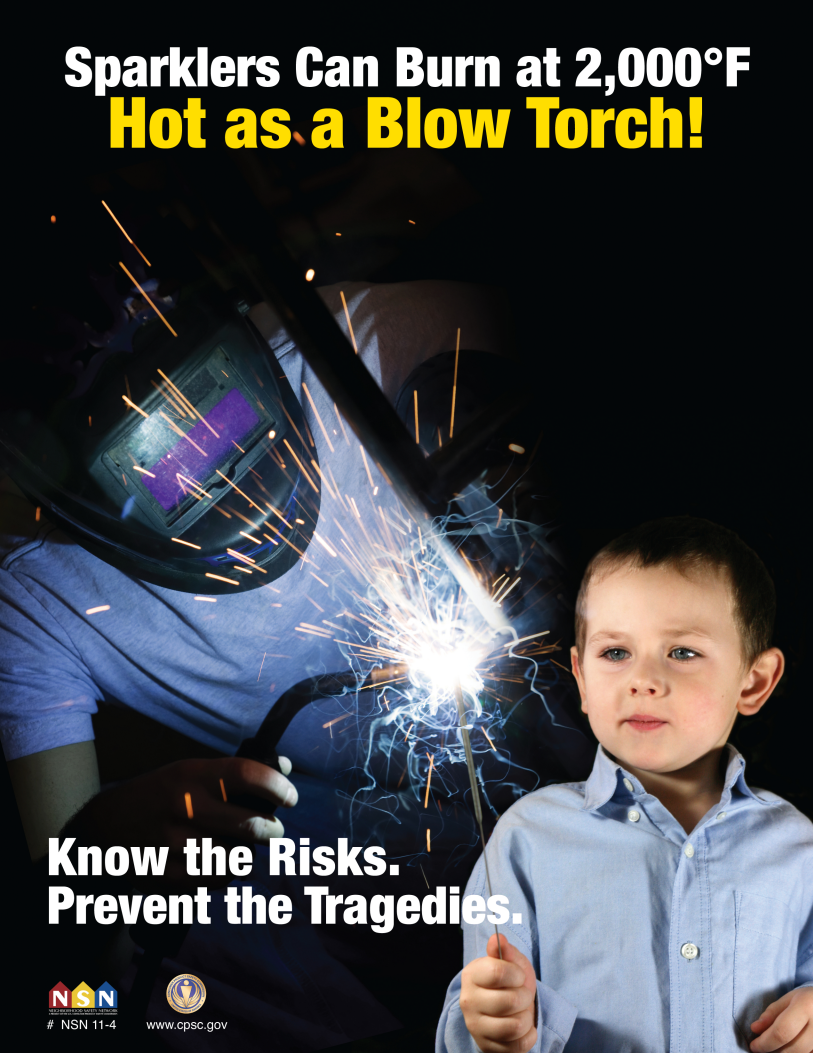
Sparklers pose an extra risk, because parents often perceive sparklers as a safe option for kids, not realizing that they can burn at temperatures of about 2,000 degrees Fahrenheit, which is hot enough to melt some metals, according to the U.S. Consumer Product Safety Commission.

The poll found that two in three parents say their children always follow the rules when using sprinklers, and a majority said they enforce the rules. However, just half of parents said they have sand or water nearby to dispose of used but still-hot sparklers.

Most parents also said they talk to their children about safety rules for fireworks, and more mothers than fathers said the believe they are always careful about supervision, the release said.

"Sparklers are only safe if parents enforce all safety measures and children follow them," said Clark. 

About 15,600 people went to emergency rooms because of fireworks injuries in 2020, a 56 percent increase from the 10,000 injured in 2019, according to the latest annual report from the Consumer Product Safety CommissionThe report says that in 2020, 18% of the estimated fireworks injuries were in children younger than 15. 

“Our poll suggests that some parents may need to be more diligent to ensure a safe environment that minimizes these risks and protects children from firework injuries," said Clark.  

Michigan Medicine offered tips for safe Fourth of July celebrations: 
  • Stay at least 100 feet away from where any fireworks are set off.
  • If setting off your own fireworks, purchase legal ones that are clearly labeled for consumer use and follow directions and safety guidelines carefully.
  • Never use fireworks while impaired by alcohol or drugs.
  • Never point or throw fireworks, including sparklers, at anyone.
  • Wear safety goggles or other eye protection if setting off fireworks yourself.
  • Keep a bucket of water or a garden hose nearby in case of a fire.
  • Douse all used fireworks with water before discarding to avoid trash fires. 
  • Only light one firework at a time and don’t try to relight the duds.
  • Wait until fireworks cool before picking them up, possibly even the next day.
Sparkler safety: 
  • Consider your child’s age and maturity level, including their ability and willingness to follow rules, before allowing them to use sparklers.
  • If using sparklers, teach children how to hold them below the point where they will burn down and to put the sparkler in a water bucket after use.
  • Check the area for rocks, toys or other objects to prevent children from tripping when it’s dark. The space should also be far from trees, homes, and fire hazards.
  • Make sure children are at least six feet apart when using sparklers.
  • Make sure children know to hold the sparkler away from their face. 
  • Use only one sparkler at a time. 
  • Ensure children wear shoes to prevent burns if they accidentally step on a used sparkler.
First aid tips for burns: 
  • Be prepared to use first aid. For a minor burn, place a towel soaked in cool water over the area for about five minutes. Then cover with a clean bandage and give your child acetaminophen to reduce pain and swelling.
  • For a major burn, or if the burn involves eyes, take the child to the emergency room promptly.

Thursday, December 16, 2021

Virus cases still lag, but Beshear says a surge is coming, and its size will depend on how many people get booster shots

Times of India illustration
By Al Cross
Kentucky Health News

As the fast-spreading Omicron variant of the coronavirus takes hold in some areas of the country, Gov. Andy Beshear says he expects it to cause a surge in cases in Kentucky over the holidays, and urged more vaccination to fight it.

Beshear said Thursday that the big factor in the coming surge “is how many people get their booster” shot of a Covid-19 vaccine. He also urged initial vaccinations, saying any natural immunity from having Covid-19 may not protect as well against the Omicron variant, which is still being researched.

With a booster shot, “You’re pretty well protected. You’ll free up that hospital capacity, if it comes in a crunch, that others will need,” he said. “So please, for the holiday season, if you haven’t gotten vaccinated, go get vaccinated. Even if it’s your first shot, go ahead and get it; it’ll help. If you've been fully vaccinated and it's time for your booster, go get it; don’t wait until after the holidays; go get it as quickly as you can.”

Beshear also asked Kentuckians to think about how they hold holiday gatherings, keeping in mind the vaccination status of the attendees, using masks and perhaps having smaller gatherings than planned.

“Try to protect one another,” he said, relating the pandemic to the tornado disaster in the western half of the state. “We’ve seen horrific loss of life . . . I see the outpouring of love; take care of each other.”

Beshear said he had not been notified that the variant is in Kentucky, but “It’s unquestionably here” and is spreading faster than previous variants. Researchers still don’t know how strong it is, but Dr. Anthony Fauci, director of the National Institute of Allergy and Infectious Diseases, said current vaccines will work on it. Fauci said he expects the variant to dominate cases in the U.S. by mid-January.

In response to a question at a press conference that focused on the disaster, Beshear said he is worried about spread of the virus as a result of it.

“That's one of reasons we’re trying to get people out of a shelter and into a state park,” he said. “We can create a little more distance.” After reporting that hundreds of victims are at park lodges, a reporter told him concern had been expressed about undocumented immigrants being housed at state facilities. Beshear said, “Anybody who lost their home, we want to have a place to stay.”

Daily report: New coronavirus cases continued on a slowly declining plateau Thursday, but the percentage of people testing positive for the virus in the last seven days went up 0.07 points, to 8.84%.

The state reported 2,507 new cases, lowering the seven-day rolling average by 32, to 2,163. The average has fallen for the last nine days, by 8.7% over that time. Of the new cases, 28% were in people 18 and younger.

The seven-day infection rate is 43.53 daily cases per 100,000 residents. Counties with rates more than double the statewide rate were Robertson, 176.2; Menifee, 151.9; Wolfe, 125.8; Lewis, 106.5; Union, 98.3; Hancock, 93.4; and Trimble, 92.8.

Kentucky's infection rate remains 21st among the states, according to The New York Times. The paper says that among the 3,100-plus counties in the nation, Lewis County has the 27th highest rate of new cases, with a 129% increase in the last 14 days. These figures, from the Centers for Disease Control and Prevention, differ from state figures due to methodological differences; for example, the state says it removes duplicate test results.

Kentucky hospitals reported 13 fewer Covid-19 cases and 12 fewer Covid patients in intensive care than Wednesday, but 14 more Covid patients were on mechanical ventilation; that number, 193, was the most since Oct. 20.

Intensive-care units have more patients in the winter, and they continue to fill up. In eight of the state's hospital regions, more than 90 percent of ICU beds were occupied, and Northern Kentucky remained at 100%.

The state reported 26 more Covid-19 deaths, raising the death toll to 11,719. Over the last seven days, 34.3 deaths per day have been reported; the 14-day average is 49.4 per day.

One good day: Beshear and others have expressed concern about the mental-health effects of the tornado disaster, but he said they got a boost Wednesday when President Biden visited two devastated towns.

Asked what surprises he had during the tour, other than Biden's announcement that the federal government would cover all cleanup costs for the first 30 days of recovery, Beshear said:

“There were really tough moments yesterday. I had not been able to get that far back into Dawson Springs, and it was even worse than I could tell, and it was painful, but to also the number of people who would say that they were blessed to be alive was pretty special . . . 

“Remember, eight blocks in any direction, nothing standing, everybody who is sporting through the rubble knows each other. I’ve said before, the trauma kind of seeps into your skin, but I will say that having the president there, and especially in Mayfield, created an energy, and you know what, I was just happy for one day – because it had been, what, five or six days? – for just one day since this happened, that there seemed to be this really positive energy, that the president of the United States was there.

“I’m not sure I expected to feel that, and you could see it on people’s faces . . . Whether or not you voted for him or you voted for me, we’re both trying to do our very best for you.”

Thursday, December 2, 2021

As positive-test rate zooms above 9% and hospital cases surge, Beshear urges more vaccinations, boosters and caution

Ky. Dept. for Public Health graph, adapted and updated by Ky. Health News; click on it to enlarge.
By Melissa Patrick and Al Cross
Kentucky Health News

The share of Kentuckians testing positive for the coronavirus in the last seven days zoomed above 9 percent Thursday, and most other measures of the pandemic in Kentucky kept rising.

"I think what this says is we are in an escalation again; at the moment we don't know how long it would last," Gov. Andy Beshear said as he gave in his first detailed pandemic report in 10 days. He said hospitalizations are up 11% in the last week, and "We need to watch that carefully." Later in the day, the state's daily report showed the seven-day increase had shot up to 20%.

The report showed 2,841 new cases of the virus, raising the seven-day average by more than 100, to 1,747. That's about where it was before the Thanksgiving holidays, which brought lags in testing and reporting. In the last three days, 8,711 cases were added, the most for any three-day period in two months.

A more reliable measure at this point is the positive-test rate. On Thursday the seven-day rolling average was 9.2%, more than half a percentage point above Wednesday's average of 8.56%. Ten days ago, it was below 7%. 

Beshear said it's too early to know what's causing the escalation, but it could be driven by behaviors, colder weather, holiday gatherings or waning immunity among people who have been vaccinated against. He said he knows "a number of folks" who got a mild case of Covid-19 because they didn't get a booster.

"If we want to prevent escalations as we move forward. . . we not only have to get more people vaccinated," he said. "We not only have to continue testing so we can isolate when we get it, but we absolutely have to get as many people boosted with that booster shot as possible."

So far, 2.7 million Kentuckians have received at least one dose of a Covid-19 vaccine, or 53% of the total population; 2.3 million are fully vaccinated (53%) and 581,442 have gotten a Covid-19 booster (13%). The state's vaccination dashboard now shows the rate for each of these categories. 

The daily number of Kentuckians getting booster shots is much larger than those getting their first shot. Beshear said the latest "day over day" number of those getting their first dose is 4,865, and 12,631 for the booster. 

Beshear said the importance of getting a booster is indicated by the rate of cases, hospitalizations and deaths among those who are not vaccinated. He said that between March 1 and Dec. 1, 82.6% of cases, 84.6% of hospitalizations and 82.7% of deaths in Kentucky were among people not vaccinated or partially vaccinated.

Another impetus for shots is the new Omicron variant of the virus. Health Commissioner Steven Stack said no cases have yet been found in Kentucky, but “It’s not a matter of if, it’s a matter of when.” He added, “Our future is not outside our control. . . . Please go get that booster; it’ll help keep you safe.”

Stack said there is still much to learn about Omicron's transmissibility, severity, immunity and treatments. He said its many mutations may make it more potent, and could also limit the effectiveness of monoclonal antibodies, a Covid-19 treatment for which Beshear said demand is growing.

Asked what can be done to encourage more vaccination, Beshear talked about boosters, not initial shots, but put the fight in stark terms: “We’re fighting death. Our battle right now is against death. This virus wants to kill as many of us as humanly possible . . . Every variant we see encourages more people to get vaccinated, but that’s not the way to ultimately win the battle.”

Stack was asked about "herd immunity," in which so many are vaccinated that the unvaccinated are protected too. He uses another name for it: "I think community immunity is still a possibility. It’s just that the longer we have large percents of the population unvaccinated, the longer this lingers and the more the problem kind of festers."

Beshear spread responsibility: “The way I would kind of translate that is we’re only finally gonna defeat Covid as one world, and it’s still gonna take some time until we can get enough vaccines to the entire world.” He said the goal in the U.S. should be to get “as protected as we can be until we reach that point.”

Stack said that also means wearing a mask in indoor public settings; getting tested if you have symptoms; and staying home if you are sick. 

Beshear said neither his office nor the state Department for Public Health track masking policies in Kentucky schools, but "Going mask-optional is a recipe for disaster for spreading the virus and for missing out on days of school." He said his two children's schools require masks and have missed only one day. 

Asked if he wished he still had the authority to require masks, which the legislature took from him in September, he said, "Yes, I wish I had more authority to fight this virus. With cases increasing certainly I would have required school systems to have universal masking. I think it's a no-brainer and I think the science shows that it's a no-brainer." He said "test to stay" programs don't work without masking.

UPDATE: Three Catholic high schools in Louisville (Assumption, St. Xavier and Sacred Heart Academy) are going mask-optional on Monday, the Courier Journal reports: "The Archdiocese of Louisville has left masking protocols for high schools up to school leadership. . . . Assumption is recommending that unvaccinated individuals still wear a mask."

More daily numbers: The state's seven-day infection rate rose to 35.8 daily cases per 100,000 residents, 8.3% higher than the day before. Counties with rates more than double the statewide rate were Cumberland, 110.2; Robertson, 101.7; Powell, 94.8; Carroll, 88.7; Harlan, 77.4; and Lawrence, 76.5.

The state's infection rate, which had been at or around 25th among the states, rose to 21st in the ranking by The New York Times. Its 19% increase in cases over the last two weeks ranks eighth.

Kentucky hospitals reported 987 Covid-19 patients, 39 more than Wednesday and 20.3% more than a week earlier, with 259 in intensive care (up 10) and 132 on mechanical ventilation (up 9). 

Eight of the state's hospital-readiness regions were using more than 80% of their intensive-care beds, with Northern Kentucky at 100% and Barren River (the Bowling Green-Glasgow area) at 97%.

The state reported 40 more Covid-19 deaths, raising Kentucky's pandemic toll to 11,027. Nationally, the disease is killing about 2,000 people per day.

Wednesday, November 24, 2021

Kentucky's coronavirus positive-test rate goes above 7%; lack of home tests will make Thanksgiving riskier than it should be

New York Times map, adapted by Ky. Health News; click it to enlarge or here for interactive version.
By Al Cross
Kentucky Health News

The pandemic in Kentucky mostly plateaued Wednesday as the nation began a long holiday weekend offering many more opportunities for the coronavirus to spread, especially among the unvaccinated. And the untested.

"Thanksgiving is bound to cause a spike in America’s covid infections," says a headline on The Economist's website. The subhead on the story: "Blame resistance to getting jabbed and a lack of home testing," which could have made Thanksgiving gatherings safer.

"We need to flood the system with testing," Dr. Anthony Fauci told CBS News.

The Economist reports, "These kits are still hard to come by in local pharmacies, and they are costly. The Quidel QuickVue test is priced at $23.99 on Amazon, and the On/Go one at $34.99—and even then they are not available until after the holiday. A family of four would need to spend about $100 or more. By contrast, in Britain the National Health Service allows each person, every day, to order a pack of seven rapid tests free."

“In other countries, we see it’s become the norm for friends and family to get tested before a party, before dinner, before celebrations,” Leana Wen, former health commissioner of Baltimore, told The Economist. “We need to get to that point in this country.” She said the Food and Drug Administration is "letting perfect be the enemy of the good" with an approval process that is too stringent. 

On Wednesday the percentage of Kentuckians testing positive for the virus in the last seven days hit 7.05%, the first time it exceeded 7% in five weeks. It hit a low of 4.98% on Oct 31; the high was 14.16% on Sept. 8.

The state reported 2,144 new cases of the virus, two more than Tuesday but lowering the seven-day rolling average by 7, to 1,733 per day. Almost 26 percent of the new cases were in Kentuckians 18 and younger.

The state's seven-day infection rate ticked up slightly, from an average of 32.49 daily cases per 100,000 residents on Tuesday to a 32.62 average on Wednesday. Counties with rates more than double that rate were Robertson, 94.9; Powell, 92.5; Carroll, 72.6; Magoffin, 70.5; Harlan, 69.2; and Breckinridge, 67.

Kentucky hospitals reported 818 Covid-19 patients, 17 fewer than Tuesday, with 204 of them in intensive care (down 13) and 107 on mechanical ventilation (up 9). Eight of the 10 hospital regions had more than 80% of their intensive-care beds occupied, led by Lake Cumberland at 96%, with Covid patients in 16%.

The state reported 35 more Covid-19 deaths, raising Kentucky's pandemic death toll to 10,795.

Over the last 14 days, the state's new-case average has gone up 29%, more than the national gain of 25%, but its national ranking has gone down slightly, to 28th, because of steeper increases in other states, mainly to the north, where the weather has been colder and people are spending more time indoors.

So says The New York Times, which has changed its method of calculating averages to eliminate days on which states don't report cases, such as holiday weekends. Kentucky's next report will come Monday.

"The previous method displayed the average of the day and the previous six days of data," the Times explains. "In the new method, if the seven-day window includes days with no data reported, the period is extended to older days until it includes seven days of reported data."

UPDATE: Gov. Andy Beshear said on Facebook, "As we sit down at our Thanksgiving meals tomorrow, remember there are folks across the commonwealth with empty seats at the table because of this virus. Tonight, let's show compassion and light our homes green. We must never forget we're in this together."

Monday, November 22, 2021

Coronavirus cases, positive-test rate and hospitalizations keep rising in Ky., creating more risk as Thanksgiving approaches

State Department for Public Health graph, adapted by Kentucky Health News; click on it to enlarge.
By Melissa Patrick
Kentucky Health News

In the last week, coronavirus cases, the share of Kentuckians testing positive for the virus, and Covid-19 hospitalizations all went up again.

"Though we don't necessarily think there's cause for alarm now, we've got to watch this very carefully," Gov. Andy Beshear said at a news conference. He added later, "It ought to tell everybody that we need to be real careful on Thanksgiving this week, as well as Christmas coming up."

Beshear encouraged eligible Kentuckians to get an immunization or booster shot before the holiday if possible, to not attend any social gatherings if you are feeling sick, to wear a mask indoors if you are not vaccinated or boosted, and to keep attendance numbers at gatherings low. 

Slide from Beshear's news conference
"Unlike last year, there's an opportunity for it to be safe," he said. 

Beshear also made a special plea for Kentuckians aged 65 to 74, who have the highest rate of having received at least one dose of a vaccine, 94%, to encourage their children and grandchildren to get vaccinated at an appropriate time during the holidays. Vaccinated seniors are more vulnerable to breakthrough cases.

Beshear said the case numbers for Saturday, Sunday and Monday were all the highest they've been for those days of the week in at least four weeks, and haven't just crept up, but are "moving up." 

Since Saturday, Kentucky reported 3,888 new cases, with 822 Monday. The seven-day rolling average for cases is 1,694, up 7.8% since Friday. Of today's new cases, nearly 24% are in people 18 and younger. 

The weekly case numbers have gone up for two weeks in a row, to 11,572 in the Monday-to-Sunday week ending Nov. 21. The latest weekly case number is the highest in five weeks, Beshear said, "so we're going to have to watch this very, very closely. Our testing has been fairly steady, so something real is happening." 

The share of Kentuckians testing positive for the virus in the last seven days is 6.56%, up from 6.24% on Friday.  This rate has gone up for three weeks.

Dept. for Public Health graph, adapted by Kentucky Health News
Also of concern is that hospitalizations for Covid-19 have gone up 21% in the last two weeks. Kentucky hospitals reported 809 Covid-19 patients, 31 more than Friday; 203 of them in intensive care, the same; and 101 on ventilation, down 3. 

Eight of the state's 10 hospital-readiness regions are using at least 80% of their intensive-care beds. Northern Kentucky region is the only region above 90%, with 19.3% of its ICU patients having Covid-19.

The state's daily infection rate is 31.54 cases per 100,000 residents, up from 30.02 on Friday. Counties with rates more than double that rate were Robertson, 128.8; Magoffin, 89.3; Cumberland, 82.1; Bourbon, 80.9; Powell, 75.1, and Breckinridge, 70.5. Eighty-one of the state's 120 counties have more than 25 daily cases per 100,000 residents, considered a high level of transmission. 

All these increases have led to an increase in the demand for monoclonal antibody infusions, said Beshear. He reminded Kentuckians that there is not an unlimited supply of these infusions, although at this time the state has enough supply to meet demand, largely because the demand has been low.

"If we had any type of surge like we did the last time we would not have enough," he said. "And it's a lot better to get a couple of shots and to have to have an infusion."

Monoclonal antibodies, laboratory-produced, mimic the body's natural immune response and reduce the likelihood of severe infection and hospitalization. They must be given soon after the infection is diagnosed and are not a substitute for a Covid-19 vaccine. 

So far, 2.6 million Kentuckians have received at least one dose of a Covid-19 vaccine, with 32,774 of them children between the ages of 5-11, or 8% of this population. Beshear said 504,028 Kentuckians have received a booster shot. There is still plenty of time to be fully vaccinated by Christmas. 

A Wall Street Journal analysis of new data finds that breakthrough cases of Covid-19 are hitting older people and those with underlying health conditions the hardest. Public health experts told the Journal that it is important to track such cases, especially as we shift to managing Covid-19 for the long term. Asked if the state has such data, Beshear said he would check into it. 

The state reported 42 more Covid-19 deaths Saturday, 15 Sunday and 44 Monday, raising Kentucky's pandemic death toll to 10,707. Three of the fatalities were in their 40s and one was 36, Beshear said.

Monday, November 15, 2021

Weekly case numbers go up 20% after falling for seven weeks; Beshear calls it a plateau, says the virus 'is not done with us yet'

Ky. Dept. for Public Health graph, adapted by Ky. Health News; to enlarge, click on it.

By Melissa Patrick

Kentucky Health News

Kentucky's coronavirus cases in the week ending Nov. 14 saw their first weekly uptick in seven weeks: to 9,506 cases, a 20% increase from the week before, when the state reported 7,919 cases. 

But when asked of that should be a warning of further increases to come, Gov. Andy Beshear was not ready to say so, calling the numbers a plateau and reason for Kentuckians to get vaccinated, in light of the cases and deaths during the peak of the Delta-variant surge last December and January. 

"Maybe not a warning, but a pretty clear statement that this is not done with us yet," Beshear said. "I don't think that it means that we are set for another increase. . . . In the very least, the fact that we are no longer in a decrease and what happened last holiday season should have people running out to get vaccinated before the holidays this season. You can protect yourself. You can protect your family." 

The governor said the number of cases in Kentucky is "at a very serious level" and it's important to do the things experts know reduce community spread, such as universal masking in schools, masking when in other indoor places; social distancing, and getting a Covid-19 vaccine.

Beshear encouraged everyone who is eligible to get an initial or second-dose vaccination or a booster shot before Thanksgiving; to get tested for the virus before attending a holiday event; and to wear masks at large indoor gatherings, especially if you have not been vaccinated or are not fully vaccinated.

"When we look at the Delta variant, and we look at where hospitals were and overrun and how many people have died, we've been through hell," he said. "And thank God, we've come out of it. We've come out,  most of us have come out on the other side. But we now know we're approaching the time that the Delta variant hit us so hard. And folks, we're we're entering a time where we'd really like to get together and be close inside, and that's Thanksgiving and Christmas."  

Beshear strongly urged Kentuckians to get 5- to 11-year-old children vaccinated, noting that between 25% and 30% of all new cases are children (27% Monday) and that 5-to-11-year-olds have the second highest infection rate.

"Compared to the rest of the population, if you have a 5- to 11-year-old, they are significantly more likely to get Covid than at any previous time during the pandemic," he said. 

Beshear said it should be possible for anyone to get a booster shot, and he is evaluating the legal effect of executive orders in other states that allow that, going beyond federal guidelines.

So far, 2.6 million Kentuckians have received at least one dose of a Covid-19 vaccine, or 58% of the total population. Beshear said 425,401 Kentuckians have gotten a booster shot and that in the first week of availability, 15,163 Kentucky children between the ages of 5-11 got  their first vaccination. 

Daily numbers: Since Saturday, Kentucky reported 3,034 new cases of the coronavirus, 726 of them on Monday. That brought the seven-day average to 1,950, a level not seen since mid-October. 

The share of Kentuckians testing positive for the virus in the last seven days is 5.73%. This rate has gone up for three weeks in a row after dropping for seven consecutive weeks. Beshear said it has plateaued around 5.5%, and the state may pivot to a different indicator to measure the virus since more people get tested when the spread is high. 

The seven-day infection rate is 27.02 daily cases per 100,000 residents, up from 24.85 cases on Friday. Counties with rates more than double Monday's rate are Powell, 82.1; Breckinridge, 79.5; Magoffin, 75.2; Monroe, 64.4; Harrison, 61.3; and Bourbon, 59.9. The New York Times ranks Kentucky 26th for its infection rate and says it has increased 2% in the last 14 days. 

Sixty-five of the state's 120 counties are in red on the state infection map, for those with more than 25 daily cases per 100,000 residents. That's up from 51 counties in the red zone on Friday. 

Beshear said Kentucky's hospital numbers are also plateauing and remain too high. Hospitals reported 719 Covid-19 patients, 16 more than  Friday; 191 in intensive care (up 2) and 105 on mechanical ventilation (up 3).

Seven of the state's hospital regions are using at least 80% of their intensive-care beds, with four over 90%. 

Beshear said 36 of the state's 96 acute-care hospitals are reporting critical staffing shortages, the fewest in months. 

The state has reported 76 more Covid-19 deaths since Saturday, 10 of them on Monday. Three were of people in their 40s. The state's pandemic death toll is now 10,280.

Beshear reminded Kentuckians that the pandemic is not over and said "we cannot grow numb." He added that it will continue to take a collective effort to get on the other side of the pandemic, and that includes getting more people vaccinated and boosted.