Showing posts with label health rankings. Show all posts

Friday, June 14, 2024

Kentucky ranks 38th in child well-being, two slots higher than in 2023; latest report shows big jump in child and teen deaths in '22

Table from Kids Count 2024 Data Book
By Melissa Patrick
Kentucky Health News

Kentucky, where nearly one in four people are children, ranked 38th among states for the overall well-being of its children, rising two slots from the last report, according to the 2024 Kids Count Data Book

The 35th annual Data Book, released June 10 by Kentucky Youth Advocates and the Annie E. Casey Foundation, rates children's overall well-being through 16 indicators in four major domains: health, economic security, education and family and community.

Overall, Kentucky improved in six of the 16 indicators, but went backward in six others, including all four indicators used to measure education. The most recent data are from 2022. Here's a look at each domain:

Health: Kentucky's health ranking improved to 36th in this year's Data Book, up from 40th last year, even though two of the indicators used to measure health worsened. 

The latest report shows a big increase in the rate of deaths of children aged 2 through 18. It rose to 37 deaths per 100,000 residents in 2022, up from 29 per 100,000 in 2019.

The percentage of low birth-weight babies (less than 5.5 pounds at birth) also inched up to 8.9% in 2022, from 8.7% in 2019. The national average was 8.6% in 2022. 

New data were not available for the percentage of Kentucky's children and teens who are overweight or obese. That rate was 38% in 2021-22, much higher than the national average of 33%. 

As in some prior years, the only good news in the health category was that the percentage of children without health insurance stayed the same in 2022, at 4%. The national rate is 5%, reflecting the fact that 10 states have still not expanded Medicaid as Kentucky has.

For larger, clearer versions of these tables, click on them.
Economic well-being
: Kentucky ranked 36th in the Economic Well-Being domain, up from 41st last year. Kentucky's children remained the same in two of the indicators used to measure economic well-being, including children living in households with a high housing-cost burden (23%) and teens not in school and not working (8%). The state saw  improvements in the percentage of children living in poverty (21%) and the share of children whose parents lack secure employment (28%). 

Family and Community
:  Kentucky ranked 43rd in this domain, down one slot from last year. The state showed improvement in all indicators, including children living in single-parent homes (34%), children in families where the household head lacks a high school diploma (10%), children living in high-poverty areas (11%) and teen births per 1,000. In 2022, there were 22 teen births per 1,000 females aged 15-19. In 2018, that number was 25 per 1,000. In 2022, the national rate was 14 per 1,000. 

Education
: Kentucky ranked 33rd in the Education domain, down from 29th in the last report. All four of the indicators used to measure education worsened. 

The biggest change was seen in the percentage of eighth graders not proficient in math, increasing to 79% in 2022, up from 71% in 2019. The percentage of fourth-graders not proficient in reading also increased, to 69%, up from 65%. The report also shows that the percentage of children ages 3 and 4 not in school also increased slightly, to 61% in 2018-22, up from 59% in 2013-17. 

“To meet educational milestones, kids of all ages must have what they need to learn – from enough food and sleep, to a safe way to get to school, to supports such as tutoring and mental-health services," Terry Brooks, executive director of KYA said in a news release. "And they must be in schools where there is a qualified and well-supported teacher in every classroom. ” 

The release says learning losses from the Covid-19 pandemic have cost the state decades of progress in education. 

Brooks points to a time in Kentucky when public education was a place where Kentuckians found common ground and that Kentucky schools were the "envy of the nation" in the early 90s. 

"We need to re-claim that legacy. We need to move from where we are – when seemingly public education is the most politized and divisive policy issue in Frankfort – and reclaim the ethos of Kentuckians joining together when it comes to K-12 classrooms,” he said in the release. “That kind of common ground agenda is essential for our children and just as critical in building a strong workforce and economy for the future. That means resources for sure, but it also means engagement by us all and a fundamental restructuring of how we do ‘school’ in Kentucky.”

Further, it points to chronic absences that have increased, particularly among children living in poverty. The Data Book shows that 25% of  the state's children were chronically absent in 2021-22. 

Adverse childhood experiences also effect a child's ability to learn. In Kentucky, the report says 47% of the state's children in 2021-22 had experienced one or more ACEs.

And while the percentage of the state's high-school students graduating on time dropped one percentage point, to 90% in 2020-21, from 91% in 2018-19, that's still better than the national rate of 86%. 

This year's report focuses on how to help children get back on track when it comes to education. 

KYA and the Casey Foundation offer recommendations for how to make sure children can thrive in the classroom, including the need for "access to low- or no-cost meals, a reliable internet connection, a place to study, and time with friends, teachers, and counselors." 

Other recommendations are to deepen investments in school wraparound services to address chronic absences, to expand access to intensive tutoring and to utilize all of the allocated pandemic relief funding to prioritize the social, emotional, academic and physical well-being of students.

Wednesday, May 29, 2024

Kentuckians’ access to mental-health care lags behind the nation. Paying providers more would help, psychologists say in report.

By Sarah Ladd
Kentucky Lantern

Kentuckians are far more likely to pay out of pocket for mental and behavioral health services than for surgical or other medical care, except for care in outpatient facilities, where the state is doing better than most states. 

This insight comes from a recent American Psychological Association report, which examined health-insurance claims made by millions of Americans who sought care. The report showed that as Covid-19 peaked in the state, the number of Kentuckians forced to go out of their insurance network for acute inpatient care also increased.

Eric Russ
Eric Russ, the executive director of the Kentucky Psychological Association, told the Lantern the actual numbers are likely higher than the report reflects because not everyone who seeks out-of-network care will file an insurance claim.

Overall, the report shows that Americans were 10.6 times more likely to go out of their insurance network for psychological care than they were for medical care. The paper cites lower reimbursement rates for mental health care providers as a major culprit.

The report’s findings are “gravely disappointing,” Arthur C. Evans Jr., CEO of the APA, said in a statement. “The federal parity law, the Mental Health Parity and Addiction Equity Act, passed in 2008 and it has still not achieved its goal of equitable access to care for mental health patients.”

“The fact that so many patients are forced to go out of network to receive mental health and substance use care is unacceptable,” said Evans.

The report recommends that states and health-insurance plans expand their behavioral-health networks by raising reimbursement rates, “as they do for medical/surgical providers.” Having access to more in-network providers, the report says, would ease the financial burden on patients who now, if they cannot afford to pay out of pocket, may go without care.

Covid-19 was ‘a sledgehammer’

The report showed that from 2019 to 2021, out-of-network use of inpatient behavioral-health care increased from 2.5% to 4.0% in Kentucky. That’s much higher than the 0.4% reported in 2019 and 0.2% in 2021 for medical and surgical care.

In 2021, Kentuckians were 17.2 times more likely to get out-of network care for behavioral health than they were for medical or surgical care. But the percent of Kentuckians going out of network for outpatient behavioral care care decreased from 2019 to 2021 — 11% to 5%.

“One thing we’ve seen out of Covid is an increase in behavioral health needs,” Russ said. Even before the pandemic, there was an increased need for mental health support. “And then Covid just took a sledgehammer to everybody’s mental health.”

Because there were not enough in-network providers, Kentuckians had to look elsewhere for help, a burden Russ said “falls harder on minority populations.”

“Structural discrimination puts minority populations at an increased risk of mental-health issues generally,” he said. “And then the clinical field tends to be a pretty white-dominated field,” which makes it more difficult to find providers who are culturally competent to treat someone from a particular background or identity.
 
Lack of access is ‘demoralizing’

Usually when people seek care for a mental-health issue, they’ve often already been struggling for a while, Russ said.

“Usually they’ve been feeling down, depressed, anxious, having relationship problems, having eating disorders for quite a long time before they even start seeking treatment,” he said. “When you start looking, finally ready to get help, and then call your insurance company or call your primary-care provider and say, ‘Hey, where do I go?’ And they give you a list of providers and everybody’s full and you can’t get in — that’s incredibly demoralizing.”

This can add to the stigma that already surrounds mental health issues, Russ said. It can also put people’s well being in jeopardy while they wait for help. This can be worse for people with conditions like ADHD (attention deficit hyperactivity disorder), who may already struggle with organization and time management.

Kentucky is doing slightly better than other states in some categories, the data show. 

In particular, the report shows Kentucky was among the states where outpatients were least likely to seek out-of-network behavioral health care, compared to medical-surgical care in such facilities, with only 13 states having a better score than Kentucky in this category.  But Kentuckians were still twice as likely to seek out-of-network behavioral-health care in an outpatient facility as they were to go out of network for outpatient medical-surgical care. 

Kentucky also showed slightly better scores than 12 other states when it came to getting out-of-network behavioral-health care, compared to medical-surgical care for inpatient facilities (17.2 times)  and for office visits with a clinician (4.9 times).  

“No one is doing well,” though, Russ said. “We have room to go before we have something that looks like real parity between our mental-health and medical systems.”

Kentucky Health News contributed to this story. 

Sunday, April 21, 2024

Kentucky is No. 4 in smoking, down from No. 2, but at 17.4% of adults, experts say the state's smoking rate is still way too high

By Melissa Patrick
Kentucky Health News

Kentucky still has one of the nation's highest adult smoking rates, but has fallen to fourth among the states, after many years of either ranking first or second. The rate for 2022, the last year for which a rate has been calculated, is 17.4%.

Asked why Kentucky might have seen a drop in its ranking, Amanda Fallin-Bennett, director of the Kentucky Center for Smokefree Policy, said it could be because Kentuckians have good access to treatment programs. 

"Compared to other states, it does have pretty good access to tobacco-treatment services for most all Kentuckians," she said, adding later, "The majority of people who smoke cigarettes would like to quit. So we know that making cessation services available and accessible is a big help."

Kentucky passed a law in 2017 to require all insurance policies sold in Kentucky to cover all smoking-cessation medications and counseling approved by the U.S. Food and Drug Administration. This also includes Medicaid, which covers one in three Kentuckians. The law also removed many of the barriers to such treatment, such as co-payments and limits on length of treatment.

Kentucky offers a program called Quit Now Kentucky. The quit line can be reached at 1-800-QUIT-NOW(784-8669); through text QUITKY to 797979; or online at www.quitnowkentucky.org. The services are free and confidential. 

Fallin-Bennett added that it's important to consider that another reason that Kentucky's smoking rate has dropped could be because of increases in the uses of alternative tobacco products, like vapes. or heat-not-burn devices.

1 in 4 in Ky. smoked five years ago; now 1 in 6

With 17.4% of Kentucky adults reporting they smoke every day or some days, Kentucky ties with Mississippi for the fourth highest smoking rate in the nation, behind West Virginia (21%); Arkansas (18.7%); and Tennessee (18.5%). The figures are from the Behavioral Risk Factor Surveillance System, a continuing national survey by the Centers for Disease Control and Prevention.

Kentucky's smoking rate has been on a steady decline since 2011, even though it was nearly 20% in 2021 and nearly 25% just five years ago, according to America's Health Rankings, using CDC data.

This means that instead of more than one in four people smoking in Kentucky just five years ago and one in five in 2021, now just over one in six Kentucky adults are considered "current smokers."

Fallin-Bennett said any decrease in smoking is to be celebrated: "Smoking is the leading cause of preventable death and disease and so anytime someone stops smoking, they are dramatically reducing their risk for cancer, heart disease, stroke, preterm birth, just a myriad of adverse health outcomes that are associated with smoking."

Shannon Baker, advocacy director for the American Lung Association for Kentucky and Tennessee, said she had no data to analyze why Kentucky now ranks fourth among states instead of second, and cautioned that the focus should remain on the fact that Kentucky's smoking rate is still among the worst in the nation.

"I can tell you that 17.4% of Kentucky adults smoke compared to the national average rate of 14%. So still, it's still a terrible statistic, right? . . .  So I guess I would caution us to look at that, instead of how we rank," she said. 

Baker said any drop in the state's smoking rate is great news, but noted that Kentucky continues to have the nation's highest rates of lung cancer and lung-cancer deaths: "We still have miles to go." 

What next? 

Asked what needs to happen to bring this rate down further, Fallin-Bennett said increasing tobacco taxes would help, as would more Kentucky counties and cities passing  comprehensive smoke-free policies.

"So only 38% of Kentuckians are covered by comprehensive smoke-free policies where smoking is not allowed in restaurants, bars and workplaces," she said. "So that is an area that Kentucky continues to struggle with and that would likely further reduce smoking rates." 

Baker praised the efforts of the state's Lung Cancer Screening Advisory Committee, but said more Kentuckians and providers need to be educated about the availability of low-dose CT screening for smokers and former smokers who qualify for it.

She said she thinks the committee is the first in the nation "that's really focusing on what we can do to increase the number of eligible individuals actually getting the low-dose CT scan done, and making making it more accessible and affordable statewide," she said. "That's a huge opportunity for us."

A missed opportunity, she said, was in the recent legislative session, when legislators removed strict enforcement measures from House Bill 11, aimed at decreasing youth vaping. She said that the current laws that prohibit retailers from selling nicotine products to youth is "not effectively enforced." 

Baker added, "We need three things: We need licensing, and we need regular compliance checks, and we need penalties for violations that escalate for repeat violations all the way up to the point of suspension and revocation of your license for the worst actors, the scofflaw, and we know that they're out there. And those things together represent a tremendous opportunity to address youth e-cigarette use and nicotine addiction, and we missed the boat."

Gov. Andy Beshear signed HB 11 into law on April 5. It limits legal sale of vape products to those approved by the FDA. It will create a database of retailers that sell the products and set fines for retailers, manufacturers and wholesalers who violate the law, but penalties for retailers are much less than in the bill's original version.

Sunday, November 5, 2023

Baby death rate fell 6% in Kentucky in 2022 while it increased nationally and in most states that border Kentucky, CDC reports

By Al Cross
Kentucky Health News

For the first time in 20 years, the rate of infant mortality in the U.S. showed a statistically significant increase in 2022, according to preliminary data from the Centers for Disease Control and Prevention. The national baby-death rate rose 3 percent from 2021, but in Kentucky it dropped 6 percent.

The rate measures the percentage of babies who died before their first birthday. The national rate rose from 5.44 deaths per 1,000 births in 2021 to 5.6 per 1,000 in 2022. Kentucky's rate fell from 6.15 in 2021 to 5.77 in 2022 and now ranks 28th among the states. In 2021, the state ranked 17th.

Cabinet for Health and Family Services graph; click to enlarge
Kentucky's infant-mortality rate has usually been higher than the nation's, reflecting its status as a poor state with lower-than-average health, but in 2019 its rate was 4.9 deaths per 1,000 births and the national rate was 5.6 per 1,000.

The state has fared worse in maternal mortality, the rate of women who die while pregnant or within six weeks of givign birth. It led the nation in 2021. Last year, when it ranked sixth nationally, state officials extended postpartum Medicaid coverage to one year after birth; it had lasted for only 60 days.

Infant mortality declined in Kentucky and 17 other states in 2022, led by Nevada at 22 percent, followed by Alabama, New Hampshire, Arkansas, Alaska, Colorado, Connecticut, Rhode Island, Minnesota, South Carolina and Kentucky.

Following Kentucky on the list of states with decreases were Mississippi, which still had the nation's highest rate, 9.11 per 1,000; North Carolina, 6.49; Oklahoma, 6.89 (all down about 3%); and Illinois, 5.59 (down 1%).

Most bordering states showed an increase in rates: Ohio, 7.11 (up 1%); Virginia, 6.21 (up 4%), Indiana, 7.16 (up 6%); Tennessee, 6.61 (up 7%); West Virginia, 7.32 (up 8%); and Missouri, 6.77 (up 16%). Arkansas continued to have one of the higher rates, 7.67 per 1,000, but had one of the bigger decreases, 11%.

Experts were uncertain of the reasons for the national increase. They noted increases in maternal complications and cases of bacterial meningitis, influenza and respiratory syncitial virus (RSV), both of which "rebounded last fall after two years of pandemic precautions, filling pediatric emergency rooms across the country," Mike Stobbe of The Associated Press reports.

"The U.S. infant mortality rate has been worse than other high-income countries, which experts have attributed to poverty, inadequate prenatal care and other possibilities," Stobbe notes. "But even so, the U.S. rate generally gradually improved because of medical advances and public-health efforts."

Friday, August 18, 2023

Physician-in-chief at Kentucky Children's Hospital says state can do better by its kids; it ranks 40th in well-being of children

Dr. Scottie B. Day (UK photo)
By Dr. Scottie B. Day
University of Kentucky

A recent report by the 2023 Kids Count Data Book studied how economic well-being, education, health and family support impacts a child’s overall well-being, and how those impacts vary from state to state. So how does Kentucky rank? Are parents able to find secure employment, with wages that keep pace with inflation and cost of living? Are the kids doing well in school, meeting education benchmarks and graduating on time? Do they have access to health care, especially mental health resources? How do we fare compared to other states?

Kentucky ranks 40th in children’s overall well-being. This is unacceptable, and we can do better.

Our kids are in crisis. 22% of Kentucky’s kids live in poverty. Without access to affordable, quality childcare and preschool programs, those kids fall behind their peers in developmental and educational benchmarks. More than 41% of children between the ages of 10-17 are overweight or obese. Children who struggle with their weight are at higher risk for heart disease, diabetes and cancer later in life. Sixty percent of children and adolescents with major depression receive no mental health care. Since 2019, suicide deaths in individuals ages 10 to 19 increased by almost 70%.

The pattern is clear; how we provide kids now informs their futures, as well as the future of the entire commonwealth.

This is not to suggest that as children transition to adulthood, they aren’t capable of change and have the knowledge to make better decisions for themselves and their children. But shouldn’t they have the best possible start to begin with? Shouldn’t we utilize every resource to ensure that every child in Kentucky grows up to be a healthy adult?

We need to help families offset the cost of child care and support child-care workers. Strengthen preschool programs accessibility so kids can build the skills they need to be successful in school. But most importantly, we must invest in kids’ physical and mental health. The stress of poverty, exposure to violence, substance abuse and lack of access to primary care, preventive screenings and proper nutrition are just a few of the factors that adversely affect a child’s physical, mental, and emotional well-being. Adversity doesn’t “build character;” it influences every aspect of a child’s life and continues to inform patterns of behavior for generations.

If we only do what we can do, we will never be more than we are now. Let’s plant the tree now and let the roots take hold to build a stable foundation. Even though we may not see the fruit for years, we can take comfort in knowing that future generations of Kentuckians will be strong and well-nourished.

Scottie B. Day, M.D., is physician-in-chief at Kentucky Children’s Hospital and chair of the University of Kentucky College of Medicine’s Department of Pediatrics.

Friday, July 21, 2023

Ky. ranks 3rd lowest in nation for seniors' health and well-being; shows health-care access goes deeper than having insurance

By Ben Chandler
President and CEO, Foundation for a Healthy Kentucky               

Having access to quality health care is crucial for a person’s well-being. But it’s a complex issue that goes much deeper than having health insurance, and that’s reflected in the results of a recently released national study.

In a state-by-state comparison of the overall health and well-being of our nation’s seniors (people 65 and older), Kentucky ranked 48th. Only Mississippi (50th) and West Virginia ranked below Kentucky in the 11th America’s Health Rankings Senior Report released by the United Health Foundation.

Finishing near the bottom of such a ranking should be disappointing – and worrying – for Kentuckians. The report analyzes dozens of health, environmental and socioeconomic measures from each state – and then identifies strengths, and areas where improvement is needed, in the health of older Americans.

It should be noted that the health of Kentucky’s overall population, when compared to other states, often ranks in the lower 30 percent. So perhaps it should be no surprise the health of Kentucky’s seniors ranks poorly. But this study calls out numerous issues that should concern all of us, while recognizing some noteworthy gains.

Among the concerns: Access to safe, affordable, quality health care. For example, the report notes the commonwealth ranks 45th in the nation for percentage of seniors who avoided receiving care because of associated costs. So, for Kentucky seniors, the availability of Medicare does not necessarily equate to being able to afford care they need. Things such as copays, deductibles, medication prices, and transportation costs can all add up and be a barrier to receiving care.

The report ranks Kentucky 42nd for number of home-health-care workers per 1,000 adults 65 and older. And we rank 38th for number of geriatric providers – doctors with specialized training in treating older patients.

It is not acceptable that in Kentucky – more than in nearly any other state – our older friends and loved ones struggle to afford care, as well as to access health care professionals. We must find ways to better support our health care workforce, so they in turn can support those in need.

A discussion about access to health care also extends to preventive measures such as health screenings and immunizations. That said, there is a significant ray of positive light in the Senior Report: Kentucky ranks 18th for percentage of seniors to receive cancer screenings. Though we would love to be ranked No. 1, this is encouraging news for a state where tobacco use and cancer deaths are among the most prevalent in the nation.

We view these rankings as evidence of the importance of our goal to advance access to safe, affordable, quality health care to all Kentuckians, including seniors. We know Kentucky doesn’t have the best health statistics. But we need more thorough and comprehensive data to tackle the issues. The world of health care is complex, with multiple players involved in delivering and financing care. We need a fuller picture of what health care services Kentuckians are receiving and how much those services cost. When we can get all that data in one place where it can be analyzed and compared, we can make better decisions to improve the health of our state.

The Foundation for a Healthy Kentucky is a nonprofit, nonpartisan organization focused on addressing the unmet health needs of Kentuckians. It funds Kentucky Health News, which is editorially independent.

Thursday, July 13, 2023

Study ranks Ky. 11th in mental health, No. 1 for adults and No. 31 for youth; 78% of calls to new 988 line are answered in the state

By Melissa Patrick
Kentucky Health News

Mental Health America, a nonprofit that promotes mental health and programs to address it, ranked Kentucky 11th in the nation for mental health and access to care, and No. 1 when it comes to adult mental health. It ranked 31st in youth mental health. The rankings are in a report, The State of Mental Health in America

"These rankings show that we've been working hard in Kentucky to address a very challenging field but being committed to getting it done," Gov. Andy Beshear said at a news conference, adding later, "Folks, mental-health care is health care, just as important as any form of physical health care. And I'm glad the work we've been doing is being noticed around the country." 

Beshear ticked off a long list of ways that Kentucky has worked to improve mental-health care in the state, including the extension of Medicaid benefits to children and women who are pregnant or postpartum; laws that expand access to assisted outpatient treatment for people with severe mental illness; implementation of policies that allow peace officers and firefighters to take 48 hours of mental-health leave after being involved in a traumatic situation; creation of the Kentucky Judicial Mental Health Commission; and laws that make telehealth more available to everyone. 

Beshear also noted that the state has supported mental health services to victims of natural disasters,  trained law enforcement officers on how to recognize and interact with folks in a mental health crisis, committed millions of dollars towards expanding school-based mental health resources, passed a law to allow students to take mental health days and created a student mental health initiative to make sure young people have a place to be heard. In addition, a law to protect doctors seeking treatment for mental health issues just went into effect. 

Beshear also noted that the news of the high ranking came at the first anniversary of Kentucky's use of the 988 Suicide and Crisis Lifeline, the short, easy-to-remember, confidential crisis hotline for mental health. 

"Since this free, confidential 24/7 line launch, we have seen a significant increase in call volume, text messages and chats with a decrease in abandonment rates and speed to answer," Beshear said. 

The latest data shows over 22,000 calls have been answered since last July, an increase of 22% compared to the prior 12 months, in addition to nearly 9,000 text messages and 9,000 online chats since the launch, Beshear said.

"I'm very proud of the work done in mental health these past few years in the commonwealth, but maybe what I'm most proud of is the people who are willing to reach out. . . . It's OK to not be OK. It's OK to reach out for help. It's OK to get tips or counseling to help you get through the hard times," he said. "People train a good portion of their life, go to school to help you if you need it and they are out there waiting for you and everyone who is feeling overwhelmed."

KFF Health News map, adapted by Ky. Health News; click it to enlarge.
Kentucky has a relatively low rate of 988 calls being answered in the state, according to KFF Health News, which reports: "988 uses the caller’s area code to route the call to the crisis center closest to that area code. If local centers don’t answer calls, they are redirected to out-of-state overflow facilities, which handle approximately 8% of all calls nationally. If national overflow facility counselors are not familiar with local resources, they may not be able to assist callers with treatment referrals or extra assistance, which can be better provided by local crisis centers. Several factors can affect a state’s in-state answer rate–including how much and how long it invests in its local call centers and broader crisis services."

MHA's Kentucky rankings

Looking at all of the adult and youth measures, the report ranked Kentucky 10th for the prevalence of mental illness and 24th for access to care. It then gave a ranking for each measure in the report. 

Kentucky adults ranked 30th in prevalence of mental illness and fourth for substance-use disorder in the past year; 25th for serious thoughts of suicide; 27th for access to care; eighth for having any mental illness reporting an unmet need; third for uninsured people having any mental illness; and fifth for those who had 14 or more mentally unhealthy days in a month and could not see a doctor due to costs. 

Overall, MHA ranked Kentucky's youth 31st for the combined seven youth measures.

It ranked Kentucky 8th for youth prevalence of mental illness; 28th for youth with substance-use disorder in the past year; eighth for youth with severe major depressive episode (MDE); 48th for youth with MDE who did not receive mental health services; 43rd for youth with severe MDE who received some consistent treatment; 11th for youth with private insurance that did not cover mental or emotional problems; and 25th for students identified with emotional disturbance for an Individualized Education Program. 

The report also looked at mental-health workforce availability, of which Kentucky ranked 30th among states and the District of Columbia. 

The rankings are based on the percentages, or rates, for each state collected from the most recently available data and largely come from data collected up to 2020. The scores were analyzed by calculating a standardized score; the higher the ranking, the better the score.

Sunday, June 18, 2023

Kentucky ranks 40th in child well-being, 3 slots lower than 2021; child obesity and underweight births up, child death rate way up

By Melissa Patrick
Kentucky Health News

Kentucky, where nearly one in four people are children, ranked 40th among states for the overall well-being of its children, dropping three slots from the last report, according to the 2023 Kids Count Data Book.

“As we look ahead to a contentious gubernatorial race this fall and a state-budget year for the General Assembly, now is the time to look more deeply at the needs of the child care sector and what it will cost the commonwealth – what it will cost our kids – if there’s no action,” Terry Brooks, executive director of Kentucky Youth Advocatessaid in a news release. "The Data Book shows concerning trends in education, health, and family economics as we enter a post-pandemic world. Our elected officials must use this as a place of common ground and as a springboard for action in 2024."

The Data Book, released June 14 by KYA and the Annie E. Casey Foundationrates children's overall well-being through 16 indicators in four major domains: health, economic security, education and family and community.

Overall, Kentucky saw improvements in four of the 16 indicators, all of them in the family and community category, did worse in nine of them and and stayed the same in three. Here is a look at each domain. 
Health: Kentucky's ranking dropped for the third year in a row, with three indicators used to measure health worsening. This year's report ranks the state 40th, down from 35th last year. 

This year's report shows 41% of Kentucky's children are either overweight or obese in 2020-21, up from 37% in 2018-19.  The national rate is 33%. 

The state also saw a big increase in the rate of deaths of children. It rose to 37 deaths per 100,000 in 2021, up from 29 per 100,000 in 2019. 

It also saw an increase in the rate of babies born weighing less than 5.5 pounds, which is considered underweight. That rate increased to 9.1% in 2021 from 8.7% in 2019. 

The only good news in this section is that the share of Kentucky's children with health insurance stayed the same between 2019 and 2021, 4%.


Education: Kentucky ranked 29th in the report's Education domain, down from 26th last year.  The good news was  that 91% of the state's high school students graduate on time, well above the national rate of 86%. And, this rate has held steady between 2018-19 and 2019-20. 

The other three indicators of education worsened. By far, the biggest change was seen in the percentage of eighth-graders not proficient in math, increasing to 79% in 2022 from 71% in 2019.  The percentage of fourth-graders not proficient in reading also increased, to 69% in 2022, up from 65% in 2019. And the share of preschool-age children not in nursery school, preschool or kindergarten increased to 60% in 2017-21, up from 58% in 2012-16. 

Economic well-being: Kentucky ranks 41st in economic well-being, down from 38th in last year's report, with three indicators worsening since 2019. 

The percentage of children whose parents lacked secure employment increased to 33% in 2021 from 31% and teens not in school or working increased to 9% from 8%. Also, the percentage of Kentucky children living in households with a high housing cost burden increased to 24% in 2021 from 23% in 2019. A high housing-cost household is defined as one where more than 30% of monthly household pre-tax income is spent on housing-related expenses, including rent, mortgage payments, taxes and insurance.

The report says that in 2021, 22% of Kentucky's children lived in families with incomes below the poverty threshold, defined then as a family of two adults and two children with an income below $27,479. This rate was the same in 2019. 
Family and Community: Kentucky ranked 42nd in this domain, the same as last year. It showed improvement in all indicators, including children living in high-poverty areas (12%), children living in families where the household head lacks a high school diploma (10%), children living in a single-parent household (33%), and teen births. In 2021, there were 22 teen births per 1,000 females aged 15-19. In 2019, that number was 25 per 1,000. In 2021, the national rate was 14 per 1,000. 

The Kids Count Data Center provides current and trend data for child well-being indicators related to each of the four domains in the report, at both a state and county level. It also offers a feature to create customized tables, maps, bar charts and graphs.

Focus on child care

This year's report also explores how the lack of affordable and accessible child care shortchanges children and causes parents to frequently miss work or even quit their jobs, and those who can find child care pay dearly for it. 

Brooks said, “Without safe child care they can afford and get to, parents face impossible choices, affecting not only their families, but their employers as well. These consistent challenges facing the child care infrastructure – accessibility, cost, and low wages for the workforce – impact the commonwealth’s economy, parents’ ability to advance in careers, and the early learning of our youngest Kentuckians.”

KYA called on the state to invest in child care in the same way it does other core infrastructure, like roads and emergency-response systems. 

It also called on public and private leaders to work together to improve the infrastructure for family child-care homes by increasing access to startup and expansion capital. 

And it called on Congress to reauthorize and strengthen the Child Care and Development Block Grant Act, to increase funding for public pre-kindergarten and Head Start and to expand the federal Child Care Access Means Parents in School program, which serves student parents. 

Friday, June 2, 2023

As a whole, Kentucky seniors are the third most unhealthy in the nation, ranking better than only Louisiana and Mississippi

Photo from Getty Images via Kentucky Lantern
By Sarah Ladd
Kentucky Lantern

New data shows Kentucky among the worst states for key health points among senior citizens, including tooth extractions, food insecurity, insufficient sleep and more.

The statistics, published in the America’s Health Rankings Senior Report in May, show Kentucky seniors have the most tooth extractions.

As a whole, Kentucky seniors rank second for insufficient sleep, exercise and cognitive difficulties; third for food insecurity, and sixth for obesity.

As a whole, Kentucky seniors are the third most unhealthy, healthier only than their counterparts in Louisiana and Mississippi.

Dr. Michael Stockman, a geriatric physician based in Minnesota, said there is a “bright side” of the report: Older Kentuckians, generally, don’t drink too much or have severe housing insecurities, and they consume sufficient fruits and vegetables.

For older Kentuckians not to drink excessively “is great because excessive drinking can lead to things like liver disease, diabetes,” said Stockman, who works for UnitedHealthcare. “It can also interfere with the medications that people are taking as well.”

The United Health Foundation released the report, which examines the health of older adults with 52 measures including social and economic status, physical environment, clinical care, behaviors and more. The rankings are based on data available up to March 8.

Kentucky had higher rates of physical inactivity than the national average, the report showed, which Stockman said can itself lead to poor health.

Nationally, 31% of seniors 65 and older are physically inactive, while the number jumps to 37% in Kentucky.

“It’s important to do those simple daily things like walking 30 to 45 minutes a day to really make a positive impact on overall health and well being,” Stockman explained.

Exercises like walking, stretching, yoga and tai chi can all help strengthen the body and prevent falls, which can lead to fractures, he said.

Social isolation

Kentucky seniors are at high risk of social isolation, the report says, a fact exacerbated by the Covid-19 pandemic. The report ranks Kentucky ranks fifth in social isolation among older adults.

“The pandemic did really create a social isolation amongst all of us. I think seniors were disproportionately affected and it … worsened during that pandemic,” Stockman said. “Being socially isolated puts people in a very vulnerable situation, particularly as they’re going through stressful life events common with aging, such as losing maybe a close friend or a family member, or as they move into retirement. Being socially isolated can lead to, really, a decline in a person’s cognitive functioning. It can increase the risk of depression and decrease the overall quality of life of older adults.”

The bright side to that point, though, is that there are more households now with access to high-speed internet than in 2019. The internet can help seniors gain access to telehealth appointments, stay in contact with family and friends and participate in social activities.

Kentucky seniors seem to be closing the gap in high-speed internet. From 2019 to 2021, 9 percent more of them used broadband, while the national increase was 7 percent.

Thursday, December 29, 2022

Kentuckians' sense of well-being, as measured by analysis of Gallup polls from 2008 to 2017, was second lowest in U.S.

By Al Cross
Kentucky Health News

Kentuckians' sense of well-being from 2008 to 2017 was the worst of any U.S. state except West Virginia, according to a research paper that uses polling data to compare life satisfaction, enjoyment, smiling and being well-rested along with the negative affects of pain, sadness, anger and worry. 

The research also looks at 163 other nations, and ranks them along with U.S. states. In those rankings, Kentucky is 89th, just below Russia and Uruguay and just above South Korea and Belgium. West Virginia is 101st, just below Sri Lanka and just above Mauritania.

The research is being done by economics professor David G. Blanchflower of Dartmouth College in New Hampshire and the University of Glasgow in Scotland, and social-science professor Alex Bryson of University College London. It is published as a working paper by the National Bureau of Economic Research, a nonprofit organization that says it is "committed to undertaking and disseminating unbiased economic research among public policymakers, business professionals, and the academic community."

The researchers write that their four positive measures aren't just the flip side of the negative measures: "It seems they are, at least to some extent, measuring different things. . . . The implication is that we might need more than life satisfaction alone to obtain a robust assessment of state rankings on well-being."

The four negative questions in the Gallup Inc. polls asked respondents if they had experienced physical pain, sadness, worry or anger "during a lot of the day yesterday." The four positive questions were:

  • Please imagine a ladder with steps numbered from zero at the bottom to 10 at the top. Suppose we say that the top of the ladder represents the best possible life for you and the bottom of the ladder represents the worst possible life for you. If the top step is 10 and the bottom step is zero, on which step of the ladder do you feel you personally stand at the present time?
  • Did you experience the following feelings during a lot of the day yesterday? How about enjoyment?
  • Did you smile or laugh a lot yesterday?
  • Now, please think about yesterday, from the morning until the end of the day. Think about where you were, what you were doing, who you were with, and how you felt. Did you feel well-rested yesterday?
Kentucky's highest rank among the states and nations, 62nd, was for enjoyment the previous day. It ranked 71st in the ladder of life, 88th in smiling or laughing, and 138th in being well-rested.

Among the negative questions, with stronger responses resuilting in a lower ranking, Kentucky did best with anger, ranking 80th. It was 103rd in pain, 113th in sadness and 118th in worry.

The top state in the rankings was Hawaii, followed by Minnesota, North Dakota, South Dakota, Iowa, Nebraska, Kansas, Alaska and Wisconsin. The bottom 10, starting with No. 41, were Rhode Island, Nevada, Oklahoma, New Jersey, Ohio, Tennessee, Arkansas, New York, Kentucky and West Virginia.

Friday, December 23, 2022

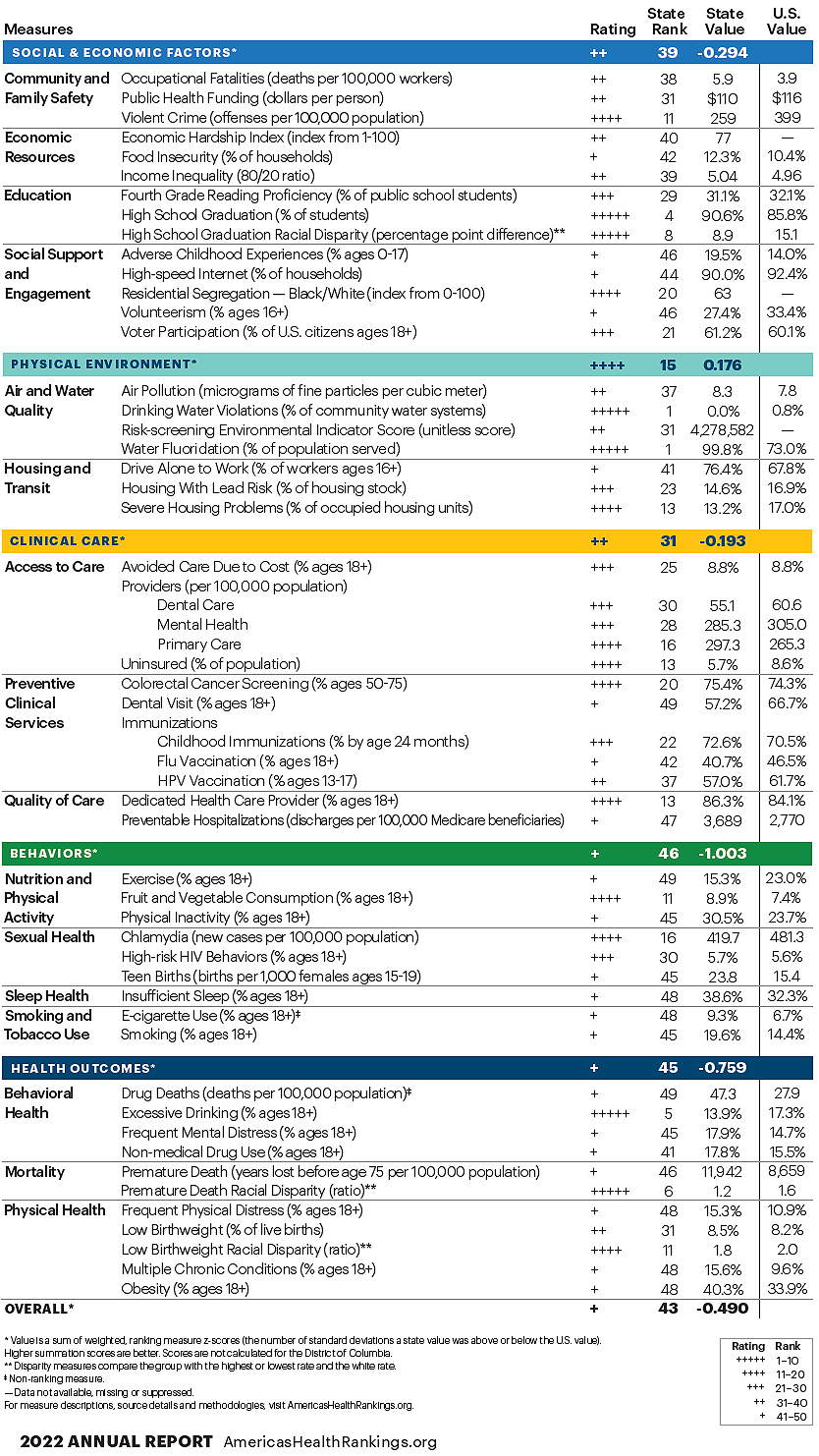
Kentucky again 43rd in America's Health Rankings, scoring lowest in behavior and health outcomes, high in having a care provider

By Melissa Patrick
Kentucky Health News

After not ranking states for two years due to the pandemic, America's Health Rankings again placed Kentucky among the 10 unhealthiest states, ranking its healthiness 43rd, the same slot it had in the last rankings, in 2019. 

Kentucky has found itself among the bottom 10 unhealthiest states since the rankings were first released in 1990, with the exception of 2008, when it ranked 39th. 

The rankings by the United Health Foundation are meant to help state leaders determine health benchmarks that can help them inform actions as they work to improve the health of their communities. 

The report examines a number of measures that influence health, broken into four categories: social and economic factors, physical environment, clinical care, behaviors, and health outcomes. 

Kentucky ranked lowest, 46th, among states in the behaviors category. 

Two measures in this category show that Kentucky adults don't get enough exercise, with only 15.3% of them saying they meet the federal guidelines for exercise in the past 30 days and 30.5% saying they didn't get any physical activity beyond their regular job in the past 30 days. For these measures, Kentucky ranked 49th and 45th, respectively. 

In the same category, Kentucky continues to have some of the highest teen birth rates in the nation at 23.8 teen births per 1,000 females aged 15 to 19; the national average is 15.4. In rankings that put the highest numbers at the bottom, Kentucky ranked 45th for this measure. 

Likewise, the state also continues to be a national leader in vaping and smoking, ranking 48th for adult use of electronic cigarettes and 45th for cigarettes (again, with higher numbers at the bottom). The rankings say 9.3% of Kentucky adults reported using e-cigarettes and 19.6% said they are regular smokers. 

Kentucky also ranked 48th in sufficient sleep, with 39.6% of adults reporting that they get, on average, fewer than seven hours of sleep in a 24-hour period. 

One of the Kentucky's better rankings in the behavior category was 11th for fruit and vegetable consumption.

In the health outcome category, Kentucky ranked 45th. With higher numbers at the bottom, it scored in the bottom 10 states for drug deaths (49th), frequent mental distress (45th), non-medical drug use (41st), premature death (46th), frequent physical distress (48th), multiple chronic conditions (48th) and obesity (48th). 

Though Kentucky ranked among the worst states in health outcomes, it does have a low prevalence of excessive drinking (fifth, with lower numbers at the top) and a low racial disparity in premature death (sixth). 

In social and economic factors, the state ranked 39th, with some of its worst scores in food insecurity (42nd), adverse childhood experiences (46th), access to high-speed internet (44th) and volunteerism (46th). 

The good news in this category is that Kentucky ranks fourth in the percentage of students who graduate from high school in four years and eighth in the difference between the high school graduation rates of white students and the racial/ethnic group with the lowest rate. 

In the clinical-care category, where it ranked 31st, Kentucky was in the bottom 10 states for dental visits (49th), flu vaccinations (42nd) and preventable hospitalizations (47th). 

Kentucky did not get any top-10 rankings in clinical care, but got top-20 rankings for its number of primary-care providers (16th), percent of uninsured population (13th), colorectal-cancer screenings (20th) and having a dedicated health care provider (13th). 

The physical environment category was the state's highest ranking, 15th, largely because it ranked first in two categories: drinking water violations and water fluoridation.


Wednesday, August 24, 2022

In 2020, Kentucky's life expectancy fell by 2 years, more than the U.S. drop of 1.8, and is now fourth from the lowest in the nation

Map by NBC News, adapted by Kentucky Health News
Kentucky Health News

One of the most striking measures of the pandemic is the decline in life expectancy from 2019 to 2020, the year the novel coronavirus hit; it declined more in Kentucky than it did in most other states.

Nationally, life expectancy declined from 78.8 years in 2019 to 77 in 2020, a drop of 1.8 years. Kentucky's decline was a full two years, from 75.5 to 73.5, according to a report from the National Center for Health Statistics

Kentucky's decline in life expectancy tied for 10th largest in the nation, with Indiana, Alabama, South Carolina and Michigan. The greatest decline, in New York, was three years, followed by the District of Columbia, Louisiana, New Jersey, Arizona, Mississippi, New Mexico, Illinois (2.2 years) and Texas.

Among other neighboring states, Arkansas' life expectancy fell 1.9 years, Tennessee 1.8, Missouri 1.8, West Virginia 1.7, Ohio 1.6, Virginia 1.5, and North Carolina 1.5.

Kentucky's 2020 life expectancy of 73.5 years ranks 47th in the nation. Below it are Alabama, 73.2; Louisiana, 73.1; West Virginia, 72.8; and Mississippi, 71.9.

Among other neighboring states, the 2020 life expectancy is 73.8 in Arkansas and Tennessee, 75 in Indiana, 75.1 in Missouri, 75.3 in Ohio, 76.1 in North Carolina, 76.8 in Illinois and 77.6 in Virginia. Hawaii has the highest life expectancy, 80.7, and had the smallest decline in 2020, only 0.2 years.

Thursday, August 18, 2022

Fewer counties at high risk, but Ky. new-case rate remains No. 1 among the states; counties in southeast among nation's top 10

Centers for Disease Control and Prevention map
By Al Cross
Kentucky Health News

The pandemic slacked a bit in Kentucky in the last week, but the Bluegrass State still has the highest rate of new coronavirus cases of any state, according to The New York Times.

The latest weekly Covid-19 risk map, issued Thursday by the Centers for Disease Control and Prevention, shows 16 fewer counties at high risk, down to 73 from 89 last week.

The CDC map shows 38 counties at medium risk and nine at low risk. Last week, 20 were at medium risk and 11 were at low risk.

In high-risk counties, the CDC recommends that you wear a well-fitting mask in public indoor spaces, and if you are at high risk of getting very sick, consider avoiding non-essential indoor activities in public where you could be exposed.

If you live in a medium or high-risk county, the CDC advises wearing a well-fitting mask when indoors and in public and to consider getting tested before having social contact with someone at high risk for getting very sick and consider wearing a mask when indoors when you are with them.

The Times, which updates its figures at least daily, shows that new cases in the state have declined 18 percent in the last two weeks, but Kentucky still has the highest new-case rate among the states for the last seven days. Puerto Rico and Guam have higher rates, but they are not states.

The Times shows McCreary County with the highest rate of any county or county equivalent in the nation, with Perry County second. Rockcastle, Harlan and Knott counties are fifth, sixth and seventh.

Monday, August 8, 2022

Kentucky children's well-being ranks 37th in U.S., foundation says

Kids Count Data Book ranks state in four domains with 16 indicators to produce an overall rank of 37.

By Melissa Patrick
Kentucky Health News

The annual Kids Count Data Book on children's well-being, released Aug. 8 by the Annie E. Casey Foundation and Kentucky Youth Advocates, again ranks Kentucky 37th in the nation for the overall well-being of its children.

The Data Book rates children's overall well-being through 16 indicators in four major domains: health, economic security, education and family and community. 

Overall, Kentucky saw improvement in 10 of the 16 indicators, did worse in four and stayed the same on one. One indicator did not show a comparison. 

"Though the commonwealth made progress on a number of indicators of child well-being over the past decade, rankings continue to show that we are not making progress as quickly as other states," KYA Executive Director Terry Brooks said in a news release. "In fact, Kentucky is in the bottom 10 of states for six of the 16 indicators."

Nearly one in four Kentuckians are children. Here is a look at each domain. 

Charts from Kids Count Data Book
Health: Kentucky's health ranking dropped for the second year in a row, with two of the indicators used to measure it worsening. This year's report ranks the state 38th, down from 35th in last year's report. The year before, Kentucky's health ranking plummeted from 25th to 42nd after Kids Count changed measured childhood obesity instead of youth alcohol and drug abuse. 

This year's report says 39% of Kentucky's children were either overweight or obese in 2019-20, up from 37% in 2016-2017. The national rate is 32%. Kentucky continues to have the highest obesity rate in the nation in children 10 to 17.  

Kentucky also saw an increase in the rate of deaths of children per 100,000 residents 19 and under. That rate increased to 35 deaths per 100,000 in 2020 from 32 per 100,000 in 2010. The national rate is 28 deaths per 100,000. 

The good news is that Kentucky continues to have a low rate of children without health insurance, 4%. The national average is 5%. 

Another indicator of children's health is the rate of babies born weighing less than 5.5 pounds. That rate was 8.5% in Kentucky in 2020, slightly lower than in recent years. 
Education: Kentucky ranked 26th in the report's Education domain, up from 30th last year. 

The good news is that 91% of the state's high-school students graduate on time, well above the national rate of 86%. 

Also, the state saw a slight decrease in the share of Kentucky eighth-graders who were not proficient in math, dropping to 71% in 2019 from 73% in 2009. And while that's good news, it still means only 29% of them are proficient in math. 

Two indicators in this domain worsened. The share of preschool-age children not in nursery school, preschool or kindergarten increased to 59% in 2016-20 from 56% in 2008-12. And the share of fourth-graders not proficient in reading inched up to 65% in 2019, from 64% in 2009.
Economic well-being: Kentucky ranks 38th in economic well-being, up from 40th in last year's report, with all four indicators showing improvement since 2008-2012. 

The percentage of children in poverty dropped to 22% in 2016-20, from 26% in 2008-12; children whose parents lacked secure employment dropped to 31% from 36%; and teens not in school and not working dropped to 8% from 10%. 

Also, the percentage of children living in households with a high housing cost burden dropped to 24% in 2016-20 from 30% in 2008-2012. A high housing-cost household is defined as one where more than 30% of monthly household pre-tax income is spent on housing-related expenses, including rent, mortgage payments, taxes and insurance.
Family and Community: Kentucky ranked 42nd in the family and community domain, up from 43rd in last year's report.

Kentucky improved in three family-and-community indicators, including children living in high poverty areas (14%), children living in families where the household head lacks a high school diploma (10%) and teen births. 

In 2020, there were 24 births per 1,000 females aged 15-19. In 2010, that number was 46 per 1,000. The current national average is 15 per 1,000. 

The percentage of children living in single-parent homes in 2016-2020 stayed the same as it was in 2008-2012, 35%. 

Focus on mental health

For the first time, the annual Data Book focuses on youth mental health, noting that the number of young people with mental-health issues was high before the pandemic, and has only gotten worse. 

"The coronavirus upended everyday life to an extent not seen since World War II," said Lisa M. Hamilton, president and CEO of The Annie E. Casey Foundation. "It is no surprise that millions of parents, caregivers and other adults are feeling overwhelmed. So are children, who face what the U.S. surgeon general has called a 'mental health pandemic' for youth." 

The Data Book reports that children across Kentucky and the nation were more likely to encounter anxiety or depression during the first year of the pandemic than they were before. 

In Kentucky,  there was a 28% increase in the number of children aged 3 to 17 who had been diagnosed with or reported to have anxiety or depression by a doctor or a health-care provider between 2016 and 2020. The share increased from 12.4% to 15.9%. 

"This increase represents 29,000 more children who are struggling to make it through the day," KYA said.

Brooks said, "The pandemic years have taken a toll on everyone — from our health professionals and educators to our families — including the rising crisis in mental health for children and youth. And, in addition to experiencing mental health challenges as a result of the pandemic, children still contend with the conditions that were making life harder well before the coronavirus — such as poverty, community violence, and hunger. Policymakers must continue to prioritize policies and investments that ease mental health burdens on children and their families — and don’t leave anyone behind." 

Call for action

KYA called on the state legislature and Congress to prioritize the basic needs of Kentucky' children, including policies to ensure financial stability for families and that ensure access to nutritious foods, stable housing and safe neighborhoods. KYA also calls on the state to ensure that every child has access to trauma-informed mental-health care that is available when and where they need it.

"All kids deserve the chance to thrive, no matter their zip code, race, or family’s income. That vision will only come to fruition when our lawmakers prioritize what’s best for all kids and families," said Brooks. "That means that Kentucky laws are written by Kentuckians and not by external national groups. That means the interests of vulnerable kids are the priority and rather than succumbing to the influence of dark money. Whether you are an elected legislative leader or a candidate for governor, there can be no more ethical priority than the interests of Kentucky's boys and girls."

The Kids Count Data Center provides current and trend data for child well-being indicators related to each of the four domains in the report, at both a state and county level. It also offers a feature to create customized tables, maps, bar charts and graphs.

Saturday, May 21, 2022

Appalachian counties continue to dominate lowest level of County Health Rankings in Ky.; most counties moved at least 10 notches

By Melissa Patrick
Kentucky Health News

The annual County Health Rankings & Roadmaps report, showing how the health status of every county in the United States compares to that of every other county in the state, has been released.

Many Kentucky counties showed little change, but 76 of the state's 120 counties shifted up or down by at least 10 notches in the rankings, which essentially measure of how long and how well we live. 

The rankings measure health outcomes, gauged by life expectancy and measures of quality of life; and health factors, such as access to physicians and areas to exercise, tobacco use, children living in poverty, violent crime, long commutes and other environmental factors. The report is issued by the Robert Wood Johnson Foundation and the University of Wisconsin Population Health Institute.

The rankings are meant to be viewed more as a general categorization of a county's health status, rather than making specific comparisons with counties that are relatively close in the rankings. Because the differences in rankings for most counties are so small that they are statistically insignificant, the researchers have placed counties in four groups of 30 counties each, called quartiles (each with one-fourth of the total of 120 counties). 

The bottom quartile for both health outcomes and health actors in Kentucky continues to be made up of almost entirely Appalachian counties. The exceptions for health outcomes are Carroll County, between Louisville and Cincinnati, and Fulton County, at the state's western tip. The relatively poor county is the only non-Appalachian county in the bottom quartile for health factors. 

In health outcomes, Fulton County moved down 17 spots from last year's report to rank 116th. Owsley County ranks 117th, followed by Perry County, which dropped 22 spots from last year's ranking, and Wolfe and Breathitt counties. The last four counties form a cluster.

Oldham and Boone, two of Kentucky's wealthiest counties, continue to be the top two in health outcomes, as they have been since 2011. No. 3, Scott County, has ranked between fifth and eighth since 2011. Campbell County in Northern Kentucky ranked fourth for the second year in a row and Calloway County, home of Murray, ranked fifth after moving up 19 notches from last year's rankings. 

Oldham and Boone are also the top two counties for health factors, and have been since 2015. They have been in the top five since 2011. Woodford, Campbell and Fayette counties are ranked third, fourth and fifth, respectively, for the second year in a row. 

The bottom five counties for health factors are Breathitt, Lee, Clay, Harlan and McCreary, all in Appalachian Kentucky.

Some big changes in health outcomes

Altogether, 26 Kentucky counties improved more than 10 notches in health outcomes from last year, and 13 of them improved by more than 20 places; 27 of them dropped more than 10, and 12 of those dropped by more than 20. 

Edmonson County improved the most for health outcomes, with a 50-notch jump up to No. 31 and the second quartile. However, its No. 81 rank last year was not typical for the county, which had been in the second quartile for health outcomes most years since 2011, so its latest rank is a return to form.

Several counties showed big improvements that moved them into the first quartile for health outcomes. Graves County improved 29 notches, to No. 28 from No. 57; Carlisle moved up to 20th from 45th; and Livingston moved up to 26th from 46th. 

Breckinridge County also saw a 37-notch gain (to 35th from 72nd) in outcomes that moved it into the second quartile.

Because the rankings are relative, county to county, they tend to have about as many drops as gains. Bracken County saw the greatest drop in health outcomes, 46 notches, to 81st from 35th. Clark County had the second greatest drop for outcomes (30th to 70th), moving from the first quartile to the third.   

Two Appalachian coalfield counties also saw big drops in outcomes, which moved them into the bottom quartile. Johnson fell to 96th from 71st, and Whitley dropped to 100th from 67th.  

Some big changes in health factors

Twelve Kentucky counties improved more than 10 notches for health factors, with three improving by more than 20. Eleven counties fell more than 10 notches; only one moved down by more than 20.

Livingston and Crittenden counties showed the most improvement for health factors. The adjoining counties in West Kentucky each moved up 24 slots into the second quartile. Livingston moved to 46th from 70th and Crittenden moved to 54th from 78th.  

Allen County's 17-notch improvement in health factors moved it into the 55th from 72nd, and into the second quartile. Simpson County moved into the first quartile by rising to 29th from 39th.  

McLean County had by far the biggest drop in health factors, falling 24 notches to 80th from 56th, which moved it down to the third quartile. Gallatin County fell to 65th from 53rd and Montgomery County fell to 62nd from 46th, both moving to the third quartile. Henry County dropped to 38th from 25th, moving it to the second quartile.

The report challenges Kentucky counties to take this data and turn it into action. Evidence-based resources to do that can be found in the "Take Action To Improve Health" section of its website. Here are the rankings (click image to enlarge):