Showing posts with label physical fitness. Show all posts

Sunday, May 8, 2022

Months after a breast-cancer diagnosis and a double mastectomy, a Monticello mother completes a 102-mile, 33-hour road race

Lindsey Sexton runs the No Business 100. (Photo by Ryan C. Hermens, Lexington Herald-Leader)
When Lindsey Sexton of Monticello started to train for a 102-mile road race in the rugged Cumberland Plateau last year, she had no idea that the race "would come only months after a breast cancer diagnosis led to her having a double mastectomy," Mark Story writes for the Lexington Herald-Leader.

When Sexton was about to turn 35, her doctor encouraged her to get a mammogram "strictly for precautionary purposes," Story reports. Abnormalities led to a biopsy and a diagnosis of two types of breast cancer, one of which can spread aggressively.

She called her husband but couldn't reach him. Calling her brother, "Sexton’s mouth would not form the words, 'I have breast cancer'," Story writes.

She recalled, “Nothing came out except this horrible noise: A cry. A scream. A sob. . . . Your world stops.” The doctor “tried to assure me that we had caught it early and that there were multiple things that could be done. I told her, ‘I’m 35. I have three kids. We’ve go to do whatever it is that is going to get me back to a normal lifestyle as soon as possible.’”

After conferring with surgeons and her husband, Sexton got a bilateral mastectomy. “My boobs aren’t what make me who I am,” she told Story. “And, if they are causing a problem, let’s just get rid of them.”

Sexton trained until just before the surgery, but after it, "Jeff Sexton broached with his wife the idea of not running in a 102-mile trail race so soon after major medical procedures," Story writes. "She wasn't going to hear of that," Jeff said.
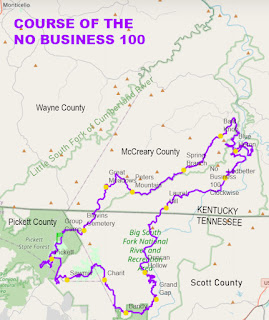
Map adapted from website; click on it to enlarge
Perhaps fittingly, the name of the race is the No Business 100, named for a creek in the nearby Big South Fork National River and Recreation Area in Kentucky and Tennessee, scene of the race. 

Sexton had never run more than 40 miles, so it could be argued that she had no business running 102, but Story reports, "The more Sexton trained, the better she felt."

The race began Oct. 1, with a 33-hour time limit for completion. At 50 miles, Sexton "began to stiffen up," blisters developed on her feet and it got dark. Her spotter, cousin Brian Jones of Louisville, ran ahead and found a group of runners stopped by a mother bear and two cubs.

After noises failed to dislodge the mother, the cubs scampered up a hill, and the mother climbed a tree, Story reports: "That meant to get past, the runners had to run directly beneath the treed momma bear." Sexton recalled, “Talk about getting your adrenaline running. But she let us go by.”

With 13 miles left, “My emotions creeped back in,” Sexton said. “I just started crying, kind of in a reflective mode of what all I had endured with surgeries, cancer diagnoses, that sort of thing.” For the last three miles, Kevin Jones, the Wayne County High School athletics director and longtime cross-country coach, "paced his younger sister," Story reports.

"Some 15 minutes beneath the race cutoff time — just under three months since undergoing a double mastectomy — Lindsey Sexton crossed the finish line of the No Business 100. . . . A friend had decorated the finish line with pink balloons in recognition of her battle with breast cancer. Members of Sexton’s church, Monticello’s First Christian, and other friends had come to cheer her to the finish."

Story concludes, "Eight months later, Sexton says her health is good. She is already registered to race in the 2022 No Business 100 this coming October. On Mother’s Day, Sexton says she hopes her children — daughter Jenna, now 11; and sons Jase, 9 and Jett, 7 — have drawn lessons from their mom’s determination in the face of unexpected adversity."

“I would hope my children learned from me that you should never give up,” Sexton told Story. “They need to know they can always do hard things. Never give up in life, and never give up on a dream.”

Thursday, January 13, 2022

Regular, moderate exercise may slow Parkinson's symptoms

Seniors exercise. (Photo by the Parkinson's Foundation)
Regular, moderate exercise one to two hours a week by people with early-stage Parkinson's disease may help slow the damage it does to the body and the mind.

A study published in Neurology, the medical journal of the American Academy of Neurology, looked at 237 people in the early stages of the disease with an average age of 63. They were followed by researchers for up to six years. Their exercise levels at the start of the study were determined by using a questionnaire that measures time and intensity of activity during the previous week: leisure activity, like walking and biking; household activity, such as gardening; and occupational activity, like taking care of others. Other tests measured verbal and memory skills and how much time it took participants to complete mental tasks.

Researchers used a common test to rate each person’s Parkinson’s symptoms on a scale of zero to four, with higher scores indicating more severe impairment. The average score of people who got less than one to two hours of moderate to vigorous exercise once or twice a week increased over six years from 1.4 to 3.7, but those who got above-average levels of moderate to vigorous exercise increased from a 1.4 to 3.0.

Similar results were seen in the cognitive tests. One cognitive test that researchers used was a common paper-and-pencil test used to measure mental processing speed. The test gives the participant 90 seconds to match numbers with geometric figures and has a maximum possible score of 110. People who got less than 15.5 hours of work per week, on average, dropped from a 44 to a 40 on the test six years later. Those with more than 15.5 hours a week dropped only one point, from 44 to 43.

“Although medications can provide people with Parkinson’s some symptom relief, they haven’t been shown to slow the progression of the disease,” said study author Kazuto Tsukita. “We found that regular physical activity, including household tasks and moderate exercise, may actually improve the course of the disease over the long run. Best of all, exercise is low cost and has few side effects.”

Researchers note that the study does not prove that maintaining an exercise program will delay the effects of Parkinson’s disease. It only shows an association.

Tuesday, October 24, 2017

Study of 140,000 Americans with an average age of 69 finds that any level of regular walking can help us live longer

Photo by Justin Horrocks, NPR.org
Regular walking can lower your risk of death, even if you don't meet the minimum recommended level of physical activity, according to an American Cancer Society study.

“Going for a walk at an average to brisk pace can provide people with a tremendous health benefit. It’s free, easy, and can be done anywhere,” Alpa Patel, lead investigator of the study, told Cancer Society reporter Stacy Simon.

The study, published in the American Journal of Preventive Medicine, analyzed data from a study of almost 140,000 people who had participated in the society's Cancer Prevention Study II Nutrition Cohort. The average age of participants in the study was 69.

The study report notes previous studies have found that walking has been associated with lowering the risk of breast cancer, colon cancer, heart disease and diabetes. It adds that physical inactivity accounts for about 11 percent of the health-care costs in the U.S.

Public-health guidelines say adults should get at least 150 minutes of moderate activity, or 75 minutes of vigorous activity, spread throughout the week. Only half of U.S. adults meet this recommendation, according to the federal Centers for Disease Control and Prevention.

And while the study found that those who met or exceeded the recommended level of physical activity through walking had a 20 percent lower mortality risk, it also found that older adults who walked less than two hours per week  had a lower death risk than those who got no exercise at all.

Patel told Nick Mulcahy of Medscape that the study evaluated walking at "an average pace," which is a speed that "may cause you to eventually feel a slight increase in your breathing and will allow you to cover roughly a mile in 20 minutes."

"Walking is simple, free and does not require any training, and thus is an ideal activity for most Americans, especially as they age," says the report.

Friday, June 2, 2017

Southern Kentucky weekly starts a column from a recovering addict in the same week it publishes another health testimonial

Clinton County (Wikipedia map)
From 2012 to 2015, the last year for which figures are available, 25 people died of drug overdoses in Clinton County, a community of 10,000 people on the Tennessee border south of Lake Cumberland. This spring, a local doctor was indicted on charges of illegally prescribing painkillers to six people, three of whom died in 2014. The county is among the 54 in Kentucky, out of 220 in the U.S., considered most at risk from an outbreak of HIV or hepatitis C from intravenous drug use. Clearly, Clinton County has a drug problem.

Last week, on an inside page of the weekly Clinton County News, a new column appeared, with a standing headline, "An Addict's Corner," with the subhead "the Journey of an Addict." It was written by local resident Phillip Lee, who told how he became addicted to crystal methamphetamine, lost his wife, cars and homes, lost contact with his children and grandson, and put him behind bars again and again for 17 years. "I'll get down to specific details in later articles," he wrote. "I'll tell you all I remember going through." Lee credits his religious faith for his recovery.

Alan Gibson, editor and publisher of the paper, said in an email that Lee "came to me a few weeks ago with a hand-written article in his hands. He was proposing the column in an effort to help others who might be facing addiction problems, as well as families who were dealing with problems with other loved ones. He wanted to submit the column on a weekly basis under a pen name, or either anonymously. I told him he should be able to own up to his writings and be proud of his message to others as well as his accomplishments. He pondered about 10 seconds and signed the column and left it with me." He has submitted two more. "I also offered to put his photo in the header like we do some of the other regular headers, but he opted out of that," Gibson wrote. "If it helps just one person, I'm glad to offer up the space." To read Lee's first column, click here.

In the same edition of the paper, recent high-school graduate Thomas Holsapple wrote a column for the Twin Lakes Wellness Center, describing how his family had turned its health around after the death of his grandmother, who was overweight and had been a smoker, and how he took the next step by exercising regularly at the center in Albany. "Even after the first night I could feel the energy it gave me and how it entirely lifted my spirits. . . . Keeping myself in shape and eating healthy has changes my life, and the lives of my friends and family." For his column, headlined "Health and Fitness: My Story," click here.

The Clinton County News is a hotbed of testimonials about health, which can be an effective motivator for others to get healthier. The Clinton County Healthy Hometown Coalition, funded by the Foundation for a Healthy Kentucky, has had a regular column that often featured articles by local residents saying how they made themselves healthier. One of those was from Julie Holsapple, the mother of Thomas Holsapple.

Sunday, April 30, 2017

Exercise cuts the risk of damage to your heart, even if you're among the 35 percent of Kentuckians who are obese

Consumer HealthDay photo
Exercise not only lowers the risk of heart damage in middle-aged adults and seniors, but can also reduce the levels of heart damage in those who are obese, according to a new study.

"The protective association of physical activity against [heart] damage may have implications for heart failure risk reduction, particularly among the high-risk group of individuals with excess weight," lead author Dr. Roberta Florido said in an American College of Cardiology news release.

Kentucky adults struggle with obesity and sedentary lifestyles, and the state leads the nation in heart disease.

Thirty-five percent of Kentucky's adults are obese, and one-third of them reported in 2015 that they hadn't had any physical activity or exercise in the 30 days before they were surveyed. And 27.5 percent of Kentucky's seniors are obese, with 39 percent of them reporting no physical activity in the 30 days prior to the America's Health Rankings survey.

The study, published in the Journal of the American College of Cardiology, examined more than 9,000 people without heart disease between the ages of 45 and 64. Researchers then grouped the participants according to how much exercise they got based on the American Heart Association's recommended guidelines of at least 75 minutes a week of vigorous activity, or 150 or more minutes of moderate to vigorous activity.

Then, to measure damage to the heart, they assessed blood levels of high-sensitivity troponin T, a marker of heart damage that has been shown to be associated with future heart failure.

"Individuals with lower levels of physical activity were significantly more likely to have elevated levels of high sensitivity troponin, suggesting higher heart damage," says the release.

For example, the study found that those in the "intermediate" category of activity (those who exercised, but less than the AHA recommendations) were 34 percent more likely to have heart damage and those who did not exercise at all were 39 percent more likely to have heart damage than their peers who met the guidelines for exercise.

Further, the researchers looked at the role of exercise on the troponin levels of obese adults and found that the obese participants who got the recommended level of physical activity had lower levels of troponin compared to those who did not exercise at all, "which indicates that the protective association of physical activity and heart damage may be stronger among individuals with obesity, a group at particularly high risk for future heart failure," says the release.

"Promoting physical activity may be a particularly important strategy for heart failure risk reductions among high risk groups such as those with obesity," Florido said.

Friday, April 14, 2017

Study finds exercise is good for the heart at all ages, even among those who are obese; Ky. is a sedentary and obese state

Consumer HealthDay photo
Exercise not only lowers the risk of heart damage in middle-aged adults and seniors, but can also reduce the levels of heart damage in those who are obese, according to a new study.

"The protective association of physical activity against [heart] damage may have implications for heart failure risk reduction, particularly among the high-risk group of individuals with excess weight," lead author Dr. Roberta Florido said in an American College of Cardiology news release.

Kentucky adults struggle with obesity and sedentary lifestyles, and the state leads the nation in heart disease.

Thirty-five percent of Kentucky's adults are obese, and one-third of them reported in 2015 that they hadn't had any physical activity or exercise in the 30 days before they were surveyed. And 27.5 percent of Kentucky's seniors are obese, with 39 percent of them reporting no physical activity in the 30 days prior to the America's Health Rankings survey.

The study, published in the Journal of the American College of Cardiology, examined more than 9,000 people without heart disease between the ages of 45 and 64. Researchers then grouped the participants according to how much exercise they got based on the American Heart Association's recommended guidelines of at least 75 minutes a week of vigorous activity, or 150 or more minutes of moderate to vigorous activity.

Then, to measure damage to the heart, they assessed blood levels of high-sensitivity troponin T, a marker of heart damage that has been shown to be associated with future heart failure.

"Individuals with lower levels of physical activity were significantly more likely to have elevated levels of high sensitivity troponin, suggesting higher heart damage," says the release.

For example, the study found that those in the "intermediate" category of activity (those who exercised, but less than the AHA recommendations) were 34 percent more likely to have heart damage and those who did not exercise at all were 39 percent more likely to have heart damage than their peers who met the guidelines for exercise.

Further, the researchers looked at the role of exercise on the troponin levels of obese adults and found that the obese participants who got the recommended level of physical activity had lower levels of troponin compared to those who did not exercise at all, "which indicates that the protective association of physical activity and heart damage may be stronger among individuals with obesity, a group at particularly high risk for future heart failure," says the release.

"Promoting physical activity may be a particularly important strategy for heart failure risk reductions among high risk groups such as those with obesity," Florido said.

Friday, September 9, 2016

Sitting down? It could be killing you; how about a standup desk?

Increasing numbers of news reports about the dangers of sitting are prompting traditional offices to make their workstations healthier by ditching desk chairs. "The link between sitting jobs and deadly disease processes galvanized the rise of the adjustable desk and the decline of the cubicle world as we knew it," Steve Shaw reports for Insider Louisville.

Burger Boy owner Dan Borsch of Louisville at his standup desk
(Insider Louisville photo courtesy of Dan Borsch)
Louisville restaurateur Dan Borsch made the switch to a standup desk after suffering a back injury three years ago."It took about two weeks to get used to the standing aspect of it," Borsch told Shaw. "After that, I don't notice it all -- and I love it."

Borsch said he is pain-free, and attributes his back relief to the $1,000 desk, not his exercises. "I do believe that, because of the standing desk, my back has been better than it would have been otherwise -- without a doubt."

Prolonged or leisurely sitting contributes to metabolic syndrome, which the Mayo Clinic defines as "a cluster of conditions -- increased blood pressure, high blood sugar, excess body fat around the waist, and abnormal cholesterol or triglyceride levels -- that occur together, increasing your risk of heart disease, stroke and diabetes." The Mayo Clinic describes in more detail what happens:

"Red blood cells in your legs begin to clump together, thickening inside your vessels and slowing circulation. If, later, you notice a further drop in energy, it's because your body's insulin production is down. The sugars . . . linger in your bloodstream, rather than being ushered into your muscles for energy. Soon a key element responsible for vacuuming fat out of the blood deactivates. Small amounts of fat begin to accumulate in your blood; your body will store it in an easy-to-access central location — your gut."

Mayo adds, "You may also have hunger cravings, even though you haven’t moved. That’s because your appetite-regulating hormones leptin and ghrelin have gone off-kilter. Meanwhile . . . deep within your leg muscles, a gene critical for suppressing clotting and inflammation switches off. By the end of the day, even with a lunch break and trips to the water cooler, your good cholesterol and insulin sensitivity may have fallen 20 to 40 percent.”

Shaw writes, “Sitting disease may be even more concerning to women than men.” A study by Alpa Patel, an epidemiologist with the American Cancer Society, found that “men who spent six hours or more per day of their leisure time sitting had an overall death rate that was about 20 percent higher than men who sat for three hours or less. The death rate for women who sat more than six hours a day was about 40 percent higher.”

Patel writes that leisure-time sitting “has been associated with greater mortality, cardiovascular disease, type II diabetes mellitus, obesity, and some cancers . . . markers of chronic disease risk such as weight gain, high cholesterol, high fasting insulin levels, and other biomarkers.” She estimates that, on average, people who sit too much “shave years off their lives.”

Convinced that standing during his long workdays will improve his health, Borsch tells Shaw that it’s likely he’ll never sit at his desk again. “Once you make that two-week transition or maybe three weeks — or however long it takes somebody to make that initial adjustment — there’s no looking back.”

If buying a standup desk isn’t on your to-do-list, Bonnie Berkowitz and Patterson Clark from The Washington Post recommend “sitting on something wobbly, stretching the hip flexors, walking during breaks, alternating between sitting and stranding, and trying yoga poses.”

Saturday, August 22, 2015

Stanford doctor starts local 'Get Healthy Lincoln County' program, plans to take it statewide via Kentucky Medical Association

Part of the effort: A weekend workout group in Stanford
A Stanford physician who started a local movement for a healthier community plans to promote it statewide through the Kentucky Medical Association’s Commission on Public Health.

"Dr. Naren James said in the next year, under the Affordable Care Act, health insurance rates will be affected by the overall health of a community," Abigail Whitehouse reports for The Interior Journal. “Having a healthier community will actually have a tangible impact on people’s health insurance rate,” James told her.

James said he was motivated to start the program when he realized that that Kentucky ranks very high in childhood obesity, "which ultimately effects the future of a community," Whitehouse notes. Much of the program's focus is on increasing residents' physical activity.

“The reason why we did ‘Get Healthy Lincoln County’ was to make a model that could be used statewide,” James told her. She writes, "His goal is to promote the movement so that every community in Kentucky can find a coalition of people interested in health to create that 'get healthy' community."

“It has to be from the ground up, not from the top down,” James said. “When you deal with health, people have to make the choice. It has to be educational.”

In June, the program conducted several activities, "many of which were successful," Whitehouse reports. "Now that the 'Get Healthy Lincoln County' movement has been approved as an annual effort, James said a committee has already begun planning for next year by determining what did and didn’t work well this time around.

For example, a history walk around Stanford, Kentucky's second oldest town, "had a great turnout," James said. Also successful were "a Saturday morning of exercise" in a local park and "Dinner with a Doctor," Linda Carney of Texas, "who provided the crowd with a plant-based diet and spoke about the benefits of such diets," Whitehouse reports.

"What’s for Dinner Stanford?," a project of the local extension office, "invited the public to participate in a plant-based cooking class using local produce," Whitehouse writes. "James said that the cooking class has done well and will continue throughout the year, but it was realized that programs which require more commitment require more of a push."

For example, a program called "Eight Weeks to Wellness" needed "more events to sell it," James said. "Anything you’re going to do for several weeks, you have to sell it. . . . We need to sell it to people’s individual needs. They have to understand why health is impacting them personally."

"In a broader sense, James said people leading the 'get healthy' movement have to learn to speak the right language," Whitehouse reports. “The language about health is immediately negative,” he said. “It’s a cultural shift. Speaking about health positively is so important, which we tried to do with the Get Healthy program and I think overall it came across positively. Even the things that are negative can be turned into positive.”

Thursday, June 18, 2015

Health department urges Kentuckians to walk regularly; state ranks high in obesity, low in physical activity

With summer here, the state health department is urging Kentuckians to adopt a regular walking schedule to connect with friends and neighbors and improve health and fitness in a state that ranks high in obesity and low in physical activity.

“Summer is the perfect time to renew your commitment to get outdoors and take a walk,” Health Commissioner Stephanie Mayfield, said in a news release. “We all know walking is healthy, but it’s also fun, relaxing, and a great way to connect with others. You can invite a friend or loved one out for a nightly walk after dinner, take care of weekend errands on foot, or invite neighbors or co-workers to start a regular walking group. The more you walk, the more you’ll connect and be part of building a stronger, healthier community.”

In Kentucky, 31.3 percent of adults are obese. “Obesity is linked to multiple chronic conditions, including diabetes, heart disease and stroke – and is one of the major chronic conditions affecting the health of Kentuckians,” said Elaine Russell, the Department for Public Health's obesity-prevention coordinator. “Regular walking could greatly reduce our state’s obesity burden.”

Russell's program and the Partnership for a Fit Kentucky have created a guide for obesity prevention and health policy for Kentucky communities, at http://www.fitky.org/wp-content/uploads/sites/2/2015/04/PA-Vision-Slidedoc.pdf. ). Kentucky is one of four states that will get technical assistance from America Walks to improve walkable community design, such as complete streets, lower traffic speeds, livable communities and economic benefits.

“We’re also working directly with communities and funding projects through a public health grant program to help cities and towns across Kentucky develop pedestrian plans,” Russell said. The department selected 11 communities for funding to start work on a pedestrian plan.

“We’re very excited about recent developments in obesity prevention and increasing physical activity in the commonwealth,” Russell said. “We hope everyone will not only become more physically active, but take some time to learn more about our vision and support our communities in their work to become more active, healthier places to live, work and play.”

Thursday, April 16, 2015

Mount Sterling follows lead of another KentuckyOne Health hospital, in Bardstown, to host monthly 'Walk With a Doc'

Saint Joseph Mount Sterling is the second KentuckyOne Health hospital to host monthly "Walk With a Doc" events as part of a nationwide program that promotes walking as a great way to improve your health, while at the same time offering a place to get to know your local physicians in an informal setting as you walk together. The program also offers a complimentary health screenings at the event, says a news release from KentuckyOne Health.

Flaget Memorial Hospital in Bardstown, also part of KentuckyOne Health, began its "Walk With a Doc" program in March.

"According to America Walks, brisk walking has been shown to reduce body fat, lower blood pressure, increase high-density lipoprotein and even reduce risks of bone fracture. Not only that, it is also associated with lower mortality rates from cardiovascular disease and cancer," says the release.

The Mount Sterling walks begin at 9 a.m. on Saturday, April 25 at Easy Walker Park, located at 1395 Osborne Rd. For more information call 859-497-5556.

Sunday, November 9, 2014

Generals say obesity is a national-security issue, and the main medical reason 73% of Ky. young adults can't join the service

"Obesity is the leading medical reason why 73 percent of our young adults cannot qualify for military service" in Kentucky, two former state adjutants general write in The Courier-Journal. They endorse the Obama administration's nutrition standards for school meals.

"We must turn the tide on the obesity epidemic by instilling good eating and exercise habits from an early age. Good nutrition starts at home, but many kids get up to half of their daily calories at school so it just makes sense to ensure they’re eating healthfully there, too," write Maj. Gens. Michael Davidson and Allen Youngman.

"Unfortunately, there is a misguided effort afoot to enable schools to retreat from these improved nutrition standards," they write. "The move is driven by complaints that some students are having trouble adjusting to the healthier offerings, and that some schools are struggling to procure healthier ingredients and the necessary equipment for preparing the new meals. In response, the USDA is offering significant flexibility to these schools. They permanently removed caps on proteins because of the challenges some schools were facing, and offered flexibility on rules regarding whole grain pasta. They also extended the grant period for funds to help schools meet the new standards, and are providing workshops to help schools that are struggling learn what works from those that are succeeding.