Showing posts with label public heatlh. Show all posts

Monday, October 24, 2022

After more than two months of pretty steady decline, new Covid-19 cases in Kentucky increased more than 50% last week

New York Times map shows rates of new coronavirus cases; for the interactive version, click here.

By Melissa Patrick

Kentucky Health News

After declining for nine of the last 10 weeks, new coronavirus cases in Kentucky increased by more than half last week.

The state Department for Public Health's weekly report for the latest Monday-to-Sunday reporting period said there were 5,044 new cases last week, or 720 per day. That was nearly 56% higher than the previous week, when the state reported 462 per day. 

New cases in Kentuckians 18 and younger made up only 13% of the total, half of what was reported the prior week. 

The share of Kentuckians testing positive for the coronavirus in the last seven days was 7.64%, down just a bit from the 8.5% reported the week before. This figure does not include at-home tests. 

Kentucky hospitals reported 262 patients with Covid-19 Monday, down nine from the week before; 41 of them were in intensive care, up 13; and 16 were in need of mechanical ventilation, up one. 

The state's new-case rate was 9.7 per 100,000 residents, down slightly from 10.02 a week earlier. The top 10 counties were Leslie, 23.1 per 100,000; Russell, 23.1; Letcher, 22.5; Knott, 22.2; Washington, 17.7; Nelson, 17.3; Cumberland, 17.3; Floyd, 17.3; Perry, 17.2; and Trigg, 16.6.

The New York Times ranks Kentucky's infection rate ninth among the states, with a 39% decrease in cases in the last two weeks. Excluding Puerto Rico's county equivalents, The Times places Letcher, Floyd, Elliott, Boyd and McCreary counties in the top 10 new-case rates in the nation in the last seven days. (The Times's figures differ from state figures because of differences in data gathering and processing.)

The state attributed 70 more deaths to Covid-19 last week, increasing the pandemic death toll to 17,261.    

Monday, February 28, 2022

State and schools get new Covid-19 guidance; Beshear makes employee masks optional; state will go from daily to weekly report

State Dept. for Public Health graph, adapted by Kentucky Health News; to enlarge, click on it.
By Melissa Patrick
Kentucky Health News

As Kentucky came close to leaving the statewide "red zone" for coronavirus infection, Gov. Andy Beshear told state employees they could take off their masks and made the state's guidance for school districts – which seem to have largely dropped mask mandates – conform to new federal guidelines.

From Saturday to Monday, the state reported 2,754 new cases of the coronavirus, reducing the seven-day rolling average to 1,889, about half what it was just 10 days ago.

In the Monday-to-Sunday reporting week ended Feb. 27, Kentucky reported 13,305 virus cases, just over half the 25,173 reported the previous week. 

In the same reporting week, the average positive-test rate fell to 9.01%. The rate Monday was 8.56%. Beshear said Kentucky is seeing a steady positivity rate decline of about one-half point per day. 

"The metrics are all continuing to move in the right direction, and they're moving very quickly in the right direction," Health Commissioner Steven Stack said at Beshear's weekly pandemic press briefing. 

Beshear said, "The pace of the decline continues to be significant. We want to continue to see these numbers going down. Right now, there's no reason to think that they won't." 

The governor said that with a few exceptions in congregate settings, state government is moving to a mask-optional policy, which will also apply to visitors. 

Beshear and Stack reviewed the Centers for Disease Control and Prevention's new masking guidance that is based on three indicators: cases in the past seven days, Covid-19 hospital admissions, and share of staffed beds occupied by Covid-19 patients. Those numbers rate each county as low, medium or high risk, with recommendations to fit.
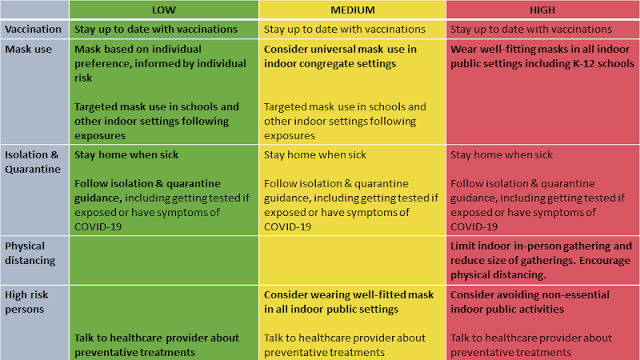
New Centers for Disease Control and Prevention guidelines for Covid-19 prevention; click to enlarge 
The CDC says people in high-risk counties, currently 104 of Kentucky's 120, should still wear masks in indoor public spaces. Stack said he expected that number to drop with the CDC's next weekly advisory.

In the 18 counties at medium risk, it says people who are immunocompromised or at high risk for severe illness should talk to a health-care provider about "additional precautions, such as wearing masks or respirators indoors in public. If you live with or have social contact with someone at high risk for severe illness, consider testing yourself for infection before you get together and wearing a mask when indoors with them."

Asked about likely compliance with this new guidance, Beshear said, "We always say that having more specific and more targeted guidance will help with compliance. We just need a commitment by our local leaders, but also all our individual families."

Starting next week, Stack said the state will switch to a weekly Covid-19 update that will coincide with the CDC's weekly update of the risk map: "It's much more appropriate as we look to start the third year of the pandemic. It gives timely information but it's also responsive to the realities of where we are."

Stack said his Department for Public Health is updating its school guidance to align with new CDC guidance that will make masks optional in schools in areas with low virus transmission, with targeted mask use following at-school exposures. The guidance will also recommend that schools in areas with medium transmission should consider universal masking for all students and staff and those in high transmission areas should require universal masking.

The CDC no longer requires masks to be worn on school buses. Stack said over the next couple of weeks, Kentucky schools will adjust their bus guidance to match what they are doing in classrooms.

Stack encouraged parents to get their school-aged children vaccinated, in part to prevent Multisystem Inflammatory Syndrome. He said about 100 Kentucky children have been diagnosed with this rare but serious condition that can occur two to six weeks after a Covid-19 infection, even in children who have mild infections or no symptoms at all.

Stack said he shared this information because more and more evidence is showing that vaccines largely prevent MSIS: "So please, our vaccination rates remain lowest in the school aged children. I would urge parents to be thoughtful about that, talk with your pediatrician and get your children vaccinated."

Twenty-one percent of today's new Covid-19 cases were in children. 
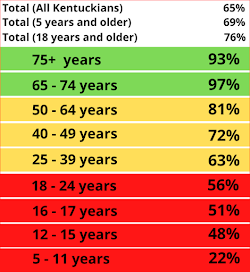
Kentucky Department for Public Health table
So far, only 48% of Kentucky's 12- to-15-year-olds and 51% of 16- to-17-year-olds and 22% of 5- to-11-year-olds have received at least one dose of a Covid-19 vaccine. 

CDC data reported by The Washington Post says that in the last week, Covid-19 vaccinations in Kentucky averaged of 2,918 per day. That which up a bit from Saturday, when the average was 2,508, but still a 46% decrease from the week before.

"If there's one negative piece of information today," Beshear said, "it's that our vaccination numbers are dropping about as quickly as the virus itself."

The state's seven-day infection rate is 27.79 daily cases per 100,000 residents, barely in the "red zone" for a high level of transmission, above 25 per 100,000. But many counties still have very high rates.

Counties with rates more than double the statewide rate are Wolfe, 161.7; Perry, 153.1; Menifee, 118.9; Leslie, 105.6; Robertson, 88.1; Lawrence, 84.9; Knott, 80.1; Letcher, 76.9; Wayne, 76.6; Owsley, 74.4; Crittenden, 73; Martin, 72.7; Breathitt, 71.3; Morgan, 69.8; Bath, 69.7; Magoffin, 69.3; McCreary, 68.8; Jackson, 66.5; Lee, 65.6; Floyd, 63; Clay, 56.7; Anderson, 55.9; and Montgomery, 55.8.

Kentucky's infection rate continues to rank sixth among states, even with a 53% decline in cases in the last 14 days, according to The New York Times. 

The state's Covid-19 hospitalization rate is second only to West Virginia's, but Kentucky's hospitals continued to get relief from the pandemic. They reported 962 patients with Covid-19 Monday, just over half the number reported two weeks ago, with 203 in intensive care and 112 on mechanical ventilation. 

Six of the 10 hospital regions are using at least 80% of their intensive-care beds, with three over 90%. Beshear said 388 National Guard members are still helping hospitals and food banks, but probably won't be needed after March 15. 

Asked about the legislation by Sen. Donald Douglas, R-Nicholasville, to end the Covid-19 state of emergency on March 7, Beshear said "We still have a pandemic" that can't be ignored and we don't need to "do anything that could stop us at any point from getting reimbursement for things that we need."

He said the bill "is more about politics . . . as far as I can tell from the outside . . . individual elections and pressure that people are facing." Douglas, who won a special election in November, is running in the May 17 primary election against Andrew Cooperrider of Lexington, who flouted Beshear's emergency pandemic restrictions and led protests against them.

From Saturday to Monday, Kentucky attributed 98 more deaths to Covid-19, bringing its pandemic death toll to 13,856. Beshear said two of the dead were in their early 20s and five were in between 39 and 49. 

"Remember," he said, "we're still losing people that are far too young."

Tuesday, November 16, 2021

Statewide pandemic metrics mostly stable, but hospital numbers keep rising; Bourbon County shifts to in-home schooling

Kentucky Dept. for Public Health map, adapted by Kentucky Health News; to enlarge, click on it.
By Melissa Patrick
Kentucky Health News

Kentucky reported 1,821 new coronavirus cases Tuesday, raising the seven-day average by 3, to 1,394; 28% of the new cases are in people 18 and younger. 

All hospital numbers went up Tuesday. Kentucky hospitals reported 739 Covid-19 patients, 20 more than Monday; 204 intensive care unit patients (up 13); and 115 of them on mechanical ventilation (up 10). The number of Covid-19 patients has increased on six of the last seven days.

Nine of the state's 10 hospital regions are using at least 80% of their intensive-care beds, with four of them above 90%; the Barren River region around Bowling Green is highest, at 96%.

The percentage of Kentuckians testing positive for the coronavirus in the last seven days is 5.73%, the same as Monday.

The New York Times ranks Kentucky's infection rate 24th among the states and says it has increased 13% in the last 14 days. 

Sixty-seven of the state's 120 counties have over 25 daily cases per 100,000 residents in the last seven days, which is considered a high level of transmission. 

The state says its seven-day infection rate is 27.08 daily cases per 100,000 residents, slightly higher than Monday. Counties with rates more than double that rate are Breckinridge, 85.8; Magoffin, 84.6; Monroe, 69.8; Bourbon, 66.4; Harrison, 62.8; and Powell, 59. 

Bourbon County schools have gone to non-traditional instruction for the next five days due to the increase in cases, Chelsea Jones reports for WKYT-TV.

School officials told WKYT that they are seeing many cases among 11-to-17-year-olds, and are urging parents to get their students vaccinated. The district will host a vaccine clinic Thursday. 

District Health Coordinator Deanna Berry told the Lexington station that nearly 50% of the county's eligible students and nearly 80% of its staff are vaccinated.

Across the state, 5% of 5-to-11-year-olds, 43% of 12-to-15-year-olds and 47% of 16- and 17-year-olds have received their first dose of a Covid-19 vaccine. 

Statewide, 2.6 million Kentuckians have received at least one dose of a Covid-19 vaccine, or 59% of the total population. According to the Centers for Disease Control and Prevention, 60.5% of the state's eligible population is fully vaccinated. 

Fayette County leads the state with 70% of its population vaccinated with at least one dose, followed by Woodford (69%), Jefferson (66%), Perry (65%) and Campbell (64%). The lowest five are Spencer (29%), Christian (34%), Edmonson (35%), Elliott (35%) and Hart (36%). 

The state reported 38 more Covid-19 deaths Tuesday, raising Kentucky's pandemic death toll to 10,318. The seven-day average of reported deaths is 36.7; the 14-day average is 34.6.

Nursing homes and assisted-living facilities welcomed new federal guidelines allowing traditional visitation, based on high levels of vaccination, Phil Pendleton reports for WKYT.

Thursday, July 29, 2021

Beshear calls for universal masking in schools, following CDC; Stack calls Kentucky 'horribly inflamed' with coronavirus

Kentucky Health News graph, based on state's initial, unadjusted daily reports; click on it to enlarge.
By Melissa Patrick
Kentucky Health News

Gov. Andy Beshear and Health Commissioner Steven Stack updated the state's mask guidance Thursday to call for universal masking in schools, regardless of vaccination status, following new federal guidance.

Beshear tacitly acknowledged that the advice is controversial: "Now, I know that people are tired. I'm tired, too. I know that people are frustrated. I'm frustrated too. We're strong enough to do this. We are resilient enough to do this. And we are compassionate enough to where we know that we have to do this."

He said Kentuckians' decisions about masking will be critical, due to aggressive spread of a more contagious coronavirus variant. "Places that haven't taken steps are seeing results that we should know by now: widespread outbreaks, clusters, large amounts of quarantines," he said at his weekly briefing.  

Asked about school districts that have said they would not require universal masking, Beshear asked them to consider the science that clearly indicates such policies will limit Covid-19 cases and subsequent quarantines in both classrooms and extracurricular activities, including sports.

Beshear suggested that school districts could be liable for sickness and death if they don't follow guidance from the U.S. Centers for Disease Control and Prevention that is based on research showing that vaccinated people can acquire the virus and spread it without having symptoms. He called that "the game changer."

"You teach science in your classroom," he said. "You should have to consider it when making decisions."

Beshear said he isn't considering a mask mandate, but would act based on how the surge in cases goes. The difference between this surge and before, he said, is that people have access to vaccines that work.

Asked if he would require state employees to get vaccinated, as some states and the federal government are doing, Beshear said he would not, but is looking at the possibility of requiring them to have regular tests, a federal alternative. Wednesday, he required all in the vicinity of others in state offices to wear a mask. 

Beshear said the mask recommendations are temporary and will be removed when it is safe to do so, as he did before. He said there is a simple equation that will keep Kentuckians at work, school and play: "more people getting vaccinated, and when you need to, wear a mask."

Without such prevention efforts, Beshear said the more contagious Delta variant will spread through unvaccinated workplaces and classrooms, disrupting education and slowing economic growth through loss of productivity and frequent quarantines.

Dept. for Public Health map, adapted by Ky. Health News; click to enlarge
Stack displayed color-coded maps that showed on June 28 there were no "red zone" counties in Kentucky, but on July 28 there were 36. Now it's 41. A red-zone county has more than 25 daily cases per 100,000 people over seven days and is considered to be at a "critical" level for transmission of the virus. 

“We have changed in the blink of an eye from a quiet, calm state to a horribly inflamed state,” said Stack. “We all know what we need to do . . . We all need to get vaccinated."

He said that since March 1, 94.5% of Covid-19 cases, 91.8% of Covid-19 hospitalizations and 88.8% of Covid-19 deaths in Kentucky were among unvaccinated or partially vaccinated or unvaccinated people.

Local health-department director Crystal Miller also spoke at the news briefing, encouraging Kentuckians to remember the beginning of the pandemic, when her home Harrison County had the first case and everyone had the same goal and was willing to do what it takes to protect themselves and their loved ones. 

“Somehow we’ve grayed those lines. We’ve gotten away from that mission," she said. "It’s been a long 16 months. It’s been frustrating. It’s exhausting. But the difference between March 6 and today is that we have a solution. We know exactly what works: vaccines and masking."

Stack and Miller asked Kentuckians to seek out reliable sources and trusted experts for information about the virus and the vaccines. Stack said, "Don't look to cable [TV] sources for your medical advice, period. Don't look to social media for your medical guidance, period. If we would do that, he said there would be no controversy or debate and we could get over this pandemic a lot faster." 

Republican pushback: Three Republicans who lead independent state agencies, and may run for Beshear's job in 2023, said they would not enforce the Democrat's mask mandate for state workers. Agriculture Commissioner Ryan Quarles' chief of staff, Keith Rogers, said they "will continue to leave it up to employees to decide for themselves whether to wear a mask while at work," Daniel Desrochers reports for the Lexington Herald-Leader.

State Auditor Mike Harmon said likewise Wednesday; Treasurer Allison Ball followed suit Thursday, saying: "The Treasury has a very high rate of vaccination among its employees, and the staff has been extremely responsible both in monitoring their own health, and in not placing their fellow employees at undue risk."

Mike Wynn, a spokesman for the Legislative Research Commission, said the legislature will stick to the mask policy it implemented on May 23, which said vaccinated people do not need to wear a mask, Desrochers reports.

Beshear said he can't discipline employees who work for separate constitutional officers, but warned that they will face a greater risk of getting sick. He said it's more important to do the right thing than to "try to score political points," and noted that the new-case rate in Franklin County skyrocketed this month. 

"I care more about the people than my popularity," he said. "I've got the backbone to do what's right for them, and wish other people did too."

Vaccinations: Beshear noted the slight uptick in vaccinations in Kentucky. CDC data presented by The Washington Post showed 10,048 shots were given Wednesday, the most since July 11. The seven-day average is 7,563.

"It does appear that the seriousness of the Delta variant is getting through to some folks who haven't been vaccinated yet," Beshear said.

Beshear said he thought the state is having success with its vaccine lottery, which held its second drawing Thursday. The winners will be announced Friday; an adult will win $1 million and five youth will get full postsecondary-education scholarships. The final set of winners will be announced Aug. 27. 

Asked if the state was working on any other incentive programs to get more Kentuckians vaccinated, Beshear said they were looking at different options and noted that there were more and more private incentives being offered. "The Delta variant ought to encourage them to do more," he said. 

Daily numbers: The state reported 1,618 new cases of the virus Thursday, with 328 (20%) in people 18 and under. That raised the seven-day rolling average by nearly 100, to 1,120 -- the highest in six months. 

The percentage of Kentuckians testing positive for the virus in the past seven days rose for the 33rd straight day, to 8.55%. Two more Kentuckians have died from Covid-19, bringing the death toll to 7,327. 

The statewide rate of daily new cases over the last seven days is 23.63 per 100,000 residents, very near the "critical" level of 25. Counties with rates more than double the statewide rate are Clay, 113.4; Jackson, 82.5; Muhlenberg, 57.8; Laurel, 57.8; Letcher, 57.7; Floyd, 52.6; Webster, 51.9; and 
Hopkins, 47.3.

Hospitalizations for Covid-19 continued to rise. Kentucky hospitals reported 608 patients with Covid-19, with 189 of them in intensive care and 82 of those on mechanical ventilation.

Tuesday, June 8, 2021

Study finds rural seniors less likely than urban ones to follow Covid-19 prevention advice, especially social distancing

Rural adults 65 and older were less compliant than their urban peers when it came to following some of the suggested strategies to slow the spread of the coronavirus, especially social distancing.

So says a recent study published in The Journal of Rural Health, which looked at whether "community dwelling" seniors (those not living in assisted living, nursing homes or other congregate settings) had adopted preventive measures recommended by the Centers for Disease Control and Prevention to slow the spread of the virus.

Following the CDC's advice is especially important for seniors because they have a higher risk of dying from Covid-19 if they get it. 

In Kentucky, 91.4% of all Covid-related deaths were in people 60 and older. And in December, WFPL reported that per-capita cases and deaths were higher in Kentucky's rural counties than its urban ones. 

The study researchers used self-reported data from the National Health and Aging Trends Study, conducted from June to October 2020, which asked about eight different risk-mitigation behaviors. The survey included nearly 3,000 community-dwelling urban and rural seniors.  

The researchers found that seniors' compliance with each of the eight behaviors to limit the spread of Covid-19 was high, but rural seniors were less likely to report compliance on five: social distancing, limiting gatherings, avoiding restaurants and bars, not touching their faces, and avoiding contact with those outside their households. 

However, after the data were adjusted for demographic characteristics, only maintaining a six-foot distance remained lower among rural seniors to a statistically significant degree. There were no rural-urban differences when it came to mask wearing, handwashing and limiting shopping.

Still, the researchers said their findings suggested the need for rural-specific messaging when it comes to such public-health emergencies.

Friday, March 26, 2021

Positive-test rate falls to 2.8%, about half of what it was 4 weeks ago; other pandemic metrics decline; death toll surpasses 6,000

Kentucky Health News graph; click on it to enlarge.
By Al Cross
Kentucky Health News

Every measure of the pandemic in Kentucky declined Friday, except death, and even that lagging indicator's averages kept declining, not counting deaths being found by an ongoing audit.

The percentage of Kentuckians testing positive for the novel coronavirus fell again, to 2.8%, about half of what it was a month ago (or four weeks, since last month was February).

The state reported 646 new virus cases, lowering the 7-day rolling average by 12, to 602, the lowest since Sept. 12.

The statewide rate of new cases over the last seven days fell to 11.38 per 100,000 residents. Counties with rates more than double the statewide rate were Lyon, 53.9; Simpson, 53.1; Owsley, 45.3; Whitley, 29.5; Powell, 27.7; Knox, 27.5; Lee, 25.1; and Mercer, 24.8.

Counties with 10 or more new cases were Jefferson, 110; Fayette, 52; Warren, 30; Scott, 24; Adair, 19; Madison, 16; Boone, 15; Clark, 13; Barren, Daviess, Mercer and Oldham, 12; Kenton, McCreary and Whitley, 11; and McCracken and Wayne, 10.

Kentucky hospitals reported 383 Covid-19 patients, 20 fewer than Thursday; 88 were in intensive care and 46 of those were on ventilators, down 18 and 3, respectively. Only the Lake Cumberland hospital region, at 82%, reported more than 80% of its intensive-care beds in use, and just 16% had Covid-19 patients.

The pandemic's death toll in Kentucky passed 6,000, as state officials added 27 more deaths to their official list of Covid-19 victims, plus 11 found by an ongoing audit of death certificates. That pushed the death toll to 6,008.

Unlike Thursday, there was no overlap in the two reports' dates of deaths. The dates of the regularly reported deaths ranged from Jan. 11 to March 24. The deaths found by audit were Dec. 8-27.

Not counting the deaths found by audit, the state's daily death average has been on a slow, general decline for the past month. Based on dates the deaths were officially listed after review, the 14-day rolling average declined from 25.2 on Feb. 27 to 21.1 on Friday. 

Gov. Andy Beshear did not comment on any daily numbers or averages in his press release, but continued to emphasize vaccination.

“More than one in three Kentucky adults have been vaccinated so far, which is a huge milestone,” he said. “If you haven’t been vaccinated, see where you can sign up. If you’ve got a family member or friend who wants their shot of hope, help them get registered and call our vaccine hotline, 855-598-2246 or TTY 855-326-4654 (for deaf or hard-of-hearing Kentuckians), if you need help. Together, we can defeat Covid-19 this year, but we have to keep up our momentum.”

A survey in Jefferson County found that 91% of residents would choose vaccination, with slightly lower rates among minorities.

"About 3% of white and 8% of minority participants indicated they would never choose vaccination," said a news release from the University of Louisville Christina Lee Brown Envirome Institute. "Minority participants reported they were more likely to choose vaccination with celebrity endorsement, offerings by faith organizations and vaccination requirements. White participants were more likely to choose vaccination if their family and friends or elected officials were vaccinated and with evidence of efficacy."

The survey was conducted as part of the Co-Immunity Project to understand the impact of Covid-19 in Jefferson County. Most of the 1,296 people who responded online to the mailed invitation were over 60 or over (44%), female (61%) and white (84%), and 90.2% reported being unvaccinated.

The state Department of Education updated its guidance on school distancing to match that of the Centers for Disease Control and Prevention: three feet, if all students are masked. Six feet is still required in common areas and during activities such as singing, band and sports, which should be moved outside.

In other pandemic news Friday:
  • The state Corrections Department reported 196 active cases among prisoners, 171 at the state penitentiary; 12 employees at the prison were among the 19 staffers with active cases.
  • "Outside of big cities, where office buildings remain vacant, people in America are becoming more active," The Washington Post reports after its analysis of cell-phone data showed that in parts of the Deep South and Mountain West, mobility is higher than it was before the pandemic. "This spring fever is palpable across much of the country," the Post reports, "and as people are on the move so is the virus: There is increasing evidence of a new bump in cases."
  • Women are more likely than men to have gone without health care during the pandemic, and as a result women who had health and economic challenges beforehand have had worse health conditions, according to a survey by the Kaiser Family Foundation, which concluded, "These gaps in care could translate into higher numbers of women experiencing severe health issues after the health emergency from the pandemic resolves."
  • Kaiser also reported, "The pandemic has had a significant effect on people’s mental health, with 51% of women and 34% of men saying that worry or stress related to the pandemic has affected their mental health. Most say that the impact has been moderate or minor, but almost one-fifth (21% women, 17% men) say the toll has taken a major impact on their mental health."

Thursday, March 4, 2021

157 new vaccination sites to open, bringing total to 567; positive-test rate is down again; one-year memorial set Saturday


University of Kentucky pharmacist Stephanie Branham, left, gave UK's 100,000th coronavirus vaccination to Roberta Mason of Frankfort, accompanied by her daughter Sherry Brown, at Kroger Field March 4. (UK photo by Mark Cornelison)
By Melissa Patrick
Kentucky Health News

Gov. Andy Beshear announced Thursday that the state would open 157 new sites for coronavirus vaccinations, and that Kentucky's rates of new cases and positive tests for the virus continue to trend down. 

“Vaccine locations are getting closer and closer and closer to you; so again, this is the infrastructure we have to build,” Beshear said at his last pandemic news briefing of the week. “The president told us earlier this week that every adult who wants a shot can get their first shot of hope by the end of May. That means that we are going to vaccinate, provided we can get everybody interested, another 2.5 million people or so in the next three months.”

The state's daily vaccination report shows 760,585 Kentuckians have received a first dose of vaccine. Beshear noted that only three days into March, the state had already vaccinated more than 60,000 people.

A downed computer server interrupted shots at the regional sites in Bowling Green and the Kentucky Horse Park, but Beshear assured those affected that they would get vaccinated, and asked for their patience. 

He said the 157 new vaccine sites will bring the total to 567. They include one new regional site at Baptist Health LaGrange; 10 Kroger sites; 10 Walmart sites; and 136 Federal Pharmacy Program sites, which include Walgreens and independent pharmacies with the Good Neighbor Pharmacy brand.

Beshear often notes that health departments and independent pharmacies will play a special role in reaching hard-to-reach populations. That played out Thursday in Lexington. The Lexington-Fayette County Health Department, with the help of the Lexington Senior Center and the Lexington Fire Department, gave more than 500 people age 70 and older their second dose of a Covid-19 vaccine today, according to a post on Twitter. 

To find the closest vaccination site near you or to find transportation to that site, go to vaccine.ky.gov or call 855-598-2246. The website also allows you to get on a list to find out when appointments are available at new and existing sites across the state.

Daily numbers: Beshear announced 1,068 new virus cases Thursday, making the seven-day average 959, the first time it's been below 1,000 since Oct. 15. 

Calling it the "best news of the day," Beshear announced that the percentage of Kentuckians testing positive for the virus in the past seven days declined again, to 4.45% , the lowest since Oct. 12.

Kentucky's case rate still remains higher than most states, ranking 12th nationwide, according to The New York Times. On Thursday, the state reported its rate to be 17.2 cases per 100,000 population.

The "hot" county in the state, with a rate of 280 per 100,000 over the last seven days, is Lyon, partly because of an outbreak at the Kentucky State Penitentiary at Eddyville. The state Corrections Department's Covid-19 report says the prison has 135 cases among inmates and 18 among staff. 

Other counties with rates more than double the statewide rate were: Caldwell, 66.1; Robertson, 54.2; Clay, 49.5; Taylor, 47.7; McCreary, 43.9; Knox, 42.7; Adair, 41.7; Green, 40.5; Simpson, 34.6; and Russell, 32.7.

Covid-19 hospital numbers in Kentucky remained mostly stable, with 645 people hospitalized with the disease (down 35 from yesterday); 172 in intensive care (down 3); and 91 of those on a ventilator (up 12).  

The Lake Cumberland hospital readiness region is the only one using 80% or more of its intensive-care beds, at 91%, with 24% of them Covid-19 patients. 

Beshear reported 28 new Covid-19 deaths on Thursday, 25 confirmed and three probable. That brings the state's death toll to 4,732. The 14-day death average is down 0.7, to 25.6 deaths per day.

In long-term care facilities, 143 residents and 144 staff have an active case of the virus, with 12 residents and eight staff added to that list today. 

Beshear said 11 of the 28 deaths reported Thursday were from long-term care, and said even though the number of deaths in these facilities is declining, that doesn't mean Kentucky isn't still losing people. 

“We will continue to lose people until we’re fully out of the woods and everybody is vaccinated,” he said. “That’s the reason we’re not going to do what Texas or Mississippi has done. Those decisions will increase casualties when we just have maybe even a matter of months to go.”

Beshear was referring to Republican governors in Texas and Mississippi reopening businesses to full capacity and ending their states' mask mandates. Tuesday, he called the Texas decision "reckless." 

Memorial: Beshear and Lt. Gov. Jacqueline Coleman will host a virtual Covid-19 memorial on the Capitol grounds at 1 p.m. ET Saturday, March 6, to honor the 4,700 Kentuckians who have died from Covid-19 and to mark one year since the first positive case of the virus was detected in the state. The event will include faith leaders, musical performances and remembrances, and a memorial video to commemorate the year. The governor will also unveil long-term plans to honor those lost to the pandemic at the ceremony. Kentuckians can watch the memorial on Facebook and YouTube.

Politics: Asked if his discussions with legislators could short-circuit the court case about their efforts to limit his emergency powers, or if he was confident enough in his position to simply allow anticipated appeals to proceed, Beshear said he was confident in his position.

He didn't directly answer the first part of the question, but said his communications with legislators had improved, "primarily on other topics."

"There's only one commander-in-chief, and ultimately this has to be an executive-driven response," he said. "That doesn't mean that we're not willing to talk to legislative leaders, we are. And I hope that we can have those conversations moving into the future and my confidence in our position isn't going to prevent that from happening."

He added, "There have been good discussions, primarily on other topics, over the last several weeks. We've had a number of areas where we've been able to work together. You've seen some bipartisan bills pass, and I had a hand in some of those. And we've seen much better communication on a number of different areas that give me hope for a better relationships moving forward. " 

He said the pandemic has been stressful for everyone. "Hopefully, the quality of our discussions can continue, and we can build some better relationships coming out of a pandemic. Obviously, that's a two- sided deal, but we see, again, we see better reach-out all the way around right now." 

Weather effects: Beshear and his lieutenants spent a good bit of the briefing talking about devastation caused by ice storms and flooding and explaining the 30-day process to apply for federal disaster aid. 

"We spent so much of this last year working to protect each other and asking people to be healthy at home," said Beshear. " And now a whole lot of our families don't have a home." 

A key take-away was the importance of documenting the damage.  “For you homeowners and folks who have had personal property damage, document, take pictures,"  said Rocky Adkins, senior adviser to Beshear. “Make sure that that’s part of . . . our information that's sent in to Washington, D.C. to ask for that declaration . . . so we can have a full application that will go in for approval to come back and bring relief to our people who are hurting so bad.”

Beshear's news release said, "Twenty cities and 44 counties have declared a state of emergency. Over 194 county roads closed due to flooding. Three counties have reported power outages: Breathitt, Jackson and Owsley. Lee and Owsley counties each have one shelter open; Breathitt County has two."

In other pandemic news Thursday: 
  • The 28 fatalities were a Boyle County woman, 88; a Carlisle County man, 66; a Daviess County woman, 87; a Fayette County woman, 96; a Floyd County man, 59; a Franklin County woman, 83; a Fulton County woman, 71; two Graves County women, 84 and 85; a Hardin County woman, 80; a Harlan County woman, 76; a Henderson County woman, 72; two Jefferson County women, 85 and 91; two Jefferson County men, 63 and 94; a Kenton County man, 61; a Larue County man, 83; a McCracken County man, 80; a Madison County woman, 96; a Marshall County woman, 78; a Meade County man, 60; two Nelson County women, 74 and 78; a Perry County man, 75; a Pulaski County man, 56; a Taylor County woman, 72; and a Warren County woman, 83.
  • Counties with 10 or more new cases of the virus were Jefferson, 152; Lyon, 127; Fayette, 51; Boone, 47; Caldwell, 45; Kenton, 36; Oldham, 30; Campbell, 24; Rowan, Scott and Warren, 22; Hardin, 19; Daviess, 18; Franklin, Laurel and Marshall, 17; McCracken and Madison, 15; Bell, Grant and Shelby, 14; Jessamine, 11; and Barren, Harlan, Pike and Wayne, 10.
  • The Lexington Herald-Leader reports on how long you should wait after a coronavirus infection to get vaccinated: The Centers for Disease Control and Prevention says such people should have no symptoms and meet the criteria to leave isolation, but other experts say that if you are not on a high-priority list for a vaccination, wait 90 days to give others without natural immunity a chance to go first.
  • Some of the University of Louisville's best-known basketball players got a vaccine Wednesday to inspire others to get it too, Deborah Yetter reports for the Louisville Courier Journal. 
  • Pregnant women in Kentucky are now eligible for vaccines, and officials from Norton Healthcare strongly recommend that they get it after the first trimester,  Lexie Ratterman reports for WDRB.
  • The CDC and the Louisville health department recommend staying home this spring break, Gina Glaros reports for WDRB.
  • Beshear extended an executive order on pharmaceuticals that allows all Kentucky pharmacists to dispense emergency 30-day refills on medications.
  • Click here for the governor's press release with information about getting access to food for students via the Pandemic-Electronic Benefit Transfer program, which has been extended through the school year; an update on unemployment insurance; and a weather update.

Tuesday, November 24, 2020

Kentucky is still in the most dangerous zone for virus cases and positive tests; White House calls for 'significant behavior change'

White House Coronavirus Task Force table; for a larger version, click on it.
By Melissa Patrick
Kentucky Health News

For the second week in a row, Kentucky is in the worst danger zone for both coronavirus cases and the share of Kentuckians who tested positive for the virus in the past seven days, according to this week's White House Coronavirus Task Force report. 

Kentucky has been in the red zone for case numbers, indicating 101 or more new cases per 100,000 people, every week since the Sept. 27 report, but this is only the second week it has been in the most dangerous zone for test positivity, meaning it has a rate above 10%.

Gov. Andy Beshear has noted several times that the state uses a different data stream than the White House, which results in a lower positive-test rate. The White House reports a 13% percent positivity rate in Kentucky. On Nov. 24, the state reported that rate to be 8.82%. 

As other states have surged even more, Kentucky's ranking in the White House report has fallen a bit. The latest report, which covers Saturday, Nov. 14, through Friday, Nov. 20, says Kentucky ranks 24th highest in the country for cases and 20th for positivity.

It says 92% of Kentucky's counties had a moderate or high level of community transmission, with 70% of them having high levels. That's up from 89% and 55%, respectively, in last week's report. 

It shows Kentucky with 433 new cases per 100,000 people. This number continues to show huge weekly increases. It was 344 per 100,000 in the prior week, and 274 per 100,000 the week before. The national average is 356 per 100,000.

In the state's Monday-to-Sunday reporting week, last week Kentucky had most cases ever: 20,514, up 22% from the week before. 

The number of counties in the White House red zone increased by 18, from 66 to 89; the orange zone number decreased by 11, from 24 to 13; and the yellow zone decreased by three, to 14. 

This week's report included a strong warning, saying the "aggressive, rapid, and expanding" spread of cases requires both "proactive, focused testing" to identify asymptomatic and pre-symptomatic individuals, combined with "significant behavior change of all Americans." 

Those behaviors include wearing a mask at all times in public, social distancing, significant reductions in public and private indoor capacity limits, and making sure that "every American understands the clear risks of ANY family or friend interactions outside of their immediate household indoors without masks." 
   
Some argue that Kentucky does not have a reliable estimate of the virus' spread because it depends on "convenience samples" from voluntary tests instead of statewide random testing. Beshear has argued that the state does so much testing that it has a pretty accurate picture of how many people have the virus, especially among those with symptoms. 

He was asked Tuesday about White House's recommendation for "proactive, focused testing" to catch the virus in people without symptoms, and the latest analysis from the University of Louisville's Co-immunity Project – which does random testing in Jefferson County, finding that the infection rate is now 10 times what it was two months ago and that the infection rate is nearly five times higher than the publicly reported number of cases.

Beshear said the state is doing a study with LabCorp, a large testing laboratory, "that is giving us data on how widespread that we think the virus is in Kentucky." He said Health Commissioner Steven Stack would talk about it next week. "It's got some different numbers than the co-immunity project, but it's also statewide."

The White House report also called for "strong Thanksgiving messaging" that encourages people to limit events to individuals in their household and to wear masks while indoors around high-risk and vulnerable people. In addition, it says to expand public-health messaging to all media platforms, to warn people about the risks of social gatherings and re-emphasize the need for masks and social distancing. 

The report also called on Kentucky to stay vigilant to protect nursing home residents and staff, ensuring that they have full testing capacity and are properly isolating those who test positive. It also calls on the state to ensure that all hospitals have expansion and contingency plans and up-to-date treatment protocols.

The report has a graph showing covid-19 hospitalizations by age and by week.

White House Coronavirus Task Force graph; for a larger version, click on it.