Showing posts with label federal spending. Show all posts

Wednesday, April 10, 2024

Guthrie warns making telehealth expansion permanent must be paid for; costs uncertain, but projected to be several billion dollars

Kentucky Health News

If telehealth services are to remain expanded as they were in the pandemic, Congress must offset the cost, U.S. Rep. Brett Guthrie of Bowling Green said in opening a House subcommittee hearing Wednesday.

“Virtually overnight, our health-care system underwent a significant transition,” said Guthrie, a Republican who represents the 2nd Congressional District and chairs the health subcommittee of the House Energy and Commerce Committee, according to a press release from the committee.

“Seniors were allowed to use telehealth across the country and could now access their health-care providers from the comfort of their home. Additionally, the number of health care services Medicare would cover if performed through telehealth increased from 118 to over 260.

“Restrictions such as requiring seniors to have an established pre-existing relationship with a health-care provider to receive mental health services through telehealth were waived. Allowing patients to consult with a provider through a simple audio-only phone call if an audio-visual connection wasn’t available.”

All those things were a big help to rural communities, Guthrie said, so Congress has extended them through Dec, 31. But he added that before they can be extended again or made permanent, some problems need to be addressed.

“I want to remind my colleagues that the previous extension was estimated by the Congressional Budget Office to increase costs to the Medicare program by over $2 billion,” Guthrie said. “Making these authorities permanent is likely to cost much more than a short-term extension, and we want to make sure that whatever we move out of committee is paid for and is delivering the best value for seniors. I think that this committee can work together, to move legislation making sure seniors have access to telehealth when they want it while also including appropriate program integrity measures, addressing the costs of such access to the program.”

Politico Pulse reports, “Generally, lawmakers seemed willing to accept higher costs to expand access to virtual care.” Rep. Cathy McMorris Rodgers (R-Wash.), chair of the full committee, said extending telehealth rules would be a “significant investment” but “We can’t afford to go backwards.” Pulse notes, "Harvard researcher Ateev Mehrotra told lawmakers that expanded telehealth is associated with a 'modest' increase in spending but also improved outcomes, particularly in mental health."

Guthrie largely dismissed concerns about increases in waste, fraud, and abuse from telehealth. “It appears that telehealth can be used to deliver care without actually raising those serious concerns. According to the Office of Inspector General, of the over 700,000 providers they studied who provided telehealth care during the pandemic, less than 2,000 warranted further scrutiny resulting from their telehealth billing practices, and mostly because they charged facility fees and for the actual telehealth visit.”

The full committee's ranking Democrat, Rep. Frank Pallone of New Jersey, acknowledged the budget implications of extending telehealth, but noted that the CBO has not estimated the cost yet. "I would like to better understand the offsets for these proposals," he said, "and want to ensure that it would not result in significant funding cuts to the Medicare program or raise health care costs for seniors."

Pallone also said, "I believe that any further expansions of telehealth flexibilities in Medicare must meaningfully increase patient access to care and ensure high quality care for seniors.  . . . Congress must ensure that additional expansions of telehealth policies do not limit access to in-person care. It is important that we preserve patient choice and that Medicare beneficiaries continue to have access to high quality in-person care and robust consumer protections, including network adequacy standards."

The top-ranking Democrat on the subcommittee, Rep. Anna Eshoo of California, voiced concern about the health-care industry “gaming” telehealth to make it into a “cash cow.”

Thursday, March 28, 2024

Government Accountability Office says Medicare and Medicaid each overpaid health-care providers by about $50 billion in 2023

UPDATE, April 10: The Oversight Subcommittee of the House Energy and Commerce Committee will hold a hearing Tuesday, April 16, "to discusss ways how to better monitor the programs, reports Amy Lotven of Inside Health Policy.

Inside Health Policy chart; Government Accountability Office data
Improper payments, mainly through overpayments, in Medicare and Medicaid are expected to total about $50 billion each for 2023, the federal Government Accountability Office says in its annual report on the topic. Both programs showed declines in improper payments from 2022: $11 billion in Medicare and about $30 billion in Medicaid, the latter due mainly to "the end of states’ Covid-19 flexibilities, including the suspension of eligibility determinations and provider enrollment requirements," reports Amy Lotven of Inside Health Policy.

The GAO estimated total improper federal payments in 2023 would be $236 billion, but noted that the projections "do not include certain programs that have been determined susceptible to improper payments: for example, the Temporary Assistance for Needy Families programs; and the government-wide total potentially does not represent the full extent of improper payments," Lotven reports.

About $175 billion of the improper payments are overpayments, "while $44.6 billion were labeled 'unknown,' meaning GAO was unable to determine whether they were proper or improper," Lotven writes. "$11.5 billion were underpayments and $4.6 billion were technically improper because they failed to follow all applicable regulations even though the recipient was entitled to the funding."

While improper Medicare payments declined overall, they increased in Medicare Advantage, the privately run version of the prohram, whoch now serves most Medicare beneficiaries. GAO estimated improper Advantage payments at $17 billion in 2023, up from $12.8 billion in 2022.

"In addition to reporting on federal programs with $5 billion or more in improper payments . . . the report also lists the 16 programs that have improper pay rates of 10 percent or more," Lotven notes. The refundable premium tax credits under the Affordable Care Act and the Children’s Health Insurance Program had rates of 26% and 12.8%, respectively; in dollars, they were $958 million and $2.1 billion.

Monday, July 10, 2023

UK gets another 5-year grant to study major environmental health impacts on Kentuckians, keeping focus on Appalachian Kentucky

UK press release

The University of Kentucky Center for Appalachian Research in Environmental Sciences will continue its work to study major environmental health impacts on Kentuckians with a renewed award from the National Institute of Environmental Health Sciences, part of the National Institutes of Health.

The $7.4 million grant will run for the next five years. UK-CARES was established in August 2017, with an initial $7.4 million NIEHS grant, making it an Environmental Health Sciences Core Center to enhance research across all spectrums — basic, clinical, epidemiological, and translational.

UK-CARES is focused on studying environmental health effects of air and water quality that are implicated in environmentally induced disease, as well as emerging threats such as flooding and exposure to new contaminants.

Ellen J. Hahn
“Over these last five years, our commonwealth has been through one major event after another, from the Covid-19 pandemic to historic flooding and devastating tornadoes,” said Ellen J. Hahn, professor in the UK colleges of Nursing and Public Health, and director of UK-CARES. “The members of UK-CARES along with our community partners have done critical research to understand and address environmental health impactsWe will continue to learn with and from the community to tackle the environmental challenges facing the state and the health of its people, especially throughout Appalachia.”

The center provides pilot project funding, research expertise, career development, a faculty fellows program in science communication, mentorship, and community grants to facilitate innovative discovery and new understandings of environmental factors in disease initiation, progression and outcomes and their community impacts. You can learn more about those efforts here.

“The research conducted within UK-CARES is a tangible fulfillment of the University of Kentucky’s mission to serve the commonwealth, specifically the people who face the highest rates of chronic diseases and the regions that face tremendous environmental challenges,” said Lisa Cassis, UK vice president for research. “The renewal of this award will allow investigators across our institution and stakeholders in the community to continue to partner to find solutions to these pressing environmental health issues in Appalachian Kentucky and beyond.”

UK-CARES is housed in the College of Nursing, along with BREATHE (Bridging Research Efforts and Advocacy Toward Healthier Environments), which Hahn also runs. The center has an interdisciplinary team of researchers across the colleges of Medicine, Nursing, Public Health and Engineering, as well as the Gill Heart Institute, Kentucky Water Research Institute, Markey Cancer Center, the UK Center for Excellence in Rural Health and Kentucky Homeplace, and the USA Drone Port in Hazard.

The center offers different types of memberships for those interested in contributing to the breadth of environmental health research at the center. You can find more information here.

Friday, March 10, 2023

Study for hospital association says 38% of Ky. hospitals at risk of closure due to losses; bill would have Medicaid pay for outpatients

By Sarah Ladd
Kentucky Lantern

Citing “inflation, record-high operating costs, and lower volumes,” a new report prepared for the Kentucky Hospital Association says 38% of Kentucky’s hospitals are at risk of closure due to “the unsustainability of operations.”

The report from health-care consulting firm Kaufman Hall shows that the state’s hospitals spent much more on medical supplies since the start of the pandemic than before it, suffered from staffing shortages, saw fewer people in emergency departments, and more.

“Kentucky hospitals continue to face existential financial and operational threats,” Erik Swanson, the senior vice president of data and analytics at Kaufman Hall, said in a statement. “In 2022, Kentucky hospitals experienced their worst financial performance since the outset of the pandemic, and conditions in 2023 remain extremely challenging.”

Breckinridge Memorial Hospital in Hardinsburg is among
hospitals that have lost money in recent years. (KHN photo)
Kentucky hospital expenses in 2022, the report says, were $4.2 billion higher than before the pandemic — and they surpassed revenue.

“Hospitals are the heart of the communities they serve, providing high-quality, life-saving care to anyone who needs it regardless of their ability to pay,” KHA President and CEO Nancy Galvagni said in a statement. “They are also some of the largest employers in towns across the state, so the financial health of hospitals is critical to both the physical and economic health of Kentucky.”

Already, 42 of Kentucky’s 120 counties do not have a hospital, excluding those facilities inside correctional institutions, a KHA spokeswoman told the Lantern.

“Rising costs are making it difficult for our members to stay open,” Galvagni said. “Labor costs, in addition to the extreme growth in costs for supplies and drugs our patients need, which are struggles all Kentuckians understand, are outpacing growth in revenue.”

KHA said that without the federal Hospital Rate Improvement Program in place last year, “Losses would have exceeded $1.3 billion and operating margins would have fallen even more.”

Citing the situation, Galvagni spoke in support of House Bill 75, which would allow hospitals to be reimbursed by Medicaid for outpatient services, before it passed the Senate Standing Committee on Health Services March 8.

HB 75, Galvagni said, is especially critical for rural hospitals, as the majority of dollars coming in for the outpatient side will go to them and they “desperately need it.”

The bill's primary sponsor, Rep. Brandon Reed, R-Hodgenville, told his colleagues that the bill is “aimed at improving access to the quality (of) health care for each and every Kentucky as well as serving as a lifeline to rural hospitals serving communities throughout the commonwealth.”

“The timing is very critical for this and we really need it to sustain our hospitals,” Galvagni told the committee, adding that there is no “relief in sight for these high costs that are out there.”

Tuesday, February 14, 2023

Medicaid isn't off the budget-cutting table, but seems resilient because it covers so many and is vital for rural hospitals

Protesters in 2017 (Photo by Drew Angerer, Getty Images)
Now that President Biden and Republicans agree they won't cut Medicare and Social Security, the federal-state Medicaid program will be on the table as Republicans try to get concessions for raising the national debt ceiling. But "Medicaid is politically better positioned to weather the storm than ever," Politico's Joanne Kenen reports.

While the House Republican platform for midterm elections was vague about cuts, "and even more vague on health policy, the conservative Republican Study Group’s budget blueprint for the current fiscal year would have restructured Medicaid entirely and cut $3.6 trillion over a decade compared to the current spending trajectory — but there’s no way that Democrats (or even some more establishment Republicans) would accept that," Kenen writes.

Medicaid has "a much stronger constituency" these days because it covers many more people, 90 million, including 1.7 million in Kentucky, more than a third of the state's population.

The program is "the largest payer of nursing-home care in the U.S, and it’s a lifeline for disabled kids and their families, both very politically sympathetic populations," Kenen reports, citing Larry Levitt, executive vice president for health policy at the Kaiser Family Foundation. “Medicaid now is touching the majority of families in the country,” Joan Alker, executive director of the Center for Children and Families at Georgetown University in Washington, D.C., told Kenen.

"As if all that wasn’t enough, Medicaid keeps safety net hospitals afloat," Kenen notes." And those hospitals, which treat a large share of poor people in both rural and urban settings, are in an even more precarious financial position than usual after the pandemic. . . . Tom Miller, a health expert at the center-right American Enterprise Institute who has written extensively on what he sees as more realistic conservative approaches to improving Medicaid, including broader use of federally-approved waivers for states, expects conservative Republicans to try again this year — and again overreach and fail."

Sunday, December 25, 2022

More than 1/3 of Kentuckians are enrolled in Medicaid. How many in your county? How many kids? What are their big health issues?

Screenshot of health portion of Cabinet for Health and Family Services report on Clay County
By Al Cross
Kentucky Health News

Most Kentuckians probably don't know much about Medicaid, but for more than one in three people in the state, it is a lifeline. In some counties, more than half the residents are Medicaid beneficiaries. But Medicaid runs somewhat under the radar, because many Kentuckians frown on the receipt of public assistance -- even though Medicaid benefits come only with demonstrated medical need.

Medicaid is a combined federal-and-state program, created in 1965 by the law that created Medicare. Originally it was for the very poor, the disabled and the pregnant, but in 2014 expanded to households with incomes up to 138 percent of the federal poverty level because then-Gov. Steve Beshear embraced the 2010 Patient Protection and Affordable Care Act, better known as Obamacare.

The federal government pays 90 percent of the cost for people covered by the expansion, and about 72 percent of others' costs. The state pays the rest, which means Kentucky taxpayers put billions of dollars a year into it. It's not the sort of program that needs to run under the radar; if we are paying the freight, we need to know what's in the haul, and it helps to know it at the local level.

That's easier now that the state Cabinet for Health and Family Services, which runs Medicaid in Kentucky, has posted monthly Medicaid enrollment reports on its website.

These county-by-county reports are more useful than the annual reports that the cabinet circulates more more to show the local impact of its programs. The Medicaid figure on those reports is the number of people in the county who received Medicaid benefits at any time during the program's fiscal year (April to March). That number overstates the rolls at any particular time, because many people go on and off Medicaid each month.

For example, the Fiscal 2022 report for Clay County, one of the nation's poorest, shows 15,922 total beneficiaries in the year, but only 12,815 in the month of June. That is still 62.6 percent of the county's estimated population of 20,484.

That said, the annual reports provide much more information about Medicaid than the monthly reports; among other things, they:
  • Break down Medicaid enrollment into types of enrollees: traditional, expansion, children in foster care, and "presumptive eligibility," people who have been enrolled during the pandemic without all the usual checks for eligibility, under legislation passed by Congress. Starting April 1, states will have to start running all the usual checks, and many people will no longer be eligible. In Clay County, for example, 2,842 presumptive eligibles were on the rolls in fiscal 2022, or 18% of the total enrollment.
  • Give the number of children who were beneficiaries at any time during the year; in Clay County, 4,612 kids were helped by Medicaid in fiscal 2022. 
  • Give the top five diagnoses for adults and children on Medicaid, which can vary widely from year to year. In another poor county, Clinton, the top five diagnoses for adults in fiscal 2021 were chronic obstructive pulmonary disease, hypertension, unspecified illness, opioid dependence and diabetes, in that order. In fiscal 2022, they were hypertension, Covid-19, contact with and suspected exposure to Covid, myopia (nearsightedness) and "other fatigue."
  • Give the top five procedures performed on beneficiaries and the top five medications prescribed for beneficiaries. In both Clay and Clinton counties in the last two fiscal years, the most-prescribed drug was naloxone, which reverses the effect of a drug overdose.
  • Show the number of health-care providers who served residents of the county and the total they were paid. For example, in Clinton County in fiscal 2022, residents were served by 48 providers who were paid $33 million; $14.3 million of that went to local providers.
  • Show the number of newborn screenings and other figures on programs for children, including the percentages of foster children who had an official goal of adoption, and the number with other official goals, such as reunification with their birth families.
The annual reports give much information on programs other than Medicaid, such as the Supplemental Nutrition Assistance Program (once known as food stamps), behavioral-health services (including syringe exchanges), other services by local health departments, health-insurance assistance, child-care assistance, child-support enforcement, social services (such as meals, home care and other services to seniors), and funding of Family Resource and Youth Service Centers, which serve public-school students and their families. The reports also list the number of cabinet employees working in each county.

Thursday, December 8, 2022

Too many pregnant Kentuckians and babies in 'maternity deserts' and Ky. has no birthing centers; midwives say they could help

Laura Browning, an Eastern Kentucky doula and midwife student, with her four children in a selfie.
By Sarah Ladd
Kentucky Lantern

During three of her four pregnancies, Laura Browning drove three hours round-trip past hospitals to get prenatal care from midwives in Lexington, the only place that offered what she needed.

She even made the trip while in labor with her first baby, feeling that “the care that I was receiving” from midwives “was worth that risk” of birthing in her car.

As deaths from pregnancy rise in the United States, Browning and other advocates say Kentucky could fill gaps in prenatal care by educating and certifying more midwives, attracting more to the doula profession and encouraging the creation of freestanding birth centers in the state.

The shortage of care for pregnant people is documented in a recent March of Dimes report, “Nowhere To Go: Maternity Care Deserts Across the U.S.”

More than 2 million Americans, most of them rural, live in “maternity care deserts,” defined in the report as having “no hospitals providing obstetric care, no birth centers, no obstetrician/gynecologist and no certified nurse midwives.”

In 2021, 14.2 percent of mothers received inadequate prenatal care, says the March of Dimes, which gave Kentucky an F on its annual report card this year, making it one of just nine states (plus Puerto Rico) to get a failing rating.

Almost half of Kentucky’s 120 counties — 48% — are maternity-care deserts, according to the March of Dimes study.

Prenatal care provided by midwives has been shown to prevent costly complications in mothers and babies, including cesarean deliveries and low birth weights. The March of Dimes reports that “midwifery care has been associated with an increased chance of having a low-intervention birth and lower cost of care due to significantly lower odds of medical intervention.”

Yet only about 8% of births in the U.S. are attended by midwives. In Kentucky, 700 to 800 babies are born every year outside hospitals, and are usually delivered with midwives present. There were 51,688 live births in Kentucky in 2020.

Certified nurse-midwives and certified midwives are accredited by the Accreditation Commission for Midwifery Education and pass national exams after graduate-level studies, according to the American College of Nurse Midwives.

The midwives and midwifery students who spoke with the Kentucky Lantern expressed passion for serving their communities and reported low rates of transfer to hospitals, easing the burden of hospital staff shortages.

Mary Harman
Also, midwives can provide important inclusive services to people who are “beyond the binary,” said Mary Harman, the only midwife within a two-hour drive from Pike County who travels that far for clients.

“Not every person needs an OB-GYN,” Harman said, but they cannot accept insurance or Medicaid, which is another barrier to their practice, Canary Nest Midwifery.

Research also suggests that freestanding birth centers, which are staffed by midwives and offer holistic birthing options for people who qualify, reduce the cost of care while producing higher patient satisfaction.

Kentucky is in the minority of states that have no freestanding birth centers. The American Association of Birthing Centers reports that more than 384 freestanding birthing centers are operating in 37 states and the District of Columbia, a 97 % increase since 2010.

Advocates attribute the lack of birthing centers to the difficulty of obtaining the state-required certificate of need in the face of opposition from hospitals that can mount costly legal battles, such as the one waged by three hospitals against a retired Army officer who tried to open a birthing center in Elizabethtown.

She prevailed in Franklin Circuit Court, which overturned a hearing officer’s denial of a certificate of need, but was forced to give up in 2017 when the hospitals won on appeal.

Rep. Jason Nemes, R-Louisville, has sponsored legislation in the past to remove the certificate-of-need requirement for birthing centers and will continue to support them. He has called the law mandating the certificate “very cumbersome.”

In 2019, the legislature did take action aimed at licensing more certified professional midwives, after the Kentucky Hospital Association and Kentucky Medical Association dropped their years of opposition.

The results have been underwhelming. In the almost four years since the law was enacted, the number of certified nurse-midwives and certified midwives in Kentucky has increased by only 12 — to 131 providers, reports the American Midwifery Certification Board.

Some hospitals have doula and midwife programs, such as the University of Kentucky’s midwife clinic and Norton Healthcares doula program.

Among the barriers to increasing midwifery care in Kentucky is the $1,000 cost of renewing a Certified Professional Midwife license. Compare that with $110 in Tennessee, $200 in California or $322 in New York.

Earlier this year, Kentucky took advantage of an opportunity in the American Rescue Act Plan to put in place one of the March of Dimes recommendations by increasing postpartum care under Medicaid from 60 days to 12 months. The change will allow an estimated 10,000 Kentucky mothers to maintain their health coverage for one year after giving birth.

Stark racial disparities in maternal mortality

The March of Dimes reports that deaths from pregnancy are increasing in the United States, which already has one of the highest maternal death rates among high-income countries.

About 900 women in the U.S. died from pregnancy-related issues in 2020, up 14% from 2019 and up a whopping 30% from 2018. Sixty-three percent of pregnancy-related fatalities are preventable, says the report. In Kentucky, preterm births increased in 2021 to 12%, up from 11% in 2020.

Pregnancy is especially dangerous for Black Americans, who are three times more likely to die from pregnancy than their white counterparts. Conversely, white women are more likely to have access to good prenatal care than Native, Black, Pacific Islander, Asian and Hispanic women. 

Those stark disparities are not lost on the expectant mothers who turn to doulas to guide them through their pregnancies and births. Doulas provide moral, physical or other support to pregnant people throughout pregnancy, delivery and postpartum.

Meka Kpoh, a doula in Louisville, founded the nonprofit Black Birth Justice to help mothers and babies get off to a healthy start all the way through the critical postpartum period. She has been in birth work long enough that the March of Dimes report wasn’t news to her.

She said these gaps in care should be taken seriously.

“The maternity care deserts aren’t going to just erase themselves,” said Kpoh, who is also in training to be a midwife. “It’s not going to be like next year there’s going to be a new hospital and every community has a hospital at least 30 to 40 minutes away. That’s not going to happen, at least not anytime soon. So it’s really important for there to be options for families like licensed certified home birth midwives.”

Kpoh said many of the clients she sees are driving hours from rural areas. “It’s really insane to me,” she said, “that we are their only option.”

In addition to more doulas and midwives, she said Kentucky needs freestanding birthing centers.

“Pregnant people are driving three hours just to get prenatal care, just to give birth, just to have postpartum appointments,” she said. “It’s ridiculous.”

To get the kind of care they want, Kpoh said many pregnant people end up facing a difficult choice: “Either they drive three hours to a hospital or they catch their baby by (themselves),” she said, adding: “I don’t recommend that for anyone.” 

Renee Basham, a doula, founded the nonprofit community doula program Hope’s Embrace to help pregnant people who are often cut off from help. Basham and her 30 doulas serve those who are unhoused and those with drug addictions.

“You’re not necessarily treated well if you are by yourself,” said Basham. “And so having people … vouch for you, or speak up for you or remind you to speak up for yourself … all of that … contributes to better outcomes.”
 
The stigma of going against the norm

Anihhya Trumbo, a doula who serves the Lexington area, said there remains a stigma about birth outside a hospital.

“Kentucky is a state where it’s always been preached that doctors know best,” she said. “It’s a bit of a taboo if you go outside of what is … considered the norm here.” 

Doula and midwife-assisted birth isn’t a new thing, either, she said.

“This is something that’s been going around since the beginning of time,” said Trumbo, who is also a military veteran. “We just got Western medicine and that’s what changed the norm but home birth and having the natural birth — that’s how we got here.”

Browning was so committed to midwifery care for herself that from six weeks gestation to birth, she drove three hours for her prenatal appointments. She’s now living in Laurel County but lived in Estill at the time of that first pregnancy.

Already a doula, Browning told the Kentucky Lantern that she is in midwifery school herself now “because women should not have to drive that far for care.”

“It’s definitely a need that we have here.”

Saturday, October 22, 2022

Enrollment for subsidized health insurance begins Nov. 1 on Kynect; 'family glitch' fix makes plans available to many more

Kynect illustration
By Melissa Patrick
Kentucky Health News

Open enrollment for federally subsidized health insurance plans starts Nov. 1 and runs through Jan. 15, for coverage that begins Jan. 1. 

Kentuckians can sign up for a qualified health plan on the state-based marketplace, Kynect, at Kynect.ky.gov. On the site, Kentuckians can compare options, apply for coverage and complete all enrollment on one platform. 

"Kynectors," who help Kentuckians sign up for coverage on Kynect, are available at no charge in every county to answer questions and help people sign up for coverage.

Federal subsidies for the plans were expanded during the pandemic, and some of them have been  extended through 2025, including the removal of the "subsidy cliff," allowing people with incomes above 400% of the poverty line to qualify for a subsidy if the full price of the benchmark plan is more than 8.5% of their income.

A Centers for Medicare and Medicaid Services fact sheet says the extension of benefits will continue to be money-savers for people who purchase marketplace plans, noting that "Consumers in these plans saved an average of $800 on their premiums in 2021 as a result of the American Rescue Plan," the first big spending bill passed by Democrats in Congress. 

The Biden administration has also removed what is called the "family glitch," which prevented some families from buying subsidized plans because their employer-based insurance was deemed affordable even though the affordability was based only on the cost of employee' coverage, not the extra premium required to cover dependents.

"This left millions of people, mostly women and children, stuck between being unable to afford unsubsidized coverage from a family member's existing policy while also being deemed ineligible to receive more affordable coverage through the marketplace," Kentucky Voices for Health said in an e-mail.

The Internal Revenue Service now looks at the affordability of an employer's plan by considering premium costs for the entire family. 

The Kaiser Family Foundation estimates that 5.1 million Americans have fallen into the family glitch. KVH estimates the change could affect as many as 72,000 Kentuckians.

Statewide, Kaiser reports that 73,935 people enrolled in individual or family plans during the open enrollment period for 2022 coverage. That was a little lower than 2021, when nearly 78,000 people enrolled.

Sunday, October 2, 2022

Kentucky gets $3.6 million federal grant for youth suicide prevention, targets five rural counties in first round of funding

By Melissa Patrick
Kentucky Health News

Kentucky will receive a five-year, $3,675,000 grant to help reduce suicide among Kentuckians under age 25.

Kentucky is one of 10 recipients of Garrett Lee Smith Suicide Prevention grants, from the federal Substance Abuse and Mental Health Services Administration

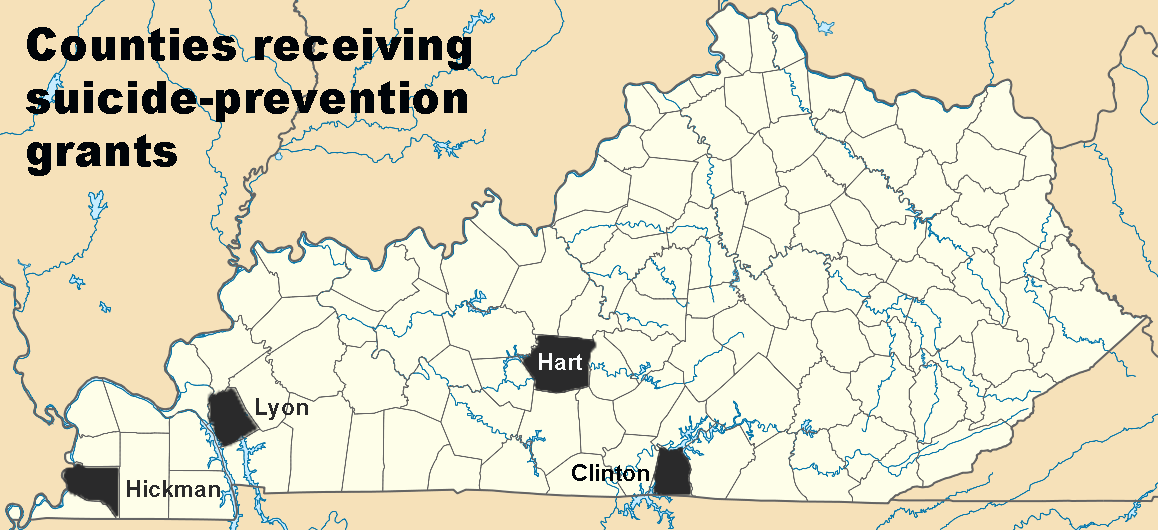
Map by Kentucky Health News from Wikipedia base map
The grant programs will begin Sept. 30 in Clinton, Hart, Hickman and Lyon counties, which were selected based on suicide-attempt rates among middle- and high- school students.

The release says additional locations will be identified in the coming years.

The award is named after the son of former Oregon Sen. Gordon Smith. Garrett Lee Smith took his own life in 2004, just before his 22nd birthday. Sen. Smith proposed the Garrett Lee Smith Memorial Act, which recognized suicide as the third-leading cause of death among youth 10 to 24.

Kentucky also received the grant in 2006, 2011 and 2015.

“My administration has always prioritized quality, accessible mental-health care,” Gov. Andy Beshear said in a news release. “The Garrett Lee Smith Suicide Prevention grant will make it easier for Kentuckians to get the help they need and deserve.”

The release says that the funding, $735,000 a year for five years, will advance the Kentucky Strategic Allies Fostering Empowerment of Today’s Youth (KY SAFETY) project. The project will help identify youth at risk for suicide and connect them with care pathways. 

KY SAFETY will also implement Youth Mental Health First Aid programs; Question, Persuade, Refer (QPR) training, and applied suicide-intervention training in agencies that serve youth. More than 5,600 staff members of youth-serving agencies are expected to be trained in the five-year grant period.

The news release says a key project component will provide first responders with internet-equipped tablets for use during behavioral-health emergencies to help ensure near-immediate access to a clinician.

“Kentucky has a long history of working to reduce suicide risk,” said Eric Friedlander, secretary of the state Cabinet for Health and Family Services. “Finding new and innovative ways to reach our youth is essential to improving access to behavioral health services. Given that many of our counties are rural, the use of tablets and telehealth services represents a creative way to provide services as quickly as possible.”
The national suicide hotline number has changed.
“The goal of the grant is to support strategies that focus on the identification of youth at risk of suicide, build capacity of clinical service providers to assess, manage and treat that risk and improve the continuity of care and follow-up of youth receiving care for their suicidality,” Patti Clark, an agency assistant director and principal investigator for the project, said in the release. 

At his Sept. 29 news conference, Beshear also encouraged Kentuckians to call the state's new, confidential 988 suicide hotline if they are experiencing a mental-health crisis or considering suicide. He said there has been a 27% increase in crisis and suicide call volume since the change, and a 10% increase in text messages. He also said calls are being answered more quickly, and the abandoned-call rate is the lowest since July 2021. 

Thursday, August 4, 2022

Feds will raise nursing-home payments, not cut them as planned

Nursing homes will get a big increase in payments from Medicare payments instead of the cut that the Centers for Medicare and Medicaid Services originally planned.

"In April, CMS proposed cutting Medicare Part A payments to nursing homes by $320 million. The transition to a new nursing-home payment model in 2019 inadvertently led to a 5% pay increase in fiscal 2020, requiring a decrease in payments next year, according to the draft regulation," Modern Healthcare reports. "But the agency has changed course, and will phase in that payment correction over two years to ease the burden on providers still struggling with the Covid-19 pandemic, the final rule says."

That means nursing homes will get a 2.7% increase next year in Medicare rates, an overall increase of $904 million. "While this is relatively more advantageous for skilled nursing facilities than the initial proposal, it falls short of the three-year phase-in the American Health Care Association/National Center for Assisted Living requested," MH reports. "AHCA President and CEO Mark Parkinson nevertheless believes the final rule will help providers during a stressful time."

LeadingAge, the lobby for not-for-profit providers, was unhappy. “We warned CMS that this is not the time to cut payments," President and CEO Katie Smith Sloan said in a news release. "Spreading the impact of the adjustment over two years . . . is helpful, but the end result adds to the chronic financial neglect of our nation’s nursing homes—in a time of real crisis."

Thursday, May 26, 2022

Campaign for healthy youth behavior cites exercise, nutrition, vaccination, managing stress, monitoring chronic conditions

Centers for Disease Control and Prevention photo
By Melissa Patrick
Kentucky Health News

The Foundation for a Healthy Kentucky and the Kentucky Department of Education have launched a public-service campaign to encourage Kentucky's children and their families to use the summer months to build healthy habits for the next school year and beyond. 

"We want to encourage Kentucky students to create and engage in healthy behaviors because research shows that healthy students are better learners. They often get better grades, they attend school more and stay focused longer in the classroom," Ben Chandler, president and CEO of the foundation said at a news conference to launch the campaign. 

The effort is part of a multi-faceted education and awareness "High Five for Health" campaign that includes animated videos, social media graphics, message points and materials to be distributed at sporting events, youth organizations and various other locations. All campaign materials are available for free download at HighFiveForHealth.org.

Chandler said the campaign is designed to help parents find no-cost or low-cost activities that the whole family can do together, and activities that older children may do independently.

The campaign focuses on five key areas to promote health, including prioritizing physical activity; practicing healthy eating; monitoring chronic conditions such as asthma, obesity and diabetes; staying up to date on vaccinations; and managing stress and emotions. 

The campaign website offers tips on each of these focus areas, including ways to prioritize physical activity and how to know if children are meeting the level of aerobic activity needed to make a difference. It also offers some healthy recipes and recommendations for how many fruits and vegetables a child should eat each day. In addition, it offers suggestions for how to help your child learn how to manage stress. 

When it comes to physical activity, the Physical Activity Guidelines for Americans recommends that children and adolescents get one-hour or more of moderate-to-vigorous physical activity daily.

Many of Kentucky's youth are sedentary. The latest Youth Risk Behavior Survey taken in 2019 found that 19 percent of Kentucky's high school students said they did not participate in at least 60 minutes of physical activity on at least one day in the week before they took the survey and 81% of them said they were not physically active at least 60 minutes per day on all seven days. 

Jim Tackett, the education department's healthy-school project director, encouraged Kentucky parents and youth to have fun as they incorporate some of these new healthy behaviors into their lives, but to also be intentional about it. He also encouraged parents and youth to be open to trying new things and to celebrate small successes. 

"Good health just doesn't happen by itself," Tackett said, adding later, "Each of our behaviors takes a little time to mold or to break. So over the summer months, we're hoping that the High Five for Health campaign will help us establish some new behaviors that we can carry with us down the road." 

Asked about the relationship between high screen time and low physical activity, Tackett recognized that this is an issue, but said this particular campaign largely addresses components suggested by the Centers for Disease Control and Prevention, which funded a large portion of it. 

He said reducing screen time would not only lead to increased physical activity, but also impact the mental health piece of this campaign.

"We would definitely support trying to take a break from those electronic devices," he said. "While they are necessary in the learning process today, we would like to strike that balance if at all possible. . . . I think there is a happy medium that we need to continually talk about." 

A recent University of Southern Denmark study, published in JAMA Pediatrics, found that children in the group that had their smartphones and tablets removed for two weeks and reduced their recreational screen media use to less than three hours per week had an average of 45 minutes more daily physical activity compared to children in the control group, which did not change their usual screen habits. 

"The difference between the groups were largest on weekend days where children in the screen reduction group had an average of 73 min more physical activity compared to children in the control group," lead author Jesper Pedersen said in the news release. 

In addition to making sure your child is up to date with their recommended schedule of vaccines, the campaign also encourages parents get their children who are five an older vaccinated against the coronavirus. To support this effort, the sponsors are offering a Covid-19 vaccine clinic in Lexington. 

In partnership with the state Cabinet for Health and Family Services and other health organizations, Chandler said the foundation and the education department will host Covid-19 vaccine clinics for youth five and older on June 3-4 and June 10-11 in Lexington, weekends when the Kentucky High School Athletics Association hosts the state boys and girls track, baseball and softball tournaments. They vaccines will be available in the green lot at Kroger Field. 

About 80% of the campaign is funded by the CDC and the U.S. Department of Health and Human Services.

Sunday, March 20, 2022

McConnell says more funds to fight the coronavirus should come from money in Democrats' 2021 relief bill that hasn't been spent

Sen. Mitch McConnell (Image and backdrop from CBS)
Senate Republican Leader Mitch McConnell said Sunday that Democrats should be willing to reallocate some unspent money from their previous pandemic relief bill to get more money to fight the coronavirus.

On CBS's "Face the Nation," McConnell was asked to comment on remarks by President Biden's chief health adviser, Dr. Anthony Fauci, on ABC's "This Week" that Congress needs to appropriate more funds for supplies of coronavirus tests, anti-vital medications and booster shots. A partisan dispute kept such funding out of the recent omnibus spending bill that funded the government through September.

"We just can't stand still, particularly as we appear to be in somewhat of a lull in the cases," Fauci said. "That's no time at all to declare victory, because this virus has fooled us before and we really must be prepared for the possibility that we might get another variant and we don't want to be caught flatfooted on that."

McConnell said Democrats passed a $2 trillion relief bill last year, "allegedly for Covid . . . on an entirely partisan basis," and "much of that money has yet to be spent. I'm willing to listen to the case that we need to spend more money on Covid, but they ought to reprogram some of this massive amount that was spent last year that is not out the door yet. So let's take a look at how to pay for it, and hem we'll be happy to decide whether or not to support it."

McConnell is essentially repeating a proposal that House Republicans made and Democrats rejected in the spending-bill negotiations, causing pandemic funding to be dropped from the bill. The Democrats' American Rescue Plan Act, passed about a year ago, gives local communities until 2026 to spend their allocations from it, but many communities have already decided how to use the money.

Thursday, January 20, 2022

CBO report issues report Yarmuth requested on health-care costs; he says Congress must do more to ease the burden

Yarmuth (WBKO image)
The Congressional Budget Office has issued a report requested by Democratic Rep. John Yarmuth of Louisville on the major drivers of increases in health-care spending and the variation in health-care prices and costs. It is stull working on a study Yarmuth sought of mechanisms to hold down growth in spending.

The report, “The Prices That Commercial Health Insurers and Medicare Pay for Hospitals’ and Physicians’ Services,” examines potential reasons that the prices paid by commercial health insurers for hospitals’ and physicians’ services are higher, rise more quickly, and vary more by area than the prices paid by the Medicare fee-for-service program, Yarmuth's office said in a press release.

Yarmuth said in the release, “We know that our country and our economy are stronger when every American has access to quality, affordable health care. But CBO’s report finds that inefficiencies in our health-care system and market consolidation are driving up prices, forcing Americans to either forgo necessary coverage or face higher premiums and out-of-pocket costs, reduced benefits, or lower wages. Congress must do more to reduce this unacceptable burden on American families.”

Earlier, the CBO issued Yarmuth-requested reports on "Policies to Achieve Near-Universal Health Insurance Coverage" and "Key Design Considerations for Establishing a Single-Payer Health Care System."

Saturday, January 8, 2022

Cap on insulin costs takes effect, but for fewer than 1/3 of Kentuckians; Biden bill would cover them all but its fate is in doubt

Jan. 1 was the effective date of a new Kentucky law that caps at $30 the cost of a 30-day supply of insulin. But it affects fewer than a third of Kentucky diabetics, so "advocates and others in the commonwealth's diabetic community are pushing for lawmakers to do more to open access to a medication that thousands in the Bluegrass State need to survive," reports Lucas Aulbach of the Louisville Courier Journal.

The law, passed last year, applies to people covered by group health-insurance plans, those regulated only by the state, plans on the Kynect exchange, and state employees. It does not apply to those who have health insurance through their employers; or through sources like Medicare or Tricare, which covers U.S. military-service members and veterans.

"The problem is that a state can't pass a law that would affect anything that's federally regulated, and most people have health insurance that's federally regulated," advocate Sarah Ferguson told Aulbach. Her daughter was diagnosed with Type 1 diabetes at age 14 more than 10 years ago.

Reps. Patti Minter and Danny Bentley saw Gov. Andy Beshear
sign their insulin price limit bill into law last March. (Screenshot)
President Biden's "Build Back Better" funding bill would cap all insulin co-payments at $35 a month, but it is stalled in the Senate and even if it passes, negotiations to accomplish that might remove the provision. "People need to let their Congress members know that this isn't OK, that people need $35 for a 30-day supply," said Rep. Patti Minter, D-Bowling Green, a sponsor of the new law.

Minter and co-sponsor Danny Bentley, R-Russell, have filed a bill to let people without health insurance those and people whose insurance has recently dropped insulin from coverage to get an emergency 30-day or 12-month supply at a reduced cost. "Similar bills have been passed in Minnesota and several other states under the name 'Alec's Law,' in honor of Alec Smith, a 26-year-old Minnesota man who died in 2017 while rationing insulin he could no longer afford," Aulbach reports.

Meanwhile, many people affected by the law are getting a significant break. "A single dose of insulin which cost between $2 and $7 to manufacture could sell for an average wholesale price of around $300 per vial," Gov. Andy Beshear said when he signed the Bentley-Minter bill into law last March.

More than half a million Kentuckians have diabetes, and Kentucky ranks seventh-highest in the U.S. for diabetes prevalence. more than one in four insulin-dependent people ration insulin due to cost, according to Angela Lautner, legislative lead for the Kentucky #insulin4all advocacy group.

The Bentley-Minter law requires health plans to provide the equipment, supplies and outpatient training and education needed to help diabetics stay healthy.

Monday, August 9, 2021

National Health Center Week salutes federally qualified health centers, primary-care providers for one in eight Kentuckians

Map (click on it to enlarge) shows Kentucky Primary Care Association members, their health centers and counties where they have school-based clinics. Shading of counties shows congressional districts.

Aug. 8-15 is National Health Center Week, promoted by the National Association of Community Health Centers, the common name for federally qualified health centers, which get federal funds to provide affordable primary care in areas with a shortage of health-care providers.

Such clinics "are the primary health-care providers for one in eight Kentucky residents, which is more than 550,000 people," the Kentucky Primary Care Association says in a news release.

“We have 32 federally-qualified-health-center members providing primary care and other services with clinic operations across the state,” said David Bolt, the CEO of KPCA. “The health centers are located in medically underserved communities and treat patients regardless of the patients’ ability to pay, their race, or their ethnicity. CHCs improve healthcare access and outcomes.”

"Many CHCs operate school-based clinics," KPCA notes. "The clinics are located in elementary, middle and high schools around the state," with the largest group operated by Cumberland Family Medical Center in 16 counties, from Anderson in Central Kentucky to Barren, Monroe, Cumberland, Clinton and McCreary in Southern Kentucky.

"CHCs employee a large number of physicians, nurses, other medical professionals, and administrative staff," the release says. "Estimates indicate they generate more than $740 million each year for local economies in communities throughout the commonwealth.

To find a clinic near you go to: https://www.kpca.net/, click on the directory tab and choose the FQHC category.

Sunday, August 1, 2021

Special enrollment period for health insurance on healthcare.gov ends Aug. 15; subsidies are bigger, and more people qualify

By Melissa Patrick
Kentucky Health News

Time is running out to sign up for low- or no-cost health insurance through the federal marketplace under the special enrollment created by Congress and President Biden. The deadline to sign up on healthcare.gov is Aug. 15. 

AARP illustration
The president reopened the marketplace in mid-February under the American Rescue Plan Act, for people who needed coverage during the pandemic, and later extended the deadline to Aug. 15. 

The special enrollment is open to both new and existing customers, including the thousands of Kentuckians who got temporary Medicaid coverage during the pandemic through the state's "presumptive eligibility" program. 

About 120,000 Kentuckians lost that temporary Medicaid coverage in July, according to Brice Mitchell, a spokesman for the state Cabinet for Health and Family Services.  

Mitchell said the state has told some of those people they would be losing their coverage and encouraged them to check kynect.ky.gov to see if they qualify for traditional Medicaid, or go healthcare.gov to apply for a federally subsidized plan. He said state Kynectors, who help people enroll, will continue the outreach through August. 

Dustin Pugel, senior policy analyst at the Kentucky Center for Economic Policy, encouraged Kentuckians who recently lost their temporary Medicaid coverage and are not covered by work or traditional Medicaid to "Run, not walk, to the marketplace to find an affordable option." 

Priscilla Easterling, the outreach coordinator for Kentucky Voices for Health and a Kynector, also encouraged Kentuckians without health coverage to explore their options on healthcare.gov, especially those who looked at plans in the past and found them unaffordable at that time.

"With the increased subsidies that the American Rescue Plan included . . . we have seen so many people save a surprising amount of money," Easterling said. "It is 100-percent worth just checking it out. . . . It's a totally different ballgame."

A federal report says 34% of those who got a subsidized plan since April 1 paid $10 or less a month for their coverage, thanks to the American Rescue Plan's premium reductions. In Kentucky, 32% of new customers and 19% of returning customers were able to find a plan for $10 or less per month. 

In the special enrollment period, plans are more affordable due to bigger premium subsidies through tax credits, and no repayments are required if a tax return shows they didn't qualify for the tax credit. Also, more people eligible for the subsidies, and costs are limited to no more than 8.5% of income, down from nearly 10%.

For the first time, the new rules allow those earning more than 400% of the federal poverty level -- about $51,000 for an individual and $104,800 for a family of four in 2021 -- to get a subsidized plan. 

This change is especially helpful to older adults with incomes above 400% of the poverty level, because unlike traditional health plans, which are allowed to charge more based on age, special-enrollment premiums are capped at 8.5% of income.

"Compared to current premium payments, a 60-year-old with a $55,000 income would pay 77% less for a bronze plan ($146 vs. $634 per month), 56% less for a benchmark silver plan ($390 vs. $887 per month), and 52% less for a gold plan ($453 vs. $951 per month), on average," says the Kaiser Family Foundation.

Also benefiting from this expansion to 400% of the poverty line are self-employed people who have not had access to affordable health insurance. "As wonderful as the Affordable Care Act was to open up affordable coverage for so many people," Pugel said. "It really did leave that group of folks out." 

Through the end of June, 13,773 Kentuckians had signed up for health insurance during the special enrollment period, according to a federal report. That's an increase from the special enrollment periods in 2020 and 2019, when 6,747 and 7,041 signed up, respectively. 

But fewer than 10% of eligible Kentuckians have taken advantage of the opportunity. Easterling said about 115,000 Kentuckians who qualify for a subsidy under the special enrollment period have not yet signed up.

Nationwide, more than 2 million have signed up.

Open enrollment is usually in effect only six weeks at the end of a year, except for those who experience a "qualifying life event," like getting married or losing a job. After the special enrollment period closes on Aug. 15, open enrollment will re-open Nov. 1.

Biden's American Families Plan would make some of these measures permanent, including the bigger tax credits, coverage to those who earn 400% and above the federal poverty level, and the premium cap of 8.5% of household income. Those measures will stop at the end of 2022 unless Congress makes them permanent.

Friday, July 23, 2021

130 Ky. rural health clinics, more than any state but Texas, will get $6.38 million to increase confidence in coronavirus vaccines

The federal government is sending $198 million to more than 1,980 rural health clinics for outreach efforts to increase confidence in the safety of coronavirus vaccines, and Kentucky is getting more money than all but one other state.

The state-by-state list of grants says $6,379,712 will go to 130 clinics in Kentucky, an average of $49,075. The only state with more is Texas, which has 142 clinic that will share $7,033,118, an average of $49,529.

David Bolt
Under the Rural Health Clinic Vaccine Confidence Program, clinics can publicize vaccination sites and partner with other public-health entities to create strategies to increase vaccine confidence. Clinics can also use the funding to improve health literacy on vaccines in general. "Compliance is governed by Health Resources and Services Administration rules and regulations, just like any other HRSA grant,” Kentucky Primary Care Association CEO David Bolt told Kentucky Health News.

"This funding is vitally important to Covid-19 vaccination efforts in local communities," Bolt said. "Trusted medical providers at our rural health clinics talk to their patients every day about the safety and effectiveness of the Covid-19 vaccines. Having additional resources will help them reach even more people and further address vaccine hesitancy issues at the community and neighborhood levels."

The funding, announced in May, is part of nearly $1 billion the American Rescue Plan Act authorized for three major programs strengthening pandemic response efforts in rural areas. In addition to the Rural Health Clinic Vaccine Confidence Program, HRSA is providing $460 million to more than 4,600 rural health clinics for coronavirus testing. Another $398 million will go to small rural hospitals for testing and mitigation.

A list of clinics and all their recent HRSA grants is here.

Tuesday, July 6, 2021

As Republican resistance complicates national vaccination effort, McConnell keeps pitching it; pundit calls Massie a demagogue

Reps. Thomas Massie and Marjorie Taylor Greene called
June 15
for the firing of Dr. Anthony Fauci. (Photo by
Jim Watson, Agence France-Press/Getty Images)
As The Washington Post ran a column with a headline saying "Republicans are preventing America from reaching Biden’s vaccination goal," and citing a Kentucky congressman as part of the problem, Senate Republican Leader Mitch McConnell continued advocating coronavirus vaccination as he toured the state.

"I know there is some skepticism out there, but let me put it this way: It may not guarantee you don't get it, but it almost guarantees you don't die from it, if you get it," McConnell told a crowd at Murray.

Three months ago, in a similar pitch in Lexington, McConnell said he "saw on some program last week that Republican men, curiously enough, might be reluctant to take the vaccine. I'm a Republican man, and I want to say to everyone, you need to take this vaccine." He made no such reference Tuesday.

The partisan picture of vaccination was explored in the Post by Council on Foreign Relations Senior Fellow Max Boot, a former Republican, who cited a Post-ABC News poll that found 86 percent of Democrats and 45% of Republicans have had at least one shot, and "47% of Republicans say they likely won’t get vaccinated, compared with only 6% of Democrats."

The emergence of the Delta variant of the virus, twice as contagious as the original and now the dominant form in the U.S., has public-health experts concerned about outbreaks among unvaccinated people, but 57% of Republicans in the poll said officials are exaggerating the variant’s risk, "compared with only 12% of Democrats," Boot notes. "These Republicans have fallen victim to a virulent strain of misinformation circulating in the right-wing echo chamber."

He identified several voices in that chamber, including U.S. Rep. Thomas Massie of the Fourth District, who tweeted July 3: “I’ve been contacted by members of our voluntary military who say they will quit if the Covid vaccine is mandated. I introduced H.R. 3860 to prohibit any mandatory requirement that a member of the Armed Forces receive a vaccination against Covid-19.” 

Boot writes, "Numerous veterans pointed out that military members can’t simply 'quit' — that would be going AWOL — and that they already receive numerous mandatory vaccinations. These despicable demagogues don’t come out and simply say vaccines are dangerous. Rather, like many conspiracy mongers, they imply it by asking loaded questions. Sen. Ron Johnson (R-Wis.), for example, recently sent letters to the CEOs of Pfizer and Moderna 'seeking answers about adverse reactions to the covid-19 vaccine.' His demand for 'answers' was then reported by Fox 'News,' which has become a super-spreader of vaccine disinformation."

Out of the national spotlight, McConnell has stuck to much the same script for months, making a vaccine pitch part of his presentations around Kentucky. At Murray, it took a minute and 45 seconds of a 22-minute presentation. After noting how Congress propped up the economy during the pandemic, he said the ultimate solution was a vaccine, and went on:

"I'm a bit of a student of vaccines, having been a polio victim when I was a kid. I've read a lot about that particular disease and how long it took to actually conquer: 70 years. Seventy years to get two vaccines that finally stopped it. Your amazing country, as the result of an extraordinary pharmaceutical industry, and $50 billion we put into something called Operation Warp Speed, came up with not one, not two, but three highly effective vaccines in under a year. A modern medical miracle, by any objective standard.

"That, obviously, is the only way to finally finish this thing off, and I might say, again getting back to a football analogy, we're in the red zone on vaccines, but we're not quite in the end zone yet. And I want to say again, there's no good reason not to get vaccinated. We need to finish the job.

"And I know there is some skepticism out there, but let me put it this way: It may not guarantee you don't get it, but it almost guarantees you don't die from it, if you get it. And so I hope we'll continue to emphasize the importance of finishing the job on vaccination, to get this into the end zone, once and for all."

On other topics, McConnell said the latest relief bill passed only with Democratic votes was "wildly out of proportion to where the country is now. . . . I didn't vote for it, but you're gonna get a lot more money," $4 billion, including $700 million to 800 million for local governments in the state: "Spend it wisely, because hopefully this windfall doesn't come along again."

He said the spending has made the national debt the size of the economy, the first time that has happened since World War II, and "We're not in World War II," but the total $7 trillion that Democrats want to spend would equal the federal spending on that war. "That's why the era of bipartisanship on this stuff is over," with the possible exception of an infrastructure bill, he said: "If credibly paid for, there's a way forward."

"I don't think we've ever had a bigger difference of opinion on doing what's good for the country," he said, but added that this Congress has passed seven major bills with bipartisan votes.