Showing posts with label health outcomes. Show all posts

Thursday, August 8, 2024

Annual health-policy forum Oct. 8 in Frankfort will focus on how a civic engagement approach can change health outcomes in Ky.

By Melissa Patrick

Kentucky Health News

What if the way to improving the health of Kentuckians is to create a culture where every person shares the same goal? That will be the focus of the Foundation for a Healthy Kentucky's 2024 Howard L. Bost Memorial Health Policy Forum, to be held at the Kentucky Historical Society, 100 West Broadway Street, Frankfort from 8:30 a.m. to 1 p.m. ET Oct. 8.

The forum, titled "Finding Common Ground on our Path to Better Health," will look at how to unite the state around a shared goal of addressing unmet health needs. The event is free, but reservations are required. To register, click here.

"Kentucky is consistently ranked as one of the unhealthier states in the country, despite the efforts by a dedicated few to improve the well-being of our communities," according to a news release for the event. "To make real progress, every single Kentuckian will need to play their part because we are stronger together."

Kentucky has been ranked among the bottom 10 states in health status since the America's Health Rankings began in 1990, except in 2008, when it ranked 39th. In 2023, Kentucky ranked No. 41.

The forum will host national and local experts who will talk about how to more authentically engage community members and find common ground on the path toward better health.

The sessions include:
  • Enough, Time to Build: How Communities Can Forge a Civic Path Forward: Rich Harwood, president and founder of The Harwood Institute, will talk about that the way forward is a new civic path, not more divisive politics.
  • Philanthropy + Democracy: Centering Humanity: Joy Ossei-Anto, managing director of Funder Engagement, Philanthropy for Active Civic Engagement will explore the role philanthropy can play in ensuring democracy is larger than politics and that humanity is centered.
  • Moving from Ally to Advocate: A Call to Action: Colene Elridge, CEO of Be More Consulting, will delve into the critical journey from allyship to advocacy within healthcare policy.
The annual forum was created in memory of Dr. Howard L. Bost, a notable health economist and founding member of the foundation's board of directors. The forum aims to raise awareness of the health issues impacting Kentuckians and highlight model strategies and policy opportunities to improve Kentucky’s health. It welcomes a range of audiences from inside and outside the health industry, including health care advocates, providers and educators, business professionals, civic leaders, policy makers and more.

Friday, May 31, 2024

Kentuckians are invited to virtual June town-hall meetings on helping families with complications from substance use

By Sarah Ladd
Kentucky Lantern

Kentuckians with ideas to improve outcomes for children placed in foster care because of substance use complications will get the chance to share them during a series of town halls this June, the Administrative Office of the Courts announced Wednesday.

Registration is required for the four virtual town halls, which Citizen Foster Care Review Boards are hosting on June 3, 5, 11 and 14.

“Community input is vital to identifying needs in each area of the state,” the AOC said in the release. “Due to confidentiality, specific cases will not be discussed.”

The town halls will seek to answer the following questions, and findings will be reported back to the Citizen Foster Care Review Board:
  •  Do families and children in your community have equitable and timely access to substance use disorder assessment and treatment services?
  • What are the barriers to accessing treatment for substance use disorder?
  • What solutions could be identified to remedy barriers to access and treatment and lead to resilience and recovery?
The four town hall dates and locations are as follows: 

June 3, 11 a.m.-noon CT/12-1 p.m. ET. Register for this town hall at kcoj.info/June32024 if you live in Allen, Ballard, Barren, Breckinridge, Butler, Caldwell, Calloway, Carlisle, Christian, Crittenden, Daviess, Edmonson, Fulton, Graves, Grayson, Hancock, Hardin, Hart, Henderson, Hickman, Hopkins, LaRue, Livingston, Logan, Lyon, Marshall, McCracken, McLean, Meade, Metcalfe, Muhlenberg, Nelson, Ohio, Simpson, Todd, Trigg, Union, Warren or Webster Counties.

June 5, 11 a.m. – noon CT/12-1 p.m. ET. Register for this town hall at kcoj.info/June52024 if you live in Adair, Bath, Bell, Boyd, Breathitt, Carter, Casey, Clay, Clinton, Cumberland, Elliott, Floyd, Green, Greenup, Harlan, Jackson, Johnson, Knott, Knox, Laurel, Lawrence, Leslie, Letcher, Lewis, Magoffin, Marion, Martin, McCreary, Menifee, Monroe, Montgomery, Morgan, Perry, Pike, Powell, Pulaski, Rockcastle, Rowan, Russell, Taylor, Washington, Wayne, Whitley or Wolfe Counties.

June 11, 11 a.m.-noon CT/noon-1 p.m. ET. Register for this town hall at kcoj.info/June112024 if you live in Bullitt, Fayette or Jefferson counties.

June 14,11 a.m.-noon CT/noon-1 p.m. ET. Register for this town hall at kcoj.info/June142024 if you live in Anderson, Boone, Bourbon, Boyle, Bracken, Campbell, Carroll, Clark, Estill, Fleming, Franklin, Gallatin, Garrard, Grant, Harrison, Henry, Jessamine, Kenton, Lee, Lincoln, Madison, Mason, Mercer, Nicholas, Oldham, Owen, Owsley, Pendleton, Robertson, Scott, Shelby, Spencer, Trimble or Woodford counties.

Sunday, March 3, 2024

Don't forget to turn your clocks ahead March 10; sleep experts say sticking with standard time would be best for health, safety

CDC illustration
By Melissa Patrick
Kentucky Health News

It's almost time to "spring forward" one hour into daylight saving time, which sleep experts don't support because they say it doesn't align with humans' internal circadian rhythms. Daylight saving time begins Sunday, March 10 at 2 a.m. local time. 

The American Academy of Sleep Medicine says "The United States should eliminate seasonal time changes in favor of permanent ST [standard time], which aligns best with human circadian biology. Evidence supports the distinct benefits of ST for health and safety, while also underscoring the potential harms that result from seasonal time changes to and from DST." The AASM published its position statement in the Journal of Clinical Sleep Medicine. 

The authors explain that human activities are affected by three clocks: the internal biological rhythm, also known as the circadian clock; the solar clock; and the social clock. When these three clocks align, the authors write that this allows for optimal health and performance. 

But when the solar clock is misaligned with the other two, they write, that causes a desynchronization between the internal circadian rhythm and the social clock -- and that happens with the change to daylight saving time. 

"The yearly change between ST and DST introduces this misalignment, which has been associated with risks to physical and mental health and safety, as well as risks to public health," says the statement. 

The AASM statement has links to several studies that show the adverse physical and mental health outcomes that come from moving clocks forward in the spring, including a surge of heart attacks, strokes and car crashes, to name a few.

A new study of the heart-health effects by the Mayo Clinic "suggests that the impact is likely minimal," says a release from the clinic.

Federal law allows individual states to exempt themselves from observing daylight time, and Kentucky has a bill to do that. However, House Bill 674, sponsored by Rep. Steven Doan, R-Erlanger, has not even been assigned to a committee.

Friday, December 22, 2023

Beshear wants lawmakers to be empathetic on controversial issues like abortion; sees better health for Ky. as possible legacy

Gov. Andy Beshear during his interview with Kentucky
Health News in the Capitol's State Reception Room
By Melissa Patrick
Kentucky Health News

In an interview Wednesday with Kentucky Health News, Gov. Andy Beshear said he would be pleased if one of his legacies as governor was improving the health of Kentuckians, and looked forward to the upcoming legislative session.

Beshear acknowledged that if Kentucky has clearly improved its health status when his term ends in 2027, he would have to share that legacy with his father, Steve Beshear, who expanded Medicaid coverage in Kentucky to 600,000 people when he was governor from 2007 through 2015.

"I'd love for both Beshears to be remembered for that," he said. 

Beshear's comments came after he was asked why he thought Kentucky showed a slight upward trend in the latest America's Health Rankings by the United Health Foundation.

The foundation ranks Kentucky 41st for overall health, up from 43rd in the last two rankings (2022 and 2019; the rankings were not made in 2020 and 2021 due to the pandemic). The state was 45th in 2018, 42nd in 2017, 45th in 2016, 44th in 2015 and 47th in 2014.

Beshear said increasing access to health care has been key to improving the health of Kentuckians, not only as a way to improve the quality of their lives, but  as a way to improve the state's workforce. 

"I believe that we are doing better, and that we will do better for a couple of reasons," he said. "First, especially coming out of the pandemic, we are seeing expansion of health-care access all over Kentucky." 

As examples, he pointed to the first hospital being built in West Louisville in 150 years, the expansion of the Bullitt County hospital and the new clinic that  Morehead-based St. Claire HealthCare is building in Morgan County. He said health-care systems are "recognizing that the overall health of our people is a shared responsibility." 

Other examples, "especially over the last four years," he said, are "the leaps we have made in treating addiction, especially the number of treatment beds." He said Kentucky has the most treatment beds per person in the country, and that has improved the overall health of Kentuckians. 

"That's a big start towards getting people healthy," he said. 

Beshear agreed that his father's 2014 expansion of Medicaid to people who earn up to 138 percent of the federal poverty level, under the 2010 Patient Protection and Affordable Care Act, has played a key role in improving access to care. He noted that his administration has extended post-birth Medicaid coverage from 60 days to 12 months, and expanded dental, vision and hearing benefits.

Outcome-based payments? Looking forward, Beshear said it will be important to find a way to use "significant dollars" to incentivize and reimburse Medicaid providers who have good patient outcomes, as opposed to the current model of reimbursing them only for the care they provide. 

"How do we create the best platform and structure to make this happen?" he pondered. "And that's going to be what we're looking at, really closely. . . .  Again, if we can move towards a model where we reward outcomes, I think we can do significantly better." 

Beshear also spoke about the importance of preventive screenings as a way to improve health outcomes, pointing to Lt. Gov. Jacqueline Coleman's experience as an example of their importance. Coleman recently underwent a double mastectomy after concerns were raised during a routine physical examination. 

"That shows just how critical and important that is," he said. 

Legislative issues: When it comes to controversial health issues, like "red-flag" laws or abortion, Beshear said it's important to approach these topics from a place of "basic human empathy" where people can find common ground.  

Beshear said he supports a red-flag law, which allows temporary confiscation of an individual's firearms if a judge finds that person is a risk to themselves or to others. A bipartisan bill to enact a version of the law is planned for introduction in the General Assembly session that begins Tuesday, Jan. 2.

But first, the governor said, he would like to stop the auctioning of murder weapons to the highest bidder. He said his support for such laws has grown stronger since the loss of a close friend, Tommy Elliott, in a mass shooting at the Old National Bank in downtown Louisville. 

"I know what it's like to lose a very close friend in a mass shooting," he said. "I know what it feels like to have someone who you love and care about murdered and taken from you." 

Beshear said it is imperative for the legislatuire to add rape and incest exceptions to the state's near-abortion ban, along with an exception for non-viable pregnancies. 

"There are kids right now that have been raped and impregnated by family members that don't have any options," he said. "Hadley said it right, she wasn't the first and she wasn't the last. There are Hadleys out there right now and they deserve better." 

Hadley Duvall, who was sexually abused by her stepfather for years and became pregnant at age 12 and eventually miscarried, appeared in an ad for Besehear's re-election campaign where she said, “To tell a 12-year-old girl she must have the baby of her stepfather who raped her is unthinkable.”

Beshear's Republican opponent, Attorney General Daniel Cameron, responded to that attack by asking Beshear in a debate and afterward how far into a pregnancy a woman should be allowed to get an abortion.

In his campaign and in the interview, Beshear wouldn't say, and turned the tables: "I believe in access, but that's not what we're going to see from this General Assembly," he told Kentucky Health News. "I believe in access with reasonable restrictions. That's not where we are. We are at zero access." 

In the interview and several others this month, the Democratic governor said he thinks he and Republicans who run the legislature can have a more cooperative relationship because he can't seek re-election in 2027.  

"This is the period of time when we can get these things done and not to be seen as a benefit or a detriment, politically," he said. "And I'm already seeing a little difference in tone, and that's everyone. . . . I think we're seeing just a different tone and willingness to talk or to . . . talk differently."

Friday, December 23, 2022

Kentucky again 43rd in America's Health Rankings, scoring lowest in behavior and health outcomes, high in having a care provider

By Melissa Patrick
Kentucky Health News

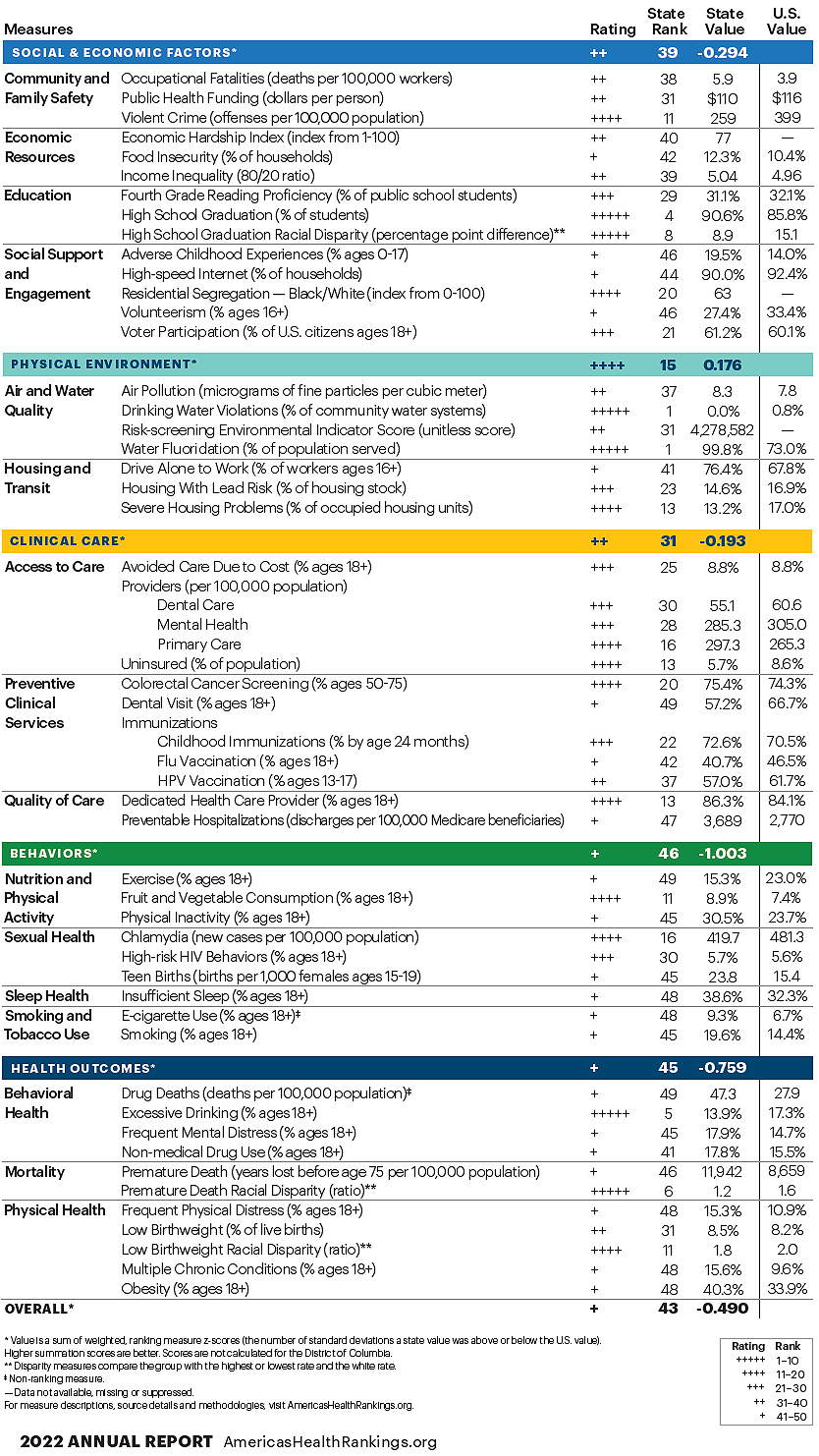
After not ranking states for two years due to the pandemic, America's Health Rankings again placed Kentucky among the 10 unhealthiest states, ranking its healthiness 43rd, the same slot it had in the last rankings, in 2019. 

Kentucky has found itself among the bottom 10 unhealthiest states since the rankings were first released in 1990, with the exception of 2008, when it ranked 39th. 

The rankings by the United Health Foundation are meant to help state leaders determine health benchmarks that can help them inform actions as they work to improve the health of their communities. 

The report examines a number of measures that influence health, broken into four categories: social and economic factors, physical environment, clinical care, behaviors, and health outcomes. 

Kentucky ranked lowest, 46th, among states in the behaviors category. 

Two measures in this category show that Kentucky adults don't get enough exercise, with only 15.3% of them saying they meet the federal guidelines for exercise in the past 30 days and 30.5% saying they didn't get any physical activity beyond their regular job in the past 30 days. For these measures, Kentucky ranked 49th and 45th, respectively. 

In the same category, Kentucky continues to have some of the highest teen birth rates in the nation at 23.8 teen births per 1,000 females aged 15 to 19; the national average is 15.4. In rankings that put the highest numbers at the bottom, Kentucky ranked 45th for this measure. 

Likewise, the state also continues to be a national leader in vaping and smoking, ranking 48th for adult use of electronic cigarettes and 45th for cigarettes (again, with higher numbers at the bottom). The rankings say 9.3% of Kentucky adults reported using e-cigarettes and 19.6% said they are regular smokers. 

Kentucky also ranked 48th in sufficient sleep, with 39.6% of adults reporting that they get, on average, fewer than seven hours of sleep in a 24-hour period. 

One of the Kentucky's better rankings in the behavior category was 11th for fruit and vegetable consumption.

In the health outcome category, Kentucky ranked 45th. With higher numbers at the bottom, it scored in the bottom 10 states for drug deaths (49th), frequent mental distress (45th), non-medical drug use (41st), premature death (46th), frequent physical distress (48th), multiple chronic conditions (48th) and obesity (48th). 

Though Kentucky ranked among the worst states in health outcomes, it does have a low prevalence of excessive drinking (fifth, with lower numbers at the top) and a low racial disparity in premature death (sixth). 

In social and economic factors, the state ranked 39th, with some of its worst scores in food insecurity (42nd), adverse childhood experiences (46th), access to high-speed internet (44th) and volunteerism (46th). 

The good news in this category is that Kentucky ranks fourth in the percentage of students who graduate from high school in four years and eighth in the difference between the high school graduation rates of white students and the racial/ethnic group with the lowest rate. 

In the clinical-care category, where it ranked 31st, Kentucky was in the bottom 10 states for dental visits (49th), flu vaccinations (42nd) and preventable hospitalizations (47th). 

Kentucky did not get any top-10 rankings in clinical care, but got top-20 rankings for its number of primary-care providers (16th), percent of uninsured population (13th), colorectal-cancer screenings (20th) and having a dedicated health care provider (13th). 

The physical environment category was the state's highest ranking, 15th, largely because it ranked first in two categories: drinking water violations and water fluoridation.


Sunday, October 30, 2022

Health officials in counties with high and low Covid-19 death rates point to vaccination rates, residents' underlying health status

Kentucky Health News map via Datawrapper, highlighting high-death-rate counties of Metcalfe, Monroe, Harlan, Perry, Lee and Robertson, and low-death-rate counties of Jefferson, Fayette, Scott and Woodford. For an earlier story with an interactive map with all counties' rates and data, click here.

By Melissa Patrick
Kentucky Health News

Health officials from Kentucky counties with some of the state's highest and lowest Covid-19 death rates both cited vaccination rates as a contributor, but the health official in the county with one of the highest death rates said the relatively low health status of the population must also be considered. 

A breakdown of Covid-19 deaths per 1,000 people in each county found that the highest county death rate is five times the lowest one. To explore that discrepancy, Kentucky Health News talked with a health official in a county with one of the highest rates, and one in a county with one of the lowest rates. 

In Woodford County, which had the fourth lowest rate, 2.09 Covid-related deaths per 1,000 residents, Public Health Director Cassie Prather said she attributed the low rate to its high Covid-19 vaccination rates, especially among residents 65 and older, who are among the most vulnerable.

"I would love to see a map overlay of the death rates and the vaccine rates," she said. Later adding, "I think the correlation is there." 

Woodford County has had one of the highest vaccination rates in the state throughout the pandemic. According to the Centers for Disease Control and Prevention Data Tracker, 78.3% of Woodford County's population has received at least one dose of the Covid-19 vaccine. Among residents 65 and older, 93.3% are fully vaccinated; 73.3% of those who are fully vaccinated have received one booster shot; and 54.6% of  those who have had the first booster have also received the second. 

Cassie Prather
Prather said getting people in Woodford County vaccinated has been a community effort that includes weekly clinics that are still running, community members volunteering to drive people to the clinics, a partnership with the emergency medical service to do home visits, and a mobile clinic that goes out twice a week to farms and people they normally wouldn't see at the health department. 

She added that city and county governments have worked diligently to keep their citizens informed, and that she and Judge-Executive James Kay still do weekly Covid-19 updates on the county government's Facebook page. "We knew how important communication would be . . . because we wanted people to be aware and to be able to make the best decisions for their family and friends," she said. 

Kay, who as judge-executive chairs the county health board, said his pandemic role has been to unite the community in an effort to fight the virus, while allowing the health department to lead the response. 

"We did a full county and community response," Kay said. "And we brought the cities and the county and the schools together to all be on the same page every day for nearly two years."

Expanding on the importance of giving the public direct, real-time information to combat misinformation, he said, "We created a level of trust. When we told them information; they knew it was true."  

Adjoining Scott County's Covid-19 death rate was just .007 per 1,000 higher than Woodford's. Crystal Miller, public health director of the regional health department that serves the county, told Mike Scogin of the Georgetown News-Graphic that the community's response to the pandemic was critical to keeping Covid-19 under control. 

“It was all hands on deck,” Miller told Scogin. “All our community partners bought in and everyone contributed. From elected leaders to businesses and industries, the hospital, schools and the newspaper, everyone wanted to do the right thing. A big portion was community support. The calls we received at the health department were, ‘How can we keep people safe?’”

Miller also said Scott County has one of the state's highest vaccination, which saved lives. The CDC says 65.2% of the county's population has received at least one dose of Covid-19 vaccine. 

“We did not get a lot of pushback," Miller said. "I know that was not the case in other communities, where people refused to even wear masks."

Metcalfe County, in south-central Kentucky, had the sixth highest Covid-19 death rate, 7.348 per 1,000 residents. It is served by the Barren River District Health Department, where Public Health Director Matt Jones said he thinks the rate stems from multiple factors.

Jones cited the county's poor health outcomes, gauged by life expectancy and measures of quality of life; and health factors, such as access to physicians, tobacco use, children living in poverty, and other environmental factors that contribute to or detract from the local population's health. 

"Those health outcomes, those health factors, they were already at play," he said. "And I think that is one of the leading reasons why we had higher mortality rates in Metcalfe County and the other six counties that you listed."

Counties with death rates higher than Metcalfe were Lee, 7.565; Perry, 7.803; Monroe, 8.075; Harlan, 8.574; and Robertson, the state's smallest county, 10.436 deaths per 1,000 residents.

Comparing just Metcalfe and Woodford counties' 2022 County Health Rankings, Metcalfe ranked 71st for health outcomes and 89th for health factors and Woodford County ranked eighth for health outcomes and third for health factors. 

Eight of the top 10 counties with the lowest Covid-19 death rates in Kentucky ranked in the top 11 counties for health outcomes, and included the top six counties for health factors.

"ZIP code matters," Jones said. 

Among the seven counties with the highest Covid-19 death rates, all ranked 69th or lower for health outcomes, and four ranked in the bottom 11. All seven ranked 64th or lower in health factors, with three in the bottom six. 

Jones also pointed to the discrepancies in health-care access between rural and urban counties as a possible reason for Metcalfe County's higher Covid-19 death rate.

He noted that Warren County, which has a population of nearly 133,000, and Metcalfe, with around 10,000, have very similar vaccination rates, 45.7% and 45.3%, respectively, with at least one dose, but Warren's death rate was less than half Metcalfe's, 3.02 deaths per 1,000 residents. 

Warren, with its fast-growing county seat of Bowling Green, has many more health resources than Metcalfe County, including two hospitals, while Metcalfe County has no hospital and a shortage medical providers, Jones noted.  

Asked about the county's lower vaccination rates, he said, "I think vaccinations did play a role, especially as it relates to moderate and severe cases. But I do think those health outcomes and the other indices played a major role in the overall outcomes of Covid." 

Among Metcalfe County seniors, 62.7% are fully vaccinated; 67.8% of those have received one booster shot; and 36% of that group have taken the second shot, according to the CDC.  

Jones said the eight counties in his health district have taken a multifaceted approach to the pandemic that has evolved as their needs have evolved. Beyond providing testing and Covid-19 vaccination clinics, the local departments participated in work groups with community leaders to keep them informed and used social media, local newspapers and radio stations to keep the public informed.

Saturday, October 15, 2022

FDA chief, at UK, says 'It's fair to be critical' of failure to control e-cigarettes; voices concern about life expectancy, misinformation

By Melissa Patrick
Kentucky Health News

U.S. Food and Drug Administration Commissioner Dr. Robert Califf said Friday at the University of Kentucky, "It's fair to be critical of the FDA" regarding the agency's struggle to regulate electronic cigarettes.

Asked in a news-media interview what the FDA is doing to crack down on e-cigarette companies that defy FDA rules and continue to sell their products, with reports that the FDA is not enforcing the law to shut them down, Califf replied that this is a "tough issue." 

Robert Califf, M.D.

Califf said that while federal law requires the companies to submit an application to the FDA to determine if they can stay on the market, it turns out that there are 6.7 million vape products, which "no one expected." He said there were already a million synthetic nicotine products on store shelves by the time Congress passed a law to cover them.

"It's been a lot more labor-intensive than was expected," he said. "We're doing a complete evaluation now that will be out in December and enforcement is a big part of that. And I would just say, it's fair to be critical of the FDA in this regard.

"But in order for FDA to have enforcement, like taking things off the shelves, that involves other branches of government also. And so we've got to figure out how to adapt to a much more creative industry than we expected in terms of all the products that are developing and the way they're dealing with it." 

As a guest speaker at UK Healthcare's 60th Anniversary Symposium, Califf touched on a number of health-related topics very relevant to Kentucky, including tobacco use, decreasing life expectancies and the role of health-related misinformation.

He said Kentucky still has work to do on tobacco use, since it still has one of the top rates in the country (21.4% of adults) and is likely to lose about 8,000 people this year to tobacco-related illnesses.

"So we've got to work together to help people stop using tobacco or reduce their use of tobacco . . . and underneath that, we've got vaping, which is rising while the use of tobacco is declining," Califf said in the interview. "Those things are right in the core mission of the FDA." 

The FDA is working on a proposal to remove menthol from tobacco products to discourage smoking. The move has been long in coming because menthol cigarettes are the choice of most Black smokers. 

"Get rid of that and you're pretty much left with tobacco-flavored tobacco," he said. "That's going to, I think, be a disincentive for people to continue to use it. . . . Law prohibits us from eliminating tobacco products, you can't take them completely off the market."  

Life expectancy: Califf voiced grave concern that life expectancy, the most basic measure of population health, has decreased in the U.S. during the pandemic and is five years shorter than the average of other high-income countries. He pointed out that life expectancy is lower in the Appalachian region and the Southeast. 

"We've got very significant work to do if we're going to turn this around," he said, adding later, "It's something that I believe is an emergency that we need to take seriously, and it's something that is not sustainable."  

One of the ways to improve life expectancy, he said, is to improve health outcomes, which include things that we already know how to treat like obesity, low physical activity, cigarette smoking, high blood pressure and diabetes -- all conditions that plague Kentuckians. He also noted the widening disparities in health outcomes in rural people, compared to urban ones. 

"These are things that are not foreign objects to us, we understand them reasonably well," he said. "We're just not doing a good job of executing on the things that we already know."

He later told reporters that experts say it will be important to fix the underlying social determinants that impact health if we are ever going to move the needle on health outcomes, including things like fundamental economic and income distribution and the education system. 

"The good news for our health is, poor people can have really good health because you are talking about blood pressure, cholesterol level, use of tobacco, simple screening things that aren't very expensive. The most important drugs now are generic . . . so this is why I keep gravitating back to having a primary-care system that works." 

The role of the FDA in all of this would be in the regulation of food and nutrition and tobacco and digital products that would enhance better health outcomes, he said. 

He touched briefly on the increasing number of deaths caused by substance-use disorders, but did say that there is a great need for a non-addictive treatment for pain, which we don't have yet. 

Misinformation: Califf spent a fair amount of time talking about health misinformation, which he defined as when well-intentioned people get health information wrong and then influence a lot of people by sharing that bad information. He said it is largely driven by the widespread use of social media and the internet.

"I can't find a single expert who can put credibly put forth a strategy that will turn around the fact that we're losing the battle on misinformation right now," he said. 

Califf called on state health institutions and health professionals to actively work to dispel misinformation, most recently as it relates to the Covid-19 vaccinations and boosters. 

"We know that the most effective way to counter misinformation is through human interpersonal interaction with someone that you trust," he said "If we don't build this in as an active part of our medical education, what our doctors and nurses and pharmacists to in day to day work, we're going to lose." 

As for the FDA's role, Califf said one of the agency's missions is to provide people with reliable information about products, and the FDA will continue to put out reliable information. 

"We have a responsibility to try to do something about it, but it's overwhelming," said Califf, who is serving in his role as FDA commissioner for the second time. "The government can't fix this because there's so much mistrust of government that we need the private sector to pitch in. And we need the press to pitch in and be aware of when it's promoting misinformation and things that will affect people's health in a negative way." 

Saturday, June 15, 2019

Scorecard ranks Kentucky's health system 40th; bright spot is health insurance; biggest increasing problem is drug overdoses

Chart by The Commonwealth Fund, which explains: (a) The 2019 rankings generally reflect 2017 data.
(b) Comparisons are with a "baseline" period, which varies among the measured indicators. The report says, "There were generally four to five years between indicators’ baseline and current-year data."
By Melissa Patrick
Kentucky Health News

Kentucky remains in the bottom fourth of all states in the latest ranking of states' health systems, though it inched up in the rankings two spots to 40th overall. Its bright spot is access to health insurance; its biggest increasing problem is drug abuse, as measured by overdoses.

The Commonwealth Fund Scorecard on State Health System Performance evaluates states on 47 indicators of health in five areas: access and affordability, prevention and treatment, avoidable hospital use and hospital cost and healthy lives,which includes measures on premature death, health status and risky behaviors. This is the Commonwealth Fund's seventh scorecard, with the first one released in 2007.

The report found that suicide, alcohol and drug-overdose deaths have increased markedly in the past decade and that the prevalence of these "deaths of despair" vary by region. Kentucky is one of 13 states, all east of the Mississippi River, with more than 30 drug-overdose deaths per 100,000 people.

For every 100,000 Kentuckians, 37.2 died of overdoses in 2017. That was 57 percent more than in 2013, when the rate was 23.7 deaths per 100,000. In the same period, Kentucky alcohol deaths increased 45%, from 6.6 per 100,000 to 9.6. Deaths by suicide showed no real statistical difference from 2013 to 2017, when the numbers were 15.5 and 16.9 deaths per 100,000.

Nationally, from 2005 to 2017, the report shows that deaths from drug overdoses went up 115%, deaths from alcohol increased 37% and deaths from suicide increased 28%. In every state, deaths from those causes have risen at least 3 percent since 2005.

"Drug overdose mortality is disproportionately impacting states in the eastern part of the country and suicide and alcohol related deaths are occurring at higher rates in the west," David Radley, senior scientist at The Commonwealth Fund and lead author of the study, said during a press conference.
“What we're seeing is a regional epidemic when it comes to premature deaths from suicide, alcohol, and drugs," Dr. David Blumenthal, president of The Commonwealth Fund, said in the news release. "It's going to take solutions that meet local need, and greater cooperation across all sectors -- at both the federal and state level -- to end the crisis that is shortening life expectancy in the United States."

Sara Collins, vice-president of The Commonwealth Fund and co-author of the study, said one of the best things states could do to ensure that people with substance-use disorders have access to care is to expand Medicaid to people who earn up to 138% of the federal poverty line, as Kentucky has under the 2010 Patient Protection and Affordable Care Act, or "Obamacare."

The Commonwealth Fund's new data center lets users create
custom tables, graphs and maps. The uninsured rate in the
Southeast is 16%; in the U.S.12%; and in Kentucky it's 7%.
Kentucky's Medicaid expansion has given it one if its few bright spots when it comes to health care: the low number of people without health insurance.

In 2013, 21% of Kentuckians lacked health insurance. Medicaid expansion in 2014 has been the major factor in lowering that to 7%, which ranks Kentucky eighth best among states.

Despite these gains in coverage, the report notes that health insurance remains unaffordable for many, especially for those whose incomes are just over the eligibility threshold for the Obamacare marketplace subsidies. 

And at the same time, it says employer plans are growing at a faster rate than median incomes, "leaving many families paying more for their insurance, but getting less."

Kentuckians spent 7.3% of their median income on employee premiums for health insurance, slightly above the national average of 6.9%.

Kentucky's rankings

Compared to the baseline data on 45 measurements, Kentucky has improved on 18 indicators, shown little or no change on 18, and worsened on nine.

Kentucky's top rankings were in prevention and treatment (20th) and access and affordability (23rd), but it remained near the bottom for health disparities (40th), avoidable use and cost of hospitals (48th) and healthy lives (49th). It ranked 50th for its large numbers of adults who smoke, adults who report fair or poor health and children who are overweight or obese. (50th was not the worst ranking because the District of Columbia was counted as a state.)

Among the state's top indicators, Kentucky ranked fourth for its high percentage of adults who got an annual hemoglobin A1C test, an indicator of diabetes; and seventh for its low number of home-health patients who did not get better at walking or moving around.

Home-health patients' mobility was Kentucky's most improved measurement, other than the much lower uninsured rate; 22% did not improve their mobility in 2017, compared to 36% in 2013. Another big improvement was in adults who went without care because of cost, falling to 12% in 2017 from 19% in 2013.

Kentucky worsened in deaths caused by overdoses, listed above; preventable hospitalizations of people 18-64, which rose from 5.4 per 1,000 employer-insured enrollees in 2015 to 7.6 per 1,000 in 2016; and death within 30 days of hospital admission, which was 14.3% in 2014-17 and 13.3% in 2010-13.

Hospital 30-day mortality measures death rates for Medicare patients with a principal diagnosis of heart attack, heart failure, pneumonia or stroke within 30 days after admission, regardless of whether the patient dies while still in the hospital or after discharge.

The report also estimated what would happen if the state improved to the level of the best-performing state, which once again was Hawaii. Among other things, 108,982 more adults and children in the state would have health insurance; 136,534 fewer adults would skip needed care because of cost; and 174,435 more adults would receive age- and gender- appropriate screenings for cancer.

For the first time, the scorecard also includes regional comparisons. The Commonwealth Fund has a data center (datacenter.commonwealthfund.org) that allows users to explore state health system performance and policy data through custom tables, graphs and maps.

Thursday, March 15, 2018

County Health Rankings show movement among some counties; rankings are blunt instruments meant to spur local action

By Melissa Patrick
Kentucky Health News

The latest County Health Rankings report for Kentucky shows little change among the top and bottom quarters of the standings, but a good deal of movement among counties in the middle -- in both directions.

The rankings look at health outcomes, gauged by life expectancy and measures of quality of life; and health factors, such as access to physicians and areas to exercise, tobacco use, children living in poverty, violent crime, long commutes and other environmental factors.

The rankings compare a state's counties against each other without comparison to national data, so when one county moves up, another moves down.

In health outcomes, 18 of the state's 120 counties moved up at least 10 notches since last year, and another 18 moved down by at least 10 slots. In health factors, about 10 counties improved at least 10 notches and 11 dropped by at least 10.

Most counties showed some shift in the rankings, but the differences may be so small they they are statistically insignificant. So, the University of Wisconsin Population Health Institute emphasizes a county's quarter (statistically, a "quartile" of 30 counties) as the best overall indicator of its health status. The rankings should be viewed more as a general categorization of a county's health status than to make specific comparisons with counties that are relatively close in the rankings.

The bottom quartile for both health outcomes and factors continues to be almost entirely Appalachian counties, with the only exceptions being Fulton County, in the Mississippi Delta at the state's western tip, which falls into the bottom quartile for both measures. In northern Kentucky, Bracken County was in the bottom quartile for outcomes, and Carroll County was in the bottom for health factors.

Oldham and Boone, two of Kentucky's wealthiest counties, continue to be the top two for health outcomes, as they have been since the rankings began in 2011. No. 3 Shelby County, which borders Oldham, has been in the top five since 2013. Adjoining Spencer County is ranked fourth. It adjoins Bullitt County, which ranked fifth. All of these counties are either in or near major metropolitan areas, which typically have better access to medical care as well as higher incomes.

Bullitt has shown considerable improvement recently. It jumped to sixth in outcomes 2016, from 27th in 2015, and was in the top 10 last year.

Breathitt, Wolfe and Owsley counties, in that order, have been the bottom three in outcomes for the past three years. Leslie and Perry counties make up the rest of the bottom five this year. All are in the East Kentucky Coalfield.

Oldham and Boone are also the top two counties in health factors, and have been since 2015. They have been in the top five since 2011. Woodford, Campbell and Spencer are currently ranked third, fourth and fifth, respectively.

The bottom five counties for health factors are Clay, Harlan, Knox, Leslie and McCreary, all in the eastern coalfield.

A few counties show big changes

Since 2011, some counties have seen big improvements in their rankings, while others have declined and others seem to bounce back and forth, perhaps because they are small and thus more likely to have their rankings changed from year to year.

Hickman is an example of how a county's rankings can fluctuate, and why it's important to look at multi-year trends. Last year, the Mississippi River county ranked 23rd in outcomes, up 53 spots from the initial 2011 report -- but it fell 20 notches this year, to 43rd. Its health-factor ranking also fell 20 places, to 57th, after improving to 23rd in 2016.

Henderson County also saw a surge of improvement in both of last year's rankings, only to drop back to some of its lowest rankings in outcomes and factors this year. The northwestern county dropped 31 outcome spots, to 70th from 39th last year, and 15 factor spots, to 55th from last year's 40th.

One of this year's success stories is Garrard County, which saw a 25-notch jump in outcomes, moving to 39th from 64th last year -- its worst ranking for this measure since the rankings began. The southern Bluegrass county also saw an improvement in its health-factor ranking, to 38th from 54th last year. It had ranked between 51st and 65th in health factors since 2013.

Christian County improved 22 notches in factors and and 18 places in outcomes over last year.

Bracken saw the greatest drop in health outcomes this year, falling 43 notches to 98th from last year's 55th. Nevertheless, it showed an improvement of 10 notches in the health-factor ranking, to 33rd.

Metcalfe County dropped 30 notches in outcomes, and 18 places in factors; Webster dropped 24 spots in outcomes and 13 spots in factors.

The report charges Kentucky counties to take this data and turn it into action, and offers specific strategies to do so on its What Works for Health website. Some of the suggestions include ways to invest in education, ways to improve employment along with improved family and social supports, ways to increase access to comprehensive sex education in both schools and communities and ways to increase social connections in communities.

The report also reminds counties to look at the health outcomes and health factors in their communities related to the racial and ethnic backgrounds of their residents, noting that these numbers are often masked when we only look at the differences based on place. For example, the report notes that 14 percent of babies born to black mothers in Kentucky are born with a low birthweight, compared to 8 percent of babies born to white mothers or 7 percent born to Hispanic mothers.

Click here to view an interactive map of your county's rankings, with details for each measurement.

Monday, June 19, 2017

Study finds dog owners walk 22 more minutes per day, at a pace that improves health; Ky. seniors rank very low for physical activity

WebMD photo
By Melissa Patrick
Kentucky Health News

Dog owners walk on average 22 more minutes per day compared to people who don't own a dog, says a recent study.

"Not only did we see an increase in exercise, but also the exercise was at a moderate pace," study author Daniel Mills of the University of Lincoln, in the United Kingdom, told Allison Aubrey of NPR.

The study, published in the journal BMC Public Health, found at times the dog owners walked around 3 miles per hour, which the Centers for Disease Control and Prevention considers moderate intensity.

"Prior studies have shown that moderate-intensity walking is just as effective as running in lowering the risk of high blood pressure, high cholesterol, Type 2 diabetes and other conditions," Aubrey reports.

The study included men and women aged 65 and older who agreed to wear an activPAL monitor, which measure speed, distance and other factors 24 hours a day. Participants also self-recorded information about their own and their dog's demographics, daily responsibilities and sleep/wake times. The study started with 43 pairs of dog owners and non-dog owners.

And in addition to the additional 22 minutes of walking at a brisk pace, the study said participants added almost 3,000 additional steps per day and sat less often, though the total time spent sitting didn't vary much.

"The national physical-activity guidelines call for 150 minutes a week of moderate-intensity exercise, and that's what they got in this study," Robert Sallis, a family physician with Kaiser Permanente in California, told Aubrey about the study. Sallis was not involved in the research.

"If you look at studies on pet ownership, people who own pets seem to live longer than those who don't own them," Sallis said. He added that it's not just the increased activity that improves a persons health, but is also the companionship that pets provide which can lead to lower rates of depression and stress.

Kentucky's seniors are ranked third in the nation for physical inactivity, according to America's Health Rankings. They also ranked last in health outcomes, which measured things like self-reported health status, premature deaths and frequent mental distress.

Harvard Medical School also touts the many health benefits of having a pet, but cautions that they can be expensive to care for, require a lot of work, can pose sanitary risks and that they can sometimes pose a health hazard for older adults.

"If you have problems with gait and stability and your pet can get under your feet or jump up and knock you over, then falls and broken bones are a real danger," psychiatrist Dr. Greg Fricchione, director of the Harvard-affiliated Benson-Henry Institute for Mind-Body Medicine, said in the article.

For a fee, the medical school has published a special health report called "Get Healthy, Get a Dog," that offers advice on how to choose the best pet to suit your lifestyle, as well as the role of service dogs.

Thursday, March 23, 2017

Health officials and advocates list Kentucky's top 5 health issues, including one newly identified: adverse childhood experiences

About 125 people worked on the state health assessment at the
Kentucky History Center in Frankfort on Wednesday, March 22.
By Melissa Patrick
Kentucky Health News

A group of about 125 people spent March 22 with officials from the Kentucky Department of Public Health to prioritize the top health issues in the state, and after a long, deliberate process decided they were substance abuse, obesity, tobacco, health-care access and adverse childhood experiences.

"Adverse childhood events" such as abuse and household dysfunctions, like having a household member in jail or coming from a divorced family, can have lasting effects on health and well-being.

ACEs affect 59 percent of Kentuckians, according to the 2015 Kentucky Behavioral Risk Factor Survey, the first one to include questions about 11 such events. The results showed that Kentucky has a higher-than-average percentage of people with six or more ACEs.

"There are things that happen to us early that make a huge difference as we get older," Dr. Connie White, senior deputy commissioner of the state health department, told the gathering of about 125 people, about half of them from outside the agency.

As for the other big issues, "Eating less, good exercise and not smoking would solve so many of our problems," said Deputy Secretary Tim Feeley of the Cabinet for Health and Family Services. He said the solution to Kentucky's health problems rested in early health education and personal responsibility.

"There isn't a pill that will fix everything," he said. "We need to make people more responsible, more in tune with their own health and we need to do that through education; we need to do that through access to good health care that encourages them to do it that way."

Various health officials reviewed data on the state's health, reminding the room full of health-minded participants that Kentucky has the nation's highest smoking rate (26 percent of adults) and the highest rate of new hepatitis C infections; has seen its opioid overdose deaths triple between 2006 and 2015; is largely sedentary; and has some of the nation's highest rates of cancer, diabetes, heart disease and obesity.

One of the few bright spots in the overview was the drop in the share of Kentuckians without health insurance, from 18 percent to 7 percent since the implementation of the Patient Protection and Affordable Care Act. This was largely because Kentucky expanded Medicaid under federal health reform to those who earn up to 138 percent of the federal poverty level.

Throughout the meeting, participants expressed concerns about Republican plan to repeal and replace the Patient Protection and Affordable Care Act, which among other things would phase out the Medicaid expansion, drop the requirement to cover 10 essential health benefits and turn Medicaid into a block grant program and give the states control of it.

Allison Adams, director of the Buffalo Trace District Health Department and president of the Kentucky Health Department Association, gave an overview of Public Health 3.0. This national initiative calls for local health-department leaders to become the "chief health strategists" in their communities, focusing on prevention and social determinants of health. This new approach to public health relies on health departments working with community partners to address the health needs of their community.

Participants wrapped up the day-long meeting by forming work groups centered around each of the five identified priorities. The groups were charged to find out what is already being done in the state around these issues, and to then decide the best holistic plan to "move the needle forward."

Thursday, March 16, 2017

Though more have insurance and can see a doctor, Ky. shows little gain on health outcomes; Chandler says that takes time

By Melissa Patrick
Kentucky Health News

The percentage of Kentuckians without health insurance has dropped by more than half since the implementation of the Patient Protection and Affordable Care Act three years ago, and few of the insured are having trouble finding a doctor when they need one, according to a report for the Foundation for a Healthy Kentucky.

However, the report also said little progress has been made to improve Kentuckians' health-care quality and health outcomes since the law was fully implemented in 2014.

"The ACA has led to clear progress for many Kentuckians in three of the five areas we tracked: insurance coverage, access to regular doctor visits and health-care costs for families," said Ben Chandler, president and CEO of the foundation. As for health-care quality and outcomes, he said, "Often, it takes longer to see these results; you don't turn around low birth weights or lengthen average lifespans in a couple of years."

The report found that since the implementation of the ACA, Kentucky's uninsured rate dropped to 6.1 percent from 13.6 percent. The highest coverage increase came in Medicaid and the Children's Health Insurance Program; 13.4 percent of Kentuckians had such coverage in 2012, and 19.8 percent had it in 2015.

Kentucky and other states that fully expanded Medicaid under the ACA saw the greatest increases in coverage. Neighboring states that expanded Medicaid had uninsured rates of 7 percent or lower; those that didn't, such as Tennessee, had rates of 9.1 percent or higher. It also noted that two neighboring states that expanded Medicaid through an "alternative" approach, like Kentucky has proposed to do, have uninsured rates similar to the non-exemption states.

The report also found that more Kentuckians said they had seen a health-care provider in the year prior to being surveyed (73.8 percent in 2012, rising to 78.7 percent in 2015) and fewer Kentuckians said they were delaying or skipping health care because they couldn't afford it (dropping from 11.7 percent to 6.5 percent). However, this wasn't true for the poorest and sickest Kentuckians who said health care cost still kept them from getting the care they needed.

Contrary to assertions by Republican Gov. Matt Bevin, the report says there is no evidence that the newly insured in Kentucky are having trouble finding a doctor when they need one, nor have they had an increase in average out-of-pocket spending on health care since 2012.

"Nearly 95 percent of Kentuckians could still find a doctor when they needed one," said Chandler, who voted against the ACA when he was a Democrat representing the 6th District in 2009.

Other improvements included fewer elderly Kentuckians delaying prescription refills or skipping or reducing medication doses because of high drug costs; a more than 500 percent increase in the number of covered substance-abuse treatments through Medicaid; a drop in the number of Kentuckians having trouble paying their medical bills; and lower monthly premiums in Kentucky's marketplace compared to most surrounding states and the U.S.

The report also looked at "quality-of-care" indicators and found they had neither improved nor declined since the ACA was implemented.

It noted that three of the quality measures that they looked at had "shown some progress," including the number of infants who were breastfed at discharge from the hospital, preventable hospitalizations due to high blood pressure, and asthma and colorectal screenings. It also noted that the state's smoking rate had dropped from 28.3 percent in 2012 to 26 percent in 2015, though the high-school student smoking rate had a smaller decline, from 17.9 percent in 2013 to 16.9 percent in 2015.

The report cites negative trends related to health behavior. Preventable hospitalizations due to short-term complications from diabetes increased, and the state's obesity rate rose from 31.3 percent in 2012 to 34.6 percent in 2015.

Chandler noted that some health measures, especially related to chronic health issues, may have worsened at first but then improved because many Kentuckians were seeing providers for the first time and were newly diagnosed. He noted that this increased access to care will ultimately improve the health of Kentuckians and decrease health care cost in the future.

"Myriad factors contribute to health and it takes time to change the tide in health outcomes," Chandler said. "In the long run, though, increased coverage, improved access and lower costs lead to better quality and outcomes. That's why I'm grateful Kentucky continues to support Medicaid expansion. We all want to sustain the gains we've achieved under the ACA and see the long-term benefits of increased coverage and access."

The foundation's study on the impact of the ACA over its first three years in Kentucky was conducted by the State Health Access Data Assistance Center at the University of Minnesota. Click here to see the full report.

Thursday, August 18, 2016

Philosophical divide evident at Medicaid oversight meeting; Bevin officials say revised plan will be sent to feds 'shortly'

By Melissa Patrick
Kentucky Health News

As Gov. Matt Bevin prepared to ask federal officials to let him change the state's Medicaid program, a discussion at a legislative committee meeting offered a glimpse of the philosophical differences between the political parties, through a window that showed the two mindsets at work.

Most of the Medicaid Oversight Committee meeting involved an overview of Bevin's draft proposal, which is designed to assure that "able bodied adults" have a higher level of involvement in their health care, through things like premiums and "community engagement" requirements.

Most who would be affected by the proposal have gained health insurance under then-Gov. Steve Beshear's expansion of Medicaid to those who earn up to 138 percent of the federal poverty level. The changes would not affect pregnant women, children or those who are deemed medically frail.

"We will be making some changes" in the draft request for a waiver of some Medicaid rules, Health Secretary Vickie Yates Brown Glisson told the committee. "We anticipate that shortly we will be getting a revised waiver to" the U.S. Department of Health and Human Services.

Comments after the presentation offered some insight into the deep philosophical divide between the political parties about how to provide health insurance to the state's poorest citizens.

Rep. Benvenuti
Rep. Robert Benvenuti, a Lexington Republican, shared a story that supports his belief that many able bodied Kentucky adults are taking advantage of the system. He said employers have called him and said they were having difficulty filling jobs because people didn't want to work full time because then they would lose the "free health care" they get from Medicaid.

"Have you all looked at that?" he asked. "The whole issue of people who voluntarily -- in other words, they are not vulnerable -- they voluntarily decided that it is simply not worth the effort to go work because the benefits of not working have outstripped the benefits of work?"

Adam Meier, the governor's deputy chief of staff, sympathized with Benvenuti and said the issue was of "serious concern." He said the fact that four of 10 Kentuckians are not working suggests "We have in some instances created a culture, or an environment where it is sometimes easier to not work and the benefits will be able to sustain you."

Meier said the work and community-engagement requirements in the draft Medicaid plan would help able-bodied Kentuckians have the tools and incentives they need "to go out and be engaged in their communities, be engaged with their employer."

Sen. McGarvey
Sen. Morgan McGarvey, a Louisville Democrat, asked the Republicans, "Do you guys have any evidence or numbers of people who have quit work to get Medicaid?

"I think that would be pretty anecdotal, it would be pretty hard to capture that," Meier said.

To which McGarvey said, "I think it would be too, especially with the roughly 5 percent unemployment rate right now."

Earlier in the meeting, Medicaid Commissioner Stephen Miller said Bevin's plan would save approximately $2.2 billion over five years, of which the state portion would be $331 million. The federal government is paying the full cost of Medicaid expansion through this year; next year the state will start paying 5 percent, rising in annual steps to the law's limit of 10 percent in 2020.

McGarvey asked the administration officials why they thought giving up nearly $2 billion in federal spending on Kentucky health care was a good idea, especially if their shared goal was to "get the best health care for the most number of Kentuckians in the cheapest way possible."

"We are going to save $331.3 million, but we are essentially giving up $1.9 billion coming into the state to get that savings," he said. "I am just wondering whether that is a good trade-off."

Meier said the administration didn't look at this as giving up money, but rather that it was a savings of taxpayer's money.

"Our administration's position is that a taxpayer dollar is a taxpayer dollar," he said.

McGarvey replied, "Under what you said, that is not necessarily true, because for every dollar we give the federal government, we get a dollar-fifty back. . . . It just looks like we are giving that up."

Meier responded, "I think from a philosophical standpoint, maybe we are going to have to disagree on that, that's the best way to use taxpayer dollars and if we can do it in a way that is more efficient and increase outcomes, then that is the approach that our administration is going to take."

McGarvey countered, "I don't disagree with that. I think we should do something in the most efficient (way), that gets the best outcomes in the state, I completely agree. I am just wondering when you look at these numbers which one actually gives us that best return. That's the question that I don't think I have enough data under the plans being proposed from the governor right now to differentiate, or to make that case."

Moving the needle

McGarvey said money spent on health care in Kentucky is money well spent, especially because this "is the first thing that has moved that needle effectively in 25 years."

Glisson disagreed: "The more we've spent, we have not moved the needle, we have not seen movement in those outcomes. . . . Our figures do not show that that needle has been improved as we have spent more on Medicaid. Those outcomes did not improve."

McGarvey asked for data supporting Glisson's claim, saying there is conflicting evidence. A study published last week found that Medicaid-eligible people in Kentucky and Arkansas, which also expanded Medicaid, are reporting that they are in "excellent" health in increasing numbers.

Emily Beauregard, executive director of Kentucky Voices for Health, noted the study in an interview. She said, "It's been really disappointing to hear the administration continue to say that we haven't moved the needle on health with Medicaid expansion, because we absolutely have. . . . We see that in the fact that preventive screenings have doubled, that chronic-disease management has increased by 15 percent, and that emergency department visits have decreased. And all of that points to expanded coverage having a real impact."

Sen. Alvarado
One area that McGarvey and Sen. Ralph Alvarado, a Republican and physician from Winchester, agreed on was the need for a statewide smoking ban, which both said would improve the state's dismal health outcomes.

"While we are debating dollars and taxpayer money up here, which is incredibly, incredibly important and certainly a large part of this debate, there are certain policies that we can do that cost nothing to improve the health of Kentuckians," McGarvey said. "We could all advocate for a smoking ban in the next legislative session." Bevin opposes such a ban, saying it is a local issue.

Agreeing with McGarvey, Alvarado said, "I think that would be a wise choice for our state going forward." He also urged the Cabinet to allow managed care organizations to pay for all smoking cessation medications, telling them that "the rates on that are tremendous."

Glisson noted that every health department in the state has a smoking cessation program, but said they would have to work with the actuaries to determine if MCOs could include all cessation medications. Meier noted that smoking cessation is one of the reward incentives in the new Medicaid plan.

Thursday, July 14, 2016

Region served by Lexington hospitals ranks low in health but beats expectations in lowering rates of uninsured

By Danielle Ray
Kentucky Health News

The region served by Lexington hospitals, most of the eastern half of Kentucky, has the worst health ranking of any such area in the state and one of the poorest in the nation.

However, it is among the best in the nation in beating expectations when it comes to lowering the number of people without insurance, thanks to the state's expansion of Medicaid eligibility.

So says The Commonwealth Fund, a foundation that aims to promote a high-performing health-care system.

Adapted Dartmouth Atlas map shows hospital referral regions.
The foundation's Scorecard on Local Health System Performance includes measurements of health and the efficacy of hospitals and other parts of the health-care system.

Lexington's hospital-referral area ranks 268th of 306 such regions in the U.S. That ranking is six spots higher than in 2011, the last time the foundation produced its scorecard.

Because there is relatively little difference between closely ranked regions, the rankings are also expressed as groups. The Lexington region ranked in the bottom fifth, the same grouping it had in 2011. When divided into 10 groups, it ranks in the next-to-last tenth. Also, the new scorecard shouldn't be viewed as a precise update to the last version, because changes in underlying data sources or definitions of measure required researchers to make some changes to their measurements, The Commonwealth Fund says.

Albert B. Chandler Hospital Pavilion, Lexington
Hospital referral regions are health-care markets with at least one hospital where complex surgeries are performed. Such hospitals are at the apex of a regional health system, which includes smaller hospitals, doctor's offices and so on. HRRs, developed by the Dartmouth Atlas of Health Care, are widely used in health-services research and policy analysis.

The overall rankings are divided into four dimensions: access, prevention and treatment, healthy lives and avoidable trips to the hospital (including hospital costs).

The Lexington region improved its ranking in only one dimension, rising to 137th from 179th in access and affordability. Factors that affect access include uninsured children and adults, adults who went without care because of cost in the past year and adults without routine doctor or dental visits.

Among 33 individual health indicators, the Lexington region worsened in two categories, insurance reimbursement and obesity, but improved in 10, including deaths from colorectal cancer and adults without health insurance.
Scatterplot of regions shows Lexington area
did better than its low income would indicate.
Other regions of Kentucky showed similar declines in the uninsured, but the Lexington region was among the best with low incomes at getting people covered.

Sara Collins, vice president of health-care coverage and access for The Commonwealth Fund, attributes the improvement in Kentucky's uninsured numbers to the 2014 expansion of eligibility for Medicaid and the creation of Kynect, the state health-insurance marketplace where Kentuckians enrolled for Medicaid or federally subsidized private insurance.

"I do think the decline we’re seeing [in the uninsured] is a direct result of both of those programs," she said. "Medicaid has been a very important source of coverage for the state."

The Lexington region's rankings fell slightly in the other three major dimensions: to 237th from 236th in prevention and treatment; to 300th from 295th in preventable hospital visits; and to 292nd from 290th in the healthy-lives dimension.

Factors for prevention and treatment include instructions given to hospital patients about home recovery, adults with a regular source of care, and adults with age-appropriate vaccines. Factors that influence avoidable hospital visits include readmissions of Medicare patients within 30 days and potentially avoidable emergency-room visits by Medicare patients. The healthy-lives dimension is influenced by factors such as obesity, smoking and deaths from certain types of cancers, including breast and colorectal.

Honolulu ranks first in the nation in performance by dimension. Owensboro ranks best in Kentucky at 173rd. Paducah is just ahead of Covington at 225th and 227th, respectively. Louisville ranks slightly ahead of Lexington at 233rd. Nashville, which is the referral region for much of the western portion of Southern Kentucky, ranks 245th. Cincinnati is 196th. The entire interactive scorecard is available here.

Area served by Paducah hospitals was among nation's most improved health regions from 2011 to 2014, data indicate

By Danielle Ray
Kentucky Health News

The health of the region served by Paducah hospitals is among the nation's most improved in the last few years, according to data compiled by the Commonwealth Fund, a foundation that aims to promote a high-performing health-care system.

Out of 306 hospital-referral regions in the U.S., Paducah is one of only 14 to improve on most measurements of health and the efficacy of the health-care system. Of the five regions based in Kentucky, it was the only one to earn that distinction. However, its ranking remains lower than the national average.

Cape Girardeau, Mo., also made the list of the most improved 14 regions in the Scorecard on Local Health System Performance, after ranking near the bottom three years earlier. Both regions include parts of Southern Illinois.

Lourdes Hospital (Photo from West Kentucky Star)
Hospital referral regions represent regional health-care markets. The Commonwealth Fund recognizes 306 HRRs with at least one hospital in which complex surgeries are performed, such as Baptist Health Paducah and Lourdes Hospital.

Such hospitals are at the apex of a regional health system, which includes smaller hospitals, doctor's offices and so on. HRRs, developed by the Dartmouth Atlas of Health Care, are widely used in health-services research and policy analysis.

The overall rankings are divided into four dimensions: access, prevention and treatment, healthy lives and avoidable trips to the hospital (including hospital costs). Paducah improved in all but one dimension, avoidable hospital trips; it fell from 277th in 2011 to 286th in 2014.

Baptist Health Paducah (Photo from WKMS)
Paducah ranks 225th of 306 regions in overall performance, up from 279th in 2011. Changes in underlying data sources and definitions of measure required researchers to make some changes to their measurements, so the new scorecard shouldn't be viewed as a precise update to the last version. Also, because there is relatively little difference between closely ranked regions, the rankings are perhaps better expressed in groups. For example, Paducah ranked in the lowest fifth in 2011 and now ranks in the next-highest fifth. Cape Girardeau, at 281st overall, remains in the lowest fifth.

The Paducah region jumped to 109th from 203rd in access and to 229th from 266th in prevention and treatment. It also improved to 215th from 259th in healthy lives.

Factors that affect access include uninsured children and adults, adults who went without care because of cost in the past year, and adults without routine doctor or dental visits. Prevention and treatment factors include instructions given to hospital patients about home recovery, adults with a regular source of care, and adults with age-appropriate vaccines. Factors that influence avoidable hospital visits include Medicare hospital readmissions and potentially avoidable emergency-room visits by Medicare patients. Finally, the healthy lives dimension is influenced by factors such as obesity, smoking and deaths from certain types of cancers, including breast and colorectal.

Paducah leaders have been fighting poverty and social inequality for years, which could be one factor responsible for the gains in the complex web of community health. For example, St. Nicholas Family Clinic, a free clinic that serves low-income individuals, was one Paducah institution involved in the Impact Poverty Task Force, which was introduced in 2010 and sought to reduce poverty in the area.

Adapted Dartmouth Atlas map shows hospital referral regions
The group brought in KentuckyCare, a federally qualified health center (a designation that gets extra reimbursement from Medicare and Medicaid), when Kentucky expanded Medicaid eligibility in 2014. KentuckyCare offers health-care assistance programs and discounts to low-income residents in eight West Kentucky counties.

Brandi Harless, director of the St. Nicholas clinic at the time, said KentuckyCare helped many of their patients who had never been insured before transition to Medicaid. She said she believes the shift to a Federally Qualified Health Center has had a direct impact on Paducah's health improvements.

St. Nicholas Family Clinic has since become St. Nicholas Family Clinic Foundation, a transition that has allowed the clinic to expand its services to provide payment assistance for dental care, doctor visits, prescriptions, eyeglasses and hearing aids to uninsured and under-insured working adults.

Meanwhile, Purchase Area Health Connections began as an informal health coalition in late 2013 with the goal of consolidating efforts to improve local health.

“There were a lot of conversations about health initiatives happening simultaneously,” Harless said. "We wanted to bring those conversations together."

The coalition has helped secure $600,000 in grants from multiple private foundations and federal entities to help implement health initiatives in several West Kentucky communities.

Among individual health factors, the Paducah region improved on 17 of 33 total indicators, including adults who smoke, adults who went without care because of cost in the past year, and uninsured adults aged 19-64.

The share of adults in the Paducah region without health insurance dropped 8 percentage points from 2011, down to 12 percent in 2014. Kentucky led the nation in getting uninsured people covered.

Sara Collins, vice president of health-care coverage and access for The Commonwealth Fund, attributes the improvement in Kentucky's uninsured numbers to Medicaid expansion and Kynect, the state health insurance marketplace where Kentuckians could enroll in Medicaid or buy federally subsidized private insurance.

"I do think the decline we’re seeing [in the uninsured] is a direct result of both of those programs," she said. "Medicaid has been a very important source of coverage for the state."

Paducah worsened from 2011 to 2014 on two indicators: colorectal cancer deaths and total reimbursements per adult enrollees with employer-sponsored insurance. Marks in the other 14 categories changed little.

Honolulu ranks first in the nation in performance. Owensboro has the highest ranking in Kentucky at 173rd overall. Covington ranks just behind Paducah at 227th. Louisville makes the list at 233rd overall, followed by Lexington at 268th. Much of Southern Kentucky, including Trigg County, is in the Nashville region, which ranks 245th. The entire interactive scorecard is available here.