Showing posts with label history. Show all posts

Sunday, March 28, 2021

People gave up on influenza pandemic measures a century ago when they tired of prevention – and many of them paid a price

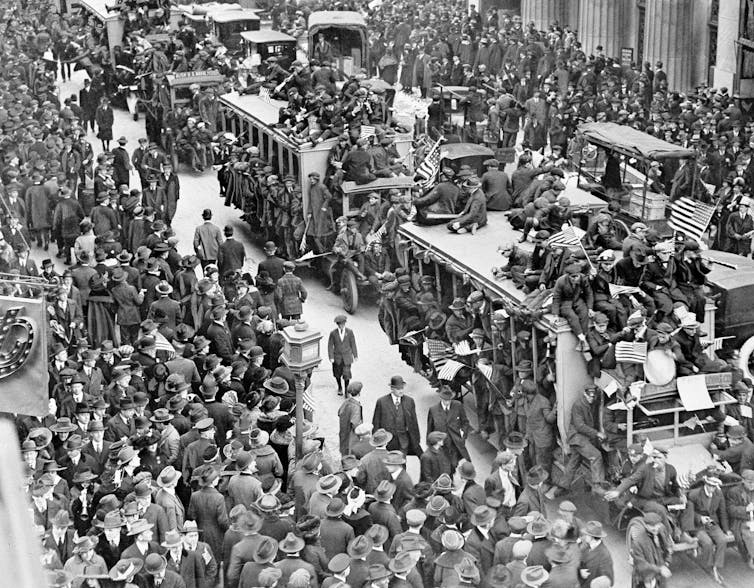
Armistice Day celebrations of the end of World War I on Nov. 11, 1918, worried public-health experts as people crowded together in cities across the United States. (Photo by The Associated Press)

By J. Alexander Navarro, University of Michigan

Picture the United States struggling to deal with a deadly pandemic.

State and local officials enact a slate of social-distancing measures, gathering bans, closure orders and mask mandates in an effort to stem the tide of cases and deaths.

The public responds with widespread compliance mixed with more than a hint of grumbling, pushback and even outright defiance. As the days turn into weeks turn into months, the strictures become harder to tolerate.

Theater and dance hall owners complain about their financial losses.

Clergy bemoan church closures while offices, factories and in some cases even saloons are allowed to remain open.

Officials argue whether children are safer in classrooms or at home.

Many citizens refuse to don face masks while in public, some complaining that they’re uncomfortable and others arguing that the government has no right to infringe on their civil liberties.

As familiar as it all may sound in 2021, these are real descriptions of the U.S. during the deadly 1918 influenza pandemic. In my research as a historian of medicine, I’ve seen again and again the many ways our current pandemic has mirrored the one experienced by our forebears a century ago.

As the Covid-19 pandemic enters its second year, many people want to know when life will go back to how it was before the coronavirus. History, of course, isn’t an exact template for what the future holds. But the way Americans emerged from the earlier pandemic could suggest what post-pandemic life will be like this time around.

Sick and tired, ready for pandemic’s end

Like Covid-19, the 1918 influenza pandemic hit hard and fast, going from a handful of reported cases in a few cities to a nationwide outbreak within a few weeks. Many communities issued several rounds of various closure orders – corresponding to the ebbs and flows of their epidemics – in an attempt to keep the disease in check.

These social-distancing orders worked to reduce cases and deaths. Just as today, however, they often proved difficult to maintain. By the late autumn, just weeks after the social-distancing orders went into effect, the pandemic seemed to be coming to an end as the number of new infections declined.

People clamored to return to their normal lives. Businesses pressed officials to be allowed to reopen. Believing the pandemic was over, state and local authorities began rescinding public health edicts. The nation turned its efforts to addressing the devastation influenza had wrought.

For the friends, families and co-workers of the hundreds of thousands of Americans who had died, post-pandemic life was filled with sadness and grief. Many of those still recovering from their bouts with the malady required support and care as they recuperated.

At a time when there was no federal or state safety net, charitable organizations sprang into action to provide resources for families who had lost their breadwinners, or to take in the countless children left orphaned by the disease.

For the vast majority of Americans, though, life after the pandemic seemed to be a headlong rush to normalcy. Starved for weeks of their nights on the town, sporting events, religious services, classroom interactions and family gatherings, many were eager to return to their old lives.

Taking their cues from officials who had – somewhat prematurely – declared an end to the pandemic, Americans overwhelmingly hurried to return to their pre-pandemic routines. They packed into movie theaters and dance halls, crowded in stores and shops, and gathered with friends and family.

Officials had warned the nation that cases and deaths likely would continue for months to come. The burden of public health, however, now rested not on policy but rather on individual responsibility.

Predictably, the pandemic wore on, stretching into a third deadly wave that lasted through the spring of 1919, with a fourth wave hitting in the winter of 1920. Some officials blamed the resurgence on careless Americans. Others downplayed the new cases or turned their attention to more routine public health matters, including other diseases, restaurant inspections and sanitation.

Despite the persistence of the pandemic, influenza quickly became old news. Once a regular feature of front pages, reportage rapidly dwindled to small, sporadic clippings buried in the backs of the nation’s newspapers. The nation carried on, inured to the toll the pandemic had taken and the deaths yet to come. 

It's hard to hang in there

Our predecessors might be forgiven for not staying the course longer. First, the nation was eager to celebrate the recent end of World War I, an event that perhaps loomed larger in the lives of Americans than even the pandemic.

Second, death from disease was a much larger part of life in the early 20th century, and scourges such as diphtheria, measles, tuberculosis, typhoid, whooping cough, scarlet fever and pneumonia each routinely killed tens of thousands of Americans every year. Moreover, neither the cause nor the epidemiology of influenza was well understood, and many experts remained unconvinced that social distancing measures had any measurable impact.

Finally, there were no effective flu vaccines to rescue the world from the ravages of the disease. In fact, the influenza virus would not be discovered for another 15 years, and a safe and effective vaccine was not available for the general population until 1945. Given the limited information they had and the tools at their disposal, Americans perhaps endured the public health restrictions for as long as they reasonably could.

A century later, and a year into the Covid-19 pandemic, it is understandable that people now are all too eager to return to their old lives. The end of this pandemic inevitably will come, as it has with every previous one humankind has experienced.

If we have anything to learn from the history of the 1918 influenza pandemic, as well as our experience thus far with Covid-19, however, it is that a premature return to pre-pandemic life risks more cases and more deaths.

And today’s Americans have significant advantages over those of a century ago. We have a much better understanding of virology and epidemiology. We know that social distancing and masking work to help save lives. Most critically, we have multiple safe and effective vaccines that are being deployed, with the pace of vaccinations increasingly weekly.

Sticking with all these coronavirus-fighting factors or easing off on them could mean the difference between a new disease surge and a quicker end to the pandemic. Covid-19 is much more transmissible than influenza, and several troubling variants are already spreading around the globe. The deadly third wave of influenza in 1919 shows what can happen when people prematurely relax their guard.

J. Alexander Navarro is assistant director of the Center for the History of Medicine at the University of Michigan. This was originally published on The Conversation, a site for journalistic reporting by academics.

Sunday, January 31, 2021

Gray works to create high-volume regional vaccination centers in anticipation of the day when there is an abundance of supply

Transportation Secretary Jim Gray
By Melissa Patrick
Kentucky Health News  

State Transportation Secretary Jim Gray manages a $2.2 billion budget and has been president of an international construction firm, two-term mayor of Lexington and Democratic nominee for the U.S. Senate, but he says none of those responsibilities has been more important than his new one: getting coronavirus vaccines to Kentuckians.

"There's probably, arguably, nothing in my lifetime that has represented more of an important responsibility than this," Gray, 67, said in an interview Friday with Kentucky Health News. 

In his new public-health role, Gray says he hears the voice of his grandfather, Dr. Carl Clifford Howard of Glasgow, who was known as the father of Kentucky's tuberculosis hospital system and was a strong advocate for public health. 

"His voice really spoke to me when the governor asked me to take on this responsibility," Gray said. "It continues to speak to me, in terms of the urgency of this effort, the significance of this effort that impacts so many of our people." 

One side of historical marker in
Summer Shade, Howard's birthplace.
(Photo from Columbia Magazine)
Dr. C. C. Howard not only opened the first hospital and medical laboratory in Glasgow, in 1914 and 1915 respectively, but was also instrumental in developing the state TB hospital there.

Gray said his grandfather, who died in 1971, "was always interested in trying to help in other locations, to take medical care to other locations," and persuaded Gov. Ned Breathitt (1963-67) to put a health clinic in the Martin County seat of Inez, four hours by road from Glasgow, where Gray grew up.

Gov. Andy Beshear named Gray director of vaccine distribution Jan. 14, tasking him with getting regional high-volume vaccine sites evaluated and secured, in anticipation of the day when the state has enough doses of vaccine to get a shot into the arm of every Kentuckian who wants one.

Gray said the effort is part of the "largest logistical effort and project in world history," according to officials of UPS, who he said clearly understand the scale of the job. The company has a hub in Louisville and delivers vaccines from the manufacturers to all states east of the Mississippi River.

Kentucky's first four regional vaccination sites are opening this week. One, in partnership with Kroger Health, opens Tuesday, Feb. 2, at the Kentucky Horse Park's Alltech Arena. Another will open in Danville, through a partnership with Ephraim McDowell Regional Medical Center. Two will open in Paducah, through partnerships with Western Baptist Hospital and Mercy Health-Lourdes Hospital. More are in the works. 

Dept. of Public Health map; click on it to enlarge.
When Beshear asked him to take this role, Gray said, he recognized the governor's main charge to him was to support and reinforce the work of the state Department of Public Health, led by Commissioner Steven Stack.

"Dr. Stack has done a remarkable job. I say routinely that this is such a high-performance team," Gray said. "I don't think there's a better leader in the country in any state than Dr. Steven Stack." 

Gray brings private- and public-sector experience to his new role, having learned about logistics and distribution during his many years in Gray Construction and about the importance of "listening eloquently" and solving problems when he was mayor of Lexington from 2011 through 2018.  

"It's all about problem solving, putting a bear hug around a problem and wrestling it to the ground," he said. "And that, in many respects, is what a project like this represents as well." 

The big bear right now, vaccine supply, is hard to reach. Beshear has said at least 64,000 shots will be given this week, but the state could vaccinate 250,000 people a week if it could get that many doses. As supplies remain tight and demand has increased, the state has had to delay the third phase of vaccine eligibility, which includes people 60 and older.

Gray said one of the first things he did after being asked to take on this role was to establish a project management office, which is run by Mark Carter, who is also in charge of the program that traces the contacts of people infected with the virus. Carter once ran a Medicaid managed-care firm in Louisville. 

Project management is a basic approach in construction, Gray's main career. "When a project-management system functions well, when it's clear, when the organization is clear and the roles and responsibilities are clear, when the schedule is clear, and the budget is clear, then the project can be more efficiently and effectively managed," he said. "So that's exactly what we've established right out of the gate." 

Gray's other lieutenants include Jamie Emmons, his Transportation Cabinet chief of staff, and Mike Dossett, the director of the state Division of Emergency Management, who leads the team that evaluates potential sites and selects them for implementation. 

Six weeks into the project, Gray said the team has evaluated sites all over Kentucky, but not chosen them all. The ultimate goal, he said, is to make sure there are no "vaccine desserts" in the state. More sites will be announced on each of the next two Thursdays, Beshear said Thursday, Jan. 28.

Gray said his team aims for an "equitable distribution" of vaccines, just like Stack and his lieutenants do when they allocate them, considering such things as the most vulnerable populations; making sure there is vaccine access for communities of color, which have been hard hit by the virus; and ensuring that areas with large populations are covered, because this improves herd immunity, which requires at least 70% of the population to have been vaccinated. 

He said the team uses a two-page checklist to evaluate sites, answering questions such as whether the clinic will be walk-in or a drive-through, the dates of availability, whether there is access to an interstate highway, the number of doses that can be administered per hour, who will provide the workforce, whether there is access to medical-grade refrigerators and high-speed internet service, what type of security is available, and the availability of restrooms. 

"Population densities, vaccine throughput, and drive times are our main drivers," Gray said. "We're trying to avoid anyone having to drive more than one county away to get a vaccine." He added, "The most efficient vaccination system is going to be one that focuses on getting as many vaccines into arms as many shots in arms as we can as quickly [as we can].

One of Gray's memories about his grandfather was that he "often went against the grain, especially against the medical community," and was often described as a socialist because of his dedication to public health. He said his advice continues to guide him: "He would say, Jim, always remember, take care of the people, and the money will take care of itself." 

As of Jan. 29, the state has administered 382,219 doses of vaccine. Of those, 327,473 have been administered in a state program, and 54,746 have been given to residents and staff in nursing homes, through a much slower federal program run by CVS Health and Walgreens.

Both vaccines in use require a booster shot three or more weeks after the first inoculation. National vaccine trackers show 7 percent of the state's population has received at least one shot, just above the national average of 6.9%.

"We're doing, I believe, the best that can be done," Gray said. "I'm going to say more than just the best we can. I think we're doing the best that can be done to distribute the vaccine, this limited supply of vaccine. We have to [get to] as many people as we can, as quickly as we can throughout the state."

Asked about the challenges of adding this new position to his ongoing responsibilities as transportation secretary, he said, "Multi-tasking is sometimes a skill that we all need to acquire and when we're called to a duty, we need to accept that call and accept that duty."

That said, he added that  he had a "really talented team" at the transportation cabinet who came with a wealth of institutional knowledge and talent, and because of that, he was more able to take on this assignment, "which is so vital and so important."

Wednesday, February 29, 2012

A look at the history of U.S. health care and health insurance

Health insurance in the U.S. has some of its roots in the World War II shipyards of Henry J. Kaiser, who built 747 vessels for the Navy. The war made workers scarce, so Kaiser needed a way to attract them and, once there, keep them healthy. He couldn't pay them more because wages were frozen, so he offered them health care, which was provided by doctors at company clinics and hospitals. In turn, he asked employees to kick in 50 cents a week for the benefit. (Photo: Kaiser Shipyards in Richmond, Calif., courtesy of SanPedro.com/Permanente Metals Corporation)

"The war ended, the workers quit the shipyards, leaving behind hospitals and doctors but no patients," Bob Rosenblatt reports for the Los Angeles Times. "So the company decided to open the system to the public — and that's how generations of Californians who never heard of Kaiser shipyards have since gotten medical care."

Kaiser's story is just one example of how America's health insurance system developed, Rosenblatt writes. As at the shipyards, most people still get coverage through their jobs and, unlike the rest of the industrialized world, not from the government.

In fact, there has long been a fight against having the government in charge of providing care, Rosenblatt contends. In 1918, when California proposed a constitutional amendment that would have organized a state-run program, doctors said "compulsory social health insurance" was "a dangerous device invented in Germany." The amendment lost, but many presidents pursued the issue. Franklin D. Roosevelt "flirted with the idea but never threw political muscle behind it," Rosenblatt reports. Harry S. Truman asked Congress to provide national health insurance, but could not bring it to a vote.

It was the model exemplified in the shipyards that was adopted, and "health insurance became a standard feature in labor contracts," Rosenblatt writes.

Things changed in 1965, when President Lyndon B. Johnson pushed through a heavily Democratic Congress what Rosenblatt calls "a legislative three-layer cake:" Medicare Part A, Medicare Part B, and the federal-state Medicaid program. The legislation was controversial, with fears that doctors would refuse to see Medicare patients and hospitals would refuse to dismantle segregated wards. "The doctors didn't strike," Rosenblatt writes. "And the hospitals were immediately integrated without protest."

In 1993, President Bill Clinton wanted to extend national health insurance to everyone, but Rosenblatt says "Congress felt excluded and insulted, and the plan never came to a floor vote in the House or Senate."

President Obama did the opposite and relied on the congressional process. "Key to the plan was a mandate that everyone buy into the system; it was the best way to spread out the costs of illness," Rosenblatt writes. It's that mandate up for debate in the Supreme Court next month, but even if the Affordable Care Act is subsequently thrown out, "people already enjoy some benefits and won't want to give them up," Rosenblatt writes.

"It seems a safe bet that some provisions in the Affordable Care Act will stay on the law books," Rosenblatt concludes. "This places a few more patches on the national healthcare quilt. That's the American way." (Read more)