Showing posts with label coroners. Show all posts

Monday, June 6, 2022

Madison County OD deaths up 27%, twice the state gain; coroner says he has told one mother about deaths of three of her children

A preliminary federal report shows drug overdose deaths in Kentucky rose 13.55% in 2021, to an estimated 2,391 deaths. It also shows that again, opioids and synthetic opioids, such as fentanyl, were the two main contributors.

Coroner Jimmy Cornelison
(Madison County website photo)
County figures will be released in the annual state report in a few weeks, but county coroners keep a running count, and they can tell the story of how such deaths impact a community. Madison County Coroner Jimmy Cornelison told Lexington's WKYT-TV a bit of that story.

Cornelison told reporter Jeremy Tombs that he knocks on the doors of families to tell them they’ve lost loved ones.

“I’ve done a family where I did three children in that same family,” he said. “Three times I hugged that mother; three times.” 

Madison County saw 75 people die from a drug overdose in 2021, up 27 percent from the 59 OD deaths recorded in 2020, WKYT reports. Cornelison added that these numbers don't show the full scale of the problem.

He told Tombs that one problem is that Madison County, is along Interstate 75, “so you can hop on, hop off. Stop in Richmond and sell your goods, meet somebody in a parking lot and be gone in 10 minutes.”

Cornelison said that while he didn't see a way out of this worsening situation, it's important to not give up on people who have a drug problem. “We have to invest in these folks. Number one invest in keeping them clean,” he said. “Find them something to do, get them a job.”

First responders help curb overdose deaths by carrying Narcan, a drug that blocks the effect of opioids. Cornelison told WKYT that his county's overdose death numbers would likely be one-third higher if it weren’t for the pre-hospital care some people receive.

People who are struggling with drug abuse or who are concerned about a family member's substance use can search for treatment providers at www.findhelpnowky.org.

Sunday, March 28, 2021

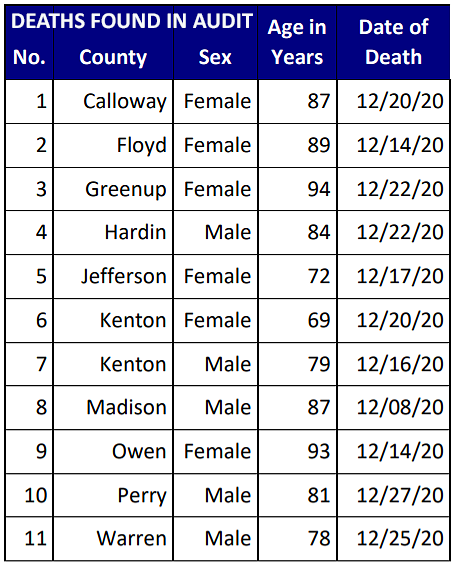
Ky. missed over 700 Covid-19 deaths because one state worker stopped double-checking reports in an antiquated system

State table, adapted by Ky. Health News,
lists deaths from audit added on Friday.
Kentucky missed more than 700 Covid-19 deaths from October to January for the same reason Ohio missed 4,000: One state employee stopped reconciling death certificates with reports from health departments using an antiquated system, reports Deborah Yetter of the Louisville Courier Journal.

"Two separate streams of information about deaths — one from health departments and the other from death certificates — must be reviewed and reconciled. The task is time-consuming and currently is performed by a human, not a computer," Yetter reports.

"Reports of Covid-19 cases already often delayed. On Monday, Beshear announced 11 new deaths and 50 more from the audit, though none were from March. . . . Timely reports are important if health officials hope to convince a sometimes-skeptical public of the need for precautions to reduce infection, such as requirements to wear masks and limit sizes of gatherings, said Dr. Kraig Humbaugh, commissioner of the Lexington-Fayette County Health Department."

"We want to be as accurate as possible," Humbaugh told Yetter. "We want to count those that are Covid deaths, and not count those that are not."

Kentucky and Ohio officials said the problem arose late last year as coronavirus cases and Covid-19 deaths "began to pile up and workers became overwhelmed," Yetter reports. "Some death reports lag behind simply because it takes time to compile, review and forward the information to public health officials in Frankfort."

They get the data in two ways, Yetter notes: "Health departments rely on epidemiologists — specialists in identifying diseases — to review information from individual cases and reach a conclusion about whether a death resulted from Covid-19," and many health departments have lagged behind. "Death certificates are filed separately with the state Vital Statistics Branch by sources including local coroners, hospitals, doctors or nursing homes. Sometimes a death certificate reports an individual had Covid-19, though it may it may not have been reported by the health department."

Sometimes, causes of death are difficult to determine "in a state with high levels of disease, such as heart and lung ailments, diabetes, cancer and other conditions which can also prove fatal and likely are complicated by Covid-19," Yetter writes. "At the state Department of Public Health, a committee of experts reviews individual cases in question in order to decide whether they should be listed as deaths from Covid-19." That's one reason deaths are often listed weeks or even months after they occur.

Saturday, January 16, 2021

Coroner in Frankfort's county says suicides doubled in 2020, while overdoses rose by almost half; those with fentanyl nearly tripled; state drug policy chief says 2020 will be worst year for ODs

Kentucky coroners aren't required to issue annual reports, but some do, and the 2020 report from Franklin County Coroner Will Harrod suggests it's a good time to ask your coroner for a report. As experts have warned, the pandemic seems to have increased drug overdoses and suicides, at least in Frankfort's county.

Harrod's preliminary report to the county Fiscal Court on Dec. 30 said that overdose-related deaths in the county with the state capital increased from 17 to 25 in 2020, most involving the powerful opioid fentanyl, and the number of suicides doubled, to 12.

“While we can not confirm the rise in cases are Covid-19 related, we can correlate the increase of cases with the pandemic experience,” including isolation as a result of restrictions, Harrod said.

"Those numbers may change, he said, as several investigations were still pending at the end of the year," The State Journal reports.

"Deaths involving fentanyl nearly tripled from seven in 2019 to 20 in 2020," the Frankfort newspaper reports. "In December, Franklin County Sheriff's Office Sgt. Lucas DeBorde told the Fiscal Court there had been four fentanyl-related deaths in two months. Frankfort Fire and EMS Chief Wayne Briscoe said at the time EMS crews had already worked 87 opioid overdoses, including fentanyl, since July 1. In the fiscal year that ended June 30, Briscoe said the department responded to 109 opioid-related overdoses."

Van Ingram
Van Ingram, executive director of the Kentucky Office of Drug Control Policy, said on a Foundation for Healthy Kentucky webinar Jan. 11 that during the pandemic, "The epidemic that we were in, of substance use disorder, only worsened; 2020 will be by far our worse year for fatal drug overdoses. . . . It's just been a horrible year for overdoses in general and in overdose deaths as well." 

Sunday, August 18, 2019

Rural coroner made the tough calls on his town's opioid epidemic

Coroner Steve Talbott, in his funeral home
(Photo by Michael S. Williamson, The Washington Post)
How many rural coroners, witnessing death after death from opioid overdoses, would call police in an effort to see how their county was being inundated by the misused prescription drugs? We don't know the answer to that question, but we do know what funeral director Steve Talbott, the elected coroner of Clinton County for the last 25 years, did. He made the calls, and one result was the conviction of a local physician who shared a building with the pharmacy that dispensed more opioids per person per county in 2006-12 than any in the U.S.

Jenn Abelson, Andrew Ba Tran, Beth Reinhard and Aaron C. Davis of The Washington Post reported the story last week, following the Post's publication of other stories drawing on the Drug Enforcement Administration database for those years. Their story is a look at the opioid epidemic from the bottom up, in Albany, Paintsville and Booneville; Kanab, Utah; and Carthage, Tenn., where pharmacies were funnels for large volumes of painkillers.

When Talbott responded as coroner to an overdose death, the Post reports, "Friends and relatives of the dead rarely had answers to Talbott’s questions: What kind of pills did they take and where did they come from? A toxicology report often answered the first question. It was the second one that typically eluded Talbott. As overdose deaths soared, Talbott repeatedly called the state police, hoping they could identify the source of opioids poisoning his community."

Clinton County (Wikipedia map)
Since 2006, 41 people have died of prescription opioid overdoses in the county of 10,000. Talbott told the Post that law enforcement took far too long to pay attention. "The federal investigation began in 2015 after Talbott noticed multiple overdose deaths involving patients of a local physician, Michael L. Cummings, and the Kentucky Board of Medical Licensure expert found Cummings’s treatment of several patients fell below minimum standards of care, court records show," the Post reports. "In 2017, Cummings was charged in federal court with the illegal distribution of controlled substances, which resulted in the deaths of three patients." He pleaded guilty in March to 13 counts of illegally prescribing controlled substances, and was sentenced July 24 to 30 months in prison and fined $400,000. Cummings had his medical practice in the same building as Shearer Drug, operated by Kent Shearer, who declined to comment.

The Post reports, "The 6.8 million opioid pills bought by Shearer Drug from 2006 through 2012 accounted for 66 percent of the total ordered by the county’s five pharmacies, according to The Post’s analysis." When Talbott heard those figures from the Post, he told the newspaper: “It’s a lot of pain medication for this little town.”

"Talbott, who said he grew up with Shearer and attended the same school, hasn’t talked to the pharmacist in a few months," the Post reports. "Talbott said the overdose deaths have waned since Cummings was indicted in 2017, but the epidemic is far from over." He told the paper, “There were just too many people dying from these drugs in such a small place. I hate these drugs. They are awful.”

Saturday, April 1, 2017

Medical examiner quits, then stays; was in dispute over resources, autopsy delays, hiring of former legislator to run office

Photo illustration from WKYT-TV
Dr. William Ralston quit his job as the state's chief medical examiner Friday "over frustrations involving personnel decisions and financial concerns for his office," then agreed to stay after the state initially said his resignation was accepted, reports Miranda Combs of Lexington's WKYT-TV.

The Lexington Herald-Leader reports Ralston and Justice Secretary John Tilley "came to an agreement for Ralston to stay as chief medical examiner sometime around 6 p.m., Jimmy Pollard, a consultant for the Kentucky Coroners Association said. Mike Wynn, spokesman for the Justice and Public Safety Cabinet confirmed that Dr. Ralston is not leaving his position."

The back-and-forth came a few days after a letter the coroners' group sent Gov. Matt Bevin a certifed letter "saying economic challenges and unpaid bills are putting death investigations in jeopardy while the state hired an unqualified administrator to run the state medical examiner’s office," Combs reports.

Katie Stine (H-L photo)
Former state Rep. Katie Stine of Northern Kentucky was hired two weeks ago as executive director of the medical examiner's office. "Pollard said the hiring of Stine, who is being paid $80,000 a year and is eligible for $27,222 from her legislative pension, was the final straw for Ralston, who had been fighting for more funding for the medical examiner’s office for months," Morgan Eads and Daniel Desrochers report for the Herald-Leader. Pollard said Stine is not qualified to oversee the office.

Lyon County Coroner Ronnie Patton, president of the coroners' group, told Bevin in the letter, “The state has not paid its bills or provided funds to hire doctors and support staff, but can hire administrative personnel with no previous knowledge of the medical examiner’s program’s operation, at a tremendous salary.”

Fayette County Coroner Gary Ginn told the Herald -Leader that a shortage of medical examiners has delayed cases for some time. "With fewer examiners, it’s taking longer for county coroners to receive completed autopsy reports. And, as the number of heroin deaths has increased, Pollard said, coroners and the medical examiner’s office have more pressure to determine cause of death so U.S. attorneys can prosecute drug dealers," the newspaper reports.

"Autopsies related to homicide cases have been prioritized so as not to delay investigations, but waiting for autopsy reports in accidental death cases can affect families, Ginn said. County coroners are unable to sign death certificates until autopsy reports are completed. Until death certificates are signed, families are often unable to begin taking care of matters like life insurance or property transfers."

Tuesday, February 15, 2011

Cost is one obstacle for bill that would require coroners to look into nursing home deaths

A bill that would require coroners to be called when someone dies in a nursing home may be in jeopardy. At issue is how to pay for it.

Chief State Medical Examiner Tracey Corey estimates she would need three more doctors, more support staff and more equipment if even 10 percent of deaths needed investigation, the Lexington Herald-Leader's Valarie Honeycutt-Spears reports.

House Bill 69, sponsored by Rep. Tom Burch, D-Louisville, right, would require a nursing home or hospice staff member to alert a coroner about a death on the premises within 24 hours. If they, and they alone, suspect abuse, coroners would be required to inform law enforcement authorities or prosecutors. The aim is to determine if abuse or neglect might have occurred.

"But Burch said if Corey's financial concerns lead to the bill being sent to the committee making decisions about state spending, he think it 'means sudden death' for the legislation," Honeycutt-Spears reports.

Burch also said nursing home officials are balking at the bill's aim to increase the penalties for failing to report abuse or neglect. As of now, such a failure is considered a Class B misdemeanor, which carries a punishment of up to 90 days in jail and a $250 fine. The bill would change it to a Class A misdemeanor, which can result in up to 12 months in jail and a fine up to $500.

The bill would also mean long-term care facilities that fail to designate a staff member to report deaths to the coroner would be fined $200 a week. (Read more)