Showing posts with label guns. Show all posts

Monday, July 1, 2024

Your Local Epidemiologist says gun violence is public-health issue

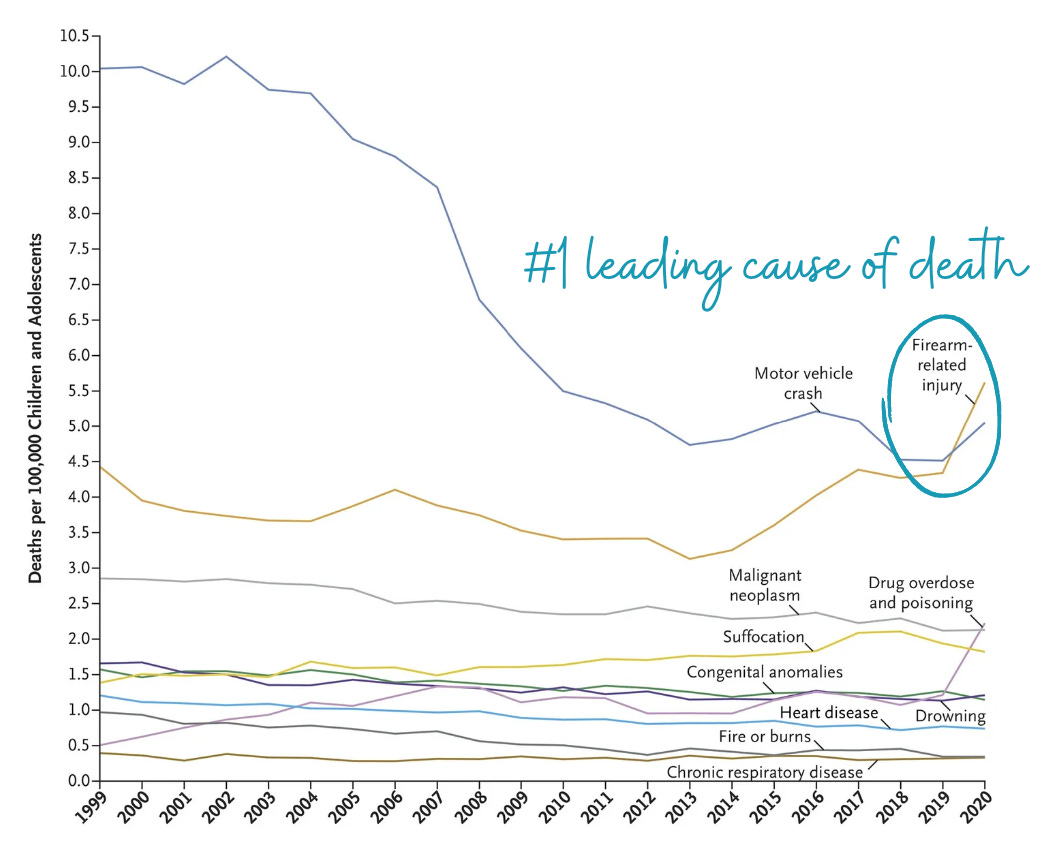
Graph from New England Journal of Medicine; Annotated by Your Local Epidemiologist
OPINION By Katelyn Jetelina
Your Local Epidemiologist

On June 24, U.S. Surgeon General Vivek Murthy declared gun violence a public-health crisis. Many narratives immediately pushed back that this isn’t public health’s lane.

Let me say this loud and clear: Gun violence is absolutely in the purview of public health. And until society accepts it as such, we will continue to lose tens of thousands of Americans annually, leaving behind massive ripples in the community. Thankfully, momentum is changing.

What is public health? It’s broader than you might think. Public health—also called population health—came into the limelight with Covid-19, but it’s much broader than a pandemic or infectious diseases. It is the science of protecting and improving the health of people and their communities.

Public health is everywhere—think seatbelts, non-smoking areas, vaccines, airbags, clean drinking water, cleaner indoor air, food security, and cancer prevention. Experts are in health departments, nonprofits, government agencies, academic institutions, and the private sector. That’s because public health is most effective when combining science, education, policy, advocacy, and innovation.

Epidemiology, one subset of public health, is charged with finding patterns: Who is impacted? What predicts certain health outcomes? Because if it’s predictable, it’s preventable.

Violence epidemiology was born out of a case study a few decades ago, which showed that clusters of cholera in Bangladesh mirrored clusters of gun violence in Chicago. This meant gun violence wasn’t random; certain factors predispose a person or community. The field has grown to study suicide, child abuse, domestic violence, and, yes, gun violence.

Gun violence patterns—who are being impacted, where, and why—have slowly emerged, providing hints about tangible and effective public health solutions. For example:
  • Firearm injuries are the leading cause of death in children. It surpassed motor vehicle crashes in 2020 for the first time.
  • 2 out of 5 homes have at least one firearm.
  • 4.6 million kids live with unlocked, loaded gun.
  • 1 in 3 youth suicides and unintentional deaths can be prevented by securing guns.
  • 8 out of 10 children that used a firearm say it belonged to a family member.
These patterns suggest safe storage and education for parents, for example, could (and are) move the needle.

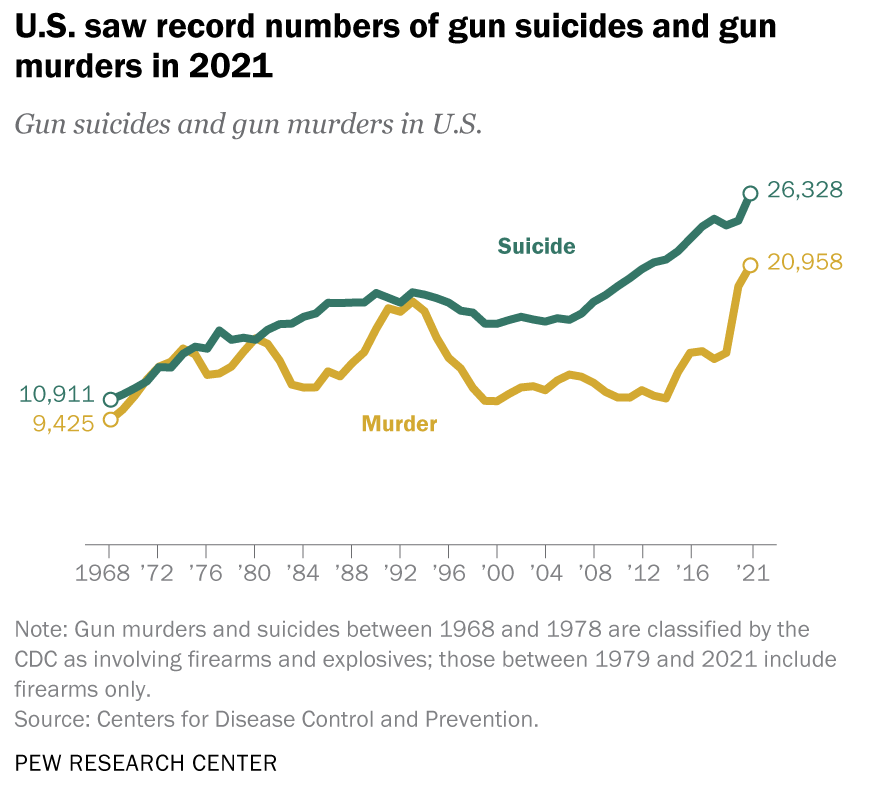
Suicides account for most gun deaths, followed by homicides. This is why some states have passed bipartisan legislation, like red-flag laws, to temporarily remove firearms from people who have been deemed a threat to themselves. It’s estimated one suicide is prevented for every 10–20 red flag orders issued.

Cause and risk are not uniform. Gun injuries and deaths differ by race/ethnicity, physical location, age, and many other factors. This suggests who and how we engage with matters to make an impact.

There are ripple effects. A single neighborhood murder can impact as many as 200 people in a community. Randomized control studies have shown that community-level interventions, like replacing vacant spaces with green spaces, break cycles of violence.

Finding answers has been a slow crawl. Although we’ve found some patterns, we’ve only scraped the surface. Progress has been plagued by an unfortunate series of events.

Rewind to 1993. A famous study published in the New England Journal of Medicine found that having a gun in the home increased the risk of homicide in the home. This set off a political domino effect, and three years later, Congress inserted the Dickey Amendment into the CDC spending bill. The provision stated, “None of the funds made available for injury prevention and control at the Centers for Disease Control and Prevention may be used to advocate or promote gun control.” The language was unclear; the epidemiologist on the 1993 study famously said, “Precisely what was or was not permitted under the clause was unclear. However, no federal employee was willing to risk his or her career or the agency's funding to find out. Extramural support for firearm injury-prevention research quickly dried up.”

This set gun violence research back decades, as it was completely reliant on nonprofits and philanthropy support. This is helpful but not enough to match the scope of the problem.

But, momentum is shifting. We see this from several angles:
  • Engagement from the bottom up. A plethora of public-health experts have partnered with groups directly impacted by gun violence. For example, working with gun owners and gun ranges to curb suicide or communities (see Cure Violence) to build solutions.
  • Funding for research. In 2020 —for the first time in 25 years—our federal budget included $25 million for the CDC and NIH to research reducing gun-related deaths and injuries. This is a start, but to be clear, it’s estimated that we need $1.4 billion to curb this epidemic. (For context, NIH gets $6.56 billion allocated for cancer research.)
  • State and federal initiatives. For example, the Office for Violence Prevention was established in 2023 to focus on key legislative actions. You may be surprised to hear that many policies have bipartisan support. Earlier this month, the office hosted 160 hospital executives and leaders to discuss the importance of using health system data to better understand patterns.
Gun violence is absolutely in the public-health lane. This is what we do. We’ve been able to do unimaginable things and save millions of lives by approaching problems with a public-health lens, like cigarettes and motor-vehicle crashes. Public health can help reduce gun violence in the U.S., and we will. But only at the speed at which society recognizes and supports it.

Tuesday, June 25, 2024

Surgeon general declares gun violence a public-health crisis; new AMA president, a Louisville physician, calls it 'evidence-based'

Surgeon General Vivek Murthy (AP file photo, 2023)
This story has been updated.
By Amanda Seitz
Associated Press

The U.S. surgeon general on Tuesday declared gun violence a public-health crisis, driven by the fast-growing number of injuries and deaths involving firearms in the country.

The advisory issued by Dr. Vivek Murthy, the nation’s top doctor, came as the U.S. grappled with another summer weekend marked by mass shootings that left dozens of people dead or wounded.

“People want to be able to walk through their neighborhoods and be safe,” Murthy told The Associated Press in a phone interview. “America should be a place where all of us can go to school, go to work, go to the supermarket, go to our house of worship, without having to worry that that’s going to put our life at risk.”

To drive down gun deaths, Murthy calls on the U.S. to ban automatic rifles, introduce universal background checks for purchasing guns, regulate the industry, pass laws that would restrict their use in public spaces and penalize people who fail to safely store their weapons.

Murthy said there is “broad agreement” that gun violence is a problem, citing a poll last year that found most Americans worry at least sometimes that a loved one might be injured by a firearm. More than 48,000 Americans died from gun injuries in 2022.

His advisory promises to be controversial and will certainly incense Republican lawmakers, most of whom opposed Murthy’s confirmation — twice — to the job over his statements on gun violence.

Dr. Bruce Scott
Dr. Bruce Scott of Louisville, new president of the American Medical Association, called Murthy’s advisory an “evidence-based public-health approach to addressing firearm violence” in a statement. “Firearm violence is indeed a public health crisis,” he said, adding, “The data now show it touches the majority of U.S. adults.”
 
Murthy has published warnings about troubling health trends in American life, including social media use and loneliness. He’s stayed away from issuing a similar advisory about gun violence since his 2014 confirmation as surgeon general was stalled and nearly derailed by the firearm lobby and Republicans who opposed his past statements about firearms.

Murthy ended up promising the Senate that he did “not intend to use my office as surgeon general as a bully pulpit on gun control.”

Then-President Donald Trump dismissed Murthy in 2017, but President Joe Biden nominated Murthy again to the position in 2021. At his second confirmation hearing, he told senators that declaring guns a public-health crisis would not be his focus during a new term.

But he has faced mounting pressure from some doctors and Democratic advocacy groups to speak out more. A group of four former surgeon generals asked the Biden administration to produce a report on the problem in 2022.

“It is now time for us to take this issue out of the realm of politics and put it in the realm of public health, the way we did with smoking more than a half century ago,” Murthy told the AP.

A 1964 report from the surgeon general that raised awareness about the dangers of smoking is largely credited with snubbing out tobacco use and precipitating regulations on the industry.

Children and younger Americans, in particular, are suffering from gun violence, Murthy notes in his advisory, called “Firearm Violence: A Public Health Crisis in America.” Suicide by gun rates have increased significantly in recent years for Americans under the age of 35. Children in the U.S. are far more likely to die from gun wounds than children in other countries, the research he gathered shows.

In addition to new regulations, Murthy calls for an increase on gun violence research and for the health system — which is likely to be more amenable to his advisory — to promote gun-safety education during doctor visits.

UPDATE, June 26: New research highlights the need for a public-health approach in news reporting of gun violence, reports Journalist's Resource at Harvard University.

Saturday, February 3, 2024

Drugs getting stronger and killing more Kentucky children; report calls for protective action, also to keep kids from getting guns

Graph from state report, adapted by Kentucky Health News
By Deborah Yetter

Kentucky Lantern

Kentucky’s youngest children continue to be at risk of drug overdoses from accidental ingestion — with the number of fatalities and the strength of the drug, or combination of drugs, increasing.

Eight children died from ingesting drugs and another 47 suffered an overdose in the fiscal year that ended June 30, 2022, among cases reviewed by the Child Fatality and Near Fatality External Review Panel, which released its annual report Thursday.

The majority of overdose victims in the report were age 4 or younger. Five years ago, by contrast, one child died among the 32 overdose cases it reviewed, the panel reported.

And just a fraction of child overdoses in Kentucky are identified in the report; the panel reviews only cases where abuse or neglect is suspected in the death or near-death of a child.

In 2022, 721 children were treated in Kentucky hospital emergency rooms for drug ingestion, with 72 requiring hospitalization, according to emergency department data, the report said.

Dr. Melissa Currie, a forensic pediatrician and founding member of the panel, said such cases are among her greatest concerns.

“I do believe ingestions are a major problem and it’s getting worse rapidly,” said Currie, a professor of medicine with Norton Children’s Hospital and the University of Louisville medical school. “We need to do a better job of educating parents about how dangerous that is.”

Drug use in the home presents the greatest risk, the report said.

“Children living in a home with a caregiver using illicit or other dangerous substances are at a higher risk of accidental ingestion,” the report said. It said children also are at risk of ingesting drugs used to treat opioid use disorder, such as buprenorphine.

Among the drugs children are ingesting: opiods, fentanyl, drugs used to treat opioid use disorder, and increasingly, cannabis or other products containing THC, the main chemical in marijuana.

Often such cases involve a combination of drugs.

One example it cited: A 19-month-old who died tested positive for fentanyl and morphine in a home where an adult overdose death had occurred just two months before and where both parents reported using heroin. Two other children in the home tested positive for fentanyl, a powerful, synthetic opioid.

Cannabis products were linked to the deaths of two children who ingested them, the report said.

Currie said the public doesn’t realize the risks even of legal products derived from hemp, such as gummies.

“It can still put kids in the ICU,” she said.

Most deaths or injuries preventable

Created in 2012 to conduct comprehensive reviews of child deaths and serious injuries from abuse or neglect, the independent panel of physicians, judges, lawyers, police, legislators and social service and health professionals meets regularly throughout the year to analyze such cases.

It is charged with producing an annual report to detail its findings to the governor, lawmakers and other officials along with recommendations for improving conditions for children in a state that has long ranked high for its rate of child abuse and neglect.

A member of the panel, state Sen. Danny Carroll, R-Paducah, said he has not had an opportunity to review the final report, but a spokesman said Carroll and the General Assembly generally consider its findings in crafting public policy.

The 2024 report examined 202 cases in which 68 children died and 134 suffered life-threatening injuries from July 1, 2021 to June 30, 2022. Most of the deaths were from neglect; 10 were from physical abuse.

The report says nearly all 90 percent of the deaths and injuries could have been prevented with appropriate precautions, such as safely storing medications or securing firearms.

Areas the panel examined this year included drug overdoses, physical abuse, neglect, firearm deaths including suicide and the role of the Cabinet for Health and Family Services in responding to reports of child abuse and neglect.

Common factors in child deaths and injuries included household financial stress, mental illness, family violence and addiction.

The report charts only a fraction of Kentucky’s child overdose/drug-ingestion cases because the panel is responsible for looking only at cases involving neglect or abuse in the death or near death of a child. In 2022, 721 children were treated in Kentucky hospital emergency rooms for drug ingestion, with 72 requiring hospitalization, according to emergency-department data.

Here are some of the key findings and recommendations:

Overdose and ingestion cases

In light of a rise in such cases over the past five years, the panel recommends better education for all professionals involved in medication-assisted treatment for adults with addiction.

Among cases of drug ingestion by children that were studied by the panel, 37% of their caregivers were receiving medication-assisted treatment, including medication for opioid misuse.

That training should stress reminding patients to safely store medication and for health professionals to report when a parent relapses.

It also recommends the Kentucky Board of Medical Licensure, which governs doctors, provide more continuing education to doctors on opioid ingestion in children.

The report also recommends training for medical marijuana providers. The Kentucky General Assembly in 2023 approved the use of medical marijuana for certain serious conditions though the law does not take effect until 2025.

It also urges more public education on safe-sleep practices and the dangers of a child sleeping with an adult, especially one who is impaired.

“Drinking and drug use (even prescribed) impair our ability to care for a child, making bed-sharing and other unsafe sleep practices even more dangerous,” the report said.

Tor the seventh year in a row, the panel asked the legislature to fund family-recovery courts statewide, not just in Jefferson and Clay counties.

And it urged a statewide system to create a “Plan of Safe Care,” a federally required system to track and assist families with children at risk, particularly infants born exposed to drugs.

Despite the federal requirement, Kentucky — and most states — have not fully implemented such a system with responsibility not clearly defined.

“We need to put this on everyone’s radar,” Currie said. “Somebody needs to step in and take responsibility or the legislature needs to assign responsibility.”

Firearms a ‘deadly means’

The report also says access to firearms continues to put children at risk.

In one case, a 4-year-old playing with a loaded handgun he found in the glove compartment of a car fatally shot himself. In another, a 14-year-old was fatally shot in the head by a friend while handling a loaded firearm in the parents’ bedroom.

Contrary to many parents' belief, research demonstrates that most children know where guns are stored and they will touch a firearm if provided the opportunity despite education not to touch it.

The report also factors in child suicides, citing the death by suicide of a 14-year-old boy who had access to unsecured firearms in the home.

The panel reviewed seven suicide cases from 2022, five fatal — four involving a firearm — and two attempts resulting in serious injury. The average age of the child was 13.

Sadly, the panel reports, the cases it reviewed were just a portion of all suicide deaths of youths in Kentucky for 2022, when 29 children under 18 died by suicide..

The report cited “a significant increase” in firearm injuries in cases it reviewed for the past five years involving 48 deaths and 24 near fatalities.

The panel classified such cases as “access to deadly means” that were largely preventable. In many cases, parents had told children not to handle firearms or thought they had hidden the weapon, the report said.

“Contrary to the beliefs of many parents, research demonstrates most children know where guns are stored and will touch a firearm if provided the opportunity despite education not to touch the firearm,” it said.

The panel recommends the legislature research national models and develop legislation to promote safe storage of firearms.

Currie said she understands firearms legislation is controversial but said it shouldn’t be when it comes to child safety.

“It should be a non-issue,” she said. “That should be something we can all agree on.”

Friday, January 26, 2024

Bill filed in Kentucky that would allow judges to temporarily take guns from those at risk of harming themselves or others

Sen. Whitney Westerfield (Legislative photo)
By Sarah Ladd
Kentucky Lantern

Admitting it faces a “tough uphill climb,” Republican state Sen. Whitney Westerfield filed a bill Jan. 25 that would allow judges to temporarily remove firearms from Kentuckians at risk of harming themselves or others.

“There is more support for it than you hear,” Westerfield said of his measure, which he calls the Crisis Aversion and Rights Retention Orders bill, or CARR.

Westerfield, of Christian County, said Senate Bill 13 is the “cleanest” version and comes after feedback from his colleagues during a December interim hearing before the Joint Committee on Judiciary.

Draft language of the bill says:

  • Law enforcement cannot enter a person’s home “or interior premises” to gather their guns unless that person needs and requests assistance in doing so.
  • Police must give a receipt to the respondent detailing what guns were taken.
  • While the CARR order is in effect, the respondent cannot possess or buy guns.
  • The court must tell the respondent that they are not being charged with a crime and that they have the right to rebuttal. 
“We don’t want to take away guns from people who are law-abiding citizens,” Westerfield said Thursday to a supporter rally. “We want to step in temporarily to keep people safe. We don’t want it to be abused. We want to do something responsible, constitutional, to keep people safe. That’s what CARR does.”

The bill has four co-sponsors, all Democrats, led by Sen. David Yates of Louisville. He says judges who are entrusted with complicated child-custody situations can also be trusted to know when people can’t be trusted to have guns.

“This is not a gun-grabbing bill,” said Yates. “Public safety has got to be a top priority. And right now, we are in a crisis.”

The other Democratic sponsors are Sens. Carrie Chambers Armstrong and Denise Harper Angel of Louisville and Reginald Thomas of Lexington.

Sheila Schuster, a licensed psychologist and the executive director of the Kentucky Mental Health Coalition, previously told the Lantern that “People with a mental illness are 10 times more likely to be a victim of violent crime than to be a perpetrator.”

She also said suicidal people taking their lives happens at an “astronomical percentage higher if there’s a gun within reach than if there’s not.”

The nonprofit Whitney Strong, which works to end gun violence, reports that a majority of gun deaths in Kentucky were suicide in 2021 — 534 compared to 364 homicides. That same year, there was a suicide by firearm every 16 hours in Kentucky, according to Whitney Strong data shared Thursday. The National Suicide Prevention Lifeline is 988.

Westerfield called his bill “constitutionally sound” and said he hopes it gets a hearing this session. As of Friday, Jan. 26, the bill was still in the Senate Committee on Committees, made up of the chanber's leaders. Westerfield is chairman of the Judiciary Committee.

Friday, December 22, 2023

Beshear wants lawmakers to be empathetic on controversial issues like abortion; sees better health for Ky. as possible legacy

Gov. Andy Beshear during his interview with Kentucky
Health News in the Capitol's State Reception Room
By Melissa Patrick
Kentucky Health News

In an interview Wednesday with Kentucky Health News, Gov. Andy Beshear said he would be pleased if one of his legacies as governor was improving the health of Kentuckians, and looked forward to the upcoming legislative session.

Beshear acknowledged that if Kentucky has clearly improved its health status when his term ends in 2027, he would have to share that legacy with his father, Steve Beshear, who expanded Medicaid coverage in Kentucky to 600,000 people when he was governor from 2007 through 2015.

"I'd love for both Beshears to be remembered for that," he said. 

Beshear's comments came after he was asked why he thought Kentucky showed a slight upward trend in the latest America's Health Rankings by the United Health Foundation.

The foundation ranks Kentucky 41st for overall health, up from 43rd in the last two rankings (2022 and 2019; the rankings were not made in 2020 and 2021 due to the pandemic). The state was 45th in 2018, 42nd in 2017, 45th in 2016, 44th in 2015 and 47th in 2014.

Beshear said increasing access to health care has been key to improving the health of Kentuckians, not only as a way to improve the quality of their lives, but  as a way to improve the state's workforce. 

"I believe that we are doing better, and that we will do better for a couple of reasons," he said. "First, especially coming out of the pandemic, we are seeing expansion of health-care access all over Kentucky." 

As examples, he pointed to the first hospital being built in West Louisville in 150 years, the expansion of the Bullitt County hospital and the new clinic that  Morehead-based St. Claire HealthCare is building in Morgan County. He said health-care systems are "recognizing that the overall health of our people is a shared responsibility." 

Other examples, "especially over the last four years," he said, are "the leaps we have made in treating addiction, especially the number of treatment beds." He said Kentucky has the most treatment beds per person in the country, and that has improved the overall health of Kentuckians. 

"That's a big start towards getting people healthy," he said. 

Beshear agreed that his father's 2014 expansion of Medicaid to people who earn up to 138 percent of the federal poverty level, under the 2010 Patient Protection and Affordable Care Act, has played a key role in improving access to care. He noted that his administration has extended post-birth Medicaid coverage from 60 days to 12 months, and expanded dental, vision and hearing benefits.

Outcome-based payments? Looking forward, Beshear said it will be important to find a way to use "significant dollars" to incentivize and reimburse Medicaid providers who have good patient outcomes, as opposed to the current model of reimbursing them only for the care they provide. 

"How do we create the best platform and structure to make this happen?" he pondered. "And that's going to be what we're looking at, really closely. . . .  Again, if we can move towards a model where we reward outcomes, I think we can do significantly better." 

Beshear also spoke about the importance of preventive screenings as a way to improve health outcomes, pointing to Lt. Gov. Jacqueline Coleman's experience as an example of their importance. Coleman recently underwent a double mastectomy after concerns were raised during a routine physical examination. 

"That shows just how critical and important that is," he said. 

Legislative issues: When it comes to controversial health issues, like "red-flag" laws or abortion, Beshear said it's important to approach these topics from a place of "basic human empathy" where people can find common ground.  

Beshear said he supports a red-flag law, which allows temporary confiscation of an individual's firearms if a judge finds that person is a risk to themselves or to others. A bipartisan bill to enact a version of the law is planned for introduction in the General Assembly session that begins Tuesday, Jan. 2.

But first, the governor said, he would like to stop the auctioning of murder weapons to the highest bidder. He said his support for such laws has grown stronger since the loss of a close friend, Tommy Elliott, in a mass shooting at the Old National Bank in downtown Louisville. 

"I know what it's like to lose a very close friend in a mass shooting," he said. "I know what it feels like to have someone who you love and care about murdered and taken from you." 

Beshear said it is imperative for the legislatuire to add rape and incest exceptions to the state's near-abortion ban, along with an exception for non-viable pregnancies. 

"There are kids right now that have been raped and impregnated by family members that don't have any options," he said. "Hadley said it right, she wasn't the first and she wasn't the last. There are Hadleys out there right now and they deserve better." 

Hadley Duvall, who was sexually abused by her stepfather for years and became pregnant at age 12 and eventually miscarried, appeared in an ad for Besehear's re-election campaign where she said, “To tell a 12-year-old girl she must have the baby of her stepfather who raped her is unthinkable.”

Beshear's Republican opponent, Attorney General Daniel Cameron, responded to that attack by asking Beshear in a debate and afterward how far into a pregnancy a woman should be allowed to get an abortion.

In his campaign and in the interview, Beshear wouldn't say, and turned the tables: "I believe in access, but that's not what we're going to see from this General Assembly," he told Kentucky Health News. "I believe in access with reasonable restrictions. That's not where we are. We are at zero access." 

In the interview and several others this month, the Democratic governor said he thinks he and Republicans who run the legislature can have a more cooperative relationship because he can't seek re-election in 2027.  

"This is the period of time when we can get these things done and not to be seen as a benefit or a detriment, politically," he said. "And I'm already seeing a little difference in tone, and that's everyone. . . . I think we're seeing just a different tone and willingness to talk or to . . . talk differently."

Friday, December 15, 2023

Bipartisan bill would allow guns to be taken from people judged to be at risk of hurting themselves or others; opposition voiced

This story mentions suicide. If you or someone you know is contemplating suicide, please call or text the National Suicide Prevention Lifeline at 988.

By Sarah Ladd
Kentucky Lantern

A Republican-backed draft bill aimed at temporarily removing firearms from Kentuckians at risk of harming themselves or others garnered mixed reactions from the Interim Joint Committee on Judiciary Friday morning.

State Sen. Whitney Westerfield (Legislative photo)
Republican Sen. Whitney Westerfield of Christian County said he will introduce t​he Crisis Aversion and Rights Retention Orders bill, or CARR, because of shootings that left children dead and people injured.

“The law has to allow us to protect people,” Westerfield told the House-Senate committee Friday. “I feel like it’s my obligation, and though I can’t speak for you, I believe it is your obligation, to not be afraid to have difficult conversations about the toughest issues that people of Kentucky face.”

Such laws have been enacted in 19 states, Louisville's WDRB reports. The nonprofit Whitney/Strong, formed by a Cincinnati woman to fight gun violence, says CARR generally works like this: 
  • A concerned community member brings evidence about potential harm to one’s self or others, and law enforcement can then file a legal petition to remove that person’s guns temporarily.
  • A judge will “approve or deny the temporary transfer petition after conducting a strict, independent judicial review.”
  • If the judge grants the petition, guns belonging to the person in question are handed over temporarily to law enforcement or “a trusted person outside of the owner’s household.”
  • A hearing is then held to determine next steps, which may include “identifying opportunities for important support services for the individual in crisis.”
  • Once the person is not in crisis, the guns are returned.
It’s unclear what Kentucky’s specific legislation would look like. Westerfield is working on two draft options, he said, which may “change a lot.”

One version of the bill includes the option for law enforcement to approach the person in question and tell them someone brought concerns forward about their safety or the safety of others.

“It gives the respondent the option,” Westerfield explained. “You can have a hearing within X number of hours, near immediate. Keep your guns until then, not keep your guns — that’s up in the air. Or, you can give us your guns now, and we’ll have a hearing in a week.”

“The respondent has the burden of defending that in that particular case,” he said. Timelines are adjustable, he added, since there may be practical problems getting a hearing so soon.

There are other potential problems, Westerfield said.

“If you tell someone that you fear has … a mental-health issue, or a trauma, something that you’re worried they’re about to break, and then you don’t act with some near immediacy, you might actually provoke the act,” he said. “That’s the concern. And you’re balancing that risk and that concern with the Second Amendment right that they have and no one disputes that they have.”

The second version of Westerfield's proposal includes an ex parte hearing, in which the judge would hold without the gun owner present.

This version “still has the law-enforcement steps,” Westerfield said. “So, it’s not just anybody on a whim asking for a judge to get your guns. There has to be some articulated, specific reasons” for the move.

Westerfield said whatever version of bill he files will be “meaningfully different in a couple of ways” from so-called “red flag” laws. “First of all, the timelines are shorter,” he said. “The burden of proof is going to be higher.”

State Rep. Savannah Maddox (Legislative photo)
Rep. Savannah Maddox, R-Dry Ridge, reiterated her “longstanding opposition to this proposal” and concern that it has the potential to violate constitutional rights such as due process and protection against government search and seizure.

“When law enforcement comes to seize the firearms, do they automatically know where to find them?” she asked. “Are they told where to find them? Do they dig through the entirety of the house?” She said this could lead to a registry of some kind.

Westerfield said he isn’t proposing any kind of “search” or “ransacking of a home,” and “I think it’s on the honor system.”

Maddox said, “We must fervently resist any effort to pass gun-control legislation. And we must be serious about analyzing the data and putting a stop to these ineffective policies that put innocent citizens in harm’s way. And we have to encourage privately held entities to do the same.”

Whitney Austin, who co-founded Whitney Strong after surviving a mass shooting in Cincinnati, told the panel that “we know that misuse of firearms is not tied to law-abiding, mentally well gun owners. CARR was not created for them. CARR was created to surgically identify the small subset of gun owners, including those in lawful possession of a firearm, who are on the brink of misusing their guns to harm themselves or others.”

Sheila Schuster, a licensed psychologist and executive director of the Kentucky Mental Health Coalition, told the Lantern that she supports CARR, but “The truth is that people with a mental illness are 10 times more likely to be a victim of violent crime than to be a perpetrator.”

She explained, “At the point that someone commits an act, particularly hurting someone else, it’s very likely that they are suffering with rage, with paranoia and in terms of feeling like somebody has done something to wrong them and they’re gonna (get) revenge.”

Schuster added that suicidal people taking their lives happen at an “astronomical percentage higher if there’s a gun within reach than if there’s not.”

In a written statement to the lawmakers, Schuster said: “As a psychologist and mental health advocate, I am painfully aware of the stigma of mental illness and the confusion in the minds of many people that mass shooters are undoubtedly mentally ill. This is not the case and the CARR legislation does a very good job of not adding to nor reinforcing that false narrative.”

Kentucky has a law that requires mental-health professionals to warn potential victims if a client makes a threat to someone’s safety. Kentuckians who are mentally ill and at risk of harming themselves or others and can benefit from treatment can be involuntarily hospitalized if that's the least restrictive mode of treatment available.

Support at the committee meeting came mainly from Jefferson County. Westerfield's intended co-sponsor is Sen. David Yates, D-Louisville. Rep. Pamela Stevenson of Louisville, this year's Democratic candidate for attormney general, endorsed CARR, saying “with every right there’s a responsibility. . . . We’ve got to be brave enough to not let people just die nilly-willy.”

Jeffersontown Police Chief Richard Sanders endorsed CARR, saying police are “faced with things today that I’ve never seen before. . . . One of the biggest problems we face in law enforcement is people suffering from mental illness.” Some people, he said, “shouldn’t have access to a weapon.”

Saturday, September 23, 2023

State doctors' group calls for more gun control, repeal of Second Amendment 'sanctuary' law; passes resolutions on many topics

By Melissa Patrick
Kentucky Health News

The Kentucky Medical Association called mass shooting and gun violence "a public-health crisis" and called for more gun control in one of nine resolutions on the topic at its annual convention.

Voting delegates representing the state's doctors also adopted resolutions addressing sex education, abortion care and more at their meeting Aug. 25-27 in Louisville.

Kentucky has the “14th-highest rate of gun deaths” in the nation, according to one of the resolutions.
 
KMA joined several other groups in declaring the public-health crisis, in a resolution that supports "A ban of assault (semi-automatic) weapons and killing-enhancement features, including high-capacity magazines, rapid-fire increases ('bump stocks'), silencers, and guns without serial numbers ('ghost' and 3-D printed guns)."

The resolution also calls for background checks without loopholes, waiting periods and safety training on all firearm transfers (retail, internet, gun-show purchases, lending and gifts); and extreme-risk protective orders ('red flag' laws) "to disarm persons who pose risks of gun violence to self or others."

Before the convention, Alex Acquisto of the Lexington Herald-Leader talked to KMA Executive Vice President Patrick Padgett about how KMA passes resolutions and what it means. 

Padgett said the association, by definition, is an advocacy organization to promote the well-being of patients, doctors and the community at large, and the resolutions represent the consensus of an organization that represents thousands of doctors statewide. Padgett said KMA members regularly conduct grassroots advocacy with legislators about health-related bills.

The group's rules say any KMA member can propose a policy change, which is then reviewed by a group of more than 100 doctors in KMA’s House of Delegates, which votes on resolutions in deliberations that are closed to the public. KMA is a private organization, not a public agency coveregd by the state Open Meetings Act.  

Acquisto notes that the KMA's suggested firearm legislation goes against the long-prevailing views in the General Assembly. 

Other resolutions support creation of a statewide gun-safety office to reduce firearm-related deaths;  eliminating ghost-gun loopholes; supporting legislation that promotes the implementation of "domestic violence prohibition laws;" screening during medical visits for presence of guns in the home; and research and educational campaigns about firearms, including safe storage.

"Gov. Andy Beshear, a Democrat, has called for the legislature to pass  to this end multiple times since he became governor — as far back as 2019 after two mass shootings in El Paso, Texas, and Dayton, Ohio, left dozens of people dead, and again this year, after a gunman in downtown Louisville killed five people," Acquisto reports.

Such laws are not popular "in a state that has historically championed the proliferation of and freedom to possess firearms," she adds. "Beshear’s predecessor, Republican Gov. Matt Bevin, said in 2019 that red flag laws are an 'erosion of our constitutional rights' and signed" into a law a bill repealing the requirement for a separate permit or training to carry a concealed deadly weapon.

"In 2020, a bipartisan bill to enact a red-flag law in Kentucky failed to get traction," Acquisto notes. "Earlier this year, legislators enacted a law making Kentucky a 'Second Amendment Sanctuary' state."

The legislation, which Beshear allowed to become law without his signature, says local and state officials and their employees shall not "enforce, assist in the enforcement of, or otherwise cooperate in the enforcement of a federal ban on firearms, ammunition, or firearm accessories."

One of the KMA resolutions calls for Kentucky to repeal the law, saying it and one to ban local gun laws "substantially weaken protection of our schoolchildren, citizens and police officers from mass shootings and gun violence." 

Abortion resolutions

Last year's KMA meeting, two months after the U.S. Supreme Court overturned federal abortion protections, allowing Kentucky's trigger law banning abortion except to save the life of the mother to become law, "could not reach consensus to take a bold stance in opposition to state laws restricting it," Acquisto reports. 

Five abortion-related resolutions were proposed at that meeting, and most were not adopted. This year, the KMA House of Delegates passed two of three abortion-related proposals. 

The first one "supports the protection of OB/GYN residents in Kentucky to have comprehensive education and training in obstetrics and gynecology," stating that without such training, "residents will compromise the future of OB/GYN health care and failure to incorporate abortion training in the resident curriculum will lead to a generation of physicians ill-equipped to fulfill their duty to care for patients." 

The other resolution calls for "revisions to relevant state statutes that restrict access to abortion-inducing medications for women who experience underlying medical conditions concurrently with life-threatening pregnancies."

That is aimed at 2022 House Bill 3, which "prohibits doctors from providing abortion-inducing medication to patients with certain medical histories, including if they have a history of ectopic pregnancies, are taking steroid hormones for rheumatoid arthritis, or are on a blood thinner medication for a heart condition, for example," Acquisto writes.  

The resolution says “The unintended consequences of HB 3 could adversely impact women and risk their lives during a life-threatening pregnancy.” 

A resolution to support comprehensive reproductive health care for women, including the opportunity to choose a medical or surgical abortion, was not adopted. 

Transgender health care and sex education 

Acquisto reports that last year, before most Republican-controlled states "began outlawing gender-affirming care for transgender youth, KMA adopted a policy supporting access to hormones and puberty blockers, and the preservation of the doctor-patient relationship in such settings, devoid of political tampering. According to the current policy handbook, KMA 'advocates against any prohibition of physicians or other health care providers (from) socially affirming gender identity or discussing evidence-based therapies for management of gender dysphoria with their patients and their parents.' The association also supports behavioral-health options and "non-surgical treatment provided to youth by appropriately trained and experienced health-care providers."

This year, the General Assembly passed Senate Bill 150, outlawing all forms of gender-affirming medical care for trans youth, contradicting the advice of the KMA and all oyther major U.S. medical associations.

None of this year's KMA resolutions addressed gender-affirming care, but two dealt with sex and health education in direct response to SB 150. One says "KMA supports legislation to remove age limits for health education in schools."

The other says "SB 150 . . . has raised the question of whether teaching students human health-related curriculum, including puberty and menstrual health education, is permitted in Kentucky before 6th grade." It amended KMA policy to say the group opposes the sole use of "abstinence-only education by providing information about condoms, birth control, and other means of preventing pregnancy and sexually transmitted diseases," and "supports age-appropriate anticipatory education related to menstruation and puberty for elementary school students," as well as "age-appropriate sexual education in schools to include information on sexual assault, consent communication, and dating violence prevention" and "age-appropriate sexual education in schools to include reference to non-traditional (LGBTQIA) practices for safe sex, in the interests of equality and prevention of sexually transmitted disease."

The resolution says KMA "will work with appropriate agencies, including but not limited to the public-school system, to ensure that sex education is age-appropriate, evidence-based, led by well- trained individuals, and subject to periodic evaluation and improvement." 

Other resolutions 

The House of Delegates also adopted resolutions to :
  • Encourage swimming lessons for children, promotion of fences around swimming pools and direct supervision of children around water by a responsible individual, amid increased focus on an increased drowning risk of children with autism.
  • Encourage caution in pediatric melatonin consumption and to promote physician-led education to caregivers regarding pediatric use of melatonin. 
  • Increase skin cancer prevention, noting that "from 2016 to 2020, Kentucky was in the top 10 states with incidence rates of melanoma." 
  • Support efforts to educate health care professionals and the public about the frequency and severity of eating disorders and weight stigma, and stated that it supports evidence-based treatment for eating disorders and the removal of insurance barriers designed to deny or restrict such treatment. 
  • Promote efforts to decrease the rate of physicians' moral injury in Kentucky, defined as “the challenge of simultaneously knowing what care patients need but being unable to provide it due to a variety of constraints that are beyond a physician’s control.”
  • Support improvements in mental health care services for the postpartum period to improve maternal and infant health outcomes; and supports advocating for funding of programs that aid postpartum depression research.
  • Support use of anti-obesity medications if they are safe, effective and have a sustained impact with lifestyle modifications; and to advocate for better access to anti-obesity medications for all patients appropriately prescribed those medications.
  • Urge an increase research on the safety and efficacy of Kratom and to support increased regulation on the sale and purchase of Kratom. The resolution states that while Kratom is legal to buy, sell and own in Kentucky, "The opioid and stimulant properties of Kratom make it an option for treating opioid withdrawal, but subsequently comes with risk for abuse, addiction, and overdose." It also supported a resolution to ban over-the-counter sales of Kratom in Kentucky and that it supports increased education regarding its misuse and negative health effects.
  • Encourages and support expanding representation of darker skin tones in medical education, especially in printed texts and textbooks. 
Click here for a list of the adopted resolutions and for the "Kentucky Medical Association Gun Violence and Firearm Safety Work Group Report to the 2023 KMA House of Delegates."

Saturday, September 9, 2023

Young heavy drinkers much more likely to carry a handgun

Kentucky Health News

A young person in rural America who drinks heavily is 43% more likely to carrying a handgun in the following year, according to a study conducted in seven states over 15 years and published in The Journal of Rural Health.

“Our study establishes a clear link between these two behaviors in rural areas, and there are evidence-based prevention programs to address both,” said lead author Alice Ellyson, an acting assistant professor of pediatrics at the University of Washington.

The study defined "heavy drinking" as consumption of five or more alcoholic drinks in a row at least once in the two weeks before the question was asked of 2,002 youth, aged 12 to 26, from 12 rural communities in Colorado, Illinois, Kansas, Maine, Oregon, Utah, and Washington. Survey responses were collected annually from 2004 to 2019 starting with children who were in fifth or sixth grade, as part of the university's national Community Youth Development Study (CYDS).

Ellyson told Kentucky Healh News that no Southern states were included in the study because the Southern communities that participated in the survey consortium that helped develop the CYDS "chose not to continue as part of the community-randomized trial portion where we obtained our data for this study."

The association between heavy drinking and gun-carrying also was evident (38% greater) among young adults ages 19 to 26, perhaps not surprising, due to minimum legal ages for drinking. The study did not break out differences between male and female respondents or address their likelihood of firing the handgun.

"Recent evidence suggests that rural adolescents may start carrying a handgun earlier and carry with a higher frequency and duration than their urban counterparts," the university says. "Handgun-carrying is associated with bullying, physical violence, and other risk factors for violence.

"Understanding youth behaviors associated with carrying a firearm has significant safety implications. In 2020, suicide and homicide were among the leading causes of death among U.S. individuals ages 12-26 years. About 91% of homicides and 52% of suicides among this age group involved a firearm."

For adolescents, Ellyson says, the message is simple: Don’t drink alcohol or carry a handgun. But she said young adults, will need a more nuanced message: “Both alcohol use and handgun-carrying become legal in young adulthood. We want to use a harm-reduction approach for young adults who engage in both behaviors (drinking and handgun carrying) so they are done in a safe way,” she said.

Communities That Care is a program for preventing these behaviors and their consequences in rural areas. It has no communities in Southern states, "but they would be very willing for that to change," Ellyson told Kentucky Health News.

The university says, "An earlier study by Ellyson and colleagues found six distinct patterns of when and how often individuals in a rural area carry a handgun. In these communities, young people carry handguns at more than twice the rate of their counterparts in urban settings. Because alcohol use is also more common among rural youth, prevention programs focusing on them are important."

Sunday, March 8, 2020

Nearly 2/3 of Ky. adults with guns at home keep them loaded and unlocked; 15% with children have loaded, unlocked guns in them

Kentuckians increasingly keep their guns loaded, and almost two-thirds who keep them loaded are not locking them up, according to a recent survey.

Kentucky Health Issues Poll chart; for a larger version, click on it
The Kentucky Health Issues Poll, taken Oct. 15-Dec. 6, found that 55 percent of Kentucky adults keep guns in or around their homes. Almost half of that group, 48%, said they were loaded, compared to 35% in 2011.

Among adults who live in a home with a child, the percentage with guns was virtually the same, 56%, but only 28% said their firearms were loaded. But 15% of those with children at home said their gun was both loaded and unlocked.

Those numbers haven't changed since 2016, says the report. And the number of Kentucky adults who reported they kept loaded and unlocked guns in their homes, 64%, is also nearly the same as the KHIP results in both 2011 and 2016, when the same questions were asked. "Neither the proportion of homes with unlocked, loaded guns nor the percentage of such homes occupied by children has improved since 2011," said a news release from the Foundation for a Healthy Kentucky, co-sponsor of the poll. Safety and health experts recommend keeping guns and ammunition in separate locations.

"We're not making any progress in the most basic step that gun owners can take to protect against tragic and often deadly accidents," Ben Chandler, president and CEO of the foundation. "Locking up your guns and keeping the ammunition in a separate place is recommended by multiple child-health and safety organizations to keep them out of the hands of kids who are either just curious or seriously considering harming themselves or others."

Kentucky law neither requires guns to be locked nor imposes criminal liability for negligent firearm storage, even if a child gains access to the firearm and causes an injury or death, according to the Kaiser Family Foundation.

The share of Kentucky adults with guns at home is higher than the national average of 42% that was reported by a 2017 Pew Research Center poll.

Responses to this question in the Kentucky poll varied by region, with adults in more rural areas of the state more likely to report having a gun. In Eastern and Western Kentucky, respectively, 67% and 63% reported having a firearm in or around their home. The figure was 52% in the Lexington area, 48% in Northern Kentucky and 40% in the Louisville area.

Men were more likely than women to report having a firearm in or around their home: 65% and 47%, respectively.

The poll was funded by the foundation and Interact for Health, a Cincinnati-area foundation. It surveyed a random sample of 1,559 Kentucky adults via landlines and cell phones. The margin of error for statewide results is plus or minus 2.5 percentage points.
In 2018, the Centers for Disease Control and Prevention reported that 762 Kentuckians died because of a firearm, including suicides, homicides and unintentional injuries. That was a rate of 16.9 deaths per 100,000 people, 13th highest in the nation.

Centers for Disease Control and Prevention chart; click on it for a larger version

Tuesday, March 28, 2017

More than half of Kentuckians have a gun in the house,15% are loaded and unlocked; among those with children, 12%

More than half of Kentucky adults have a firearm in the home and 15 percent of those guns are loaded and unlocked, according to a the latest Kentucky Health Issues Poll.

"Gun safety is a public health issue," said Ben Chandler, president and CEO of the Foundation for a Healthy Kentucky, a co-sponsor of the poll. "Whether it's a toddler who stumbles across a loaded gun or a teenager showing off to a friend, accidents happen every day. We can prevent these tragedies by keeping guns and bullets in separate, secure places."

The poll, taken Sept. 11 through Oct. 19, found that 55 percent of Kentucky adults had a firearm in or around the home, up from 45 percent in 2011, the last time the poll asked this question.

Asked if they had a loaded gun in the home, one in four of the gun owners said they did. Of those with a loaded gun, 10 percent said it was locked and 15 percent said it was unlocked.

among Kentuckians who had a child in the home, 59 percent also had a firearm there, compared to 44 percent in 2011. Of this group, 35 percent said it was unloaded, 12 percent said it was loaded but locked, and 12 percent said it was loaded and unlocked.

The news release noted that in 2015, 694 Kentuckians and nearly 1,500 children in America died from a firearm injury. Kentucky ranks about 26th in population but 13th in number of deaths from firearms, 15.2 per 100,000 people.

The American Academy of Pediatrics recommends not keeping a firearm in a home with a child, but if you, it says the firearm should be unloaded and securely locked in storage, away from the ammunition.

The poll found that those with higher incomes were more likely to have a firearm in the home than those with lower incomes, around 60 percent compared to 47 percent. And those living in suburbs (63 percent) and rural counties (62 percent) were more likely to have a firearm in the home, compared to those in urban counties (37 percent).

The poll was funded by the foundation and Cincinnati-based Interact for Health. It surveyed a random sample of 1,580 Kentucky adults via landlines and cell phones, and has an error margin of plus or minus 2.5 percentage points.

Friday, October 7, 2016

Smoking marijuana isn't the biggest concern for your doctor, unless perhaps he or she is a Republican

Marijuana use is not among your doctor's major worries, but that might depend on his or her politics, according to a study published in the Proceedings of the National Academy of Sciences. Yale University researchers Eitan Hersh and Matthew Goldenberg "presented a representative sample of 233 primary-care physicians with nine hypothetical patient behaviors -- tobacco use, alcohol use, obesity, etc. -- and asked them how much of a problem they thought these behaviors were on a 10-point scale," Christopher Ingraham writes for The Washington Post.

Abortions and marijuana use were tied as the "least-worrisome behaviors," while alcohol use, tobacco use, obesity and depression were rated significantly more problematic. (In 2012-14, 32 percent of adults in Kentucky were obese, 27 percent smoked, and they averaged five mentally unhealthy days per month.) "By contrast, doctors rated not wearing a helmet while riding a motorcycle and having intercourse with sex workers several times a year as the most problematic behaviors on the list," Ingraham writes.

Washington Post chart
Though the findings "add some empirical heft" to a Scientific American essay by Nathaniel Morri, the original intent of the study was to find a political distinction between Republican and Democratic doctors' opinion on marijuana use. "Republican doctors were, on average, much more concerned about marijuana use than their Democratic colleagues," Ingraham writes. His colleague Erin Blakemore reported, "When faced with hypothetical scenarios involving politically charged issues, they make different treatment decisions."

Republican doctors are also more likely to discuss both health and legal risks of marijuana to "urge the patient to cut down," according to the study. Ingraham added: "The doctors were also polarized over the relative seriousness of previous abortions (Republican doctors more concerned) and of the presence of guns in the home (Democratic doctors more concerned)."

Researchers are more concerned with heavy use of marijuana -- the people who use marijuana daily, or multiple times a day, Ingraham writes. "Those people are at a greatest risk for dependency and various health problems associated with heavy use -- even if those problems don't appear to be as severe as the debilitating conditions associated with long-term heavy tobacco or alcohol use."

Sunday, June 19, 2016

AMA, led by Ky. doctor, says gun violence is public-health crisis; calls for research, background checks, waiting periods for all guns

The American Medical Association, led by a Kentucky emergency-room physician, declared gun violence a public-health crisis last week and endorsed waiting periods an background checks for purchases of all firearms, not just handguns.

"The AMA, the country's largest doctor group, also vowed to lobby Congress to overturn a decades-old ban on gun violence research by the Centers for Disease Control and Prevention," two days after the Orlando shooting that left 49 dead and 53 wounded, reports Kimberly Leonard of U.S. News and World Report. "The AMA joins the American College of Physicians in its position, which has been calling gun violence an epidemic since 1995."

Dr. Steven Stack
AMA President Steven Stack of Lexington said the research "is vital so physicians and other health providers, law enforcement and society at large may be able to prevent injury, death and other harms to society resulting from firearms. . . . With approximately 30,000 men, women and children dying each year at the barrel of a gun in elementary schools, movie theaters, workplaces, houses of worship and on live television, the United States faces a public-health crisis of gun violence."

Leonard notes, "Federal law doesn't technically outlaw the CDC from studying gun violence, but prohibits the agency from using federal dollars to advocate or promote gun control. Though President Barack Obama lifted the research ban through executive order nearly three years ago, Congress has blocked funding for these studies."

The National Rifle Association has called the public-health approach a back-door path to more gun control, Leonard writes, and "has said that doctors shouldn't be asking patients about gun ownership because they are not gun safety experts."

"Who will Congress listen to now: the healers or the merchants of death?" Lexington Herald-Leader columnist Tom Eblen asked to start his Sunday column. "The AMA's stand is unlikely to change anyone’s mind about gun control. But it underscores the absurdity of Congress’ two-decade effort to block legitimate scientific research that could reduce gun deaths and injury."

Suicides accounted for about two-thirds of the 33,390 firearms deaths in the U.S. in 2014. The CDC "said 627 people were killed in Kentucky that year with firearms, a rate of 13.8 per 100,000 population, higher than the national average of 10.2," Eblen reports. He said research on gun violence could reduce those figures, just as research into auto accidents has reduced such fatalities.

Read more here: http://www.kentucky.com/news/local/news-columns-blogs/tom-eblen/article84482382.html#storylink=cpy

Friday, April 29, 2016

Suicide rates are rising in the U.S.; experts attribute high rate in rural Ky. to poor mental health access, stigma and 'gun culture'

By Melissa Patrick
Kentucky Health News

After a decade of decline, suicide is becoming more common in the United States, increasing by 24 percent from 1999 through 2014, according to the federal Centers for Disease Control and Prevention.

The CDC report looked at cause-of-death data between 1999 and 2014 and found that suicide rates increased for both males and females in all age groups from 10 to 74.

Graph: CDC Age-adjusted suicide rates by sex
Overall, the suicide rate increased from 10.5 per 100,000 people in 1999 to 13 per 100,000 in 2014, showing a steady 1 percent annual increase through 2006 and a 2 percent annual increase after that.

And while the suicide rates for males continues to be higher than those for females, the report notes that the gender gap is narrowing. Among females, the rate of increase was 45 percent, compared to 16 percent for males.

Suicide rates for middle-aged women aged 45-64 were the highest, in both 1999 (6 per 100,000) and 2014 (9.8 per 100,000), showing a 63 percent increase. In females, the largest increase occurred among girls 10-14 (200 percent), though the actual number of suicides in this group was relatively small, tripling from 0.5 per 100,000 in 1999 to 1.5 in 2014.

For men, suicide rates were highest for those 75 and over, with approximately 39 for every 100,000 men in 2014. However, men 45-64 had the greatest increase among males, increasing from 20.9 per 100,000 in 1999 to 29.7 in 2014, a rise of 43 percent.

In 2014, poisoning (34.1 percent) was the most common method of suicide in females and firearms (55.4 percent) was the most common in males.

The CDC report didn't address why suicides are up, but several studies offer clues about possible reasons among the middle-aged, including a study published in 2015 in the American Journal of Preventive Medicine that found that "job, financial, and legal problems" are most common in adults aged 40-64 who had committed suicide, and a 2011 CDC study which found that suicide rates increased during periods of economic recession and declined during economic growth among people aged 25-64 years.

Rural areas have highest suicide rates

Suicide is the 10th leading cause of death in the nation and the state, and with nearly 700 Kentuckians dying by suicide annually, Kentucky is one of the top 20 states for it.

Suicide is more prevalent in rural areas, where the rate is almost twice as high as in urban areas (17.6 suicides per 100,000 vs. 10.3 per 100,000), according to a separate CDC study.

"The myth is that suicide is an inner-city, urban problem, but the reality is that it is not," Melinda Moore, a licensed psychologist and assistant professor at Eastern Kentucky University, said in a telephone interview.

Moore, also the chair of the Kentucky Suicide Prevention Group, attributed some of the increase in suicide rates in rural Kentucky to its "gun culture."

"We have a culture that is very familiar with guns and that familiarity, unfortunately, can really lead to people using very lethal means when they are suicidal," she said.

And when you add gun culture to economic distress, which is common in much of rural Kentucky, it can be a "cocktail for disaster" for those who are suicidal, she said.

Another challenge is the lack of access to mental-health care in rural Kentucky, Moore said, noting that even if people have access to mental-health providers, many providers aren't trained to work with suicidal people. She said this should be improving, since the state now requires all behavioral health providers get suicide training when they renew their licenses.

Julie Cerel, psychologist and associate professor in the University of Kentucky College of Social Work, attributed the increase in rural suicides to several things, including the Gun culture, lack of access to mental-health care and the stigma that surrounds mental-health issues that deters people from seeking help.

Cerel, also president-elect of the American Association of Suicidology, said one reason for the national increase in suicides could be that coroners have become better trained on how to report them. She said that is very important, because people who were close to a person who died by suicide need to know so that they can seek their own mental-health support.

Cerel said 47 percent of Kentuckians knew someone who died by suicide, "and people who are exposed to suicide, especially if it is someone close to them, are more likely to have their own depression and anxiety and thoughts of suicide."

What should you do if you have suicidal thoughts or are concerned about someone?

Moore and Cerel said the first line of defense, especially in areas that don't have great mental-health resources, is to call the national suicide-prevention lifeline, 800-273-TALK (8255). This is a free, 24/7 service that can provide suicidal persons or those around them with support, information and local resources. It also offers a website at www.suicidepreventionlifeline.org .

Moore said community mental health centers are also great resources for those who are suicidal in rural Kentucky, and Cerel stressed the importance of telling someone if you are having suicidal thoughts, including your primary health-care provider.

Monday, November 5, 2012

Kentucky teens attempt suicide more often than those in all U.S.

In a 2011 update of a study done four years ago, the U.S. Department of Health and Human Services Office of Adolescent Health (OAH) surveyed America's teenagers about their physical health and potentially risky behaviors. Broken down state-by-state, the study presents a picture of what ails us, if we are willing to pay attention.

In Kentucky, the numbers read as not terribly surprising. Our kids are a little more fat than the national average. They smoke and chew more tobacco. They have a little more sex while in high school. But one statistic is startling: Kentucky's teenagers are trying to kill themselves more frequently than other teenagers nationwide.

According to data collected by the Centers for Disease Control and Prevention last month, 11 percent of Kentucky youth have attempted suicide, compared to 8 percent nationally. Moreover, 5 percent of Kentucky's teenagers have had a suicide attempt result in an injury, poisoning or overdose that had to be treated by a doctor or nurse during the 12-month period before the survey was conducted. That compares to only 2 percent nationwide for kids responding who required the same treatment during the same duration.

If there is good news for Kentucky in the survey, it's this: The state's teenagers are in reasonably good health, but are not getting the physical exercise that the rest of the nation's teens are getting (39 percent vs. 49 percent) and they are playing fewer team sports (46 percent vs. 58 percent). They are heavier (16 percent vs. 13 percent) than the average American teen and more likely (36 percent to 28 percent) to drink a can, bottle or glass of soda or pop one or more times a day.

They are less likely to have never tried smoking (41 percent  to 55 percent) than other American teens, to have smoked on a least one day of the last 30 (24 percent to 18 percent), bought their own cigarettes (21 percent to 14 percent) and used chewing tobacco (17 percent to 8 percent). Eight percent of Kentucky teenagers report using pain relievers for non-medical reasons in the last 12 months. That's a bit higher than the national average of 6 percent of U.S. teens who report doing the same.

Kentucky's teenagers are also a bit more likely to have had sexual intercourse while in high school (52 to 47 percent) than the national average, more likely to carried a weapon on a least one day (23 percent o 17 percent), carried a gun (9 percent to 5 percent), though less likely to have been in a physical fight (29 to 33 percent).

To find each of these topics, go here. Look for the heading (physical health, mental health, substance abuse, healthy relationships), then go to the Kentucky site page. A more complete data picture will emerge.

Tuesday, February 8, 2011

Bill filed to keep guns from those judged to be mentally ill

Keeping guns out of the hands of the mentally ill is the aim of House Bill 308, which was filed last week by Rep. Bob Damron, D-Nicholasville.

"We want only the right folks to be able to buy a firearm," said Damron, right. "That does not include the mentally ill. I think most gun owners would stand behind that." Damron is an ally of the National Rifle Association.

The bill covers a loophole in state law. Though the federal Brady Handgun Violence Prevention Act of 1993 requires background checks when someone buys a gun and prohibits the sale of guns to people "adjudicated as a mental defective or who has been committed to a mental institution," Kentucky does not require courts to give their mental health records to the FBI, The Lexington Herald-Leader's John Cheves reports. Since 1998, Kentucky has only submitted four records.

Damron's proposal would require state courts to inform the Kentucky State Police when someone is adjudged mentally incompetent or sent to a mental institution. The KSP would then notify the FBI, which in turn would add the names to the National Instant Criminal Background Check System. The names would only be those of mentally ill people who have been documented by the courts. Those who voluntarily commit themselves to a mental institution or who are treated for mental health issues would be protected by privacy laws.

The gap in the law, which exists in many states, went under a national microscope when Seung-Hui Cho killed 32 people and himself on the Virginia Tech campus in 2007. More than a year before the shooting, a judge had deemed Cho dangerously mentally ill following a stalking incident. When Jared Loughner killed six people and injured many others, including U.S. Rep. Gabrielle Giffords, in Tucson, Ariz., the gap again gained national attention. However, Loughner is not known to have been a patient in an institution, so it is not clear if his mental health issues were documented. (Read more)