Showing posts with label county health departments. Show all posts

Sunday, May 8, 2022

Former state public-health commissioner Jeff Howard is interim director of Metro Louisville Department of Health and Wellness

Dr. Jeffrey Howard
Dr. Jeffrey Howard, the longest-serving of three public-health commissioners in the previous state administration, has been named acting director of the Louisville Metro Department of Health and Wellness.

Howard succeeds Dr. Sarah Moyer, who will become chief medical officer for Humana Healthy Horizons, the new name for the health-insurance company's Medicaid plan in Kentucky. She will remain an adviser until June 30, the end of the the fiscal year, and start her new job on July 5.

Howard's "commitment to equitable health outcomes, paired with his experience at the state and federal levels makes him the right person to lead our health department at this critical time," Mayor Greg Fischer said.

Howard has been the department's contracted medical director since October. He told Kentucky Health News he still plans to leave to become a general surgeon at Louisville's Norton Healthcare in August.

Howard, a native of Harlan County, was health commissioner in 2017-19, during the term of Republican Gov. Matt Bevin. He left to become a White House fellow for a year, then returned to complete his residency at the University of Louisville.

Thursday, December 30, 2021

Frankfort paper names local health agency Newsmaker of Year

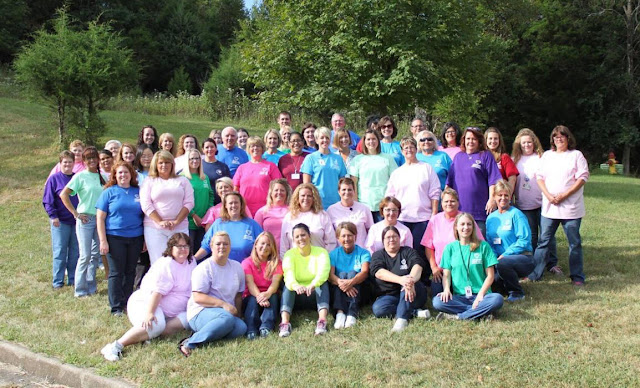
Franklin County Health Department staff pose for a photo taken by Deputy Director Brittany Parker.
The pandemic has been very hard on local health departments, which in many if not most cases haven't received the respect and recognition they deserve for bearing the extra workload and putting up with coronavirus skeptics who harass or abuse them. At least one got very prominent recognition at year's end, as The State Journal of Frankfort named the Franklin County Health Department its Newsmaker of the Year.

"It is because of their tireless efforts to keep the community healthy, while dealing with an increasingly hostile environment and constant threat of possible contamination," Harrison Wagner writes. "From organizing a way to administer tests and multiple doses of the vaccines, to creating informational materials about virus prevention, all while attempting to keep a healthy work-life balance and still perform their normal duties, the Franklin County Health Department has managed to weather the storm of the pandemic."

Health departments also enforce rules at workplaces, and "there were instances of hostility towards health environmentalists, or health inspectors, while they were enforcing safety guidelines at businesses," Wagner reports, quoting Director Judy Mattingly: “There were quite a few scary situations where their strict instructions from me were that if any business owner is hostile with you in any way, shape or form, that you are to leave immediately. There were situations at that time where our environmentalists were able to call our police partners or sheriff partners and be accompanied on those inspections.”

On the bright side, the pandemic has raised the profile of the department "and its other healthy-living initiatives," Wagner writes. "The staff has become closer as a result of working together at the testing and vaccination drive-thrus. Mattingly said this has led to Secret Santa gift exchanges and Friendsgivings, which has made the department more tightly knit."

Wednesday, August 18, 2021

Financial troubles may make Letcher County Health Department vacate the multi-million-dollar building it opened 12 years ago

UPDATE, Oct. 13: The health department bought the former Dairy Queen for $280,000 and is renting parts of its building, the Mountain Eagle reports.

Letcher County Health Department (Mountain Eagle photo)
By Sam Adams
The Mountain Eagle

An unwillingness to raise tax rates, a declining tax base, reduction in federal and state funding, and Covid-19 closures and layoffs have created a perfect storm that has put the Letcher County Health Department in danger of losing the multi-million-dollar health center that opened just 12 years ago.

Discussions are underway for the department to purchase the old Dairy Queen building just across the river for storage of records, and possibly to move some services to the Letcher County Recreation Center, though officials would not talk about that possibility.

“At the last board meeting, what I can tell you, is the health department is exploring options because the amount of taxes the public health taxing district will take in is the lowest it has received in decades,” said Scott Lockard, director of public health for the Kentucky River District Health Department.

Lockard would not say what those options are, but he said the department has not defaulted on its loans. He said it was able to pay all its bills except its assessment to the district.

“We have no plans to move out of it at this time, but I don’t know what the future holds,” Lockard said. The department is “actively seeking renters” for space in the 32,000-square-foot building, he said.

Letcher County (Wikipedia map)
Minutes of the Letcher County Board of Health meetings, which occur only one time a year, show the district has been struggling since at least 2019, when Lockard informed the board it was facing a $183,000 deficit and recommended a tax increase. Judge/Executive Terry Adams, who sits on the board, suggested renting unused space instead of raising taxes. Adams made a motion during the same meeting to set the tax rate at 8 cents per $100 assessed value, the same as the prior year, and the board voted to accept that rate. The board has set the same rate each year since then, turning down a 9.2 cent per $100 tax rate in June of this year.

During that meeting, Lockard suggested the board cash in certificates of deposit to buy the old Dairy Queen building, and the board voted unanimously to authorize Dr. Ricky Collins, chairman of the board, and board member Dr. Debbie Williams to sign a purchase contract.

Collins, who was elected chairman during the meeting, said Tuesday that discussions on the property purchase are still underway. He said he had heard talk of a move to the recreation center also, but he has not been involved in anything about it and knew of nothing official. He referred questions to Judge Adams.

Adams said he could not comment on whether the department could move to the recreation center, which is just across the river from the Health Center. “There’s nothing affirmative about doing anything,” he said.

Monday, December 7, 2020

Kentucky's contact-tracing program lacks specific data sought by Beshear's critics; he says its main purpose is to prevent disease

Terrie Burgan traces contacts for the Lincoln Trail District
Health Department. (Photo by Pat McDonogh, Courier Journal)
When Gov. Andy Beshear shut down indoor dining in restaurants and bars to slow the increasing spread of the coronavirus, "criticism from Republican leaders in Frankfort was both swift and predictable," Joe Sonka of the Louisville Courier Journal notes in a story about the effort to trace past contacts of those with the virus. 

Republican legislative leaders reiterated their complaint about Beshear's lack of collaboration, but also said he had no contact-tracing data to show why the move was necessary. Some restaurant owners in Louisville have made similar complaints, Sonka reports, "saying there was no data in Kentucky to justify the prohibition in the first place." 

Beshear counters that "a litany of national research and public health experts to justify his latest orders restricting things such as indoor dining," Sonka reports. But the governor and his administration acknowledge that the program lacks the sort of detailed data the critics want to see. They point to a decentralized system of 61 local health departments as one reason.

Sonka reports in some detail that other states have been able to quickly gather and disseminate the kind of data that the Republican lawmakers and restaurant groups are looking for, like what types of locations individuals visited in the days before testing positive for the coronavirus, or where "cluster locations" are, where multiple people have tested positive after visiting. 

In Kentucky, the Louisville Metro Department for Public Health and Wellness has begun publishing this type of data, including "weekly contact tracing data detailing the types of places people reported visiting in the two days before testing positive or showing symptoms, in addition to the locations where they worked in person," Sonka reports. 

However, health officials at the Louisville agency told Sonka that it's been a laborious task because of the state's approved data management system.

"The state's system allows sortable data entry only in very broad categories of potential exposure locations, such as "events" or "other" to capture exposures besides household, work or school, said Karen Handmaker, who has run the agency's tracing program since May. Handmaker told Sonka that pulling together specific locations like bars, restaurants, churches, gyms and grocery stores "is manual. . . . It is a human endeavor as opposed to an automated."

Asked by Kentucky Health News at his Dec. 7 briefing if the challenges to get better contact tracing data is an indication that the state needs a more centralized system, Beshear didn't answer directly, but said, "I think the way that we share information, the way that we collect information, needs to be more uniform, and I think that they agree as well. It's a little harder in the original system that we had out there, but we're getting closer and closer to it."

Beshear was referring to a new tracking system into which all health departments put data on where exposure to the virus may have occurred. The system was funded by federal coronavirus money and can be used after the pandemic for other communicable-disease tracing. 

State Department for Public Health map; click to enlarge
Beshear has said more than once that the Barren River District Health Department's contact tracers identified outbreaks at 46 different restaurants, but department spokeswoman Ashli McCarty told Sonka that she could not provide specifics on that claim. 

 "We are collecting data on the number of cases that become clusters within establishments (staff), but are unable to collect data on any community spread cases that stem from these clusters," McCarty wrote in an email. "We are not providing data to the public on any specific establishments, but are tracking clusters within establishments on a case-by-case basis.” 

Beshear objected Monday to what he called the "narrative that's being pushed on contact tracers" and said the two primary purposes of tracing is to prevent the spread of the disease from the infected person and those they came into contact with after exposure. 

"What we're talking about is going backwards and getting data," Beshear said. "We're in the middle of a battle to stop this thing from spreading wider, and if that means we put more focus on stopping it from reaching and potentially killing more people than being able to say, in these 34 examples it came from X, then yes, we're doing what we have to do."

He added that he has received "calls for data in areas where every national expert tells us the same thing. So if we don't believe that it was spreading in these places, ask the White House for their data; I'm sure they could give you everything that they have been relying on." 

Beshear has cited research showing that indoor service at bars and restaurants worsens the spread of Covid-19, and that there is no reason to think what goes on in other states isn't happening in Kentucky.  Sonka notes, "A CDC study of 10 states found adults with positive test results were twice as likely to have dined in a restaurant than those testing negative, while a Stanford University simulation suggested fully opened restaurants would spread four times the numbers of additional infections as gyms."

Beshear has also cited the decrease in cases in Florida, Texas and Arizona during the second wave of the virus when those states put restrictions on restaurants, and the strong recommendations of the White House Coronavirus Task Force, which regularly calls on the state to limit bar and restaurant capacity. 

On Nov. 18, when Beshear banned in-person dining and in-person schooling, Senate President Robert Stivers said the lack of publicly available contact-tracing data to justify the restrictions was unacceptable.

Last week, Stivers said the state should "kill the contract" for the tracing program and put the remaining $40 million "back into a fund to help these businesses that are barely surviving." The program employs 1,600.

Beshear, in effect, rejected that idea Monday: "Come back to those who think that we don't need contact tracers. How alone would you feel if you got an email saying you had Covid and nobody ever called you, ever?" He said the call from a tracer "puts you in a system that says: Do you need food assistance? Do you have a doctor? Who do you call? Here are the symptoms you need to monitor?"

He added, "I know the attacks are intended to be on me, but . . . the local health departments feel those too."

Mark Carter
At the governor's Dec. 1 briefing, Mark Carter, who heads up the state's tracing program, said a significant update to the data management system for contact tracers could improve its publicly available data "in the next month or so." 

Because of the recent surge in cases, contact tracers throughout the state have been instructed to tell positive cases to reach out to their potential contacts themselves and give instructions on how to self-quarantine. 

Meanwhile, federal money for the program will dry up on Dec. 30 unless Congress appropriates more, and Beshear and Carter have made urgent pleas for it.

Friday, November 6, 2020

Christian County health director goes behind the daily data to tell covid-19 "stories to pull at your heart strings"

The front-line fighters against the coronavirus are employees of local health departments, who find their jobs increasingly difficult. People exposed to the virus won't self-quarantine, or won't answer the phone if they think the call is from a contact tracer at the health department. And as the pandemic accelerates, health-department employees lose more of their friends and relatives to covid-19. Christian County Health Director Kayla Bebout wrote about the personal and professional aspects of the pandemic on behalf of the department's 43 employees this week in a letter to news media in Hopkinsville. For the complete letter, in Hoptown Chronicle, click here.

Kayla Bebout
Our staff continues to work overtime to manage the pandemic, track cases, keep up with direct contacts — which can sometimes be in the thousands, and still operate other programs that are essential in our community," she wrote. "We don’t say this to solicit sympathy or for a pat on the back, but we do see the back story of the pandemic, what’s going on behind the scenes, and personally talk with people who have the virus each day. We report the data, and the public sees the numbers and statistics, but we sometimes forget that each number represents a real person, living a real life, who, in just a moments’ time, has had their world temporarily, sometimes permanently changed because of covid-19.

On a personal level, some of our very own staff have lost aunts, grandmothers and friends to covid-19. We have talked with friends who are restless because they are isolated at home, alone, frustrated, and concerned about their finances because they are missing work. We have staff with parents who are recovering cancer patients who are at an especially high risk for contracting a detrimental case of covid-19. One of our staff even sympathized with a friend who just had a baby. When she delivered, she was positive [for the virus] so she was isolated away from her newborn for days. Could you imagine being a new mother unable to hold your baby?

Marketing Specialist Amanda Sweeney lost her aunt in April to covid-19. “She was in her 80s, and in the Owensboro hospital for days by herself because she couldn’t have visitors,” Sweeney said. “My uncle still tells the story of how lonely she sounded on the phone as she told him, ‘I don’t think I’ll ever be home,’ and she didn’t come home. She died on Easter Sunday.”

Are we telling you these stories to pull at your heart strings? Well, we hope these stories pull on your heart strings. Even if in the grand scheme of numbers, the death toll may seem to be a small percent, these “small percentages” are real people who have died and left very big holes in the hearts of families and communities. These “mild cases” are still people who, although they may feel well, are still isolated at home away from family and friends, while missing work and worrying about how their mortgage will be paid if they don’t return work soon.

So, when we sound like a broken record as we ask you to wear your mask, wash your hands, and social distance, please remember that these simple measures could mean one less case. One less case means someone didn’t lose a loved one. One less case means someone isn’t out of work for days on end and stressing about finances. One less case means that a parent isn’t isolated from her children. One less case, although a small number, is still a huge deal when that small case is you.

Wednesday, October 7, 2020

Beshear: Some local officials will enforce mask mandate, while others will only encourage; Fayette case backlog makes a record

Beshear wore a mask throughout the briefing and said in
reply to a question that doing so might be a good example.
By Melissa Patrick
Kentucky Health News

Gov. Andy Beshear announced 2,398 new cases of the coronavirus Wednesday, by far a record, but not really; 1,472 of them were part of a backlog of cases from Fayette County; 926 were newly reported. 

"Even without the backlogged cases, we're on pace unfortunately to have another record week for the most cases," Beshear said at his daily briefing. 

Beshear said the state has helped the Lexington-Fayette County Health Department get its case data up to date, with an expectation that it will be maintained. This matters because the state's guidance for when it's safe for schools to hold in-person classes is based on the incidence rates in each county, so the numbers need to be current.

And just as the state has let local school districts decide whether they should hold in-person classes or not, Beshear is now asking local government officials to be the leaders in their communities when it comes to enforcing his mandate to wear masks, a proven way to slow the spread of the virus. 

Owsley County Judge-
Executive Cale Turner
Asked about his call that he had yesterday with mayors and county judge-executives, Beshear said Owsley County Judge-Executive Cale Turner, whom he did not name, "talked about how we all need to step it up, that it's serious and Owsley is in the red" zone for new cases. "So, it was good to hear what he was ready to do."

Beshear suggested that some mayors want some help in return. "I heard a little bit about some changes that I think we can make in code enforcement," he said. "Some cities have not been able to get people to cut their grass. That's something we ought to be able to deal with in the midst of this.

"But my sense is that everybody wants to do the right thing and is ready to do that encouragement. The real response will be what we see in our communities."

Beshear said Harlan County Judge-Executive Dan Mosley and he agreed "that people have gotten more casual about it, and I know he's ready to step up and do some of those same things that he was doing before. Hopefully we'll see in their own way every local leader trying to do their part.

"There may be some that feel more comfortable walking into some of their establishments and telling people, 'You really need to do this,' and there may be others that are willing to take stronger enforcement methods. Certainly in some of our larger cities, especially with bars, we need to see more direct enforcement." 

Health Commissioner Steven Stack reminded Kentuckians that as cases go up, so do hospitalizations, noting that in late September the state had about 380 hospitalizations a day, but as the cases have surged, so too have hospitalizations. 

Beshear said 672 people were hospitalized in Kentucky with covid-19 on Wednesday, with 161 of them in intensive care and 79 of those on ventilators. 

Seven states saw record hospitalizations from covid-19 on Oct. 6: Arkansas, Montana, North Dakota, Oklahoma, South Dakota, Wisconsin and Wyoming, The Washington Post reports.

Stack, a physician, stressed that if Kentuckians will just follow the recommended guidelines, the case numbers will go down. 

"I do admit some puzzlement when folks say, 'So what are you going to do next? What are you going to mandate next?' I would say that we have very good guidance in place," he said. "The guidance is, wear your mask, socially distance, keep your hands clean, and you should also stay home if you are sick." 

The share of Kentuckians testing positive for the coronavirus in the past seven days is 4.21%. Stack said the the backlogged cases added today did not affect today's the positive-test rate, which is determined by test results from laboratories, not health departments.  

First Lady Britainy Beshear, who opened the briefing, said more than 40,000 masks have been donated to Kentucky schools through the Coverings for Kids program, and masks will continue to be collected through Oct. 30.

Before introducing the #MaskupKy social media segment of the briefing, she said, “Wearing a mask is one of the best ways to prevent the spread of the coronavirus. Right now, as we continue to see high case numbers, it is crucial to practice kindness to others, to set a good example by wearing a mask when you are out in public. It helps protect you and the people you care about."

The governor announced that five more Kentuckians had died from covid-19, bringing the state's death toll to 1,223. They were a 68-year-old man from Fayette County; an 80-year-old woman from Greenup County; a 65-year-old man from Harlan County; a 79-year-old man from Henderson County; and a 75-year-old woman from Whitley County.

Michael Reynolds
"We expect the next several weeks that these numbers will go up as the number of cases go up," he said.

Beshear honored the life of Michael Reynolds, a 58-year-old Louisville man who died Oct. 6 of covid-19. His niece, who was identified only as Ms. Fisher, asked the governor to tell his story to stress the seriousness of the virus. She said her uncle was a man who loved his family and friends, music, sports and shopping. "He was known for his sense of style and for always talking about his children, grandkids, fiancé and friends. He loved them all so much," she said in a letter to the governor.

In other covid-19 news Wednesday:
  • With the backlogged cases, Fayette County had 1,510 new cases recorded on Wednesday.  Of those, 39 were newly reported today. Other counties with 10 or more new cases in the daily report were Jefferson, 191; Warren, 31; Hopkins, 30; Daviess, 28; Kenton and Laurel, 25 each; Bullitt and Scott, 21 each; Boone, Hardin and Henderson, 20 each; Knox, 16; Christian and Whitley, 15 each; Calloway, Pike and Shelby, 14 each; Franklin, Knott and Letcher, 13 each; Adair, Boyle and Todd, 12 each; Graves, 11; and Allen, 10. 
  • In long-term care, 48 more residents and 22 more staff have tested positive for the virus, with 711 active resident cases and 440 active staff cases. The daily report shows 719 residents and five staff have died of covid-19.
  • Beshear said at least 25 veterans have tested positive for the coronavirus at the Thompson-Hood Veterans Center in Wilmore. He said veterans and employees are being tested every 72 hours and being screened for symptoms daily. He said the facility has created a covid-19 unit and nine veterans have been transferred to the VA Medical Center in Lexington. 
  • The K-12 student daily report and the college and university daily report will not have new numbers added until next week because the system is being automated. Click here for the K-12 dashboard.
  • Kentuckians 18 and younger accounted for 358 of the newly reported cases, and 38 of them were 5 and under, Beshear's news release said. 
  • Officials at Western Kentucky University have canceled spring break and will end the semester a week early, the Associated Press reports. The decision was made "in order to minimize the possibility of a covid-19 flare-up on campus," a school official said.
  • Health Secretary Eric Friedlander said licensed day-care centers and certified and registered child-care programs will receive a one-time grant of $130 per child from federal relief funds, since many are struggling financially because of the closures and capacity limits placed on them because of the pandemic. He said the facilities received $225 per child earlier this year.
  • Beshear said driver's license offices in Louisville, Elizabethtown and Prestonsburg are closed because of at least one positive covid test among employees. He acknowledged the inconvenience, but said it's important to do the right thing to protect other employees.
  • “The White House has cleared the the Food and Drug Administration’s stricter standards for vaccine approval . . . after the FDA "unilaterally published the guidelines on its website," The Washington Post reports. President Trump had called the guidelines “political” and indicated that he might not approve them, but “Tired of the delay, the FDA circumvented the White House by publishing the criteria online as part of a briefing package for a meeting with its vaccine advisory committee that is scheduled for Oct. 22.”
  • "A former director of the Centers for Disease Control and Prevention and public health titan who led the eradication of smallpox asked the embattled, current CDC leader to expose the failed U.S. response to the coronavirus, calling on him to orchestrate his own firing to protest White House interference," USA Today reports.
  • Until a coronavirus vaccine is available, "The key to avoiding covid-19 is reducing one’s risk of infection as much as possible. Better sleep can help," National Geographic reports. It says sleep is a simple but solid way to bolster the immune system. 
  • Doctors told Deborah Yetter of the Courier Journal that covid-19 patients in the Louisville area can get similar high-quality care and most of the same drugs received by President Trump for covid-19. The exception is the new, experimental "antibody cocktail" produced by Regeneron that Trump received, though Kentucky is about to launch its first clinical trial of the drug within days. Yetter expands on the use of the other two drugs used, Dexamethasone, a steroid, and Remdesivir, an anti-viral medication, which has been authorized for treating certain covid-19 patients, but is still awaiting final FDA approval. 
  • Nine Eastern Kentucky health departments released covid-19 numbers on Tuesday and WYMT reports them. 
  • As of Oct. 7, The Guardian and Kaiser Health News has profiled 224 health workers who have died from covid-19.Click here to read their stories. 

Friday, February 7, 2020

Most health departments support overhaul of their funding, though some would lose; spreadsheet lists estimated impact on all

The logo used by state and local health departments
By Melissa Patrick
Kentucky Health News

Driven by the state's pension crisis and a non-equitable funding model, Kentucky health departments warn that if the state doesn't change its requirements for how they prioritize available public health resources -- and how they are funded -- many of them will have to cut essential services, and half could close their doors.

Legislators and health-department officials are seeking a complete overhaul of the state's public health system, not only to help it survive in the face of a $40 million deficit in 2020, but also focus on core programs to improve the state's poor health outcomes.

"House Bill 129 codifies the prioritization of public health funding at every resource level -- state, local and federal -- to programs that provide the most significant opportunity to improve Kentucky's overall health," said Allison Adams, president of the Kentucky Health Department Association. "It also codifies the methodology in how that funding is distributed at the local level so that it is equitable at each county level."

The current system funds each health department with the same formula, regardless of its ability to generate local funds. The new formula would take that into account, making it more equitable, Adams said. In other words, departments that have more resources would get less state funding under this model.

A spreadsheet prepared by Adams' group estimates that 14 of the 61 county and district health departments would get less state funding, and the rest would get more, using a formula based on a county's population, its ability to support its health department with its current taxing authority, how many employees the county would need to provide only the health services required by law, and an estimated increase in environmental fees.

Several district health departments, which serve multiple counties, would get the largest annual increases. Barren River, which serves eight counties in Southern Kentucky, would gain $1,018,200; Lake Cumberland, which serves 10 counties to the east, would gain $1,377,842; and Elizabethtown-based Lincoln Trail would gain $1,054,679.

The 14 departments that would get less funding would be in Breathitt, Bullitt, Clark, Fayette, Franklin, Johnson, Knox, Madison, Marshall, Montgomery, Oldham, Whitley and Woodford counties, and the Wedco District Health Department, which serves Harrison, Nicholas and Scott counties. The losses range from $36,729  in Whitley County to a high of about $1 million for the Lexington-Fayette County Public Health Department.

Dr. Kraig Hambaugh, director of the Lexington agency, cautioned that the numbers in the spreadsheet are estimates, with many based on assumptions. He said that even with the predicted gains and losses, the model is designed to make sure every county's core public health needs can be met.

Humbaugh also stressed that the new model is just one part of the departments' funding puzzle, since it doesn't address their looming pension obligations. He said that if nothing changes before July 1, the beginning of the next fiscal year, the current pension obligation of 93 percent of payroll would make his department use about $6 million of its $17 million budget for retirement costs.

All that said, he recognized that his department would lose money under this new model, but said he still supported it.

"This shouldn't turn into an us-versus-them kind of game, one health department versus the other, because we're all part of one larger system that is designed to promote health in the commonwealth and to protect the public's health," he said.

He added that he felt HB 129 also shows legislators and the public that local health departments are willing to do their part to economize and use their resources wisely.

Adams said the association has been talking about this new funding methodology for about five years and that association members have had opportunity to vet it. Further, she said an over-whelming majority of the departments supported the new model during a roll-call vote.

"This is a funding methodology that provides equitable resources to all of our communities so that we can provide the most basic public health services at each county level," she said.

HB 129, sponsored by Rep. Kim Moser, R-Taylor Mill, passed the House Health and Family Services Committee, which she chairs, on Jan. 16. It is now in the Appropriations and Revenue Committee. The "Public Health Transformation" bill  has 20 bipartisian sponsors.

Pension woes

This new model has been in the works for several years, but gained momentum after health-department pension obligations were set to jump from 49.47% of payroll to 93%.

During a special session last summer, lawmakers gave health departments, regional universities and quasi-governmental agencies the choice of staying in the Kentucky Retirement System and paying the full obligations or leaving the system, either by paying a lump sum or buying their way out over time. Those that choose to leave would need to move employees to a 401(k)-type plan.

The departments say none of these choices are viable, and none have left KRS. The state Department for Public Health has said that without some relief from their pension obligations, dozens of health departments are at risk of closing.

Gov. Andy Beshear has proposed giving the departments about $16.5 million in each year of the budget as a way to freeze their employer contribution rate at 67.41% of payroll. The Democratic governor's proposal would have to be approved by the Republican-controlled legislature.

Lawmakers are working on another pension solution through HB 171, sponsored by Rep. Jim DuPlessis, R-Elizabethtown, which would change how health departments, regional universities and quasi-governmental agencies, pay for their pensions altogether. It would move away from the current  percentage-of-pay" formula and move to one that requires entities to pay what they owe the pension system over 27 years, which is often called "level dollar funding." It passed the House State Government Committee Feb. 6 and is expected to be sent to the Appropriations and Revenue panel.

What is Public Health Transformation?  

The new public health model calls for health departments to only be required to provide four "core public health" areas. They include services required by law or regulation; the federal Women's, Infants and Children nutrition program; the HANDS program, which stands for Health Access Nurturing Development Services for child rearing; and harm reduction and substance-use-disorder programs, including syringe exchanges.

"The programs that we've identified that are the most basic, which we call foundational services, are the programs that have been identified as comprehensive public-health systems," Adams said. "So if we provide those at every level, over time we should expect better health, better health outcomes and longer life expectancies."

The plan also requires departments to perform community health assessments, which many of them already do, to determine local public health priorities beyond the core requirements. Such priorities would have to meet certain criteria for the department to address them and would also need to be funded separately.

For example, a vaccination clinic run by the Todd County Health Department that serves only Amish and Mennonite families would be considered a local public health priority.

"It’s a niche need in Todd County that the public health department, because of strict state and federal funding guidelines, has struggled for years to fund," Alex Acquisto reports for the Lexington Herald-Leader. She notes that the program costs about $5,000 a year.

Photo by Silas Walker, Lexington Herald-Leader
The clinic serves about 3,000 people, or a fifth of the county's population, Acquisto reports, telling of  their monthly horse-and-buggy trips to the clinic to get vaccinations for their infants and toddlers, most of whom only speak Pennsylvania Dutch.

Until a decade ago, when the clinic started, virtually none of the Amish or Mennonites in the area were vaccinated. "If you have a fifth of your population who isn't vaccinated, then your whole public is at risk," Jennifer Harris, the health department's director, told Acquisto.

The bill would also allow health departments, for the first time, to refuse state program funding that their counties don't need in order to invest in the services they do need.

"Without passage of this bill, in Todd County, the Amish and Mennonite and public-school vaccination clinics would be some of the first services cleaved from the budget, because Harris can no longer afford them," Acquisto writes.

The bill also requires local governments to ensure a minimum public-health tax rate of at least 1.8 cents per $100 of assessed property value, or equivalent alternative funding, to be allocated toward foundational public-health programs.

And to help offset some of the added cost, health departments are asking for a one-year reprieve on a rule that restricts increasing environmental fees to no more than 5% each year. After that year is up, the statute would go back into place. This would allow health departments to bring those fees in line with what they actually costs, since they are currently subsidizing the difference.

At the committee meeting, Moser said, "The public health transformation initiative will result in a more simplified and a more focused public health model that prevents duplication, encourages shared responsibilities and resources and expertise to create economies of scale, a fairness across the state, and clearly defines the role throughout the system."

Sunday, February 2, 2020

Beshear's budget offers pension reprieve for health departments

Before the legislature froze health departments' pension contributions last year, the Department of Public Health made this map, which is based on 2019 data but still shows their relative financial health.
By Melissa Patrick
Kentucky Health News

As health departments across Kentucky face pension challenges that could force many of them to enforce big cuts in services or even close their doors, Gov. Andy Beshear's two-year budget proposal offers them a bit of a reprieve.

Beshear's proposal would give the departments about $16.5 million in each year of the budget as a way to freeze their employer contribution rate at 67.41% of payroll.

Their current rate is 49.47% of payroll, but this is set to jump to 83.43% on July 1, the day the next budget starts. The Democratic governor's proposal would have to be approved by the Republican-controlled legislature.

Scott Lockard, director of the Kentucky River District Health Department, said his agency, which serves Knott, Lee, Leslie, Owsley, Perry and Wolfe counties, will need this funding to stay open.

“I am very grateful,” Lockard said in an email. “This increase in funding is an acknowledgement of the importance of the critical services we provide. The options provided to KY River District under House Bill 1 of the special session are completely unaffordable for my agency. This increase in state support to cover pension cost increases is the only way will be able to continue to protect and promote the health of the residents of the KY River District.”

During a special session last summer, lawmakers gave health departments, regional universities and quasi-governmental agencies the choice of staying in the Kentucky Retirement System and paying the full obligations or leaving the system, either by paying a lump sum or buying their way out over time. Those that choose to leave would need to move employees to a 401(k)-type plan.

The departments say none of these choices are viable, and none have left KRS. The state Department for Public Health has said that without some relief from their obligations, dozens of health departments are at risk of closing.

To address their financial crisis, the departments want lawmakers to approve a major overhaul of the health-department system, including changes in how they are funded. HB 129, sponsored by Rep. Kim Moser, R-Taylor Mill, has passed the House Health and Family Services Committee. which she chairs, and is in the House Appropriations & Revenue Committee.

"I am appreciative of our governor recognizing the plight of local health departments and I look forward to working with our legislature thorugh the budget process," said Allison Adams, president of the Kentucky Health Department Association.

Friday, January 10, 2020

Ky. among national leaders in flu, which keeps accelerating; 2 more deaths raise state total to 8; still plenty of time to get a shot

Kentucky Health News

Two more people have died in Kentucky from influenza this season, bringing that number up to eight, according to the state Department for Public Health weekly flu report.

Kentucky is among states with the highest levels of flu activity, says the federal Centers for Disease Control and Prevention, and the latest report shows another jump in new cases, bigger than the week before.

In the week ended Dec. 28, the last week for which the state has issued a report, Kentucky had 2,213 new cases of flu, up from 1,339 new cases reported the week before. During this flu season, 5,988 cases have been confirmed in Kentucky. The actual number is higher; 22 of the state's 120 county health departments did not report.

At the same time last year, Kentucky had a total of 1,457 lab confirmed flu test and five deaths, one under the age of 18. One of those who died this year was under 18.

The CDC recommends that everyone over six months of age get a flu vaccination each year. There is still plenty of time to get one; flu season runs through May.

A spokesman from the Lexington-Fayette Health Department stressed the importance of getting a flu shot and told Spectrum News that of the county's 141 lab-confirmed cases of the flu, only about 20% of them had received the flu shot. Fayette County reported 77 new cases during the week.

"What we're seeing right now is just a lack of people getting the flu shot . . . So go out, get the flu shot, whether it's here or at your pharmacy, your medical provider, just get it somewhere," health-department spokesman Kevin Hall told Spectrum News.

Pike County saw a big jump in flu cases during the week ended Dec. 28, with 107 new cases, for a total of 242 this season. Joel Thornbury, a pharmacist at Pikeville's Nova Pharmacy, told Hazard's WYMT-TV Jan. 7 that he had about 100 doses of flu vaccine to give away, as a way to help those who might not otherwise be able to get one.

Barren and adjoining counties continued to be a hotspot, with most of the seven counties doubling or nearly doubling their numbers; most of Allen County's cases being reported that week. Barren reported 126 new cases, for a total of 265; Allen had 31 more for a total of 49; Warren had 100 more for a total of 184; Monroe had 52 more for a total of 110; Hart had 30 more for a total of 61; Metcalfe had 29 more for a total of 58; and Edmonson had two more for a total of seven.

Clark County, which had not reported recently, reported its first 22 cases. Lincoln County, which had been listed as reporting, reported 62 new cases during the week ended Dec. 28, for a total of of 63.

Several other counties saw big jumps. Garrard reported 28 new cases, for a total of 34, Marshall reported 38, for a total of 48, and Shelby reported 38 for a total of 71. Oldham County saw a big jump of 90 new cases for a total of 147.


Sunday, August 4, 2019

Health departments get another year before pension hikes kick in, but some are already raising taxes in anticipation

By Melissa Patrick
Kentucky Health News

While local health departments are more than grateful that legislation passed in the recent special legislative session gives them another year to manage their looming pension crisis, several counties have already asked for a tax increase as a way to help pay for it.

The Kentucky Department of Public Health said in an email last week that it had received 63 of this year's 113 county tax resolutions and so far 10 counties have asked for a higher rate. Of those, the department said board minutes show that Boone, Boyd, Campbell and Kenton discussed the increase in the Kentucky Retirement System cost prior to voting on the tax rate.

"However, the other six counties mentioned in their board minutes there was a discussion, but did not mention in the minutes details of the discussion," the email said. They are Leslie, Muhlenberg, Ohio, Union, Wayne and Webster counties.

The new law, written and signed by Gov. Matt Bevin, freezes the pension cost of health departments for another year, at 49 percent of payroll, avoiding an increase to 83 percent.

That gives them one more year to decide whether to stay in the state retirement system, with an increase in their pension contribution to 83% of payroll, or leave it -- and either pay a lump sum equal to their projected pension liabilities, or pay it off over the next 30 years in installments.

Allison Adams, director of the Buffalo Trace District Health Department, which includes Mason and Robertson counties, explained that the state has a cap of 10 cents per $100 property value for health taxing districts, and some counties have set this cap even lower through referenda.

Adams, who is also the president of the Kentucky Public Health Association, said it is a fallacy to believe that health departments can simply double their tax rate to pay for their pension obligations, as some legislators have suggested.

Using Robertson County as an example, she said the tax rate there is already set at 8 cents per $100 property value, which would allow it to request 2 more cents per $100 property value, which she said would bring in about $90,000.

But that's not enough to make any real difference, since the cost of one clerk and one nurse in that department, figuring 83% of payroll for their pension, is $175.207 -- an amount that does not include any other costs for required programs and services, Adams said.

"For those who have the tax base, it would help them," she said. "But for those who don't, it wouldn't help."

And for those counties that are levying the maximum tax rate and still don't have enough resources, even after whittling down their staff, to deliver only core and statutorily required services, Adams said, "The next thing to do is to cut services."

The Anderson County Health Department  increased its tax rate in June to help pay for the pension increase that was set to kick in on July 1, but has since been delayed until next year. But the county Board of Health rescinded a portion of the requested 75% increase, reducing it from 52.5 cents per $1,000 in assessed property value to 47.5 cents, which represents a 58% increase from the original rate of 30 cents per $1,000, Ben Carlson reported on June 19 for The Anderson News.

Public Health Director Tim Wright made the request to lower the rate at a specially called meeting after discovering he had made a mistake in his request, explaining that he was unaware that the spreadsheet he used to build his annual budget already included the increase for pension costs, so when he computed his figures the pension had been added in twice, Carlson reported.

The new rate will keep the department from tapping into its reserves to pay the looming pension costs. The new rate will generate about $230,000, and $140,000 of that will go into pension funding, according to documents provided by Wright, Carson reports. Wright said that this is the county's first rate increase in about 20 years.

J Smith, the public health director of Garrard County Health Departmenttold John Cheves at the Lexington Herald-Leader: “The only reason we came in under budget this year is because of all the cuts we made. But we can’t keep doing that, we’ve done all we can do there,” Smith said. “I told our Board of Health that if we want to keep the services we have left, we’re going to have to have a tax increase.

Chris Crum, public health director at Greenup Health Departmenttold Rachel Adkins of The Daily Independent in Ashland that because Greenup County raised its health tax last year, it was no longer at risk of closing because of the looming pension costs.

Another challenge is that some counties don't have a separate taxing district to finance their health departments, Melinda J. Overstreet reports for the Glasgow Daily Times.

Barren County Judge-Executive Micheal Hale told Overstreet that Barren is one of three counties in the eight-county Barren River District Health Department that does not have a separate taxing district for health, and without that the county is fiscally responsible for its funding. The county's health department is one that the state health department put on a list that were at risk of closing within 12 months if they didn't get a reprieve from the bigger pension obligation.

Hale told Overstreet that an overnight jump to an 83% contribution would require the county to contribute well over $1 million, which he said would be "catastrophic" for the county's budget. He added that after the final budget is decided, he would ask the committee to look into the possibility of a health taxing district.

Depending on local tax dollars to fund public health would result in huge inequities, said Scott Lockard, director of the Kentucky River District Health Department, which covers some of the state's poorest and unhealthiest counties.

"Communities that need public-health services the most, that have the highest poverty rate, that have the poorest health outcomes, also have the least ability to raise local revenue," Lockard told Kentucky Health News in June.

Adams pointed out  that counties with high property values could raise their tax by 0.5 cents and generate more revenue than a county with low property values that double their rates.

Sunday, July 28, 2019

Health departments and their employees making tough choices now that the General Assembly has passed Bevin's pension bill

Bevin at bill signing (Lexington Herald-Leader photo by Alex Slitz)
Kentucky's health departments and their employees face some difficult decisions in the wake of the pension legislation passed in the recent special session of the General Assembly.

The law written and signed by Gov. Matt Bevin freezes the pension costs of health departments for another year, at 49 percent of payroll, avoiding an increase to 83 percent, which would have forced layoffs and program cuts, and could have put some of them out of business.

But now the health departments must choose whether to stay in the Kentucky Retirement System "at full cost, leave the retirement system by paying a lump sum equal to future projected benefits payments, or buy their way out in installment payments over 30 years," writes David Zoeller of The Paducah Sun.

Marshall County (Wikipedia map)
Zoeller notes that the Marshall County Health Department "has already been making tough decisions," such as ending its school-nurse program and cutting its staff by almost 30 percent.

John Cheves of the Lexington Herald-Leader notes, "Public employers that quit KRS will be encouraged through financial incentives to freeze their employees’ pensions so they accrue no further benefits. Instead of a pension, employees will be transferred into a riskier defined-contribution retirement plan, such as a 401(k), with a balance that rises and falls with the stock market, and that retirees can outlive if their money runs dry. . . . Some could lose hundreds of thousands of dollars in anticipated retirement benefits if their pensions are frozen."

Cheves's object example is the Garrard County Health Department, which has seven employees, some of whom are less than 10 years from retirement. "Under the state pension formula, the final decade on the job is crucial to maximizing their monthly retirement checks," he notes, and gives a specific example:

"Cathy Stapleton, a nurse at the health department, is 55 with plans to retire at 62. She doesn’t want her pension to be frozen and replaced with a 401(k) account that would have seven years — not the usual 30 to 40 — to build wealth through compound interest. One ill-timed market crash could sink her." She told Cheves, "It means a lot when you come into a pension. It means you have a retirement where you can count on having that income every month." Getting a new 401(k) plan at age 55 "would be a lot different."

Garrard County (Wikipedia map)
Department Director J Smith told Cheves he will recommend to the Garrard County Board of Health that it stick with KRS and pay the 83 percent. "Telling middle-aged people who devoted their lives to public service that they’re suddenly going to risk financial insecurity in their senior years is not a viable choice, he said," Cheves reports, quoting him directly: “We’re not going to opt out. If we opt out, to me, we’re screwing our employees here. Some of my people have got just a few years left. We expect to get what we were promised. We were promised a pension.”

The department has already eliminated family-planning services, cut health education, "laid off its emergency-preparedness coordinator and a front-desk clerk, and officially eliminated a third position, Smith’s old job, which he still does in addition to being director," Cheves reports. "That means he splits his time between inspecting schools, businesses, septic tanks and the like for safety and cleanliness, and managing the department."

“I’ll admit, our response time is slower now because of it,” Smith told Cheves. “When people used to call in for a site evaluation, we usually could get out there the same day. Now it might take us a week. It’s just — I’m sorry, we don’t have the people we used to. . . . I told our Board of Health that if we want to keep the services we have left, we’re going to have to have a tax increase.”

Kentucky River District Health Department
service area: Wolfe, Lee, Owsley, Leslie,
Perry, Knott and Letcher counties (KRDHD map)
Using local tax dollars to fund public health would result in huge inequities, said Scott Lockard, director of the Kentucky River District Health Department, which covers some of the state's poorest and unhealthiest counties. "Communities that need public-health services the most, that have the highest poverty rate, that have the poorest health outcomes, also have the least ability to raise local revenue," Lockard told Kentucky Health News in June.

Scores of reported cases of Rocky Mountain spotted fever in Lincoln Trail area; awaiting state health department confirmation

Kentucky Health News

Rocky Mountain spotted fever, the main tick-borne disease in Kentucky, has affected scores of people in the area served by the Elizabethtown-based Lincoln Trail District Health Department.

The six-county department "has investigated a total 79 cases of Rocky Mountain spotted fever for June in the district, which comprises Har­din, Meade, LaRue, Nel­son, Washington and Mar­ion counties," Mary Alford reports for The News-Enterprise in Elizabethtown.

In Grayson County, which is in the Lincoln Trail Area Development District but has a separate health department, 26 cases were reported from July 7 to 17. All the numbers are subject to confirmation by the Kentucky Department for Public Health. In a typical year, the entire state has 10 to 30 cases, Grayson Brown, director of the University of Kentucky Public Health Entomology Laboratory, told Kentucky Health News as the summer tick season began.

Dog ticks (middle) are the usual carriers of Rocky Mountain spotted fever.
"Reports of tick-borne illnesses that make it to the health department stem from people with a known tick bite who go to the doctor, exhibiting symptoms such as fever, rash, headaches, muscle aches and tiredness, and are tested for Rocky Mountain spotted fever, Lyme disease and other ailments,"Alford reports. The district health department has also found a few cases of tick-borne Lyme disease.

How can you protect yourself from these diseases, which can be debilitating and in rare cases fatal? Use insect repellents, shower soon after being outdoors, and check for ticks daily, especially in hard-to-see places, Rebecca Morris writes for The Record in Grayson County, citing material from the federal Centers for Disease Control and Prevention web page about ticks.

CDC recommends "a full body check upon return from potentially tick-infested areas," Alford writes. "Ticks most commonly attach around the ears, inside the belly button, behind the knees, between the legs, around the waist and especially in and around the hair. To remove a tick, people should use tweezers to grab the tick close to the skin and gently pull on the arachnid with steady pressure, and wash hands and the bite site with soap and water after the tick is removed. Also, apply an antiseptic to the bite."

Other tips, from UK's Brown:
  • Check your pets.
  • Keep grass and shrubs trimmed, and clear overgrown vegetation in your yard.
  • Don't walk through uncut fields, brush and overgrown areas.
  • Walk in the center of hiking trails.
  • Wear light-colored clothes, which make it easier to spot ticks.
  • Wear long pants tucked into boots or socks, and tuck your shirt into your pants.
  • Place a band of duct tape, sticky side out, around your lower legs to trap ticks.
  • Use tick repellent that has DEET or picaridin, or use permethrin-based clothing sprays.
Rocky Mountain spotted fever "can take three to 12 days to incubate," Morris notes. "Initial symptoms appear in one to four days, and include a high fever, severe headache, swelling around the eyes and on the backs of the hands, nausea and vomiting." The spotted rash usually appears two to five days after initial symptoms, but 10 percent of victims never develop a rash.

"After five days without medical treatment, patients can have altered mental states, lapse into a coma, develop respiratory problems or even have organ failure," Morris writes, citing the CDC. The disease "can lead to death if patients aren't treated early."

Sunday, March 24, 2019

Health departments scramble to fight hepatitis A outbreak

Peyton Manning had hepatitis C but didn't know about hepatitis
A or the outbreak until it hit him. (Michael Clevenger, Courier Journal)
The nation's largest outbreak of hepatitis A has slacked off somewhat in Kentucky, but remains a threat and local health departments are dipping into their reserves and taking unusual steps to get people vaccinated for the liver disease, which has killed 44 Kentuckians during the outbreak.

The medical director of the Lake Cumberland District Health Department doesn't usually give vaccinations, but each of her counties only had one or two nurses to do that, so Dr. Christine Weyman started giving shots, too, Laura Ungar and Chris Kenning report for the Louisville Courier Journal.

"She has gone out to vaccinate drug users who largely were spreading the virus," they report. "She once went so far as to chase two men down a street to persuade them to get the shot. (They weren't interested.) She also went to the crowded Pulaski County Detention Center, realizing the 213-bed jail with more than 400 inmates could be an excellent incubator for the virus. Right outside the jailer's office door, her health department placed a refrigerator for the sole purpose of storing vaccines."

"In many ways," Ungar and Kenning wrote, the Somerset-based department "is a microcosm of rural Kentucky's continuing struggle with hepatitis A. What's happening there reflects how Kentucky's communities with limited resources are quietly battling the nation’s largest and deadliest outbreak — learning as they go and altering their strategies to meet the many challenges they face."

The state has averaged 76 hepatitis A cases per week this year, "sometimes reaching more than 90 a week, compared with 151 a week at its peak in early November," the CJ reports, but "Kathleen Winter, an epidemiologist at the University of Kentucky, said a recent downward curve in the outbreak doesn't necessarily mean it's waning."

"We still need robust intervention," Winter told the newspaper. "It's still too early to say whether it’s really winding down. We still have individuals getting sick, being hospitalized and dying."

The story's first example was Peyton Manning, 27, "who was sleeping behind a Walmart in Lexington and spending his days shooting meth and heroin. Late last year, he admitted himself to The Healing Place in Campbellsville. Then a virus hit him. He couldn’t sleep. He couldn't keep any food down." He went to the UK hospital and recovered at his mother's home.

Manning already had hepatitis C, but said he didn't know about hepatitis A or the outbreak. "didn’t even know it was a thing," he told the CJ. "I started to watch the news. It was like, damn, I didn’t know it was that bad."

Health departments are responding "with a mix of resources," the paper reports. "In addition to using state funding, local health departments can also order federally funded vaccine through the state or buy shots using money from $233 million in county health department reserves," which "vary greatly across counties and area development districts. They're in the negative numbers in some places and reach into the millions of dollars in others."

The Lake Cumberland agency had unrestricted reserves of about $5 million when the outbreak hit in 2017, but was "trying to avoid using this as much as possible to help with the pension crisis," said Ron Cimala, its administrative director. Many health departments have said they will have to close unless the legislature keeps giving them relief from the state's new requirement for funding their employees' pensions.
Ranges of health department reserves that could be used to pay Kentucky Employees Retirement System obligations. About half of the counties are in district departments; others are independent.

Sunday, October 7, 2018

Frankfort fast-food restaurant closes for cleaning after one employee is found to have hepatitis A

A Frankfort fast-food restaurant closed for cleanup after one of its employees was found to have the liver disease hepatitis A, usually caused by ingestion of fecal material.

“The risk of infection from this food-service worker is very low due to hand-hygiene requirements at Hardee’s and all eating establishments,” Franklin County Health Department Director Judy Mattingly said in a news release.

Top of health department news release
The restaurant, at 1248 South US 127, "voluntarily closed . . . for a thorough cleaning and sanitizing after being notified," and ensured that all employees received a hepatitis A vaccination immediately, said the release, posted on the department's Facebook page.

The department later posted, "Prior to Oct. 4 the food service worker was in roles wearing gloves, or roles where there was no contact with food. So, the minimal risk of exposure occurred on Oct. 4. Any concerned community member should get a hepatitis A vaccine before Oct. 18."

"It’s the 22nd case of the virus in Franklin County during the ongoing outbreak in Kentucky — called the worst in the nation," Josh Bergeron of The State Journal reports. "From Aug. 1, 2017, to Sept. 22, 2018, the latest available numbers, the hepatitis A outbreak in Kentucky numbered 1,851 cases, with 1,029 hospitalizations and 14 deaths. In Franklin County, there had been 21 total cases reported as of Sept. 22. A majority of the reported cases in Kentucky have been linked to illicit drug use." 

Hepatitis A can cause fatigue, loss of appetite, nausea, fever, stomach pain, brown urine, light-colored stools, and yellowing of the eyes or skin or eyes. People may have some of these symptoms or none of them; a person can transmit the disease without showing symptoms, and can become ill from the virus up to seven weeks after being exposed to it.

The disease "usually spreads when a person unknowingly ingests the virus from objects, food or drinks contaminated by small, undetected amounts of stool from an infected person," the news release said. "The virus spreads when an infected person does not wash his/her hands adequately after using the toilet, or engages in behaviors that increase risk of infection."

The federal Centers for Disease Control and Prevention recommends the hepatitis A vaccination for the following groups:
• All children at age 1
• Travelers to countries that have high rates of hepatitis A
• Family members and caregivers of recent adoptees from countries where hepatitis A is common
• Men who have sexual contact with other men
• People who use injection and non-injection illegal drugs
• People with chronic (lifelong) liver diseases, such as hepatitis B or hepatitis C

Wednesday, September 12, 2018

About 100 Anderson Co. students out of school until they get hepatitis A vaccine; state sees 'overall good compliance' in Ky.

Nearly 100 students had to stay home from school in Anderson County this week because they were not compliant with the state's new hepatitis A vaccination requirement, Ben Carlson reports for The Anderson News.

Since August 2017, Anderson County has had seven reported cases of the highly contagious liver disease, according to a weekly Department of Public Health report. One of them was a student at Anderson County High School.

Carlson reports that the health department said that as of Tuesday, Sept. 11, the high school and Anderson County Middle School had the highest number of non-compliant students, with 48 and 35, respectively, and the rest scattered in elementary schools and an early-childhood center.

County Health Director Tim Wright told Carlson that there was no reason for students to have shown up to school in early August without being in compliance. “We started advertising this in July of 2017,” he said. “The requirement was for August of 2018, so we advertised it for 13 months.”

Lexington's WKYT-TV reported on Sept. 6 that School Supt. Sheila Mitchell said students and their families had been well informed about the new requirement and the Sept. 7 deadline, adding that they had worked closely with the the Anderson County Health Department and Cumberland Family Medical to provide two clinic days at school for all students to get vaccinated or seek exemptions.

Wright told Carlson he was "disappointed" that schools let non-compliant students in on Monday, Sept. 10, even though they had been told not to come if they hadn't been vaccinated for hepatitis A. He was also frustrated that the school district still couldn't tell him how many of the 350 people who could have been exposed to the student who tested positive for the disease had had their vaccine.

Carlson reports that Supt. Mittchell did not respond when asked why non-compliant students were allowed to attend on Monday, nor could she answer why the school's Cumberland Family Medical nurse left Monday in the middle of sorting through which students remained non-compliant. Cumberland Family Medical also refused to comment on why the nurse left.

Despite his many frustrations, Wright told Carlson: "The positive thing is, we don’t have any more confirmed cases. Hopefully we won’t have an outbreak but, as of today, those not in compliance are not in school.”

State Public Health Commissioner Dr. Jeffrey Howard told Kentucky Health News in an e-mail that the state health department has received "sparse reports" from across the state of only a few students being held out of school for not being vaccinated for hepatitis A.

"However, when our team investigated the case of a student with HAV [hepatitis A] in Anderson County, they discovered many students were not in compliance with vaccination recommendations," he said. "Having 100 students without the appropriate vaccination at a single school [district] is an extreme exception to what has been overall good compliance."