Showing posts with label rural-urban disparities. Show all posts

Sunday, May 12, 2024

AMA president-elect, from Louisville, lays out his ideas for getting more physicians in rural areas, reforming prior authorization

By Melissa Patrick
Kentucky Health News

With about 46 million people in the U.S. living in rural areas and new research showing they are more likely to die early from the five leading causes of death than their urban counterparts, the American Medical Association is sounding the alarm. 

AMA President-elect Bruce Scott (AMA photo)
"Rural health is America's health," Dr. Bruce Scott of Louisville, AMA president-elect, told reporters in a May 9 press conference in conjunction with the National Rural Health Association annual conference in New Orleans. "We need policymakers to understand that the American Medical Association is deeply concerned about the ever-widening health disparities between urban and rural communities. disparities that are at the root of why rural Americans suffered disproportionately high rates of heart disease, cancer, stroke, respiratory illness, diabetes, and unintentional injuries." 

Scott, who is board-certified in both otolaryngology and facial plastic surgery, served as the Kentucky Medical Association's president in 2018-19. He will become AMA president in June. 

Scott pointed to several environmental, economic and social factors factors that put people who live in rural communities at a higher risk of death from these often preventable conditions. But the AMA's focus, he said, is on the health-care worker and the physician shortage and how this affects rural people's health. 

He added that these shortages are hitting rural areas the largest and are "creating health-care trends that are simply unacceptable. We need to reverse these trends for all individuals to live a long, healthy and active life."

Scott said rural areas have about 30 physician specialists for every 100,000 residents, compared to 236 per 100,000 in urban communities, and he noted that more than 130 rural hospitals closed from 2010 to 2021, with many more on the verge of closing today. 

Also, he said that in 2023, 65% of rural communities had insufficient access to primary-care physicians, including pediatricians. And, he said there are not enough residency spots to train doctors in rural areas. 

"History has shown us that residents, 80% of the time, tend to wind up practicing within 80 miles of where they've done the residency," Scott said. "So residency location becomes very important. In addition, medical schools are receiving fewer and fewer applicants from individuals from rural areas."

Call for Medicare reform

Scott said the AMA is working to build a stronger physician workforce, which he said starts with supporting physicians who are already in practice, to keep them practicing.

"AMA is focused on fixing the systemic issues of our health-care system that are known to be driving physician burnout, and contributing to early retirement and physicians leaving practice altogether," he said. "Highest among these problems are the broken Medicare physician payment system and the administrative burdens." 

The problem, said Scott, is that Medicare payments to doctors are not keeping up with inflation. He said that when adjusted for inflation, the payment rate to physicians has dropped 29% since 2001, and private payers and other insurers have linked their payments to the Medicare structure. 

"We need a system that is sustainable, predictable, and provides at least an annual inflation update that encourages patients choice rather than consolidation," he said. "We need Congress to act." 

Administrative burdens

Scott said physicians spend two hours on administrative work for every one hour with patients, contributing to burnout and hindering patient care. 

A key contributor to this is "prior authorization," which requires a physician to get approval from a third-party payer for care that the physician and patient have agreed on before it can be implemented.  

"On average, physicians complete 45 prior authorizations per week and it's even worse in primary care," Scott said. "The prior authorization process is overused, overly burdensome and wastes physicians' time. But I'm even more concerned about the fact that prior authorization hurts patients." 

He added, "We need Congress and payers and the administration to respond, because the result is that physicians are getting burned out and they're leaving practice, not because they don't want to practice medical care anymore, but because the system is making it more and more difficult for them to care for their patients." 

During the 2024 legislative session, Rep. Kim Moser, R-Taylor Mill, again filed a bill to address the prior authorization issue in Kentucky, but health insurers blocked it. It would have exempted from the process health-care providers who have had 90% or more of their claims approved. 

Scott said the AMA is "fighting for legislation fixes" to increase incentives for physicians to work in rural areas, to expand the number of residency spots, particularly in primary care and in rural areas, to make the pandemic's telehealth flexibilities permanent, and to allow qualified international medical graduates to keep practicing in America. 

Asked about the role of advanced-practice registered nurses and physician assistants to help increase access to care in rural areas, Scott said that "there is absolutely" a role for these "physician extenders" in a physician-led team model. 

"The AMA believes strongly in the concept of a physician-led medical team, where every component of the team is working to the highest level of their knowledge base and their experience," he said. "Now, we're not in favor of independent practice for nurse practitioners or PAs. We think that patients, no matter what ZIP code they happen to live in, deserve care by a physician." 

Sunday, December 3, 2023

Rural trauma deaths could be reduced if ambulances could bill insurance companies for delivering blood en route to the hospital

Kentucky Hospital Association chart, adapted by Kentucky Health News
Kentucky Health News

In 2020, a traumatic injury killed an American every 31½ minutes, and such injuries are the top killer of children and adults under 45. Those statistics could be better if more ambulances carried blood, Lauren Caruba of the Dallas Morning News reports in a package with the San Antonio Express-News.

The problem is worst in the sparsely populated West, but "parts of the South performed worse compared with the coasts," Caruba reports. The package focuses on western Colorado and has an interactive map showing how far every location in the 48 contiguous states is from a trauma center. The part of the map centered on Kentucky shows that from most of the state, Level I and II trauma centers are more than half an hour, when deaths from bleeding peak.

Section of Dallas Morning News interactive map, selected by Kentucky Health News
"The solution is straightforward: If paramedics widely carried blood, as military medics have done for years, tens of thousands of lives could be spared annually. But the country’s fragmented health-care system does not allow for an easy fix. . . . Despite repeated pleas from specialists, the federal government has not prioritized or properly invested in the plight of injured Americans."

The Defense Department has greatly improved combat death rates with faster evacuation, "increased tourniquet use and administered blood on the way to the hospital," Caruba notes. "No such overhaul has happened in U.S. health care, and efforts have not been made to broadly adopt the military’s best practices, particularly before patients reach a hospital."

In 2019, fewer that 1% of trauma patients "received blood products of any kind on the way to the hospital, even when they displayed clear warning signs of bleeding out," Caruba reports, citing research by the University of Alabama-Birmingham. She notes that there is relatively little research into trauma deaths, and that the federal government doesn't even track them. But a federal report in 2016 estimated that over the previous decade, 200,000 to 300,000 trauma deaths were potentially avoidable.

The U.S. has more than 23,000 emergency medical services, "but only about 100 ground ambulance services have blood on hand, trauma advocates have found in recent surveys. While most air ambulance companies carry blood products, they treat only a small fraction of injured patients," Caruba reports. "Blood is a costly, limited resource, and most emergency medical providers lack relationships with blood banks. They also face regulatory and logistical hurdles, like maintaining blood refrigeration temperatures in the field and creating a system where unused units do not go to waste."

The Prehospital Blood Transfusion Initiative Coalition is focusing on the servcies' "inability to bill insurers for the cost of the blood and the rules in some states that prevent paramedics from starting transfusions," Caruba reports. "The group hopes to present recommendations to Congress and the National Association of State EMS Officials next year. Their goal is that every patient with major bleeding — including the injured and those hemorrhaging from medical complications — will receive blood if they need it."

Thursday, September 14, 2023

Most people have end-of-life wishes, but don't talk about it; planning for death is less likely in rural areas, study finds

St. David's Foundation graph; click on it to enlarge.
As America ages, more families face end-of-life decisions, and rural Americans are less likely to have their wishes known or followed by family members, reports Liz Carey of The Daily Yonder. "A new study found that while most people have end-of-life wishes, only a little over a third of them actually get them fulfilled. That is even more true with rural residents, researchers said."

Researchers from St. David's Foundation in Texas found that when it comes to end-of-life care, most Texans want to die at home (76%) and not be a burden to their families (77%). "But only one in three people surveyed said their loved one's wishes were honored," Carey writes. "Of those who are least likely to have their end-of-life wishes followed are rural residents, the study found. . . . Only 37% of the survey respondents said their loved ones died at home. Close to half of them (47%) said their loved one faced challenges related to their care – from problems with insurance coverage to facing cultural or language barriers."

Honoring a person's wishes begins with knowing what they are. Andrew Levack, senior program officer with St. David's Foundation, told Carey: "One of the interesting things the study found was how few conversations respondents had with their doctors around plans for end of life. I think people have an idea of what they would like, but it takes some active planning and advocacy to make that happen."

Study researchers noted a common thread of disconnection across the state -- people have end-of-life care desires, but don't voice them. "Most Texans, even older adults, are unprepared for decisions about end-of-life care. The vast majority believe it is important to have their wishes in writing, yet over half have not done so. Similarly, many say they would like to discuss end-of-life planning with their health care provider if they were faced with a serious illness, yet only 17% have had a provider initiate a conversation about it."

Geographical isolation and a lack of health care access make rural populations more likely to not have end-of-life plans or discussions. Dr. Kate Tindell, medical director for Austin Palliative Care and Hospice, told Carey: "People have really disjointed health care now. We've sort of lost that sense that there is a captain of the medical ship who is aware of all the moving parts and is giving the patient that guidance. I think that really causes people to not have the kind of relationship that would allow them to have that kind of conversation (about end-of-life wishes) the way they would if they had seen the same provider every single time for 10 years."

Monday, July 31, 2023

'Forensic nursing' idea of online Frontier Nursing University student could help victims of domestic violence in rural areas

Unseen and unspoken, rural victims of domestic violence are more likely to suffer alone because of geographical isolation, lack of medical support networks, and an "everybody knows everybody" small-town culture that can keep victims from asking for help.

Leslie Copp (Photo from The Daily Yonder)
With the help of a Tillman Foundation scholarship, Leslie Copp, a nurse who grew up in a home with domestic violence, aims to change some of that in rural Indiana, reports Liz Carey of The Daily Yonder. "Copp is an online graduate student at Frontier Nursing University, located in Versailles. Her nursing work includes caring for trauma victims and gathering evidence for prosecutors. She wants her graduate education to help her specialize in trauma care and establish trauma care centers in rural communities like her hometown of Odon, Indiana, pop. 1,400."

Forensic nursing is an emerging field that many students may not know exists. Copp began her medical career as a Certified Nurse Assistant, then earned a bachelor's degree in nursing, but along the way, "realized she enjoyed taking care of trauma victims and helping as a forensic nurse to collect evidence to assist in prosecuting abuse cases. She said she feels born to work as a forensic nurse examiner." She told Carey: "I was raised at the very first of my life in a home where I dealt with watching my mother go through domestic violence. I didn't realize that the trauma that I had been through as a young adult would set the base for something that I would grow to love. I turned my trauma into something that I could do to help others." Carey reports, "She intends to pursue a doctorate in nursing practice and to become a mental health nurse practitioner."

Copp told Carey: "In Indiana alone, there are wide areas where there are no resources or care for victims of trauma or violence. My goal is to start with one (rural trauma care center) and plant it in a place that has the widest area of no coverage so that we can at least start providing medical exams (for trauma victims) and point people in the right direction." Part of the dilemma in gathering prosecutorial evidence from victims is timing and victim bandwidth for the process, Carey writes. By the time a victim is treated at their local hospital, they don't have the energy to go to a metro hospital for another work-up. "Even if a nurse sees them in a metropolitan area, the patients get lost in the system without access to resources like trauma therapy, advocacy services, and support systems."

Frontier Nursing University Assistant Professor Dr. Joshua Faucett told Carey, "Copp's experience as a nurse and violence survivor made her a good candidate for the scholarship. . . . Leslie is a sexual assault nurse examiner and has testified on behalf of sexual assault victims to bring their abusers to justice." Carey adds, "Copp's goal is to create a trauma center in a rural area that could both do medical exams and help victims gain access to social workers, prosecutors, and emergency housing."

Sunday, July 23, 2023

Excess Covid-19 deaths grew in 2nd year despite vaccines; study cites shortage of rural vaccinations; Ky. fared worst during Delta

By Al Cross
Kentucky Health News

Scientists generally believe that the number of deaths attributed to the Covid-19 pandemic has been understated, and they point to what they call "excess deaths," the number of deaths above the number that would have been expected if the pandemic hadn't occurred, based on recent trends. A new study shows that excess deaths in the U.S. increased in the second year of the pandemic even though that is when Covid-19 vaccines became widely available, and that they went up largely because of increases in rural counties, where fewer people were vaccinated.

"In rural counties across the United States—where vaccines were harder to obtain, where vaccine skepticism remained higher, and where access to good health care is often more challenging—excess deaths in year two of the pandemic actually increased, despite the presence of vaccines," Boston University says of the study, done mainly by BU faculty and published in Science Advances. "The study provides the first look at monthly estimates of what the researchers call “excess deaths” for every U.S. county in the pandemic’s first two years."

Andrew Stokes, an assistant professor of global health at BU and corresponding author of the study, pointed to a shortage of rural vaccinations as the main cause. The study reports, "In urban areas, 75% of people aged 5 years and older were vaccinated as of January 2022 compared to only 59% of people aged 5 years and older in rural areas. This urban-rural difference in vaccination rates more than doubled since April 2021." Stokes told the BU public-relations staff, "Inequalities in mortality outcomes in the second year of the pandemic were fundamentally shaped by patterns of vaccine uptake at the community level. . . . There was less vaccination happening in rural areas and that gap between urban and rural areas grew as the second year progressed." The difference rural and urban death rates largely disappeared early this year, The Daily Yonder reported in February.

There were other factors, the study says: "The emergence of partisanship and misinformation further disadvantaged small metropolitan and rural areas during the second year of the pandemic. This partisanship even went as far as deteriorating the quality of surveillance data by affecting the certification of Covid-19 deaths, which were systematically undercounted in rural communities."

The study broke down the results by four main segments of the pandemic: the first six months, the first winter (October 2020 through February 2021), the surge of the Delta variant of the virus (August through October 2021) and the Omicron variant (November 2021 through February 2022). In Kentucky, the highest excess-deaths rates estimates were from the Delta surge.

The study says county-by-county data are important "because counties are the administrative unit for death investigation, excess mortality estimates have the potential to help identify counties where Covid-19 death rates differ from excess mortality rates and who might benefit from additional training and other resources around cause-of-death certification. These estimates may also be valuable for informing local public health workers, community organizations, and residents of the true impact of the pandemic, thus potentially increasing vaccination and uptake of other protective measures."

Here are the Kentucky sections of the county-by-county maps from the study, in chronological order, as adapted by Kentucky Health News. The high-resolution originals can be downloaded here. The study says these are estimates, and are uncertain in small counties.


Wednesday, April 12, 2023

New Office of Rural Health is being created at the Centers for Disease Control and Prevention to address rural health disparities

Medical News photo illustration
The newly created Office of Rural Health at the Centers for Disease Control and Prevention will work to combat rural health disparities across the nation by addressing infrastructure needs and  creating a rural health strategic plan that ensures rural health interests are represented in all facets of health care, Maaisha Osman reports for The Nation's Health, a publication of the American Public Health Association.

The need for this office is well-documented, Osman reports, noting that while the 19% of Americans who live in rural areas die from the same causes of death as others in the U.S., they are more likely to die earlier than their urban counterparts. And, she writes, the Covid-19 pandemic added to this challenge with rural residents less likely to get vaccinated and more likely to die from the disease. 

The national government has a Federal Office of Rural Health Policy, but Congress's creation of a rural-health office at the CDC and funding it with $5 million was "a massive victory," said Carrie Cochran-McClain, chief policy officer of the National Rural Health Association.

Cochran-McClain told Osman that the CDC needs a voice inside the agency to speak about the unique challenges of rural areas, and will be responsible for the maintenance and enhancement of the rural public-health infrastructure and for connecting and collaborating with other federal agencies and state offices of rural health. She said the goal is for the office to open this year. 

She said there has long been discussion in the rural-health community about the need for such an office, and disparities between rural and urban populations during the pandemic generated momentum to create it. She said Covid-19 underscored the structural barriers to health care in rural areas and said the office is needed to support rural public-health agencies and workers. 

What can the office accomplish? "Really think about how we can grow the public-health workforce in rural communities, and how we can provide technical support and do research around some of the unique challenges that rural populations face," Cochran-McClain said. She pointed to "worrisome" maternal mortality and illness rates in rural areas, obesity, chronic diseases, the need for more preventive services, and an aging population that would like to age in place. 

And when asked what progress has been made to improve rural health, she ended up listing a whole list of other challenges, including the need for more suicide prevention, health education, more health workers and better health-care infrastructure, and noted closures of rural hospitals and skilled nursing homes. 

Cochran-McClain told Osman that if she could do one thing to improve rural health it would involve making sure rural areas have a robust rural health care workforce and public-health workforce. Further, she said, we need to figure out how to retain and grow a new generation of health-care workers.

Sunday, March 27, 2022

One mother's story helps show how recovery from addiction, difficult anywhere, is even harder in much of rural Kentucky

Megan Simpson works after group class at Living Clean transitional
housing in Manchester. She recently completed peer support training
and passed her certification test. She started as a peer support specialist
in Corbin and is scheduled to go to court in April to regain custody of
her three children. (Photo by Silas Walker, Lexington Herald-Leader)
Kentucky Health News

The continuing struggle of Megan Simpson of Manchester helps show the difficulty that rural and small-town Kentuckians have getting treatment for substance-use disorder.

Simpson's story of addiction, treatment, relapse and recovery has been told in two long installments by Liz Moomey of the Lexington Herald-Leader. The latest appeared Sunday, along with a story by Moomey about the limited access that rural Kentuckians have to treatment.

She reports, "In many rural areas, resources are often few and far between to get treatment and return to life after recovery. Sober living housing is scarce. Transportation is limited. Childcare is sparse. Broadband internet for telehealth appointments or for virtual recovery meetings is unreliable."

“Many people don’t have all those stars aligned and they have a very difficult path ahead of them,” said Matt Brown, Addiction Recovery Care’s senior vice president of administration, who "struggled with substance use disorder for 18 years," Moomey writes. "He considers himself fortunate to have a wife who stayed with him through his addiction, an education and a job."

Rural areas not only lack a choice of providers for counseling and treatment, there is a lack of anonymity in small towns, Moomey notes, quoting Brown: “Everybody knows everything.”

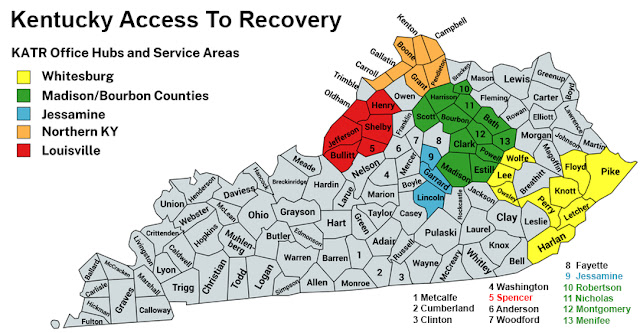
The Kentucky Access to Recovery program of the nonprofit Federation of Appalachian Housing Enterprises, a 37-county program that "connects participants recovering from opioid-use disorder or stimulant use disorder to housing, childcare, dental care, transportation and other services," Moomey writes. 

KATR map via Herald-Leader, adapted by Kentucky Health News; to enlarge, click on it.
Aaron Brown, a Western Carolina University professor who researches the issue, "said KATR wants to address the practical needs of rural Kentuckians that prevent people from accessing recovery," Moomey reports. Brown said the types of jobs available and the benefits provided are more limited in rural areas. From his research on rural areas, good-paying jobs were often more taxing and didn’t always provide the option to take off work to participate in recovery opportunities."

Brown told Moomey that the ideal recovery model has these steps: medical detoxification, inpatient rehabilitation and a sober living facility with intensive outpatient services, such as group and individual treatment. But that's not always realistic in rural areas "because of lack of services and health professional shortages," Moomey writes.

Friday, March 4, 2022

Rural vaccination rates lag in Ky. and rest of U.S., but difference in rural and urban rates in Ky. isn't as big as national gap

By Al Cross
Kentucky Health News

Getting vaccinated for Covid-19 is less popular in Kentucky, and in rural America, than in the rest of the country. But rural Kentuckians do a better job of keeping up with their counterparts in other states than urban Kentuckians do.

That's one way to look at a study published Thursday by the Centers for Disease Control and Prevention, of first-dose coronavirus vaccinations through Jan. 31.

It found that 73.1 percent of Americans had received one of the vaccines, but only 58.5% of rural Americans had. The rate among urban Americans was 75.4%.

In Kentucky, 63.7 percent of residents were vaccinated, but the difference in urban and rural counties was less than in the rest of the nation. The urban rate was 68.7% and the rural rate was 56.5.%

Kentucky's rural rate was much closer to its national counterpart, just 2 percentage points less, than the urban rates: 68.7% of urban Kentuckians were vaccinated, while 75.4% of all urban Americans were.

So, while rural residents have been blamed for low vaccination rates, urban Kentuckians play an important role in that, too. Here's a breakdown of the national and state figures by type of area (click on a table to enlarge it):

                                                Metropolitan areas
                 Total    Large (Central)    (Fringe)       Medium        Small        Micropolitan    Non-core     URBAN    RURAL


Friday, January 7, 2022

Ky. doesn't just break the 10,000 new-case mark, it goes over 11,000; Covid-19 hospitalizations up by nearly half in last 2 weeks

Ky. Health News graph; case numbers are from initial, unadjusted daily reports; click on it to enlarge.
By Al Cross
Kentucky Health News

Kentucky shattered its recently set records for new coronavirus cases Friday, reporting more than 11,000, the first time the number has had five digits.

The state's daily report, the last one until Monday, showed 11,096 new cases, raising the seven-day rolling average to 6,984. That's 86 percent higher than it was one week earlier, and 200 percent higher than two weeks ago.

The top five highest days for new cases have occurred in the last seven days, as the highly contagious Omicron variant keeps spreading with the unwitting help of unmasked, unvaccinated, and vaccinated but unboosted Kentuckians.

"Omicron is burning through Kentucky, and for the third straight day, we have an all-time high in cases," Gov. Andy Beshear said in a Facebook video. "Get your booster. Wear your mask, This thing is spreading like crazy. Protect yourself."

The Omicron fire is burning hottest in the state's urban areas. The counties with the top seven infection rates are all metropolitan. Jefferson County leads with 236 daily cases per 100,000 residents in the last seven days. Other top counties are Fayette, 226 per 100,000; Oldham, 191; Campbell, 190; Jessamine, 184; Boyd, 181; and Shelby, 173.

The state's overall seven-day infection rate is 142 per 100,000, double what it was a week ago. Its rate is 21st in the nation, and its 14-day increase is now higher than the nation's, after many days below it, according to The New York Times' breakdown of Centers for Disease Control and Prevention data.

The percentage of Kentuckians testing positive for the virus in the last seven days also set a new record: 24.45%, less than a percentage point above the previous seven-day rate.

Health experts say the more important numbers to watch are from hospitals. Omicron cases seem to be milder than those from the previously dominant Delta variant, but there are so many cases that hospitals could be overrun, and some have scaled back surgeries to make sure they have beds available.  

Kentucky hospitals reported 1,856 Covid-19 patients Friday, 73 more than Thursday. That's 24% more than a week earlier and 48% more than two weeks earlier.

Intensive-care units reported 423 Covid-19 patients, 21 more than the day before, with 223 on mechanical ventilation, down by four.

Seven of the state's hospital regions reported more than 90% of their ICU beds occupied; Northern Kentucky was again at 100%. The region with its ICUs most heavily occupied by Covid-19 patients is the far west, around Paducah, at 46%; overall, 97% of the region's ICU beds were occupied.

Perhaps reflecting the high new-case rate in Jefferson County, the Louisville hospital region had the highest share of its inpatient capacity used by Covid-19 patients, 18%. Overall, it was at 73% capacity and its ICUs were 93% full.

St. Claire Regional Medical Center in Morehead said it ran out of monoclonal antibodies used to treat people with Omicron.

The state reported 39 more Covid-19 deaths Friday, raising Kentucky's pandemic toll to 12,358.

Tuesday, October 26, 2021

UK physician Peterson will be co-presenter in Nov. 9 webinar about the critical role of family physicians in rural America

Lars Peterson, M.D., Ph.D.
A University of Kentucky physician and a University of Washington researcher will hold a webinar at 1 p.m. Tuesday, Nov. 9 to discuss the critical role of family physicians in rural America, how they're trained, their rural distribution, and differences in scope of practice in rural vs. urban family doctors.

The webinar will last about an hour. It's free, but registration is required. Click here for more information about the webinar and to register.

Lars Peterson and Davis Patterson will present the webinar. Peterson is a family physician and health services researcher, vice president of research of the American Board of Family Medicine, an associate professor of family and community medicine at UK and a faculty member at its Rural & Underserved Health Research Center. His major research focuses on how continuing education can improve quality of care. 

Patterson is a sociologist, research associate professor of family medicine and director of the Rural Health Research Center and the Collaborative for Rural Primary Care Research, Education, and Practice, and an investigator in the UW Center for Health Workforce Studies. His research focuses on improving rural health-care access and examining trends in rural workforce supply.

Tuesday, October 5, 2021

Kentucky ditches federal exchange and moves back to Kynect, which will have two more insurers and its first vision-care plan

Cabinet for Health and Family Services map, adapted by Ky. Health News
By Melissa Patrick
Kentucky Health News

Kentucky is reopening Kynect, the state's health-insurance exchange, as the portal for Kentuckians to purchase low- or no-cost insurance, and the site will have two more insurers and its first vision plan.

Open enrollment on kynect.ky.gov runs from Nov. 1 through Jan. 15, 2022 for health insurance coverage beginning in 2022. Kentuckians can start browsing and comparing 2022 insurance plans on Oct. 15.

Kynect was re-launched last year as a one-stop shop for Kentuckians to apply for Medicaid and connect qualified families to other resources, including the Supplemental Nutrition Assistance Program (formerly food stamps) and family and child-care assistance programs. 

Now the platform will again allow Kentuckians to access and compare state-managed insurance options, apply for coverage and complete their enrollment all on one convenient platform, which was its original intent.  

In addition to Anthem’s statewide coverage and CareSource, which offers health plans in 100 of the 120 counties, consumers can shop for plans available in select counties from two new health insurers; Ambetter from WellCare of Kentucky, in six western counties, and Passport Health Plan by Molina, in Jefferson, Oldham and Bullitt counties.

Fourteen counties will have only Anthem plans to choose from, down from 26 this year. Most are small and rural, but they include Warren County, the core of metropolitan Bowling Green, the state's third-largest city. Warren and eight neighboring counties also had Anthem as their only choice this year.

Beshear also announced that for the first time, Kentuckians will be able to purchase a vision plan through Kynect. VSP Individual Vision Plans will offer enrollees a comprehensive eye exam from an in-network doctor, an eye frame allowance and lens enhancements, such as progressives.

Kynect was created by Beshear's father, then-Gov. Steve Beshear, in 2013 under the 2010 Affordable Care Act. It was closed in 2017 by Republican Gov. Matt Bevin, who said the site was too expensive to maintain and was redundant. Beshear, a Democrat, said the return to the state-based exchange is expected to save Kentuckians about $15 million a year.

"We encourage everyone to look at their quality health-care options, which we consider to be a basic human right," Beshear said at Monday's news conference. "Never has a need for quality health care been more evident than during the Covid-19 global health pandemic."

Touting the benefits of using a state-based exchange over the federal one, which Kentuckians have used since Kynect was shut down, Beshear said Kynect will have more options for consumers and offer the ability to tailor coverage to address Kentuckians' unique needs. 

Beshear noted that people who buy commercial health plans through the federal site pay a surcharge on premiums, which Kynect will not do. He said those savings will be passed on to Kentuckians who buy coverage through the state-based exchange.

The governor announced that Kentucky will receive $650,000 in American Rescue Plan Act funding through the Centers for Medicare and Medicaid Services to support the reopening of Kynect. 

Since Kynect re-launched in October 2020, the portal has been logged into more than 2.3 million times by more than 1.8 million visitors. Nearly 105,000 applications for benefits have been submitted, and nearly 1 million supporting documents have been uploaded. This is a 180% increase over the daily average noted last year from January through September, said Beshear.

“Kynect is truly a one-stop shop for consumers in need of health coverage, whether it’s Medicaid or a private insurance plan,” Cabinet for Health and Family Services Secretary Eric Friedlander said in the news release. “With its convenient, mobile-friendly option, it’s also the place to go for access to other resources that you or someone you know may need, including food assistance, transportation, employment, job-training and veterans’ benefits. It will also connect Kentuckians with community services in partnership with Kentucky United Way chapters through all the organizations available on their statewide 211 platform, including: clothing, transportation, housing and more.”

Kentucky is among three states to transition from healthcare.gov to their own state-based exchange for 2022 coverage, along with Maine and New Mexico.

Saturday, June 12, 2021

Rural Ky. needs more community health workers and medical-school residents, legislators and UK hospital executive say

Charles Aull of the Kentucky Chamber of Commerce, upper left, moderated the webinar.
By Al Cross
Kentucky Health News

Improving health care and health in rural Kentucky will take more people in the health-care workforce, specifically at the top and bottom of the pay scale, two key legislators and one of the state's top hospital administrators said Tuesday, June 8.

Kentucky needs more health-care workers overall, because it may lose some to the pandemic, Mark Birdwhistell, vice president for health services administration at the University of Kentucky and chief of staff for UK HealthCare, said during a Kentucky Chamber of Commerce webinar on rural-urban health disparities.

"Coming out of Covid . . . many of our clinical workforce are fatigued, and they're second-guessing: 'Is this the career path that I want to go on?' They've been in combat for a year and a half now," Birdwhistell said.

State Rep. Kim Moser, a Republican from Taylor Mill in Northern Kentucky, agreed. "Burnout is real," she said, noting that her husband is a pulmonologist who has treated Covid patients.

The need for more community health workers, who are not health-care providers but can educate people about care and help them get it, came up as Birdwhistell, a former state health secretary, discussed the 2014 expansion of the federal-state Medicaid program for lower-income Kentuckians.

"Just because you've got coverage doesn't mean you've got access" to the health care you need, Birdwhistell said, because "Many providers don't take Medicaid." He and Baptist Health Louisville President Larry Gray said health insurance tends to cost more in rural areas due to lack of competition, so people buy policies with high co-payments and deductibles.

The expansion of Medicaid made clearer how the "social determinants of health" leave rural areas with lower health status, Birdwhistell said. It's twice as likely for someone in an urban area to finish high school or college as someone in a rural area, he said, so health literacy is lower in rural areas. And that extends to health insurance, he said, giving one example: "Deductible. That's hard to explain in English."

Moser, a retired nurse who chairs the state House Health and Family Services Committee, said expanding the limited government and commercial-insurance reimbursement for community health workers' services would help. "That is one policy that we're looking at possibly expanding," she said.

Birdwhistell said that would be "very, very cost-effective," because "In a lot of communities, people don't know how to access care, and they show up in the emergency room. And that is probably the worst place for anybody to show up with a high fever, strep throat, whatever. They don't get a continuum of care. . . . They will listen to somebody that they grew up with, somebody that they go to church with, somebody that they see on the soccer field with their kids."

Service area of Kentucky Homeplace
Eastern Kentucky already has the third largest concentration of community health workers in the nation, trailing only Alaska and northwest Mississippi, according to the Bureau of Labor Statistics.

That is likely due to Kentucky Homeplace, a 27-year-old program of UK's Center for Excellence in Rural Health in Hazard. It says it helps people in the region with "lifestyle choices, environmental factors, inadequate health insurance and general lack of understanding of the health-care system."

Nationally, CHW pay averages $46,000 a year, but in Kentucky the average is $37,320.

The webinar discussion also addressed the need for more doctors in rural Kentucky.

Birdwhistell said a major obstacle to getting more physicians in rural areas of the state are the limits on federally funded residency slots at the UK and University of Louisville medical schools. "Flipping that switch could pretty instantly change the number of professionals we have coming out," he said.

Republican Sen. Ralph Alvarado of Winchester, a physician, agreed, saying that residents tend to set up practices within 80 miles of where they do their residency. Moser also endorsed the idea.

Alvarado, chair of the Senate Health and Welfare Committee, noted that some rural areas have a shortage of health-care providers, which he blamed on state laws that make malpractice insurance expensive.

Gray said the shortage is especially bad in Eastern Kentucky, which needs providers who are willing to come to the region with "a sense of mission and vocation." But even with enough providers, transportation to get some patients to them is still an obstacle in some areas, he said. The expansion of telehealth has helped, he said, but some areas still lack internet access that is fast enough for it.

And even with telehealth, a shortage of specialists blocks care. For example, Kentucky has only 59 child psychiatrists, and half of them "are cash-only, don't take insurance," Alvarado said.

The panel started out by discussing some of the state's poor health statistics. Alvarado said the use of tobacco is heavier in rural areas, leading to all sorts of health issues, and obesity is more common, causing "more negative outcomes."

The news isn't all bad, he said, noting how Kentucky has raised its screening for colon cancer from 47th to 19th in the nation. "That's going to rub off on our death rates . . . in 10 years," he said. "There is some hope." But he also noted that screening rates in Eastern Kentucky remain relatively low.

Wednesday, June 9, 2021

Rural and conservative congressional districts, in Kentucky and the nation as a whole, have lower coronavirus vaccination rates

Map from Harvard University study, adapted by Ky. Health News; click here for its interactive version.
More conservative and more rural Americans – and Kentuckians – are more likely to remain unvaccinated against the coronavirus, and the divide is growing.

"All but one of the 39 congressional districts where at least 60 percent of residents have received a coronavirus shot are represented by Democrats, according to a Harvard University analysis that presents one of the most detailed looks yet at the partisan split behind the nation’s diverging vaccination drive," Dan Goldberg and Alice Ollstein report for Politico. "By contrast, Republicans represent all but two of the 30 districts where fewer than one-third of residents have received a shot."

The 14 least fully vaccinated districts are all Republican and rural (or have a rural population of at least 40%). Missouri, which has one of the lowest vaccination rates of any state, took the bottom four spots. Appalachian Kentucky's Fifth District shows up 38 spots up from the bottom, with 29.23% of residents fully vaccinated. The state's next most rural district, the First, follows shortly thereafter with 29.82%.

As of June 1, Kentucky's overall vaccination rate was 39.1%, the same as the nationwide average for metropolitan areas; among rural Kentuckians, the rate was 31.4%, just above the national rural average of 31.1%, Tim Murphy and Tim Marema report for The Daily Yonder. The Yonder, which has an interactive map with county-level vaccination data, notes that the nationwide metro vaccination rate is growing more quickly than the rural rate. Three weeks ago, the rural-urban vaccination gap was 7.2 percentage points, but two weeks ago it was 8 points.

The rural-urban gap stems partly from ideological sentiment, but also problems of access. "House members representing districts with low vaccination rates and public health experts, discussing their efforts to reach the unvaccinated, described what essentially has become two distinct conversations," Goldberg and Ollstein report. "One is aimed at chipping away at vaccine hesitancy among conservative white Republicans, while the other is centered around reducing socioeconomic barriers to vaccination for poorer populations and communities of color."

For an April 11 story on what members of Kentucky's congressional delegation were doing (or not doing) to encourage vaccination, click here.
Screenshot from Harvard University study; for a larger version of the image, click on it.

Wednesday, May 26, 2021

Chamber, UK school starting public-policy series with discussion of health differences and disparities between rural and urban Ky.

The health disparities between rural and urban Kentucky, and differences in health-care access and delivery, will be discussed in the first of a new series of public-policy webinars sponsored by the Kentucky Chamber of Commerce and the Martin School of Public Policy & Administration at the University of Kentucky.

The sponsors say the event, scheduled from noon to 1:30 p.m. ET Tuesday, June 8, will examine the intersection of health care and the urban-rural divide: How do health care systems differ between Kentucky’s urban and rural areas and what makes these differences significant? Does public policy in Kentucky accurately reflect the diverse health care needs of our urban and rural populations? How does the urban-rural divide impact access to health care in Kentucky? Answers will come from a panel:
  • Mark Birdwhistell, UK Health Care chief of staff and vice president for health services administration
  • Larry Gray, president of Baptist Health Louisville and former president of Baptist Health Corbin
  • State Sen. Ralph Alvarado, R-Winchester, chair of the Senate Health and Welfare Committee and a physician
  • State Rep. Kim Moser, R-Taylor Mill, chair of the House Health and Family Services Committee and a former nurse
Chamber Senior Policy Analyst Charles Aull will moderate the discussion. He said it will include the opportunity for questions from participants. The webinar is free; to register, click here.

“We look forward to not only engaging in these roundtable discussions but also serving as a resource for policy-makers and other interested parties,” said Kate Shanks, vice president of public affairs at the Chamber and a Martin School graduate. “Our goal is that these sessions will lead to better understanding of these important issues and help develop Kentucky-specific solutions.”

Future programs in the series will address the rural-urban divides in education (July 15) and economic development (Aug. 10).

Wednesday, April 28, 2021

New federal guidelines will let almost all providers prescribe buprenorphine for opioid-use disorder, a boon to rural Kentucky

The U.S. Department of Health and Human Services said Tuesday that it will allow most medical providers to prescribe buprenorphine for opioid-use disorder without being trained and getting a waiver. "For years, many addiction physicians and public health advocates have argued that the 'X-waiver,' as the special buprenorphine license is known, poses a barrier to basic care for patients with opioid addiction," Lev Facher reports for Stat. "Many have argued that if a doctor can prescribe potentially addictive prescription pain drugs, they should also be able to prescribe the medicine used to treat the addiction."

Assistant Secretary for Health Rachel Levine said in the press release that increasing overdose deaths, especially during the pandemic, show the need for more access to medication-assisted treatments. Rural patients seeking such therapy can have a hard time accessing it because of transportation issues and the relative lack of qualified prescribers. But buprenorphine can be prescribed for a month at a time and taken at home, meaning rural patients don't have to travel so much, and can easily get it even at mobile clinics. About 40 percent of U.S. counties don't have a health-care who is approved to prescribe buprenorphine, an active ingredient in Suboxone, the preferred drug in medication-assisted treatment for substance-use disorder, according to a federal report.

"The move comes amid a worse-than-ever drug overdose crisis, which has taken a dire turn amid the Covid-19 pandemic," Facher reports. "More than 87,000 Americans died of overdoses during the 12-month period that ended in September 2020, according to estimates from the Centers for Disease Control. Data for the full 2020 calendar year isn’t available yet, but most addiction policy officials expect the death toll will climb even higher."

Sunday, April 25, 2021

Study in West Virginia finds rural users of electronic cigarettes are older, and often sicker, than their urban counterparts

E-cigarettes are called "vapes," for vapor, but make aerosols. (Centers for Disease Control and Prevention graphic)
A new study out of West Virginia University says rural users of electronic cigarettes are older, and often get sicker, than their urban counterparts.

The study, published in Hospital Practice, looked at patients with lung injuries associated with e-cigarettes and vaping-associated lung injury, or EVALI, who were admitted to WVU hospitals from August 2019 to March 2020. It found that EVALI in rural Appalachia resulted in severe respiratory failure. 

"One of the real lessons we learned is we can't take data from urban centers and apply them to rural. We could be different, and we physicians need to treat the way that the science is showing in our areas." Sunil Sharma, lead author of the study, said in a WVU press release.

The researchers "recorded demographics, baseline characteristics, health conditions and vaping behavior for 17 patients admitted to WVU hospitals with EVALI. They also evaluated lung specimens for signs of inflammation and analyzed patient-volunteered e-liquid materials using mass spectrometry to determine chemical composition," says the release. 

The study found that compared to EVALI studies done in urban centers, the rural patients in the study were older, had a higher amount of illicit drug use and were much sicker.

"The median age of patients in this study was 33, compared to 23 in a large national study. Thirteen patients had a history of cigarette smoking, while four were never smokers. Urine testing determined that nine patients were also consuming THC and another nine were positive for other illicit drugs. Seven of the patients consuming THC required critical care, and four of the 17 had secondary infection of the lungs. Ten patients required mechanical or noninvasive ventilation while two required treatment with an extracorporeal membrane oxygenation machine, which pumps someone's blood outside of their body, oxygenates it and returns it to the body," says the release. 

The researchers also found higher levels of "volatile organic compounds" in the e-liquids provided by the three most severely ill patients, which includes things like formaldehyde, acetaldehyde, acetone, propylene glycol and cyclohexane. 

"We were the first ones to show that there was high correlation of volatile organic compounds, specifically in patients who were really sick," said Sharma, who is section chief of pulmonary/critical care and sleep medicine in the WVU School of Medicine. "Inhaling all these volatile organic compounds into your lungs at high temperatures, producing these really toxic gaseous compounds, can cause chemical burns in your lungs."

Despite the strong correlation between lung injury and volatile organic compounds, Sharma said there are many other factors that also determine how much e-cigs harm the lungs, like "the type of device or technique used to vape, the ratio of propylene glycol and vegetable glycol used as the e-liquid base, what flavors were added, the age of the patient and if the patient uses other drugs."

The study indicates it may be time to target messages about the dangers of vaping to older people in rural areas, the release says, quoting Sharma: "All the effort has been directed toward high schoolers and young people, but maybe in rural areas, we should be having awareness campaigns for older populations."

Tuesday, April 20, 2021

Kentucky put 32% fewer coronavirus shots into arms in the last vaccine-reporting week, as supply continued to outstrip demand

State table, updated by Kentucky Health News, shows how vaccine supply has exceeded demand.
By Melissa Patrick
Kentucky Health News

As delivery of coronavirus vaccines plummeted by almost a third in the past week, Gov. Andy Beshear continued to urge Kentuckians to get vaccinated so the state can get back to normal.

Beshear didn't have a news briefing Tuesday, but issued a press release emphasizing vaccinations over virus cases, which remained on a plateau.

“As our case numbers seem to be plateauing, it’s more important than ever for us to make sure our vaccination numbers are rising consistently,” he said. “Let’s meet our 2.5 million vaccine Team Kentucky Vaccination Challenge so we can get back to more of the activities we enjoy and keep ourselves, our families and our communities safe.”

Beshear has said he will open all businesses and activities to full capacity once 2.5 million Kentuckians have received a dose of vaccine. According to his press release, at least 1,672,364 Kentuckians have done so, which means about 827,000 more need to get vaccinated to reach that goal. 

But in the last Tuesday-to-Monday reporting week, only 84,968 Kentuckians got vaccinated, down from about 125,000 each of the two weeks before that, according to the state's vaccine report. That's a drop of about 32%.

The line for that week has an asterisk, which signifies that the state stopped administering the Johnson & Johnson vaccine on the advice of federal officials because one in a million people who got it had an unusual type of blood clot. The vaccine has only accounted for about 5% of the doses administered in Kentucky, but is in more demand because it requires only one dose.

At the current rate of vaccination, following Beshear's plan, the state wouldn't reopen until June 8, the Lexington Herald-Leader reports.

Beshear has asked vaccine sites to use at least 90% of their vaccine each week. Statewide, that goal hasn't been met for more than a month. Vaccine weeks run Tuesday to Monday because the state gets its supplies on Tuesdays. The state used 58% of its supply in the vaccine week beginning March 30; 45% the week beginning April 6 and 54% the week beginning March 13. 

Supply has clearly outstripped demand. Yesterday, Beshear said the state had about 400,000 doses available, and that was before the 150,000 doses that were expected to arrive today. Kentuckians can visit vaccinemap.ky.gov to find a vaccination site near where they live.

Polls have indicated that white, rural Republicans are less likely to get the vaccine, but another demographic factor appears to be in play. An NPR analysis of vaccinations of people 65 and older shows that Kentucky is lagging in the number of rural seniors getting shots; urban seniors' vaccination rate is 6.4 percentage points more than that of rural seniors.
NPR graph, adapted by Kentucky Health News; for a larger version, click on it.
Daily numbers: Beshear reported 609 new cases on Tuesday, bringing the state's seven-day rolling average down to 576, returning it to the levels seen around a week ago. 

The share of Kentuckians testing positive for the virus is 3.44%, down .02% from Monday and about the same as it's been for the last six days.

The state's daily average of new cases over the last seven days dropped to 11.71 per 100,000 residents, a drop of .43 from Monday.  The New York Times ranks Kentucky's rate 34th among the states. 

Counties with double the statewide rate were Bracken, 68.8; Lewis, 46.3; Mason, 41; Bath, 38.9; Powell, 34.7; Harlan, 32.4; Morgan, 32.2; Wolfe, 29.9; Logan ,27.4; Robertson, 27.1; Bell, 23.6; and Henderson, 23.4.

The state added 13 more Covid-19 deaths to its list of fatalities, seven from regular health-department reports and six from the ongoing audits of death certificates. That brings the total to 6,360. Over the last two weeks, the regularly reported deaths have averaged 7.7 per day. 

The regularly reported deaths were a Clay County man, 65; a Daviess County man, 77; a Meade County man, 82; a Pulaski County man, 88; two Rowan County women, 70, 82; and a Rowan County man, 83. The audit deaths were a Floyd County man, 83; a Hardin County woman, 65; a Jefferson County man, 73; a Larue County woman, 86; a Lewis County man, 85; and a McLean County woman, 83. 

Kentucky hospitals reported 419 Covid-19 patients (up 17 from Monday); 121 in intensive care (no change); and 48 of them on a ventilator (up 5). 

The Lake Cumberland hospital-readiness region continues to be the only one using at least 80% of its intensive-care beds, at 84%. 

Counties with 10 or more new cases were Jefferson, 80; Fayette, 44; Warren, 29; Christian, 22; Hardin, 19; Kenton, 17; Harlan, 16; Boone and Pike, 15; Campbell, 13; Daviess and Madison, 12; Henderson, 11; and Scott, 10. 

In long-term care, one more resident and four more staff members have tested positive for the virus, bringing the number of active cases to 46 residents and 84 staff.

Saturday, March 13, 2021

Blacks and whites traded places in Ky. coronavirus statistics as the pandemic became less urban and more rural

Graph by Bruce Maples (click to enlarge); dashed lines show races' share of state population.

By Bruce Maples
Kentucky Health News

As the coronavirus pandemic took off, there was a striking anomaly in the data: African Americans were being infected, and dying, at a rate much greater than their share of the population.

The difference was so great, and so striking, that it drew frequent comment from Gov. Andy Beshear in his daily press conferences. A month into the pandemic, on April 11, he announced that Kentucky Blacks were dying of Covid-19 at a rate two and a half times their 8.4% population share; they were 21% of the deaths in which the person's race was known (81% of cases at the time).

Graph by Bruce Maples; dashed lines are races' share of state's population.

Over the past year, however, the proportion of Blacks in the daily case and death numbers have steadily declined, to the point that they are now roughly the same, or less than, their share of the population.

At the same time, white Kentuckians' shares of Covid-19 deaths have steadily climbed and are now greater than their share of the state's population. Whites' share of cases also rose.

Meanwhile, Asian Americans' share of Covid-19 deaths in Kentucky is now less than their share of the population, reversing the pattern from early in the pandemic, when they were affected by some of the same factors as African Americans, one health expert said.

Dr. Sarah Moyer, director of the Louisville Metro Department of Public Health and Wellness, said many persons of color are "essential workers," often in customer-facing industries such as restaurants and grocery stores, and thus could not work from home. So in the early days, while many people were able to be "healthy at home," the Black and Asian populations in the state had to go into work, and thus were more at risk.

But as things began opening up, white institutions have been more aggressive about doing so, Moyer said: "More white churches went to in-person services. Black churches tended to stay remote. More whites started traveling. And, it's been largely white-majority schools that have pushed to get back into the classroom.

"And, it's just anecdotal, but it seems to me that whites are more willing to take risks."

State's latest report on cases and deaths by race and ethnicity
Donna Arnett, dean of public health at the University of Kentucky, said she suspects the early infection rate among people of color led to some "acquired immunity."

"I don't want to use the term 'herd immunity,' because we aren't clear on just where that line is," Arnett said. "But I do think that the large number of infections could have led to acquired immunity in that population."

She added, "An Indiana study showed that for every reported case, there are about 10 more cases that are not reported and not counted. So, that early spike we see on the graphs actually represents an even larger spike of cases, which may have affected later infections."

In Louisville, Moyer noted most of the people under 60 who are dying of Covid who are under 60 are Black or Hispanic.

One thing that has seemed clear over the past few months is that the rate of infection has dropped in the urban areas in the state, and increased in the rural areas.

The pandemic was later in getting to rural areas, but when it did, it found a vulnerable population that was sicker, older, and has less access to health care, several reports have noted.

WFPL graph shows higher rates of new coronavirus cases in rural counties and one health district.

For example, Louisville's WFPL reported Dec. 23 that the November death rate in the Kentucky River Health District was 107% higher than the statewide rate, so deaths there were 4% of the state total though the district has only 2% of the state's population. Out of 120 counties in Kentucky, only 18 had higher death rates in November than those comprising the Kentucky River district, based in Hazard.

Daily Yonder graph
This trend is national. The Daily Yonder does a weekly look at coronavirus cases and Covid-19 deaths in the rural U.S. Its latest graph clearly shows that the pandemic went from being an urban issue to a rural issue in August of last year, and that the divergence only grew as time went on, until recently.

Now vaccines are widely available, but public-health experts worry that rural residents will be more hesitant to get them, or outright resistant to the idea. They say the same sort of targeted communication that has been directed at communities of color needs to be designed to overcome rural reluctance.