Showing posts with label adolescents. Show all posts

Saturday, September 9, 2023

Young heavy drinkers much more likely to carry a handgun

Kentucky Health News

A young person in rural America who drinks heavily is 43% more likely to carrying a handgun in the following year, according to a study conducted in seven states over 15 years and published in The Journal of Rural Health.

“Our study establishes a clear link between these two behaviors in rural areas, and there are evidence-based prevention programs to address both,” said lead author Alice Ellyson, an acting assistant professor of pediatrics at the University of Washington.

The study defined "heavy drinking" as consumption of five or more alcoholic drinks in a row at least once in the two weeks before the question was asked of 2,002 youth, aged 12 to 26, from 12 rural communities in Colorado, Illinois, Kansas, Maine, Oregon, Utah, and Washington. Survey responses were collected annually from 2004 to 2019 starting with children who were in fifth or sixth grade, as part of the university's national Community Youth Development Study (CYDS).

Ellyson told Kentucky Healh News that no Southern states were included in the study because the Southern communities that participated in the survey consortium that helped develop the CYDS "chose not to continue as part of the community-randomized trial portion where we obtained our data for this study."

The association between heavy drinking and gun-carrying also was evident (38% greater) among young adults ages 19 to 26, perhaps not surprising, due to minimum legal ages for drinking. The study did not break out differences between male and female respondents or address their likelihood of firing the handgun.

"Recent evidence suggests that rural adolescents may start carrying a handgun earlier and carry with a higher frequency and duration than their urban counterparts," the university says. "Handgun-carrying is associated with bullying, physical violence, and other risk factors for violence.

"Understanding youth behaviors associated with carrying a firearm has significant safety implications. In 2020, suicide and homicide were among the leading causes of death among U.S. individuals ages 12-26 years. About 91% of homicides and 52% of suicides among this age group involved a firearm."

For adolescents, Ellyson says, the message is simple: Don’t drink alcohol or carry a handgun. But she said young adults, will need a more nuanced message: “Both alcohol use and handgun-carrying become legal in young adulthood. We want to use a harm-reduction approach for young adults who engage in both behaviors (drinking and handgun carrying) so they are done in a safe way,” she said.

Communities That Care is a program for preventing these behaviors and their consequences in rural areas. It has no communities in Southern states, "but they would be very willing for that to change," Ellyson told Kentucky Health News.

The university says, "An earlier study by Ellyson and colleagues found six distinct patterns of when and how often individuals in a rural area carry a handgun. In these communities, young people carry handguns at more than twice the rate of their counterparts in urban settings. Because alcohol use is also more common among rural youth, prevention programs focusing on them are important."

Monday, May 8, 2023

American Psychological Association issues research-based recommendations for use of social media by young people

Shutterstock photo via The Conversation
The American Psychological Association has issued recommendations for adolescents' use of social media, noting that while the platforms can promote healthy socialization, young people should not use them until they have taken training in social media literacy to give them skills to have "balanced, safe and meaningful experiences," APA says.

Social media are “neither inherently harmful nor beneficial to our youth,” APA President Thema Bryant said. “But because young people mature at different rates, some are more vulnerable than others to the content and features on many social media platforms that science has demonstrated can influence healthy development. Just as we require young people to be trained in order to get a driver’s license, our youth need instruction in the safe and healthy use of social media.”

Bryant appointed an advisory panel to issue the 10 recommendations, titled the American Psychological Association Health Advisory on Social Media Use in Adolescence. It recommends psychological competencies that youth should possess before using social media, plus periodic booster training to minimize the chances for harm and maximize the benefits that social media can provide.

The advisory notes that not all findings apply equally to all youth: “Scientific findings offer one piece of information that can be used along with knowledge of specific youths’ strengths, weaknesses and context to make decisions that are tailored for each teen, family and community. Age-appropriate use of social media should be based on each adolescent’s level of maturity (e.g., self-regulation skills, intellectual development, comprehension of risks) and home environment.”

Among the report’s recommendations are:
  • Tailor social-media use, functionality and permissions to youths’ developmental capabilities; designs created for adults may not be appropriate for children.
  • Adults should monitor younger adolescents' social media use, including discussing and coaching about content. This should be balanced with youths’ appropriate needs for privacy. Autonomy may increase gradually as children age and gain more digital literacy.
  • Minimize adolescents’ exposure to social-media content that depicts illegal or psychologically maladaptive behavior, including content that instructs or encourages youth to engage in self-harm or high-risk behaviors or those that encourage eating-disordered behavior (such as restrictive eating, purging or excessive exercise).
  • Minimize adolescents’ exposure to online content that promotes discrimination, prejudice, hate or cyberbullying, especially directed toward groups targeted because of race, ethnicity, gender, sexual orientation, religion or disability status.
  • Monitor adolescents for signs of problematic social media use that can impair their ability to engage in daily roles and routines and may present risk for more serious psychological harms over time.
  • Limit social media use so as not to interfere with adolescents’ sleep or physical activity, as each is required for healthy brain and psychological development.
  • Limit adolescents’ use of social media for primarily beauty- or appearance-related content.
The report acknolwledges that it is not yet possible to determine if social media harm youth. Relatively few studies have been conducted with youth from racial, ethnic, sexual, gender, socioeconomic or differently-abled populations, and/or youth with chronic developmental or health conditions.

Researchers at Baylor University in Texas recently reported that "immersion in a world created by the social media experience drives problematic social media behaviors and addiction." The report calls for “a substantial investment in research funding” and access to more data, including data from tech companies.

“We hope these recommendations will be helpful as we all try to keep pace with the rapidly shifting social media ecosystem,” APA CEO Arthur C. Evans Jr. said. “APA will continue to keep tabs on developments within the current and future platforms, with an eye toward safeguarding our youth and enabling them to benefit from the positive aspects of social media.”

The APA said its recommendations are based on scientific research in psychology and related disciplines, conducted with thousands of adolescents who completed standardized assessments of social, behavioral, psychological and/or neurological functioning, and reported engaging with specific social media functions or content, or were observed doing so.

Friday, December 2, 2022

Pandemic stress caused premature aging in teenagers' brains; long-term effect uncertain, but some parents say impact will last

Shutterstock photo
American teenagers' brains prematurely aged by three years during the pandemic due to the stress of lockdowns, a study has found.

The researchers found changes similar to those seen in "children who have faced chronic stress and adversity," reports Katherine Reynolds Lewis of The Washington Post.

"The study, published Thursday in Biological Psychiatry: Global Open Science, was the first to compare scans of the physical structures of teenagers’ brains from before and after the pandemic started, and to document significant differences, said Ian Gotlib, lead author on the paper and a psychology professor at Stanford University."

Axios, citing Gotlib, reports, "Accelerated aging of the brain itself is not necessarily a bad thing," and quotes him: "These are 16-, 18-year-olds. They're not atrophying in the alarmist sense. For me, the cause for concern is their higher rates of depression and anxiety and sadness … it makes it even more important that we address that."

Gotlib had pre-pandemic images because he and his colleagues started the work eight years ago, with the goal of "better understanding gender differences in depression rates among adolescents," Lewis reports. "The researchers recruited 220 children ages 9 to 13, with a plan to take MRI scans of their brains every two years."

Then the pandemic hit, interrupting the third set of scans, but presenting an opportunity. Gotlib said they knew teens had higher “levels of depression, anxiety and fearfulness” than “before the pandemic. But we knew nothing about the effects on their brains. We thought there might be effects similar to what you would find with early adversity; we just didn’t realize how strong they’d be.”

The researchers "compared MRI scans of a group of 128 children, half taken before and half at the end of the first year of the pandemic, the researchers found growth in the hippocampus and amygdala, brain areas that respectively control access to some memories and help regulate fear, stress and other emotions," Lewis reports. "They also found thinning of the tissues in the cortex, which is involved in executive functioning. These changes happen during normal adolescent development; however, the pandemic appeared to have accelerated the process, Gotlib said."

Premature aging of children’s brains can make them more vulnerable as adults "to depression, anxiety, addiction and other mental illnesses, they can raise the risk of cancer, diabetes, heart disease and other long-term negative outcomes," Lewis notes. "Prior research has found dramatically higher levels of anxiety, depression, suicidality and other mental illnesses in adolescents since the onset of the pandemic."

Gotlib said, “The takeaway for me is that there are serious issues with mental health and kids around the pandemic Just because the shutdown ended doesn’t mean we’re fine.”

Jason Chein, professor of psychology and neuroscience and the director of the Temple University Brain Research & Imaging Center, said the study is important but he "cautioned against making broad interpretations based on the changes the researchers observed," Lewis reports. "brain regions can show nonlinear patterns of growth, so simply seeing a thinner cortex or larger amygdala volume doesn’t necessarily indicate an older brain, he said."

But there are anecdotal examples. "Stacy Gittleman, 54, of West Bloomfield, Mich., saw the pandemic derail one of her children," Lewis writes. "An aspiring musical theater actor, he was a junior in high school when school and theater shut down." Gittleman said, “So much of how my son thrives depends on moving, acting, doing hands-on work and interacting with others. He spent much of his time in bed, which was very painful as parents to watch, as my son before the pandemic was so lively and social.”

While "managing his mental health will be a lifelong task, she said," her son's older siblings, now 24 and 26, weren't as affected by the pandemic. “In the long term, the adversity thrown at the feet of our teenagers I believe will make them stronger and more resilient,” she said.

"Other parents aren’t so sure," Lewis writes, quoting Meg Martin, 55, of Gaithersburg, Md., whose son intended to apply to a four-year residential college, but now feels unmotivated and disengaged from school after years of online and hybrid learning: “I really think the way his high-school years unfolded are going to have ripple effects for years to come.”

Sunday, September 25, 2022

With the important exceptions of vaping and marijuana, substance abuse among U.S. teenagers has been going down

Past-month substance use by time and usage group, including parental supervision
(Graphs from study in Substance Use & Misuse journal; click the image for a larger version)

By Melissa Patrick
Kentucky Health News

Except for cannabis use and vaping, substance use among American teens is going down, according to a recent study.

Published in the peer-reviewed journal Substance Use and Misuse, the study examined data from more than half a million adolescents in 1991-2019 from the national Monitoring the Future survey to track trends in use of cigarettes, alcohol, cannabis, vaping of both nicotine and cannabis, and other substances for children in school grades 8 (13-14 years old), 10 (15-16) and 12 (17-18).

The researchers cross-referenced these habits against demographic factors such as level of social engagement, participation in structured activities, level of adult supervision, and employment. They further cross-referenced the patterns across race, sex, and parental education, along with other demographics.

The researchers said in a news release that while the reasons for the decrease in substance use among teens is not clear, it appears to correlate to a number of social factors, including increased parental monitoring and decreased partying and dating.

"Their findings found that low social engagement and participation in structured activities seemed to be the overall best predictors of substance abuse avoidance," the release said. "Conversely, substance abuse was higher overall in the highly social and highly engaged groups with less supervision. Time at a paid job was also a significant factor in increasing the chances of trying illicit substances."

The research also found that "Cannabis use use increased among all groups, but especially among adolescent workers. Nicotine vaping increased the most among the highly social and engaged group that was less supervised. And cannabis vaping increased most among social but disengaged teens."

“Social settings where adolescents interact with peers (e.g., parties) provide opportunities for substance use, especially in the absence of adult supervision," said Noah Kreski of Columbia University, the study's lead author. “These social settings may produce peer pressure for adolescents to engage in substance use in order to fit in.”

The researchers suggest that such peer pressure may drive substance use among employed adolescents, largely because they interact with older teens and adults. Cannabis users especially appear to seek out other cannabis users, creating social circles where the drug plays a central role; the researchers said vaping is similarly correlated to social influence.

The authors suggest that a variety of peer-led and community-based programs may be effective in diminishing use across a broad spectrum of adolescent demographics. They also urge further examination of mental health conditions that may lead to substance abuse.

The researchers note several limitations to the study; the data was not comprehensive on how teens spent their time, and did not include data from 2020 and 2021, so it does not capture behaviors in the pandemic.

Across the sample examined, here are some further results from the study:
  • 15% respondents reported any past two-week binge drinking;
  • 27.4% drank alcohol in the past month;
  • About 14.7% of adolescents smoked cigarettes in the past month;
  • 12.6% reported any past-month cannabis use;
  • Over 8.64% reported past-month use of other substances;
  • 12.3% reported nicotine vaping and 6.2% reported cannabis vaping from 2017 onward.

Friday, May 20, 2022

In Mental Health Awareness Month, New York Times focuses on Glasgow as an example of children's mental-health troubles

"The setting for adolescent mental health care looks ever more like Dr. Melissa Dennison's office . . . the next patient arriving every 15 minutes," says The New York Times. (NYT photo by Annie Flanagan)
May is Mental Health Awareness Month, and that increasingly means looking after teenagers.

"Over the last three decades, the major health risks facing U.S. adolescents have shifted drastically," Matt Richter of The New York Times writes from Glasgow, Ky. "Teen pregnancy and alcohol, cigarette and drug use have fallen while anxiety, depression, suicide and self-harm have soared. In 2019, the American Academy of Pediatrics issued a report noting that 'mental health disorders have surpassed physical conditions' as the most common issues causing 'impairment and limitation' among adolescents. In December, the U.S. surgeon general, in a rare public advisory, warned of a “devastating” mental health crisis among American teens. But the medical system has failed to keep up, and the transformation has increasingly put emergency rooms and pediatricians at the forefront of mental-health care."

Richter's object example is Glasgow and Dr. Karen Dennison, a pediatrician who is now unofficially a part-time psychologist or psychiatrist. His story begins with a 14-year-old girl who told Dennison she was depressed "and had been cutting her arm to relieve her emotional pain. Dr. Dennison suggested therapy, but the girl said she would not go," Richter reports. Dennison told her, “You need to get off the phone and the computer. When it’s pretty outside like this, put on a bunch of clothes and go for a walk.” She also gave the girl and her mother a prescription for the antidepressant Zoloft, though "She wasn’t sure the girl was clinically depressed."

“I’d rather they see a psychiatrist,” Dennison told Richter. “But if I’ve got this child and they’re cutting and saying they’re going to kill themselves, I’ll say, ‘Well, I’ll see them today.’ If I call a child psychiatrist, they say, ‘I’ll see them in a month.’” In Barren County, "There are counselors in the schools and therapists in town, including four at Dr. Dennison’s clinic. But they are often booked months out. Psychiatrists are scarce, here and nationwide," Richter reports. "Over two days, Dr. Dennison had 66 appointments, 20 of them related to mental and behavioral health."

"The causes of this crisis are not fully understood," Richter reports. "Experts point to many possible factors. Lifestyle changes have led to declines in sleep, physical activity and other healthful activities among adolescents. This generation professes to feeling particularly lonely, a major factor in depression and suicide. Social media is often blamed for these changes, but there is a shortage of data establishing it firmly as a cause." The Washington Post reports, "No group has ever slept as little as the modern adolescent."

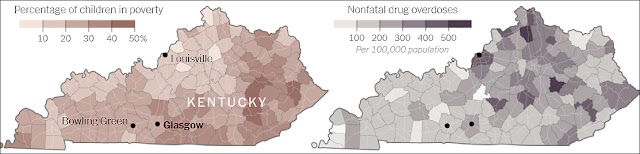
"In Glasgow, a town of 14,000, the challenges are intensified by high rates of drug addiction and poverty and their effect on families," Richter writes. "Glasgow has a poverty rate of 27 percent and a median household income of $28,000, according to 24/7 Wall Street, a data company that in 2020 ranked Glasgow the poorest town in Kentucky."
New York Times maps; to enlarge any image, click on it.
Mallie Boston, executive director of the Boys & Girls Club of Glasgow-Barren County, "said that today’s teens were less physically active and spent less time just hanging out," Richter reports, quoting her: “If you come to Glasgow right now, the options for what you can do are the movie theater, which is identical to when I was a child, or you have Ralphie’s, the bowling alley. . . . TikTok is such dopamine fuel,” she said. “I worry it is their dopamine.”

Richter interviewed several adolescents at the club, on the condition that he wouldn't use their names. "Some described struggling with anxiety, depression, suicidal thoughts or self-harm," he reports. "Katrina Ayres, the mental-health coordinator for the local school district, pointed to another change: Students were deeply focused on themselves, selfie-obsessed, which led them to “think everybody is looking at me,” she said. “We’re raising a generation that is very ‘me’ focused. . . . They need to see they’re part of a bigger picture.”