Showing posts with label insurance exchange. Show all posts

Friday, November 2, 2018

Open enrollment on Healthcare.gov is open until Dec. 15; subsidies make rates about the same as last year

By Melissa Patrick
Kentucky Health News

It's again time to sign up for federally subsidized health insurance through Healthcare.gov. Open enrollment for coverage in 2019 runs through Dec. 15.

It's worth taking a look, because most shoppers in the marketplace will qualify for financial help to lower their costs. About 80 percent of Kentuckians enrolled through the federal exchange qualified for tax credits or subsidies that reduced their premiums, according to a Cabinet for Health and Family Services news release.

"For most of those who qualify, the credits will offset any premium increases, so the cost of insurance in 2019 will be about the same as this year," says the release.

In Kentucky, Anthem Health Plans of Kentucky and CareSource will offer federally subsidized plans on Healthcare.gov, with rate increases of 4.3 percent and 19.4 percent, respectively. Anthem has returned to 34 counties it formerly served, to cover a total of 93. CareSource is covering 61 of the state's 120 counties.

While 34 counties will now have a choice between Anthem and CareSource, the only Anthem plan in 16 of those counties will be the Anthem Pathway Transition HMO, which has a very narrow provider network. The state insurance commissioner has cautioned people in these counties to look closely at provider networks.

Anyone who already has a plan on Healthcare.gov and doesn't choose a new one will be automatically re-enrolled, but there is widespread agreement among experts that it's best to take a look at your options each year to make sure you have the one best suited to your needs.

Margot Sanger-Katz, who writes extensively about health care for The New York Times, offered the following tips on Twitter. She is also part of a Kaiser Health News "What the Health?" podcast discussion on this topic.
  • Don't procrastinate; you've only got six weeks to get this done.
  • Look at your options as soon as possible, even if you love your current plan.
  • If you don't qualify for Medicaid, but earn less than double the poverty level, about $24,000 for a single person, look at the silver plans. "The cheapest one that covers the doctors you care about is almost always your best option," she writes.
  • If you qualify for a subsidy, about $48,000 for a single person, look at all the plans.
  • Check the deductibles! Even if you get a great premium, make sure you can afford the deductible.
  • If you make too much to get a subsidy, first look on Healthcare.gov, then at plans sold directly by insurance companies -- a broker can help.
  • Short-term plans are cheaper, but have fewer benefits. "If a short-term plan is all you can afford, you should shop really carefully. Read the fine print. And consider discussing it with someone who has expertise," she writes. Click here for her story on short-term plans.
  • Beware of fraudulent plans.
It's also important to take note that Healthcare.gov has scheduled possible maintenance for the program each Sunday morning during the sign-up period, except for the final Sunday, for a total of 60 hours potential of downtime.

Where can I find help?

The state-based call center is available at 855-459-6328 to help assist Kentuckians with where to go for coverage, answer questions and pre-screen for eligibility. The Healthcare.gov customer service center (800-318-2596) is also available 24 hours a day, seven days a week.

Click here to find an application assister or an insurance agent near you.

Healthcare.gov provides a shopping tool to allow you to preview 2019 plans and estimated prices before you log in.

The Kaiser Family Foundation also offers a Health Insurance Marketplace Calculator to provide estimates of health insurance premiums and subsidies for people purchasing insurance on their own on Healthcare.gov. It allows you to enter your income, age and family size to estimate your eligibility for subsidies and how much you should spend on health insurance. It will also allow you to see if you qualify for Medicaid.

Monday, August 27, 2018

Insurance expert advises: understand premiums, coverage, Obamacare subsidies and how much risk you want to assume

'Anyone buying health insurance this fall faces a daunting task: having to choose among multiple, often-complex options that offer widely varying degrees of protection," Trudy Lieberman of the Rural Health News Service reports in her latest column, syndicated to supporting organizations.

The new options include association health plans for small-business groups, short-term policies that may last from only a few months to a year (but can be renewed for three years in some states). "Then there are plans offered by church ministries that look like insurance but really aren’t," Lieberman writes. "Plus, multiple and complex options remain from the Affordable Care Act."

Trudy Lieberman, Rural Health News Service
Lieberman advises, "Before you comb through the fine print in an insurance policy, think about these major factors: The more you pay in premiums, the more you get in benefits. Many of the new options don’t have to cover all of the Affordable Care Act’s 10 essential benefits, and most insurance experts believe that in order to offer cheaper premiums, many of them won’t."

Low premiums and fewer benefits "may seem attractive," especially to older people who don't want to pay for mental-health and maternity coverage, Lieberman acknowledges. But the 10 essential benefits "also include prescription drug coverage, generous hospital coverage, emergency services, and rehabilitative services that are important to older people."

And there are pitfalls. Lieberman says some of the new policies "will limit hospital coverage to a certain number of days, or they might limit radiology services or drug coverage. The new so-called short-term policies will come with few if any regulations from the federal government or state insurance regulators."

Once you grasp the relationship between premiums and coverage, "The next big decision is how much risk you want to assume if you become seriously ill," Lieberman advises. "In other words, how much can you afford to pay out of pocket? For a large portion of Americans, the answer is not much. The Commonwealth Fund recently found that nearly half of working age adults could not pay an unexpected medical bill of $1,000 within 30 days."

Lieberman, who has covered health insurance for decades, writes, "Over the years, I’ve heard too many families say they are healthy, aren’t going to use the insurance, and might as well buy the cheapest policy possible – or none at all. I’ve interviewed many people who took that position only to end up later in bankruptcy court when unforeseen illness struck because they had no insurance and not enough money to pay the bills."

Once you understand your own situation, Lieberman says, "Look at the offerings on your state’s insurance exchange. Obamacare polices have gotten a bad rep almost since the beginning because they tend to be pricey for families that don’t receive an income-related subsidy to help cover the premium. About 87 percent of people who buy on the exchanges do get a subsidy."

And you may qualify for a second subsidy, cost sharing for people "with very low incomes who buy certain Obamacare policies. Those subsidies help pay for the deductibles and coinsurance that many of the policies require," Lieberman writes.

Lieberman asks, "What trade-offs are you prepared to make this year?" and asks you to tell her by emailing trudy.lieberman@gmail.com. For her entire column, and earlier ones, click here.

Saturday, June 23, 2018

Both Affordable Care Act insurers in Kentucky seek rate hikes; Anthem is returning to 17 unspecified counties, for a total of 76

By Melissa Patrick
Kentucky Health News

The two health insurers offering government-subsidized health plans in Kentucky's individual market for 2019 are both requesting an overall rate hike, the most popular one seeking increases averaging 3.5 percent and the other asking for 19.4 percent.

Insurers offering plans for small groups under the Patient Protection and Affordable Care Act are asking for average hikes of nearly 11 percent. These overall percentages reflect an average that will vary, depending on whether individuals smoke, how old they are, and where they live.

Anthem Health Plans, which has covered most of the ACA-subsidized customers in Kentucky, requested an average 3.5 percent increase for its 13 different plan offerings.

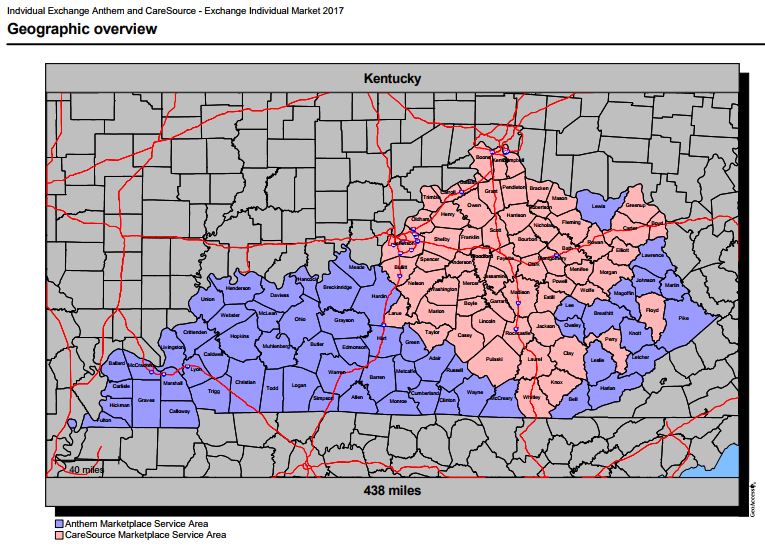
Anthem has also asked to expand its service area to include 17 more counties. If approved, that would increase its footprint from 59 counties to 76. Materials made public by the state Department of Insurance did not list the counties; an Anthem spokesman told Kentucky Health News that it was not releasing the list yet "for competitive reasons."

Anthem, based in Indianapolis, had offered plans in all 120 Kentucky counties in 2017, but scaled back to 59 counties in 2018.

CareSource's current counties
are in pink, Anthem's in blue.
CareSource of Kentucky, which covers the remaining 61 counties, submitted rate increases averaging 19.4 percent for its 12 plans, with no change in the counties it serves.

The requests are preliminary and subject to change. The Insurance Department can approve, lower or raise the rates. The department said in a press release that it expects to finalize the rates by late August.

“The initial rate increase percentages for 2019 are not as high as in previous years and some policyholders could see rate decreases,” Insurance Commissioner Nancy Atkins said in the release.

Last year, Anthem asked for an average 34.1 percent increase and CareSource asked for a 20.8 percent hike, and the Insurance Department gave both more than they asked for: increases averaging 41.2 percent and 56 percent, respectively.

Kentucky had 89,569 residents enroll in subsidized coverage through its health-benefit exchange and HealthCare.gov during the 2018 open enrollment period. That was more than a 10 percent increase over the 81,155 who had enrolled in 2017, but lower than the 2016 and 2015 totals: 93,687 and 106,330, respectively. The state shifted enrollment to the federal exchange in 2016, away from the state-based exchange called Kynect.

Open enrollment for 2019 begins Nov. 1.

Tuesday, January 30, 2018

Ky. Obamacare enrollment bounces back; increase 2nd in nation

Kentucky had the second greatest percentage increase in the number of residents who signed up for health insurance under the Patient Protection and Affordable Care Act in the 2017 signup period, compared to the year before. The number in Kentucky was 110.4 percent higher than the 2017 sign-up. The rankings may change as numbers come in from remaining states that extended their enrollment deadlines (in blue on chart).
ACAsignups.net chart; SBM means state-based marketplace, or exchange; FF-SBMs are federally facilitated (hosted).
Charles Gaba, an independent analyst and writer of ACASignups.net, found that Kentucky and 12 other states were ahead of their 2017 enrollment numbers and 11 were ahead of their 2016 enrollments. Gaba's analysis compares 2016, 2017 and 2018 enrollment data for states that participate in either a state exchange or the federal exchange.

A big reason for Kentucky's leading position is that its Obamacare enrollments in the state dropped last year, when the state moved from its own exchange to the federal exchange. Gaba, on Twitter, said the change had "confused people greatly."

Enrollment dropped to 81,155 in 2017, from 93,666 in 2016. Between 2017 and 2018, the state saw a 10 percent increase, to 89,569, which brought the number of Kentuckians on subsidized Obamacare plans close to 96 percent of the 2016 enrollment total.

Another reason: Kentuckians who were enrolled in 2017 were automatically re-enrolled for 2018 unless they picked a different health plan. The year before, a full re-enrollment process was required, Dustin Pugel noted in a blog post for the Kentucky Center for Economic Policy.

Pugel, an analyst for the left-leaning center, said the numbers would have been even higher in Kentucky and the rest of the nation if not for efforts by the Trump administration that discouraged enrollment, such as an open-enrollment period that was cut in half and huge budget cuts to the national marketing and navigator budgets.

Sunday, December 10, 2017

We're in the final few days of open enrollment for insurance on healthcare.gov; automatic re-enrollment might not be the best way

Updated Dec. 11, 2017: This article has been edited to reflect that CareSource's marketplace products are not part of Humana.  

By Melissa Patrick
Kentucky Health News

You have just a few days to enroll in a 2018 health-insurance plan on healthcare.gov. Open enrollment under the Patient Protection and Affordable Care Act ends Friday, Dec. 15.

"The clock is ticking," Whitney Allen, the outreach and enrollment coordinator for the Kentucky Primary Care Association, said in an e-mail. " We encourage anyone that has questions about enrolling in a 2018 health insurance plan to contact their local application assister before Dec. 15!"

And even if you don't need marketplace coverage, Allen says you should remind others, because that seems to be the way most people are hearing about government-subsidized insurance this year.

"It seems word of mouth has been the best advertising, this open enrollment," Allen said.

The state health agency has said it is using direct mail, text messages, phone calls and e-mails to communicate with current policyholders and potential new enrollees about open enrollment because it no longer gets federal funds for outreach.

Allen said most people in southeastern Kentucky who have called for application assistance say they heard about the service from family members and friends who have used it.

Who needs coverage?

Anyone who doesn't have health coverage through a job, Medicare, Medicaid, the Children's Health Insurance Program, or other coverage that meets federal standards, needs to sign up for marketplace coverage or risk paying a penalty.

The penalty for not having health insurance in 2018 is $695 per adult and $347.50 per child, with a maximum of $2,085 per family, or 2.5 percent of the household's income, whichever is larger.

If you miss the deadline, and don't qualify for a special enrollment period, you will have to wait another year to sign up, says the healthcare.gov website.

Health advocates have encouraged consumers to actively pick a plan to make sure they are getting the best coverage for the best cost, even if they will be automatically re-enrolled, as around 80,000 Kentuckians could be if they don't pick their own plan.

Stan Dorn, a senior fellow at Families USA, an advocacy group, told Kaiser Health News that auto-enrollment doesn't take premiums or benchmark plan changes into account, which means that even if you are assigned to the same plan, your cost could be different next year.

Kaiser Health News has also reported that it's important to actively choose a plan because "if you don't like the plan you're auto-enrollled in this year you may be stuck with it in 2018, unlike previous years when people could generally switch."

In general, the federal exchange plans are more attractive to individuals and families who earn less than 400 percent of the federal poverty level because they will qualify for subsidized coverage. And those who make too much to qualify for a subsidy are encouraged to connect with a certified health insurance agent or a broker to determine whether an exchange or off-exchange plan is best for them.

CareSource, which is offering exchange plans in 61 Kentucky counties, encouraged consumers to also check to see if their doctors are on their plans network.

"Even if a plan did not include your doctor last year, check again for 2018. Some plans, like CareSource, have recently signed agreements with new provider groups. This means more doctors may be in network beginning on January 1, 2018," CareSource said in a news release.

Anthem Blue Cross Blue Shield is selling plans in the other 59 counties. Here's a healthcare.gov checklist of the information that you need to have available when you sign up for coverage:


Where can I get help?

Application assisters are available in every Kentucky county to help people sign up for coverage, and their services are free. There are also sign-up events throughout the state. To find an event in your county or an assister, go to healthbenefitexchange.gov.

Help is also available through the state call center at 855-459-6328 and the Healthcare.gov customer center at 800-318-2596, which is available 24 hours a day, seven days a week.

Click here for a livestream open enrollment information session that aired Friday, Dec. 8 on the Kentuckians for The Commonwealth Facebook page. The video features application assisters from the Primary Care Association.

Sunday, December 3, 2017

Tax bill would repeal requirement to have health insurance, perhaps boosting efforts to repeal and replace Obamacare

Reporters interviewed Sen. Mitch McConnell between negotiations
on the tax bill. (Associated Press photo by J. Scott Applewhite)
The tax-reform bill the Senate passed early Saturday morning, with Majority Leader Mitch McConnell of Kentucky in the driver's seat, includes a repeal of the requirement that almost all Americans obtain health insurance.

The provision, perhaps the most important part of the 2010 Patient Protection and Affordable Care Act, appears highly likely to remain in the final version of the bill that will emerge from a House-Senate conference committee. That's because it was also in the House bill and would help make up for the budget deficits caused by tax cuts, writes Paige Winfield Cunningham of The Washington Post.

Once the mandate is repealed, Republicans may find it easier to "repeal and replace Obamacare," as they vowed for seven years but have so far failed to do, because "It disposes of a major reason previous GOP measures were projected to result in fewer Americans with coverage," Cunningham notes.

Enactment of the tax bill could also lead to cuts in Medicare. "If lawmakers don’t waive a 2010 rule known as 'paygo,' aimed at keeping government spending in check, that deficit spending would trigger automatic cuts to mandatory spending," limited to 4 percent, Cunningham writes. "Sen. Susan Collins (R-Maine), who generally opposes cuts to entitlement programs," has said that McConnell has promised that Congress will waive 'paygo', "but such a decision is beyond McConnell’s ability to control. Waiving 'paygo' requires 60 votes in the Senate, and it’s not at all clear that Democrats would be willing to help Republicans save themselves from mandatory cuts." Perhaps McConnell believes enough would.

Part of the price McConnell paid for the vote of Collins, who helped kill a repeal-and-replace-Obamacare bill in the summer, was a promise for a vote on legislation to restore the insurance subsidies that President Trump ended recently. That measure, sponsored by Sen. Lamar Alexamder (R-Tenn.) and Patty Murray (D-Wash.), "seems awfully shaky," Cunningham writes. "The Senate is focused right now on the tax overhaul; yesterday House conservatives told The Hill they wouldn't support it (they've labeled it an 'insurer bailout'); and, as conservative policy wonk Chris Jacobs writes over at The Federalist, even if the payments are included in a year-end spending bill, they might not ever get made, due to mandatory sequester cuts."

Cunningham concludes, "Here's the interesting question at play over the next few weeks: Will Congress make two changes to the ACA marketplaces that are contrary to each other? Repealing the mandate undermines the marketplaces by ultimately weakening their risk pools (some healthy people drop coverage without the mandate). Making the subsidy payments (known as cost-sharing reductions) helps lower marketplace premiums, but it's kind of moot if you've already removed the key requirement underpinning the whole ACA."

If Trump signs the individual-mandate repeal into law, health-insurance companies will have to decide whether they want to sell through the Obamacare marketplaces, notes Sarah Kliff of Vox: "Are they comfortable selling in a marketplace where they have to offer all consumers coverage but healthy people can decide not to purchase? Or are they scared off by the prospect of getting swamped with sick customers? . . . By September or October of next year, we'd have a sense of whether there are some places where nobody wants to sell Obamacare. And we'll know if there are places with really high premiums, as insurance plans only their sicker customers to stick around."

Kliff concludes, "If Obamacare does truly seem to be in collapse — insurance plans fleeing the markets, premiums spiking — that might give Republicans the pretext to once again take another shot at Obamacare repeal."

Sunday, November 26, 2017

Many Kentuckians with Obamacare plans got premium notices that over-estimated costs for 2018; see HealthCare.gov for facts

By Melissa Patrick
Kentucky Health News

With a shortened enrollment period, huge cuts in advertising and in-person assistance, and ongoing efforts to repeal and replace the federal health law, it's no wonder many Americans are confused about whether they can or should sign up for health coverage on government marketplaces this year.

Perhaps the most basic facts are these: The Patient Protection and Affordable Care Act, also known as Obamacare, is still the law of the land; it still requires everyone to have health insurance or pay a penalty; and the Dec. 15 deadline to sign up for a plan is fast approaching.

The requirement to have health insurance is designed to spread the risk and hold down costs. The penalty for not having it in 2018 will be $695 per adult and $347 per child, with a maximum of $2,085 per family or 2.5 percent of the household's income, whichever is larger.

Another possible source of confusion is that many returning Obamacare customers received renewal notices from their insurer that underestimated their 2018 monthly premium estimate. The notices used the customers' 2017 tax credit for the estimate instead of the larger 2018 tax credit, which could be causing "significant -- and misleading -- sticker shock," says the Kaiser Family Foundation.

Tax credits are available to people who earn between 100 and 400 percent of the federal poverty line to help reduce Obamacare premiums. The smaller your income, the larger your tax credit.

The practice of using the previous year's tax credit amount to determine the upcoming year's estimate wasn't as much a problem in the past because there wasn't much change from year to year in premium costs.

Tax credits will be larger in 2018 because they are based on the cost of benchmark "silver" marketplace plans, which have increased significantly in most markets for 2018 as a result of the federal government no longer paying a cost-sharing payment to insurers to keep these costs down. Generally, people who have had little or no changes in income and qualify for a tax credit will get a bigger one in 2018, and that will keep their monthly premium about the same.

Kaiser offered an example of the differences in estimated and actual costs of a 2018 silver plan for a 40-year-old in Louisville with income of twice the poverty level.

Such a person would pay the same $127 per month for a benchmark silver plan after using the appropriate tax credit. But if the 2017 tax credit is applied to the 2018 premium, as some renewal notices did, that calls for a monthly cost of $277, more than double this year's.

Elizabeth Kuhn, a spokeswoman for the Kentucky Public Protection Cabinet, said in an e-mail that between Nov. 1 and Nov. 22, about 9 percent of the calls to the state's Department of Insurance Consumer Protection Division were related to the federal marketplace, HealthCare.gov, including calls about this issue.

"The department representatives have explained that premiums could potentially be lower," she said. "Also, the premium notices sent to policyholders by insurers referenced that the 2018 premiums were estimates."

In Kentucky, Anthem Inc. is offering plans in 59 counties and CareSource, a Humana Inc. plan, is handling the other 61. Fran Robinson, a spokeswoman for CareSource, said its premium-estimate notices used the 2017 tax credit instead of the higher 2018 tax credit.

Robinson said the notices stated that the premium estimate was only an estimate, and encouraged recipients to update their information on Healthcare.gov to get their actual 2018 premium amount. She said they have explained this to any consumers who have called about this issue and encouraged them to update their accounts to get an accurate premium amount.

Anthem did not respond to the same inquiry from Kentucky Health News.

Suzanne Craig, program manager of the Community Access Project for the Green River District Health Department, told WKMS in Murray that "substantial numbers" of people are signing up for their ACA plans and many are fearful that they will lose their coverage.

"We are seeing more than we expected. These enrollments are taking longer because people have more questions," Craig told Rhonda Miller of WKMS, the Murray State University station.

WHAT CONSUMERS NEED TO KNOW, from Kentucky Health News:

Don't assume you can't afford a health insurance plan this year, especially if you got a notice that says your premium will be higher in 2018 than it was in 2017. Instead, to get the most accurate estimate go directly to Healthcare.gov, update your information and view the cost of all the plan options after the 2018 credit is applied.

Remember that help is available in person, by phone and online.

Every county in Kentucky has an application assister, formerly called Kynectors, to help consumers sign up for health coverage. They are offering sign-up events throughout the state.

To find an event in your county or an assister, go to healthbenefitexchange.ky.gov. The site also includes net payment examples for regions of the state and 2018 sample scenarios for individuals and families. It also provides answers to a list of frequently asked questions.

Kaiser Family Foundation offers a health insurance marketplace calculator to help consumers estimate their 2018 marketplace costs.

Help is also available through the state call center at 858 855-459-6328 and the Healthcare.gov customer center at 800-318-2596, which is available 24 hours a day, seven days a week.

Saturday, November 18, 2017

Study finds 1/3 of Americans haven't heard about open enrollment for subsidized health plans, which ends Dec. 15; here's a primer

By Melissa Patrick
Kentucky Health News

About a third of Americans haven't heard anything about open enrollment for federally subsidized health insurance, and nearly half of them say they are hearing less about it this year than last year, according to a recent poll by the Kaiser Family Foundation.

That's a problem, especially in Kentucky, where about 265,000 people had no health coverage in 2016. Of those, 114,000 were eligible for Medicaid and the other 151,000 could have bought a plan on Healthcare.gov -- many with a subsidy to help pay for it, according to Kaiser.

Despite huge national cuts to programs that fund in-person helpers, Kentucky still has application assisters, formerly called Kynectors, in every county who can offer in-person help for free. Here's a short primer of what people need to know to sign up for insurance under the Patient Protection and Affordable Care Act.

What is open enrollment and when is the deadline to enroll?

Open enrollment is a set period of time when people can buy health insurance through the federal marketplace. Open enrollment on Healthcare.gov for 2018 ends Dec. 15. After Dec. 15, you can only sign up for a plan under special circumstances. Coverage for these plans takes effect on Jan. 1, 2018.

But don't plan on shopping on Sunday mornings. Healthcare.gov is shut down for maintenance from midnight to noon Eastern Time  on every Sunday, except for Dec. 10.

Am I required to have health insurance? The Affordable Care Act requires everyone to have health insurance or pay a penalty. And despite all the talk about whether this requirement, called the individual mandate, will remain the law, it still is.

What is the penalty to not have health insurance? The penalty in 2018 is $695 per adult and $347.50 per child, with a maximum of $2,085 per family or 2.5 percent of the household's income.

The Kaiser Family Foundation has encouraged those who are uninsured to look into the cost of a plan because they could pay less in premiums than they would owe as an individual tax penalty for lacking coverage.

How do I enroll? Enrollment is through Healthcare.gov. This website will walk you through your options, including whether you will qualify for a subsidy or not. New users will have to create a user account and complete an online application. Current policyholders will have immediate access to the site's shopping tool. Before you get started, make sure you have all of your tax records and personal information with you. There is also a place on Healthcare.gov to preview 2018 plans and get estimated prices before you log in. Click here.

But can't I just automatically be re-enrolled? If you are one of the 80,000 Kentuckians who already have a plan through the federal exchange, you will be automatically re-enrolled into the most similar plan available. But health experts say make sure you are happy with your plan, because you won't be able to change it in January, as in the past. They also advise that you compare plans and costs, since they have changed since last year.

What is a tax credit? People earning between 100 percent and 400 percent of the federal poverty line will qualify for federal tax credits to help them pay their monthly premiums on plans purchased through Healthcare.gov. The smaller your income, the larger your tax credit. Most people who qualify for a tax credit will find that the cost of insurance in 2018 will be about the same, according to the state's health agency.

What is a cost-sharing reduction? And didn't President Trump end them? Cost sharing reductions are payments that reimbursed insurers for making plans more affordable for people who earn between 100 percent and 250 percent of the federal poverty level.

President Trump did stop these payments, but the two companies offering plans in Kentucky had prepared for this circumstance by increasing their premiums. And because the tax credit that helps pay premiums is based on the average cost of "silver" plans, those who qualify for assistance will get a larger subsidy.

In fact, some people's subsidy will be large enough for them to qualify for a no-cost or low-cost bronze plan, but health experts warn that many of these bronze plans come with very high deductibles or large yearly out-of-pocket costs.

Still, not everyone will benefit from this change. For example, those who make too much money to qualify for a subsidy will likely have to pay more for their plans than in previous years.

What should I do if I make too much money to qualify for any help? Health advocates are encouraging the 20 percent of Kentuckians who don't qualify for any help to look at plans off the exchange, as they could be less expensive.

Kentucky Department of Insurance map shows Anthem
counties in blue, CareSource in pink
Who is offering plans in my area? In Kentucky, Anthem Inc. is offering plans in 59 counties and CareSource is in the other 61.

Where can I get help? Assisters are avialable in every Kentucky county to help people sign up for coverage, and their services are free. There are also sign-up events throughout the state.

To find an event in your county or an assister, go to healthbenefitexchange.gov. The site also includes net payment examples for all regions of the state and 2018 sample scenarios for individuals and families.

Help is also available through the state call center at 858 855-459-6328 and the Healthcare.gov customer center at 800-318-2596, which is available 24 hours a day, seven days a week.

What's the takeaway? Advocates say: Sign up early, make sure you compare costs and plans and make an early appointment with your application assister. State officials remind Kentuckians to pay attention to their mail, text messages, phone calls and email about open enrollment, because that is how the state is spreading the word about open enrollment this year.

Sunday, November 5, 2017

Obamacare enrollment is on through Dec. 15; sign up early for assistance and compare plans, experts advise

By Melissa Patrick
Kentucky Health News

Sign up early, make sure you compare costs and plans and make an early appointment with your "application assister."

That was the advice given on an Oct. 31 Kaiser Family Foundation webinar offering open enrollment advice to consumers in Kentucky, as well as in Tennessee and Virginia.

Open enrollment began Nov. 1 for 2018 health insurance plans sold on Healthcare.gov and ends Dec. 15, half as long as in previous years.

"Consumers should start this process early this year," said Jennifer Tolbert, director of state health reform at the foundation. "Waiting to the final week of open enrollment is risky."

In addition to the shorter enrollment period, Tolbert said it's important to enroll early because there is no guarantee the federal government will extend the enrollment date for those who have started the application process prior to Dec. 15, as they have in the past.

Also, the federal government has announced that the Healthcare.gov website will be shut down every Sunday from noon to midnight midnight to noon (12 a.m. to 12 p.m.) Eastern Time (except Dec. 10) for maintenance, the foundation reports.

It's also important to pay attention to any mail, text messages, phone calls and emails you get about open enrollment, because this is how the state's health agency is spreading the word about open enrollment this year. The state no longer gets federal funds for advertising or outreach.
.
The webinar also reminded Kentuckians that the Patient Protection and Affordable Care Act is still the law. "The law has not been repealed or replaced. Individuals must have health insurance in 2018 or risk paying a tax penalty," the Kaiser foundation said.

The penalty for not having health insurance in 2018 is $695 per adult and $347.50 per child, with a maximum of $2,085 per family or 2.5 percent of the household's income.

Kentucky Department of Insurance map shows Anthem
counties in blue, CareSource in pink.
The 80,000 or so Kentuckians who have a plan through the federal exchange will automatically be re-enrolled into the most similar plan available, but the foundation and other experts advise them to make sure they are happy with their re-enrollment plan, because they won't be able to change it in January, as they have in the past.

In Kentucky, Anthem Inc. is offering plans in 59 counties and CareSource is in the other 61.

The webinar also urged consumers to compare plans and costs, since they have changed since last year.

About 80 percent of Kentuckians enrolled on the exchange will qualify for a tax credit or subsidy to reduce their monthly premiums, and because the credits are calculated to offset premium increases, the cost of insurance in 2018 will be about the same, according to the state Cabinet for Health and Family Services.

The Kaiser foundation also cautioned that while many will qualify for a "bronze" plan with a very low premium or no premium at all, it's important to look at the whole plan because these low or no-cost plans have very high deductibles and co-pays.

The foundation encouraged the remaining 20 percent of Kentuckians who don't qualify for any help and will likely see large increases in their premiums to look at plans off the exchange, because they could be less expensive.

Assisters are available in every Kentucky county to help people sign up for coverage, and their services are free. They will also be offering sign-up events throughout the state.

The webinar encouraged individuals to schedule an appointment with their assister early, noting the shortened sign-up period and that spots traditionally fill up quickly during the last week of enrollment.

To find an event in your county or an assister, go to healthbenefitexchange.gov. The site also includes net payment examples for all regions of the state and 2018 sample scenarios for individuals and families.

Help is also available through the state call center at 858 855-459-6328 and the Healthcare.gov customer center at 800-318-2596, which is available 24 hours a day, seven days a week.

Thursday, September 7, 2017

Each Kentucky county has only one insurer with Obamacare exchange plans for 2018 after Anthem pulls out of 61 counties

Kentucky Department of Insurance map shows Anthem's
remaining counties in blue, Care Source counties in peach.
(An earlier version of this caption transposed the colors.)
By Melissa Patrick
Kentucky Health News

Anthem Blue Cross and Blue Shield will no longer offer Obamacare exchange plans statewide, leaving all Kentucky counties with only one choice in 2018.

Anthem offered plans in all 120 Kentucky counties last year, and had earlier planned to do the same, but scaled back to 59 counties in 2018 citing a "shrinking and deteriorating individual market, as well as continual changes and uncertainty in federal operations, rules and guidance, including cost sharing reduction subsidies and the restoration of taxes on fully insured coverage. "

CareSource will cover the other 61 Kentucky counties. The Hill notes that Anthem had already announced plans to scale back participation in or leave the Indiana, Wisconsin, Missouri, Nevada and Ohio exchanges.

The Kentucky Department of Insurance also approved rate hikes for Anthem and CareSource's exchange plans, 41.2 percent and 56 percent respectively. The rate filings are subject to federal approval by Sept. 27.

These rates affect only those who get their health insurance on healthcare.gov and not those who get insurance in other ways, like employer plan, Medicare or Medicaid. Last year, more than 81,000 Kentuckians got their health insurance on the exchange. It should be noted that these rate hikes are just an average. Individual's rates will also factor in the plan type, smoking habits, age and place of residence, among other things.

These hikes are largely due to the uncertainty around whether the Trump administration will continue to pay the cost sharing reductions that help lower-income people afford their health insurance. Right now they are being paid on a month-to-month basis. Regardless, the insurance companies are responsible for them and because of the uncertainty have passed this cost onto the consumer.

"We remain hopeful that the federal government will continue providing CSR funding because it is a benefit to consumers and helps them afford their premiums," Bob Brett, vice president for CareSource, told Jacob Dick of The Messenger-Inquirer. "Like many insurers across the country, CareSource prepared multiple rate scenarios to factor in the uncertainty around CSR subsidies."

All this comes as a bipartisan group in Congress have started meeting to find ways to stabilize the Obamacare insurance markets -- even calling for a long-term extension of the CSR payments this week, though this recommendation comes a too late to influence next year's rates.

The state Insurance Department says every county has one insurance provider offering both on- and off-exchange plans, though the insurer options will be more limited than in prior years.

An open enrollment checklist prepared by the state notes that all plans have changed from last year and among other things points out that all 2018 plans are HMO plans that require the insured to only use in-network providers, except in an emergency.

“The driving force behind today’s insurance market is uncertainty and instability but, despite these factors, the department remains committed to providing the best possible outcome for Kentuckians and will continue to look for solutions to lessen the burden on consumers,” said Insurance Commissioner Nancy Atkins in the news release.

The open enrollment for 2018 plans has been shortened this year from three months to 45 days. It will run from Nov. 1 to Dec. 15.

Murray State University's NPR station, WKMS, list the 61 counties that Anthem will no longer offer plans in 2018, including: Anderson, Bath, Boone, Bourbon, Boyd, Boyle, Bracken, Bullitt, Campbell, Carol, Carter, Casey, Clark, Clay, Elliott, Estill, Fayette, Fleming, Floyd, Franklin, Gallatin, Garrard, Grant, Greenup, Harrison, Henry, Jackson, Jefferson, Jessamine, Kenton, Knox, Larue, Laurel, Lincoln, Madison, Marion, Mason, Menifee, Mercer, Montgomery, Morgan, Nelson, Nicholas, Oldham, Owen, Pendleton, Perry, Powell, Pulaski, Robertson, Rockcastle, Rowan, Scott, Shelby, Spencer, Taylor, Trimble, Washington, Whitley, Wolfe and Woodford.

9/14/17 Correction: The caption on the picture has been corrected to reflect that Anthem will be selling plans in the blue counties and CareSource will be selling plans in the peach counties.  

Friday, September 1, 2017

After little action on Obamacare, Trump administration says it will cut enrollment advertising 90%, in-person helpers 41%

The Trump administration announced Thursday that it will cut Obamacare advertising 90 percent and the "navigator" program to help people enroll by 41 percent, with "the deepest cuts to the enrollment workers who have signed up few health law enrollees," Sarah Kliff reports for Vox.

Navigators helped San Franciscans sign up for Obamacare
in 2015. (Photo by Jim Wilson, The New York Times)
"Administration officials cited 'diminishing returns' from outreach activities," Kliff reports. "They said that most Americans already know about the Affordable Care Act. . . . Obamacare advocates, however, worry that these type of budget cuts will be devastating to the law, making it difficult for potential enrollees to learn about the benefits."

Washington & Lee University law professor Tim Jost told Kliff, "The surest way to kill the exchanges is to keep them a secret. Sick people will find them, but getting younger and healthier people enrolled is the problem."

Doug Hogan, spokesman for the Cabinet for Health and Family Services said in an e-mail that a federal cut in funding for navigators, called application assisters in Kentucky, shouldn't impact their involvement in the rollout of the state's new Medicaid plan, upon its approval.

"We are not in a position to speculate on any potential impact without first seeing a specific federal proposal," Hogan said. "That said, this should not have any effect on the implementation of Kentucky HEALTH or on the use of assisters for Kentucky HEALTH, upon approval of the 1115 waiver by the Trump administration."

The Obama administration spent $100 million on digital and broadcast ads for Obamacare in the last enrollment period, and $62.5 million for the navigator program, "which trains individuals and organizations to provide people with unbiased information and help them sign up," Kliff notes. The Trump administration will spend $10 million and $36 million, respectively, amounting to a 72 percent overall cut in outreach.

Department for Health and Human Services official, who declined to be named, said, “The Obama administration doubled spending on advertising and saw a 5 percent decline in enrollment. Despite a doubled budget, there are diminishing returns.”

However, enrollment was on track to be about the same as the year before until the Trump administration "abruptly canceled $5 million in advertisements after taking office," Kliff notes. "Officials said they had not done any studies of the efficacy of enrollment advertising or whether public awareness is indeed quite high."

Little research has been done on Obamacare ads, but a 2017 study published in the journal Health Affairs said “Counties exposed to higher volumes of local insurance advertisements during the first open enrollment period experienced larger reductions in their uninsurance rates than other counties.”

Consumer advocates "argue that this is the exact moment when advertising is needed, given all the uncertainty over the health law’s future the recent congressional debate has created," Kliff reports.

She reported earlier, "Reports from conservative outlets have cast doubt on the value of enrollment-outreach programs, and HHS has highlighted those stories to other reporters." The law requires a navigator program, but doesn't say how robust it must be. Decisions about the program must be made soon.

President Trump has repeatedly said that the Patient Protection and Affordable Care Act is "imploding," and has talked about letting it collapse of its own weight, but until now his administration isn't doing much hasten its demise, Kliff reported earlier.

Kiff and Robert Pear of The New York Times reported on a briefing by another HHS official who declined to be named and said: "We want people to have access to quality health care. I think people want stability in the marketplace. We want the health-care market, the individual marketplace, to function, and to function well. It is not functioning, the way it is today."

Several U.S. counties that had been forsaken by insurance companies selling individual Obamacare plans now have at least one insurer, but many counties (including most rural counties) have only one insurer, which decreases competition and increases premiums.

Since the failure of Senate Republicans to pass a repeal-and-replace bill, and insurance companies' agreements to offer Obamacare policies in counties that were being left out, the spotlight has shifted to HHS, headed by Secretary Tom Price, a physician who as a congressman from Georgia railed against Obamacare.

Paige Winfield Cunningham notes in The Health 202The Washington Post's daily digest of health news and analysis, that Price "slashed in half the sign-up season, which used to run through the end of January. Some state insurance officials complain they’re not hearing as much from the Trump administration unlike the communication they had with Obama's government. But things seem to be chugging along behind the scenes at HHS, according to the National Association of Insurance Commissioners. 'They are doing everything they have done in the past to make sure the exchange is up and running and everything is loaded,' said a spokesperson for the NAIC."

"Price is facing a hard reality pitting politics against practicality," Cunningham writes, quoting former Republican Senate Finance Committee staffer Chris Condeluci: “I think HHS and the administration find themselves in a precarious position because on one hand they want to keep up the political rhetoric but they still can’t let the markets crater.”

In April, HHS finalized "a number of stricter rules that insurers had said are necessary to help them stabilize the individual markets next year and beyond," including one the Obama administration wrote, requiring people who want to enroll outside the open enrollment period in November and December to prove they had major life changes such as a divorce or a new baby. Mike Adelberg, a former top director at the Center for Consumer Information and Insurance Oversight at HHS’ Center for Medicare and Medicaid Services, told Cunningham, “Frankly, if they were really trying to kill the program this is something they could have thrown the brakes on.”

In May, HHS issued a policy easing sales of Obamacare plans by online brokers such as eHealth and HealthSherpa. "ACA supporters have raised concerns that online brokers might not present consumers with their full range of options, but even they admit the strategy could boost enrollment numbers by giving shoppers even more venues from which to sign up," Cunningham reports.

Sunday, July 30, 2017

Thwarted again, Republicans in Washington are divided about whether to keep trying to pass a health-insurance bill

Pence, McConnell and Trump in happier days (Getty Images)
By Al Cross
Kentucky Health News

After his last-ditch attempt to pass a health-insurance bill failed early Friday morning, Senate Majority Leader Mitch McConnell said, "It's time to move on," and scheduled other business.

President Donald Trump, hungry for a legislative victory, did not agree.

"Unless the Republican Senators are total quitters, Repeal & Replace is not dead! Demand another vote before voting on any other bill!" Trump said Saturday on Twitter.

Trump aides confirmed Sunday that the tweets are presidential policy. "The president will not accept those who say, quote, 'It's time to move on'," Trump adviser Kellyanne Conway said on "Fox News Sunday."

Some House Republicans also said work on health insurance should continue, but they are scheduled to recess at week's end. "The Senate is scheduled to work another two weeks," The Associated Press notes. "McConnell has said the unfinished business includes addressing a backlog of executive and judicial nominations, ahead of a busy agenda in September that involves passing a defense spending bill and raising the debt limit."

In several tweets, Trump called on McConnell and other Republican senators to eliminate the filibuster, which effectively requires 60 votes to pass significant legislation.

“The very outdated filibuster rule must go. Budget reconciliation is killing R's in Senate. Mitch M, go to 51 Votes NOW and WIN. IT'S TIME!” Trump wrote. “Republicans in the Senate will NEVER win if they don't go to a 51 vote majority NOW. They look like fools and are just wasting time.”

McConnell has repeatedly said that he will not support eliminating the filibuster, and "a McConnell aide said it's not going to happen," reports John Bennett of CQ-Roll Call.

In another tweet, Trump threatened to cut off subsidies of insurance for people whose incomes are less than 250 percent of the federal poverty level, or a family of four with annual income of about $85,000: "If a new HealthCare Bill is not approved quickly, BAILOUTS for Insurance Companies and BAILOUTS for Members of Congress will end very soon!" he wrote Saturday.


In an aside during a speech Friday, Trump repeated his threat to "let Obamacare implode." Insurance companies say ending the subsidies would further destabilize Obamacare's individual insurance market. The Kaiser Family Foundation has estimated that it would raise the cost of a typical plan by 15 percent in states that expanded Medicaid (including Kentucky) and 21 percent in other states.

Sen. Susan Collins of Maine, one of three Republicans to vote against McConnell's bill and a former state insurance commissioner, said Trump's threats have already "contributed to the instability in the insurance market" and "I seriously hope that in the meantime the president doesn't do anything to hasten that collapse." She said the payments are "not an insurance company bailout but help people who are very low income avoid their out-of-pocket costs . . . It would really be detrimental to the most vulnerable citizens if those payments were cut off."

Office of Management and Budget Director Mick Mulvaney told Jake Tapper on CNN's "State of the Union" the president's tweets reflect official policy, and "I think what you see there is simply the president reflecting the mood of the people. . . . You can't promise folks you're going to do something for seven years and then not do it. . . . They need to stay, they need work, and they need to pass something."

Mulvaney said Trump's congressional bailout reference was to an Office of Personnel Management decision two years ago that "allowed a special exemption to the rules on employer contributions to those plans." The rule insulates members and staff from premium increases on the government insurance exchange by allowing them to get employer contributions from the government to pay for plans on the small-business exchange for the District of Columbia.

As Trump called for action, some Republicans in the House and Senate met to discuss how that could be done. Rep. James Comer of Western and Southern Kentucky's 1st District "said he expects the next steps for health-care reform to include bipartisan efforts," Sarah Loesch reports for The Gleaner in Henderson.

McConnell said in late June that if Republicans did not agree "and change the status quo . . . markets will continue to collapse and we’ll have to sit down with Senator [Chuck] Schumer,” of New York, the Democratic leader. “Doing nothing is not an option.” McConnell has not repeated that warning, at least not publicly, and has seemed wary of a bipartisan approach.

McConnell said after his bill died Friday that he wanted to hear ideas from Democrats, but "Bailing out insurance companies without any thought of reform is not something I want to be part of."

Sen. David Perdue (R-Ga.) said that when he heard Schumer say early Friday that Obamacare needs major reforms, he started talking to Democrats about compromises, but other Republicans suggested they would oppose bipartisan talks.

“I don’t think the Democrats have any interest in doing anything productive” on health care, said Sen. Ted Cruz (R-Tex.). “Republican senators are going to go home. They’re going to hear from their constituents, and I don’t expect the response to be muted.”

Collins said "the first bill we should consider" is one to stabilize the insurance market, and called for a bipartisan approach, as did Sen. John McCain of Arizona when he returned from a brain-cancer diagnosis to cast a vote allowing debate on the issue last week. McCain cast the deciding vote against what he called McConnell's "shell bill" that the leader said was designed to take the issue to a House-Senate conference committee. The votes of McCain, Collins and Alaska's Lisa Murkowski made the tally 51-49. "Most people expected a tie," Collins said Sunday.

The cost-sharing subsidies expire Monday, July 31, and other deadlines loom.

"The drawn-out health care debate on Capitol Hill has left lawmakers and administration officials with very little time to reassure jittery insurers that the markets created by the ACA will be stable enough for them to offer plans at a reasonable rates," Ed O'Keefe reports for The Washington Post. "Companies must set their final rates by Aug. 16 and states must submit the rates they’ve approved to federal officials by Sept. 27."

Sens. Lindsey Graham has an alternate plan and met at the White House on Friday with Sens. Bill Cassidy of Louisiana and Dean Heller of Nevada, fellow Republicans. "The bill’s supporters are telling administration officials and congressional aides that the bill will score far better than previous efforts, which CBO analyses project would cause millions more uninsured people and short-term spikes in premiums," report Burgess Everett, Josh Dawsey and Rachel Bade of Politico.

"Several senior Republican Senate aides and allies of GOP leaders cautioned against any feelings of momentum coming from the White House on Saturday," especially after Trump's tweets about the filibuster. "McConnell has resisted such a suggestion publicly and has been pushing back against Trump privately, according to people familiar with their interactions. One person close to McConnell said Trump has asked McConnell personally to change the rules but said no."

The Politico reporters add, "Senate rules don’t appear to be the problem. From the 'skinny repeal' bill to a McConnell designed replacement bill to a so-called “clean” repeal bill, all GOP efforts failed to get 50 votes in the Senate," at which point Vice President Mike Pence could break the tie in Republicans' favor.

The Post's Mike DeBonis and Amber Phillips write that congressional Republicans “now live in the worst of both worlds -- with nothing to show for seven years of campaign promises, even though dozens of vulnerable lawmakers cast votes that could leave them exposed to attacks from Democrats. . . . Republicans have continually failed to coalesce around an alternative — vividly demonstrated by the dramatic failure of the 'skinny repeal' on the Senate floor early Friday morning. They appear trapped in the fallacy of sunk costs: Having invested so much political capital in the ACA’s repeal, they cannot possibly abandon it.”

Former McConnell chief of staff Josh Holmes, a Republican strategist who often reflects his former boss's views, told the Post that Republicans should “Quarantine it. You can let it destroy your entire agenda and your entire party as a result of inaction by continuing to dwell on something that, frankly, they’ve proven unable to do.”

Friday, June 30, 2017

Only two health-insurance companies offer 2018 individual plans on exchange; asking for rate increases averaging 27.5 percent

Update 8/11/17: The Centers for Medicare and Medicaid Services has extended the rate filing deadline for 2018 Obamacare marketplace plans until Sept. 5. 

By Melissa Patrick
Kentucky Health News

The only health insurer offering government-subsidized health plans everywhere in Kentucky for 2018 is asking for rate increases averaging 34 percent, and the only other insurer offering subsidized plans in the individual market wants a hike of almost 21 percent.

The rate requests reflect a base rate that will fluctuate with individual consumers based on their age, whether they smoke and where they live.

Table from Kentucky Department of Insurance website
Kentucky is down to two participating insurers in the individual marketplace for 2018: Anthem Health Plans of Kentucky Inc. and CareSource Kentucky Co., based in Dayton, Ohio.  Humana Inc., which offered individual plans in nine Kentucky counties this year, announced in February that it was leaving the individual market nationwide.

Anthem, which recently announced that it would no longer offer subsidized plan in Ohio, requested an increase of 34.1 percent for its individual policies in 2018.

"Anthem has changed its cost structure in part by making changes to the networks in which people can access doctors under their insurance plan," Boris Ladwig reports for Insider Louisville. "The Kentucky Department of Insurance will analyze the rate requests and decide by Aug. 16 whether they’re warranted. The department can approve, lower or raise the rates."

CareSource requested an increase of 20.8 percent. Overall, the average was 27.5 percent. Insurers offering small-group plans are asking for average hikes of almost 10 percent.

Once again, CareSource will offer exchange plans in 61 counties and Anthem will be the only insurer offering individual plans statewide -- leaving 54 of the state's 120 counties with only one insurer.

The Insurance Department attributes the rate increases to "market forces, an aging population, and systemic instability and uncertainty injected by the failure of Obamacare," the common name it uses for the Patient Protection and Affordable Care Act.

Anthem told Insider Louisville that its proposed rate hike reflects “increases in the cost of delivering medical services coupled with pharmacy expenses and overall increased use of health care services by Anthem members in ACA plans.” The company "warned that it might adjust its request — and its participation in the Kentucky market — in response to legislative changes, especially if the U.S. Congress eliminates or significantly lowers subsidies that help people buy health insurance," Ladwig reports.

The increases have also been attributed to the uncertainties about whether the federal government will continue to pay for cost-sharing subsidies that make coverage more affordable and whether it will enforce the individual mandate that requires everyone to have health insurance or pay a fine.

These uncertainties led Kentucky to extend its filing deadline twice, and has prompted some states to allow insurers to file two sets of premiums for different circumstances: continuation or repeal of the Obamacare cost-sharing subsidies, and the enforcement of the individual mandate.

Insurance Commissioner Nancy Atkins said in the news release that the rate increases are "commonplace for most states."

“DOI has emphasized to carriers that the best possible outcomes for Kentucky consumers must be achieved,” said Atkins. “Obamacare’s failure at the federal level combined with the collapse of the Kentucky Health Cooperative under the Beshear administration placed a substantial strain on the state’s entire healthcare matrix, which continues to impact the current stability of the marketplace.”

The cooperative was a non-profit insurer created under Obamacare to provide more competition in the marketplace, but then was not fully funded by Congress and had to liquidate. It covered 51,000 Kentuckians, many of them the state's unhealthiest people, and those clients have had to find new insurers who must assume their risk.

Both Anthem and CareSource increased their individual exchange policy rates this year by double digits, Anthem by 22.9 percent and CareSource by 29.3 percent.

Kentucky had 81,155 people enroll in coverage through its exchange during the 2017 open enrollment period. Open enrollment in HealthCare.gov for plan year 2018 begins Nov. 1. The release notes that all rates are subject to change and will be finalized by Aug. 16.

CareSource will offer individual exchange plans in these counties: Anderson, Bath, Boone, Bourbon, Boyd, Boyle, Bracken, Bullitt, Campbell, Carroll, Carter, Casey, Clark, Clay, Elliott, Estill, Fayette, Fleming, Floyd, Franklin, Gallatin, Garrard, Grant, Greenup, Harrison, Henry, Jackson, Jefferson, Jessamine, Kenton, Knox, LaRue, Laurel, Lincoln, Madison, Marion, Mason, Menifee, Mercer, Montgomery, Morgan, Nelson, Nicholas, Oldham, Owen, Pendleton, Perry, Powell, Pulaski, Robertson, Rockcastle, Rowan, Scott, Shelby, Spencer, Taylor, Trimble, Washington, Whitley, Wolfe and Woodford.

Saturday, May 20, 2017

Beshear joins lawsuit to defend Obamacare cost-sharing subsidies; D.C. appeals court to consider request Monday

By Melissa Patrick
Kentucky Health News

Kentucky Attorney General Andy Beshear and 15 of his counterparts have filed a motion aimed at maintaining cost-sharing subsidies for health insurance for low-income people under the Patient Protection and Affordable Care Act. The attorneys general want a federal court to let them directly defend the subsidies, about which the Trump administration has been ambivalent.

In 2014, House Republicans sued the Obama administration over the legality of these cost-sharing subsidies being paid to insurance companies because Congress never appropriated the funding for them. A district court ruled in favor of the House, but the Obama administration appealed the ruling. The subsidies were allowed to continue pending the appeal.

When Obama left office, the Trump administration became the defendant in the lawsuit. The administration is scheduled to inform the U.S. Court of Appeals for the District of Columbia Circuit on Monday, May 22, how it wants to proceed with the appeal.

Harris Meyer of Modern Healthcare reports, "The state attorneys general claim their states' interests would be gravely harmed if the payments stop because many insurers would exit the individual insurance market, premiums would spike, many of their residents would be left uninsured, and state and local governments would face heavy costs in paying for medical care for the newly uninsured people."

Beshear said in a news release, “Thousands of Kentuckians who purchase health insurance from the federal exchange are at risk of losing access to affordable health care coverage. The loss of federal funds and the financial uncertainty threatened by the case would lead to higher health insurance costs for Kentuckians and to insurers abandoning the individual health insurance market.”


The Kaiser Family Foundation projects that without the cost-sharing subsidies, premiums would increase by an average of 19 percent on ACA "silver" plans, the most popular, and higher in states that have not expanded Medicaid. The subsidies are available to people with incomes between 100 and 250 percent of the federal poverty level -- between $24,300 and $60,750 for a family of four.

Kentucky has extended its deadline for filing 2018 Obamacare plans to June 7, from the original May 17, "to allow insurers more time to obtain relevant data, including enrollment and claims data for the beginning of 2017, for use in developing assumptions utilized by actuaries to determine necessary plan pricing," Ronda Sloan, spokeswoman for the state Department of Insurance, told Kentucky Health News in April.

During the 2017 open enrollment period, 81,155 Kentuckians enrolled for coverage through the exchange and four out of five of them received a subsidy to help pay for their premiums, according to the Kentucky Center for Economic Policy. 

Both the ACA and the House-passed health bill, called the American Health Care Act, include subsidies, but use different formulas. The ACA takes family income, local cost of insurance and age into account, while the AHCA bases its tax credit only on age, with a phase-out for individuals with incomes above $75,000. It would continue the cost-sharing subsidies until 2020, "but would not appropriate those funds, leaving insurers uncertain whether they would receive the payments," Modern Healthcare reports.

Subsidies to low-income consumers who sign up for insurance on the exchange are estimated at $7 billion this year, according to the Congressional Budget Office.

Politico reports that Trump has told his advisers that he wants to end the Obamacare subsidies to force Democrats to the table to negotiate an Obamacare replacement.

The states seeking to intervene in the case are California, Connecticut, Delaware, Hawaii, Illinois, Iowa, Kentucky, Maryland, Massachusetts, Minnesota, New Mexico, New York, Pennsylvania, Vermont and Washington, as well as the District of Columbia.


Tuesday, March 7, 2017

Ky. and most surrounding states had fewer companies on government health-insurance exchanges this year than last year

The number of health insurance companies offering subsidized coverage didn't shrink just in Kentucky, but in most of adjoining states, according to a study done for the Foundation for a Healthy Kentucky.

The report found that the number of insurers on Kentucky's exchange dropped to three in 2017 from seven in 2016. Likewise, the number of insurers in Illinois and Indiana also dropped by four. Ohio's exchange lost five insurers during this time frame, but it still has 11 to choose from. Virginia, with 11, and West Virginia, with 2, remained the same.

The report found that while Kentucky continues to have three insurers on the exchange, only one of them covers all 120 counties, leaving 59 counties with one carrier, 52 counties with two carriers and only nine counties with all three.

"One of the concerns about the uncertainty surrounding the Affordable Care Act is that the number of insurers offering plans is dwindling in many markets, and that's exactly what happened in Kentucky," Ben Chandler, president and CEO of the foundation, said in the news release. "Kentuckians living in more than 90 percent of counties in the commonwealth had just one or two carrier choices; half of Kentucky counties had only one carrier option. And the choices were most limited in the lower-income, less-healthy areas of the commonwealth."


The ACA requires everyone to be covered by health insurance, either public or private, or pay a penalty. Consumers who buy plans on the exchange, depending on their income, may be eligible for tax credits to reduce their monthly premium payment amounts.

The report also found that in 2017, the second-lowest priced silver-level plan for a family of four with an income of $60,000 was lower in Kentucky than both the U.S average and five of its eight neighboring states, though the monthly premium cost for all of the states in the study was about the same, around $405, after the varying amount of tax credits was subtracted from the varying premium costs.

For example, Kentucky's premium for this plan is $939, and the tax credit is $534, leaving the person to pay $405 each month. The U.S. average premium for this plan is $1,090, with a tax credit of $686, leaving the person to pay $404 each month.

Chandler said that fewer carriers lead to higher premiums, less competition, and higher cost to taxpayers who pay for the tax credits to buy those premiums down.

He also pondered what would happen if insurers refused to cover some areas of the state altogether, thus removing any opportunity for a tax credit for those residents and making it more expensive for them.

"That would move Kentucky backward by once again increasing the number of people who cannot afford insurance, so they rely on the emergency room or just delay or skip essential health care," he said.

The study was done by the State Health Assistance and Data Center at the University of Minnesota.