Showing posts with label health education. Show all posts

Friday, May 10, 2024

17 Ky. schools have free online mental health wellness course

Kentucky Health News map; for a larger version, click on it
More than 1,500 students in 17 Kentucky schools recently gained access to a free digital course on mental wellness, provided by the Medicaid program of Anthem Inc., one of the health insurers that manages the federal-state health program in Kentucky.

"The announcement comes during Mental Health Awareness month and as more adolescents, especially girls, report depressive symptoms," notes Sarah Ladd of the Kentucky Lantern.

The 17 schools in the program are Clay County Middle School, Daviess County High School, Estill County High School, Grant County Middle School, Graves County High School, Grayson County Middle School, Hazard Middle School, Henderson County High School, Bazzell Middle School in Allen County, Jenkins Independent School in Letcher County, Lewis County Central Elementary School, Marion County High School, Murray Middle School in Calloway County, Ohio County Middle School, Owensboro Middle School, Russell High School in Greenup County and Webster County High School.

The program has been launched in these schools and will continue into the 2024-25 academic school year, according to Quin Welch, media contact for Anthem Medicaid.

Understanding Mental Wellness” is a course for students in grades 8, 9 and 10. It has six 15-minute lessons, according to Blackbaud, the digital-services firm that designed the course. 

Anthem says the course exposes students “to the experiences of others in order to develop awareness and empathy, reduce stigma, and provide facts on the prevalence and symptoms of mental health conditions.”

Students then “explore their own mental health, identify challenges they may face, and develop concrete strategies for managing those challenges while increasing their awareness of resources and empowering them with the knowledge, skills, and language necessary to identify and support a peer in need or at risk.”

Ladd reports, "Online previews of the course show a tour of mental health through the program, starting with a lesson on what mental health is and ending with the chance to create a personal wellness plan.

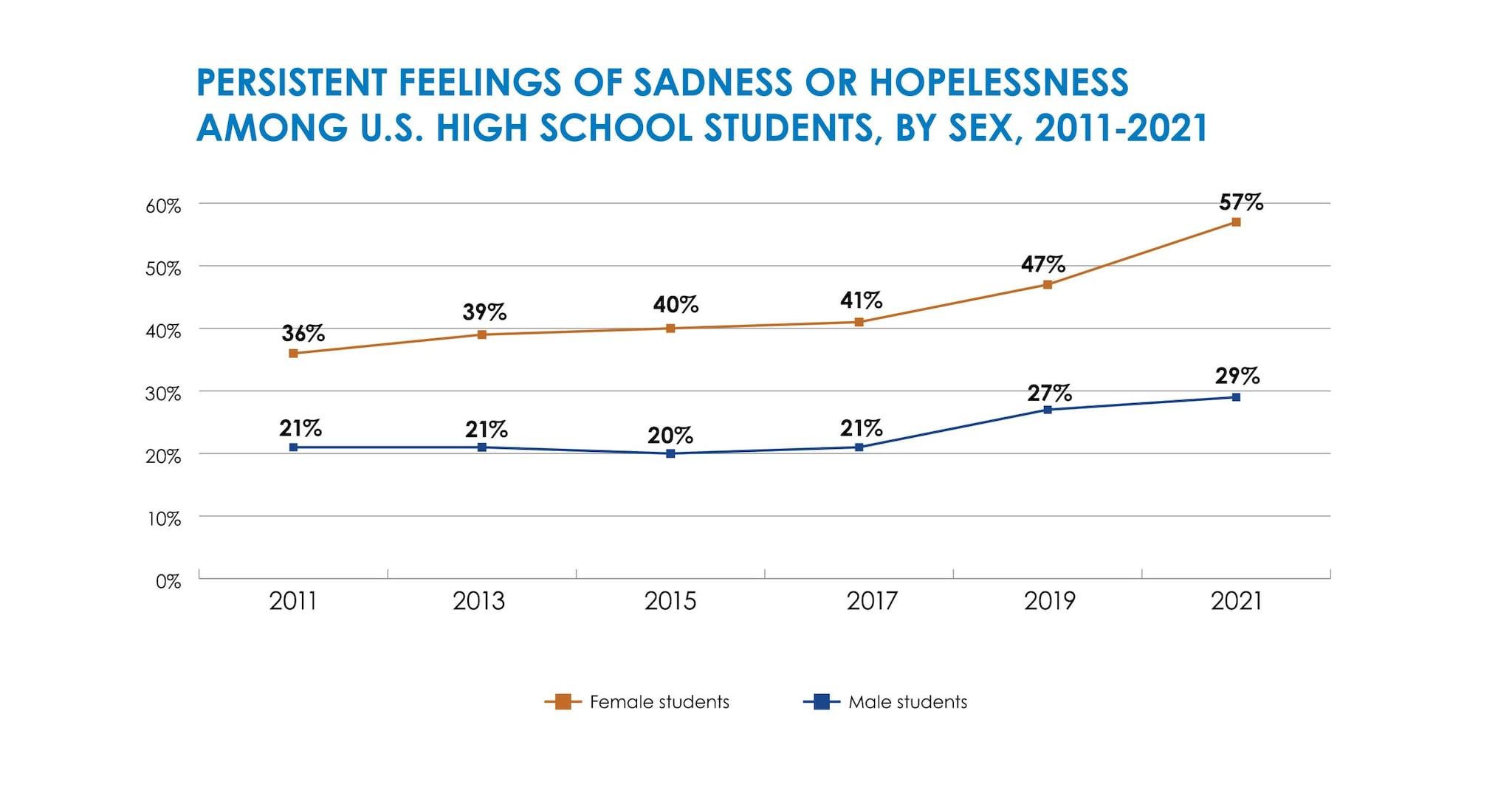
"Since the onset of Covid-19, mental health has worsened. In 2021, the Centers for Disease Control and Prevention found that sadness and hopelessness had increased from pre-pandemic levels, especially for teen girls. In 2017, 41% of female high school students and 21% of male high school students felt sad or hopeless. By 2021, those statistics were at 57% and 29%, respectively."

“Young people need resources and education from trusted sources to protect their mental health,” said Leon Lamoreaux, market president for Anthem Medicaid. He said the program “will help us reach students from all over the Commonwealth and equip them with tools and strategies that will make a positive difference in their lives for years to come.”

Tom Davidson, the CEO of Everfi, said the goal of the program is to help “those who are impacted by mental-health challenges, those who want to build and maintain positive mental health and those who have the opportunity to positively impact the mental health of a friend or peer.”

Tuesday, April 9, 2024

Despite waiting list, a shortage of nurses and plenty of money, governor and legislature don't fund new building for KSU nursing

Kentucky State University’s nursing program has outgrown the Betty White Health Center, opened in 1971. Nursing classes are spread in buildings across campus. (Kentucky Lantern photo by Jamie Lucke)
By Sarah Ladd
Kentucky Lantern

Kentucky State University requested $50 million this year to build a nursing school for its growing class of future health care providers. The governor and legislature rejected the request, even though the KSU program has a waiting list and Kentucky suffers from a shortage of nurses but enjoys a record surplus.

“The real tragedy is that we had the money to do it,” Rep. George Brown Jr., a Lexington Democrat, told the Lantern last week. He called the omission “a travesty.” Brown and other lawmakers said the decision is part of a long pattern of neglect and underinvestment in historically Black colleges and universities (HBCUs) — a disparity the Biden administration also has highlighted.

It’s “always been the history,” said House Democratic Floor Leader Derrick Graham, a KSU alum who urged Republican legislative leaders to fund the nursing building.

During House debate, Black lawmakers pointed out that Kentucky’s only public HBCU was being denied $50 million for a project they deem critical to its future, while $125 million was quickly found for Northern Kentucky University and the University of Kentucky to open a biomedical center in downtown Covington, where plans also call for NKU to move its law school.

The Senate added the Covington project to House Bill 1, which moves $2.7 billion from the Budget Reserve Trust Fund into one-time spending over the next two years. HB 1 includes other higher education projects: $60 million for a veterinary tech facility at Murray State University, $25 million for a UofL Health cancer center in Bullitt County and $22 million for a livestock innovation center at a UK research farm.

“Kentucky State always seems to suffer and always has to wait,” Brown said March 29 on the House floor. “‘You have to wait your time; it’s not your time.’ … So the question is, when will it be Kentucky State’s time?”

When budget negotiators met in a free conference committee on March 26, Graham asked why KSU’s “top priority” was not included in budget legislation. Graham represents Frankfort where KSU sits on a hill overlooking the capital city. Sen. Chris McDaniel, chairman of the Senate budget committee, said KSU had also revised its budget request by asking for money to deal with failing infrastructure and other maintenance needs.

House Bill 6, the budget bill, sets aside $60 million in bonding for “asset preservation,” described by McDaniel as “cleaning up campus.” House Bill 1 includes $5 million to design a Health Science Center for the nursing program but nothing to build it. McDaniel vowed “full intent” to pay for construction of KSU’s nursing building in the 2026 budget bill. McDaniel’s district includes Covington; he was instrumental in obtaining the $125 million for the downtown project involving NKU.

“We have a great deal of confidence in the new president of Kentucky State,” McDaniel said in the March 26 meeting. He was speaking of Koffi Akakpo, who became KSU’s 19th president last year on July 1. Before that, he was president of Bluegrass Community and Technical College.

HB 6 provides all the public higher-ed institutions with asset preservation funding pools for renovation and maintenance of buildings and other infrastructure.

During the free conference committee meeting, Democratic Senate leaders Gerald Neal of Louisville and Reggie Thomas of Lexington, both of whom are Black, said that expanding KSU’s nursing program is critical to the school’s rebound from recent troubles. The construction delay will cost KSU new students and needed tuition revenue and disrupt Akakpo’s plan for the future, said Neal.

Neal and Thomas urged the budget negotiations to reconsider. Thomas suggested spending less on restoration and maintenance at KSU in this budget to free up $50 million over the next two years to design and build the nursing building.

Senate Republican Floor Leader Damon Thayer of Georgetown responded ​​that KSU was “probably lucky that they get the taxpayer money that they have been getting and continue getting. With the recent numbers and results that have come from K-State, I think we should be dubious moving forward.” He said the “numbers have been pretty embarrassing.”

KSU has faced a series of controversies, including misused funds under a former administration and a 2023 warning from its accreditation body. In 2022, the legislature put KSU under a management improvement plan and provided $23 million to help it recover from a budget deficit.

In an interview with the Lantern last week, Akakpo said he is “grateful” for the $60 million in bonding but that it will “go quickly” as he tackles a list of maintenance needs.

The HVAC system, he said, is “not quite up to par” and the dorms are “in really bad shape.” Sidewalks and entryways need fixing, he said, and “leaky roofs” have caused damage that needs attention. The $60 million does “not quite” cover these needs, he said. “But we will try the best we can.”

A new building for nursing students and money to address maintenance needs were “both equally crucial for us to move forward,” Akakpo told the Lantern.

KSU's 342 nursing students make up 24% of the university's enrollment, and the program is “only going to grow,” said Akakpo. Nursing students study in three separate buildings because no designated building is large enough.

The Betty White Health Center, which is 53 years old, has administrative offices and a learning lab. Students take classes in Bradford Hall, Carver Hall and Hathaway Hall. “The building is needed because the building that is assigned to the nursing program is too small,” Akakpo said. It’s also already full.

Kentucky is thousands of nurses short of what it needs. The state is short 5,391 registered nurses and licensed practical nurses, according to the Kentucky Hospital Association. And, the students going into nursing school aren’t enough to replace those retiring and leaving the workforce.

Brown said KSU’s backlog of maintenance needs stems from historic underinvestment. The historically Black university, he said, is “the redheaded stepchild, if you will” of Kentucky higher education.

The Biden administration last year documented roughly $12 billion in underfunding for HBCUs nationwide when compared with state funding of similar predominantly white institutions.

The study compared land-grant institutions created by Congress in the 19th century, first for white students and later for Black students. KSU and UK are Kentucky’s land-grant universities. In Kentucky the disparity in per student state funding from 1987 to 2020 was $172 million.

U.S. Education Secretary Education Miguel Cardona and Agriculture Secretary Tom Vilsack sent letters to governors, including Kentucky’s, asking for states to right the “historical underinvestment.”

A letter from Cardona to Gov. Andy Beshear cited “unbalanced funding” and “longstanding and ongoing underinvestment” as reasons KSU “has not been able to advance in ways that are on par with University of Kentucky.” It added that “unequitable funding” of KSU put it $172.1 million short of what it would have received in the last 30 years.

The budget Beshear introduced in December did not include money for the KSU nursing building. It did ask lawmakers to allocate about $1.2 million to KSU for nursing and social-work scholarships in 2024-26.

Tuesday, December 5, 2023

UK's largest academic building will be the Michael D. Rankin M.D. Health Education Building, named for an alumnus from Danville

A rendering of the building, to be built on University Drive between the main library and Cooper Drive
By Kristi Willett
University of Kentucky

The University of Kentucky Board of Trustees approved Tuesday the naming of the university's new building for health education as the Michael D. Rankin M.D. Health Education Building.

As an alumnus, Rankin has devoted himself to the UK College of Medicine, its success and the success of its students. He has been an invaluable member of the UK Medical Alumni Association, its past president, chair of the Dean's Advisory Council and volunteer faculty in the Department of Family and Community Medicine. In addition, he has served many years on the College of Medicine scholarship and admissions committees.

The Board of Trustees previously accepted a gift commitment of $22 million from Rankin for scholarships in the college and to support the construction of the building — which, when completed, will be the largest academic building in the history of UK.

“Dr. Rankin has left an indelible mark of healing and hope, not just on this university, but on the state of Kentucky,” said UK President Eli Capilouto. “His influence will be felt by generations of students and the patients they later serve.”

At over 500,000 square feet, the new Health Education Building will house programs in the colleges of Medicine, Public Health, Health Sciences and Nursing as well as the Center for Interprofessional and Community Health Education. The new facility will become a prominent campus landmark at the intersection of Huguelet and University drives when it opens in 2026.

Rankin when his gift was revealed in 2021 (UK photo)
Rankin, of Danville, received his bachelor’s degree in electrical engineering from UK in 1971 and his medical degree from the College of Medicine in 1980. He completed his residency in family medicine in 1983 at UK HealthCare and pursued a successful practice in primary care and family medicine in Atlanta before retiring and returning to Boyle County on a farm 10 miles from where he grew up.

“One of the greatest challenges facing the commonwealth is the current and growing shortage of health care providers, including physicians, nurses, physician assistants, physical therapists, athletic trainers, medical laboratory scientists, speech language pathologists, audiologists, public health officials and other health care professionals,” Capilouto said. “With this new facility, we will be addressing this health care workforce shortage head-on and, but it couldn’t be done without our partners like Dr. Michael Rankin, who share with us a vision for a healthier Kentucky.”

Friday, November 10, 2023

Kentucky health insurers give $750,000 to Louisville public-benefit firm to improve care for opioid-exposed infants in rural Kentucky

NAS stands for neonatal abstinence syndrome.
By Melissa Patrick
Kentucky Health News

The Kentucky Association of Health Plans, the trade group for companies selling health insurance in Kentucky, has given $750,000 to Nascend, a Louisvile-based public-benefit corporation that works to help infants with neonatal abstinence syndrome, caused by mothers using opioids during pregnancy. 

The KAHP grant will allow Nascend to extend its certification program to rural hospitals in Kentucky, to help standardize and improve care for opioid-exposed infants across the state, a news release said.

“Kentucky’s Medicaid managed-care organizations are proud to partner with Nascend . . . to show demonstrable results by eliminating care gaps and improving health outcomes for mothers and babies,” KAHP Vice President of External Affairs Katherine Kington North said in the release.

The NAS certification program is designed to help health-care providers treat substance-exposed infants more effectively and efficiently, which ultimately leads to better outcomes for the children and families as well as savings to the health care system, the release said. 

Dr. K. Dawn Forbes, founder and CEO of Nascend, said her team of neonatologists is excited about the impact that this grant will have across the state, particularly in rural areas. 

“We are going to be able to address a lack of standardized care guidelines, outdated and ineffective infant assessment tools, overused medication treatment, poor parental engagement, and insufficient nutrition," Forbes said in the release. "This is a game-changer, and we appreciate Kentucky health plans for being laser-focused on improving the social determinants of health.”

Kentucky has been particularly affected by the opioid epidemic, with NAS rates reaching 19.4 per 1,000 infants, with a peak rate of 77 per 1,000 infants in the state's Appalachian region. The national average is only 7 per 1,000.

The release says the KAHP grant will "help decrease the need to transfer infants to facilities in urban areas, better maintain patient-provider relationships, reduce family stress, and retain care and resources locally while also contributing to an estimated cost savings of at least $2.83 million annually by serving a minimum of 500 infants per year at full implementation." 

Nascend says it has trained more than 7,000 health-care providers in 38 states and improved the lives of more than 1.6 million infants. The company was recognized this year as a "Top 10 Health Education Services Provider" by Healthcare Business Review, and received the "Top Social Impact Company Award" at the 2023 Canopy Annual Good Business Summit for "aligning purpose and value with community impact," a news release said

Tuesday, October 10, 2023

Postsecondary education council honors Stivers for legislation

Stivers receives award from Dr. Aaron Thompson, president of
the postsecondary education council, and Dr. Leslie Sizemore,
its executive director for workforce and economic development.
State Senate President Robert Stivers received the Innovative Healthcare Leader Award from the state Council on Postsecondary Education at its Workforce Collaboratory awards luncheon in Lexington Tuesday.

"The award celebrates Stivers’ tenacity, creativity, and dedication to building a diverse and highly skilled healthcare workforce for Kentucky’s future," a Senate press release said. It cited Senate Bill 10, a Stivers measure that passed the legislature and "made significant strides in removing artificial barriers that prevented eligible students from entering the nursing profession. It made it easier for nurses outside Kentucky to practice here, addressing major workforce shortages. It also removed arbitrary caps on admission to nursing programs.

"Most importantly, SB 10 restructured the Kentucky Board of Nursing to reflect more of Kentucky’s geographical diversity and bolster the voices of nurses by requiring 10 board members to be practicing nurses. It also requires Senate confirmation of the members.

Stivers, a Republican from Manchester, said in the release, “I wholeheartedly believe we have to tackle our health-care challenges with innovative ways and bring in new partners to invigorate the industry that holds so much promise for Kentucky in so many ways. Everyone in Kentucky has a reason to be excited about how we are changing the health-care landscape because it means better opportunities for those seeking health-care professions and better outcomes for those receiving higher quality care.”

Wednesday, August 23, 2023

Kentucky is next to last in currency of nursing-home inspections, and it may not have hit bottom yet, health officials tell legislators

Kentucky is farther behind on nursing-home inspections than only one other state, and the huge backlog might last a long time, Beshear administration officials state officials warned a legislative committee Tuesday. That could leave health and safety problems undiscovered, reports John Cheves of the Lexington Herald-Leader.

“We’re waaay behind,” Health and Family Services Secretary Eric Friedlander told the Health and Human Services Delivery Task Force. “It’s gonna take us, if we’re lucky, a year to dig out of this.”

There are many reasons, he said, including the pandemic, but the main one is a lack of registered nurses, who "form the backbone of the health cabinet’s inspection teams," Cheves reports. Adam Mather, the cabinet's inspector general, said only 30 of the 83 nurse inspector positions are filled.

Adam Mather (KET image
via Lexington Herald-Leader)
“As a nurse myself, I’ve never seen a more challenging environment for the profession,” Mather said. “We’re just unfortunately, nationally, we’re not educating enough nurses to provide the care that’s needed in the country.”

The task force co-chair, Sen. Stephen Meredith, R-Leitchfield, said “We’ve got a very serious issue that kind of caught us by surprise.”

Cheves notes, "The Herald-Leader reported in July that 73 percent of Kentucky’s 277 nursing homes were listed as going more than two years without a so-called 'annual' inspection. According to federal data, only Maryland had a larger backlog, at 75 percent. The national backlog average is 11 percent." The figures come from the federal Centers for Medicare and Medicaid Services, which requires states to inspect nursing homes each year.

"Gov. Andy Beshear’s administration is trying a variety of possible solutions, including pay raises that have bumped the nurse positions from about $50,000 a year in 2020 to a salary range of $72,328 to $95,834," Cheves reports. "It’s also using private contractors to recruit nurses to the health cabinet and even to perform some facility inspections. And it’s creating a new career ladder at the health cabinet to allow licensed practical nurses, with less formal education than registered nurses, to be hired and advance while on the job, the officials said. In the meantime, as it works to reduce the inspection backlog, the cabinet will prioritize nursing homes that have a history of more serious citations or complaints, Mather said."

But Friedlander still isn't sure what they're doing will work. “I’m hoping we are at the nadir,” he said. “I’m hoping we’re at the bottom. But I cannot swear it to you all. It has been a tremendous challenge retaining and hiring nurses, and that’s exactly where we are.”

Thursday, August 17, 2023

Kentucky Homeplace trains 11 more community health workers

Kentucky Homeplace is the University of Kentucky's
program to train community health workers.
By Melissa Patrick
Kentucky Health News

Community health workers fill a vital role in meeting the health-care needs of Kentuckians. Now the state now has 11 more of them.

CHWs aren't trained medically, but as patient advocates who come from the communities they serve. They help their clients coordinate care, provide access to medical, social and environmental services, work to improve health literacy, and deliver education on prevention and disease self-management.

The graduates from the University of Kentucky Center of Excellence in Rural Health's CHW program, called Kentucky Homeplace, were recently honored by the center and health insurer UnitedHealthcare Community Plan of Kentucky at a ceremony held in Hazard where the center is located.

Through this initiative, funded with $35,000 from UnitedHealthcare's Community Plan of Kentucky, the 11 students from Hazard and Perry County high schools completed the training with Kentucky Homeplace and can now apply for CHW certification.

Once completed, they will be able to serve as health-care advocates providing education and guidance to help Eastern Kentuckians connect with health-care resources.

CHWs serve in their own communities, which helps ensure cultural sensitivity to their client's health disparities and special needs. Ten more CHWs will graduate in 2024.

The federal Bureau of Labor Statistics says Kentucky had 1,540 CHWs in May 2022, with an average wage of $54,530. 

Friday, August 11, 2023

Pandemic image of nurses as 'health care heroes' is both daunting and inspiring to nursing students, who are in short supply

A nurse at Louisville's James Graham Brown Cancer Center
(Photo by Ron Cherry, Getty Images, via Kentucky Lantern)
By Sarah Ladd
Kentucky Lantern

Fewer students were studying to become nurses in Kentucky last year than in 2019, the last pre-pandemic year.

Enrollment in educational programs that lead to a nursing license declined in 2021 and 2022. But a variety of statewide efforts could help push the numbers back up in the coming years.

Kentucky needs more nursing students in the pipeline to address staff shortages, especially as the state tries to bounce back from the worst of Covid-19. In 2021, nearly 5,000 nurses left their jobs, most of them to retire.

And, a 2022 Kentucky Hospital Association’s workforce report showed more than 13,000 vacancies in the state’s hospitals.

Experts attribute the enrollment drop to several pandemic-related factors. Those include the conflicting images of nursing that emerged and the learning loss experienced by high school students.

During the emergency years of Covid-19, highly-trusted Kentucky nurses became more visible.

This was a good thing, in part. The label of “health care heroes” presented nurses and other medical professionals as celebrities, making a career in those fields look exciting and rewarding.

But nurses were also shown as worn down, exhausted, burnt out. The people who stood in for family at the end of patients’ lives. The ones who treated infectious patients early in the pandemic with insufficient personal protective equipment. 

College preparedness became more of a challenge during the emergency years of the pandemic as well.

In 2018, 8,253 nursing applicants met admission criteria. That jumped to 11,121 in 2019 and 11,676 in 2020, according to data obtained through an open records request.

But in 2021, 8,925 students — a 24% decline from 2020 — met admission requirements, which bumped up to 10,199 in 2022.

Mary DeLetter, interim dean of the University of Louisville School of Nursing, said many nursing applicants completed most or part of their high school education online.

It’s an “unfortunate situation” and not everyone is college-ready at the same level, she said.

The Kentucky Lantern previously reported that there was an increase during the pandemic of youth not proficient in reading and mathematics.

“The rapid shift to online was difficult,” DeLetter said. “I think that’s one of our biggest challenges, is that variability of how students are coming to college right now, (and) whether they are college ready.”

By the numbers

Pre-licensure nursing programs in Kentucky have seen a decline in “traditional” students coming in – traditional meaning a person who has just left high school and is now going to college, Kentucky Board of Nursing Executive Director Kelly Jenkins told the Lantern.

In 2020-21, there were 14,394 students enrolled in pre-licensure programs. That dropped by 971 to 13,423 students for 2021-22. (Graduate-level nursing programs do not submit their numbers to the Board of Nursing, so those numbers are not represented).

Spread across the commonwealth, in undergraduate and advanced nursing programs and across the two to four years it takes to earn an undergraduate nursing degree, Kentucky has 5,257 “empty seats” that could be filled with students who could eventually help ease the shortage.

None of the state’s 101 programs are at risk of being shut down and “most,” Jenkins said, are meeting the benchmarks required by the nursing board.

Nursing schools also have lost faculty. According to data obtained through an open records request, Kentucky’s pre-licensure nursing programs had 87 full time faculty vacancies last fall.

No one program had more than six vacancies in the fall of 2022. The programs collectively had 38 part-time faculty vacancies last fall, for a total of 125 part- and full-time vacancies across 30 programs.

That’s an increase from the four years prior, data from the nursing board show. In 2018, there were 50 part- and full-time vacancies.

The total jumped to 79 in 2019 and dropped again to 73 in 2020. In 2021, there were 77 full and part time vacancies.

The University of Kentucky College of Nursing did not make their dean available for this story. A spokesperson said there were no faculty shortages last year, which data confirms.
 
Financial challenges – and Covid-19

A bill that became law during the 2023 legislative session could help funnel more workers into health care fields.

House Bill 200, which received bipartisan support from legislators, will create a health care workforce fund with private-public partnership administered by the Council on Postsecondary Education.

DeLetter, of UofL, said that the bill should help programs around the state bounce back from any COVID-19 -induced delays.

“Any time we can help students pay for part of their schooling, it is a huge benefit to the student,” she said. “They can focus and they can be more successful when they are less distracted by the need to to work, or to work extensive hours.”

But, financial challenges continue – and HB 200 doesn’t have state funding yet.

DeLetter said in addition to how expensive higher education is, nursing programs have more expenses that other programs don’t: stethoscopes, uniforms, liability insurance.

Those items may fall under “fees” and not “tuition,” meaning specifically-designated dollars don’t cover them.

“So,” she said, “those become the burden of the student.”
Training heroes

The image of nurses as heroes during the emergency phase of the pandemic was both inspiring and daunting for students, DeLetter said.

But being a hero can’t happen overnight, she said. You need to have both hard and soft skills necessary to save a life – and comfort the patient.

“One can be a hero when one is prepared,” DeLetter said. “I can teach everyone physiology ’till the cows come home. But if they can’t interact with patients in a positive way, you know, they won’t be trusted.”

In her more than 40-year career, DeLetter said, “I’ve worked in two states and several cities, and we’ve cycled through shortages.”

But: “Never have I seen anything like Covid in my lifetime.”

And: “I never have worked as hard as I worked during Covid.”

Every day was a new challenge. The federal and state governments changed guidelines back-to-back as infectious disease experts learned more about the virus.

Shifting alongside those institutions, hospitals and other clinical settings had to adjust how they let students come in and train. The pipeline could not halt.

“I think what made it daunting for people was to see how incredibly hard nurses were working,” she said. “And some people did not want that for a lifestyle. And, you know, who’s to blame them? I mean, it was hard.”

Her job, then, was to show students the reality of the world, prepare them for it as best she could, and get them out the door and into the workforce as fast as possible.

Covid-19 caused temporary restrictions on clinical availability, causing programs to give their students that experience in creative ways.

“We were able to manage all of our clinical with simulation options,” DeLetter said. “It was very hectic and it was a great deal of work on our part. But we were very committed to graduating those students and giving them the best possible experiences that we could given the worldwide situation.”

“We did not want to send people out into the workforce who were woefully underprepared and thought they were going to be a hero only to be daunted by the reality of the world,” she said. “So we worked really hard to make them ready for what was out there.”

‘A rewarding career’

The Board of Nursing is focused on the nursing education pipeline, Jenkins said. It’s working with partners who can talk to students early about why they should go into nursing.

The board is partnering with organizations like the Kentucky Hospital Association and long term care organizations to help address shortages.

“We understand … that they’re suffering from shortages and so we’re trying to work with them on creating new avenues” to address those, Jenkins said.

The Chamber of Commerce Foundation and the hospital association, Jenkins said, plan to get “talent pipeline managers” spread out across the state.

These people will go into high schools; they’ll meet with students and other folks and talk to them about the benefits of pursuing a health care career.

Despite the pandemic and its challenges, nursing faculty say the career is a rewarding one.

Vanessa Lyons, the LPN to RN Bridge Coordinator at West Kentucky Community and Technical College in Paducah, said now is a great time to go into nursing.

That’s because Covid-19 helped create newfound appreciation for nurses, Lyons said. It also bolstered benefits, working conditions, helped improve patient ratios, flexibility and more.

And, nurses are in high demand, so “it’s very easy to find your perfect job,” she said.

The best nurses are people who have resilience, flexibility and a caring attitude, she said. Patients remember the tenderness a nurse provides during a hospital stay.

Those qualities help make them the most trusted professionals in the country.

“We can teach the academics, we can teach the skills and we can provide the knowledge. But those innate abilities like … resilience and caring, we can’t teach those,” Lyons said. “And so it helps if people come in with those characteristics already.”

When Jenkins goes home to Union County, people still remember the care she gave their loved ones as a working nurse.

“I always run into somebody who says, ‘I remember when you took care of my grandma.’ Or: ‘I remember when you took care of my husband,’” she said. “It’s a very rewarding career.”

Saturday, July 22, 2023

'Disrupting Addiction: A KET Forum' premieres Monday, July 24, to discuss the work being done to ease this public-health crisis

Kentucky Injury Prevention and Research Center map, enhanced by Kentucky Health News
Kentucky Health News

According to the state's annual Overdose Fatality Report, 2,135 Kentuckians died from a drug overdose in 2022. That was 5 percent fewer than in 2021, but many counties reported an increase in such deaths. 

Kentucky Educational Television is airing a program that includes a panel of survivors, drug-recovery experts and providers about the public-health crisis of addiction and the ongoing work to ease it. 

"Disrupting Addiction: A KET Forum" premieres Monday, July 24, at 8 p.m. ET on KET. It will be aired 21 more times on various days, times and channels through Aug. 9. To see the list of dates and times the program will air go to https:// ket.org/program/ket-forums/. It can also be viewed on the website KET.org.

The panelists include: Jimmy Cornelison, Madison County coroner; Eric Friedlander, secretary of the state Cabinet for Health and Family Services; Jennifer Hancock, president and CEO, Volunteers of America Mid-States; Bryan Hubbard, executive director and chair of the Kentucky Opioid Abatement Advisory Commission in the attorney general's office; Van Ingram, executive director of the state Office of Drug Control Policy in the Justice and Public Safety Cabinet; State Rep. Kim Moser, R-Taylor Mill, chair of the House Health Services Committee; and Dr. Devin Oller, University of Kentucky College of Medicine, primary care and addiction medicine physician. 

The program will also feature reports from Isaiah House Treatment Center; Kungu Njuguna, an attorney who is recovering from alcohol and heroin addiction; and the Estill County Health Department, which now offers a syringe-service program through a mobile clinic after being shut down for several years.

Friday, March 31, 2023

Appalachian Nursing Academy for high school juniors and seniors in Appalachian counties extends application deadline to April 15

The Appalachian Nursing Academy, for high school students in Appalachia who are wondering if they would like to pursue a career in health care, has extended its application deadline to April 15. 

The academy is a free, two-week summer program at the University of Pikeville July 10-21. It is available to rising junior or senior high school students who reside in one of Kentucky's 54 Appalachian counties. 

Those counties are Adair, Bath, Bell, Boyd, Breathitt, Carter, Casey, Clark, Clay, Clinton, Cumberland, Edmonson, Elliott, Estill, Fleming, Floyd, Garrard, Green, Greenup, Harlan, Hart, Jackson, Johnson, Knott, Knox, Laurel, Lawrence, Lee, Leslie, Letcher, Lewis, Lincoln, McCreary, Madison, Magoffin, Martin, Menifee, Metcalfe, Monroe, Montgomery, Morgan, Nicholas, Owsley, Perry, Pike, Powell, Pulaski, Robertson, Rockcastle, Rowan, Russell, Wayne, Whitley, and Wolfe. 

Participants of the academy are required to attend the entire program and participate in a year-long mentorship program following the academy. Those who complete the program will also receive a $1,500 scholarship to any college or university of their choice.

Participants will receive housing, three meals a day, interactive programming and trips to see regional attractions and activities. 

To apply, students will need to submit a permission form, a completed application, a copy of their unofficial transcript and a letter of recommendation. Click here for more information. Click here for answers to frequently asked questions. Applications will close Saturday, April 15 at 11:59 p.m. ET.

The academy is sponsored by Shaping Our Appalachian Region in partnership with the state Department for Public Health and the university. This is the second time the academy has been offered. 

Friday, March 24, 2023

Beshear vetoes bill that would ban gender-affirming care for Kentuckians under 18; Republicans are expected to override it

Gov. Andy Beshear (State photos)
By Melissa Patrick
Kentucky Health News

Gov. Andy Beshear has vetoed a far-reaching bill that would ban transgender minors' access to gender-affirming care and sets strict rules for teaching in Kentucky's schools about sexuality. 

Senate Bill 150 would ban gender-affirming treatment for Kentuckians under 18, including surgeries and puberty-blocking hormones, even if parents want the treatment for their children.

It would bar schools from requiring teachers to use a transgender student's preferred pronouns, keep trans students from using bathrooms that fit their gender identity, and bans instruction that explores "gender identity, gender expression or sexual orientation," among other sex-education requirements. 

State Sen. Max Wise
The veto came as no surprise. Beshear, a Democrat running for re-election, has been consistent in his disapproval of the bill, sponsored by Sen. Max Wise, R-Campbellsville, who is running for lieutenant governor on a slate headed by Kelly Craft of Lexington.

"I think I've been clear on how I feel about it," Beshear said the day before he vetoed the bill. "I believe Senate Bill 150 tears away the freedom of parents to make important and difficult medical decisions for their kids. It tears away the freedom of parents to do what those parents believe is best for their kids, and instead has big government making those decisions for everyone -- even if the parents disagree."

Beshear's veto message says SB 150 "allows too much government interference in personal healthcare issues and rips away the freedom of parents to make personal family decisions." He wrote that it turns educators and administrators into investigators who must report to parents about how students behave and/or refer to themselves or others. 

He also wrote, "My faith teaches me that all children are children of God and Senate Bill 150 will endanger the children of Kentucky," citing data to support his concerns.

"In a 2022 National Survey on LGBTQ youth mental health, 45% of LGBTQ youth seriously considered suicide in the past year and nearly one in five transgender youth attempted suicide," he wrote. "The American Medical Association reports that receipt of care dramatically reduces the rates of suicide attempts, decreases feelings of depression and anxiety, and reduces substance abuse. Improving access to gender-affirming care is an important means of improving health outcomes for the transgender population. Senate Bill 150 will cause an increase in suicide among Kentucky's youth." 

Lawmakers will reconvene March 29 and 30, when the majorities of Republicans in the House and Senate are expected to easily override the veto. Republicans were quick to criticize it. 

Wise's statement said Beshear "puts party over Kentuckians' wish to eliminate woke ideologies in our children's schools." He said the goal of the bill "is to strengthen parental engagement and communication in their children’s education."

He added, "Parents should look at this veto as a slap in the face. . . . I look forward to the legislature overriding this veto, and protecting children from the irreparable harm of gender-transition surgeries by making SB 150 law.”

Wise also issued a joint statement with Craft, saying “Time and time again, Gov. Beshear has proven he is out of step with what Kentuckians are talking about at their kitchen tables: communication and engagement with their children’s schools. A Craft-Wise administration will ensure our children are protected, make sure parents are heard, and empower teachers to focus on providing a world-class education that teaches our children how to think, not what to think.”

Republican Party of Kentucky spokesman Sean Southard also criticized the veto and looked ahead to the election.

“Is Andy Beshear the governor of Kentucky or California?” Southard asked. “Kentucky voters will have an opportunity this fall to rid our state of this far-left governor and replace him with a Republican who will work to protect children. Once this campaign is over, today may very well be remembered as the day Andy Beshear lost his bid for re-election.”

Attorney General Daniel Cameron, the apparent front-runner in the May 16 Republican primary, criticized news-media coverage of the bill and said “chemical castration and genital mutilation . . . is the exact opposite of how we should support children experiencing gender dysphoria or mental-health struggles. My administration will protect our youth from dangerous ideologies and defend Kentucky’s values.”

Others issued statements praising the veto. 

"By vetoing this hateful legislation, Gov. Beshear has demonstrated his commitments to protect Kentucky parents’ rights to raise their children as they see fit, and to keep medical decisions where they belong: between providers and patients," said Angela Cooper, communications director for American Civil Liberties Union of Kentucky.   

Chris Hartman, executive director of the Fairness Campaign, said "SB 150 will only lead to disaster and despair for transgender Kentucky kids and their families. . . . We urge state lawmakers to read the governor's veto message, listen to medical professionals and sustain Gov. Beshear's veto." 

Kentucky Voices For Health said in its newsletter that it joined more than 500 organizations, providers and individuals in signing a letter of opposition to SB 150, and urged citizens to call their legislators' offices at 502-564-8100.

Thursday, September 1, 2022

'Youth Mental Health: A KET Forum', about youth suicide and ways to help, will air live Sept. 13 and be repeated and online

One out of seven Kentucky high school students report having seriously considered taking their own life, and suicide is the second leading cause of death for teens and young adults in Kentucky.

Kentucky Educational Television is airing a forum that examines teen and young-adult suicide in the state and how to prevent it.

"Youth Mental Health: A KET Forum," hosted by Renee Shaw, will examine the youth-suicide problem by talking with students, educators and mental-health professionals about the root causes of anxiety and depression. It will also discuss ways to help young people in crisis. 

It premieres at 8 p.m. ET Tuesday, Sept. 13, on KET. It will also be shown Thursday, Sept. 15, at 2:30 a.m. on KET and at 7:30 a.m. on KETKY; and at 2 p.m. Sunday, Sept. 18, on KET.

If you have a question about youth mental health that you would like to see addressed in the forum, send the question to publicaffairs@KET.org

After the live forum, KET will air "Facing Suicide," a PBS program that explores the powerful stories of those impacted by suicide, taking us to the frontiers of science, medicine and health policy to show us what we know about suicide and what that knowledge tells us about helping those at risk. "Facing Suicide" will air Tuesday, Sept. 13, at 9 p.m. ET.

After the Kentucky program airs, it will be available for streaming at KET.org and on the PBS video app. September is National Suicide Prevention Month. 

Help is available for anyone who is thinking about suicide or knows someone who is considering it. To get help, dial 988, which is the new suicide and crisis lifeline. The new three-digit mental health crisis hotline offers free, confidential support and is available 24 hours a day.

For more KET programs about mental health and related topics, visit KET.org/mental-health.

Monday, May 16, 2022

Owensboro Health plans education facility for health professions

Google map locates business center where health-professions training facility will be housed.
Owensboro Health, which operates the largest hospital in Western Kentucky and owns two others in Greenville and Leitchfield, is planning to build a training facility for nurses and other medical professions.

The Commonwealth West Healthcare Workforce Innovation Center will be funded with $38 million in the state budget through the work of Rep. Suzanne Miles of Owensboro, chair of the House Republican Caucus, reports James Mayse of the Owensboro Messenger-Inquirer.

President and CEO Mark Marsh said his hope is to have the center ready to start operating by January in the company's business center at 25th and Frederica streets. It will train nurses, radiologists and professionals in fields such as behavioral health and community health, a press release said.

"Roughly, there area about 30 different disciplines" that will be taught at the facility, Marsh told the Messenger-Inquirer.

Courses will be taught by faculty members from nine colleges and universities, including Kentucky Wesleyan College and Brescia University of Owensboro, Owensboro Community and Technical College, Western Kentucky University and the University of Louisville's nursing school.

Marsh said the institutions will create the curriculum with the advice of Owensboro Health, and students will get degrees from their parent universities. He said it could be possible for students to get degrees or certifications from more than one university.

The center will include both classroom space and "simulation labs," where students will practice being in patient rooms and operating rooms, Marsh said.

He said the facility "will also offer mathematics and science instruction to high school students, and it can teach classes through remote learning to high schools across western Kentucky," Mayse reports. "Marsh said the center will be a way for high school students to learn about health-care careers."

"I think a lot of kids slip through the cracks," he said. "It is imperative on us to create the enthusiasm and create the pathway" to a healthcare career.

The center is an effort to address anticipated shortages in healthcare workers. Its operations will be headed by Bart Darrell, former Kentucky Wesleyan president. "Darrell, an attorney who led KWC for five years until 2019, was named vice president" of the center, Mayse reports.

Friday, May 13, 2022

DEA declared National Fentanyl Awareness Day; now is 'the most dangerous time in history to use drugs,' ARC executive says

dea.gov photo
By Melissa Patrick
Kentucky Health News

In response to increase in overdose deaths caused by fentanyl, a highly addictive synthetic opioid, the U.S. Drug Enforcement Administration declared Tuesday, May 10 National Fentanyl Awareness Day. The goal is saving lives by increasing awareness of, and decreasing the demand for, the powerful drug.

"The advent of fentanyl's integration into street-level use has dramatically changed the landscape of addiction, making this the most dangerous time in history to use drugs," Pat Fogarty, Addiction Recovery Care senior vice president of operations, said in a news release. "Nearly all illicit drugs are potentially contaminated with fentanyl, making any kind of drug use potentially deadly."

Fentanyl is about 50 times more potent than heroin and 100 times more potent than morphine. Drug traffickers often mix it with other illicit drugs to drive addiction and create repeat customers.

"Many people who are overdosing and dying don’t even know that they are taking fentanyl," says a DEA news release. 

Nationally, the news release says nearly 107,000 people died from a drug-overdose death in the 12-month period ending November 2021. Synthetic opioids, including fentanyls, are involved in 66% of all overdose deaths. 

Kentucky recorded 1,964 overdose deaths in 2020, the highest number recorded to date and a 49% increase from the year before, according to the state's latest annual report. 

Fentanyl-related overdose deaths are also on the rise among teens. A recent study published in the Journal of the American Medical Association shows that between 2019 and 2020, overdose deaths increased by 94.03% among teens aged 14-18, increasing from 492 overdose deaths in 2019 to 954 in 2020. From 2020 to 2021, they increased by 20.05%, increasing to 1,146 overdose deaths. In 2021, fentanyls were identified in 77.14% of adolescent overdose deaths. 

The researchers conclude that "increasing adolescent overdose deaths, in the context of increasing availability of illicit fentanyls, highlight the need for accurate harm-reduction education for adolescents and greater access to naloxone and services for mental health and substance use behaviors." 

The ARC news release says overdose deaths among teens "are projected to more than double in two years." 

In 2020, the state recorded 127 overdose deaths among Kentuckians between the ages of 15 and 24.

"Fentanyl overdose deaths are not only the result of individuals using a contaminated supply, but many have also adopted fentanyl as their drug of choice," added Fogarty. “For those who are struggling, treatment is available at Addiction Recovery Care, and recovery is possible.”

People who are struggling with drug abuse or who are concerned about a family member's substance use can also search for treatment providers at www.findhelpnowky.org. The KY Help Call Center (1-833-859-4357) also provides information on treatment options an open slots among treatment providers. The Kentucky State Police has also launched the Angel Initiative, which allows anyone with a substance-use disorder seeking treatment to visit a KSP post where they are directed to treatment.

Thursday, May 5, 2022

Study: Ky. non-profit hospitals get more in tax exemptions than they give in community benefit; hospitals dispute methodology

By Melissa Patrick and Al Cross
Kentucky Health News

A first-of-its-kind report argues that all of the nonprofit hospital systems in Kentucky are spending less on community investments and charity care than they receive in tax exemptions. The hospitals disagree, saying they're not being given credit for all the services they provide. 

The Lown Institute Fair Share Spending report calculated "fair share spending" by comparing a hospital's charity care and community contributions with the value of its tax exemptions, using 2019 tax information to calculate their findings. (If data were not available from this year, IRS Form 990 from 2018 was used.) The report considers a fair share of charity care and meaningful community investment to be at least 5.9% of overall expenditures. The figure is based on peer-reviewed research published in 2018.

The institute, a nonprofit think tank based in Massachusetts, calculated this measure for more than 1,800 hospitals across 275 nonprofit hospital systems in the U.S. It found that 227 of the 275 systems spent less on charity care and community efforts than what they received in tax exemptions, resulting in an $18.4 billion "deficit" in community spending.

Kentucky's nonprofit hospital systems ranked 39th among states in fair share spending, with a deficit of $424 million. 

Pointing to the 10 hospital systems that account for $5.6 billion of the $18.4 billion total fair share deficit, Dr. Vikas Saini, president of the Lown Institute, asked in the news release whether that money would be better spent by directly funding community efforts, like addiction, food insecurity and homelessness.

Kentucky hospitals dispute methodology

Several Kentucky hospital systems and their associations criticized the report's methodology, saying it doesn't include things like uncompensated and unreimbursed costs, including Medicaid shortfalls, research and support for education in health professions. 

Kentucky Hospital Association spokeswoman Ginger Dreyer said in an e-mail, "The report cherry-picks only certain categories of community investment while ignoring others, including many programs and services which benefit the community but may not be included in a hospital’s community benefit report." 

Rick Pollack, president and CEO of the  American Hospital Association, said in a blog post that the report was "an obvious example of relying on preconceived notions and faulty methodology to draw inaccurate conclusions." He cited a 2019 Ernst and Young report that found for every dollar invested in nonprofit hospitals and health systems via the tax exemption, $11 in benefits were delivered to communities. 

Baptist Health, Kentucky's largest hospital chain, said in an e-mail that it echoes the AHA's comments,  and spokeswoman Kit Fullenlove Barry offered more detailed criticism.

Barry said there are strict standards governing what research can be reported as a community benefit, and contrary to the Lown Institute's understanding, hospitals are not reimbursed for the education of the majority of health professional trainees, who provide health care; and that shortfalls in Medicaid reimbursements are considered a form of uncompensated care, long regarded as a community benefit.

"When all IRS-defined community benefit activities are included, Baptist Health more than covers the $135,093,407 that the Lown Institute has calculated as the system’s 'tax value.' Baptist Health’s community report that covers data from roughly the same time period, shows community benefit spending of $177.6 million," Barry said.  

The Lown Institute's figures are much different. It reports that the hospitals in Baptist Health's Kentucky system got more than $135 million in tax exemptions, but spent just over $62 million on charity care and community investment, for a nearly $73 million shortfall. 

Guy Karrick, spokesman for Saint Elizabeth Healthcare, also criticized Lown's methodology. He said Medicaid losses, health-professions education and research "are indeed recognized by the IRS on our 990 form as counting toward community benefit. . . . “In 2019, our 7.41% of expenses was well above the 5.9% criteria they are using for the fair share amount. The losses on Medicaid are real and the reimbursement from Medicaid is well below the cost of care. The teaching component goes well beyond our residency programs and includes nurses and other healthcare professionals for which there is no reimbursement. All three of these clearly benefit the patients and community we serve."

Of the four Kentucky hospitals in the Saint Elizabeth system, the Lown Institute report shows they received nearly $69 million in tax exemptions and provided nearly $46 million in community benefit spending, for a "fair share spending deficit" of nearly $23 million. 

Norton Healthcare spokeswoman Maggie Roetker said in an e-mail, "As a not-for-profit system our mission is to support the health of the community. Our community benefit numbers are reported on our Form 990, which is based on industry-accepted methodology and within the IRS guidelines for tax exemption. For a complete picture of our community benefit, go to nortoncares.com."

The Lown Institute says Norton got more than $110.5 million in tax exemptions and provided less than $32 million in community benefit, for a $78.5 million fair share spending deficit. 

The Lown Institute's account of its methodology acknowledges all the excluded categories, saying they don't have a direct impact on the community. It says:

"Medicaid shortfall was not included because hospitals are already reimbursed for Medicaid patients by the state. Hospitals offer discounted rates for most insured patients, yet these are not considered community benefits; it is unclear why discounts for Medicaid patients should be an exception.

"Hospital spending on health-professions education and research were not included because these investments do not have a direct impact on the health of its community. The labor [that] hospital trainees provide helps hospitals provide patient care, but their work is not targeted toward particularly underserved patients or specialties. Additionally, hospitals are already reimbursed for trainees. Many hospitals do not report on Form 990 the indirect medical education payments they receive from Medicare for training residents, even though these payments are often greater than the cost of inpatient care. While research funding is a public good, it is unlikely that a hospital’s self-funded research has a direct impact on the health of the surrounding community."

Independent analyst says approach seems appropriate

 Julia F. Costich, Ph.D. 
Julia Costich, the Peter P. Bosomworth Professor of Health Services Research at the University of Kentucky College of Public Health, noted that the Lown clearly states it is only looking at programs that directly impact a community.

"Because the purpose of the report is to compare tax revenue foregone by the community with inputs specifically to the community where the hospital is located, the approach seems appropriate to me," she said.

As for research and education, Costich said, "These hospitals are typically not academic research institutions," and health-professions graduates "are scattered to the four winds," so the benefits to the community in these two areas are likely minimal. (UK's hospital system is not included in the report because it is classified as government-owned.)

"Hospitals for the most part have explicit charitable missions," Costich said, and this report puts "their feet to the fire" to make sure they are accomplishing all of the charity and community work they say they will do in order to get this tax exemption. 

Costich added that the release of the report is badly timed for the nonprofits, because in the last two years "Hospitals have really taken a hit because in the pandemic they have not been able to perform generously reimbursed procedures in the volumes they were used to, so hospital margins have definitely declined. That said, not-for-profit hospital systems often have substantial resources, and if you look at executive salaries in the not-for-profit world, particularly in the gigantic systems, they are intentionally competitive with some parts of the for-profit realm in order to arguably attract the level of expertise that is needed to run these hugely complex systems."

Some of those systems are in Kentucky. The report said the seventh largest "fair share deficit" in the nation, $515 million was incurred by Catholic Health Initiatives, which has 10 of its 76 hospitals in Kentucky; their share of the chain's total was nearly $81 million.

The 16th largest deficit, $249 million, was incurred by Cincinnati-based Mercy Health, another Catholic-affiliated chain that operates Lourdes Hospital in Paducah and Marcum and Wallace Hospital in Irvine. The prorated Kentucky deficit was more than $14 million.

Other Kentucky hospital systems in the report were:
  • Appalachian Regional Healthcare with nine of its 11 hospitals in Kentucky and a $35.6 million deficit; the prorated Kentucky amount was nearly $30 million.
  • Owensboro Health, with a deficit more than $25 million.
  • Ephraim McDowell Health, based in Danville, with a deficit of more than $11 million.
Each of the hospital systems were offered the opportunity to respond to this report.

Wednesday, February 16, 2022

'Fighting to Breathe,' a look at lung diseases in Ky., their causes and new treatments, premieres Monday night on KET


Kentucky Educational Television is airing a three-part series and forum that will examine the under-told story of lung cancer and other lung diseases in Kentucky: the causes, the impact on those afflicted, and the exciting new developments in treatment and prevention. 

Kentucky leads the nation in lung cancer and deaths from it, largely in part to the state's high smoking and radon-exposure rates and low rates of early detection. 

"Fighting to Breathe: Lung Disease in Kentucky" will be hosted by Renee Shaw and Dr. Wayne Tuckson, who will speak with researchers, experts, advocates and survivors who reveal eye-opening information that challenges some basic assumptions about lung health. Viewers will also learn about the anatomy of the respiratory system as well as the resilience and vulnerability of the human lung, which inhales and exhales over 400 liters of air every hour.

The first episode in the series is titled "The Threats Around Us" and will premiere at 9 p.m. ET Monday, Feb. 21. It will examine the major threats to lung health, especially in lower-income communities, and look at what happens when the lungs' defenses are overwhelmed.

The second episode, "Chronic Obstructive Pulmonary Disease and Asthma," will air at 9:30 p.m. ET Monday. It will look at two of the most common chronic lung diseases in Kentucky, exploring the causes, diagnosis (and misdiagnosis) and best practices for clinical treatment. It will also present new research from the University of Kentucky and the University of Louisville and look at innovative public-health measures to address these conditions. 

America's Health Rankings reports that 12.3% of Kentucky adults have COPD, second highest among the states. Nationally, the rate is 6.2%. The same report says 11.5% of Kentucky adults have Asthma, ranking it fourth among the states. Nationally, this rate is 9.6%. 

The third episode, "Lung Cancer," will air the following Monday, Feb. 28 at 9 p.m. ET, and will be followed by a one-hour forum starting at 9:30 p.m. 

The third episode will examine how low-dose CT scans are saving lives by finding lung cancer early, and the need for more people to take advantage of them. "Until very recently, the news about lung cancer was uniformly bleak. However, with the advancement of low dose CT scans for detecting early lung cancers in smokers and formers smokers, the tide is changing," KET says in a news release. 

The episode will also explore new treatments for lung cancer—targeted therapies and immunotherapies—that are increasing survival rates. And it will provide information about the 20% of lung-cancer patients who never smoked and are desperate for others to understand that we are all at risk for lung cancer.

The final episode will be a one-hour forum to explore the next steps in the fight to reduce the burden of lung disease in the state and enhance the respiratory health of all Kentuckians.

"Fighting to Breathe" is funded, in part, by grants from the Foundation for a Healthy Kentucky and the Kentucky Medical Association (through a grant from the Anthem Foundation).

Wednesday, June 3, 2020

Career-college CEO says to take a look at health care careers

By Bruce Kepley

In the mid-1990s, I started and ran a business that trained workforces on specific computer software. Large companies would hire us to come in and train their entire workforce to use the new tools the company had purchased.

It was interesting work and we were good at it, but a small segment of our business was even more interesting to me. Our industry called them “career-changers.”

These were individuals who wanted to do more than just learn a specific piece of software that they would use at their existing job. They wanted to retool their career for a newly emerging, more tech-savvy economy. The students wanted to become software developers or engineers.

Each of those students had a different personal story, but they were united in realizing that economic shifts represent opportunity for those who are willing to keep learning.

Along the way, I’ve shifted too. I moved away from workforce training, to career-oriented colleges. And I’m now the majority owner of MedQuest College, which is focused on health-career related occupations. But the students we work with today have much in common with those students I met 30 years ago.

The economic tides have shifted several times since the mid-90s. The dot.com bubble came and went. The terrorist attacks of 9/11 caused huge shifts in our national priorities and interests. Then, in 2008 we saw the beginning of the Great Recession.

What I saw each time was greater interest in education and higher enrollment at colleges like MedQuest. According to the U.S. census, enrollment jumped 29 percent at two-year colleges during the Great Recession.

Our current economic downturn is unlike anything any of us have experienced. The future is filled with many uncertainties. Unemployment has skyrocketed — and it’s hard to know how quickly those jobs can come back.

But this month, MedQuest and other colleges — proprietary, private and public — will be starting new classes. Those classes will be filled with students who see education as a path into a brighter future. At MedQuest in particular, the students tell us that by preparing for a career in health care they are choosing to be part of the solution in a time of uncertainty.

When responsible colleges see sudden growth in interest or enrollment, they worry about outcomes — will all these new students be both dedicated to finish and will there be jobs waiting for them when they are done? But my experience in previous downturns makes me confident that, in fact, education is part of the way we pull ourselves out of economic slumps.

For the high-school seniors who graduated this month, for the people who are watching health-care heroes and wondering how they can become a part of that critical industry, and for those who have suddenly experienced reduced hours, furloughs or layoffs, I recommend that you take a moment to explore higher education options. Whether you’re adding a new skill or credential, or revamping your career entirely, this may be the best time to act. That’s a way all of us can help build a better economy.

Bruce Kepley is CEO of MedQuest College in Louisville. This first appeared in the Courier Journal.

Wednesday, January 8, 2020

Lexington launches free app for youth to educate them about opioids; promoters hope to roll it out across state this year

Image from the FEND website
By Melissa Patrick
Kentucky Health News

Lexington is offering a new app called FEND, for "Full Energy, No Drugs," to aid in the education and prevention of opioids among Fayette County's 75,000 youth.

Mayor Linda Gorton announced Jan. 6 that the app will be offered through a partnership between the city and Preventum Initiative.  It is funded by private donations, grants and corporate sponsorships.

“Teaching young people about the dangers of addiction, opioids, and prescription drugs better equips them to handle situations, helps arm them with useful tools, and we hope, deters them from the use of illicit or non-prescribed drugs," Gorton said at a news conference.

Dr. Jacquii Burgess, executive director of Preventum Initiative, said FEND gives young people the facts about opioids, prescription drugs, and addiction so they can make informed choices about their health.

“Understanding what an opioid is, why they’re so addictive, and how to recognize and respond to an opioid overdose can potentially save a life,” Burgess said in the news release. 

The app, which is offered for free in Apple and Google Play stores, will reward Fayette County youth for using the app. A news release says the campaign for the app includes a competition between Lexington high schools and will reward youth who use it with gift vouchers, streetwear, concert tickets, athletic events and other rewards.

Burgess told Kentucky Health News that the app can be accessed and opened by all teens across the state, but only those in Fayette County will be able to redeem the localized rewards.

"We are currently working with our partners in the state of Kentucky and hope to roll out the full version of FEND statewide in the coming year," she said in an e-mail.