Showing posts with label epidemic. Show all posts

Tuesday, January 16, 2024

This looks like the year for an epidemic of measles, the most contagious disease, which can be deadly but is very preventable

New York Times chart, with CDC data, shows the risks of measles and the vaccine that prevents it.
By Katelyn Jetelina
Your Local Epidemiologist

Yesterday I got a Google news alert: “Measles.” Yes, measles. In the 21st century. At the height of winter. Measles typically spreads in spring. What’s going on?
This sure seems like a lot. Is measles increasing?

A measles case here or there is not abnormal. We see them every year. Cases typically come from international travelers, but sometimes locally acquired outbreaks emerge among unvaccinated pockets.

Cases today are still far, far, far below rates in the 1950s and ’60s thanks to vaccines. However, when we zoom into the past 10 years, we see a slow but steady rise. This shouldn’t be a surprise, given the reduction in routine vaccination coverage and the increase in vaccine exemptions.

Also, measles has epidemic cycles. It flares up every four to five years—2008, 2011, and 2019. It is exactly five years since the last flare-up, which suggests this may be a bad year. Of course, the pandemic could throw off patterns, but we aren’t off to a great start.
 
What is (and is not) a way forward?

Measles is preventable. And, in the Pennsylvania outbreak, one unvaccinated child went to daycare while infected, defying isolation.

People are disappointed and shocked that fellow parents wouldn’t vaccinate their children. People are angry that their loved ones may get exposed as a result, especially since babies under 12 months old cannot be vaccinated. I share a lot of the frustration. But I remember what Dr. Sandro Galea said during the pandemic, “We cannot finger-wag our way to a healthier world.”

As generations age, the memory of mid-20th-century diseases like measles fade. Measles is the most contagious disease, with an infected person infecting an average of 12 to 18 others (assuming no immunity in the population). In some cases, a single person has infected hundreds of people.
 
It’s not “just a fever or a rash.” While most people who get measles will recover, it can harm the body in every way possible. Measles can wipe out a huge fraction of immune memory to other diseases, causing an increase in all-cause deaths. The risks of infection far outweigh the risks of the vaccine.

One of the biggest challenges is the rise of individualism. It goes against public health’s DNA: a collective response for the good of the population. We desperately need to engage with people who find individualism increasingly important. Develop interventions with them.

Is this due to a recent and dramatic decline in trust? Let’s do something about it. Mistakes were made during the pandemic. Misinformation is supercharged by social media. Bad actors, like the disinformation dozen, drive the majority of anti-vax content. Politics are further dividing individual health. Many people talk about these challenges, but I’m getting increasingly frustrated with inaction.
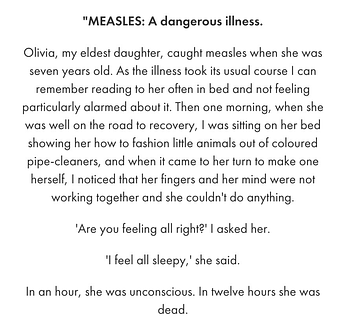
Bottom line: Unfortunately, measles is off to a great start in 2024. We expect trends to increase. We need to heed the underlying warning. A laissez-faire approach to public health, on both sides, will not work. Harrowing stories like Roald Dahl’s below will creep into the 21st century. We can do better.
A big thanks to Edward Nirenberg for his help pulling a lot of the research integrated above.

Your Local Epidemiologist is written by Dr. Katelyn Jetelina, M.P.H., Ph.D.—an epidemiologist, wife, and mom of two little girls. During the day, she is a senior scientific consultant to several organizations, including the CDC. At night, she writes this newsletter. Her main goal is to “translate” the ever-evolving public-health world so people will be well-equipped to make evidence-based decisions. This newsletter is free, thanks to the generous support of fellow YLE community members.

Sunday, August 13, 2023

Demon Copperhead author and Ky. native Barbara Kingsolver talks about the opioid epidemic and Appalachia's difficulty with it

Barbara Kingsolver (Facebook photo)
Barbara Kingsolver says she intended her Pulitzer Prize-winning novel Demon Copperhead to be her "great Appalachian novel" that told the story of how the opioid epidemic has ravaged the region, and its impact on children. 

Ezra Klein of The New York Times interviewed Kingsolver, who grew up in Nicholas County, for his podcast, "The Ezra Klein Show." The Times transcribed the interview. It is wide-ranging, but a big chunk has her telling Klein how the opioid epidemic has impacted a whole generation of children who have become orphans and are being raised by grandparents and the foster system — and getting the bulk of their social services at school.
 
"We have a generation of orphans coming up through our schools," Kingsolver said, adding later, "There’s so many more kids in need than there are social networks to catch them — but the caseworkers are so overloaded and so pathetically underpaid. . . . This is something that I think the world needs to know about, this country — voters — need to know about. We need to know how this epidemic has left a generation of innocents that nobody’s taking decent care of. . . . These kids have been left behind. Our burdened public school systems are being asked to raise these kids." 

Klein and Kingsolver also talked about how Central Appalachia was targeted by Purdue Pharma with a drug that was so addictive and with doctors who were told otherwise. "This was done to them," Kingsolver said of her neighbors in southwest Virginia and southeastern Kentucky. "Nobody wants to be addicted."

Winner of the 2023 Pulitzer for fiction
Kingsolver also talked about the stigma associated with addiction and how people have been brainwashed to think it is a moral failing, instead of the brain disease that it is. 

"We have been trained, culturally trained, to think of addiction in this way, as a personal failing that needs to be punished. Incarceration does not cure addiction any more than it cures cancer. Addiction is a disease," she said. "It’s impossible to describe how terrible this disease is, not just the dope sickness of it but the fact that your entire life has to become just a really difficult, hard work in process of, every morning, getting your means, getting your fix, getting through another day. And nobody wants to live like that." 

Kingsolver told Klein that she hopes her novel will help people have more compassion and think of people with addiction as having a disease and to get rid of the idea that you don't treat a person with addiction until they "hit bottom." 

"That’s how we treat the disease of addiction. And it’s incredibly inhumane. And effective treatment will only happen after we switch over from putting this in the hands of the police and the prisons to medical workers who can meet addicted people where they live and offer them the first steps of clean needles and fentanyl test strips so that they won’t die in the weeks that it will take for them logistically, physically, emotionally, to get to the beginnings of treatment," she said. 

And to those who maintain a moral objection to such "harm reduction" programs, she said, "It’s as if people feel that addicted people deserve to die. Imagine if we looked at any other disease that way."

Friday, February 10, 2023

Bird-flu impact may go beyond eggs, birds; experts call for more surveillance as the virus appears able to spread among mammals

Centers for Disease Control and Prevention chart; for a larger version, click on it.

The U.S. is experiencing a record outbreak of bird flu, a virus that is currently deemed a low risk to humans, but has hiked prices of eggs and poultry. The Biden administration is weighing whether to vaccinate poultry against the disease and it appears that the virus can spread among mammals. 

"Egg prices are up 60%, which means we are paying upwards of $5-7 for a dozen eggs. That is if you can find them," reports epidemiologist Katelyn Jetelina in her newsletter titled Your Local Epidemiologist. "Why? A constellation of reasons, but there is one we can’t ignore: the avian flu is hammering poultry farmers." 

The U.S. Department of Agriculture reported in December: "As a result of recurrent outbreaks, U.S. egg inventories were 29 percent lower in the final week of December 2022 than at the beginning of the year. By the end of December, more than 43 million egg-laying hens were lost to the disease itself or to depopulation since the outbreak began in February 2022. . . . The average shelf-egg price was 267 percent higher during the week leading up to Christmas than at the beginning of the year and 210 percent higher than the same time a year earlier." 

USDA adds that egg prices are expected to decrease as flocks are replenished. 

Bird flu spread among minks at a farm in Spain. (Nature photo) 
Another concern is that that virus appears capable of spreading among mammals, including humans.  

"The virus is primarily a threat to birds," reports The New York Times' Emily Anthes, "but infections in mammals increase the odds that the virus could mutate in ways that make it more of a risk to humans, experts say."

Anthes reports that a new variant of the H5N1 virus has "taken an unusually heavy toll on wild birds and repeatedly spilled over into mammals, such as foxes, raccoons and bears, that might feed on infected birds." 

More recently, it has infected farmed minks, which scientists describe as a "new and troubling development," pointing to an outbreak in Spain where the virus appeared to spread from mink to mink and had an unusual mutation that might be a sign of adaptation to mammals, Anthes reports, adding that experts say the mink outbreak is no cause for panic, but highlights the need for more proactive surveillance.  

Michael Osterholm, director of the University of Minnesota’s Center for Infectious Diseases Research and Policy, also told Stat in April 2022 that the presence of bird flu in the U.S. calls for heightened surveillance. Jetelina reports that "from 2003-2021 there have been very few human cases worldwide: 864. But, among these cases, 456 died—a 53% mortality rate." 

Jetelina also notes that the risk of bird flu in humans is "currently very low," citing research from the Centers for Disease Control and Prevention, which tracked the health of more than 5,190 people who have been exposed to infected birds in 2022 and only one human case was reported. The Times reports "fewer than 10 known cases in people since December 2021, and there have been no documented instances of human-to-human transmission, according to the CDC."

Federal scientists are gearing up to test the first vaccines in poultry against the bird flu as a way to counter the growing oubreak, Alexander Tin reports for CBS News. The Biden administration has not yet greenlighted the use of these vaccines. Officials told Tin that one of the concerns about issuing these vaccines is that it could make it harder to export American poultry products. 

"A record 58 million birds — mostly commercially-raised poultry — have died in the outbreak so far, according to figures tallied by the USDA's Animal and Plant Health Inspection Service — either killed by the virus itself or put down in efforts to quash its transmission. Every state has detected the virus spreading among wild birds and 47 have spotted them in poultry," Tin reports.

The virus is spread from an infected bird's nasal secretions, saliva and feces. The USDA says properly prepared and cooked poultry and eggs should pose no risk to consumers. 

"Right now you don’t need to do anything, unless you’re in close contact with birds. A person’s level of risk is dependent on duration and intensity of exposure. In other words, a person with one chicken in their backyard is at much lower risk than someone at a poultry farm," Jetelina writes. 

She adds, "Those around wild birds, such as at parks, lakes, rivers, or other waterways, need to exercise caution, including wearing PPE, washing hands, and changing clothes. If you have backyard poultry, wear a mask and wash your hands. Also, monitor the health of your flock, especially if they come in contact with other wild birds."

Friday, March 12, 2021

Bill to allow opt-out of mandatory vaccines in an epidemic passes House, after what one lawmaker called a 'disclaimer'

By Melissa Patrick
Kentucky Health News

With what one lawmaker called a "disclaimer," the House changed and passed a Senate bill to let Kentuckians opt out of a mandatory vaccination during an epidemic.

"In my many years of being here, this is the first time I've ever seen a disclaimer read before we actually had a vote," said Rep. Jim Gooch of Providence, who was first elected to the House in 1994. 

Rep. Kim Moser
Legislative photo from Jan. 6
He was referring to fellow Republican Rep. Kim Moser's speech for the bill, in which the chair of the House Health and Family Services Committee talked more about the virtues of vaccines than the importance of individual liberties. 

After referring to Kentucky's poor health and giving some recent history of vaccines, Moser, a retired nurse from Taylor Mill, said, "Vaccines are meticulously researched, and have been proven safe. It is imperative that our citizens understand the realities of these diseases when deciding whether or not to get a vaccine. 

"Civil discourse has been strained this year and with mandates being opposed, the result has been an erosion of public trust. This has influenced vaccine hesitancy and I understand that. So it is critical that we get back to a place where we are listening and we are being civil in our approach to resolving differences and come to a better understanding of disease prevention and public health protections.

"Personal civil liberties must be balanced with the rights of persons not to be infected and likely killed by a deadly disease, especially if they cannot be vaccinated for medical reasons. 

"This legislation would expand those exemptions to adults with a conscientious objection during an epidemic. But we  must all be mindful of the risks not only to ourselves, but to others when we make these decisions. 

"Vaccines do save lives, they prevent the spread of dangerous diseases. That being said, individuals should talk to their doctor to decide if this is a safe vaccine for them. Ask your trusted healthcare provider to help you interpret research data and articles that you may read." 

Senate Bill 8, sponsored by Sen. Mike Wilson, R-Bowling Green, would allow adults. emancipated minors and parents making decisions for their children to opt out of mandatory vaccines in an epidemic for religious grounds, medical reasons or a "conscientiously held belief."

The bill does not change any current school immunization requirements, which allow exemptions for medical or religious reasons only, nor does it impact any workplace requirements. 

Wilson has said he supports vaccinations, but filed the bill because of the concerns of so many people who had reached out to him who were concerned that they would be required to take a vaccine. An old state law allows the health department to mandate vaccines "in the event of an epidemic in a given area," but Gov. Andy Beshear has said he does not plan to require the Covid-19 vaccine.

Moser said federal law prohibits any vaccine approved under emergency-use authorization, like the current Covid-19 vaccines, to be mandated under federal law. 

Rep. Lisa Willner, D-Louisville, in opposition to the bill submitted a statement read by Democratic Floor Leader Joni Jenkins of Shively: "Health provider groups and health advocacy organizations oppose Senate Bill 8. . . . It's irresponsible and reckless to weaken vaccination requirements during epidemics."

But Rep. Savannah Maddox, R-Dry Ridge, said the bill didn't go far enough: "Kentuckians have the ability to make good decisions for themselves and their families in conjunction with their health-care providers' advice."

The House defeated an amendment sponsored by Rep. Lynn Bechler, R-Marion, that would have prohibited mandating a vaccine before licensing or before it had been tested for at least two years.

Moser said the Cabinet for Health and Family Services had agreed to create an educational document to give people who opt out of getting a vaccine during an epidemic with information about the vaccine and the reason for it, as they do now for parents who opt their children out of vaccines for medical or religious reasons. This suggestion was made by Rep. Mary Lou Marzian, D-Louisville. 

The bill passed the House 77-20 with a committee substitute that changes the phrase "medical provider" to "health-care provider." If the Senate approves the change, the bill would go to Beshear. If not, the House could agree to drop the change. If it did not, the bill would go to a House-Senate conference committee that could rewrite it completely. 

Sunday, March 15, 2020

Two main fronts in fighting the new coronavirus and covid-19 in Kentucky are a familiar pair: Saturday night and Sunday morning

Gov. Andy Beshear showed how aggressive steps to limit social interaction can prevent deaths from a pandemic of a disease for which there is no vaccine. A reproducible version of the chart is below.
This story was updated at 10 a.m. Monday, March 16 with news that Beshear will order the closure of restaurants and bars to inside traffic.

By Al Cross
Kentucky Health News

Kentucky has a Saturday-night and Sunday-morning problem when it comes to the greatest public-health threat in a century, the new coronavirus.

After seeing videos of people crowding into bars and restaurants on the weekend before St. Patrick's Day, Gov. Andy Beshear said Sunday that he might have to follow the lead of other states (such as Ohio and Illinois) and use his emergency powers to close them. Monday morning, he said he would, effective at 5 p.m.

On Sunday morning, many if not most Kentucky churches held services, despite Beshear's call several days earlier to cancel them.

Both measures are intended to slow the spread of the virus so that the respiratory disease it causes, covid-19, does not overwhelm the U.S. health-care system. Noting that he has asked hospitals to not do any elective surgeries after Wednesday, Beshear said, "We absolutely must be ready if we see a significant influx of cases."

Many experts say that significant influx is not a matter of "if," but "when."

Dr. Anthony Fauci, the director of the National Institute of Allergy and Infectious Diseases, was asked on CNN Sunday if it is possible that hundreds of thousands of Americans could die from the disease. He replied, "It could happen, and it could be worse."

Andrew Slavitt, who ran the Centers for Medicare and Medicaid Services under President Obama, said on Twitter March 12 that experts expect the disease to kill more than 1 million Americans because the virus was not contained and testing for it has been so limited.

Fauci, told that many bars were filled over the weekend, was asked if the U.S. needs "a national lockdown," closing such gathering places. "I would like to see a dramatic diminution of the personal interaction we see in restaurants and bars," he said. "For a while, life is not going to be the way it was in the United States; we have to accept that."

The disease appears to have limited effect on young people, but they are not immune and can carry it to others, Fauci noted. "That's why everybody's got to take this seriously, even the young."

The first covid-19 patient identified in Kentucky was a 27-year-old woman from Cynthiana who has since recovered. Five other cases have been confirmed in Harrison County, two of them with a direct link through a church.

Beshear said Wednesday, March 11, that churches should cancel services. On Sunday, he was asked if he had any reports on compliance. He didn't reply directly, but indicated reasons that he made the request; he noted the Harrison County connection and estimated that a third of his congregation at Beargrass Christian Church in Louisville, where he is a deacon, is in the demographic categories most vulnerable to the virus. Those are people over 60 and those with underlying medical conditions.

"I don't think having church or going to church during this is a test of faith," Beshear said. "I believe God gives us wisdom and has given us so many tools to be able to participate and worship remotely or through other areas."

Compliance with his request appeared to be spotty. In Hopkinsville, the Hoptown Chronicle reported Saturday that most churches it surveyed planned to hold services.Unlike some other Roman Catholic dioceses, including Lexington, the Archdiocese of Louisville continued masses, but said communion wine should not be poured from the chalice, and parishioners shouldn't touch during the passing of the peace, the Courier Journal reported. On Monday, Archbishop Joseph Kurtz reversed course and said public masses were being suspended.

Closing bars might improve compliance, one of the state's leading religious figures suggested. Kentucky Today, a news outlet of the Kentucky Baptist Convention, the state's largest denomination, quoted Hershael York, pastor of Buck Run Baptist Church in Frankfort: “I can’t really take the suggestion seriously when they are not asking theaters, bars, and clubs to shut down. Churches on Sunday morning are not the hotbed of contagion.”

Beshear reiterated Sunday that houses of worship had not been "singled out," and said, "I know there are people who might politicize this -- and every time I talk about my faith, I hear that -- but I love my church. It's an important part if my life; my faith is an important driver in helping me make the decisions that I am making during this crisis. We just need everybody's help."

To illustrate the importance of limiting the spread, Beshear displayed a chart illustrating how St. Louis and Philadelphia responded to the 1918 outbreak of so-called Spanish Flu, which infected more than a fourth of the world's population and killed around 50 million.

"In Philadelphia, they started their aggressive steps a couple weeks too late. It shows you what taking these steps, and taking them early, can do," Beshear said.

"We don't put this up to scare people; our health-care system is much better, much better, in 2020 than it was in 1918 and 1919. But this shows the importance of taking aggressive steps."

The governor said people who note "only 20 positive" test results in Kentucky as of Sunday evening should realize that "We see the direction that this can go. I'm not gonna be the governor that acted two weeks too late. This is about protecting each and every one of us."

Asked about the General Assembly session, which brings groups of people from all over the state to Frankfort, Beshear suggested that legislators focus on passing a budget, with the prospect of a special session he could call after the threat has passed. His answer illustrated that no one knows when that will be.

"Where we see this is going . . . where we can anticipate having the surge that we've got to be ready for in our health-care facilities, I believe it is increasingly clear that they need to do the most important work, do it in as short order as possible, and then go home," he said. "We cannot say for certain that we would be able to have them back in enough time to pass a budget." The current budget runs through June 30.

"We know that we'll get through this," Beshear said, using a version of his main mantra for the crisis. "We don't know exactly how long it's going to take. We know that when you reduce social contacts -- and remember, social distancing is not isolation, and it shouldn't be isolation -- if you do not have the coronavirus, we want to make sure you have human interaction, but you have to have it in the right confines, and we have to be able to able to reduce overall contacts."

He concluded, "If you want to get energy out, get outside, go for a run on your own; do not pack in to one place thinking that this is not a big deal. Yeah, what you're doing probably won't hurt you, but it could really hurt somebody else. That could be somebody's parents; it could be somebody's grandparents. I'm just asking you to do the right thing."

Beshear says he may have to close restaurants and bars; pleads against runs on stores; CDC advises against gatherings of 50+

As news develops in Kentucky about the coronavirus and its covid-19 disease, this page will be updated. Official state guidance is at https://kycovid19.ky.gov.

Sunday, March 15, 2020
  • Gov. Andy Beshear said today he may order closure of large bars and restaurants if they keep drawing big crowds at they have done in advance of St. Patrick's Day. "If you go out and get in a place with 100-plus people, you frustrate those efforts" to stop spread of the virus, he said. Noting that Ohio has ordered such closures (as have other states), he said, "If we cannot show responsible practices in how we social-distance, then I will be forced to do the same."
  • Beshear said the other place where Kentuckians "have to be better" is avoiding runs on supplies, leaving store shelves empty. "We have to understand that we are all going to have to change our lifestyles in different, fundamental ways. . . . If we are going to change the curve in what we expect of these cases, if we are going to protect our loved ones who are out there, we have to be willing to change our practices, and everybody has to be a good teammate."
  • Further signaling that he will close day-care centers, Beshear said health-care workers would need exemptions. The day before, he asked the centers to make plans to close on 72 hours' notice.
  • Asked if he had any reports on how churches had complied with his requests to cancel services, in light of reports that many did not, Beshear didn't say, but indicated why he made the request: He said a church in Montgomery County may have helped spread the virus, and a Harrison County church was directly linked to two cases there.
  • The U.S. Centers for Disease Control and Prevention recommended that there be no gatherings of more than 50 people for the next eight weeks.
  • The number of covid-19 cases in the state has risen to 21, with new cases in Clark and Jefferson counties, after 254 tests. Beshear said at 4 p.m. Sunday that 19 more tests are in process.
  • Beshear said one patient is not expected to recover, but "The coronavirus is not the only factor" in that case. He declined to give details until the case is over.
  • “Mental health is going to be critically important in getting through this,” Beshear said. “Make sure that you do things that help your mental health.” The day before, a state mental-health expert gave detailed advice on that, and newspapers ran stories about helping children cope.
  • The governor said he has tested negative for the virus. He said he qualified for testing as a "mission-critical" person after someone at a March 7 fundraiser for the Speed Art Museum in Louisville tested positive. That person appeared to be philanthropist Christy Brown, who acknowledged Sunday that she had tested positive.
  • Also testing positive in Louisville was “Mary Moss Greenebaum, the leader of the Kentucky Author Forum, who also attended the Speed Ball,” the Courier Journal reported. She told the paper that an initial test at the University of Louisville was negative, but “one wise doctor was skeptical enough — given my symptoms — to insist that the test be done again and it turned out positive.”
  • U.S. Rep. John Yarmuth, D-Louisville, said he would self-quarantine for 14 days because he "was in the presence of an individual who has since tested positive for covid-19. . . . I have been tested and am awaiting results."
  • Centre College in Danville extended its spring break by a week and said all classes would be online for the rest of the semester.

Coping with covid-19: It's important to maintain mental and behavioral health, especially among children, experts say

Sandra Wilson logged into a school-supplied iPad at Klondike Elementary in Louisville. Students are getting lessons remotely while not attending school. (Courier Journal photo by Michael Clevenger)
By Al Cross
Kentucky Health News

The covid-19 disease and the coronavirus that causes it have caused much uncertainty: How long will it last? How bad will it get? What do I need to do to protect myself, my loved ones and my neighbors?

"The most difficult thing about this is uncertainty, and uncertainty leads to anxiety," Dr. Allen Brenzel, the Department of Behavioral Health medical director, said at Gov. Andy Beshear's Saturday afternoon press conference.

Anxiety isn't all bad, Brenzel said: It can make us pay attention and do things, but "We have to be careful not to be overwhelmed by our anxiety." He offered suggestions:
  • Get information from reliable sources.
  • "Don't over-expose yourself to too much information." Take a break from social media and online searches "to try to live your life."
  • "Preserve your routine as much as possible."
  • Take care of your basic health, to remain resistant to disease: practice social distancing, get enough sleep and exercise, preferably outdoors.
  • While social distancing is important, don't become isolated. "Being together is really important for us to reduce our anxiety."
  • Look for other ways to reduce stress, and if you get overwhelmed, get help.
"Mental health is going to be critically important in getting through this," Beshear said Sunday.

Children deserve special attention. "The onslaught of information about covid-19 can be overwhelming even for grown-ups. For the newest generation, plugged in nearly 24/7, it can be downright frightening," writes Mandy McLaren of the Louisville Courier Journal.

For example, children may see events in other countries and think those things are happening in their locality, Brenzel said. "Limiting media contact for children can be very, very important," he said.

McLaren quotes Sandra Wilson, a Louisville nine-year old who turns on the TV for news updates as soon as she wakes up": "I'm really scared ‘cause I really don't want to die."

Brenzel said parents should help children "feel comfortable asking questions," and give answers that are age-appropriate -- and don't mislead or lie, to maintain trust.

McClatchy Co. newspapers, including the Lexington Herald-Leader, published a story saying essentially that, and giving details.

Parents first need to take care of themselves, so they can properly care for kids, Brenzel said, and "model things they need to do," such as washing hands and keeping distance.

"Studies confirm that looking at adorable
animals is good for your health," says the
Cincinnati Zoo, showing this red panda.
With schools closed and children separated from friends and social supports, he said, parents should find ways to help them interact, perhaps online. For example, the Cincinnati Zoo says it is starting a "Home Safari Facebook Live each weekday at 3 p.m. ET where we will highlight one of our amazing animals and include an activity you can do from home."

And if parents see behavioral changes in their children, they should seek advice from mental-health professionals, Brenzel said.

Friday, March 13, 2020

When health officials talk about strong measures to 'flatten the curve' to fight the coronavirus, this is what they're talking about

Measures that are being called "drastic" and "extreme" are necessary to keep the coronavirus and its covid-19 disease from overwhelming the U.S. health-care system, according to health experts and public officials. This chart roughly illustrates what happens when there is no action against a pandemic, and what happens when interventions flatten the transmission of the virus to a point where the health-care system can cope with it. It shows a somewhat idealistic scenario; The New York Times has an interactive version of this chart, with various scenarios.


Monday, March 9, 2020

As covid-19 cases grow, Beshear tells those over 60 not to fly or take cruises; health chief gives advice on when to see a doctor

Kentucky Department for Public Health chart; for a larger version, click on it.
By Melissa Patrick
Kentucky Health News

Kentucky has confirmed two more cases of covid-19, the disease caused by the new coronavirus, bringing the state's total to six. All of the patients are in isolation, Gov. Andy Beshear said.

"As time goes on, we will have more cases," Beshear said. "We need to expect that."

Three cases are in Harrison County, where the first case was confirmed Saturday. Two are in Fayette County and one is in Jefferson County. A March 9 news release says that Kentucky has done 34 tests, with 28 of them coming back negative.The figures are updated at kycovid19.ky.gov, along with other information about the virus.

Saturday, the U.S. Centers for Disease Control and Prevention recommended that all Americans over 60 or those with heart, lung or kidney disease avoid public gatherings. Monday evening, Beshear also advised those 60 and older against flying or taking cruises.

Dr. Steven Stack, Kentucky's public health commissioner, offered some advice on when a person should go to the doctor at a morning news conference.

He said if you are "worried, but well," do not go to a hospital, emergency room or doctor's office -- stay home. If you are feeling ill, but otherwise would not have sought out medical care, do not seek care at an ER, hospital or doctor's office. If you need advice, call the state hotline at 1-800-722-5725 or call your local health care provider. If you are sick and feel you have an emergency, call your doctor or seek medical care.

“For 80 percent or more of people who get infected, you are going to be just fine. You’ll probably either have cold symptoms or no symptoms,” said Stack.

Beshear said in the news release, “I know many people are concerned, but I want Kentuckians to know the risk remains low and there is no need to panic. Everyone can help protect themselves, their loved ones and their communities by taking simple measures to reduce their risk.”

Those measures include: washing your hands with soap and warm water for at least 20 seconds; only use alcohol-based hand sanitizer if soap and water are not available; avoid touching your eyes, nose and mouth with unwashed hands; avoid close contact with people who are sick; stay home if you are sick; do not visit with seniors or people with chronic health conditions if you are sick; cover your cough or sneeze with a tissue and then throw it away; get a flu shot; and clean and disinfect frequently touched objects and surfaces. It is also suggested to engage in social distancing, which means trying to stay six feet apart.

At a Monday news conference, Dr. Nancy Messonnier, director of the CDC National Center for Immunization and Respiratory Diseases, emphasized that older Americans are at the highest risk for a serious infection of the coronavirus, and that so far only about 2 percent of infected patients were people younger than 19. She was using data from China that analyzed more than 70,000 cases of covid-19.

"This seems to be a disease that affects adults," she said.

She said the study found 80% of those infected had a mild case of covid-19 and recovered, and 15 to 20% had a serious illness, with those 60 and older and those with underlying health conditions at the greatest risk of serious illness. She said the greatest risk of serious illness and death was among those 80 and older.

The state has not recommended that schools or public gatherings close at this time, though schools can make that decision.

Harrison County has decided to close through at least March 13, while Fayette and Jefferson counties have decided to stay open. A Jefferson County Public Schools tweet said Monday, "Dr. Sarah Moyer -- health department director -- says several factors would have to be present before @LouMetroHealth would recommend closing schools, the biggest being wide spread of virus between children."

Beshear said the first covid-19 patient in Kentucky is an employee at the Walmart in Cynthiana. Crystal Miller, the county's public health director, said that six other employees have self-isolated, but have not shown any symptoms. Beshear said there was no reason not to visit the Cynthiana Walmart "right now." .

WLEX-TV published a statement from Wal-Mart Stores Inc. that says, in part, "Upon learning about the case from health officials we reinforced our cleaning and sanitizing protocols with guidance from Walmart’s chief medical officer."

To make sure factual information about covid-19 reached all of its citizens, The Cynthiana Democrat worked through the weekend to be able to send a special edition today to every mailbox in Harrison County.

Cynthiana Mayor James Smith told The Rural Blog he thought this was a good idea because ""Not everyone, especially in a rural county like Harrison County, has internet connection; not everybody is on Facebook; not everybody listens to the local radio," and some watch TV stations based in Cincinnati, not Lexington. "Some people in the county didn't even know we had a case in the county."

Beshear said that two of the Harrison County patients were linked and that a travel history was found in only one of the individuals.  He added that they believe that  Kentucky is experiencing some "community spreading."  People can get the virus and display no symptoms, and can pass it along for days without showing symptoms

“We believe, and this seems to be the case nationally, that this is community spreading, spreading from person to person,” he said. “Again that has been expected, we are ready for it, it is what we always thought that we would see with this novel coronavirus.”

Beshear issued an executive order Monday to waive all cost-sharing, including co-payments, coinsurance, and deductibles for screening and testing for covid-19, to waive any prior authorization requirements for screening and diagnostic testing for covid-19, and to allow insured individuals to obtain refills of their prescriptions early, with approval of the provider. It also requires insurers to ensure that provider networks are adequate to handle an increase in the need for care, including by offering access to out-of-network services where appropriate. The order applies to both private and state insurers, and will remain in effect for the duration of the state of emergency.

The governor has also removed any impediments, like prior authorizations,  for treatment of Medicaid patients for anything related to coronavirus.

He has also issued an executive order to prohibit price gouging. If Kentuckians have information regarding possible price gouging call the attorney general's consumer protection hotline at 888-432-9257.

Two days after state's first covid-19 case is confirmed there, weekly paper sends a special edition to everyone in its county

The four-page edition was printed on thicker,
whiter paper for easier handling and retention.
By Al Cross
Kentucky Health News

A weekly newspaper in Kentucky is setting a great example for the rest of the nation of how to deliver reliable information about the new coronavirus.

After working through the weekend, The Cynthiana Democrat sent a special edition today to every postal patron in Harrison County, where the first case of covid-19, the disease caused by the coronavirus, was confirmed Saturday. Another was announced Sunday.

The idea arose as Editor Becky Barnes rode with Cynthiana Mayor James Smith and County Judge-Executive Alex Barnett from a state Capitol press conference Gov. Andy Beshear held Saturday to announce the first case.

"I said, there's just so much information that needs to get out there," Barnes recalled, "because there's so much misinformation."

Barnett said he told Barnes and Smith, "Let's get it in every mailbox in the county and we’ll come up with a way to pay for it."

Smith said, "We talked about what should be in there, and decided how it should go to every household in the county," which has 18,000 people and "probably 6,000 households."

Becky Barnes, in 44th year at the paper
Smith said he thought it was a good idea because "Not everyone, especially in a rural county like Harrison County, has internet connection; not everybody is on Facebook; not everybody listens to the local radio," and some watch TV stations based in Cincinnati, not Lexington. "Some people in the county didn't even know we had a case in the county."

Newspapers can reach everyone in their home counties quickly because postal regulations allow them mail up to 10 percent of their annual circulation in their home county to non-subscribers at subscriber rates. It's a way to build and maintain print circulation, but many papers don't take advantage of it.

Harrison County (Wikipedia map)
Barnes was familiar with the idea, because The Cynthiana Democrat published a sample-copy edition after a 1997 flood in Harrison County. Her paper is owned by Landmark Community Newspapers, which regularly uses sample copying, and has a press in Cynthiana. That made it easier to print on Sunday and mail as soon as possible.

This is an example for the whole country. Printed community newspapers have a high level of trust with their readers, and are ideal vehicles to circulate reliable information on a topic that has become the subject of false or misleading online information and political talking points.

To make sure it reached everyone in the county, Barnes said, the paper went beyond the usual sample copying, sending (at extra cost) papers to patrons of post offices that are in other counties but serve Harrison County residents. It also provided copies to Harrison Memorial Hospital, which first treated the first patient found to have the disease and draws patients from adjoining counties.

So, who's paying for the printing and mailing of the special edition? Local officials are looking into funding sources, but say they will come up with the money if they have to. "We asked the postmaster if he could bill us later," Smith said. "We told Becky that, as a city, if the money doesn't come from other sources, the county and the city would figure out how to pay."

Smith concluded, "Hopefully, we're setting some examples for other communities."

Saturday, March 7, 2020

First Ky. case of coronavirus disease found; clinicians suspected it, but patient didn't qualify for testing when testing was hard to get

Crystal Miller, head of the health department serving Harrison County, at a press conference Saturday. Others, L to R:  Gov. Andy Beshear; Health Commissioner Steven Stack; Harrison County Judge-Executive Alex Barnett; Cynthiana Mayor James Smith; and Mark Newman, head of UK HealthCare.
This story was updated at 8 p.m. Sunday.

By Melissa Patrick and Al Cross
Kentucky Health News

Kentucky found its first case of the new coronavirus, in Harrison County, on Saturday, and Gov. Andy Beshear advised residents of the county to avoid crowds. Sunday, he announced that the county had another case, and that Louisville and Lexington each had one.

Beshear's advice came on the same day that the U.S. Centers for Disease Control and Prevention recommended that all Americans over 60 or those with heart, lung or kidney disease avoid public gatherings. Seniors and people with underlying medical conditions are more vulnerable to the virus.

The governor said the patient had been treated at Harrison Memorial Hospital in Cynthiana, and the University of Kentucky said the patient is now in isolation at UK Chandler Hospital. Beshear said the patient was in serious condition but is improving. "There is no cause for fear at this time," he said.

The hospital said the patient was treated for "flu-like symptoms" and when those didn't subside, the patient was tested further but the state Department for Public Health "determined the patient did not qualify for testing" for the coronavirus. However, "due to the patient's condition," hospital clinicians admitted the patient "into a negative-pressure isolation room," to prevent spread of any viruses. "From there, the patient was transferred to a tertiary care facility," meaning UK.

State Health Commissioner Steven Stack said in an email to the Louisville Courier Journal Saturday night, “Like other states, Kentucky has been following the CDC guidelines for who and when to test. This individual was tested when CDC guidelines and clinician judgment determined testing was medically indicated.”

The Washington Post reports, "Even where test kits are available, many states are following strict criteria for who should be tested to avoid overwhelming their labs."

Stack said earlier Saturday, "The state of Kentucky has all the test kits it needs to test everyone we need to test at this time." With commercial laboratories soon doing tests, "We hope that very soon people will be able to seek routine medical care and get a test . . . just like they would for the flu."

Harrison County (Wikipedia map)
State and local officials said they expect Harrison County to have more cases, and Beshear said the county's schools would close for "at least a portion of a week if not a full week," as health officials had recommended. "We would advise that public gatherings be delayed," and that nursing homes be closed to visitors, he said.

"We are not advising the closing of any business," Beshear said. "What we are suggesting is engaging on social distancing, trying to stay six feet apart, and then practicing good hygiene, practicing really, really good hygiene: washing your hands, washing them well, washing them a whole lot more than you might have a month ago, and making sure that if you are sick, anywhere in Kentucky but especially in Harrison County, do not go to work."

The virus causes a disease that has been named covid-19, for "coronavirus disease 2019." Symptoms may include fever, cough or shortness of breath, and may appear in as few as two days or as long as 14 days after exposure.

Health officials continue to stress that washing hands with soap and warm water for at least 20 seconds is the best way to prevent transmission of the virus because it is mainly transmitted by tiny droplets from sneezes and coughs. Other suggestions include:
  • Only use alcohol-based hand sanitizer if soap and water are not available. 
  • Avoid touching your eyes, nose and mouth with unwashed hands. 
  • Avoid close contact with people who are sick. 
  • Stay home if you are sick; especially do not visit with seniors or people with chronic health conditions if you are sick. 
  • Cover your cough or sneeze with a tissue and then throw it away. 
  • Get a flu shot. There is no vaccine for the new coronavirus, but the flu vaccine can boost resistance to it.
  • Clean and disinfect frequently touched objects and surfaces.
The U.S. Environmental Protection Agency has released a list of EPA-registered disinfectant products for use against the coronavirus. The EPA's news release says coronaviruses are one of the easiest types of viruses to kill with the right disinfectant.

Beshear said that the threat posed by the virus is still low, but that he declared a state of emergency Friday to make sure the state has access to all of the resources available to it. He and other officials advised calm.

"We've gotten through this just like this, or even worse, in the past," said Dr. Steven Stack, commissioner of public health. He advised against general use of face masks, or hoarding them, which could leave health care short.

Role players include consumers, employers, Congress

At UK HealthCare, “Supplies of personal protective equipment are exceedingly low, and many items are on back order,” UK Executive Vice President for Medical Affairs Dr. Mark Newman told employees, asking them, "Please be frugal."

Beshear said he has invoked, for preventive and related items, the state law against price gouging, and has asked Attorney General Daniel Cameron to enforce it. Cameron issued a call for residents to report cases of price gouging by calling his office's consumer protection hotline, 1-888-432-9257.

Dr. Crystal Miller, director of the WEDCO District Health Department, based in Cynthiana, said employers should take preventive measures: "I urge you to be flexible in everything that you do; be creative," she said. "If your employees are sick, please be flexible with them."

Beshear has urged employers who don't offer sick leave to grant it, to limit the spread of the virus. He said Saturday that the state will offer its employees more sick leave than they have accumulated.

The state recently started doing its own testing for the virus, with four positive results out of the 21 tests done through midafternoon Sunday. The figures are updated at kycovid19.ky.gov.

U.S. Sen. Mitch McConnell announced Friday that Kentucky would receive at least $7 million to fight the coronavirus. This money is part of a special $8.3 billion appropriations bill President Trump signed that day. McConnell's news release said the funding "will be provided to state officials who will determine how the resources will be distributed."

Asked Thursday if any of the money could be used by  health departments to help fund their efforts in controlling the virus, Beshear said, "I am committed before this legislature ends or through any other powers that I have in making sure that we have sufficient funding to meet the threat. . . . This shows how important our local health departments are, doesn't it? We haven't appreciated those as a state in far too long and I think this serves as a reminder about how absolutely critical they are."

"The number of public health workers in Kentucky fell from 3,449 in 2012 to 2,269 last year," Chris Kenning of the Courier Journal reports, citing the Kentucky Center for Economic Policy. "The strain is particularly acute in small, rural health departments."

Medicaid beneficiaries, take note

Beshear said the state will not require pre-authorization for treatment of Medicaid patients "for anything related to coronavirus." On Friday, he said Kentucky is fortunate to have expanded Medicaid, something it did during the administration of his father, Steve Beshear.

"I do believe that we are in a better place to address this  than many states because of expanded Medicaid," he said. "I don't mention that because of my belief in expanded Medicaid, but it does mean that there is more access out there, that people will have less barriers to get service."

Beshear said Kentuckians should be wary of scammers and con artists claiming to have a cure or a vaccine for the virus, and to be wary of e-mails pretending to be the CDC or other public-health organizations, and people claiming to raise money to develop a coronavirus vaccine or to help victims.

Newman said most patients with covid-19 will be treated in local hospitals or at home. Officials have voiced concern that the disease and the flu will overload hospitals, and that people congregating in clinics could spread the virus.

"If you are sick, try to use the telephone first," Stack said, adding that people with a fever and a cough should "take Tylenol and stay home and rest." He said those who are concerned but not sick should call the state's covid-19 hotline, 1-800-722-5725.

Wednesday, March 4, 2020

Live forum about coronavirus on KET Tuesday night

With the spread of the coronavirus around the world, the United States declared a public health emergency at the end of January, and the number of confirmed cases in the U.S. grew significantly in the first week of March.

To help address this health risk, Dr. Wayne Tuckson of KET's "Kentucky Health" will host a special live forum on the network Tuesday, March 10, at 9 p.m ET. "Trusted health experts will share the latest information about the coronavirus, answer viewers’ questions, and discuss how the state and healthcare providers have been preparing," a KET news release says. The panel will include physicians and other professionals:

• Steven Stack, commissioner of the Kentucky Department for Public Health
• Lori Caloia, medical director of the Louisville Department of Public Health and Wellness
• Derek Forster, medical director for infection and prevention control at UK HealthCare
• Staff from the Lexington-Fayette County Health Department

Have a question you’d like answered? You may submit questions in advance via:
• Email: ketforum@ket.org
• Twitter: @KET
• Facebook: facebook.com/KET

Monday, March 2, 2020

Is the coronavirus causing covid-19 a pandemic? It looks like one, and health officials across the world are treating it like one

By Paige Winfield Cunningham
The Washington Post

Officials have been slow to use the “P” word to refer to the spread of coronavirus.

Yes, that word: “Pandemic.”

. . . The story of covid-19, the disease caused by the virus, isn't the same as a Hollywood thriller. But some health experts are frustrated by the hesitancy of officials to describe it as a pandemic, even though it checks just about every box of criteria.

“Personally, I think we're doing everyone a disservice by continuing this debate,” Lauren Sauer, director of operations for the Johns Hopkins Office of Critical Event Preparedness, told me. “It is creating more panic than just declaring it and moving on.”

A pandemic refers to an infectious disease spreading so rapidly across multiple countries that it can’t be contained. The World Health Organization defines “pandemic” this way: “The worldwide spread of a new disease” that sickens a large number of people because they don’t have immunity to it.

One could argue — and most epidemiologists do — the coronavirus is a pandemic under that definition; cases have been reported in more than 50 countries and on every continent (except Antarctica) and nearly 3,000 people have died from it.

Japan and South Korea have shuttered their schools. China has dramatically scaled back its manufacturing under intensive quarantines. Heck, even the Louvre in Paris is closed.

When officials do use that term, it indicates they’re worried the virus has hit a tipping point where drastic actions such as closing schools, canceling public gatherings and urging people to stay at home are necessary. While containment is the goal under an epidemic — where a disease is spreading only regionally, not globally — mitigation becomes the goal under a pandemic.

There are growing signs that health officials around the world are viewing coronavirus as a pandemic — even if they're not willing to state it yet directly.
  • Last Tuesday, the U.S. Defense Department raised its “Risk of Pandemic” warning from “probable crisis” to “imminent crisis,” according to a document obtained by Newsweek. Officials expect the coronavirus will “likely” become a global pandemic within the next 30 days.
  • Nancy Messonnier, a top official at the Centers for Disease Control and Prevention, said the following day the coronavirus has met two criteria of a pandemic: causing illness resulting in death and spreading person to person in a sustained way.
    “The world moves closer toward meeting the third criteria — worldwide spread of the new virus,” Messonnier told reporters.
  • And yesterday, the WHO director general used the word “pandemic” as he warned “the window of opportunity for containing it is narrowing.”
    “We need to be preparing side by side for a pandemic,” Tedros Adhanom Ghebreyesus told CNBC.
In some regards, it doesn't matter much whether officials say they're dealing with a pandemic or not. Global authorities are already responding to the novel coronavirus as though it’s the highest-level health threat, regardless of the terms used to describe its spread. . . .

WHO no longer uses “pandemic” as a term to classify the threat of infectious diseases. The agency changed its classification system after calling the 2009 swine flu outbreak a “pandemic.” At the time, it was accused of exaggerating the alarm for an illness that turned out milder than initially expected.

But the agency has already given coronavirus its highest threat level — dubbing it a “Public Health Emergency of International Concern” — and its leaders have been wary of using the term pandemic casually.

“Using the word pandemic carelessly has no tangible benefit, but it does have significant risk in terms of amplifying unnecessary and unjustified fear and stigma, and paralyzing systems,” Ghebreyesus said last week.  But WHO spokesman Tarik Jasarevic told me this morning “we are at a critical juncture in the outbreak.”

“While we must continue efforts to contain Covid-19 — focusing on strengthening surveillance, conducting thorough outbreak investigations to identify contacts and applying appropriate measures to prevent further spread — countries should also use this time to prepare for the possibility of wider transmission,” Jasarevic wrote in an email.

In public, top Trump administration officials are staying away from the term “pandemic” as they try to reassure Americans the threat of getting the virus is still low and do damage control after reports suggested the administration's response has been internally chaotic.

Pence said on CNN's “State of the Union” that the Trump administration is leading an aggressive, coordinated response, keeping the threat of the flulike illness at a low level for the average person.

“The good news is, of the 22 Americans that have contracted the coronavirus, more than half of them are almost fully recovered,” Pence said. “And I think it’s all a reflection of the fact that early on in this crisis, the president took the unprecedented step of suspending all travel from China and establishing a quarantining effect.” 

Sunday, March 1, 2020

Risk of Americans getting the new coronavirus remains low, but a top expert cautions that this is an evolving situation

The new coronavirus (Centers for Disease Control)
By Melissa Patrick
Kentucky Health News

Kentucky health officials have been monitoring more than 100 people for the novel coronavirus, all of whom agreed to voluntary isolation after recent travel to mainland China, but as of Sunday there had been no confirmed cases in Kentucky.

The state has tested one person for the virus, and that test came back negative, Gov. Andy Beshear said at a Feb. 27 press conference. State public-health officials have offered a list of several steps you can take to protect yourself and those around you:
  • Wash hands with soap and water for at least 20 seconds; only use alcohol-based hand sanitizer if soap and water are not available.
  • Avoid touching your eyes, nose and mouth with unwashed hands.
  • Avoid close contact with people who are sick.
  • Stay home if you are sick.
  • Cover your cough or sneeze with a tissue and then throw it away.
  • Clean and disinfect frequently touched objects and surfaces.
  • Get a flu shot.
Why get a flu shot when it won't work against the coronavirus, which causes a disease that has been named covid-19? The U.S. surgeon general says fewer flu patients equals more resources to combat covid-19; and the Kentucky Medical Association says having the flu weakens the immune system, leaving unvaccinated people more susceptible to contracting other illnesses. In the great majority of covid-19 deaths there has been an underlying medical condition.

At this time there are no recommendations for individuals who are well to wear a face mask, despite there being a rush to buy them. The Centers for Disease Control and Prevention says it "does not recommend that people who are well wear a face mask to protect themselves from respiratory diseases, including covid-19. Facemasks should be used by people who show symptoms of covid-19 to help prevent the spread of the disease to others. The use of face masks is also crucial for health workers and people who are taking care of someone in close settings (at home or in a health-care facility)."

On Saturday, the surgeon general concured, saying on Twitter that Americans should stop buying masks because They won't prevent the general public from catching the virus, "but if health-care providers can’t get them to care for sick patients, it puts them and our communities at risk!"

Facts about the virus

Covid-19 is a respiratory illness that can spread from person to person. The CDC says it is transmitted by tiny droplets from sneezes and coughs and can spread to people as much as six feet away. And while it may be spread from contact with infected surfaces or objects, "this is not thought to be the main way the virus is spread," the CDC says.

The virus was first identified in China. The CDC says it is not spreading throughout the United States. Two deaths from the virus were reported Saturday and Sunday in Washington state.

As of Feb. 29, the CDC reported there had been 22 confirmed and presumptive positive cases in the U.S., plus 47 confirmed positive cases among people who have been repatriated to the U.S.: three from Wuhan, China, and 44 from the Diamond Princess cruise ship, which had been docked in Yokohama, Japan.

The World Health Organization reported on Feb. 28 that there are more than 83,000 cases worldwide, with more than 2,800 deaths.

The risk of getting covid-19 in the U.S. is currently low, but Dr. Anthony Fauci, the director of the National Institute of Allergy and Infectious Diseases, said at a White House press conference Saturday that it's important to remember that "this is an evolving situation."

Common signs and symptoms of covid-19 include cough, other respiratory symptoms, fever, shortness of breath and breathing difficulty. Symptoms may appear in as few as two days or as long as 14 days after exposure.

Preliminary information shows that older people and people with underlying health conditions may be at increased risk for a severe case of the virus. Most cases of the virus are mild, but that is one thing that makes it harder to deal with.

An insidious disease

Because covid-19 is generally not life-threatening, it is harder to identify and isolate, Dr. James Hamblin writes for The Atlantic: "It is deadly, but not too deadly. It makes people sick, but not in predictable, uniquely identifiable ways. Last week, 14 Americans tested positive on a cruise ship in Japan despite feeling fine. The new virus may be most dangerous because, it seems, it may sometimes cause no symptoms at all."

Marc Lipsitch, a Harvard University epidemiology professor, told Hamblin, “I think the likely outcome is that it will ultimately not be containable.”

Hamblin writes, "Testing people who are already extremely sick is an imperfect strategy if people can spread the virus without even feeling bad enough to stay home from work." 

That's what happened to Carl Goldman, who got the virus while on the quarantined Diamond Princess.

Goldman, who is in his late 60s, tells his story in The Washington Post, writing that his only symptoms are that this chest feels tight and he has coughing spells. He writes that he has no chills, no body aches, breathes easily and has no stuffy nose.

"If I were at home with similar symptoms, I probably would have gone to work as usual," he writes.

His treatment has largely been preventive IV care, "gallons and gallons of Gatorade, and when my fever rose just above 100 degrees, some ibuprofen. . . . It’s surreal to see everyone panic — news conferences, the stock market falling, school closures — about a disease I have. It does seem likely that coronavirus will spread in the United States, but it won’t help anybody if we all panic."

Robert Redfield, the CDC director, said at Feb. 27 press conference, "At this stage, the risk is low we need to go on with our normal lives."