Showing posts with label substance abuse. Show all posts

Sunday, August 11, 2024

Kentucky maternal health roundtable explores ways to improve Kentucky maternal health; two stories from Kentucky Lantern

Centers for Disease Control and Prevention photo
The Kentucky Lantern offers two stories this week about maternal health in Kentucky, both by Sarah Ladd. One is about a roundtable held in Louisville that was moderated by Carole Johnson, the administrator of the Health Resources and Services Administration for the Biden administration. The other is a Kentucky Lantern Q&A with her. 

The roundtable discussion touched on several topics, including the Health Access Nurturing Developmental Services program, more commonly known as HANDS; praise for Rep. Kim Moser's, R-Taylor Mill, "Momnibus" bill that passed during the 2024 legislative session; and the need for a comprehensive approach toward improving the state's maternal mortality rates, including addressing social determinants of health, which includes things like transportation and housing, and the role that substance-use plays in such deaths.

Kentucky's maternal mortality rates are dismal, according to Ladd's reports. And, they are worse for women of color than white women. 

"The 2023 March of Dimes report showed the state once again had high maternal mortality, which was worse for Black Kentuckians. The state has a maternal mortality rate of 38.4 deaths per 100,000 live births, higher than the national rate of 23.5 deaths per 100,000 live births," Ladd reports.

She adds, "A 2023 state report on maternal mortality also showed substance-use disorder contributed to nearly 60% of all maternal deaths. Most maternal deaths in Kentucky — 88% — are preventable, a report from the Cabinet for Health and Family Services said." 

The links to the stories are below. 

https://kentuckylantern.com/2024/08/09/a-kentucky-lantern-q-a-with-federal-health-

https://kentuckylantern.com/2024/08/08/roundtable-explores-ways-to-improve-kentucky-maternal-health/


Thursday, July 18, 2024

Program for mothers and pregnant women with substance-use disorder gets grant to help more Black women get its services

Freedom House (Photo provided to Kentucky Lantern)
By Sarah Ladd

The Volunteers of America chapter that includes Kentucky will spend $123,000 over the next nine months to figure out how to get more Black women into treatment for substance-use disorder.

Volunteers of America Mid-States received the money from the Kentucky Association of Health Plans, the trade group for health insurers in the state, to fund a new initiative called Access Justice.

With the grant money, scholar, writer and activist Brandy Kelly Pryor will evaluate VOA’s Freedom House, which is a program for “pregnant and parenting women” who have substance-use disorders. Her report is due in April.

The 31-year-old program, with locations in Louisville and Manchester, also lets minor children (under the age of 18) stay with their mothers during treatment. Kelly Pryor will primarily study Louisville and may branch out elsewhere at later.

Jennifer Hancock, president and CEO of Volunteers of America Mid-States, said this move is in direct response to the high rates of maternal mortality among Black women and the disproportionately high overdose rates among Black Kentuckians.

Kentucky overdose deaths decreased in 2023 for the second year in a row, according to the state's Drug Overdose Fatality Report.

In 2022, 2,135 Kentuckians died from an overdose, marking the first decline since 2018. Ninety percent of those deaths were from opioids and/or fentanyl.

In 2023, the number of fatal overdoses was down to 1,984. Fentanyl, a powerful synthetic opioid, was involbved in 1,570 of those — about 79% of the 2023 deaths. The 35-44 age group was most at risk, the report shows. Methamphetamine was involved in 55% of 2023’s overdose deaths.

Despite the overall decrease in the state, the number of Black Kentuckians who died from a drug overdose increased from 259 in 2022 to 264 in 2023.

A 2023 state report on maternal mortality also showed substance-use disorder contributed to nearly 60% of all maternal deaths. Most maternal deaths in Kentucky, 88%, are preventable, says the report from the state Cabinet for Health and Family Services.

Black partcipants at Freedom House's Kentucky locations are less likely to complete its program than those of other races, Hancock said.

“I think some of it is about the stigma that they face coming into treatment,” Hancock said. “I think that there could be some cultural and familial pressures that they experience disproportionately.”

Kelly Pryor’s study is expected to provide answers as to why Black Kentuckians leave the Freedom House program without completing it, she said.

“Women, generally speaking, have to be convinced that they deserve treatments and that they are worthy of getting this help and support versus trying to do it on their own,” Hancock said.

In her analysis, Kelly Pryor will “identify gaps in care and opportunities for improvement, ensuring that substance-use-disorder recovery services are equitable and accessible for everyone who needs them,” VOA said. The nonprofit will then come up with plans to fill any gaps in care and access.

Hancock doesn’t know if the solution will be “an internal-to-VOA process that needs to be improved, or if it’s more of a public campaign that we need to wage to reassure Black women that they’re worthy of treatment, that treatment is a place where they can feel supported and feel seen and heard.”

The measure of success, Hancock said, will be when VOA and Freedom House start seeing “better engagement rates of Black women” and higher program completion rates.

Kelly Pryor said in a prepared statement, “Building on principles of healing justice, we will ensure a process that facilitates those most affected, leading us toward the best solutions for recovery and prevention. This effort will take time and involve critical self-reflection, yet the return will have an indelible impact on Kentucky and beyond.”

Friday, May 17, 2024

Early data show 7.9% fall in overdose deaths in Ky. in 2023 was much more than national drop, but number of ODs remained high

Centers for Disease Control and Prevention graph; to enlarge, click on it; to download, right-click.
By Melissa Patrick
Kentucky Health News

The Centers for Disease Control and Prevention's latest provisional overdose-death data say drug-overdose deaths in Kentucky fell by 7.9 percent in 2023, more than the national decline of 3%. 

Morgan Hall, communications director for the state Justice and Public Safety Cabinet, cautioned that the CDC's numbers are predictions and are subject to change and said the state Office of Drug Control Policy will release official numbers in a couple of weeks. 

Gov. Andy Beshear said in an email provided by the cabinet, "By working together, Kentucky is making great progress in leading those with addiction to recovery. We will release the 2023 report in the next coming weeks and will not stop fighting until every life is saved." 

Predicted provisional counts represent estimates of the number of deaths, with adjustments for incomplete reporting that always occurs. 

Despite the decline in overdose deaths, the numbers remain high. 

In Kentucky, the provisional report shows that 2,125 people died from a drug overdose in 2023, down from 2,309 in 2022. Nationally, 107,543 people died from a drug overdose in 2023, down from 111,029 in 2022. 

During this same period, all but one of the seven states adjoining Kentucky saw varying declines in overdose deaths. West Virginia saw a 1.3% increase, to 1,441 overdose deaths in 2023.  

CDC graphic shows ODs by drug class; click on it for a larger version or right-click to download
Several states saw drug-overdose fatality declines of 15% or more, including Kansas (16%), Indiana (17.9%), Maine (15.9%) and Nebraska (24.7%), according to the CDC report.  

And 16 states saw increases in drug overdose deaths, with the highest increases in Alaska (44.1%), Oregon (30%), Nevada (28.9%) and Washington (27.6%).

Like the rest of the nation, most of Kentucky's 2023 overdose fatalities were linked to fentanyl and other opioids. This was followed by psychostimulants (including methamphetamine), cocaine, and natural and semi-synthetic opioids (including, methadone, oxycodone or hydrocodone). 

Kentuckians who are struggling with drug abuse or who are concerned about a family member's substance use can search for treatment providers at www.findhelpnowky.org or contact the KY HELP Statewide Call Center at 1-8338-KY-HELP (1-833-859-4357).

Friday, April 19, 2024

UK professor Alex Elswick overcame opioid addiction to work with others in recovery and start a community organization to aid them


By Grace Sowards
University of Kentucky

Alex Elswick grew up with everything he needed. With two great parents, a roof over his head and good grades in school, he was a young person who wouldn’t lead people to believe drug addiction would be in his future.

Elswick stands in front of the wall of hope at Voices of Hope,
The board is full of reasons to persevere through addiction,
and messages of gratitude. (UK photo by Sabrina Hounshell)
“I come from a really privileged background,” said Elswick. “My dad is a doctor, I grew up in the suburbs and kind of had every advantage. That mattered; it mattered in terms of my addiction and my recovery.”

Today, Elswick is an assistant extension professor in the University of Kentucky's School of Human Environmental Sciences. He has master’s and doctoral degrees from the Martin-Gatton College of Agriculture, Food and Environment, which includes the school. His work focuses on substance-use prevention and recovery across the state. He is a founding member of Lexington’s Voices of Hope, a substance-use disorder community center focused on research-based recovery treatment.

Elswick’s passion for recovery education did not initially blossom from research. For many, addiction can start before an individual ever touches a substance. At age 18, he underwent wisdom-tooth surgery and was prescribed opioid painkillers. Risk factors, such as family history or mental illness, can seriously increase one’s likelihood for addiction. Elswick faced both.

“I took it exactly as it was prescribed by my provider, but with all those risk factors, I got addicted,” Elswick said. “Two years later, I woke up and I had a $200-a-day opioid addiction.”

Elswick describes his addiction in the years following his surgery as ‘nothing special.’ He experienced homelessness, unemployment and isolation. Finally, after checking into a treatment shelter in Dayton, Ohio, Elswick was able to get and stay sober for six months.

While his sobriety was an exciting milestone, Elswick confrontd barriers and questions that many people face when leaving addiction treatment. Where could he go for housing? How would he find employment? This is where his connections to the UK community made him luckier than most.

“I told everybody I was going to do tobacco research, but really I was just digging holes,” Elswick chuckled. “It was such a great job for me early in my recovery. I got to be outside, working with my hands.”

For Elswick there was a sense of healing in this work. Through it, he discovered his own healing wasn’t the whole story; he wanted to work in drug and alcohol counseling. One afternoon, colleague Kenny Hunter asked him if he had put any thought into his future. Elswick shared his new dream of working in recovery, and it opened a door he didn’t even know was there.

Hunter’s wife is Jennifer Hunter, an extension professor and director of the School of Human Environmental Sciences. She and Elswick were introduced, and it wasn’t long before he returned to the classroom.

With the support of Hunter and other UK faculty, Elswick used his own experience with addiction to address needs he noticed in his community.

“We looked at all of the help I had in my recovery,” Elswick said. “With my employment, education, mental and physical health—you could go down the list of everything I had access to that put me in a better position to recover. But 99% of folks who have addictions in our community don’t have access to most of those resources.”

Elswick knew they needed to create a one-stop-shop for recovery. This model already exists in recovery community organizations. After researching as much as they could on the topic, Elswick and his colleagues traveled to see some RCOs making real change in their communities.

Thus was Voices of Hope born. An RCO in the heart of Lexington working to prove to those struggling that change can be made at any stage. The Voices team upholds the unique approach of supporting other pathways of recovery besides complete sobriety, or abstinence. Voices of Hope supports individuals who want to practice abstinence and provides programming from organizations like Alcoholics Anonymous for those interested. However, the team of coaches at Voices encourage any and all steps toward recovery, no matter the pace.

“If you think about any other kind of behavior change, people typically don’t change all at once,” said Elswick. “If I want to lose weight, it’s usually a process. Even if I have 50 pounds to lose, if I go to my doctor and say I’m only willing to lose 10, he or she will not kick me out of their office. It’s an improvement in your health, and at Voices, we recognize that by meeting you where you are.”

Voices of Hope began in 2014 as a group that provided access to naloxone (brand name Narcan), the drug that reverses drug overdoses, when it was very stigmatized and difficult to find. Now, they are a fully operational RCO with two Lexington locations and thousands served.

It provides servics to the deaf and hard-of-hearing, has a partnership with the state Department of Corrections to place recovery coaches in prisons, and has created mobile recovery units to provide resources in hard-to-reach areas of Louisville and Lexington. Those are just a few of the major projects Voices has achieved in the last few years.

Today, Elswick continues to be motivated by the same community that lifted him out of his substance use disorder and into his life of service. This includes his family and those at UK who encouraged him to work and do research in the substance use disorder space.

“It’s a cliché, I suppose, to say I wouldn’t be here without them, but I think it’s literally true,” said Elswick. “There’s no single job on the planet better suited for me than exactly the job that I have, and I believe strongly that if it weren’t for Kenny and Dr. Hunter advocating for me, I would not be where I am now.”

In his college, Elswick teaches the course Addiction is a Chronic Disease and has taught classes on Substance Use, Family and Society, Family Resource Management. Working with students and inspiring change is something he’s immensely grateful for.

“The University of Kentucky, from the beginning, supported me and supported recovery,” Elswick said. “I never experienced stigma and I never experienced shame from the university. I always heard university leadership saying ‘this is an issue that we want to get behind.’”

For more information on Voices of Hope, visit https://voicesofhopelex.org.

Elswick stands outside Voices of Hope at 644 N. Broadway in Lexington. (UK photo by Sabrina Hounshell)

Wednesday, April 10, 2024

State's high maternal-death rate gets study; pregnancy-related deaths mostly from violence, substance use, anxiety, depression

UK researchers studying the state's high maternal-mortality rate include (front row, left to right) Anna Chamberlain, Ann Coker, Linda Berry, Heather Bush; (back, left to right) John O'Brien, Cynthia Cockerham, Dana Quesinberry and Josh Bush. (Photo by Jeremy Blackburn, UK Research Communications)
Thursday, April 11 is the International Day of Maternal Health and Rights.

By Lindsay Travis
University of Kentucky

A team of health-care providers and researchers at the University of Kentucky is working with community and government leaders across the state to address a pressing issue facing the state: its high rate of death and illness among women who give birth.

“Kentucky has one of the highest maternal mortality rates in the country. Lowering the proportion of women dying during or after childbirth in our state is not just a goal, but a necessity to safeguard the health and futures of both mothers and their children,” said Dr. John O’Brien, director of the Division of Maternal Fetal Medicine at UK HealthCare. O'Brien is also a professor in the Department of Obstetrics and Gynecology in the UK College of Medicine, and the appointed chair of the Kentucky Maternal Morbidity and Mortality Task Force in the state’s Cabinet for Health and Family Services.

The task force is funded by a $5.2 million, five-year grant from the Health Resources and Services Administration of the U.S. Department of Health and Human Services.

The state has a Maternal Mortality Review Committee that determines the causes of maternal deaths and identify opportunities for preventing future deaths, through policy or practice. The panel has documented that substance use, injury and behavioral-health conditions are all common contributing factors to maternal death or maternal illness, also called maternal morbidity.

“In Kentucky, the study of severe maternal morbidities reveals a stark reality that these outcomes are deeply intertwined with health-care disparities,” O’Brien said. “Rural communities and people of color bear a disproportionate burden, highlighting the urgent need to address systemic inequalities in maternal healthcare access and quality.”

O'Brien's task force will work with hospitals, other health-care providers, community partners and state agencies to implement and promote best practices to make birth safer, improve maternal health outcomes and, ultimately, save lives.

The task force will work with state agencies to develop a scorecard to track severe maternal-health issues, using hospital records. The team will also create a data surveillance system to monitor maternal deaths and injuries, with a goal of making this information publicly available.

“Our team also wants to be able to provide critically important hands-on learning opportunities for smaller hospitals to be prepared to handle pregnancy-related complications,” said O’Brien. “We also want to extend and assist coordination of telehealth services to birthing facilities throughout the state as we have shown reduction of severe morbidity in rural communities is possible through telehealth availability.”

The federal grant will also fund bystander-informed violence intervention and prevention training specifically for obstetric health-care providers to address maternal health related to violence.

“In Kentucky, the majority of pregnancy-associated maternal deaths stem from partner or family violence, substance use and anxiety or depression,” said Dana Quesinberry, associate director of the Kentucky Injury and Prevention Research Center and an assistant professor of health management and policy in the UK College of Public Health. “Our goal is to leverage our collective expertise to share violence intervention and prevention training models statewide to make a targeted effort to reduce these types of death.”

“The majority of violence-related maternal deaths ARE preventable. We are firm in our belief that this proactive approach will offer hope to mothers in our state and make a measurable difference in health outcomes,” said Ann Coker, one of the team leaders on the project. She is the Verizon Wireless Endowed Chair in the Center for Research on Violence Against Women and a professor of epidemiology in the Department of Obstetrics and Gynecology.

O'Brien said, “This task force is a comprehensive project involving multiple stakeholders and a crucial step for Kentucky moving forward. By uniting expertise, resources and advocacy, our goal is to ensure every mother receives care and support.”

In addition to the grant, HRSA provided $170,233 to be used for Medicaid redetermination and postpartum-care coverage navigation for pregnant and postpartum individuals and their families. “We have utilized these funds to establish a Perinatal Community Health Worker Program . . . to provide culturally and linguistically matched services to pregnant and postpartum persons in the state,” said Cynthia Cockerham, community program and research director for UK HealthCare’s Division of Maternal Fetal Medicine.

The study team also includes Linda Berry, a registered nurse and perinatal substance use coordinator at UK HealthCare; Public Health Dean Heather Bush, an endowed professor in the Center for Research on Violence Against Women; and Dr. Barbara Parilla, medical director of the UK HealthCare Perinatal Assistance and Treatment Home (PATHways) program and a professor in the Department of Obstetrics and Gynecology.

To inquire about the task force, email Kentucky_MMM@uky.edu. For more information about the Perinatal Community Health Worker Program, email PerinatalCHW@uky.edu.

A webinar to discuss how a new Transforming Maternal Health Model provides opportunities to improve rural maternal-health access will be held at 12:30 p.m. ET April 18. This is the newest model from the Centers for Medicare and Medicaid Services.  At 2 p.m. April 23, the Rural Helath Information Hub is hosting a webinar obstetric readiness in rural facilities without birth units.

Saturday, March 23, 2024

'Momnibus' bill nears passage with change to require hospitals, birthing centers and midwives to offer perinatal palliative care

By Melissa Patrick
Kentucky Health News

A House-approved bill aimed at reducing maternal-mortality rates in Kentucky was approved without dissent by the Senate Health Services Committee on March 22 and sent to the Senate on the consent calendar, reserved for bills that are passed without debate.

State Rep. Kim Moser
"Kentucky has the ranking as second in the nation in maternal deaths in the year following childbirth," said the bill's sponsor, Rep. Kim Moser, R-Taylor Mill. "For this reason, we really started looking at some of the most significant problems and how to solve them."

Moser's House Bill 10 passed the House without disssent on March 5 and awaits a vote on the Senate floor with only six days left on the legislative calendar. 

The "Momnibus" bill would expand the Health Access Nurturing Development Services (HANDS) program and would allow the home-visitation program to be available up to three years after a child’s birth. It also would cover lactation consultation and needed equipment to encourage breastfeeding, and would educate mothers on the benefits of safe sleep for infants. These services would also be available via telehealth.

The bill would also ensure access to insurance coverage for pregnant women by adding pregnancy to the list of reasons a person would qualify for enrollment outside the normal open-enrollement period. This provision aims to help pregnant women address issues like obesity, diabetes and heart disease, all of which can cause complications and even death in pregnancy. 

"Deaths due to any of these factors are usually preventable," Moser said.

The bill would also address mental-health care by establishing a hotline for providers to get an immediate consultation for a mother in need of mental-health services. The hotline would be called Lifeline for Moms. It also aims to strengthen addiction services for those in need. 

"Our substance-use problem is one of the most significant issues," said Moser, noting that 53% of mothers who die in the year after childbirth "die from their substance abuse problem." 

The bill also has a provision to study doula programs and their benefit to those most at risk of poor maternal outcomes. Doulas provide moral, physical or other support in pregnancy, delivery and the postpartum period. 

What's in the committee substitute? 

The Senate committee substitute for the bill added language to require all hospitals, birthing centers and midwives to "provide or make referrals to a perinatal palliative care program, or perinatal palliative care support services" when there is a "prenatal diagnosis indicating that a baby may die before or after birth, diagnosis of fetal anomalies where the likelihood of long-term survival is uncertain or minimal or (the) newborn is diagnosed with a potentially life-limiting illness." The bill would also require this service to be covered by insurance. 

This addition comes from language in House Bill 467, sponsored by Rep. Nancy Tate, R-Brandenburg. It is titled the "Love Them Both Part II Act." Alex Acquisto of the Lexington Herald-Leader expands on the tension caused by HB 467 saying it is intended to offer "alternatives to pregnancy termination." 

Acquisto reports that "termination is one of the handful of options considered the standard of care health care providers present to patients with nonviable pregnancies," but with abortion illegal in Kentucky, this is not an option unless they go to another state for those services. 

Further, health care providers have told the Herald-Leader that such services already exist in hospitals across the state, thought not always in a formalized program.

HB 467 cleared the House Health Services Committee , which Moser chairs, on March 7. At that time, Kentucky Health News asked Moser, who is a primary co-sponsor of the bill, if she anticipated a greater need for perinatal palliative care since the state no longer allows abortions for nonviable pregnancies if there is cardiac activity present.

"I don't know that we're going to see a sudden uptick, but we just want to be available to moms and families," she said, adding later, "The intent is to provide support to a family who is dealing with a devastating diagnosis." 

The substitute bill would also require Safe Haven Baby Boxes to be staffed continuously by a licensed emergency-medical-services provider except when personnel are temporarily off-site providing emergency medical services. It also would require every public school to prominently display the Safe Haven Baby Boxes Crisis Line. This  language comes from House Bill 272, also sponsored by Tate.

Wednesday, March 6, 2024

House passes 'Momnibus' bill with measures for maternal health

Rep. Kim Moser speaks about her 'Momnibus' bill. (LRC photo)
By Isabella Sephaban
Kentucky Lantern

A maternal-health bill nicknamed “Momnibus’ was unanimously approved by the Kentucky House Tuesday after about 20 minutes of discussion.

The bipartisan House Bill 10 came out of a working group of Republican and Democratic women in the House and the Senate.

The Momnibus legislation would expand the Health Access Nurturing Development Services (HANDS) program and allow such home-visitation programs to be available up to three years after a child’s birth. It also would educate mothers on topics such as the benefits of breastfeeding, safe sleep for infants, and provide lactation consultation and equipment. These services would also be available via telehealth.

Supporters say Momnibus addresses Kentucky’s high rate of maternal deaths following childbirth.

Rep. Kimberly Poore Moser, the bill’s main sponsor, said “53 percent of women who die in the year following childbirth die as a result of their substance-use disorder.”

Other factors that increase maternal mortality include diabetes, heart disease and mental illness.

“These are all made more difficult during and after pregnancy, and can cause dangerous situations,” said Moser, a Republican from Taylor Mill in Northern Kentucky.

Although these situations are harmful and at times, even deadly, Moser said that “deaths due to any of these factors are usually preventable, and the ways to prevent these deaths are to identify and treat these diseases early in the pregnancy, if not before.”

“This is why prenatal care is so critical,” she said.

During their workgroup, Moser and her colleagues discovered that “there’s no structured mechanism to accessing mental health care quickly, in that Kentucky families lack support during the postpartum period to keep mothers, babies, and their families healthy.”

Momnibus aims to help decrease these high maternal mortality rates by ensuring access to insurance coverage for pregnant women.

Although there are special enrollment periods to buy insurance coverage for marriage, divorce, and fostering children, there are no special enrollment periods available for pregnancy, said Moser.

“A special enrollment period will allow pregnant women to purchase insurance coverage for pregnancy to get the care that she and her baby need during the prenatal period, for a healthy delivery, and during postpartum,” she said.

Momnibus also aims to address the lack of mental health care available to pregnant women by implementing a new psychiatric access program called Lifeline for Moms.

Moser said this program will establish “a hotline for providers to get an immediate consultation for a mother in need of mental health services.”

The lawmakers working on Momnibus have already applied and received a $750,000 grant to start implementing the program. This grant would be used to “specify the needed stakeholders to study birth and pregnancy outcomes, make recommendations to improve outcomes, provide oversight for the Lifeline for Moms program, and provide an annual report of their research and observations,” according to Moser.

The bill is in the Senate awaiting a committee assignment. Moser told Kentucky Health News that it will be handled by Sen. Julie Raque Adams, R-Louisville.

Wednesday, January 31, 2024

House has passed Guthrie's bills to increase health-care price transparency, allow inmates to file for Medicaid before release

U.S. Rep. Brett Guthrie (BG Daily News photo by Jack Dobbs)
Kentucky Health News

Second District U.S. Rep. Brett Guthrie of Bowling Green told his hometown newspaper that the House has passed his bills to increase transparency in medical costs and allow inmates to pre-file for Medicaid benefits before they are released.

The Lower Costs, More Transparency Act is intended to "drive prices down organically rather than through direct congressional action," Jack Dobbs of the Bowling Green Daily News reports. "Guthrie said the bill requires medical providers to offer quotes for procedures and medications before taking action, allowing both individual patients and employers to know how much they will pay beforehand.

“We want to engage these big employer groups so that they can drive the market to get control of the cost, because the costs keep getting passed on to the point where it's just unsustainable,” Guthrie said.

Dobbs writes, "The act would also require any rebates be returned to a patient rather than absorbed by an insurance company’s profit. Guthrie said this was a policy passed during the Trump administration but undone through the Inflation Reduction Act.

The House has also sent to the Senate a Guthrie-sponsored reauthorization of the SUPPORT (Substance Use-Disorder Prevention that Promotes Opioid Recovery and Treatment) for Patients and Communities Act. The current law was passed in 2018.

"The act, in part, creates grant opportunities that help states bolster substance abuse treatment capabilities. It also offers substance abuse treatment coverage for children in foster care," Dobbs reports. "Guthrie said jail is no solution to addiction issues, but many who suffer from addiction end up incarcerated anyway."

The reauthorization bill would allow inmates to pre-file for Medicaid benefits when they know their release date. “So on day one, they qualify for Medicaid when they walk out of the jail and can go right into a treatment program,” Guthrie said.
 
If someone on Medicaid is jailed, the federal-state program no longer covers their expenses and the state government picks up all the cost. Guthrie told Dobbs that it can take up to 30 days to reapply for Medicaid, posing risks to those in need of substance-abuse intervention.

"Guthrie said he wants to see more continuing services readily offered, such as sober living facilities or halfway houses, to remove people with addictions from environments that put them at risk," Dobbs reports. "He added that employment training adds another layer to treatment by removing individuals from harm and encouraging stability. It’s a win-win both for those in recovery and businesses needing employees, Guthrie said."

The reauthorization bill would also put on the federal controlled-substances list Xylazine, an animal sedative that is known as "Tranq" and sometimes mixed with drugs like fentanyl for illicit use. "Guthrie said Xylazine is particularly dangerous because Narcan can not revive someone who has overdosed on it," Dobbs reports.

Politics: Guthrie, a relatively moderate Republican, told Dobbs that he plans to support former President Trump if he is nominated and thinks “the primaries are over” but former South Carolina Gov. Nikki Haley is “a good candidate and would be a good president.”

Despite Guthrie's equivocation, he posted on X (formerly Twitter) Jan. 22 that he had endorsed Trump.

“There are experts saying 250,000 people in five to seven states are going to determine who the next president is,” Guthrie told Dobbs. “I think Republicans need to get together and know that that we offer a better solution than where we are today.”

Wednesday, October 11, 2023

Rogers, citing treatment-bed increase, says E. Ky. is becoming U.S. drug-recovery capital; state has launched anti-stigma effort

L-R: Bryan Hubbard, chair of the state opioid commission; Behavioral Health Commissioner Katie Marks; state drug-policy director Van Ingram; Operation UNITE Director Vic Brown, Jeffersontown Police Chief Rick Sanders; and Amanda Peters of the Northern Ky. Office of Drug Control Policy.
By Al Cross
Kentucky Health News

Kentucky, especially its Appalachian counties, continues to be a hotbed of the opioid epidemic. But it is also a leader in fighting it, and getting people into treatment and recovery, the congressman who represents most of Appalachian Kentucky told the Kentucky Opioid Symposium Tuesday.

Rep. Harold "Hal" Rogers of the 5th District recalled a 2003 Lexington Herald-Leader headline that said Eastern Kentucky was the “nation’s painkiller capital” and said, After all the great strides that we’ve made from ground zero, and seeing the volume of treatment beds increase ten-fold over the last 20 years, I think it’s time for a new headline: Eastern Kentucky is now becoming the nation’s recovery capital, and it’s time to spread the message of hope in our commonwealth."

Rogers said Dr. Nora Volkow, director of the National Institute on Drug Abuse, "tells me that Kentucky has had so much success that while other states appear to be making great gains, they're merely catching up to Kentucky."

Rogers (Spectrum News image)
Rogers, a Republican from Somerset, said the battle is "one of the few issues in Frankfort and Washington that is truly bipartisan," and "shows what we can do when we put partisanship aside." But that didn't keep him from making two pointed compliments of Republican gubernatorial nominee Daniel Cameron, who as attorney general appointed most of the members of the Opioid Abatement Advisory Commission, which sponsored the symposium.

The summit began Monday with a keynote address by Sam Quiñones, author of Dreamland and The Least of Us: True Tales of America and Hope in the Time of Fentanyl and Meth. He reiterated the message he has delivered before in Kentucky, that the solution for the opioid crisis lies in communities, not capitals.

To that end, a panel discussion Tuesday about the course of the opioid epidemic included a local police chief, a regional drug-policy director, two state officials and the director of Operation UNITE, the Rogers-founded anti-drug nonprofit for Appalachian Kentucky.

Jeffersontown Police Chief Rick Sanders said he opened his department for addicts to seek treatment, then did likewise when he ran the state police. He said the idea met resistance from some officers "until we proved that it worked." Now his departnent has three "embedded social workers."

Sanders added, "Two of the biggest problems in law enforcement are addiction and mental health. We're sending way too many people to jail that should be going to hospitals for treatment, and opening up those beds at the jail for people we really need to be afraid of."

Amanda Peters of the Northern Kentucky Office of Drug Control Policy said that as the region gained more treatment beds, it built a "long-term recovery pipeline" with employers and community organizations. She said that can also be done in rural communities, and cited the counties of Grant, Gallatin and Carroll as examples other rural counties could follow.

Van Ingram, director of the state Office of Drug Control Policy, said that 20 years ago, different regions of Kentucky had different drug issues, but "that distinction just doesn't exist anymore."

Behavioral Health Commissioner Katie Marks showed this slide.
State Behavioral Health Commissioner Katie Marks outlined the basic steps to dealing with the problem, in succession: prevent initiation of drug use, prvent misuse, identify the need for treatment early on, provide treatment access and engagement, support completion of treatment, and sustain remission and recovery. She said the final step "is really important when we think about a community response."

Marks also talked about specific stratgeies for prevention and harm reduction, including syringe exchanges, "vital infrastructure" that has still not been established in many Kentucky counties that the federal government considers at high risk for spread of disease among intravenous drug users.

Also, there needs to be more naloxone, the drug that counteracts overdoses, "in the hands of people most likely to witness an overdose or respond to an overdose," Marks said, noting that the state is part of a national effort to determine how best to do that.

This effort is aimed at the stigma of drugs. (Photos by Al Cross)
Marks promoted Unshame Kentucky, an effort to combat the stigma that many people still attach to the subject: "This is a community-driven, statewide anti-stigma campaign, developed by the voices of Kentuckians to say that we are going to unshame, we are going to reduce the stigma of addiction, of seeking treatment, of long-term recovery."

The state's partner in the effort is Shatterproof, a national nonprofit that says it is dedicated to "revolutionizing the treatment system, breaking down addiction-related stigma, and supporting and empowering our communities."

Sunday, October 1, 2023

Survey of 52 high-school students in Ky. hears calls for support of parents, not just students, when tackling substance-use problem

Bloom Kentucky research finds that Kentucky's
young people speak out against substance abuse.
 
Kentucky Health News

Kentucky high-school students in a recent study about substance abuse and its prevention offered some pointed advice about why their peers turn to substances, and said it's important to consider the whole family, not just youth, when looking for solutions. 

Students reported that while they know some peers who use opiates, they most commonly reported opioid use is among the adults in the peers' lives, says the report.

“[We need] support for students whose parents use," said a high school student from Taylor County. "Target both youth and parents because they are influencing use in their children or other students."

Bloom Kentucky did the survey among 52 youth from across the state, with 11 of them completing a survey and 41 of them participating in focus groups. The research was conducted in May and June with support from the Foundation for a Healthy Kentucky. 

Bloom Kentucky is an initiative supported by grantmakers from across Kentucky that are invested in making policy changes to prevent and lessen the impacts of childhood trauma, also called adverse childhood experiences, or ACEs. One in five Kentucky children has experienced at least two ACEs. 

Speak Out Against Substance Use graphic
The survey found that 73% of the students said they feel either concerned or very concerned about the level of substance use in their school. The most commonly discussed issue among the student participants was vapes and electronic cigarette usage among their peers. 

The survey found that 10% of youth and 30% of adults in Kentucky reported having lived with someone who had a problem with alcohol or drugs. 

"Vapes is the big thing," said an Oldham County student. "Everyone knows someone that has been around a vape or does it themselves."

Asked why youth turn to substances, the students listed stress, anxiety, peer pressure and depression as the top four reasons. 

"With trauma, they have two options: they either go seek help or they turn to substances to numb themselves out, " said a Graves County student.

The students suggested four key solutions to help mitigate and prevent substance use among youth, which have both policy and programmatic implications, according to the report. They include: 
 
Investing in youth and community activities: "We need more safe activities to do on the weekends and during the summer," said a student from Hancock County. 

The report highlights a program in Franklin County that does just this. The "Just Say Yes" program  is a pilot program that provides funding directly to families to pay for after-school and other out-of-school time activities, a time when substance use and other harmful behaviors are highest. Woodford County is also actively working toward implementing this program. 

Investing in comprehensive substance use prevention programming: The students said prevention education should be shared early and often. "Messages need to be tailored for elementary age and advance as youth get older.  [Kids] need these messages at both ages," said a Taylor County student. 

Supporting youth through positive adult relationships: “Kids aren't going to open up unless they know the person and trust them. Mental health counselors don’t know us on a personal level because they have so many students. It’s a great idea but you have to have the resources and amount of people for that to be able to get to know kids well enough and to open up," said an Oldham County student.

Modifying program messaging and delivery: The students called for messaging that meets the needs of today's students, including positive, strengths-based framing, as well as engaging program activities.  "Fear-mongering is not an effective tactic," an Oldham County student said.

Kentucky Justice Commission on Mental Health to hold five more town-hall meetings; the next one is set for Oct. 11 in Lexington

Kentucky Health News


The Kentucky Judicial Commission on Mental Health is hosting nine town hall meetings across the state through Nov. 29 to garner input for changing how the justice system addresses people with challenges involving mental illness, substance use and/or intellectual and developmental disabilities. Four of the town halls have already taken place, with five remaining.  

"The commission wants to hear from people and/or their families with lived experience in this area as well as business owners, civic leaders and anyone else with an interest," says a news release. "The findings will be used to help guide the work of the commission and associated groups and to design training for the state court system and its justice partners." 

Those who are unable to attend, but want to share their experiences of navigating the courts or the behavioral health system can do so by emailing JCMH@kycourts.net. ASL interpreters will be provided and those with other language or accessibility needs should email JCMH@kycourts.net.

The first four town halls were held in Owensboro, Covington, Ashland and London.

All of the meetings take place from 6 to 8 p.m. local time. Dates and locations for the remaining town halls are as follows: 
  • Oct. 11 – Lexington, Central Bank Center, 430 W. Vine St.
  • Oct. 25 – Paducah-McCracken County Convention & Expo Center, 415 Park Ave.
  • Nov. 8 – Louisville, Kentucky International Convention Center, 221 S. 4th St.
  • Nov. 15 – Pikeville, Appalachian Wireless Arena, 126 Main St.
  • Nov. 29 – Bowling Green, Sloan Convention Center, 1021 Wilkinson Trace
The Kentucky Judicial Commission on Mental Health was established in August 2022 and is charged with exploring, recommending and implementing transformational changes to improve systemwide responses to justice-involved people with mental health challenges, substance use issues and/or intellectual and developmental disabilities. ​

Toward this end, the commission held its first Mental Health Summit in Louisville on May 31 through June 2, with more than 1,000 people in attendance. The town halls are expected to build on this success, says the release. 

Saturday, September 23, 2023

Governor declares Recovery Month, says he has 'grave concerns' about opioid-settlement spending as opioid commission meets

Gov. Andy Beshear posed with members of the recovery community on Sept. 22 in the Capitol rotunda as he proclaimed September as Recovery Month in Kentucky. (Photos by Melissa Patrick) 
By Melissa Patrick
Kentucky Health News

More than 200 people attended an event to mark National Recovery Month on Friday, Sept. 22 in the state Capitol, hearing a message that recovery is possible -- along with "grave concerns" from Gov. Andy Beshear about how the Opioid Abatement Advisory Commission may spend the millions coming to the state from lawsuit settlements with opioid makers and distributors.

Later that day, the commission approved nearly $14 million in 34 grants, but only by application numbers and amounts, saying the names of the grantees would not be announced until early October. 

The recovery event was opened by Dr. Katherine "Katie" Marks, commissioner of the Department for Behavioral Health, Developmental and Intellectual Disabilities, saying Kentucky is leading the way when it comes to access to recovery, and that by working together, recovery is possible. 

"Seven out of 10 people, of adults, who have experienced substance-use or mental health conditions . . . are in recovery; they are here with us. We are those people. It reminds us over and over that recovery is not just possible, it is probable," said Marks, who ran the state Opioid Response Effort before becoming commissioner. 

Gov. Andy Beshear
Before signing a proclamation recognizing September as Recovery Month in Kentucky, Gov. Andy Beshear touted a number of the programs in the state to help people who are in recovery or seeking recovery. He noted the addition of six more Recovery Ready Communities, bringing that number to seven.

"For the first time I can remember, we in the commonwealth have a bed for anyone ready to go into treatment," Beshear said to rousing applause. 

Beshear said that in his previous job, he sued "more opioid companies than any other attorney general in the country." He called the funds coming from settlements of those lawsuits "blood money" and said it must be spent in the "right way." 

"It is so critical that we use the hundreds of millions of dollars that we will receive in the right way to support recovery, to support treatment. And please lift your voice in the committee that is making decisions right now that I have grave concerns about," he said, referring to the opioid commission.

"When we haven't seen $10 million going into treatment, spending $40 million to support some company's private patent for a drug that the FDA will not and does not approve is not the way we ought to be spending these funds."

Beshear was referring to the proposal by the commission's chair and executive director, Bryan Hubbard, to spend $42 million of the settlement money for research to get ibogaine, a psychedelic drug that is anecdotally reported to stop withdrawal symptoms, approved for use in the United States.

Hubbard is an employee of, and the commission is housed in the office of, Attorney General Daniel Cameron, the Republican nominee for governor against Democrat Beshear in the Nov. 7 election.

The commission has held two full days of public hearings on the proposal, but has not acted on it. 

Beshear said at the Capitol event, "We ought to be spending to lift up the groups that are here, that do the hard work day in and day out, and you know what, save people one life at a time. It's important that we spend every single one of these dollars right, because I saw what these dollars can be. Sometimes just a little help, just a hand up, to the folks that are already doing the hard work can unlock the potential to do so much more."

Half of the money from the settlement is going to cities and counties. Van Ingram, head of the state Office of Drug Control Policy, encouraged counties to use their money to create more Recovery Ready Communities.

"All of your communities where you live are coming into the opioid abatement dollars. I submit to you that there's no better way to spend the money than to look at the things you're missing in your communities," Ingram said to a thundering round of applause. 

Dr. Steven Stack
Health Commissioner Steven Stack opened his remarks at the recovery event by reminding people that substance abuse is a medical problem, not a moral failure. 

"People do not choose to have substance-use disorder and all of the terrible things that go along with it," Stack said. "These chemicals are powerful. They alter brain chemistry. And they impair decision-making in ways that are not human failings; they are biological realities." 

Stack wrapped up by encouraging people seeking help to use one of the many resources available in Kentucky, including findhelpnowky.org; findrecoveryhousingnowky.org; the Kentucky Opioid Assistance and Resource Hotline at 1-800-854-6813, which is available 24/7; or the 988 suicide/crisis hotline. 

Medicaid Commissioner Lisa Lee told the story of her 55-year-old brother who died of an opioid overdose 10 years ago,. four months before Kentucky expanded Medicaid to anyone with income up to 138% of the federal poverty line. She said her brother didn't have insurance, so he didn't have access to substance-use-disorder treatment like thousands of people do now because of the expansion.

Lee encouraged he listeners to reach out to anyone they know on Medicaid and to ask them to make sure the state has their correct contact information so they don't lose coverage. Her agency has resumed its annual renewal process, following the end of pandemic rules that allowed continuous enrollment without contact for renewal.

"We want everyone who is eligible to be enrolled in Medicaid and stay on the program to get the services they need," Lee said. 

Five people talked about their recovery journey, with a common message to "recover out loud." 

Alex Elswick
The first was Alex Elswick, an assistant extension professor for substance-use prevention and recovery at the University of Kentucky, who is in long-term recovery.

"I want to make sure that I do the thing that I think is most important, which is that we recover out loud," Elswick said. "That we stand up without any shame, without any fear and say 'This is who I am. This is the problem that I struggled with. This is the way that I found help, and hopefully shine the light for someone else.'" 

He also said addiction doesn't discriminate, but recovery does.

"I see it every single day," he said. "We've created an artificial division between my friends who are in recovery and my friends who still struggle with active addiction," who he later added are just as deserving of access to resources and recovery capital. 

In closing, Elswick said, " We know that addiction is a chronic disorder. And what I've learned is that means it's a chronic disorder for me also. And that means that tonight when I leave here, if God forbid I return to use, I hope that there are very many pathways there for me and not just one. I hope that your response won't be to throw me in jail. I hope that your response won't be to punish me, to demand perfection. I hope you'll give me an opportunity."

Sunday, September 17, 2023

At opioid panel's final hearing, Ben Chandler leads endorsers of funding research into psychedelic drug as treatment for addiction

By Melissa Patrick
Kentucky Health News

Twenty-three people spoke in favor of funding the development of an opioid-use disorder treatment using the psychedelic drug ibogaine with some of the state's opoid-settlement money at the Kentucky Opioid Abatement Advisory Commission's second and final public hearing on Friday, Sept. 15.

Ben Chandler (File photo)
Foundation for a Healthy Kentucky President and CEO Ben Chandler, a former Kentucky attorney general and five-term congressman, opened the meeting by saying that he had seen this problem from almost every angle.

Chandler spoke of a first cousin's addiction to opioids and other drugs and at least 15 failed attempts at recovery, having gone to "about every rehab center that you could go into of any note in this country." At age 30, the cousin "put a bullet to his head" and died. "He was like a brother to me."

Then his real remaining brother, Matthew Chandler, died of a fentanyl overdose in January. Ben Chandler said his brother sought illegal opioids to manage his pain because he wasn't able to legally obtain the pain medications he thought he needed, and he had been addicted to opioids for "probably 15 years." 

Chandler also talked about the surge of Oxycontin in Eastern Kentucky in the late 1990s, when he was attorney general, and his efforts to combat it, then about his time in Congress and the "enormous sums of money" spent to address this problem.  

"The bottom line to me is, despite the best efforts of so many people working on this problem for so many years -- and I mean that, they work their tails off, and they care deeply -- we have been unable, in my judgment, to solve this problem," he said. "It continues to be intractable, and we need as many tools as we can get.

"And I believe that a drug like ibogaine, from what I have read, it has the potential to make the difference that we need to have made, or at least a big difference. It's a tool that we can give the people who are working in the trenches, which will give them the opportunity, maybe, to break this cycle of addiction and actually save quite a number of lives. And I endorse anything that we can do to get that done." 

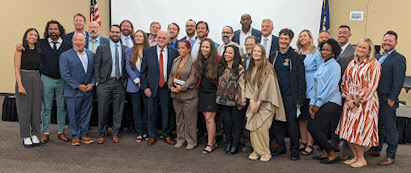
Most speakers and Opioid Abatement Advisory Commission staffers
at the Sept. 15 public hearing to discuss the psychedelic drug ibogaine
gathered for a group photo after the meeting. (Photo by Melissa Patrick)
Chandler said the proposed $42 million to fund this proposal, about 5 percent of the settlements with opioid makers and distributors, "is a drop in the bucket, compared to what has been spent over the years to try to deal with this problem. And spent quite frankly, to a large extent, unsuccessfully. We have successes, but we have a whole lot of failures. And I've seen those failures in my family, both my cousin and my brother, in and out of facilities, strong efforts to try to break the chain of addiction, both of them no longer with us." 

Ibogaine is illegal in the U.S. but has been anecdotally reported to stop the withdrawal symptoms of opioid dependence. The $42 million expenditure, to help get ibogaine federal approval in the next six years, was proposed by Bryan Hubbard, chair and executive director of the commission, which operates in the office of Attorney General Daniel Cameron, the Republican nominee for governor. 

Dr. Joseph Barsuglia, a clinical psychologist and ibogaine researcher who also provided a long list of professional connections to ibogaine, talked about the first time he witnessed an opioid detoxification with ibogaine in 2015. 

"I could not believe my eyes," he said. "To witness a patient with the most severe and chronic addiction you can imagine on death's doorstep undergo a 48-hour process and come out calm, connected, with a new radiance in their eyes and really wanting to live -- this is a miracle in the truest sense. With ibogaine, this is not a rare occurrence, this is the norm."

Barsuglia said ibogaine works for opioid-use disorder because it "rapidly alleviates opioid withdrawal and cravings and promotes lasting sobriety in a manner that is superior to opioid-maintenance therapies," and because "It induces dreamlike visions that increase insight into the causes of one's addiction, which can lead to durable psychological change." 

He said studies show that "ibogaine simultaneously targets addiction and craving to multiple substances, including alcohol, methamphetamines, cocaine and nicotine -- not just opioid use disorder," which is important because over half of opioid-use disorder patients are addicted to multiple substances.

Also, he said ibogaine is "fast acting and has durable outcomes." He said it takes 12 months to break opioid dependence with methadone and 12 hours with ibogaine. He added, "It reduces anxiety, improves mood, does not require ongoing burden on the medical system and has little potential for abuse."

The major objection to legalizing ibogaine are its risks to the heart. Barsuglia said that can be mitigated under a carefully controlled environment.

"I believe funding ibogaine research for opioid use disorder is perhaps one of the most obvious and necessary decisions that can be made in the history of addiction medicine," he said. 

Several speakers gave personal testimonies about their experience with ibogaine, with a recurring message that it not only healed them physically, but also spiritually.

Paria Zandi, a licensed marriage and family therapist in California, said she describes her life as two distinct chapters, "pre-ibogaine and post-ibogaine," and has been free of her opioid addiction for 10 years. 

"Through an intense 24-hour treatment, I emerged feeling reborn," she said. "Not only did I escape the clutches of the physical withdrawal symptoms and cravings, but I also began to relive some of the traumas in my life and gained a newfound perspective. I saw myself as someone of immeasurable worth, and a child of God. I experienced a profound sense of aliveness and connectedness that had eluded me until that moment." 

Zandi added that ibogaine is not a "cure-all" and if it is ever approved will need to be combined with social services, support systems and education. "We urgently need innovative approaches to addiction treatment, such as ibogaine," she said. 

Navy SEAL veteran and ibogaine patient Tommy Aceto told the commisison, "It wasn't just a medicinal treatment. It was a deep dive into my subconscious, self-forgiveness and most importantly, self-love."

Reed Madison, a parent of an ibogaine patient, said of his son, "The reason he went to an ibogaine clinic is because ibogaine offered him a solution for addiction interruption without withdrawals. . . . So I feel incredibly lucky that I learned about ibogaine at the time to help give my son a way out of his addiction problem before it was too late. I think there's a pretty good chance he may not be alive today had ibogaine not been available to him." 

In closing, retired Marine Corps Lt. Gen. Martin Steele, CEO of Reason for Hope and the president of the Veterans Mental Health Leadership Coalition, called on the commission to vote unanimously to fund the ibogaine initiative. 

"Our nation owes its citizens a viable alternative to something that's not working. You have it here in Kentucky, you have this moment in history, this moment in time," he said. "To conclude, I implore each and every member of the commission to support this initiative. A unanimous vote will send a message that will resonate loudly, nationwide."

Asked what was next, Hubbard told Kentucky Health News, "I think every commission member needs to take a little while to think over everything that they have heard. It's a tremendous amount of information to absorb that's been presented between May 31 and now we sit here on Sept. 15. And I think after some due diligence individually and collectively at some point, within some months, we'll be ready to put a vote on the agenda."

Sunday, September 3, 2023

Overdose Awareness Day was opportunity to raise awareness and reduce stigma of drug use; now it's National Recovery Month

By Melissa Patrick

Kentucky Health News

Each year, the last day of August is observed as International Overdose Awareness Day, to raise awareness of overdoses, acknowledge the grief felt by families and friends who have lost someone to a drug overdose, and to reduce the stigma of drug-related deaths. 

Heather Spurlock-Venters, who is a peer-support specialist at Addiction Recovery Care, shared her story of loss in an ARC news release. 

Spurlock-Venters, who is in addiction recovery, said she was sharing the story of her brother-in-law Sean Riley's overdose death to help others battling addiction. The release notes that Riley died a year ago and that Spurlock-Venters was early in her own recovery when she learned of  his overdose death. 

“When you’re in active addiction, you think you’re bulletproof and that nothing like that can happen to you. It never crossed my mind that one day one of us wasn’t going to be here,” she said in the release. “He passed away that day not only because he used, but used alone. He didn’t have anyone there to help him or try to bring him back. That’s what we do as people in recovery. We reach back for the ones still suffering because we know what it is like to suffer. I don’t want anyone else to ever go through that – not if I can help it. . . . We don't have to be a statistic." 

The release adds that with the influx of fentanyl and other synthetic opioids, there has never been a more dangerous time to be using illicit substances. It also provides a one-page list of resources to educate people on overdose risk factors, prevention, signs and symptoms of an overdose and how to respond to an overdose. 

According to the Kentucky Office of Drug Control Policy’s 2022 Overdose Fatality Report, there were 2,135 overdose deaths in Kentucky last year. This was 5% fewer than in 2021. Fentanyl was identified in 1,548 of the deaths, or 72.5%. Nationwide, 109,680 people died as a result of drug overdoses in 2022.

In recognition of Intrenational Overdose Awareness Day, the Kentucky Injury Prevention and Research Center highlighted resources for preventing workplace drug overdoses and supporting recovery from substance-use disorder.  

KIPRC reports that Kentucky had its highest number of workplace overdose fatalities in 2021, with 18, which was triple that of 2019. The number dropped to seven in 2022. 

“We are glad to see that fatal overdoses decreased both in Kentucky residents in the general community and at work,” Rebecca Honaker, program director for KIPRC's Kentucky Occupational Safety and Health Surveillance, said in a news release. "Despite the decrease, workplace overdose deaths remain a significant concern."

To help small businesses address this issue, KIPRC issued a "Hazard Alert" in August about the issue of workplace overdose deaths that included recommendations and resources for employers to help them create a recovery-ready workplace.

And to recognize Drug Overdose Awareness Day, the center released the Kentucky Small Business Toolkit for Hiring Employees in Recovery, which provides additional ways to become a recovery-friendly workplace, including addressing stigma, recruitment, how to use tax credits, bonding programs, community resources, and how to promote a business a recovery-friendly.

Looking forward, September is National Recovery Month.

“Substance use is a dangerous and deadly disease, but treatment is available and recovery is possible,” Matt Brown, president of ARC Healthcare, said in the ARC release. “We remain committed to doing everything we can to reduce overdoses in Kentucky and educate people on the many pathways to recovery.”

People who are struggling with drug abuse or who are concerned about a family member's substance use can search for treatment providers at www.findhelpnowky.org. And for those seeking recovery housing, visit findrecoveryhousingnowky.org. KIPRC also offers a Drug Overdose Prevention Tackle Box, A Guide for Communities.

Wednesday, August 30, 2023

Clinic that serves 33 Ky. counties is first in state to get a grant from program for comprehensive drug treatment and recovery

Owensboro Hope House is one of MCCC's facilities.
Kentucky Health News

A behavioral-health clinic that serves 33 Kentucky counties is the first in the state to receive a grant from a national program that fosters comprehensive drug treatment and recovery centers with a full spectrum of treatment, harm reduction, and recovery support services, especially for people without commercial health insurance.

Mountain Comprehensive Care Center, based in Prestonsburg, is getting the $850,000 grant from the Substance Abuse and Mental Health Services Administration of the U.S. Department of Health and Human Services.

"This grant will allow us to provide treatment for substance-use disorder to persons whose insurance coverage is not sufficient for the treatment required," Promod Bishnoi, CEO of MCCC, said in a press release issued by Eastern Kentucky's congressman, Rep. Hal Rogers.

Rogers said, “This is a life-saving grant program that is needed now, more than ever before. Last year, more than 100,000 Americans died from drug overdoses, so every investment that we make into recovery programs, workforce training, counseling and other resources could mean the difference between life and death for someone.”

Rogers, a Republican from Somerset, announced the grant with Senate Republican Leader Mitch McConnell and Rep. Brett Guthrie of Bowling Green, the ranking Republican on the health subcommittee of the House Energy and Commerce Committee. The release said he recently re-introduced the Comprehensive Opioid Recovery Centers Reauthorization Act of 2023, which would extend the grant program through 2028. It was enacted in 2018.

Guthrie said, “This is welcomed news that Kentucky received its first Comprehensive Opioid Recovery Centers grant. I was proud to lead legislation establishing the Comprehensive Opioid Recovery Center program five years ago. These centers provide targeted resources to communities most impacted by the overdose crisis, including workforce training, medication assisted treatment services, recovery housing, and peer to peer counseling.”

McConnell said, “Kentucky tragically remains one of the states hardest hit by the opioid epidemic. The good news is care centers across the commonwealth are constantly stepping up and finding new ways to combat this crisis. I’m happy to see Kentucky receive its first Comprehensive Opioid Recovery Center grant, which funds crucial services to communities devastated by the opioid epidemic.”

In the eastern third of the state, MCCC has facilities in Bath, Boyd, Carter, Clay, Floyd, Greneup, Johnson, Knott, Lawrence, Lee, Leslie, Letcher, Magoffin, Martin, Mason, Morgan, Pike, Perry, Rowan and Wolfe counties. In Central Kentucky, it is in Bourbon, Clark, Fayette, Garrard, Harrison, Madison and Powell counties. In Western Kentucky, it is in Caldwell, Christian, Daviess, Hopkins, Marshall and McCracken counties.