Showing posts with label children's health. Show all posts

Thursday, July 25, 2024

With fall sports around the corner, it's time for a sports physical

Centers for Disease Control and Prevention photo
By Dr. Scott Black

University of Kentucky

The potential benefits of letting your child participate in sports are innumerable, but sports also come with inherent risks -- many of them that can be avoided with a sports physical. 

From the intensity of competitive play to the physical demands of training, athletes face potential injuries that could range from mild strains to more serious issues like an irregular heartbeat.

That’s why a sports physical should be at the top of every annual preseason checklist. Not only are sports physicals often required by states and schools prior to athletic participation, they’re also essential for injury prevention and catching preexisting conditions that could keep an athlete off the field.

What happens at a sports physical? While a sports physical should not substitute for an annual checkup or well-child visit, sports physicals are similar in that a medical provider will perform a physical examination of your child to evaluate if they can safely take part in sports.

The health-care provider may inquire about your child’s medical history by asking about any known medical problems like asthma or diabetes, past injuries like concussions or broken bones, allergies, medical issues that may run in the family, medications your child is taking, including over-the-counter medicines or supplements and their diet. 

The provider will also typically record your child’s height and weight, check their blood pressure, listen to their breathing and heartbeat, examine their reflexes and muscle, bone and joint health and test their vision

If the doctor determines your child’s health is fit for the field, they’ll clear them for competition. Should they identify anything of concern, the provider might offer a treatment plan or refer your child to a specialist for further evaluation.

It’s recommended to schedule your child’s sports physical several weeks prior to the start of the school year. That way, if there is an issue, your child can begin treatment well before the beginning of the season.

Where should we go for a sports physical? Many families go to their primary care providers to get their sports physicals done. Some schools or clinics may offer free sports physicals on a particular day, but that examination may be less personal, especially if your child doesn’t already know the provider.

Do we still need to do a check-up? While a sports physical is similar to an annual checkup, they’re not the same. Annual check-ups are crucial to making sure your child’s development is on track, is up to date on vaccinations and that your child is generally healthy.

A sports physical can’t replace a check-up, but you can ask your provider’s office if they can be done at the same time.

Dr. Scott Black is clinical director of the University Health Service at the University of Kentucky.

Friday, June 14, 2024

Kentucky ranks 38th in child well-being, two slots higher than in 2023; latest report shows big jump in child and teen deaths in '22

Table from Kids Count 2024 Data Book
By Melissa Patrick
Kentucky Health News

Kentucky, where nearly one in four people are children, ranked 38th among states for the overall well-being of its children, rising two slots from the last report, according to the 2024 Kids Count Data Book

The 35th annual Data Book, released June 10 by Kentucky Youth Advocates and the Annie E. Casey Foundation, rates children's overall well-being through 16 indicators in four major domains: health, economic security, education and family and community.

Overall, Kentucky improved in six of the 16 indicators, but went backward in six others, including all four indicators used to measure education. The most recent data are from 2022. Here's a look at each domain:

Health: Kentucky's health ranking improved to 36th in this year's Data Book, up from 40th last year, even though two of the indicators used to measure health worsened. 

The latest report shows a big increase in the rate of deaths of children aged 2 through 18. It rose to 37 deaths per 100,000 residents in 2022, up from 29 per 100,000 in 2019.

The percentage of low birth-weight babies (less than 5.5 pounds at birth) also inched up to 8.9% in 2022, from 8.7% in 2019. The national average was 8.6% in 2022. 

New data were not available for the percentage of Kentucky's children and teens who are overweight or obese. That rate was 38% in 2021-22, much higher than the national average of 33%. 

As in some prior years, the only good news in the health category was that the percentage of children without health insurance stayed the same in 2022, at 4%. The national rate is 5%, reflecting the fact that 10 states have still not expanded Medicaid as Kentucky has.

For larger, clearer versions of these tables, click on them.
Economic well-being
: Kentucky ranked 36th in the Economic Well-Being domain, up from 41st last year. Kentucky's children remained the same in two of the indicators used to measure economic well-being, including children living in households with a high housing-cost burden (23%) and teens not in school and not working (8%). The state saw  improvements in the percentage of children living in poverty (21%) and the share of children whose parents lack secure employment (28%). 

Family and Community
:  Kentucky ranked 43rd in this domain, down one slot from last year. The state showed improvement in all indicators, including children living in single-parent homes (34%), children in families where the household head lacks a high school diploma (10%), children living in high-poverty areas (11%) and teen births per 1,000. In 2022, there were 22 teen births per 1,000 females aged 15-19. In 2018, that number was 25 per 1,000. In 2022, the national rate was 14 per 1,000. 

Education
: Kentucky ranked 33rd in the Education domain, down from 29th in the last report. All four of the indicators used to measure education worsened. 

The biggest change was seen in the percentage of eighth graders not proficient in math, increasing to 79% in 2022, up from 71% in 2019. The percentage of fourth-graders not proficient in reading also increased, to 69%, up from 65%. The report also shows that the percentage of children ages 3 and 4 not in school also increased slightly, to 61% in 2018-22, up from 59% in 2013-17. 

“To meet educational milestones, kids of all ages must have what they need to learn – from enough food and sleep, to a safe way to get to school, to supports such as tutoring and mental-health services," Terry Brooks, executive director of KYA said in a news release. "And they must be in schools where there is a qualified and well-supported teacher in every classroom. ” 

The release says learning losses from the Covid-19 pandemic have cost the state decades of progress in education. 

Brooks points to a time in Kentucky when public education was a place where Kentuckians found common ground and that Kentucky schools were the "envy of the nation" in the early 90s. 

"We need to re-claim that legacy. We need to move from where we are – when seemingly public education is the most politized and divisive policy issue in Frankfort – and reclaim the ethos of Kentuckians joining together when it comes to K-12 classrooms,” he said in the release. “That kind of common ground agenda is essential for our children and just as critical in building a strong workforce and economy for the future. That means resources for sure, but it also means engagement by us all and a fundamental restructuring of how we do ‘school’ in Kentucky.”

Further, it points to chronic absences that have increased, particularly among children living in poverty. The Data Book shows that 25% of  the state's children were chronically absent in 2021-22. 

Adverse childhood experiences also effect a child's ability to learn. In Kentucky, the report says 47% of the state's children in 2021-22 had experienced one or more ACEs.

And while the percentage of the state's high-school students graduating on time dropped one percentage point, to 90% in 2020-21, from 91% in 2018-19, that's still better than the national rate of 86%. 

This year's report focuses on how to help children get back on track when it comes to education. 

KYA and the Casey Foundation offer recommendations for how to make sure children can thrive in the classroom, including the need for "access to low- or no-cost meals, a reliable internet connection, a place to study, and time with friends, teachers, and counselors." 

Other recommendations are to deepen investments in school wraparound services to address chronic absences, to expand access to intensive tutoring and to utilize all of the allocated pandemic relief funding to prioritize the social, emotional, academic and physical well-being of students.

Monday, April 29, 2024

Measles, which can lead to complications and even death, threatens to come back; vaccine is 97% protective against it

Photo by Pro-Stock Studio, iStock/Getty Images
By Dr. Nicholas Van Sickels
University of Kentucky

Over two decades ago, measles – a highly contagious and potentially deadly childhood disease – was declared eliminated in the United States. As of April 18, at least 125 measles cases have been recorded nationwide this year – more than double the amount of cases observed in all of 2023.

Measles most commonly affects unvaccinated children, and 20 to 40% of infected children require hospitalization. Ear infections, pneumonia, long-term neurologic issues and even death can occur. In general, most will recover, but some will have complications from the infection.

The sharp increase in cases is due to:
  • A national and international decline in measles vaccination rates.
  • International travel to areas with active outbreaks.
  • The extreme contagiousness of the measles virus. On average, one infected person can infect nine to 10 other people, if unvaccinated.
Experts still consider measles to be eliminated in the U.S. but that could change if we don’t continue to take proper preventative measures. In response to the increase in cases, the Centers for Disease Control and Prevention has issued warnings to health professionals and the general public throughout the spring.

How do I protect myself from measles?

Fortunately, the best tool for preventing a measles infection is still highly effective. Measles is almost entirely preventable through vaccination. One dose of measles, mumps, and rubella (MMR) vaccine is 93% protective. Two doses – the recommended number – are 97% protective against the disease.

Because of the inherent contagiousness of measles, 95% or more of a population needs to be vaccinated for the entire population to be protected from an outbreak. Currently the U.S. has 93.1% vaccination coverage.
 
Kentucky has 91.6% coverage (of greater than one dose of MMR vaccine).

This last week of April is World Immunization Week – a good opportunity to discuss the importance of measles vaccination with family and friends, especially those who are planning to travel internationally or to parts of the U.S. where a measles outbreak is active. The latest tracking of measles cases and more information about the disease can be found on the CDC’s measles webpage.

What are the symptoms of measles?
  • Measles symptoms typically include: Fevers (can be very high)
  • Cough
  • Runny nose
  • Red eyes
After the above symptoms, the characteristic red rash appears, starting from the head and spreading downward.

People with measles are thought to be contagious from about four days prior to developing the rash to four days after the onset of the rash (with the onset being day zero).

What to do if you think you’ve been exposed: If you’re concerned you or your child have been exposed to measles, contact your health care provider immediately.

Many of us, fortunately, have never seen a case of measles in our lifetime. With a renewed focus on prevention, hopefully, we never will.

Nicholas Van Sickels, M.D., is infectious-disease specialist and director of infection prevention and control at UK HealthCare.

Thursday, April 18, 2024

Free webinar, Health for a Change: Tackling the Immunization Crisis, is scheduled for Wednesday, May 8, by health foundation

The Foundation for a Healthy Kentucky's next "Health for a Change" webinar is titled "Tackling the Immunization Crisis." It will be held Wednesday, May 8, from 11 a.m. to noon ET. 

The free event will address three main topics, including: why dropping rates of immunizations in children should be considered a public-health crisis; what policies and conspiracies are contributing to the problem; and methods and resources advocates can utilize to improve vaccine access and trust. Click here to register. 

"The rise of vaccine hesitancy is creating a public-health crisis in our communities. In Kentucky and across the country we are now seeing cases of diseases that were once thought to be eliminated," says a foundation news release. "Misinformation and anti-vaccine policies are fostering mistrust, while also making it more difficult to access vaccines in some cases. This webinar will dive into these issues and explore ways advocates and health officials can tackle this crisis." 

The webinar's scheduled speakers are:
  • Dr. Christopher Bolling, volunteer professor of pediatrics, University of Cincinnati; retired pediatrician, Crestview Hills, Ky. 
  • Jessy Sanders, health communicator program manager, Kentucky Rural Health Association – Immunize Kentucky Coalition
  • Kelly Taulbee, director of communications and development, Kentucky Voices for Health

Saturday, March 23, 2024

Bill to let pharmacists give vaccines to children 5 and older heads to governor's desk; 11 Senate Republicans vote against it

By Melissa Patrick
Kentucky Health News

A bill to allow Kentucky pharmacists to order and administer vaccinations to children down to the age of 5 has gained final passage, but only after several senators voiced their concerns about the bill and four of them changed their votes from "yes" to "no."

Since 2017, Kentucky pharmacists have been able to administer vaccinations to children as young as 9, and younger with an order from a health-care provider. The age was lowered to 3 during the Covid-19 public health emergency to help increase access to care, but that law is set to expire Oct. 1.

The original version of Rep. Danny Bentley's House Bill 274 would have allowed pharmacists to order and administer vaccinations to children as young as 3, with the consent of a parent or guardian, but this was increased to age 5 in a committee substitute to appease the Kentucky Medical Association.

State Sen. Stephen Meredith, R-Leitchfield
(Legislative photo from March 8, 2024) 
Sen. Stephen Meredith, who presented the bill to the Senate, lauded it as a way to "fix a problem," noting that Kentucky ranks lower than five of the seven surrounding states when it comes to childhood vaccinations.

"Kentucky is facing a public-health crisis in regard to childhood vaccinations," the Leitchfield Republican said. "It does not introduce any new vaccine mandates. It does not expand the scope of practice of pharmacy. It does not replace well-child checkups."

The Senate gave final passage to HB 274 on a vote of 26-11 on March 22. It will now go to Democratic Gov. Andy Beshear's desk for his signature or veto. 

Sen. Lindsey Tichenor, R-Smithfield, withdrew two floor amendments that she had filed, one to ban requiring students to get the Covid-19 vaccine for "enrollment, employment or medical treatment" and the other to require employers to offer religious or medical exemptions for vaccinations to all employees. 

(On the same day, Tichenor's Senate Bill 295, to prohibit the requirement of a Covid-19 vaccine for any individual for the purposes of student enrollment, participation in any school-based program or extracurricular activity, internship, acquiring or maintaining a professional license or receiving a health care services, was approved with a committee substitute by the Senate Health Services Committee on a vote of 8-2.)

The bill Meredith carried, HB 274, passing the House without dissent on March 5, ran into opposition in the Senate.

Sen. Adrienne Southworth, R-Lawrenceburg, voted no and said she was "baffled" about the discussion, arguing that there is no longer a need for pharmacists to administer vaccines to younger children because the public-health emergency is over.

"I know our pharmacists have been administering vaccines, when we're in a state of emergency," she said. " And we're done with emergencies. . . . Are pharmacists dispensing drugs or are they administering vaccines?"

Tichenor also voted no, voicing concerns that the bill allows pharmacists to give vaccines to a child without knowing their medical history: "I think it's a little bit reckless to be issuing out vaccines that do have potentials for bad adverse events, and to be opening a door where it can be easy or easier, more accessible with less oversight." 

Sen. Shelley Funke Frommeyer, R-Alexandria, questioned the safety of the additives in vaccines: "We are continuing to promote and advocate something that isn't actually [in] your control. It's now in the doctor's or the pharmacists," she said. "We must own our health. We must be committed to our children's health." 

Meredith lambasted his colleagues who voted against the bill, speaking to the challenges that people in rural Kentucky have when it comes to getting access to care. 

“It’s easy to assume that people have access to care, particularly rural Kentucky. It’s not there," he said. "What do they do if they don’t have it? . . . That’s very easy to say, ‘Just get in your car and drive a few miles up the road.’ If you think that way, then you don’t really understand rural Kentucky."

Meredith added, “If you’re voting against this based on principle, you’re cheating the children of Kentucky, particularly rural Kentucky. I can’t begin to tell you how disappointed I am in that.”

Other Republican senators voting against the bill were Floor Leader Damon Thayer of Georgetown, Tichenor, Johnnie Turner of Harlan, Stephen West of Paris and Gex Williams of Verona. Changing their vote from "yes" to "no" were Republicans Robby Mills of Henderson, John Schickel of Union, Brandon Smith of Hazard and Phillip Wheeler of Pikeville. 

Kentucky kids still playing vaccine catch-up

Access to routine vaccinations remains crucial, especially among kindergarteners, a group whose routine vaccinations seem to have been hit hardest by the pandemic.

In November, Kentucky Health News reported that uptake of the combined measles-mumps-rubella vaccine in the state increased in 2023, after three years of decline, but the remains below the national average and the level needed to protect the population from measles, a highly contagious disease that has cropped up in several states.

Most of the routine childhood vaccine rates for kindergarteners remain below pre-pandemic levels, according to the state Department for Public Health Kindergarten Immunizations Dashboard.

The Centers for Disease Control and Prevention offers a wealth of information about the safety of vaccinations and the American Academy of Pediatrics calls for the on-time, routine immunization of all children and adolescents "as the safest and most cost-effective way of preventing disease, disability and death," it says.
 
Kentucky's schools require students to provide up-to-date immunization records at the beginning of each school year, unless a student is exempted for religious or medical reasons.

Thursday, February 8, 2024

Norton Healthcare expands its footprint in Bowling Green with primary care; also adds a multi-purpose facility in Frankfort

Norton's new Frankfort facility (WLKY image)
Kentucky Health News

Norton Healthcare
of Louisville is buying Bowling Green Internal Medicine and Pediatric Associates as its latest interest in the state's third largest city.

"It's about taking our specialized services out into the state," Dr. Steve Hester, Norton's senior vice president and chief clinical and strategy officer, told Don Sergent of the Bowling Green Daily News. "We appreciate the relationships we already have with providers in Bowling Green. Now we want to look at what things we can bring that aren't already there."

Norton spokesman Joe Hall todl Sergent that the company already has "significant investments" in Bowling Green through such Norton Children's Hospital specialty practices as heart, neurology and maternal-fetal medicine, and the new group will "bring primary care into the fold."

Sergent notes, "Norton is also expanding to other locales outside of Louisville. Earlier this month, it announced a new $12 million multi-practice location in Frankfort that will provide pediatrics, adult services and urgent care under one roof."

Monday, February 5, 2024

Routine checkups are part of the recipe for healthy children

By Dr. LaTawnya Pleasant
University of Kentucky

In the journey of parenthood, an essential step toward ensuring the health and happiness of your child is attending well-child care visits with your pediatrician.

The American Academy of Pediatrics recommends parents schedule routine checkups at key developmental stages to give your little one the best care.  

Photo by Monkey Business Images via Getty Images
Those stages include:
  • First week (3-5 days)
  • 1 month old
  • 2 months old
  • 4 months old
  • 6 months old
  • 9 months old
  • 12 months old
  • 15 months old
  • 18 months old
  • 2 years old
  • 2 ½ years old
  • 3 years old
You can talk to your pediatrician to set well-child visits beyond the first three years of care. Well-child visits also offer your child important health advantages, including:

Immunization. At your well-child visit your child can receive scheduled vaccinations to protect them against various diseases as their immune system continues to develop. By ensuring that your child is up to date on vaccines, you contribute to the well-being of the community and create a safer environment for your child to thrive in.

Tracking growth and development. This is an integral part of pediatric visits. Doctors carefully monitor your child’s physical, cognitive and emotional progress, providing key insights into their overall health. Regular visits ensure time for suggestions, questions or concerns and a place for support.

Getting answers. Well-child visits are an opportunity for parents to ask health care providers important questions on a variety of topics from eating habits to behaviors. Being able to address health concerns early on is a proactive approach to preventing sickness and helping your child grow.

Teamwork. While the focus of these routine checkups is on the health of your child, it’s also about building a partnership between you and your health care team. The visits should be an opportunity for parents and doctors to comfortably collaborate to create the best outcome for their child. Open communication fosters a supportive environment, empowering parents to actively participate in their child’s health care journey.

A strong parent-doctor relationship will ensure your child’s health care is personalized to meet their needs and create a trusting relationship between doctor and child. The more comfortable you are with your pediatrician the more open you can be with your health care.

The American Academy of Pediatrics also offers new parents checklists online for each of these well-child visits. If you have questions about scheduling visits or health care concerns, contact your child’s pediatrician.

LaTawnya Pleasant is an associate professor of pediatrics in the UK College of Medicine and pediatrician with Kentucky Children’s Hospital.

Saturday, February 3, 2024

Bill to let pharmacists give vaccines to children 5 years and older advances, as state struggles to catch up on child immunizations

By Melissa Patrick
Kentucky Health News

A bill to allow Kentucky pharmacists to order and administer vaccinations to children down to the age of 5 advanced out of committee unanimously. 

Brooke Hudspeth and Rep. Danny Bentley present House Bill 274
to the House Health Services Committee. (Photo by Melissa Patrick)
"This bill is for those counties without pediatricians," said the bill's sponsor, Rep. Danny Bentley, R-Russell (Greenup County). "And we know that most people are within five miles of the pharmacy." 

The House Health Services Committee approved House Bill 274 on Feb. 1, and the measure was posted for passage in the full House on Monday, Feb. 5. 

The original version of the bill would have allowed pharmacists to order and administer vaccinations to children as young as 3, with the consent of a parent or guardian, but this was increased to age 5 in a committee substitute to appease the Kentucky Medical Association. 

Dr. Donald Swikert, a family medicine doctor and KMA member, told Kentucky Health News that the KMA felt it was important to make sure children continued to go to their annual well-check physician visits through age four because those are really "key visits" and  "there's a lot that goes on other than vaccinations." 

Bentley, a pharmacist by trade, said he appreciated the work of the KMA on the bill, but also pointed out that 51 of the state's counties have no pediatrician. 

Since 2017, Kentucky pharmacists have been able to administer vaccinations to children as young as 9, and younger with an order from a health-care provider.  

The age was lowered to 3 during the Covid-19 public health emergency to help increase access to care, with legislation that is set to expire Oct. 1. 

Brooke Hudspeth, president of the Kentucky Pharmacists Association, told the committee that Bentley's bill would ensure continued access to care. 

"House Bill 274 simply codifies the practice that pharmacists across the state have been performing for the past four years, so that we can ensure continued access to care that children and their parents have come to expect," Hudspeth said. "Pharmacists are trained and educated to screen and administer immunizations to children and adults. . . .  Your constituents and our patients have come to rely upon access to immunizations at their local pharmacy." 

Bentley stressed that this bill is not a mandate and committee Chair Kim Moser, R-Taylor Mill, said she appreciated that aspect of the bill. 

“We want to make sure that children are protected from communicable diseases and vaccines have been proven to keep children safe,” Moser said. “It does increase the convenience factor for families and parents and ensures safety and … protection.”

Kentucky kids still playing vaccine catch-up

Access to routine vaccinations remains crucial, especially among kindergarteners, a group whose routine vaccinations seem to have been hit hardest by the pandemic.  

In November, Kentucky Health News reported that uptake of the combined measles-mumps-rubella vaccine increased last year, after three years of decline, but the state's rate remains below the national average, and below the level needed to protect the population from measles, a highly contagious disease. 

Most of the routine childhood vaccine rates for kindergarteners remain below pre-pandemic levels, according to the Kentucky Department for Public Health Kindergarten Immunizations Dashboard. 

Kentucky's schools require students to provide up-to-date immunization records at the beginning of each school year, unless exempted for religious or medical reasons.

Saturday, January 6, 2024

Free webinar, 'Health for a Change: ACEs, Substance Use Disorder, and Prevention' is scheduled for Friday, Jan. 19

The Foundation for a Healthy Kentucky's next "Health for a Change" webinar is titled "ACEs, Substance Use Disorder and Prevention." It will be held Friday, Jan. 19, from 11 a.m. to noon ET. 

This free webinar will dive into the connection between adverse childhood experiences, or ACEs, and SUD, while sharing what’s going on in Kentucky to address it. Click here to register. 

"Substance use disorder is a critical health concern in Kentucky," says a foundation news release. " So, how can we prevent future generations from struggling with the disease? It requires us to start as early as childhood." 

Studies show that ACEs, a term used for all types of abuse, neglect and family dysfunction that occur under the age of 18, are linked to negative health outcomes in adulthood. One in five Kentucky children have experienced at least two ACEs.

The webinar will offer prevention strategies and ways to support them. It will include topics such as how childhood trauma makes a person more at risk of developing substance use disorder, examples of ACEs interventions and SUD prevention and how an initiative called Bloom Kentucky is working to increase these efforts across the state.

The webinar's scheduled speakers include:
· Barry Allen, president & treasurer, The Gheens Foundation, Louisville
· Shannon Moody, chief policy and strategy officer, Kentucky Youth Advocates
· Dr. Connie White, deputy commissioner for clinical affairs, Kentucky Department for Public Health

Sunday, November 19, 2023

Kids Count County Data Book looks at the well-being of state's children, county by county, and has some 'warning signs'

Kentucky Youth Advocates graphic
By Melissa Patrick
Kentucky Health News

The 2023 Kentucky Kids Count County Data Book, which looks at the well-being of children in each county, serves as a guidepost for how Kentucky's children are doing. This year, it comes with some "warning signs."

"This year's Kids Count report, more than most, serves as a warning," Terry Brooks, executive director of Kentucky Youth Advocates, said at a Nov. 15 press conference to release the data book. "Candidly, it is not a house on fire, but it's certainly not good news." 

To support his warning, Brooks noted that only 46% of the state's kindergarteners are considered ready to learn, and that worsened in 105 of the state's 169 school districts. Also, two-thirds of fourth graders do not read at the national proficiency level, and 66% of eighth graders can't meet minimal math standards. 

Further, the report shows more Kentucky children are in foster care and fewer of them are being reunited with their families in 2020-22, compared to 2015-17. 

Brooks called the more than 200,000 Kentucky children living poverty a  "canary in the coal mine" because this number indicates where all of the other Kids Count data points are going. 

He also pointed to a decline in health-insurance coverage for children as an area of great concern. 

"Even areas where historically we've done better, there's warning signs," he said. "For instance, we still have a very high rate of kids who are covered for health insurance. That's the good news. The bad news is, well over half the counties in Kentucky are showing a decline in that." 

The percentage of Kentuckians under 19 who were covered by some form of health insurance in 2021 dropped just a bit, to 96.1%, when compared to 2016 when that rate was 96.7%. And, 97 of the state's 120 counties, or nearly 81% saw a drop in this coverage. 

The data book was compiled by KYA and the Kentucky State Data Center at the University of Louisville as part of the 33rd annual release of Kids Count, a national initiative of the Annie E. Casey Foundation to track the status of children in the United States.

Health indicators 

The County Data Book rates children's overall well being through 16 indicators in four major domains: economic security, education, family and community and health. The health indicators include smoking during pregnancy, low-birthweight babies, children under 19 with health insurance and teen births. 

Statewide, the report saw improvements in the percent of Kentucky births born to women who smoke during pregnancy, to 14.2% in 2019-21, down from 18.1% in 2014-16. 

Twelve Kentucky counties saw this number worsen: Ballard (17.9%), Bracken (30.1%), Calloway (14.2%), Crittenden (19.1%), Hickman (20.5%), Lawrence (27.6%), Livingston (21.3%), Lyon (21.4%), McCracken (14.4%), Trigg (19.6%), Trimble (26.6%) and Wolfe (34.8%). 

Smoking during pregnancy increases the risk of health problems for developing babies, including birth before full term, low birthweight, and birth defects of the mouth and lip. Smoking during and after pregnancy also increases the risk of sudden infant-death syndrome, according to the Centers for Disease Control and Prevention.

The percentage of low-birthweight babies in Kentucky stayed the same from 2014-16 to 2019-21, at 8.8%. The national average is about 8%.

A low-birthweight baby is defined as less than 5.5 pounds. The March of Dimes says babies born with low weight are more likely to have certain health conditions later in life, including diabetes, heart disease, high blood pressure, intellectual and developmental disabilities, metabolic syndrome and obesity.

Just over half of Kentucky's counties saw an increase in low-birthweight babies from 2014-16 to 2019-21. On the low end, five counties had rates undetr 6%: Carlisle (5.2%), Casey (5.8%), Lyon (5.2%), Oldham (5.7%) and Todd (5.7%). On the high end, two had rates of 15.3%: Robertson and Union. 

Fewer teenagers are giving birth in Kentucky. The state's rate was 22.8 per 1,000 females aged 15-19 in 2019-21, down from 31.7 in 2014-16. This rate has decreased steadily since 2014-16 when that rate was 31.7 teen births per 1,000 females aged 15-19. The highest rate, 54.5, is in in Menifee County. 

Twelve counties had higher teen-birth rates in 2019-21 than they did in 2014-16: Cumberland, 37.7 births per 1,000; Fleming, 34.7; Fulton, 33.7; Hickman, 37.5; Lee, 50.8; Logan, 32.4; Monroe, 41.2; Morgan, 43.1; Muhlenberg, 41.5;  Owen, 27.3; Robertson, 51.1 and Washington, 24.6. 

The report was made possible with support from the Casey foundation and other sponsors, including Aetna Better Health Kentucky, Kosair for Kids, Charter Communications and Mountain Comprehensive Care Center

The Kids Count Data Center provides easy access to county and school district data for about 100 indicators and allows the user to rank states, counties and school districts; to create customized profiles of the data; to generate customized maps; and to embed maps and graphs in websites or blogs. Click here to see your county's profile.

Wednesday, October 11, 2023

Kentucky Children's Hospital branch to open Monday in former home of Shriners Hospital on Richmond Road in Lexington

Every aspect of the clinic was designed to meet the unique needs of patients with complex medical and developmental conditions. (Photo by Adam Padgett, via UK HealthCare strategic communications)
Kentucky Children’s Hospital, part of the University of Kentucky, will open a facility with four pediatric specialty clinics Monday, Oct. 16 in Lexington.

A university press release said the four clinics are:
  • Complex Care Clinic, which provides medical and developmental follow-up care for infants and young children up to age 5 with medical complexity.
  • Developmental Pediatrics Clinic, which offers screening, diagnostic and therapeutic services for children with complex developmental-behavioral conditions such as autism.
  • NICU Graduate Clinic, a clinical site for babies and young children with special medical needs. The clinic not only serves babies who were cared for in the KCH Neonatal Intensive Care Unit but also children born prematurely who are at risk for developmental problems.
  • Physical Medicine and Rehabilitation Clinic, where patients over age 5 with complex care needs can go to improve their functional abilities and strength.
"Children with complex medical and behavior needs may not feel comfortable or have their needs met in a traditional clinic space," the release said. "Kentucky Children’s Richmond Road was designed with this unique patient population in mind. Carefully considered features were included to not just alleviate the stress of appointments and treatment for patients, but to also reduce the physical and logistical obstacles for parents and caregivers.

The facility's amenities include "a quiet waiting room with soothing features for patients with complex sensory needs who need a calming environment in which to wait prior to their appointment," the release said. It includes "an observation area where parents and caregivers can watch providers interact with and assess their children without interruption" and "comfortable, private areas for one-on-one treatment, discussion and interaction between the provider and the patient."

The facility is in the former Shriners Hospital building, in space shared space with Easterseals Bluegrass, a nonprofit organization that serves adults and children with special needs. Funding for the renovation and services expansion of services came partly from the local community partners of Children’s Miracle Network Hospitals.

“The mission of Kentucky Children’s Hospital has always been to provide the most advanced, comprehensive care to our patients and their families without them having to travel far from home,” said Dr. Scottie B. Day, KCH physician-in-chief. “Having access to a full range of specialized medical and developmental care in one location, reduces the travel burden on families, and allows us to offer a continuity of care not found elsewhere in the commonwealth.”

Saturday, August 19, 2023

Kentucky's transgender youth are caught in the middle as Beshear, Cameron and political allies spar over trans health care

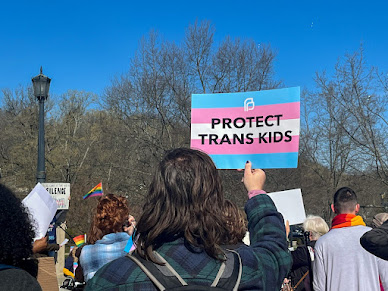
Students protested at the state Capitol against a law that banned gender-
affirming care for minors. (Kentucky Lantern photo by McKenna Horsley)
By McKenna Horsley
Kentucky Lantern

Ysa Leon is questioning their future in Kentucky. The outcome of the state's gubernatorial election this November will be a deciding factor.

“I’ve told my family: Be prepared in November, because that might change where I’m staying after I graduate in May,” said Leon, a 20-year-old nonbinary student at Transylvania University, where they are president of the Student Government Association.

Leon and other transgender Kentuckians have been concerned for much of the year as Kentucky politics filled with heated discourse on the rights of trans people, specifically over what gender-affirming medical care for youth should be permitted in the state.

After the General Assembly passed one of the strongest anti-trans bills in the country, Senate Bill 150, Ray Loux, 17, decided to enroll in Fayette County Public Schools’ Middle College program for his senior year. He did not want to worry about which bathroom he should use, what pronouns his teachers will use and “not being able to talk about who I am with my friends in school.”

Ray is considering going to a college out of state.

“I had a panic attack the other day because I wasn’t sure what my health-care situation would look like going forward,” Ray said, noting that he must taper off his hormones while he is underage.

Now, the issue of trans rights has reached the governor’s race.

Democratic Gov. Andy Beshear, who is seeking a second term in office, has released a 15-second ad called ‘Parents.” It focuses on claims made by Republicans, including his opponent Republican Attorney General Daniel Cameron, that the governor supports “sex change surgery and drugs” for kids.

Wearing basic dad attire — a blue button down under a red quarter-zip pullover — Beshear stares into the camera and says: “My faith guides me as a governor and as a dad.”

He then repeats a familiar line — “all children are children of God” — before saying Cameron’s attacks are not true, adding: “I’ve never supported gender reassignment surgery for kids – and those procedures don’t happen here in Kentucky.”

GOP backlash was swift, and rhetoric uplifting culture wars reached the annual Fancy Farm Picnic in West Kentucky earlier this month. Among his jokes for the day, Cameron riffed that come November Beshear’s pronouns will be “‘has’ and ‘been’,” and criticized the governor for protecting “transgender surgeries for kids.” (Those two words are not pronouns.)

In a press conference last week, Cameron highlighted a letter from a University of Kentucky health clinic, stating it had performed “a small number of non-genital gender reassignment surgeries on minors who are almost adult,” but stopped after the ban on gender-affirming medical care for youth took effect.

Hours later, Beshear said in his press conference that the letter was new to him, and said that if a bill that only banned gender-reassignment surgeries for minors made its way to his desk, he would have signed it.

“Daniel Cameron’s taken this race to the gutter in a way that I’ve never seen,” Beshear said. “I mean, right now, I think if you ask him about climate change, he’ll say it’s caused by children and gender reassignment surgeries.”

As politicians put a spotlight on gender-affirming medical care, advocates say the lives of transgender Kentuckians — especially those of the commonwealth’s trans youth — are on the line.
 
‘It’s hard to be a trans child anywhere’

Transgender youth are already vulnerable, and the way politicians talk about trans people in general is “really dehumanizing,” said Oliver Hall, trans-health director at the Kentucky Health Justice Network. They work directly with transgender youth, a demographic that Hall said is being used as a “political football.”

“It’s hard to be a kid. It’s hard to be a teenager in general,” Hall said. “And then it’s additionally hard to be a trans teenager. It’s hard to be a trans child anywhere.”

Leon, who came out as queer in 2020 and then as trans and nonbinary in 2021, said it took a lot of therapy to find themselves. At first, only their roommates and close friends referred to them with they/them pronouns in private.

“When I heard it the first time, I felt like I took the biggest breath ever — this exhale that I’d been holding in for so long. All of this pent up anxiety was gone and I felt so good,” Leon said. “And it’s not that that fixed everything for me, but accepting yourself and having other people accept you changed my life. It changes everything for some people.”

SB 150 took effect in July despite a legal challenge brought by the American Civil Liberties Union of Kentucky. Cameron's office is defending the law, which bans gender-affirming medical care for anyone under 18, including forcing those already taking puberty blockers to stop. It allows teachers to ignore trans kids' choices of names and pronouns, regulates which school bathrooms kids can use, and limits the sex education students can receive.

Beshear vetoed the legislation, but the Republican supermajority in the General Assembly easily overrode it. In his rejection of the bill, Beshear wrote that he was doing so based on the rights of parents to make decisions about how their child is treated and that the law would allow government interference in medical care.

“Improving access to gender-affirming care is an important means of improving health outcomes for the transgender population,” the governor wrote in his veto message.

Leon said gender-affirming care is different for each transgender person. They did not use puberty blockers because they came out as an adult, but socially transitioned with support from their friends and family. Gender-affirming medical care is also not always covered by health-insurance companies.

Having such laws on Kentucky’s books mixed with support from politicians running for the highest state office in the Commonwealth has “a detrimental effect on the physical and mental health of trans people,” said Hall, of the Kentucky Health Justice Network.

Some in the trans community fear that, eventually, gender-affirming care for adults could be banned as well, said Ray’s mother, Shavahn Loux. While her son is in a “better situation than a lot of kids” because he will be an adult in a few months and could regain access to health care, she said “it’s scary” to think Ray’s access to hormone treatment in general could end completely.

“I know a number of people who were thinking about coming here and are now no longer considering it because of this,” she said. “That’s true for trans individuals and non-trans individuals.”

Cameron, asked recently if he thought gender-affirming medical care for adults should be banned in Kentucky, told reporters that he supported “what our legislature did in protecting our children.”

“Adults can make different decisions but this is about protecting kids and making sure that we don’t rob them of youth and innocence,” Cameron said.

‘The right buzzwords’

After a federal judge reversed a temporary block on the health-care part of the new law, Cameron issued a statement calling the treatments “experimental” and vowed that his office would continue to “stand up for the right of children to be children, free from the influences of leftist activists and radical gender ideology.”

Rebecca Blankenship, the executive director of Ban Conversion Therapy Kentucky and the first openly transgender person ever elected to public office in the state, noted that Cameron’s defense was initially “rebuked” by the judge in the injunction, who noted that the drugs “have a long history of safe use in minors for various conditions.”

This shows, she said, that “Attorney General Cameron is willing not only to lie to voters, but even to the courts to advance these political talking points.”

Alexander Griggs, the community outreach coordinator for the Fairness Campaign, said such messaging argues that “Trans people shouldn’t have autonomy over the decisions they make over their bodies” and that their medical needs are “wrong.” With that constant messaging, transgender youth may internalize it, Griggs said: “The more of that language that’s used, the more damage is being done.”

Leon agreed, saying “People think they can say whatever they want, and not realize the harm that it does.”

As a teenager, Leon said they tried their best to fit in with their cisgender peers. They turned to their church, but were presented with the option of conversion therapy, which seeks to change a person’s sexual or gender identity. They rejected the offer, which leading medical and mental-health organizations have criticized.

Leon said, “My mental health and my self-love improved more than I could have ever imagined after I came out as nonbinary.”

Beshear has taken a more moderate stance on gender-affirming medical care. Bobbie Glass, a transgender woman who testified before lawmakers against Senate Bill 150, said Beshear’s recent ad used “very specific” language to discuss his position, pointing out that he did not discuss his position on puberty blockers.

Beshear is using “the right buzzwords” that people in the transgender community will understand, she said, adding that people who don’t understand the terms could interpret the ad to mean “he believes the same thing” they do.

“But then, Daniel Cameron’s going to turn around and try to exploit that stuff with the language he used in his veto,” Glass said. “And so it’s still going to have the effect of just making life miserable.”

Blankenship appreciates Beshear’s ad for “advancing the conversation, in that he’s lowering the temperature of it, and focusing on the truth.” Ban Conversion Therapy Kentucky does not endorse or oppose political candidates.

“He has been unwilling to bow to pressure from radicals to hurt us,” Blankenship said of the governor. “But at the same time, it’s difficult to point to anything that he’s done since maybe 2020, that was clearly designed to help LGBT people.”

Members of the LGBTQ+ community have asked the governor’s administration to direct the state Cabinet for Health and Family Services to track suicides within the community or where conversion therapy is happening in the state, Blankenship added.

The Trevor Project, which aims to prevent suicide among LGBTQ+ youth, reported in 2022 that 59% of Kentucky’s transgender and non-binary kids considered suicide, and 24% tried to take their own lives.

At least 15 laws banning gender-affirming care for transgender youth have been enacted across the country, according to the Human Rights Campaign, along with at least seven laws that require or allow the misgendering of transgender students. HRC also found that more than 220 bills specifically targeting transgender and non-binary people were introduced in state legislatures this year.

If Beshear is re-elected, Hall hopes the governor “will acknowledge the support that trans Kentuckians have given him” and enact executive orders to ensure policies like anti-discrimination protections for transgender people statewide.

Ray called Beshear’s first term “empowering” for trans Kentuckians: “It was really nice to be able to see somebody in a position of power in Kentucky who was accepting of people like me and welcoming of us and embracing us to live in this state.”

A February Mason-Dixon poll released by the Fairness Campaign showed 71% of Kentucky registered voters don’t want lawmakers making the decisions about transgender youths' health care. 

Nevertheless, the Trevor Project’s 2023 U.S. National Survey on the Mental Health of LGBTQ Young People found that 27% of transgender and nonbinary touth reported being physically threatened or harmed in the previous year because of their gender identity.

But the politicization of the issue “is radicalizing people, and people are treating trans people even worse than we have been treated historically,” Hall said.

Leon and Ray say the outcome of the November election will impact their future in Kentucky. Ray is prepared to leave the state for college if he has to. “If Beshear loses, I think Kentucky is going to become a lot less welcoming of a place,” he said.

Leon hasn’t decided: “I’m kind of weighing: Do I stay here and fight for people like me and make it a better state for people like me or do I protect myself and go somewhere where I am safe?”

Friday, August 18, 2023

National poll finds online patient portals for children are underused

University of Michigan illustration
By Melissa Patrick
Kentucky Health News

A national survey found that only 43% of parents have set up an online patient portal for their child and 41% said they had not been educated on when to use it.

"Given all the conveniences portals offer, it's surprising that over half of parents have not set one up for their child, most commonly because they don't see a need for it," Sarah J. Clark, co-director of the polling team, told HealthDay. "This report suggests many parents may not be aware of all the potential benefits of using a patient portal for children."

Patient portals are computer applications to facilitate communication between patients, parents and health-care providers.

The poll was taken by the C. S. Mott Children's Hospital at the University of Michigan. It was administered in February to a randomly selected, stratified group of 2,000 adults who were parents of at least one child living in their household. The poll's overall margin of error is plus or minus 1 percentage points, and up to 6 poimts for its subsamples.

The poll found that 59% of parents said their child's health-care provider gave them instructions or guidance on when to use the portal. Of that group, three-fourths said they felt "very satisfied" with their ability to communicate with their child's provider, compared to just over half of those who said they received no instruction. 

Of those who did not have a portal, 31% said they did not need one, 25% said they did not know it needed to be set up, 21% said it was not an option with their provider, 16% said they prefer other ways to communicate, 6% had privacy concerns and 3% had technical problems in getting it set up. 

Of those who had a portal, the top three uses were for scheduling appointments (57%), completing pre-visit forms (68%) and looking at their child's test results (65%). Other uses included telehealth visits, requesting records and forms for school, sports or camp, getting a prescription refilled and referrals. And, 34% of the parents used the portal to get advice about their child's illness, injury or symptoms.

One concern among parents reported in the poll was losing access to their child's health information as they age, with 74% of them wishing they had access to their child's health records until they turned 18. 

The poll found that 31% of parents of teens saw changes in their patient portal access, including the information and messages from their child that they could see.

Physician-in-chief at Kentucky Children's Hospital says state can do better by its kids; it ranks 40th in well-being of children

Dr. Scottie B. Day (UK photo)
By Dr. Scottie B. Day
University of Kentucky

A recent report by the 2023 Kids Count Data Book studied how economic well-being, education, health and family support impacts a child’s overall well-being, and how those impacts vary from state to state. So how does Kentucky rank? Are parents able to find secure employment, with wages that keep pace with inflation and cost of living? Are the kids doing well in school, meeting education benchmarks and graduating on time? Do they have access to health care, especially mental health resources? How do we fare compared to other states?

Kentucky ranks 40th in children’s overall well-being. This is unacceptable, and we can do better.

Our kids are in crisis. 22% of Kentucky’s kids live in poverty. Without access to affordable, quality childcare and preschool programs, those kids fall behind their peers in developmental and educational benchmarks. More than 41% of children between the ages of 10-17 are overweight or obese. Children who struggle with their weight are at higher risk for heart disease, diabetes and cancer later in life. Sixty percent of children and adolescents with major depression receive no mental health care. Since 2019, suicide deaths in individuals ages 10 to 19 increased by almost 70%.

The pattern is clear; how we provide kids now informs their futures, as well as the future of the entire commonwealth.

This is not to suggest that as children transition to adulthood, they aren’t capable of change and have the knowledge to make better decisions for themselves and their children. But shouldn’t they have the best possible start to begin with? Shouldn’t we utilize every resource to ensure that every child in Kentucky grows up to be a healthy adult?

We need to help families offset the cost of child care and support child-care workers. Strengthen preschool programs accessibility so kids can build the skills they need to be successful in school. But most importantly, we must invest in kids’ physical and mental health. The stress of poverty, exposure to violence, substance abuse and lack of access to primary care, preventive screenings and proper nutrition are just a few of the factors that adversely affect a child’s physical, mental, and emotional well-being. Adversity doesn’t “build character;” it influences every aspect of a child’s life and continues to inform patterns of behavior for generations.

If we only do what we can do, we will never be more than we are now. Let’s plant the tree now and let the roots take hold to build a stable foundation. Even though we may not see the fruit for years, we can take comfort in knowing that future generations of Kentuckians will be strong and well-nourished.

Scottie B. Day, M.D., is physician-in-chief at Kentucky Children’s Hospital and chair of the University of Kentucky College of Medicine’s Department of Pediatrics.

Saturday, April 8, 2023

Drinking while pregnant can have long-lasting effects on children, but almost 1/2 of pregnant Kentuckians report consuming alcohol

Centers for Disease Control and Prevention illustration
Did you know that children of mothers who drink alcohol during pregnancy can undergo changes to their facial features, accompanied by a variety of lifelong mental and physical challenges? And some other changes may not be visible. Exposure to alcohol before birth can also affect systems throughout the body and have lasting impact, Emma Yasinski reports for National Geographic.

"Studies have estimated that fetal alcohol spectrum disorders, or FASD, affect between 1 and 5 percent of the population, though experts suspect the prevalence is even higher," Yasinski reports. 

The FASD United Policy and Training Center website says FASD is the "most commonly known cause of developmental disabilities in the United States," and recent research shows up to one in 20 first graders have a disability from it.

Almost half of Kentucky women with a recent live birth consumed alcohol during the three months before pregnancy. The figure was 48.7% in 2019, according to the America's Health Rankings report from the United Health Foundation. The national rate was even worse, 56.7%.  

FASD-related problems

It wasn't until the early 1970s that researchers found a pattern among babies born to mothers with severe alcohol-use disorders, including hallmark facial features such as a smooth upper lip, a small head, and a flat nasal bridge. These features were generally accompanied by a variety of lifelong mental and physical challenges such as learning disabilities, difficulty reasoning, growth deficiencies, and heart and kidney problems," Yasinski reports.

Since then, researchers have found that prenatal alcohol exposure can disrupt development of the brain and body even without affecting the face, and include a broad range of conditions that are often inconsistent from one patient to another. Yasinski also delves into the details of how FASD changes the brain. 

The FASD center says people with the disorder often have difficulty learning and remembering, understanding and following directions, shifting attention, controlling emotions and impulsivity, communicating and socializing, and performing daily life skills. It says FASD cases are seriously under-diagnosed and often hard to distinguish from other developmental disorders. 

Further, Yasinski reports that diagnosis requires complex tests and treatments that, due to limited resources and awareness, many patients never get.

“Alcohol affects the brain in different ways, depending on when the brain is exposed in pregnancy and how much it's exposed, and what else is going on, like nutritional factors, genetic factors, other things about the mom and the fetus,” Jeffrey Wozniak, a neurobehavioral development researcher at the University of Minnesota, told Yasinski. “So there's a lot of variety in terms of the brain effects.”

How prevalent is drinking during pregnancy? 

According to Kentucky's 2020 births report from the Public Health Neonatal Abstinence Syndrome Reporting Registry, "Alcohol use was reported by mothers of 4.8% of infants with NAS in Kentucky, which may be lower than the actual rate of use."

Centers for Disease Control and Prevention data show that in 2018-20, 13.5% of pregnant U.S. adults reported that they were currently drinking and 5.2% reported they had engaged in binge drinking.

Many women drink without knowing they are pregnant, and that harm a fetus. About half of all U.S. pregnancies are unintended, and most women don't know they are pregnant until four to six weeks into the pregnancy.

While binge drinking and regular heavy drinking put a fetus at the greatest risk for sever problems, even lesser amounts can also cause damage, says the National Institute on Alcohol Abuse and Alcoholism

"In fact, there is no known safe level of alcohol consumption during pregnancy" says the institute. 

Looking forward

The good news is that in the early 2000s, "Studies started to show that targeted therapies could help people who were prenatally exposed to alcohol," Yasinski reports.  

For example, Julie Kable, a neurodevelopmental exposure researcher at Emory University in Atlanta, told Yasinski that she and her team found with the CDC that offering adaptive support helped people with FASD better learn and understand math. Yasinski says researchers have also found ways to help people with FASD with executive function and decision making. 

Kanle told Yasinski, “No longer could we allow pediatricians to say, Well, why should I diagnose it when there's nothing we can do about it?”

But Yasinski reports that the U.S. has too few places that can diagnoise FASD, "and some states don’t even have a single FASD diagnostic center. Since diagnosis requires comprehensive evaluations, the centers that do exist have limited capacity to complete them. Many will only see patients who they know were very likely to have been exposed to alcohol in utero, which accounts for a fraction of those believed to be affected."

She adds,, "While most experts agree on the basic characteristics of FASD, there are also minor differences in diagnostic criteria between states, countries, and clinics, with slightly different cutoffs."  And this, she reports "can create challenges for researchers working to build large data sets, but it also has more immediate impact." For example, one FASD specialist told her that individuals with FASD in some states don't qualify for disability services because " the CDC only has consistent diagnostic criteria for fetal alcohol syndrome, not the whole spectrum of disorders." 

Some in Congress are working to provide resources for screening, research and other supportive services for people with FASD, in a bill called the FASD Respect Act. The FASD United Policy and Training Center says a new version of this bill is to be introduced.

Susan Shepard Carlson, who was a district court judge and first lady of Minnesota, told Yasinski that she is advocating for this bill largely because she realized in 1997 that a many children coming through the courts "had the same kind of profile [as] someone with FASD . . . but we weren't really looking at the underlying cause." 

Because of this, Carlson convened a task force that led to the state funding FASD research and treatment. "The court was able to screen children suspected of having an undiagnosed FASD, and she says about 25 percent of the kids they chose to screen did have an undiagnosed disorder," writes Yasinski.

Kable told Yasinski, “It’s really important to know that we can still have dramatic differences in the developmental outcome of these children, if we get them recognized, and get them services as early as possible.” 

Information for this story was also gathered by Melissa Patrick of Kentucky Health News.

Friday, March 24, 2023

Beshear vetoes bill that would ban gender-affirming care for Kentuckians under 18; Republicans are expected to override it

Gov. Andy Beshear (State photos)
By Melissa Patrick
Kentucky Health News

Gov. Andy Beshear has vetoed a far-reaching bill that would ban transgender minors' access to gender-affirming care and sets strict rules for teaching in Kentucky's schools about sexuality. 

Senate Bill 150 would ban gender-affirming treatment for Kentuckians under 18, including surgeries and puberty-blocking hormones, even if parents want the treatment for their children.

It would bar schools from requiring teachers to use a transgender student's preferred pronouns, keep trans students from using bathrooms that fit their gender identity, and bans instruction that explores "gender identity, gender expression or sexual orientation," among other sex-education requirements. 

State Sen. Max Wise
The veto came as no surprise. Beshear, a Democrat running for re-election, has been consistent in his disapproval of the bill, sponsored by Sen. Max Wise, R-Campbellsville, who is running for lieutenant governor on a slate headed by Kelly Craft of Lexington.

"I think I've been clear on how I feel about it," Beshear said the day before he vetoed the bill. "I believe Senate Bill 150 tears away the freedom of parents to make important and difficult medical decisions for their kids. It tears away the freedom of parents to do what those parents believe is best for their kids, and instead has big government making those decisions for everyone -- even if the parents disagree."

Beshear's veto message says SB 150 "allows too much government interference in personal healthcare issues and rips away the freedom of parents to make personal family decisions." He wrote that it turns educators and administrators into investigators who must report to parents about how students behave and/or refer to themselves or others. 

He also wrote, "My faith teaches me that all children are children of God and Senate Bill 150 will endanger the children of Kentucky," citing data to support his concerns.

"In a 2022 National Survey on LGBTQ youth mental health, 45% of LGBTQ youth seriously considered suicide in the past year and nearly one in five transgender youth attempted suicide," he wrote. "The American Medical Association reports that receipt of care dramatically reduces the rates of suicide attempts, decreases feelings of depression and anxiety, and reduces substance abuse. Improving access to gender-affirming care is an important means of improving health outcomes for the transgender population. Senate Bill 150 will cause an increase in suicide among Kentucky's youth." 

Lawmakers will reconvene March 29 and 30, when the majorities of Republicans in the House and Senate are expected to easily override the veto. Republicans were quick to criticize it. 

Wise's statement said Beshear "puts party over Kentuckians' wish to eliminate woke ideologies in our children's schools." He said the goal of the bill "is to strengthen parental engagement and communication in their children’s education."

He added, "Parents should look at this veto as a slap in the face. . . . I look forward to the legislature overriding this veto, and protecting children from the irreparable harm of gender-transition surgeries by making SB 150 law.”

Wise also issued a joint statement with Craft, saying “Time and time again, Gov. Beshear has proven he is out of step with what Kentuckians are talking about at their kitchen tables: communication and engagement with their children’s schools. A Craft-Wise administration will ensure our children are protected, make sure parents are heard, and empower teachers to focus on providing a world-class education that teaches our children how to think, not what to think.”

Republican Party of Kentucky spokesman Sean Southard also criticized the veto and looked ahead to the election.

“Is Andy Beshear the governor of Kentucky or California?” Southard asked. “Kentucky voters will have an opportunity this fall to rid our state of this far-left governor and replace him with a Republican who will work to protect children. Once this campaign is over, today may very well be remembered as the day Andy Beshear lost his bid for re-election.”

Attorney General Daniel Cameron, the apparent front-runner in the May 16 Republican primary, criticized news-media coverage of the bill and said “chemical castration and genital mutilation . . . is the exact opposite of how we should support children experiencing gender dysphoria or mental-health struggles. My administration will protect our youth from dangerous ideologies and defend Kentucky’s values.”

Others issued statements praising the veto. 

"By vetoing this hateful legislation, Gov. Beshear has demonstrated his commitments to protect Kentucky parents’ rights to raise their children as they see fit, and to keep medical decisions where they belong: between providers and patients," said Angela Cooper, communications director for American Civil Liberties Union of Kentucky.   

Chris Hartman, executive director of the Fairness Campaign, said "SB 150 will only lead to disaster and despair for transgender Kentucky kids and their families. . . . We urge state lawmakers to read the governor's veto message, listen to medical professionals and sustain Gov. Beshear's veto." 

Kentucky Voices For Health said in its newsletter that it joined more than 500 organizations, providers and individuals in signing a letter of opposition to SB 150, and urged citizens to call their legislators' offices at 502-564-8100.