Showing posts with label housing. Show all posts

Monday, February 19, 2024

Eastern Ky. towns fight to recover from opioid epidemic, with help from newcomers and recovering addicts, national author reports

An event in downtown Hazard: “When somebody gets clean, they want to change the world,” Stephanie Callahan, a former addict and current business owner in Hazard, said of the town’s new can-do spirit. “You do something just to prove you can do it.” (Photos by Stacy Kranitz for The Free Press)
By Sam Quinones
Republished from The Free Press

In early 2020, Mandi Fugate Sheffel, 42, opened a tiny bookstore in her hometown of Hazard. Everyone thought she was crazy.

Downtown Hazard was a forbidding place to start any business, much less a bookstore. Most coal mines that once supported the area had closed. Many brick buildings from Hazard’s heyday were gone, bequeathing a gap-toothed look to Main Street.

What’s more, Fugate Sheffel couldn’t afford a website or employees. She had never run a business before. And she had a complicated personal history to wrestle with.

But she loved to read—particularly contemporary Appalachian authors like Silas House, James Still and Gurney Norman, who told stories that felt real to her. She figured others in town were tired, like her, of driving two hours to Lexington to buy books.

So, on January 30, she opened Read Spotted Newt in a 250-square-foot space—the size of a small bedroom.
 
I met Fugate Sheffel last spring when I visited Hazard for the first time. I came to speak about my book, The Least of Us, about America’s drug-addiction epidemic. I had heard about the town, and had formed an image of it as the buckle on Eastern Kentucky’s opioid belt.

Mandi Fugate Sheffel poses outside her bookstore in Hazard.
From Fugate Sheffel, though, I heard another story—one that I heard elsewhere in the Appalachian coalfield.

“When you don’t have industry, you’re having ecological disaster and a drug epidemic—you would think all those things would get us to a place where the town would be uninhabitable,” Fugate Sheffel told me. “But that’s not what I’m seeing at all. I’m seeing a lot of people rally.”

The loping hills of Eastern Kentucky are studded with scores of towns like Hazard—and nearby Prestonsburg and Pineville and Corbin—that, over the centuries, emerged in the valleys and along its rivers. By the early 20th century, coal dominated the region, with roughly 700,000 men and boys toiling in the mines of Kentucky and neighboring West Virginia.

In the 1990s, “as one declined and things got worse, the other increased and things got worse,” Les Stapleton, the mayor of Prestonsburg, pop. 4,000, 35 miles northeast of Hazard, told me about the correlation between jobs and drugs.

Larger forces over which locals had little or no control exacerbated things: the rise of natural gas for power plants, new environmental standards, our shifting political and cultural landscape.

By the early 2000s, the region had become the epicenter of the new opioid epidemic, which had its epicenter in Eastern Kentucky, West Virginia, and southwest Virginia.

Downtowns emptied out. Buildings were abandoned. Business startups seemed dominated by “pill mills”—clinics that prescribed huge quantities of prescription painkillers. In the little evangelical churches, they prayed for an end to “hillbilly heroin.”

The state cracked down on the pill mills, but by 2017, Perry County was the worst-hit county in the United States when it came to hospitalization for opiate addiction.

But then, weirdly and unexpectedly, at the same time that everything was falling apart, things started to get better—and that old world started, very tentatively, to build itself back up.

In the past few years, some 43 businesses have opened in Hazard, creating 171 new jobs, said Bailey Richards, the town’s coordinator of downtown development. That includes a toy store, a café, a women’s boutique, a quilt and apparel place, and a smoothie shop. A longtime restaurant just moved downtown.

The population, which declined for most of the latter half of the 20th century, now appears to be inching up. The growth was driven mostly by outsiders—new families, mostly from cities in Kentucky, in search of a better future, and immigrants, including health-care workers a nascent Latino community.

Shane Barton, the downtown-development coordinator at the University of Kentucky’s Community and Economic Development Initiative, went so far as to call Hazard “a hip destination for young people.”

It was hard to say why this was happening. Gradually, people were becoming more aware of the crisis of Appalachia and were doing things trying to help. Covid-19 pushed people to move out of the cities. And there were the recovering addicts; they weren’t expensive to hire if you needed a barista or someone to stock your shelves or paint your walls, and they were eager to work, to live.

In Hazard, about a quarter of the new jobs are held by recovering addicts. In Pineville, an hour and a half southwest of Hazard, one-third of new jobs are filled by people in recovery, said Jacob Roan, who oversees economic development in the Bell County seat.

“When somebody gets clean, they want to change the world, and have ideas of how to change the world,” Stephanie Callahan, a former addict and current business owner in Hazard, told me. “You do something just to prove you can do it.”

Joey Jones poses in his Ready Set Play toy store in Hazard.
That’s what inspired Joey Jones—the can-do spirit.

Jones and his wife, Nikki, grew up in Hazard, went to the University of Louisville, and in 2019, returned home after ten years away, now with two kids.

Though a trained social worker, Joey Jones opened a toy store. This was last year. He called it Ready Set Play, and it’s on Main Street. Jones advertises on social media and, despite selling toys that are available online, he is expanding.

“The small business community here feels like family,” Jones said. Mandi Fugate Sheffel, who knew something about hard times and people coming together, agreed.

She had been in high school in the 1990s, as the mines were closing and pain pills were invading. “One day, we were drinking beer in the back of a truck,” she said. “Then, all of a sudden, these pills were everywhere.” By 1997, she was an OxyContin addict.

The addicts dubbed a local park “Pillville,” and Fugate Sheffel got out. She moved to western Kentucky, came home in 2002, got sober, married, had a son. She survived.

So did her bookstore, against all odds.

A few days after she opened it, in 2020, it was flooded. Then Covid hit and Kentucky’s governor banned in-store shopping, and Fugate Sheffel thought this might really be it for Read Spotted Newt.

But after news media reported on Read Spotted Newt’s woes, Fugate Sheffel started getting orders from all over. Soon, she said, “I was shipping books everywhere—Boston, Florida, Texas, L.A.  Anybody who had any tie to Eastern Kentucky who knew this was going on were like, ‘We gotta make sure she makes this work.’”

By late 2020, she had moved to a larger space—a triangular building on a corner that once housed Hazard’s tourist welcome center. The city renovated it for her.

There are other pockets of hope scattered across the region.

In Prestonsburg, an hour north of Hazard, there are five locally owned restaurants, all but one of which opened in the last five years. An Indian restaurant is coming soon. The two-block historic downtown once had eleven abandoned buildings. Now, all are occupied.

In Pineville, pop. 1,600, the downtown was similarly decimated. Now there are boutiques, a hair salon, a furniture store, and several restaurants. Importantly, noted Roan, the economic-development director, “Those businesses are still in business six, seven years after opening.”

In Corbin, pop. 8,000), just up the Cumberland Gap Parkway from Pineville, several old buildings have been redone. They now house restaurants, a clothing boutique, a print shop, a café, an ice cream parlor, a record store, and a pinball museum.

“Everybody is like, ‘What can I start? What’s missing around here?’ ” Corbin Mayor Suzie Razmus told me.

Something else locals are starting to see in these places: people. On the street, outside their favorite coffee shop, chatting with a friend through an open car window.

In the past, a town grew from a big factory that employed hundreds or more people. But no one’s waiting any longer for factories or big-box stores—to say nothing of the mines or unions—to save them.

Prestonsburg Mayor Les Stapleton: “If a deer gets killed on the
highway, I pull over and put it in the truck and get rid of it . . .
I don’t want people seeing that the first time they drive into town.”
“Too many have come in to try to save us, and they don’t,” said Stapleton, the Prestonsburg mayor. “We got to do it ourselves.”

Now, he’s facing a problem he could never have anticipated: a shortage of affordable housing. This has been driven, he added, by outsiders who, since Covid, have been moving to Prestonsburg and other towns across the region.

Jeff Siegler, whose firm Revitalize, or Die advises small towns on rebuilding, said the area’s success “has to be about small, incremental victories—one business at a time.”

The new generation of mayors, town councilors, and city planners across much of Appalachia, who had come through the disaster of the last three decades and seemed inspired by recovering addicts in their own communities, understood what Siegler was saying: small is good; local is good; people are good.

Instead of trying to lure massive out-of-state companies with tax incentives, they were thinking about beautification projects and homeowners and places where people could congregate.

“That’s the shift,” said UK's Shane Barton. “How can we make our communities people-ready as opposed to industry- or investment-ready?”

Still, progress is uneven, and many small-town economies are frail. Self-reliance may take them only so far.

The drug problem rages on. Fentanyl seems to be mixed into everything on the street, creating staggering numbers of overdoses. On top of all this, a form of perverse gentrification has taken hold that’s peculiar to this birthplace of the opioid epidemic. Legions of national drug treatment centers catering to the addicts have moved to the region—sopping up cheap real estate and pricing lower-income buyers and start-ups out of the market.

But at this point, that seems like a minor, mostly surmountable hurdle, at least to the people here who have stopped waiting for outsiders—coal companies, big-box retailers, Frankfort, Washington—to save them.

That is definitely the way Stephanie Callahan, in Hazard, sees things.

Now in her early forties, Callahan, like Mandi Fugate Sheffel, was part of the generation consumed by Oxycontin. She got clean when she had a baby—this was 15 years ago—and built a career as a showroom saleswoman at a local furniture company. But she yearned to do something on her own.

She loved fashion. For two years, she had been running a side hustle out of her bedroom, selling plus-size clothes. She hated that she had to go to Lexington every time she needed a new top or skirt.

So, in the summer of 2021, Callahan quit her full-time job and rented a space in downtown Hazard that had once been a gym. Her father said she’d lost her mind, opening a women’s clothing store during Covid. She did it anyway, calling it Hot Mess Express, which is what her mother and friends often called her.

She showed them: in her first two years, Callahan had 2,000 repeat customers. She now has nine part-time employees and will soon open a men’s store.

It wasn’t just about the clothes. It was about people in Hazard, like so many towns, trying to find their way back to each other.

“When I was growing up, we had arcades, movie theaters, mom-and-pop restaurants,” Callahan said. Now, “there’s no place for people to go talk to each other.”

So, she put a brown leather couch, almost as an afterthought, in the middle of the store, intending it for men accompanying their wives and girlfriends to sit and scroll through their phones or read a magazine—kill time. Instead, it became the focal point of the store, and it made Hot Mess Express a community hangout as well as a women’s boutique. A little place, or nook, where people would say hi, catch up, laugh, hug, gossip.

“It’s comfortable,” Callahan told me, referring to the couch. “I have a photo of the mayor asleep on it.”

Sam Quinones is the author of four books, including his latest, The Least of Us: True Tales of America and Hope in the Time of Fentanyl and Meth. You can follow him on X at @samquinones7.

Friday, August 18, 2023

McConnell announces another multi-million-dollar grant to former Gov. Fletcher's firm to help build housing for drug treatment

Former Gov. Ernie Fletcher
Kentucky Health News

Senate Minority Leader Mitch McConnell announced that he helped get $3.3 million for the Fletcher Group, a nonprofit founded by former Gov. Ernie Fletcher, to build housing for rural people in drug recovery.

“With the help of the Fletcher Group’s targeted prevention, treatment and enforcement programs, Kentucky’s rural communities can take a stand against addiction and save lives,” McConnell said in a news release.

However, Andrew Howard, a former McConnell aide who is the Fletcher Group’s policy director, told John Cheves of the Lexington Herald-Leader that the firm doesn't provide care or own facilities. 

“Rural communities often have capacity challenges,” Howard said. “You’ll have one kind of spark plug in the community that’s wearing multiple hats, and they don’t have that capacity to understand or to figure out or to find information about new best practices or recovery housing programs. So that’s where we come in — to be boots on the ground and walk with those community stakeholders.” 

Howard told Cheves that this latest round of funding will help the Fletcher Group and its partners to accomplish several specific projects in Kentucky, including the opening of a recovery home in Bell County for pregnant women and new mothers that will offer holistic treatment and job training and a pilot project at Southeast Kentucky Community and Technical College in Cumberland to help recruit and train certified peer support specialists. 

The Fletcher Group is one of three “rural centers of excellence” that have shared in many millions of dollars in drug-abuse grants in recent years from the Health Resources and Services Administration of the U.S. Department of Health and Human Services.

"We serve any HRSA-designated rural community in the U.S.; however, we have had a significant focus on Kentucky's rural communities," Fletcher Group CEO Dave Johnson told Kentucky Health News. "There are 103 HRSA-designated rural counties in Kentucky, of the 120 Kentucky counties. Over the past four years we have provided consultation, training, education, and research in 47." 

Cheves reports, "The Fletcher Group, founded in 2017, has locations in London and at the home of Ernie Fletcher and his wife, Glenna, near Sarasota, Fla. It employs more than 30 people working out of 13 states. From 2018 to 2021, it collected nearly $8.8 million in public funds, with steadily rising revenues, according to its most recently available tax returns."

Howard told Cheves that McConnell announced previous HHS grants for The Fletcher Group of $6.66 million in 2019, $3.33 million in 2021, and $1.68 million from the Appalachian Regional Commission in 2019. Cheves reports that the firm "has paid the Washington lobbying firm of Akin Gump Strauss Hauer & Feld at least $120,000 a year since 2018 to lobby congressional spending committees on its behalf, according to federal lobbying disclosures."

Cheves adds, "Ernie and Glenna Fletcher together collected $850,345 in compensation from The Fletcher Group during the three years from 2019 to 2021, according to the nonprofit’s tax filings. Each of them is identified as co-chair and co-founder of The Fletcher Group. Additionally, Ernie Fletcher is listed as chief medical officer." 

During his tenure as governor, in 2003-07, the Republican established a recovery housing program called "Recovery Kentucky" that continued under Steve Beshear, the Democrat who ousted him in the 2007 election. The firm's website says the program inspired Fletcher to extend this recovery model nationwide.

Sunday, November 28, 2021

Ky. ranks first in lung-cancer cases, and low in survival and early diagnosis, but prevention, screening and treatment are easier now

At 89 cases per 100,000 residents, Kentucky is No. 1 in the rate of new lung cancer cases. The national rate is 58. (Map from the American Lung Association 2021 State of Lung Cancer report)

By Melissa Patrick
Kentucky Health News

Lung Cancer Awareness Month falls in November, but in Kentucky the promotion of prevention and early detection of lung cancer is needed all year because the state leads the nation in lung-cancer cases and has a death rate from the disease that is 50 percent higher than the national average.

A year-long multimedia campaign, led by the Kentucky Medical Association, the Kentucky Foundation for Medical Care and the Anthem Foundation, aims to do just that. The Breathe Better Kentucky campaign is designed to educate Kentuckians on lung-health issues and encourage them to schedule appointments to discuss any symptoms, risk factors, or screening tests that they might be eligible for.

"For patients who have small, early-stage lung cancer, early detection is critical to successful treatment, as the cure rate can be as high as 80 to 90 percent when caught in the beginning stages," Dr. Neal Moser, Dr. Shawn Jones and Dr. Jeff Reynolds wrote in the Northern Kentucky Tribune. 

Far too few Kentuckians know lung cancer has become easier to prevent, find and treat, Dr. Timothy Mullett, medical director of the University of Kentucky's Markey Cancer Center Affiliate & Research Network.

At a news conference about Lung Cancer Awareness Month, Mullett said he was frustrated about that, partly because "the burden of lung cancer on the people in Kentucky is unequaled." 

American Lung Association graphic; for a larger version, click on it.
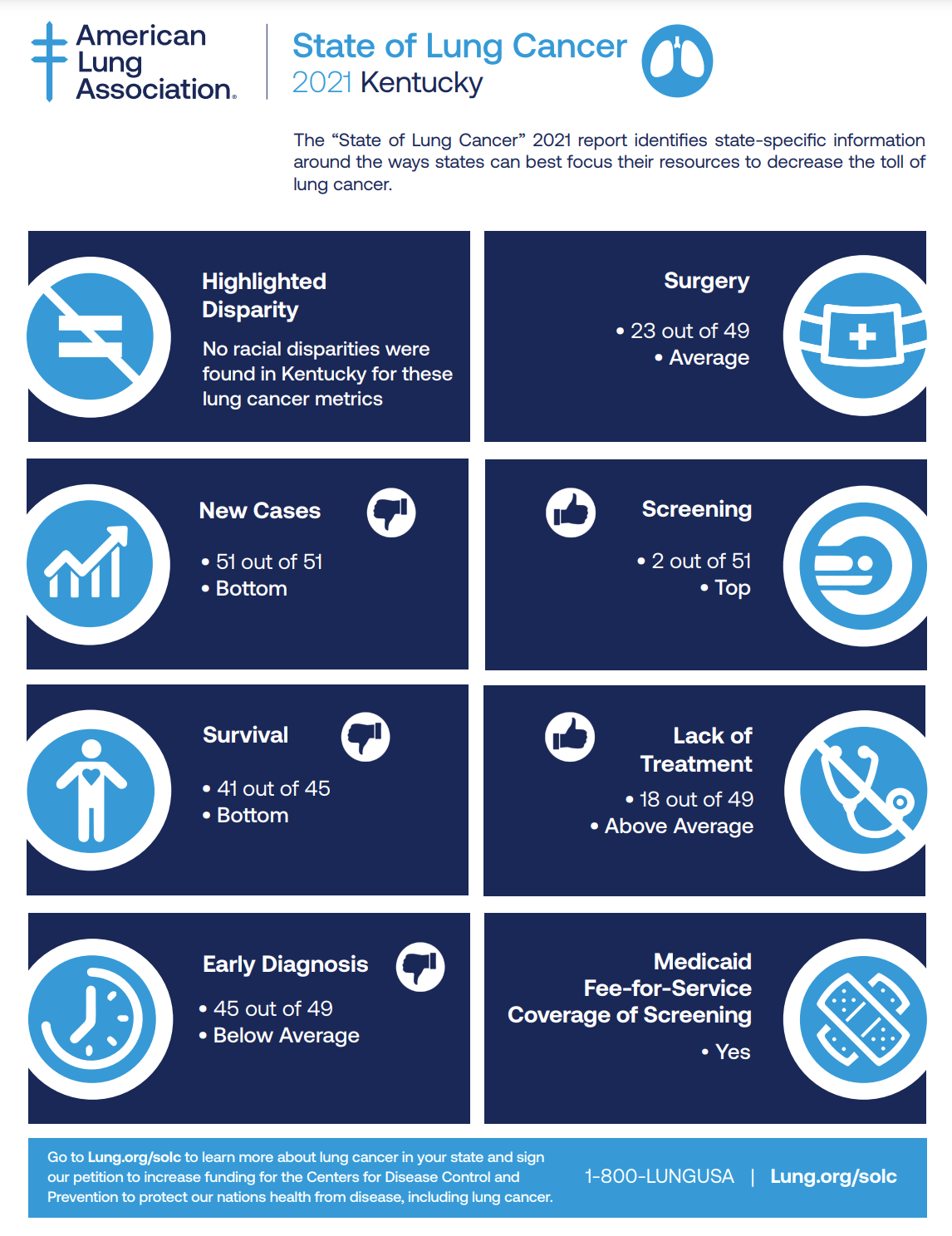
The fourth annual American Lung Association State of Lung Cancer report places Kentucky among the worst five states for smoking, new cases, early diagnosis and survival.

The report ranks Kentucky second in screening, perhaps driven by its high case rate, but says it's worse than average in the percentage of lung-cancer patients (19%) not receiving treatment. It ranks 18th for this measure. 

The national rate for lack of treatment is 21%. The report adds that over the last five years, the percent of cases receiving no treatment in Kentucky increased by 10%. 

One of the best ways to prevent lung cancer is to prevent it and that involves helping the 23.4% of smokers in Kentucky to quit. Smoking is the number one cause of lung cancer, causing about 90% of cases, according to the American Lung Association. Kentucky ranks 2nd in the nation for smoking, following behind West Virginia. 

The state Department for Public Health offers a service called Quit Now Kentucky to help Kentuckians of all ages quit smoking. To learn more go to QuitNowKentucky.org, text QUITKY to 797979 or call 1-800-QUIT-NOW.

The only recommended screening test for lung cancer is low-dose computed tomography, also called a low-dose CT scan, according to the Centers for disease Control and Prevention. 

Annual CT scans are recommended for adults ages 50 to 80 who have smoked at least 20 "pack-years" (a pack-year amounting to one pack of cigarettes a day for a year, or an equivalent amount, such as half a pack a day for two years) and either still smokes or has quit within the last 15 years.

Map shows potential of indoor radon accumulation; click to enlarge.
The second leading cause of lung cancer is exposure to radon, an invisible gas that comes from bedrock. You cannot see, taste or smell it, so the only way to know the concentration of it in your home is to test for it. Concentrations of radon in and under homes are high in many parts of Kentucky.

Some local health departments, as well as the Kentucky Radon Program, offer free short-term radon test kits to Kentucky residents. If elevated levels of radon are detected, radon mitigation systems can be installed to reduce it. 

It's also important to know that there is an even higher risk of lung cancer for people who smoke and also have radon exposure. According to the UK College of Nursing, the lifetime risk of radon-induced lung cancer is 62 per 1,000 ever-smokers compared to seven per 1,000 never-smokers. Because of this, people who smoke or use vape products should smoke outside, says the college's BREATHE (Bridging Research Efforts and Advocacy Toward Healthy Environments) project.

Other causes of lung cancer include exposure to certain hazardous chemicals, pollution, and genetics. 

Symptoms of lung cancer are coughing that gets worse or doesn't go away, chest pain, shortness of breath, wheezing, coughing up blood, feeling very tired all of the time or weight loss with no known cause, according to the CDC.

Friday, June 4, 2021

Beshear starts incentives to get people vaccinated, including 15 scholarships for students 12-17 and three $1 million drawings

By Melissa Patrick
Kentucky Health News

As coronavirus vaccination rates in Kentucky keep slowing, Gov. Andy Beshear has announced new lottery-style incentives: $1 million each for three residents who have received at least one dose, and 15 education scholarships for children between the ages of 12 and 17 who have received at least one shot. 

Beshear announces incentives (Photo by Melissa Patrick)
"We know Covid vaccines are life-saving. And now, for some people, they're going to be life-changing," Beshear said at a Friday news conference in the Capitol rotunda. 

In Kentucky, the daily number of vaccines given has dropped below 10,000, and the last seven days saw 44% fewer shots than the week before. The New York Times estimates that at the current rate, it will take Kentucky about two months to get 70% of its adults vaccinated with at least one dose. 

Beshear said he expects the incentives will result in a "significant increase" of vaccinations, noting that Ohio's similar $5 million sweepstakes saw a nearly 30% spike in vaccinations after its rollout. 

Statewide, 46.7% of Kentuckians have received at least one shot, 57% of adults have had at least one, and 38.7% are fully vaccinated.

The drawings will be held July 1, July 29 and Aug. 26 and winners will be announced the day after the drawings, on July 2, July 30 and Aug. 27. The last date to enter for each drawing is the day before the drawings.

Beshear said the money for the "Shot At a Million" drawings will come from the federal government's initial coronavirus relief funds.

Entry into the drawings are free and must be completed at shotatamillion.ky.gov, or by calling 855-598-2246 to enter. Once a person enters for a drawing, they will be eligible for all future drawings. 

Entry requires your name, birthdate, email address, phone number, home address and the name and location of your vaccination. Participants must agree to the rules and agree to have their vaccination information verified. 

Entry for the scholarship drawings has additional requirements: a parent or guardian’s name, email address and phone number. The scholarships can be used at a Kentucky public college, university or technical or trade school and will include tuition, room-and-board and books. 

"If you've already gotten your shot, good for you, you're eligible. All you have to do is sign up," Beshear said. "If you haven't gotten your shot, well get it. Protect your family and get qualified for this amazing opportunity." 

Go to vaccine.ky.gov to find a vaccination site. 

Not eligible for the incentives are non-residents of Kentucky; inmates incarcerated for a felony; employees of the governor's office, the Cabinet for Health and Family Services, the Kentucky Higher Education Assistance Authority and Kentucky Interactive LLC, and blood relatives, spouses or household members of such employees.

Kentucky Health News asked if there had been talk of offering incentives to counties with low vaccination rates, such as the 21 that are less than 25% fully vaccinated or those along the southern border, where rates are like the low rates in Southern states, putting them at risk of more contagious variants. 

Beshear acknowledged that the lower vaccination rates in Tennessee affect the border counties, and noted that it is important that every county gets the same information about the vaccines. He said in a call with judge-executives this week, the state asked to bring a vaccine mobile unit to all their festivals. 

The governor said offering incentives on a different scale could be an option, and added that local governments could use some of their recent American Rescue Plan Act money for such incentives. 

Eviction Relief Fund: Beshear announced that Lexington will get $11.7 million and Louisville $27 million for their eviction relief programs because they received fewer federal funds for them than expected.

The state got $264 million for its emergency rental assistance program and, working with partners, has processed over $18 million to landlords and utilities on behalf of 2,800 renter households, a news release said. All funds must be spent by Sept. 30, 2025. For more information visit https://teamkyhherf.ky.gov/.

Tuesday, February 16, 2021

State to get a 29% boost in vaccine supply next week; weekly shipments have increased 63% since vaccine rollouts began

Dept. for Public Health map, relabeled by Ky. Health News; for a larger version click on it.
By Melissa Patrick
Kentucky Health News

Kentucky's coronavirus vaccine supply will increase by 29 percent next week, and the amount being sent through the federal pharmacy program will double, Gov. Andy Beshear announced Tuesday.

The latest increase means the weekly vaccine supply will be about 87,860 doses, up from 53,800 when vaccine rollouts first began the week before President Joe Biden took office . Since the Biden administration took office, supply has increased 57%, Beshear said: "That is moving in the right direction." The overall increase since the start of the rollouts has been 63%.

Also, the federal pharmacy program, which serves 78 Walgreens branches and 47 independent pharmacies that are part of the Good Neighbor Pharmacy brand, is doubling its weekly doses from 13,000 to 26,000, Beshear said. 

The state vaccination report shows 542,394 Kentuckians have received their first "shot of hope," including more than 70,000 in the week beginning Feb. 9, Beshear said, "so this vaccination machine is working." 

Beshear said the Kroger regional vaccination sites are reopening, after closing because of the bad weather. He said the regional site in Frankfort is set to open Wednesday and those in Lexington, Covington and Bowling Green are to reopen on Thursday, despite a bad weather forecast.

"We're gonna do everything in our power to keep our regional sites open these next days," he said. "We've already had to reschedule too many appointments." 

Monday, Beshear announced that child-care workers would be moved to Phase 1B of vaccination, along with people 70 and older, first responders and K-12 personnel, who are being prioritized now. 

Beshear again called for patience from those who aren't yet able to get a vaccine, but did say Phase "1C is coming, and it's coming soon." This group includes all essential workers, anyone 60 and older and anyone 16 or older with certain health conditions. 

Daily numbers: Beshear reported 1,255 new cases of the coronavirus on Tuesday, bringing the state's seven-day rolling average to 1,384, the lowest it's been since Oct. 25. 

This is also the first time a seven-day period has had fewer than 10,000 cases in initial, unadjusted reports since Oct. 26.

Beshear said five cases of more contagious variants of the virus have been reported in the state: one in Jefferson County and four in Northern Kentucky. He said he thinks the state can ward off a surge in cases from such variants because Kentuckians "are wearing masks better than ever" and because of the "urgency" the state has placed on vaccination. 

The percentage of people testing positive for the virus in the past seven days is stable, having increased by .01 point since Monday to 6.58%. 

At 935, hospitalizations for Covid-19 are the fewest since Oct. 29. There are 272 people in intensive care (down by 14 from yesterday) and 133 of those are on a ventilators (up by one). 

Two of the state's 10 hospital readiness regions have more than 80% of their intensive-care beds in use: the easternmost region, 81.6%, with 23.5% of those beds used by Covid-19 patients; and Lake Cumberland, 91.1%, with 26.7% used by Covid-19 patients. 

Beshear reported 27 more deaths from the disease, 24 of them confirmed and three of them probable. That brings the state's death toll to 4,318.

Despite Tuesday's spike, death averages went down. The average for the last 14 days is 36.1, down from 36.5 yesterday; the seven-day average is 27.4, down from 28.6.

Beshear said he would need to see a continued decrease in cases and the positive-test rate before rolling back some of the capacity restrictions he has placed on businesses to thwart spread of the virus.

“We want to make sure that when we’re doing a good job, that people continue those practices, but that we also recognize the good job that’s being done,” he said.

New York Times chart, labeled by Ky. Health News; click to enlarge
Despite its falling case numbers, Kentucky's rate of new cases continues to rank high among the states. A New York Times compilation shows Kentucky's rate in the last seven days is sixth highest. 

Beshear said only 63 of the state's 120 counties are in the red zone for counties averaging 25 or more new cases per 100,000 residents in the last seven days. 

The state's overall incidence rate is 27.83 per 100,000 residents. (Calculations of rates by the state and the Times differ.) Counties with twice that rate are McCreary, 59.7 per 100,000; Clinton, 61.5; Metcalfe, 62.4; Russell, 69.3; and Owsley, 74.4. The Times lists additional counties.

Asked by Kentucky Health News if the state is doing anything to help the hottest counties bring their rate down, Beshear said those counties are still asked to follow the red-zone recommendations, but at this time the state has not targeted any guidance on them. 

He added that the state is willing to work with any local government that asks for help, and with fewer red counties on the list, some form of direct intervention might be something the state could consider. 

In other coronavirus news Tuesday: 

  • The 27 fatalities were two Barren County women, 61 and 91; a Bath County woman, 71; two Boone County men, 54 and 65; a Boyd County woman, 70; two Daviess County women, 57 and 78; a Daviess County man, 67; an Edmonson County man, 63; a Fayette County man, 65; a Harlan County woman, 92; a Harlan County man, 66; a Jefferson County woman, 71; three Kenton County women, 76, 83 and 90; a Madison County woman, 69; a Mason County woman, 72; a Mercer County man, 81; an Ohio County woman, 65; a Powell County man, 87; a Pulaski County woman, 69; a Rowan County man, 79; a Shelby County man, 74; a Warren County woman, 86; and a Wayne County woman, 67.
  • Counties with 10 or more new cases were Jefferson, 217; Fayette, 129; Kenton, 56; Boone, 51; Hardin, 50; Warren, 42; Shelby, 41; Daviess, 34; Campbell, 30; Nelson, 27; Clark, 25; Christian, 24; Bell and Montgomery, 22; Bullitt and Madison, 21; Rowan, 20; McCracken, Pike and Taylor, 15; Grant, 14; Franklin, Henderson and Knott, 13; Letcher and Logan, 12; Jessamine and Perry, 11; and Barren, Estill, Johnson, Knox and Scott, 10.
  • In long-term care, 249 residents and 186 staff have an active case of the virus, with seven new resident cases and 13 new staff cases announced today. Beshear attributed five more deaths of long-term-care residents to Covid-19, bringing the total to 2,229. 
  • The Louisville Courier Journal provides an easy-to-read list of the 19 regional Covid-19 vaccination sites and their addresses. Sarah Ladd also reports on what to know if your vaccination appointment was canceled because of weather. 
  • Snow and ice information is available at snowky.ky.gov and information on road conditions is available on goky.ky.gov.
  • Tenants in most counties can apply for rent and utility assistance to cover their past-due and future bills through the Healthy at Home Eviction Relief Fund at teamkyhherf.ky.gov. To apply in Fayette County, go to covid19renterhelp.org; to apply in Jefferson County, go to stopmyeviction.org. Beshear said tenants and landlords should both apply.  
  • WKYT-TV offers a Question and Answer page on its website that answers all kinds of questions about the coronavirus vaccine. Today's Q&A addresses caregivers, Walmart vaccine sign-ups, Phase 1C vaccination and pharmacy programs. 

Friday, January 15, 2021

As pandemic keeps us at home more, risk of lung cancer from radon gas increases; tests are available; it's Radon Action Month

Radon gas comes from rocks, so this geological map suggests risk levels, but there are other factors such as construction and ventilation. For details and more about the map, click here.
By Stacy R. Stanifer

This year alone, approximately 4,890 Kentuckians will be diagnosed with lung cancer, yet the disease remains highly preventable.

While nearly 80 percent of lung cancers are caused by tobacco smoke, exposure to radon gas is the second leading cause of lung cancer, accounting for approximately 21,000 cases of lung cancer each year in the U.S.

Radon gas exposure is an invisible threat to your health, and you cannot taste or smell it. While the naturally occurring gas is present at low levels in outdoor air, our greatest risk of exposure is in the home, where the gas enters and becomes trapped, and where we spend most of our time.

Given the global pandemic and the recommended public health guidelines, individuals and families are spending more time than ever at home. With January being National Radon Action Month, there is no better time than now to create a healthy home.

Thankfully, there is something you can do to lower your risk of exposure to dangerous radon gas. Because you cannot see, taste, or smell radon gas, the only way to know the concentration of radon in your home is to test for it. Some local health departments, as well as the Kentucky Radon Program, offer free short-term radon test kits to Kentucky residents.

When elevated radon levels are found, radon mitigation systems can be installed by certified radon mitigation professionals. In many cases these systems can reduce radon levels in homes by up to 99%.

While we are all doing our part to “Stay Healthy at Home,” we urge you to test your home for radon, and if the concentrations are high, fix or mitigate your home. Exposure to radon can be dangerous to anyone, regardless of the presence or absence of other risk factors for lung cancer.

If you haven’t tested your home for radon, National Radon Action Month is the perfect time to take action and request a free radon test kit from your local health department or the Kentucky Radon Program. Then, test your home, know your level, and take action if your home radon concentration is at or above 4.0 pCi/L. If anyone in your home uses tobacco or vape products, ask them not to use the products inside (and at least 25 feet away from entryways, windows, and building vents).

Breathing radon is dangerous for everyone but even more harmful when also exposed to tobacco smoke or e-cigarette aerosol. What better way to “Stay Healthy at Home” than with the peace of mind knowing that you are protecting you and your family from the second leading cause of lung cancer by testing for radon?

Stacy R. Stanifer, Ph.D., APRN, AOCNS, is an assistant professor in the University of Kentucky College of Nursing. Contact her at Srecke0@uky.edu or 859-323-6874.

Monday, December 14, 2020

Good news: First coronavirus vaccines given in Ky.; plan to re-open schools is announced; state saw a drop in cases last week

LaShawn Scott, one of the first to get the coronavirus vaccine in Kentucky, got it from fellow nurse
Sarah Bishop at University of Louisville Hospital. (Courier Journal photo by Michael Clevenger)
By Melissa Patrick
Kentucky Health News

Calling it a "heck of a week," Gov. Andy Beshear hailed the first coronavirus vaccinations, announced plans to resume in-person schooling and said last week's lower case numbers showed his aggressive measures work.

"Today marks the beginning of the end of Covid-19. We are going to defeat this virus in 2021," Beshear said Monday, adding later, "This is a great day. This is a truly great day."  

Beshear announced 1,802 new cases of the virus in Kentucky on Monday, bringing the state's seven-day average down for the third straight day, to 3,203. 

Week-to-week case numbers also declined, by more than 1,000. The weekly number hadn't declined since mid-October, other than Thanksgiving week, when testing was limited.
State Department for Public Health graph, relabeled by Kentucky Health News; click it to enlarge
Beshear cautioned that the state is waiting to see the full impact of social gatherings and travel during Thanksgiving, but he again attributed the decline to his recent mandates such as shutting down schools and indoor food service. Most mandates went off today, with bars and restaurants allowed half capacity. 

"No question, just like March and April, just like in July, taking these steps has made a difference, at least slowing if not plateauing the growth," Beshear said, noting his initial lockdown and his mask mandate. "And we hope we will continue to see a decline."

Another indicator, he said, is the share of Kentuckians testing positive for the virus in the past seven days. It rose slightly, to 8.58%, but had gone down for 10 straight days, by nearly 1.5 percentage points. "That's a big deal and that's a leading indicator," Beshear said.  

Schools: The governor announced new public-health guidance for schools, designed to allow those in red zones -- counties at least 25 new cases of the virus in the past seven days -- to hold some level of in-person classes. On Monday, only two counties were not in the red zone: Fulton and Owsley. 

The plan adjusts the recommendations for counties in red and orange zones, primarily by asking schools in those counties to implement "more aggressive" hybrid learning to reduce the number of people in schools. 

It also asks schools to provide a meaningful virtual option for all classes in order to avoid forcing immuno-compromised students to choose between their health and their education, Beshear said. He said one school had not offered advanced placement classes in its hybrid plan. 

He said schools must accommodate employees who fall into a high-risk category with a virtual option, and his "Healthy at School" guidelines will be mandatory starting Jan. 4. They include rules for masking and social distancing.

The K-12 Covid-19 Dashboard shows that last week, 1,141 students and 669 staff were quarantined, with 785 new students and 511 new staff reporting that they had tested positive for the virus. 

Significantly, the state Department for Public Health now recommends that schools return to in-person learning on Jan. 11, instead of the originally suggested Jan. 4. Beshear said that would make the period from Christmas to the the first day of school 14 days, the incubation period of the virus.

Beshear said his administration is still collecting suggestions and working to finalize the language for his executive order on schools, which he expects to post later in the week. 

Lt. Gov. Jacqueline Coleman, an educator by trade, said all of these strategies to get students back in the classroom depend on community members doing their part too. 

"If there is ever a group of people that I trust more than anyone to create and implement mitigation strategies with fidelity to protect our kids, it is certainly our educators. And I know Governor Beshear shares the same trust that I have with them," she said. "But here's the thing: They can't do it alone. It takes every one of us doing the right thing to help our kids experience the consistency of classroom [learning] again. Even the best mitigation strategies in large congregate populations, like our schools, cannot overcome the most self-serving behaviors." 

Implicitly appealing to those with pandemic fatigue, she said, "We are almost there. Make sure that you mask up and do everything that you need to do to help get our kids back in school and help them to stay there."

Hospitals: Beshear said three hospital-preparedness regions had more than 80% of their intensive-care beds occupied: Barren River, 87.8%; Lake Cumberland, 93.5%; and the easternmost region 83.1%.  He said the figures would be updated on Mondays.
State Department for Public Health map, relabeled by Ky. Health News; click on it to enlarge.
Earlier in the day, Beshear watched as the first frontline health-care worker received the first round of the coronavirus vaccine in Kentucky.

The first person vaccinated was Dr. Jason Smith, chief medical officer at University of Louisville Health, who said he hopes others will follow suit as it becomes available, the Courier Journal reports. “I fully believe this is a safe and effective vaccine,” he said. “I volunteered to go first because of that.”

Beshear watched as Smith, two nurses and two other doctors prepared to get the vaccine that had arrived at the hospital in a UPS truck about an hour before, at 9:40 a.m. “Today for the very first time we are vaccinating Kentuckians against this virus,” he said. “This is truly a great day in the commonwealth.”

Two other Kentucky hospitals, Baptist Health Lexington and the Medical Center at Bowling Green, each got 975 doses Monday and began vaccinating, Beshear's office said in a news release. Eight more are in line to get part of the first shipment of the vaccine developed by Pfizer Inc. and BioNTech.

Medical Center President and CEO Connie M. Smith said in the release, “We have seen firsthand the impact of this devastating virus on our patients, physicians and health care workers, as well as the community. Now is not the time to let our guard down. While the arrival of the vaccine is a game-changer in the fight against this pandemic, we recognize that the delivery of subsequent vaccines for the general public will take time over several months. We all must continue to wear a mask, practice proper hygiene and keep socially distant. Let’s finish this together!”

The governor said CVS and Walgreens, which have federal contracts to vaccinate nursing-home residents and staff, are expected to start those shots Monday. He said the goal is to immunize all long-term care residents by the end of February.

In long-term-care facilities, Beshear reported 2,760 active cases among residents and 1,401 in staff. There have been 1,544 resident deaths and seven staff deaths, nearly 70% of the state's total. Beshear said that shows the importance of making vaccinations in long-term care among the first. 

Beshear said he hopes educators can start getting vaccinated in February. Asked about when essential workers and people at moderate risk can get shots, Beshear noted that the federal government is still working on those guidelines and is considering whether older people in high-risk categories or those who are considered essential workers should be vaccinated next. He said about 91% of the state's Covid-19 deaths are in people over 60. 

"We know that victory is in sight," said Beshear. "And if we are smart and we work hard between now and when we can get everyone vaccinated and we don't do rash things like eliminate protections we have in place, we can save so many lives because everyone lost between now and when we get everyone vaccinated is an avoidable loss." 

Beshear said he is likely to be vaccinated next week "as part of the rollout and to build confidence." 

The governor announced 17 additional Covid-19 deaths on Monday, bringing the state's confirmed death toll to 2,224. 

William Orban Manns
Beshear honored the life of William Orban Manns of Mount Sterling, who died at 65 from Covid-19 on Nov. 25. Beshear said Manns and his entire family were tested in preparation for his daughter Pamela's upcoming procedure and that they all tested positive. She told Beshear they were shocked that they had the virus, because they did everything right: lived on the same property, quarantined together, always wore masks and only left home for the occasional errand or grocery run. In addition to his daughter, Manns is survived by his wife -- who was also hospitalized with Covid-19, but is now home -- a son-in-law, and three grandchildren.

"Our thoughts and our prayers are with William's entire family as they mourn his loss and still recover from the virus. . . . We're going to honor him by doing better every single day," said Beshear.  

In other coronavirus news Monday:
  • The 17 additional Covid-19 fatalities were a 74-year-old man from Bath County; a 92-year-old Calloway County woman; a 92-year-old woman and an 81-year-old man from Fayette County; a 61-year-old woman and two men, 69 and 83, from Hopkins County; two women, 37 and 74, and a 77-year-old man from Jefferson County; a 77-year-old woman from Jessamine County; a 67-year-old Lawrence County man; two Oldham County men, 55 and 59; and three Washington County women, 66, 83 and 84.
  • Counties with 10 or more new cases were: Jefferson, 346; Fayette, 146; Boone, 73; Warren, 53; Kenton, 49; Pulaski, 49; Carter, 44; Harlan, 44; Christian, 43; McCracken, 41; Boyd, 39; Madison, 34; Oldham, 28; Caldwell, 27; Campbell, Graves, Letcher and Logan, 22; Franklin, 21; Adair, 19; Boyle, Bullitt and Shelby, 19; Greenup and Woodford 18; Scott, Taylor, Trigg and Wayne, 17; Harrison, 16; Elliott and Magoffin, 15; Muhlenberg and Simpson, 14; Perry, 13; Bell, Daviess, Hopkins, Marion and Mercer, 12; Jessamine, Rowan, Todd and Whitley, 11; and Calloway, Henry and Johnson, 10.
  • There are 1,712 people hospitalized for Covid-19 in Kentucky, 441 of them in intensive care and 243 of those on a ventilators.
  • Beshear re-opened the state's Eviction Relief Fund and will leave it open until exhausted, which is anticipated to happen Tuesday or Wednesday. His news release said this reopening is only for past-due rent between March through December 2020, not future rent. An estimated $1.4 million is available. Click here to apply.
  • The Lexington Herald-Leader produced a series of graphs to show coronavirus cases, covid-19 hospitalizations and deaths in Fayette County, including deaths in individual nursing homes. Here's one:

Monday, October 26, 2020

Poll taken Oct. 7-15 gave Beshear 66% approval for his work on pandemic, found 60% support state law mandating masks

Graphs from Spectrum Networks
By Al Cross
Kentucky Health News

Kentuckians polled Oct. 7-15 gave Gov. Andy Beshear good grades for handling the coronavirus pandemic and supported the idea of a state law to require wearing of masks in public.

The poll, released Oct. 21, found that 37 percent of Kentucky adults strongly approved Beshear’s handling of the crisis, with another 28% saying they somewhat approved, for total approval of 66%, with addition of decimals. Beshear's overall approval rating was 63%.

Though Beshear is the most powerful person in state government, only 53% approved of the overall state-government handling of the pandemic, rating it excellent or good, while 41% rated it fair or poor. That could reflect perception of other statewide constitutional officers, such as Attorney General Daniel Cameron, who has sued to void Beshear's emergency orders. The poll did not ask opinions of Cameron's work on the pandemic; only 33% said Beshear's orders have overstepped the authority state law gives governors.

Local governments' response to the pandemic won approval, 51% to 42%, but only 34% approved the response of the Trump administration, while 60% disapproved. "Republicans were the only group in which at least half gave the federal response a passing grade, with 55% approving," Spectrum reported.

The poll found that 45% said President Trump's comments about masks and social distancing had made them less favorable toward him, while 24% said they had improved their favor for him.

Asked if they agreed or disagreed with the statement, "There should be a state law in Kentucky mandating that masks be worn at all times in public," 60% agreed, 37% strongly; and 33% disagreed, 10% strongly. Republicans were about evenly divided on the idea, while Democrats were strongly in favor of it. Beshear, who issued a mask mandate in July, is a Democrat.

The poll was taken by Ipsos Group for Spectrum Networks, which operates digital information systems, including cable news channels with state newsrooms. It surveyed 1,001 Kentucky adults online and had a margin of error of plus or minus 3.5 percentage points.

Asked to name the main problems facing Kentucky, 50% named covid-19, 39% mentioned drug addiction, and 34% said unemployment. Other results in double digits were: 24% health care, 22% crime and violence, 19% racial injustice, 17% education, 13% affordable housing.

Beshear recommended in early August that in-person schooling be delayed until Sept. 28, but left decisions up to local officials. Overall, Kentuckians approved of his approach, 53% to 37%. Asked if schools should have started the year with in-person learning, only 31% said yes and 62% said no.

The poll asked several questions about management of schools in the pandemic; 58% of adults said their local school district was doing a good job, while 27% said it wasn't. Among those who have a child in the house the split was 60%-30%, and 51% said they did not think their child would be safe attending school in person, while 44% said they would.

Asked about the statement “My child is falling behind in school because of covid-19,” they were evenly split. "Working parents, 59% of whom agreed with the statement, were among those most concerned about their children’s progress in school," Spectrum reported. "Meanwhile, only 35% of those who are out of work believe their children are falling behind."

Kentuckians were pandemic's economic effects have made it hard for them to pay their bills; 43%. said they have had trouble with that and 52% said they had not. Half of those making under $50,000 a year reported trouble, as did 55% of those with a child in the home. "The problem is particularly acute among those living in urban areas, 55% of whom cited problems with bills," Spectrum reported. "The number falls to 44% in rural areas and 33% in the suburbs."

Other results of the poll included:

  • "All colleges and universities in Kentucky should be closed and only offer virtual classes:" 59% agree, 32% disagreed.
  • "I feel comfortable dining inside a restaurant:" 46% agree, 48% disagreed.
  • 3% said they had been tested and diagnosed with covid-19, and 7% said they suspected that they have it, or have had it.

Tuesday, September 8, 2020

Kentucky's positive coronavirus test rate drops below 4% for first time in eight weeks; Beshear says that puts state in a safer place

Kentucky Health News chart; each day's number is the average for the last seven days.

By Mary Meehan 
Kentucky Health News
 
While announcing only one new death from covid-19 on Tuesday and a positive test rate dipping below 4% for the first time since mid-July, Gov. Andy Beshear also urged caution. 

The seven-day average of Kentuckians testing positive for the coronavirus dropped to 3.91% Tuesday; the last time the rate was below 4% was July 14, at 3.95%. 

“Remember, if we can get, especially below four and stay below four, if we can be going down, then we're in a place where we have a lot more opportunity and it is a lot safer,” Beshear said at his daily briefing, all the while cautioning that this low rate could be the result of limited Labor Day reporting.

State officials say the positive-test rates reported by the federal government are generally 2 to 3 percentage points higher than the rates reported by the state because the feds miss many negative cases due to the ways different labs report, and they include all positive tests for the same person, but the state eliminates those duplicates.

Public health officials consider a rate of 5% a danger level because it increases the risk of community spread of the virus. Anything less than 5% is to be celebrated. Many Kentucky counties are below 5% but many are above 10% and 14 were above 20% last week, according to the latest White House Coronavirus Task Force report.

One of those 20% counties was Lewis, the site of the only death reported Tuesday, a 79-year-old man. He brought the state’s official death toll to 988, inching it closer to the grim milestone of 1,000 lives lost. The toll recorded by local health departments is already over 1,000, the Lexington Herald-Leader reported last week.

“It is going to be a difficult month,” Beshear said. “Last week was the deadliest week in terms of lost lives that we had and we're going to see more of that moving forward.” 

Last week the state reported its highest number of weekly cases yet, 4,742. This was the fourth week in a row the state reported more than 4,000 cases. 

Gaynell Howard died at 89.
The governor highlighted the lost life of Gaynell Howard of Louisville, reminding Kentuckians that even though she was 89, she was the mother of two sons and a grandmother to five grandchildren and a great-grandmother to four. 

Beshear said the last time her family spoke to her was March 9 after Treyton Oak Towers, where she lived, stopped visits because of the virus. Howard died April 13. 

“These are real people that we love and that we care about. Not just numbers, not something to argue about whether it's real or not real,” Beshear said. “And don't tell anybody in her family ‘Oh, she was old.’ She's special. She had more years left in this world and they were taken from that family because of covid-19.” 

Beshear announced 273 new cases of the virus Tuesday, again saying the number may be artificially low because of the holiday weekend and will likely increase as the week progresses.

The state's daily report said 510 people are hospitalized with covid-19 in Kentucky, 130 of them in intensive care and 74 of those on ventilators. Sen. Gerald Neal, D-Louisville, 74, is one of those newly hospitalized. 

The Louisville Courier Journal reports that Neal's prognosis is good and that he went to the hospital Monday as a precaution, according to state Senate Minority Leader Morgan McGarvey, D-Louisville. 

State Rep. Attica Scott, D-Louisville, announced Monday that she had tested positive. Beshear said Scott, 48, has not required hospitalization and has put herself into the required quarantine. 

Tricia Holliday, center, told the Lexington Herald-Leader
that her children, Marvin and Serenity, weren't able to
join online classes until Friday because a wireless
hotspot wasn't installed. (Photo provided)
The ongoing debate about the seriousness of the virus played out at the Capitol Tuesday as a group of Fayette County parents and students protested against virtual learning. 

WKYT reports that a Facebook group called “Let Them Learn in Fayette County” organized the event. The group has more than 1,500 members. Members said they are frustrated with virtual learning and are calling on lawmakers and education leaders to reopen classrooms to in-person learning. The few dozen protesters carried signs saying, “Let Me Learn” and “I need school.” 

Asked about the protest, Beshear said he was concerned but optimistic that schools will open safely with in-person learning by his recommended date of Sept. 28. 

As he has before, Beshear singled out Warren County because of its high daily case count, announcing 42 today. The county was one of the first to start in-person schooling.

Other counties with more than 10 new cases were Fayette, 59; Jefferson, 50; Madison, 13; and Marshall, 11. 

Beshear also mentioned Marshall County, but praised school officials there for reporting cases as all school districts have been asked to do. 

“While I disagree with that school system going back when they did, it does appear that they are publicly reporting cases,” he said. “That's a good thing. That's showing responsibility.” 

As schools face such challenges, Beshear reminded them that no school district is likely to have a straight path to success. He said he expects some to experience what happened in Green County, which switched to virtual learning following a spike in new cases. 

The latest state report says there are 334 active cases of the virus in K-12 students, and 137 in employees. Beshear said these include 10 students and three employees added Tuesday. Among 31 Kentucky colleges or universities with at least one case of the virus, 63 more students tested positive. The daily report shows 1,020 active student cases and 36 active cases in employees. 

Again, Beshear said wearing masks is the key to a safe transition back to school, among other activities.

“This is our greatest tool,” he said while holding up a mask, “our most important tool to getting back to everything that we want to do, about getting back to in-person classes.”

In other covid-19 news Tuesday:
  • Beshear said there are 546 active cases in residents of Kentucky long-term care facilities and 340 active cases in long-term-care staff. 
  • He said 13 additional child-care centers have reported at least one case, including 10 more staff and five more children. 
  • Senate Majority Leader Mitch McConnell announced Republicans will unveil a new covid-19 relief bill. The bill apparently will include an extension of the Paycheck Protection Program, Postal Service aid, money for schools and more enhanced unemployment insurance, which are among points of agreement between the two political parties, Politico reports. Democratic leaders rejected the bill even before its details were released. Beshear said he was unaware of the specifics, but said if federal dollars aren’t made available to offset state and local deficits, Kentucky state government could see more budget cuts of as much as 8 percent. “We've already cut through the muscle; they would cut deep into the bone,” he said. Click here for McConnell's press release. 
  • Beshear announced details of the Healthy at Home Eviction Relief Fund for renters and landlords to get financial assistance. The fund was created from $15 million in federal relief money as a way to make sure renters have homes and protect landlords from financial hardship. Beshear said the funds are available on a first-come, first-serve basis and require both the renter and landlord to submit an application. The application is at teamkyhherf.ky.gov. Jefferson County residents will need to apply for money from a separate fund; they should connect with the Louisville/Jefferson County Eviction Prevention Covid-19 Relief Fund. The Team Kentucky Fund is also available to help Kentuckians pay rent.

Sunday, August 23, 2020

Kentucky stays on four-week elevated plateau of new virus cases; 7-day average is more than triple what it was two months ago

Kentucky Health News chart based on state data; for a larger version, click on it.
This story has been revised to correct an error by the editor.

By Melissa Patrick
Kentucky Health News

While Kentucky remains on a rough, elevated plateau of new coronavirus cases, Sunday's addition of 467 cases pushed the state into an apparent new high for a Monday-to-Sunday reporting week -- 4,450 cases reported Aug. 17-23. However, that was based on the uncorrected daily totals, which are revised downward by the removal of duplicate tests. The revised weekly total was 4,214, 119 less then the previous week, which remains the record.

The new seven-day rolling average of 636 is the eighth highest of the pandemic, and more than triple what it was two months ago.

“We remain in a plateau with our number of new cases, which is positive, but we have to see those numbers steadily decline,” Gov. Andy Beshear said in a news release. “All of your sacrifices are working, and we must all continue to be patient and do our part to drive those numbers down.”

The new weekly high is 117 more cases than the 4,333 reported last week.

As some school districts and day-care centers push back against Beshear's recommendations around reopening dates and capacity limits, he has taken to reporting the daily number of children newly infected by the virus. Today, he said 79 of the newly reported cases were from people 18 and younger, of which 15 were five or under. The youngest was 3 days old. 

“We are seeing a steady number of coronavirus cases among the young in Kentucky, and make no mistake: Youth is not a guarantee of a good outcome against this virus,” he said.

As usual, Sunday's report did not include some data, including the share of Kentuckians testing positive for the virus in the last seven days. Saturday, it fell below the key level of 5 percent for the first time in 30 days.

Beshear reported nine more deaths from covid-19, raising the state's toll to 881. Two small, rural counties each had two covid-19 deaths. Green County lost two residents, a 90-year-old woman and a 91-year-old man; and Lewis County lost two men, 73 and 78. 

The other fatalities were a 63-year-old man from Johnson County; a 63-year-old man from Shelby County; a 72-year-old man from Knox County; a 77-year-old woman from Oldham County; and an 88-year-old woman from Scott County. 

Health Commissioner Steven Stack kept imploring Kentuckians to follow public-health guidelines that he said are having a positive impact, saying in the release that even though Kentucky is on an "elevated four-week plateau . . . we remain in a difficult place, and Kentucky could quickly begin a rapid escalation."  

Stack, a physician, joined Beshear in putting gentle heat on school leaders and other local officials: “These are difficult times without simple solutions. Through their actions, local leaders have an obligation to keep the virus under control to reduce the risk of medical harm to their students, staff, and larger communities.”

He added basic reminders: “Please, socially distance greater than six feet. Wear a mask at all times when in public and around others. Wash your hands often. Check for signs of infection and get tested if ill. Cooperate with contact tracing if you are called. If we do these things, we can contain the coronavirus and get back to more of the activities we miss.” 

In other covid-19 news Sunday:
  • Jefferson County had nearly one-third of the new coronavirus cases Sunday, with 152. Other counties with more than 10 new cases in the daily report were Fayette, 76; Madison, 29; Kenton, 20; Calloway, 11; and Marion, 10.  
  • Conflicting orders have left unclear who is and who isn't protected from eviction in Kentucky, Matt Mencarini reports for the Louisville Courier Journal. Cathy Hinko, head of the Metropolitan Housing Coalition, told him, "Now we're down to this arm-wrestling between sheriffs and the court system and the governor. . . . The lack of clarity in the face of a pandemic maelstrom of displacement is beyond comprehension." Beshear said at his Thursday briefing that he will make an announcement Monday about an agreement to settle a Northern Kentucky eviction lawsuit and funnel some CARES Act money to landlords. Chris Otts of WDRB also reports on the issue.
  • The University of Louisville will require its students to be tested for the coronavirus, after initially only encouraging them to do so, Sarah Ladd reports for the Courier Journal. Free testing will begin Monday and tests must be taken between Aug. 24 and Sept. 4. Failure to comply may lead to "disciplinary action if necessary," U of L said. 
  • Chris Kenning of the Courier Journal tells the story of a hospital chaplain and the entries from a journal he has kept since the start of the pandemic: "His journal, alternating in tone between the brevity and stoicism of a sea captain’s log about a gale to passages of emotional storytelling, is filled with instances of front-line health workers scrambling bravely amid the dangers and chaos of life-and-death emergencies."
  • Six positive coroanavirus tests have been confirmed at the Eastern Kentucky Veterans Center, a nursing home in Hazard, among one employee and five veterans, Evan Hatter reports for WYMT-TV.