Showing posts with label state governments. Show all posts

Wednesday, June 26, 2024

Rural Tennessee hospitals near Kentucky border remain closed as the Volunteer State keeps spurning expansion of Medicaid

Jellico Medical Center is defunct. (KFF News photo by Taylor Sisk)
By Taylor Sisk
KFF Health News

JELLICO, Tenn. — In March 2021, this town of about 2,000 on the Kentucky border in the shadow of Pine Mountain lost its hospital. It's in Campbell County, which ranks 90th of Tennessee’s 95 counties in health outcomes and has a poverty rate almost double the national average, so losing its health care cornerstone sent ripple effects through the region.

“That hospital was not only the health-care lifeline to this community,” said Tawnya Brock, a health-care quality manager and a Jellico resident. “Economically and socially, it was the center of the community.”

Since 2010, 149 rural U.S. hospitals have closed or stopped in-patient care, according to the Cecil G. Sheps Center for Health Services Research at the University of North Carolina. Tennessee has had the second-most closures of any state, with 15, and the most closures per person. Texas has the most, with 25. Neither state has expanded Medicaid under the Patient Protection and Affordable Care Act, as has Kentucky, where only four hospitals have closed.

Jellico Medical Center was a 54-bed, acute-care facility. When it closed, some 300 jobs went with it. Restaurants and other small businesses in Jellico also have gone under, said Brock, who is a member of the Rural Health Association of Tennessee’s legislative committee. And the town must contend with the empty husk of a hospital.

Dozens of small communities are grappling with what to do with hospitals that have closed. Sheps Center researchers have found that while a closure negatively affects the local economy, those effects can be softened if the building is converted to another type of health care facility.

In Jellico, the town owns the old hospital building, and Mayor Sandy Terry said it is in decent condition. But the last operator, Boa Vida Healthcare of Indiana, holds the license to operate a medical facility there and has yet to announce its plans for the building, leaving Jellico in limbo. Terry said local officials are talking with health-care providers that have expressed interest in reopening the hospital. That’s their preferred option. Jellico does not have a Plan B.

“We’re just in hopes that maybe someone will take it over,” Terry said. Meanwhile, the nearest emergency rooms are a half-hour drive away in LaFollette, Tenn., and in Corbin, Ky.

MapQuest map, adapted by Kentucky Health News
An hour and a half away in Fentress County, the building that once housed Jamestown Regional Medical Center has been empty since June 2019, when Florida-based Rennova Health — which also previously operated Jellico Medical Center — locked it up.

County Executive Jimmy Johnson said Rennova’s exit from Jamestown was so abrupt that “the beds were all made up perfectly” and IV stands and wheelchairs sat in the halls. About 150 jobs evaporated when the center closed.

Rennova still owed Fentress County $207,000 in taxes, Johnson said, and in April the property was put up for auction. A local business owner purchased it for $220,000. But Rennova was granted a year to reacquire the building for what it owed in back taxes, plus interest, and did so within a few days.

Abandoned hospital buildings dot the map in Middle and East Tennessee. In West Tennessee, some shuttered hospitals have found new life.

The closing of McKenzie Regional Hospital in 2018 was a blow to the local economy. But Baptist Memorial Health Care, which operates a hospital in nearby Huntingdon, bought the assets — including the building, land, equipment, and ambulance service — and subsequently donated the building to the town of McKenzie.

Cachengo, a technology company, ultimately took over the space. Because of hospitals’ electrical infrastructure, the site was a perfect fit for a business like his, said Ash Young, Cachengo’s chief executive. Young said Cachengo is now looking into repurposing abandoned hospitals across the country.

Jill Holland, McKenzie’s former mayor and a local-government and special-projects coordinator for the Southwest Tennessee Development District, believes the town can become a technology hub. “It’s opening a lot of doors of opportunity for the youth in the community,” she said.

But in Jamestown, the vacant hospital is “deteriorating,” said Johnson, the county executive. “It could have been used to save lives.” Rennova did not respond to a request for comment.

The University of Tennessee Medical Center opened a freestanding emergency room elsewhere in Jamestown, sparing residents a half-hour drive to the closest ER. Johnson believes the old hospital building could serve the community as housing for those who are homeless or as a facility to treat substance use disorder.

Brock, the health-care quality manager, thinks things will get better in Jellico, but the community has had its hopes dashed more than once.

Brock believes a freestanding emergency room could be a viable solution. She urges her community to be responsive to “a new day” in rural health in America, one in which a hospital must focus on its community’s most urgent needs and be realistic about what that hospital can provide.

“Maybe it is just the emergency room, a sustainable emergency room, where you could hold patients for a period of time and then transfer them,” Brock said. “And then you build upon that.”

She added, “There are options out there.”

KFF Health News, part of the Kaiser Family Foundation, is a national nonprofit newsroom producing in-depth journalism about health issues.

Friday, August 25, 2023

Free-market economist says certificates of need shouldn't be required for health facilities; hospitals, nursing homes disagree

John Garen (Lantern screenshot of KET legislative video)
By Sarah Ladd
Kentucky Lantern

Kentucky would be “well served by the improved access to health care” if it were to repeal its certificate-of-need laws, a retired economics professor told a legislative task force charged with examining the state’s CON structure.

University of Kentucky Professor Emeritus John Garen, who said he was speaking as an independent researcher, told legislators Aug. 21 that “the arguments made to justify certificate of need do not stand up to careful examination.”

“We should not have certificate of need on health-care services in general,” said Garen, who made his reputation as a free-market economist.

The certificate-of-need requirement mandates regulatory mechanisms for approving major capital expenditures and projects for certain health-care facilities, according to the National Conference of State Legislatures.

Sometimes called the “competitor’s veto,” 35 states and Washington, D.C., had such laws as of December 2021.

CON laws were passed with the notion that demonstrating a need for a health-care facility or service would prevent overbuilding and hold down costs, but Garen said the laws do not reduce health-care costs in general or improve quality care to underserved populations.

The Kentucky Association of Health Care Facilities, the Kentucky Home Care Association and the Kentucky Hospital Association previously testified before the task force that removing the CON review process would neither lower the cost of care nor improve its quality.

Proponents of keeping Kentucky’s CON rules in place argue that should they be repealed, competitors popping up would take away revenue-producing patients from hospitals, forcing closures or discontinuation of some services.

Sen. Stephen Meredith, R-Leitchfield, a former hospital adimistrator, said Kentucky can’t easily be compared to other places and must also be examined outside of the “average.”

“If we relied on ‘average,’ no one would ever drown in the Rio Grande,” Meredith said. “In the summertime, the average depth is three foot. Kentucky is not average. We get a lot of outlying situations, particularly for the poverty that we have in rural Kentucky, and even some of our urban areas have suffered the same problems.”

Representatives from Northern Kentucky’s St. Elizabeth Healthcare also testified, saying they support modernization of CON laws but not an outright repeal.

Mark Guilfoyle, an attorney with the Louisville firm DBL Law, who spoke alongside St. Elizabeth executive Sarah Giolando, said “certificate of need provides significant benefits,” such as access to care in rural areas.

Guilfoyle said the certificate-of-need law also reduces the need for more tax revenue for emergency medical services and incentivizes providers to serve disadvantaged patients and areas.

The next task force meeting is Sept. 18.

Saturday, June 10, 2023

OPINION: Criminologists say baseless anti-transgender claims fuel adoption of harmful laws in Kentucky and other states

By Henry Fradell and Alexis Rowland
Republished from The Conversation

It has been seven years since North Carolina made headlines for enacting a “bathroom bill” — legislation intended to prevent transgender people from using restrooms that align with their gender identity. After boycotts threatened to cost the state more than $3.7 billion, legislators repealed the law in 2017. Since then, however, religious and political conservatives have successfully spread an anti-trans moral panic, or irrational fear, across the United States.

As far back as 2001, Republican lawmakers proposed the first of what are now nearly 900 anti-LGBTQ+ bills. More than 500 of these were introduced in 49 state legislatures and the U.S. Congress during the first five months of 2023. To date, at least 79 have passed.

Many of these laws have been  written and financed by a group of far-right interest groups, including the Alliance Defending Freedom, the Family Research Council, the American Principles Project and Liberty Counsel.

These groups claim the laws protect cisgender women and girls – whose gender identity matches the sex they were assigned at birth – from violent trans people who are often depicted in movies and other media.

But as criminologists, we know these claims are without merit. No reliable data supports the argument that transgender people commit violent crimes at higher rates than cisgender men and women. In fact, transgender people are more than four times as likely to be the victim of a crime as cisgender people.

In the last year, at least 18 states including Kentucky have enacted laws that limit medically age-appropriate gender-affirming health care for trans minors, with similar bills pending in 14 more states. And Florida’s barrage of anti-LGBTQ+ regulations even prohibits the mere discussion of sexuality and gender identity in schools through the 12th grade. Journalist Adam Rhodes called these efforts a “centrally coordinated attack on transgender existence.”

We believe these laws and bills illustrate the increasingly hostile legislative landscape for LGBTQ+ people despite polls showing that most people in the United States want trans people to be protected from discrimination in public spaces on the basis of their gender.

What the data show

A variety of myths, false narratives, bad science, misconceptions and outright misrepresentations undergird anti-trans laws. The reality, however, is that trans-exclusionary laws do not protect cisgender women and girls from harassment or violence. Rather, they result in dramatic increases in violent victimization for transgender and gender-nonconforming adults and children.

When laws permit transgender people to access sex-segregated spaces in accordance with their gender identities, crime rates do not increase. There is no association between trans-inclusive policies and more crime. As one of us wrote in a recent paper, this is likely because, just like cisgender folks, “transgender people use locker rooms and restrooms to change clothes and go to the bathroom,” not for sexual gratification or predatory reasons.

Conversely, when trans people are forced by law to use sex-segregated spaces that align with the sex assigned to them at birth instead of their gender identity, two important facts should be noted.

First, no studies show that violent crime rates against cisgender women and girls in such spaces decrease. In other words, cisgender women and girls are no safer than they would be in the absence of anti-trans laws. Certainly, the possibility exists that a cisgender man might pose as a woman to go into certain spaces under false pretenses. But that same possibility remains regardless of whether transgender people are lawfully permitted in those spaces.

Second, trans people are significantly more likely to be victimized in sex-segregated spaces than are cisgender people. For instance, while incarcerated in facilities designated for men, trans women are nine to 13 times as likely to be sexually assaulted as the men with whom they are boarded.

In women’s prisons, correctional staff are responsible for 41% of women’s sexual victimization, with cisgender women committing the balance of nearly all prisoner-on-prisoner violence. Similarly, trans boys and girls who are barred from using the washrooms and locker rooms that align with their gender identity are respectively between 26% to 149% more likely to be sexually victimized in the locations they are forced to use than cisgender youths.

In society at large, between 84% and 90% of all crimes of sexual violence are perpetrated by someone the victim knows, not a stranger lurking in the shadows – or the showers or restroom stalls. But trans and nonbinary people feel very unsafe in bathrooms and locker rooms, though others experience relative safety there. In fact, the largest study of its kind found that upward of 75% of trans men and 64% of trans women reported that they routinely avoid public restrooms to minimize their chances of being harassed or assaulted.

Lies drive harm

Because criminological data does not support trans-exclusionary laws or policies, advocates of anti-trans laws often resort to lies, flawed anecdotal evidence, or what fact-checkers have called “extreme cherry-picking” to support their position.

For instance, one of us documented how isolated news stories, often from notoriously transphobic tabloids, conflate the actions of sexual predators with the “dangerousness” of trans women. Although there are undeniably examples of actual transgender people committing crimes, even deeply troubling ones, they are not evidence of any behavioral trends among the broader class of trans people. No such data exist.

We believe the spate of anti-trans proposals represents a textbook example of crime-control theater – an unnecessary, ineffective and harmful legislative response to unfounded fearmongering.

Anti-trans laws are not just baseless. They’re hurtful and damaging, especially to LGBTQ+ teenagers. Recent polls indicate that more than 60% of these people experience deteriorating mental health — including depression, anxiety and suicidal thoughts – as a result of laws and policies aimed at restricting their personhood.

The criminological research is clear that anti-trans laws do not help the people they are claimed to protect. In fact, these laws inflict harm on people who are even more vulnerable.

Henry Fradella is a professor in the School of Criminology and Criminal Justice at Arizona State University, where he also holds a law-school appointment . He is the author, co-author, or editor of 13 books, including
LGBTQ+ Issues in Criminology and Criminal Justice. Alexis Rowland is a Ph.D. student in criminology, law and society at the University of California, Irvine.

Sunday, April 23, 2023

Kentucky's Covid-19 death rate lower than U.S. average when adjusted for health conditions and average ages in the states

Rates before (L) and after (R) adjustment for conditions; click image to enlarge
By Melissa Patrick
Kentucky Health News

Now that Covid-19 has gone beyond the pandemic phase to the endemic phase, how did Kentucky handle the pandemic? A study has found that Kentucky's coronavirus infection rate and Covid-19 death rate were above the national averages, but the death rate was below average when states' rates were adjusted for their residents' health conditions and average age.

“It is encouraging that the authors found that Kentucky outperformed in preventing Covid-19 deaths relative to the health status of our population," state Health Commissioner Steven Stack said in an email response to Kentucky Health News's request for comment.

"It’s important we remain mindful, however, that more than 18,000 Kentuckians have died from Covid-19 and that our shared journey has been difficult," said Stack, a physician. "I am grateful, though, that Kentuckians confronted this threat together and together have overcome it while showing kindness and caring towards each other." 

The research, published in The Lancet, a British medical journal, aimed to compare the states' successes in mitigating the impact of Covid-19. 

To compare state data, the researchers, led by Thomas Bollyky of the Council on Foreign Relations and Emma Castro of the Institute for Health Metrics and Evaluation at the University of Washington, standardized the Covid-19 infection rates for population density and the death rates for age and the prevalence of comorbidities, which is the existence of more than one disease or other health condition at the same time. 

They found that Kentucky's unadjusted Covid-19 death rate from January 2020 through July 2022 was 472 deaths for every 100,000 residents. But after adjusting for age and comorbidities, the rate was only 341 deaths per 100,000 population—lower than the national rate of 372. 

The state with the lowest adjusted death rate was Hawaii (147 per 100,000 residents) and the highest was Arizona (581 per 100,000).

After adjusting the rates, the researchers looked at the effect of states' characteristics before the pandemic began, such as education levels, health spending per person, state mitigation policies, and individual factors such as vaccine coverage and employment. 

Income, education, vaccines, personal trust, preventive mandates cited

The researchers found that states with low poverty rates, higher education rates and a greater share of people expressing interpersonal trust—defined as the trust that people report having in one another—had lower infection and death rates. 

States that offered access to quality health care also had fewer Covid-19 deaths and infections, but states with higher public-health spending and more public-health personnel per capita did not. 

A state's use of protective mandates were associated with lower infection rates, as were mask use, lower mobility and higher vaccination rates. And, higher vaccination rates were associated with lower death rates.

What about politics? The political affiliation of a state's governor was not associated with lower infection or death rates, but worse outcomes were associated with the proportion of a state's voters who voted for then-President Donald Trump in 2020.

Kentucky was a strong Trump state and has a Republican legislature, but has a Democratic governor, Andy Beshear, who imposed mask mandates and limitations on business activity and public gatherings.

States that did not close businesses, such as restaurants, had higher infection rates, the researchers found, based on unemployment rates: "On average, 1,574 additional infections per 10,000 population were associated in states with a one percentage point increase in the employment rate."

State policies were a factor, the researchers wrote: "States' struggles in the Covid-19 pandemic were not inevitable. The nearly four-fold differences that existed across states in Covid-19 death rates, even when standardized for factors such as age and comorbidities, suggest that lower death rates were achievable." 

The researchers added that while "Covid-19 magnified the polarization and persistent social, economic, and racial inequities that already existed across U.S. society . . . the next pandemic threat need not do the same. U.S. states that mitigated those structural inequalities, deployed science-based interventions such as vaccination and targeted vaccine mandates, and promoted their adoption across society, were able to match the best-performing nations in minimizing Covid-19 death rates. These findings could contribute to the design and targeting of clinical and policy interventions to facilitate better health outcomes in future crises." 

Sunday, March 12, 2023

With pandemic benefits long gone, and inflation pushing up food prices, lines for free food can stretch for a mile in Hazel Green

By arriving at 4 a.m., Danny and Flora Blair got the first spot in the line at the Hazel Green Food Project. The line became a mile long. (Photos by Reshma Kirpalani, The Washington Post)
By Tim Craig
The Washington Post, March 4

HAZEL GREEN, Ky. — As he claimed the first spot in a mile-long line for free food in the Appalachian foothills, Danny Blair vividly recalled receiving the letter announcing that his pandemic-era benefit to help buy groceries was about to be slashed.

Kentucky lawmakers had voted to end the state’s health emergency last spring, which by default cut food stamp benefits created to help vulnerable Americans like Blair weather the worst of Covid-19. Instead of $200 a month, he would get just $30. He crumpled up the letter and threw it on the floor of his camper.

“I thought, ‘Wow, the government is trying to kill us now,’” said Blair, 63, who survives on his Social Security disability check and lives in a mobile home with his wife after their house burned down five years ago. “They are going to starve us out.”

Blair and his wife hop into their truck twice a month at 4 a.m. to ensure they get a few staples at the Hazel Green Food Project’s giveaway. On a recent Friday, they waited nine hours until local prisoners on work duty started loading bags of meat and vegetables, potato chips and cookies into vehicles in one of the nation’s most impoverished communities.

Hazel Green is in Wolfe County. (Wikipedia map)
From the front to the back of the line, the sea of despair and hardship along this desolate Kentucky highway foreshadowed what may be in store for millions of Americans as the federal government ended the remaining pandemic increase in monthly food stamp benefits this week.

The latest cuts to one of the nation’s vital social- safety-net programs will limit how much food an estimated 31 million Americans will be able to afford each month, testing whether the Biden administration and state leaders can take away assistance without exacerbating a growing food insecurity crisis.

Over the past year, 18 states, including Kentucky, ended official states of emergency and rescinded the Covid food benefit. For the other 32 states as well as the District of Columbia, the U.S. Virgin Islands and Guam, Congress mandated in December that the extra help sunset in March.

The pullback of federal Supplemental Nutrition Assistance Program benefits [formerly called food stamps] is part of a broader effort by the government to unwind some of the billions of dollars spent to help protect jobs or boost incomes for Americans during the pandemic. Over the past 18 months, the federal government has halted enhanced unemployment benefits and ended pandemic-era child tax credits. It is in the process of rolling back an adjustment to Medicaid that boosted enrollment, putting millions of Americans at risk of losing coverage.

Collectively, the return to pre-pandemic policies could pose a setback to President Biden’s efforts to slash poverty while building a healthier and more sustainable middle class.

“We saw positive benefits from this and less hardship, including for families with children,” said Dottie Rosenbaum, a senior fellow at the nonpartisan Center on Budget and Policy Priorities, who noted there was a steep decline in childhood poverty rates in 2021. “We can expect that to reverse now.”

For those waiting in line for food in Kentucky, the last year has been jarring. Some said they can now only afford to eat once a day. Others limit expensive items like meat for specific family members like growing teenage boys. All described feeling hunger.

‘Could not be coming at a worse time’

Authorized by Congress in the early months of the Covid crisis, the emergency SNAP allotments allowed 41 million recipients to receive an increase in food stamp benefits, helping families at a time when businesses were shuttering, schools closed and uncertainty abounded.

The extra cash for groceries varied based on considerations such as income level and amount of aid received before the pandemic hit, but all were entitled to the maximum allowance for their particular situation. For many families, that translated to significantly fuller grocery carts. Even recipients receiving the largest monthly benefit available before the pandemic were granted an extra $95 a month.

Many senior citizens on food stamps in Kentucky saw their monthly food benefit drop from $281 to $22 last year after the state emergency ended in May, according to Feeding Kentucky, a network of local food banks.

With Kentucky serving as a warning beacon, social services agencies and charities across the country are now preparing for a summer of misery as food prices continue to soar due to inflation.

“We are bracing, and our agencies, member food banks, food pantries and soup kitchens are not prepared for what is about to hit them,” said Lisa Hamler-Fugitt, executive director of the Ohio Association of Foodbanks, which includes about 3,600 charities. “This reduction, and end of the public health emergency, could not be coming at a worse time.”

In Kentucky, Republican lawmakers in the state House and Senate argued in March 2022 that the immediate impacts of the pandemic had waned and that it was time for a return to normal. Democratic Gov. Andy Beshear vetoed the measured to end Kentucky’s Covid emergency, saying it would effectively “take food off the table” for more than a half-million people. But Republicans, who hold a majority in both chambers, voted to override his opposition.

The sponsor of the resolution, Sen. Donald Douglas of Nicholasville, did not return a request for comment, but contended during debates that it was not practical to live “under a constant state of emergency.”

“Let’s ask yourself, should SNAP benefits be a way of life?” he asked. "Now we know it is for some. Should it be a way of life for adults?”

A sudden surge in need

In a state that has been hit particularly hard by the collapse of the coal industry, entrenched poverty and hunger have been generational problems that state and federal officials have struggled for decades to address.

But during the pandemic, state officials and charities say the influx in federal assistance for the poor — including expanded unemployment benefits, stimulus checks, child tax credits and an increase to maximum SNAP benefit allotments — helped lift scores of families out of hardship.

Federal data shows about two-thirds of SNAP recipients are families with children. More than 41 percent are working households. The gross monthly income to qualify in 2022 was at or below $2,379 for a three-person family.

In Fayette County, Kentucky’s second-most populous, the number of individuals and families seeking assistance from food pantries declined during the height of the pandemic even as unemployment soared, said Michael J. Halligan, chief executive of God’s Pantry Foodbank, which operates in 50 counties in Central and Eastern Kentucky.

But since Kentucky halted its emergency SNAP benefits in May, Halligan said food pantries in the state have seen about a 20 percent increase in need. God’s Pantry Foodbank now distributes or serves the equivalent of 100,000 meals per day, Halligan said.

“The message I have shared with colleagues all across the country is here’s what we experienced when the emergency health declarations were rescinded,” Halligan said. “You should expect the same thing. You will see it within 30 to 60 days after those benefits sunset.”

Nicky Stacy, left, runs the Hazel Green Food Project.
Nicky Stacy initially launched the Hazel Green Food Project in February 2021 in response to a series of devastating flash floods in Eastern Kentucky.

A town of just a few hundred residents, Hazel Green was a hub of commerce and tourism in the early 20th century as people flocked to bottle mineral water from natural springs believed to have therapeutic benefits. Today, Hazel Green and the surrounding parts of Wolfe County — where 30 percent of residents live in poverty — mostly consists of agricultural land and weather-worn farmhouses.

After Kentucky’s emergency food benefits expired, Stacy said interest in the Hazel Green Food Project’s bimonthly giveaways soared as residents from Wolfe County and surrounding communities realized they had less money to buy food.

“They never even gave these people any warning,” Stacy said. “It was just like, ‘Damn, it’s gone.’”

Memories of ice cream

At the food giveaway on Feb. 24, the mile-long line of vehicles snaked down Kentucky Route 205, a stretch of highway that also includes a Dollar Store, Uncle Sam’s Gun & Pawn Shop and Bites and Bargains homestyle restaurant.

Inside many of the vehicles, motorists blamed the reduction in SNAP benefits for their desperation. Further down the line from the Blairs, Elizabeth Conley sat coughing in a rusted truck where the gas pedal was wrapped in duct tape and wires dangled from the dashboard. She said her monthly SNAP benefit was cut from $398 to $84 last year. Conley, 45, also receives $914 in Social Security disability benefits because she suffers from lupus and fibromyalgia.

The mother of three — a 21-year-old son in college and two teenagers at home — recounted how quickly she spent her February SNAP benefits.

“I went to the store and I come [home] with like five items — milk, cereal, eggs and some meat that the kids will eat,” Conley said.

“I have teenage boys,” Conley added, her voice rising with exasperation. “People don’t understand boys eat quite a bit, especially teenage boys, and I am not going to let the kids starve.”

Three days after Conley went to the grocery store, the food was gone.

“That is when we knew we needed to come here,” said Conley, who was joined by her boyfriend, who has two teenage boys and saw his monthly SNAP benefits reduced from $396 to $228 last year. “We just need food, and we don’t have any.”

A few cars away, Courtney and Beatty Stone parked in the line around 10 a.m. and settled in for a three-hour wait.

Courtney, 68, and Beatty, 64, were both hooked up to mobile oxygen tanks and said their monthly food stamp benefit dropped last year from $350 to $140.

As they puffed on cigarettes and their oxygen machines chirped with each breath, the former tobacco farmers recalled how the increased benefits during the pandemic allowed them to occasionally buy some comfort food.

“When we had $350, we could buy some ice cream sometimes. And some pop and chips,” said Courtney Stone, referring to a slang for soda.
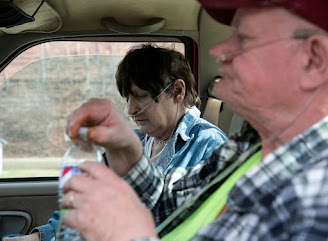
Betty and Courtney Stone arrived at 10 and waited three hours.
Now, the couple said they struggle to afford even their monthly supply of what they consider to be staple foods.

“By the time you buy your mayonnaise, ketchup, salt and pepper and eggs, oh the [price of] eggs, they went crazy … we might have only $5 left on our SNAP card,” Beatty Stone said.

As the couple passed the time by listening to a Christian radio station, Courtney Stone said he feels betrayed by the government. The couple — each of whom also collect $680 a month in Social Security benefits — said they are most upset about not being able to go to church as often because they cannot afford the price of gas.

“How can you give something and then take it away?” he asked. “They didn’t lower taxes. They didn’t lower the price of everything else.”

But as he took another hit of his cigarette, Courtney said he was slowly coming to accept his predicament.

“The thing is, you were born to die,” he said.

Ryan Quarles, a Republican who serves as Kentucky’s agriculture commissioner, also hopes Congress weighs in on ways to alleviate hardship, although he added he’s not ready to endorse a return to pandemic-era benefit amounts.

“Food insecurity in Kentucky has reached catastrophic levels,” said Quarles, a candidate for the GOP nomination for governor. “There is no excuse for a state that produces so much food to have any Kentuckian go to bed hungry.”

But outside the Hazel Green Volunteer Fire Station last week, the line for free food kept growing. The number of people in line easily eclipsed the total population of Hazel Green before the pantry opened, reflecting how the donation program has become a source of food for people throughout western Kentucky.

As 74-year-old Martha Miller and her daughter, Mary, waited in line, they said they’ve started using centuries old Appalachian Mountain cooking tips to save on food costs.

If a recipe calls for eggs, use shortening instead. A can of cream and two cups of water can make the equivalent of 1 percent milk. And save bacon grease to use later as shortening.

“I don’t buy fresh vegetables anymore. I can’t afford them,” Martha Miller said. “I don’t buy eggs anymore. I can’t afford them.”

But for some people in line, even food conservation is not enough to keep them fed all month.

About an hour after the 1 p.m. food giveaway began, Henry Tolsen pulled his 30-year-old pickup truck to the back of the line. He settled in for an anxious three-hour wait, worrying whether any food would be left for him.

Tolsen, a tobacco and corn farmer who went bankrupt after a flood took out his crops in 1997, saw his monthly food stamp benefit reduced last year from $240 to $30 a month.

He also receives $1,000 a month in Social Security benefits to help pay his bills and keep gas in his truck. But Tolsen, 58, who is divorced and lives alone with his pet chiweenie, said he’s starting to eat just one meal a day.

“Yesterday, I only ate a bowl of cereal and a can of peaches,” said Tolsen, as he turned off his truck to save gas until the line started moving again. “I would like to be able to eat bacon and eggs, biscuits and gravy for breakfast, a decent lunch, and a homegrown supper like I used to.”

Although the Hazel Green Food Project hands out food until they run out, there is usually little to offer those at the back of the line, which was not lost on Tolsen.

“If they run out, I go home empty-handed,” Tolsen said. “Let’s just pray and thank the good Lord I will get my disability check.”

At about 5 p.m., Tolsen reached the front of the line. Volunteers handed him three venison steaks, two heads of cabbage and three bags each of potatoes, carrots and fried pork rinds.

Although Tolsen had food again, he drove away questioning whether his government really cared about him.

“I know everyone was happy to get that stimulus, but they didn’t realize there is going to be a payday, and we are paying for it now,” he said. “How did the government give us anything when they let inflation get so high we can’t live and we are going to starve out?”

Thursday, January 5, 2023

S.C. high court is first in U.S. since Roe repeal to find abortion right in state constitution; Idaho says no; Ky. case still pending

By Al Cross
Kentucky Health News

The South Carolina Supreme Court has become the first to find a right to abortion in a state constitution since the U.S. Supreme Court said last June that there is no such right in the U.S. Constitution.

The Kentucky Supreme Court might have been the first, tentatively, but it still has not ruled in a case that it heard Nov. 15. Since then, two justices have retired and two new ones have been elected, and they can rehear the case or just watch and read the arguments, Supreme Court Clerk Kelly Stephens said, adding that she does not expect a decison this month.

Meanwhile, the Idaho Supreme Court declined Thursday to find a right to abortion in that state's constitution. The vote was 3-2, the same as in South Carolina, but with the opposite result.

The South Carolina justices said the state’s ban on abortion afer the sixth week of pregnancy violated the state constitution's explicit guarantee of privacy rights. Kentucky's constitutional privacy rights rely on unspecific language and previous interpretations by the state Supreme Court.

South Carolina’s constitution says “The right of the people to be secure in their persons, houses, papers, and effects against unreasonable searches and seizures and unreasonable invasions of privacy shall not be violated.”

The court's majority opinion said any limit of privacy rights “must be reasonable,” meaning that a woman needs “sufficient time to determine she is pregnant and take reasonable steps to terminate that pregnancy.” The court said that six weeks is “quite simply, not a reasonable period of time for those two things to occur” because “women typically do not realize they are pregnant until around six weeks.”

Kentucky also has six-week ban, but also a stronger ban, allowing abortion only to save the woman's life. The latter was in a "trigger law" that took effect after the U.S. Supreme Court struck down Roe v. Wade.

A Louisville judge issued an injunction that blocked the trigger law, but a state Court of Appeals judge blocked the injunction, allowing the law to take effect. A fractured Supreme Court allowed it to stay in effect while it considered the case. It set the hearing for a week after the Nov. 8 election, in which voters defeated a proposed amendment to the state constitution, saying it does not grant a right to abortion or funding of it.

At least initially, the Supreme Court's ruling will be on the injunction, not on the merits of the lawsuit, but a key piece of injunction law is the likelihood of prevailing on the merits.

Similar challenges to state abortion laws, citing state constitutional proviosions, are pending in Arizona, Georgia, Indiana, Iowa, North Dakota, Ohio, Utah, Wisconsin and Wyoming, according to Politico.

Four of the South Carolina court’s five justices are registered Republicans; Chief Justice Donald Beatty, who voted with the 3-2 majority, is a Democrat. All five were appointed by the Republican-conrolled legislature. Kentucky judges are elected by the people in nonpartisan races.

Monday, January 2, 2023

Former deputy secretary in Ky. is Arkansas human services chief

Kristi Putnam
Kristi Putnam, who was deputy secretary of the state Cabinet for Health and Family Services during the administration of Republican Gov. Matt Bevin, has been named secretary of the Arkansas Department of Human Services by Gov.-elect Sarah Huckabee Sanders.

"Kristi and I share a vision for bold reforms that support our neighbors in need, care for our most vulnerable, protect children in foster care, and ensure Arkansans are not trapped in a lifetime of poverty," said Sanders, who was White House press secretary for Donald Trump and is the daughter of former Gov. Mike Huckabee.

Putnam, 51, said in the same news release, "We will protect our fellow citizens while prioritizing reforms and identifying efficiencies and taxpayer savings, which is what I have done throughout my career." In Kentucky, Putnam "oversaw cross-cabinet reforms in health policy, human-services delivery system design, workforce strategies, and child-welfare improvements while leading an organization with more than 8,000 employees and a budget exceeding $14 billion," the release says.

She was most recently chief personnel officer for AppHarvest, the agritech startup with huge vegetable greenhouses in Kentucky. Before that, "She co-founded Connecting the Dots Policy Solutions, which provided policy guidance for the U.S. Department of Health & Human Services, the Kentucky House of Representatives, the State of Arkansas and several other health plans," the release says.

Tuesday, November 22, 2022

State Sen. Ralph Alvarado, head of Senate health committee, will resign to become state health commissioner in Tennessee

State Sen. Ralph Alvarado
Republican state Sen. Ralph Alvarado, a Winchester physician who chairs the state Senate's Health and Welfare Committee, is resigning his seat to become health commissioner in Tennessee.

The office of Gov. Bill Lee said Alvarado will resign his seat before taking office Jan. 16. That indicates that the special election to succeed him will not be called by Democratic Gov. Andy Beshear, but by Senate President Robert Stivers, since the legislature will convene Jan. 3.

“It’s an honor to join Governor Lee’s team to advance health and prosperity for every Tennessean,” Alvarado said in a prepared statement. “I appreciate this opportunity and look forward to serving individuals and families across the Volunteer State.”

Tuesday, August 23, 2022

Agency that handles Medicare and Medicaid says it will propose a rule next spring for minimum levels of staffing in nursing homes

Photo from RTI.org
Efforts to require minimum levels of nursing-home staffing, which have failed in Kentucky and some other states, are now focused on the federal level, where the Biden administration is working on it.

The Centers for Medicare and Medicaid Services says it will issue a draft rule in spring 2023 after studying the issue and gathering opinions of stakeholders.

CMS says it has received more than 3,000 comments from "advocacy groups; long-term care ombudsmen; providers; labor unions and organizations; nursing home staff and administrators; industry experts and researchers; family members; and caretakers of nursing-home residents," reports Bridget Early of Inside Health Policy.

"A vast majority of the comments CMS received from families, beneficiary advocates and caretakers of nursing home residents highlighted deep concerns about unsafe care stemming from a lack of staff," Early reports. CMS said, “Multiple comments stated that residents will go entire shifts without receiving toileting assistance, leading to falls or increased presence of pressure ulcers.”

The nursing-home industry told CMS "that staffing in nursing homes has not rebounded from the Covid-19 pandemic and recruiting is a challenge -- and facilities will allegedly have to close because they are unable to meet minimum staffing levels," Early reports.

Sunday, August 14, 2022

CJ visits Illinois abortion clinic; Bristol clinic closer to much of Ky.

With almost all abortions illegal in Kentucky, at least for the time being, and largely unavailable in most other bordering states, Sarah Ladd of the Louisville Courier Journal went to the abortion clinic in Granite City, Ill., to describe how it has become a medical magnet for women from 19 states.

"On the day Roe v. Wade fell, hundreds of people called the Hope Clinic," Ladd reports. "Front-desk employees of the Granite City abortion clinic usually field no more than 200 calls a day. But when the U.S. Supreme Court overturned the federal right to abortion on that day in June, more than 600 people called the office seeking help. For many in the surrounding region, the Land of Lincoln suddenly became the only place to legally access abortion, following a series of state "trigger" laws banning or severely limiting the procedure."

Supporters post signs at the Tennessee clinic, above, and the
new Virginia clinic. (Photo by Sam Whitehead, Kaiser Health News)
But Granite City isn't the only abortion magnet within a few hours' drive of most Kentuckians. Sam Whitehead of Kaiser Health News reports that a doctor at Bristol Regional Women's Center in Bristol, Tenn., got an out-of-state abortion provider to open Bristol Women's Health a mile away in Bristol, Va., because of the change in the law. Tennessee's ban on abortions after six weeks of pregnancy takes effect Aug. 25.

Bristol, Va., is closer than Granite City to the geographic center of Kentucky, Lebanon; and to the state's center of population, which is near Willisburg, 20 miles north-northeast of Lebanon. According to Google Maps, they're 4 hours and 40 minutes and 4:45 from Bristol, respectively.

A Memphis-based abortion provider is planning to open a clinic this month in Carbondale, Ill., which is three and a half hours from Louisville, about 20 minutes less drive time than Granite City. When the clinic opens, Lebanon will be about the same distance from it as from the Bristol clinic. 

Bristol is two hours from Middlesboro, on Kentucky's southeastern corner; 2:10 from Pikeville; three hours from Corbin; and 3:40 from Somerset.

The owner of the Bristol clinic is Diane Derzis, who owned the Mississippi clinic that lost the Supreme Court case, Dobbs vs. Jackson Women's Health Organization. "Derzis said a doctor at the Bristol Regional Women’s Center reached out to her with the idea for the Virginia clinic," Whitehead reports.

"Derzis said the Tennessee and Virginia clinics are separate, distinct operations. . . . She said she’s working to offer abortions to people across the Southeast who have lost access as states restrict the procedure. She opened Las Cruces Women’s Health Organization in southern New Mexico in late July after closing her clinic more than 1,000 miles away in Jackson."

Like almost any abortion clinic, the one in Bristol has already drawn protesters. "On a recent weekday morning, a handful stood on the sidewalks around the clinic holding large anti-abortion signs," Whitehead reports. "On the clinic property, a group of volunteers who call themselves the Pink Defenders had put up pro-abortion rights signs and hung large sheets in various shades of pink and purple around the clinic parking lot."

In Granite City, longtime anti-abortion protesters Daniel and Angela Michael drive from 40 minutes away "several times a week in a purple RV that advertises 'Mobile Medical Unit' and 'Real Hope … Real Help'," Ladd reports. "They run an organization called Small Victories, which provides things such as ultrasounds, formula and diapers to people. 

The Michaels "criticized protesters who name-call and berate patients headed into the clinic as hypocritical," Ladd writes: “They always scream and yell at people and talk them out of abortion, but they won't help them after that,” Daniel said, his voice breaking as he spoke.

"Both he and Angela feel like a lot of crisis pregnancy organizations make it too difficult for people to get assistance, such as requiring classes in exchange for supplies." The Michaels "estimate they’ve turned more than 6,000 potential patients away from the clinic. Two of the couple’s 13 children were adopted from people who had initially come to the clinic for abortions, Daniel said. . . . The couple raises about $100,000 annually and uses the money to drive to the clinic, as well as provide supplies for mothers through the first year after birth, Daniel said."

Tuesday, March 29, 2022

Cameron and 20 other attorneys general, most of them in GOP, sue to overturn CDC mask mandate in public transportation hubs

Attorney General Daniel Cameron has joined 20 of his counterparts in a lawsuit to overturn the Centers for Disease Control and Prevention's rule requiring masks to be worn in public transportation hubs.

The suit "argues that the mandate exceeds the authority of the CDC, noting that the Biden administration continues to use a failed interpretation of a quarantine statute that has been ruled against in court several times," Cameron's office said in a press release.

Cameron said, “With most states now relaxing their Covid-19 requirements, the CDC should follow suit and eliminate the mask mandate for airports, train stations, and other transportation hubs. We believe the current mask mandate exceeds the authority of the agency, and the Biden administration should end it immediately.”

The attorneys general, most of them Republicans like Cameron, argue that the law used to justify the mandate does not authorize such broad measures. only authorizes rules directly related to preventing interstate spread of disease, and does not permit mask requirements for individuals who show no sign of infection, the release says. The suit also argues that the rule is arbitrary and capricious and does not consider preventive actions by states.

The other plaintiff states are Alabama, Alaska, Arizona, Arkansas, Florida, Georgia, Idaho, Indiana, Kansas, Louisiana, Mississippi, Missouri, Montana, Nebraska, Ohio, Oklahoma, South Carolina, Utah, Virginia and West Virginia. To read the lawsuit, click here.

Tuesday, March 22, 2022

McConnell, Va. senator poke FDA about lack of action on rules to enforce two-year-old minimum age of 21 to buy tobacco products

Sens. McConnell and Kaine at the University of Louisville's
McConnell Center in 2019 (Courier-Journal photo by Pat McDonogh) 
Senate Republican Leader Mitch McConnell of Kentucky and Democratic Sen. Tim Kaine of Virginia have complained to the Food and Drug Administration about the agency's delay in implementing the law they got passed more than two years ago to raise the minimum age to buy tobacco products to 21.

They also needled FDA Commissioner Robert Califf, who was confirmed by the Senate on Feb. 15, about "the lack of communication regarding the inaction, and asking the commissioner for plans regarding the future," reports Halfwheel, blog about cigars and tobacco issues.

McConnell and Kaine sent Califf a letter March 11 "to express concern about the delays in finalizing regulations related to the Tobacco 21 legislation and the lack of transparency around the implementation and enforcement of that legislation," as they put it. Without updated regulations, "FDA is limited in its ability to punish retailers for potentially violating the new standard," Halfwheel notes.

The senators noted that the FDA's compliance checks of retailers fell off greatly in 2020, with less than half the number of inspections and a third as many warning letters as in 2019.

"Many states and local governments had already passed legislation increasing the minimum age to purchase tobacco products to 21 prior to December 2019 and many more have followed through since then," Halfwheel reports. "By changing state and local laws, it allows for state and local law enforcement to issue warnings and citations to those caught selling tobacco products to people under the age of 21."

McConnell and Kaine asked Califf to respond by Friday, March 25, with a timeline for issuance of the regulations, "including details on the rule’s current status in the review process and an explanation for why FDA did not meet the statutory deadline for issuing a final rule," which was June 2020.

Sunday, January 16, 2022

Feds say Covid-19 home tests will ship directly to users starting Wed., same day they plan to put online the website to order them

The Biden administration says it will begin mailing Covid-19 tests directly to Americans on Wednesday, Jan. 19. That's also the same day it plans to put online the U.S. Postal Service website where they can order the tests.

Administration officials "did not state a specific time on Wednesday when orders could begin," Kelly Lienhard of Inside Health Policy reports. "The officials said the government currently has over 420 million tests under contract and they are confident the government will be able to procure the remaining 80 million by Wednesday." The estimated cost is $4 billion.

The tests are rapid at-home tests that have been granted emergency-use authorization by the Food and Drug Administration. Federal studies "have confirmed the tests can detect the Omicron variant," Lienhard reports.

"Americans can expect to receive the tests within seven to 12 days of placing an order through the website. The government is working with USPS to ship the tests for free to all 50 states and U.S. territories through priority mail. Administration officials said they projected the timing based on typical shipment times, but they anticipate it will be quicker as the program matures."

Orders will be limited to four tests. "Administration officials stressed that the Covid-19 test mailing initiative is only part of its testing strategy and added that there are myriad other ways to be screened for the virus, including through pharmacies and community health centers," Lienhard reports.

President Biden announced Thursday that he had directed the government to procure 500 million more tests. Republican Maryland Gov. Larry Hogan said on CBS's "Face the Nation" Sunday that the federal government was "hijacking" supplies of tests that had been ordered by Maryland and other states.

The world will probably wind up living with the coronavirus, but that approach poses risks, some medical experts warn

"Nations around the planet are making a subtle but consequential pivot in their war against the coronavirus: Crushing the virus is no longer the strategy," reports Joel Achenbach of The Washington Post. "The phrase often heard now in the United States and many other nations is “live with the virus.” That new stance is applauded by some officials and scientists, and welcomed by people exhausted with the hardships and disruptions of this global health emergency entering its third year.

"But there are also disease experts who fear the pendulum will swing too far the other way. They worry that many world leaders are gambling on a relatively benign outcome from this omicron variant surge, and sending messages that will lead people who are normally prudent to abandon the social distancing and mask-wearing known to limit the pathogen’s spread. Epidemiologists say the live-with-it strategy underestimates the dangers posed by omicron."

The consensus among experts is that "Omicron is essentially unstoppable but of limited threat to individuals even as it causes societal chaos," Achenbach reports. "Ali Mokdad, an epidemiologist at the University of Washington’s Institute for Health Metrics and Evaluation, said he believes that about half of the U.S. population will be infected with omicron during the next three months, with most cases asymptomatic." But it will keep sickening and killing people.

The coronavirus has killed more than 5.5 million people, including 850,000 Americans and 13,500 Kentuckians, but the virus and the Covid-19 disease it causes "are now so familiar, they have lost some of their early spookiness," Achenbach writes. "Many nations continue to impose mask requirements, vaccination mandates and travel restrictions, but few leaders in democratic societies have the political capital to take harsh measures to suppress transmission."

So, in the absence of further prevention, what can we expect?  "In the ideal scenario, omicron’s alarming wave of infections will spike quickly, leaving behind a residue of immunity that will keep a broad swath of the population less vulnerable to future infections," Achenbach writes. "This would be the last major, globally disruptive wave of the pandemic. The virus would still be around but would no longer be in a special category apart from other routinely circulating and typically nonfatal viruses such as influenza."

But ideal scenarios often involve wishful thinking. Scientists don’t know how long immunity from having omicron will lasts, and "The virus keeps mutating," Achenbach notes. "Slippery variants packing a more powerful punch could yet emerge, and virologists say that, contrary to what has sometimes been conjectured, viruses do not inexorably evolve toward milder strains."

Some of the doctors "who advised President Biden during the presidential transition have urged a reset of the strategy to recognize the 'new normal' of the virus, which has little chance of being eradicated and will probably continue to cause typically mild illness and require vaccination boosters at a frequency yet to be determined," Achenbach reports.

But others say that approach has risks. James Lawler, co-director of the University of Nebraska’s Global Center for Health Security, told Achenbach, “If we just completely let everything go and allow the omicron epidemic to run its natural course, we’ll completely overrun our health system and be left in a situation potentially worse than what we experienced in early 2020.”

Lawler worries about the lack of precautions among the public. "Earlier this week, he went to a grocery store and was virtually alone in wearing a mask," Achenbach reports. "That’s the norm, he said, in Omaha." Lawler said, “We should have learned by now the only way to get high levels of compliance like this is to make it mandatory. That’s what happened with seat belts.”

Around the world, Achenbach writes, "There is fatalism mixing with pandemic fatigue and, in some countries, science denial or ideological rejection of the restrictions and mandates that many public-health experts consider to be common sense measures in a pandemic. And anecdotally, people may rationally feel the battle is lost, the virus has won.

"Public health officials warn that this is a dangerous attitude. It’s true that for an individual, risk might be low. But when a virus spreads as quickly as omicron does, the equation suddenly spits out alarming results — millions of people sick at once, many of them with underlying conditions that have already put them on the edge of a cliff and vulnerable to a shove."

Wednesday, July 21, 2021

National settlement would bring Kentucky and its local governments $460 million over 18 years to fight opioid epidemic

Opioid tablets (Getty Images photo)
Kentucky's Daniel Cameron and other state attorneys general announced Wednesday a tentative settlement with the nation’s three top drug distributors and drug maker Johnson & Johnson for their role in "creating and fueling the opioid epidemic," as a Cameron press release put it.

The $26 billion deal with J & J, Cardinal Health, AmerisourceBergen and McKesson Corp. would resolve more than 4,000 claims that states and local governments have made in various courts, and bring an estimated $460 million to Kentucky, which state and local governments would split 50-50 over 18 years.

"The substantial majority of the money is to be spent on opioid treatment and prevention," Cameron said at a briefing. His release said "Each state’s share of the funding has been determined by agreement among the states using a formula that takes into account the impact of the crisis on the state – the number of overdose deaths, the number of residents with substance use disorder, and the number of opioids prescribed – and the population of the state."

Kentucky has been one of the states hardest hit by opioid abuse, which the pandemic has worsened. It had the second-highest percentage increase in overdose deaths in 2020.

The state's use of its share would be overseen by a new Opioid Abatement Advisory Commission, authorized by the law the legislature passed to create the 50-50 split.

States have 30 days and local governments 150 days to adopt the settlement. Connecticut Attorney General William Tong said on PBS that he expects all states to adopt it. "A huge majority of states must sign on for the deal to proceed, although the companies have not specified an exact number," reports Jan Hoffman of The New York Times. "If that threshold is not met, the companies could walk away and litigation would resume."

If that happens, Cameron said he would continue fighting in court, and "Justice ultimately will be served."

The agreement "leaves thousands of other lawsuits against many other pharmaceutical defendants still unresolved, including manufacturers, drug-store chains and smaller distributors," Hoffman notes. "Most of those companies are working on negotiating their own deals, which could potentially bring even more money to states, cities, counties and tribes. Purdue Pharma, the maker of OxyContin and its owners, members of the billionaire Sackler family, are negotiating a $4.5 billion settlement with plaintiffs as part of a bankruptcy restructuring."

Republican state Rep. Danny Bentley of Russell, who sponsored the law on the settlement, called the deal "an important step toward remediating the opioid epidemic in Kentucky. Our citizens have suffered for far too long, and this settlement, once final, will allow Kentucky to combat that suffering."

Under the agreement, Johnson & Johnson would stop selling and promoting opioids, and the three distributors would create a centralized, independent clearinghouse for data and analytics "about where drugs are going and how often, eliminating blind spots in the current systems used by distributors," Cameron's release said. They would "terminate customer pharmacies’ ability to receive shipments, and report those companies to state regulators, when they show certain signs of diversion." Also, they must "prohibit sales staff from influencing decisions related to identifying suspicious opioid orders" and "require senior corporate officials to engage in regular oversight of anti-diversion efforts."

Under a headline, "Too Little, Too Late?" The Economist says, "The payments cannot eradicate the damage that has been done. (Indeed, the companies continue to deny any wrongdoing.) The Centers for Disease Control and Prevention estimate that almost a half a million Americans died from opioid overdoses between 1999 and 2019. And the crisis is far from over. Almost three-quarters of recorded overdose deaths in America last year were linked to opioids."

Sunday, June 27, 2021

Louisville-based columnist for Washington Post includes Beshear and two other governors among list of heroes of the pandemic

Govs. Andy Beshear, Mike DeWine (Ohio) and Jay Inslee (Wash.)
By Perry Bacon
The Washington Post

I was relieved in 2019 when voters in Kentucky, where I live, rejected giving then-incumbent Gov. Matt Bevin (R) a second term. Unlike Bevin, who spent his time in office on Trump-like attacks on the press, judiciary, teachers and other institutions, his opponent Andy Beshear was at least a small d-democrat. My worry was that Beshear was also a big-D Democrat — the kind of blah, status-quo figure the party often churns out, who isn’t particularly good at politics or governing. After all, the main reason he won was that people in Kentucky disliked Bevin and had good memories of Steve Beshear, the former governor and Andy’s dad.

I was totally wrong about Andy Beshear. As Covid-19 struck, the usually mild-mannered governor was aggressive early, emphatically emphasizing the dangers of the virus in ways that helped get people in the state to take it seriously sooner than we might have otherwise. He issued a stay-at-home order and required business closures before many other states did — a bold move, considering the Republicans who hold most of the power in this bright-red state wanted to take their cues from President Donald Trump. In his almost-daily news conferences, Beshear was reassuring and optimistic about how the state could limit sickness and fatalities if we all followed public health guidance. It was a moment of real leadership — and it saved lives.

Beshear, of course, isn’t the only person who rose to the occasion. So here is my list of some of the people who provided outstanding service to the country during the worst stages of the pandemic. I consulted with journalists, government officials, policy experts and others, but these are solely my choices. It no doubt leaves out many who did important work. I also do not mean to minimize the failures of government and society more broadly that could have prevented more death and suffering. Nor do I want to suggest that the fight is over — deaths from Covid-19 are way down, but 370 died of the virus Wednesday.

A lot of governors were consistently supportive of mask-wearing and other policies advocated by health experts to stop the spread of the virus. And the nation’s governors as a group deserve a lot of credit for managing what my colleague Max Boot has rightly described as one of the most important achievements of U.S. governance — of American adults getting coronavirus vaccines over the past six months.

But it was easier to take aggressive steps if you were a governor (Democrat or Republican) in a blue state. In Ohio, Mike DeWine (R), like Beshear, had to navigate around a lot of conservatives mimicking Trump’s dismissive attitude toward the virus. DeWine’s innovative move to start a lottery to encourage people to take the vaccines became a model for other states and the federal government. Under Jay Inslee (D), Washington was the first state with a major covid-19 outbreak, but the worst of it was stamped out fairly quickly thanks to the leadership of Inslee and other key figures there.

Public health leaders: With the federal government often both downplaying the virus and taking a hands-off approach when Trump was in office, city and state public health directors had to make hard and politically fraught decisions. That led to intense criticism of these officials, including threats of violence, and a wave of resignations or outright ousters. But these local officials took actions that saved lives during the heat of the pandemic. It would be impossible here to list every standout official, but I will single out Ohio’s Amy Acton, Santa Clara County’s (Calif.) Sara Cody, Michigan’s Joneigh Khaldun, the Cherokee Nation’s Lisa Pivec and Maine’s Nirav Shah for their exemplary work fighting the pandemic in their communities and states.

Anthony S. Fauci, director of the National Institute of Allergy and Infectious Diseases: The doctor hasn’t been perfect — he made some comments that turned out to be inaccurate and at times prioritized placating Trump over candor with the public. That said, when Trump was in office, Fauci seemed to be the top U.S. official taking the pandemic seriously. That was an extremely important role. It’s hard to imagine all of the mask-wearing, closures and other mitigation efforts that happened before Biden became president without Fauci repeatedly delivering a message that was essentially: “Ignore what the Leader of the Free World says, and take this virus really seriously."

Adam Silver: On the night of March 11, 2020, Trump announced a 30-day ban on people from Europe traveling to the United States to stop the spread of the virus. But in my view, what really convinced Americans that Covid-19 was a super-serious threat was the National Basketball Association deciding that same night to suspend its season. Sports are one of America’s most influential institutions. So when league commissioner Adam Silver was seen to take the virus more seriously than even most elected officials, it had a huge impact, forcing a national conversation and resulting in cancellations and closures across a number of sectors.

President Biden and Ron Klain: Biden entered office with exactly the right approach — making covid-19 the highest priority of his administration. Klain, the White House chief of staff who also managed the U.S. government’s response to Ebola during the Obama administration, has led the implementation of that approach, both communicating that strategy in a calm and reassuring manner and executing it.

Vaccine scientists: Having vaccines rolled out so quickly was a critical success and a huge credit to the scientists and companies who worked on them, both those working in government agencies such as the National Institutes of Health and at companies such as Johnson & Johnson, Moderna and Pfizer. Barney Graham and Kizzmekia Corbett of NIH were among the key figures in the vaccine development process.

Health-care workers: More than 3,600 health-care workers died of Covid-19 over the past year, according to an analysis done by The Guardian and Kaiser Health News. That is significantly larger than the number of U.S. military deaths — about 2,300 — in Afghanistan since 2001. This was a kind of war, and health-care workers were our front-line troops, risking their lives for us all.

The American people: Millions of Americans stayed home for much of the past year, wore masks, supervised online schooling for their children, stopped seeing friends and family, and took newly developed vaccines. We needed leaders such as Beshear and Fauci, but we also needed Americans to become health leaders in their individual circles. America’s covid-19 year was terrible in so many ways. But it also showed that there are a multitude of great leaders among us.