Showing posts with label working poor. Show all posts

Thursday, February 15, 2024

Beshear lieutenants tell Senate that the House didn't budget enough for Medicaid, based on enrollments they have projected

By Deborah Yetter
Kentucky Lantern

The state Senate began its review of the House two-year budget proposal Feb. 14, starting with Medicaid, which spends $15 billion a year to provide health coverage and other services to about 1.5 million Kentuckians who are low-income, disabled or meet other criteria.

The Senate Appropriations and Revenue Committee heard from Eric Friedlander, secretary of the Cabinet for Health and Family Services, and John Hicks, budget director for Gov. Andy Beshear — chiefly about their concerns over cuts in the state’s share of the program that gets 70%' to 80% of its money from the federal government.

Health Secretary Eric Friedlander said the best way to cut Medicaid
rolls is to attract better-paying jobs with health coverage. State Budget
Director John Hicks is at his right. (Kentucky Lantern photo by Deborah Yetter)
“This creates a hole in the Medicaid budget for Fiscal Year '25,” which begins July 1, 2024, Hicks told the committee. He said the House’s proposed budget for FY 2026 does not cut Medicaid.

Advocates worry the House plan could force cutbacks in Medicaid services in FY 2025 through more than $900 million in cuts to the amount sought by Beshear, a Democrat, in his budget proposal.

Republicans, who firmly control both chambers of the General Assembly, will enact the final budget.

Jason Bailey, executive director of the Kentucky Center for Economic Policy, told the Kentucky Lantern that overall, the House plan cuts about $139 million in state funds Beshear sought for Medicaid in FY 2025, which would cause the state to pass up, another $783 million in federal matching money for a total of around $922 million.

Rep. Jason Petrie (R-Elkton), chairman of the House budget committee, has said the House presumes fewer people will be enrolled in Medicaid, now that the federal government is requiring enrollees to recertify annually that they are eligible. That requirement was dropped during the public health emergency of the Covid-19 pandemic.

But Hicks said state budget forecasters worked hard to project how many people will leave Medicaid—so far, around 200,000—and develop an accurate count for the governor’s budget proposal. “We’ve incorporated those numbers into the budget forecast,” he said.

Advocates are hopeful the Senate will restore the state’s share of funds for Medicaid.

Committee members made few comments as they listened to the Beshear administration officials.

Sen. David Givens, R-Greensburg, expressed concern about the growth in Medicaid, which covers about a third of Kentuckians, including more than a half million children and most nursing-home residents.

Givens asked how to reduce the number of Kentuckians enrolled in Medicaid. Friedlander said most adults who are in the prohgram and not disabled or elderly are working at low-wage jobs without health insurance.

“Getting higher-wage jobs, that’s the way that you work on having fewer people eligible for Medicaid,” Friedlander said. “I think that will make as big a difference as anything else.”

Givens suggested a committee meeting during the interim after the legislative session ends to discuss specific ways to reduce the Medicaid rolls, noting that Medicaid has grown significantly during his 15 years as a legislator. The big jump was in 2014, when the state expanded it under the 2010 Patient Protection and Affordable Care Act to households with incomes up to 138 percent of the federal poverty threshold.

Thursday, December 14, 2023

Travel for abortions, mainly from states like Kentucky, has doubled following Supreme Court decision, and can pose many difficulties

OPINION By Katelyn Jetelina
Your Local Epidemiologist

This week, Kate Cox got an abortion, but had to leave Texas, where she lives, to get it. She joined more than 9.3 million Americans who got a legal abortion in the past 10 years, of which 8,300 (0.9%) got one after 20 weeks of gestation. (Texas and Kentucky have similar, near-total bans on abortion.—Editor.)

I’ve seen many on social media wonder: What’s the big deal? She found the health care she needed after all; and this cross-state journey is rare, right?

Forced abortion travel has doubled following the U.S. Supreme Court's Dobbs ruling. And if you’re one of the lucky few who can travel, this journey isn’t without very real challenges that may not be apparent to the unseen eye.

The journey for an abortion looks very different depending on who you are. In general, though, many challenges could be prevented if we, as a society, accepted abortion as health care.

First, many people’s journeys stop before they begin. It can take a lot of cash—plane tickets, rental car, hotel rooms, food, and procedure. This adds up to about $10,000 to $30,000. As you can imagine, many people can’t afford this, and often, insurance doesn’t cover it. Half of all abortion seekers live below the federal poverty level—an income of less than $13,000 a year. This is especially true for adolescents and teens (who make up a big number of later abortion patients), undocumented people, and parents.

If they make the journey, it’s not without other hard realities:
  • Pain meds are available. For those later in pregnancy, though, it doesn’t do much. You may not have access to an epidural, depending on the state’s regulations, because you’re at an outpatient clinic. This is unimaginable pain—in all senses of the word.
  • Your partner can’t be there to support you during labor, like hold your hand, or coach you through pain. You can’t have a phone, either. Tight security is required at abortion clinics. In the same vein, you walk past protesters yelling at you every morning and every night for a week. You wish, with all your heart, you could enjoy the same level of ignorance.
  • Recovering in a hotel room means a cold, unfamiliar place. Without your slippers, without your bed, without your cat, and without access to the comfort food you crave. All you want to be is at home.
  • The journey means needing time off from work and getting your Family Medical Leave Act form signed by a physician in another state. All you hope is that your employer won’t ask questions because you don’t have any energy to explain.
  • The journey may include carrying the baby’s ashes on an airplane. This requires holding back a flood of emotions in public—exhaustion, grief, anxiety, pain, a strong desire for privacy.
  • People who have abortions are no more likely to struggle with mental health than the people who do not—in fact, not getting a needed abortion has been found to increase anxiety and depression in the first 12 months. But there are emotional costs in needing to travel, and much of that is driven by stigma and ostracization of abortion care. Also, recognizing when you need help (remember you don’t have a follow-up appointment with your OB) and finding the right clinician or therapist, given the unique circumstances and the trust required, is hard.
Two things help. First, confidence in making the right decision: 95% of people who have an abortion say it was the right decision for them. The most common emotion reported afterward is relief. Second, health-care workers—literally angels on earth—at the abortion clinic ensure moments of human connection, empathy, and support. You feel cared for, which helps tremendously. And the rare souls you trust with your story like family, friends, and clinicians thereafter also help tremendously.

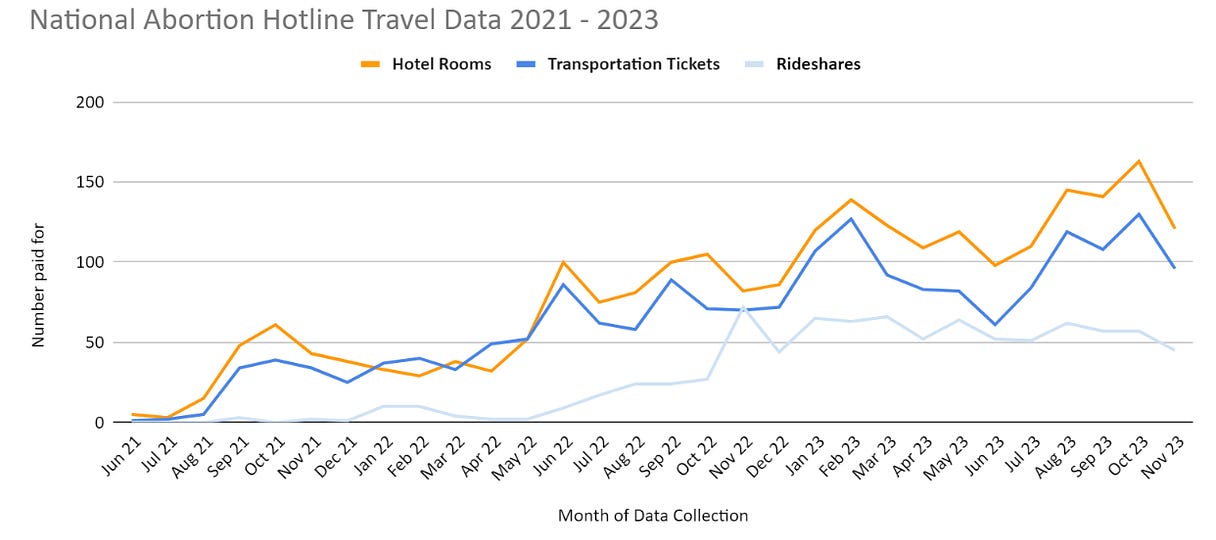
This journey is becoming more common. Before Dobbs, 1 in 10 women having abortions had to travel. Now the rate has doubled, to 1 in 5. We see increased travel from many angles. While the number of abortions across states has greatly shifted post-Dobbs, the national average hasn’t budged.
Calls to the National Abortion Hotline for travel services, like hotel rooms and plane tickets, have tripled post-Dobbs and remain high.

Map from National Abortion Federation, based on data from its National Abortion Hotline
Scientists who measured distance to abortion facilities found average travel time also tripled post-Dobbs.

This speaks to why we see increases in self-managed abortion (i.e., medication abortion). It’s also why colleagues in Latin America, for example, have been supporting people to self-manage with pills up to 24 weeks of pregnancy, which is safe and effective.

An increasing number of women are traveling out of state for reproductive health care. This journey isn’t without very real obstacles. The most tragic part is much of the associated trauma is preventable if we had access to local health care.

It may be hard to understand, but it’s harder for people to live through. Trust women. Listen to their stories. Trust their voices. It is, after all, their lives and their livelihoods.

(A big "thank you" to Dr. Heidi Moseson, a reproductive epidemiologist who helped immensely with much of this piece’s research.)

If you want to support travel for abortions, here are some great options: The Brigid Alliance supports people who are traveling for abortions at 15+ weeks. The National Network of Abortion Funds a collective of over 100 abortion funds across the U.S.

“Your Local Epidemiologist” is written by Dr. Katelyn Jetelina, MPH, Ph.D.—an epidemiologist, data scientist, wife, and mom of two little girls. During the day, she works at a nonpartisan health policy think tank and is a senior scientific consultant to a number of organizations. At night she writes this newsletter. Her main goal is to “translate” the ever-evolving public health science so that people will be well-equipped to make evidence-based decisions.

Saturday, September 2, 2023

Cameron declines to give more details of plan for work rules in Medicaid; Beshear says Cameron 'heck-bent' on cutting benefits

At a happier time: In 2019, Gov. Andy Beshear appointed Daniel
Cameron attorney general to succeed him after they each won
offices with different starting dates. (AP photo by Bruce Schreiner)
Kentucky Health News

Gov. Andy Beshear said Thursday that Attorney General Daniel Cameron, his opponent in the Nov. 7 election, appears "heck-bent" on changing the Medicaid program in ways that would lead to some people losing their benefits.

Cameron said at a Kentucky Farm Bureau forum July 26 that "one of the first things I would do as governor" is seek federal approval for a requirement that able-bodied adults on Medicaid work to maintain their coverage. His campaign said later that adults would have to work, be enrolled at least part-time in college or be involved in job training or community service, and quoted him as saying, “We will protect the truly vulnerable but we will not allow able-bodied people to take advantage of taxpayer generosity.”

Cameron said in a KET debate during his May primary campaign that the work requirement could be met by 20 hours a week of "volunteer" work, as was proposed by Beshear's predecessor, Republican Matt Bevin.

Asked Wednesday whether his plan would be substantially similar to Bevin's, or how it would be different, Cameron said, "Well obviously, as I move into the governor's office, I'll obviously consult with my team about the specifics."

The next day, at his weekly press conference, Beshear shot back: "When asked about it, he didn't know how he was going to do it. I guess he's just heck-bent on ensuring that 100,000 Kentuckians can't go to a doctor when they're sick."

The Bevin administration estimated that its plan would reduce the state's Medicaid rolls by 95,000 over five years, largely because some Medicaid beneficiaries would be unwilling or unable to comply with its rules, including paperwork to certify their eligibility. The administration reduced that estimate to about 79,000, but academic health experts said in a lawsuit challenging the plan that a more likely range was 175,000 to 297,500.

The Courier Journal's Joe Sonka asked Cameron how many able-bodied Medicaid recipients in Kentucky are not working.

Cameron replied in an email, "It's not a specific number that matters, but rather the general principle that able-bodied people should work. "Why should a middle-class taxpayer subsidize an able-bodied person because they have become so dependent on the government? Let’s get that person the skills they need and get them back on the job."

Beshear's campaign has been running a television commercial about the issue. Sonka took a close look at the issue and did a fact-check.

Friday, July 28, 2023

Cameron says that if elected governor he would resume efforts, thwarted by federal court, to add work requirement to Medicaid

Attorney General Daniel Cameron
Attorney General Daniel Cameron said Wednesday that if elected governor he would quickly restart Republican efforts to "require some able-bodied adults to work in exchange for health-care coverage through Medicaid," Bruce Schreiner writes for The Associated Press.

When Republican Matt Bevin was governor, he tried to require able-bodied Medicaid recipients who were not caregivers to work, enroll at least part-time in education or job training, volunteer, or perform other “community engagement” activities to qualify for benefits. A federal judge in Washington, D.C., blocked the move, saying it was not allowed under the 1965 law that created Medicaid and Medicare and noting state estimates that almost 100,000 people would lose coverage, mostly 

After Democrat Andy Beshear defeated Bevin in 2019, he dropped the state's appeal of the court decision, saying his action was the “moral, faith-driven thing to do.” Beshear calls health care a “basic human right,” Schreiner notes. Cameron said Medicaid work rules would be “one of the first things I will do as governor.”

Cameron raised the issue in the primary election, and Wednesday in answering a question about Kentucky's low workforce participation rate at a Kentucky Farm Bureau Federation forum that Beshear did not attend.

“If we want the plan and the coverage to exist and remain solvent for those that are means-tested and medically necessary, we need to make the program, as best as possible, transitory – something that folks will come off of if they are able-bodied individuals,” he said.

In a statement issued later by his campaign, he said, “We will protect the truly vulnerable but we will not allow able-bodied people to take advantage of taxpayer generosity.” The campaign said the plan would exclude able-bodied adults who are “truly vulnerable,” including those with children or who are pregnant.

Work rules require waivers from the federal government. Bevin got one from the administration of Donald Trump, but Joe Biden's Department of Health and Human Services has generally resisted the idea.

Schreiner notes, "Medicaid is a joint federal and state health-care program for poor and disabled people. Advocates have said work requirements would become one more hoop for low-income people to jump through, and many could be denied coverage because of technicalities and challenging new paperwork."

Kentucky's Medicaid rolls grew by hundreds of thousands in 2014 when then-Gov. Steve Beshear, the current governor’s father, expanded the program to cover able-bodied adults under the 2010 Patient Protection and Affordable Care Act, generally known as Obamacare. "For many Kentuckians," Schreiner notes, "it was their first time to have health coverage in a state plagued by high disease rates."

Monday, December 21, 2020

Work on successful lawsuit against changes in Medicaid earns Rich Seckel the Gil Friedell Healthy Policy Champion award

Rich Seckel
UPDATE, Dec. 21: Seckel was named the Gil Friedell Health Policy Champion award, which comes with a $5,000 grant to a Kentucky-based nonprofit of his choice. (The original version of this story was published Dec. 13.)

The point man in a lawsuit that blocked changes to Kentucky's Medicaid program has been honored for his work by the Foundation for a Healthy Kentucky.

Rich Seckel, director of the Kentucky Equal Justice Center, which helps legal-service programs in the state, was named a Healthy Kentucky Policy Champion "for his work to protect health care coverage gains for persons living on low incomes in Kentucky," the foundation said in a news release.

The foundation gives the award to Kentucky individuals and organizations who help improve the health of people in their communities and/or the state through policy change.

Under Seckel 's direction, the KEJC filed a lawsuit that kept then-Gov. Matt Bevin from implementing a federal waiver that would have added work requirements, premiums and administrative penalties to Medicaid.

The waiver application said the state's Medicaid rolls would have 95,000 fewer people five years after implementation than they would have without it, much of it from noncompliance with the new rules.

Seckel was nominated by Louisville psychologist and mental-health advocate Sheila A. Schuster, who was one of 2019's Healthy Policy Champions.

"Rich is the absolute epitome of the excellent health policy advocate," Schuster said. "He has offered his considerable policy expertise, outstanding writing skills, incisive analysis and strategic thinking, and his utmost generosity in sharing his time and talents (and that of his staff) to nearly every significant health policy initiative that has happened in Kentucky over the past thirty years."

Jane Perkins, legal director of the National Health Law Program, which worked with Seckel on the lawsuit, said, "Through Rich’s passionate and organized work with a team of legal advocates, KEJC has provided effective advocacy, consumer assistance and empowerment, policy change, and education around social-justice and health issues."

Seckel is a member of the foundation's Community Advisory Council, and was instrumental in the creation of the foundation, leading a coalition effort to use the $45 million in charitable assets of Kentucky Blue Cross and Blue Shield when it merged with Anthem Inc. The money provides the endowment for the foundation's work.

At KEJC since 1979, Seckel often advocates on poverty-law issues before state agencies and the legislature. Before earning a master's in social work from West Virginia University, he was a volunteer boycott organizer for the United Farm Workers.

Nominations for the Healthy Kentucky Policy Champion Award are accepted at any time. See details on the foundation's website.

Sunday, July 19, 2020

Passport Health Plan, which lost its Medicaid contract in recent bidding, is selling key assets to one of the winners, Molina Health

By Lisa Gillespie
Kentucky Health News

Molina Health, in line to be one of Kentucky’s newest Medicaid managers, will be the successor to Kentucky’s oldest one, Passport Health Plan. Louisville-based Passport recently lost out on bidding to stay in the state’s Medicaid business, but its name, brand and networks of doctors won’t disappear after all.

Last year Passport lost out in Medicaid contract bidding under then-Gov. Matt Bevin, and again this year under Gov. Andy Beshear. It has a protest pending, but its announcement Friday indicates that its appeal is moot. Passport’s main business is in Medicaid, so without a state contract, it would have been in dire straits.

Molina is buying “certain assets” of Passport for $20 million, including its name and brand, operations and agreements from health providers to accept Passport payments, the companies said in press releases.

"We firmly believe that this agreement provides the best path forward for Passport members, providers, employees and our community," Passport CEO Scott Bowers said. “The trusted Passport name and brand will live on and, more importantly, this agreement provides continuity of care and coverage for our members during these challenging times for our community.”

Passport has 320,000 clients. It is partly owned by health-care consulting firm Evolent Health, which bought a major stake in January 2020 for $70 million. The purchase is subject to regulatory approval and was expected to close by the end of 2020.

The University of Louisville, which once owned 70 percent of Passport, had 19 percent after the sale to Evolent. Other local owners include University of Louisville Physicians, the Jewish Heritage Fund for Excellence and Norton Healthcare. They are also being bought out, U of L spokesman John Karman said. It’s not clear whether Molina is buying these players out of ownership, since the releases said Molina was buying assets and did not say it was buying the company.

Molina, based in Long Beach, Calif., mainly runs state-based health-insurance exchanges, Medicaid and Medicare plans for 3.4 million people in states from California to Michigan.

“Acquiring the operations as well as transferring over employees of Passport Health Plan provide us with a well-known brand in Kentucky and position us well to compete even more effectively in the market,” said Joe Zubretsky, president and chief executive officer of Molina.

Along with Passport’s loss of a Medicaid contract, Indianapolis-based Anthem Inc. also lost two bids to stay in Kentucky’s Medicaid program.

Anthem has alleged that Molina had an unfair advantage in winning a contract; Molina hired a former employee of Gov. Beshear who was privy to key documents that other bidders couldn’t see. Anthem says that’s just one reason the state should withdraw the contract awards and start over again. Anthem did not respond to an inquiry about the sale of Passport could mean for its appeal of the contract awards.

Passport was formed in 1997 under an innovative project to create managed-care companies that would administer Medicaid benefits, instead of the state doing it directly. Passport was, until the purchase by Evolent, run as a nonprofit. This meant the insurer wasn’t beholden to stockholders; many insurers are publicly-traded corporations.

Virginia-based Evolent in part was brought in to infuse money into Passport, which faced financial troubles that were compounded by when the Bevin administration cut payment rates in the Louisville region. By January, when the sale was announced, Evolent was already running a substantial part of Passport’s administrative business, and supplied staff.

Passport also started on a large project in western Louisville, a historically Black neighborhood with a lack of economic investment from large businesses. It purchased a 20-acre plot of land to relocate headquarters and to create a community health and wellness campus. Molina will purchase that site under a separate agreement, the companies said.

Beshear said when he announced the Medicaid contract awards that Molina had indicated it wanted to take over the project. Asked Friday to comment on the sale, he said it means continuity of coverage and “creates the possibility for a regional headquarters of a multi-billion-dollar company in west Louisville.”

Wednesday, July 8, 2020

Pandemic, job losses and easy eligibility push Medicaid enrollment in Kentucky to a record high

Kentucky Health News chart; state data via Herald-Leader; click to enlarge
More Kentuckians than ever are on Medicaid, due to job losses caused by the pandemic and the resulting relaxation of eligibility rules for the program, John Cheves reports for the Lexington Herald-Leader.

"After slowly falling for two years, the number of Kentuckians enrolled in Medicaid shot up by 10 percent to 1.45 million as tens of thousands of people lost their jobs — and typically, their employer-provided health insurance — following the shutdown of the state’s economy in March," Cheves writes. "That means roughly one in every three Kentuckians was getting health coverage in June from Medicaid." It's about 30 percent.

Medicaid Commissioner Lisa Lee told a legislative committee June 25 that 77,000 of the new Medicaid beneficiaries enrolled under “presumptive eligibility,”  in which the usual Medicaid screening process for enrollment is waived for two months, under an order from Gov. Andy Beshear. “Basically, if you’re uninsured and you’re under age 65, it will get you coverage. Normally with Medicaid, there are all these extra rules,” Dustin Pugel, senior policy analyst at the Kentucky Center for Economic Policy in Berea, told Cheves.

“They’ve sort of been coy,” Pugel added. “They don’t want to broadcast that they’ve created basically a whole new coverage option. It is temporary, both for the folks who are on it and for the program itself, so I don’t think they wanted to tell the world, ‘Hey, we’ve got this new wide-open coverage option for folks who have lost their insurance.’” Presumptive eligibility is scheduled to end Sept. 30.

Lee also told the legislators that the federal government has picked up part of the tab, but the budget impact of higher enrollment is uncertain because the pandemic is unpredictable. "Still, lawmakers say they’re not too worried, yet," Cheves reports: "Moments of crisis like this is one of the reasons for Medicaid, said state Sen. Julie Raque Adams, R-Louisville, a member of the budget subcommittee for health care spending." Adams said, “It’s the right thing to do during this unprecedented time.”

Saturday, May 30, 2020

Rebidding of Medicaid managed-care contracts gets same result: Anthem and Passport to be out on Jan. 1; Passport plans protest

By Al Cross
Kentucky Health News

Hundreds of thousands of Kentuckians on Medicaid will have a new managed-care organizations to deal with when the new year rolls around, because two of the five MCOs serving the state were not among the five winners this week of state contracts for 2021.

Medicaid members of Anthem Health Plans and Passport Health Plan will have to choose from subsidiaries of the five insurers that won the bidding: Aetna, Humana, UnitedHealthcare, WellCare and Molina Healthcare, which apparently hopes to supplant Passport as Louisville's favored MCO. Passport was scored seventh among seven bidders, and Anthem placed sixth.

The two losers and the five winners were the same chosen by the administration of Republican Matt Bevin 11 days before he left the governor's office in December. Democratic Gov. Andy Beshear canceled the contracts and sought new bids, noting the timing, the vote against the contracts by a legislative advisory committee and Bevin's previous criticism of Passport.

Health Secretary Eric Friedlander said terms of the contracts were revised to increase oversight, quality control and transparency. But in the end, the result for the 1.4 million Kentuckians on Medicaid was the same.

"I wasn't a part of it whatsoever," Beshear said Friday. "It's done objectively, and it's done under the law." He noted that the bid scoresheets are posted online. The contracts total almost $8 billion.

Beshear said Anthem "does a really good job" with the state employee health plan, and said Passport "has provided great service and "been an important community member." It is the only not-for-profit MCO in Kentucky and is based in Louisville, where most of its members live. It was created in 1997 as a pilot project to control Medicaid costs in the Louisville area at the state's request.

Passport was building a new headquarters in western Louisville. Beshear indicated that Molina wants to take over the project; he said one company had said it was committed to creating 1,100 jobs in a headquarters in Louisville, and indicated later that the company was Molina, which is based in Long Beach, Calif., and has 3.4 million members.

Evolent Health, which recently bought most of Passport, said they would protest the contract decision, saying that "disrupting insurance coverage and continuity of care during an unprecedented public health crisis could have on some of the most vulnerable members of Passport's community."

The University of Louisville, which once owned 70 percent of Passport, had 19 percent after the sale. Other local owners include University of Louisville Physicians, the Jewish Heritage Fund for Excellence and Norton Healthcare.

Sunday, February 23, 2020

House passes public-assistance bill with plan for temporary health coverage for people who earn too much to stay on Medicaid

By Melissa Patrick
Kentucky Health News

A bill aimed at moving Kentuckians off public assistance includes several health-related provisions, including a new coverage plan for people who lose their Medicaid benefits if their income rises above the limit for the program.

House Speaker Pro Tem David Meade
presents House Bill 1. (LRC photo)
A heavily revised version of House Bill 1 passed the House Feb. 21 by a vote of 58-32. It was along party lines, except one Democrat who voted for it: Rep. John Sims of Flemingsburg.

Other Democrats said the bill was rushed, but Speaker Pro Tem David Meade, R-Stanford, its lead sponsor, said "We are trying to find a good balance between compassion to help those folks in those situation who truly need care and help in these public assistance programs, but also a balance of accountability."

Most of the bill is aimed at cracking down on fraud, but a major part of it would provide a temporary state health-insurance option for Kentuckians who stop being eligible for Medicaid because their income exceeds 138 percent of the federal poverty level, $17,609 for a single person. It would be available for those earning up to 200% of the poverty line, $25,520 for an individual.

This provision addresses the "benefit cliff," the term for the loss of public benefits by people whose earnings exceed limits for programs but who are unlikely to have jobs with health insurance or the money to afford it. Republicans said they had heard stories of people who ask employers not to give them raises so they can keep their Medicaid benefits.

This health insurance program would require premiums and cost sharing to rise 25% for every 15% in income above 138% of the poverty line. Participants could stay in the program for a year after exiting Medicaid, with a possibility of extension on a case-by-case basis.

The Supplemental Nutrition Assistance Program is a major focus of the bill, as is Temporary Assistance for Needy Families. It would remove from the programs individuals who fraudulently misuse their benefits card, or are completely able-bodied adults with no dependents who choose not to participate in a community engagement program, including work, school or volunteering, if such requirements are implemented. It would expand many benefits, with task groups formed to explore further expansions.

Democratic objections

Some Democrats said they agreed with the goals of the bill, but said it was rushed. They questioned its enforcement costs and said it would lead to lawsuits.

"Although there are good elements in this piece of legislation that I'm glad to see move forward, they are really stamped and trampled on by the bad parts of this legislation," said Rep. Charles Booker, D-Louisville.

Meade said, "What you're hearing today is, we like the expansion of benefits, we want to continue to give people more but we don't want to hold anyone accountable."

The House adopted two amendments from Rep. Kim Moser, R-Taylor Mill, one of which had to do with health. It would require the state to apply for a waiver of the rules to allow Medicaid to pay for substance-use disorder treatment for people who are incarcerated.

The bill would ban from Medicaid and other programs people who violate the rules.

For example, those who are convicted of a drug-related felony who are released from incarceration and fail to sign up for substance-use treatment within 90 days of release would be banned from getting Medicaid, but the bill makes provisions for regaining coverage.

Dustin Pugel, policy analyst for the Kentucky Center for Economic Policy, wrote that "a similar ban in SNAP in Kentucky has led to thousands losing food assistance and likely more who never applied due to a past conviction." Further, he writes that "Medicaid law doesn't allow bans contingent on recovery status or for people with a drug-related felony conviction."

If passed, Gov. Andy Beshear's administration would be required to implement the measures within 120 days. Beshear said Friday, "I want to continue to see where they're going, but I don't believe in a system that pushes people off of benefits." Mark Vanderhoff reports for WLKY-TV.

Beshear added, "I believe in a system that encourages people and gives them the tools to get jobs with higher wages where you naturally move off of them. I believe in providing people opportunity -- not consequences."

Medicaid work requirements?

Reflecting Republicans' concern about the cost of the 2014 Medicaid expansion, the bill says that if the state General Fund appropriation for this population reaches half of General Fund spending on Medicaid overall, those who have been on the expansion for a year would have to participate in at least 80 hours a month of "qualifying activities," presumably work, school or volunteering.

That seems unlikely; the Kentucky Center for Economic Policy reports that it is currently only 10.7% of the budget. Such requirements were an integral part of former Gov. Matt Bevin's plan to overhaul the state's Medicaid program. It and a similar plan in Arkansas were blocked twice by a federal judge, and Beshear rescinded the plan soon after taking office in December.

Several lawmakers predicted that this part of the bill would be challenged in court, noting that a federal appeals court recently upheld the rulings against Arkansas's plan. The Supreme Court may or may not hear an appeal.

Meade said it is "well worth the risk" of a legal challenge to these community engagement requirements for able-bodied workers because they have been shown to move people off public assistance and increase their income in other states.

Concerns about fraud

Much of the debate was around the issue of fraud in public assistance programs, an issue that Rep. Nima Kulkarni, D-Louisville, said likely has to do more with perception than reality.

The U.S. Department of Agriculture reports that public-assistance fraud is 1%, and it was mentioned during the debate that it's reported at 2% in Kentucky.

"My concern here is that we are ignoring actual facts, actual numbers . . . and going with opinions and potential numbers that are not in existence, that we have not heard about in this body," Kulkarni said. "In our zeal to counteract the tiny fraction of fraud that may be occurring in Kentucky, we are potentially impacting millions of lives that are using these programs to simply lift their families out of poverty, to put food on the table at night. I really urge the body to think long and hard about the unintended consequences of this bill to those individuals that are properly using the benefits that they so desperately need."

Early in the two-and-a-half-hour debate, Meade corrected a statement he made Feb. 20 that there were studies showing upwards of 40% of fraud in public assistance programs. He corrected that to say that a group had told him that with its current detection systems, Kentucky was likely only catching 30 to 40% of the fraud in the system. When asked who that group was, he declined to answer. But he said he thinks it is higher than 2% because people are very creative when they commit fraud. "To say that we only have a 2 percent fraud rate, that we feel we are catching it all, is just not imaginable in my mind."

But House Minority Leader Joni Jenkins, D-Louisville, said, "I think what we have here is an attempt to go after a gnat, and when you go after a gnat with a sledgehammer, you tend to destroy the whole darn thing."


Friday, February 14, 2020

Federal appeals court strikes down Medicaid work requirements

Gov. Matt Bevin announced his plan in 2016. (WFPL photo)
A federal appeals court ruled Friday against the work requirements that then-Gov. Matt Bevin tried to impose on Medicaid enrollees who were not "medically frail" and had no dependents.

The Trump administration was arbitrary and capricious when it approved Bevin's plan and one in Arkansas, a three-judge panel of the U.S. Court of Appeals for the District of Columbia Circuit ruled unanimously.

The U.S. Department for Health and Human Services essentially ignored the main purpose of Medicaid, which “was to provide health-care coverage to populations that otherwise could not afford it,” wrote Senior Judge David Sentelle, who was appointed to the court by Ronald Reagan.  The Trump administration is expected to ask the Supreme Court to hear the case.

The ruling upheld several by a judge in the D.C. District Court, which scuttled a program Arkansas had started and kept Kentucky's from taking effect. Democratic Gov. Andy Beshear, who defeated Bevin in the November election, rescinded Kentucky's plan soon after taking office in December. Republicans control the state legislature but have shown no interest in enacting Bevin's plan.

The plan had been challenged by 16 Medicaid beneficiaries in the state, who noted the Bevin administration's initial forecast that Kentucky Medicaid rolls would have 95,000 fewer people in five years than without the plan, in large measure because of noncompliance with the requirements to work, attend school or perform community service 80 hours a month and report monthly.

Friday, January 3, 2020

Beshear cancels, re-bids $8 billion in manged-care contracts Bevin awarded; Lisa Lee returns as Medicaid commissioner

Gov. Andy Beshear (Photo from Kentucky Today)
Gov. Andy Beshear has cancelled, and ordered rebidding of, $8 billion in Medicaid managed-care contracts that then-Gov. Matt Bevin awarded to five insurance companies 24 days after Beshear defeated him and 11 days before Beshear took office.

Beshear offered several reasons for his actions at a Dec. 23 news conference, Jack Brammer reported for the Lexington Herald-Leader. He noted that the original request for proposals included provisions from Bevin's plan to change Medicaid, which Beshear recently rescinded.

Bevin's proposal would have required "able-bodied" adults without dependents to work or participate in approved "community engagement" activities 80 hours a month and pay small, income-based premiums monthly to stay covered by Medicaid.

The original proposal projected that in five years the Medicaid rolls would have 95,000 fewer people with the plan than without it, largely because of non-compliance with its requirements, including monthly reporting. Bevin's plan had been twice blocked by a federal judge in Washington, D.C., and was awaiting the decision of an appeals court.

Beshear also noted that members of the legislature's Government Contract Review Committee, which has only advisory powers, unanimously voted to reject the contracts on Dec. 9 "and that Bevin had shown bias against one of the unsuccessful bidders -- Passport Health of Louisville -- by criticizing the company," Brammer noted.

Passport and Anthem Inc., which both have managed-care contracts, were not included among those awarded for the fiscal year beginning July 1, 2020, which the Bevin administration announced Nov. 27. The contracts went to Aetna Better Health of Kentucky, Humana Health Plan and Wellcare Health Insurance of Kentucky, all of which have contracts with the state, and two newcomers, United Healthcare and Molina Health Care.

Passport and Anthem had promised to appeal the awards; Beshear's cancellation of them could create a cause of legal action for the other companies.

About 1.2 million of the 1.3 million low-income and disabled Kentuckians in Medicaid are covered by the managed-care system, in which the companies deal with patients much like private insurance plans.

Beshear said the state would rebid the contracts on an accelerated time schedule, with a request for proposal target date of Jan. 10; responses due Feb. 7; and a goal of selecting providers in April.

Meanwhile, the managed-care program will operate under the current contracts, which Beshear said may require extensions to prevent any loss of coverage.

He told reporters that his decision “has nothing to do with who won or lost in the initial process. The rebidding will be fair. No one is guaranteed a contract."

Lisa Lee
On Jan. 3, Beshear announced that Lisa Lee, who was Medicaid commissioner in the final years of the governorship of his father, Steve Beshear, will return to the job. In her 16 years in the Cabinet for Health and Family Services, she had been a member services representative, director of provider services, a policy analyst and deputy commissioner before becoming commissioner.

“During my time in Medicaid, I saw firsthand how important this program is to Kentucky – from the members it serves to the providers who treat them,” Lee, a native of Hazard, said in a press release. “I am excited to return to Medicaid and assist this administration in developing policies aimed at improving the health of all Kentuckians.”

Saturday, December 21, 2019

Gov. Beshear rescinds Bevin's Medicaid waiver plan but asks federal government to let Kentucky keep four parts of it

By Melissa Patrick
Kentucky Health News

As he promised in his campaign, Democratic Gov. Andy Beshear rescinded defeated Republican predecessor Matt Bevin's Medicaid plan, which included highly controversial work requirements. But Beshear said he also wants to keep using four parts of it.
Beshear signs executive order on Medicaid. (Melissa Patrick photo)

"We were convinced that the only way to address this waiver initially was to fully rescind it and then move forward on addressing or creating those programs that might be beneficial inside of it," he said at a Dec. 16 news conference, where he signed an order rescinding Bevin's request for a waiver of federal rules to implement the plan.

The plan would have required "able-bodied" adults on Medicaid to work or participate in approved "community engagement" activities 80 hours a month and pay small, income-based premiums monthly to stay covered.

Bevin's original proposal projected that in five years the Medicaid rolls would have 95,000 fewer people with the plan than without it, largely because of non-compliance with its requirements, including monthly reporting.

"My faith teaches me that rescinding this waiver is not only the right thing to do, it is the moral, faith-driven thing to do," Beshear said. " I believe health care is a basic human right."

"That's spot on," said Ben Chandler, president and CEO of the Foundation for a Healthy Kentucky. "That's what I was always taught Jesus Christ was about, is about including people and giving them a hand up when and where you could. And that's what this is and I think it's a great thing."

Chandler noted that the foundation had committed to helping the state keep people from losing coverage under the waiver, and could now use those resources for other efforts.

"We had been concerned about the hundred thousand or so people who were predicted to ultimately lose their coverage had the waiver been implemented." Chandler told Kentucky Health News.

Bevin's proposal had already been struck down twice by a federal judge in Washington, D.C., and was awaiting the decision of an appeals court. Beshear told reporters that by ending the waiver, Kentucky would no longer be involved in that lawsuit. Arkansas, which implemented a similar plan before being sued, will remain in the suit.

Beshear's office hinted in a news release that he might use his order as partial grounds for also rescinding "the $8 billion in Medicaid managed care contracts that the previous administration awarded with just 11 days left in the administration. Those contracts were awarded based on the waiver." Legislators in both parties have objected to the awards.

Two days after signing the executive order, Beshear's administration sent a "clarification" letter to the Centers for Medicaid & Medicare Services saying his request did not apply to four provisions in the waiver.

Two of those provisions involve substance use disorder. One allows non-emergency medical transportation for methadone treatment for most people on Medicaid; the other involves the substance-use disorder program that is available to all Kentucky Medicaid beneficiaries.

The third involves a provision that extends Medicaid coverage to former foster-care youth who were the responsibility of another state before moving into Kentucky; the fourth allows a family to coordinate its annual Medicaid re-determination with an open-enrollment period for an employer-sponsored insurance plan. It would include any children who are enrolled in Medicaid or in the Children's Health Insurance Program and are covered by a parent or caretaker's plan.

The judge's rulings against the waiver had no effect on those four elements, as the letter to CMS notes. It also points out that the four have operated without interruption in Kentucky during the suit.

"I am glad Governor Beshear sees the importance of keeping these positive policy changes," Marcie Timmerman, executive director for Mental Health America of Kentucky, told Kentucky Health News in an e-mail. "Mental health and substance use disorders affect people from every race, class, ethnicity, and orientation. The commitment of Kentucky to help our citizens have access to substance use disorder recovery is something we can all build on."

Kristen Arant of Newport, who receives coverage through expanded Medicaid, told reporters at the news conference that it had saved her life, allowing her to receive treatment for her substance-abuse disorder. She's now a college graduate and a social worker.

“Health care is not a luxury," she said.  “It is not a commodity. It is a God-given right. People who do not feel well have the right to feel well. People who need medications have the right to have access to those medications."

The expansion has increased by more than a 500% the number in Medicaid beneficiaries receiving treatment for a substance-use disorder, said Emily Beauregard, director of Kentucky Voices for Health. She called Beshear's order a tremendous victory for the 16 plaintiffs who challenged Bevin's plan in federal lawsuits.

The Kentucky Equal Justice Center, which was largely behind the lawsuits that kept the plan from taking effect, are "real heroes in this," Chandler said.

Center Director Richard Seckel diverted his appreciation to the 16 plaintiffs, calling them courageous. "We do hope that as this suit goes on with Arkansas that there will be findings that this waiver never should have been approved in the first place," he said.

Kentucky's Medicaid program covers about 1.3 million people; about 600,000 of them are children, and nearly 450,000 of the total are covered the expansion. Each month, tens of thousands of Kentuckians go on and off the program as they gain or lose eligibility.

"On any given day, most Kentuckians are simply a lost job, reduced work hours, a new baby, an accident or an illness away from qualifying for programs like Medicaid," Beauregard said. "That's why we call it a safety net."

Friday, November 1, 2019

Citing 'pending legal challenge,' Indiana suspends its Medicaid work requirements; lawsuit is fourth one to challenge them

Indiana’s Medicaid program has temporarily suspended its work and community-engagement requirements "due to a pending legal challenge," according to an Indiana state news release.

Kaiser Family Foundation graphic
The lawsuit against Indiana is the fourth federal challenge to a state's attempts to add work and community-engagement requirements to the Medicaid program, James Romoser reports for Inside Health Policy. The other three have been in Arkansas, Kentucky and New Hampshire. All four states are led by Republicans.

Kentucky, led by Gov. Matt Bevin, was the first state to be approved, but a federal judge in Washington, D.C. blocked its plan twice, and stopped a similar plan that had already taken effect in Arkansas. A three-judge appellate panel appeared skeptical of both plans in a hearing Oct. 11. The panel is expected to rule within a few months.

The same federal district judge who ruled on the Kentucky and Arkansas cases, and blocked the New Hampshire waiver in July, is the judge for the Indiana lawsuit, Romoser reports. Since, the Centers for Medicare and Medicaid Services and New Hampshire have appealed the ruling, which places it in the same appeals court that is considering the legality of the Arkansas and Kentucky cases, Romoser reports in a separate article.

Judge James Boasberg of Washington, D.C., has said the waivers are invalid because CMS failed to explain how work requirements would promote Medicaid's goal of providing health coverage.

Indiana health officials said they remain committed to the state's "Gateway to Work" program and are delaying work reporting requirements to allow time for the state's lawsuit to be resolved and give time for similar legal challenges to work their way through the appeals process.

That said, the work requirements would not have applied to all of the Indiana Medicaid enrollees, Lisa Gillespie reports for Louisville' WFPL. "Out of about 400,000 enrollees, 80,000 would have had to track their hours and risk losing coverage if they didn’t." she writes. Before the Arkansas program was shut down, 18,000 people lost their Medicaid coverage because of non-compliance.

Dustin Pugel, a policy analyst with the Kentucky Center for Economic Policy, told Gillespie that Indiana may have suspended its program because it would be an "administrative nightmare" to do so because of a court ruling.

“They voluntarily suspended, I assume, thinking about what will be coming similarly for them that came to New Hampshire, Arkansas and Kentucky,” Pugel said. “I imagine they were doing it this way so that they could smooth out any administrative bumps that could come up from having to pull the plug quickly in response to a judge’s order.”

Arizona has also suspended its plan to add work requirements to its Medicaid program due to all of the legal uncertainty.

Medicaid work and community engagement requirements have been a key difference between Kentucky's gubernatorial candidates as they fast approach election day on Nov. 5.

At an Oct. 15 debate, Attorney General Andy Beshear pledged to drop the plan if elected because "This is paperwork and it is intended to tear health care away from people."

Bevin replied, "This isn't about people being, having anything ripped away from them. What I propose is that people work and or volunteer and or go to school or be in training or take care of someone in exchange" for their benefits.

Bevin's original proposal estimated that in five years, Kentucky's Medicaid rolls would have 95,000 fewer people than without the plan, largely because of noncompliance. Academic health experts said in a friend-of-the-court brief that a more likely range was 175,000 to 297,500. Medicaid covers 1.4 million Kentuckians, around 450,000 of them under the expansion of the program to the working poor under the Patient Protection and Affordable Care Act.

Studies have indicated that most people in Kentucky who would be affected by the work rules are already meeting them. One study based on polling estimated that 97% were already meeting the requirements; another, based on claims data, indicated that 64% were.

So far, 18 states have asked for a waiver of the traditional Medicaid rules to allow such requirements, with six of the waivers approved, nine of them pending and three of them set aside by the court, including those in Kentucky, Arkansas and New Hampshire, according to the Kaiser Family Foundation.

Monday, October 21, 2019

Citing legal problems encountered by Kentucky and Arkansas, Arizona suspends its plan to add work requirements to Medicaid

Section 1115 waivers are the device being used to add work and other "community engagement" rules.
Arizona has indefinitely suspended its plan to add work requirements to its Medicaid program "due to legal uncertainty caused by several court rulings that have blocked other states from implementing the policy," including Kentucky, James Romoser reports for Inside Health Policy.

Arizona is one of 10 states where the Centers for Medicare and Medicaid Services allowed work requirements, and it is the first Republican-led state to reverse course, Romoser reports.

Kentucky, led by Republican Gov. Matt Bevin, was the first state to be approved, but a federal judge in Washington, D.C., blocked its plan twice, and stopped a similar plan that had already taken effect in Arkansas. A three-judge appellate panel appeared skeptical of both plans in a hearing Oct. 11.

The panel is expected to rule within a few months. Bevin is seeking re-election Nov. 5 against Democratic Attorney General Andy Beshear, who has pledged to drop the plan if elected because "This is paperwork and it is intended to tear health care away from people," as he said in an Oct. 15 debate with Bevin.

Bevin told Beshear, "This isn't about people being, having anything ripped away from them. What I propose is that people work and or volunteer and or go to school or be in training or take care of someone in exchange" for their benefits.

Bevin's original proposal estimated that in five years, Kentucky's Medicaid rolls would have 95,000 fewer people than they would without the plan, largely because of noncompliance. Academic health experts said in a friend-of-the-court brief that a more likely range was 175,000 to 297,500. Medicaid covers 1.4 million Kentuckians, around 450,000 of them under the expansion.

Studies have indicated that most people who would be affected by the work rules are already meeting them. One study based on polling found that 97% were already meeting the requirements; another, based on claims data, showed that 64% were.

Sunday, September 29, 2019

Rural hospitals, already cut by Medicare, are about to get their Medicaid payments reduced, too; here's a partial Kentucky list

By Melissa Patrick
Kentucky Health News

Hospitals in Kentucky and across the nation are getting a reprieve, maybe a short one, from a new formula cutting the money the federal government gives them to care for poor people.

The cuts in Medicaid were supposed to go into effect Oct. 1, but Congress passed a continuing resolution to fund the federal government that, among other things, includes a provision to delay the cuts until Nov. 21. President Trump signed the resolution Friday.

"We are hoping that it will be delayed permanently," Carl Herde, vice president of financial policy at the Kentucky Hospital Association, told Kentucky Health News.

The cuts are for "disproportionate share hospitals," which care for a significant number of uninsured and Medicaid patients. DSH payments under Medicare are already being cut.

The Centers for Medicare and Medicaid Servicesfinal Medicaid DSH rule, issued Sept. 23, calls for payment reductions in fiscal years 2020-25, with a $4 billion cut in fiscal 2020 and $8 billion in each of the next four fiscal years. Federal fiscal years begin Oct. 1.

Those figures mean Kentucky hospitals' DSH payments in 2021 would be $60 million, 75 percent less than the 2018 total of $227 million, according to the Kentucky Hospital Association.

Rural hospitals in Kentucky would likely be hit hardest, since so many of their patients are on Medicare and Medicaid or have no health insurance. Almost one of every three Kentuckians is on Medicaid.

"The final method considers the rate of uninsured in each state, the number of Medicaid inpatients, the level of uncompensated care in the state and other budget-neutrality factors," Michael Brady reports for Modern Healthcare. "It also clarifies the definition of total hospital cost and specifies state data submission requirements. Lastly, it adjusts the weighting of certain factors required in the methodology by the Affordable Care Act."

Hospitals and providers agreed to take cuts after the Patient Protection and Affordable Care Act passed in 2010, because they assumed that the law would increase the number of people with insurance and decrease the number who couldn't pay their hospital bills.

"CMS issued a final rule in 2013 to implement cuts to DSH funding, but subsequent legislative efforts have delayed the federally required cuts," according to Becker's Hospital CFO Report.

CMS says its final DSH payment methodology “would mitigate the negative impact on states that continue to have high percentages of uninsured and are targeting DSH payments to hospitals that have a high volume of Medicaid patients and to hospitals with high levels of uncompensated care, consistent with statutorily required factors,” meaning the requirements of federal law.

Hospitals in Kentucky have already been hit by a separate round of DSH cuts from the Medicare program that will result in an estimated $77 million reduction by next year.

These cuts come because Medicare is no longer trying to mitigate what the industry calls the "Medicaid shortfall," or the difference between what Medicaid pays and the actual cost of care. That's a problem because Medicaid only pays 82% of the total cost of care, KHA says. The new formula now only includes charity care and bad debt.

But doing that shifts money from Kentucky and other states that expanded Medicaid to the working poor to states that didn't expand.

"States that did not expand have more charity and bad debt than those that did expand, but those that did expand have a lot more shortfall for Medicaid, obviously than the states that didn't expand," Herde said.

The Medicare DSH cuts are being phased in over two years. In the first round, Kentucky hospitals with the biggest cuts were: Norton Hospitals of Louisville, $8 million; Jewish Hospital & St. Mary's Healthcare of Louisville, $4 million; UK HealthCare, $2.7 million; and Baptist Health Lexington, nearly $2 million.

Cuts to rural hospitals were much smaller, but many have such small profit margins that they are at risk of closing, so any payment reduction is a concern.

For example, Pineville Community Healthcare in Bell County, which recently sold in a bankruptcy auction, saw a $171,500 cut.

The second round of Medicare DSH cuts are in motion.

A report by Navigant Consulting in February concluded that 16 of Kentucky's rural hospitals, one-fourth of the total, are at high risk of closing unless their finances improve. The report does not name the hospitals. Since 2009, five rural hospitals in Kentucky have closed, according to the Sheps Center for Health Services Research at the University of North Carolina, which tracks such closures.

The table of Medicare cuts is from the Kentucky Hospital Association and shows the first round of cuts for hospitals other than critical access hospitals, which operate under different rules.

Sunday, September 8, 2019

Republican ad says Beshear has 'radical views on health care;' he calls it a smear and says Bevin wants to take away coverage


By Al Cross
Kentucky Health News

Health care has become a major issue in the Nov. 5 election for governor, with a Republican ad accusing Attorney General Andy Beshear of having "radical views on health care." The Democrat calls the ad a "smear" and says he is opposing moves by Republican Gov. Matt Bevin that Beshear says would take away many Kentuckians' health coverage.

The 30-second ad from the Republican Governors Association says, "Andy Beshear supported the government takeover of health care; now Beshear supports giving taxpayer-funded health benefits to people who CAN work but choose not to. We can't afford Andy Beshear's radical views on health care."

Beshear opposes Bevin's efforts to require work, volunteering, schooling or other "community engagement" of able-bodied, childless people who are covered by the 2014 expansion of Medicaid by Beshear's father, then-Gov. Steve Beshear (under the Patient Protection and Affordable Care Act, better known as Obamacare), to people with incomes up to 138 percent of the federal poverty level.

Bevin asserted in July that "hundreds of thousands of people" on Kentucky Medicaid "could be going to work, should be going to work, and choose not to go to work." A study by researchers working for his administration, but doing research on their own, estimated that about 48,000 people on Medicaid would not currently meet the community-engagement requirements; they estimated that the number is about 36 percent of those who would be subject to the requirements.

The requirements have been blocked twice by a federal judge in Washington, D.C. His latest decision, and a similar one against similar work requirements already implemented in Arkansas, have been appealed to the U.S. Court of Appeals for the District of Columbia. Three judges of the court will hear the cases Oct. 11 but they are not expected to rule before the election.

Bevin has predicted that the Supreme Court will ultimately decide the issue, and has issued an executive order that would abolish the Medicaid expansion six months after any final court decision against his work requirements.

In a press release issued in response to the spot, the Beshear campaign did not mention the work rules, but said the ad "tries to smear Andy Beshear’s strong record of fighting to lower the cost of health care for working families and protect coverage for Kentuckians with pre-existing conditions."

The release notes that Bevin is among officials who appealed a ruling blocking association health plans, which would make it easier for small employers to form insurance groups. The proposed rule for such plans says they can't deny coverage based on pre-existing conditions, but critics of the plan say they could simply refuse to cover certain conditions they don't want to cover.

The Beshear release also includes links to news stories about Bevin calling for the repeal of the Affordable Care Act and supporting a lawsuit that could lead to the 2010 law being struck down, without actually mentioning the law.

The Republican ad includes images of an angry Sen. Bernie Sanders, an anguished-looking Rep. Alexandria Oscasio-Cortez and a yelling Sen. Elizabeth Warren, saying "Washington liberals want to eliminate employer-provided health coverage, forcing everyone into a single, government-run plan. Every single person." That is not at issue in the election for governor. Both political parties often try to associate the other party's candidates with personalities or proposals that their public-opinion polls show are unpopular among voters in the election being contested.