Showing posts with label sexually transmitted diseases. Show all posts

Friday, June 24, 2022

First probable case of monkeypox is reported in Kentucky

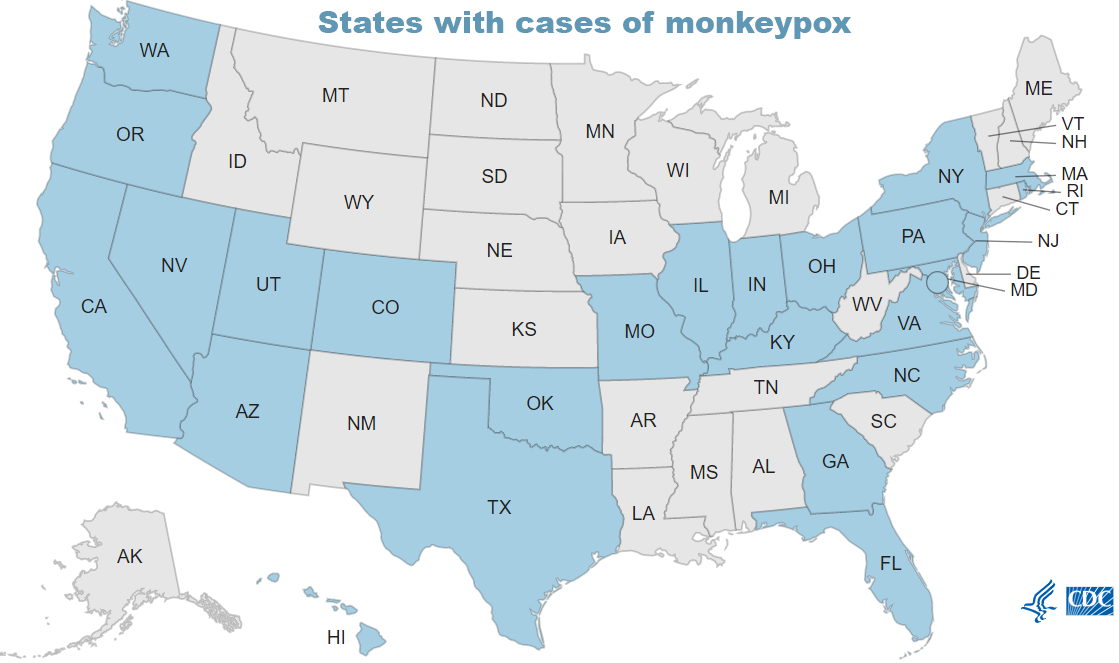
Centers for Disease Control map, adapted by Ky. Health News
Kentucky health officials announced Friday that the state's first probable case of monkeypox has been identified in a resident of Jefferson County.

"The patient remains isolated, and health officials are working to identify anyone the patient may have had close contact with while infectious," the Department for Public Health said in a news release. "Confirmatory testing is pending at the Centers for Disease Control and Prevention." The CDC has identified 201 monkeypox cases in 28 states.

State Health Commissioner Dr. Steven Stack said in the release, “Identifying the first case of monkeypox in Kentucky is concerning but not surprising. Fortunately, the risk to the general public remains low. We continue to work closely with CDC and our local health department and healthcare partners to contain the spread of this virus.”

Monkeypox can be transmitted through body fluids, sores created by the disease, contaminated items such as bedding or clothing, or respiratory droplets during "prolonged face-to-face contact," the release said.

The disease usually begins with a flu-like illness, including fever and swelling of lymph nodes five to 21 days after exposure, followed one to three days later by a rash or lesions that are often painful . They usually begin on the face but may occur anywhere. Illness generally lasts two to four weeks. Infected people are considered contagious from the time symptoms start until all scabs from the rash have fallen off and the skin has healed.

Monkeypox can spread through sexual contact, so the health department "urges you to be vigilant," the release says. "People who have symptoms of monkeypox, particularly the characteristic rash or lesions, should take the following steps: Visit a medical provider for an evaluation; cover the area of the rash with clothing; wear a mask," and avoid close contact with others.

The CDC says, "It’s not clear how the people were exposed to monkeypox, but early data suggest that gay, bisexual, and other men who have sex with men make up a high number of cases. However, anyone who has been in close contact with someone who has monkeypox is at risk."

If you develop a rash in the genital or anal area and don't have a regular health-care provider, you can get medical attention at local health department sexual-health clinics. The state health department is advising providers that "the rash may be hard to distinguish from syphilis, herpes simplex virus infection, chancroid, varicella zoster, and other more common infections." More information is available on the state health department website.

Monday, December 2, 2019

Pharmacies could help get more teens vaccinated for a virus that causes sex-related cancers, in which Kentucky leads the nation

Alabama Department of Public Health
There's a vaccine for a virus that causes sex-related cancer, but rural teens are less likely to get it or know about it. Rural pharmacies could help improve vaccination rates, writes Casey Daniel, a Ph.D. pharmacist who teaches in the family medicine department at the University of South Alabama.

"Human papillomavirus (HPV) is the most common sexually transmitted infection, with 80 million Americans currently infected and 14 million new cases of infection each year," Daniel notes, but only about two-thirds of 13-to-17-year-olds start the HPV vaccine series, and fewer than half have up-to-date vaccinations. Kentucky's rates are much lower; less than half get any shots and only a third get the full series. Probably due to that, the state has the highest rate of HPV-related cancers in the nation.

Rural HPV vaccination rates are 11 percent lower than urban rates, partly because rural areas have fewer health-care providers, Daniel writes in the Journal of Rural Health. He says that gap could be filled by pharmacies, which are more widespread than doctors' offices and open longer hours. "In the 2018 President's Cancer Panel report on HPV vaccination for cancer prevention, pharmacies were specifically recommended as a way to increase vaccine accessibility," he writes. "Most pharmacies are also ideally suited for immunizations because of their inherent infrastructure and storage capacity for various medications. Many pharmacies offer vaccines such as flu, pneumonia, and shingles, and therefore, they have established immunization protocols that can be easily adapted to HPV."

Convenience is important for HPV immunization "because this vaccination is a multi-dose series requiring subsequent visits," Daniel writes. "While large chain pharmacies have a broad, mass market appeal, there is a considerable case to be made for collaborating with 'community pharmacies' as alternative settings for HPV vaccination, particularly in rural and small-town settings. In these areas, independent community pharmacies are often an established part of the community. Community pharmacists frequently have personal relationships with their patients, knowing them both within and outside the bounds of the pharmacy, and have a unique, established trust. They are trusted providers within the community, acting as the first line of health care and consultation for many patients."

That's also important for HPV immunization because research has shown that rural parents are less likely to be aware of HPV and the vaccine. Community pharmacists "frequently have personal relationships with many local individuals," Daniel writes. "Therefore, they can function in both education and reinforcement regarding the importance of HPV vaccination. . . . In the exploration of alternative settings to increase HPV vaccination, community pharmacies have been significantly overlooked. Particularly in rural settings, these pharmacies have vast potential to reach under-served, disparate populations and serve crucial roles in addressing community health care needs and filling resource gaps."

Saturday, March 23, 2019

Montgomery County reports uptick in cases of syphilis

Health officials in Montgomery County say they're seeing more syphilis cases.

"What had become a relatively rare disease is now seeing a resurgence nationwide," the Montgomery County Health Department said on its Facebook page Friday. The agency "said it has seen an increase in syphilis cases in recent months," the Lexington Herald-Leader reports.

Montgomery County (Wikipedia map)
The department said on Facebook, "The increase has initially been identified among those in the drug community, with injection drug use being a risk factor. However, health officials warn that this disease can be passed along to others outside of this group."

“This disease does not discriminate against anyone or any group,” said Kelly Allen, the department's nurse supervisor. “We want the public to be aware of symptoms in case treatment is needed and to take steps to protect themselves.”

Syphilis, a curable disease, is transmitted by sexual and other forms of contact with a syphilis sore, which is also the most common symptom. That is followed by a rash. "These symptoms may not be painful, but they shouldn’t be ignored," the department said. "Syphilis can cause severe health problems if not treated, including paralysis, blindness and even death. It can also be spread from a mother to her unborn baby."

Friday, March 8, 2019

Ky. vax rates for HPV, which causes cancer, rose last year but still lag rest of nation; 'Parents feel their children will always be angels'

Kaiser Family Foundation map, adapted by Kentucky Health News; for a larger version, click on it
"Human papillomavirus is the most common sexually transmitted disease in the nation . . . but Kentucky children remain among the least vaccinated in the U.S.," Caroline Eggers reports for the Bowling Green Daily News.

The HPV vaccine is the only one that can prevent any form of cancer. "There are more than 100 types of HPV," Eggers notes. "Most infections go away on their own, but some forms of HPV cause genital warts – and some types cause cancer."

Kentucky's HPV vaccination rate is going up, but remains far behind the national rate, Eggers reports: "In 2017, about 31.4 percent of Kentucky children aged 13 through 17 had the first dose of the HPV vaccine. In 2018, that number increased to 42 percent, according to the Kentucky Immunization Registry."

The national first-dose rate in 2018 was 66 percent, "and about half of all adolescents were up to date with the vaccine in 2017," Eggers reports. "Kentucky's HPV vaccination rate is estimated at 39 percent or less, and rural areas reported less vaccination coverage . . . The percentage of children who received two or more doses dropped significantly," but a spokeswoman for the Kentucky Cabinet for Health and Family Services told Eggers that could be due to under-reporting.

Texas Medical Association poster; for a larger version, click on it
There are three main reasons children don't get immunized for HPV, Dr. Rebecca Shadowen, an infectious disease specialist at The Medical Center at Bowling Green, told Eggers, who writes:

"First, there is no requirement to get the HPV vaccine. The Kentucky General Assembly has introduced legislation in the past to require HPV vaccination for students entering sixth grade, but never passed a measure, according to the National Conference of State Legislatures.

Second, 'There is a real problem with people who are anti-vaccine,' Shadowen said. 'They’re that way, unfortunately, with outdated information. Vaccines are not linked to autism; that is very well proven.'

"Third, children cannot give consent to protect themselves from the virus." Shadowen said many parents don't understand the risk of sexually transmitted diseases: "Parents feel their children will always be angels.”

Fred Wyand, communications director at the American Sexual Health Association, told Eggers that many parents don't understand why their 12-year-old, who is unlikely to be sexually active, needs the vaccine. "The earlier the vaccine is given, the more robust the immune response," Wyand said, adding that if children get vaccinated by age 12, the series can be completed in two doses instead of three.

"I think really the vaccine is a public health marvel," Wyand said. "The disappointing thing about it is we're not getting it to the people who need it the most." But he added that HPV affects most sexually active people at some point in their lives.

HPV "causes cancers in the cervix, vagina, vulva, penis, anus, rectum and the oropharynx – the back of the tongue and throat," Eggers notes. "More than 90 percent of both cervix and anus cancers and 70 percent of pharynx cancers are attributed to HPV. About 63 percent of penis cancers and 75 percent of vagina cancers are probably caused by HPV. . . . Among the cancers caused by HPV, more than 90 percent could be prevented with the vaccine."

More education is needed, Wyand said: "If you had a vaccine for HIV, chlamydia or syphilis, almost everyone has a cultural reference for that. But with HPV, they're like, 'What is that?'"

Tuesday, November 27, 2018

Sexually transmitted diseases are on the rise, even as funding to prevent and treat them is declining

Health officials are worried about this strain of gonorrhea that
resists antibiotics. (Centers for Disease Control and Prevention  photo)
"Health officials are tracking record-breaking rates of sexually transmitted disease, including a resurgence of some infections which had been considered rare, such as gonorrhea and syphilis. These STDs are on the rise amid cuts to public health budgets dedicated to testing, prevention, and public outreach," Mary Meehan reports for Ohio Valley ReSource, which covers Kentucky, Ohio and West Virginia.

The Centers for Disease Control and Prevention reported 2.4 million new cases of STDs in 2017; about 40 percent of those were among people aged 15 to 25. In some Ohio Valley communities, chlamydia infections rose more than 200 percent and gonorrhea rose 1,000 percent or more between 2011 and 2017, Meehan reports.

The surge among younger people could stem from a greater likelihood to engage in risky sexual behavior. Jim Thacker, spokesperson for the Madison County Health Department, told Meehan that people born after the AIDS epidemic was largely contained may be less fearful about STDs. And the availability of effective, long-term birth control might make young adults and teens less prone to use condoms, he said.

Some of those affected by STDs are much younger than teens: according to a recent CDC report, more infants are dying after catching syphilis from their mothers during birth. Syphilis is easily treated with antibiotics, but an untreated pregnant woman has up to an 80 percent chance of passing it on to her baby during birth, Meehan reports. The number of babies born with syphilis increased from 362 in 2013 to 918 in 2017, mostly in Southern and Western states.

Matt Prior, spokesperson for the nonprofit National Coalition of STD Directors, told Meehan that STDs are a public health crisis often hitting areas already hurting from the opioid epidemic, such as Appalachia.  Meehan reports, "As rates go up, Prior said, funding has gone down. So while STDs have increased by 30 percent in the last five years to reach an all-time high, the amount of federal money for prevention and education has consistently gone down since 2003. Prior says that federal funding is critical for states like Kentucky, West Virginia and Ohio."

Prior told Meehan, "The federal STD prevention line is the only line or funding streams these states have so it is really the first and last line of defense."

Thursday, September 6, 2018

Sept. 18 webinar will explore why rural areas lag in getting children a vaccine that can prevent a major type of cancer

The Rural Health Information Hub will hold a webinar to discuss the Centers for Disease Control and Prevention's recent report showing that rural teens are less likely than their urban peers to know about the human papilloma virus or meningococcal conjugate vaccines or receive them. HPV is the known cause of several genital, anal, and throat cancers. Featured speakers will be:
  • Tanja Walker, an epidemiologist at the CDC’s National Center for Immunization and Respiratory Diseases
  • Electra D. Paskett, a cancer-research professor at Ohio State University
  • Robin C. Vanderpool, an associate professor in the Department of Health, Behavior & Society in the University of Kentucky College of Public Health
The free webinar will take place at noon ET on Sept. 18. A recording will be available on the RHI website afterward. Click here for more information or to register.

Sunday, June 26, 2016

There's a vaccine for young people that prevents cancer, but most of them don't get it because most doctors fail to recommend it

By Melissa Patrick
Kentucky Health News

The human papilloma virus vaccination is proven to prevent cervical cancer and genital warts, but many pediatricians and family doctors still don't strongly recommend it, and they need to do better.

That was the main message at an HPV conference in Lexington June 21, where more than 100 people, mostly health-care providers, came to learn about the cancer-causing virus and the under-utilized vaccine that prevents it.

Dr. Alix Casler, medical director of pediatrics at Orlando Health Physician Associates in Florida, stressed the importance of teaching everyone in a health-care organization about why HPV vaccinations are so important.

"Every year that we fail to reach our goal, there are thousands of children who are going to go on to develop cancer," Casler said. "It is one of the most lifesaving things we do," but because it isn't mandatory and the diseases that it causes aren't ones pediatricians deal with, it often falls to the bottom of providers' priorities, she said.

Studies show that a "clear recommendation" from a physician is the most important factor in whether children get the HPV vaccine. Casler noted that a 2013 survey found that 80 percent of mothers who received a same-day recommendation had their son or daughter vaccinated that day.

The three-dose HPV vaccine was approved by the federal government 10 years ago and is recommended for 11- and 12-year-old boys and girls.

Kentucky falls in the bottom 10 states for HPV vaccinations, with 37.5 percent of its girls and 13.2 percent of its boys aged 13 to 17 vaccinated as of 2014. Nationwide, fewer than half of girls and only one-fifth of boys are getting immunized, and vaccination coverage did not increase substantially from 2011 to 2014.

HPV is spreading. About 79 million people in the United States are infected with it, and about 14 million more become infected each year. It is estimated that half of these new infections occur in people 15 to 24 years old.

Though most HPV infections will clear up on their own, the most persistent strains of the virus are directly linked to 27,000 new cancers a year. About 30 women per day in the U.S. are diagnosed with cervical cancer caused by HPV, and every year, there are about 324,000 new cases of genital warts caused by the virus.

Lois Ramondetta, a gynecologic oncologist at MD Anderson Cancer Center in Houston, who is on a mission to educate health-care providers about the vaccine, told clinicians in southern Texas, “If you are not recommending the vaccine, you are not doing your job. It’s the equivalent of having patients in their 50s and not recommending a colonoscopy — and then having them come back with cancer.” So reports Laurie McGinley for The Washington Post.

HPV infections cause more than 90 percent of anal and cervical cancers and 70 percent of vaginal, vulvar, penile and middle throat cancers, and two of the HPV strains are associated with more than 90 percent of anal and genital warts.

HPV is most commonly transmitted through sexual intercourse, but it can also be transmitted through any skin-to-skin contact, including genital contact of any kind or simply kissing.

Doctors and parents alike have struggled with the idea of giving young children a vaccine for a sexually transmitted disease. And some parents hesitate because they say the vaccine encourages sexual promiscuity, though research says otherwise.

Caslir said that just like putting on a seat belt to protect yourself before you turn on the engine, the most effective time to vaccinate for the cancer causing HPV virus is prior to exposure. In addition, it is important to vaccinate pre-teens early because they have the best immune response to the vaccine and are more likely to keep coming in for annual visits.

Dr. Daron G. Ferris, a speaker at the conference who works at the Georgia Cancer Center in Augusta, said that a mother of a 21-year-old woman with cervical cancer caused by HPV asked him, "So you mean if my daughter had received the Gardasil shots, she probably would not be having this surgery today?" and that he told her, "Yes. She would not have been there if she had been vaccinated."

Kirk Forbes, whose daughter Kristen died at the age of 23 from cervical cancer caused by a high risk strain of HPV, told the story of his daughter's battle. He and his wife have founded the Kristen Forbes EVE Foundation, whose mission is to eradicate cervical cancer and significantly reduce HPV infection rates. One of the foundation's efforts is a nationally acclaimed documentary that profiles five women, including Kristen, called "Someone You Love: The HPV Epidemic."

"We have the means to stop 90 percent of cervical cancers and who know how many versions of oral cancer, anal cancer, penile cancer... and could literally wipe out genital warts," Forbes said."We've got all the tools we need, now we've got to go out and get the job done."

Tuesday, May 3, 2016

Studies conclude that abstinence pledges do little to cut youth sexual activity, pregnancies, sexually transmitted diseases

Abstinence pledges—sometimes called purity pledges—don't keep young people from engaging in sex, contracting sexually transmitted diseases or avoiding pregnancy, according to a pair of studies, Denise-Marie Ordway reports for Journalist's Resource. The main problem is that students are not receiving enough sex education. A federal Centers for Disease Control and Prevention report from December 2015 found that "fewer than half of high schools and only a fifth of middle schools teach all 16 topics recommended by CDC as essential components of sexual health education."(CDC graphic)

A 2005 study by Yale and Columbia universities found that 88 percent of youth who take the abstinence pledge engage in pre-marital sex, Ordway writes. "The study found that pledgers were just as likely to get STDs as those who never made a pledge of virginity."

more recent study, published in April in the Journal of Marriage and Family, found that among students in grades 7 to 12, "as a whole, young women who did not take abstinence pledges and those who did but broke them were equally likely to acquire HPV, a common STD," Ordway writes. "Approximately 27 percent of each group tested positive for HPV. Of the young women who had two or more sex partners, pledge breakers were more likely to have HPV. The difference was largest among women who had between six and 10 sex partners. One-third of women who had not taken a pledge and had six to 10 sex partners tested positive for HPV. Meanwhile, 51 percent of pledgers who had six to 10 sex partners acquired HPV. About 30 percent of pledgers and 18 percent of non-pledgers became pregnant within six years after they began having sexual intercourse outside of marriage."

"In the U.S, the teen pregnancy rate is higher than in any other western industrialized country, according to the CDC," Ordway writes. "At the same time, a growing number of American teens and young adults have been diagnosed with sexually transmitted diseases (STDs). While individuals aged 15 to 24 make up 27 percent of the U.S. population that is sexually active, the CDC estimates that they account for half of the 20 million new infections occurring annually."

Friday, April 15, 2016

Kentucky is in the bottom 10 states for cancer-preventing HPV vaccination, probably because it has to do with sex

The human papillomavirus vaccination is nearly 100 percent effective in preventing precancers and noninvasive cervical cancers caused by two strains of the virus, but most parents in Kentucky and the nation are still not getting their adolescents vaccinated.

HPV is a group of more than 150 related viruses, which together are the most common sexually transmitted infections in the U.S.

An estimated 79 million Americans are infected with HPV and about 14 million more become infected each year, according to the federal Centers for Disease Control and Prevention. And while most HPV strains cause no symptoms and go away on their own, 10 percent of HPV infections lead to cancers of the cervix, vagina, vulva, penis, anus and throat.

The HPV vaccination was approved by the federal government 10 years ago and is recommended for all adolescent girls and boys 11 and 12 years old. Nationwide, fewer than half of girls and only one-fifth of boys are getting immunized.

Kentucky falls in the bottom 10 states for HPV vaccinations, with 37.5 percent of its girls and 13.3 percent of boys aged 13 to 17 vaccinated as of 2014.

The vaccine can be given to females as old as 26 and males as old as 21, but early vaccination is important. The vaccine is less effective if a person has already been exposed to the virus, because it works to prevent HPV before exposure, and not to treat existing HPV infections or associated diseases. Vaccinating adolescents better protects them before they are likely to become sexually active and exposed to the virus.

And therein lies the key reason health experts say most parents don't get their children vaccinated and health providers are hesitant to push this potentially life-saving vaccine: It has to do with sex, Michael Ollove reports for Stateline.

But guess what? Almost 42 percent of Kentucky's high-school students say they have had sexual intercourse, and almost one-third of them say they are currently sexually active, according to the 2015 Kentucky Youth Risk Behavior Survey. And, almost 10 percent of the state's middle-school students say they have had sex.

Opponents of the vaccine being given to adolescents argue that it encourages them to engage in sex because it removes the fear of contracting HPV, but at least one study shows no increase in sexual activity in girls who have been immunized, Ollove reports.

Health officials often lament that the vaccine wasn't originally sold to the public as an anti-cancer vaccine rather than one to prevent a sexually transmitted disease, Ollove reports.

“It should have been pushed out as an anti-cancer drug,”Walt Orenstein, a professor of medicine at Emory University and the former director of the National Immunization Program at the CDC, told Ollove. “People didn’t understand why their children needed this drug when they were still years away from being sexually active.”

Ollove notes other reasons for low vaccination rates: Health-care providers often don't stress the importance of the vaccine; many don't promote the vaccine because they aren't comfortable talking about sex with their young patients or their parents; and many providers feel the vaccine is not urgent because most adolescents in middle school are not sexually active. Another barrier is that the the HPV vaccine requires three inoculations over several months; the CDC shows a dramatic drop-off between the first and last doses.

Citing Noel Brewer, who does research on immunizations at the University of North Carolina and has studied parental and provider attitudes toward HPV, Ollove writes, "Contrary to what doctors may believe, parents are interested in the vaccine and a strong recommendation from a physician correlates highly with youngsters getting the full course of vaccinations."

Ollove notes that mandatory HPV immunizations have not proven to be successful. “Mandates are a last resort after you’ve built consensus that they are a good thing to do,” Orenstein told him.

Health policy researchers say that "reminder and recall" notices are the best way to keep patients up to date on vaccinations, and yet this is not a common practice, Ollove reports.

Insurance will cover the cost of the HPV vaccine and the Vaccines for Children Program will cover the vaccine at no cost for children who don't have insurance and are younger than 19. Call 800-232-4636 for more details.

The Kentucky Rural Health Association in collaboration with the Kentucky Immunization Program and the state Division of Women's Health will be hosting Kentucky's HPV Summit, "HPV: You ARE the Key!," at the Embassy Suites in Lexington June 21. The cost is $40 until June 1 and $55 afterward. Click here to register.

Thursday, April 14, 2016

Teens who talk to their parents about sex make the best choices; Clark County will offer parenting classes on sex communication

In an average Kentucky high school class of 30 students, almost 13 of the teenagers say they have had sexual intercourse at least once, but many of them have never discussed sex with their parents.

And while Kentucky parents may think their children are learning about sex in the classroom because Kentucky mandates sex education, they may not realize that the state has no set curriculum for fact-based, comprehensive sex education, and the only thing required to be taught is abstinence -- an approach that has been proven ineffective, Aaron Yarmuth reports for Leo Weekly in an in-depth article about sex education in the state.

This lack of parent-teen communication about sex has prompted a study in Clark County that will include classes to help parents become more comfortable talking about sex with their children, Whitney Leggett reports for The Winchester Sun.

The classes will be led by Shannon Phelps of Winchester as part of her research to earn a doctorate in interdisciplinary education sciences from the University of Kentucky, Leggett reports. It is funded by a $15,700 grant from the Clark County Community Foundation.

“Because the subject matter is not one that many people are comfortable with, part of the objective is to help increase parents’ comfort in discussing sexual health topics so they will be more likely to address those topics with their children,” Phelps told Leggett.

"The overall goals of the program are to increase frequency and quality of parent-child sexual health communication, improve parents’ comfort and confidence in their communication with their children about sexual health topics and increase openness of sexual communication between parents and their children," Leggett writes. "Topics will range from abstinence to safe sex, contraception, resisting peer pressure and communicating with potential partners, among others."

Phelps said the six week courses will promote parent-child sexual health communication, which is associated with better sexual health outcomes for young people.

“Research tells us that children, especially adolescents, who have parents who communicate with them about sexual health topics have better sexual health outcomes,” Phelps told Leggett. “That follows logic... Sometimes parents are hesitant to talk to their children for fear that they’ll go and have risky sexual behaviors, but research tells us the opposite.”

Phelps told Leggett that studies show that when parents talk to their children about sex, "it can delay the onset of sexual behaviors and reduce unintended outcomes like sexually transmitted infections and unintended pregnancies," Leggett writes.

For more information email Phelps at shannon.phelps@uky.edu, or call 859-621-1065.

study published in the Pediatric Journal of the American Medical Association found that nearly one-fourth of youth report that they have not discussed sexual topics with their parents, and even fewer report that they have had meaningful, open conversations with them about this subject. The study attributes this poor communication to parental embarrassment, parents' lack of accurate knowledge of the subject, and poor self-efficacy.

It's a topic that needs discussion in Kentucky because almost 10 percent of the state's middle-school students have had sexual intercourse and almost one-third of its high school students are sexually active, according to the 2015 Kentucky Middle and High School Youth Risk Behavior Survey.  The survey found that overall, 41.7 percent of Kentucky's high school students have had sexual intercourse at least once.

And there is an obvious disconnect related to birth control. Kentucky ranks seventh in teen births, at 39.5 births per 1,000 females aged 15 to 19, according to America's Health Rankings. The 2015 YRBS found that 14.5 percent of high school students did not use any birth- control during the last time they had sexual intercourse.

Friday, June 26, 2015

Study finds that one dose of HPV vaccine that targets only cervical cancer is as effective as three doses, now recommended

By Melissa Patrick
Kentucky Health News

A study has found that one dose of the human papillomavirus vaccine Cervarix appears to be as effective in preventing HPV infections that lead to cervical cancer as do three doses, the recommended course of vaccination. Only 25 percent of Kentucky adolescent women initiate the vaccination, and fewer than one in nine of those who do get three does, according to the Kentucky Cancer Consortium.

"Many women around the world and in the U.S. don't get the full three doses that are recommended, so this is promising news," said Elisia Cohen, an associate professor of communication at the University of Kentucky, who does extensive research on community strategies to improve adolescent and adult vaccinations. However, she cautioned that the drug Cervarix is "only 1 percent of the U.S. market" and that the findings from this study do not apply to Gardasil, the drug most commonly used in the U.S.

Dr. Diane Harper of the University of Louisville, one of the researchers, said in a news release, “Kentucky is one of the states that has not had a program in place to make Cervarix available to all of its citizens, and has very low three-dose completion rates of Gardasil.”

Most health departments and physicians choose Gardasil over Cervarix because it protects against four strains of HPV: two strains that cause 70 percent of all cervical cancers and two strains that cause genital warts and oral and anal cancers, concerns for males as well as females. Cervarix only protects against the two strains that cause cervical cancer. "Generally, the thinking is that protection against four strains is better that two," Cohen said.

She said Gardasil 9, which will protect against 90 percent of HPV strains that cause cervical cancer as well as pre-invasive cervical cancer lesions, has just been approved by the U.S. Food and Drug Administration and is going through its labeling process, and will be recommended for both boys and girls.

HPV is the most common sexually transmitted infection in the U.S., affecting an estimated 79 million individuals, according to the federal Centers for Disease Control and Prevention.

The study, published in The Lancet Oncology, analyzed data from two large trials of Cervarix. In the trials, women were randomly chosen to receive three doses of Cervarix or a control vaccine. All of the women were evaluated, regardless of how many doses of the vaccine they received, for the effectiveness of the vaccine for a period of four years. The analysis found that the protection from one dose was similar to that achieved by three doses of the vaccine.

“Knowing that Cervarix offers protection in one dose reassures public health agencies that they are not wasting money when most of their vaccines are given to those who never complete the three-dose series,” the researchers wrote.

The CDC recommends HPV vaccination for girls 11 and 12 years old, and catch-up vaccination for females from 13 to 26. The second dose should be given one to two months after the first injection; the third dose should be administered six months after the first dose.

Wednesday, June 19, 2013

Lexington internist, Dr. Ardis Hoven, becomes president of the AMA, the nation's largest physician organization

Ardis Dee Hoven, M.D., an internal medicine and infectious disease specialist in Lexington, was installed as president of the American Medical Association at its annual meeting Tuesday night in Chicago. The AMA is the nation's largest physician organization.

Dr. Hoven is a graduate of the University of Kentucky medical school, and she has served in numerous leadership position for the AMA, including her first presidential term in 1993-94. Hoven has also served at the UK’s Bluegrass Care Clinic, which treats infectious diseases including HIV/AIDS, reports Business Lexington.

The AMA is headquartered in Chicago, and since 1847 it has aimed "to promote the art and science of medicine and the betterment of public health," says its website. Furthermore, the organization's strategic focus is aligned with many of the health care issues now facing Kentucky, which are improving health outcomes, accelerating change in medical education and enhancing the sustainability of medical practice.


Monday, October 15, 2012

Studies show that preteen girls who get the HPV vaccination are not more inclined toward promiscuity than those who don't

An electron micrograph of the
human papilloma virus.
(National Cancer Institute photo)


The most recent study of preteen girls who received the vaccine for the human papilloma virus (HPV) found that they were no more likely than unvaccinated girls to get pregnant, develop sexually transmitted infections or seek birth-control counseling. The findings in Monday's issue of Pediatrics are in line with recent studies on British teens, which also dismissed concerns that getting the vaccination might encourage promiscuity.  USA Today reporter Michael Healy writes that while the latest results were based on parental or self-reporting, the reports were corroborated by medical tests, clinical markers of sexual activity and other behavior markers.

Robert Bednarczyk, a clinical investigator with the Kaiser Permanente Center for Health Research-Southeast and an epidemiologist at Emory University in Atlanta., queried 1,398 girls, aged 11 and 12, and analyzed their medical records. He and colleagues divided the girls into two groups and followed them for three years. "One group of 493 girls received at least one dose of the HPV vaccine Gardasil, along with other recommended vaccines for tetanus and meningitis. A comparison group of 905 girls received the tetanus and meningitis vaccines, but not HPV," Healy writes. "There was a very similar rate of testing, diagnosis and counseling between both groups," with no increase in pregnancies, STIs or birth-control counseling, Bednarczyk reported. Fewer than 1 percent of all girls tested positively for a sexually transmitted infection, and fewer than 1 percent had a positive pregnancy test.  (Read more)

Wednesday, September 26, 2012

Kentucky Parent Survey: We could do a lot better on school meals, we're very much in favor of more health education

Fewer than 10 percent of Kentucky
parents report that their child has ever
walked or biked to school.
When asked, only about one in four Kentucky parents describe the meals served at their child's schools or day care centers as being nutritious. Fewer than 10 percent report that their child have ever walked or biked to school. And an overwhelming majority want information about sexually transmitted infections, human anatomy, abstinence education, birth control methods and condom use taught in Kentucky's high schools.

These are just a few of the surprising results from the first Kentucky Parent Survey conducted by the Foundation for a Health Kentucky, a random telephone survey of 1,006 parents of children under 18. The survey assessed the views of parents, step-parents, grandparents, foster parents and other legal guardians of children in Kentucky. The term "school" was used broadly in the survey as included (2 percent of total surveyed), as well those in pre-school and day care. The study took on nutrition, physical activity and health education.

Eighty-eight percent of parents reported that it was "very important" that meals at schools meet a minimum standard for nutritional value. Only about 1 in 4 parents currently thought their schools were meeting that standard. Only 11 percent are concerned that their younger children are getting too many "celebration-related" treats at their school.

While parents in the state reported that a little more than half (52 percent) of school-age children took physical education classes, that class was not a daily occurrence but met between one and four times a week. Only about 1 in 3 students took a daily course in P.E. That leaves 14 percent without a planned daily class during the school year.

On the topic of health education, parents reported that half of school-age children in the state took health classes, but again not daily. According to the FHK, "The Kentucky Parent Survey included a series of questions about dating relationships and sexual health to determine support for covering those topics...
At the middle school level, more than 8 in 10 parents would favor teaching communication skills (99 percent), human anatomy (91 percent), abstinence education (85 percent), and information about HIV and sexually transmitted infections (84 percent). At the high school level, more than 8 in 10 would favor teaching communication skills (99 percent), information about HIV and sexually transmitted infections (97 percent), human anatomy (97 percent), abstinence education (94 percent), birth control methods (87 percent), and condom use (84 percent)."

Future reports in the FHV series will address access to safe and effective health care for children, children's health behaviors and family routines and the places where parents turn for information on raising healthy kids.


Thursday, August 2, 2012

Next phase of health reform: New and renewed insurance policies will have to cover birth control, other preventive care for women

Even though the decision was widely expected, as part of health care reform, the news is still what Julie Rovner of National Public Radio termed "a pretty big deal." Earlier this week, she reports, the Department of Health and Human Services adopted in full the women's health recommendations issued two weeks ago by the independent Institute of Medicine. "Since birth control is the most common drug prescribed to women ages 18-44, insurance plans should cover it," said HHS Secretary Kathleen Sebelius in a press briefing. "Not doing it would be like not covering flu shots, or any of the other basic preventive services that millions of other Americans count on every day."

The upshot: Starting a year from now, most new health insurance policies, and eventually almost every policy, will have to offer a comprehensive list of women's preventive health services with no co-pay or deductible, including all forms of prescription contraception approved by the Food and Drug Administration. These services include: Screening for gestational diabetes; counseling about sexually-transmitted infections; support for breast-feeding, including supplies and counseling; and domestic violence screening and counseling.

Rovner reports that "The new rules do take into account the complaints from some conservative and religious groups, by allowing religious organizations that provide health insurance to refrain from offering contraceptive coverage 'if that is inconsistent with their tenets.' HHS says that part of its proposal is modeled on the most common exemption used by the 28 states that already require contraceptive coverage to be offered in health insurance policies. The department, however, is specifically asking the public to comment on that portion of the rules, 'as we work to strike the balance between providing access to proven prevention and respecting religious beliefs.' Already the reactions are pouring in. Some people object to the religious exemption." (Read more)

Monday, January 16, 2012

Rural women are less likely to complete vaccinations for cervical-cancer virus; study finds vaccine does not increase sexual activity

Women living in rural areas of the U.S. were far less likely to return for their follow-up doses after they get the initial injection of the human papillomavirus vaccine, a study in the Journal of Rural Health has found. (Photo by Pete Rodman, Bowling Green Daily News)

The study contrasted the rates of vaccination follow-up by young women recruited from two rural locations and one urban location. "Despite being free, the researchers concluded that uptake of booster doses by rural women was problematic," states an article in the Rural Center for AIDS/STD Prevention's "RAP Time" publication. "This barrier might be resolved by providing the HPV doses at easy-to-access locations in rural communities, such as large grocery stores and area events."

The HPV vaccine requires three doses. The women who went to the rural clinic were seven times less likely to return for at least one follow-up dose.

The vaccine, which has proven to prevent most cervical cancers, has been approved for use in women ages 9 to 26 years, as well as boys. The vaccine is generally given at the age of 11 or 12 and is effective only if administered before a person becomes sexually active. As many as 80 percent of men and women become infected with HPV during their lives, but most do not develop symptoms or illness.

The vaccine has been met with reluctance by parents, some of whom fear it encourages sexual activity, but a study published in the American Journal of Preventive Medicine found girls or women who received the vaccine "were no more likely to be sexually active or have more partners than those not vaccinated."

Last year, just 49 percent of adolescent girls nationwide had received at least the first dose of the vaccine, and only a third had gotten all three. In Kentucky, just 25 percent of adolescent females had gotten the first dose and fewer than 11 percent had received all three doses.

In Kentucky, the annual death rate caused by cervical cancer is 2.9 deaths per 100,000. In the United States, it's 2.4 per 100,000. "The U.S. is remaining stable. Kentucky's is actually falling," gynecologist Dr. Mark Yurchisin told Alyssa Harvey of the Bowling Green Daily News.

The decrease is being attributed to an increase in screenings. "In certain counties in Kentucky there is a high incidence, they implemented outreach clinics because they didn't have clinics where they could get Pap screenings done," Yurchisin said. "They can diagnose it at an earlier and treatable stage." (Read more)

Thursday, December 1, 2011

Get tested, get treatment, Bluegrass HIV Coalition encourages

Today is World AIDS Day and health advocates are asking Kentuckians to get tested and get treatment.

Hundreds of Kentuckians are diagnosed with AIDS each year, reports Mary Meehan of the Lexington Herald-Leader. Minority populations are hit particularly hard, with black men nearly 10 times more likely to die of AIDS than non-Hispanic white men. Black women are almost 23 more times more likely to die from the infections, compared to non-Hispanic white women.

Though people are still dying, AIDS is not a widely-discussed disease, in part because of its past association with homosexual activity. Mark Johnson, member of the Bluegrass HIV Coalition, said AIDS can be hard for people to talk about.

In addition, the infection is often seen as treatable, in part because of people like Magic Johnson, who has had the infection more than 20 years but is still in good health. What people don't see "is the often expensive regimen of drugs that is needed to keep the worst of the disease at bay, the side effects of those medicines or the ultimate end of what is still an incurable disease," Meehan reports. (Read more)

Monday, November 28, 2011

Dec. 1 is World AIDS Day; 1.2 million Americans are thought to be infected, but only 1 in 5 know it

Friday is World AIDS Day, an opportunity to learn the facts about the virus and show support for people living with it.

In the United States, there are 1.2 million people living with the HIV infection, which leads to AIDS. Of those who are infected with the virus in the U.S., only one in five know they have it, the Centers for Disease Control and Prevention report. Each year, about 50,000 Americans become infected. About 1,700 Kentuckians were diagnosed with HIV between Jan. 1, 2005 and Dec. 31, 2009; Kentucky ranks 19th in the country for the number of people who have the HIV infection.

Since the epidemic began, nearly 594,500 people have died with AIDS in the U.S. Between 1981 and 2007, more than 25 million people have died from the virus around the world.

Secretary of State Hillary Rodham Clinton spoke of the epidemic in a Nov. 8 address at the National Institutes of Health. "The fight against AIDS began three decades ago in June 1981. American scientists reported the first evidence of a mysterious new disease," she said. "Thirty years later, we ... know a great deal about the virus itself. We understand how it is spread, how it constantly mutates in the body, how it hides from the immune system. And we have turned this knowledge to our advantage."

Most at risk are gay, bisexual or other men who have sex with men. The CDC estimates that though this population accounts for just 2 percent of the U.S. population, it accounted for 61 percent of all new HIV infections in 2009. But heterosexuals and people who inject drugs can also contract the disease. Heterosexuals account for 27 percent of new cases. Another 9 percent of people who contracted the virus did so by using injected drugs.

Blacks accounted for 44 percent of new HIV infections in 2009, though they only represent 14 percent of the U.S. population. In 2009, the rate of new infection was 6.5 times greater for black men than it was for white men.

People can now be tested for the infection using a saliva sample and have the results in just 15 to 20 minutes. To find an HIV/AIDS prevention and service provider by county, click here.

Wednesday, October 26, 2011

Boys should get HPV vaccine to keep from spreading virus

A federal committee has recommended that boys receive the human papilloma virus vaccine, already recommended for girls, to fight the sexually transmitted virus that is known to cause cervical cancer. The vaccine could also protect boys against genital warts and anal cancer.

The Advisory Committee on Immunization Practices released its recommendation Wednesday. It is the first time there has been a public push for boys to receive the vaccine, though it has been licensed for male use for the past two years.

Dr. Baretta Casey, director of Cervical Cancer-Free Kentucky, applauded the move. "To stem the spread of the HPV virus and the many problems it causes is the best thing," she said.

The vaccine is usually given at the age of 11 or 12 and is only effective if it is given before a person becomes sexually active. As many as 80 percent of men and women are infected with HPV during the course of their lives, but most do not develop symptoms or illness, the Centers for Disease Control and Prevention reports.

The vaccine has been met with reluctance by parents, some of whom fear it would encourage sexual activity. Last year, just 49 percent of adolescent girls nationwide had received at least the first of its three doses, and only a third had gotten all three. In Kentucky, only 25 percent of adolescent females had received the first dose, and fewer than 11 percent had received all three doses.

Casey attributed parents' hesitation to a fear that the vaccine is harmful, though research shows otherwise. "It's our hope that people understand that this is a vaccine that has been around for quite a while now," she said. "The effects of the immunization are similar to other vaccines that we currently give our children. And if I can give my child a vaccine that would prevent them from ever developing cancer, I'm for it." On average, 391 Kentucky women develop cervical cancer and 66 die.

The cost of the vaccine — about $110 for each of the three doses — is also believed to be a factor in the low vaccination numbers, though Casey said Medicaid covers it, as do major health insurance providers such as Blue Cross Blue Shield and Anthem. Though the numbers are low, Casey said she is seeing some boys being vaccinated in Kentucky "but it's not a widely done practice." (Read more)

Tuesday, October 18, 2011

Parents, children should discuss HPV vaccine, study indicates

A study at Ohio State University found that college-aged women who have talked to their mothers about the human papillomavirus are more likely to get the vaccine that prevents it, Brandy Reeves, right, a certified sexuality educator and health education coordinator at the University of Kentucky, writes in the Lexington Herald-Leader.

HPV is known to cause cancer, including cervical cancer, oral cancer, vulvar cancer, anal cancer and penile cancer.

There are two vaccines for HPV approved by the Food and Drug Administration: Gardasil and Cervarix. "Because men can carry HPV and transmit it sexually to their partners, the FDA has approved the use of Gardasil in both genders, from ages 9 to 26," Reeves writes. "Parents who are nervous about bringing up the topic can focus on how the vaccine is safe and effective, and that it prevents cancer." (Read more)