Showing posts with label dental school. Show all posts

Monday, October 30, 2023

Sugar season has started, so brush your teeth twice a day, floss daily, and drink plenty of water, UK dental-school dean advises

Photo illustration by Viktoriia Hnatiuk, iStock/Getty Images Plus
By Jeff Okeson, D.M.D.
Professor and dean, University of Kentucky College of Dentistry

From Halloween through New Year's, holiday parties and family events are filled with gifts and delicious treats. Kids go trick-or-treating, pies are baked and cookies are decorated. It’s the time of year that brings everyone together.

But with all the sugary treats, increased potential for cavities can be a concern. Cavities are small holes in the teeth caused by tooth decay. Eating sugar without proper dental hygiene can lead to plaque buildup on teeth, which can dissolve the enamel on teeth and eventually cause cavities.

It’s important to pay attention to holiday favorites like sugary baked goods, candied nuts and candy canes that contain a lot of added sugar which can lead to tooth decay. It’s also easy to forget that holiday drinks like apple cider and cocktails can be acidic leading to tooth erosion.

While sweet treats can be enjoyed, as we head into the fall and winter months it is important to stay on top of your oral health to ensure your dental visits are cavity-free. Here's how to do that:

Brush your teeth properly. Adults and children alike should brush their teeth twice daily with fluoride toothpaste for a full two minutes. Divide the mouth into four sections, top right, top left, bottom right, bottom left and brush each section for 30 seconds. Gently rotate the toothbrush bristles in circles, being careful not to irritate the gums. Rinse the mouth to wash out all toothpaste.

Floss daily. Flossing is equally as important as brushing. Flossing cleans hard-to-reach areas between the teeth and below the gum line. One of the most common places for a cavity to form is between the teeth, which is why flossing is necessary when cleaning the entire mouth. Adults and children should floss their teeth at least once a day, ideally at night before bed.

Drink plenty of water. Staying hydrated is beneficial for overall health, but drinking water is also one of the easiest ways to help prevent cavities. Water containing fluoride strengthens teeth and prevents decay. Water also washes away leftover food and residue that can lead to cavity-causing bacteria.

Visit the dentist regularly. Adults and children should visit the dentist for routine check-ups every six to 12 months. Visiting the dentist regularly lets people know if they are at risk for cavities. Once a patient is seen, dentists can understand which treatments might be needed or what changes in oral hygiene or diet might help reduce their risk of tooth decay.

While these tips can help prevent tooth decay, even the most diligent brushers can still get a cavity. There are a few telltale signs that indicate a dental visit is needed. Contact a dentist or health care provider if you experience any of the following symptoms:
  • Toothache or pain
  • Sensitivity to heat or cold
  • Tooth discoloration
  • Swollen gums
Holiday sweets and drinks are something to look forward to and may be hard to avoid completely. Instead of worrying about what isn’t okay to eat, focus on consuming in moderation. Drinking plenty of water and keeping up on your brushing and flossing are some of the best ways to take care of oral health.

Friday, August 11, 2023

Legislators insist on 'procedure' as dental-school deans plead for approval of expansion of dental benefits in Kentucky Medicaid

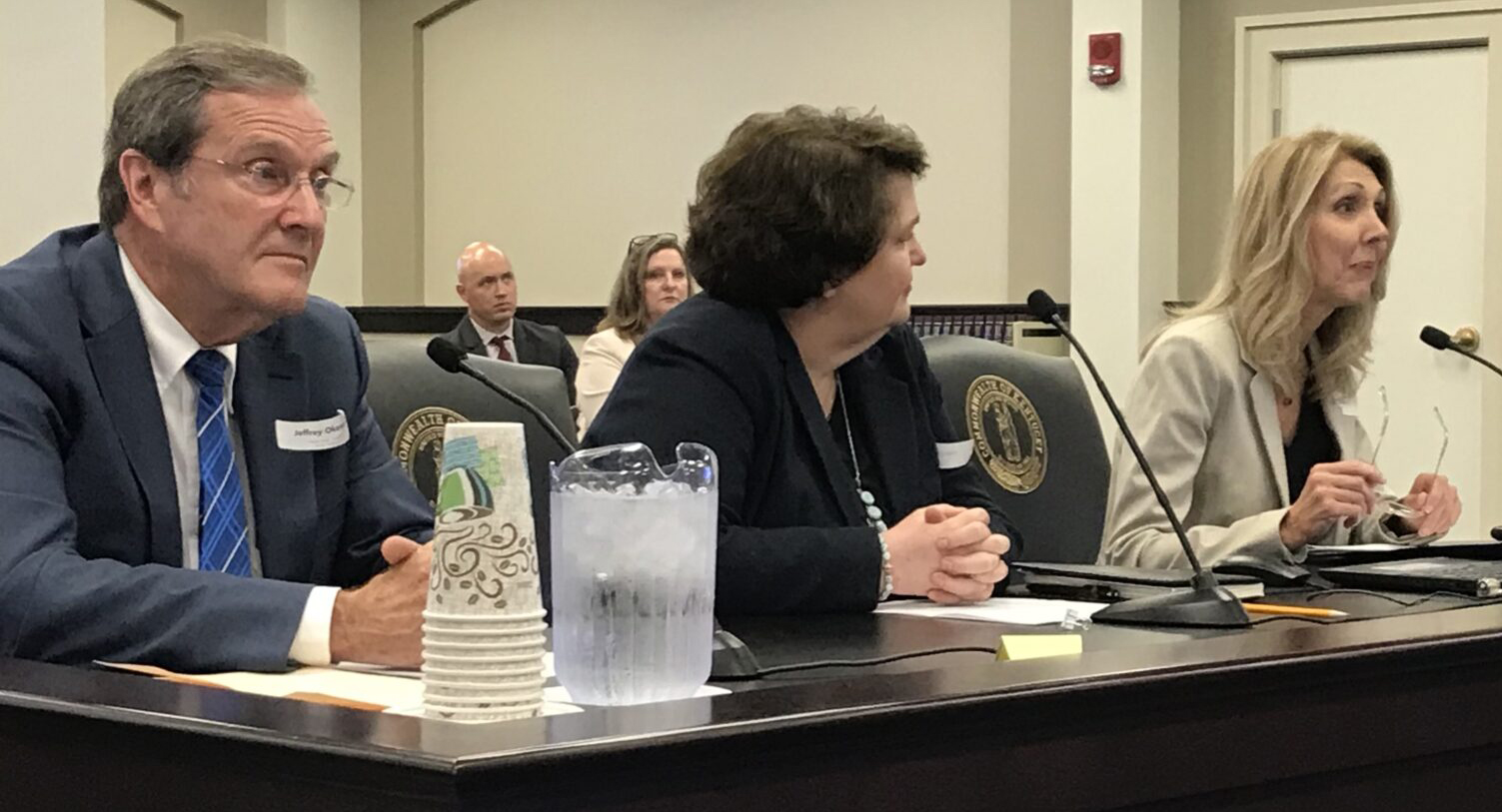
Dr. Pamela Stein, right, dean of the University of Pikeville dental school, spoke in Frankfort Tuesday about the need for expanded Medicaid dental benefits, joined by Dr. Margaret Hill, interim dean of the University of Louisville dental school, and Dr. Jeffrey Okeson, dean of the University of Kentucky dental school. (Kentucky Lantern photo by Deborah Yetter)
By Deborah Yetter
Kentucky Lantern

Working at a public “safety net” dental clinic in rural Western Kentucky, Dr. Pamela Stein routinely saw a heartbreaking sight.

“It was not unusual at 6 o’clock in the morning to see 10 or 15 people standing in line waiting to get in because they had tooth aches, because they couldn’t find anyone else to care for them,” said Stein, appointed last year as dean of a new dental school being formed at the University of Pikeville.

Some patients at the Marshall County clinic were in tears after having diseased, throbbing teeth removed at the clinic operated by the University of Kentucky, she said.

“People would actually cry, they were so relieved,” Stein said, speaking before a legislative committee Tuesday in Frankfort.

She and others spoke in support of the state’s recently expanded Medicaid dental services for adults to include dentures, fillings, root canals and crowns. Medicaid previously paid only for one annual cleaning and tooth extractions for adults though children get a full range of services.

Stein joined the deans of dental schools at the universities of Kentucky and Louisville to urge continuation of the dental services authorized by Gov. Andy Beshear that have ignited a partisan political fight in Frankfort.

Republicans who control the General Assembly are seeking to block Beshear, a Democrat, from expanding Medicaid dental coverage, as well as vision and hearing benefits, arguing he usurped power that rests with lawmakers.

Officials with the Beshear administration disagree, saying they had the authority because the $39 million expansion is paid for through savings in Medicaid and doesn’t require allocation of new money. The federal government covers 85% of the costs.

But the dental school deans, as did other witnesses who appeared, avoided politics, instead focusing on Kentucky’s abysmal oral health — it ranks 49th in the nation — as well as low reimbursement rates that keep many dentists from treating Medicaid patients.

As a result, many patients living with untreated dental disease can’t find a dentist, especially in rural areas, or often find long waiting lists. And oral infection is linked to a host of other health problems that plague Kentucky, including heart disease, stroke, diabetes and premature births.

“It’s an enormous problem that we have here and it’s not getting any better,” said Dr. Jeffrey Okeson, the UK dean. Okeson said Medicaid doesn’t cover costs of dental care.

For example, he said, UK last year billed Medicaid $14.2 million to treat 37,000 patients but was reimbursed only $4.1 million, about 30% of its costs. UK makes up the difference but can’t do so indefinitely if it begins cutting into the academic budget, he said.

His counterpart at U of L agreed, noting that together UK and U of L treat around 90,000 Medicaid dental patients a year, many of whom can’t find care elsewhere.

“These folks would probably not be able to receive dental care if it wasn’t for dental schools acting as a safety net,” said Margaret Hill, interim dean of U of L’s dental school.

“Today we are here before you, speaking on behalf of our patients and our students who would like to do the right thing, and ask that the Medicaid expansion of dental services continue and that rates of reimbursement be more reasonable,” Hill added.

Several witnesses described the enormous suffering of patients who previously lacked dental coverage and now, even if covered under the expanded benefits, can’t find a dentist.

“I don’t mean to tug on your heart strings but I really hope that I do,” said Tiffani Hays, a social worker who works with cancer patients in Winchester, many in dire need of dental treatment. “Oral health is probably one of the most common problems in our patients.”

It was the first opportunity for public comment on the dental benefits expansion enacted by Beshear in April after the lawmakers voted down his first, Jan. 1 expansion in the 2023 legislative session. Beshear reinstated them, with some changes, after lawmakers adjourned.

The stop and start nature of the expanded benefits has patients scared, said Missy Newland, a Louisville woman who gets health coverage through Medicaid and needs ongoing dental care.

“The political tug of war has always had me worried about staying eligible,” said Newland, who works cleaning homes and testified by video. “I fear my access to health care will be taken away and with my health issues, that’s scary.”

The current benefits — which also include expanded benefits for items such as eyeglasses and hearing aids — are good through the end of the year. While Republican lawmakers have objected, they don’t have the power to block them till they meet in 2024 in the next legislative session.

Meanwhile, tens of thousands of Kentuckians have received benefits such as dentures, crowns, fillings, hearing aids and eyeglasses, said Emily Beauregard, executive director of Kentucky Voices for Health, a coalition of health advocacy groups.

“These services are life-changing for people,” said Beauregard, adding that with better vision, hearing and teeth, people are more likely to find jobs.

But GOP legislators object even as some acknowledge the benefits are sorely needed for the about 900,000 adults who get health coverage from Medicaid, a federal-state health plan for low income and disabled individuals.

Rep. Randy Bridges, R-Paducah, and a vocal critic of Beshear’s expanded Medicaid services, accused officials with the Cabinet for Health and Family Services of making “end runs” around lawmakers who, he argued, hold the sole power to fund such programs through its budget committee.

“To come in here and pull at our heartstrings, to say we are the keepers of the purse — we aren’t the keeper of the purse,” he said of the Administrative Regulation Review Subcommittee holding Tuesday’s hearing.

“You’re doing end runs and you want to make us appear to be the villains and we’re not,” Bridges added. “We just want to do it in the proper manner.”

But Sen. David Yates, a Louisville Democrat, argued it’s the health needs of constituents rather than legislative procedure that should matter.

“It did in fact pull on my heartstrings as it should any Kentuckians,” Yates said. “Forget the partisan politics and political games, I think everyone agrees that something has to be done.”

Bridges also complained that witnesses who appeared in support of the expanded benefits were misled by state officials about the legislative process.

“I feel like you have inappropriately led them with some wrong ideas on how this works,” Bridges said.

That prompted a heated retort from Lisa Lee, state Medicaid commissioner, who also spoke Tuesday.

“I have never, ever misled anyone in my 23 years in Medicaid and I will not do so,” Lee told Bridges. “And I really don’t appreciate the fact that you indicated that we have been misleading people.”

As for the witnesses who spoke, Lee said, “They are here because they are concerned that people are going to lose their benefits.”

They included Dr. Bill Collins, a dentist at the Red Bird Mission dental clinic in Clay County who said he constantly seeks grants to cover the costs of dental care for patients Medicaid doesn’t fully cover.

Kentucky has one of the highest rates in the nation of adults with no teeth and patients are flocking to get dentures newly covered under the expanded Medicaid rates, Collins said.

But Medicaid covers only about half the costs, he said.

“When the grant money runs out it has to stop,” he said.

Collins was among witnesses urging lawmakers to continue expanded services and increase payments to dentists. “You can make it a reality,” he said. “That’s what I beg you to do.”

The committee took no action Tuesday. It already has found the regulations Beshear issued to enact the expansion “deficient,” meaning lawmakers could strike them down when they meet next year.

But Rep. Derek Lewis, R-London, committee co-chair, ended the meeting on a conciliatory note, saying he’s willing to work with everyone involved to find a solution.

“I know we’re in an election year,” Lewis said, alluding to the fact Beshear is seeking a second term as governor. “What I don’t want to see is this made to be a political football, I don’t want to poison the well and leave patients and providers holding the bag.”

“I think we can make a difference,” he said. “We need to make a difference.”

Thursday, May 12, 2022

University of Pikeville says it will build Kentucky's third dental school with a $25 million gift from an anonymous donor

University of Pikeville website logo
The University of Pikeville plans to create Kentucky's third dental school with a $25 million gift from an anonymous donor's family foundation, the largest in the school's 133-year history.

UPike President Burton Webb announced the gift last Saturday during the private university's health-professions commencement.

“The foresight of a generous family giving to a university to establish a dental school is special,” Webb said. “This is another example of challenges being met and solved right here by those who call this area home. It’s also incredible that the university, this family and now a dental school will each have their roots right here in these mountains. It’s a great day to be a Bear!” The university's mascot is a bear.

Webb told the Appalachian News-Express of Pikeville that the proposed school would go through an accreditation process, similar to that for its Kentucky College of Osteopathic Medicine and Kentucky College of Optometry, which will determine the project's timeline and size.

“Sometime before we started the optometry college, the university had done a feasibility study on the need for more dentists in Appalachia,” Webb told the newspaper. “At the behest of the family foundation we refreshed that study and it showed continued need. The gift is generous and we are deeply grateful.”

Kentucky's dental colleges are at the University of Kentucky and the University of Louisville. Pikeville is the seat of Pike County, Kentucky's easternmost, and is nearer to Charleston, W.Va. That state has one dental school, at West Virginia University in Morgantown, and Virginia has one, at Virginia Commonwealth University in Richmond. Lincoln Memorial University in Harrogate, Tenn., just south of Cumberland Gap and Kentucky's southeast corner, is scheduled to open a dental school this fall.

Terry Dotson, chair of UPike's Board of Trustees, said in a news release, “The founding of a dental program in these mountains will lead to better healthcare outcomes for a historically medically underserved population. This institution, its students, faculty and staff are a driving force for health education in the commonwealth. The dental school will complete the circle of medical services for the region and the immediate area. The economic impact with the addition of more professional students will grow businesses throughout the entire community and the region. This will be a project that will take the time and talents of many partners locally and statewide.”

Vice President for Advancement and Alumni Relations David Hutchens said the anonymous donor “has a deep love for Appalachia and a passion for improving healthcare in our region. Their generosity will reverberate for generations, impacting not only the graduates of the program but also profoundly benefitting the lives of the countless patients they will serve for generations to come. This is a transformative gift, an act of deep love and devotion for this region. We are humbled by this generosity, thrilled to have this opportunity and ecstatic about this vision.”

Monday, January 7, 2019

UK professor who won whistleblower settlement for loss of post-retirement job returns to run an oral health program for 18 months

Raynor Mullins
When he retired from the University of Kentucky dental school several years ago, Raynor Mullins, now 74, continued working for UK on efforts to improve oral health in the state, especially in rural areas.

When he lost that job, he alleged in a lawsuit that it was retribution for his criticism of Gov. Matt Bevin's removal of dental care as a basic benefit for the working poor in Medicaid. Last month, as the case was about to go to trial, the university agreed to pay him $620,000 and rehire him.

His new job will be director of a new Oral Health Innovation Initiative in the College of Public Health, with the first big goal developing a strategic plan for the initiative. It will receive $100,000 in start-up funding and "Mullins will be paid $52,800 for working 40 percent of a full-time job" for 18 months, and hold the rank of professor, Linda Blackford reports for the Lexington Herald-Leader.

His attorney, Joe Childers, told Blackford, “Dr. Mullins is excited to lead this new Oral Health Innovation Initiative, and believes it will lead to long-term gains for the health of Kentuckians. It is truly a win-win for both Dr. Mullins and the University of Kentucky.”

In settling the lawsuit, "UK did not admit that College of Dentistry Dean Stephanos Kyrkanides had pushed Mullins out for his comments, despite numerous depositions from witnesses who heard Kyrkanides say that Mullins had to go," Blackford notes. "In agreeing to allow the lawsuit to go to trial, U.S. District Judge Robert Weir called the case 'the epic story of academic intrigue and the place of free speech.'" Mullins' post-retirement job did not have traditional tenure protection.

In his lawsuit, Mullins said Kyrkanides had told him that he needed to stay "off radio" on the matter, and "communicated that this direction came from 'up top'." The first named defendant in the suit was Mark Birdwhistell, the UK HealthCare vice president and former state Medicaid director who helped Bevin's staff draft the proposed changes. Mullins claimed Kyrkanides was acting at the direction of Birdwhistell, who was acting at the behest of Bevin or his agents. The other defendant was "John Doe," identified only as a member of the governor's administration. They were dismissed from the case several months ago, after Mullins amended his complaint to exclude them. Bevin's office denied any interference, and Birdwhistell testified in a deposition that he had no discussions with anyone in Frankfort about Mullins' comments and never discussed Mullins with Kyrkanides (who testified likewise).

Sunday, December 9, 2018

UK to pay dental professor $620,000 to settle lawsuit alleging he was terminated because he criticized governor's Medicaid plan

The University of Kentucky has agreed to rehire a former dental professor and pay him $620,000 to settle a lawsuit alleging he was taken off the payroll because he criticized Gov. Matt Bevin's plan to remove dental and vision care as a basic service of the state's Medicaid program.

Raynor Mullins
Dr. Raynor Mullins, a statewide oral-health leader who had remained on the College of Dentistry payroll after retirement from normal duties, lost his job as an emeritus faculty member, a position that did not have traditional tenure protection.

After depositions had been taken in the case, U.S. District Judge Robert E. Weir ruled in October that it should be decided by a jury trial, calling it “the epic story of academic intrigue and the place of free speech.”

The suit charged that a few days after Bevin made the proposal in June 2016, new dentistry Dean Stephanos Kyrkanides told Mullins that he needed to stay "off radio" on the matter, and "communicated that this direction came from 'up top'." It says that Mullins presumed that to mean no radio or television interviews, and that he told Kyrkanides, “I have not received any requests from the media, but I do have serious concerns,” and said he would submit formal comments about it.

The next month, Mullins was among five Kentucky oral-health leaders who filed comments saying that the cost explanation for reducing dental and vision benefits was "fuzzy," and based on "flawed cost assumptions." They argued that removing the benefits would cost the state more than it would save, because poor oral health increases "major cost drivers such as diabetes and cardiovascular disease," as well as obesity, and would increase wasteful use of emergency rooms.

"According to legal documents, someone from Bevin’s administration called UK officials, who then expressed the administration’s displeasure to Kyrkanides," Linda Blackford reports for the Lexington Herald-Leader. "The person who allegedly called UK has never been identified. When the lawsuit was filed in August, 2017, a Bevin spokeswoman denied the claims that anyone from Bevin’s office had pressured UK."

The suit claimed that Kyrkanides asked other dental-school leaders and faculty how to terminate Mullins' appointment and told his colleagues "that they could no longer work with Dr. Mullins on new grant-funded projects, in retaliation against Dr. Mullins," and told them to stop speaking to him "in an effort to ostracize and retaliate against Dr. Mullins for exercise of his First Amendment rights."

The first named defendant in the suit was Mark Birdwhistell, the UK HealthCare vice president and former state Medicaid director who helped Bevin's staff draft the proposed changes. It claimed Kyrkanides was acting at the direction of Birdwhistell, who was acting at the behest of Bevin or his agents. The other defendant was "John Doe," identified only as a member of Bevin's administration. Birdwhistell was dismissed from the case several months ago.

"Mullins’ colleagues testified that Kyrkanides’ attitude toward Mullins changed," Blackford reports. "Kyrkanides took Mullins off projects and caused dissension between Mullins and his colleagues. In January 2017, Mullins was informed that his post-retirement appointment was finished because he had not secured more grant funding to support it. UK spokesman Jay Blanton said Mullins will return to the university although the details are not yet final."

In a joint statement, UK and Mullins said, “Both parties have reached a settlement and desire to resolve their disputes in a positive manner. Just as important the resolution only serves to strengthen our shared commitment to the University of Kentucky’s mission and goals to improve health in the commonwealth. Oral health and its relationships with overall health and well-bring are critically important issues that need and deserve our full commitment. We will have no further comment on this matter as we are united now in our intent to focus squarely on these shared goals moving forward.”

Wednesday, August 2, 2017

Ex-UK dental leader's lawsuit alleges that he lost his job because he criticized Gov. Bevin's proposal for changes in Medicaid

This story has been updated.

A Kentucky oral-health leader has filed a federal whistleblower lawsuit against University of Kentucky officials and an unnamed state official, alleging that he lost his post-retirement job in UK's College of Dentistry because he criticized Republican Gov. Matt Bevin's proposal for changes in the Medicaid program.

Raynor Mullins
M. Raynor Mullins sued Mark Birdwhistell, the UK HealthCare vice president who helped Bevin's staff draft the proposed changes; dental-school Dean Stephanos Kyrkanides; and "John Doe," identified in the suit only as "a member of the staff of Gov. Matt Bevin or a member of Gov. Bevin's administration."

In June 2016, Bevin asked federal officials for a waiver to help him reduce Medicaid costs, a request that is still pending. One proposal would remove dental and vision benefits for all people covered by the 2014 expansion of Medicaid eligibility by then-Gov. Steve Beshear, a Democrat.

The suit says that a few days later, Kyrkanides told Mullins that he needed to stay "off radio" in regard to the waiver, and "communicated that this direction came from 'up top'." It says that Mullins presumed that to mean no radio or television interviews, and that he told Kyrkanides, “I have not received any requests from the media, but I do have serious concerns about the proposed waiver,” and said he would submit comments during the comment period required by federal law.

The next month, Mullins was among five Kentucky oral-health leaders who said in a formal comment on the waiver request that said the cost explanation for reducing dental and vision benefits was "fuzzy," and based on "flawed cost assumptions." They argued that removing the benefits would cost the state more than it would save, because poor oral health increases "major cost drivers such as diabetes and cardiovascular disease," as well as obesity, and would increase wasteful use of emergency rooms. Beshear posted the comments on his "Save Kentucky Healthcare" website.

Mullins' lawsuit says he was the primary drafter of the statement, which said it "in no way represented the official positions of the University of Kentucky or any of its academic units." Joining him were Jeff Ebersole, a UK professor of oral health science and director of the oral-health research center; Jim Cecil, a former state dental director and Medicaid dental director; Robert Henry of the Department for Veterans Affairs hospitals in Lexington; and David Nash, former dean of the dental school.

Mark Birdwhistell talked Medicaid as Gov. Matt Bevin listened.
The lawsuit says that Bevin, Birdwhistell "and/or officials in the Bevin administration" called Kyrkanides while he was on vacation in Greece and "communicated their displeasure" with the statement and pressured the dean to "retaliate" against Mullins. It later says that the dean told other dental-school leaders that the call had come from "the governor's office," that he had to "figure out how to get rid of Raynor Mullins," that he told one of them Mullins "has to go," that one of the leaders told Mullins and another faculty member about his conversation with the dean, and that the dean ultimately told Mullins "that these threats flowed from the governor's office" and "We all work for the governor."

The suit says that the dean asked other dental-school leaders and faculty how to terminate Mullins' appointment as a post-retirement emeritus faculty member, a non-tenured post he had held since 2006; that he then told Mullins that due to his comments, "the UK College of Dentistry had been threatened, and Dr. Mullins needed to go 'off the radar' and keep a low profile;" and that "Kyrkanides also reported that Defendant Birdwhistell had intervened to 'protect the college'."

Mullins alleges that Kyrkanides was trying to discourage him from exercising his free-speech rights on matters of public concern, at the direction of Birdwhistell, who was acting at the behest of Bevin or his agents. On Oct. 6, he and the other four oral-health leaders sent federal officials comments critical of the waiver proposal, which "further infuriated Gov. Bevin and other administration officials," the suit alleges.

It goes on to say that Kyrkanides "notified Dr. Mullins’ colleagues that they could no longer work with Dr. Mullins on new grant-funded projects, in retaliation against Dr. Mullins," and told them to stop speaking to him "in an effort to ostracize and retaliate against Dr. Mullins for exercise of his First Amendment rights."

Mullins filed a complaint with UK's Office of Institutional Equity and Equal Opportunity, which "failed to conduct a complete investigation" and never told him of the outcome, the lawsuit says. It also says Kyrkanides told faculty leaders and staff in the Department of Oral Health Science to not process a 2017-18 faculty reappointment form for Mullins, copying the investigative office on the email but not Mullins, who was told Jan. 17 that he wouldn't be reappointed, contrary to his stated desires.

The lawsuit says the letter "inaccurately stated that the UK College of Dentistry was not aware of any effort by Dr. Mullins to secure grants or other external funding regarding his position, and inaccurately stated that the current budget climate made it impossible to support Dr. Mullins’ position from other funding streams. These stated bases for terminating Dr. Mullins were a pretext for the real reason for his employment termination – retaliation against Dr. Mullins for exercise of his First Amendment rights."

The lawsuit says the defendants conspired to violate Mullins's civil rights and seeks unspecified compensatory and punitive damages. Claims made in the filing of a lawsuit give only one side of a case. UK spokeswoman Kristi Lopez said the university had just received the suit and had no comment "at this time."

On Friday, Aug. 4, UK President Eli Capilouto, a dentist by trade, sent a message to the university community, reading in part: "I will not comment on the specifics because we are now in litigation. A court of law will determine the facts and we will respond accordingly. But I want to be very clear: the University of Kentucky has a deep and enduring commitment to academic freedom. Our regulations protect it; and our values hold it sacred. No member of our community will be punished for expressing their views on matters of public concern."

Bevin spokeswoman Amanda Stamper told the Lexington Herald-Leader, “Neither Governor Bevin, nor anybody else in the governor’s office, knows the plaintiff or has any knowledge about the allegations detailed in the media’s coverage of this case,” Stamper said. “We doubt it’s a coincidence that both the plaintiff and his lawyer are political donors and supporters of Steve and Andy Beshear,” the Democratic attorney general with whom Bevin is feuding.

Mullins said at a press conference, “What I experienced has no place in our state or in our land-grant university. I have great affection for the University of Kentucky and our state. Colleagues and friends who know me well will comprehend how difficult the decision was to file this lawsuit. The need now is to inject transparency in the rays of bright sunlight on what has occurred.”

The suit says Mullins headed UK's Department of Community Dentistry from 1974 to 1988, head of the college's education program in 1988-94, chief of the Division of Dental Public Health from 1994 to 2004, and then "with the UK Center for Oral Health Research, its community partners, and other UK colleges, to develop education, service, and research partnerships aimed at improving oral health literacy, dental public health programs, and reducing oral health disparities in counties across Kentucky," attracting several grants. It said his honors include the presidency of the American Association of Public Health Dentistry (1981-82); the Kentucky Public Health Hall of Fame (2006); the Presidential Citation Award for Outstanding Contribution to Health of Kentuckians from the Kentucky Dental Association (2008); the Kentucky Primary Care Association's Lois Baker Exemplary Service Award (2015); the dental school's Distinguished Alumnus of the Year Award (2015); and the University of Pikeville’s Distinguished Alumnus of the Year Award (2015).

UPDATE, Aug. 3: UK HealthCare's former chief financial officer sued the university, saying it fired him after he complained about his pay. Sergio Melgar "was mentioned as part of another lawsuit against UK, that of UK surgeon Paul Kearney, who lost clinical privileges after a UK panel ruled that he was rude and unprofessional. Kearney contends that he was targeted only because he had questioned the financial dealings of UK HealthCare," the Herald-Leader reports. "In 2015, Kearney told the Herald-Leader that UK has a pattern of 'getting rid of people who speak out,' including Melgar."

Tuesday, July 21, 2015

State, dental schools start pilot program to forgive loans of dental graduates who set up practice in Appalachian Kentucky

By Al Cross
Kentucky Health News

ANNVILLE, Ky. – Two to five new graduates of Kentucky's dental schools will each have up to $150,000 of their tuition debt forgiven if they practice dentistry in Appalachian Kentucky, under a pilot program state and university officials announced July 21.

Gov. Steve Beshear said the money will come from existing funds in the state Department of Public Health and will go to the dental schools at the University of Kentucky and the University of Louisville.

The shortage of dentists in Appalachian Kentucky is often cited as one reason the region and the state have such poor oral health.

"The lack of oral health care is a very serious problem in the commonwealth," Beshear said, noting its appearance in news and reality shows: "Too often the face of our state is represented by a person with a number of missing teeth." He said that's an incorrect stereotype, but noted that only three states have a higher percentage of residents missing six or more teeth.

The pilot program will run for two years. It will cover up to $100,000 in outstanding dental-school loans for a new dentist who practices two years in Appalachian Kentucky. The commitment can be renewed for one to two more years to get another $50,000 in debt relief.

"We think this is going to be a very attractive program," Beshear said, noting that the average debt of a U.S. dental-school graduate is about $280,000. U of L Dental School Dean John Sauk said starting a dental practice costs about $500,000, so "Going home to serve the communities in which they grew up is often not an economical option" for new dentists.

The program will give priority to students from Eastern Kentucky and graduates who practice in economically distressed areas.

"A lot of our graduates at UK and U of L really want to return home to practice," said Dr. M. Raynor Mullins, project leader of the Appalachian Rural Dental Education Project of the UK Center for Oral Health. "I hear that from them every day, but high student debt is a real barrier."
Dr. M. Raynor Mullins speaks as Gov. Steve Beshear (far left) and other speakers (right) listen.
U.S. Rep. Harold "Hal" Rogers said the program should send some in his Fifth District back home. He said dental-care access has been poor because "We've shipped out our talent for their education and the rest of their productive life" and given them little incentive to return. Meanwhile, more than half of Eastern Kentucky children aged 2-11 have tooth decay, he said.

Beshear said the program will save money in the long run by heading off more expensive dental treatment and costs for other health problems cause by lack of oral health.

Dentists in the program will be required to accept Medicaid patients. One obstacle to oral-health access in Appalachia is that many dentists won't accept Medicaid, citing low reimbursements.

More dentists than ever are needed to treat the hundreds of thousands of Kentuckians newly covered by Medicaid after the state's expansion of the federal-state program. State Health Secretary Audrey Haynes said 270,000 of the nearly 500,000 children enrolled in Medicaid visited a dentist last year.

"For our children, dental care has been particularly problematic," Beshear said. "Hundreds of thousands of children don't see a dentist regularly and many at all" and suffer pain, anxiety and low self-esteem "because dental problems can be pretty visible."

Haynes illustrated the impact of the Medicaid expansion by reporting that fewer than 84,000 adults had a Medicaid dental visit in 2013, the year before the expansion, and that almost 184,000 visited a Medicaid dentist in 2014.

The announcement preceded a meeting of the executive committee of Shaping Our Appalachian Region, the bipartisan initiative started by Rogers and Beshear. Rogers' endorsement of the pilot program suggests he may use it as the basis for federal appropriations or legislation to help other rural areas that need dentists or even doctors.

"When you put people first and politics second," said UK President Eli Capilouto, "a lot can happen." Capilouto, a dentist by trade, said the program "will make a big difference."

Mullins said, "We now have a lot more assets in the Appalachian region that we've never had to work with," including a dental education partnership with Morehead State University.

Friday, July 17, 2015

Beshear, Rogers to announce loan-repayment program for new dentists who agree to set up practices in Eastern Kentucky

Rogers and Beshear at SOAR Strategy Summit in May
Gov. Steve Beshear and 5th District U.S. Rep. Hal Rogers plan to announce an "initiative promoting sustained oral health and well-being in Eastern Kentucky," a media advisory from their offices announced Friday. The oral health of the region is among the worst in the nation.

The initiative will be a program to help dental students who agree to practice in Eastern Kentucky to repay their student loans at the University of Kentucky and the University of Louisville. UK President Eli Capilouto, U of L School of Dentistry Dean John Sauk, and Dr. Raynor Mullins, project leader of the Appalachian Rural Dental Education Project of the UK Center for Oral Health., will join Rogers, Beshear and state Health and Family Services Secretary Audrey Tayse Haynes at the announcement.

The announcement is scheduled for 1 p.m. Monday, July 20 at the offices of Jackson Energy Cooperative, 103 Mildred Rd. in McKee. The announcement will be followed by a meeting of the executive committee of Shaping Our Appalachian Region, the Rogers-Beshear initiative to help the economy of Eastern Kentucky.

Wednesday, July 1, 2015

Louisville dental school ranked second in U.S. by website that surveys students and recent graduates

The University of Louisville School of Dentistry is ranked second among dental schools in the U.S. by GraduatePrograms.com, a peer-written rating and review site for graduate schools. Last year the school ranked fourth. The No. 1-ranked program on the site was Western University of Health Sciences in Pomona, Calif.

Students and recent graduates, contacted via scholarship entries and social media, rate schools on 15 areas, including academic competitiveness, workload and faculty accessibility, a university news release said.

 “It is gratifying to know that students at the UofL School of Dentistry value their experience in the program, even if it is from a limited sampling,” Dean John Sauk said in the release. “In any case, we will persevere to continually seek to improve the quality of our educational programs and develop the empathy and skills of the professionals we educate.”

Tuesday, June 9, 2015

UK students in national program to educate kids about oral health

A University of Kentucky undergraduate dental group was recently spotlighted by the National Children's Oral Health Foundation for their passion to share oral-health education with elementary and middle schools in Kentucky, according to a UK news release.

UK Students United with America's ToothFairy was founded in 2014 and is made up of more than 100 UK undergraduates interested in dentistry, who are also part of the UK Pre-Dental Society.

The America’s ToothFairy® program is the branch of the National Children’s Oral Health Foundation that works to prevent childhood dental disease through community-based prevention, education and treatment services.

"At a young age, these children can lose and permanently damage their teeth," Nabeela Rahman, a first-year UK College of Dentistry student and former UKPDS president, said in the release. "Being able to help these children, even slightly, was a very rewarding experience for me."

Already this year, UK's SUAT chapter has held six community outreach events reaching more than 500 students, targeting schools in Lexington and some rural Kentucky areas. It is considered one of the largest and more active chapters in the nation, the release says.

At each event, SUAT members share oral health and nutrition information and demonstrate proper tooth brushing and flossing. They also share information about the effects of tobacco on oral health and send the students home with toothbrushes, toothpaste and floss.

Tooth decay is the most common chronic disease in children and adolescents ages 6 to 19, according to the federal Centers for Disease Control and Prevention. And a 2001 Kentucky oral health survey found that 29 percent of third- and sixth-grade students screened had untreated tooth decay and 75 percent had not seen a dentist in more than a year, according to the release.

Saturday, October 26, 2013

Halloween candy hikes risk of cavities, not just from more sugar, but from more frequent eating of it; here are tooth-friendly tips

Photo from EnviroDad.com
Halloween candy can rot your teeth.

At Halloween, the issue is not just sugar, it's how often you eat it. Often, kids bring enough candy home from trick-or-treating to last a lifetime, but then eat the candy in a few days.

Every time we eat or drink something that contains sugar or starches, bacteria in our mouth use the sugar and starch to produce acids. These acids eat away at tooth enamel and cause cavities.

With Halloween candy, the problem is twofold, according to the National Institute of Dental and Craniofacial Research. Not only do kids increase the amount of sugar consumed, they also increase the frequency at which they eat it. hat increases the exposure of their teeth to sugar, which increases acid exposure, which can cause cavities.

The University of Louisville School of Dentistry has worked for the past decade to inform the students in the Jefferson County Public Schools of the increased risk of cavities during the Halloween season. Over the years, the school's program has provided more than 25,000 students with free education about oral health and general health. This year, the dentistry freshmen continued the tradition and went to more than 70 classrooms and spoke to 3,300 students about the importance of oral health, especially during the Halloween season. The focus of their discussion was to teach the students about candy and the decay process.

The Dental and Craniofacial Research Institute offers these tooth-friendly tips to decrease the chance of tooth decay, especially important during the months after Halloween, when children (and even some adults!) see increases in both volume and frequency of sugar:

  • Limit between-meal snacks.
  • Save candy, cookies, soda and other sugary drinks for special occasions.
  • Limit fruit juice.
  • Don't eat or drink anything with sugar in after bedtime tooth brushing.
  • Brush your teeth.
  • Use fluoride toothpaste, especially if you have well water or only drink bottled water.
  • Sunday, May 5, 2013

    Oral health care for the poor in Kentucky suffers under managed care as dentists leave Medicaid; how about your county?

    Kentucky's serious oral-health problems are getting worse because fewer dentists are participating in the Medicaid program -- a result of "new paperwork issues compounding Medicaid's reputation" for low payments to providers, Laura Ungar reports for The Courier-Journal.

    Ungar's source for that is Dr. Raynor Mullins of the College of Dentistry at the University of Kentucky, who told her that only 700 to 800 of the state's nearly 2,500 dentists, about 30 percent, accept Medicaid patients.

    That makes now seem like a good time for journalists to ask their local dentists if they accept Medicaid -- and if not, why not; and if so, whether they are considering dropping it.

    Ungar notes that 28 of Kentucky's 120 counties are deemed not to have enough dentists to serve the local population. Most if not all of them are rural. You can find out which counties are under-served by physical, dental or mental health providers at this federal Health Resources and Services Administration website.

    Monday, March 11, 2013

    Louisville dental school to mark Women's History Month with women's art and oral-health fair and reception

    The University of Louisville School of Dentistry will kick off its Women's History Month celebration March 18 with "Chew Art," an all-women's art and oral-health fair and reception.

    In an effort to better engage with the community on issues related to oral health, increase oral health literacy and celebrate Women's History Month, the fair will focus on specific oral health care needs of women. The school will provide oral health information, and in some cases, limited screenings for women who live with diabetes, hypertension, who are pregnant or undergoing various treatments for cancer.

    But the school says this event will not be like an ordinary trip to the dentist or health fair; it will be much more exciting! It is teaming up with Kristen Hughes, Arts in Healing manager at the Kentucky Center for the Performing Arts, to employ an innovative Arts in Health Care approach. Unlike the normal clinical environment, original works of art, created by a group of local female artists, will be on display at the fair.

    The "Chew Art" event will take place Monday, March 18, from 5 to 7 p.m. on the second floor of the newly renovated dental building at 501 S. Preston St. and will feature tapas, wine, sangria and live music in addition to the art displays.  To RSVP, email Deborah Wade at D0wade01@louisville.edu.

    Thursday, April 12, 2012

    Diabetes can cause gum disease and tooth decay

    Though it's commonly known that diabetes can affect organ function and eyesight, an oral-health expert points out that the disease can also cause tooth decay and gum disease.

    "Diabetics with uncontrolled glucose levels tend to develop more gum disease and may lose more teeth than diabetics who have good control of their glucose levels," writes Dr. John Novak, associate director of University of Kentucky's Center for Oral Health Research, in an op-ed piece for the Lexington Herald-Leader. A high carbohydrate/sugar diet can also lead to high levels of sugar in the blood, which can hamper the way the body deals with infection, he writes. Gum disease may be the result because the gums are inflamed by the increased levels of bacteria living in the mouth.

    Diabetes can also cause dry mouth, which "creates the perfect environment for the growth of bacterial plaque and for fungal infections such as thrush," he writes. To avoid these problems, Novak recommends brushing teeth and gums twice a day with a fluoride toothpaste, flossing every day and using fluoride mouth wash before going to bed.

    Signs of tooth decay or gum disease include tender gums that bleed easily when brushing or flossing; teeth sensitive to hot or cold temperatures; loose or broken teeth; sores, ulcers or a burning sensation in the mouth; and bad breath or a bad taste. (Read more)

    Thursday, February 2, 2012

    Smile Kentucky! celebrates 10 years and more than 100,000 children helped

    Smile Kentucky! celebrates its 10-year anniversary tomorrow, representing $1 million in free dentistry and benefiting more than 100,000 students.

    "It's a wonderful program," said Arleta Watkins of Bullitt County Schools. "I've had children who've never had a dental exam before. They get that service for free."

    The program serves children in Louisville and nearby counties. Since it began, more than 127,000 students in 143 schools and 11 counties have received classroom dental education, 35,000 kids have gotten free dental screenings at school and nearly 3,000 children have received free treatment.

    Smile Kentucky! works with 30 elementary schools in Jefferson and surrounding counties each fall. Students receive dental education, and children in grades 3 to 6 get a free dental screening. Children without dental insurance or medical care get free treatments by going to the University of Louisville's School of Dentistry or private dental offices in February.

    "Dental pain and infection is one of the leading causes of missed days at school and affects a child's ability to concentrate," said John Sauk, dean of U of L's School of Dentistry.

    U of L is one of 30 agencies on the steering committee. Other founding partners include the Louisville Water Co.,  the Louisville Dental Society, Colgate, Sullivan Schein Dental, Northwest Area Health Education Center and the Bullitt County Health Department.

    For more information about Smile Kentucky!, click here.

    Monday, October 3, 2011

    $45 million renovation complete at U of L School of Dentistry

    The University of Louisville announced the completion of a $45 million renovation to its School of Dentistry last week. The two-year project added 20,000 square feet and renovated another 211,000. Enhancements include "updates to infrastructure, operatory equipment and clinical education support. Other features include new digital radiography, incorporation of an electronic health records system and state-of-the-art classroom technology. Improvements in patient waiting rooms and clinical space include new chairs, lighting, cabinetry and touch screen computer terminals," a press release said.

    "These upgrades are critical to competing nationally for high-quality students, recruiting talented faculty and attracting patients who need care and who augment the education experience of our students," said Dr. David Dunn, U of L executive vice president for health affairs. (Read more)