Showing posts with label Foundation for a Healthy Kentucky. Show all posts

Thursday, August 8, 2024

Annual health-policy forum Oct. 8 in Frankfort will focus on how a civic engagement approach can change health outcomes in Ky.

By Melissa Patrick

Kentucky Health News

What if the way to improving the health of Kentuckians is to create a culture where every person shares the same goal? That will be the focus of the Foundation for a Healthy Kentucky's 2024 Howard L. Bost Memorial Health Policy Forum, to be held at the Kentucky Historical Society, 100 West Broadway Street, Frankfort from 8:30 a.m. to 1 p.m. ET Oct. 8.

The forum, titled "Finding Common Ground on our Path to Better Health," will look at how to unite the state around a shared goal of addressing unmet health needs. The event is free, but reservations are required. To register, click here.

"Kentucky is consistently ranked as one of the unhealthier states in the country, despite the efforts by a dedicated few to improve the well-being of our communities," according to a news release for the event. "To make real progress, every single Kentuckian will need to play their part because we are stronger together."

Kentucky has been ranked among the bottom 10 states in health status since the America's Health Rankings began in 1990, except in 2008, when it ranked 39th. In 2023, Kentucky ranked No. 41.

The forum will host national and local experts who will talk about how to more authentically engage community members and find common ground on the path toward better health.

The sessions include:
  • Enough, Time to Build: How Communities Can Forge a Civic Path Forward: Rich Harwood, president and founder of The Harwood Institute, will talk about that the way forward is a new civic path, not more divisive politics.
  • Philanthropy + Democracy: Centering Humanity: Joy Ossei-Anto, managing director of Funder Engagement, Philanthropy for Active Civic Engagement will explore the role philanthropy can play in ensuring democracy is larger than politics and that humanity is centered.
  • Moving from Ally to Advocate: A Call to Action: Colene Elridge, CEO of Be More Consulting, will delve into the critical journey from allyship to advocacy within healthcare policy.
The annual forum was created in memory of Dr. Howard L. Bost, a notable health economist and founding member of the foundation's board of directors. The forum aims to raise awareness of the health issues impacting Kentuckians and highlight model strategies and policy opportunities to improve Kentucky’s health. It welcomes a range of audiences from inside and outside the health industry, including health care advocates, providers and educators, business professionals, civic leaders, policy makers and more.

Sunday, May 12, 2024

Falling immunization rates pose threats to Kentucky and the rest of nation; immunization climate remains 'turbulent,' observer says

Foundation for a Healthy Kentucky photo
By Melissa Patrick
Kentucky Health News

The immunization crisis in Kentucky is not just a Kentucky issue, but is happening nationwide.

"It's not going to take long before we see the effects of falling rates of immunizations. We're seeing some decrease across the board, again, from coast to coast, border to border," said Dr. Christopher Bolling, who represented the Kentucky Chapter of the American Academy of Pediatrics on a May 8 webinar hosted by the Foundation for a Healthy Kentucky titled “Tackling the Immunization Crisis.”

Bolling said many people have a "false view" that nothing will happen because of these falling immunization rates because it's been so long since we've seen the illnesses that they protect against.

As a recent example, on May 7, the Lexington-Fayette County Health Department reported another cases of pertussis, or whooping cough. It was the city's third case since late April. Since April 1, cases have also been confirmed in Boyd, Jessamine, Logan, Pulaski and Warren counties.

Brice Mitchell, spokesperson for the state Cabinet for Health and Family Services, told Kentucky Health News that there were 84 confirmed cases of pertussis in Kentucky in 2023, and 32 confirmed so far in 2024 -- about the same rate, but dependent on confirmations that may be delayed.

Looking forward during the webinar, Bolling said it's important to not let the controversies surrounding the Covid-19 vaccine influence people's decisions to get vaccinated against other diseases.

"We really do not want to see it start affecting other vaccines as well," he said. 

Looking at Kentucky's vaccination rates, he said that with the exception of young children's diphtheria, tetanus and pertussis vaccines, Kentucky's vaccination rates are lower than the national averages. 

In particular, Bolling pointed to Kentucky's low measles-mumps-rubella vaccination rate. He said Kentucky's rate is 90.1%, the national rate is 93.1% and the level to achieve herd immunity is 95%. 

"So we are susceptible," he said. Herd immunity is the level needed to protect people who can't or won't be vaccinated for various reasons.

Bolling offered suggestions for health-care providers and others for how to talk to people about immunizations and fight misinformation. He said it's important to always remember that behavior changes must be self-motivated.

"The choices they make are going to be based on their own values, their own standards, and their own understanding," he said. "So you really want to evoke within them things that are going to help them make good decisions." 

Kelly Taulbee, director of communications and development at Kentucky Voices for Health, called the current climate around immunizations a "turbulent space." 

"Something to keep in context is you have entire families that don't talk to each other anymore, friends that have lost connection simply because of the positions they took during the pandemic on immunizations," she said. 

Taulbee stressed that the importance of keeping an eye on policies that would hurt the state's immunization rates, pointing to eight bills that were filed in the 2024 legislative session that did not pass. 

Jessy Sanders, health communicator program manager for the Kentucky Rural Health Association's Immunize Kentucky Coalition, announced their upcoming events. Symposiums will be held in Hazard May 17, Somerset Aug. 8 and Paducah Aug. 23, and the 2024 Immunization Summit will be held Oct. 9. 

Thursday, April 18, 2024

Free webinar, Health for a Change: Tackling the Immunization Crisis, is scheduled for Wednesday, May 8, by health foundation

The Foundation for a Healthy Kentucky's next "Health for a Change" webinar is titled "Tackling the Immunization Crisis." It will be held Wednesday, May 8, from 11 a.m. to noon ET. 

The free event will address three main topics, including: why dropping rates of immunizations in children should be considered a public-health crisis; what policies and conspiracies are contributing to the problem; and methods and resources advocates can utilize to improve vaccine access and trust. Click here to register. 

"The rise of vaccine hesitancy is creating a public-health crisis in our communities. In Kentucky and across the country we are now seeing cases of diseases that were once thought to be eliminated," says a foundation news release. "Misinformation and anti-vaccine policies are fostering mistrust, while also making it more difficult to access vaccines in some cases. This webinar will dive into these issues and explore ways advocates and health officials can tackle this crisis." 

The webinar's scheduled speakers are:
  • Dr. Christopher Bolling, volunteer professor of pediatrics, University of Cincinnati; retired pediatrician, Crestview Hills, Ky. 
  • Jessy Sanders, health communicator program manager, Kentucky Rural Health Association – Immunize Kentucky Coalition
  • Kelly Taulbee, director of communications and development, Kentucky Voices for Health

Saturday, January 6, 2024

Free webinar, 'Health for a Change: ACEs, Substance Use Disorder, and Prevention' is scheduled for Friday, Jan. 19

The Foundation for a Healthy Kentucky's next "Health for a Change" webinar is titled "ACEs, Substance Use Disorder and Prevention." It will be held Friday, Jan. 19, from 11 a.m. to noon ET. 

This free webinar will dive into the connection between adverse childhood experiences, or ACEs, and SUD, while sharing what’s going on in Kentucky to address it. Click here to register. 

"Substance use disorder is a critical health concern in Kentucky," says a foundation news release. " So, how can we prevent future generations from struggling with the disease? It requires us to start as early as childhood." 

Studies show that ACEs, a term used for all types of abuse, neglect and family dysfunction that occur under the age of 18, are linked to negative health outcomes in adulthood. One in five Kentucky children have experienced at least two ACEs.

The webinar will offer prevention strategies and ways to support them. It will include topics such as how childhood trauma makes a person more at risk of developing substance use disorder, examples of ACEs interventions and SUD prevention and how an initiative called Bloom Kentucky is working to increase these efforts across the state.

The webinar's scheduled speakers include:
· Barry Allen, president & treasurer, The Gheens Foundation, Louisville
· Shannon Moody, chief policy and strategy officer, Kentucky Youth Advocates
· Dr. Connie White, deputy commissioner for clinical affairs, Kentucky Department for Public Health

Friday, December 1, 2023

11 Kentucky nonprofits get grants to work on substance-use-disorder awareness and prevention in underserved communities

Foundation for a Healthy Kentucky photo illustration
By Melissa Patrick
Kentucky Health News

Eleven nonprofit organizations have been selected to receive as much as $50,000 each from the Foundation for a Healthy Kentucky's Funding for Recovery Equity and Expansion Program. 

The FREE Program provides grants ranging from $10,000 to $50,000 to organizations that raise awareness about overdose prevention, reduce the stigma associated with substance-use disorder and improve greater access to harm reduction, treatment and recovery support services for people with substance use disorders.

“We are eager to see all that these organizations will accomplish with these funds,” Ben Chandler, president and CEO of the foundation, said in a news release. “Their knowledge of their respective communities and established relationships are a vital resource. We believe these projects will be able to reach underserved individuals in need and address some of the overdose disparities we are seeing in Kentucky.”

The organizations receiving funds and amounts are:
  • Appalachian Kentucky Health Care Access Network, $21,999: Based in Lexington, and working statewide, it will train 100 community health workers and multiple Black, Indigenous and people of color (BIPOC)-serving organizations on drug-use stigma reduction. 
  • Change Today, Change Tomorrow, $24,000. Located in Louisville, this group will distribute hygiene kits, Naloxone, safe-use kits, and fentanyl testing strips in West Louisville while training individuals and community partners how to safely react to an overdose emergency.
  • Hope Center, $50,000. This Lexington facility will employ a mobile case coordinator who will engage monthly with at least 25 individuals who use drugs to connect them to harm-reduction services and provide referrals to medical care.
  • Joshua Community Connectors, $50,000: JCC’s Removing Roadblocks to Recovery Project, in Louisville, will provide people with substance use disorders with access to a licensed mental health professional, housing options and case management services.
  • Louisville Pride Foundation, $50,000: The foundation's "Caution to Care" program will focus on addressing substance use disorders within the LGBTQ community through a range of activities that utilize LGBTQ ambassadors who are trained as community health workers.
  • Mental Health America Northern Kentucky & Southwest Ohio, $40,000: This organization is headquartered in Newport, but works statewide. It aims to fill vacancies for peer support specialists by recruiting and training more than 150 of these paraprofessionals and connecting them to job openings with service providers.
  • New Legacy Reentry Corp., $50,000: This Louisville organization will use this funding to build out an inpatient and outpatient recovery center that specifically serves formerly incarcerated citizens who struggle with substance use and mental-health issues.
  • Pathways Inc., $48,258.50: Working all over Eastern Kentucky, this Ashland-based group will conduct a digital marketing campaign and  two community-outreach events focusing on reducing the stigma of drug use and recovery in the BIPOC population.
  • People Advocating Recovery, $49,252.50: PAR is based in Louisville, but works statewide. It will build community with minority populations, then build and disseminate empowerment storytelling training materials that are more inclusive of all populations and experiences. From these materials, it will produce videos for a stigma-reduction campaign on social media.
  • Recovery Café, $50,000: This Lexington nonprofit will use this funding to make full-time its minority-outreach specialist position. 
  • Voices of Hope, $49,991: VOH, located in Lexington, will use this funding to provide staff with diversity/equity/inclusion training and work with communities of color to create video and print materials, inclusive of Black and Latinx individuals, that provide education about drug overdoses, substance-use trends, and community resources for recovery.
The FREE program is structured to break down barriers that often make it more difficult for grassroots and smaller nonprofits to compete for funding, according to the news release. In addition to the grant funds, the program includes support from the foundation, the Kentucky Opioid Response Effort and the Kentucky Department for Public Health to help the recipients utilize their resources, build organizational capacity and prepare for future growth.

"We must address addiction and its impacts for everyone, but especially for our underserved communities," state Cabinet for Health and Family Services Secretary Eric Friedlander said in the release. "What happens to any one of us impacts all of us." 

This project is supported by the health deparyment's Office of Health Equity with funding from the Centers for Disease Control and Prevention as well as the Kentucky Opioid Response Effort via the federal Substance Abuse and Mental Health Services Administration.

Thursday, November 2, 2023

Most Kentucky adults favor requiring licenses to sell tobacco and vape products, and revoking licenses of repeat sellers to minors

By Melissa Patrick
Kentucky Health News

Most Kentucky adults support the idea of licensing retail stores to sell tobacco and electronic-cigarette products, and revoking the licenses of repeat offenders who sell the products to minors, according to a Foundation for a Healthy Kentucky poll taken Jan. 18-23.

Foundation for a Healthy Kentucky graphics; to enlarge any image, click on it.
Asked if they support or oppose requiring retailers that sell tobacco to be licensed, more than two-thirds of (69%) said they support the idea, 25% said they opposed it, and 6% said they were undecided. 

The question posed to them was, "Currently, tobacco retailers do not need a license to sell tobacco and vape products in Kentucky, but requiring such a license would be a way to make sure they are following and enforcing all the laws, including underage sales. Knowing this, do you support or oppose requiring retailers that sell tobacco to be licensed?" 

Then they were asked,  "If a licensed retailer were found to have repeatedly violated state law by selling tobacco and vape products to kids, would you support or oppose the revocation of their license?"

To this question, 86% of the respondents said they would support such licenses being revoked; 11% said they would oppose it; and 3% were undecided. 

The poll report said,  "Data shows licensing requirements for tobacco products reduces youth tobacco-initiation rates, usage of tobacco and electronic products, and allow cities to monitor compliance with tobacco control laws."

2023 National Youth Tobacco Survey graphic, depicting national data
The 2023 National Youth Tobacco Survey, released Nov. 3, shows that the nationwide effort to decrease youth tobacco and vaping rates is making some progress.

"Among U.S. high-school students, current overall tobacco-product use declined during 2022-23 (16.5% to 12.6%)," the report said. "This decline was primarily driven by e-cigarettes (14.1% to 10.0%), which translates to 580,000 fewer high school students who currently used e-cigarettes in 2023. Among high school students, declines were also observed during 2022-2023 for cigars and overall combustible tobacco smoking, representing all-time lows."

Further, the survey found, "In 2023, 10.0% of high-school students and 4.6% of middle-school students used e-cigarettes during the past 30 days. From 2022 to 2023, a significant decline in current e-cigarette use occurred among high-school students . . . while no statistically significant change occurred among middle-school students," whose usage was much lower than that of high-school students, according to a Centers for Disease Control and Prevention report.  

The NYTS report said, "Sustained public health monitoring with implementation of evidence-based tobacco control strategies, including effective youth interventions, media campaigns, Food and Drug Administration regulations, and other proven tobacco-prevention policies might further reduce youth tobacco-product use."

The latest tobacco-use data for Kentucky is from the 2021 Youth Risk Behavior Survey.  It found that 4.9% of the state's high-school students said they currently smoked cigarettes and 21.9% said they currently used electronic vapor products. Among middle schoolers, the report found 1.6% of them said they currently smoked cigarettes and 13.8% of them currently used an electronic vapor product.  

In such surveys, "current use" is considered having used a tobacco product on at least one day during the 30 days prior to the survey. 

The foundation's survey was conducted by Mason-Dixon Polling & Strategy as part of a Kentucky poll. It surveyed a random sample of 625 registered Kentucky voters via landline and cell phone, giving it a margin of error of plus or minus 4 percentage points.

11/6/23 Correction: The story incorrectly attributed the 2023 National Youth Tobacco Survey with a quote that correctly should have been attributed to the Foundation for a Healthy Kentucky poll report: "Data shows licensing requirements for tobacco products reduces youth tobacco-initiation rates, usage of tobacco and electronic products, and allow cities to monitor compliance with tobacco control laws."

Sunday, October 15, 2023

Sen. Stephen Meredith calls for a new health-care delivery system in Kentucky, with Medicaid block grants to local governments

By Melissa Patrick
Kentucky Health News

It's time to invent a new health care delivery system in Kentucky, and it should be driven by health-care providers, state Sen. Stephen Meredith of Leitchfield said in the keynote address at the Foundation for a Healthy Kentucky's 2023 Howard L Bost Memorial Health Policy Forum, held Oct. 11 in Lexington. 

Before making this assertion, Meredith pointed to a quote attributed to Abraham Lincoln and Peter Drucker: "The best way to predict the future is to create it." Then he said, "Let's do that. Let's create a new health-care delivery system." 

State Sen. Stephen Meredith was the 
keynote speaker at the 2023 Howard
L. Bost Memorial Policy Forum Oct. 11.


The address was titled "How Do You Fix an Irretrievably Broken Health-Care System?"

Meredith spent decades as a leader in health-care administration before being elected to the Senate in 2016. When he retired as boss of Twin Lakes Regional Medical Center, now a subsidiary of Owensboro Health, was one of the four financially strongest hospitals with under 100 beds in Kentucky. He was also CEO of the Grayson County Hospital Foundation, which employed most of the local medical practitioners and managed their practices.

Meredith, a Republican, is chair of the Senate’s Health Services Committee, co-chair of the Government Contract Review Committee, and a member of other committees, including the recently formed Family and Children Committee.

"He knows the challenges facing our health-care delivery system, because he's seen them firsthand," Ben Chandler, CEO president of the foundation, said in introducing him. 

Meredith opened his address by listing several known challenges with the existing health-care system, including the "astronomical" cost of care that has resulted in the average person no longer being able to afford it. 

He also called the "mass" of health-care professionals who are leaving the system "alarming" and called one of the largest insurance companies in the U.S. making a profit of $86.4 billion in the last year one of the "most damning indictments of our current health-care delivery system. "

He noted that the U.S. is spending $1.2 trillion on health care, but has some of the worst health outcomes. 

"The problem is, we know what the issues are; we don't act on the issues," Meredith said. 

He went on to point out that the state's move to a managed-care program for Medicaid has been in place since 2012, "and we have not improved the health of our population." Further, he said the state Medicaid budget was $10 billion to serve 1.3 million people, and that is as large as it should ever be. 

"In inventing a new health-care delivery system in the future, we all have to agree and acknowledge,  there's enough money already in the health-care delivery system to take care of every man, woman and child in this country if we spend it the right way," he said.  

Further, he said, "If we're truly improving the health of the population and we are getting people back to gainful employment, we should have enough money to take care of everyone." 

To do this, he said we must have a clear mission and vision for how to fix the system.

"If we're all united in this, it's quite simple," he said. "We're here to cure the sick, to help relieve pain and suffering, to give comfort to the dying and improve the quality of life for the people we serve. If we're all united in that, doesn't that move us in one direction.

"And one thing I haven't mentioned is, it doesn't say anywhere in there to make a profit. Now, I'm a capitalist to the nth degree, and I believe in making a profit. But it's when you bring value to the system. You increase efficiencies, and you do it a better way. And we're not doing that." 

He said changes should be made on the local level by moving to a Medicaid block grant program, which would allow local governments to determine how Medicaid dollars are spent, with an incentive to save money for other local purposes.

"If you improve the health of population, whatever savings you achieve, you get to keep to improve your community," he said. "If you want to invest in your school system, you want to invest in tje infrastructure, you want to invest in broadband, it's yours to keep." 

Meredith said the main reason we don't do such things is fear: "People don't like risk. Fear keeps us from doing what we need to do."

Thursday, October 12, 2023

CEO of Pikeville Medical Center wins 2023 Gil Friedell Memorial Health Policy Award from the Foundation for a Healthy Kentucky

Donovan Blackburn
By Melissa Patrick
Kentucky Health News

Donovan Blackburn, CEO of Pikeville Medical Center, is the latest winner of the Foundation for a Healthy Kentucky's Gil Friedell Memorial Health Policy Award for his work in changing the landscape of health care in Eastern Kentucky. 

“Donovan Blackburn has been a visionary for Eastern Kentucky and has helped bring the type of high-quality care to the region that its residents have long deserved,” Ben Chandler, president and CEO of the foundation, said in a news release. “A chance for a healthy life shouldn’t be determined by the area of Kentucky in which you live, and Donovan’s work is making the commonwealth a more equitable place to access healthcare.”

Gary Dryden of Louisville, chair of the foundation's Community Advisory Council, noted that the expansion of health-care options in Appalachia facilitated by Blackburn's hospital has provided care that residents previously had to travel hours to larger cities to obtain. 

"Because of his vison," Dryden said Wednesday, "thousands of Kentuckians have access to resources needed to sustain a healthy life." 

Blackburn’s ability to foster consensus through collaboration has helped secure millions in investment in healthcare delivery, the release said.

Under his leadership, in 2020, PMC opened its Appalachian Valley Autism Center.  In 2021, the Mettu Children’s Hospital opened, allowing clinicians to partner with specialists in cardiology, endocrinology, and pulmonology at the University of Kentucky Children’s Hospital. In 2022, a satellite center in Floyd County opened, enabling the Autism Center to provide services to children from Pikeville and Prestonsburg.

PMC also opened its Heart and Vascular Institute of Eastern Kentucky, the result of a $35.2 million capital investment. The new space includes a new cardiac rehabilitation department, 29 exam rooms and three state-of-the-art interventional cardiac catheterization labs. 

“I am deeply honored and humbled and honored," Blackburn said about receiving the award. "I recognize and realize what this award stands for and I wear it as such also as a badge of honor, not for myself, but for the 3,100 employees that I have the opportunity to lead from the back. . . . And so on behalf of our organization, I'm very proud to accept this award."

Donovan Blackburn accepts a $5,000 donation to the non-profit of his choice, Appalachian Valley Autism Center from Ben Chandler, and Gary Dryden. (Foundation for a Healthy Kentucky photo). 

Blackburn also expressed his gratitude for the $5,000 donation to the non-profit of his choice.  Blackburn selected the Autism Center, which provides applied-behavior-analysis therapy to children between the ages of 2 and 12 on the autism spectrum. 

Blackburn explained that his granddaughter, Ava, who is now 6, was the inspiration for the center because she was born with sensory disorder and is on the spectrum. His wife, Debbie Blackford, is the executive director of the center, which is called the AVA Center. 

"We sincerely appreciate not only the award, acknowledging the work that we've done throughout Eastern Kentucky, but also for the generosity and the gift for the AVA Center that is changing so many kids lives in the region as well," he said. 

According to the news release, the center supports 90 children and is projected to double that by the end of 2024.

The winner of the Gil Friedell Memorial Health Policy Award is chosen from recipients of a Healthy Kentucky Champions Award, which recognizes Kentuckians who are working to improve the health of their community and the commonwealth. This year, there was a record number of nominees. Click here to read more about each of them.

The other 2023 Healthy Kentucky Champions are: 
  • Dr. Muhammad Babar – Doctors for Healthy Communities, Louisville
  • Shelly Baer – Emerald Therapy Center of Murray
  • Mark BirdwhistellUK HealthCare
  • Lacretia Dye – Western Kentucky University
  • Donald Frazier – UK Science Outreach Center
  • Ellen Hahn - UK Kentucky Center for Smoke-free Policy
  • Jeremy Harrell – Veteran’s Club of Louisville
  • Susan Jones – Western Kentucky University
  • Dr. Whitney Jones – Colon Cancer Prevention Project
  • Dr. Karl Lange – Mission Health Lexington
  • Katherine Marks – Commissioner, state Department of Behavioral Health, Developmental and Intellectual Disabilities
  • Rhondell Miller – Hotel Inc. of Bowling Green
  • Jerry Ugrin – Lewis County Primary Care Center

Sunday, October 1, 2023

Survey of 52 high-school students in Ky. hears calls for support of parents, not just students, when tackling substance-use problem

Bloom Kentucky research finds that Kentucky's
young people speak out against substance abuse.
 
Kentucky Health News

Kentucky high-school students in a recent study about substance abuse and its prevention offered some pointed advice about why their peers turn to substances, and said it's important to consider the whole family, not just youth, when looking for solutions. 

Students reported that while they know some peers who use opiates, they most commonly reported opioid use is among the adults in the peers' lives, says the report.

“[We need] support for students whose parents use," said a high school student from Taylor County. "Target both youth and parents because they are influencing use in their children or other students."

Bloom Kentucky did the survey among 52 youth from across the state, with 11 of them completing a survey and 41 of them participating in focus groups. The research was conducted in May and June with support from the Foundation for a Healthy Kentucky. 

Bloom Kentucky is an initiative supported by grantmakers from across Kentucky that are invested in making policy changes to prevent and lessen the impacts of childhood trauma, also called adverse childhood experiences, or ACEs. One in five Kentucky children has experienced at least two ACEs. 

Speak Out Against Substance Use graphic
The survey found that 73% of the students said they feel either concerned or very concerned about the level of substance use in their school. The most commonly discussed issue among the student participants was vapes and electronic cigarette usage among their peers. 

The survey found that 10% of youth and 30% of adults in Kentucky reported having lived with someone who had a problem with alcohol or drugs. 

"Vapes is the big thing," said an Oldham County student. "Everyone knows someone that has been around a vape or does it themselves."

Asked why youth turn to substances, the students listed stress, anxiety, peer pressure and depression as the top four reasons. 

"With trauma, they have two options: they either go seek help or they turn to substances to numb themselves out, " said a Graves County student.

The students suggested four key solutions to help mitigate and prevent substance use among youth, which have both policy and programmatic implications, according to the report. They include: 
 
Investing in youth and community activities: "We need more safe activities to do on the weekends and during the summer," said a student from Hancock County. 

The report highlights a program in Franklin County that does just this. The "Just Say Yes" program  is a pilot program that provides funding directly to families to pay for after-school and other out-of-school time activities, a time when substance use and other harmful behaviors are highest. Woodford County is also actively working toward implementing this program. 

Investing in comprehensive substance use prevention programming: The students said prevention education should be shared early and often. "Messages need to be tailored for elementary age and advance as youth get older.  [Kids] need these messages at both ages," said a Taylor County student. 

Supporting youth through positive adult relationships: “Kids aren't going to open up unless they know the person and trust them. Mental health counselors don’t know us on a personal level because they have so many students. It’s a great idea but you have to have the resources and amount of people for that to be able to get to know kids well enough and to open up," said an Oldham County student.

Modifying program messaging and delivery: The students called for messaging that meets the needs of today's students, including positive, strengths-based framing, as well as engaging program activities.  "Fear-mongering is not an effective tactic," an Oldham County student said.

Sunday, September 17, 2023

Annual health-policy forum Oct. 11 in Lexington will focus on health-care workforce shortage; discount hotel rate expires Mon.


A strong and robust health-care workforce is fundamental to ensuring access to high-quality care, but  many areas of Kentucky have a shortage of this vital resource. Kentucky's health-care workforce shortage will be the focus of the Foundation for a Healthy Kentucky's 2023 Howard L. Bost Memorial Health Policy Forum, to be held at the Griffin Gate Marriott in Lexington from 9 a.m. to 4 p.m. Oct. 11. Doors will open at 8:15. 

The forum will highlight factors contributing to the health-workforce shortage and explore potential solutions. Presenters and panelists will discuss ways to better support health-care providers, optimize use of resources and explore ways to sustain the current workers.

The forum is free of charge. Register here. Hotel rooms are available at a discounted rate through Monday, Sept. 18, for the night before and after for those who are interested. Book here.

The forum will open with the presentation of the Gil Friedell Award, the annual winner of which is selected from among the foundation's Healthy Kentucky Champion honorees.

The morning sessions will include a presentation from Kevin McAvey, director of Manatt Health Strategies, on "How States Are Investing in their Systems of Health to Meet the Needs of a Data-Driven Future."

This will be followed by TED-talk-style presentation by Dr. Stephen Houghland, chief medical officer of the Kentucky Primary Care Association and Tiffany Taul Scruggs, patient-service outreach manager for Sterling Health and a certified community health worker.

Sen. Stephen Meredith
The keynote address, "How Do You Fix an Irretrievably Broken Health-Care System," will be given by state Sen. Stephen Meredith, a Republican from Leitchfield.

Meredith spent decades as a leader in health-care administration before being elected to the Senate in 2016. When he retired from Twin Lakes Regional Medical Center, the hospital was one of the four financially strongest hospitals with under 100 beds in Kentucky. He was also CEO of the Grayson County Hospital Foundation, which employed most of the local medical practitioners and managed their practices.

Meredith is chair of the Senate’s Health Services Committee, co-chair of the Government Contract Review Committee, and a member of other committees, including the recently formed Family and Children Committee.

David Gross
Afternoon segments will offer choices of panel sessions. 

"Finding Funding and Preparing the Pipeline" will address how rural health providers can pursue state funding to address the workforce shortage. It will also address how the next generation of providers is being strengthened. The panelists for this session are from area health education centers: David Gross, director of the northeast center; Michael Gayheart, the southeast director; Catherine Malin, south-central director; and Missy Stokes of Purchase AHEC.  

The segment's other session is "Streamlining the Process," about licensing, accreditation and certification. This panel will focus on the importance of data sharing and making credentialing more manageable.

Emily Beauregard
Panelists include Emily Beauregard, executive director of Kentucky Voices for Health; Rosmond Dolen, associate vice president for payer relations and health policy finance at the Kentucky Hospital Association; and Jeffrey Talbert, professor at the University of Kentucky and division chief of biomedical informatics in its College of Medicine. The moderator will be Angela Carman, associate professor in the Health, Behavior & Society Department of the UK College of Public Health.

The afternoon's second segment also offers two options. 

"Closing the Gaps: Meeting the Needs of the Underserved," will discuss policies and programs to get providers to work where they are needed most. 

Matt Coleman
Panelists will be Matt Coleman, director of the Kentucky Office of Rural Health; Frances Feltner, director of the UK Center of Excellence in Rural Health; state Rep. Ken Fleming, R-Louisville; Dr. Donald Neel of Louisville, a leading pediatrician; and Pam Sparks Stein, dean of the dental college being created at the University of Pikeville. The moderator for this session will be Dr. Laura Hancock Jones, a Morganfield dentist.

"Helping Providers Survive and Thrive" will focus on how workplace and community support can help beat the burnout for the healthcare workforce.

Panelists will be Charles Aull, executive director of the Kentucky Chamber of Commerce Center for Policy & Research; Delanor Manson, CEO of the Kentucky Nurses Association; and Eric Russ,  executive director of the Kentucky Psychological Association. The moderator will be Tim Marcum, associate vice president of planning at Baptist Health.

Monday, April 17, 2023

2023 Healthy Kentucky Champion nominations are due May 1


The deadline to nominate someone for a 2023 Healthy Kentucky Champion award is Monday, May 1. 

The award, sponsored by the Foundation for a Health Kentucky, is meant to recognize people leading the change to improve the health of Kentuckians.

The foundation offers some guidelines for whom to consider: 
  • A Kentuckian who has invested time, energy and dedication to improving the health of their community and/or the Commonwealth.
  • A leader who has demonstrated their commitment by advancing programs, research, policy advocacy, and/or initiatives to address unmet health needs of Kentuckians.
  • An exceptional person who has participated, led and/or mentored others in efforts to address and reduce health risks and disparities and promote health equity in Kentucky.
Click here for the nomination form and to view a 20-minute webinar that answers questions about the program.


Tuesday, March 7, 2023

Learn how to nominate someone for recognition as a Healthy Kentucky Champion in a 30-minute webinar at noon ET March 21

Mental-health advocate Sheila Schuster, center, was the first Gil Friedell Health
Policy Champion, selected from several Healthy Kentucky Champions, in 2019.
Kentucky has many "Healthy Kentucky Champions," people recognized by the Foundation for a Healthy Kentucky for their efforts to make our state a healthier place. You may know someone worthy of this award, but don't know how to nominate them. Here's your chance to give them the recognition they deserve.

The foundation will host "Health for a Change: Recognizing Healthy Kentucky Champions," a 30-minute webinar, at noon ET Tuesday, March 21. Viewers will learn about the program, its benefits, and how to nominate someone. "You’ll get the inside scoop on how to make your nomination stand out from the bunch," the foundation says in a news release. "Let’s promote the efforts of people working to improve the health of Kentuckians!" To register, click here

Panelists on the webinar will be Ashley Brauer, the foundation's vice president of communications, and Matthew Coleman, a member of its Community Advisory Council and a project manager for the Kentucky Office of Rural Health in the University of Kentucky Center of Excellence in Rural Health.

Tuesday, December 13, 2022

58% of Kentucky adults say the pandemic is over for them, and resistance among the unvaccinated to getting a shot is increasing

By Melissa Patrick
Kentucky Health News

Four in seven Kentucky adults (57%) think the pandemic is over in the state and more than 80% say concerns about Covid-19 will not keep them from attending or hosting gatherings during the holiday season, according to a Foundation for a Healthy Kentucky poll taken from Oct. 29 to Dec. 4. 

"Kentuckians are, I think as a general matter, determined that this pandemic is over," Ben Chandler, president and CEO of the foundation, said Tuesday. "They're going to behave like it for the most part during the holidays."

Chandler said that's appropriate, if people are up-to-date on their Covid-19 and flu vaccinations, keeping their hands washed and staying home when they are sick. But the poll found that resistance among unvaccinated Kentuckians to getting vaccinated to protect them from the disease continues to increase.

Foundation for a Healthy Kentucky graph; click on it to enlarge.
The poll found that 59% of Kentucky adults said it is "not likely at all" that Covid-19 will prevent them from attending or hosting a small gathering with friends and family this holiday season and 22% said it is "not too likely" that Covid-19 will impact this decision. Only 4.4% said it is "very likely" and 12.5% said it is "somewhat likely" that Covid-19 will affect their decision to gather with others over the holidays. 

Being vaccinated didn't seem to matter when making the decision to attend or host a small holiday gathering, as 73% of those who were vaccinated with at least one booster, 86% of those who were  vaccinated with no boosters and 91% of those who were not vaccinated said they were either not likely at all or not too likely to let Covid-19 impact their decision to attend or host a small holiday gathering

Further, the poll found that more men (69%) than women (50.2%) said they were not likely at all to let Covid-19 prevent them attending or hosting a small holiday gathering.

Hanukkah begins Sunday, Dec. 18; Christmas is Sunday, Dec. 25, and Kwanzaa starts Dec. 26.

The poll was the latest edition of the Vaccines in Kentucky Poll, which the foundation has sponsored four times since February 2021.When asked if they thought the pandemic was over in Kentucky, 41.5% of the respondents said it was. That was an increase over the summer, when 31.7% said it was. 

The share of Kentucky adults who said the pandemic was not over decreased to 56.6% in the latest poll, down from 65.4% in the summer. 

And when asked if the pandemic was over as it pertains to their own lives, 58.1% of the respondents said it was, up from 53.3% in the summer poll. This rate was highest among Kentucky adults who were not vaccinated (80.1%), followed by those vaccinated but not boosted ( 61%) and those vaccinated with at least one booster (42.2%).  

Foundation for a Healthy Kentucky graph; click on it to enlarge.
The poll also found that nearly three-quarters of vaccinated Kentuckians (73%) were either "very likely" or "somewhat likely" to get an annual Covid-19 booster if that were recommended like annual flu shots are.

The groups of vaccinated Kentuckians most resistant to getting an annual Covid-19 booster in the future were those who live in suburban counties (37%) and those between the ages of 30 and 45 (39.5%), either saying they were either "not too likely" or "not likely at all" to receive an annual booster. 

In rural and urban counties, about 75% of Kentucky adults in these areas said they would be very or somewhat likely to get a booster if recommended.

Foundation for a Healthy Kentucky graph; click on it to enlarge.
Since the first Vaccines in Kentucky Poll was taken in February 2021, an increasing share of Kentucky adults have said that getting vaccinated is a personal choice, rather than part of everyone's responsibility to protect the health of others. That view rose to 65% in the latest poll, marginally more than the 63% found this summer. In February 2021, shortly after vaccines became available, polling showed a nearly even split on the question. (Each number in the statewide sample has an error margin of plus or minus 3.4 percentage points.)

Generally, the less education Kentuckians have, the more likely they are to consider vaccination a personal choice, but even 58% of college graduates agreed with that statement. Among high-school graduates and people who have attended college but not graduated, the number was 66%; among those with less than a high-school education, it was 73%.

The belief that vaccination is a personal choice is also strong among rural Kentuckians, with 72% of them saying they agree with that statement and 27% of them saying getting vaccinated is everyone's responsibility to protect the health of others. In suburbs, the numbers were 66% and 32%, respectively; in cities, they were 57.5% and 41.8%.

People who rated their personal health as excellent or good were more likely to consider vaccination a personal choice than those who rated it good, fair or poor; the numbers for those two groups were 70% and  61%, respectively. 

The latest poll also found that the number of unvaccinated people in Kentucky who said they will "definitely not get the vaccine" has increased to 75.2% in the latest poll, up from 63.5% in the summer. 

The poll, which was funded by the foundation, was conducted by the University of Cincinnati's Institute for Policy Research. It surveyed a random sample of 855 Kentucky adults via landline and cell phones.

Tuesday, October 18, 2022

Denise Hall awarded Gil Friedell Health Policy Award for her substance-use prevention efforts with youth in Trimble County

Left to right: Foundation for a Healthy Kentucky Board Chair Dr. Clifford Maesaka, Denise Hall, Foundation President and CEO Ben Chandler, and Council President Tim Marcum.
Denise Hall of Trimble County is this year's winner of the Foundation for a Healthy Kentucky's Gil Friedell Health Policy Award for her  substance-use prevention efforts among youth. 

“Drug addiction is something far too many Kentuckians have seen first-hand, and that’s why Denise Hall’s work is so critical,” said Ben Chandler, president and CEO of the foundation. “Her efforts to prevent future addictions and support the overall wellbeing of the youth of her community makes her the perfect person to receive the Friedell Award. At a time when so many young people are struggling with their mental health, Trimble County students can take comfort in knowing what a strong advocate they have on their side.”

Hall began working in the substance-use prevention field in 1998 at Seven Counties Services. In 2003, she became coordinator for the Trimble County Family Resource and Youth Services Center, an organization that connects students and their families to needed services, like utility assistance or clothes and food, as a way to remove nonacademic barriers to learning. 

While with the FRYSC, Hall wrote two Drug Free Communities grants and directed them. In 2017, she gave up her coordinator position to focus on the grant program, which is in its 10th and final year. 

Hall retired Oct. 1, with plans to assist local nonprofits and schools with grant writing and continue attending meetings of the Trimble CARES Coalition, of which she was managing director. CARES stands for Community Assessing Resources and Education on Substance misuse. 

Hall’s work also includes implementing a Drug Education Series and a Sources of Strength group at Trimble County Junior/Senior High School. She made tools such as drug-testing kits and medication-deactivation kits available to parents and she provided one-on-one education for students who violated school drug and alcohol policies. She was also crucial in getting vape detectors installed at the high school. She has written grants for a small kitchen that allows for life-skills lessons in a special-needs classroom and for a washer and dryer at TCJSHS, and was instrumental in finding money to build a new wheelchair ramp after the old one broke. 

“I am so honored to be chosen for this award,” Hall said. “So many wonderful people worked on these projects with me, and we so appreciate the amazing students of this community.”

The Memorial Health Policy Award is named for Gil Friedell, first director of the Markey Cancer Center at the University of Kentucky and cofounder of the Kentucky Cancer Registry. He helped launch a nonprofit advocacy education organization in 2005 that later became the Friedell Committee for Health System Transformation. The Foundation created the award when it united with the Friedell Committee in 2018.

The foundation makes a $5,000 grant to a Kentucky nonprofit working to improve health policy in the commonwealth in honor of the Friedell Award winner. Hall selected Trimble CARES Coalition, which works against the harmful effect of substance abuse and strives to ensure that all youth have support available to make positive, healthy choices.

Hall was selected from the foundation's 2022 Healthy Kentucky Champions, Kentuckians honored for making a difference in the health of their communities or the state. Click here to nominate someone for the 2023 class of Healthy Kentucky Champions. 

Sunday, October 16, 2022

Connections between education and better health to be examined in Foundation for a Healthy Ky.'s day-long online forum Monday


The annual health-policy forum of the Foundation for a Healthy Kentucky, to be held online all day Monday, Oct. 17, will examine the connections between education and better health.

The Howard L. Bost Memorial Health Policy Forum will run from 9:30 a,m. to 4:30 p.m. ET and is free. To register, click here.

“There are many facets of education – often well beyond the four walls of a school building – that impact the long-term health of Kentuckians,” said Ben Chandler, president and CEO of the foundation, promising “a productive conversation around the situation here in Kentucky, including where there are gaps and potential solutions.”

The forum will begin with presentation of the foundation's annual Gil Friedell Health Policy Award, followed by:

9:45 a.m. Making the Case for Funding: Education and Beyond: Considering education as a social determinant of health, panelists will discuss school funding, social safety-net programs’ impact on education, and real examples from urban and rural schools. Mark Neikirk, executive director of the Scripps Howard Center for Civic Engagement at Northern Kentucky University, will moderate a panel of Pam Thomas, senior fellow, Kentucky Center for Economic Policy; Collin Groth, executive vice president of strategy and development, StriveTogether; and Supts. Mike Borchers of Ludlow Independent Schools and Patricia L. Sheffer of Union County Schools.

11:20 a.m. Keynote address from Willie Carver, academic advisor, University of Kentucky Gatton College of Business & Economics, and the 2022 Kentucky Teacher of the Year. (Lunch break follows.)

12:30 p.m. Literacy for Life: Critical Lessons for Positive Health: They’re lessons most don’t receive in school but can mean the difference between addressing and overcoming life’s challenges or becoming overwhelmed. Panelists will discuss mental health and emotional literacy, financial literacy and navigating systems, and how nutrition education impacts hunger long-term: Matthew B. Courtney, state Department of Education; Nichole Huff, Extension specialist for family finance and resource management, UK; and Heather Gibbs, Department of Dietetics & Nutrition, University of Kansas; moderated by Stephanie Gastauer, director, Stober Drives, Maysville.

1:45 p.m. Linked But Addressable: Helping Families Overcome Obstacles: A look at how family income plays a critical role in the academic outcomes of students, and therefore, the lifelong health of individuals. Brad Hershbein, senior economist, W.E. Upjohn Institute for Employment Research; Felicia C. Smith, president and CEO, National Center for Families Learning (moderator) and Ashley Spalding, research director, KCEP.

3 p.m. Breaking Down Barriers: Real Examples of Kentucky Communities Making Positive Change: Panelists will share about connecting families with early childhood intervention services; public schools and public health collaborating on mental health services; and, how a community is working to chart paths for non-traditional career building: Ashley Brandt, director of early care and education, Metro United Way; Jen Harris, director, Todd County Health Department; Dr. Robert Boone, chief officer, National Workforce Solutions, Career Team, Bowling Green; moderated by Rufus Friday, executive director, the Hope Center, Lexington.

4:15 p.m. Closing session, led by Allison Adams, vice president for policy, Foundation for a Healthy Kentucky.

The forum was created in memory of Dr. Howard L. Bost, a notable health economist and founding member of the foundation’s board of directors.

Tuesday, August 9, 2022

53% in statewide poll say the pandemic is over for them; 1/3 are unvaccinated; 1/3 of those say they could be moved to get a shot

By Melissa Patrick
Kentucky Health News

Even as the share of Kentuckians testing positive for the coronavirus continues to rise, about a third of the state's adults believe the pandemic is over, and more than half believe it is over as it pertains to their own lives, according to a Foundation for a Healthy Kentucky poll taken June 4 through July 13.

What this means is that Kentuckians are back to living their normal everyday lives, despite the ongoing pandemic, foundation president and CEO Ben Chandler said at a news conference Tuesday. 
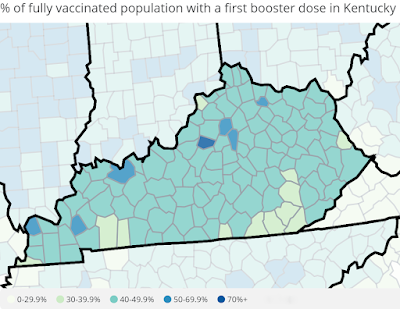
Centers for Disease Control and Prevention maps; click to enlarge.
"We have to remember to stay vigilant against the virus," Chandler said. "Research shows the best way to avoid severe illness and death is to stay up to date with vaccines and boosters. Other ways to keep on guard include staying home if you feel sick, and testing, wearing a mask in a big crowd and getting healthier by doing things like eating nutritious foods." 

One dose provides very little protection, experts say.

The poll found that 65.4% of Kentucky adults said they believed the pandemic was not yet over in Kentucky, 31.7 % said it was over and 3% said they didn't know. But when asked if the pandemic was over as it pertains to their own lives, 53.3% said it was, 44.7% said it was not, and 2% said they didn't know. 

In both cases, the share who said the pandemic was over was higher among men and younger age groups.

The pandemic is clearly not over. The state's latest weekly report showed a 6.8% increase in coronavirus cases last week, with 2,236 new cases per day. The positive-test rate, which does not include home tests, rose to 18.41%; hospitalizations increased; and 67 more deaths were attributed to the virus, the largest weekly total since 79 were reported in mid-May. Kentucky has the second highest infection rate in the nation, according to The New York Times. 

Good news and bad news

Chandler said the good news from this poll is that when unvaccinated Kentucky adults were asked if they would get a vaccination, about one-third of them appeared open to the possibility. 
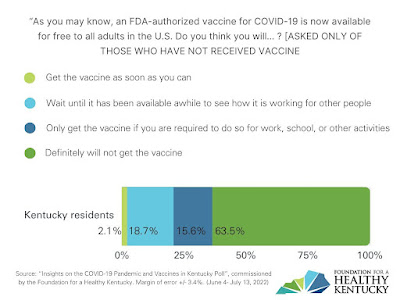
Opinions of the unvaccinated; click on graph to enlarge it.
The bad news is that poll found that the number of unvaccinated Kentuckians who say they "definitely will not" get vaccinated is going up. The poll found that 63.5% of the unvaxed said they definitely will not, compared to 46.6% in August 2021 and 19% in February 2021. 

On the other hand, the poll found that 2.1% said they would get a shot as soon as possible; 18.7% said they were waiting to see how the vaccines worked for other people; and 15.6% said they would only get a shot if it was required for school, work or other activities. 

"We think these responses are encouraging," said Chandler. "This shows there are still movable people and we should continue educational efforts to increase confidence in the safety and efficacy of the vaccine and boosters." The reportedly persuadable unvaccinated are about 12% of the state population.

Chandler said focus groups, small-group discussions about current topics, have found Kentuckians want to discuss vaccination with their doctors and it's not too late to have those conversations. 

"We've been able to drill down on this point with some of our recent focus groups, and feel there's an opportunity to educate people about the risks from getting Covid-19, including severe illness and 'long Covid' symptoms, compared to the risks of side effects and benefits of the Covid-19 vaccines and boosters," he said. 

According to the state Department for Public Health, 34% of Kentuckians have not received a Covid-19 vaccine. That amounts to 1.5 million. If 36% of this unvaccinated group are still open to getting a shot, as Chandler suggests, that means about 550,000 Kentuckians could still be convinced to get it.

The poll found an increase in those who believe getting a Covid-19 vaccine is a personal choice and fewer saw it as a "part of everyone's responsibility to protect the health of the community." In February 2021, Kentuckians were split nearly equally on this issue, but the most recent poll shows 62.7%, believe it is a personal choice.

Confidence in the vaccines is dropping

The poll also found that among the unvaccinated, confidence in the vaccines' efficacy has lessened since the emergence of the Delta and Omicron variants and subvariants, with 76.4% of unvaccinated Kentucky adults doubting effectiveness of the vaccines, up from 65.7% in August 2021. 
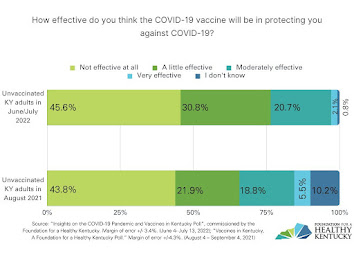
Opinions of the unvaccinated; click on graph to enlarge it.
The most recent poll found that of the 76.4% of unvaccinated adults who doubted effectiveness of the vaccines, 45.6% said the vaccines are "not effective at all," 30.8% said they are "a little effective," 20.7% said they are moderately effective, 2.1% said they are very effective ad 0.8% said they didn't know.  

In August 2021, 43.8% of this group said the vaccines were "not effective at all" and 21.9% said they were only "a little effective." 

The poll also found real concern among Kentucky adults about the effectiveness of the vaccines and boosters against future strains of the coronavirus. Among the unvaccinated, 52.4% said a vaccine would not be "effective at all" against new strains, marginally higher than in August 2021. 

Among fully vaccinated adults, 75.7% said they felt booster shots would be "moderately effective" or "very effective" in protecting them, but only 63.8% said the booster shots would have the same levels of protection against new strains of the virus.

Chandler said this lack of confidence in the vaccines, especially when it comes to protecting against new variants, is one reason that it is hard to get unvaccinated Kentuckians vaccinated.

He said the foundation will use these insights to inform vaccine outreach and educational efforts. "We hope the information encourages health-care workers to continue talking with patients about the vaccine and boosters discussing those risks and benefits and dispelling misinformation," he said.  

The poll, which was funded by the foundation, was conducted by the University of Cincinnati Institute for Policy Research. It surveyed a random sample of 814 Kentucky adults via landline and cell phones and has a margin of error of plus or minus 3.4 percentage points.