Showing posts with label FDA. Show all posts

Saturday, June 22, 2024

FDA OKs menthol e-cigs made by firm Altria recently bought, thus supporting its smoking-cessation claims; health advocates object

By Matthew Parrone
Associated Press

The Food and Drug Administration on Friday authorized the first menthol-flavored electronic cigarettes for adult smokers, acknowledging that vaping flavors can reduce the harms of traditional tobacco smoking.

Njoy menthol product
The FDA said it authorized four menthol e-cigarettes from Njoy, the vaping brand recently acquired by tobacco giant Altria, which also sells Marlboro cigarettes.

The decision lends new credibility to vaping companies’ longstanding claim that their products can help blunt the toll of smoking, which is blamed for 480,000 U.S. deaths annually due to cancer, lung disease and heart disease. E-cigarettes have been sold in the U.S. since 2007 but in recent years their potential benefits for smokers have been overshadowed by their use by adolescents and teens.

Parents and anti-tobacco groups immediately criticized the decision, which follows years of advocacy efforts to keep menthol and other flavors that can appeal to teens off the market.

“This decision could mean we’ll never be able to close the Pandora’s box of the youth vaping epidemic,” said Meredith Berkman, co-founder of Parents Against Vaping E-cigarettes. “FDA has once again failed American families by allowing a predatory industry to source its next generation of lifetime customers — America’s children."

Youth vaping has declined from all-time highs in recent years, with about 10% of high schoolers reporting e-cigarette use last year. Of those who vaped, 90% used flavors, including menthol.

In Kentucky polling in 2021, 45% of high-school students said they had used an electronic vapor product, 22% were current users, 8% were frequent users, and 7% used the products daily. Among Kentucky middle-school students, 24% said they had used an electronic vapor product, 11% said they were current users, nearly 3% said they were frequent users, and 2% said they used daily.

All the e-cigarettes previously authorized by the FDA have been tobacco, which isn't widely used by young people who vape.

Njoy is one of only three companies that previously received FDA's OK for vaping products. Two of the four FDA-approved products are "sealed, pre-filled, non-refillable pods that are used with a previously authorized Njoy device, and two are disposable e-cigarettes with a prefilled, non-refillable e-liquid reservoir," reports Jessica Karins reports of Inside Health Policy.

Njoy’s products accounted for less than 3% of U.S. e-cigarette sales in the past year, according to Nielsen. Vuse, owned by Reynolds American, and Juul control about 60% of the market, while hundreds of disposable brands account for the rest.

Most teens who vape use disposable e-cigarettes, including brands like Elf Bar, which come in flavors such as watermelon and blueberry ice.

Altria's data showed Njoy e-cigarettes helped smokers reduce their exposure to the harmful chemicals in traditional cigarettes, the FDA said. The agency stressed the products are neither safe nor “FDA approved,” and that people who don’t smoke shouldn’t use them.

Friday’s action is part of a sweeping FDA review intended to bring scientific scrutiny to the multibillion-dollar vaping market after years of regulatory delays. The U.S. market includes thousands of fruit- and candy-flavored vapes that are technically illegal but are widely available in convenience stores, gas stations and vape shops.

The FDA faced a self-imposed court deadline at the end of this month to wrap up its yearslong review of major vaping brands, including Juul and Vuse.

Those brands have been sold in the U.S. for years, awaiting FDA action on their scientific applications. To stay on the market, companies must show that their e-cigarettes provide an overall health benefit for smokers, without significantly appealing to kids.

“Based upon our rigorous scientific review, in this instance, the strength of evidence of benefits to adult smokers from completely switching to a less harmful product was sufficient to outweigh the risks to youth,” said Matthew Farrelly of FDA’s Center for Tobacco Products.

Richmond-based Altria previously took a $13 billion stake in Juul in 2018, when the brand controlled most of the U.S. vaping market. But Juul's value plummeted after it was hit with lawsuits and investigations over its role in sparking a national spike in underage vaping.

Several longtime health-advocacy groups criticized the decision.

American Lung Association CEO Harold Wimmer wrote, “The tobacco industry has been using menthol and other flavors to attract kids for decades - this opens up a legal pathway for Njoy to market their highly addictive products.”

Lisa Lacasse, president of the American Cancer Society Cancer Action Network, noted that the move comes less than two months after the Biden adminisration announced an indefinite delay in FDA’s proposed rule to ban menthol cigarettes and flavored cigars, which had bene pending for two years.

"FDA has been more closely scrutinized by Congress over its e-cigarette regulation approach in recent months," Karins notes. "Lawmakers in both parties agree FDA isn’t doing enough to combat illegally imported e-cigarettes, but a partisan divide is emerging on whether the agency should respond by approving more domestic products. Some Republicans have suggested the agency should approve more applications for American companies’ products while Democrats largely want those products off the market as well."

In its announcement, "FDA appeared to respond to criticisms," Karins writes. Center for Tobacco Products Director Brian King said, “This action is further reinforcement that authorization of an e-cigarette product is possible when sufficient scientific evidence has been submitted to the agency to justify it.” 

King said Njoy submitted evidence "showing a benefit to adult smokers relative to the company’s previous tobacco-flavored products that is sufficient to outweigh risks of the products, including potential appeal to youth."

Karins notes, "FDA’s statement says authorization of the products does not mean they are safe, adding that people who do not use nicotine products shouldn’t start. It also says the agency remains concerned about youth vaping. It will monitor the marketing of the Njoy products levels of use of the products among youth and former smokers, and the number of smokers who are able to completely switch to the products."

Under the FDA rule, Njoy may not "use most advertising methods," and ads "cannot include cartoon images, images of food or fruit, or depictions of people who appear to be younger than 45," Karins reports. "Retailers must place Njoy products only in non-self-service areas of stores."

Saturday, March 9, 2024

Bill is moving to create database (but not licensing) of vape retailers, raise fines and bring state law in line with FDA rules

A customer vapes at a shop in Richmond, Va. (Associated Press file photo by Steve Helber)
By Melissa Patrick
Kentucky Health News

A bill to create a statewide database of retailers that sell vaping products, and align state law with federal restrictions on the products, is moving through the Kentucky General Assembly.

House Bill 11, sponsored by Republican Rep. Rebecca Raymer of Morgantown, was approved with a committee substitute by the House Health Services Committee on March 7 and was posted for possible action by the House starting Monday, March 11. 

After nearly an hour of discussion, HB 11 was approved 14-1-3, with Rep. Felicia Rabourn, R-Pendleton (Henry County), voting no and Democratic Reps. Adrielle Camuel of Lexington, Rachel Roarx of Louisville and Lindsey Burke of Lexington passing. 

Rep. Rebecca Raymer

Raymer said she began working on the bill after learning that most items confiscated in Kentucky schools are flavored and disposable vapes,and “I found out that these vapes are not even supposed to be offered for sale,” under rules of the U.S. Food and Drug Administration.

She said opponents would say that the bill will all such products off the shelf, but “That is simply not true. There are other states that have used the same definitions that we are using. I think Alabama is one of the states and they have about 1,600 products on their registry of things that can still be sold.”

Raymer said Congress is lobbying the FDA to create a concise list of what is legal and not legal, and “We are not the regulatory authority over these products. We don't get to decide what is legal and illegal.”

Dr. Britt Anderson, a pediatric emergency-medicine physician and vice-president of the Kentucky Chapter of the American Academy of Pediatrics, told the committee that she sees children come into emergency rooms addicted to nicotine and unable to stop vaping, which makes them cough and wheeze and be unable to exercise.

Vaping has become much more common among Kentucky schoolchildren than smoking. While the long-term effects of vaping on young people's health are unknown, Anderson said what we do know about vaping and nicotine use in youth is not "cutting-edge science." 

"We do know that they cause lung injury and changes to brain development during a crucial stage of life," she said. "And it's not just the nicotine. The complete ingredient list may contain fine particles and other carrier solvents that are unhealthy as well."

Mallory Jones, a junior at George Rogers Clark High School in Winchester, told the legislators that high schoolers can easily purchase vaping products despite the age restrictions.

"Once one person in a friend group starts using e-cigarettes, word gets around of where you can buy these products illegally, and it spreads like a domino effect," she said.

Jones lauded the bill, saying, "Addressing the source of these products is critical to reducing youth access and initiation of nicotine, but the rules are only as good as the enforcement that we put behind them."

Griffin Nemeth, coordinator of the #iCANendthetrend Youth Advisory Board at the University of Kentucky, noted that while HB 11 does not allow Kentucky to join the 40 other states that have some form of comprehensive tobacco retail licensure, it does allow the state to have a better understanding of the retail environment.

But he added that alone is not enough to make a difference: "It is with, and only with, the three combined elements of a retailer database, compliance checks and stiff penalties for violations that we can implement comprehensive prevention at the point of sale." 

Opponents of the bill

Troy LeBlanc, a retailer and manufacturer of vape products, said he supports efforts to decrease youth use of them, but said this bill won't do that because the bulk of the products approved by the FDA are sold in convenience stores and that's where most of the bad actors are when it comes to selling these products to youth.

"I urge you to change this bill to put these products in 21-and-over stores and have them policed by the ABC and have them fined with major fines . . . Make sure that the fine hurts enough to where people will not do it," he said. 

LeBlanc also said this bill would eliminate access to low-nicotine products while allowing sale of high-nicotine products made by large companies. 

He said the average nicotine level of products sold in vape shops is 3 milligrams per milliliter, while the large companies like Altria (formerly Philip Morris), make products with a much higher nicotine content.

"I don't believe it's the right bill because all it's going to do is to make sure that Altria is the main seller in every convenience store . . . . Juul is going to be all over the state," he said. "Juul also does not offer any nicotine product that's lower than 30 milligrams per milliliter." 

LeBlanc also pushed back on Raymer's claim that Alabama allows 1,600 products on their shelves, saying that after dissecting the list, "There are only eight brands on there of flavored nicotine." 

Mike Reichert of Campbell County, who said he owns two vape shops in Northern Kentucky, said this bill would likely cause his shops to close. 

"Most of the products that I sell would be banned as this bill is currently written," he said. "It would almost certainly cause my stores to close." 

Reichert said he got into the business to help people quit smoking, making that possible by selling the lower-nicotine products that can be tapered down to zero nicotine in his store. He agreed with LeBlanc that sales should be limited to 21-and-older stores, with higher fines to keep the bad actors out. 

Tommy Wilson of Pulaski County, who said he owns two vape stores, also pushed for such a move, which he said would likely make this issue go away. 

Wilson said he had helped thousands of people get off nicotine via combustible cigarettes and move to a lower-dose vaping product. 

“We too don't want youth vaping," he said. "But that said, we feel like it’s an adult’s choice to be able to find something that they deem is less harmful to their body. . . . Is it perfect? Maybe not, but is it better than 3,000 chemicals and burning smoke going into your lungs? I feel it is." 

The committee chair, Rep. Kim Moser, R-Taylor Mill, asked the opponents of HB 11 to keep talking to the bill sponsor to see if any tweaks can be made. 

"No one wants to do anything that is going to put anyone out of business," she said. "That's not our goal." 

Legislators' concerns

Rep. Josh Bray, R-Mount Vernon, asked the vape-shop owners if they're selling products that are not FDA-approved, prompting them to walk through the history of vaping products in the U.S., the ongoing methodology challenges to get products approved by the FDA and the legal challenges surrounding this issue. 

Earlier in her remarks, Raymer noted that she understands that those in opposition of this bill don't like the FDA process for regulating these products, but the bottom line is that the FDA has that authority. 

"And so we, as a state, have an obligation to offer some protection to our citizens," she said. "If we know these products are not authorized, they are not legal per the FDA, we shouldn't have them."

Roarx, one of the Louisville Democrats, said she appreciates the bill’s goal to keep Kentucky youth away from nicotine products, but said she has concerns that the bill might have unintended consequences on the tobacco and e-cigarette industry by creating a monopoly.

“I hope we can continue to make progress to make sure that we’re not just giving a couple of brands a monopoly on the entire industry,” Roarx said. 

The bill would take effect Jan. 1, 2025. Among other things, it would:
  • limit the sale of products to those authorized by the FDA and would punish retailers who sell unauthorized products to anyone under 21 years of age;
  • require businesses that sell vaping products to acknowledge that in their annual business filings with the secretary of state;
  • require the secretary of state to create a list of the businesses and share it monthly with the ABC and the state Department of Revenue;
  • require the ABC to create and maintain a tobacco database and reporting system, to be published monthly;
  • set rules around how manufacturers, wholesalers and retailers sell and distribute the products;
  • establish fines for manufacturers, wholesalers and retailers for noncompliance; and
  • allow police officers and ABC investigators to issue a uniform citation for any violation of the law. The citations would then be reported to and enforced by the ABC.
What are the fines? 

The bill would require any manufacturer of products covered by the federal Tobacco Control Act to sell authorized products to wholesalers and retailers. A manufacturer that violates this section would be subject to a fine of $25,000 for a first violation, $50,000 for a second violation and $75,000 for third and subsequent violations.

It would ban a wholesaler from selling unauthorized products and from selling authorized products to a retailer until it verifies that the retailer is not in the tobacco non-compliance database and reporting system. Violators would be subject to a $5,000 fine for the first violation, and $15,000 for the second and subsequent violations.

State law already bans sales to minors, with a fine of $100 to $500 for the first violation and $500 to $1,000 for the second violation. The bill would require the second-violation fine to be $1,000 and set a $5,000 fine for a third violation. A retailer with a fourth violation in two years would be banned from selling vapes. That would also apply to retailers who don't pay fines within 60 days.

Friday, October 20, 2023

Heart expert: Ibogaine to treat opioid addiction is safe only in hospitals; others say risk can be mitigated; 'rough' plan outlined

By Melissa Patrick
Kentucky Health News

In a session focused on challenges of getting the psychedelic drug ibogaine approved by the Food and Drug Administration for treating addiction with help of the state's opioid settlement funds, a cardiologist said it couldn't be done in a reasonable time and the drug is unsafe.

"My opinion is that ibogaine is not safe, the efficacy is unproven, it's unlikely to be approved by the FDA in a reasonable time period, and the cost to Kentucky would be unsupportable," said Dr. Mark Haigney, a board-certified cardiologist and electrophysiologist, and an attending physician at the Walter Reed National Military Medical Center.

Haigney was invited to a special Kentucky Opioid Abatement Advisory Commission meeting on Oct. 17 by commission member Patricia Freeman, a pharmacy professor at the University of Kentucky. The meeting also saw the head of the commission discuss a "rough" plan for funding ibogaine research.

Patricia Freeman
(Photos by Melissa Patrick)
After two hearings that focused on ibogaine development and personal testimonies favoring the drug, she asked to invite experts in regulatory drug development to testify about the challenges of navigating ibogaine through the FDA process, given its potential for damage to the heart and its current classification as a Schedule I drug with no medical use.

Freeman said she had concerns that people at one hearing thought there would be quick access to ibogaine with the $42 million investment and felt compelled to ensure they understand that this would be a multi-year endeavor with no guarantee of success. 

"I felt this was important as it would help make sure that at large, our commission would be as fully informed as possible prior to making a decision on proposed ibogaine funding," Freeman said. 

The proposal comes from Bryan Hubbard, chair and executive director of the commission, which operates in the office of Attorney General Daniel Cameron, the Republican nominee for governor. Ibogaine is illegal everywhere but Mexico and New Zealand, but has been anecdotally reported to stop drug-withdrawal symptoms. 

Haigney, who described himself as an "expert in drug-induced sudden death and drug-induced loss of consciousness," said that while he recognized the attractiveness of a single-dose drug like ibogaine to treat opioid-use disorder, such a drug must be "safe in the immediate term, effective in the long term, FDA-approved, and affordable for the huge number of Kentuckians with opioid-use disorder." 

He said ibogaine isn't safe because it is known to cause cardiac arrhythmias and sudden death. In detail, he explained that this happens because ibogaine causes a "prolonged QT interval," which is one of the measurements taken by a standard electrocardiogram. 

A prolonged QT interval occurs when the heart muscle takes longer to contract and relax than usual, which can affect heart rhythms and lead to sudden cardiac arrest. 

Haigney said the FDA requires all drugs to undergo cardiac testing and that "the finding of QT interval prolongation is the most common reason for removal of a drug from further development." 

He added that a prolonged QT interval can happen when a drug blocks the cardiac potassium channels to the heart and that ibogaine is a "potent blocker" of this channel, even with normal therapeutic doses. 

"So this means that most if not all subjects would experience some significant degree of blocking the channel," he said. "And this is a very poor prognostic finding for a drug."

Haigney pointed to a study of 14 hospitalized patients who received a "relatively low dose" of ibogaine. The average increase in QT interval was 95 milliseconds. He said the FDA's published guidelines say it is concerned when a drug prolongs the QT interval by 5 milliseconds or more. 

"I've never seen a drug prolong the QT interval so profoundly," he said, adding later, "This degree of QT prolongation would be expected, associated with increased risk of fatal events."

He then asked rhetorically, "Can this drug be given safely?" His answer, "Yes, in the hospital. We do a lot of dangerous things in the hospital with a lot of technology," adding that this would be "an incredibly resource-demanding" drug to administer. 

"The likelihood that this drug with this safety profile will be approved by the FDA in less than 10 years, in my opinion, is remote and the effort will require at least a billion dollars," Haigney said. "The administration of ibogaine would strain hospital resources at a time when bed shortages are severe. This is a treatment for wealthy individuals who can pay for hospitalization with intensive monitoring," so it would not help most Kentuckians "who struggle with opioid dependence." 

Freeman also invited Robert Walsh, recently retired from working in the National Institute on Drug Abuse for 36 years, where he headed NIDA's Regulatory Affairs Branch. 

Walsh spoke to the regulatory challenges of ibogaine development, including cardiac safety, ensuring enough supply of a plant-based drug from another country, creating a plant-based drug with the same dose in each pill, and the challenges of working with a Schedule I drug in laboratories and clinical settings.

Dr. Sidney Peykar, a cardiac electrophysiologist and medical director at the Cardiac Arrhythmia Institute, said the drug could be given safely in a hospital setting and said he has expanded the protocol for how to administer ibogaine safely at the Beyond Ibogaine Treatment Center in Cancun, Mexico.

"Most if not all of these deaths could be mitigated or completely prevented through safety protocols," he said.

Dr. Javier Muniz, the FDA's supervisory general-health scientist for controlled-substances initiatives, was asked if FDA would definitely not approve ibogaine. He said that without all of the information in front of him, "I have no idea." 

Asked by Freeman if a 95-millisecond QT prolongation would disqualify ibogaine from being approved, he said it's important to remember that when the FDA is considering the approval of a drug, the agency looks at a drug holistically and considers both risks and benefits. 

Bryan Hubbard, right, and
Carlos Cameron, commission
member. 
Hubbard was asked after the meeting if any speaker had caused him to change his mind about his ibogaine plan. He said, "Dr. Haigney was brought in here to oppose this initiative and he articulated all of the talking points that the opponents of this initiative have already parlayed at public remarks. So there was nothing that was either surprising, nor persuasive about his remarks, and insofar as what he has articulated, are already widely publicly disseminated talking points of opposition."

He said Haigney was "thoroughly debunked [by] individuals who serve, respectively, on an FDA advisory board for psychopharmacology, as well as the science journal for the FDA's research arm related to controlled substances."

At the end of the meeting, Hubbard gave the commission a "very rough draft" of a plan with a list of requirements that would have to be met before the commission would commit $42 million to the project. He did not release the plan, but told Kentucky Health News after the meeting that it contains these points:
  • "Viable research proposals from qualified research entities" that will match the state's $42 million
  • The state would have ownership of any patentable intellectual property that is generated
  • Clinical trials would be held in the West End of Louisville and in Wast Kentucky, "in a way that ensures social, racial, and economic equity of access to the treatment,"
  • An approved drug-investigation application from the FDA "with secured clinical-trial sites and a diverse group of qualified clinical-trial participants before the first dollar is ever matched by the commission," 
"This will have to be a viable, go project before any commission resources are put on the table," Hubbard said,. Nothing like this has ever been done. So all of this is breaking ground." He cited "the competing interests, the areas of concern, the nature of this money, the necessity of protecting it, the necessity of making sure that the Commonwealth of Kentucky has a leadership position that is protected and recognized, and consideration of risk that we are taking by making this bet."

When it comes time for the commission to vote, he said, "Theoretically, the vote will be to legally authorize a $42 million match from the commission for our clinical research team that is ready to conduct clinical trials with ibogaine in Kentucky."

Hubbard said it is imperative that no vote be taken until Dr. Nolan Williams' peer-reviewed research of veterans who have suffered from traumatic brain injury and received ibogaine is published and they hear from him about his findings. Williams is an associate professor at Stanford University.

At the commission's first public hearing, Williams said he had let other professionals look at the data from his study and they said "the findings are shocking and that they've never seen a drug do this before." 

Before the eight guests spoke, Hubbard took about five minutes to address how he and the commission came to explore ibogaine and its potential therapeutic uses. He said as far back as 2018, he became aware of emerging science on therapeutic psychedelics and an author who at the time wrote about the topic and led him to other sources of information. Her newsletter The Journey is published on Substack. She wrote under the pen name of Julia Blum now uses the name Julia Christina.

Hubbard was responding to an Oct. 9 Daily Beast story, excerpted in Kentucky Health News, which reported that about the time Cameron implicitly endorsed his plan at a public event, a major national political contributor increased its investment in ibogaine research and later gave Cameron's campaign a political boost. He is running against Democratic Gov. Andy Beshear, who has objected to Hubbard's ibogaine plan.

Hubbard said, "It's important to set the record straight in full public view, lest the fictitious narrative of a smoke-and-mirror smear job generated by a third-rate, agenda-driven political tabloid prevail in the public arena against the integrity and sincerity of all who have offered their time, expertise and visceral lived experiences for all the world to see on behalf of all Kentuckians."

The commission's next regular business meeting is scheduled for 1 p.m. Nov. 14 at 1024 Capital Center Dr., Suite 200, Frankfort.

Friday, July 7, 2023

First drug to slow Alzheimer's disease gets full FDA and Medicare approval for early-stage cases; drug is still in clinical trials at UK

Dr. Jim Jackson of Morehead receives a lecanemab infusion
at UK's Sanders-Brown Center on Aging. (UK file photo) 

By Melissa Patrick
Kentucky Health News

The U.S. Food and Drug Administration has granted full approval for the first drug to slow down the progression of Alzheimer's disease, opening the door for Medicare to pay for it.

"This is the first medicine ever that actually changes the disease in the brain, removes a component of the disease and can extend quality of life for patients who are developing and who are in the early stages of Alzheimer’s disease," Dr. Greg Jicha, director of clinical trials at the University of Kentucky Sanders-Brown Center on Aging, said at a news conference on Friday. 

Jicha stressed that the drug is not a cure, but instead has been shown in clinical trials to slow the disease process by 27% to 40%. 

Lecanemab, marketed by Japanese drug maker Eisai and U.S. partner Biogen under the brand Leqembi, is an antibody that targets amyloid plaques, which are found in brains of people with Alzheimer's. It is administered twice a month, intravenously; the firms have estimated treatment will cost $26,500 a year. 

The drug has been on the market since January 2023 under an accelerated approval from the FDA but was not broadly covered by Medicare. Following the FDA's full approval of the drug, Medicare, which primarily serves adults age 65 and older, will now cover it for those who qualify. 

With the Centers for Medicare and Medicaid Services' announcement, Jicha said the approval would make coverage more likely by other insurers, including Medicaid, which is a federal-state program.

Jicha also said he hopes Esail will have patient-assistance programs to ensure that anyone who qualifies for the drug has access to it. 

“I really think it behooves all of us to ensure that this medicine is accessible to everybody,” he said. “No matter what their socioeconomic status, no matter what their geographic limitations are, everyone who has early Alzheimer’s disease deserves the opportunity as long as the medicine is going to be safe for them.”

Dr. Jim Jackson, a retired pediatrician from Morehead, participated in an 18-month lecanemab study at UK and is now part of what his wife, Sharon, called an "extension study." 

"I felt that it was really a good opportunity to be part of something that can improve life for many, many people," he said at the news conference. Later adding, "I would be very happy to recommend this drug. I've been tickled to death to be in the study." 

Jicha said there are some side effects to the drug, including amyloid-relating imaging abnormalities (ARIA), typically a temporary swelling and/or bleeding in certain areas of the brain that usually resolve over time. He said people with two copies of a well-known Alzheimer's risk gene may be more at risk of ARIA. 

Sharon Jackson said her husband has responded well to the drug and has had no side effects. When he started the clinical trial, she said, "Jim had a little bit of memory issues and I can plausibly say that it has not progressed very much. . . . I can see that this medication, from what I understand about Alzheimer's, seems to be holding him pretty steady."

Who qualifies for the drug?

The medication will only be available to those in the early stages of the disease, and doctors willhave to verify that there is a buildup of amyloid in the brain before they can prescribe, Jicha said. Also, he said the drug must be administered by specialists who understand how to provide the treatment and to monitor for safety. 

“This medicine is only for those with mild memory problems, what we call mild cognitive impairment or folks that are in the mild stage of Alzheimer’s,” Jicha said, because benefits are uncertain for those in “a more moderate or severe stage.”

The drug is not available to people at risk of Alzheimer's, but Jicha said ongoing clinical trials are evaluating the usefulness of the drug for this group.   

The Alzheimer's Association promoted early detection and diagnosis in its press release celebrating the full approval of lecanemab. 

"With this approval, early detection and diagnosis are even more critical to ensure individuals receive the most benefit at the earliest point possible. If you or a loved one is experiencing memory changes, the Alzheimer’s Association strongly encourages speaking with a health care provider for a thorough evaluation and diagnosis and to discuss treatment options," says the release. 

In Kentucky, 75,000 people 65 and older are living with Alzheimer's and that number is expected to increase by 15% in the next few years, to 86,000 in 2025, according to the Alzheimer's Association. Further, the association says 11.2% of people aged 45 and older have subjective cognitive decline.

Some people have misgivings. "Providers and health researchers who have doubts about the drug’s safety and efficacy say the decision exemplifies broader problems with FDA’s approval process," Jessica Karins of Inside Health Policy reports. "The critics raise concerns with the safety profile of the early-stage Alzheimer’s treatment . . . and say the difficulty of measuring cognitive decline means it remains unclear how much the drug can slow the progression of Alzheimer’s disease."

Tuesday, August 30, 2022

FDA has authority to crack down on illicit vapes, but isn't doing it, Stat reveals; study finds increased e-cig use among lesbian girls

Food and Drug Administration photo
Even though the U.S. Food and Drug Administration has ordered hundreds of flavored, nicotine-heavy vaping products off of the market, "a Stat investigation found that vape companies are regularly flouting the FDA’s orders. They’re making, stocking, and selling the illicit goods. And the agency is just letting it happen," Nicholas Florko and Elissa Welle report for Stat, the medicine-and-science publication of The Boston Globe 

The authors write that while the FDA has ordered more than 100 vape manufacturers to stop making more than 250 specific flavors and vapes, "We found scores of companies across the country that are defying the FDA's demands." 

And despite having "sweeping legal authorities" to crack down on vape companies that ignore its bans, "ranging from levying seven-figure fines to physically pulling products off shelves," the Stat investigation found that the FDA has never used those powers, according to its own data. And in several cases, "It’s even dropped cases against companies that it knows are still selling illegal products," Florko and Welle write. 

The authors note that the FDA declined Stat’s request for an interview with FDA Commissioner Robert Califf or the head of the FDA’s Center for Tobacco Products, Brian King, but say a spokesperson implied the agency may soon get tougher against companies that ignore its orders,

“The agency is currently working on further enforcement in situations where companies that have [been banned from the market] continue to sell illegal products,” the spokesperson told Stat in an email. “The FDA is currently engaged in discussions with the Department of Justice regarding specific potential enforcement actions.”

Vape shops argued that the FDA’s orders aren’t clear enough, and that until they are more so, they'll keep selling the products.

The shops “are doing their best, despite a complete lack of clarity or transparency from the agency, to piece together what products are still legally able to be sold,” Amanda Wheeler, president of American Vapor Manufacturers, told Stat. “It would be legally and morally irresponsible for us to recommend that companies should voluntarily close down their businesses because FDA cannot sort out their filing systems.”

The authors walk through the FDA's regulation process for vaping products that ultimately requires every company that manufactures a vaping product to get the FDA's permission before selling their products in the United States. After being pushed back from November 2018, the deadline for asking permission was September 2020. And last year, the FDA finally started denying some companies' requests to sell their vaping products, resulting in many companies ignoring the requests. 

As part of the investigation, "Stat reviewed 120 letters issued to vaping companies between August 2021 and May 2022, covering bans on some 274 named products. According to company websites and information provided by vape shops by phone, at least 139 of the products are still being sold — more than 50% of the products named in those warnings." 

“If a large portion of the vaping products FDA has ordered off the market are still being sold, I’m baffled," Bill Schultz, a former deputy FDA commissioner who also served as the federal health department’s top lawyer and represents the Campaign for Tobacco Free Kids, told Stat.  “Congress gave the agency the authority to act decisively and they should be using it.”

The authors note that their investigation is likely an underestimation of the issue, since they only analyzed warning letters sent to companies that formally asked the agency for permission to sell their products, and then had that request denied and did not focus on the hundreds more companies that received warning letters for never asking the FDA for permission at all.

Much of the impetus for the FDA  to crack down on vaping companies' sale of products came from the surge in teenagers' use of these highly addictive devices. From 2019 to 2020, the popularity of disposable electronic-cigarette use among U.S. high school students who currently vaped went up by 1,000 percent, from 2.4% to 26.5%, according to the Centers for Disease Control and Prevention

Researchers are beginning to look at which groups of teens vape and the underlying reasons that put them at risk to start with. 

One such study recently published in the American Journal of Preventive Medicine, looked at the prevalence of vaping among high-school students in different sexual orientation, race and ethnicity groups. The study used survey data from more than 38,000 U.S. high-school students from 2015-2019.

The study uncovered significant differences in the prevalence of current electronic-cigarette use between lesbian and heterosexual girls when comparing across racial groups, says a news release from the Annenberg School for Communication at the University of Pennsylvania.  

"Current e-cigarette use was higher in Black girls who identify as lesbian compared to Black girls who identify as heterosexual (18.2% versus 7.1%)." the release says. "The rate was also higher in multiracial girls who identify as lesbian compared to multiracial girls who identify as heterosexual (17.9% versus 11.9%). On the other hand, white girls who identify as lesbian were found to be at lower risk of current vaping compared to white girls who identify as heterosexual (9.1% versus 16.1%)."

The study found that among boys, there were no significant interactions between sexual orientation and race or ethnicity in relation to vaping prevalence.

The authors note, "Previous surveys of gay and lesbian teens suggest that e-cigarette use might be a coping mechanism to deal with the stress of sexual orientation or gender identity-based discrimination or bullying — or a way to bond with others in their social circle." 

They also suggest that a possible reason for finding disparities in e-cig use at the intersection of sexual orientation and race among girls — but not among boys — may be due to higher levels of targeted e-cig marketing toward lesbians of color. 

“For years, the tobacco industry has targeted marketing toward traditionally marginalized groups, whether in clubs, bars, Pride events, or through magazines,” Andy Tan, co-author of the study, said in the release. “Sexual, racial, and ethnic minority youth are more likely to report engaging with online tobacco advertising including e-cigarette ads on social media.”

Thursday, August 15, 2019

FDA proposes new, graphic warnings for cigarette packs and ads

A Food and Drug Administration photo illustration shows three  of the 13 proposed warnings.
The Food and Drug Administration has again published a proposed rule to "require color graphics depicting the negative health consequences of smoking be added to cigarette packages and in cigarette advertisements," Inside Health Policy's Beth Wang reports.

The warnings would be the first update to cigarette package warnings in more than 30 years. They were authorized by a 2009 law, but a tobacco-company lawsuit blocked FDA's first attempt.

Wang describes the proposed warnings:

Tobacco smoke can harm your children,” with an image that shows the head and shoulders of a boy 8 to 10 years old, wearing a hospital gown and receiving a nebulizer treatment for chronic asthma.

Tobacco smoke causes fatal lung disease in nonsmokers,” with an image showing gloved hands holding a pair of diseased lungs containing cancerous lesions.

Smoking causes head and neck cancer,” with an image showing the head and neck of a woman 50 to 60 years old who has a tumor protruding from the right side of her neck, just below her jawline.

Smoking causes bladder cancer, which can lead to bloody urine,” with an image of a gloved hand holding a specimen cup with bloody urine.

Smoking during pregnancy stunts fetal growth,” with an image of an infant on a medical scale with a digital display reading 4 pounds.

Smoking can cause heart disease and strokes by clogging arteries,” with an image of a 60- to 70-year-old man with a large, recently sutured incision in his chest as he undergoes monitoring.

Smoking causes COPD, a lung disease that can be fatal.” There are two versions of the COPD warning. One will have an image of gloved hands holding a pair of diseased, darkened lungs removed from a smoker; the other will have an image of the head and neck of a 50- to 60-year-old man who has a nasal canula under his nose supplying oxygen, with the oxygen tank behind him.

Smoking reduces blood flow, which can cause erectile dysfunction,” with an image of a 50- to 60-year-old man sitting on the edge of a bed and leaning forward with one elbow resting on each knee. The man’s head is tilted down with his forehead pressed into the knuckles of his right hand while his female partner sits behind him on the bed, looking in another direction.

Smoking reduces blood flow to the limbs, which can require amputation,” with an image of feet with several toes amputated due to damage resulting from peripheral vascular disease caused by smoking.

Smoking causes type 2 diabetes, which raises blood sugar,” with n image of a personal glucometer device showing a high blood sugar level.

Smoking causes age-related macular degeneration, which can lead to blindness,” with the image of a senior man getting an injection in his right eye to prevent additional macular degeneration.

Smoking causes cataracts, which can lead to blindness,” with the image of a man who is at least 65 years old who has a cataract covering his right pupil.

A lawsuit by public-health and anti-smoking advocates prompted FDA to issue the proposal, Wang notes: "The proposed warnings are required by law to be displayed on half the front and rear panels of cigarette packages, and on the top 20% of the area at the top of advertisements.

"This marks the second time FDA has issued a proposed rule to require graphic warnings on cigarette labels and advertisements," Wang notes. "The first rule was blocked in 2012 by the U.S. Court of Appeals for the District of Columbia in R.J. Reynolds Tobacco Company v. FDA, which argued the proposed rule violated the First Amendment by not justifying why there is a need to issue regulation on commercial speech. In March, however, a federal court ordered FDA to issue the proposed rule by Aug. 15, and a final rule by March 15, 2020."

The Family Smoking Prevention and Tobacco Control Act of 2009 "required nine new health warning statements to be included on cigarette packages and in cigarette advertisements, and it directed FDA to develop color graphics depicting the negative health consequences of smoking to accompany warnings," Wang notes. "After having their initial proposed rule rejected by the court in 2012, FDA undertook a research and development process to consider whether the TCA’s textual warning statements would promote greater public understanding of the risks associated with smoking. Through that process, FDA determined there was support to propose adjusting some of the TCA statements. FDA ended up with 16 statement-and-image pairings to test in a final quantitative consumer research study, which resulted in the 13 cigarette graphic health warnings listed in the proposed rule."

Friday, August 9, 2019

FDA probes 127 reports of seizures or other neurological symptoms possibly related to e-cigarettes, asks for more reports

By Melissa Patrick
Kentucky Health News

The U.S. Food and Drug Administration is investigating 127 reports of seizures, tremors, fainting or other neurological symptoms that may be related to electronic cigarettes, and is asking people to report if they have such symptoms, the agency announced Aug. 7.

Photo from Healthline 
"The FDA is continuing its scientific investigation to determine if there's a direct relationship between the use of e-cigarettes and a risk of seizure or other neurological symptoms," Dr. Ned Sharpless, the acting FDA commissioner, said in a news release.

"We still don't have enough information to determine if e-cigarettes are causing these reported incidents," which occurred from 2010 to 2019. Sharpless said. He strongly encouraged the public to continue submitting new or follow-up reports with as much detail as possible.

"Additional reports or more detailed information about these incidents are vital to help inform our analysis and may help us identify common risk factors and determine whether any specific e-cigarette product attributes, such as nicotine content or formulation, may be more likely to contribute to seizures," Sharpless said.

The release notes that users can report any unexpected health or product issues experienced with e-cigarettes or any other tobacco products through its Safety Reporting Portal. The FDA wants all submissions to include detailed information such as the brand name; whether the product had been modified in any way; if any other tobacco products, medications or substances were being used at the same time; underlying medical conditions; and usage patterns.

When the FDA announced its investigation in April, it noted that varying levels of nicotine concentration in e-cigarettes could have contributed to some of the cases. Since then, the agency has received about 92 new reports of people experiencing seizures after vaping.

E-cigarette liquids contain high concentrations of nicotine. For example, one pod made by Juul Labs has as much nicotine as a whole pack of cigarettes. Juuls are one of the most popular e-cigarette brands with teens, largely because they look like an oversized computer flash drive, are easy to conceal and come with flavorings.

Symptoms of nicotine poisoning include nausea, vomiting, dizziness, tremors, sweating and quickened heart rate.  In severe cases, nicotine poisoning can cause seizures and death, according to the National Capital Poison Center.

Kentucky teens are using e-cigarettes at alarming rates, with use nearly doubling from 2016 to 2018. Kentucky's high-school seniors report the highest use, with 27% reporting in 2018 that they had tried the product, according to the Kentucky Incentives for Prevention survey. 

Kentucky is aggressively working to curb teen use of these products. The legislature this year passed a new law to ban the use of tobacco products in all Kentucky public schools, effective next school year (with a local opt-out), and the Foundation for a Healthy Kentucky has sponsored a social media campaign to warn youth and educate adults about the dangers of these products.

Kentucky lawmakers plan to pre-file a  bill for the 2020 legislative session to tax electronic cigarettes just like other tobacco products as a way to curb youth use.  At the federal level, U.S. Sen. Mitch McConnell has a bill to raise the legal age to buy tobacco products to 21 nationwide.

Tuesday, December 18, 2018

Surgeon general issues national advisory on epidemic use of youth e-cig use; all agree it will take everyone to curb epidemic

By Melissa Patrick
Kentucky Health News

Electronic-cigarette use among teens is so widespread that the top U.S. public health official has issued a rare national advisory stressing the importance of protecting children from such devices, saying they are setting them up for a lifetime of nicotine addiction and associated health risks.

"We are in the midst of a historic and unprecedented increase in youth use of any substance," Surgeon General Jerome Adams said during a Dec. 18 news conference when he announced the advisory.

Federal research released in November showed a 78 percent increase in e-cigarette use among high-schoolers between 2017 and 2018, with the number of users surpassing 3 million. The same report showed use by middle schoolers increased 48 percent from the year before.

And this week, a National Institute on Drug Abuse study of 45,000 eighth, 10th and 12th graders found similar increases, with vaping among high school students near doubling from 11 percent in 2017 to 21 percent in 2018. In addition, this study found that nearly 8 percent of 12th graders used e-cigs to vape marijuana.

Elizabeth Anderson-Hoagland of Kentucky's Tobacco Prevention and Cessation Program said in a state-issued Facebook post about the surgeon general's advisory that while the latest research doesn't include state specific numbers, this uptick in e-cig use among teens is also a problem in Kentucky.

"Schools are saying that kids are using them in the classrooms, using them in the hallways, using them during games," she said. "It's just everywhere. It's really exploded"

Foundation for a Healthy Kentucky photo
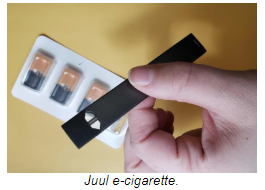
E-cigarettes come in all shapes and sizes, but the most popular one is the Juul, which looks like a USB flash drive. Kids love them because they are easy to hide, are essentially odorless and come in flavors they like. Juul commands about 75 percent of the market.

Another problem is that youth don't realize e-cigs are harmful, and don't know they contain nicotine, which is highly addictive and harmful to brain development. In fact, one Juul pod can have as much nicotine as a pack of cigarettes and even products that are advertised as nicotine-free have been found to contain nicotine.

"Once they try the flavors, they get the nicotine hit -- and they don't realize that most products contain nicotine," said Anderson-Hoagland. "So they come because it taste good, and they stay because it's addictive."

Teens also have the misconception that they emit a harmless water vapor, when in fact they can contain harmful substances, including" ultrafine particles that are inhaled into the lungs, flavorings such as diacetyl, volatile organic compounds, heavy metals and cancer-causing chemicals," according to a Foundation for a Healthy Kentucky news release.

"So in those very important adolescent years when a child's brain is developing, these compounds can have very negative impacts," Dr. Jeff Howard, commissioner of the state Department of Public Health, said in the Facebook post.

The e-cigarette problem is so prevalent that the U.S. Food and Drug Administration has called it an epidemic, prompting the agency to implement and advise for stricter measures to keep the products out of teens' hands. They include, among other things, a crackdown on flavored products, which teens report is the main reason they start using the products.

The surgeon general said that while we are "late to the game" on this issue, everyone has a role to play in stopping this epidemic: parents and kids, teachers and administrators, health professionals, state and local governments and the federal government.

Juul has recently run large newspaper advertisements touting it as a device that helps smokers quit tobacco. Adams said neither he nor FDA Commissioner Scott Gottlieb "are against exploring the harm-reduction potential of these products, but we will not stand for another year of exponential, unprecedented, historic rises in youth use of these products."

At an e-cigarette conference held Dec. 10 in Louisville, Brian King, deputy director for the Office on Smoking and Health at the federal Centers for Disease Control and Prevention in Atlanta, pointed out that cessation is a necessary prerequisite for e-cigs to be considered a harm reduction product, and so far research does not support that this is the case.

"In the end, if we're going to have a benefit from e-cigarettes, the adult cessation has to outweigh youth initiation and that is simply not what we are seeing, particularly as we are seeing skyrocketing rates of use among youth. Remember, you have 2.8 percent of adults using the product and 21 percent of high school students. A seven- to eight-fold higher rate of use among kids compared to adults and that is why the public health community is so justifiably outraged over what we are seeing. We cannot leave kids behind in this discussion of harm and risk reduction among adults and we don't even have a product that has been effectively proven to help adult smokers quit," he said.

In Kentucky, about the same number of high-school students smoke cigarettes as use e-cigs, 14 percent. But health advocates warn that e-cig use is likely much higher among the state's youth because the survey was taken before the introduction of Juul and Juul-like products.

Howard echoed the surgeon general's call to action: "I'm very concerned about the use of electronic cigarettes and I encourage all parents, educators and community members to join me in making sure our teens and youth are aware of the risk of electronic cigarettes and doing as much as we can to prevent the use of electronic cigarettes in this population."

CDC image
Anderson-Hoagland was more specific in what needs to be done to stop this epidemic, calling for communities to enact tobacco-free smoke policies that include e-cigarettes, 100 percent tobacco-free school policies, and increased education about these products aimed a both adults and teens.

"We've been down this road before with regular cigarettes, so really we need to use the same playbook for e-cigarettes," she said.

King, of the CDC, added price increases, increased access to proven cessation products and mass media campaigns to this list of ways to stop this epidemic. As of now, Kentucky does not tax e-cigs, nor do they fall under the definition of tobacco in the state, though they are included in the federal definition.

"When it comes to tobacco control, prevention is key," King said. "We've got to stop those nine in 10 adults who began as youth from starting altogether. When you implement these [policies] in the context of effective regulation, you are going to get effective prevention measures that impact the population."

The American Cancer Society Cancer Action Network commended the surgeon general's advisory, but said more federal regulation is necessary to get in front of this epidemic.

“While a number of states and communities have begun to take action to address this epidemic across the country, community level action alone cannot solve this crisis. The most substantial way to begin reversing this epidemic of e-cigarette use among youth is for the [FDA] to exercise its full regulatory authority and conduct the legally required review of e-cigarettes and cigars, including prohibiting their use of flavoring, in order to be on the market," it said in a statement.

Friday, November 16, 2018

FDA cracks down on e-cigs, noting use by youth more than doubled in a year, and proposes to ban menthol in cigarettes

Centers for Disease Control and Prevention graphic
By Melissa Patrick
Kentucky Health News

The U.S. Food and Drug Administration proposed Thursday to ban menthol-flavored cigarettes and cigars, and restrict the sales of some flavored electronic-cigarette liquids, some flavored cigars and the removal of e-cigarettes that are marketed to youth.

The proposals are aimed at curbing teen use of e-cigarettes and follow the release of data showing that teen use of these products increased 78 percent among high-school students and 48 percent among middle-school students in the past year.

The 2018 National Youth Tobacco Survey found that 3.6 million middle and high schools students are using e-cigarettes -- up from 1.5 million last year -- with more than 3 million, or 21 percent, of the students in high school and 570,000, or nearly 5 percent of them in middle school.

"It’s clear we have a problem with access to, and appeal of these products to kids, and we’re committed to utilizing the full range of our regulatory authorities to directly target the places kids are getting these products and address the role flavors and marketing are playing in youth initiation,” Dr. Scott Gottlieb, the FDA commissioner, said in a news release.

Explaining the menthol/mint ban, Gottlieb said it's not fair to create a market difference by limiting menthol and mint flavors in e-cigarettes when they are still allowed in combustible products.

The researchers attribute the surge in e-cigarette use to the popularity of the Juul and similar devices, because they resemble USB flash drives, allowing them to be used discreetly; have a high nicotine content; and come in kid-friendly flavors.

The new restrictions would require all vaping liquids flavored with anything other than tobacco, mint or menthol be sold only in stores that have strict age-checking practices. And if sold online, the flavored liquids must be sold under more stringent age verification rules, which will be forthcoming.

Gottlieb said the FDA would proceed with a proposed regulation banning flavored cigars, would issue a proposed rule to ban menthol cigarettes and cigars and will seek to remove any e-cig products that are marketed to youth, including those using cartoon or animated characters on the packaging.

Gottlieb said the package "reflects a careful balancing of public health considerations" between adults having access to a less harmful alternative than combustible cigarettes to quit smoking and preventing teen use. "But make no mistake," he warned. "If the policy changes that we have outlined don’t reverse this epidemic, and if the manufacturers don’t do their part to help advance this cause, I’ll explore additional actions."

Michigan Education Association photo
Juul Labs, which controls more than 70 percent of the market, announced earlier this week that, among other things, it will stop selling its mango, fruit, creme and cucumber pods in convenience stores and vape shops, and would shut down its social-media promotions and keep monitoring third-party accounts.

More bad news in youth tobacco survey

The jump in e-cigarette use supports the fears of health officials who have long been concerned that e-cig use by teens will reverse the declines in overall youth tobacco use. Multiple studies show that teens who use e-cigs are more likely to transition to cigarettes.

The youth tobacco survey found that in the last year, overall tobacco-product use among high-school students increased by 38 percent, rising to 27.1 percent from 19.6 percent, and among middle-school students by 29 percent, rising to 7.2 percent from 5.6 percent.

Not only is use of the products increasing, so is the frequency of use, which could indicate development of a habit that may be hard to stop. The survey found that the number of high-school students reporting they had used e-cigs on 20 or more of the past 30 days increased from 20 percent to nearly 28 percent in the past year.

More high school students reported having used flavored e-cigarettes in the past year; that figure rose to 68 percent from 61 percent. And current use of menthol- or mint-flavored e-cigs rose to 51.2 percent from 42.3 percent. Teens and young adults have told researchers that the flavors are the primary reason for their e-cig use.

Proposals spark debate

Gottlieb is getting some push-back from conservatives, but has held firm to his commitment to stop the teen use of these products.

“My former friends in the libertarian community who think this is emblematic of nanny-state government intervention and denying adults access to legal pleasures — I hope that when they sit and think about the data we’re seeing they’re willing to accept modest speed bumps in terms of the access adults will have to these products to hopefully close off the access of these products to kids,” Gottlieb told Paige Winfield Cunningham of The Washington Post.

In a detailed story in The Wall Street Journal about menthol products and "Big Tobacco," a spokesman for Reynolds American Inc., which makes Newport, the leading U.S. menthol brand, said banning menthols could possibly result in a legal battle, and a ban would also expand the underground market for these products, Jennifer Maloney and Tom McGinty report.

Matthew L. Myers, president for the Campaign for Tobacco Free Kids said in a news release that the menthol ban would "have a greater impact in reducing tobacco use by youth and the African-American community than any regulatory measure ever undertaken by the federal government."

But Myers argued that the FDA's e-cigarette proposal doesn't go far enough, because it stops short of banning many flavors that are highly popular with young people, noting that the menthol and mint flavors used by 51 percent of teen e-cig users will still be available.

"With these flavors still widely available, it is doubtful that this plan will stem the tide of youth e-cigarette use, and it will be critical for the FDA to quickly supplement the steps announced today," Myers said. "In addition, the Juul device itself and other e-cigarettes that deliver exceptionally high levels of nicotine will continue to be sold in convenience stores and gas stations."

Bonnie Hackbarth, a spokeswoman for the Foundation for a Healthy Kentucky, noted that the proposed regulatory changes can take years to implement and that there has already been "unnecessary delays" in the e-cigarette regulations, which have allowed new products to "flourish."

"We’re heartened by the FDA’s stepped-up enforcement and by what appears to be a clear-minded attempt to balance the absolute necessity of keeping tobacco products out of the hands of kids while allowing adults who smoke access to products that may help them quit tobacco completely," she said. "But we can’t wait two more years or even another six months, only to find that e-cig flavors and easy access have hooked millions more kids to a deadly habit."

Ben Chandler, president and CEO of the foundation, said, "Flavored cigarettes were banned in 2009 largely because the colorful packaging and names appealed to youth, which is the age most smoking habits are established. The explosive growth in teen use of Juul and other pod e-cigarettes in recent months, in conjunction with research showing that most youth try flavored e-cigarettes first . . . just proves the point. Flavors are a powerful tool in the tobacco business-model toolbox that relies on addicting new customers to stay in business. Unless and until it's proven that flavored e-cigs actually do help adult smokers quit, they shouldn't be allowed on the market."

Wednesday, October 3, 2018

Cheap knockoffs of popular Juul electronic cigarettes are latest FDA target to protect teens from vaping

Cheap knock-offs of the Juul electronic cigarettes popular with teens have been showing up in stores and online, "despite a U.S. Food and Drug Administration rule banning the sale of new e-cigarette products after August 2016 without regulatory approval," Chris Kirkham reports for Reuters.

The FDA applied the August 2016 deadline to new e-cigarette products, while older devices are allowed to continue without regulatory approval until 2022.

"Start-ups and major tobacco firms have launched more than a dozen new high-nicotine devices with Juul-like designs since the FDA imposed the deadline, according to Reuters review' of the companies’ online advertisements, social media posts and public statements," Kirkham writes.

FDA Twitter graphic on efforts it's taking to shut
down the sale and marketing of e-cigarettes to minors.
Earlier this month the FDA threatened to ban Juul and four other vaping-product companies unless they took steps to prevent use by minors, but Kirkham reports that other companies have flooded the market with Juul copycats with no regulatory consequences.

The FDA told Reuters that it was looking into whether certain brands were being improperly sold and plans to take "additional action on this front very soon," focusing on products with high nicotine concentrations and flavors that apparently target youth.

Teens love these products because they are small and look like a computer USB drive, making it easy for them to hide them from parents and teachers. They also come in flavors that appeal to teens and pack a powerful nicotine punch. One Juul pod has the nicotine content of about 20 cigarettes, which is the number in a traditional pack.

Health experts have voiced concern that these high-nicotine products are creating lifelong addictions in young people and will erode decades of progress in reducing youth tobacco use.

According to the national Youth Behavioral Risk Survey, smoking among high-school students declined from 15.8 percent in 2011 to 7.6 percent in 2017, but e-cigarette use grew from 1.5 percent to 11.5 percent over the same period.

In Kentucky, traditional smoking rates and e-cigarette rates have both been on the decline since the Kentucky YBRS started asking about e-cig usage in 2015.

In 2017, about the same number of Kentucky high-school students reported using e-cigarettes as traditional ones, 14 percent. This was down from 23.4 percent and 17 percent respectively in 2015.

That said, it looks like more Kentucky teens are trying e-cigs than traditional cigarettes these days. In 2017, about 45 percent of Kentucky's high-school students said they had ever used an electronic vapor product, compared to about 41 percent who had ever smoked cigarettes.

Health officials have warned that e-cigarette use is likely much higher among teens than reported in 2017, because those numbers don't reflect the surge in Juul sales.

Anti-smoking advocates have called for Kentucky schools and locales to enact 100 percent smoke-free laws that include e-cigarettes and for state officials to tax e-cigarette devices and their liquids at the same rate as conventional tobacco products as a way to address this uptick in teen use of these products.

Another concern is that teens are using Juul and the knockoff devices to smoke marijuana because their design allows a person to replace the liquid nicotine with liquid marijuana or other concentrated marijuana products or be "hacked" to allow for such products. And because there is no odor, this allows a user to smoke it anywhere without others knowing what's inside.

Saturday, August 25, 2018

17 companies that were warned to stop packaging electronic-cigarette liquids to kids have stopped; FDA warns it's still watching

Reuters photo 
All 17 companies that were warned in May to stop marketing their electronic cigarette liquids in packaging that resembled "kid-friendly food products," like juice boxes, candy and cookies, have stopped done so, says the U.S. Food and Drug Administration.

"Removing these products from the market was a critical step toward protecting our kids," FDA Commissioner Scott Gottlieb said in a news release. "We can all agree no kid should ever start using any tobacco or nicotine-containing product, and companies that sell them have a responsibility to ensure they aren't enticing youth use."

HealthDay News gave examples of the products that were targeted in the warning letters, including: One Mad Hit Juice Box, which resembled children's apple-juice boxes; Whip'd Strawberry, which resembled a dairy whipped topping; Twirly Pop, which resembled a Unicorn Pop lollipop and was shipped with one; and Unicorn Cakes, which included images of a strawberry beverage and unicorns eating pancakes, similar to those used by the My Little Pony television and toy franchise.

"When companies market these products using imagery that misleads a child into thinking they're things they've consumed before, like a juice box or candy, that can create an imminent risk of harm to a child who may confuse the product for something safe and familiar," Gottlieb warned.

The FDA said in the release that it expects some of the companies to continue selling the products, but with revised labeling, and that it will continue to monitor the situation. "We expect to take additional, robust enforcement actions over the next few months that target those who we believe are allowing these products to get into the hands of children," Gottlieb said.

More than 2 million middle- and high-school students reported using e-cigarettes in 2016, and  the availability of flavored-liquids is a major reason teens use them.

In Kentucky, about the same number of high-school students smoke traditional cigarettes as e-cigarettes, around 14 percent, according the the 2017 Youth Risk Behavior Survey. However,  about 45 percent of them reported that they had ever tried and electronic vapor product.

The Coalition for a Smoke-Free Tomorrow is scheduled to host a half-day conference Dec. 10 to provide the latest information available on e-cigarettes, vapes and other electronic nicotine delivery systems.

The conference will be held at the Foundation for a Healthy Kentucky offices in Louisville, but will include "live-watch events" at two or three additional Kentucky locations. Attendance will be free, but registration is required. Agenda details and registration information will be forthcoming.

Saturday, August 26, 2017

FDA expected to soon decide if smokeless cigarette can be sold in U.S., rule on Philip Morris's health claims later

Washington Post illustration
Philip Morris International says it has created a heat-not-burn smoking device that will have 90 to 95 percent less toxic compounds than cigarettes, "an innovation it claims could save lives and eliminate smoking in America," William Wan reports for The Washington Post.

The process gently heats sticks of tobacco in a special battery-operated device and is sold in 25 countries under the brand HeatStick. The Food and Drug Administration is expected to decide in the next two months if it can be sold in the U.S., but won’t rule on the company's health claims until the beginning of next year, Wan reports. If the FDA approves the claims, HeatStick "would be the first tobacco product to carry the U.S. government’s stamp as a less harmful alternative to cigarettes — a marketing coup for Philip Morris."

The company's request to the FDA has caused "heated debate and worries" among health experts about "whether the new device will lower tobacco-related deaths, or if it is just substituting one harmful product for another" and "fueling such doubts is that many of America’s leading health organizations and experts remain deeply suspicious of Philip Morris," the leading U.S. cigarette manufacturer, Wan writes.

“They are masterful liars. That’s not an exaggeration — that’s a fact proven by decades of evidence,” Matthew L. Myers, longtime president of the Campaign for ­Tobacco-Free Kids, told Wan. “So the question we’re all asking ourselves is: What’s their ultimate game plan with this thing?”

The process or device is called IQOS, for "I quit ordinary smoking," according to the only independent study, of it, published this year in the journal JAMA Internal Medicine. The study found that the process produced "higher levels of several toxic compounds" than Philip Morris has claimed since it announced IQOS in 2014. Wan reports that the company's forceful response to the study has made the researchers' unwilling to talk publicly about their work.

Some health advocates say that even if the the company's health claims are true, they are concerned that the product will hook a new generation of Americans on nicotine, halting the reduction of smoking rates in America, now at an all-time low. Others are concerned about the health issues associated with nicotine and ultrafine particles.

"It probably isn't as bad as a cigarette, but that's like saying jumping out of a 10-story building isn't as bad as jumping out a 50-story building," Stanton Glantz, a tobacco researcher at the University of California at San Franscisco, told Wan.

But other health researchers support the move to a safer product: “If you have a company willing to shift to a less harmful product, is that something we should be getting in the way of?” Jonathan Foulds, a smoking cessation expert at Penn State, told Wan.

“The skepticism is not surprising for us,” Philip Morris’s chief scientist, Moira Gilchrist, told Wan. “You don’t have to trust or believe us. You don’t have to take our word for it. But what we ask is that people have an open mind. Look at the science we’ve done on this and base your decision on that.”

Philip Morris CEO André Calantzopoulos predicts smokeless products will eventually replace the production of regular cigarettes in his company.

IQOS is a big success in Japan, where Wan reports it has "grabbed 10 percent of Japan's tobacco market -- a feat that has investors salivating over its U.S. prospects," Wan reports. The demand in Japan is so large that Philip Morris has had to limit its sales there. The company has plans to "more than triple its manufacturing capacity, from 15 billion HeatSticks to 50 billion. By the end of 2018, it plans to produce 100 billion," Wan writes.