Showing posts with label food stamps. Show all posts

Sunday, December 3, 2023

Ky. ranks low in benefits for the poor; health secretary says he reminds legislators of the impact programs have on communities

Health Secretary Eric Friedlander

Update, Dec. 4: This story has been updated with additional information from state Health and Family Services Secretary Eric Friedlander's office. One number has been corrected.

By Melissa Patrick
Kentucky Health News

In a national webinar on safety-net programs, state Health and Family Services Secretary Eric Friedlander said he would mention the state's low ranking in assistance to needy families in his discussions with legislators who will soon write the state budget. 

The webinar was held Nov. 28 by the Brookings Institution, a leading think tank that does in-depth, nonpartisan research to improve policy and governance at local, national and global levels.

The webinar opened with an introduction to Brookings' new tool, State Safety Net Interactive, showing the evolution of safety-net benefits over 21 years for a hypothetical sample of non-disabled, non-immigrant, single-mother families if they had full access to major safety-net programs, based on each state's rules.

Screenshot of Brookings Institution interactive map
The interactive tool shows that in 2022, Kentucky ranked 49th in cash and food assistance for this theoretical family, providing $4,810 in assistance. That was lower than any state but Arkansas and Mississippi. Adjusted for the cost of living in each state, Kentucky ranked 44th.

Friedlander told the webinar audience that he looked forward to using this interactive tool in his policy discussions with the state's lawmakers: "I appreciate getting the additional data and support from the tool that Brookings is rolling out today and I think it will be helpful in my discussions with the General Assembly."

Friedlander said it's important to recognize that Kentucky has a "blue governor" and a "very red General Assembly" and that there are often differing narratives when it comes to safety-net benefits and policy.  

He said that when it comes to safety-net programs, his cabinet tries to recognize that whatever happens to an individual in any community impacts everyone in the community, and he tries to convey this to policymakers. One example he used is the Supplemental Nutrition Assistance Program, formerly food stamps.

"I've taken an approach with the General Assembly, which is, if it weren't for SNAP, we wouldn't have the amount of grocers that we have across the state. If it wasn't for Medicaid, we wouldn't have a health-care system at all. If it wasn't for child-care support, we wouldn't have child care," he said. "So I also take it from an angle of the economic support to communities . . . but what happens to communities when we're able to provide support for these individuals in their communities."

Kentucky increases benefits to the most needy families

Friedlander said his cabinet recently increased Temporary Assistance for Needy Families, a federal program that provides cash assistance to families with children and very low incomes.

In a follow-up email, Friedlnader spokeswoman Susan Dunlap said Kentucky's TANF program is called the Kentucky Transitional Assistance Program and stressed that the interactive Brookings tool does not yet reflect the changes made to Kentucky's program. 

"The funding level changed earlier this year, and adjustments do not yet show up in the interactive tool, which reflects data through 2022," Dunlap said in an email. "The tool, soon, should reflect the change in income eligibility level."

Dunlap said the benefit and income eligibility levels for this program had not changed since at least 1995, when the one and two-person household income categories were last increased, and the last increase for larger households was even earlier. 

She offered this example: "Accounting for inflation having risen 92 percent between 1995 and 2022, the maximum benefit level for a household of three would have been $503 had it just kept up with inflation. The current benefit reflected in the interactive tool is $262 for a household of that size. The recent increase in funding doubles the benefit level to $524 for a household of three – just above the inflation-adjusted equivalent for 1995."

Dunlap added that the income eligibility limit has been frozen for the past 27 years. "Had it kept up with inflation, it would have been $1,870 per month last year," she wrote. "The current limit for a household of this size reflected in the interactive tool is just $974 per month." 

Friedlander said Kentucky had not changed TANF in 20 27 years and that the recent changes increased payments and reduced some administrative barriers. When legislators asked why, the cabinet showed them the economic impact of SNAP, TANF and Medicaid for each county, beyond the numbers for individuals.

"And it actually made an impact," Friedlander said, adding later, "There are these dependence narratives that are out there, and I don't believe that they're backed up by evidence. But we have to be able to show the evidence that this is not the case within the Cabinet for Health and Family Services." 

He said it is possible to work across partisan lines "as long as we are being honest and evidence-based about what's happening." He added that such talks generally take place "off-stage" and require "relationship building." 

Friedlander pointed to the state's efforts to use the Kynect website to reduce the administrative burden of safety-net programs. "We have an integrated eligibility system, meaning you can go and you can sign up for different programs -- TANF, SNAP, Medicaid, child care -- under one umbrella."

Friedlander said Kentucky discovered this system could work really well during the pandemic. He said other lessons from the pandemic include learning that CHFS could be "nimble" and "can make changes quickly" and can deliver services in a different, but often "more effective and efficient way."

"As of December 2023, there were approximately 12,514 families participating in the KTAP program, made up of approximately 6,242 adults and 21,534 children. Since 2016 alone, the total number of Kentuckians receiving KTAP had fallen by 54 percent," according to the CHFS.

Sunday, March 12, 2023

With pandemic benefits long gone, and inflation pushing up food prices, lines for free food can stretch for a mile in Hazel Green

By arriving at 4 a.m., Danny and Flora Blair got the first spot in the line at the Hazel Green Food Project. The line became a mile long. (Photos by Reshma Kirpalani, The Washington Post)
By Tim Craig
The Washington Post, March 4

HAZEL GREEN, Ky. — As he claimed the first spot in a mile-long line for free food in the Appalachian foothills, Danny Blair vividly recalled receiving the letter announcing that his pandemic-era benefit to help buy groceries was about to be slashed.

Kentucky lawmakers had voted to end the state’s health emergency last spring, which by default cut food stamp benefits created to help vulnerable Americans like Blair weather the worst of Covid-19. Instead of $200 a month, he would get just $30. He crumpled up the letter and threw it on the floor of his camper.

“I thought, ‘Wow, the government is trying to kill us now,’” said Blair, 63, who survives on his Social Security disability check and lives in a mobile home with his wife after their house burned down five years ago. “They are going to starve us out.”

Blair and his wife hop into their truck twice a month at 4 a.m. to ensure they get a few staples at the Hazel Green Food Project’s giveaway. On a recent Friday, they waited nine hours until local prisoners on work duty started loading bags of meat and vegetables, potato chips and cookies into vehicles in one of the nation’s most impoverished communities.

Hazel Green is in Wolfe County. (Wikipedia map)
From the front to the back of the line, the sea of despair and hardship along this desolate Kentucky highway foreshadowed what may be in store for millions of Americans as the federal government ended the remaining pandemic increase in monthly food stamp benefits this week.

The latest cuts to one of the nation’s vital social- safety-net programs will limit how much food an estimated 31 million Americans will be able to afford each month, testing whether the Biden administration and state leaders can take away assistance without exacerbating a growing food insecurity crisis.

Over the past year, 18 states, including Kentucky, ended official states of emergency and rescinded the Covid food benefit. For the other 32 states as well as the District of Columbia, the U.S. Virgin Islands and Guam, Congress mandated in December that the extra help sunset in March.

The pullback of federal Supplemental Nutrition Assistance Program benefits [formerly called food stamps] is part of a broader effort by the government to unwind some of the billions of dollars spent to help protect jobs or boost incomes for Americans during the pandemic. Over the past 18 months, the federal government has halted enhanced unemployment benefits and ended pandemic-era child tax credits. It is in the process of rolling back an adjustment to Medicaid that boosted enrollment, putting millions of Americans at risk of losing coverage.

Collectively, the return to pre-pandemic policies could pose a setback to President Biden’s efforts to slash poverty while building a healthier and more sustainable middle class.

“We saw positive benefits from this and less hardship, including for families with children,” said Dottie Rosenbaum, a senior fellow at the nonpartisan Center on Budget and Policy Priorities, who noted there was a steep decline in childhood poverty rates in 2021. “We can expect that to reverse now.”

For those waiting in line for food in Kentucky, the last year has been jarring. Some said they can now only afford to eat once a day. Others limit expensive items like meat for specific family members like growing teenage boys. All described feeling hunger.

‘Could not be coming at a worse time’

Authorized by Congress in the early months of the Covid crisis, the emergency SNAP allotments allowed 41 million recipients to receive an increase in food stamp benefits, helping families at a time when businesses were shuttering, schools closed and uncertainty abounded.

The extra cash for groceries varied based on considerations such as income level and amount of aid received before the pandemic hit, but all were entitled to the maximum allowance for their particular situation. For many families, that translated to significantly fuller grocery carts. Even recipients receiving the largest monthly benefit available before the pandemic were granted an extra $95 a month.

Many senior citizens on food stamps in Kentucky saw their monthly food benefit drop from $281 to $22 last year after the state emergency ended in May, according to Feeding Kentucky, a network of local food banks.

With Kentucky serving as a warning beacon, social services agencies and charities across the country are now preparing for a summer of misery as food prices continue to soar due to inflation.

“We are bracing, and our agencies, member food banks, food pantries and soup kitchens are not prepared for what is about to hit them,” said Lisa Hamler-Fugitt, executive director of the Ohio Association of Foodbanks, which includes about 3,600 charities. “This reduction, and end of the public health emergency, could not be coming at a worse time.”

In Kentucky, Republican lawmakers in the state House and Senate argued in March 2022 that the immediate impacts of the pandemic had waned and that it was time for a return to normal. Democratic Gov. Andy Beshear vetoed the measured to end Kentucky’s Covid emergency, saying it would effectively “take food off the table” for more than a half-million people. But Republicans, who hold a majority in both chambers, voted to override his opposition.

The sponsor of the resolution, Sen. Donald Douglas of Nicholasville, did not return a request for comment, but contended during debates that it was not practical to live “under a constant state of emergency.”

“Let’s ask yourself, should SNAP benefits be a way of life?” he asked. "Now we know it is for some. Should it be a way of life for adults?”

A sudden surge in need

In a state that has been hit particularly hard by the collapse of the coal industry, entrenched poverty and hunger have been generational problems that state and federal officials have struggled for decades to address.

But during the pandemic, state officials and charities say the influx in federal assistance for the poor — including expanded unemployment benefits, stimulus checks, child tax credits and an increase to maximum SNAP benefit allotments — helped lift scores of families out of hardship.

Federal data shows about two-thirds of SNAP recipients are families with children. More than 41 percent are working households. The gross monthly income to qualify in 2022 was at or below $2,379 for a three-person family.

In Fayette County, Kentucky’s second-most populous, the number of individuals and families seeking assistance from food pantries declined during the height of the pandemic even as unemployment soared, said Michael J. Halligan, chief executive of God’s Pantry Foodbank, which operates in 50 counties in Central and Eastern Kentucky.

But since Kentucky halted its emergency SNAP benefits in May, Halligan said food pantries in the state have seen about a 20 percent increase in need. God’s Pantry Foodbank now distributes or serves the equivalent of 100,000 meals per day, Halligan said.

“The message I have shared with colleagues all across the country is here’s what we experienced when the emergency health declarations were rescinded,” Halligan said. “You should expect the same thing. You will see it within 30 to 60 days after those benefits sunset.”
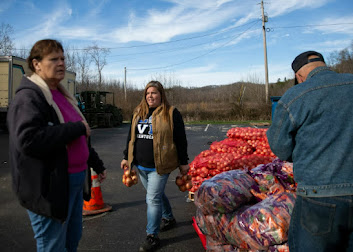
Nicky Stacy, left, runs the Hazel Green Food Project.
Nicky Stacy initially launched the Hazel Green Food Project in February 2021 in response to a series of devastating flash floods in Eastern Kentucky.

A town of just a few hundred residents, Hazel Green was a hub of commerce and tourism in the early 20th century as people flocked to bottle mineral water from natural springs believed to have therapeutic benefits. Today, Hazel Green and the surrounding parts of Wolfe County — where 30 percent of residents live in poverty — mostly consists of agricultural land and weather-worn farmhouses.

After Kentucky’s emergency food benefits expired, Stacy said interest in the Hazel Green Food Project’s bimonthly giveaways soared as residents from Wolfe County and surrounding communities realized they had less money to buy food.

“They never even gave these people any warning,” Stacy said. “It was just like, ‘Damn, it’s gone.’”

Memories of ice cream

At the food giveaway on Feb. 24, the mile-long line of vehicles snaked down Kentucky Route 205, a stretch of highway that also includes a Dollar Store, Uncle Sam’s Gun & Pawn Shop and Bites and Bargains homestyle restaurant.

Inside many of the vehicles, motorists blamed the reduction in SNAP benefits for their desperation. Further down the line from the Blairs, Elizabeth Conley sat coughing in a rusted truck where the gas pedal was wrapped in duct tape and wires dangled from the dashboard. She said her monthly SNAP benefit was cut from $398 to $84 last year. Conley, 45, also receives $914 in Social Security disability benefits because she suffers from lupus and fibromyalgia.

The mother of three — a 21-year-old son in college and two teenagers at home — recounted how quickly she spent her February SNAP benefits.

“I went to the store and I come [home] with like five items — milk, cereal, eggs and some meat that the kids will eat,” Conley said.

“I have teenage boys,” Conley added, her voice rising with exasperation. “People don’t understand boys eat quite a bit, especially teenage boys, and I am not going to let the kids starve.”

Three days after Conley went to the grocery store, the food was gone.

“That is when we knew we needed to come here,” said Conley, who was joined by her boyfriend, who has two teenage boys and saw his monthly SNAP benefits reduced from $396 to $228 last year. “We just need food, and we don’t have any.”

A few cars away, Courtney and Beatty Stone parked in the line around 10 a.m. and settled in for a three-hour wait.

Courtney, 68, and Beatty, 64, were both hooked up to mobile oxygen tanks and said their monthly food stamp benefit dropped last year from $350 to $140.

As they puffed on cigarettes and their oxygen machines chirped with each breath, the former tobacco farmers recalled how the increased benefits during the pandemic allowed them to occasionally buy some comfort food.

“When we had $350, we could buy some ice cream sometimes. And some pop and chips,” said Courtney Stone, referring to a slang for soda.
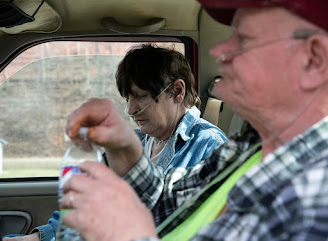
Betty and Courtney Stone arrived at 10 and waited three hours.
Now, the couple said they struggle to afford even their monthly supply of what they consider to be staple foods.

“By the time you buy your mayonnaise, ketchup, salt and pepper and eggs, oh the [price of] eggs, they went crazy … we might have only $5 left on our SNAP card,” Beatty Stone said.

As the couple passed the time by listening to a Christian radio station, Courtney Stone said he feels betrayed by the government. The couple — each of whom also collect $680 a month in Social Security benefits — said they are most upset about not being able to go to church as often because they cannot afford the price of gas.

“How can you give something and then take it away?” he asked. “They didn’t lower taxes. They didn’t lower the price of everything else.”

But as he took another hit of his cigarette, Courtney said he was slowly coming to accept his predicament.

“The thing is, you were born to die,” he said.

Ryan Quarles, a Republican who serves as Kentucky’s agriculture commissioner, also hopes Congress weighs in on ways to alleviate hardship, although he added he’s not ready to endorse a return to pandemic-era benefit amounts.

“Food insecurity in Kentucky has reached catastrophic levels,” said Quarles, a candidate for the GOP nomination for governor. “There is no excuse for a state that produces so much food to have any Kentuckian go to bed hungry.”

But outside the Hazel Green Volunteer Fire Station last week, the line for free food kept growing. The number of people in line easily eclipsed the total population of Hazel Green before the pantry opened, reflecting how the donation program has become a source of food for people throughout western Kentucky.

As 74-year-old Martha Miller and her daughter, Mary, waited in line, they said they’ve started using centuries old Appalachian Mountain cooking tips to save on food costs.

If a recipe calls for eggs, use shortening instead. A can of cream and two cups of water can make the equivalent of 1 percent milk. And save bacon grease to use later as shortening.

“I don’t buy fresh vegetables anymore. I can’t afford them,” Martha Miller said. “I don’t buy eggs anymore. I can’t afford them.”

But for some people in line, even food conservation is not enough to keep them fed all month.

About an hour after the 1 p.m. food giveaway began, Henry Tolsen pulled his 30-year-old pickup truck to the back of the line. He settled in for an anxious three-hour wait, worrying whether any food would be left for him.

Tolsen, a tobacco and corn farmer who went bankrupt after a flood took out his crops in 1997, saw his monthly food stamp benefit reduced last year from $240 to $30 a month.

He also receives $1,000 a month in Social Security benefits to help pay his bills and keep gas in his truck. But Tolsen, 58, who is divorced and lives alone with his pet chiweenie, said he’s starting to eat just one meal a day.

“Yesterday, I only ate a bowl of cereal and a can of peaches,” said Tolsen, as he turned off his truck to save gas until the line started moving again. “I would like to be able to eat bacon and eggs, biscuits and gravy for breakfast, a decent lunch, and a homegrown supper like I used to.”

Although the Hazel Green Food Project hands out food until they run out, there is usually little to offer those at the back of the line, which was not lost on Tolsen.

“If they run out, I go home empty-handed,” Tolsen said. “Let’s just pray and thank the good Lord I will get my disability check.”

At about 5 p.m., Tolsen reached the front of the line. Volunteers handed him three venison steaks, two heads of cabbage and three bags each of potatoes, carrots and fried pork rinds.

Although Tolsen had food again, he drove away questioning whether his government really cared about him.

“I know everyone was happy to get that stimulus, but they didn’t realize there is going to be a payday, and we are paying for it now,” he said. “How did the government give us anything when they let inflation get so high we can’t live and we are going to starve out?”

Friday, July 15, 2022

Ky. Voices for Health sets sessions across state to give updates on policies affecting the health and well-being of Kentuckians

Kentucky Voices for Health and its Thrive KY advocacy partners are hosting regional events to provide updates on state and federal policies that impact the health and well-being of Kentuckians. 

The two-hour sessions will cover important updates on the economy, Medicaid, KCHIP, SNAP, housing, transportation, child care, public health, behavioral health, and suicide prevention, as well as new tools available to assist community members with meeting basic needs, and tips on being a more effective advocate in your community.

The first event was held July 12 in Lexington. Events are scheduled for 10 a.m. to noon local time at:

KVH says continuing education and/or professional development credit will be available and that the event is open to anyone who serves their community, including community leaders, public employees, nonprofit organizations, frontline service providers, outreach workers, educators, faith leaders and counselors.

Sunday, April 10, 2022

Beshear vetoes public-assistance, abortion bills; gets one more month of pandemic food benefits; more health bills could pass

Gov. Andy Beshear, signing and vetoing bills on Thursday, April 7 (KHN photo by Melissa Patrick)
By Melissa Patrick
Kentucky Health News

Kentucky lawmakers will return to Frankfort Wednesday to consider overriding Gov. Andy Beshear's vetoes of several bills, including two related to health. They would put new limits on abortion and set new rules for public assistance programs, including Medicaid.

The General Assembly will also consider passing other bills, but because it is required to adjourn by Friday, the Democratic governor could veto them without fear of being overridden by the Republican legislature.

The wide-ranging anti-abortion measure, House Bill 3, would ban mailing of medications that have become the means for most abortions in Kentucky, strengthen parental-consent rules and ban abortion after the 15th week of pregnancy, mimicking a Mississippi law that is awaiting a decision from the U.S. Supreme Court. 

In his veto message, Beshear noted that the bill makes no exemptions for pregnancies caused by rape or incest, and described how the proposed parental-consent rules would require both parents to be notified if a girl under 18 wants an abortion. He said that could create a situation where a young girl who has been raped and impregnated by her father would have to notify him of her intent to get an abortion or go through an onerous process of getting a court order to allow it.

"Rape and incest are violent crimes," Beshear said. "Victims of these crimes should have options, not be further scarred through a process that exposes them to more harm from their rapists or that treats them like offenders themselves."

Further, he said the bill is likely unconstitutional and that the new reporting and oversight systems would create an "unfunded mandate" for the state Cabinet for Health and Family Services. 

Beshear said he vetoed the public-assistance reform bill, HB 7, "because it will hurt Kentuckians by threatening access to health care and making it harder for those in need to access crucial benefits." He said the administrative burdens could cause people to lose benefits, said the bill could violate federal Medicaid requirements, and said it provides no appropriations for the health cabinet to implement the bill's requirements. He pointed out that when Kentuckians lose health and food benefits, that not only affects them, but physicians, hospitals and the economy.

The bill's sponsor, Rep. David Meade, R-Stanford, has said the added rules in Medicaid and food-benefit programs are needed to reduce fraud and encourage able-bodied adults without dependents to get off Medicaid and other public-assistance programs and back into the workplace. 

It is expected that both bills, priorities for Republicans, will be repassed over Beshear's vetoes, just as they overrode his veto of a resolution ending the Covid-19 state of emergency about a month early, costing 544,000 Kentuckians an extra $100 a month in pandemic-related food benefits. 

Federal law required the state to have a state of emergency were needed to get those additional benefits as long as the national state of emergency is in place, but also allowed Kentucky to apply for a "phase out" month of the benefits after its state of emergency ended, and that has been approved. 

On March 30, a spokesperson for the U.S. Department of Agriculture, which houses the Supplemental Nutrition Assistance Program, formerly called food stamps, told Kentucky Health News that the additional month of Covid-19 benefits had been approved for April. 

Bills hanging fire 

One of the health bills to watch is HB 174, sponsored by Rep. McKenzie Cantrell, D-Louisville, that would extend Medicaid coverage to new mothers up to 12 months after giving birth. This bill sailed unanimously out of the House in February, passed out of its Senate committee unanimously on March 23 and was placed on the consent calendar, used to pass bills without debate.

Since then, five floor amendments have been filed, including one by Sen. Adrienne Southworth, R-Lawrenceburg, that includes provisions of HB 51, sponsored by Rep. Lynn Bechler, R-Marion, that would allow a parent or guardian to opt out of any masking, testing or vaccination requirements imposed in response to the coronavirus. HB 51 passed the House 56-35 on March 8, but has lingered in the Senate Health and Welfare committee without a hearing. 

Another bill to watch is HB 604, sponsored by Rep. Kim Moser, R-Taylor Mill. It would create the Kentucky Center for Cannabis Research at the University of Kentucky. It is supported by Senate President Robert Stivers, who has said the idea of medical marijuana needs more study to become law.

It also appears that three health bills that were added to a catch-all bill, Senate Bill 58, are set to pass. They are HB 645, sponsored by Rep. Danny Bentley, R-Russell, to create the mobile crisis service fund; HB 751, sponsored by Majority Caucus Chair Suzanne Miles, R-Owensboro, to create the Commonwealth West Healthcare Workforce Innovation Center; and HB 573, sponsored by Moser, to establish the Healthcare Worker Loan Relief Program for qualifying health-care workers. 

Tuesday, March 29, 2022

Beshear seeks one more month of pandemic food benefits, after leaving impression that the legislature hadn't left that option open

By Melissa Patrick
Kentucky Health News

On March 21, Republicans in Kentucky's legislature overrode Democratic Gov. Andy Beshear's veto of their resolution ending the Covid-19 state of emergency about a month early, and with it an extra $100 a month in food benefits for 544,000 Kentuckians, who will revert to the standard $243 monthly benefit.

Senate President Pro Tem David Givens of Greensburg said any state could apply for an extra month of the benefits after the end of its emergency, but Beshear said there had to be a state-declared state of emergency.

Technically, they were both right. Now Beshear has requested the extra month of additional Supplemental Nutrition Assistance Program benefits, formerly called food stamps, from the U.S. Department of Agriculture.

State spokesman Brice Mitchell told Kentucky Health News that the state asked for the one-month "phase-out" extension of the benefits on Monday, March 28, a week after the legislature overrode his veto.

"Since the General Assembly voted to end food assistance for nearly 500,000 Kentuckians, the Cabinet for Health and Family Services is notifying the USDA today that a transition period is now needed for April to notify recipients that their benefits are ending May 1," Mitchell said in an e-mail. "If the General Assembly would have not taken this action, the cabinet would have been able to have requested that the benefits continue beyond May 1." The emergency had been scheduled to end April 14.

After the legislature overrode the veto of Senate Joint Resolution 150, Beshear said it would take benefits from Kentuckians, because it had barred him from declaring another emergency.

He said March 24, "We could have continued to provide, at no cost to the Commonwealth, extra dollars to help kids and seniors afford food that costs more than before the pandemic. So what this legislature said is no more help. We're going to go back to giving you the same amount pre-pandemic, even though things cost more."

Beshear didn't respond directly to a question asking him if he had investigated the federal guidance that Givens alluded to, instead saying the state needed an emergency declaration to continue the benefits. He said the resolution was passed for political reasons, and "It's not worth any political point that someone's trying to make to take food off the table of those that need it."

The sponsor of SJR 150 is Sen. Donald Douglas of Nicholasville, who was elected in a special election in December and is opposed in the May 17 Republican primary by Andrew Cooperrider of Lexington, who was a fervent opponent of anti-pandemic measures and has said the bill is designed to boost the candidacy of Douglas, a more mainstream candidate.

Senate President Robert Stivers issued a statement on March 22 criticizing the governor's desire to continue the emergency benefits. 

“Twenty-eight states have already declared the end of the emergency, as well as the U.S. Senate,” Stivers said. “Continuing to operate under a false emergency for the sake of pulling down federal dollars is simply fraudulent and unethical.”

Wednesday, June 23, 2021

Agriculture Secretary Tom Vilsack talks at Rural Health Journalism Workshop about boosting federal nutrition programs

Secretary Tom Vilsack
By Melissa Patrick
Kentucky Health News

The Department of Agriculture is making sure children have enough to eat this summer, updating temporary food-assistance programs and evaluating federal formulas for food assistance, Agriculture Secretary Tom Vilsack told a rural health journalism workshop Wednesday.

Vilsack said he hopes the one-year Summer Food Service Program, also called the Summer Electronic Benefit Transfer Program, put in place because of the pandemic, will be continued permanently through the Biden administration's $1.8 trillion American Families Plan pending in Congress.

"We know these nutrition programs do make a difference in terms of health and educational outcomes," said the former Iowa governor in his second stint as secretary. "And so it's important for us to look at ways in which we can fill the gap between the 180 days of the school year and the summer months." 

$45 billion in the plan would also extend what is called community eligibility, which determines whether a school district is qualified for free and reduced lunch, Vilsack said. During the pandemic, all schools have had access to free meals. 

He said that for the first time in 45 years, USDA is looking at the calculations used to determine benefits in the Supplemental Nutrition Assistance Program, formerly known as food stamps, because "There are significant gaps and barriers to accessing full and complete food security."

Kentucky had 603,105 people enrolled in SNAP, or 13.5% of the state's population, in May, according to the Kentucky Center for Economic Policy SNAP data tracker.

USDA graphic; for a larger version, click on it.

A USDA study issued the same day, Barriers that Constrain the Adequacy of Supplemental Nutrition Assistance Program Allotments, found that nearly nine out of 10 SNAP participants face barriers to providing their households a healthy diet for a full month.

The most common barrier, faced by 61% of households, was the cost of heathy food. Other barriers included a lack of time to prepare meals made from scratch (30%), the need for transportation to the grocery (19%) and no storage for fresh or cooked foods (14%), a USDA press release said.

Vilsack also spoke to the importance of continuing things that worked during the pandemic, such as the food-box program, encouraging producers to donate food, and ensuring that food banks have appropriate infrastructure to store their goods. USDA recently committed $1 billion toward this effort. 

Vilsack noted at the workshop, sponsored by the Association of Health Care Journalists, that Congress will make the decisions on such changes and the "onus is on us" to make the case for them. 

"We know from studies that SNAP does reduce poverty. We know that it does improve health outcomes. We know that it reduces obesity rates among children of low income families. We know that it provides a better opportunity for these youngsters to be better learners, which results in higher graduation rates," he said. "So I think there's a return on investment that we need to remind Congress about so that as they look at the additional costs associated with these nutrition assistance programs, they understand we're getting significant benefit in reduced healthcare costs over time, in better educational outcomes and better employment opportunities for these youngsters." He added that SNAP benefits farmers and local rural economies.

Vilsack also hit on several other topics at the workshop, including issues around climate change, rural hospitals, and meat industry safety standards.

Thursday, April 1, 2021

Legislature says 'deadbeat parents' shouldn't get food aid; Democrats say move will hurt children more than parents

By Melissa Patrick
Kentucky Health News

The General Assembly has reinstated a 2018 policy that disqualified some non-custodial parents from getting federal food benefits if they owe child support. Gov. Beshear halted the policy by regulation in April 2020, citing the pandemic, and vetoed a bill to repeal the regulation. The legislature overrode him.

Rep. Pamela Stevenson (Legislative photo from Feb. 25) 
Senate Bill 65 passed along party lines after getting strong opposition from Democratic lawmakers, most strongly from Rep. Pamela Stevenson, D-Louisville.

"This bill is bad for two reasons," Stevenson said in a House floor speech Tuesday night. "One, if we say we want people to be fed, children to be fed, and then we have a bill that says, if you don't pay your bills, we'll make you hungry. It makes no sense. Find another way to punish deadbeat parents instead of making children suffer. Or, tell the truth and say you don't care. Either way works." 

Stevenson said the title of the bill, "An act relating to deficient administrative regulations," made it easy to miss that it removed of Supplemental Nutrition Assistance Program benefits, formerly called food stamps, from thousands of Kentucky children. The bill dealt with three separate regulations.

In his veto message, Beshear said that the policy cost 6,011 children their food benefits, and that reinstating it would cost the state $200,000 to identify and investigate noncustodial parents who are disqualified. SNAP benefits are funded by the federal government but the state pays half the administrative costs.

Stevenson asked, "Now why would you make the state of Kentucky pay for something that the government will give; the federal government will concede to us? Why do you keep talking about, we don't have enough money, but then when we get money, you don't use it in the way it was intended? This is bad, bad, bad -- and it makes me hungry," she concluded in a flourish of emotion. 

Rep. Josie Raymond, D-Louisville, also spoke against the bill. "If you told me we had a bill to keep food from 6,000 children, I'd say I'm a 'no'," said Raymond. "And then if you said, 'Yeah, and we're gonna spend $200,000 to do it,' I'd say I'm a 'Heck, no'." 

After sharing a personal story about how her family had benefited from food stamps while growing up, and that while she didn't like the "disgusting Tuna Helper" that her mother was able to buy with those benefits, it was what they could afford.  

"This bill, like many others, is punitive," Raymond said. "It's not going to do what we say it's going to do. It's not going to just give people a kick in the pants so they all of a sudden pay all that child support they've been withholding. They're probably not able to pay it and that's why their households are receiving SNAP."

An analysis of the bill's effects by the liberal-leaning Kentucky Center for Economic Policy found that the policy is ineffective at significantly increasing child-support payments and would worsen food insecurity across the state. The national Center on Budget and Policy Priorities has a similar report. 

Republicans say Democrats have "false narrative" 

Rep. David Meade
House Speaker Pro Tem David Meade, R-Stanford, said the assertions about the bill taking food away from children constituted a "false narrative." 

He said federal regulations allow states to disqualify non-custodial parents from receiving SNAP benefits for "refusal to cooperate," which includes not paying court-ordered child support. He read a list of exemptions, including showing good cause for non-payment, living in a home with children under 6, being pregnant or three-months post-partum, enrolling in drug treatment, participating in state or federally funded job training, and more. 

"This regulation really gets to those, as it says, who refused to cooperate," Meade said. "The losers in this are the children who have single parents who are trying to make ends meet and put food on the table for them" but are shorted on child support. "It's about holding people accountable to the taxpayers of this state, when they won't take care of those children they need to be taken care of."

Meade noted a March 29 WDRB story reporting that the Jefferson County attorney's office has published a list of 3,400 parents who owe a total of $89 million in child support. The office says nearly 1,300 of the parents owe at least $25,000.

The bill passed 30-7 in the Senate and 71-23 in the House.

A few health bills pass as the legislative session wraps up

By Melissa Patrick
Kentucky Health News

Lawmakers passed four health-related bills on the last day of their 30-day legislative session, including one to help struggling rural hospitals, two related to addiction care, and one that would change the state's constitution to ban abortions if voters agree and the U.S. Supreme Court reverses its ruling that guarantees abortion rights. And the day before, they passed two health-related bills, overriding vetoes. 

House Bill 556, sponsored by Rep. Danny Bentley, R-Russell, puts $20 million into a revolving loan fund to help struggling rural hospitals, a fund created but not funded in the pandemic-shortened 2020 session. A recent report shows that 16 of the state's 69 rural hospitals are at risk of closing. 

The bill allows the Cabinet for Economic Development to provide loans to struggling hospitals for three purposes: to maintain or upgrade their facilities; to maintain or increase staff; or to provide health-care services not currently available. The loans could run 20 years and would be available to hospitals in counties with fewer than 50,000 people.

The funding was approved in a catch-all bill the final hours of the session. Money can also be added to this fund through gifts or philanthropy. 

The bill also allocates millions from federal relief and the General Fund to be used toward state Capitol renovations, school construction, vocational-school renovations, money for a tax-increment-financing district in western Louisville, jail projects and sesquicentennial commissions. It passed the Senate 30-4 and the House 79-12. It has been delivered to Gov. Andy Beshear for his signature or veto. 

Addiction treatment and care

Two of the health bills passed on the last day of the session involve addiction treatment for people with substance-use disorder. 

Senate Bill 51, sponsored by Sen. Ralph Alvarado, R-Winchester, would ban the requirement of prior authorization for any prescription drug that is used in the treatment of alcoholism or opioid-use disorder and that contains methadone, buprenorphine or Naltrexone. The bill also requires health-care providers to file a report with the Department of Insurance about their prescribing practices, including any concurrent behavioral therapy or counseling prescribed to patients. 

Sen. Ralph Alvarado
A last-minute House floor amendment was added at the behest of the health cabinet and its Department for Medicaid and Medicare Services to ensure the state's compliance with federal regulations and restrict the medications to those approved by the U.S. Food and Drug Administration at the time the bill is enacted.

SB 51 passed the House 87-2 with the floor amendment and the Senate accepted the changes without dissent. It has been delivered to the governor for his signature or veto. 

Senate Joint Resolution 59, sponsored by Alvarado, directs the Cabinet for Health and Family Services to create written recommendations for distribution throughout the state for individuals who suffer from substance-use disorder to help them get treatment. 

It was amended to require CHFS to create an advisory committee to establish a pilot program to investigate funding mechanisms for a diversion program for treatment and recovery housing services for individuals with substance-use disorder who have been arrested for substance-use offenses. 

The advisory committee's recommendations are due Dec. 1, 2021. The pilot program is to be implemented and operational by July 1, 2022.  SJR 59 passed both chambers without dissent and has been delivered to the governor for his signature or veto. 

Abortion and a constitutional amendment 

HB 91, sponsored by Rep. Joseph Fischer, R-Fort Thomas, would add to the state constitution a statement that it does not secure or protect a right to abortion or funding of abortion, if voters approve it in November 2022.

The bill is intended to pre-empt any court ruling for state abortion rights if the Supreme Court reverses its 1973 Roe v. Wade decision.

It would add this phrase to the Kentucky Constitution: “To protect human life, nothing in this Constitution shall be construed to secure or protect a right to abortion or require the funding of abortion.”

The bill passed the House 76-20 and the Senate 32-6, largely along party lines. It goes directly to the ballot; governors do not act on constitutional amendments, which must be voted on at general elections when legislators are elected. There are no elections this year.

Senate Minority Leader Morgan McGarvey, D-Louisville, voiced concern on the Senate floor that the amendment has no exemptions such as rape, incest, or if the mother's life is in danger. "That takes a pretty extreme stance on what oftentimes we use as a political issue," he said. 

In a news release, Alexis McGill Johnson, president of the Planned Parenthood Action Fund, called the passage of the amendment "a blatant effort to take away Kentuckians' fundamental rights and prevent individuals from making the health care decisions best for them and their families." 

Veto overrides

The Republican super-majorities in the General Assembly overrode Beshear's vetoes of two health-related bills. House Joint Resolution 77, sponsored by House Speaker David Osborne of Prospect, listed which Covid-19 emergency orders that would stay in place if the legislature wins its legal battle over the governor's emergency powers. It has appealed a Frankfort judge's injunction.

In the veto statement, Beshear said HJR77 is unconstitutional and may violate the injunction. He also noted that the list of approved orders in the bill does not include his masking or social-distancing orders, and said it sets arbitrary deadlines for the expiration of other public-health measures, which he says could lead to increased spread of the disease and delay the end of the state of emergency. 

Legislators also overrode Beshear's veto of SB 65, sponsored by Sen. Stephen West, R-Paris, which would reinstate a 2018 policy to disqualify some non-custodial parents from receiving Supplemental Nutrition Assistance Programs benefits (formerly food stamps) if they owe child support. Beshear's administration halted the policy by regulation in April 2020, citing the pandemic.

The bill repeals two other regulations found to be deficient after review by a legislative subcommittee. West said it is meant to ensure that the legislature, not the governor, has ultimate control over policymaking.

Wednesday, April 22, 2020

Beshear sets first reopenings, in health care; reveals expanded testing; U of L researchers developing therapy to block virus


As news develops about the coronavirus and its covid-19 disease, this item will be updated. Official state guidance is at kycovid19.ky.gov.

By Melissa Patrick
Kentucky Health News

Slow and steady goes Gov. Andy Beshear's plan for opening the state's economy, with only a few health-care services being allowed to open Monday. But he also announced Wednesday that testing for the coronavirus, a key step needed for more opening, would expand significantly next week.

"We are very close to coming to a consensus and an agreement in being able to put out guidelines for the gradual re-opening of many of our hospital and health-care services," Beshear said at his daily briefing.

He said plans were being made based on health-care capacity and whether there would be enough personal protective equipment to protect everyone. He said final guidelines are still being worked on, but said he felt confident enough about it to announced that diagnostic radiology and non-urgent but  emergent doctor visits could resume Monday.

He said pre-anesthesia testing services will also resume, to prepare for the "ramp-up" of surgical procedures over the next few weeks, starting with outpatient and ambulatory procedures. Kentucky hospitals have said they are losing $20.4 million a day because they can't do elective procedures.

"We know that it is incredibly important, that it has hit the bottom line of our health-care institutions," Beshear said. But he cautioned that medicine will not look the same; for example, no general waiting rooms: "The new regular waiting room is your car."

And when asked if it would be OK to make plans for summer camps and other children's activities, he said it is too early to say for sure, but "Those are gonna be very difficult to do safely." He noted that the three-phase White House reopening guidelines call for avoiding such activities in the first phase. "My goal is to have us as close to the new normal going into the school year," he said.

Beshear said the state has "passed the test of sacrifice; now we’re in the second part of that test, planning and patience," which he said would take "the next month to month and a half. . . .We have to be sure were doing it right and we’re rolling it out right."

The governor's third phase is perseverance. "until we get to a vaccine or very effective treatment," he said. "Perseverance is gonna be that new normal."

Progress on testing

The White House guidelines say reopening should be preceded by widespread testing for the virus, and not just of people with symptoms. Beshear announced several steps in that direction Wednesday.

He said state is ramping up its testing capacity, announcing several new sites, and for the first time issued a clear, general invitation for people who don't have symptoms to sign up for tests.

He said the Kroger-sponsored drive-through testing that runs through Thursday in Madisonville, Somerset, Paducah and Pikeville completed about 571 tests Wednesday, much less than the 1,000 tests available at each location. 

"We will now test anybody that wants a test" at those locations and new ones that will be open for the next two weeks in Lexington, Louisville, and April 28-30 in Owensboro and Bowling Green. At Shawnee Park in Louisville and the Bluegrass Community and Technical College on Newtown Pike in Lexington, those being tested will also receive a mask and hand sanitizer. 

Those two locations were chosen to serve predominately African-American communities, Beshear said: "We have seen the disproportionate impact, especially in the death rate of this virus," among black Kentuckians, who make up about 8.5 percent of the state's population.

He gave the latest statistics, with about 84% of the known cases accounted for: 77.2 percent of Kentuckians who have tested positive are white, 13.4% were black, 4.8% were multiracial, 4.6% were Asian and 0.04% were Native Americans or Alaska Natives.

The disparity in deaths is even worse. With about 85% of the known cases accounted for, Kentucky deaths have been 79.7% white, 17.7% black, 1.9% Asian and 0.64% multiracial.

Louisville Mayor Greg Fisher said African Americans' covid-19 death rate in Louisville Metro is about 40% higher than their share of the population. "That is something that is just completely unacceptable," he said.

In Lexington, Walgreens at 2296 Executive Drive will offer drive-thru testing seven days a week, from 9 a.m. to 5 p.m., but only for adults with symptoms, health-care workers and first responders. Beshear said another testing partner would be announced later this week. 

Listing the current testing capacity in the state, Beshear said,"Our goal is to be able to use this capacity and to try to start being able to deploy about 20,000 tests, this would be a start, per week." He noted that the state has only done 36,075 tests so far. 

Beshear again asked associations, businesses and industries to keep submitting plans for how they could open under Centers for Disease Control and Prevention guidelines. Plans can be sent to HealthyAtWork.ky.gov. He said the state has already received a number of well-thought-out proposals. 

"It gives me a lot of hope that we will move through this in a smart, deliberate, and gradual fashion where we can do everything we can to prevent a future spike, which will open up our economy in a way to where I believe we can be more successful than many others who are currently taking different steps," he said, alluding to other Southern states that are moving faster.

In other covid-19 news Wednesday:
  • The state reported 196 new cases of the coronavirus, for a corrected total of 3,373. Beshear reiterated that the number of new cases has plateaued. 
  • The governor announced 14 new deaths from covid-19, raising the state's total to 185. They were 68-year-old woman from Boyd County; a 74-year-old woman from Campbell County; a 71-year-old man from Fayette County; a 96-year-old woman from Graves County; a 76-year-old woman from Grant County; an 88-year-old woman from Hopkins County; and a 68-year-old man and an 83-year-old woman from Kenton County; and from Jefferson County, three men aged 50, 74, 87; two women aged 85 and 80; and a 58-year-old victim of undisclosed gender.
  • University of Louisville researchers have developed a technology that they believe can keep the coronavirus from infecting human cells. The university says it wants to "fast track" development of the therapy, including an application to the U.S. Food and Drug Administration for approval to start treating seriously ill covid-19 patients.
  • In a wide-ranging interview, the Centers for Disease Control and Prevention Director Robert Redfield told The Washington Post that the second wave of covid-19 is likely to be even more devastating than the first because it will likely coincide with the start of flu season. 
  • The Kentucky Rural Health Association said the latest coronavirus relief package includes a new $225 million grant program exclusively for federally certified rural health clinics, for testing and related expenses associated with the pandemic. The Senate passed the bill Tuesday and the House is expected to do so Thursday.
  • Two nursing homes in Kentucky have had at least 10 residents die from covid-19, and at least 14 of them have had a death from it, Daniel Desrochers reports for the Lexington Herald-Leader, along with an easy-to-read list of all of the nursing homes that have been affected.
  • The Supplemental Nutrition Assistance Program, formerly food stamps, has been expanded during the pandemic, giving families the maximum monthly benefit regardless of “reportable income and other factors” that would otherwise reduce it, a Department of Agriculture release said. "For households with two adults and three children with no income, the maximum benefit is $768 but can be $528," the Herald-Leader reports. 
  • In a separate story, the Herald-Leader reports that Walmart and Amazon will soon allow people with SNAP benefit cards to use them online. Jeremy Chisenhall reports that Kentucky was one of three states to get federal approval for the pilot program.  
  • The Herald-Leader reports on yet another complication for some with severe cases: blood clots. “The number of clotting problems I’m seeing in the ICU, all related to covid-19, is unprecedented,” Dr. Jeffrey Laurence, a hematologist at Weill Cornell Medicine in New York City, told CNN, calling the problem “widespread.”
  • Bill Estep and Will Wright of the Herald-Leader report on Kroger-sponsored coronavirus testing in rural Kentucky, including sites in Somerset, Pikeville, Paducah and Madisonville. Testing will continue there through Thursday. 
  • The Herald-Leader reports that Louisville lawyer James Gregory Troutman, 53, "was charged with threatening Gov. Andy Beshear after he allegedly referenced an assassinated governor in a Facebook post before saying he hoped people would shoot at Beshear, police said." Troutman's lawyer, Steve Romines, told WDRB that Troutman's social-media comment was "not a threat" to kill Beshear. 
  • Morgan Eads of the Herald-Leader tells the story of a family who had to say goodbye to a loved one who died from covid-19 on FaceTime. Eads reports that three family members got sick after being visited by a home-health nurse, cautioning that people without symptoms can still spread the disease.  
  • The Lexington History Museum wants your covid-19 pictures, stories,letters and memorabilia for a Pandemic History Project, the Herald-Leader reports.  
  • Click here to see the Kentucky Department of Public Health Covid-19 Dashboard found at kycovid19.ky.gov. 
  • Click here for a Kentucky Chamber of Commerce webinar titled, "How Can Business Re-open and Protect Public Heath?"

Saturday, April 4, 2020

Covid-19 update: Beshear says drop in flu cases shows social distancing works; says mass gatherings at churches etc. likely kill

Gov. Andy Beshear displayed a photo montage of covid-19 victim Aaron Jordan and his family during
Saturday's press conference. (Screenshot of Facebook page; emojis on right were posted by viewers)
Department for Public Health weekly chart of flu cases; dates are end of each reporting week 
As news develops in Kentucky about the coronavirus and its covid-19 disease, this item may be updated. Official state guidance is at https://kycovid19.ky.gov.

A steep drop in flu cases in Kentucky shows that social-distancing measures taken to fight the coronavirus are working, Gov. Andy Beshear said Saturday.

“It is preventing wider spread of, certainly, the flu,” Beshear said. “Now, we believe the coronavirus spreads a lot faster and a lot more aggressively at this point, but look at that downward trend and know that if we stick with this, if we follow the rules and restrictions, we will absolutely lessen or slow the spread of the coronavirus.”

Beshear said those who follow Friday's Centers for Disease Control and Prevention recommendation to wear cloth masks in public when around others, such as grocery trips, “does not replace the social distancing piece. Just because you wear a mask doesn’t mean you can get withing six feet of somebody and still have a conversation.” He also warned against fiddling with masks: “You can't touch your face;” and using surgical or N95 respirator masks that are needed by health-care workers.

Urging social distancing despite pleasant weather, Beshear said, “What every single one of us does matters every day, every decision, every action.”

Asked about Jack Roberts, a Bullitt County pastor who plans to hold services Sunday despite the ban on mass gatherings, Beshear said, “If you are still holding mass gatherings, church or otherwise, you are spreading the coronavirus and you are likely causing the death of Kentuckians.”

The Louisville Courier Journal's story on Maryville Baptist Church in Hillview and other churches noted that Our Savior Lutheran Church in Hillview is holding services, but "attendance is limited to those who register online" and "seating is restricted to every other pew."

Beshear said he had heard reports of people going door to door seeking church attendees. “You cannot go door to door right now for any reason,” he said. “I mean, folks, that's how people die.”

At his daily press conference, Beshear displayed a photo montage of ARon Jordan, a 49-year-old bricklayer from Ashland who died of covid-19 in a Detroit hospital after quarantining himself in the city so he wouldn't risk infecting his family. Mandy McLaren of the Courier Journal told his story, marking the first time a Kentucky covid-19 victim was identified.

Jordan is believed to be Kentucky's youngest covid-19 victim. Beshear announced three new deaths Saturday: A 56-year-old woman in Lexington, a 52-year-old woman in Bullitt County and an 81-year-old man in Boone County, bringing the state's death toll to 40.

Beshear said Kentucky confirmed 92 new cases Saturday and eliminated six duplicates from Friday's report of 90, for a total of 917; he said 130, or 14 percent, have been hospitalized and 76 remain so. The day's two relative hotspots were Hopkins and Simpson counties, which each reported five cases.

Other developments on the covid-19 front Saturday:
  • Two residents and two staffers at a Kuttawa nursing home tested positive for the virus, and most of the test results haven't come back yet. Beshear said the state tested everyone in a wing with a patient who developed covid-19, "the most testing we've seen in any of these facilities." But Lyon County Judge-Executive Wade White wants broader testing, and "said state officials were initially reluctant to provide tests, and most were provided by local hospitals," reports the Kentucky Center for Investigative Reporting.
  • Beshear has allowed trails at state parks to stay open, but some local officials wish he would close them because of gatherings at trailheads, Will Wright reports for the Lexington Herald-Leader.
  • Senate Majority Leader Mitch McConnell said there needs to be a fourth covid-19 relief bill, "a more targeted response to what we got wrong and what we didn't do enough for" in previous bills, with health care at the top of the list.
  • Beshear and Health and Family Services Secretary Eric Friedlander urged Kentuckians without health insurance to sign up for Medicaid. "We've taken a 20-page application and made it one" page, and people are available to help complete the application.
  • Friedlander said the state has asked the federal government for a waiver to allow people in the Supplemental Nutrition Assistance Program to use their electronic benefit transfer cards to order groceries online.
  • People in the small town of Midway enjoyed Yard Art, the latest in a series of events to occupy children and, in this case, adults.
  • Noting sacrifices made by other generations, Beshear said that for them, “The time or even the victory was uncertain. We know here we’re not looking at years, we’re looking at months, and we know we will come out of this on the other side.”

Sunday, February 23, 2020

House passes public-assistance bill with plan for temporary health coverage for people who earn too much to stay on Medicaid

By Melissa Patrick
Kentucky Health News

A bill aimed at moving Kentuckians off public assistance includes several health-related provisions, including a new coverage plan for people who lose their Medicaid benefits if their income rises above the limit for the program.

House Speaker Pro Tem David Meade
presents House Bill 1. (LRC photo)
A heavily revised version of House Bill 1 passed the House Feb. 21 by a vote of 58-32. It was along party lines, except one Democrat who voted for it: Rep. John Sims of Flemingsburg.

Other Democrats said the bill was rushed, but Speaker Pro Tem David Meade, R-Stanford, its lead sponsor, said "We are trying to find a good balance between compassion to help those folks in those situation who truly need care and help in these public assistance programs, but also a balance of accountability."

Most of the bill is aimed at cracking down on fraud, but a major part of it would provide a temporary state health-insurance option for Kentuckians who stop being eligible for Medicaid because their income exceeds 138 percent of the federal poverty level, $17,609 for a single person. It would be available for those earning up to 200% of the poverty line, $25,520 for an individual.

This provision addresses the "benefit cliff," the term for the loss of public benefits by people whose earnings exceed limits for programs but who are unlikely to have jobs with health insurance or the money to afford it. Republicans said they had heard stories of people who ask employers not to give them raises so they can keep their Medicaid benefits.

This health insurance program would require premiums and cost sharing to rise 25% for every 15% in income above 138% of the poverty line. Participants could stay in the program for a year after exiting Medicaid, with a possibility of extension on a case-by-case basis.

The Supplemental Nutrition Assistance Program is a major focus of the bill, as is Temporary Assistance for Needy Families. It would remove from the programs individuals who fraudulently misuse their benefits card, or are completely able-bodied adults with no dependents who choose not to participate in a community engagement program, including work, school or volunteering, if such requirements are implemented. It would expand many benefits, with task groups formed to explore further expansions.

Democratic objections

Some Democrats said they agreed with the goals of the bill, but said it was rushed. They questioned its enforcement costs and said it would lead to lawsuits.

"Although there are good elements in this piece of legislation that I'm glad to see move forward, they are really stamped and trampled on by the bad parts of this legislation," said Rep. Charles Booker, D-Louisville.

Meade said, "What you're hearing today is, we like the expansion of benefits, we want to continue to give people more but we don't want to hold anyone accountable."

The House adopted two amendments from Rep. Kim Moser, R-Taylor Mill, one of which had to do with health. It would require the state to apply for a waiver of the rules to allow Medicaid to pay for substance-use disorder treatment for people who are incarcerated.

The bill would ban from Medicaid and other programs people who violate the rules.

For example, those who are convicted of a drug-related felony who are released from incarceration and fail to sign up for substance-use treatment within 90 days of release would be banned from getting Medicaid, but the bill makes provisions for regaining coverage.

Dustin Pugel, policy analyst for the Kentucky Center for Economic Policy, wrote that "a similar ban in SNAP in Kentucky has led to thousands losing food assistance and likely more who never applied due to a past conviction." Further, he writes that "Medicaid law doesn't allow bans contingent on recovery status or for people with a drug-related felony conviction."

If passed, Gov. Andy Beshear's administration would be required to implement the measures within 120 days. Beshear said Friday, "I want to continue to see where they're going, but I don't believe in a system that pushes people off of benefits." Mark Vanderhoff reports for WLKY-TV.

Beshear added, "I believe in a system that encourages people and gives them the tools to get jobs with higher wages where you naturally move off of them. I believe in providing people opportunity -- not consequences."

Medicaid work requirements?

Reflecting Republicans' concern about the cost of the 2014 Medicaid expansion, the bill says that if the state General Fund appropriation for this population reaches half of General Fund spending on Medicaid overall, those who have been on the expansion for a year would have to participate in at least 80 hours a month of "qualifying activities," presumably work, school or volunteering.

That seems unlikely; the Kentucky Center for Economic Policy reports that it is currently only 10.7% of the budget. Such requirements were an integral part of former Gov. Matt Bevin's plan to overhaul the state's Medicaid program. It and a similar plan in Arkansas were blocked twice by a federal judge, and Beshear rescinded the plan soon after taking office in December.

Several lawmakers predicted that this part of the bill would be challenged in court, noting that a federal appeals court recently upheld the rulings against Arkansas's plan. The Supreme Court may or may not hear an appeal.

Meade said it is "well worth the risk" of a legal challenge to these community engagement requirements for able-bodied workers because they have been shown to move people off public assistance and increase their income in other states.

Concerns about fraud

Much of the debate was around the issue of fraud in public assistance programs, an issue that Rep. Nima Kulkarni, D-Louisville, said likely has to do more with perception than reality.

The U.S. Department of Agriculture reports that public-assistance fraud is 1%, and it was mentioned during the debate that it's reported at 2% in Kentucky.

"My concern here is that we are ignoring actual facts, actual numbers . . . and going with opinions and potential numbers that are not in existence, that we have not heard about in this body," Kulkarni said. "In our zeal to counteract the tiny fraction of fraud that may be occurring in Kentucky, we are potentially impacting millions of lives that are using these programs to simply lift their families out of poverty, to put food on the table at night. I really urge the body to think long and hard about the unintended consequences of this bill to those individuals that are properly using the benefits that they so desperately need."

Early in the two-and-a-half-hour debate, Meade corrected a statement he made Feb. 20 that there were studies showing upwards of 40% of fraud in public assistance programs. He corrected that to say that a group had told him that with its current detection systems, Kentucky was likely only catching 30 to 40% of the fraud in the system. When asked who that group was, he declined to answer. But he said he thinks it is higher than 2% because people are very creative when they commit fraud. "To say that we only have a 2 percent fraud rate, that we feel we are catching it all, is just not imaginable in my mind."

But House Minority Leader Joni Jenkins, D-Louisville, said, "I think what we have here is an attempt to go after a gnat, and when you go after a gnat with a sledgehammer, you tend to destroy the whole darn thing."