Showing posts with label lung disease. Show all posts

Monday, May 20, 2024

Study: E-cig use raises risk of early development of asthma 252%

Studies show vaping may contribute to the development of asthma. (Image from Very Well Health) 
Kentucky Health News

There is a significant link between vaping and asthma in adults, according to a new study published in the Journal of the American Medical Association Network Open.

The study found that adults who did not have any asthma symptomps at the beginning of the study and reported e-cigarette use in the past 30 days increased their risk of developing asthma at an earlier age by 252%.

“While previous studies have reported that e-cigarette use increases the risk of asthma, our study was the first to examine the age of asthma onset,” said first author Adriana Pérez, professor of biostatistics and data science at the University of Texas-Houston School of Public Health. “Measuring the potential risk of earlier age of asthma onset as it relates to past 30-day e-cigarette use may help people from starting use or motivate them to stop.”

The study used data from the Population Assessment of Tobacco and Health Study, a national longitudinal study of tobacco use and how it affects the health of adults and youths in the U.S.

“The findings of the study underscore the need for further research, particularly regarding the impact of e-cigarette use on youth and its association with early age of asthma onset and other respiratory conditions,” Pérez said in a news release. The study says the lack of youth impact "could be due to a lack of statistical power."

"Pérez said the study highlights the need to address the health burden of asthma, which results in $300 billion in annual losses due to missed school or workdays, mortality, and medical costs according to the Centers for Disease Control and Prevention," the release says. "Tobacco regulations, prevention, intervention campaigns, and cessation programs are needed to prevent early age of asthma onset due to e-cigarette use, the authors wrote."

Sunday, March 3, 2024

Bowling Green hospital uses new technology to find lung cancer

Jennifer Finch, director of clinical intergration at Med Center
Health in Bowling Green, directs discussion of cases in the
hospital's new lung-cancer screening program. (Photo provided)
Kentucky Health News

The Medical Center at Bowling Green has established "a fast-track clinic that will help in the fight against lung cancer and give patients a better chance of surviving it," Ann Marie Dotson reports for the Bowling Green Daily News.

"The goal of the program is to detect lung nodules at the earliest stages to either prevent serious issues before they occur or to treat concerns quickly by offering a variety of options tailored to a specific diagnosis," Dotson writes, noting the it uses "a new technology that allows pulmonologists to biopsy smaller nodules."

Jennifer Finch, director of clinical integration at Med Center Health, said the program can detect cancer at stage 1, where there is a survival rate of 70 to 80%. “Historically, on small lesions, we had to wait and watch to see if they grew, but this computer-assisted robotic guided program guides the doctors to the small nodule, allowing them to get it,” she told Dotson.

The hospital said it started the program because Kentucky has the highest rate of new lung-cancer cases across the country, Dotson reports. It's a collaboration between its cardiothoracic surgeons, oncologists and Western Kentucky Heart and Lung board-certified pulmonologists.

"The team meets each Friday to view and discuss patients who may need further examination and review reports of patients who have incidental lung nodules and those detected through low-dose CT scans, working directly with the patient’s primary care providers," Dotson reports. "Eligible patients are then scheduled for consultations with the program’s team of physicians."

Finch told Dotson, “As a team, we review the patient’s history, whether the patient is a smoker, family history and cancer risk to see if the nodule could be benign or cancerous.”

Then the team devises a treatment plan "based on the patient’s needs, including further testing, surgery, diagnostic imaging, chemotherapy, radiation therapy or a biopsy." Finch said since the program opened Dec. 8, “we have had fantastic outcomes already.”

She added, “This program is really personal for me, and I have such a passion for it because my father died of lung cancer.” Kentucky leads the nation in lung cancer and deaths from it.

Thursday, February 15, 2024

Kentucky rises to No. 2 in the nation in screening for lung cancer, which lowers the chances that the disease will be fatal

Tony Stumbo (Photo by Veronica Turner for KFF Health News)
By Charlotte Huff
KFF Health News

Dr. Tony Stumbo’s heart sank after the doctor shared his mother’s chest X-ray.

“I remember that drive home, bringing her back home, and we basically cried,” said the internal medicine physician, who had started practicing in Eastern Kentucky near his childhood home in Floyd County shortly before his mother began feeling ill. “Nobody wants to get told they’ve got inoperable lung cancer. I cried because I knew what this meant for her.”

Now Stumbo, whose mother died the following year, in 1997, is among a group of Kentucky clinicians and researchers determined to rewrite the script for other families by promoting training and boosting awareness about early detection in the state with the highest lung cancer death rate.

For the past decade, Kentucky researchers have promoted lung cancer screening, first recommended by the U.S. Preventive Services Task Force in 2013. These days the Bluegrass State screens more residents who are at high risk of developing lung cancer than any state except Massachusetts — 10.6% of eligible residents in 2022, more than double the national rate of 4.5% — according to the most recent American Lung Association analysis.

The effort has been driven by a research initiative called the Kentucky LEADS (Lung Cancer Education, Awareness, Detection, and Survivorship) Collaborative, which launched in 2014 to improve screening and prevention in order to identify more tumors earlier, when survival odds are far better. The group has worked with clinicians and hospital administrators statewide to boost screening rates both in urban areas and regions far removed from academic medical centers, such as rural Appalachia.

However, a decade into the program, the researchers face an ongoing challenge as they encourage more people to get tested: the fear and stigma that swirl around cancer.

Lung cancer kills more Americans than any other malignancy, and the death rates are worst in a swath of states including Kentucky and its neighbors Tennessee and West Virginia, and stretching south to Mississippi and Louisiana, according to the Centers for Disease Control and Prevention.

It’s a bit early to see an impact on lung-cancer deaths, because people may live for years with a malignancy, LEADS researchers said. Plus, other factor such as improvements in treatments may also help reduce death rates. Still, data already shows that more cancers in Kentucky are being detected before they become advanced and thus more difficult to treat.

Of total lung cancer cases statewide, the percentage of advanced cases — defined as cancers that had spread to the lymph nodes or beyond — hovered near 81% between 2000 and 2014, according to the Kentucky Cancer Registry. By 2020, that number had declined to 72%, according to the most recent data available.

“We are changing the story of families. And there is hope where there has not been hope before,” said Jennifer Knight, a LEADS principal investigator.

Older adults in their 60s and 70s can hold a particularly bleak view of their mortality odds, given what their loved ones experienced before screening became available, said Ashley Shemwell, a nurse navigator for the lung cancer screening program at Owensboro Health.

“A lot of them will say, ‘It doesn’t matter if I get lung cancer or not because it’s going to kill me. So I don’t want to know,’” said Shemwell. “With that generation, they saw a lot of lung cancers and a lot of deaths. And it was terrible deaths because they were stage 4 lung cancers.” But she reminds them that lung cancer is much more treatable if caught before it spreads.

The collaborative works with several partners, including the University of Kentucky, the University of Louisville, and GO2 for Lung Cancer, and has received grant funding from the Bristol Myers Squibb Foundation. Leaders have provided training and other support to 10 hospital-based screening programs, including a stipend to pay for resources such as educational materials or a nurse navigator, Knight said. In 2022, the state legislature established a statewide lung cancer screening program based in part on the group’s work.

Jacob Sands, a lung-cancer physician at Boston’s Dana-Farber Cancer Institute, credits the LEADS collaborative with encouraging patients to return for annual screening and follow-up testing for any suspicious nodules. “What the Kentucky LEADS program is doing is fantastic, and that is how you really move the needle in implementing lung screening on a larger scale,” said Sands, who isn’t affiliated with the Kentucky program and is a volunteer spokesperson for the American Lung Association.

In 2014, Kentucky expanded Medicaid under the 2010 Patiemt Protection and Affordable Care Act. That increased the number of lower-income people who qualified for lung-cancer screening and related treatment. Adults 50 to 80 years old are advised to get a CT scan every year if they have accumulated at least 20 pack years and still smoke or have quit within the past 15 years, according to the latest task force recommendation, which widened the pool of eligible adults. (To calculate pack years, multiply the packs of cigarettes smoked daily by years of smoking.) The lung association offers an online quiz, called “Saved By The Scan,” to figure out likely eligibility for insurance coverage.

Half of U.S. patients aren’t diagnosed until their cancer has spread beyond the lungs and lymph nodes to elsewhere in the body. By then, the five-year survival rate is 8.2%. Regular screening boosts those odds. When a CT scan detects lung cancer early, patients have an 81% chance of living at least 20 years, according to data published in November in the journal Radiology.

Some adults, like Lisa Ayers, didn’t realize lung-cancer screening was an option. Her family doctor recommended a CT scan last year after she reported breathing difficulties. Ayers, who lives in Ohio near the Kentucky border, got screened at University of Kentucky King’s Daughters Hospital in Ashland. The scan didn’t take much time, and she didn’t have to undress, the 57-year-old said. “It took me longer to park,” she quipped.

She was diagnosed with a type of lung tumor that can grow in various parts of the body. Her cancer was considered too risky for surgery, Ayers said. A biopsy showed the cancer was slow-growing, and her doctors said they would monitor it closely. That type of cancer isn’t typically linked to smoking, but Ayers quit anyway, feeling like she’d been given a second chance to avoid developing a smoking-related cancer: “It was a big wake-up call for me.”

Kentucky is second only to West Virginia in the percentage of adults who smoke. Adults with a smoking history often report being treated poorly by medical professionals, said Jamie Studts, a health psychologist and a LEADS principal investigator, who has been involved with the research from the start.

Studts said the goal should ne to avoid stigmatizing people and instead to build rapport, meeting them where they are that day: “If someone tells us that they’re not ready to quit smoking but they want to have lung cancer screening, awesome; we’d love to help. You know what? You actually develop a relationship with an individual by accepting ‘No’.”

Nationally, screening rates vary widely. Massachusetts reaches 11.9% of eligible residents, while California ranks last, screening just 0.7%, according to the lung association analysis.

In hospitals of Appalachian Regional Healthcare, 3,071 patients were screened in 2023, compared with 372 in 2017. “We’re just scratching the surface of the potential lives that we can have an effect on,” said Stumbo, the chief medical officer in ARH's Big Sandy Region.

The doctor hasn’t shed his own grief about what his family missed after his mother died at age 51, long before annual screening was recommended. “Knowing that my children were born, and never knowing their grandmother,” he said. “Just how sad is that?”

KFF Health News is a national newsroom producing in-depth journalism about health issues. It is a core operating program of the Kaiser Family Foundation, an independent source of health policy research, polling and journalism.

Monday, November 20, 2023

UK doctor debunks myths about lung-cancer screening, which can find cancer before it spreads or causes symptoms, and save lives

Photo illustration by dragana991, iStock/Getty Images Plus
By Dr. Timothy Mullett
University of Kentucky

Lung cancer is the leading cause of cancer deaths in the U.S., claiming more lives than prostate cancer, breast cancer, and colorectal cancer combined. However, it can be a curable disease if detected early through screening, which can often identify cancer before it spreads or causes symptoms.

The U.S. Preventive Services Task Force recommends annual low-dose CT scans for lung-cancer screening for individuals who meet the following criteria:
  • Are 50 to 80 years old
  • Currently smoke or have quit smoking within the past 15 years
  • Have at least a 20 pack-year smoking history, which is determined by multiplying the number of packs a person smoked per day by the number of years the person has smoked
Despite the benefits of screening, only a fraction of eligible people get screened due to public unawareness, stigma, and prevalent myths and misconceptions about the procedure. Here I address some of the most common myths:

Myth: “Lung cancer screening is not covered by my insurance or is too expensive.”
Fact: If you meet the eligibility criteria, lung cancer screening is covered by Medicare, Medicaid and most private insurance plans without cost-sharing. In rare instances where insurance coverage is unavailable, many programs including UK’s Lung Cancer Screening Program, offer screenings at a relatively low cost.

Myth: “I quit smoking years ago, so I don't need to be screened.”
Fact: Even individuals who have quit are at high risk for lung cancer and should get screened. While screening is primarily recommended for those who quit within the past 15 years, the American Cancer Society recently expanded its guidelines to encourage screening for people with a smoking history outlined above regardless of the number of years since quitting.

Myth: “I currently smoke, so I will get screened after I quit.”
Fact: If you currently smoke, you are at the highest risk. Everyone deserves empathetic health care, and you should not feel judged or ashamed for smoking. In addition to screening, your doctor can help connect you to smoking cessation resources. Quitting smoking at any time, even after a lung cancer diagnosis, reduces the risk of dying from other diseases besides cancer, including heart and lung disease.

Myth: “Lung cancer diagnosis is a death sentence. I’d rather not know.”
Fact: A lung cancer diagnosis today is not the same as it was even 10 years ago. Surgery for lung cancer is becoming much less invasive, and improved treatment options include targeted therapy and immunotherapy. Getting screened is your best defense against lung cancer — if it’s caught early, outcomes are greatly improved, and in some cases, the cancer can be cured.

Myth: “Lung cancer screening is time-consuming and invasive.”
Fact: Lung cancer screening is less invasive than procedures like mammograms or colonoscopies. It is a painless, quick process that involves a low-dose CT scan of the chest, taking only a few minutes to complete. Minimal preparation is required, and no needles or contrast dye are used.

Myth: “Lung cancer screening has a high rate of false positives.”
Fact: While cancer screenings provide valuable tools for early detection, they also carry a potential for false positives. These results may appear as abnormalities on imaging tests but don't necessarily translate to a need for invasive procedures.

Timothy Mullett, M.D., is a UK Markey Cancer Center surgeon and the medical director of the UK Markey Cancer Center Affiliate and Research Networks.

Wednesday, March 23, 2022

Almost six months after going into hospital with Covid-19, and a double-lung transplant as a last resort, patient is heading home

Staff members congratulate Victor Gonzales-Villatoro on his discharge at UK. (Photo by Hilary Brown)
By Hilary Brown
University of Kentucky

Staff at UK HealthCare gathered Wednesday to celebrate the discharge of patient Victor Gonzales-Villatoro, who was hospitalized with Covid-19 in October. The disease ravaged his lungs, Victor’s family was told he had almost no chance of survival, and they considered withdrawing life support.

As a last effort, UK doctors considered Victor a candidate for a double lung transplant and placed him on extracorporeal membrane oxygenation (ECMO) to see if his body could recover enough to withstand the transplant surgery.

For several months, while on ECMO, Victor remained unconscious. He awoke, and with a determined spirit, worked hard to gain the strength to receive a transplant — including getting up and walking while still connected to ECMO. On March 1, after five months on ECMO, Victor, 37, got a new set of lungs. Within a week, he was off the ventilator and walking.

Victor’s fighting spirit and unwavering determination endeared him to his care providers. After almost six months in the hospital, Victor was discharged amid a chorus of cheers and applause. He will spend the next few weeks at Cardinal Hill Rehabilitation Hospital in Lexington, where he will work to regain his strength and endurance.

Wednesday, March 9, 2022

Must-pass spending bill will let FDA regulate synthetic nicotine, which electronic cigarette makers adopted to avoid regulation

The Puff Bar e-cigarette (Photo by Marshall Ritzel, AP)
The spending bill Congress is passing to keep the federal government going until the fall will let the Food and Drug Administration regulate synthetic nicotine, "which is used in e-cigarettes popular with young people," reports Laurie McGinley of The Washington Post.

"The FDA already has authority over nicotine extracted from tobacco plants. The new legislation would provide the agency with explicit jurisdiction over nicotine made in labs. In the last few years, as the agency has cracked down on e-cigarette makers to curb youth use, some companies, including the popular Puff Bar brand, have switched to synthetic nicotine to avoid regulation."

The FDA gave Puff Bar a big boost in 2020, when it temporarily banned "sweet and fruity e-cigarettes featuring refillable cartridges," McGinley notes. "The restrictions did not apply to Puff Bar’s products because they are not refillable," so "young people flocked to the brand." It was the most popular among high- and middle-school students in a 2021 survey by the FDA and the Centers for Disease Control and Prevention.

The FDA ordered Puff Bars off the market in July 2020, "saying they did not have the needed authorization," McGinley reports. "Last year, Puff Bar reemerged, using a new synthetic nicotine formula that put it beyond the reach of the FDA tobacco regulators. Some other vaping companies took similar steps and still others are considering it, including ones whose marketing applications for tobacco-derived products were rejected by the FDA."

Matthew L. Myers, president of the Campaign for Tobacco-Free Kids, told McGinley, “There has never been a more blatant attempt to circumvent regulation. Some companies announced they were using synthetic nicotine for exactly that purpose.”

Amanda Wheeler, president of American Vapor Manufacturers, which represents companies that make electronic cigarettes and e-liquids, told McGinley, “Like nearly the whole of our industry, we believe synthetic nicotine is a positive innovation that enhances consumer choice and provides a crucial pathway for cigarette smokers to switch to vaping.”

The bill passed the House Wednesday and the Senate is expected to pass it soon. "I’ll be encouraging my colleagues to support this bill," Senate Republican Leader Mitch McConnell said in a press release. "This compromise is not the bill that Republicans would have written on our own. But I am proud of the major concessions we have extracted from this all-Democrat government."

Sixty days after the bill becomes law, the manufacturers would have to apply for FDA authorization, and "Any product not authorized by the agency within 120 days of enactment would become illegal," McGinley reports. "Industry officials said they doubted that the synthetic-nicotine companies would apply to the FDA for permission to sell their products, given that some acknowledged they were striving to avoid FDA regulation. And they questioned whether the firms would have the scientific data necessary to meet the FDA’s standard for granting marketing clearance — that the product be 'appropriate for the protection of public health'."

McGinley notes, "For more than a year, the FDA has been going through the time-consuming task of deciding which vaping products can remain on the market. (Products introduced before August 2016 were given until September 2020 to apply for FDA authorization.) The agency has ordered a halt in sales for a multitude of products but has not acted on the applications of some big players, including Juul. And some of the companies that have been denied marketing authorization are suing the agency."

Wednesday, February 16, 2022

'Fighting to Breathe,' a look at lung diseases in Ky., their causes and new treatments, premieres Monday night on KET


Kentucky Educational Television is airing a three-part series and forum that will examine the under-told story of lung cancer and other lung diseases in Kentucky: the causes, the impact on those afflicted, and the exciting new developments in treatment and prevention. 

Kentucky leads the nation in lung cancer and deaths from it, largely in part to the state's high smoking and radon-exposure rates and low rates of early detection. 

"Fighting to Breathe: Lung Disease in Kentucky" will be hosted by Renee Shaw and Dr. Wayne Tuckson, who will speak with researchers, experts, advocates and survivors who reveal eye-opening information that challenges some basic assumptions about lung health. Viewers will also learn about the anatomy of the respiratory system as well as the resilience and vulnerability of the human lung, which inhales and exhales over 400 liters of air every hour.

The first episode in the series is titled "The Threats Around Us" and will premiere at 9 p.m. ET Monday, Feb. 21. It will examine the major threats to lung health, especially in lower-income communities, and look at what happens when the lungs' defenses are overwhelmed.

The second episode, "Chronic Obstructive Pulmonary Disease and Asthma," will air at 9:30 p.m. ET Monday. It will look at two of the most common chronic lung diseases in Kentucky, exploring the causes, diagnosis (and misdiagnosis) and best practices for clinical treatment. It will also present new research from the University of Kentucky and the University of Louisville and look at innovative public-health measures to address these conditions. 

America's Health Rankings reports that 12.3% of Kentucky adults have COPD, second highest among the states. Nationally, the rate is 6.2%. The same report says 11.5% of Kentucky adults have Asthma, ranking it fourth among the states. Nationally, this rate is 9.6%. 

The third episode, "Lung Cancer," will air the following Monday, Feb. 28 at 9 p.m. ET, and will be followed by a one-hour forum starting at 9:30 p.m. 

The third episode will examine how low-dose CT scans are saving lives by finding lung cancer early, and the need for more people to take advantage of them. "Until very recently, the news about lung cancer was uniformly bleak. However, with the advancement of low dose CT scans for detecting early lung cancers in smokers and formers smokers, the tide is changing," KET says in a news release. 

The episode will also explore new treatments for lung cancer—targeted therapies and immunotherapies—that are increasing survival rates. And it will provide information about the 20% of lung-cancer patients who never smoked and are desperate for others to understand that we are all at risk for lung cancer.

The final episode will be a one-hour forum to explore the next steps in the fight to reduce the burden of lung disease in the state and enhance the respiratory health of all Kentuckians.

"Fighting to Breathe" is funded, in part, by grants from the Foundation for a Healthy Kentucky and the Kentucky Medical Association (through a grant from the Anthem Foundation).

Sunday, November 28, 2021

Ky. ranks first in lung-cancer cases, and low in survival and early diagnosis, but prevention, screening and treatment are easier now

At 89 cases per 100,000 residents, Kentucky is No. 1 in the rate of new lung cancer cases. The national rate is 58. (Map from the American Lung Association 2021 State of Lung Cancer report)

By Melissa Patrick
Kentucky Health News

Lung Cancer Awareness Month falls in November, but in Kentucky the promotion of prevention and early detection of lung cancer is needed all year because the state leads the nation in lung-cancer cases and has a death rate from the disease that is 50 percent higher than the national average.

A year-long multimedia campaign, led by the Kentucky Medical Association, the Kentucky Foundation for Medical Care and the Anthem Foundation, aims to do just that. The Breathe Better Kentucky campaign is designed to educate Kentuckians on lung-health issues and encourage them to schedule appointments to discuss any symptoms, risk factors, or screening tests that they might be eligible for.

"For patients who have small, early-stage lung cancer, early detection is critical to successful treatment, as the cure rate can be as high as 80 to 90 percent when caught in the beginning stages," Dr. Neal Moser, Dr. Shawn Jones and Dr. Jeff Reynolds wrote in the Northern Kentucky Tribune. 

Far too few Kentuckians know lung cancer has become easier to prevent, find and treat, Dr. Timothy Mullett, medical director of the University of Kentucky's Markey Cancer Center Affiliate & Research Network.

At a news conference about Lung Cancer Awareness Month, Mullett said he was frustrated about that, partly because "the burden of lung cancer on the people in Kentucky is unequaled." 

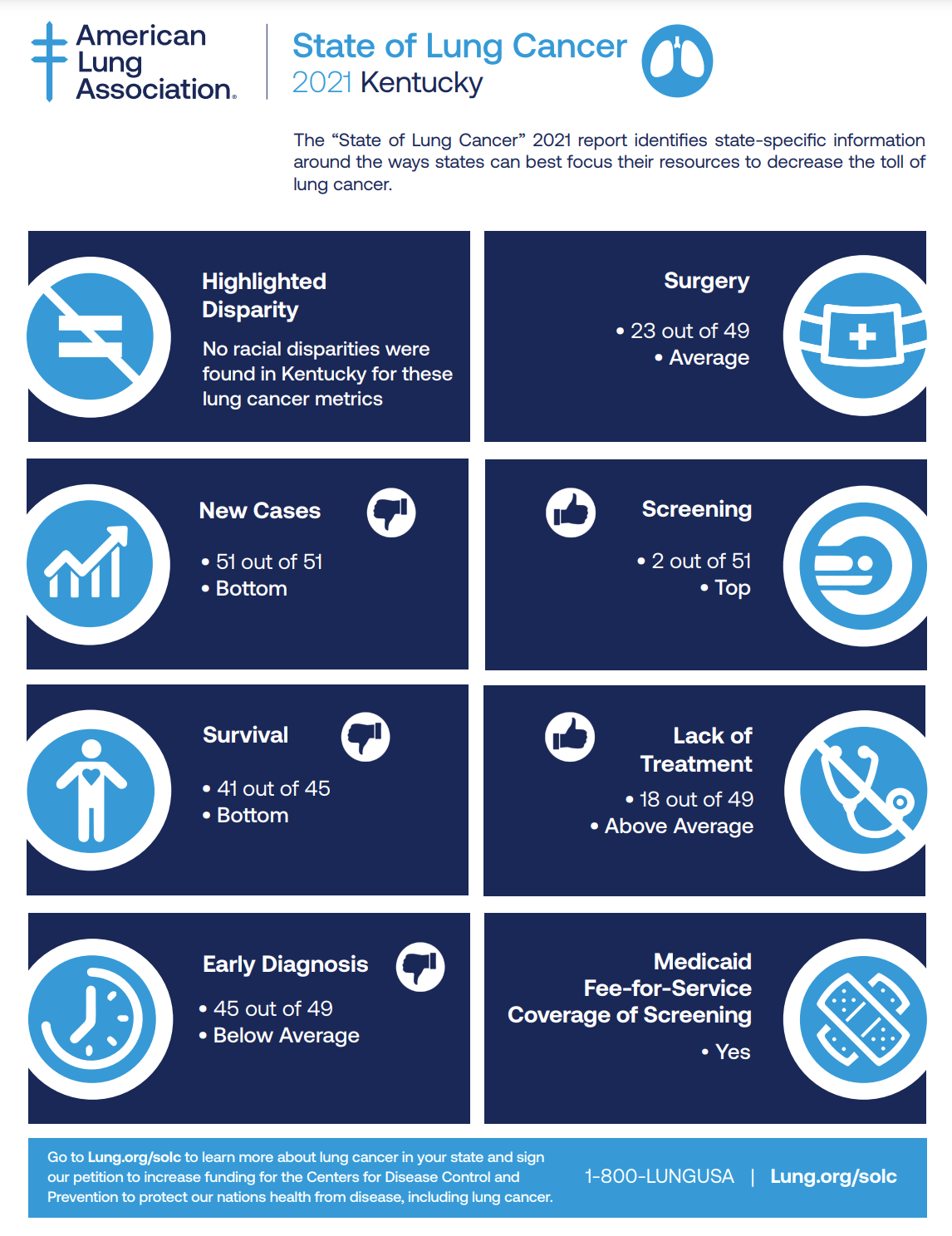
American Lung Association graphic; for a larger version, click on it.
The fourth annual American Lung Association State of Lung Cancer report places Kentucky among the worst five states for smoking, new cases, early diagnosis and survival.

The report ranks Kentucky second in screening, perhaps driven by its high case rate, but says it's worse than average in the percentage of lung-cancer patients (19%) not receiving treatment. It ranks 18th for this measure. 

The national rate for lack of treatment is 21%. The report adds that over the last five years, the percent of cases receiving no treatment in Kentucky increased by 10%. 

One of the best ways to prevent lung cancer is to prevent it and that involves helping the 23.4% of smokers in Kentucky to quit. Smoking is the number one cause of lung cancer, causing about 90% of cases, according to the American Lung Association. Kentucky ranks 2nd in the nation for smoking, following behind West Virginia. 

The state Department for Public Health offers a service called Quit Now Kentucky to help Kentuckians of all ages quit smoking. To learn more go to QuitNowKentucky.org, text QUITKY to 797979 or call 1-800-QUIT-NOW.

The only recommended screening test for lung cancer is low-dose computed tomography, also called a low-dose CT scan, according to the Centers for disease Control and Prevention. 

Annual CT scans are recommended for adults ages 50 to 80 who have smoked at least 20 "pack-years" (a pack-year amounting to one pack of cigarettes a day for a year, or an equivalent amount, such as half a pack a day for two years) and either still smokes or has quit within the last 15 years.

Map shows potential of indoor radon accumulation; click to enlarge.
The second leading cause of lung cancer is exposure to radon, an invisible gas that comes from bedrock. You cannot see, taste or smell it, so the only way to know the concentration of it in your home is to test for it. Concentrations of radon in and under homes are high in many parts of Kentucky.

Some local health departments, as well as the Kentucky Radon Program, offer free short-term radon test kits to Kentucky residents. If elevated levels of radon are detected, radon mitigation systems can be installed to reduce it. 

It's also important to know that there is an even higher risk of lung cancer for people who smoke and also have radon exposure. According to the UK College of Nursing, the lifetime risk of radon-induced lung cancer is 62 per 1,000 ever-smokers compared to seven per 1,000 never-smokers. Because of this, people who smoke or use vape products should smoke outside, says the college's BREATHE (Bridging Research Efforts and Advocacy Toward Healthy Environments) project.

Other causes of lung cancer include exposure to certain hazardous chemicals, pollution, and genetics. 

Symptoms of lung cancer are coughing that gets worse or doesn't go away, chest pain, shortness of breath, wheezing, coughing up blood, feeling very tired all of the time or weight loss with no known cause, according to the CDC.

Friday, March 12, 2021

Virus outbreak at state penitentiary stalls decline in number of new coronavirus cases in Kentucky; positive-test rate down again

By Al Cross and Melissa Patrick
Kentucky Health News

Most measures of the pandemic in Kentucky kept declining Friday, though an outbreak at the state penitentiary helped drive the state's seven-day average of new cases up for the second straight day.

Gov. Andy Beshear said in a press release, “The number of new cases, deaths and the positivity rate all continue to decline,” but that was true for cases only on a day-to-day basis, not the seven-day average, a better indicator of the trend of the pandemic.

The state reported 963 new cases, fewer than each of the previous two days. However, Friday's report raised the seven-day average of new cases to 823, six higher than Thursday. The average had fallen to 796 on Friday. Friday's new cases were 43 more than the 920 reported the previous Friday.

The Covid-19 death toll rose to 4,950 as the state added 29 fatalities, two probable and 27 confirmed. That was less than the number listed the previous two days, but the seven-day average of deaths rose to 28 per day. The 14-day average is 25 per day and has declined most days this week.

The share of Kentuckians testing positive for the novel coronavirus resumed its two-month decline, to 3.88 percent. That is the lowest percentage since Sept. 21, when the figure was 3.77%.

“While this is encouraging,” Beshear said, “we need to remain committed to the public-health measures that have helped Kentucky curb the number of infections, hospitalizations and deaths that would have otherwise occurred.”

Dr. Anthony Fauci, director of the National Institute of Allergy and Infectious Diseases, told CBS that cases are "absolutely not" low enough to relax public-health restrictions as some states have. 

The U.S. is still recording an average of 60,000 new infections a day and Fauci said "That is risky for triggering another surge." He said cases need to fall below 10,000 per day to comfortable lift restrictions, like wearing face masks. 

Lyon County, site of coronavirus outbreaks at two state prisons, continued to lead the nation in new cases per person over the last seven days, according to The New York Times. The Corrections Department report , which does not correspond exactly to the state's overall daily report, showed 496 active cases among inmates and 44 among staff at the Kentucky State Penitentiary, and 23 and 70, respectively, at the Western Kentucky Correctional Complex.

The state reported Lyon County's new-case rate to be 510 cases per 100,000 residents and the statewide rate to be 14.11. Counties with rates higher than the state rate were Carroll, 34.9; Rowan, 34.5; Clinton, 33.6; Bell, 30.7; Laurel, 29.8; Washington, 29.5; Clay, 29.4; Knox, 26.6; Owsley, 25.9; Caldwell, 23.5; Lawrence, 22.4; Logan, 22.1; Scott, 22.1; Carter, 20.8; Robertson, 20.3; Powell, 19.7; Green, 19.6; Breathitt, 19.2; Martin, 19.1; Knott, 17.4; Muhlenberg, 16.8; Ohio, 16.7; Whitley, 16.5; Harlan, 16.5; Adair, 16.4; Franklin, 16.2; Simpson, 16.2, Gallatin, 16.1; Henry, 15.9; LaRue, 15.9; Bourbon, 15.2; Boone, 15; Jefferson, 14.5; Barren, 14.5; Taylor, 14.4; Harrison, 14.4; Fayette, 14.3; and Mason, 14.2.

Counties with more than 10 new cases were: Lyon, 254; Jefferson, 167; Kenton, 92; Boone, 61; Fayette, 58; Campbell, 50; McCracken, 29; Knox, 20; Daviess, 18; Franklin, 16; Bullitt, 15; Hardin, 15; Madison, 14; Warren, 14; Pulaski, 13; Laurel, Oldham Russell and Scott, 12; and Grant and Graves, 11.

In other pandemic news Friday: 
  • The state's daily report showed 70 percent of Covid-19 patients in Kentucky hospitals' intensive-care units were on ventilators, 10 percentage points higher than any such share since Kentucky Health News began tracking it in late September. Hospitals reported 520 Covid-19 patients, three fewer than Thursday; 125 were in intensive care (down 11) and 88 were ventilated (up 13). 
  • Alex Acquisto of the Lexington Herald-Leader tells the story of a 23-year-old Kentucky woman who had Covid-19 that led to brain fog, memory loss and not being able to sleep. Acquisto writes that while the exact number is not known, "Tens of thousands of people across the country, including some kids, are reportedly plagued with long-term side-effects once the active virus has left their system." To meet this demand, Norton Healthcare and the University of Louisville have opened post-Covid clinics.
  • Kaiser Health News reports on the challenges these Covid "long haulers" have in their battle for disability benefits.
  • The University of Kentucky said it is planning to "return to levels of in-person instruction in similar numbers to that of fall 2019 in terms of course delivery and attendance."
  • All Jefferson County Public Schools will be provided with rapid-test kits for students or staff who arrive at school with symptoms of illness. The tests will be administered by nursing staff, Billy Kobin reports for the Louisville Courier Journal. The tests will be made available to any JCPS student, employee, parent or guardian who feels they may have been exposed to the virus. They will be make available starting Monday by appointment, with a limited number of walk-in or drive-up appointments. These test are most accurate on people who have symptoms.
  • The Orlando Sentinel reports that Florida is reporting the most cases of variant strains of the virus in the U.S. as travelers flock to the state for spring break, according to Becker's Hospital Review. Public-health officials have voiced concern that spring-break visitors may end up bringing more contagious variants back to their home states.
  • A report released this month by the World Obesity Federation found that increased body weight is the No. 2 predictor of Covid-related hospitalization and death across the globe, trailing only old age as a risk factor. This problem is exacerbated in the South, which has nine of the nation's 12 heaviest states, Kaiser Health News reports. Kentucky ranks fifth, tied with Tennessee, in the share of residents who are obese: 35.5%.
  • Recent studies estimate that we use an astounding 129 billion face masks globally every month – 3 million a minute. Most are disposable masks made from plastic microfibers. Researchers from the University of Southern Denmark warn that without good guidance on recycling, masks could become the next "plastic problem." If not disposed of for recycling, like other plastic wastes, disposable masks can end up in the environment, freshwater systems, and oceans, where weathering can generate a large number of micro-sized particles (smaller than 5 mm) during a relatively short period (weeks) and further fragment into nanoplastics (smaller than 1 micrometer).

Wednesday, October 28, 2020

Are there medical exceptions for mask wearing? Very few.

The Washington Post
A so-called “mask loophole” has been circulating on social media. It suggests that people who don't want to wear masks should tell store workers that they have a medical condition, and if challenged they should cite the privacy section of HIPAA, the Health Insurance Portability and Accountability Act.

To be clear, the Americans with Disabilities Act doesn't apply to people without disabilities, and HIPAA only applies to the flow of medical information through health-care providers and insurers.

“This social-media post doesn’t relay a ‘mask loophole’ so much as it encourages people to exploit a law designed to provide protections to disabled people,” the fact-checking website Snopes wrote.

There are very few conditions that would prevent someone from being able to wear a mask. The Centers for Disease Control and Prevention says people who should not wear a mask are: 1) children younger than 2 years old; 2) anyone who has trouble breathing; 3) anyone who is unconscious, incapacitated, or otherwise unable to remove the mask without assistance.

“Anyone who has trouble breathing” is ambiguous, and this seems to be where people like to point if they don't want to wear a mask.  In an article in the medical journal JAMA, a legal expert and a medical expert wrote that “few medical conditions are truly incompatible with all forms of mask wearing.”

People with facial deformities that are incompatible with masks is one example the authors raised. People with sensory or processing disorders was another. But less clear were the cases of people with chronic lung illnesses who weren't experiencing an acute attack. There is some evidence that masks protect the wearer to a certain extent, which would be beneficial to those with underlying lung disease. Having a chronic cough is also a really good reason to wear a mask.

For asthma, it depends on the severity. For people with mild or well-controlled asthma, masks shouldn't be a problem, according to the Asthma and Allergy Foundation of America. For those with severe asthma that involves many hospital visits and medications, wearing a mask for long periods might not be best.

Sunday, July 12, 2020

Coronavirus cases numbers lower, typical for a Sunday; number in the last week was 49 percent higher than the week before

Kentucky Health News chart; daily numbers may have been slightly adjusted since report.
By Al Cross
Kentucky Health News

Kentucky reported 277 new cases of the coronavirus Sunday, the least since the previous Sunday, when 280 were reported. Sundays tend to have lower figures due to less reporting by testing laboratories; in the six days between the two Sundays, the state averaged 375.5 cases per day and set four new daily records.

The latest number left the seven-day rolling average of new cases at 361.4, virtually the same as the 361.8 it was the day before. The previous week, the average was 241.7, so the week-to-week increase was 49 percent. The daily news release from Gov. Andy Beshear's office noted the week-to-week comparison.

“Folks, this is serious,” Beshear said in the release. “So what we need everybody to do is wear that mask. It’s a requirement, just like wearing your seat belt. At every store, it’s no shirt, no shoes, no mask, no service. This is just where we are in our battle as Americans and as Kentuckians against covid-19.”

Stores and other businesses are the first line of enforcement for Beshear's order requiring that a mask be worn inside indoor public places, or outdoors when six feet of social distancing cannot be maintained. It took effect at 5 p.m. Friday. Numerous news and social-media reports cited examples of businesses where few if any people were wearing masks; local health departments enforce the order on businesses.

Health Commissioner Steven Stack said in the news release, “Given the elevated rate of positive covid-19 cases that continues to increase, the need to curb spread of infection and keep others safe must be taken seriously. It is important for everyone to realize we all have a role in containing this disease so hospital capacity remains at a manageable level. Kentuckians must stay committed to this very important effort.”

The state health department's daily report did not include data on covid-19 hospitalizations and use of intensive-care units, the reporting system for which is being changed. It said the counties with more than five new cases Sunday were Jefferson, 39; Fayette, 25; Graves, 18; Boone, 14; Bell, 11; Warren, 11; McCracken, 10; Carroll, 8; Christian, 8; Campbell, 7; Hardin, 7; Kenton, 7; and Oldham, 6.

Beshear reported three more deaths from covid-19, raising the state's death toll to 625. The fatalities were two Fayette County men, 71 and 87, and a 100-year-old woman from Shelby County.

Shelby County now ranks seventh in deaths, with 19, tied with Adair, which had a major outbreak in its nursing home. Above them are Jefferson, with 206; Kenton, 37; Fayette, 33; Hopkins, 33; Boone, 23; and Graves, 21, most of which have also had nursing-home outbreaks. Patients of long-term-care facilities have accounted for about 65 percent of covid-19 deaths in Kentucky.

Thursday, July 9, 2020

As masks are mandated in Kentucky, Louisville doctor talks about why they're important, and others debunk myths about masks

Beshear dressed up and went to the Capitol rotunda
to make the announcement. (Courier Journal photo)
By Melissa Patrick

Kentucky Health News

In an effort to get ahead of the rising number of cases of coronavirus in Kentucky, Gov. Andy Beshear issued a statewide mask requirement Thursday that will be in place for at least 30 days.

"It's no longer voluntary, it's mandatory," Beshear said. "I'd hoped that we'd all be willing to do the right thing, but I think that the amount of time that we've dealt with this, plus our anxiety, cabin fever, all of it has added up. But it's time to get serious. It's time to stop our escalation now."

Beshear and his top health officials have spent months begging Kentuckians to voluntarily wear masks, to little avail. Today, he stopped begging and made it a requirement.  He said 22 other states now have some form of a mask mandate.

"It's no longer a question," he said. "I understand that the CDC and the federal government told us different things. Right. But that doesn't get in the way of what the science absolutely shows now. . . . A mask helps to stop the spread of covid. It protects other people from getting it from you and now, there are studies showing that it can protect you from getting this virus in the first place."

Beshear was referring to a new study at the University of California-Davis Children's Hospital that found wearing a mask decreases the risk of covid-19 infection in the person wearing it by 65 percent.

"Everyone should wear a mask," Dr. Dean Blumberg, chief of pediatric infectious diseases at the hospital, said during a July 2 livestream. "People who say 'I don't believe masks work' are ignoring scientific evidence. It's not a belief system. It's like saying, 'I don't believe in gravity'."

Why wear a mask? 

Dr. Monalisa Tailor, an internal-medicine physician at Norton Community Medical Associates in Louisville, strongly recommended wearing a mask during an online press conference Thursday. She said many people have the virus -- but don't have symptoms -- and can easily spread it when they sneeze, cough, or spit while talking.

She said wearing a mask that covers both the nose and mouth helps to prevent the spread of those infected droplets to others, adding later that such aerosols can linger in the air up to three hours.

"It is something that we can do to protect ourselves, protect our family members and protect our neighbors," she said.

Beshear's executive order has a long list of exemptions, including people with physical impairments that keep them from safely wearing a mask. That said, Tailor encouraged almost everyone to wear a mask in public, including those with asthma or mild lung conditions, largely because of the risk the virus poses to their lungs if they get it.

"There are very few people that I would recommend should not wear one, and those would be folks that might suffer from claustrophobia or severe anxiety or panic attacks because they have some trauma related to feeling smothered, and that's going to be a very select group of people," she said. "Overall, looking at the general population, I would encourage everyone to wear a mask."

Tailor encouraged those who can't wear a mask to stay at home as much as possible, and if they do go out, to avoid closed indoor spaces, stay six feet away from others and keep their hands clean.

She said that social distancing is still "very important" even with a mask; that surgical masks should be thrown away after a trip out in public; and that cloth masks should be washed after each outing. She also reminded Kentuckians to remove masks by using the ear loops.

"That way you are less likely to touch the front," she said. "That would be another way that you could spread the virus."

Some fear a mask will make them breathe too much of their exhaled carbon dioxide, but Tailor said that that should not be a concern, since carbon dioxide and oxygen molecules are small enough to pass through masks.

She said Norton employees have worn pulse oximeters at work to measure oxygen levels while wearing masks and found that "It does not affect your oxygen capability or your ability to lose the carbon dioxide."

What she would say to people who refuse to wear a mask? "This is something that we are doing to protect ourselves and those around us. I don't want my family members getting sick, I don't want my patients getting sick, I don't want my friends getting sick. And if this is one way that I can help prevent the spread of the virus, I want to do that -- for myself and for others."

Debunking the myths

Infectious-disease physician Dr. Catharine Paules and pediatric allergist-immunologist Dr. Tracy Fausnight of Penn State debunked a list of common myths about masks in a university news release.

Myth: We didn’t need masks early in the pandemic, so we don’t need them now.
Fact:  Mask recommendations have evolved with the data around covid-19. Early on, very little data existed about the virus, and the nation was short of masks. "Recently it has become clear that asymptomatic people can transmit covid-19 from speaking, coughing or sneezing," they write. "This led to public health officials strongly recommending masks to prevent COVID-19 spread from individuals who do not know they are infected.

Myth: No studies exist about the effectiveness of masks.
Fact: “Several observational studies published since the covid-19 pandemic began show emerging data that masks coupled with other distancing measures help to prevent the transmission of covid-19,” Paules said.

Myth: Masks trap in bacteria and fungi, making people more susceptible to bacterial or fungal pneumonia.
Fact: “There is no data to support this statement,” Paules said. The release notes that health-care providers ask people at high risk for fungal infections, such as cancer patients, to wear masks for protection.

Myth: Masks won’t keep me from getting sick.
Fact: Masks do help keep a person from getting sick, and are even more effective at preventing somebody else from getting sick, the doctors write.

Myth: Masks weaken the immune system.
Fact: The immune system is exposed to germs all the time, they write, and wearing a mask doesn’t prevent it from “remembering” all of those prior exposures and staying strong.

Myth: We don’t need masks. We need herd immunity, to protect almost all the population.
Fact: Herd immunity works only if about 70 percent of the population has antibodies from an infection or a vaccine, and achieving that with the coronavirus would come at the cost of "a catastrophic number of deaths due to covid-19," so we must prevent the spread of the virus until a treatment or vaccine is found, the doctors write.

One “myth” that has some truth, they write, is that wearing a mask can cause some people anxiety and a sense of claustrophobia. To overcome that, “Try wearing a mask at home for short periods of time,” Paules said. “Then you can gradually build up to wearing it for a whole trip to the grocery store, for example.”

Wednesday, July 8, 2020

Record numbers of coronavirus cases prompts 'new requirements that are going to be mandatory,' Beshear says; could it be masks?

Kentucky Health News chart; the state did not report hospital data for Sunday, June 28.
By Melissa Patrick

Kentucky Health News

Kentucky reported 402 new cases of the coronavirus Wednesday. That was the highest number yet identified on a single day, for the second straight day. And it was the fourth consecutive day that the seven-day rolling average of new cases also set a new record.

Tuesday's record was 371, not including the 625 cases reported May 5, when the total included 309 found over days of testing at a Western Kentucky prison.

“The rising case numbers are cause for concern, so tomorrow we’re going to announce some new requirements that are going to be mandatory,” Gov. Andy Beshear said in his daily news release and a short video. “Given what we are seeing across the country with exploding numbers in certain places, my commitment is to make sure that doesn’t happen here, but I can’t do it alone.”

Beshear will make that announcement at his weekly press briefing at 4 p.m. Thursday. He said he would hold an additional briefing at 4 p.m. Friday. The briefings can be viewed on his official Facebook page or Youtube channel.

One measure Beshear could mandate is the wearing of face masks, a step that is highly controversial despite proof that it curbs the spread of the virus. Such orders have been issued by governors in at least 19 other states, including West Virginia, the Louisville Courier Journal reported in a front-page editorial that urged Beshear to do likewise.

Wednesday's 402 cases brought the state's total number to at least 17,919. The state's daily report shows that a near-record 453 Kentuckians are currently hospitalized with covid-19, with 111 of them in intensive care. After 451,451 tests, the state's positive rate is 3.88 percent.

The counties with double-figure numbers of new cases Wednesday were Jefferson, 79; Fayette, 50; Warren, 21; Laurel, 15; Bell, 14; Graves, 13; Boone, 12; and Pulaski, 10.

Hardin County, which reported nine new cases, has the highest estimated virus-transmission rate on CovidActNow, a site that uses official data to make such estimates. The rate of 1.46 means that every 100 infected people will infect 146 others. Officials like the rate to be below 1.1.

The site estimates Kentucky's overall rate to be 1.08, up from 1.04 on Tuesday. Rt.live, a similar site, estimates the state's rate to be 1.18, down from 1.21 on Tuesday.

Beshear announced six new deaths from the virus, bringing the state's death toll to 608, 65 percent of which have been patients from long-term-care facilities.

The latest fatalities are 72-year-old man from Casey County; a 67-year-old man from Fulton County; a 74-year-old woman from Perry County, and from Jefferson County, a 61-year-old man and two women, 73 and 77.

“That is far too many Kentuckians to lose, and we’ve got to do everything we can to minimize our loss moving forward,” Beshear said.

In other covid-19 news Wednesday:
  • The University of Kentucky's Center for Clinical and Translational Science has joined the National Covid Cohort Collaborative to leverage big data in the fight against covid-19, UK reports. The collaborative is working to turn data from hundreds of thousands of medical records from coronavirus patients into treatments and predictive analytical tools that can help address the evolving pandemic.
  • The World Health Organization acknowledged "emerging evidence" exists of airborne spread of the coronavirus, Becker's Hospital Review reports. This comes after 239 scientists urged the WHO to update its recommendations about how the virus is spread, citing evidence that it lingers in indoor air. WHO's previous position was that evidence of airborne transmission was inconclusive and it is possible only after medical procedures that produce aerosols. 
  • Dr. Anthony Fauci, the nation's top infectious-disease doctor, took issue Tuesday with President Trump's suggestion that the dropping death rate among U.S. covid-19 patients is evidence of a successful response to the virus, CNN reports: "It's a false narrative to take comfort in a lower rate of death," Fauci said during a livestream press conference with Sen. Doug Jones, D-Ala. "There's so many other things that are very dangerous and bad about this virus, don't get yourself into false complacency." Kaiser Health News provides a round-up of stories on this topic. 

Sunday, June 28, 2020

Sunday cases low, as usual; 7-day average still high; 30-year-old dies; those in 20s are plurality of Ky. cases; media influence seen

State map of all cases, labeled by Kentucky Health News; click on it for a larger version.
Kentucky officials reported 67 new coronavirus cases Sunday, following the trend of Sundays having lower numbers because of limited reporting from laboratories that process tests looking for the virus. The report lowered the state's rolling seven-day average to 222 from 229, where it had jumped after a near-record number of cases on Saturday.

“We see states in the South like Florida and Texas with rising cases, and know it could happen here in Kentucky,” Gov. Andy Beshear said in a press release. “It wasn’t anything magic that led us to our early success. It was us truly coming together as a people and showing that the lives of other Kentuckians is more important to us than anything.”

The phenomenon of limited reporting on weekends, and the value of a seven-day rolling average, is freshly illustrated by the state Department for Public Health's revised epidemic curve. It now dates cases as beginning on the day of the test, not the day symptoms began (as many as half of those infected have no symptoms but can still spread the virus):
For a larger version of the Kentucky epidemic curve, click on the chart.
Nationally, the number of new cases hit a record for the fifth day in a row.

The second wave of cases this fall is likely to be "substantially larger than the first wave," Dr. William Schaffner, a Vanderbilt University infectious-disease specialist, told CNN. Beshear said in the release, “In the coming weeks and months, we’re going to be tested again about whether we truly can be Together Kentucky and Team Kentucky once again. I know we’re up for it.”

Beshear reported four more deaths Sunday, raising the state's covid-19 death total 558. The fatalities included a 30-year-old woman from Fayette County, who appears to have been the youngest covid-19 death in the state. The local health department says she had no underlying conditions. Others were an 84-year-old woman from Fayette County, an 81-year-old man from Franklin County and a 93-year-old man from Shelby County.

Sunday's update did not include hospitalization data, which have become more important to watch as the virus spread among younger people, who are generally less vulnerable to the virus. When sorted by decades of age, people in their 20s now account for more Kentucky cases than any other decade. Counties reporting five or more new cases Sunday were Jefferson, 10; Fayette, 9; Warren, 7; and Pike, 5.

In other covid-19 news Sunday:

People who get their news from Google or Yahoo, watch Fox News or listen to Rush Limbaugh are more likely to be misinformed about the coronavirus and covid-19, three studies have found. A Harvard University study found that was true even when discounting for age, gender, ideology and party preference. It found that readers of The Associated Press, The New York Times, The Washington Post and The Wall Street Journal were better informed. It also found, "Exposure to sources such as Facebook, Twitter or YouTube was positively correlated with belief in the efficacy of vitamin C, the belief that the CDC was exaggerating the threat to harm President Trump, and the belief that the virus was created by the U.S. government." Another study found that "Infection and mortality rates are higher in places where one pundit who initially downplayed the severity of the pandemic — Fox News’s Sean Hannity — reaches the largest audiences," the Post reports

Pastor says the pandemic is like driving: Distancing and masking are analogous to wearing a seat belt and watching your speed

Paul Prather
Paul Prather of Mount Sterling, a Pentecostal minister and former Lexington Herald-Leader religion reporter who still writes a column for the paper, has a Facebook page with a diverse set of friends and followers. Recently, he asked them, "Are my wife and I alone in still taking precautions against covid-19? I'm beginning to feel as if we are. Are you wearing masks and practicing strict social distancing or have you returned to your pre-pandemic lifestyle? Either way, what's your rationale? . . . I've ever experienced what I feel now—that those around me could not care less whether they kill me. That the lives of those who are older or have chronic illnesses apparently mean nothing."

Prather reports in the newspaper, "The responses weren’t what I’d anticipated, in volume or content. What I learned from my Facebook friends (mostly) lifted my soul." He estimates that 98 percent those who responded said they wear a mask, but suspects that "way more than 2 percent of my friends aren’t wearing masks or social-distancing now, if they ever did. Apparently, for whatever reasons, these folks didn’t feel comfortable declaring themselves."

That's what Kentucky Health News reporter Melissa Patrick found this month when she interviewed shoppers in the parking lot of Walmart on Nicholasville Road in Lexington. "Most who weren't wearing a mask also didn't want to be interviewed, and of the few who did, most didn't want to share their name," she reported. "But every person who had a mask on and was asked for an interview agreed to it and all but one gave their name."

Prather writes that he has the impression that "hardly anybody was taking precautions," but "After my post, I realized far more people are acting cautiously than I’d imagined. . .. The reason it seemed they weren’t there was that—duh!—they weren’t there. That is, they weren’t the folks cramming into Walmart or Lowe’s or massing on Florida beaches. They were home."

As for his own attitude, Prather says he approaches the pandemic much like driving -- an inherently risky proposition but one that can be managed safely.

"Any 4,000-pound machine hurtling down a road is a lethal threat. People die or are maimed in crashes every day. So I wear my seatbelt. I obey the speed limit (kind of, more or less). I don’t drink and drive. I don’t text while driving. I maintain a comfortable distance between my vehicle and the one ahead of me. If it’s raining, snowing or icy, I slow down. I hope to decrease my odds of having—or causing—a wreck. I want to protect you and me alike," he writes.

"This is how I approach wearing a mask, social distancing and hand washing. I do what I can. I don’t quake with fear. I see it as using good sense and being a good citizen. If you want to risk your life by getting drunk and driving 90, or by failing to take reasonable precautions against covid-19, yes, theoretically that’s your right. Until you start endangering others’ lives. That’s not your right."

Saturday, June 27, 2020

Cases keep trending up; long-term-care visits will come with restrictions; Ky. researchers developing masks that attack virus


Video from Health and Family Services Secretary Eric Friedlander runs 5 minutes and 35 seconds.

If you plan to visit a long-term-care facility in Kentucky as visitation reopens, be prepared to follow some tight restrictions. Visitation opens Monday, June 29 for personal-care homes, assisted-living communities and family-care homes, and July 15 for skilled nursing facilities. (The facilities are not obligated to open visitation on those days.)

Visitors will have to schedule in advance, no more than two people can visit a time, they must be socially distanced, and they won't be in patients' rooms. Facilities must have a designated visitation room near the main entrance or outdoors so the area can be sanitized between visits. Inside visitors must be masked, and will be screened for possible signs of covid-19.

“This is done balancing needs of individuals, needs of families, needs of folks in these facilities themselves to start seeing each other again,” Health and Family Services Secretary Eric Friedlander said in an online message.

Visitation is resuming after "three months of forced isolation," notes the Lexington Herald-Leader. "Residents who mostly have been confined to their rooms since March will be able to resume some group activities and communal dining in their facilities.:

Most of Kentucky's deaths from covid-19 have been among residents of long-term-care facilities, and a few nursing homes have lost "close to a quarter of their populations," the Herald-Leader notes. "A spike in cases announced Friday at a nursing home in Corbin shows the facilities remain potentially vulnerable."

There are other restrictions. Before they can allow visitors and resume group activities, the facilities that can start Monday must have gone two weeks without a new coronavirus infection, and those starting July 15 start date must have gone four weeks.

Kentucky Health News chart
The state reported 316 new cases of the coronavirus Saturday, close to the record of 322 on April 19 (except the day it included all results from a prison in the daily report). Saturday's cases raised the seven-day rolling average to 229 from 216; that increase was the sixth in a row.

The number was driven partly by the Corbin nursing-home outbreak; Knox County had 43 new cases. Fayette County had 49, and Jefferson County led the list with 56. Warren County, with 26, was the only county in double figures.

Reporting via press release, Gov. Andy Beshear said, “This virus is not going away yet. We see numbers spiking in states all across the country. We need to be vigilant so that doesn’t happen here in Kentucky.” Hospitalization figures in the state's daily report remained stable.

One death from covid-19 was reported Saturday, a 78-year-old woman from Fayette County, raising the state's death toll to 554.

In other covid-19 news Saturday:
  • "University of Kentucky and Somerset Community College professors could soon deliver 3D-printed, customizable masks that hold a re-usable, washable filter that can inactivate covid-19," reports Rick Childress of the Herald-Leader. Isabel Escobar, a UK engineering professor, "said her long-term goal is to get the masks — which would be effective against many viruses and bacteria — on the faces of first responders and eventually the general public. Since the masks are so early in development, Escobar said it’s hard to pinpoint when that’ll be and what the price of the masks might be."
  • The Herald-Leader's Liz Moomey reports on the reopening of the free Red Bird Clinic in northern Bell County, closed for three months due to the pandemic. Renovations allow it to see as many as before, and accommodate University of Louisville dental students in the fall.
  • People needing help with unemployment claims can make appointments for next week in Frankfort from 8 a.m. to 4 p.m.; and for Monday or Tuesday from 9 a.m. to 6 p.m. local time at community colleges in Owensboro and Grayson. Appointments can be made at kcc.ky.gov and going to the In-Person UI Services "View Services" button. Assistance is also available at through the website's "Chat Now" button or by calling 502-564-2900.
  • Pfizer Inc. CEO Albert Bourla "said the company anticipates it will have safety and efficacy data from phase 3 trials of its covid-19 vaccine available by the fall, perhaps as early as September," in time for Food and Drug Administration approval or authorization in October, Inside Health Policy reports. With an FDA green light, "Pfizer will likely be able to have hundreds of millions of doses of the vaccine available by the end of this year, and 1 billion by 2021, he added." Speaking Friday, he also cautioned: “You need to have the stars aligned to accomplish what I'm describing. And frankly, I'm still surprised that things are still aligned.”