Showing posts with label dentistry. Show all posts

Monday, February 26, 2024

Anti-fluoride legislators cry 'local control' and 'forced medication;' dentists say it's been proven to reduce tooth decay for 70+ years

Centers for Disease Control and Prevention graphic; click to enlarge
By Deborah Yetter
Kentucky Lantern

As a dental hygienist working with low-income schoolchildren in Louisville, Jennifer Hasch said the untreated tooth disease she saw was shocking.

Some teens had decay so severe they had to have all their teeth pulled and be fitted with dentures. Middle-school kids reported being unable to sleep because of pain from infected and abscessed teeth. First- and second-graders required inpatient oral surgery under anesthesia because of the severity of tooth and gum disease.

“It was heart-wrenching,” said Hasch, who’s on the steering committee of the Kentucky Oral Health Coalition.

Adults don’t fare much better.

Kentucky ranks 49th in overall oral health and is among the top states in the number of toothless, older adults. And last year, a University of Kentucky oral health physician described to legislators patients being air-lifted to the UK hospital because of life-threatening infections from dental disease.

Yet a group of lawmakers led by Rep. Mark Hart, R-Falmouth, is pushing a bill to make fluoridation optional for local water districts, despite what Hasch and others, including the American Dental Association and the Kentucky Dental Association, say is overwhelming evidence fluoride safely helps reduce tooth decay.

“It’s a bill that will undo an unfunded mandate and return the issue to local control,” Hart said, speaking before the Feb. 7 meeting of the House State Government Committee in support of his House Bill 141.

Hasch and other oral health professionals are fighting HB 141, which would eliminate the fluoridation mandate established in 1954.

“There are kids that already are suffering,” Hasch said. “Water fluoridation protects that from getting worse.”

Dr. Stephen Robertson, executive director of the state dental association, urged lawmakers to reject HB 141, saying “Kentucky is not in a position to take a step backward in oral health.”

“Please listen to our professional advice and continue to provide consistent fluoride access to our patients in community water supplies,” urged Mary Ann Burch, representing the Kentucky Association of Dental Hygienists.

They didn’t.

Instead, the committee approved HB 141 by a vote of 16-1, framing it not as a public health issue but rather one of local autonomy. The bill now is pending in the House.

“This is a local control issue,” said co-sponsor Rep. William Lawrence, R-Maysville. His city was the first in Kentucky to add fluoride to its drinking water supply in 1951.

“Local control — that’s what this bill is about,” said Rep. Steve Rawlings, R-Burlington, also a co-sponsor.

“Let’s just leave it to local control,” said Rep. Kevin Bratcher, R-Louisville.

In all, six members of the committee cited “local control” as grounds for passing HB 141. Rep. Keturah Herron, D-Louisville, cast the only no vote.

Bill hasn't moved since Feb. 9

After getting out of committee, the bill went to the House Rules Committee, which is controlled by House leaders. It has been there since Feb. 9, which could indicate that its sponsors haven't yet rounded up the votes to pass it through the full House.

Meanwhile, though, the prospect of allowing local water utilities to eliminate fluoride from drinking water has Kentucky dental and public health officials frantic.

“Other than setting my hair on fire, there’s not enough words I can say that this is a critically important step, if Kentucky takes it, to harm developing teeth, children’s teeth and adult teeth,” Dr. Connie White, Kentucky’s deputy public health commissioner, said on a recent call with health advocates.

Fluoride reduces cavities by 25%, White said.

Not only will it lead to even more tooth decay than Kentucky already has, she said, it will drive up costs of Medicaid, a government health plan for low-income individuals that covers nearly half of Kentucky’s children.

Filling one cavity in a child costs Medicaid about $250, which could add million of dollars to the cost of the program, White said.

Already facing a shortage of dentists in the state, especially pediatric dentists, removing fluoride from community water supplies will mean longer delays in care, Hasch said.

“We don’t have the resources to handle that increase,” Hasch said. “All these dental providers are desperately trying to catch up with the current need.”

Dr. Bill Collins, a longtime dentist in Eastern Kentucky, said too many children in rural areas on well or cistern water already lack access to fluoridated water and suffer much more from dental decay as a result. Compounding the problem is high use of sugary sodas and lack of access to oral health care throughout the state.

He said he’s baffled about why lawmakers want to remove the fluoride mandate.

“They don’t see the need for fluoride because they haven’t experienced the decay that we have out in the rural areas,” said Collins, director of the Red Bird Mission dental clinic in Beverly, in northern Bell County. “If this happens, they’re going to experience it and they should be held responsible.”

‘Grounded in science’

Kentucky's statewide adoption of fluoridation, hailed as one of the major public-health advances of the past century by the U.S. Centers for Disease Control and Prevention, has made Kentucky a national leader, advocates said.

A naturally-occurring mineral, flouride helps strengthen tooth enamel and prevent decay when added to water in small amounts, Hasch said. It helps when children’s teeth are developing, but the main benefit is topical exposure to fluoride from drinking treated water.

The recommended level is 0.7 parts per million, which Hasch said is comparable to adding one drop of fluoride to about 11 gallons.

The Louisville Water Co., the state’s largest public water provider, has been adding fluoride to water it gets from the Ohio River since 1951, said spokeswoman Kelley Dearing Smith.

The river water already contains some natural fluoride and the water company adds enough to bring it to the recommended level, she said.

“We are grounded in public health,” she said. “Everything we do is grounded in science.”

The Louisville Water Co. joined insurer Delta Dental of Kentucky, the dental and dental hygienists associations, the Oral Health Coalition and the Kentucky Primary Care Association in a letter to legislators urging them to reject HB 141.

“Community water fluoridation is a safe, reliable cost-effective prevention measure to keep teeth strong and reduce cavities by at least 25%,” the letter said. “We are deeply concerned about any efforts to make water fluoridation programs optional in our communities.”

‘Forced medication’

Questions about fluoride’s safety and efficacy have persisted over the years, despite evidence to the contrary. 

Four rural water districts submitted letters in support of HB 141: the Grayson County Water District, Irvine Municipal Utilities, the Martin County Utility Board and the McCreary County Water District.

Craig Miller, division manager for the Martin County water utility.], wrote, “The facts are out there proving fluoridation of water is dangerous to human health.” He said eliminating fluoridation would save Martin County about $14,000 a year, which he said could be better spent upgrading the problem-plagued water system.

Nina McCoy, a longtime activist for better water in Martin County and a member of the utility board said she wasn’t consulted on HB 141 and the board didn’t vote on the matter. She suggested legislators defer to public health officials. “I don’t pretend to be an expert in this at all,” she said.

A letter from Stephen Whitaker, superintendent of the McCreary water district, cited potential “adverse effects of fluoridation” including thyroid, tooth and bone problems.

Lawrence, a co-sponsor of HB 141, called adding fluoride to water “forced medication.”

Hasch, with the Oral Health Coalition, dismissed claims of studies linking water fluoridation to health problems as “junk science” and said the overwhelming body of research supports it as safe and effective.

Collins, who has practiced dentistry in Eastern Kentucky for more than three decades, said he doesn’t understand persistent distrust of fluoride.

“I really don’t understand why they are so adamant about removing this,” he said. “It’s something that’s time-tested and shown to be a good thing and it’s safe. It’s just mind boggling.”

Wednesday, February 7, 2024

Mobile vans bring dental care to those who have trouble getting it

Kare Mobile serves patients in six states. (Photo provided) 
By Hayden Gooding
University of Kentucky

Good oral health is crucial for overall well-being and receiving dental services helps maintain it. But many people who need dental care are often unable to receive it, especially in rural areas or those in certain racial, ethnic and socioeconomic groups.

University of Kentucky College of Dentistry alumnus Kwane Watson founder and CEO of Kare Mobile Inc., strives to advance Kentucky by serving those who need dental care but often lack access.

While working as the state dental director for Community Dental of Kentucky, Watson gained a clearer view of access issues and demand for dental care while traveling between Western Kentucky and the West End of Louisville.

“Practicing in Western Kentucky was an eye-opener,” Watson recalled. “I didn’t realize the degree of need in Western and Eastern Kentucky, or how long people have to wait to get an appointment because there are no Medicaid providers available.”

Kwame Watson (Kare Mobile photo)
In 2017, Watson had a vision. He found a van and reached out to a friend who had experience in completing food truck renovations. From there, his first mobile dental operatory, Kare Mobile, was created.

Over the past six years, his practice has become dedicated to eliminating "dental deserts" to ensure that all patients can receive care regardless of their racial, ethnic or socioeconomic status.

Kare Mobile puts patients at the center of everything it does. Watson’s goal is to bring affordable, comprehensive dental services to low-income communities where services have been hit hard by the rising cost of dental operations.

The mobile dental service provides various services including adult and child cleanings, root canals, extractions, fillings and more.

What started as a dentist with a vision and a van in Louisville, has now expanded across multiple states. Kare Mobile currently serves patients in Kentucky, Ohio, Tennessee, Michigan, Georgia and Oklahoma. Watson plans to continue growing Kare Mobile to reach more underserved communities and individuals facing barriers to traditional dental services.

In recognition of his accomplishments, Watson was awarded a Torch of Excellence Award by the UK Alumni Association last fall. These awards celebrate alumni "whose faith, hard work and determination has positively affected the lives of people on the UK campus, the city, state or nation.

Learn more about Kare Mobile and services near you here.

Friday, August 11, 2023

Legislators insist on 'procedure' as dental-school deans plead for approval of expansion of dental benefits in Kentucky Medicaid

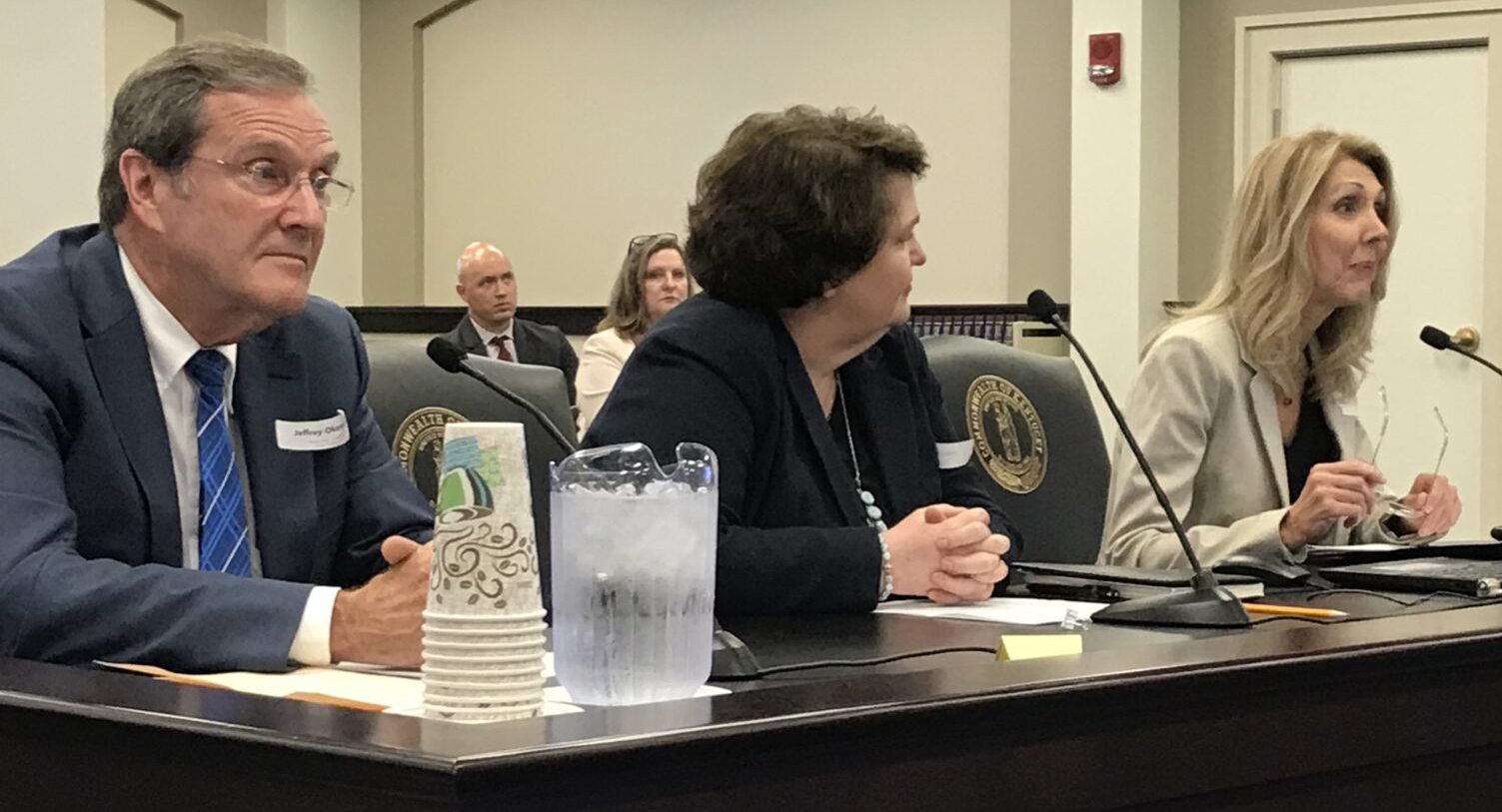
Dr. Pamela Stein, right, dean of the University of Pikeville dental school, spoke in Frankfort Tuesday about the need for expanded Medicaid dental benefits, joined by Dr. Margaret Hill, interim dean of the University of Louisville dental school, and Dr. Jeffrey Okeson, dean of the University of Kentucky dental school. (Kentucky Lantern photo by Deborah Yetter)
By Deborah Yetter
Kentucky Lantern

Working at a public “safety net” dental clinic in rural Western Kentucky, Dr. Pamela Stein routinely saw a heartbreaking sight.

“It was not unusual at 6 o’clock in the morning to see 10 or 15 people standing in line waiting to get in because they had tooth aches, because they couldn’t find anyone else to care for them,” said Stein, appointed last year as dean of a new dental school being formed at the University of Pikeville.

Some patients at the Marshall County clinic were in tears after having diseased, throbbing teeth removed at the clinic operated by the University of Kentucky, she said.

“People would actually cry, they were so relieved,” Stein said, speaking before a legislative committee Tuesday in Frankfort.

She and others spoke in support of the state’s recently expanded Medicaid dental services for adults to include dentures, fillings, root canals and crowns. Medicaid previously paid only for one annual cleaning and tooth extractions for adults though children get a full range of services.

Stein joined the deans of dental schools at the universities of Kentucky and Louisville to urge continuation of the dental services authorized by Gov. Andy Beshear that have ignited a partisan political fight in Frankfort.

Republicans who control the General Assembly are seeking to block Beshear, a Democrat, from expanding Medicaid dental coverage, as well as vision and hearing benefits, arguing he usurped power that rests with lawmakers.

Officials with the Beshear administration disagree, saying they had the authority because the $39 million expansion is paid for through savings in Medicaid and doesn’t require allocation of new money. The federal government covers 85% of the costs.

But the dental school deans, as did other witnesses who appeared, avoided politics, instead focusing on Kentucky’s abysmal oral health — it ranks 49th in the nation — as well as low reimbursement rates that keep many dentists from treating Medicaid patients.

As a result, many patients living with untreated dental disease can’t find a dentist, especially in rural areas, or often find long waiting lists. And oral infection is linked to a host of other health problems that plague Kentucky, including heart disease, stroke, diabetes and premature births.

“It’s an enormous problem that we have here and it’s not getting any better,” said Dr. Jeffrey Okeson, the UK dean. Okeson said Medicaid doesn’t cover costs of dental care.

For example, he said, UK last year billed Medicaid $14.2 million to treat 37,000 patients but was reimbursed only $4.1 million, about 30% of its costs. UK makes up the difference but can’t do so indefinitely if it begins cutting into the academic budget, he said.

His counterpart at U of L agreed, noting that together UK and U of L treat around 90,000 Medicaid dental patients a year, many of whom can’t find care elsewhere.

“These folks would probably not be able to receive dental care if it wasn’t for dental schools acting as a safety net,” said Margaret Hill, interim dean of U of L’s dental school.

“Today we are here before you, speaking on behalf of our patients and our students who would like to do the right thing, and ask that the Medicaid expansion of dental services continue and that rates of reimbursement be more reasonable,” Hill added.

Several witnesses described the enormous suffering of patients who previously lacked dental coverage and now, even if covered under the expanded benefits, can’t find a dentist.

“I don’t mean to tug on your heart strings but I really hope that I do,” said Tiffani Hays, a social worker who works with cancer patients in Winchester, many in dire need of dental treatment. “Oral health is probably one of the most common problems in our patients.”

It was the first opportunity for public comment on the dental benefits expansion enacted by Beshear in April after the lawmakers voted down his first, Jan. 1 expansion in the 2023 legislative session. Beshear reinstated them, with some changes, after lawmakers adjourned.

The stop and start nature of the expanded benefits has patients scared, said Missy Newland, a Louisville woman who gets health coverage through Medicaid and needs ongoing dental care.

“The political tug of war has always had me worried about staying eligible,” said Newland, who works cleaning homes and testified by video. “I fear my access to health care will be taken away and with my health issues, that’s scary.”

The current benefits — which also include expanded benefits for items such as eyeglasses and hearing aids — are good through the end of the year. While Republican lawmakers have objected, they don’t have the power to block them till they meet in 2024 in the next legislative session.

Meanwhile, tens of thousands of Kentuckians have received benefits such as dentures, crowns, fillings, hearing aids and eyeglasses, said Emily Beauregard, executive director of Kentucky Voices for Health, a coalition of health advocacy groups.

“These services are life-changing for people,” said Beauregard, adding that with better vision, hearing and teeth, people are more likely to find jobs.

But GOP legislators object even as some acknowledge the benefits are sorely needed for the about 900,000 adults who get health coverage from Medicaid, a federal-state health plan for low income and disabled individuals.

Rep. Randy Bridges, R-Paducah, and a vocal critic of Beshear’s expanded Medicaid services, accused officials with the Cabinet for Health and Family Services of making “end runs” around lawmakers who, he argued, hold the sole power to fund such programs through its budget committee.

“To come in here and pull at our heartstrings, to say we are the keepers of the purse — we aren’t the keeper of the purse,” he said of the Administrative Regulation Review Subcommittee holding Tuesday’s hearing.

“You’re doing end runs and you want to make us appear to be the villains and we’re not,” Bridges added. “We just want to do it in the proper manner.”

But Sen. David Yates, a Louisville Democrat, argued it’s the health needs of constituents rather than legislative procedure that should matter.

“It did in fact pull on my heartstrings as it should any Kentuckians,” Yates said. “Forget the partisan politics and political games, I think everyone agrees that something has to be done.”

Bridges also complained that witnesses who appeared in support of the expanded benefits were misled by state officials about the legislative process.

“I feel like you have inappropriately led them with some wrong ideas on how this works,” Bridges said.

That prompted a heated retort from Lisa Lee, state Medicaid commissioner, who also spoke Tuesday.

“I have never, ever misled anyone in my 23 years in Medicaid and I will not do so,” Lee told Bridges. “And I really don’t appreciate the fact that you indicated that we have been misleading people.”

As for the witnesses who spoke, Lee said, “They are here because they are concerned that people are going to lose their benefits.”

They included Dr. Bill Collins, a dentist at the Red Bird Mission dental clinic in Clay County who said he constantly seeks grants to cover the costs of dental care for patients Medicaid doesn’t fully cover.

Kentucky has one of the highest rates in the nation of adults with no teeth and patients are flocking to get dentures newly covered under the expanded Medicaid rates, Collins said.

But Medicaid covers only about half the costs, he said.

“When the grant money runs out it has to stop,” he said.

Collins was among witnesses urging lawmakers to continue expanded services and increase payments to dentists. “You can make it a reality,” he said. “That’s what I beg you to do.”

The committee took no action Tuesday. It already has found the regulations Beshear issued to enact the expansion “deficient,” meaning lawmakers could strike them down when they meet next year.

But Rep. Derek Lewis, R-London, committee co-chair, ended the meeting on a conciliatory note, saying he’s willing to work with everyone involved to find a solution.

“I know we’re in an election year,” Lewis said, alluding to the fact Beshear is seeking a second term as governor. “What I don’t want to see is this made to be a political football, I don’t want to poison the well and leave patients and providers holding the bag.”

“I think we can make a difference,” he said. “We need to make a difference.”

Tuesday, July 11, 2023

Frankfort power struggle, too few dentists and low Medicaid pay are all barriers to healing the pain in poor Kentuckians' mouths

Dr. Bill Collins treats a patient at the Red Bird Mission
dental clinic in Clay County. (Photo by Deborah Yetter)
By Deborah Yetter

Kentucky Lantern

RED BIRD, Ky. — At the Red Bird Mission dental clinic in southeastern Kentucky, patients with few or no teeth now are eligible for dentures through an expansion of the state’s Medicaid dental services for adults.

“People are tickled to death,” said Dr. Bill Collins, the dentist at the United Methodist Church mission in a remote corner of Clay County. “We get patients who haven’t had teeth for 20 years.”

Dentures and other services newly covered by Medicaid have the potential to remake Kentucky’s image as a state of “toothless hillbillies,” said Collins, who has treated patients in the region for decades. “I hate that image.”

But a political fight in Frankfort over who has the power to enact the new benefits — that also expand vision and hearing services — could end the extra coverage advocates say is desperately needed.

Already the new benefits have started, stopped and started again amid a tussle between Republicans who control the General Assembly and Gov. Andy Beshear, a Democrat who enacted them Jan. 1.

Lawmakers have scheduled a hearing Thursday, July 13 on the new benefits, but already expressed their disapproval at a meeting in May, where Republicans who control the legislature said Beshear usurped their authority over Medicaid, the federal-state health plan for low-income people.

“I’m not necessarily opposed to doing this,” said Rep. Derek Lewis, R-London. “There’s a lot of people in my district that could benefit from this. But the process matters.”

His southeastern Kentucky district usn't the only one. The state ranks 49th in oral health and consistently ranks among the top states in the number of adults with no teeth.

“We really wish that the governor’s office and the legislature, working together, could find a way to get this done instead of being adversarial,” said Dr. Stephen Robertson, executive director of the Kentucky Dental Association.

Since lawmakers have the power to kill the expansion when they next meet in 2024, there’s no guarantee the benefits will last beyond this year.

Samone Gist, a Louisville woman suffering from multiple dental problems, says she just wishes someone would establish consistent, accessible dental care for people like her, who rely on Medicaid for health coverage.

A shortage of dentists — especially a lack of those who accept Medicaid, due to its notoriously low reimbursement rates — makes it difficult to find an appointment, health advocates say.

Recently, Gist said she managed to get one decayed tooth pulled but has others that need treatment. “I was in so much pain, it was unbelievable,” she said. “The pain is unbearable.”

Dental disease is linked to a host of health problems including infection, diabetes complications, heart disease and premature births — all significant health issues in Kentucky. It also is linked to addiction among those prescribed painkillers for dental abscess and decay, problems that too often send people to emergency rooms, advocates say.

Kentucky spends about $9 million a year in Medicaid funds on patients visiting the emergency room for dental pain, according to the Cabinet for Health and Family Services. In such cases, patients generally are prescribed antibiotics for infection and painkillers but don’t get dental care.

By contrast, the expansion of dental, vision and hearing benefits is expected to cost about $36.5 million a year, with $31 million covered by the federal government, which pays most of the state’s share of Medicaid. Beshear has said the state’s costs will be covered from savings in other areas in Medicaid.

Advocates argue that dental health, as well as good vision and hearing, also are essential in helping people get and keep jobs.

“Kentuckians need teeth. They need glasses. They need hearing aids,” said Cara Stewart, director of policy advocacy for Kentucky Voices for Health, a coalition of health groups. “It’s just a no-brainer.”

Gist, who recently attended a job-training program and is looking for work, agrees.

With bad teeth, “It’s embarrassing to do an interview or try to get a job,” she said. “It will definitely hold you back.”

There seems to be little dispute in Frankfort about the need for the expanded dental and other services for the 900,000 adults covered by Medicaid who could benefit.

But that’s where agreement ends.

‘We’re number one’

For decades, adults covered by Medicaid were eligible only for an annual cleaning and tooth extraction. In a poor state where nearly 1.7 million people get care through the federal-state health plan, that led to inevitable results, said Robertson, the dental association executive.

“When the only benefit you’ve got is to have a tooth removed, that’s what the outcome is going to be,” Robertson said, adding that a recent study ranked Kentucky first in the number of toothless, older adults: “We’re number one”

So last October, citing the need, Beshear announced he was using executive authority to expand Medicaid dental, hearing and vision benefits for adults in the program.

Adults can now get dentures, fillings, crowns, and two checkups a year — as well as eyeglasses and hearing aids.

Children enrolled in Medicaid, currently about 637,000, already are eligible for a full range of dental, vision and hearing services.

Republican lawmakers objected to Beshear's move, saying he should have sought legislative approval. They passed Senate Bill 65 to stop the new benefits. But after the legislature adjourned, Beshear issued a new set of emergency regulations to again provide the expanded dental, vision and hearing services.

That restored the benefits but set up a new confrontation with Republicans who hold a supermajority in the General Assembly.

'Groundhog Day'

GOP lawmakers were swift to react, taking up the new version of the benefits at the May 9 meeting of the joint Administrative Regulations Review Subcommittee. They complained the new version looked much like the old version they had already rejected.

“I half expected Bill Murray to come to the table today because I feel like this is ‘Groundhog Day’,” said Senate Majority Floor Leader Damon Thayer, referring to the movie where Murray plays a TV news personality caught in a time loop. “The same thing kept happening over and over again.”

Beshear administration officials, including Medicaid Commissioner Lisa Lee, insisted the plan was within the bounds of a law that prohibits enacting regulations that have been rejected.

Besides, Lee said, with Kentucky’s abysmal ranking in oral health, it’s time to break out of the groundhog mode.

Since 2014, after Kentucky expanded access to Medicaid under the Affordable Care Act to include more low-income adults, the state has moved from 47th to 43rd in overall health rankings. “But we remain 49th in oral health care,” Lee said. “We have got to get something done here.”

Rep. Daniel Grossberg, a Louisville Democrat, agreed.

“Something has got to change,” he said. “We may be having an element of ‘Groundhog Day’ here but we’re living it over and over because neither side’s willing to give.”

Cabinet numbers show that the expanded benefits so far have resulted in dental, vision and hearing services for 196,000 people and about $12 million in payments to providers. About 4,000 adults have received dental services including 2,500 sets of dentures.

Republicans say they don’t necessarily dispute the need for those services, they fault the Beshear administration for failing to work with them.

“You kept coming back after we said no,” said Rep. Randy Bridges of Paducah. “We said no. We said no. You don’t want no. You’re going to do what you dang well please.”

Lewis, co-chair of the committee, said benefits aren't the point. “I think every single person on this committee would be in favor of expanded dental services,” he said. “But our job on this committee is to protect the legislative process.”

The committee voted 5-2 to find the regulations “deficient,” with Democrats casting the two no votes, but the legislature can’t actually block them until it meets again in session in 2024 and enacts legislation to do so.

‘Last bastion of small business’

Meanwhile, Kentucky needs to work on other problems plaguing dental services throughout the state, especially in rural areas, dental officials said.

Medicaid reimbursement rates for dental services have not increased for 30 years to the point where costs of dental care exceed what the program pays, Robertson said: “For an office to decide to participate in Medicaid, they have to agree to operate at a loss.” 

Of the state’s 3,200 licensed dentists, about 57% are signed up to treat Medicaid patients, but many either don’t accept them or limit those they see because of low reimbursement, he said.

The Medicaid reimbursement of $656 for dentures doesn’t cover the Red Bird clinic’s base cost of $1,100, meaning the nonprofit clinic has to make up the difference from other sources, Collins said.

“People tend to forget dentists are the last bastion of small business in Kentucky,” Robertson said. “When you are asked to operate at a loss, that’s not a sound business plan.”

The state’s latest proposed regulations include increased reimbursements for dentists.

The state also doesn’t have enough dentists and other staff, such as dental hygienists, to meet demand.

Even federally qualifed community clinics, long considered the medical safety net, have extended waits for dental care and few openings for patients, said Melissa Mather, chief communications officer for Family Health Centers in Louisville.

Collins, the Red Bird Mission dentist, agrees all those problems must be addressed. But he said another concern is whether the legislature will even allow the expanded benefits to survive.

“I am for this Medicaid expansion big-time,” he said. “But when Jan. 1 hits, they’re going to come in here and stop it.”

Robertson thinks all these problems have solutions, but it’s going to take a concerted effort in a state that ranks 49th in oral health and first in the rate of older adults with no teeth.

When it comes to overall health, “The mouth is the gateway to everything,” he said. “We’re for finding the best way to move forward.”

Tuesday, April 25, 2023

Beshear administration issues regulations to restore expansion of Medicaid dental, vision and hearing benefits legislature nixed

Family Health Centers in Louisville serves many
Medicaid patients. (FHC Louisville website photo)
By Melissa Patrick
Kentucky Health News

Gov. Andy Beshear has again proposed regulations to expand dental, vision and hearing benefits for  Kentucky adults on Medicaid, after the legislature found similar regulations deficient, thus ending the benefits. 

Each regulation says why it is "substantially different" from the original regulation. Most of the reasons have to do with changes in the services offered under the original and new regulations. This language was necessary because the bill that quashed Beshear's original regulation to expand dental, vision and hearing services for Medicaid adults requires any new regulation to be "substantially different."

The bill had an emergency clause, so it became law as soon as the legislature overrode Beshear's veto. But it also told the Medicaid program to reimburse health-care providers "for services rendered or initiated prior to the effective date of this act," which was March 29.

The proposal is open for public comment through the end of May. 

"The legislature needs to hear from people about whether dental, vision and hearing services do make a difference in their life, if in the past there have been times when they needed additional hearing care or hearing aids or additional dental work," Cara Stewart, policy-advocacy director for Kentucky Voices for Health, which favors expansion of such benefits, told Kentucky Health News.

Anyone interested in participating in a Zoom hearing at 9 a.m. ET May 22 should notify the Cabinet for Health and Family Services in writing by May 15.  Those who have made this request will have a Zoom invitation emailed to them the week before the scheduled hearing. If no requests to attend the public hearing are received by May 15, the hearing may be canceled. 

The cabinet is accepting written comments on the regulations until May 31. Comments should be sent to Krista Quarles, Policy Analyst, Office of Legislative and Regulatory Affairs, 275 East Main Street 5 W-A, Frankfort KY 40621. Her phone number is 502-564-6746; her fax is 502-564-7091; and her email is CHFSregs@ky.gov.

Kentucky Voices for Health will also be collecting comments from anyone who would like to make a public comment on these regulations, as they have done before for other rules.  Stewart said KVH will include these comments in their written public comment submission to the health cabinet. 

Stewart said the purpose of their easy-to-use comment collector is to be able to hear people's "real voices" tell what these policies mean in their "real lives because that's what matters most." 

Each of the new regulations addressing expanded dental, vision and hearing services for adults on Medicaid starts by giving reasons they are needed, including concern that failure to implement these services, which have gained federal approval, could result in the loss of federal funds. 

They say the regulations are needed to be able to pay providers for these services, and as a way to ensure that appropriate services are being offered in appropriate settings, instead of emergency rooms. 

Stewart also noted that it is especially important for people to get dental care from an appropriate provider because dental pain in the emergency room is a gateway "to addiction to pain medication." 

"Offering better and more comprehensive dental services is a way to stop that," Stewart said. "So literally, it's a way to save lives and save suffering." 

The regulations say these services will help more than 900,000 Medicaid recipients in Kentucky who are 21 and older return to the workplace.

The governor's veto of Senate Bill 65 said the dental expansion had served "more than 1,000 Kentuckians in all 120 counties" with "nearly 3,330 dental services, including from a dentist in Clay County, who . . . has provided four sets of dentures for patients and has 44 more sets of dentures in progress." Clay County is the home of Senate President Robert Stivers, R-Manchester.

Beshear added, "Nearly 7,000 Kentuckians have received vision services under these regulations, with nearly 43,000 services provided. And 40 Kentuckians have received hearing services with these regulations in place."

Stewart said that having access to dentures and hearing aids will make the biggest difference because many of the managed care organizations already offer glasses as an extra benefit, but not the others. As an example, she noted that many domestic-violence survivors and crime victims have lost teeth and need access to dentures.

"And that really affected their recovery and their ability to feel great about themselves," she said. "And also, every time they open their mouths to smile, they have memories of being abused. . . . There are so many populations for where this is a really big deal." 

State Sen. Stephen West, R-Paris, the sponsor of the bill, has not responded to a request for comment. Legislators complained that Beshear, without consulting them, funded the expansion through savings that Medicaid achieved by having only one pharmacy benefit manager, a middleman between drug manufacturers and the managed-care organizations that deal with Medicaid beneficiaries.

UPDATE, April 26: In a statement to Kentucky Health News, the heath cabinet said the bill affected Medicaid members treated by providers that the state reimburses through fees for services. "Managed-care organizations have the flexibility to continue to provide the extra dental, hearing and vision services referenced in Senate Bill 65 as a value-added benefit to plan enrollees," the cabinet said.

Tuesday, September 27, 2022

University of Pikeville names Dr. Pamela Sparks-Stein as the first dean of its dental school, the third in Kentucky

Pamela Sparks-Stein
The University of Pikeville has named Pamela Sparks-Stein as the first dean of its College of Dental Health, Kentucky's new dental school.

"Among several strong candidates, Dr. Sparks-Stein stood out for her incredible alignment to the mission of the University of Pikeville,”  UPike President Burton Webb said in a news release. “Her compassion and empathy will help her create the kind of dental school where care for the underserved is central to our identity, where the health of the public is paramount, and where quality care is an absolute necessity.”

Sparks-Stein comes to UPike from the University of Kentucky College of Dentistry, where she serves as division chief of dental public health. Prior to her roles in education, she was in private practice in Kentucky for 13 years. 

“I am a public-health dentist and my heart has a passion for helping vulnerable and underserved populations,” Sparks-Stein said in the release. “My years of working with grants and projects in Eastern Kentucky have shown me there are so many wonderful partners who are willing to help, making it a great place to forge partnerships that will allow us to make a true impact in central Appalachia.”

Sparks-Stein received her dental degree and and master’s of public health degree from UK.

The UPike College of Dental Health is the third dental school in Kentucky and was made possible from a $25 million gift from an anonymous donor's family foundation. The other two dental colleges are at UK and the University of Louisville. 

Saturday, February 27, 2021

It's National Children's Dental Health Month, time to think about improving the poor oral health of Kentucky's children

By Stephanie Poynter
Chair, Kentucky Oral Health Coalition

It is no secret that Kentucky has historically had a poor reputation when it comes to our dental health. In a recent study ranking states with the best and worst dental health, the state ranked 41st in the nation in indicators of dental wellness. We have among the lowest dentists per capita, highest sugar-sweetened beverages consumption, and highest percentage of adult smokers – all contributing factors to poor oral health outcomes.

This is a reality that dental providers and advocates have grappled with for decades. And this is the reality that motivates the Kentucky Oral Health Coalition and its diverse membership in its collaborative oral health campaign designed to educate parents, activate policymakers, and inspire health professionals, as well as engage the public to create optimal oral health for all.

February is National Children’s Dental Health Month – a time when dental health providers and advocates promote the importance of establishing good oral hygiene habits early in life, needs around access to dental care and coverage, and ways to improve health outcomes across the lifespan.

Dr. Stephanie Poynter
Now, many of us have likely experienced some sort of tooth pain in our life – think back to how distracting or limiting that pain was for your daily life.

For children, when experiencing prolonged and persistent dental pain, it is difficult for them to develop the skills they need to learn. Once in school, students with poor dental health are three times more likely to be absent than other students. Additionally, children with poor oral health care experience higher rates of emergency room visits and have less promising job prospects as adults compared to children who receive appropriate oral health care.

The bottom line: when teeth are healthy and pain-free, it is easier for children to focus and listen, play and learn, and grow and thrive.

A recent survey of Kentucky parents and oral health, primary care, and school professionals conducted by KOHC indicated that the Commonwealth needs increased education around dental care early in a child’s life from pediatricians, school professionals, and parents as well as improved access to affordable dental care across the state for there to be real progress in health outcomes. Here are a few urgent recommendations for action in the statehouse to the schoolhouse to your house:

• Promoting oral health literacy campaigns to teach the basics of oral health.

• Integrating oral health services into doctor’s visits to prevent cavities in children, pregnancy complications in women, and oral health infection in adults.

• Ensuring all children entering Kindergarten have a dental screening/exam.

• Establishing school-based health programs and utilizing the Expanded Care Services policy in schools to increase access to care for children right where they are learning.

• Increasing access to care in rural and urban communities by leveraging tele-dentistry to detect oral health concerns – a practice that has increased in use during the Covid-19 pandemic.

• Sustaining state funding for Medicaid and Kentucky Children’s Health Insurance Program (KCHIP), and prioritizing investments focused on closing the remaining gap in child health coverage.

Oral health is much more than a bright, beautiful smile.

It takes establishing good brushing and flossing routines early in life and maintaining regular dental check-ups across the lifespan. It takes more equitable access to dental care right in our communities. It takes a commitment from state leaders to allocate funds for Medicaid and KCHIP programs and to address persistent racial disparities in coverage and access so that every child and their family can access the health care they need. It requires healthy foods and safe drinking water in every neighborhood and county.

It takes all of us to recognize that oral health IS health and that it must be prioritized in our homes, in our communities, and in our state budget. Only then will we see progress in that poor oral health ranking that has burdened Kentucky for far too long.

Dr. Stephanie Poynter is dental director at Louisville-based Family Health Centers Inc.

Sunday, December 13, 2020

With first vaccinations expected Monday, but only the beginning of long rollout that will run well into summer, Beshear urges caution

A container with insulated boxes of vaccine is rolled into the UPS
Worldport in Louisville. (Photo provided by governor's office)
By Al Cross

Kentucky Health News

As the first shipments of coronavirus vaccine arrived in Kentucky, and the pandemic's advance remained steady, Gov. Andy Beshear again asked Kentuckians to "remain vigilant," said a press release from his office.

The state reported 2,454 new cases of the virus, more than 100 fewer than last Sunday, and its seven-day rolling average of new cases dropped to 3,228. During that time, the state saw 1,235 fewer cases than the previous week, and the share of Kentuckians testing positive continued to fall.

The current seven-day positivity rate is 8.52%, 1.23 percentage points below where it was last Sunday, 9.75%. That's a decrease of 12.6%. The rate, which Health Commissioner Steven Stack has called a "leading indicator" suggestive of future trends in cases, has declined for 10 consecutive days.

“We are seeing good trends and getting great news in our battle against Covid-19,” Beshear said in the release. “Now we are less than 24 hours from the true beginning of the end of this virus,” with the arrival of vaccine.

The first plane from the Pfizer Inc. plant in Michigan arrived at the United Parcel Service hub in Louisville at 12:06 p.m., reports Lucas Aulbach of the Courier Journal. The shipments are being sorted "and shipped out the same day to destinations across the eastern U.S.," he writes.

Beshear said in another news release that he expects the first Kentucky vaccinations Monday -- at 11 strategically selected hospitals that can maintain ultra-cold storage of the vaccine -- and nursing homes, where pharmacy chains CVS and Walgreens have federal contracts to vaccinate residents and staff.

One of the first boxes that arrived at the UPS Worldport was headed to a nearby hospital and another was going to an undisclosed Kentucky site, NBC reported.

Health Commissioner Steven Stack said in the release, “Early doses will be limited in supply and immunization will begin with nursing-home residents and frontline health-care workers. From there, as vaccine shipments continue, Kentucky will immunize all health-care (including oral-health) workers and first responders, followed by the K-12 education community, to get our children and educators safely back to school.”

Beshear said, “Our community doctors and nurses, as well as long-term care residents and staff, are preparing to do their part first. We will all get a turn. When it is your turn, I strongly encourage you to get vaccinated so you can do your part to protect yourself, your family and our entire state.”

Stack said the state is awaiting more guidance from federal officials on who will come next. He added, “Having vaccines this quickly is a modern medical miracle. Having patience in the months ahead is essential, though, as vaccine supplies increase and hopefully all interested persons have access to vaccination by the end of summer 2021.”

The 11 hospitals expected to get 12,675 doses of the vaccine are in Louisville, Paducah, Bowling Green, Madisonville, Pikeville, Corbin, Lexington and Edgewood. Another 25,350 are going to CVS and Walgreens for nursing homes.

The vaccine developed by Moderna, which does not require ultra-cold storage, is expected to get federal approval next week. Between the two, Kentucky could get 150,000 doses this month, Beshear said. Both require second doses, which will come in later shipments. 

"The immediate goal is reducing Covid-19 deaths," the release said. "With 66% of the deaths coming from long-term care facilities, vaccines could help significantly decrease Kentucky’s Covid-19 death toll beginning in January. Also, because long-term care residents tend to require the most care, vaccinations in these facilities will help reduce Covid-19’s burden on Kentucky’s health-care system."

Sunday's 15 Covid-19 fatalities, which raised the state's toll to 2,207, were a 75-year-old Bell County woman; two women, 65 and 58, from Boone County; an Caldwell County man, 85; two Daviess County women, 65 and 74; a woman, 82, and a man, 79, from Hopkins County; a Jefferson County man, 83; a Kenton County man, 85; a Lawrence County woman, 58; an Oldham County man, 56; two Pulaski County women, 89 and 50; and a Taylor County man, 76. 

In other coronavirus news Sunday:

  • Counties with 10 or more new cases were: Jefferson, 446; Fayette, 165; Boone, 115; Pulaski, 111; Kenton, 106; Mercer, 79; Hardin, 75; McCracken, 61; Harlan, 52; Campbell, 48; Boyle, 44; Bullitt, 39; Warren, 39; Russell, 36; Carter, 34; Laurel, 33; Daviess, 32; Taylor, 30; Whitley, 30; Boyd, 29; Scott, 29; Jessamine,  27; McCreary, 26; Franklin, 24; Madison, 23; Letcher, 22; Bell, 21; Christian, Greenup, Lincoln and Wayne, 19; Grant and Perry, 18; Adair, Henderson, Nelson and Oldham, 17; Breckinridge and Pike, 16; Calloway, Floyd, Shelby and Spencer, 15; Meade and Trimble, 14; Casey, Graves and Harrison, 13; Bracken, Grayson and Green, 11; and Allen, Estill, Logan and Monroe, 10.
  • Hospitalizations for Covid-19 remained steady, at 1,712, with 434 of them in intensive care and 224 of those on ventilators. The share of intensive-care patients on ventilators is 52%, which is the average for the past month. 
  • The Centers for Disease Control and Prevention approved the Pfizer vaccine for use in 16- and 17-year-olds. The Food and Drug Administration approval Friday was for adults.
  • Extension volunteers in northeastern Kentucky made 250 surgical gowns for employees at Primary Plus, which has 10 clinics in the region and was having difficulty getting protective gear to do coronavirus testing, Katie Pratt reports for the University of Kentucky.
  • "A bipartisan group of senators is expected to introduce a $908 billion coronavirus relief bill as soon as Monday, with a twist: The deal is expected to be split into two pieces," Politico reports, citing "two people familiar with the negotiations. One would be a $748 billion piece of coronavirus relief with less controversial items like schools and health care; the other would marry $160 billion in money for local governments with a temporary liability shield. Those two components have been the toughest part of the negotiation so far, and Senate Majority Leader Mitch McConnell has suggested dropping them and concentrating on the less divisive areas. McConnell had long called a liability shield from coronavirus legislation his 'red line,' while congressional Democrats say the money for states and cities is their top priority. Some Republicans from states with hard-hit budgets like Sen. Bill Cassidy (R-La.) also are pushing for local aid, but many conservatives don’t want to send money to states. Splitting the bill could make it more likely that a relief package can be finalized before Congress leaves for the holidays — something deemed essential with 12 million Americans set to lose unemployment benefits in the coming weeks."

Saturday, April 25, 2020

Dentists and state officials scramble to set rules for reopening dental offices; Beshear says they won't reopen Monday, but soon

About 15 motorists, most honking their horns, circled the Capitol about 15 minutes before Gov. Andy Beshear's briefing, conducted in the white-curtained room at the building's southeast corner. State police have restricted access to the area near the room, but provided an area for protesters to park. The yellow sign says "The cure is worse than the virus;" the white one says "Gov. Andy, you lied; every life matters," apparently referring to Beshear's veto of a bill that would have required medical care for a baby born alive after an attempted abortion. He said existing law provides full protection in such cases.
As news develops about the coronavirus and its covid-19 disease, this item may be updated. Official state guidance is at kycovid19.ky.gov.

By Al Cross
Kentucky Health News

Gov. Andy Beshear said Saturday that dentists' offices won't be able to open Monday because they and state officials haven't agreed on rules for it, but suggested that other businesses might reopen on a regional basis.

Beshear had planned to allow reopening of medical, dental and other health-care providers Monday, but said “Dentists aren’t gonna be ready to reopen on Monday because there isn’t agreed-upon guidance. . . . We have to make sure were doing it right, given how those oral secretions happen in a dentist’s office.”

He said in response to a question at his 5 p.m. briefing, “Before a dentist’s office can reopen we need agreed-upon rules. . . . “We think that the guidelines will come together fairly quickly.” He said they will leave “some risk, but we believe we will have mitigated that risk.”

Sharon Turner, secretary-treasurer of the Kentucky Dental Association, said in an email at 7 p.m. that KDA, the Kentucky Board of Dentistry, the Kentucky Dental Hygenists Association and the Kentucky Oral Health Coalition "all agreed on a plan today. It will be filed later today."

She said acceptance of the plan is still up to Health Commissioner Steven Stack, "but we worked with the state director of public health dentistry, Dr. Julie McKee. We tried to address each bullet point that Stack provides in terms of his concerns needing to be addressed. We have scientific evidence behind recommendations."

Turner said in a telephone interview that KDA cited research from the University of Washington about what sort of personal protective equipment is appropriate for the wide range of procedures that dentists, hygenists and oral surgeons perform. She said rubber mouth dams, which neither providers or patients like, are likely to be used more, as well as high-powered suction.

She said some dentists may not be ready to reopen, or may want to test patients for the coronavirus before treating them, and the proposed plan allows room for professional judgment. "We hope it'll be accepted," she said. "If it's not, it will only be around what's enhanced aerosol protection." The virus travels on droplets that are so tiny they remain suspended in the air.

Turner, former dental dean at the University of Kentucky, added that KDA "heard about the need for the filing of the plan Thursday evening," when Stack issued a call for help during Beshear's briefing. "I think we have done a remarkable job of getting consensus from a large group of divergent stakeholders pretty darn quick."

On Friday, Beshear dismissed the idea that other relaxation of social-distancing rules could occur on a county-by-county basis, as some officials in Clark and Jessamine counties requested. Saturday, he opened the door to the possibility of regional differences, but remained cautious.

Asked about those requests, he said, "If a county makes the wrong decision and causes an outbreak, that sets the whole state back." Then he added that there could come a time when reopenings could be done by region, but “It’ll still have to have a lot of thought.”

At the start and end of his daily briefing, Beshear kept urging Kentuckians to stick with his emergency restrictions.

“Today, I'm tired, just like I know so many of you are, but every day we’ve got to bring it,” he said at the start. “We have to be strong, we have to be patient, we have to be resilient.” At the end, he said, “Let’s not be the generation that got halfway through meeting covid-19 and then just decided it was gonna be too hard. . . . There is hope, there is light, but we gotta do it the right way; we have sacrificed too much … to not finish it out the right way.”

Some protesters returned to the Capitol to protest restrictions, circling the Capitol and honking their horns before the briefing, and chanting during it. Without referring to them directly, Beshear said, “We might have some out there that are anxious but I believe we are more united than we have ever been.”

In other covid-19 news Saturday:
  • The governor reported 171 new coronavirus infections in Kentucky, for a corrected total of 3,905. The number was lower than the previous two days; he said that could be a result of some labs not reporting on Saturdays, “but we still think we are plateaued, or we’re somewhere in the very top part of that curve.” He said the state “could be potentially starting our decline” needed for major reopenings, but several more days would be needed to confirm that.
  • Beshear corrected some news-media reports that major reopenings can't occur unless the number of new cases decline every day for 14 days. “We just have to have a declining rate for 14 days; one day we may have a little more,” he said.
  • The number of deaths reported daily declined for the third day, to five, and Beshear said he thought all were “in senior-living settings.” They were an Adair County woman, 79; a Graves County woman, 92; and three Jefferson County women, 87, 88 and 93. He said 17 percent of the deaths have been of African Americans, twice their percentage of the state's population.
  • Counties with more than five new cases were Jefferson, 33; Graves, 20; Warren, 19; and Fayette, 9.
  • Long-term-care facilities added 24 residents and five employees to the list of those testing positive, for a total of 602 and 273, respectively. Of the 205 covid-19 deaths in Kentucky, 94, or 46 percent, have been in such facilities. The state is issuing a daily report on each facility with a case.
  • Beshear cited the number of cases in Warren County as he announced that a planned three days of testing next week at South Warren High School would be expanded to four days and the following week. He said labs have processed 46,558 tests, and “Our testing capacity is significantly increased; we need to do a lot more.”
  • Of the approximately 3,900 Kentuckians who have been identified as having the virus, 1,266 have been hospitalized, and 301 remain so, Beshear said; 605 have been in intensive care and 164 still are; and 1,501 have recovered.

    Read more here: https://www.kentucky.com/news/coronavirus/article242296216.html#storylink=cpy
  • After some recovered patients retested positive, a three-county health department has adopted a stricter definition for being free of the virus. The Wedco District Health Department, which serves Harrison, Nicholas and Scott counties, said 41 people thought to be recovered were retested and 11 tested positive for the virus. Now the department considers patients to be recovered and able to stop quarantine only after they have tested negative and have had the disease for at least 14 days, with seven of those days symptom-free, including at least three without fever. "The decision is crucial to determining who no longer quarantines to prevent spreading the virus, Rick Childress reports for the Lexington Herald-Leader. "There is no indication other counties are following Wedco’s lead." Harrison County had Kentucky's first covid-19 case.
  • Emergency-room use at the University of Kentucky hospital has dropped by more than half in the last month, UK officials said. The likeliest explanation? "People are avoiding hospitals — even when they really need to go — because they’re scared of catching the novel coronavirus from patients who are infected, John Cheves of the Herald-Leader reports. "Similar no-show stories are being repeated at hospital emergency rooms around the country, worrying doctors who say people could be putting their lives at risk by not seeking health care right away for serious ailments."

Monday, January 20, 2020

Dentist gives warning signs of oral cancer, 'not always definitive'

By Dr. Shelley Shearer

There are nearly 50,000 new cases of oral cancer in the United States each year, accounting for 3 percent of all cancer diagnoses. Most are discovered in a dental office.

Oral cancer is caused by the uncontrolled growth and reproduction of cells in some regions of the mouth. It can occur inside the cheeks, under the middle and front of the tongue, or on the tissue lining of the mouth or gum. That’s why it is worthwhile to ensure that people know the symptoms, causes and risk factors.

Shelley Shearer
Early detection and treatment of oral cancer can help prevent the cancer from developing further or spreading to other areas. Be sure to tell your dentist is you have experienced any of the following for more than two weeks:
• difficulty chewing or swallowing
• a lump or sore area in the mouth, throat or on the lips
• a white or red patch in the mouth
• difficulty moving the tongue or jaw
• unexpected weight loss
• a sore or ulcer that does not heal or bleeds
• tenderness, pain, or lumps anywhere in the mouth or on the lips.

These are not always definitive signs of oral cancer and may be caused by other conditions, such as an allergy or an infection. But it’s better to check out these occurrences before it’s too late.

Patients often ask what causes oral cancer so they can try to avoid it. Here are some of the main causes and risk factors:
• Tobacco and alcohol use: Any form of tobacco use involves carcinogenic substances entering the mouth, which significantly increases the risk for oral cancer. Excessive alcohol use can also increase the risk.
• Age: The risk of oral cancer increases with age, with the average age of diagnosis at 62 years old.
• Human papillomavirus (HPV): This is a sexually transmitted infection that has strong associations with several forms of oral cancer.
• Sun exposure: The sun emits rays that can burn the lips and trigger the development of oral cancer.
• Gender: Males are more than twice as likely to develop oral cancer than women. Researchers have yet to discover a reason why.

As with most other cancers, it is not always possible to prevent oral cancer. Some risk factors for oral cancer, such as being male or aging, are not preventable. However, consider some lifestyle factors that can reduce the risk of oral cancer such as:
• avoiding tobacco
• consuming alcohol in moderation
• maintaining a healthy diet
• using screen around the mouth and a balm on the lips when exposed to sun
• exercising regularly
• maintaining good oral hygiene by brushing and flossing twice a day
• regularly visiting a dentist for check-ups.

Conduct Your Own Self-Check: Just as women take time for a monthly breast self-exam, those with oral cancer risk factors should conduct their own self-check.

First, look at and feel your head and neck in a mirror. Do the left and right sides of the face have the same shape? Are there any lumps, bumps, or swellings that are only on one side of your face? Also view the skin on your face for changes in color or size, sores, moles or growths. To check the neck, press along the sides and front of the neck for tenderness or lumps.

Lips and cheeks can reveal much as well. Pull your lower lip down and check for sores or color changes. Then use your thumb and forefinger to feel the lip for lumps, bumps, or changes in texture. Repeat this on your upper lip. Examine your inner cheek for red, white, or dark patches. Put your index finger on the inside of your cheek and your thumb on the outside. Gently squeeze and roll your both sides of your cheeks between your fingers to check for any lumps or areas of tenderness.

Often the roof of the mouth is an indicator that something is off. Tilt your head back and open your mouth wide to look for any lumps and see if the color is different than usual. Touch the roof of your mouth to feel for lumps. Extend your tongue and look at the top surface, sides and underneath for lumps, swelling or changes in color and texture.

Tell your dentist if you suspect anything unusual in your mouth. Catching oral cancer early can save time, money and most importantly, your life.

Shelley Shearer is founder of Shearer Family and Cosmetic Dentistry in Florence, and wrote this for the Northern Kentucky Tribune and KyForward.

Thursday, August 8, 2019

Study: Rural dentists show higher awareness of opioid epidemic in their prescribing, and are in good positions to fight it

While rural and non-rural dentists prescribe about the same number of pain pills, rural dentists do so more often in combination with ibuprofen or acetaminophen and at lower dosage rates. So says a new study, which also found that rural dentists are more likely to have suspected their patients of drug abuse -- and not prescribed opioids to them as a result of that suspicion.

AARP photo illustration
The study, published in The Journal of Rural Health, pointed out that rural dentists are in a great position to help combat the opioid crisis, largely because rural communities have been hit so hard by the opioid epidemic and because dentists prescribe about 12 percent of annual opioid prescriptions.

"Recognizing and engaging rural dentists as leaders in addressing opioid misuse will be an important step toward reducing the fatal impacts of this epidemic among rural communities," the researchers write. "Rural dentists encountering this epidemic can implement screening for opioid misuse and abuse, as well as provide a referral for treatment."

The researchers delivered an online survey to dentists in the National Dental Practice-Based Research Network to measure both rural and non-rural dentists' pain management practices, their perceptions of the scope of the problem and the perceived adequacy of their training around preventing the misuse and abuse of opioids.

The survey excluded those who did not provide an e-mail address, and those who practiced exclusively in orthodontics, oral pathology or pediatric dentistry, because those types of practices rarely prescribe opioids. Of the 822 dentists who completed the survey, 91 were in a rural practice and 731 were not; 11.1% of them were in an area that is short of health professionals. Rural practice was defined as those with a ZIP code with more than 50% of its population living in a non-metropolitan county or in a rural census tract. (Many metro counties have rural census tracts.)

"Rural dentists were significantly more likely to prescribe opioids in combination with a recommendation to use ibuprofen or acetaminophen for pain management, and were significantly less likely to prescribe six to seven days' supply of opioids," the researchers report. They also found that only one-third of the dentists said their training to prevent misuse or abuse of opioids was "sufficient and up to date." Rural dentists appeared slightly less likely to say that. The rest said their training was either sufficient, but out of date; insufficient; or that they had received no such training.

The researchers said the American Dental Association's new policy was a great support for dentists because it sets limitations for opioid dosage and duration for acute pain, elevates the significance of mandatory continuing education for prescribing opioids and other controlled substances, and provides a recommendation for dentists to use state prescription-drug monitoring programs.

The journal article concludes, "Dentists should employ recommended risk-mitigation strategies broadly, as a substantial segment of dental patients report at least some non-medical use of their pain medications, and recent substance abuse—including problematic alcohol use or illicit drug use—has been reported by approximately one in five dental patients."

The article acknowledged several limitations to the study: Self-reported data is retrospective in nature, making it subject to potential bias; no objective prescribing data was collected; a patients may live in a different ZIP code (perhaps an urban one) than the dentist; and the study did not differentiate between the complexity of procedures as potential reasons for the dentists' prescribing practices.

The corresponding author of the study report is Dr. Jenna McCauley of the Department of Psychiatry and Behavioral Sciences at the Medical University of South Carolina. The editor of the Journal of Rural Health is Ty Borders, director of the Rural and Underserved Health Research Center at the University of Kentucky.

Wednesday, January 16, 2019

UK removes dean who was defendant in suit ending in payment of $620,000 to professor who objected to Bevin's Medicaid plan

Stephanos Kyrkanides (University of Kentucky photo)
The University of Kentucky has removed the dental-school dean whose alleged retribution to a faculty member resulted in a $620,000 settlement with the professor and his restoration to the payroll.

Dr. Stephanos Kyrkanides ended the post-retirement employment of Dr. Raynor Mullins in 2017, after Mullins and other College of Dentistry faculty members objected to the withdrawal of dental and vision benefits from the state's standard Medicaid plan, as part of a package of changes advocated by Gov. Matt Bevin.

A federal whistleblower lawsuit by Mullins initially alleged that the move was prompted by a call Kyrkanides received from Bevin, an administration official, or Mark Birdwhistell, the UK HealthCare vice president who helped the administration draft the plan; and that Kyrkanides told Mullins to make no more public statements about the plan, and "communicated that this direction came from 'up top'." Bevin's office denied any knowledge of the allegations.

A revision of the suit dropped Birdwhistell and an unnamed Bevin administration official, identified only as "John Doe," as defendants. They were later dismissed, but without prejudice, meaning they could have been reinstated. That left Kyrkanides as the only defendant. In December, as the case was heading to trial, UK and Mullins settled the matter and issued a statement saying they would have no further comment on it. Mullins has been rehired to run a new oral-health program.

On Wednesday, Provost David Blackwell, the university's chief academic officer, sent an email to faculty and staff in the dental school, saying:
As of this morning, Dr. Kyrkanides is no longer the Dean of the College of Dentistry. He will begin a 1-year sabbatical/administrative leave immediately, but remains a faculty member in the College. I thank Dr. Kyrkanides for his service to the College and University during his time as Dean.

I will soon be meeting with the leadership team of the College to discuss interim leadership. During this time of change, I urge each of you to stay focused on your excellent work in teaching, research, service, and patient care.

We will be arranging meetings with faculty and staff in the near future to discuss next steps for the College. Thank you very much for your contributions to the Commonwealth, UK, and the College of Dentistry.
Asked if the move was voluntary or involuntary on the part of Kyrkanides, who had been dean since 2015, Blackwell referred the question to university spokesman Jay Blanton, who declined to comment, other than to say Kyrkanides would be paid $287,760, 75 percent of his dean's salary, while on leave.

Mullins' suit roused concern among UK faculty, even though post-retirement positions do not have traditional protection of tenure for professors. At the December meeting of the University Senate, the faculty's governing body, fine-arts professor Herman Farrell noted the settlement and told UK President Eli Capilouto that the claim of a "response coming from the governor's office" with "consequences to that faculty member . . . really does affect academic freedom, and it frightens me as a faculty member." He asked Capilouto if "at some point in the future that you would take a sort of a more sort of proactive approach to what was implicated there."

Capilouto said, "There was a contention in this case about intervention by governmental officials. That part of the case was thrown out. I know no circumstance where the governor or anybody in the governor's administration said anything to undermine academic freedom. I've been here seven and a half years. I've never had an elected official -- I've served under two governors -- tell me anything about someone's employment, period. Especially no one has ever said anything to me, employment-related, to what someone said -- and you say controversial things, and it is my responsibility to defend you when you say, and that's where I stand on it."

Shortly after the suit was filed, Capilouto said in a university-wide email that UK "has a deep and enduring commitment to academic freedom. Our regulations protect it, and our values hold it sacred. No member of our community will be punished for expressing their views on matters of public concern."

Sunday, December 9, 2018

UK to pay dental professor $620,000 to settle lawsuit alleging he was terminated because he criticized governor's Medicaid plan

The University of Kentucky has agreed to rehire a former dental professor and pay him $620,000 to settle a lawsuit alleging he was taken off the payroll because he criticized Gov. Matt Bevin's plan to remove dental and vision care as a basic service of the state's Medicaid program.

Raynor Mullins
Dr. Raynor Mullins, a statewide oral-health leader who had remained on the College of Dentistry payroll after retirement from normal duties, lost his job as an emeritus faculty member, a position that did not have traditional tenure protection.

After depositions had been taken in the case, U.S. District Judge Robert E. Weir ruled in October that it should be decided by a jury trial, calling it “the epic story of academic intrigue and the place of free speech.”

The suit charged that a few days after Bevin made the proposal in June 2016, new dentistry Dean Stephanos Kyrkanides told Mullins that he needed to stay "off radio" on the matter, and "communicated that this direction came from 'up top'." It says that Mullins presumed that to mean no radio or television interviews, and that he told Kyrkanides, “I have not received any requests from the media, but I do have serious concerns,” and said he would submit formal comments about it.

The next month, Mullins was among five Kentucky oral-health leaders who filed comments saying that the cost explanation for reducing dental and vision benefits was "fuzzy," and based on "flawed cost assumptions." They argued that removing the benefits would cost the state more than it would save, because poor oral health increases "major cost drivers such as diabetes and cardiovascular disease," as well as obesity, and would increase wasteful use of emergency rooms.

"According to legal documents, someone from Bevin’s administration called UK officials, who then expressed the administration’s displeasure to Kyrkanides," Linda Blackford reports for the Lexington Herald-Leader. "The person who allegedly called UK has never been identified. When the lawsuit was filed in August, 2017, a Bevin spokeswoman denied the claims that anyone from Bevin’s office had pressured UK."

The suit claimed that Kyrkanides asked other dental-school leaders and faculty how to terminate Mullins' appointment and told his colleagues "that they could no longer work with Dr. Mullins on new grant-funded projects, in retaliation against Dr. Mullins," and told them to stop speaking to him "in an effort to ostracize and retaliate against Dr. Mullins for exercise of his First Amendment rights."

The first named defendant in the suit was Mark Birdwhistell, the UK HealthCare vice president and former state Medicaid director who helped Bevin's staff draft the proposed changes. It claimed Kyrkanides was acting at the direction of Birdwhistell, who was acting at the behest of Bevin or his agents. The other defendant was "John Doe," identified only as a member of Bevin's administration. Birdwhistell was dismissed from the case several months ago.

"Mullins’ colleagues testified that Kyrkanides’ attitude toward Mullins changed," Blackford reports. "Kyrkanides took Mullins off projects and caused dissension between Mullins and his colleagues. In January 2017, Mullins was informed that his post-retirement appointment was finished because he had not secured more grant funding to support it. UK spokesman Jay Blanton said Mullins will return to the university although the details are not yet final."

In a joint statement, UK and Mullins said, “Both parties have reached a settlement and desire to resolve their disputes in a positive manner. Just as important the resolution only serves to strengthen our shared commitment to the University of Kentucky’s mission and goals to improve health in the commonwealth. Oral health and its relationships with overall health and well-bring are critically important issues that need and deserve our full commitment. We will have no further comment on this matter as we are united now in our intent to focus squarely on these shared goals moving forward.”

Sunday, September 30, 2018

Red Bird dental clinic fixes teeth of people in drug treatment, preparing them for work and cutting need for painkillers

Dr. Bill Collins works on a patient. (Photo by Deborah Yetter)
A dental clinic in southeastern Kentucky, with help from dental-school students, is pulling teeth and providing dentures for residents of drug-treatment centers "in hopes of building their self-confidence and putting them in a better position to get jobs," Deborah Yetter reports for the Louisville Courier Journal.

"In a state that already suffers from high poverty and poor dental health, addiction is adding to the toll on teeth — and that is holding back some people in drug treatment programs," Yetter writes, quoting Dr. Bill Collins, dental director at the Red Bird Mission of the United Methodist Church: "People do well when they complete treatment. But when they smile and they have no teeth, it's hard for them to get employment. And if they can't find work, they go back to drug use."

Students from the state's two dental schools are helping. "The Red Bird dental clinic shows what institutions of higher education should do," University of Louisville President Neeli Bendapudi said at an open house at the clinic, in far southern Clay County.

Sharon Turner, retired dental dean at the University of Kentucky, who volunteers at the clinic, "said it's important to treat all patients with respect and provide quality dental care she said is offered at Red Bird," Yetter reports.

Turner said there's another reason to fix the teeth of people coming out of drug treatment, Yetter writes: "Chronic pain from untreated dental problems can lead people to resort to painkillers, causing them to relapse."

Patients pay only $25 a visit for treatment, "which can run up to five visits for cases that require extraction of all teeth and having dentures made," Yetter reports. "The actual costs of dentures is about $2,000, Collins said. The clinic works with people who can't pay, and Collins said several outside grants help cover costs for low-income and uninsured patients and the mobile services." The grants are $50,000 from Delta Dental, an insurance company; $37,250 from the Methodist Church's Good Samaritan Foundation; and $20,000 from Avesis, a dental managed-care company.
"The best part for everyone is the reaction of patients they've helped, such as a woman's exclamation of delight recently when staff at the clinic handed her a mirror to admire her new dentures," Yetter reports, quoting Turner: "It's changing their world."