Showing posts with label smoking ban. Show all posts

Saturday, January 27, 2024

Ky. Center for Smoke-free Policy seeks nominations by March 15 for smoke-free advocates to be honored at next conference

The Kentucky Center for Smoke-free Policy is accepting nominations for local smoke-free advocates who deserve to be recognized for their dedication to improving smoke-free policy and secondhand smoke education in Kentucky. Self-nominations are welcome. 

The winners will be honored at the 2024 Kentucky Tobacco Control Conference, to be held April 23-24. One of the advocates will be awarded the Dr. David B. Stevens Smoke-free Advocate of the Year Award. 

Nominations are due March 15. The nomination form requires a minimum of 500 characters to describe the advocate’s smoke-free work. Also, please remember that the Advocate of the Year Award is intended for individuals and that nominations of groups or organizations will not be considered. 


Thursday, April 29, 2021

FDA announces plan to ban menthol-flavored cigarettes and all flavored cigars within the next year; likely to be a long process

Menthol cigarettes (New England Public Media photo)

By Melissa Patrick
Kentucky Health News

The Food and Drug Administration announced a plan Thursday to ban menthol-flavored cigarettes and all flavored cigars within the next year. The proposed ban is likely the beginning of a long process that could take years to implement, CNBC reports.

The agency says the goal is to "reduce tobacco addiction" and curb deaths. "Banning menthol — the last allowable flavor — in cigarettes and banning all flavors in cigars will help save lives, particularly among those disproportionately affected by these deadly products," acting FDA Commissioner Janet Woodcock said in a news release. "With these actions, the FDA will help significantly reduce youth initiation, increase the chances of smoking cessation among current smokers, and address health disparities experienced by communities of color, low-income populations, and LGBTQ+ individuals, all of whom are far more likely to use these tobacco products.”

The ban is not expected to take effect within a year, because it will take years to produce sufficient evidence to support it, and it is likely to face legal challenges from the cigarette industry. The Centers for Disease Control and Prevention reports that as of 2018, sales of menthol cigarettes made up 36% of all cigarette sales in the U.S.

Richmond, Virginia-based Altria Group, which controls about 17% of the menthol market, told CNBC, “We share the common goal of moving adult smokers from cigarettes to potentially less harmful alternatives, but prohibition does not work. Criminalizing menthol will lead to serious unintended consequences," such as illegal sales. 

Imperial Tobacco's ITG Brands, which has about 8% of the market, told CNBC that the FDA’s decision was “disappointing” but expected: “We believe the rulemaking process will reveal that there is no clear scientific evidence to support a federal menthol and flavor ban. We are hopeful that FDA will follow the law and prioritize sound policy and science over political pressure.”

The proposal does not set an effective date. Its next step will be publication of the proposed rules and an opportunity for public comment.

Anti-smoking groups have long called for this ban, supported by research that shows Big Tobacco has deliberately targeted Black communities, especially youth, with marketing menthol cigarettes, cigars and other tobacco products.

Menthol products also have a strong appeal for youth, since menthol numbs the throat and reduces irritation from smoking and makes it easier for them to start smoking.

If implemented, one study suggests that within the first 13 to 17 months of a ban, an additional 923,000 American smokers would quit, including 230,000 African Americans. Another study projected a ban would prevent about 633,000 American deaths, including nearly a quarter million African Americans.

“This ban is a crucial step in preventing youth initiation and addiction to nicotine and will help mitigate some of the health outcome disparities for African Americans,” Ben Chandler, president and CEO of the Foundation for a Healthy Kentucky, said in a press release. “The foundation applauds the FDA for taking this step to improve Americans’ health, save lives and reduce health care costs.”

The proposal also gained the support of Dr. Richard E. Besser, president and chief of the Robert Wood Johnson Foundation, in a op-ed in The Hill: "Together, these actions would provide a monumental victory for public health, a generational advancement in our nation’s efforts to achieve health equity, and a significant step forward to protect ourselves against future pandemics."

About 20 million Americans smoke menthol cigarettes, including nearly 85% of Black smokers and 30% of white smokers, says the release. Tobacco use is the number one cause of preventable death among African Americans. Some 45,000 African Americans die annually from tobacco-related diseases.

If implemented, the regulations would only apply to manufacturers, distributors, wholesalers, importers and retailers to ensure the products do not make their way onto the market. It would not be enforced against individual consumer possession of the products, says the release.

The FDA made the decision to ban menthol products after facing an April 29 court-ordered deadline to respond to a citizen petition sent to the agency in 2013 to ban menthol as a flavor in cigarettes, Reuters reports.

Sunday, June 21, 2020

More Kentuckians favor a statewide smoking ban, but leading advocacy group is still focused on persuading some localities

Kentucky Health Issues Polls are conducted in the fall; the latest was taken Oct. 16 through Dec. 6.
By Al Cross
Kentucky Health News

About three-fourths of adult Kentuckians said last fall that they favored a state law that would ban smoking in most public places, including workplaces, public buildings, offices, restaurants and bars.

That was a significant jump from 2018, when about two-thirds of those polled the year before. Still, the Coalition for a Smoke-Free Tomorrow, the state's umbrella anti-smoking group, remains focused on getting local anti-smoking ordinances, the group's spokeswoman said.

"We believe that there is still some work to do at the local levels in Kentucky before we approach the legislature for a statewide law," said Bonnie Hackbarth, vice president for external affairs at the Foundation for a Healthy Kentucky, which acts as staff to the coalition.

The foundation says only 36 percent of Kentuckians are covered by comprehensive smoking bans, and Kentucky is one of 13 states "without any type of statewide smoke-free indoor air law."

The foundation and Interact for Health, a Cincinnati-area foundation, fund the Kentucky Health Issues Poll, which has been surveying Kentucky adults on the issue each fall since 2011. It showed slow, steady increases to 71 percent support in 2017, then dropped to 66% in 2018. The 2019 number was 74%.

The poll's margin of error is plus or minus 2.5 percentage points.
The poll was taken from Oct. 16 through Dec. 6. It found that support for a statewide smoking ban was highest in the region it defines as Western Kentucky, and lowest in Eastern Kentucky. Democrats, at 80%, were slightly more likely to favor a ban; among Republicans, support was 73%; among independents, 65%.

Support didn't vary by exposure to smoke at work. Among those who said they were exposed to smoke in their workplace (one-fourth of those polled), 77% favored a statewide law; among those not exposed, 74% supported it.

The latest poll surveyed a random sample of 1,559 adults from throughout Kentucky by telephone, 468 by landline and 1,091 by cell phone users. The margin of error was plus or minus 2.5 percentage points. The poll asks about many issues, and releases its results over several months. The release of the smoking-ban poll was delayed by the coronavirus pandemic, Hackbarth said.

The Foundation for a Healthy Kentucky funds Kentucky Health News, which controls its own content.

Thursday, February 13, 2020

Bills aimed at reducing youth 'vaping' pass first hurdles

By Melissa Patrick
Kentucky Heath News

FRANKFORT, Ky. -- Two House bills aimed at reducing teen use of electronic cigarettes have cleared committee and are before the full House. One would place a 25 percent tax on the products, which is projected to bring in nearly $50 million in the next two-year state budget; the other adds regulations aimed at making it harder for teens to obtain e-cigarettes.

Abby Piper, with Jefferson County Public Schools; state
Rep. Jerry Miller; and Bonnie Hackbarth, of the Foundation
 for a Healthy Kentucky, presented HB 69 in committee.
The sponsor of both bills, Rep. Jerry Miller, R-Louisville, says both bills are needed, to protect independent "vape" shops. House Bill 32 has the tax and HB 69 the regulations.

"These are two pieces of a whole," he said. "While 32 may hurt independent vape shops, HB 69 will help independent vape shops."

HB 69 would require makers and retailers of "enhanced vapor products" with flavorings, other than tobacco or menthol, to register with the state Department of Alcoholic Beverage Control and pay a registration fee of $210 per location annually.

The bill refers to e-cigarettes as "enhanced vapor products," but they actually produce an aerosol that contains volatile organic compounds, ultrafine particles, heavy metals and potential cancer-causing agents, not a vapor.

HB 69 would also prohibit registered retailers or manufacturers of e-cigarettes from selling them online, through catalog sales or by phone; prohibit home delivery by outside vendors; require real-time age verification for purchase through an electronic third-party source no later than Jan. 1, 2021; require flavored products other than tobacco and menthol, and those with more than 4% nicotine content to only be sold in "vape" shops; and authorize fines on any person under 21 who tries to purchase e-,cigarettes or related products.

Miller added that the bill also allows the state to track purchases back to the store that sold them as a way to thwart those who might buy them in bulk and then sell them to minors.

"This bill simply seeks to regulate a product which adults should be able to use, but is such that it is very prone to abuse by underage people," Miller said. "We have a crisis of youth using these nicotine products, and that's what this bill is about."

Data from Kentucky Incentives for Prevention survey, graphic from
from Sept. 18 Department for Public Health PowerPoint presentation
The Kentucky Incentives Prevention Survey found that from 2016 to 2018, Kentucky teens nearly doubled their e-cig use, with more than one in four high-school seniors and one in seven eighth-graders reporting use in 2018.

The House Committee on Licencing, Occupations and Administrative Regulations Committee approved HB 69 Feb. 12 with no dissent.

Kentucky Smoke-Free Association Board Chair Tony LeBlanc defended the industry, which he said is considered "evil" in the U.S., but promoted in the United Kingdom as 95% safer than cigarettes, and a way to quit smoking, citing a 2013 British study that he acknowledged some have disputed.

"We're doing everything we can to keep these out of teen hands, but I'm telling you right now, this is a device that is saving lives. It's saving lives and people are trying to tax it and ban it and smear it through the mud. I don't understand," he said.

The British study was debunked in a recent American Journal of Public Health article, which included an appendix of research to back up its conclusions. It said, "The evidence-lacking estimate derived in 2013 cannot be valid today and should not be relied upon further."

After the meeting, Bonnie Hackbarth, vice-president of external affairs at the Foundation for a Healthy Kentucky, pointed out that it is illegal in the U.S. to advertise e-cigarettes as a smoking-cessation device, citing the recent 700-page U.S. Department of Health and Human Services report that says more research is needed before it can be concluded that e-cigs help people stop smoking.

E-cigarette tax 

The day before HB 69 passed, HB 32 passed out of the House Appropriations and Revenue Committee with a committee substitute that would impose a 25% wholesale tax on e-cigarettes, instead of the 27.5% it first proposed.

The bill would also raise the wholesale tax for "other tobacco products," such as cigars, to 25% from the current 15%, and add e-cigarettes to that list. It would also double the per-unit tax on non-smokeable and chewable products, as was proposed in Democratic Gov. Andy Beshear's budget.

Miller said the aim of the bill is to decrease youth e-cigarette use. "The most effective way to attack use by those under 21 is through raising the price," he said.

Representatives from the Kentucky Smoke Free Association, which represents about 400 independent vape shops statewide, told the panel that while they support the added regulations in HB 69 because they address teen access issues, they do not support the tax because it would hurt their businesses, while doing little to hurt leading e-cig maker Juul Labs or grocery and gas-station chains, which will still be allowed to sell e-cigs with tobacco and menthol.

"It's going to do nothing but hurt them and increase the [money in the] pockets of companies like Juul, who can absorb a 25% tax easily," said LeBlanc, who spoke at both meetings.

(Juul is not happy with the bills; recently it sent a message to its customers asking them to reach out to their legislators in opposition of the bills. The website includes a link to a message that states opposition to the bills.)

The opponents said their goal is to help people quit smoking cigarettes, and argued that the tax would discourage adults who want to use them as a smoking-cessation device. Further, they said it will push teens into purchasing their products online.

Jason Underwood, a lobbyist for the group, cited a study by the National Bureau of Economic Research that found higher e-cigarette taxes could lead to increased cigarette smoking. The study looked at Minnesota data, which imposed a 95% tax on e-cigs, much higher than proposed here.

Ben Chandler, president and CEO of the Foundation for a Healthy Kentucky, endorsed the 25% tax.

"We know that raising the price of tobacco products is one of the most effective measures for reducing tobacco use," he said, adding later, "An excise tax of 25 percent of the wholesale price is close enough to the current tax on cigarettes and would lead to a substantial enough price increase to create a considerable reduction in youth vaping."

Rep. Lynn Bechler, R-Marion, who cast the only vote against the tax bill, said he didn't think this "sin tax" was warranted because people are already taxed enough. He added that he had taken the testimony of the "vape" shop representatives to heart.

"I don't want to put those people out of work," he said. "So if we're putting people out of work and the epidemic isn't going to lessen, I don't understand the reason to do it."

Beshear's budget recommends a small increase in the existing tax on cigarettes and other tobacco products and a 10-cent-per-milliliter tax on vaping liquids. These hikes are projected to raise $57 million over the next two years.

E-cigarettes are subject to the state's 6 percent sales tax, but that's all; they are the only tobacco product in Kentucky that does not have an excise tax.

Tuesday, September 17, 2019

Ky. River District Health Department director named a Ky. health policy champion for helping pass Perry County's smoke-free law

Scott Lockard
The Foundation for a Healthy Kentucky has named Public Health Director Scott Lockard of the Kentucky River District Health Department its latest Healthy Kentucky Policy Champion for leading the team that helped Perry County enact a smoke-free workplace ordinance.

Perry is the first county in Eastern Kentucky to go smoke-free, and one of only six that have a comprehensive law that includes all workplaces and enclosed public places.

"Scott and his team showed patience, persistence and a determination to do the legwork to get the right policy passed in Perry County," Fran Feltner, director of the Hazard-based University of Kentucky Center for Excellence in Rural Health, said in a foundation news release. "This law will greatly reduce the exposure to secondhand smoke for all residents of the county, and may also reduce the smoking rates."

The Perry County Fiscal Court passed the ordinance June 18 and it went into effect immediately. It bans smoking and use of e-cigarettes in all indoor and outdoor workplaces, and indoor public places.

The health department worked closely with Shannon Smith, state director of government relations for the American Heart Association, to educate the community and Fiscal Court members about the health benefits of the ordinance, the release says.

"With the help, guidance and support of Scott and his team, especially Sherrie Stidham, we were successful in building the powerful partnerships needed to pass this ordinance, which is backed by many health organizations and citizen advocates," Smith said.

Following passage of the ordinance, the county seat of Hazard strengthened its smoke-free policy to mirror the countywide law.

Lockard and the health department, along with other winners of the award, are now eligible for the Gil Friedell Health Policy Champion award, which comes with a $5,000 grant from the foundation to a Kentucky-based nonprofit of the winner's choice. The winner will be announced at the foundation's annual health policy forum Sept. 23 in Lexington.

Thursday, July 11, 2019

Perry County becomes the 35th Kentucky community with a comprehensive anti-smoking ordinance; Hazard keeps partial ban

The Perry County Fiscal Court unanimously passed a comprehensive smoke-free ordinance on June 18, becoming the 35th community in Kentucky to do so.

The law, which took effect immediately, bans smoking, including the use of electronic cigarettes, in all places of employment and public buildings. It also prohibits smoking within 15 feet of any public door, window or ventilation system, as well as any public outdoor seating and recreational areas.

Perry County (Wikipedia map)
The county seat of Hazard will continue to operate its own smoke-free ordinance, which was implemented in 2016. The county ordinance "does not affect property within the City of Hazard," Katie Kelley of the Hazard Herald reports. The city's ban is considered only partial because it doesn't include all workplaces, says the Kentucky Center for Smoke-Free Policy.

The county ordinance will be enforced by the county Code Enforcement Board, with a possible fine  for violators of up to $50. Fines have also been set for business owners and employers who fail to comply with the ordinance. Business owners and employers are required to post "no smoking" signs.

At 28 percent, smokers are more prevalent in Perry County than the rest of the state, where that rate is 25%, but Emily Bennett with Hazard's WYMT-TV reports that most there are pleased with the ban.

Local diners at Frances' Diner, a restaurant that used to allow smoking, told Bennett that they are now able to eat without worrying about their health.

Matthew Combs, who works in Hazard, told her that he suffered from allergies and asthma and that being able to eat in a smoke-free environment is "wonderful."

One local health official pointed out the dangers of secondhand smoke, especially for employers who are exposed to it all day.

 "If it's a smoking venue, it is the equivalent to them having a pack a day habit themselves for a non-smoker having to work in a smoking environment where that is allowed," Scott Lockard, the public health director for the Kentucky River Regional Health Department, told Bennett.

Another told Bennett that such policies eventually create a "new norm."

Sherrie Stidham, a health educator, told Bennett, "We're wanting to set a new norm. We don't want children to get used to seeing everybody in these places and smoking and think it's an okay thing to do."

Saturday, April 13, 2019

Bevin signs bill making all Ky. school property and events free of tobacco and e-cigs by July 2020, unless school boards opt out

By Melissa Patrick
Kentucky Health News

Gov. Matt Bevin has signed into law to ban the use of tobacco products in all Kentucky public schools and events, a policy that has taken several years to pass. It will take effect July 1, 2020.

Rep. Kim Moser
"It's not only going to help kids become less addicted in the future and improve overall health, but I think it will actually improve the light in which Kentucky is looked upon as a healthy state," said state Rep. Kim Moser, the bill's sponsor. "I really feel like this is a step in the right direction and I just think the messaging is so critical, especially for kids."

Moser, a Republican form Taylor Mill in Northern Kentucky, said it's important to recognize that e-cigarettes and other tobacco products not only create what are often life-long addictions to the nicotine, they also can prime the adolescent brain for addiction to other drugs.
.
Moser and Sen. Ralph Alvarado, Bevin's running mate for lieutenant governor and a longtime advocate for tobacco-free schools, said the alarming increase in teenagers' electronic cigarette use in the last year was likely the main reason the bill was able to pass this year.

"The more people started realizing what a problem this is, I think that really shed a lot of light on this whole tobacco-use issue," Moser said.

Sen. Ralph Alvarado
Alvarado, a Winchester physician, credited a group of Johnson County Middle School students for educating legislators on the rampant use of e-cigarettes in schools. Among other things, they told them that some students have become so addicted to the nicotine that they can't even make it through one class without going to the bathroom to use a device.

The most popular device for teens, made by Juul Labs, is easy to hide because it looks like a large computer flash drive. One Juul pod has the equivalent of a pack of cigarettes, and some kids are going through about eight a day, Alvarado told lawmakers on the Senate floor.

The students were actually pushing a Senate bill that would have created an anonymous hotline for students to report concerns about e-cigs and tobacco use . The bill made it all the way to the House floor, but wasn't called up for a vote. Alvarado, who presented the tobacco-free schools bill in the Senate, said he planned on inviting the students to the ceremonial signing of the bill because of the role they played in getting it passed.

"I think they gave everybody a little insight on what happens in the classroom, what happens on school grounds," he said. "I think they also had an instrumental part in being able to open some folks eyes in terms of how big this problem is becoming with vaping and tobacco use in our schools."

The tobacco-free schools measure, House Bill 11, prohibits the use of all tobacco products, including electronic cigarettes, on school-owned property and school-sponsored events in all Kentucky schools. Tobacco use will be permitted on field trips that are off school property if students are not present.

The bill does not ban the possession of tobacco products, just their use. Enforcement is also left up to individual school boards. School boards have also been given three years to opt out of the ban.


As of July 2018, only 42 percent of the Kentucky's 173 school districts have 100% tobacco free school policies, covering 57% of the state's students, and many of them have not updated their policy to meet new standards for electronic cigarettes.

"Up to 225,000 more Kentucky students will be protected from secondhand cigarette smoke and e-cigarette aerosol at school thanks to the tobacco-free schools bill," Bonnie Hackbarth, vice-president of external affairs for the Foundation for a Healthy Kentucky, said in a news release.

Moser said it took "many voices' to get this "positive piece of legislation" passed, and expressed her gratitude for them all. "I'm just excited for Kentucky," she said. "Looking forward, I think every step we take toward improving our health is a good step for Kentucky."

Saturday, March 9, 2019

Ban on tobacco use in schools still alive; may pass House with measure raising to 21 legal age to buy tobacco and e-cigarettes; question may be 'coming to terms' with agricultural community

By Melissa Patrick and Al Cross
Kentucky Health News

With just three days left to pass bills, lawmakers in the state House are still working on measures that would protect Kentucky's youth from tobacco and electronic cigarettes, efforts that health advocates have said could stop nearly one in three Kentucky students from ever smoking.

House Speaker David Osborne
A bill to ban the use of tobacco at all public schools and their events was finally in line for a House floor vote Thursday, but House Speaker David Osborne said it was delayed by a drafting error in his amendment to raise the legal age to buy tobacco products and e-cigarettes from 18 to 21.

"I will take blame for it; the amendment was overly inclusive and it specified all tobacco products, meaning cessation products as well, and that was not intended to be in there," Osborne said Thursday. "That is not the intent of my amendment. . . . I'm having that amendment re-drafted."

The bill's sponsor, Rep. Kim Moser, R-Taylor Mill, said in an email Friday night that she expects the House to vote on her House Bill 11 Tuesday. "The House has indicated their support for the measure, so I anticipate its passage and being sent on to the Senate," she wrote.

But for the bill to become law, Senate leaders would have to put it on the fastest possible track, giving its first reading on Tuesday, soon after House passage. It takes three days for a bill to get through the House or Senate, and the last legislative day is Thursday -- except March 28, when the legislature will return for one day to reconsider any bills that Gov. Matt Bevin may veto.

Senate President Robert Stivers
A Senate bill to raise the legal age to 21, known as the "tobacco 21" bill, failed in the Senate Agriculture Committee Feb. 25, but Senate President Robert Stivers said Republicans who run the Senate would consider moving the combined "tobacco 21" and tobacco-free schools bill if passed by the House with all "sectors of that community" in agreement on it.

"We had a lot of communications, and we thought there was a consensus on that bill from all sectors of that community -- be it producers, growers, whomever -- and apparently it collapsed," Stivers said of the "tobacco 21" bill. "I told them that they needed to go find a solution and bring it to us from the House perspective. So once they do that, if they can do that, then we'll deal with it when it gets here."

A key player in the process is Altria Group, the leading cigarette manufacturer, which is buying 35 percent of Juul Labs, maker of the electronic cigarette that is by far most popular with young people. Altria pushed the "tobacco 21" bill in what critics said was a public-relations maneuver to show that it isn't targeting minors. Altria gave $100,000 to the state Republican Party building fund in October and is routinely the legislature's biggest-spending lobbying interest.

However, Altria and its allies have had difficulty getting the consensus Stivers called for, since some legislators see the "tobacco 21" bill as an attack on a crop that has relatively few growers but is a big part of the state's economical, cultural and agricultural heritage.

On Thursday, Sen. Julian Carroll, D-Frankfort, in an impassioned floor speech about tobacco and hemp production in Kentucky, said that he voted against the "tobacco 21" bill in committee after hearing several members from rural communities say, "If we move the age to 21, we are finally putting the death knell on tobacco in the Commonwealth of Kentucky."

Sen. Steve Meredith
The "tobacco 21" bill's sponsor, Sen. Steve Meredith, R-Leitchfield, said he took "great issue and umbrage" with Carroll's assertion and didn't want to be "labeled with that mantle" because that was not his intent.

"This was not my bill," Meredith told the Senate. "I was asked to carry it, and I enthusiastically did so, for two reasons. One, because I think it really addresses a crisis issue with vaping products for our young people, same with smoking," he said. "But also I was told that this was going to save the tobacco industry because the FDA was really scrutinizing the situation with regard to teenage smoking and vaping products, saying there was a real possibility that they could take actions that could greatly harm the tobacco industry in Kentucky." He didn't explain how that might happen.

The FDA has called teens' use of electronic cigarettes an epidemic, and cracked down on flavored e-cigs, which teens report is the main reason they start using the products. Recently, it called out major retail chains for wholesale violations of age limits on purchases of such products.

Meredith said he was told that the Burley Tobacco Growers Cooperative Association had endorsed his bill, "so I'm getting some very mixed messages to what the future of tobacco is in Kentucky. And if we're going to visit this issue again in the near future or in the next session, I think we need to come to terms with the agriculture community [over] exactly what do we want to do with tobacco."

The House has had trouble coming to terms, too. Moser's bill passed unanimously out of the House health committee, which she chairs, but has remained on the House calendar since Feb. 11.

House Majority Floor Leader Bam Carney, R-Campbellsville, has told Kentucky Health News several times that the holdup has been a lack of unity among the 61 House Republicans about whether making schools tobacco-free should be determined through a statewide mandate or be decided locally. About 42 percent of the state's school districts ban the use of tobacco.

Several amendments have been filed to the bill to try to appease the concerns of those who say this measure amounts to government overreach. One, by Rep. R. Travis Brenda, R-Cartersville, would allow adults to use tobacco products at schools when students are not present. Another, filed by Moser, would allow local school boards to opt out of the ban. A provision that would expire three years after the law takes effect in 2020.

Asked Thursday if HB 11 was likely dead, Osborne said, "Do you think I would be filing an amendment on a dead bill? I've got a lot of things to do with my time and messing around with dead items is not one of them."

He added, "It is very late, obviously. As of right now, if a bill has had two readings it can be moved in three days so there is certainly still time. We have four days left on the calendar and so time is tight, but we can still do it."

Friday, February 22, 2019

Tobacco-free schools bill is in trouble in the House; sponsor, a Republican, can't get enough of her party's members to be for it

By Melissa Patrick
Kentucky Health News

A bill to make all Kentucky school properties and events tobacco-free is in trouble in the state House, prompting advocates to mount a rescue effort.

Fifteen organizations took to social media and sent a letter to every representative asking for their support for House Bill 11, the statewide tobacco-free school bill,  including the Kentucky School Boards Association,

Rep. Kim Moser
“We respectfully urge the Kentucky House of Representatives to call HB 11 for a vote on the House floor as soon as possible," says the letter. "Please do not sacrifice the health of all of our school children to the convenience of fewer than a quarter of Kentucky adults who use tobacco."

The bill's sponsor, Rep. Kim Moser, R-Taylor Mill, told Kentucky Health News in a telephone interview that she still has hope it will get called up for a vote and is still working toward that end, but couldn't get any answers as to what was going on with it. She said she had heard it was going to be pulled from the House's orders of the day.

That would be a death knell for the bill, which passed unanimously out of the committee Moser chairs on Feb. 7 and was put on the consent calendar, used to pass bills without debate. Then it was moved to the regular orders, a switch that required signatures of three lawmakers: Reps. Lynn Bechler, R-Marion; Myron Dossett, R-Pembroke; and Reginald Meeks, D-Louisville. Meeks said he was for the bill but wanted it to be debated.

Rep. Suzanne Miles
Bonnie Hackbarth, vice-president for external affairs with the Foundation for a Healthy Kentucky, told Kentucky Health News that House Republican Caucus Chair Suzanne Miles of Owensboro is opposed to the bill. Moser said that she was not aware of that. Miles did not respond to a request for comment.

Opposition from one of the five leaders of the House's Republican majority is a danger sign for the bill, which is already under attack through floor amendments.

Rep. R. Travis Brenda, R-Cartersville, a Rockcastle County teacher, filed an amendment to allow use of tobacco products if children were not present, an effort likely meant to appease some of the bill's opponents. Moser promptly filed an amendment to clarify that the law, if passed, would prohibits smoking by all persons at all times on school properties, activities or trips.

Then Rep. Richard Heath, R-Mayfield, filed an amendment that would gut the bill and let local school boards make all decisions about tobacco use in their districts, as they already do. Rep. Lynn Bechler, R-Marion, filed an identical amendment the next day, Feb. 22.

Bechler who initiated the effort to move the bill from the consent calendar, told Kentucky Health News last week that he opposes the bill because it is government overreach. Rep. Myron Dossett, R-Pembroke, who also signed the petition, said likewise. He also spoke up for tobacco, noting that he represents Christian County, a large tobacco producer and home to a large smokeless-tobacco factory.

Moser noted that the opposition comes from members of her own party. "I think I have the votes in the House as a total to pass this," she said, "but if they are worried about there being more Democrats than Republicans, at this point they might be right -- and that's kind of sad." The House has 61 Republicans and 39 Democrats.

All the bill's active opponents but Brenda are from Western Kentucky, which has fewer school districts with 100 percent tobacco-free school policies (but not as many as in Eastern Kentucky). Most of the schools in Miles's district are already tobacco-free.

Overall, 74 of the state's 173 districts have adopted such policies, covering 740 schools and 58 percent of the state's students. Federal law only prohibits smoking inside schools that receive federal funding.

“It's just too bad, too bad for Kentucky," Moser said. "The whole thing is just beyond me as to why this is something that we can't pass in Kentucky."

Moser said Kentucky needs a statewide tobacco-free school law because of the "exploding rates of [youth] vaping and Juuling," which she said leads to an addiction to nicotine "that is priming their brains for future addictions." Further, she said it's a great way to prevent Kentucky's teens from becoming adult smokers, noting that 90 percent of adult smokers started smoking in their teens.

"People complain that we don't do enough about prevention, and this is a prime example of something that is great that we can do -- and they won't do it," she said.

The letter to the lawmakers also points to reasons to pass such a law: “House Bill 11, the tobacco-free schools bill, would create an environment where smoking cigarettes and e-cigarettes is not the norm, reduce youth tobacco initiation, provide positive adult role modeling, and protect students, faculty, and visitors from the harms of secondhand smoke and aerosol 24 hours a day, seven days a week."

Health advocates have also taken to social media. On Twitter and Facebook, the Foundation for a Healthy Kentucky writes: Parents, teachers, health advocates, business leaders, students: Don't allow #tobaccofreeschools bill to languish and die in the House. Urge your state representative to call HB11 for a floor vote today!

Hackbarth said the advocates are arguing that since the bill passed the House Health and Family Services Committee unanimously, and most Kentucky adults in a recent poll supported it, "It really deserves the right to be heard."

The latest Kentucky Health Issues Poll, taken in September and October, found that 87 percent of Kentucky adults supported such a law. Polls since 2013 have found strong support for the policy.

"This is a short session and we cannot afford to wait any longer," Moser said in the news release about the letter. "We won't let this bill die quietly. Our constituents deserve to see a floor debate and vote on this important health legislation."

The letter was signed by the foundation, the American Heart Association, the American Lung Association, Baptist Health, the Campaign for Tobacco-Free Kids, the Kentucky Cancer Foundation, the Kentucky Chamber of Commerce, the Kentucky Council of Churches, the Kentucky Equal Justice Center, the Kentucky Health Collaborative, the Kentucky Health Departments Association, the Kentucky Hospital Association, the Kentucky Medical Association, the Kentucky School Boards Association and Kentucky Youth Advocates.

The policy also has the support of the Kentucky Association of School Superintendents and the Coalition for a Smoke-free Tomorrow, a coalition of about 180 groups in the state.

Tuesday, February 5, 2019

Gubernatorial candidate Adam Edelen endorses statewide smoking ban and raising cigarette tax to national average

By Melissa Patrick
Kentucky Health News

Adam Edelen, a Democratic candidate for governor, has endorsed a statewide ban on smoking in indoor workplaces and an increase in the state cigarette tax to the national average of $1.72 per pack as part of his agenda to "modernize and reform" Kentucky.

Adam Edelen
"I am not a nanny-state candidate. I believe that if you want to smoke, you should be able to," the former state auditor said in a Feb. 5 press call. "But I also believe that those who choose not to smoke -- those who choose to protect their health in the workplace or the health of their children -- have a right to a law that protects them in the pursuit of clean air."

Edelen, one of three major Democrats in the May 21 primary, said his smoke-free law would ban tobacco products, including electronic cigarettes, from all indoor workplaces with three or more employees, but would exempt facilities that specialize in tobacco products.

About 35 percent of Kentuckians live in cities or counties that have adopted such laws. Nationwide, 28 states and the District of Columbia have passed them. Such a law is supported by 66 percent of Kentucky adults, according to the latest Kentucky Health Issues Poll.

The state House passed a statewide smoking ban in 2015, but its takeover by Republicans after the election of a Republican governor has dimmed the prospects for such a law. Gov. Matt Bevin, who is running for re-election, has said this is a matter for local governments, not the state.

That is also the view of the new chair of the House health committee. Rep. Kim Moser, a Northern Kentucky Republican, recently told Kentucky Health News that while she personally wouldn't mind a statewide smoking ban, and is an advocate for smoke-free policies, especially when it comes to smoking around children, she too thinks this should be a local decision.

Edelen also called for raising the cigarette tax by 62 cents to get it to the national average of $1.72 per pack. He said some of the revenue would be used to help Kentuckians stop smoking, or on aggressive efforts to discourage them from smoking. The poll found that 23 percent of Kentucky adults are smokers.

The General Assembly increased the cigarette tax by 50 cents to $1.10 per pack in the last legislative session. That was the largest increase in the state's history.

Edelen pointed out that Kentucky only invests $2.6 million on its smoking and prevention efforts while paying nearly $2 billion a year on tobacco-related illnesses. "That is a wrong-headed approach," he said.

Edelen said that cigarette manufacturers have "far too much influence with our legislators," and that he is prepared to go up against them to pass his anti-smoking agenda. He noted that he had pledged not to accepting money from political action committees of lobbying groups and other interests.

"I think the legislature's reluctance to embrace a more modern approach to dealing with our public health concerns in Kentucky is largely because of a dependence on PAC money and the strength of lobbyist who represent these special interests," he said.

Edelen said he is a former smoker and the son of a Meade County tobacco farmer, but his role as a parent cemented for him the importance of passing laws to would improve the state's health and economy.

"This isn't just about public health, this is about what kind of state we live in," he said. "Do we believe our people in every walk of life has the right to clean air? I certainly believe that we do and will be leading from the front on this issue."

House Minority Leader Rocky Adkins, who will be running against Edelen in the May 21 primary, said in an e-mail, "I have favored a statewide smoking ban in the past, but we need to look at comprehensive tax reform that doesn't overly burden our working families."

Attorney General Andy Beshear, the other major candidate in the Democratic primary, did not respond to a request for comment.

Thursday, January 17, 2019

Most Ky. adults for statewide smoking ban and raising legal age to buy tobacco to 21, but movement on either issue is unlikely soon

A majority of Kentucky adults continue to support a comprehensive statewide smoke-free law and favor raising the legal age to buy tobacco products from 18 to 21 years, according to the latest Kentucky Health Issues Poll.

The telephone survey, taken Aug. 26 through Oct. 21, found that 66 percent of Kentucky adults support a comprehensive statewide smoke-free law, down from 71 percent in the last two polls, but generally about the same since 2013. The poll's margin of error is plus or minus 2.5 percentage points for each number.

The poll found about the same support as last year, 56 percent, for raising the legal age to buy tobacco products in Kentucky to 21.

"Neither proposal is the subject of a bill in the 2019 legislative session, but it's important for policymakers to recognize both that these laws work, and that the public strongly supports them," said Ben Chandler, president and CEO of the Foundation for a Healthy Kentucky, which co-sponsors the poll.

This year, bills have already been introduced in the House and Senate to prohibit the use of tobacco products, including the highly popular electronic cigarettes, on school properties. The latest poll on this topic shows that 87 percent of Kentucky adults would support such a law.

The Kentucky Health Issues Poll found that a statewide smoking ban still has strong bipartisan backing, but since the 2016 poll was taken support has dropped among Republicans, to 62 percent from 72 percent, and among independents, to 55 percent from 68 percent.

Kentuckians who say they have never smoked continue to voice the greatest support for a statewide smoking ban, at 75 percent, followed by former smokers, at 67 percent. And nearly half of current smokers, 46 percent, favor such a law.

A statewide smoke-free law would prohibit smoking in public places, including workplaces, public buildings, offices, restaurants and bars throughout Kentucky. About 35 percent of Kentuckians live in cities or counties that have adopted such laws. Nationwide, 28 states and the District of Columbia have passed statewide smoke-free laws.

The state House passed a statewide smoking ban in 2015, but its takeover by Republicans after the election of a Republican governor has dimmed prospects for such a law. Gov. Matt Bevin has said it is a matter for local governments, not the state.

As with support for a smoke-free law, the percentage of Kentucky adults who favor raising the minimum legal age to purchase tobacco in Kentucky to 21 has held steady for the past three years, with six in 10 Kentucky adults in favor of making this change.

Such a law is often referred to as a "Tobacco 21" law. According to the Campaign for Tobacco-Free Kids, six states and at least 430 cities and counties have adopted such a policy.

According to a 2015 Institute of Medicine report, a Tobacco 21 law would reduce the smoking rate by about 12 percent and smoking-related deaths by 10 percent over the long term. The report adds that among teens ages 15 to 17, such a law would decrease initiation of tobacco use 25 percent, says the release.

"Kids today are the primary feeder market for the nicotine-addicted tobacco customers of tomorrow," Chandler said. "Most youth who experiment with tobacco products start at about age 13 or 14, and they often get their tobacco products from older teens. Between the ages of 18 and 21 is when youthful experimentation turns into adult addiction. Tobacco 21 laws reduce both experimentation and addiction at a time when young brains are vulnerable to irreparable damage from nicotine."

The poll is funded by the foundation and Interact for Health, a Cincinnati-area foundation. It surveyed a random sample of 1,569 adults via landlines and cell-phones.

Tuesday, January 1, 2019

Williamstown is first city in Northern Kentucky to implement comprehensive workplace and public-place smoking ban

On Jan. 1, the Grant County seat of Williamstown became the first place in Northern Kentucky to implement a comprehensive ban with smoking ban. Kenton County has significant exemptions, meaning it does not have a comprehensive smoke-free policy.

The ordinance, which passed in September, bans smoking, including the use of electronic cigarettes, in all buildings and places of employment, as well as in public outdoor patios. The new law allows for an exception for private clubs, unless it is being used for a function where the general public is invited.

Parks in the city of Williamstown have been tobacco-free since July 2017.

The new law also requires smokers to be 25 feet away from all entrances and windows that open and ventilation systems.

The Northern Kentucky Health Department will be responsible for enforcing the law and investigating any complaints.

"We congratulate the Williamstown City Council in taking this important step to improve the health of the community,” department Health Director Lynne Saddler said in a news release.

Williamstown is the 33rd city in Kentucky to implement a comprehensive smoke-free law, according to the news release.
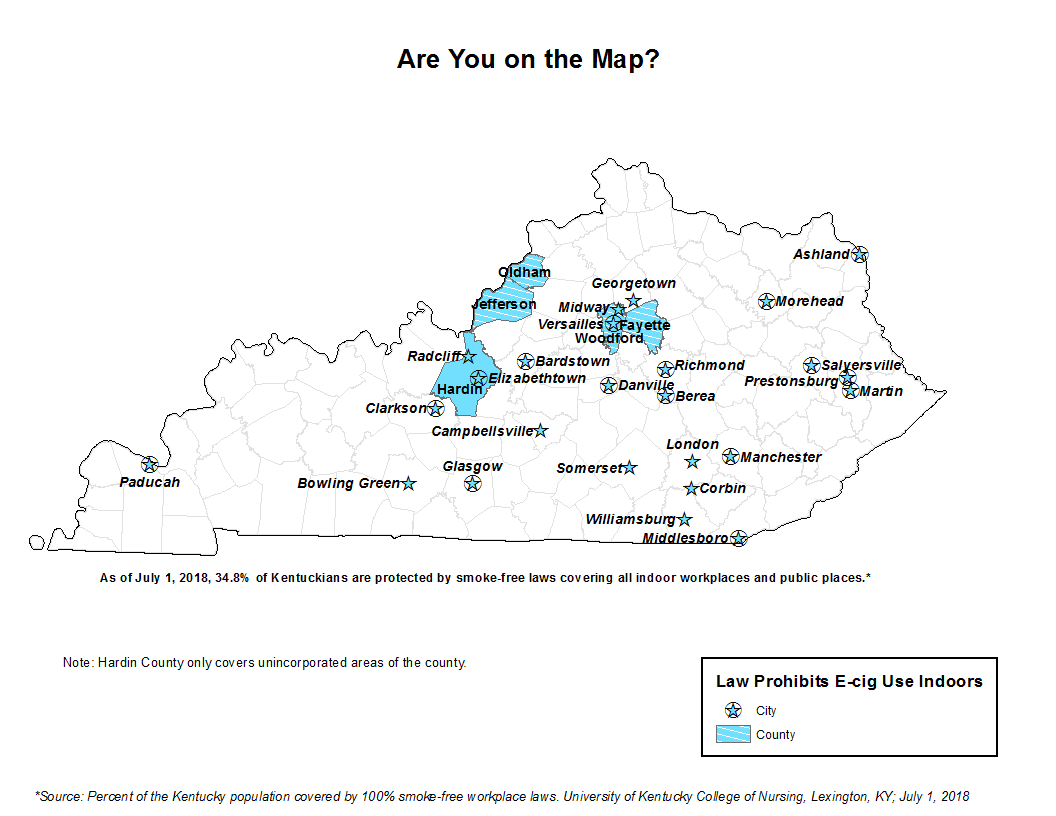
On Oct. 1, 35 percent of Kentuckians were covered by comprehensive smoking bans for indoor
workplaces and public places. Williamstown's took effect Jan. 1. (Kentucky Center for Smoke-Free Policy)

Friday, October 5, 2018

Smoke-Free Coalition will lobby for state law to ban tobacco products and e-cigs from all school property and activities

By Melissa Patrick
Kentucky Health News

Concerned that historic declines in youth tobacco use will be undermined by the "exploding popularity" of Juul and other e-cigarettes, Kentucky's Coalition for a Smoke-Free Tomorrow says it will lobby for a law making all schools in the state 100 percent tobacco-free in the upcoming year.

Photo by The Sentinel-Echo, London, Ky. 
"We're suddenly seeing epidemic levels of kids vaping e-cigarettes, and we've got to get a handle on it before we totally reverse the gains we've made in the last couple of decades in reducing youth tobacco use," Ben Chandler, chair of the coalition, said in a news release.

The latest Kentucky Health Issues Poll  found 87 percent of Kentucky adults would support such a law, and polls since 2013 have found strong support for the policy, but there has been little legislative progress toward it, and fewer than half of local school boards have acted. School-board seats are on the ballot in all districts this fall.

"It's a good time to ask school board candidates what they think about such a policy, and if they would support it or not," said Al Cross, director of the Institute for Rural Journalism and Community Issues, which publishes Kentucky Health News.

Legislative bills to require all school properties and school events to be tobacco-free have gained little to no traction. Two were introduced in the last session, but were not called up in the legislature's education committees. The Senate passed one in 2017, but the House didn't take it up.

The coalition says it will promote a comprehensive policy that "prohibits the use of all tobacco products, including e-cigarettes and vapor products, by staff, students and visitors at all times inside board-owned buildings or vehicles, on school property, and during school-sponsored field trips, sports events and other activities."

It also wants the law to provide adequate funding for signage and other tools to implement the policy, make penalties for violation appropriate and not prevent students from learning, and allow local bodies to enact stronger policies than the state policy.

Fewer than half of Kentucky's school districts have enacted such policies. As of July, 72 of the 173 districts had adopted 100 percent tobacco-free school policies, covering 734 schools and 57 percent of the state's students. Federal law only prohibits smoking inside schools that receive federal funding.

"A statewide tobacco-free schools law would expand a powerful tool already used by 734 schools in the state to all Kentucky public schools, in order to reduce youth exposure and peer pressure to tobacco products and create an atmosphere where tobacco use is not the norm," the coalition said.
Coalition for a Smoke-Free Tomorrow chart
Kentucky's high school students smoke at a much higher rate than the national average, 14.3 percent compared to 8.8 percent. Almost as many, 14.1 percent, use e-cigarettes, a bit above the 13.2 percent nationally, according to the 2017 Youth Risk Behavior Survey.

The e-cigarette figures are probably higher now, health experts have warned, because Juul sales have surged since the survey -- so much that it's prompted the U.S. Food and Drug Administration to crack down on them and other vaping-product companies over their teen marketing strategies.

Juuls and their cheaper knock-offs are especially popular among teens because they are small and look like an oversize USB drive, making them easy to hide from parents and teachers. They also offer flavors that are appealing to youth, and pack a powerful nicotine punch.

Wednesday, September 5, 2018

Murray Mayor Jack Rose named a Healthy Ky. Policy Champion; among winners eligible for top award to be made Sept. 24

The Foundation for a Healthy Kentucky has named Murray Mayor Jack Rose a Healthy Kentucky Policy Champion for his work to improve local health by successfully pushing for a smoke-free ordinance in the city. It takes effect in October.

"Mayor Rose was the primary impetus behind adoption of a comprehensive smoke-free law in Murray, one of only two such laws in the western third of the state," Dona Rains, director of community outreach at Baptist Health Paducah and a member of the foundation's board of directors, said in the news release. Rains nominated Rose for the award.

Foundation President and CEO Ben Chandler said, "He is an ideal recipient of this award because he did his homework to put forth an ordinance based firmly in science, rounded up the necessary community and city council support, and got it passed without a lot of delay. Murray will see great health and economic benefits from his leadership on this issue."

Rose was elected mayor in 2014. He previously served as Murray State University's faculty regent, was dean of its College of Education in 1998-2003 and was Calloway County school superintendent for 21 years. He has been chairman of the Murray-Calloway County Hospital; president of the board of the Kentucky YMCA Youth Association; and president of the Southern Association of Colleges and Schools, an accreditation organization.

Earlier the same week, the foundation named as champions Paducah Mayor Brandi Harless, for her leadership in enacting a stronger city smoking ban, and Dr. Van Breeding of Whitesburg, for leadership in fighting the substance-use crisis in Eastern Kentucky. Earlier winners were Paducah cardiologist Pat Withrow, 19 Casey County High School students, Lexington Legends owner Andy Shea and Lexington Mayor Jim Gray, all of whom took steps against use of tobacco, a main cause of Kentucky's health problems.

The winners are eligible for the Healthy Kentucky Policy Champion of the Year award, which comes with a $5,000 grant from the foundation to a Kentucky-based nonprofit of the winner's choice. The winner of that award will be announced on Sept. 24 at the foundation's Howard L. Bost Memorial Health Policy Forum in Lexington.

Nominations for the Healthy Kentucky Policy Champion Award are accepted at any time. A nomination must also be supported by a member of the foundation's board or Community Advisory Council; details are on the foundation's website.

Friday, August 10, 2018

All Kentucky public housing under smoking ban as of July 31; some housing authorities are offering help with cessation

Northern Kentucky Health Department poster in federally subsidized
housing; blank space is for local information about cessation programs
As of July 31, all federally funded housing projects are supposed to be smoke-free, a rule that has caused some controversy, but one that has helped some residents to quit smoking -- or move.

Smokers ask, “Why are you targeting smokers?” Non-smokers say, “It’s about time,” Andrea Wilson of the Lexington Housing Authority told Hillary Thornton of WKYT-TV.

“I don't think it's fair for them to stop us from smoking in our apartments . . . and come outside, because a lot of us have disabilities,” Michael Taylor told Gil Corsey of WDRB-TV, while smoking a cigarette in his wheelchair outside his public housing unit in downtown Louisville.

In Owensboro, “The question posed to me most is whether people are moving out because of it,” Shauna Boom, executive director of the Housing Authority of Owensboro, told Jacob Dick of the Messenger-Inquirer. “I don’t think it's specifically been about the smoking ban. It might have been the last straw that pushed them toward a decision they were already thinking about.”

The ban was set two years ago by the U.S. Department of Housing and Urban Development. The rule prohibits the use of cigarettes, cigars and pipes, but does not ban electronic cigarettes, although individual housing authorities can ban them. HUD also bans the use of tobacco products within 25 feet of the buildings. Click here for a question-and-answer sheet about the new policy.

The ban is meant to protect residents and visitors from secondhand smoke. "Eliminating smoking indoors and close to buildings is the only way to fully protect people from secondhand smoke," says a fact sheet about the policy.

The U.S. surgeon general said in 2006 that scientific evidence shows that "separating smokers from nonsmokers, cleaning the air, and ventilating buildings cannot eliminate exposures of nonsmokers to secondhand smoke.”

The Centers for Disease Control and Prevention says about 41,000 Americans die each year from secondhand smoke, with about 1,000 of those deaths in Kentucky, according to the Kentucky Center for Smoke-free Policy.

Boom told the Messenger-Inquirer that the Owensboro housing authority, which has 560 residential units at six locations, used the two-year lead time to educate their clients about the process.

“We did a lot of education to explain where this regulation came from and how it was to be enforced,” Boom said. “We also partnered with the American Lung Association and had a grant where we could provide smoking cessation classes.” She added that the new rule have resulted in some people quitting.

The Lexington housing officials told WKYT that they also had worked with the health department to help those who want to quit smoking. "They can attend the cessation classes for free," Wilson said.

HUD says the ban will save an estimated $153 million per year in costs associated with health care, repairs and fire damage" to almost 1 million subsidized housing units.

How are violations of the new policy handled? It varies by housing authority.

A first-time violation in Owensboro will result in a warning, followed by a letter reminding the violator that certain actions, including eviction, are within the power of the agency, Dick reports.

The first violation in Lexington will result in a warning, a second could mean a cleaning fee and a third could result in eviction, WKYT reports.

In Louisville, first-time violators will be warned, second-timers fined $15, third-timers $30, followed by several $45 fines, WDRB reports. Repeat violators can be evicted, Louisville's leases say.

Kentucky offers the Kentucky Quitline program called Quit Now Kentucky, which can be found at www.quitnowkentucky.org or by calling 1-800-QUIT-NOW (1-800-784-8669). Also, health departments, health organizations and many employers offer free or low-cost smoking cessation programs. State law also requires insurance companies, Medicaid and its managed-care organizations to cover the cost of smoking-cessation treatments and counseling without imposing any barriers.

Secondhand smoke linked to school absences, ER visits and respiratory symptoms in teenagers; Ky. smoke-free policies lag

Photo from Psychology Today
By Melissa Patrick
Kentucky Health News

It's long been established that exposure to secondhand smoke is harmful to babies and young children. Now a study shows that it's bad for teenagers, too.

The University of Cincinnati study, published in the peer-reviewed journal Pediatrics, analyzed data from 7,389 non-smoking teens aged 12-17 who did not have asthma and had completed the 2017 Population Assessment of Tobacco and Health Study, which measures tobacco use behavior and related health outcomes.

About a third of of the teens in the study reported that they were around others who smoked for at least an hour a day for the previous seven days, at home, in the car, at school or outdoors.

The researchers found that the teens who were around secondhand smoke at least an hour a day were more likely to report shortness of breath, difficulty exercising, wheezing during or after exercise, and a dry cough at night.

They were also more likely to have missed school due to illness, and less likely to report good overall and physical health. They were also more likely to have visited an emergency room or urgent-care center in the past year.

"Eliminating tobacco smoke exposure is the only way to protect nonsmokers," the researchers concluded. They note that despite increased tobacco control, 9.6 million U.S. teens are still exposed to tobacco smoke.

The 2010 recent Kentucky Youth Tobacco Survey found that 36 percent of Kentucky high-school students reported exposure to secondhand smoke while in a car during the week before they took the survey, and 45 percent reported being exposed in a room.

And while that was eight years ago, not much has changed in Kentucky when it comes to adult smoking rates since then. In 2010 that rate was 24.8 percent, compared to 24.5 percent today. About 14.3 percent of Kentucky's high-school students are smokers.

Kentucky is slowly inching its way to stronger tobacco control.

This year the legislature raised the cigarette tax 50 cents per pack, to $1.10. That was the biggest increase in Kentucky history, but health advocates wanted a $1 increase, noting that research shows any lesser increase would have no real health benefits because cigarette companies can counter such increases with discounts and coupons. The Coalition for a Smoke-Free Tomorrow has said a $1 hike would have prevented 23,200 Kentucky young people from becoming adult smokers.

Kentucky has also struggled to pass a statewide smoking ban, though nearly seven in 10 Kentuckians support one. Gov. Matt Bevin says that this should be a local decision. Only 35 percent of Kentucky's population is by local smoking bans, according to the Kentucky Center for Smoke-free Policy.

Ellen Hahn, a University of Kentucky nursing professor and director of the center, said in an e-mail that that means 65 percent of Kentuckians are likely exposed to secondhand smoke in public places and workplaces. "We know that when communities pass 100 percent smoke-free laws, more people quit smoking and smoking prevalence drops," Hahn said.

While 72 of the state's 173 school districts have adopted 100 percent tobacco-free school policies, and 87 percent of Kentucky adults favor tobacco-free campuses, legislation for a statewide policy has not made progress in the legislature.

Statewide smoke-free policies would protect the almost 121,000 Kentucky teens who are in the workforce, as well as protecting them from toxins left on indoor surfaces by tobacco smoke, called third-hand smoke, which can result in substantial nicotine exposure, studies have shown.

“Laws that prohibit smoking and vaping in all workplaces are among the most effective policies that lawmakers can enact to protect the public from secondhand smoke," said Ben Chandler, president and CEO of the Foundation for a Healthy Kentucky. "Comprehensive smoke-free laws that include e-cigarettes also help change the culture so that tobacco use is no longer the social norm."

The researchers note that their study can only show an association between teen exposure to secondhand smoke and the aforementioned health issues, and say that more research is needed.

Thursday, June 21, 2018

Murray City Council passes a smoking ban on 8-2 vote, but the mayor, who pledged to pass it, says it could still be 'tweaked'

Murray City Council members voted 8-2 on June 14 to prohibit smoking in all public places and places of employment within the city limits, but John Wright reports for the Murray Ledger & Times that it may not be a "done deal." After about an hour of debate, Mayor Jack Rose suggested that the council pass the ban, but leave the issue open. (Wright's story is behind a paywall.)

Sperling's Best Places map
“I think we need to go ahead and pass it tonight, then come back and tweak it if need be,” Rose said. “I’m interested in listening if someone has an idea to make this the best situation we can find. If we see that there’s an element of difficulty with it, then we can look at it later.”

The ordinance, which is set to take effect in September, prohibits the smoking of cigarettes, as well as electronic cigarettes and vapor devices, in parking lots and areas within 15 feet of entrances, windows and ventilation systems. In restaurants and bars there must be a 15-foot buffer between outdoor seating and serving areas, and the rules also apply for numerous outdoor areas, Taylor Inman reports for WKMS-FM.

"Heartfelt congratulations to Mayor Jack Rose," Ben Chandler, president and CEO of the Foundation for a Healthy Kentucky, said in a news release. "He committed to getting it done before he retired. And, by gosh, he has done that! Even better, the ordinance that he was able to shepherd through to passage follows all the guidelines for truly making a difference in the health of those who live, play and work in Murray."

Local restaurant owners voiced opposition to the ban. Ron Gladden, owner of the Big Apple Cafe, one of only six restaurants in Murray that still permits smoking, told the council that smokers often outnumber non-smokers in his restaurant, and non-smokers had 62 non-smoking restaurants in the area to choose from.

“The citizens of Murray and Calloway [County] essentially vote every day on where they want to eat," Gladden said, adding that at the Big Apple, "the vote" is pretty clear. “I don’t believe it is the city council’s right to make decisions on smoking. It should be the business owners and the citizens of Murray, Kentucky," he said.

Robin Floyd, a longtime radiologist at the local hospital and also the owner of Tap 216, a restaurant that allows smoking, acknowledged that smoking is unhealthy, but said he thought restaurants that had created ways to separate the smokers from the non-smokers should be allowed to "opt-out" of the ordinance.

Supporters of the ordinance also spoke out. Local hospital CEO Jerry Penner said he had worked to strengthen smoke-free rules at the facility over the past two years, and though he recognized how hard these rules are for smokers, he said, "I think we have to err or the side of health here."

Penner also pointed out that far Western Kentucky, including Murray, ranks first in the state for lung cancer cases and deaths from it. “I’m tired of burying people," he said.

Rose, citing studies proving the danger of secondhand smoke, said the ordinance is needed to improve health in the city, Kentucky's 20th largest. “Let’s just say they get all kinds of secondhand smoke and are lucky and don’t get cancer or some other kind of disease because of that,” Rose said. They’re still more comfortable, so we’re making a comfort level.” Here is a video report from Paducah's WPSD-TV.