Showing posts with label community health workers. Show all posts

Thursday, August 17, 2023

Kentucky Homeplace trains 11 more community health workers

Kentucky Homeplace is the University of Kentucky's
program to train community health workers.
By Melissa Patrick
Kentucky Health News

Community health workers fill a vital role in meeting the health-care needs of Kentuckians. Now the state now has 11 more of them.

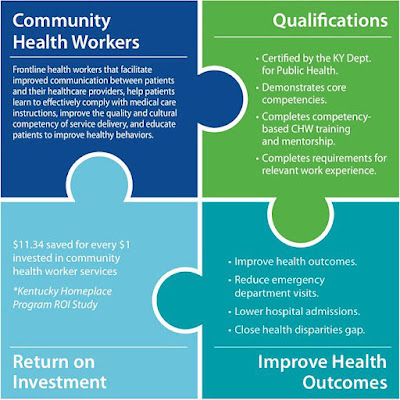
CHWs aren't trained medically, but as patient advocates who come from the communities they serve. They help their clients coordinate care, provide access to medical, social and environmental services, work to improve health literacy, and deliver education on prevention and disease self-management.

The graduates from the University of Kentucky Center of Excellence in Rural Health's CHW program, called Kentucky Homeplace, were recently honored by the center and health insurer UnitedHealthcare Community Plan of Kentucky at a ceremony held in Hazard where the center is located.

Through this initiative, funded with $35,000 from UnitedHealthcare's Community Plan of Kentucky, the 11 students from Hazard and Perry County high schools completed the training with Kentucky Homeplace and can now apply for CHW certification.

Once completed, they will be able to serve as health-care advocates providing education and guidance to help Eastern Kentuckians connect with health-care resources.

CHWs serve in their own communities, which helps ensure cultural sensitivity to their client's health disparities and special needs. Ten more CHWs will graduate in 2024.

The federal Bureau of Labor Statistics says Kentucky had 1,540 CHWs in May 2022, with an average wage of $54,530. 

Tuesday, April 19, 2022

Kentucky gets $4.19 million to expand AmeriCorps work in public health, with the hope it will funnel more people into such work


Kentucky has received nearly $4.2 million to expand the public-health role of the AmeriCorps program in the state. The grant comes from the American Rescue Plan Act, last year's pandemic relief bill.

"This funding will support the recruitment, training and development of a new generation of public health leaders,” Gov. Andy Beshear said in a news release. “The funding will support the addition of community health workers with coordination from Serve Kentucky, the agency committed to engaging Kentuckians in volunteerism and service to positively impact our communities.”

This new public health initiative is the result of a partnership between AmeriCorps and the Centers for Disease Control and Prevention. Nationwide, the initiative will fund up to 5,000 public-health positions over the next five years. 

Public Health AmeriCorps will help meet public-health needs of local communities by providing surge capacity and support while also creating pathways to public health-related careers, says the release. 

Health Commissioner Steven Stack pointed to the many public-health challenges caused by the pandemic, noting that it has been "neither easy nor without loss" to get to our current low rates of transmission. 

"This grant allows us to plan for future public health emergency responses," he said. "Creating a standing corps of public health personnel to manage surge capacity and respond to crises will enable Team Kentucky to stand ready to support Kentuckians when emergencies arise." 

Funding from the grant will  to the Kentucky Health Departments Association and Family Scholar House. 

The KHDA will get $1,367,986 to add 75 AmeriCorps members as community health workers in local health departments. They will work in programs such as the Health Access Nurturing Development Services, (HANDS), the Women, Infant and Children (WIC) program, and harm-reduction programs.

AmeriCorps members will not replace any existing health-department staffers, Susan Dunlap, spokeswoman for the Cabinet for Health and Family Services, told Kentucky Health News in an e-mail. 

"AmeriCorps members will be used to bolster the local public health workforce in Kentucky to expand the number of services delivered at local health departments currently available," Dunlap said. "Additionally, AmeriCorps members will receive training to become certified as community health workers, which are in short supply at local health departments throughout Kentucky."

Family Scholar House, which oversees the annual grant competition that awards funding to AmeriCorps State and other community service programs, says it works to provide a comprehensive, holistic continuum of care for low-income families and youth to help them reach their educational, career and family goals. It will get $2,825,124 to offer additional services.

Dunlap said, "FSH applied for the grant due to their familiarity with AmeriCorps, and because the grant will enable participants to receive training and support to enter the public-health field (in addition to the living allowance and education award) – which aligns with FSH’s priorities of health, educational support, and career pathways."

FSH's grant will allow it to leverage 200 AmeriCorps members who will provide health-care support to seniors and disabled individuals in health care facilities across Kentucky, says the news release. 

"FSH AmeriCorps member activities will include support with basic clinical assistance, activities for socialization, infection control, and dietary and patient services," said Dunlap. "FSH AmeriCorps members will develop their healthcare knowledge and complete credentialing coursework—enabling them to work in memory care, skilled nursing, assisted living, and other healthcare related environments." 

Eric Friedlander, secretary of the cabinet, which administers and oversees Serve Kentucky, said this initiative will serve as a steppingstone to get more people into the public-health field.

“After their year of service, we expect more than 200 AmeriCorps members will pursue future engagement in the public-health sector,” Friedlander said in the release. "AmeriCorps and the CDC believe that Public Health AmeriCorps provides a unique way to expose those interested in learning more about public health and its various careers.”

Joe Bringardner, executive director of Serve Kentucky, said, "Adults of all ages and education backgrounds are eligible to serve in Public Health AmeriCorps."

Thursday, April 7, 2022

Beshear and Senate president discuss medical marijuana, hero pay; Stivers says PBM bill stuck in Senate over cost concerns

By Melissa Patrick
Kentucky Health News

FRANKFORT — State Senate President Robert Stivers said he favors funding more research on medical marijuana before making it legal in Kentucky, but Gov. Andy Beshear says medical cannabis has overwhelming support in the state and should pass when the legislature returns to reconsider vetoed bills. 

At separate press conferences in Frankfort Thursday, the two leaders also discussed the Republican legislature's rejection of the Democratic governor's plan to give Kentuckians who worked throughout the pandemic a "hero bonus;" and Stivers said a House bill to rein in pharmacy benefit managers died in the Senate for fear it would raise consumers' and employers' costs.

Medical marijuana: Stivers said the House-passed cannabis bill "would be difficult" to pass the Senate next week, but he supports a bill by Rep. Kim Moser, R-Taylor Mill, to create a cannabis research center at the University of Kentucky and expects it to pass. "I think it not only would be good locally but nationally and internationally to understand the medicinal and therapeutic values of marijuana," he said.

Senate President Robert Stivers

Stivers acknowledged that studies show cannabis helps with certain medical conditions, "but every study I've read said the sample sizes have been too small, the duration is too long and therefore more study is needed."

Moser's House Bill 604 has had two of its three required readings, so it could clear the Senate Appropriations and Revenue Committee and the full Senate quickly on April 13 and/or 14.

Beshear urged the legislature to pass the medical-cannabis bill in those two remaining days, which would require suspension of the three-readings rule. "Its time has certainly come."  

He added, "Kentuckians deserve the passage of a medical-marijuana bill. They overwhelmingly support it. When 70-plus percent of a state is in favor of something, it's time for the General Assembly to step up and do something about it. Represent the people." 

Asked later if he could do anything by executive order to make it easier for people with certain conditions to have access to medical cannabis, Behsear said, "We're going to explore that. . . . I am for medical marijuana and I will continue to push it until we make it a reality." 

The House passed its cannabis bill, HB 136, by a vote of 59-35, with just over half of the Republicans who voted on the bill favoring it. A similar bill passed the House in 2020 but died in the Senate. 

Pharmacy benefit managers: House Bill 457 would ensure that patients could pick their pharmacy, instead of being required to use one affiliated with a pharmacy benefit manager; increase transparency between insurers and PBMs; and ban PBMs from retroactively denying a pharmacy claim after adjudication, commonly referred to as "clawing back." It passed the House 88-3.

Asked why the bill didn't gain any traction in the Senate after such overwhelming support in the House, Stivers said, "When it got here, we started getting, from business sector and provider sector, various questions and comments about what the overall cost would be to various plans." 

The bill was opposed by one of the session's heaviest lobbying campaigns. The Pharmaceutical Care Management Association, the PBM trade group, spent $38,369 to get its message to lawmakers before March, when it ran television commercials urging voters to ask their legislators to defeat it.  

Stivers said it had been assigned to the Appropriations and Revenue Committee "because it has potential fiscal impact -- local, individual, personal and state fiscal impact." He indicated that the bill would not pass, since that would require suspension of the three-readings rule, and more education would be needed among Republican senators about what it would do. 

Hero bonuses: Stivers said the General Assembly took a different approach to hero bonuses that he said would benefit everybody, mainly because it was too hard to determine just who would qualify for bonuses. He said the legislature is giving income-tax reductions and workforce incentives, and investing in  infrastructure and higher education. 

Gov. Andy Beshear
Beshear disagreed, reflecting on how scary it was early in the pandemic when the mortality rate from the virus was 10 percent in some places and essential workers were asked to show up at work every day.

"I believe this legislature needs to spend some of the last two days including hero bonuses. They deserve those hero bonuses. . . . I think it's really disappointing."

Health bills become law: Beshear signed three more health-related bills into law Thursday.

House Bill 525, sponsored by Moser, would allow Medicaid to pay certified community health workers. CHWs aren't trained medically, but are trained as patient advocates who come from the communities they serve. They help clients coordinate care, provide access to medical, social and environmental services, work to improve health literacy, and deliver education on prevention and disease self-management.

Senate Bill 10, sponsored by Sen. Robby Mills, R-Henderson, addresses the nursing shortage with both short-term and long-term solutions, including streamlining the process for out-of-state and foreign trained nurses to practice in Kentucky without compromising the standards of care; improving access to nursing education by removing "arbitrary" enrollment limits without compromising the quality of the programs; and adding term limits and geographic requirements for the Board of Nursing.

Senate Bill 105, sponsored by Sen. Max Wise, R-Campbellsville, will increase awareness and screenings for the cytomegalovirus (CMV), a virus that can cause childhood deafness and other health conditions. Most CMV infections are not diagnosed without newborn screening, resulting in missed opportunities for needed care. It is titled Bella Dawn Streeval’s Law, after a woman who died two years ago Thursday after suffering from CMV.

Saturday, February 26, 2022

Bill would let Medicaid pay certified community health workers

UPDATE, March 1: The House sent the bill to the Senate on 94-4 vote.

UPDATE, March 16: The Senate Health & Welfare Committee passed the bill with a committee substitute. 

By Melissa Patrick
Kentucky Health News

A bill to require Medicaid reimbursement for certain services provided by certified community health workers, and streamline their certification process, awaits a vote in the full House. 

CHWs aren't trained medically, but are trained as patient advocates who come from the communities they serve. They help their clients coordinate care, provide access to medical, social and environmental services, work to improve health literacy and deliver education on prevention and disease self-management.

Rep. Kim Moser at a Feb. 17 briefing on HB 525 (News release photo) 
"What makes community health workers unique is not that they are necessarily clinical professionals, rather they are the point guard in helping individuals understand what resources are available," Rep. Kim Moser, R-Taylor Mill, said at a press conference about the bill in a video from the Kentucky Primary Care Association. 

The federal Bureau of Labor Statistics says Kentucky had 1,350 CHWs in May 2020, with an annual average wage of $37,320.

House Bill 525, sponsored by Moser, would require the Department for Medicaid Services to seek federal approval for a state plan amendment, waiver or alternative payment model, including public-private partnerships, for services delivered by certified CHWs.

Teresa Cooper, director of government affairs for the KPCA, said in an e-mail that CHWs are hired as a staff person by a facility, but their services cannot be billed to Medicaid or private insurance. "This legislation would allow the clinic to bill for their services and receive reimbursement or count them in their cost of operations," she said.

The bill would also require CHWs to be employed and supervised by a Medicaid-participating provider and says as of Jan. 1, 2023, "no person shall represent himself or herself as a community health worker unless he or she is certified as such" in accordance with the provisions laid out in the act. 

The bill passed out of the House Health and Family Services Committee, which Moser chairs, on Feb. 24. She pointed to a Kentucky Homeplace study that found between July 2001 and June 2021, community health workers achieved a return on investment of $11.32 saved for every $1 invested in their services. 

"The cost-benefit analysis has shown it to be a very productive use of our taxpayer dollars," she said, adding that because Kentucky expanded Medicaid under the Patient Protection and Affordable Care Act in 2014, the program serves 1.6 million Kentuckians, about one of every three. 

"We know that it's time, because of this Medicaid expansion, to really get more targeted with our Medicaid dollars and work on programs that work," Moser said.

Emily Beauregard, director of Kentucky Voices for Health, said Moser's bill, if passed, could be a "real game-changer" toward providing a sustainable funding source for community health workers in Kentucky. 

"House Bill 525 creates a very, very important pathway to expand our current network of community health workers," Beauregard said.

Pamela L. Spradling, a CHW with Big Sandy Health Care, a federally qualified health center in Prestonsburg that covers five counties, said their CHWs are currently  paid as staff or through grant funding. 

Asked what it would mean for them to be able to bill Medicaid, she said, " That would be huge for us because it would mean sustainability for our program. . . we wouldn't have to constantly be worrying about where the money is going to come from to pay our community health workers." She added that the challenge with grant funding is that when the grant money runs out, so does the CHW program. 

Spradling also spoke to the value of CHWs in changing health outcomes, noting that 62% of their 150 patients with diabetes who have a CHW have seen a 2.5 point reduction in their A1C, and some of them with even higher reductions. An A1C is a blood test for diabetes that measures your average blood sugar levels over the past three months. A normal A1C level is below 5.7%. 

Tiffany Taul Scruggs, a certified CHW and the patient service outreach coordinator for Sterling Health Care, a federally qualified health center based in Mount Sterling, said the CHWs in her facility are either on staff or paid for by grants. 

"If we could bill Medicaid, we could probably hire more community health workers just because we have such a big population in our coverage area," she said. "It would be wonderful if we could bill." 

Scruggs noted several services their CHWs provide, including helping their patients obtain medical equipment, medications and food, helping patients navigate the health care system and providing health education. She added that one their greatest needs is transportation to and from medical appointments. 

"I am proud to say our transportation service has provided just shy of 1,300 rides to our most vulnerable population in 2021," she said in a statement prepared for the House committee. "The team consists of one full-time driver, one part-time driver who was recently hired, two outreach and enrollment specialists, and three community health workers ready to assist our patients when needed." 

Tammy Collett, Cumberland River regional director for Mountain Comprehensive Health Corp. in Whitesburg, said in an e-mail that funding for their CHWs is provided through a grant from Marshall University, The University of Chicago and the Merck Foundation. She said the goal of this grant program is to demonstrate the effectiveness of using CHWs to improve health outcomes and quality of life. 

"It is our hope that payers will recognize the benefit of CHWs and consider coverage for their services," Collett said.

Saturday, August 7, 2021

Community Health Days offering screenings and coronavirus vaccines in 32 Appalachian Ky. counties through November

The first Community Health Day was held in Hindman Friday, Aug. 6. (Photos by Melissa Slone, UK)
By Melissa Patrick
Kentucky Health News

HINDMAN, Ky. — The first of 96 University of Kentucky events to offer Covid-19 vaccines and other health screenings in 32 Kentucky counties resulted in seven more Kentuckians getting a vaccine. 

The three-hour Community Health Days event, which felt like a mini-health fair, was held at the June Buchanan Clinic in Hindman Friday, Aug. 6. The next one listed on the UK Center of Excellence in Rural Health website is Aug. 20 at Topmost Baptist Church, also in Knott County. The events will continue through November and will be added to an interactive website at www.kyruralhealth.org as they are scheduled.

Robin Hensley got a shot at the first Community Health
Day from the Kentucky River District Health Department.
Robin Hensley of Clay County, who was camping in the area, was one of the seven who got vaccinated. Hensley, a registered nurse, said she was initially against taking the vaccine because "it came out too soon," but after learning more about it, decided to get a shot. 

"I think it's important to to be respectful of others' opinions if they choose not to get it, but I also have studied it enough to know that now I'm comfortable with the decision to go ahead and take it," she said. 

The coronavirus vaccines were able to be developed, tested and given emergency-use authorization in less than a year because of previous research on related coronaviruses and new technology, and federal funding by Congress and the Trump administration.

Community Health Days are funded by a $3.3 million federal grant and sponsored by the UK rural-health center, Kentucky HomeplaceUSA Drone Port and a network of community partners, according to a UK news release.

Screenshot, adapted, of interactive map; it's available here.
At the request of the Health Resources and Services Administration, which made the grant, the program will also include clinics in West Virginia's Mingo and Wayne counties.

The clinics are being offered as the much more contagious Delta variant of the coronavirus surges across the state, with no real end in sight. They offer more than vaccinations.

Melissa Slone, research, interdisciplinary director at the UK center, said blood-pressure checks and screenings for diabetes and stroke risk at the events remind people to start thinking about and managing their chronic health conditions again after allowing them to worsen while vaccines were yet to come.

"We want people to get vaccinated," Slone said, "but if we can also help them with managing some of the other chronic diseases, then that's a win as well."  

Kentucky Homeplace, through its community health workers, can help people with a range of resources, whether medical, social, or environmental, like heating and air-conditioning assistance or housing needs. 

Twenty-two people were evaluated at the Hindman event, but only seven got the vaccine. 

Fran Feltner, director of the rural-health center, which is based in Hazard, said it's important to offer a range of screenings along with the coronavirus vaccines because it allows them to provide factual information about the vaccines and to answer any questions the participants may have about them, whether they choose to get vaccinated or not. 

Fran Feltner's magnets
For example, she said many people continue to think there is a microchip or a magnet in the vaccine, which is not true. To dispel that myth, she had a pack of magnets available to prove that wasn't true. 

"Our intent is to meet people where they are to work through barriers, alleviate fears, dispel myths, educate and assess any needs people may have that could be holding them back from being vaccinated," Feltner said in the news release.

Feltner said in the interview that the events are "about community members taking care of community members. The ultimate goal is to make sure that everybody has access to vaccine, whether it be the kids or the adults that need access to the vaccine. And sometimes, you bring it to them instead of them coming to you. . . . It's up to us as community members to make sure that people have the right information so that they can make the right decisions." 

Feltner said the Homeplace health workers, who know the people in their communities, have been instrumental in planning the events. She said some sites have had trouble finding local providers to administer vaccinations, and in those cases Walgreens has agreed to partner with them to give the vaccines.

Feltner wrapped up the interview by encouraging people who are hesitant to get a vaccine to seek out credible information about the vaccines and to then weigh their risk before deciding to get one or not. She said, "The more people we can get vaccinated, the more we can get back to a new normal." 

Click here for answers to frequently asked questions about the coronavirus and the vaccines.

Sunday, June 13, 2021

Local collaborations help tackle Ky.'s health problems, and can be guided by hospitals' and health departments' needs assessments

By Melissa Patrick
Kentucky Health News

Collaborations in individual communities can play a critical role when it comes to improving Kentucky's poor health outcomes, largely because those outcomes are grounded in behaviors and unmet social needs at the community level.

That was the underlying message of the June 10 webinar hosted by the Foundation for a Healthy Kentucky, "Transforming Kentucky's Public Health System: The Critical Role of Community Collaborations." 

"There's a huge need for these coalitions because our health rankings are in the toilet and they've been in the toilet for quite some time," Ben Chandler, president and CEO of the foundation, told Kentucky Health News. "So much of the poor health resides in counties where they have lots of other issues." 

Those other issues are often called "social determinants of health" and include things like housing, transportation, food insecurity, education, healthcare and employment. Researchers have said they account for 80 percent of health outcomes. 

Kentucky ranked 48th for health behaviors and 46th for health outcomes in the last America's Health Rankings report from the United Health Foundation. 

Chandler noted that while the U.S. spends twice as much money on health care as other developed nations, it has worse outcomes. 

"So what it boils down to is, we've got to spend more of our resources working on changing people's behavior," he said. "And that sort of thing, I believe can only be done through public policy and at the community level; each community has to be involved." 

Many of these coalitions already exist in Kentucky, but Chandler said there is a need for more and a need to rejuvenate some that already exist. 

The Muhlenberg County Health Coalition is an example of one that is thriving. 

Jessica Browning, chairperson for the coalition, explained that this coalition was initially created to address the findings of the 2018 community health needs assessment of Owensboro Health Muhlenberg Community Hospital's, where she is the marketing director, and includes representatives from all sectors of the community. 

Tax-exempt hospitals like Muhlenberg must do community needs assessments every three years, under the 2010 Patient Protection and Affordable Care Act, with the expectation that they use them to create plans to address the identified community health needs. Some do, and some don't, but Chandler said they are a great tool to guide community collaborations.

Browning walked through several of the collaborative's initiatives, including efforts to make information about community and health resources easily available to the county's most vulnerable residents. The coalition also offers a community resource day twice a month, has found ways to address the county's homeless and housing issues, and has secured a grant to ensure affordable transportation for people who needed rides to work, school and medical appointments.

The Purchase Area Health Connections coalition in has also created a searchable database of resources in Kentucky's far west to make it easier for citizens to find the resources they need. 

Kaitlyn Krolikowski, network director of the coalition, said two of its largest initiatives are an opioid task force and a transitional care team of community health workers who work to reduce hospital readmission rates. CHWs are not health-care providers but educate people about care and help them get it.

The Purchase coalition's website shows that it also works on issues around childhood obesity, diabetes, mental health and more.

Krolikowski said the coalition formed when community members realized it would make the best use of their resources if everyone worked toward the findings of a regional community health needs assessment. She said the coalition's first meeting served as a "catalyst moment" to create different partnerships. 

Community collaborations have also been important to the state's local health departments, especially as it moves to a new model of operation, dubbed Public Health Transformation. 

Public Health Transformation was launched in 2019 and became law in 2020. Among other things, it establishes four "core public health" services that must be provided, those required by law or regulation. It also requires departments to do community health assessments, which many already do, to determine local health priorities beyond the core requirements. Those local priorities are funded separately. 

Jan Chamness, the state's Public Health Transformation project leader and director of the Division for Women's Health, said the transformation depends on strengthening partnerships in a community and allows health departments to collaborate with community partners to achieve their local priorities. 

For example, she said some departments have turned their women's health services and school health programs over to federally qualified health centers, clinics that get federal funds for meeting federal rules.

Public Health Transformation came about because of the fiscal instability of the health departments and because their services had evolved to not reflect their community needs, Chamness said. 

"What we're doing is not really working that well and so we really need to transform public health to be more responsive," she said.

Saturday, June 12, 2021

Rural Ky. needs more community health workers and medical-school residents, legislators and UK hospital executive say

Charles Aull of the Kentucky Chamber of Commerce, upper left, moderated the webinar.
By Al Cross
Kentucky Health News

Improving health care and health in rural Kentucky will take more people in the health-care workforce, specifically at the top and bottom of the pay scale, two key legislators and one of the state's top hospital administrators said Tuesday, June 8.

Kentucky needs more health-care workers overall, because it may lose some to the pandemic, Mark Birdwhistell, vice president for health services administration at the University of Kentucky and chief of staff for UK HealthCare, said during a Kentucky Chamber of Commerce webinar on rural-urban health disparities.

"Coming out of Covid . . . many of our clinical workforce are fatigued, and they're second-guessing: 'Is this the career path that I want to go on?' They've been in combat for a year and a half now," Birdwhistell said.

State Rep. Kim Moser, a Republican from Taylor Mill in Northern Kentucky, agreed. "Burnout is real," she said, noting that her husband is a pulmonologist who has treated Covid patients.

The need for more community health workers, who are not health-care providers but can educate people about care and help them get it, came up as Birdwhistell, a former state health secretary, discussed the 2014 expansion of the federal-state Medicaid program for lower-income Kentuckians.

"Just because you've got coverage doesn't mean you've got access" to the health care you need, Birdwhistell said, because "Many providers don't take Medicaid." He and Baptist Health Louisville President Larry Gray said health insurance tends to cost more in rural areas due to lack of competition, so people buy policies with high co-payments and deductibles.

The expansion of Medicaid made clearer how the "social determinants of health" leave rural areas with lower health status, Birdwhistell said. It's twice as likely for someone in an urban area to finish high school or college as someone in a rural area, he said, so health literacy is lower in rural areas. And that extends to health insurance, he said, giving one example: "Deductible. That's hard to explain in English."

Moser, a retired nurse who chairs the state House Health and Family Services Committee, said expanding the limited government and commercial-insurance reimbursement for community health workers' services would help. "That is one policy that we're looking at possibly expanding," she said.

Birdwhistell said that would be "very, very cost-effective," because "In a lot of communities, people don't know how to access care, and they show up in the emergency room. And that is probably the worst place for anybody to show up with a high fever, strep throat, whatever. They don't get a continuum of care. . . . They will listen to somebody that they grew up with, somebody that they go to church with, somebody that they see on the soccer field with their kids."

Service area of Kentucky Homeplace
Eastern Kentucky already has the third largest concentration of community health workers in the nation, trailing only Alaska and northwest Mississippi, according to the Bureau of Labor Statistics.

That is likely due to Kentucky Homeplace, a 27-year-old program of UK's Center for Excellence in Rural Health in Hazard. It says it helps people in the region with "lifestyle choices, environmental factors, inadequate health insurance and general lack of understanding of the health-care system."

Nationally, CHW pay averages $46,000 a year, but in Kentucky the average is $37,320.

The webinar discussion also addressed the need for more doctors in rural Kentucky.

Birdwhistell said a major obstacle to getting more physicians in rural areas of the state are the limits on federally funded residency slots at the UK and University of Louisville medical schools. "Flipping that switch could pretty instantly change the number of professionals we have coming out," he said.

Republican Sen. Ralph Alvarado of Winchester, a physician, agreed, saying that residents tend to set up practices within 80 miles of where they do their residency. Moser also endorsed the idea.

Alvarado, chair of the Senate Health and Welfare Committee, noted that some rural areas have a shortage of health-care providers, which he blamed on state laws that make malpractice insurance expensive.

Gray said the shortage is especially bad in Eastern Kentucky, which needs providers who are willing to come to the region with "a sense of mission and vocation." But even with enough providers, transportation to get some patients to them is still an obstacle in some areas, he said. The expansion of telehealth has helped, he said, but some areas still lack internet access that is fast enough for it.

And even with telehealth, a shortage of specialists blocks care. For example, Kentucky has only 59 child psychiatrists, and half of them "are cash-only, don't take insurance," Alvarado said.

The panel started out by discussing some of the state's poor health statistics. Alvarado said the use of tobacco is heavier in rural areas, leading to all sorts of health issues, and obesity is more common, causing "more negative outcomes."

The news isn't all bad, he said, noting how Kentucky has raised its screening for colon cancer from 47th to 19th in the nation. "That's going to rub off on our death rates . . . in 10 years," he said. "There is some hope." But he also noted that screening rates in Eastern Kentucky remain relatively low.