Showing posts with label Medicaid. Show all posts

Sunday, August 11, 2024

13 of Kentucky's 71 rural inpatient hospitals at risk of closing, with six of them at immediate risk, a national policy center estimates

Center for Healthcare Quality and Payment Reform map
By Melissa Patrick
Kentucky Health News

Thirteen of Kentucky's 71 rural inpatient hospitals are at risk of closing, and six of those are at immediate risk of closing, according to the latest analysis of Hospital Cost Reports by the Center for Healthcare Quality and Payment Reform, a policy center that says it works toward patient-centered, affordable health care. 

The report does not name the 13 hospitals, but it does offer a wealth of financial information about most rural hospitals in Kentucky and every other state, including critical access hospitals and rural emergency hospitals that are not designated as rural.  

The center says its analysis is based on financial data from the most recent cost reports that hospitals must submit annually to the Centers for Medicare and Medicaid Services. The financial report shows rural hospitals' operating margins, profits and losses on patient services and revenues and costs on patient services and those that are not directly tied to patient care. 

Low reimbursement rates from Medicare and Medicaid are often blamed for why rural hospitals have such ongoing financial troubles, but the center expands that list to all types of insurance, saying in the report, "losses on private insurance patients are the biggest cause of overall losses" in at-risk hospitals. 

"The only way to prevent more closures of services and hospitals is for all health insurance plans, including Medicare Advantage plans, commercial insurance plans, and Medicaid programs, to pay rural hospitals enough to cover the higher costs of delivering services in rural areas," the center says in a news release. 

The center also states that the federal  Rural Emergency Hospital program, which forces rural hospitals to eliminate inpatient services in order to receive large federal grants, "is not a solution to these problems" because it eliminates much-needed services in a community. Kentucky has one such hospital, Crittenden Community Hospital in Marion, Ky. 

Instead, the center calls for change in how rural hospitals are paid and proposes a method of payment that calls for all payers to start providing "standby capacity payments" to rural hospitals to cover the fixed costs of essential services such as emergency care, inpatient care and maternity care. 

What the numbers show

According to the center's "Data on Rural Hospitals" financial status report, using data from the three most recent years for which Hospital Cost Reports are available, 15 rural hospitals in Kentucky lost money (defined as "negative total margin");  19 others lost money on patient services, but not overall; and 10 lost money on patient services and overall. 

The 15 listed with negative total margins are in Fulton, Pineville, Irvine, Carlisle, Madisonville, Shelbyville, Albany, Manchester, Owenton, Mount Sterling, Marion, Burkesville, South Williamson, Campbellsville and Russellville.  

The 10 cited that lost money on patient services and overall are in Pineville, Irvine, South Williamson, Marion, Mount Serling, Shelbyville, Albany, Owenton, Manchester and Fulton. 

The 19 listed that lost money on patient services, but not overall are in Martin, Columbia, Prestonsburg, Benton, Hazard, Paintsville, Danville, Greenville, McDowell, Harlan, Salem, Middlesboro, West Liberty, Carrolton, Russell Springs, Monticello, Tompkinsville, Hardinsburg and Whitesburg.

The report explains several ways that a hospital could lose money on patient services, but not overall. 

"Many hospitals have managed to remain open despite losses on patient services because they receive local tax revenues or state government grants," says the report. "However, there is no guarantee that these funds will continue to be available in the future or that they will be sufficient to cover higher costs." 

For example, the report notes that the federal assistance many hospitals received during the pandemic has ended, which has resulted in more than one-third of rural hospitals losing money overall in 2022-23. 

It also says that some hospitals have financial reserves to offset the loss of inpatient services, adding that "the hospitals at greatest risk of closing have more debts than assets . . . to offset their losses on patient services for more than a few years."

What's Kentucky doing? 

The previous report said 16 rural Kentucky hospitals were at risk of closing and 10 of those at immediate risk of closure, higher than this year's 13 and six, respectively.  

More information is needed to know why the number of at-risk hospitals in Kentucky is lower than they were in last year's report, but what is known is that Kentucky legislators have passed laws to help support them. 

Kentucky Cabinet for Economic Development table 
For example, in 2020 they created the Kentucky Rural Hospital Loan Program, a revolving loan fund for distressed rural hospitals, and in 2021, funding of $20 million. 

The original bill allows the Cabinet for Economic Development to provide loans to struggling hospitals to maintain or upgrade facilities; maintain or increase staff; or provide health services not currently available. The low-interest loans can run up to 20 years and are available to hospitals in counties with fewer than 50,000 people.

So far, eight Kentucky hospitals have been approved for projects, with $7.2 million in funds authorized. They are Pineville Community Health Center, Baptist Health Deaconess Madisonville, Rockcastle Hospital & Respiratory Care Center in Mount Vernon, Trigg County Hospital in Cadiz, Crittenden Community Hospital in Marion, Ohio County Hospital Corporation in Hartfort, Deaconness Union County Hospital in Morganfield and ARC Health Systems in Ashland.  

Of this list, the hospitals in Pineville and Madisonville and the Rural Emergency Hospital in Marion have negative total margins. 

Laws have also been passed to allow Kentucky hospitals to get more money from Medicaid, basing payment on the "average commercial rate" instead of the current Medicaid rate, which is often below that amount. This legislation was passed under two bills -- the first in 2021 that addressed higher rates for inpatient care and the second, passed in 2023, that addressed higher payments for outpatient care, which is the one that is most beneficial to rural hospitals. 

More recently, the Kentucky Hospital Association gave a detailed overview of the 340B drug discount program at the July 30 Interim Joint Committee on Health Services and asked for help to secure these payments with contract pharmacies as a way to ensure rural hospitals can keep providing many of the programs they support. 

KHA President Nancy Galvagni explained that the 340B program requires pharmaceutical companies to sell drugs to covered hospitals and their contract pharmacies at their best price, allowing Kentucky hospitals to then invest their 340B savings to provide patient services that otherwise would not be available. 

For example, she said the savings from the 340B program allows some hospitals to "keep the doors open." Others, she said, use it to offer low-cost medications for the uninsured, cancer programs and hepatitis C clinics, and to support their charity care.   

Galvagni added that because some hospitals don't have in-house pharmacies, they contract with local pharmacies to provide the medications covered by the 340B program. 

"The problem we face is the large pharmaceutical manufacturers have refused to deliver the medications covered by the 340B program to our contract pharmacies," she said. "That refusal by these large, highly profitable multinational corporations to deliver medications to the contract pharmacies creates massive losses for the critical programs our patients need. Without the savings from the 340B program, critical health services will become unaffordable, and hospitals simply won't be able to provide the care that is funded from the 340B savings." 

In closing, Galvagni asked the General Assembly to enact legislation to require the delivery of these 340B medications to contract pharmacies in Kentucky, as six other states have already done and 19 more are working on. 

The center's figures can be downloaded at https://ruralhospitals.chqpr.org/Data1.html.

Friday, August 2, 2024

Lawmakers join Ky's largest addiction treatment provider to oppose Medicaid payment cuts; centers trying to negotiate cuts

By Deborah Yetter and Tom Loftus
Kentucky Lantern

The state’s largest provider of drug and alcohol treatment is warning that looming cuts in Medicaid reimbursement to some providers could damage efforts to curb addiction that has engulfed Kentucky — just as the state is showing improvements.

Matt Brown
“Kentucky has made significant strides in access to treatment,” Matt Brown, chief administrative officer for Addiction Recovery Care, or ARC, told a legislative committee Tuesday. “With these cuts, it could completely set back addiction treatment in our state 20 years.”

A handful of companies that provide substance use disorder treatment, including ARC, have been notified they face cuts of 15% to 20% from some private insurers that handle most Medicaid claims, Brown told the committee.

Brown noted that overdose deaths in Kentucky have declined for the past two years after years of rising. Kentucky also has the most treatment beds per resident, most of them through ARC, he said.

The state’s latest annual overdose report, released in June, shows a decrease in deaths to 1,984 from 2,200 the year before, a decline of 9.8%.

Brown was joined by Deron Bibb, chief financial officer for Stepworks, a recovery program based in Elizabethtown, and ARC executive John Wilson, also executive director of the Kentucky Association of Independent Recovery Organizations, speaking to the interim joint Health Services Committee about the cuts.

“This will likely result in higher overdose rates, higher recidivism, more crime and incarceration,” Bibb said. “We need to understand the full scope and impact of these cuts.”

The cuts have been announced by three of the six managed care organizations, or MCOs, private insurance companies that handle claims for most of the state’s $16 billion-a-year Medicaid program, Brown said.

Under their contracts with the state, the MCOs generally have authority to set rates they pay providers. The state pays MCOs a fixed amount per member to cover Medicaid costs.

One company also has begun notifying patients it will no longer cover addiction services at ARC effective Sept. 30, Brown said.

He did not identify the MCOs that have announced cuts and declined to do so after the hearing, saying ARC and other companies are still attempting to negotiate with them.

The Kentucky Association of Health Plans, which represents the MCOs, said in a statement released Thursday by spokesman Tyler Glick, that its members “are proud to work collaboratively with quality, trustworthy providers of behavioral health and substance use disorder treatment” and access to those services is “top of mind” to ensure those in need receive care.

“Health plans strive for the best networks possible and are encouraged by the state to prioritize plan member outcomes and value-based care,” it said.

Sen. Stephen Meredith, R-Leitchfield and co-chairman of the health committee, said Tuesday the lawmakers likely would seek more testimony on the subject, including from the MCOs.

“I know there’s two sides to every story,” he said.

Wellcare, with 420,000 members, is the largest of the six MCOs followed by Passport by Molina, Aetna, Anthem, Humana and United HealthCare. Together they oversee payment of Medicaid claims for about 1.4 million Kentuckians.

Wilson said the recovery organization he represents wants to make sure lawmakers are aware of the situation and already has asked them to voice concerns.

“There’s going to be real world consequences and I think it’s important to let legislators know what’s taking place,” he said.

Some defenders benefitted from owner’s largesse

Several lawmakers have signed letters urging that the MCOs suspend any cuts to substance use treatment until the General Assembly can further review the matter. They include some in key leadership positions and some who have benefited from campaign donations from ARC founder and owner Tim Robinson and his employees.

ARC, a for-profit company based in Louisa, has emerged as the state’s largest and fastest growing provider of addiction services, financed largely by Medicaid, the government health plan with the majority of funds from the federal government. Growth took off after 2014 when substance use treatment was included in the Medicaid expansion authorized by the Affordable Care Act.

The Lantern reported the company took in about $130 million last year in Medicaid funds and was by far the largest recipient of the about $1.2 billion the state spent on substance use treatment.

The company and Robinson also have become among Kentucky’s major political donors with more than $500,000 in contributions over the last decade — with funds divided among Republican causes and those of Gov. Andy Beshear, a Democrat, the Lantern reported earlier this month, citing campaign finance and other public records.

Sen. Phillip Wheeler, R-Pikeville, who has received $19,900 in contributions from Robinson, his wife Lelia and ARC employees since 2016, on July 9 sent a letter to Kentucky Medicaid Commissioner Lisa Lee urging the cuts for addiction services be suspended “until the legislature fully understands the reasons behind them.”

“Kentucky has made great progress in tackling the addiction crisis that has touched so many of our constituents, neighbors, colleagues, friends and family members,” Wheeler said.

Cutting reimbursement now “could negatively affect some of our most vulnerable citizens and prevent us from seeing these positive trends continue,” his letter said.

A similar letter addressed to “to whom it may concern” was signed by Rep. Patrick Flannery, R-Olive Hill, who has received about $17,000 in campaign contributions from Robinson and ARC employees.

Another letter was signed jointly by Senate President Robert Stivers, R-Manchester, House Speaker David Osborne, R- Prospect, Rep. Kimberly Moser, R-Taylor Mill and Meredith. Moser and Meredith are co-chairs of the joint Health Services Committee which heard from ARC and other treatment officials Tuesday.

Republican supermajorities control the Kentucky House and Senate.

Robinson has given $10,000 to the Kentucky House Republican Caucus, and $15,000 to the Kentucky Senate Republican Caucus in the last four years.

Robinson also has given other contributions to campaigns of Republican state legislators in the past decade including $4,100 to Moser and $2,000 to Osborne.

From 2021 through 2023, ARC companies and employees gave about $252,000 to a political committee supporting Beshear, whom Robinson, a Republican, has said he admires and would like to see run for president.

Bibb, Stepworks’ chief financial officer, gave $500 to Flannery in December 2023 and $2,500 to the Kentucky House Republican Caucus in October 2022, according to Kentucky Registry of Election Finance records.

Not asking for more money, just no cuts, says company official

Brown said that one concern of the MCOs is the cost of treatment, in particular long-term treatment for addiction.

ARC understands concerns about costs, but experience shows people with addiction benefit the most from long-term services, Brown told the committee.

“It is not just about surviving from their addiction but thriving in their communities,” he said. “Long-term treatment is vital.”

Without quality treatment, costs to the state will rise elsewhere, Bibb said.

“These costs will not go away,” Bibb said. “They simply will shift back to the emergency room, the judicial system, foster care, homelessness.”

ARC is willing to work with the MCOs and the state to ensure it is using money efficiently and effectively, Brown said after the hearing.

“Everybody’s got to be good stewards,” he said. “We’re committed to helping provide a solution.”

Brown and Wilson said representatives of treatment providers plan to meet with MCOs and state officials in coming weeks to try to resolve their differences.

“We’re not asking for more money,” Brown said. “We’re asking for no cuts.”

Wheeler, in an interview, said he appreciates the support of Robinson, a longtime friend since college together at the University of Kentucky, but that’s not why he sent the letter.

Rather he’s concerned about the impact of cuts of up to 20% on ARC’s services, which he said have helped many people in the region including a brother who benefited from its treatment program.

Also, he said, ARC is a major employer in the area where jobs have been scarce and also trains its clients for jobs.

Wednesday, July 17, 2024

As part of resetting its relationship with rural hospitals, UK will not build a new hospital at interstate junction in southeast Lexington

By Al Cross
Kentucky Health News

FRANKFORT, Ky. -- The University of Kentucky will not build a hospital in southeast Lexington because it wants to do what its network of rural hospital partners want: focus on its mission as a top-level care facility for the sickest patients, a UK vice president told a legislative subcommittee Wednesday.

Mark D. Birdwhistell (UK photo)
The proposed Hamburg-area hospital "was perceived as us stepping outside of our swim lane" by the university's clinical affiliates out in the state, Senior Vice President for Health and Public Policy Mark Birdwhistell told the Budget Review Subcommittee on Health and Family Services.

"We heard loud and clear, 'We want UK HealthCare to focus on taking care of the sickest of the sick. We don't want UK out doing primary care and secondary care.' . . . That was very eye-opening."

Birdwhistell reiterated, "The message we received loud and clear from our clinical affiliates was, 'When our folks get that sick, we want them to come to UK. We want them on campus. We don't them in a community hospital.'"

UK was in the planning process for a new hospital at the southern junction of Interstates 75 and 64, and had bought the property and done some initial work. Baptist Health is in the process of opening a new hospital on an adjacent site.

Instead of a hospital, UK will build a clinic with specialty services like the one it has built in a former department store in the Turfland Center in southwest Lexington, but larger, Birdwhistell said after the meeting: "Turfland plus."

He told the legislative subcommittee that the university will also build other clinics to serve its employees in Lexington and the Bluegrass region, many of whom are "having to get health care outside the system. . . . We feel like that is our obligation."

Birdwhistell spoke to the subcommittee in a new role, which he said will include centralizing the university's "government-relations activities across campus," including "building a better partnership with the General Assembly. I felt I was uniquely positioned to do that."
 
Previously, Birdwhistell was UK HealthCare's vice president for health system administration and chief of staff. He was secretary of the state Cabinet for Health and Family Services under Republican Gov. Ernie Fletcher, and helped Republican Gov. Matt Bevin propose changes to the federal-state Medicaid program, which he had run before becoming cabinet secretary. He appeared with Angela Dearinger, executive vice dean of the UK College of Medicine, who was briefly health secretary at the end of Bevin's term.

The General Assembly is firmly controlled by Republicans. In the recent legislative session, Birdwhistell was the university's point man in changing legislation that helped Pikeville Medical Center and some other rural trauma hospitals but in its original form would have reduced some of the extra Medcaid payments that UK gets for being a "safety net" hospital.

That relates to UK's recent takeover of other hospitals in Ashland and Morehead, which Birdwhistell discussed at Wednesday's legislative subcommittee meeting. Speaking of UK's absorption of King's Daughters Medical Center in Ashland, he said "Where we failed . . . is when you put that UK brand in front of that name, that brings with it an expectation of service, not predator," which he said was the perception of some.

"And so, we're readjusting a lot of the narratives to say, 'When you have UK in front of your name, you go to a partner and say, 'What can we do to help you be successful?' It's not 'What do we do to crush you?' And this is community health care. This is not our forte, so we've learned that lesson. . . . We can grow the workforce for those providers and not have to do it ourselves."

Birdwhistell said UK can also serve as a backstop for its rural partners, noting that UK doctors rearranged their schedules one weekend to keep open the neonatal intensive-care unit at Pikeville, which would have had to close temporarily due to employee vacations. "That's what we do," he said. "That's where we excel and that's where we need to get back to."

UK's latest acquisition is St. Claire Medical Center in Morehead, where it has run a satellite medical-school program for several years. The College of Medicine also has satellites in Bowling Green and Northern Kentucky, and Dearinger said it has seven residency programs in Bowling Green, the state's third largest city, and is starting residency programs in Ashland and Pikeville.

"We are trying to grow the number of doctors to stay in our state," Dearinger said, calling UK's Rural Physician Leadership Program "one of our crown jewels." She said it has produced 120 doctors, most of whom are practicing in Kentucky, "the vast majority" in rural parts of the state. Later, she said 42 percent of all recent medical-school graduates from UK have stayed in Kentucky, far above the 24% of "a few years ago."

Two Democratic legislators from Louisville, Sen. Karen Berg and Rep. Lisa Willner, asked Dearinger if UK has had fewer applicants for medical school or residencies due to restrictions on medical education, by which they meant the recent state law that bans abortions except in cases of threat to the woman's life or permanent damage to a life-sustaining organ.

Dearinger said "To be honest, we have not seen a decrease." She said she has heard anecdotal reports of students or graduates interested in obstetrics and gynecology going elsewhere, but "We are still inundated with OB applicants to do a residency at the University of Kentucky."

Another Louisville Democrat, Rep. Sarah Stalker, noted a May 16 Kentucky Health News story, from Kentucky Public Radio, that said 15% fewer U.S. medical-school graduates applied to Kentucky residency programs in the 2023-24 academic year, and there was a 23% decline in those for obstetrics and gynecology, according to the Association of American Medical Schools., which blamed the decline on the state's near-total abortion ban.

Dearinger said UK is still getting hundreds of "very good applicants, and we don't have any problems filling our residency programs and fellowship programs with very high-quality young physicians. We are prioritizing as much as we can, Kentucky students, so that they will stay" in the state.

Roll call: Most members of the subcommittee did not attend the late-morning meeting. The chairman, Sen. Donald Douglas of Nicholasville, a physician, noted that at the start of the meeting and made an unusually pointed comment: "I expect my colleagues in the General Assembly to show up."

Friday, July 5, 2024

Kentucky can soon provide Medicaid coverage to people nearing release from prison or juvenile detention; jails might come later

By Melissa Patrick

Kentucky Health News

Kentucky is one of five additional states that will soon provide Medicaid health coverage for people nearing release from prison or juvenile detention, according to the U.S. Department of Health and Human Services. 

"We've been eagerly anticipating CMS's approval of Kentucky's healthy re-entry demonstration for years now," said Emily Beauregard, executive director of Kentucky Voices for Health, a coalition of health advocacy groups.

The program started as a demonstration focused on treatment for substance-use disorder during incarceration and "has expanded to focus on putting in place all of the physical and behavioral health treatment, care coordination, and wrap-around supports justice-involved Kentuckians need to successfully return to their communities and thrive," Beauregard said in an email. 

This demonstration program is operated under a partial waiver of the Medicaid program's inmate-exclusion policy, which prohibits paying for services to inmates unless they are admitted to a hospital.

"Providing avenues for greater health outcomes is always the right thing to do, and this program does just that," state Cabinet for Health and Family Services spokesman Brice Mitchell said in an email.

Before the state can start the coverage, it must submit an implementation plan to the Centers for Medicare and Medicaid Services, Mitchell said: "Upon receiving implementation approval from CMS, Kentucky will cover a select set of pre-release health-care services through Medicaid and the Kentucky Children’s Health Insurance Program for up to 60 days before an individual’s expected date of release."

Kentucky didn't take full advantage of the waiver, which allows states to provide coverage up to 90 days before the expected release date. Eligibility is based on income; the limit is 138 percent of the federal poverty level.

Mitchell added, "The individual must be eligible for Medicaid or KCHIP to qualify and must be a state inmate housed in one of Kentucky’s 14 prisons or a post-adjudicated juvenile in the custody of the Department for Juvenile Justice."

Mitchell provided data from the state Department of Corrections, which said "There are 19,220 individuals serving felony convictions in state prisons or jails, as well as an additional 49,700 on active supervision with the Division of Probation and Parole. At least 95% of the state inmate population will be released from incarceration at some point." 

Kentucky's waiver doesn't allow inmates in jails to participate, because its jails are operated by counties, not the state. Beauregard said, "We've advocated for allowing jails to opt in, if they are willing to meet requirements and participate fully." She said the state Department for Medcaid Services "has said they will consider [jails] as a future phase of this project."

Coverage will be available not only to adult prisoners, but incarcerrated youth, under the Children's Health Insurance Program, called KCHIP in Kentucky. Beauregard praised the inclusion of youth in the coverage, which was not part of the original demonstration program for substance-use-disorder treatment and not part of the orignal application for its expansion. 

"Another important expansion from the original waiver is that youth who are in detention facilities will also get these services and wrap-around supports, which has the potential to reduce recidivism," Beauregard said.
 
A July 2 news release from HHS noted that incarcerated people often report higher levels of substance-use disorders, chronic health conditions and other health concerns, and that people transitioning out of jail or prison can experience delays in obtaining access to Medicaid or CHIP. 

HHS Secretary Xavier Becerra said in the release, "For people involved in the justice system, ensuring a successful transition back into the community includes having the health-care supports and services they need."

Kentucky is the first Southern state in the program. The other newly approved states are Illinois, Oregon, Utah and Vermont; California, Massachusetts, Montana and Washington had already been approved.

Tuesday, July 2, 2024

Recovering alcoholic built Kentucky's largest substance-use treatment provider, which has 1,800 beds and 1,350 employees

Map from Addiction Recovery Care website, via Kentucky Lantern, adapted by Ky. Health News
By Deborah Yetter
Kentucky Lantern

LOUISA, Ky. — Around the office at Addiction Recovery Care, Vanessa Keeton is still known as “Client One” — marking her status as the first client of the first recovery center ARC opened as a group home in Lawrence County.

But her official title is vice president of marketing, where she has worked since 2012, a little more than a year after she entered the program known as Karen’s House — choosing it over jail for a string of drug and alcohol-related offenses.

Vanessa Keeton
(Lantern photo by Matthew Mueller)
“Dec. 2, 2010, that was my first day,” she said. “That’s a day I’ll never forget as long as I live. That’s the day that everything changed.”

ARC, too, has changed dramatically since it started as a treatment home for women run by volunteers, based largely on Bible study and prayer.

It now operates as a for-profit company paid $130 million last year by Medicaid, the federal-state health plan which in 2014 expanded access to addiction treatment, or substance-use disorder, as it’s now known.

Gov. Andy Beshear has praised ARC for helping Kentucky — ravaged in recent years by addiction and overdose deaths — become the state with the most treatment beds per resident in the nation, according to an East Tennessee State University study.

“With the help of organizations like ARC, we are working to build a safer, healthier commonwealth for our people,” Beshear said, speaking at an ARC ribbon-cutting for a new facility in March.

Owned by founder and CEO Tim Robinson and his wife, Lelia, the company provides the couple an annual income of about $533,400, according to a 2022 tax-filing by Odyssey Inc., a non-profit affiliated with ARC.

Tim Robinson (Lantern photo by Matthew Mueller)
Robinson said he and his wife struggled financially for years while establishing the treatment business — facing potential foreclosure on their home and repossession of their car. He doesn’t think that income is unreasonable.

“We took a lot of risks,” said Robinson, 48, a lawyer and recovered alcoholic who says he has been sober since 2006 — two years before he started building the faith-based treatment business that would become ARC. “I’m living the American dream. I’m doing better than I ever thought I could be doing financially.”

Kentucky’s largest provider

The fast-growing company is by far the state’s largest substance-use treatment provider, with 1,800 residential beds in 24 Kentucky counties, and reaches hundreds more clients through outpatient services. ARC, which estimates it provides 75% of treatment beds in Kentucky, also is planning programs in Ohio and Virginia.

Earlier this year, ARC opened a 40-bed behavioral health unit with plans to expand to 300 at the former Our Lady of Bellefonte Hospital in Ashland, which closed in 2020. In 2020, ARC opened its largest center — with a capacity for 700 — on the campus of St. Catharine College in Springfield, which closed in 2016.

ARC is no longer simply a treatment organization, said Matt Brown, a former ARC client who overcame addiction and now serves as ARC’s chief administrative officer and president of ARC Healthcare. “We view ourselves as a behavioral health system,” Brown said.

While Christian faith remains at the heart of its mission, ARC relies on professional therapists, medical specialists including nurses and doctors, a structured treatment program and medication such as Suboxone to reduce the cravings of some patients for drugs and help them maintain sobriety, Robinson said.

Its religious component — which includes tracking how many clients decide “to follow Christ” (1,320 in 2023) — is strictly voluntary, according to Robinson, who said he was able to get sober in 2006 with the help of a local pastor and friend who “led me to the Lord.”

More importantly, he said, is that the number of clients who agree to stay in long-term treatment up to six months has increased steadily, which he thinks is the best indicator of effectiveness of the program.

Medicaid, which funds the majority of substance treatment, doesn’t require programs to measure outcomes.

But ARC measures its own outcomes, which it reports to Medicaid quarterly, Robinson said. That includes a retention rate of around 70% of its clients in treatment for up to six months and even longer through periodic contact with a case manager.

“I’ve been in this a long time,” Robinson said. “Long-term residential treatment is the reason people recover.”

As an indicator of success in addressing addiction, the Beshear administration points to the decline, for the second year in a row, of overdose deaths in Kentucky.

The state’s latest overdose report, released in June, shows a decrease in deaths to 1,984 from 2,200 the year before, a decline of 9.8%.

Last year, ARC received about $130 million in payments from Kentucky’s Medicaid program — more than double the amount of its closest competitor, Spero Health, a Nashville- based company that received $60 million in Kentucky Medicaid funds in 2023, according to the Cabinet for Health and Family Services, which licenses and oversees treatment facilities and Medicaid.

ARC accepts private insurance, but Robinson and Brown said almost all of the company’s revenue is from Medicaid, since their clients generally have lost jobs and any health insurance because of addiction.

The state spent $1.2 billion on substance-use-disorder services in the fiscal year that ended June 30, 2023, with most funds coming from the federal government, according to the cabinet.

Robinson, a former county prosecutor who started his business from a home office in Louisa, has emerged as a major political donor and well-connected business leader who recently joined the Kentucky Chamber of Commerce board.

Beshear singled out Robinson for recognition in his State of the Commonwealth speech in January, calling him “an essential partner in our fight against addiction.”

Robinson, a lifelong Republican, is effusive in praise for Beshear, a Democrat, in part because of the governor’s emphasis on addiction treatment and the governor’s frequent references to his own religious faith.

“I’ve never been for anybody like I’ve been for Andy Beshear,” Robinson said. “I hope he runs for president.”

‘Treatment on demand’

ARC employs 1,350 people, 500 at its headquarters in Louisa, population 2,600, perched above the forks of the Big Sandy River, across from West Virginia. The company is Lawrence County’s largest employer, even more than the school system.

About 40% of its workers are “graduates” of its treatment program, Robinson said, and most of its upper management — himself included — are in recovery from addiction.

ARC promises “treatment on demand,” and operates a 24-hour hotline people can call to identify help within 15 minutes, including transportation, if needed, to one of its centers. Last year it served more than 12,000 individuals from 119 of Kentucky’s 120 counties.

Tim Robinson in front of one of his buildings in 
downtown Louisa (Lantern photo by Deborah Yetter)
It has developed a network of job-training programs including welding, automotive repair, lawn service, culinary arts, chaplaincy and food service. As part of that, ARC has rebuilt more than a block of rundown buildings in downtown Louisa into a coffee shop, commercial kitchen, community theater and an event space.

It offers clients a chance to get certification toward a trade and get college credit for some training.

ARC owns a pharmacy used to provide medication to clients, a laboratory for medical testing and operates a health clinic in Louisa. Also, Tim and Lelia Robinson founded the private Millard School, a Christian academy in Louisa attended by some children of their employees.

Vanessa Keeton and her husband James live in Louisa and their son attends the Millard School. James, a 2011 ARC graduate, manages the Second Chance garage which repairs and restores vehicles for the public as well as maintaining an ARC fleet of about 200. “We restore cars and we restore lives,” he said.

ARC runs a sophisticated marketing program complete with a website, billboards, television and radio commercials, a social media presence, sponsorships and news releases, contracting with the Louisville-based public relations firm, RunSwitch. Scott Jennings, a CNN commentator and Republican political consultant, is one of RunSwitch’s founding partners. ARC spends about 4.5% of its revenue, or about $5.8 million a year on marketing.

Vanessa Keeton said the marketing is important to promote awareness of its services to those in need, “to meet people where you are.”

‘Dangerously brilliant’?

Some outsiders criticize ARC for its rapid growth, its size and Robinson’s political giving, including Mark La Palme, the founder and former CEO of Isaiah House, a treatment program based in Harrodsburg.

La Palme, now retired, said he worked with Robinson on a project in the mid-2000s but parted ways over disagreement with practices including designating clients as “interns” in ARC programs for low pay while in treatment, saving the company the cost of paying a regular employee.

He calls ARC “huge,” has called it a “bully” in a social media post and questions its rapid expansion. La Palme also questions the prolific giving of Robinson and ARC entities, which rank among the state’s major political contributors.

“It seems like you’re buying political influence,” he said.

But he acknowledges that Robinson has been highly effective in building ARC into the state’s largest treatment system: “He’s dangerously brilliant.”

Robinson said he considered La Palme a friend and colleague but they parted ways after a proposed collaboration fell through. Robinson said ARC’s programs meet all state standards, are accredited and the company works to provide high quality care.

He said internships are a way of introducing people to job skills they will need to succeed once they leave treatment and interns in various job training programs receive a paycheck either through ARC or an outside employer.

Robinson said he doesn’t apologize for political giving, seeing it as a way to support causes and politicians he believes in.

And he doesn’t think ARC is too big, saying that the company had to expand to remain viable within the constraints of Medicaid reimbursement, which pays for most of its clients. “We had to grow to survive,” he said.

The Robinson employees who spoke with Kentucky Lantern, including Brown, are highly enthusiastic about the boss.

Brown, trained as a physical therapist, battled addiction for 18 years before coming to ARC as a patient and remaining as an employee.

Robinson is “a visionary,” Brown said during a tour of ARC properties in Louisa, “He sees things in people before they see it in themselves.”

‘Papaw taught me’

Robinson said he grew up in adjoining Martin County, in “the poorest part” of a poor county. His introduction to business came from his grandfather who owned a country store. “He put me on a pop carton to run the cash register,” he said. “Papaw taught me about business.”

Another boyhood business venture of Robinson’s — selling baseball cards — would provide a life-changing entrée into college and law school, when he was befriended by Inez banker and businessman Mike Duncan, a former Republican national chairman and mentor to many young people in Martin County.

Robinson said he and Duncan crossed paths when he began selling baseball cards to Duncan's son, Robert M. “Rob” Duncan, who was appointed U.S. attorney for Eastern Kentucky under Donald Trump. Duncan is now the top deputy to state Attorney General Russell Coleman.

Robinson said he considers both Duncans friends but remains closest to Mike Duncan, a trusted friend and adviser. He said Mike Duncan, showed interest in his boyhood baseball-card venture and became a mentor, encouraging Robinson to go to college — a prospect he hadn’t considered.

“Nobody in my family ever went to college,” Robinson said.

But with Duncan’s encouragement, Robinson graduated from the University of the Cumberlands in Williamsburg, earned a law degree from the University of Kentucky and was elected student body president at both institutions.

Good times and bad times

“He helped me through the good times and the bad times,” Robinson said.

Among the worst times: Robinson’s 2003 indictment for felony vote fraud while he was student body president at UK, after some 750 voter registration cards collected during a student government drive were never turned in. Apparently forgotten, they were later found in a student-government office, according to a 2003 Lexington Herald-Leader story.

“It was devastating,” Robinson said. “I thought my whole life was over.”

Instead, with the help of his lawyers, Robinson pleaded guilty to a lesser misdemeanor charge of failing to turn in the registration cards and paid $90 restitution. Robinson said he dropped out of law school during the legal case, but was readmitted and graduated.

But that ordeal, plus the death of his mother while he was at UK, “finished my mental health off,” Robinson said. He returned home to Eastern Kentucky to work but alcohol by then had a powerful hold on his life.

Back in Lawrence County, Robinson joined in law practice with a friend and became an assistant county attorney but by then said he had become a “raging alcoholic” though still somehow able to perform his job.

He would drink on weekends, come to work on Mondays hung over and avoid alcohol on days he had to be in court. Toward the end of the week, Robinson said, he’d resume drinking and stay drunk till the following Monday. “I was leading kind of a double life,” he said.

That continued until a deputy sheriff at the courthouse where Robinson worked intervened. The deputy, also a pastor and a recovering alcoholic, helped Robinson stop drinking through prayer and support — taking him with him to nightly events where he would preach and play Bluegrass music.

Though Robinson said he knew nothing about treatment or programs such as Alcoholics Anonymous, he decided he needed to expand services in the region that in the mid-2000s offered little.

“I was convinced God was calling me to stop practicing law and start a recovery center,” Robinson said.

So he did, leaving his law job and starting out of a home office on Nov. 3, 2008.

Robinson got help from Rev. Ralph Beiting, a Catholic priest who founded the Christian Appalachian Project. Together they opened a recovery house for women in Lawrence County called Karen’s House.

It was a makeshift operation run by volunteers with donated goods, including some old Army cots. Meanwhile, Robinson was taking men to the closest treatment center, Chad’s Hope in Clay County, getting occasional funding from Operation UNITE, launched in 2003 by U.S. Rep. Hal Rogers to help Kentucky battle rising addiction — in particular the tide of opioid pain pills engulfing the state.

But broke and discouraged, Robinson was close to quitting when he contacted a consultant who suggested he expand by opening a second recovery center for men. He located a site in Fleming County and in 2013, Belle Grove Springs was opened by the company that would become ARC.

Brown, now ARC’s chief administrative officer, was among the first clients admitted to the men’s center.

The following year, under the expansion authorized by the Patient Protection and Affordable Care Act, Medicaid began funding substance use disorder services and a reliable funding stream opened. Kentucky was among the first states to include addiction as a service covered by Medicaid.

While the income was welcome, it wasn’t enough to finance ARC’s operation and Robinson said the company’s only choice was to expand and recoup more money through a higher volume of clients. “People thought we were growing because we were booming but we had to grow to survive,” he said. “You cannot make it on a couple of small facilities.”

ARC didn’t show a positive cash flow until 2019, he said.

‘Take our time’

While ARC expansion has slowed, Robinson said the company is still looking at other opportunities, including expansion into Virginia, which has far fewer treatment beds than Kentucky. “We’re going to take our time,” he said.

ARC also was flagged in a budget item this year by the state General Assembly with a $12 million allocation over two years directed to the Life Learning Center in Covington, an organization aimed at helping people develop skills to improve their lives “through gainful employment.”

The budget line says the funds are to be distributed to the center to support “treatment, rehabilitation, and community reintegration in partnership with Odyssey Inc.,” the non-profit arm affiliated with ARC.

Robinson said he expects Odyssey to submit a proposal as treatment provider for a program the center plans to establish in Somerset.

And while his work has expanded statewide and beyond, Robinson said he’s committed to staying in Louisa and keeping his company headquartered there.

“I’m where I’m going to be,” he said. “This is my adopted hometown.”

Wednesday, June 26, 2024

Rural Tennessee hospitals near Kentucky border remain closed as the Volunteer State keeps spurning expansion of Medicaid

Jellico Medical Center is defunct. (KFF News photo by Taylor Sisk)
By Taylor Sisk
KFF Health News

JELLICO, Tenn. — In March 2021, this town of about 2,000 on the Kentucky border in the shadow of Pine Mountain lost its hospital. It's in Campbell County, which ranks 90th of Tennessee’s 95 counties in health outcomes and has a poverty rate almost double the national average, so losing its health care cornerstone sent ripple effects through the region.

“That hospital was not only the health-care lifeline to this community,” said Tawnya Brock, a health-care quality manager and a Jellico resident. “Economically and socially, it was the center of the community.”

Since 2010, 149 rural U.S. hospitals have closed or stopped in-patient care, according to the Cecil G. Sheps Center for Health Services Research at the University of North Carolina. Tennessee has had the second-most closures of any state, with 15, and the most closures per person. Texas has the most, with 25. Neither state has expanded Medicaid under the Patient Protection and Affordable Care Act, as has Kentucky, where only four hospitals have closed.

Jellico Medical Center was a 54-bed, acute-care facility. When it closed, some 300 jobs went with it. Restaurants and other small businesses in Jellico also have gone under, said Brock, who is a member of the Rural Health Association of Tennessee’s legislative committee. And the town must contend with the empty husk of a hospital.

Dozens of small communities are grappling with what to do with hospitals that have closed. Sheps Center researchers have found that while a closure negatively affects the local economy, those effects can be softened if the building is converted to another type of health care facility.

In Jellico, the town owns the old hospital building, and Mayor Sandy Terry said it is in decent condition. But the last operator, Boa Vida Healthcare of Indiana, holds the license to operate a medical facility there and has yet to announce its plans for the building, leaving Jellico in limbo. Terry said local officials are talking with health-care providers that have expressed interest in reopening the hospital. That’s their preferred option. Jellico does not have a Plan B.

“We’re just in hopes that maybe someone will take it over,” Terry said. Meanwhile, the nearest emergency rooms are a half-hour drive away in LaFollette, Tenn., and in Corbin, Ky.

MapQuest map, adapted by Kentucky Health News
An hour and a half away in Fentress County, the building that once housed Jamestown Regional Medical Center has been empty since June 2019, when Florida-based Rennova Health — which also previously operated Jellico Medical Center — locked it up.

County Executive Jimmy Johnson said Rennova’s exit from Jamestown was so abrupt that “the beds were all made up perfectly” and IV stands and wheelchairs sat in the halls. About 150 jobs evaporated when the center closed.

Rennova still owed Fentress County $207,000 in taxes, Johnson said, and in April the property was put up for auction. A local business owner purchased it for $220,000. But Rennova was granted a year to reacquire the building for what it owed in back taxes, plus interest, and did so within a few days.

Abandoned hospital buildings dot the map in Middle and East Tennessee. In West Tennessee, some shuttered hospitals have found new life.

The closing of McKenzie Regional Hospital in 2018 was a blow to the local economy. But Baptist Memorial Health Care, which operates a hospital in nearby Huntingdon, bought the assets — including the building, land, equipment, and ambulance service — and subsequently donated the building to the town of McKenzie.

Cachengo, a technology company, ultimately took over the space. Because of hospitals’ electrical infrastructure, the site was a perfect fit for a business like his, said Ash Young, Cachengo’s chief executive. Young said Cachengo is now looking into repurposing abandoned hospitals across the country.

Jill Holland, McKenzie’s former mayor and a local-government and special-projects coordinator for the Southwest Tennessee Development District, believes the town can become a technology hub. “It’s opening a lot of doors of opportunity for the youth in the community,” she said.

But in Jamestown, the vacant hospital is “deteriorating,” said Johnson, the county executive. “It could have been used to save lives.” Rennova did not respond to a request for comment.

The University of Tennessee Medical Center opened a freestanding emergency room elsewhere in Jamestown, sparing residents a half-hour drive to the closest ER. Johnson believes the old hospital building could serve the community as housing for those who are homeless or as a facility to treat substance use disorder.

Brock, the health-care quality manager, thinks things will get better in Jellico, but the community has had its hopes dashed more than once.

Brock believes a freestanding emergency room could be a viable solution. She urges her community to be responsive to “a new day” in rural health in America, one in which a hospital must focus on its community’s most urgent needs and be realistic about what that hospital can provide.

“Maybe it is just the emergency room, a sustainable emergency room, where you could hold patients for a period of time and then transfer them,” Brock said. “And then you build upon that.”

She added, “There are options out there.”

KFF Health News, part of the Kaiser Family Foundation, is a national nonprofit newsroom producing in-depth journalism about health issues.

Friday, May 31, 2024

Bill to help Pikeville hospital turned into a law that will help other rural hospitals after UK saw it as a threat and rewrote the bill

State Sen. Phillip Wheeler discussed his SB 280
 on KET's "Kentucky Tonight." (Screenshot from KET)
By Melissa Patrick
Kentucky Health News

State Sen. Phillip Wheeler of Pikeville says one of the most consequential pieces of legislation passed by state lawmakers this year is a bill he sponsored to funnel more money to rural hospitals in Kentucky. 

Senate Bill 280 allows certain rural hospitals that get at least 35% of their revenue from Medicaid to get the same enhanced Medicaid reimbursement rate as the University of Kentucky or the University of Louisville. 

The hospitals are defined as those that have a trauma center and offer clinical rotations for doctors, nurses and other medical professionals who are in training.

"It kind of levels out that playing field," Wheeler told Kentucky Health News. "And it does this without placing any additional liability for matching funds on the General Fund by allowing local communities to assess a provider tax against the medical provider." Such taxes are applied to revenues of health-care facilities, typically to get more government matching money.

Asked if his bill will keep rural hospitals from closing, Wheeler said, "I wouldn't be so bold as to say that this is the only solution. I think you need to take a multifaceted approach and providing these hospitals with the ability to compete and the funding they need to develop this specialized care is one piece of the puzzle."

Wheeler, a Republican who represents Elliott, Johnson, Lawrence, Martin and Pike counties, said the higher reimbursements will allow rural hospitals to provide a higher level of care, especially when it comes to specialty services. And this, he said, will increase access to care for rural communities. 

"Not only does that make a huge difference to the patients being served, but it also will result in a much larger increase in investment in health care in those communities," he said. "And . . . especially in a lot of rural areas, including where I live in the 31st Senate District, health care has essentially become our largest industry. I mean, the largest employer in my district, by far, is Pikeville Medical Center with over 3,000 employees." 

Wheeler said he didn't think anyone would be harmed by this law, noting that he resolved concerns voiced by UK HealthCare, which has clinical rotations at King's Daughters Medical Center in Ashland, which it recently purchased.

Path to "good public policy" 

Mark Birdwhistell, UK HealthCare's vice president for health system administration and chief of staff, explained that UK and UofL receive enhanced Medicaid reimbursements because they are Level I trauma centers that agree to care for the "sickest of the sick" patients in the state and also house the state's primary educational programs for medicine and dentistry.

UK HealthCare VP Mark Birdwhistell
He said the impetus of SB 280 and its companion bill SB 281, which was not heard in committee, came about when UK bought King's Daughters, which allowed the Ashland hospital to get the higher Medicaid reimbursement. 

The original SB 280 would have given Level II trauma centers -- Pikeville has the only one in the state -- the same enhanced Medicaid rate as UK and UofL. SB 281 said UK and UofL could only take that enhanced Medicaid reimbursement in clinics or hospitals that operated in the county of the educational facility, limiting UK's enhancement to Lexington.

"Both of these had unintended consequences," Birdwhistell said, so UK could not support the bills in their original form. He said they would have left UK with lower Medicaid payments for services provided in any hospital that it has an agreement with to provide care, such as Hazard Appalachian Regional Healthcare. In addition, he said UK has practices in other counties, such as Bowling Green and Manchester, that get enhanced Medicaid payments.   

"That would have been devastating if that had come to fruition," said Birdwhistell, who was state health secretary in 2006-07. Later adding, "It would have significantly reduced funding and would have eventually compromised good patient care in the commonwealth."

That's because the state has to get ongoing approval from the federal government for the special Medicaid payment plans, one for public universities and another for private hospitals. And, he said, if these two pieces of legislation had passed in their original format, it would have triggered an amendment to the current plans, possibly putting them at risk. 

Driven by this concern, Birdwhistell said he suggested that the bill keep the existing enhanced Medicaid plans but have a different solution allowing a third way for hospitals to get the enhanced payments. 

"We moved it from a potential where we would not be able to get as much federal Medicaid money in the state to a new program that has the potential of pulling in additional reimbursement and an incentive to focus on access and improved outcomes, improved patient outcomes," he said. 

The revised bill that passed allows an opportunity for hospitals to get comparable reimbursement to what the universities get if they meet the criteria to do so, and Birdwhistell. And this, he said, accomplishes the goal of creating a more "level playing field."

Further, he said SB 280 allows the opportunity for additional Medicaid payments for care provided by other health-care workers, such as advance-practice registered nurses, dentists and social workers. It also says that pediatric teaching hospitals are able to get the additional Medicaid reimbursements for services to patients under 18. 

"So I think we ended up with good public policy that has the potential of improving access and  patient outcomes for the Medicaid population," Birdwhistell said.

He added later, "I think it is transformative because it has the potential of aligning people's incentives around an increased increased physician workforce, opening up additional access, appointment availability. And thirdly, aligning around access and quality." 

Birdwhistell said six or seven hospitals will likely qualify for the enhanced Medicaid payments in the first wave of hospitals. He said the goal is to get the plan submitted to the Centers for Medicaid and Medicare Services by Aug. 1 and for payments to be approved by January 2025. 

A news release from the governor's office said it estimates that 43 Kentucky hospitals meet the requirements of the new plan, dubbed the Kentucky Medicaid Assistance Program. The plan is contingent upon approval from CMS. Wheeler said they have "very good indicators" that it will be approved. 

Why SB 280 is important

Donavan Blackburn, president and chief executive officer of Pikeville Medical Center, said he'd been working on this bill for the last year and a half "to address the inequality and disparity between us and urban hospitals," which have a greater share of patients with commercial insurance, which pays higher rates. 

He pointed out that his Level II trauma hospital accepts patients from 48 other hospitals in the region who need a higher level of care and that 77% of them are either on Medicaid or Medicare. He said Pikeville Medical Center "serves the sickest of the sick and the most financially challenged in the nation." 

And while he said his hospital could be likened to UK or UofL when it comes to the services it provides, it is not a state-owned hospital or a teaching hospital. The hospital has an agreement with the University of Pikeville and four nursing schools to provide clinical rotations. 

In particular, he said it's his mix of payers that makes SB 280 so important because this extra money will allow the high level of care provided by the hospital to continue. 

"And what that extra payment means is, is that programs like our children's hospital, like our trauma center, like our specialties and subspecialties, endocrinology, rheumatology, all those different specialties that we're able to offer here in our community can stay in our community," he said. "Which means that not only people have access to care, but it prevents a diagnosis that if it goes untreated, becomes advanced, which costs actually the state and federal government even more."

Further, he said it will allow the hospital to retain jobs in health care, which is the top economic driver in the region. 

Blackburn said the success of SB 280 will be evident if they are able to "keep those service lines open and to keep making investments and advancements and to be able to keep up with all the other markets. . . . It's about advancement and sustainability." 

Wednesday, May 22, 2024

High cost of new diabetes drugs, more popular in Ky. than any other state, deprives low-income people of effective treatment

Photo by George Frey, Bloomberg, via iStock/Getty Images, KFF Health News
Editor's note: At the end of 2023 Kentucky led the nation in the percentage of state population, 2.1%, who had received the new class of diabetes and weight-loss drugs.

By Renuka Rayasam
KFF Health News

For the past year and a half, Tandra Cooper Harris and her husband, Marcus, who both have diabetes, have struggled to fill prescriptions for medications they need to control their blood sugar.

Without Ozempic or a similar drug, Cooper Harris suffers blackouts, becomes too tired to watch her grandchildren, and struggles to earn extra money braiding hair. Marcus Harris, who works as a Waffle House cook, needs Trulicity to keep his legs and feet from swelling and bruising.

The couple’s doctor has tried prescribing similar drugs, which mimic a hormone that suppresses appetite and controls blood sugar by boosting insulin production, but those are also often out of stock. Even if they are available, their Affordable Care Act insurance burdens the couple with a lengthy approval process or an out-of-pocket cost they can’t afford.

“It’s like, I’m having to jump through hoops to live,” said Cooper Harris, 46, a resident of Covington, Georgia, east of Atlanta.

Supply shortages and insurance hurdles for this powerful class of drugs, called GLP-1 agonists, have left many people who are suffering from diabetes and obesity without the medicines they need to stay healthy.

One root of the problem is the high prices set by drugmakers. About 54% of adults who had taken a GLP-1 drug, including those with insurance, said the cost was “difficult” to afford, according to KFF poll results released this month. Patients with the lowest disposable incomes who are hit the hardest; they have few resources and often struggle to see doctors and buy healthy foods.

In the United States, Novo Nordisk charges about $1,000 for a month’s supply of Ozempic, and Eli Lilly charges a similar amount for Mounjaro. Prices for a month’s supply of different GLP-1 drugs range from $936 to $1,349 before insurance coverage, according to the Peterson-KFF Health System Tracker. Medicare spending for three popular diabetes and weight loss drugs — Ozempic, Rybelsus, and Mounjaro — reached $5.7 billion in 2022, up from $57 million in 2018, according to research by KFF.

The “outrageously high” price has “the potential to bankrupt Medicare, Medicaid, and our entire health care system,” Sen. Bernie Sanders (I-Vt.), who chairs the U.S. Senate Committee on Health, Education, Labor and Pensions, told Novo Nordisk in April.

The high prices also mean that not everyone who needs the drugs can get them. “They’re kind of disadvantaged in multiple ways already and this is just one more way,” said Wedad Rahman, an endocrinologist with Piedmont Healthcare in Conyers, Georgia. Many of Rahman’s patients, including Cooper Harris, are underserved, have high-deductible health plans, or are on public assistance programs like Medicaid or Medicare.

Many drugmakers have programs that help patients get started and stay on medicines for little or no cost. But those programs have not been reliable for medicines like Ozempic and Trulicity because of the supply shortages. And many insurers’ requirements that patients receive prior authorization or first try less expensive drugs add to delays in care.

By the time many of Rahman’s patients see her, their diabetes has gone unmanaged for years and they’re suffering from severe complications like foot wounds or blindness. “And that’s the end of the road,” Rahman said. “I have to pick something else that’s more affordable and isn’t as good for them.”

GLP-1 agonists — the category of drugs that includes Ozempic, Trulicity, and Mounjaro — were first approved to treat diabetes. In the last three years, the Food and Drug Administration has approved rebranded versions of Mounjaro and Ozempic for weight loss, leading demand to skyrocket. And demand is only growing as more of the drugs’ benefits become apparent.

In March, the FDA approved the weight-loss drug Wegovy, a version of Ozempic, to treat heart problems, which will likely increase demand, and spending. Up to 30 million Americans, or 9% of the U.S. population, are expected to be on a GLP-1 agonist by 2030, the financial services company J.P. Morgan estimated.

As more patients try to get prescriptions for GLP-1 agonists, drugmakers struggle to make enough doses.

Eli Lilly is urging people to avoid using its drug Mounjaro for cosmetic weight loss to ensure enough supplies for people with medical conditions. But the drugs’ popularity continues to grow despite side effects such as nausea and constipation, driven by their effectiveness and celebrity endorsements. In March, Oprah Winfrey released an hourlong special on the medicines’ ability to help with weight loss.

It can seem like everyone in the world is taking this class of medication, said Jody Dushay, an assistant professor of medicine at Harvard Medical School and an endocrinologist at Beth Israel Deaconess Medical Center. “But it’s kind of not as many people as you think,” she said. “There just isn’t any.”

Even when the drugs are in stock, insurers are clamping down, leaving patients and health care providers to navigate a thicket of ever-changing coverage rules. State Medicaid plans vary in their coverage of the drugs for weight loss. (Kentucky's does not.) Medicare won’t cover the drugs if they are prescribed for obesity. And commercial insurers are tightening access due to the drugs’ cost.

Health-care providers cobble together care plans based on what’s available and what patients can afford. For example, Cooper Harris’s insurer covers Trulicity but not Ozempic, which she said she prefers because it has fewer side effects. When her pharmacy was out of Trulicity, she had to rely more on insulin instead of switching to Ozempic, Rahman said.

One day in March, Brandi Addison, an endocrinologist in Corpus Christi, Texas, had to adjust the prescriptions for all 18 of the patients she saw because of issues with drug availability and cost, she said. One patient, insured through a teacher-retirement health plan with a high deductible, couldn’t afford to be on a GLP-1 agonist, Addison said.

“Until she reaches that deductible, that’s just not a medication she can use,” Addison said. Instead, she put her patient on insulin, whose price is capped at a fraction of the cost of Ozempic, but which doesn’t have the same benefits. “Those patients who have a fixed income are going to be our more vulnerable patients.”

Friday, May 10, 2024

17 Ky. schools have free online mental health wellness course

Kentucky Health News map; for a larger version, click on it
More than 1,500 students in 17 Kentucky schools recently gained access to a free digital course on mental wellness, provided by the Medicaid program of Anthem Inc., one of the health insurers that manages the federal-state health program in Kentucky.

"The announcement comes during Mental Health Awareness month and as more adolescents, especially girls, report depressive symptoms," notes Sarah Ladd of the Kentucky Lantern.

The 17 schools in the program are Clay County Middle School, Daviess County High School, Estill County High School, Grant County Middle School, Graves County High School, Grayson County Middle School, Hazard Middle School, Henderson County High School, Bazzell Middle School in Allen County, Jenkins Independent School in Letcher County, Lewis County Central Elementary School, Marion County High School, Murray Middle School in Calloway County, Ohio County Middle School, Owensboro Middle School, Russell High School in Greenup County and Webster County High School.

The program has been launched in these schools and will continue into the 2024-25 academic school year, according to Quin Welch, media contact for Anthem Medicaid.

“Understanding Mental Wellness” is a course for students in grades 8, 9 and 10. It has six 15-minute lessons, according to Blackbaud, the digital-services firm that designed the course. 

Anthem says the course exposes students “to the experiences of others in order to develop awareness and empathy, reduce stigma, and provide facts on the prevalence and symptoms of mental health conditions.”

Students then “explore their own mental health, identify challenges they may face, and develop concrete strategies for managing those challenges while increasing their awareness of resources and empowering them with the knowledge, skills, and language necessary to identify and support a peer in need or at risk.”

Ladd reports, "Online previews of the course show a tour of mental health through the program, starting with a lesson on what mental health is and ending with the chance to create a personal wellness plan.

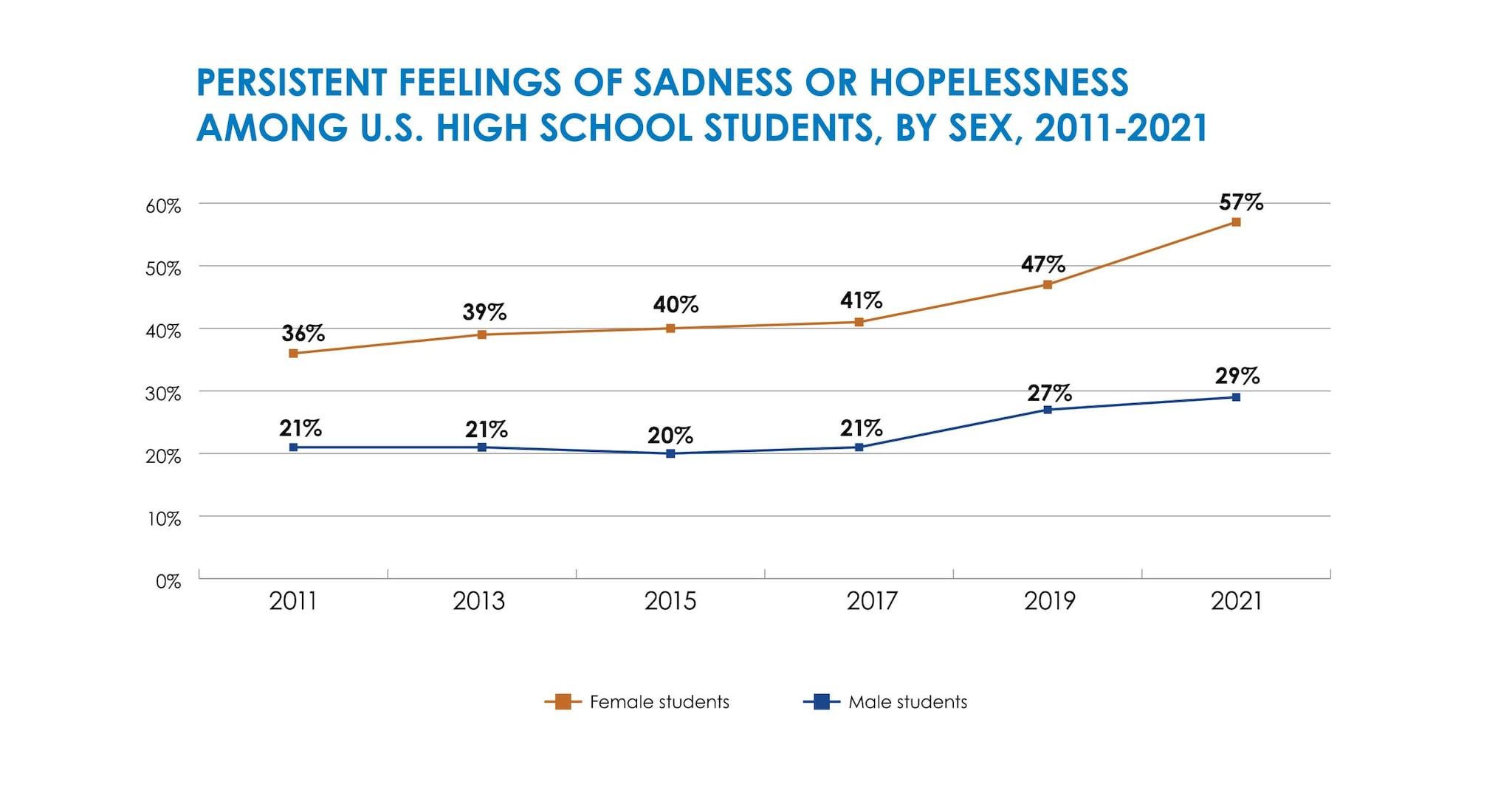
"Since the onset of Covid-19, mental health has worsened. In 2021, the Centers for Disease Control and Prevention found that sadness and hopelessness had increased from pre-pandemic levels, especially for teen girls. In 2017, 41% of female high school students and 21% of male high school students felt sad or hopeless. By 2021, those statistics were at 57% and 29%, respectively."

“Young people need resources and education from trusted sources to protect their mental health,” said Leon Lamoreaux, market president for Anthem Medicaid. He said the program “will help us reach students from all over the Commonwealth and equip them with tools and strategies that will make a positive difference in their lives for years to come.”

Tom Davidson, the CEO of Everfi, said the goal of the program is to help “those who are impacted by mental-health challenges, those who want to build and maintain positive mental health and those who have the opportunity to positively impact the mental health of a friend or peer.”

Friday, May 3, 2024

2% fewer Ky. children were on Medicaid a year after pandemic re-enrollment began; total enrollment, including adults, dropped 9.5%

Top half of Georgetown University table, adapted by Ketucky Health News; to enlarge, click on it.
By Melissa Patrick
Kentucky Health News

Medicaid enrollment of Kentucky's children fell 1.6 percent since the continuous-coverage protections of the pandemic were lifted last year. That was one of the smallest declines in the nation.

Coverage of U.S. children fell 10% in the "unwinding" process, says the report from the Georgetown University Center for Children and Families, based on data from the Centers for Medicare and Medicaid Services.

Kentucky hasn't started the re-enrollment process for children yet because, unlike most states, it worked with the federal government to delay the restart of renewals for children until this September. So did North Carolina.

"The story of Georgetown's report is an incredible good news story that speaks to how well Kentucky did things for kids," said Priscilla Easterling, outreach coordinator for Kentucky Voices for Health, a coalition of health-care advocacy groups.

Nationwide, 4.16 million children were dropped from from Medicaid and the Children's Health Insurance Program, and most would likely still be eligible, says the report. The numbers do not reflect individual children, but the change in total enrollment, which fluctuates from month to month for various reasons.

In Kentucky, 10,477 fewer children were covered than the 648,865 who were enrolled in either Medicaid or KCHIP before the unwinding -- the gradual resumption of annual Medicaid coverage renewals. Renewals in Kentucky began in April 2023.

Overall, Kentucky's Medicaid rolls have declined 9.5 percent in the last year. The number enrolled in April was 1,561,400. County-by-county figures are available from the Cabinet for Health and Family Services.

Cabinet spokesperson Brice Mitchell told Kentucky Health News in an email that Kentucky was the first state to request and get approval to automatically grant children 12 months of continuous coverage, without needing to go through a renewal during the unwinding. 

"The state sought this flexibility to ensure our children kept access to the coverage they need and deserve," Mitchell said. 

The only way a child may be disenrolled during the 12-month continuous coverage period is if the child turns 19, a parent or guardian requests disenrollment, or if the child moves out of state, Mitchell said. 

Easterling said it is expected that the children's renewal period that begins in September will go smoothly since the state will have already processed the adult renewals. 

She also noted that it would be great if the state took advantage of an existing program that would allow continuous coverage for children up to age 3 as some other states have done.  

"We know that kids losing coverage and being uninsured negatively impacts their health and their family's finances, with the risk of big medical bills . . . that a family can't afford to pay," Easterling said.