Showing posts with label deaths. Show all posts

Sunday, August 11, 2024

Kentucky maternal health roundtable explores ways to improve Kentucky maternal health; two stories from Kentucky Lantern

Centers for Disease Control and Prevention photo
The Kentucky Lantern offers two stories this week about maternal health in Kentucky, both by Sarah Ladd. One is about a roundtable held in Louisville that was moderated by Carole Johnson, the administrator of the Health Resources and Services Administration for the Biden administration. The other is a Kentucky Lantern Q&A with her. 

The roundtable discussion touched on several topics, including the Health Access Nurturing Developmental Services program, more commonly known as HANDS; praise for Rep. Kim Moser's, R-Taylor Mill, "Momnibus" bill that passed during the 2024 legislative session; and the need for a comprehensive approach toward improving the state's maternal mortality rates, including addressing social determinants of health, which includes things like transportation and housing, and the role that substance-use plays in such deaths.

Kentucky's maternal mortality rates are dismal, according to Ladd's reports. And, they are worse for women of color than white women. 

"The 2023 March of Dimes report showed the state once again had high maternal mortality, which was worse for Black Kentuckians. The state has a maternal mortality rate of 38.4 deaths per 100,000 live births, higher than the national rate of 23.5 deaths per 100,000 live births," Ladd reports.

She adds, "A 2023 state report on maternal mortality also showed substance-use disorder contributed to nearly 60% of all maternal deaths. Most maternal deaths in Kentucky — 88% — are preventable, a report from the Cabinet for Health and Family Services said." 

The links to the stories are below. 

https://kentuckylantern.com/2024/08/09/a-kentucky-lantern-q-a-with-federal-health-

https://kentuckylantern.com/2024/08/08/roundtable-explores-ways-to-improve-kentucky-maternal-health/


Friday, May 17, 2024

Early data show 7.9% fall in overdose deaths in Ky. in 2023 was much more than national drop, but number of ODs remained high

Centers for Disease Control and Prevention graph; to enlarge, click on it; to download, right-click.
By Melissa Patrick
Kentucky Health News

The Centers for Disease Control and Prevention's latest provisional overdose-death data say drug-overdose deaths in Kentucky fell by 7.9 percent in 2023, more than the national decline of 3%. 

Morgan Hall, communications director for the state Justice and Public Safety Cabinet, cautioned that the CDC's numbers are predictions and are subject to change and said the state Office of Drug Control Policy will release official numbers in a couple of weeks. 

Gov. Andy Beshear said in an email provided by the cabinet, "By working together, Kentucky is making great progress in leading those with addiction to recovery. We will release the 2023 report in the next coming weeks and will not stop fighting until every life is saved." 

Predicted provisional counts represent estimates of the number of deaths, with adjustments for incomplete reporting that always occurs. 

Despite the decline in overdose deaths, the numbers remain high. 

In Kentucky, the provisional report shows that 2,125 people died from a drug overdose in 2023, down from 2,309 in 2022. Nationally, 107,543 people died from a drug overdose in 2023, down from 111,029 in 2022. 

During this same period, all but one of the seven states adjoining Kentucky saw varying declines in overdose deaths. West Virginia saw a 1.3% increase, to 1,441 overdose deaths in 2023.  

CDC graphic shows ODs by drug class; click on it for a larger version or right-click to download
Several states saw drug-overdose fatality declines of 15% or more, including Kansas (16%), Indiana (17.9%), Maine (15.9%) and Nebraska (24.7%), according to the CDC report.  

And 16 states saw increases in drug overdose deaths, with the highest increases in Alaska (44.1%), Oregon (30%), Nevada (28.9%) and Washington (27.6%).

Like the rest of the nation, most of Kentucky's 2023 overdose fatalities were linked to fentanyl and other opioids. This was followed by psychostimulants (including methamphetamine), cocaine, and natural and semi-synthetic opioids (including, methadone, oxycodone or hydrocodone). 

Kentuckians who are struggling with drug abuse or who are concerned about a family member's substance use can search for treatment providers at www.findhelpnowky.org or contact the KY HELP Statewide Call Center at 1-8338-KY-HELP (1-833-859-4357).

Monday, April 15, 2024

'Momnibus' bill to improve maternal health passes on final day, after being attached to another bill to avoid floor fight on abortion

Rep. Kim Moser presents SB 74
to the state House (Ky. LRC photo)
By Melissa Patrick and Al Cross
Kentucky Health News

On the last day of the 2024 legislative session, a bipartisan bill aimed at improving Kentucky's dismal maternal-mortality rate was finally passed, after parliamentary maneuvering to avoid divisive issues.

Provisions of House Bill 10, known as the "Momnibus" bill for its varied approach, were added to Senate Bill 74, a bill to require analysis of child and maternal fatalities and add reporting requirements.

The Momnibus bill, sponsored by Republican Rep. Kim Moser of Taylor Mill, came from an informal, bipartsan House-Senate workgroup of female legislators who tackled a big problem: the nation's second highest rate of death of mothers in the year following childbirth. 

From that came a multifaceted bill that ensures access to health-insurance coverage for pregnant women by adding pregnancy to the list of exceptions for enrollment outside the normal open-enrollment period, and several other things.

It establishes a mental-health hotline called Lifeline for Moms that allows providers access to an immediate mental-health consultation for a mother in need; expands the Health Access Nurturing Development Services (HANDS) home-visiation program and lets it be available up to three years after birth; covers lactation consultation and needed equipment to encourage breastfeeding; and will educate mothers on the benefits of safe sleep for infants. These services would also be available via telehealth.

Democratic Sen. Cassie Chambers Armstrong of Louisville told the Senate that Moser "brought together a bicameral, bipartisan group of women legislators and "This is a truly great piece of legislation that will absolutely save lives."

The final bill dropped controversial language that added by a Senate committee. It would have required all hospitals, birthing centers and midwives to refer patients to a perinatal palliative-care program if the patient had a prenatal diagnosis that indicated a "baby" might die before or after birth. Kentucky abortion law does not allow for the termination of such pregnancies, though it is considered a standard of care for a nonviable pregnancy.

Abortion prompted the parliamentary maneuvering. Democratic senators filed floor amendments to Moser's HB 10 to change "baby" to "fetus"; let a physician terminate a pregnancy if it is complicated by a fatal fetal anomaly, or in the good-faith belief that the pregnancy was caused by rape or incest. To avoid a Senate floor fight over the issue, Moser looked for another vehicle.

She found SB 74, sponsored by Sen. Shelley Funke Frommeyer, R-Alexandria, with an apt title. "I saw 'An act relating to maternal health'," she recalled. "It was germane, and apropos. . . . It works really well with the underlying bill."

Funke Frommyer said SB 74 was viewed favorbaly by a House committee, but didn't get a floor vote before legislators recessed to give Gov. Andy Beshear time to veto legislation and give them time to override his vetoes. Moser said the House considered the bill safe from a veto because it was non-controversial.

The original parts of SB 74 require the Cabinet for Health and Family Services to publish a report on its website for the most recent five years of available data on the number and types of delivery procedures for pregnancy by hospital.  It also has cleanup language for a number of health-cabinet programs.

The revised, combined bill passed the House 91-1, with Rep. Courtney Gilbert, R-Hodgenville, voting against it. On the House floor, Rep. Lindsey Burke, D-Lexington, praised the bill and Moser's work.

 "I have never been more delighted, proud or excited to vote for any single piece of legislation," Burke said. "It is a gift to the families of the commonwealth. I thank her for her hard work." 

The Senate agreed to the changes on a 29-5-2 vote, with Republicans Greg Elkins of Winchester, Jimmy Higdon of Lebanon, Chris McDaniel of Ryland Heights, Robby Mills of Henderson and Stephen West of Paris voting no and Republicans Donald Douglas of Nicholasville and Adrienne Southworth of Lawrenceburg passing. Republican John Schickel was absent.

Sen. Amanda Mays Bledsoe, R-Lexington, told the Senate, "I thought it was fantastic to have a Kentucky-crafted legislation that looked at solutions for us and not other states. . . . I just complement the bill sponsors and members of that working group for the good work."

Abortion did hit the Senate floor late in the day, as Sen. David Yates, D-Louisville, tried to bring up his SB 99, which would have added rape and incest exceptions to state abortion laws. Senate leaders ruled his action out of order, and when he appealed the ruling, senators upheld it largely along party lines.

Wednesday, March 6, 2024

On 4th anniversary of Ky.'s first Covid-19 case, Beshear says it's a time 'to say that we're going to try to do better and better . . . '

Gov. Andy Beshear spoke at the observance of the fourth anniversary of Kentucky's first case of Covid-19. Next to him are Health Commissioner Steven Stack, in the front row, and Kandie Adkinson, in the back row. At the end of the front row are Rowena Holloway, widow of Virginia Moore, who was Beshear's main sign-language interpreter during the pandemic, and LeRoy Mitchell, who talked about his near-death from the disease and his sister's death from it. (Lantern photo by McKenna Horsley)
By Sarah Ladd
Kentucky Lantern

Four years after the day that Kentucky confirmed its first official case of Covid-19, Kandie Adkinson rang a singular bell in the state Capitol rotunda, its chime echoing through the marbled halls.

She did this to honor those lost to Covid-19, just as she did during much of the pandemic.

Adkinson was joined Wednesday by Gov. Andy Beshear and others who gathered in the rotunda to mark the day with grief for those lost to the virus and hope for the future.

In the last four years, nearly 20,000 Kentuckians have died with Covid-19. Many more contracted the illness and survived, like LeRoy Mitchell.

“Most of us know somebody that died because of Covid,” said Mitchell, who drives a bus for the Clark County school system.

His sister died with the virus on Sep. 5, 2020.

“If losing my sister was not devastating enough for me and my family,” he said, “four months later, Covid came for me in the worst kind of way.”

His wife discovered him on Jan. 8, 2021, he said. He was unresponsive and sent to the Clark County Regional Medical Center via ambulance then by helicopter to the University of Kentucky hospital’s intensive care unit in Lexington.

When he got there, he said, he “had no time to spare.” His doctors later told him Covid-19 had caused his diabetic coma and the blood clot in his lung, and was “trying to shut down my kidneys.”

He went on oxygen and spent three weeks in the hospital, followed by rehabilitation for two weeks. He grew weak in the hospital, losing 50 pounds during his ordeal.

“I … basically went back to being like an infant, baby stage. I could not do anything for myself,” he said. His road to recovery — complete with a wheelchair, walker, oxygen tank and supportive wife — took eight months, he said.

Ultimately, Mitchell told those gathered Wednesday, “Covid lost. And I won with life.”

Beshear signed a proclamation Tuesday making March 6 a “Day of Compassion.”

In the future, he said, “we want to, as much as we can every year, not just talk about the loss — and loss is important — but also talk about what good can come out of it?”

“While we don’t face a pandemic, we still face challenges right now. And if we could just approach them with a little bit of the same, at least, attempt to understand each other and love each other, then this world could be a much better place.”

March 6 should be a time to reflect, he said, “where we always say that we’re going to try to do better and better and better as the years go by.”

Sunday, December 3, 2023

Rural trauma deaths could be reduced if ambulances could bill insurance companies for delivering blood en route to the hospital

Kentucky Hospital Association chart, adapted by Kentucky Health News
Kentucky Health News

In 2020, a traumatic injury killed an American every 31½ minutes, and such injuries are the top killer of children and adults under 45. Those statistics could be better if more ambulances carried blood, Lauren Caruba of the Dallas Morning News reports in a package with the San Antonio Express-News.

The problem is worst in the sparsely populated West, but "parts of the South performed worse compared with the coasts," Caruba reports. The package focuses on western Colorado and has an interactive map showing how far every location in the 48 contiguous states is from a trauma center. The part of the map centered on Kentucky shows that from most of the state, Level I and II trauma centers are more than half an hour, when deaths from bleeding peak.

Section of Dallas Morning News interactive map, selected by Kentucky Health News
"The solution is straightforward: If paramedics widely carried blood, as military medics have done for years, tens of thousands of lives could be spared annually. But the country’s fragmented health-care system does not allow for an easy fix. . . . Despite repeated pleas from specialists, the federal government has not prioritized or properly invested in the plight of injured Americans."

The Defense Department has greatly improved combat death rates with faster evacuation, "increased tourniquet use and administered blood on the way to the hospital," Caruba notes. "No such overhaul has happened in U.S. health care, and efforts have not been made to broadly adopt the military’s best practices, particularly before patients reach a hospital."

In 2019, fewer that 1% of trauma patients "received blood products of any kind on the way to the hospital, even when they displayed clear warning signs of bleeding out," Caruba reports, citing research by the University of Alabama-Birmingham. She notes that there is relatively little research into trauma deaths, and that the federal government doesn't even track them. But a federal report in 2016 estimated that over the previous decade, 200,000 to 300,000 trauma deaths were potentially avoidable.

The U.S. has more than 23,000 emergency medical services, "but only about 100 ground ambulance services have blood on hand, trauma advocates have found in recent surveys. While most air ambulance companies carry blood products, they treat only a small fraction of injured patients," Caruba reports. "Blood is a costly, limited resource, and most emergency medical providers lack relationships with blood banks. They also face regulatory and logistical hurdles, like maintaining blood refrigeration temperatures in the field and creating a system where unused units do not go to waste."

The Prehospital Blood Transfusion Initiative Coalition is focusing on the servcies' "inability to bill insurers for the cost of the blood and the rules in some states that prevent paramedics from starting transfusions," Caruba reports. "The group hopes to present recommendations to Congress and the National Association of State EMS Officials next year. Their goal is that every patient with major bleeding — including the injured and those hemorrhaging from medical complications — will receive blood if they need it."

Sunday, September 3, 2023

Overdose Awareness Day was opportunity to raise awareness and reduce stigma of drug use; now it's National Recovery Month

By Melissa Patrick

Kentucky Health News

Each year, the last day of August is observed as International Overdose Awareness Day, to raise awareness of overdoses, acknowledge the grief felt by families and friends who have lost someone to a drug overdose, and to reduce the stigma of drug-related deaths. 

Heather Spurlock-Venters, who is a peer-support specialist at Addiction Recovery Care, shared her story of loss in an ARC news release. 

Spurlock-Venters, who is in addiction recovery, said she was sharing the story of her brother-in-law Sean Riley's overdose death to help others battling addiction. The release notes that Riley died a year ago and that Spurlock-Venters was early in her own recovery when she learned of  his overdose death. 

“When you’re in active addiction, you think you’re bulletproof and that nothing like that can happen to you. It never crossed my mind that one day one of us wasn’t going to be here,” she said in the release. “He passed away that day not only because he used, but used alone. He didn’t have anyone there to help him or try to bring him back. That’s what we do as people in recovery. We reach back for the ones still suffering because we know what it is like to suffer. I don’t want anyone else to ever go through that – not if I can help it. . . . We don't have to be a statistic." 

The release adds that with the influx of fentanyl and other synthetic opioids, there has never been a more dangerous time to be using illicit substances. It also provides a one-page list of resources to educate people on overdose risk factors, prevention, signs and symptoms of an overdose and how to respond to an overdose. 

According to the Kentucky Office of Drug Control Policy’s 2022 Overdose Fatality Report, there were 2,135 overdose deaths in Kentucky last year. This was 5% fewer than in 2021. Fentanyl was identified in 1,548 of the deaths, or 72.5%. Nationwide, 109,680 people died as a result of drug overdoses in 2022.

In recognition of Intrenational Overdose Awareness Day, the Kentucky Injury Prevention and Research Center highlighted resources for preventing workplace drug overdoses and supporting recovery from substance-use disorder.  

KIPRC reports that Kentucky had its highest number of workplace overdose fatalities in 2021, with 18, which was triple that of 2019. The number dropped to seven in 2022. 

“We are glad to see that fatal overdoses decreased both in Kentucky residents in the general community and at work,” Rebecca Honaker, program director for KIPRC's Kentucky Occupational Safety and Health Surveillance, said in a news release. "Despite the decrease, workplace overdose deaths remain a significant concern."

To help small businesses address this issue, KIPRC issued a "Hazard Alert" in August about the issue of workplace overdose deaths that included recommendations and resources for employers to help them create a recovery-ready workplace.

And to recognize Drug Overdose Awareness Day, the center released the Kentucky Small Business Toolkit for Hiring Employees in Recovery, which provides additional ways to become a recovery-friendly workplace, including addressing stigma, recruitment, how to use tax credits, bonding programs, community resources, and how to promote a business a recovery-friendly.

Looking forward, September is National Recovery Month.

“Substance use is a dangerous and deadly disease, but treatment is available and recovery is possible,” Matt Brown, president of ARC Healthcare, said in the ARC release. “We remain committed to doing everything we can to reduce overdoses in Kentucky and educate people on the many pathways to recovery.”

People who are struggling with drug abuse or who are concerned about a family member's substance use can search for treatment providers at www.findhelpnowky.org. And for those seeking recovery housing, visit findrecoveryhousingnowky.org. KIPRC also offers a Drug Overdose Prevention Tackle Box, A Guide for Communities.

Sunday, July 23, 2023

Excess Covid-19 deaths grew in 2nd year despite vaccines; study cites shortage of rural vaccinations; Ky. fared worst during Delta

By Al Cross
Kentucky Health News

Scientists generally believe that the number of deaths attributed to the Covid-19 pandemic has been understated, and they point to what they call "excess deaths," the number of deaths above the number that would have been expected if the pandemic hadn't occurred, based on recent trends. A new study shows that excess deaths in the U.S. increased in the second year of the pandemic even though that is when Covid-19 vaccines became widely available, and that they went up largely because of increases in rural counties, where fewer people were vaccinated.

"In rural counties across the United States—where vaccines were harder to obtain, where vaccine skepticism remained higher, and where access to good health care is often more challenging—excess deaths in year two of the pandemic actually increased, despite the presence of vaccines," Boston University says of the study, done mainly by BU faculty and published in Science Advances. "The study provides the first look at monthly estimates of what the researchers call “excess deaths” for every U.S. county in the pandemic’s first two years."

Andrew Stokes, an assistant professor of global health at BU and corresponding author of the study, pointed to a shortage of rural vaccinations as the main cause. The study reports, "In urban areas, 75% of people aged 5 years and older were vaccinated as of January 2022 compared to only 59% of people aged 5 years and older in rural areas. This urban-rural difference in vaccination rates more than doubled since April 2021." Stokes told the BU public-relations staff, "Inequalities in mortality outcomes in the second year of the pandemic were fundamentally shaped by patterns of vaccine uptake at the community level. . . . There was less vaccination happening in rural areas and that gap between urban and rural areas grew as the second year progressed." The difference rural and urban death rates largely disappeared early this year, The Daily Yonder reported in February.

There were other factors, the study says: "The emergence of partisanship and misinformation further disadvantaged small metropolitan and rural areas during the second year of the pandemic. This partisanship even went as far as deteriorating the quality of surveillance data by affecting the certification of Covid-19 deaths, which were systematically undercounted in rural communities."

The study broke down the results by four main segments of the pandemic: the first six months, the first winter (October 2020 through February 2021), the surge of the Delta variant of the virus (August through October 2021) and the Omicron variant (November 2021 through February 2022). In Kentucky, the highest excess-deaths rates estimates were from the Delta surge.

The study says county-by-county data are important "because counties are the administrative unit for death investigation, excess mortality estimates have the potential to help identify counties where Covid-19 death rates differ from excess mortality rates and who might benefit from additional training and other resources around cause-of-death certification. These estimates may also be valuable for informing local public health workers, community organizations, and residents of the true impact of the pandemic, thus potentially increasing vaccination and uptake of other protective measures."

Here are the Kentucky sections of the county-by-county maps from the study, in chronological order, as adapted by Kentucky Health News. The high-resolution originals can be downloaded here. The study says these are estimates, and are uncertain in small counties.


Thursday, June 8, 2023

Ky. is getting older; sees more deaths than births for several years

Kentucky State Data Center maps
Kentucky's population is getting older, and that is expected to put a strain on the state's health-care system, which already lacks enough primary-care providers, Sarah Ladd reports for the Kentucky Lantern. 

An analysis of new census data by the Kentucky State Data Center found that Appalachian Kentucky is aging faster than the rest of the state, possibly due to young people moving away, but the oldest counties are in West Kentucky, while counties with colleges and military clusters are home to the younger populations Ladd reports.

The data show that from 2010 to 2020, the median age of Kentuckians increased from 38.1 to 39.4 and the share of people 65 and older increased from 13.3% (just over one in eight) to 17% (just over one in six).

 “It’s not unexpected that the population is aging like this,” said KSDC director Matthew H. Ruther, a University of Louisville professor, told Ladd. 

Ruther said that the increase from 13% to 17% in people 65 and older is “a really big jump.”

“And it’s not done yet. We’re going to still be seeing this going into the future," estimating that the 65 and older population will eventually hit 20%, he told Ladd. 

“The peak of the baby boom was in 1957,” he explained. “Those people are now 66. And so you’re … still going to be seeing this older population get larger, both in absolute terms and as a percent of the population.”

Effects on health care and health

With Kentucky's aging population comes an influx of medical needs that the state and its health-care systems will have to consider, writes Ladd. 

The National Council on Aging said in March that about 95% of older adults have at least one chronic condition, such as diabetes or heart disease. And almost 80% have two or more chronic conditions, according to the Center on Aging.

"Yet large areas of Kentucky suffer from a lack of primary-care providers," Ladd notes. "The Kentucky Primary Care Association said in 2022 that 94% of the state’s 120 counties don’t have enough."

“People are already having trouble getting to doctors or hospitals because of supply issues,” Ruther told Ladd. “If nothing changed, then this is going to become more problematic in the future.”

Ladd also reports that deaths exceeded births in 2020, the first year of the pandemic, when there were nearly 4,000 more deaths than births in Kentucky. In 2021, deaths exceeded births by 8,089, according to the Centers for Disease Control and Prevention (CDC). 

That trend is slowing, but is continuing. Preliminary data released June 1 show that in 2022, Kentucky deaths (57,269) exceeded births (52, 219) by 5,050.

However, Kentucky was one of only 13 states that showed an increase in births in 2022, barely: five more births than in 2021, according to the preliminary data for 2022 and final numbers for 2021.  

Nationally, the number of births has plateaued after a modest increase in 2021, reports Tim Henderson of States Newsroom, Kentucky Lantern's parent organization, citing CDC data available May 30. 

Sunday, April 23, 2023

Kentucky's Covid-19 death rate lower than U.S. average when adjusted for health conditions and average ages in the states

Rates before (L) and after (R) adjustment for conditions; click image to enlarge
By Melissa Patrick
Kentucky Health News

Now that Covid-19 has gone beyond the pandemic phase to the endemic phase, how did Kentucky handle the pandemic? A study has found that Kentucky's coronavirus infection rate and Covid-19 death rate were above the national averages, but the death rate was below average when states' rates were adjusted for their residents' health conditions and average age.

“It is encouraging that the authors found that Kentucky outperformed in preventing Covid-19 deaths relative to the health status of our population," state Health Commissioner Steven Stack said in an email response to Kentucky Health News's request for comment.

"It’s important we remain mindful, however, that more than 18,000 Kentuckians have died from Covid-19 and that our shared journey has been difficult," said Stack, a physician. "I am grateful, though, that Kentuckians confronted this threat together and together have overcome it while showing kindness and caring towards each other." 

The research, published in The Lancet, a British medical journal, aimed to compare the states' successes in mitigating the impact of Covid-19. 

To compare state data, the researchers, led by Thomas Bollyky of the Council on Foreign Relations and Emma Castro of the Institute for Health Metrics and Evaluation at the University of Washington, standardized the Covid-19 infection rates for population density and the death rates for age and the prevalence of comorbidities, which is the existence of more than one disease or other health condition at the same time. 

They found that Kentucky's unadjusted Covid-19 death rate from January 2020 through July 2022 was 472 deaths for every 100,000 residents. But after adjusting for age and comorbidities, the rate was only 341 deaths per 100,000 population—lower than the national rate of 372. 

The state with the lowest adjusted death rate was Hawaii (147 per 100,000 residents) and the highest was Arizona (581 per 100,000).

After adjusting the rates, the researchers looked at the effect of states' characteristics before the pandemic began, such as education levels, health spending per person, state mitigation policies, and individual factors such as vaccine coverage and employment. 

Income, education, vaccines, personal trust, preventive mandates cited

The researchers found that states with low poverty rates, higher education rates and a greater share of people expressing interpersonal trust—defined as the trust that people report having in one another—had lower infection and death rates. 

States that offered access to quality health care also had fewer Covid-19 deaths and infections, but states with higher public-health spending and more public-health personnel per capita did not. 

A state's use of protective mandates were associated with lower infection rates, as were mask use, lower mobility and higher vaccination rates. And, higher vaccination rates were associated with lower death rates.

What about politics? The political affiliation of a state's governor was not associated with lower infection or death rates, but worse outcomes were associated with the proportion of a state's voters who voted for then-President Donald Trump in 2020.

Kentucky was a strong Trump state and has a Republican legislature, but has a Democratic governor, Andy Beshear, who imposed mask mandates and limitations on business activity and public gatherings.

States that did not close businesses, such as restaurants, had higher infection rates, the researchers found, based on unemployment rates: "On average, 1,574 additional infections per 10,000 population were associated in states with a one percentage point increase in the employment rate."

State policies were a factor, the researchers wrote: "States' struggles in the Covid-19 pandemic were not inevitable. The nearly four-fold differences that existed across states in Covid-19 death rates, even when standardized for factors such as age and comorbidities, suggest that lower death rates were achievable." 

The researchers added that while "Covid-19 magnified the polarization and persistent social, economic, and racial inequities that already existed across U.S. society . . . the next pandemic threat need not do the same. U.S. states that mitigated those structural inequalities, deployed science-based interventions such as vaccination and targeted vaccine mandates, and promoted their adoption across society, were able to match the best-performing nations in minimizing Covid-19 death rates. These findings could contribute to the design and targeting of clinical and policy interventions to facilitate better health outcomes in future crises." 

Thursday, April 20, 2023

Annual overdose deaths in Kentucky fell for first time in four years

By Melissa Patrick
Kentucky Health News

For the first year since 2018, Kentucky saw a drop in drug overdose deaths last year.  

Provisional data gathered by the Kentucky Injury Prevention and Research Center shows that 2,127 Kentuckians died of overdose in 2022, 5 percent less than the 2021 figure of 2,257. 

"I think it's important that we note that because it ought to give us at least hope," Gov. Andy Beshear said at his weekly news conference Thursday. "Hope that progress is possible, hope that we can see fewer deaths next year than we saw this year, hope that we can get more people better and back with their families, back in society, back in a good job." 

Dana Quesinberry, co-principal investigator for surveillance of the Kentucky Drug Overdose Data to Action Program, said "We're really optimistic about this finding" because it could be an early signal that the state's prevention and intervention efforts are having an effect. It could also reflect the increased avaialbilty of Narcan (naloxone), which can stop an overdose by blocking action of the opioid(s).

"While this news is encouraging, there's still a lot of work to be done," Quisenberry said. "And we really hope that this early signal will . . . strengthen our resolve to address substance-use issues, including the diagnosis and treatment of substance-use disorders and continue to support Kentuckians . . . in their recovery and our joint recovery as we move forward." 

Beshear was asked if he expected the new availability of medical marijuana to certain people to further reduce OD deaths, "Well, I certainly hope that the medical marijuana program, or what's allowed under my executive order, is resulting in fewer people having to take opioids," he said. "So if we can take another step to decrease people's uses of opioids, if they can treat pain instead with medical marijuana, yes, I do believe that it will result in fewer opioid deaths." 

Kentucky lawmakers passed a bill to legalize medical marijuana for people meeting certain qualifications in 2025 on the last day of the 2023 legislative session, and Beshear quickly signed it into law. Last year, Beshear issued an order to use  his pardon power to allow people with 21 specified medical conditions and a doctor's certificate to possess up to eight ounces of marijuana bought legally in another state. (Illinois is the only adjoining state where non-residents can legally buy cannabis now.)

The legislature also passed a law to decriminalize possession of fentanyl test strips, which are used to detect the synthetic opioid that contributed to 73% of Kentucky's 2021 drug overdose deaths. 

Thursday, April 6, 2023

Maternal deaths up in Ky., U.S., especially among Blacks; state's rate is sixth in nation; drug and substance abuse are big factors

National Center for Vital Statistics graph, via Centers for Disease Control, adapted by Ky. Health News

By Melissa Patrick
Kentucky Health News

Pregnancy-related deaths continue to be on the rise across the nation, going up nearly 40 percent between 2020 and 2021, according to the Centers for Disease Control and Prevention.  

The National Center for Health Statistics found that 1,205 women in the U.S. died from pregnancy-related causes in 2021, up from 861 deaths in 2020 and up from 754 deaths in 2019, or nearly 60%.

The national maternal mortality rate for 2021 was 32.9 deaths per 100,000 live births, compared with a rate of 23.8 in 2020 and 20.1 in 2019. The report also found that maternal death rates increased with maternal age.

The report did not provide state-level data, but data provided to Kentucky Health News by the CDC shows that in 2018-21, 38.9 Kentucky women out of 100,000 died while they were pregnant or within 42 days after childbirth.

During that period, Kentucky had the nation's sixth highest maternal mortality rate, one that was 65% higher than the national rate of 23.5 deaths per 100,000 births. And when compared to surrounding states, Kentucky had the third highest rate, behind Virginia and Tennessee, both with rates of 41.7 deaths per 100,000 births. 

That said, the CDC calls for caution when comparing state maternal-death data because the actual numbers are small and reporting systems vary by state.  

The United Health Foundation's America's Health Ranking report, using federally available data, shows Kentucky's annual maternal death rates were 24.3 per 100,000 births in 2020; 29.7 in 2021; and 34.6 deaths in 2022. 

To address this issue, Kentucky legislators established the Maternal Mortality Review Committee in 2018 to review all maternal deaths from any cause that occurred during pregnancy or within a year of delivery.

Key findings in the annual 2021 report, for 2013-19, include: 91% of maternal deaths in 2018 were deemed to be preventable; 16% were pregnancy-related; 52% were pregnancy-associated, meaning that the death resulted from a cause unrelated to pregnancy; and 52% had substance-use disorder linked to the death. 

It also found that of the 339 maternal deaths that occurred in 2013-19, 21 of them, or 6%, were by suicide and 128 of them, or nearly 38%, were accidental, meaning that the death occurred from an "inadvertent event," which includes, among other things, overdose deaths. For example, in 2019 alone, the report found that 44% of the accidental deaths were from drug overdose. 

A bill to ensure greater access to information and resources for mental-health care before and after the birth of a child passed out of the legislature this year and has already been signed into law. 

Senate Bill 135, sponsored by Sen. Shelley Funke Frommeyer, R-Alexandria, calls on the state Cabinet for Health and Family Services to create written information on perinatal mental-health disorders, including postpartum depression, and make it available on its website. It also requires the cabinet to provide access to online clinical assessment tools to help providers detect the symptoms of perinatal mental-health disorders.

The cabinet is also charged with creating a panel of maternal- and infant-health experts to explore the issue of perinatal mental-health disorders, including prevention, treatment and gaps in service. The panel is required to report its findings to the Interim Joint Committee on Health, Welfare and Family Services and the Advisory Council for Medicaid Services on or before Nov. 1 of each year.

CDC photo
In 2018, Black women in Kentucky had a maternal pregnancy-related death rate of 40.2 deaths per 100,000 births -- three times the rate of white women, at 13.1 deaths per 100,000 births. 

Maternal deaths among black women are higher across the nation. In 2021, the CDC report found that the maternal mortality rate for Black women was was 69.9 deaths per 100,000 births, which was 2.6 times the rate for white women, at 26.6 deaths per 100,000 births. 

Black Maternal Health Week is April 11-17 and the Louisville Coalition for Black Maternal Health is holding programs each day to bring awareness to this issue. The list of events can be found on their Facebook page. 

The state report points to a number of risk factors impacting maternal mortality, including, "tobacco use, obesity, racial disparities, depression, opioid use, and other social determinants of health such as transportation, access to care, domestic violence, and a rural state."  It also notes that conditions such as diabetes, hypertension, or other health conditions require additional follow-up and management during the pregnancy.

That said, the state report found that 21% of the women who died had received no prenatal care and 26% of them had had less than four visits during their pregnancy.


Monday, March 27, 2023

Coronavirus cases up 8.7% over prior week; Covid-19 deaths fall, but remain above month's average; state attributed 49 last week

Kentucky Department for Public Health graph, adapted by Kentucky Health News
By Melissa Patrick
Kentucky Health News

New coronavirus cases in Kentucky rose last week and deaths attributed to Covid-19 went down, but remained above the recent average as Kentuckians continued to die from the disease.

The state Department for Public Health's latest report showed there were 2,222 new cases of the coronavirus last week, or 317 cases per day. That's 8.7% more than the prior week, when the state reported 2,044 new cases, 292 per day.

The state attributed 49 more deaths to Covid-19 last week, down from 66 the week before. The state's Covid-19 dashboard indicates that the attribution of deaths is running about a month behind the dates of death.

Over the last four weeks, the state has reported an average of nearly 44 Covid-related deaths each week. The state's death toll from Covid-19 is now 18,292.

The best way to protect yourself from the virus is to get vaccinated and there's still plenty of Kentuckians who need to do so. State data show that only 58% of Kentucky's total population is "fully vaccinated" and only 39% have been boosted.

The weekly new case rate was 6.91 cases per 100,000 residents, up from 6.17 the week before. The top 10 counties were Fleming, 32.33 cases per 100,000; Clinton, 20.97; Elliott, 19; Wayne, 17.56; Powell, 17.34; Rowan, 16.35; Russell, 15.14; Rockcastle, 14.55; Green, 14.36; and Martin, 14.04.

Monday, March 20, 2023

New coronavirus cases dropped again last week in Kentucky, but state-recorded deaths from Covid-19 had another weekly increase

N.Y. Times map of new-case rates has Menifee County as a hot spot.
By Melissa Patrick
Ky. Health News

Last week, new coronavirus cases in Kentucky dropped 20 percent from the week before, but deaths from Covid-19 increased again. 

The state Department for Public Health attributed 66 more deaths to Covid-19 last week, up from 47 the week before and 13 the week before that. The state's pandemic death toll is now 18,243. 

The state reports there were 2,044 new cases of the coronavirus last week, or 292 cases per day. That's a drop from 2,572 the week before. 

The weekly new case rate was 6.17 cases per 100,000 people, down a bit from 6.39 the week before. The top 10 counties were Bath, 18.29 cases per 100,000; Rockcastle, 16.26; Lyon, 13.92; Powell, 13.87; Hopkins, 11.83; Webster, 11.04; Mason, 10.04; Wolfe, 9.98; Hardin, 9.91; and Fleming, 9.8.

The New York Times ranks Kentucky's case rate 12th among the states, with a 41% drop in cases in the last two weeks.

Saturday, October 22, 2022

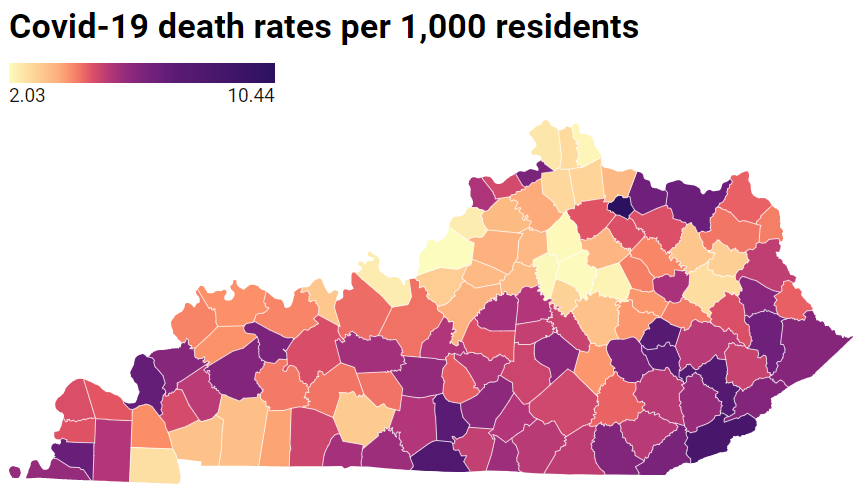
Jefferson County has the lowest Covid-19 death rate in Kentucky, and the top seven counties are all in official Appalachia

Kentucky Health News map via Datawrapper from state data
By Melissa Patrick
Kentucky Health News

Kentucky has lost more than 17,000 people to Covid-19, which has killed more Kentuckians than World War I, World War II and the Vietnam War altogether. This burden has been much greater in some counties; the highest county death rate is five times the lowest one.

Using death rates as a measure of which counties have handled the pandemic the best so far, Jefferson County came out on top with just under 2.03 deaths per 1,000 residents. (For each county's rate, see interactive map above.)

Jefferson, the state's most populous county, is followed by five counties with death rates lower than 2.6 per 1,000: Fayette (2.07), Scott (2.09), Woodford (2.09), Campbell (2.15), Clark (2.21), Oldham (2.34), Meade (2.34), Boone (2.47) and Calloway (2.59). 

The county with the most Covid-19 deaths per 1,000 residents is Robertson, with a death rate of 10.43. The rate and the county's ranking are not statistically strong, since the county's population is only 2,108. It had 22 Covid-19 deaths, meaning that the disease killed just over 1 percent of its population.

The other counties with the highest Covid-19 death rates were were Harlan (8.5 per 1,000), Monroe (8.0), Perry (7.8), Lee (7.5), Metcalfe (7.3) and Owsley (7.2). All of these counties and Robertson are in the officially recognized Appalachian region of the state. 

As Kentucky settles into a phase of living with the novel coronavirus, it's important to remember that between 60 and 80 Kentuckians are still dying each week from Covid-19.

"We're going to be processing this grief for years to come," Gov. Andy Beshear said at a recent news conference. 

Beshear's administration is working toward placing a Covid-19 memorial on the state Capitol grounds to honor those lost to the pandemic.

Monday, September 19, 2022

New Covid-19 cases in Ky. hit a plateau, but in Eastern Kentucky it's a very high plateau, and part of the nation's biggest hotspot

Ky. Health News graph from state data; click to enlarge
By Al Cross
Kentucky Health News

New cases of the coronavirus in Kentucky hit a plateau last week after declining for four of the last five weeks, but the number of Kentucky hospital patients with Covid-19 fell 22 percent, according to the weekly report from the state Department of Public Health.

The state's daily infection rate in the last week was fifth in the nation, according to The New York Times, but the newspaper said the rate had declined 39% in the last two weeks, one of the larger drops in the nation.

The state report for the Monday-to-Sunday reporting week said there were 9,159 new cases, or 1,308 per day, slightly above the 1,296 daily average recorded the week before. But the latest figures were 29% less than the week before that.

Just under 23 percent of the week's new cases were in Kentuckians 18 and younger, the group that has the lowest rates of vaccination for Covid-19. The Times says that in Kentucky, only 21% of 5- to 11-year-olds and and 45% of 12- to 17-year-olds are fully vaccinated. That is a growing concern, with school in session and the prospect of cool weather that will increase time spent indoors. 

The new-case reports from the state and the Times differ due to different reporting methods. The state said its new-case infection rate last week was 20.1 per 100,000 people, while the Times said it was 28 per 100,000. The only states with higher rates were West Virginia (37 per 100,000), South Carolina (31), Alaska and North Carolina (both 29).

New York Times map; to enlarge, click on it.
The Times says six Kentucky counties are in the top 10 for infection rate: Perry (121 per 100,000), Rowan (117), Wayne (107), Breathitt (94), Rockcastle (87) and Carroll (79). The state's report says its top 10 counties are Wolfe (174 per 100,000), Harlan (163), Rockcastle (147), Perry (131), Powell (131), Menifee (106), Bath (105), Knox (105), Whitley (97.3) and Morgan (95.5).

What both reports make clear is that Appalachian Kentucky and parts of West Virginia consttitute the biggest national hotspot for coronavirus infections.

The biggest positive change in the state report was the drop in Kentucky hospital patients with Covid-19, to 456 from 584 the week before. Hospitalizations are a key measure in gauging the risk posed by the virus.

The state said the share of Kentuckians testing positive for the virus in the last week was 11.96%, the lowest rate reported since the end of May. Those figures do not include at-home tests.

Perhaps reflecting the higher infection rates of a few weeks ago, the state said it attributed 80 more deaths to Covid-19 last week. That was the highest weekly total in four months, though just two above the 78 reported two weeks ago. The average for the last three months is 61 deaths per day. The state's pandemic death toll stands at 16,902.

Sunday, June 26, 2022

Kentucky had the second highest increase in deaths caused by alcohol, drugs and suicide in 2020, just behind West Virginia

By Melissa Patrick
Kentucky Health News

In the first year of the pandemic, the United States experienced the highest-ever combined rates of deaths due to alcohol, drugs and suicide, and Kentucky's rate was second in the nation, according to a report released by Trust for America's Health and Well Being Trust.

Nationwide, deaths associated with alcohol, drugs and suicide, called "deaths of despair," took the lives of 186,763 Americans in 2020, a 20 percent increase from 2019. It included the highest number of substance-misuse deaths ever recorded for a single year, according to the report.

Kentucky's combined deaths of despair increased 36% between 2019 and 2020, the second only to West Virginia, which had a 37% increase.

Maps are from the report
In 2020, the latest Pain in the Nation: The Epidemics of Alcohol, Drug, and Suicide Deaths  report shows Kentucky had 3,680 combined deaths from alcohol, drug and suicide, an age-adjusted rate of 82.8 deaths per 100,000 people. Of those, 738 were alcohol-induced (37%); 2,187 were drug-induced ( 47%); and 801 were by suicide (7%). 

“With the trends continuing to go in the wrong direction we must ask ourselves, what will it take to move to robust and comprehensive action? The story behind these data is beyond devastating and heartbreaking to those families who have suffered loss,” Dr. Benjamin F. Miller, president, of Well Being Trust, said in the release. 

He added, “Let’s begin to address this crisis with the urgency it deserves by bringing care to where people are. From schools to primary care to our workplaces, let’s ensure that all places are equipped to address mental health and substance misuse. This is not just the responsibility of the mental health and addiction field – but all our responsibility.”

The release notes that while deaths of despair have increased for decades, the national increase in 2020 was unprecedented and driven by a 30% increase in drug-induced deaths and a 27% increase in those related to alcohol. 

According to the report authors and other experts, the 2020 increase in alcohol and drug deaths was exacerbated by: the rise in synthetic opioid and psychostimulant overdoses, disruptions to recovery and treatment programs, and the financial hardships many individuals and families experienced during the Covid-19 pandemic.

The report offers detailed recommendations for local, state and federal governments to take to reverse this crisis, including ways to invest in programs that promote and prevent substance misuse and suicide, programs and policies that address substance misuse and overdoses, and ways to increase access and ensuring parity for  mental health and substance use disorder treatment, all while working to decrease stigma. 

The report also examines the last two decades of the drug overdose crisis, including an analysis of the underlying causes and policy responses, with a  call to rethink strategies to match the crisis. It also includes an interview with Sam Quinones, author of two acclaimed books on the opioid crisis, about the need to heal communities in order to deal with the addiction crisis.

Thursday, June 16, 2022

Ky. health-system performance ranked 41st, Covid-19 response 49th; highest hospitalization rate, relatively low vaccination rate

Chart from 2022 Scorecard on State Health System Performance, The Commonwealth Fund
By Melissa Patrick
Kentucky Health News

Kentucky ranks 41st among the states and Washington, D.C. in the latest ranking of states' health systems, but when it comes to how well those systems and their states' populations have handled the pandemic, Kentucky ranked 49th, ahead of only Alabama and Oklahoma.

The rankings are done annually by The Commonwealth Fund, a New York-based foundation that says it aims to promote a high-performing health-care system. In past years, the Scorecard on State Health System Performance has asked three questions: 

  • Do Americans have good access to health care? Does their health insurance enable them to get the care they need to stay healthy? Are they protected from high out-of-pocket health costs?
  • Are Americans getting the right health care, at the right time, and in the right setting? To what extent are they seeking care from emergency departments or other costly settings instead of visiting a primary care provider? Has health care use and spending gone up or down?
  • How healthy is America? How prevalent are high-risk behaviors like smoking or health conditions like obesity that put people at higher risk for poor health? What are Americans’ chances of dying early in life from preventable or treatable causes?
This year, the fund added a question: "How well has each state responded to and managed the Covid-19 pandemic?"

"Covid-19 has disrupted aspects of care and we wanted to take a closer look at how states have responded," said David Radley, senior scientist at the fund, said in an online press briefing.

To do that, the researchers used seven metrics for Covid-19 through March 2022: hospitalization rates (Kentucky was No.1), stress on intensive-care units, hospital staffing shortages, deaths in nursing homes and overall, percentage of adults vaccinated and boosted, and the number of days it took to get 70% of the state's 12-and-over population fully vaccinated. Kentucky is one of 21 states that still hasn't achieved that; the scorecard ranked it 31st in vaccination.

Graph from Scorecard on State Health System Performance; for a larger version, click on it.

While the scorecard is for state health systems, Radley acknowledged that it also reflects the choices of a state's residents. Noting Kentucky's relatively low vaccination rate, he said that even if the state made a strong effort to get Kentuckians vaccinated, "People also have to be willing to get the shot."

Overall, the scorecard evaluated states on 56 health-care indicators in seven areas: access and affordability, prevention and treatment, avoidable hospital use and cost, healthy lives, which includes things like  premature death, health status and risky behaviors, income disparity, racial and ethnic equity, and the new Covid-19 indicators. 

Kentucky's top rankings were in racial and ethnic equity (21st), prevention and treatment (22nd), and access and affordability (32nd). It ranked 43rd for income disparity, and ranked 49th in three measures: Covid-19, avoidable hospital use and cost and healthy lives. The last four are reflections of the state's low health status, which the report ranked second from the bottom.

Among indicators used to measure the above categories, Kentucky's best were its percentage of home- health patients with improved mobility, ranked 10th; the infant death rate (11th) and percentage of uninsured adults (12th). The state's expansion of Medicaid under the Patient Protection and Affordable Care Act gave it perhaps the nation's largest reduction in the percentage of residents without health insurance.

Kentucky's bottom-ranked indicators, other than worst of all in Covid-19 hospitalizations, were adults who report fair or poor health, adults without a dental visit in the past year, adults who have lost six or more teeth, adults who smoke, children who are overweight or obese (all next to last)) and preventable hospitalizations of seniors (47th, or fourth from the worst). 

In the overall ranking of health systems, Kentucky was sixth among the 12 southeastern states (Alabama, Arkansas, Florida, Georgia, Kentucky, Louisiana, Mississippi, North Carolina, South Carolina, Tennessee, Virginia and West Virginia).

Kentucky's pandemic management and outcomes

The scorecard shows the impact of the pandemic on each of the measured domains; states that entered the pandemic with stronger health status and systems fared better with the pandemic. Hawaii, Maine, Vermont, Washington, and Oregon ranked tops in handling the pandemic, while Alabama, Oklahoma, Kentucky, Mississippi, and Georgia ranked at the bottom.

Commonwealth Fund table, adapted by Ky. Health News; click it to enlarge
Among the seven indicators used to measure the Covid-19 response in states and Washington, D.C., Kentucky ranked ninth worst (43rd) for Covid-19 deaths among nursing home residents. 

And despite a huge effort by state officials to get Kentuckians vaccinated, the state ranked 34th in percentage of fully vaccinated adults who had gotten a booster shot by the end of March 2022 (31%)

Kentucky ranked 39th for three Covid-19 indicators: days of high use of intensive-care units (126 days); days of hospital staffing shortages (180); and excess deaths from February 2020 through March 2022. Excess deaths are the number above what would have been expected from historic mortality patterns; they include Covid-19 deaths.

"Because the pandemic disrupted their ability to get timely care for conditions other than Covid-19, many more people likely died sooner than they otherwise would have," says the report.

Asked if these rankings have more to do with the strength or weakness of the state's health-care systems than states' policies to address the pandemic, Sara Collins, vice-president of coverage and access for The Commonwealth Fund, said it's important to look at the whole picture to understand why Kentucky has such a low Covid-19 score.

Collins said "It is striking" that Kentucky ranked so low after expanding Medicaid and having a low uninsured rate, but it also has high Covid-19 hospitalization rates and a highly vulnerable population that has high levels of pre-existing health conditions like obesity and smoking. 

"It just goes to show you that coverage is a necessary condition for access to health care and good outcomes, but it is not a sufficient condition," she said.

The state Cabinet for Health and Family Services was asked for comment on Kentucky's ranking of 49th in handling the pandemic, but did not respond before the 12:01 a.m. Thursday time of publication.

Other indicators affected by the pandemic

The indicator that worsened most in Kentucky during the pandemic was drug-overdose deaths. Kentucky ranked third for this measure, with 49 overdose deaths per 100,000 residents, a 51% increase from 2019 to 2020. 

Graph from Scorecard on State Health System Performance; to enlarge, click on it.

"Immediately after the pandemic began, deaths spiked, as people dealt with physical isolation, disrupted addiction treatment, and a supply of deadlier drugs like fentanyl," says the report.

The latest overdose-death report in Kentucky shows  that while this rate continues to go up, it increased by much less from 2020 to 2021, when it went up 14.6%.  

Kentucky also had one of the highest rates for deaths from treatable conditions (such as heart disease and diabetes) before age 75. Kentucky ranked seventh for this indicator, with 113 premature deaths from treatable causes per 100,000 residents. This increase is largely attributed to people postponing routine health services because of Covid-19, says the report. 

Dr. David Blumenthal, president of The Commonwealth Fund, told reporters that as the U.S. faces an ongoing public-health crisis, it is important for states to prioritize policy solutions that focus on equity, safety and health. 

"Lawmakers should look for ways to ensure that people can get the health care they need, shoring up the health insurance safety net and building on coverage gains achieved during the pandemic," he said. "Finally, states need to invest in their health-care infrastructure. As the scorecard shows high performing health care systems that provide comprehensive, high quality care every day, also performed better during a pandemic. Having a strong health care system is the best preparation for any public health crisis." 

The report's findings are based on the authors’ analysis of the most recent publicly available data from federal agencies including the U.S. Census Bureau, Centers for Disease Control and Prevention, and the Centers for Medicare and Medicaid Services, as well as other data sources.    

Wednesday, June 1, 2022

Early data shows ODs rose 13.55% in Ky. in 2021, much less than in 2020; ODs among Black Kentuckians jumped 117% in 2016-20

UPDATE, June 13: The state reported a 14.5% increase.

By Melissa Patrick
Kentucky Health News

Drug-overdose deaths in Kentucky rose 13.55% in 2021, according to a recent federal report. 

The preliminary data from the Centers for Disease Control and Prevention shows Kentucky had 2,391 overdose deaths in 2021, up from 2,104 in 2020. 

After having the second highest rate of increase among the states in last year's preliminary report, 54%, 2021's much lower increase puts Kentucky near the midpoint of the rankings, at 22nd lowest and below the national estimated increase of 14.9%.

An interactive CDC graphic shows the number of overdose deaths in the previous 12 months for each month of the year. In Kentucky, drug-overdose deaths saw a big increase when the pandemic began in March 2020. While the number of estimated overdose deaths remains higher than before the pandemic, they are not increasing at the same trajectory.

Nationwide, more than 107,000 overdose deaths were reported in 2020, up from more than 93,000 estimated in 2020.  

Graph shows overdose deaths by drug or class of drug in Kentucky since 2018; click it to enlarge.
The report also includes data about drug-overdose deaths by drug or class of drugs. In Kentucky, it shows that opioids and synthetic opioids, such as fentanyl, were the two main contributors for overdose deaths in 2021, with opioids involved in 1,906 of the deaths and synthetic opioids in 1,728 of them. 
Like the rest of the nation, the new data show overdose deaths involving opioids and synthetic opoids increased between 2020 and 2021. 

Overdoses jump among Kentucky Blacks

A separate analysis done by the University of Kentucky found that the rate of drug-overdose deaths among African Americans in Kentucky more than doubled from 2016 and 2020.  

The Black overdose-mortality rate increased nearly 117% — from 21.2 deaths for every 100,000 people in 2016 to 46 per 100,000 in 2020, according to the report. 

The study, published in the journal Public Health Reports, shows that about 80% of drug-overdose deaths among all racial and ethnic groups in Kentucky involved opioids.

“Historically, opioid-overdose death rates have been disproportionately higher among white individuals, but the new study shows that the rates for both white and Black individuals in Kentucky are now nearly the same,” Svetla Slavova, study co-author and associate professor in the UK College of Public Health, said in a news release. “This reflects national data, which show that disparities in opioid overdose deaths continue to worsen for Black people.”

Slavova is part of UK's HEALing Communities Study research team that conducted the study and a faculty member in the Kentucky Injury Prevention and Research Center.

The researchers conclude that their findings "underscore the urgent need to expand treatment and harm reduction services to non-Hispanic Black residents with substance-use disorder." 

“Black Kentuckians who are at risk for drug overdose may face additional barriers to accessing treatment,” Sharon Walsh, principal investigator for the study and director of UK’s Center on Drug and Alcohol Research, said in the release. “This study underscores the importance of our efforts to expand treatment and harm reduction services in Kentucky’s communities of color.”

One of the study's goals is to create culturally tailored interventions and partnerships with community organizations to better engage people in communities of color with evidence-based practices to reduce opioid overdose, including increasing access to and treatment with approved medications for opioid-use disorder, such as buprenorphine and methadone. It also includes education about overdoses and distribution of naloxone, a life-saving medication that rapidly reverses an opioid overdose. 

People who are struggling with drug abuse or who are concerned about a family member's substance use can search for treatment providers at www.findhelpnowky.org.