Showing posts with label healthy food. Show all posts

Saturday, June 20, 2020

Free webinar on Friday, June 26 will discuss access to healthy foods during the coronavirus pandemic, must register


A free webinar on Friday, June 26, will discuss access to healthy foods during the coronavirus pandemic. It is sponsored by the Foundation for a Healthy Kentucky. The webinar will run from 2 to 3 p.m.. It is free, but participants must register here.

The webinar, titled "Kentucky Inspired: Whitesburg, Food and Community,"  will feature Valerie Horn of Whitesburg, who has been actively engaged as a community leader in a variety of enterprises to increase the amount of fresh food available in Letcher County.

Horn is chair of the City of Whitesburg/Letcher County Farmers Market and CANE Kitchen, and director of the Cowan Community Action Group.

All the "Health for a Change" webinars are recorded and posted, along with slide presentations, on the foundation's website.

Tuesday, November 28, 2017

Here are some holiday dining tips for people who have diabetes, a disease that affects almost 460,000 Kentuckians

Diabetes UK photo
The food and festivities that are part of the holiday season can make it hard to eat healthy, especially if you are one of the almost 460,000 Kentuckians who have diabetes.

But it doesn't have to be if you make a plan and stick to it, says the American Association of Diabetes Educators. To help make this plan, the association created a collection of "Holiday Season Eating Tips" with strategies to help people with diabetes enjoy the holiday season and maintain their blood sugar levels.

When it comes to eating big meals, the association's tip-sheet suggests: not skipping meals; limiting the number of starchy foods on your plate; choosing fruits and vegetables served raw, grilled or steamed; and sticking to calorie-free drinks. And if you choose to drink alcohol, which can lower blood sugar and interact with diabetes medicines, limit the amount and drink it with food.

If you are the one preparing the food, make sure you include healthy food choices like fruits, vegetables and lean meat; avoid frying or adding extra fat during cooking; and avoid sampling the foods more than necessary while you are cooking.

Another way to control your holiday portions is by using the "diabetes plate method," and foregoing seconds, says an article on The Diabetes Council website that also offers tips on managing diabetes during the holidays.

This method involves filling up half of your 9-inch plate with non-starchy, low carbohydrate vegetables, one fourth of the plate with a lean meat or protein and the other fourth of your plate with a carbohydrate of your choice. This method also allows for two more carbohydrate servings, which could be milk, fruit or a higher carbohydrate dessert.

As for all of those holiday treats, the association's tip-sheet recommends taking small portions, eating slowly and savoring every bite.

Holiday parties provide their own set of challenges when it comes to making healthy food choices, including the opportunity to graze, which can lead to poor food choices and overeating.

The tip sheet emphasizes the importance of not skipping meals, which can lead to overindulgence because you will arrive at the party hungry. It also recommends that you study all of the food options before deciding what to put on your plate, adding that if you choose something you don't enjoy, don't eat it.

And as always choose raw vegetables first, with only a small amount of dip (or skip it entirely); eat chips and crackers in moderation; sip on water or mineral water; and don't hang out near the food table.

The association also reminds people with diabetes to check their blood sugar regularly throughout the holidays, possibly adding a few extra checks in on party days to help guide your choices.

The federal Centers for Disease Control and Prevention offers some additional tips for people with diabetes to "holiday proof" their meal plans.

One of them reminds people with diabetes to make sure they eat close to their usual mealtime to keep their blood sugar steady, and if the holiday meal is to be served later than normal, eat a small diabetes-friendly snack at their usual mealtime and eat a little less when the meal is served.

Others include cutting back on carbohydrates during the main meal to allow for a sweet treat; making sure you are sleeping seven to eight hours per night because sleep loss can make it harder to control your blood sugar and tends to make people eat more and prefer high-fat, high-sugar foods; finding ways to fit in your favorite holiday dishes; and to make sure you keep moving, even if your physical activity is broken up into smaller chunks to fit your busy schedule.

And if you need further help with your diabetes management during the holidays, talk to your diabetes educator.

Thursday, September 14, 2017

Study finds SNAP not enough for healthy diet, as budget plans call for cuts in program on which Ky. is more reliant than most

By Melissa Patrick
Kentucky Health News

The Supplemental Nutrition Assistance Program, formerly known as food stamps, only covers 43 to 60 percent of the cost of the federal nutrition guidelines, according to a study by researchers who say policymakers should consider that as they propose deep cuts to the program.

“Even though SNAP is not designed to cover all of the cost of food – it’s meant to be a supplemental food program – this study makes it clear that there would be many low-income households that would not be able to cover the gap needed to eat a diet consistent with federal dietary guidelines,” Lindsey Haynes-Maslow, co-author of the study, said in a news release.

The report notes that the average gross income for all SNAP participants is $786 a month, and the expectation is that "SNAP households are expected to spend about 30 percent of their resources on food," says the U.S. Department of Agriculture.

The study, published in the Journal of Nutrition Education and Behavior, estimated how much it would cost to fulfill the USDA's MyPlate guidelines, which recommend filling half your plate with vegetables and fruits, the other with a lean protein and grains, along with a serving of low-fat dairy. Then it estimated the additional costs needed by SNAP recipients to adhere to it.

The researchers concluded that SNAP benefits are sufficient to meet the needs of children under the age of 8 and women over the age of 51, but are insufficient for older children, younger women, and men of any age.

It found that while the average monthly SNAP benefit is $254 per household, the cost of feeding a family of four according to the MyPlate guidelines is between $1,000 and $1,200 per month, depending on the number and age of children in the home.

The study used average monthly SNAP benefits for 2015 and monthly retail price data from the USDA to determine food costs. The calculations also took into account the time it takes to shop for and prepare the food, citing previous studies that show that in addition to food costs, the time it takes to prepare nutritious foods is a barrier to eating healthy.

“Even without including labor costs, a household of four would need to spend approximately $200 to $300 in addition to their SNAP benefits to follow the dietary guidelines," said Haynes-Maslow, who is also an assistant professor of agricultural and human sciences at North Carolina State University.

SNAP funding based on guidelines that were replaced in 2010

The researchers pointed out that SNAP funding is based on the 2005 Food Pyramid nutrition guidelines, which MyPlate replaced in 2010. They encouraged policy makers to use current information on "the true costs of healthy eating" as they consider cuts to the program. They say proposed cuts to SNAP would "decrease the amount of benefits available for food purchases, and fewer people would have access to the program."

President Trump's 2018 budget proposal calls for $191 billion in cuts to the SNAP program over 10 years, a cut of more than 25 percent. The cuts would largely come from requiring a "state-match" that would shift 25 percent of the cost of the program to states by 2023, while giving them flexibility to cut benefits.

The U.S. House of Representatives' 2018 budget proposal calls for even deeper cuts, which are "$4.87 billion below last year's level and $2.6 million below the president's budget request," the House Appropriations Committee said in a June 27 news release. The Senate has no budget proposal yet.

“This research highlights how modest these benefits really are, which is something a lot of people, including many policymakers, probably don't realize. In Kentucky, it's just $1.36 per person per meal," Ashley Spalding, research and policy associate for the Kentucky Center for Economic Policy, said in a telephone interview. “And so with benefits already this modest, the recently proposed federal cuts would be devastating for our state.”

As of February, 651,889 Kentuckians received SNAP benefits. Of those, 41 percent were children, 25 percent were elderly or disabled, 52 percent lived in a rural county, and about 36 percent were working, Spalding wrote for the Ky Policy Blog, which details the impacts of the proposed SNAP cuts on Kentucky.
Kentucky Center for Economic Policy table 
Spalding notes that Eastern Kentucky would have the most to lose from cuts, because the state's 5th Congressional District has the sixth largest number of households on the program.

She also cites studies that show how SNAP lifts people out of poverty, and that people who receive SNAP when they are children have improved academic achievements, are more likely to graduate from high school, and ultimately have better long-term health outcomes.

Spalding said Kentucky is in no position to take on additional funding responsibilities for SNAP, as proposed in the Trump budget. The state ended the 2017 fiscal year on June 30 with a $138 million shortfall, and is projected to end the 2018 fiscal year with another $200 million shortfall. Gov. Matt Bevin recently ordered a 17 percent budget cut across most state agencies.

The Kentucky Association of Food Banks, representing seven food banks, distributed the equivalent of 58 million meals last year, which doesn't even meet the demand, Tamara Sandberg, the executive director of the Kentucky Association of Food Banks, said in a Lexington Herald-Leader op-ed .

"Despite the large volume of food distributed by our network each year, we struggle to keep pace with the demand because of the high need for food assistance in Kentucky," she wrote.

Sandberg urged the Kentucky congressional delegation to oppose any budget cuts to SNAP and other poverty-reduction programs. She noted that 65 percent of households served by the food banks also receive SNAP benefits.

She said, "Despite our best efforts to meet the need for food assistance among our neighbors, Kentucky’s food banks could never make up the difference if SNAP was cut."

Friday, July 21, 2017

Introduction to adult food can be a big turning point in a child's nutritional health; program in 22 counties helps poor get local food

By Melissa Patrick
Kentucky Health News

Taste preferences are established early, and that's why those early bites of ice cream matter.
A program that helps low-income families who use food-assistance programs to get locally produced food gets additional funding.
A group in Louisville is working on opening a community-owned grocery store.

These were just some of the topics discussed during the July 12 "Food in Kentucky" webinar, sponsored by the Foundation for a Healthy Kentucky.

Ana Chang, founder of Concept Hatchery, a California consultancy, opened the webinar with findings from her company's research with the 1,000 Days project, which looks at the nutritional health of mothers and their children during the 1,000 days from pregnancy to a child's second birthday.

Chang said her research involved 19 mothers from Kentucky, California and Mississippi, with varying levels of income levels. The study looked at what the children ate and how the mothers decided what to feed them, through food journals and in-person evaluations during meal and snacks.

All of the children started out on equal footing because they were all fed either formula or breast milk, Chang said, but the nutritional value of their food changed quickly when they started eating adult food.

"The first taste of food that babies get are really often what the family eats; they are not specialized for babies. And so the taste preferences are established really early. Even as young as four months or younger, babies might be given a finger that's been dipped in soup that the family is having, or a lick of ice cream," she said. "So how well that family ate, that's how well that baby is going to eat as it starts growing up."

Chang noted that one of the Kentucky families in the study was part of a diabetes-prevention program that provided fresh produce to the whole family, even though only one family member had been diagnosed with the disease. "That is the kind of intervention that we need to start thinking about," she said, "because once food is brought into a family kitchen, it becomes available for everybody."

Chang noted some nutrition challenges for the low-income families in the study, including: lack of access to fresh fruits and vegetables, transportation barriers, lack of a safe place to store foods, and a lack of a cooking space. She said almost every family in the study struggled with food bounty and scarcity issues which were tied to the arrival of their paychecks and food stamps.

Martin Richards, executive director of the Community Farm Alliance, said his 32-year-old group focuses on agriculture and family farming policy because policy can affect the most people, but also supports non-legislative initiatives that reinforces the bills they are trying to pass.

Click on the image to view a larger version.
One of those projects is Kentucky Double Dollars, a program that allows low-income families who use food-assistance programs to double their purchasing power at participating farmers' markets and retail stores in 22 Kentucky counties.

The program allows those on food stamps (now called the Supplemental Nutrition Assistance Program) or the Women, Infants and Children program to double the value of their SNAP or WIC dollars to buy Kentucky-grown produce, meats, eggs and dairy products. The double dollars program is also available to seniors who are part of the Senior Farmers Market Nutrition Program for Kentucky-grown produce only.

"We saw the huge amount of money that comes into Kentucky from federal food nutrition programs and we saw this as a way to get that money to support local and regional food systems," Richards said, adding that the program recently received an additional $1.4 million from federal, state and private-sector funding to help sustain it. (The program was formerly called "Double Dollars," but recently changed its name to Kentucky Double Dollars after it merged with the Bluegrass Farm to Table and the "Bluegrass Double Dollar" programs in Lexington.)

This season, 27 Kentucky farmers’ markets, 12 Fresh Stop Markets in Lexington and Louisville, and Good Foods Co-op in Lexington and Lexington Market East End, are participating in Kentucky Double Dollars.

Other CFA initiatives include a program that gives children vouchers to use at participating farmers' markets; a program that allows health-care providers to prescribe fruits and vegetables as part of a treatment plan; a program that provides food to children in the summer; a walking program that links farmers' market vouchers to community exercise goals; a school-based program that encourages students to drink water; and healthy cooking classes.

The CFA also offers technical and financial support through a 50-50 cost-sharing arrangement to communities that want to create a farmers' market. "When a farmers' market has somebody dedicated to help making that market run, even if it is just part time and seasonal, it makes a huge difference to that market," Richards said.

In another part of the webinar, Cassia Herron of the Louisville Food Co-op said her group is working to open a community-owned grocery store in one or more of the neighborhoods in Louisville's urban core. She said this group is working to hire a project manager who will lead and launch a capital campaign for this project, which they hope will come to fruition within the next two years.

Wednesday, March 1, 2017

Poll finds that most Kentucky adults have access to healthy foods, but most also don't eat enough fruits and vegetables daily

By Melissa Patrick
Kentucky Health News

Most Kentucky adults don't eat enough fruits or vegetables every day, even though most of them say they have easy access to them, according to the latest Kentucky Health Issues Poll.

"Too many Kentuckians still aren't getting their 'apple a day'," said Ben Chandler, president and CEO of the Foundation for a Healthy Kentucky, co-sponsor of the survey. "Federal guidelines say that half the food we eat each day should be fruits and vegetables, but only about one in 10 Kentuckians gets enough vegetables, and only a quarter of us get enough fruits."

The poll, taken Sept. 11 through Oct. 19, found that 42 percent of Kentucky adults don't get enough fruits and vegetables each day. and only 21 percent said they got enough of both.

Yet, 80 percent of those polled said it was easy to buy healthy foods, like whole grains, low-fat options and fresh fruits and vegetables. This number was 87 percent among those with higher incomes, 74 percent among those with lower incomes.

Lower-income people tend to have poorer health status, and the poll found that those who reported health status were more likely to say the cost of healthy food is too high: six in in 10, compared to about three in 10 of those who reported good, very good or excellent health.

"Cost is a barrier, but it's not the only obstacle to healthier eating," Chandler said. "The foundation is funding demonstration projects to provide education and enact healthy school-food policies in six communities statewide to help children establish better eating habits, and we're sharing what we're learning as part of our effort to change these statistics."

These numbers were largely unchanged from 2013, the last time the poll asked these questions. It is conducted by the Institute for Policy Research at the University of Cincinnati for the foundation and Interact for Health, a Cincinnati-area foundation. It surveyed a random sample of 1,580 adults via landlines and cell phones and has a margin of error of plus or minus 2.5 percentage points. Error margins for the smaller subsamples are larger.

Wednesday, September 7, 2016

Teacher learns food literacy is more than teaching about healthy food; it's also about geographic and socioeconomic challenges

Cooking Club, part of Fern Creek's Food
Literacy class (Photo by Joe Franzen)
A "food literacy" class that began as a way to teach high-school students to eat healthier has turned into a social-justice exploration through the shared language of food preparation and eating, Joe Franzen writes in a "Classroom Connection" piece for The Courier-Journal.

Franzen, a food and sustainability educator at Fern Creek High School in Jefferson County, said he showed up to his first food-literacy class at FCHS with plans to teach about "healthy" foods, new and improved cooking techniques and how to grow a garden.

"My students balked," he wrote, saying they pushed back on his curriculum with real-world issues that screamed of the geographic and socioeconomic realities that often segregate people into those who can afford to eat "healthy" and have access to fresh, healthy foods and those who can't and don't.

"They complained of not having the tools to cook at home or the ability to purchase ingredients on a budget.They explained how apartments don’t have yards to dig up.They talked about how junk food tastes good," he wrote.

So Franzen said he shifted the focus of the class, realizing that it would have to deal with the "dynamic realities" of his students.

Franzen noted that one of the first changes he implemented was to ask his students: "What is your food reality? What is your definition of 'good' food? What are the recipes that your family values? What are the boundaries that you face in eating well?"

Which, he said, led to "student-written food narratives, lessons in food discourse and debate, class cookbooks, 30-student potlucks, and conversations about what people deserve, what is just and right -- all while using our city as a classroom, textbook, and laboratory to explore and critically engage."

And all of this led to "talking about socioeconomic status, income inequality, privilege, race, religion, gender, and ethnicity," he wrote. "All I started out wanting to do was teach a couple of recipes, encourage less soda consumption, and show how to put a plant in a hole."

Franzen said he was "glad that students sent back the first version of 'food literacy' and that the new curriculum now formally "looks like Food Lit., a food-themed pre-AP English course, Cooking Club, Food Sociology, Global Issues, and Environmental Club."

"Through this process, I realized what good teaching should be: responding to the needs and curiosities of the students to help them critically engage and question the world in a way that allows them to improve themselves and the community around them," he wrote.

In conclusion, Franzen challenged all of us to find common ground around the table, to build a relationship over sharing a meal, and "to engage the world around us in a meaningful, sustaining, and compassionate way," and to come back for seconds.

He wrote: Food literacy "isn’t just about eating “healthy” or learning to cook, it is about building community and building resiliency within ourselves and together during such divisive times."

Sunday, July 12, 2015

Cut back on sugar-sweetened beverages, eat natural foods and read labels to decrease the added sugar in your kids' diet

A greater awareness about added sugars in food products has led many parents to make healthy food swaps for their children, granola bars for cookies, yogurt for ice cream, but what they probably don't realize is that they have likely swapped one source of added sugar for another, Liza Lucas reports for CNN.

Image: foodnutritionscience.com
Lucas offers some suggestions on choosing foods with no or little added sugar and recommends that for a short time, until you easily recognize these foods, you will have to become a "sugar detective." Added sugar is syrup or sugar that is added to foods during processing; the sugar in fruits, vegetables and other whole foods are natural sugars.

The American Heart Association's guidelines for the daily amount of added sugar a child should consume depends on the child's age and caloric intake. BJC HealthCare in St. Louis breaks it down on its website:
  • Preschoolers averaging 1,200 to 1,400 calories per day should limit added sugar to about 4 teaspoons (16 grams) per day.
  • Children ages 4 to 8 who average 1,600 calories per day should limit added sugar to about 3 teaspoons (12 grams) a day. To fit in all the nutritional requirements for this age group, there are fewer calories available for added sugar.
  • Pre-teen and teens averaging 1,800 to 2,000 calories per day should not have more than 5 to 8 teaspoons (20 to 32 grams) of added sugar per day.
Why does it matter?

Added sugar has been linked to obesity, which is then linked to so many other chronic diseases: type 2 diabetes, high cholesterol, heart disease, high blood pressure and cancer.

Kentucky is the 7th most obese state for children, with 36 percent of its children overweight or obese, according to Child Health Data. And studies have shown that children who are obese are likely to become obese adults, according to the Centers for Disease Control and Prevention.
The United States Department of Agriculture found that kids eat 18 teaspoons of added sugar a day and most of that comes from what they eat at home.

One 12-ounce regular soda has 8 teaspoons of sugar, which is more sugar than children of any age should have in a given day.

In Kentucky, 15 percent of high school students reported that they had three or more sodas a day during the past seven days, 25 percent said they had two or more per day, 33 percent said they had one or more a day, and 22 percent said they did not drink any soda, according to the 2013 Youth Risk Behavior Survey.

How do you help your kids cut back on added sugar?

Multiple sources recommend limiting sugar-sweetened beverages, which includes soda, fruit drinks and sports drinks, as the most important thing we can do to decrease most of the added sugars in our kids diets. They recommend replacing it with water.

"The preponderance of research shows that sugar sweetened beverage consumption leads to excess caloric intake and weight gain, as well as increased obesity rates among children and adolescents," says a report from the Robert Wood Johnson Foundation.

Serve treats occasionally and only at special events. The added sugar from daily cookies in the lunch box and ice-cream every night adds up quickly.

The easiest way to decreases added sugars is to eat whole, natural, unprocessed foods. They have no added sugars.

It is also important to learn how to read labels, especially snack foods, breakfast foods, any foods marketed toward children and beverages. Four grams of sugar is equal to one teaspoon, so a food that has 16 grams of sugar has 4 teaspoons of sugar in it.

In addition to desserts and processed treats, granola bars, cereals, barbecue sauce, ketchup, salad dressings, tomato sauces, soups, fruit juice, lemonade, bottled teas, and flavored yogurts are common foods that kids eat that are loaded with added sugars, Madeline Vann reports for Everyday Health.

Nutrition labels don't list the amount of added sugars separate from naturally occurring sugars in a product so you will have to read the ingredient list to see if the product contains added sugars. First look for any word that ends in "ose," and then look for any of these following added sugars: agave syrup, brown sugar, corn sweetener, corn syrup, high-fructose corn syrup, fruit juice concentrate, honey, invert sugar, malt sugar, molasses, raw sugar, sugar, and syrup, says the American Heart Association.

"Even 4 grams of sugar makes a difference. It may be only 7 grams versus 11," in terms of product comparison "But if you're making five choices a day, that's 20 grams of sugar you're saving," Dr. Melina Jampolis, a physician specializing in nutrition, told Lucas.

Friday, July 10, 2015

Generals ask Congress to renew school nutrition rules, note 73% of young adult Kentuckians too fat to fight, 8th highest in nation

By Melissa Patrick
Kentucky Health News

A new report from the Department of Defense found that 73 percent of young adults in Kentucky aren't qualified to serve in the military, mostly because they are overweight. That is the eighth highest ineligibility rate in the nation.

Nearly one-third of all Americans ages 17 to 24 are too overweight for military service.

“Too many young people today have unhealthy eating and exercise habits,” retired U.S. Marine Corps Maj. Gen. Jerry D. Humble of Russellville said in a press release from Mission: Readiness / Military Leaders for Kids. “This problem threatens to diminish our future military strength and put our national security at risk.”

In Kentucky, 33 percent of teens are overweight or obese, and 78 percent don't get the recommended hour of exercise daily.

This report documents the "staggering impact of obesity on America's military" and has prompted more than 450 retired admirals and generals, many from Kentucky, to support the reauthorization of the Child Nutrition Act, commonly known as the Healthy Hunger-Free Kids Act,which is set to expire in September.

“As a doctor, I can tell you that we must turn the tide on the obesity epidemic by instilling good eating and exercise habits from an early age," Gen. Rhonda Cornum, a surgeon and former director of the U.S. Army's Comprehensive Soldier Fitness program, said in the release. "Good nutrition starts at home, and parents play a central role in combating childhood obesity, but it’s critical to remember that children consume up to half of their daily calories while at school and out of sight of their parents.”

As Congress prepares to reauthorize the program, it is certain that many will push for changes that address "inedible meals, food waste and misspent funds," Julie Kelly and Jeff Stier report for the Wall Street Journal.

Many of the GOP lawmakers are backed by the School Nutrition Association, which is asking for changes, citing the increase in food waste and decline in student participation in the school-lunch program in the past three years, Lydia Wheeler and Kate Hardiman report for The Hill.

SNA is asking Congress "to revert back to 2010 standards that require only half of all grains offered to be whole-grain rich, leave sodium levels where they are until research proves further reductions benefit children and do away with the requirement that forces kids to take the half cup of fruit and vegetables with every meal, since most students end up throwing them away," the Hill reports.

Advocates are urging constituents to call their representatives and tell them that the new nutrition standards are working, citing studies that say students are responding positively to the healthier lunches and are eating more fruits and vegetables and are wasting less since before the new nutrition standards were enacted, Chef Ann Cooper writes for U.S. News and World Report.

Results from poll sponsored by Robert Wood Johnson Foundation,
 the Pew Charitable Trusts and the American Heart Association
The military report included the same research support for the new school nutrition standards that Cooper included in her article, but also added a poll released last week by the Pew Charitable Trusts, Robert Wood Johnson Foundation and the American Heart Association that found 72 percent of parents nationwide favor updated nutritional standards for school meals and school snacks, while 91 percent favor requiring schools to serve fruits or vegetables with every meals.

The report also provided the results from the Kids' Safe and Healthful Foods Project poll that found 75 percent of Kentucky voters and 76 percent of public school parents support the new federal school nutrition guidelines. And roughly 70 percent support the higher nutrition standards placed on vending machines, snacks and a la carte menus.

Susan Zepeda, President and CEO of The Foundation for a Healthy Kentucky, said, "The health and well being of our next generation is at stake, We must remove the barriers to good health that stand in the way of Kentucky kids being ready to learn in school and prepared for any career they choose."

Retired Army Maj. Gen. D. Allen Youngman said, “Look, plenty of students don’t like algebra. Does that mean we stop teaching math? Of course not. Change can be hard, but if we want kids to grow up fit and healthy, it’s just plain common sense to serve nutritious meals in schools.”

Youngman added, “More than 30 million children have eaten healthier school meals since 2012. We need to keep that momentum going, because when our children’s health and our national security are at stake, retreat is not an option.”

Wednesday, June 10, 2015

Advocates of school nutrition standards use high-school chefs' competition to show that food can still taste good

The higher school-food standards required by the Child Nutrition Act expire this year, and Republicans are continuing their efforts to roll back some of them. Democrats and advocates of the standards used a student cooking event on Capitol Hill to generate support for the standards, apparently to counter arguments of some school nutrition directors that some of the healthier options are more difficult to prepare and serve.

In the final competition, the top nine high-school teams served their winning dishes to lawmakers. The dishes had to follow their cafeterias' budgets and the national standards: To win, students had to include products rich in whole grains, low in sodium and a half-cup of fruits and vegetables, Whitney Forman-Cook reports for Agri-Pulse, a Washington newsletter. She doesn't list any of the dishes, but they're listed with the winners on the "Cooking Up Change" website of the Healthy Schools Campaign.

Sen. Debbie Stabenow, D-Mich., hosted the event. She said that she and Senate Agriculture Committee Chariman Pat Roberts, R-Kan., who has vowed to roll back some of the standards, have been discussing the issue, and she would like to pass a bipartisan bill by Sept. 30, when the current law's authority ends. One standard Stabenow doesn't want to compromise on is the requirement for a half-cup of fruit and vegetables; Michigan is a big fruit and vegetable state.

Stabenow said the Department of Agriculture "is very willing to work with schools where there are issues" in meeting nutrition requirements. (Read more)

Friday, April 10, 2015

Event at UK library features discussion of Kentucky food traditions, how they are changing and how to capitalize on them

Story and photo by Melissa Landon
Kentucky Health News

Local food experts gathered at the University of Kentucky April 9 to discuss how Kentucky food tradition is changing and how to develop local food culture through businesses and other means.

"From Plows to Plates: A Journey Through Kentucky Foodways" was an event sponsored by the UK Libraries Special Collections Research Center. It included a panel discussion, book signings by local food authors and food samples. Panelists included anthropology professor John van Willigen, author of Kentucky's Cookbook Heritage: 200 Years of Southern Cuisine and Culture; Ouita Michel of Midway, chef and proprietor of several restaurants; Tiffany Thompson, horticulturist and manager of the College of Agriculture, Food and Environment's Community Supported Agriculture program; and Kristy Yowell, marketing manager of the Good Foods Co-Op in Lexington.

"I want to elevate Kentucky food culture way above restaurants," Michel said. "Restaurants are not food culture." She said Kentucky is known for its chain restaurants, such as Kentucky Fried Chicken, but she wants to focus on helping young chefs and small businesses succeed.

Emma Yetter talks about vegetables via community supported agriculture.
Yowell said, "We want to make affordable, healthy food for everyone. That shouldn't be a privilege."

Thompson said Kentucky's history has had a lot to do with tobacco, which is becoming less prominent. He said community supported agriculture, in which local residents agree to buy produce in advance, has much potential. "What can Kentucky agriculture do to positively influence health? Make more vegetables! CSA is growing, and I'm really excited about it."

The college's CSA Vegetable Program allows people to sign up to receive weekly seasonal vegetables throughout the spring, summer and fall. It costs $19 per week for the smallest "share" of vegetables, which is enough for a single person or a couple, said Emma Yetter, who works events and does deliveries for the program.

Associate Dean of Libraries Deirdre A. Scaggs, author of The Historic Kentucky Kitchen, said at the event that her inspiration for the book came from working in the Special Collections Research Center. She found old recipes, many of which were hand-written, and decided to try them out. She collected over 100 recipes, tested them and modified some of the instructions so a modern audience could understand them.

Thursday, March 12, 2015

Survey shows satisfaction with after-school programs aimed at helping children's health and physical fitness

Kentucky Health News

A household survey for the Afterschool Alliance shows that after-school programs may be key in preventing childhood obesity in Kentucky and across the nation. The "Kids on the Move: After-School Programs Promoting Healthy Eating and Physical Activity" survey showed parentswere generally satisfield with the programs, which are aimed at health and physical fitness.

The great majority of parents (78 percent in Kentucky and 72 percent nationally) report that after-school programs give their children snacks, drinks and/or meals, and 80 percent in Kentucky say that the sustenance provided is healthy. Eighty-six percent of Kentucky parents report that their child's afterschool program provides opportunities for physical activity. To see the rest of the statistics, click here.

"Afterschool programs are a proven, but sometimes underappreciated, weapon in the battle against childhood obesity and physical inactivity," said Afterschool Alliance Executive Director Jodi Grant.  "The healthy habits afterschool programs help instill can last a lifetime."

Key national findings from Kids on the Move:
  • Older youth are less likely than younger children to attend an after-school program that offers food and less likely to be physically active in their program.
  • Providing healthy food during after-school programs is especially important to low-income, African-American and Hispanic parents.
  • Opportunities for physical activity are important to African-American, Hispanic and low-income parents.
  • Many parents are unaware that standards for healthy eating and physical activity exist for afterschool programs. The Healthy Eating and Physical Activity Standards recommend best practices related to food and activity, including at least 30 minutes of morning or after-school program time for physical activity (60 minutes for a full day program).
Kids on the Move recommends that providers of afterschool programs make sure they are aware of policies that support such programs. Findings from America After 3PM show that in the last 10 years, afterschool program participation has risen from 6.5 million to 10.2 million, and 19.5 million parents said they would send their children to an afterschool program if one were available.

Thursday, September 19, 2013

Kentuckians can act to protect against heart disease and stroke; half of preventable deaths occur in adults age 65 or younger

By Molly Burchett
Kentucky Health News

Nearly one on three deaths in the U.S. each year is caused by heart disease and stroke. At least 200,000 of these deaths are preventable, and nearly half of those preventable deaths are of people under 65, says a new report.

What can you do to stop heart disease and stroke from killing you? Change your health habits, says the federal Centers for Disease Control and Prevention's "Vital Signs" report. Changes can include quitting smoking, getting more physical activity and using less salt in your diet. Kentucky communities can also take preventive measures by creating healthier living spaces, such as smoke-free zones and safe places to exercise.

While the number of preventable deaths from heart disease and stroke has declined in people 65 to 74, it has remained virtually unchanged in those under 65, says the report. Men, particularly black men, are at a greater risk for dying early from these conditions. Overall, counties in Southern states, including Eastern and some parts of Western Kentucky, have the highest preventable death rates.

Map: Age-adjusted preventable death rates per 100,000 people from CDC "Vital Signs" 
To take action against the heart disease and stroke, risk factors should be considered. Adults in Kentucky have been found to have these risk factors for heart disease and stroke: high blood cholesterol, diabetes, overweight or obesity, not exercising regularly and not eating the suggested amount of fruit and vegetables.

If you have one of more of these risk factors, it is possible to reduce your risk of getting and dying prematurely from heart disease or a stroke. For example, you should work with your doctor on a treatment plan to control your high cholesterol and diabetes, and if you use tobacco, find resources to quit smoking.  It is also important to maintain a healthy diet and a weight, in addition to exercising for 2 hours and 30 minutes every week. (Click here to read more)


Saturday, September 14, 2013

National Childhood Obesity Awareness Month: Policy changes underway in Ky. to lower its very high childhood obesity rate

September is National Childhood Obesity Awareness Month, and a number of policy changes are underway to combat the increasing trend of overweight children in America and Kentucky, where one in three kids are on their way to developing Type 2 diabetes.

Kentucky suffers from one of the highest childhood obesity rates in the country, tying Mississippi for the highest percentage of youth in grades 9 to 12 that are obese (18 percent). It has the third highest percentage of children ages 10 to 17 who are obese (21 percent), compared to 16.4 percent nationally, says a report by Kentucky's Task Force on Childhood Obesity.

The state's efforts to lower childhood obesity rates include two important studies for the Cabinet for Health and Family Services – "Shaping Kentucky’s Future: Policies to Reduce Obesity" and "Unbridled Health: A Plan for Coordinated Chronic Disease Prevention and Health Promotion." These reports contain policy recommendations for work communities, corporations, schools and the state itself to help Kentuckians eat healthy and exercise, The Foundation for a Healthy Kentucky says in a news release.

“Lowering childhood obesity rates is a positive lever for overall health change, reduced risk of chronic disease and an improved quality of life," said Susan Zepeda, president of the foundation. "Foundation polling and recent news reports signal growing awareness among Kentuckians of the importance of and the need for lowering our obesity rates."

Nationally, the recent report "F as in Fat: How Obesity Threatens America’s Future 2013" provides recommendations that could improve health in Kentucky and across the country with funding and effective implementation, including:
 · All food in schools must be healthy
 · Kids should have opportunities to be physically active on a regular basis
 · Restaurants should post calorie information on menus
 · Only healthy products should be marketed to children
 · Transportation plans should encourage walking and biking
 · Everyone should be able to purchase healthy, affordable foods close to home

“Here at home, Kentucky will host the Southern Obesity Summit in 2014 and several organizations are hard at work to advance health policies that support sound nutrition and active living at work, at school and in our communities,” said Zepeda. “These efforts create opportunities to discuss strategy and create more awareness of the compelling need to reduce childhood obesity rates in the commonwealth.”

Tuesday, July 16, 2013

Kids' excessive salty snacks are linked to obesity, high blood pressure; new limits on school vending items may help

As new research shows that America's child-obesity epidemic is linked to eating too many salty snacks,  new federal regulations could ensure that vending-machine snacks in Kentucky's schools are healthier and lower in sodium.

Spurred by children eating too much salt and being too fat, "blood pressure in America's kids and teens has gone sky-high," creating a young generation at risk for serious health problems, including heart disease, stroke, reports Brian Alexander of NBC News.

“Kids eat far too much sodium,” the study's co-author, Dr. Stephen Daniels told NBC. “And they aren’t adding it at the table, and their parents aren’t putting it into food; they’re getting it through processed foods.” The research, published Monday in the journal Hypertension, links this rising blood pressure to children's increasing bod- mass index and sodium intake.

The "Smart Snacks in Schools" nutrition standards, announced last month by the Department of Agriculture, require any food sold in public schools to meet calorie, fat, sugar and sodium limits. The changes shouldn't be very significant for Kentucky students because the state already prohibits vending machine sales during the school day. And, a few existing state regulations, like fat content, are tougher than the federal changes and will remain in place, Sue Bartenfield, nutrition program manager for the Kentucky Department of Educationtold Stu Johnson of the Kentucky Public Radio bureau in Frankfort. The new federal limits on calories and sodium are tighter, and the federal law will also keep vending machines shut down for a half-hour after school, Bartenfield told Johnson.

Wednesday, July 3, 2013

Summer lunch programs promote healthy eating habits for students, their families and the entire community

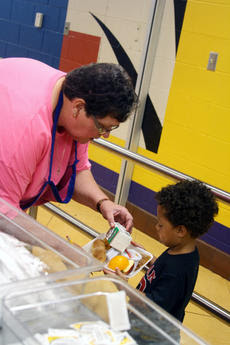
Carol Greenwell, who runs the summer lunch
program for Bardstown City Schools, hands
Brennen Maddox a carton of fat-free milk after
he picks up lunch. (Photo by Jennifer Corbett)
Both school districts in Nelson County are whipping up a magic solution to childhood obesity, using a key ingredient to promoting healthy eating habits in children: their parents.  The summer school lunch programs not only serve healthy foods while providing education about them, but also establish partnerships with parents in the community to do the same.

School officials say the summer lunch programs are a way to instill healthy eating habits at an early age, in collaboration with parents.  If parents don’t encourage healthy eating habits early on, children's health could suffer long-term and they are at greater risk for developing chronic diseases like heart disease and type two diabetes, writes Jennifer Corbett of The Kentucky Standard.

A recent Kids Count report says that in 2010, 17.4 percent of Nelson County children were considered obese, up by one-sixth since 2006, when the figure was 14.9 percent, notes Corbett.

Experts say that in order to encourage kids to take healthy steps to lose or maintain weight, or improve health, the whole family should be involved. For example, parents should think of fun, physical activities the whole family can do together, such as walking the dog or hiking.

“The best thing parents can do is be a good role model,” Jessica Bickett, a registered dietitian with the Lincoln Trail District Health Department, told Corbett. “If Mom and Dad walk around with a Mountain Dew in their hand all day, well guess what? The child will want to do it as well. If Mom says, ‘Go ride your bike’ while she sits on the couch watching TV, that doesn’t go too well.”

Schools also play a vital role in establishing a healthy lifestyle for students, says the Centers for Disease Control and Prevention., and Nelson County School Supt. Anthony Orr agrees. “We know nutrition is a really important part of growing up,” he told Corbett, adding that the summer lunch program “is a really good opportunity for the schools to serve the community.”

As part of the summer school lunch program, both Bardstown and Nelson County schools serve free breakfast and lunch to students, and adults can pay a small amount to eat, too. Orr is working to get the program into more schools because serving kids and their families introduces healthier choices to the students. This month, Bardstown established a district coordinated school health council focused on providing opportunities for all students to be active and to ensure that school food meets nutritional guidelines. These initiatives could serve as a model for a state that suffers from high childhood obesity and low health rankings. (Read more)


Thursday, June 27, 2013

Parents should walk the walk, not just talk the talk, when it comes to healthy eating and exercise, study shows

A new study highlights the influential role parents have in shaping their children's eating and exercise habits. Children of mothers who encourage them to exercise and eat well, while doing likewise themselves, are more likely to be active and healthy eaters, says a Duke University study.

Both exercise and healthy diets are critical in fighting childhood obesity, a significant problem in Kentucky, where more than one in four kids aged 2 to 5 are already overweight or obese, says a report by the College of Public Health at the University of Kentucky.

At the same time parents are setting a good example for their children, they can keep themselves healthy; being overweight or obese greatly increases the risk of developing chronic diseases like diabetes, arthritis, heart disease and cancer.

The Duke study is a reminder that parents are influential role models in shaping their children's habits, whether that's good or bad. "It’s hard for parents to change their behaviors, but not only is this important for you and your own health; it is also important for your children because you are a role model for them,” said Marissa Stroo, a co-investigator on the study. “This might be common sense, but now we have some evidence to support this.”

To promote healthy dietary and physical behaviors in children, a healthy home environment and parental role modeling are important, the researchers say. They recommend limiting access to junk foods, providing access to fruits and vegetables at home, setting parental policies to support family meals and increased consumption of healthy foods, and encouraging children to play outside to increase their physical activity.

“Obesity is a complex phenomenon, which is influenced by individual biological factors and behaviors,” said study author Dr. Truls Østbye, professor of community and family medicine at Duke. “But there are variations in obesity from one society to another and from one environment to another, so there is clearly something in the environment that strongly influences the obesity epidemic.”

These findings are important because they show that being overweight doesn't just come from your genes, and parents can be actively involved in improving the health and well-being of Kentucky's children. In this study, Østbye and his colleagues examined the relationship between the home environment and behaviors related to obesity, such as dietary and exercise habits, among 190 preschoolers. The study was published online in the International Journal of Obesity. (Read more)

Friday, June 14, 2013

Working with a local, regional or state health coalition? A simple step can help make healthy changes in Kentucky

The Foundation for a Healthy Kentucky is asking you to help update last year's Kentucky Health Coalitions Directory, a list of local groups working to better Kentucky's health, so that additional coalitions can be identified and groups can work together toward their shared goal of bettering the state.

“These are local residents working on solutions to health issues in their cities and towns,” said Susan Zepeda, CEO and president of the foundation. “These groups have differing levels of organization and are pursuing various goals. The Coalitions Directory is a resource for them and allows them to connect with other groups working to make their community a healthier place to live, work, and play.”

Now, across the state's 120 counties, there are 143 coalitions with varying health interests: some are increasing access to healthy food and physical activity, others focus on education about risk-factors for serious health problems like diabetes and other chronic diseases and others are improving working conditions through smoke-free ordinances.

All groups are working to positively change Kentucky's health, and an updated directory will help the foundation raise awareness of the coalitions' local efforts, foster collaboration, build local capacity and provide assistance to groups. Follow this link to submit new or revised information to the Coalitions Directory.

Thursday, June 13, 2013

Covington schools show 'Fitness Rocks' by lowering body mass, lifting the bars of nutrition, wellness and academic achievement

Sparks are flying in Covington Independent Schools. The schools' Fitness Rocks program, which combines fitness and wellness activities in an after-school program four or five days a week to create a healthier community for students, is the reported cause of fire.

The district's after-school student activities are based on the SPARK (Sports, Play and Active Recreation for Kids) curriculum for out-of-school-time, and the district reports great success since the program launched three years ago.

Since then, students' body mass has shrunk 4 percent, and there has been a 6 percent increase in the number of students who engage in at least an hour of daily physical activity and the number of students eating fruits two or more times a day, and vegetables three or more times a day, reports Julie Wohlleb of the Kentucky School Boards Association.

Students in Fitness Rocks also saw a greater increase in their math and science MAP (Measure of Academic Progress) scores than students not participating. “It’s been demonstrated how students who are active 60 minutes or more a day have increased academic success,” Haggard told Wohlleb.  

The program is also being used for professional development for physical education teachers, and "The SPARK curriculum has been really helpful in giving our fitness coaches and PE teachers ways to get all kids engaged no matter their skill level,” Haggard told Wohlleb.

The district started Fitness Rocks three years ago at each of its seven schools through a Carol M. White Physical Education grant from the U. S. Department of Education. The program encourages a range of activities to keep students active, from playing flag football to video games, and so far, 55 percent of elementary students and 19 percent of high school students across the district have participated in the program this year.

In addition to after-school activities, Fitness Rocks provides healthy snacks and sponsors family nights at every school that focus on fitness, wellness and nutrition, and program coordinators are witnessing changes in health behaviors across the district. “We’ve been really working hard, especially this year, at finding a sustainability model because it has been so impactful for the community and parents and students alike; they just love it,” Haggard said. (Read more)

Tuesday, May 28, 2013

Website eases application process for SNAP, formerly food stamps, and promotes healthy food

With a federal grant, the state Department for Community Based Services has launched a customer service website to promote healthy foods by assisting the families receiving food benefits through the Supplemental Nutrition Assistance Program, formerly called food stamps.

The portal allows people to check their eligibility for SNAP and apply for benefits with a shorter application that will be followed by a DCBS interview. They can also check their benefit status, report changes and receive electronic notices.

The agency says an online application eliminates any transportation issues a family may have with visiting a DCBS office, and encourages applications. “Modern improvements like this make it easier for families to apply for benefits and ultimately increase access to healthy food,” said Audrey Haynes, secretary of the Cabinet for Health and Family Services, which houses DCBS.

“SNAP helps people of all ages afford healthy food,” said DCBS Commissioner Teresa James. “For some of our DCBS customers, it means the difference between having a family meal or nothing at all. This website makes applying for benefits, making updates or accessing information even easier since customers don’t have to make an office appointment or even pick up the phone to get help.”

Since the portal’s launch on March 11, DCBS has received more than 1,000 electronic applications. Click here to learn more about SNAP.