Showing posts with label alcohol abuse. Show all posts

Friday, June 28, 2024

988 roll-out uneven, but Ky. appears to be doing 'pretty well;' last of 14 regional mental-health centers nearing certification for calls

By Melissa Patrick
Kentucky Health News

Even though the roll-out of the three-digit national suicide hotline remains a work in progress across the nation, Kentucky's roll-out over the past two years has gone "pretty well."

So says Steve Shannon, executive director of the Kentucky Association of Regional Programs for mental health. He said Kentucky's success has largely been because of a statewide 988 coalition and its subcommittees that work toward quality outcomes and toward having all of the state's 988 calls to be answered by people inside the state.

"We appreciate the partnership with the team at the Department for Behavioral Health, Developmental and Intellectual Disabilities," he said. "The call centers have worked very closely with them and it's been a great outcome for Kentuckians." 

The 988 line connects people experiencing a mental-health or substance-use crisis with a trained counselor. Shannon said 13 of the state's 14 community mental health centers act as call centers, and that the 14th center is in the process of getting certified to meet the national 988 call center standards, which will mean that eventually 988 calls in all 120 counties can be served by their regional cengter.   

"Our goal is 100% of Kentucky calls get answered by Kentucky," he said. 

Brice Mitchell, spokesman for the state Cabinet for Health and Family Services, also praised Kentucky's 988 roll-out, stating that the centers have used federal grants to increase workforce capacity by hiring staff and utilizing volunteers. 

"These efforts have ensured calls to 988 are most often answered at the local level, 84% in May," Mitchell said in an email. "Additionally, the current in-state answer rate of 25 seconds steadily remains faster than the national average of 36 seconds, and we know every second is critical when it comes to getting someone connected to help."

Asked about the 379 abandoned in-state calls that were reported in May, Mitchell said, "We are not able to determine why calls may be abandoned; one reason could be due to internet or cell phone instability." 

Since May 2023, the state has seen a 40% increase in calls from Kentuckians to 988 and a 53% increase in the number of those calls that are answered in state. Additionally, there has been a 15% increase in Kentucky’s answer rate over the past two years, according to data provided by the the cabinet. 

The federal government provided about $1 billion to launch and implement the 988 Suicide & Crisis Lifeline, with the expectation that states would establish their own funding to operate the call centers, but Axios reports that the "efforts have been uneven . . .  leading to significantly lower response times in certain states." 988 launched in July 2022. 

Axios reports that only 10 states have added a surcharge to cell-phone bills to fund 988 services, though all states fund their general-emergency 911 services in this way, according to a report from Inseparable, a mental health advocacy group. Kentucky is not one of them. 

Kentucky's General Assembly has put money in the budget for the 988 call centers since the 2022 legislative session, but "At some point, a dedicated funding mechanism that allows to accommodate for growth and calls is really necessary," Shannon said. "The appropriation is good, but the concern is, as utilization increases, those costs will increase."  He added that there have been some "preliminary conversations" about this, and the goal is to have an "ongoing, dedicated funding stream, comparable to 911."

This year, Rep. Adam Bowling, R-Middlesboro, filed HB 740 to fund 988 with a fee on special license plates, gifts, grants, contributions, appropriations or other sources. It was never heard in committee.

Another challenge is that many people still don't know about 988. The Pew Charitable Trusts released a survey last year that showed only 13% of adults in the U.S. had heard of the 988 line.

A national 988 paid marketing campaign will launch this month and run through October to help address this issue. It will also likely increase the number of calls. 

Axios reports that going forward, "States and cities are also moving toward integrated 988 and 911 services, said Kaiser Family Foundation researcher Heather Saunders, who tracks policies around the hotline. Federal regulators are also looking to require that 988 calls are routed to a person's actual location, rather than their area code, to better connect them with nearby resources." 

Saturday, January 20, 2024

Lesser-known health benefit of Dry January: cancer prevention

National Institute on Alcohol Abuse and Alcoholism graphic
By Rachel C. Miller
University of Kentucky

As we begin 2024, resolutions to eat healthier and exercise more are likely on many minds. This year, you may consider adding another: reducing alcohol or taking a break altogether. Many people have also started to participate in “Dry January” – a month-long vow to go alcohol-free.

Beyond the well-known health benefits of improved sleep, clearer skin, increased energy and shedding extra weight, ditching alcohol offers another often-overlooked advantage – reducing your risk of cancer.

Research shows a link between alcohol consumption and an increased risk of several cancers, including head and neck, esophageal, liver, breast and colorectal. Emerging evidence also suggests a connection to melanoma, prostate, and pancreatic cancers.

Alcohol damages the DNA in our bodies’ cells, impairs nutrient absorption, promotes inflammation, and disrupts hormones – all factors that can increase cancer risk.

Whether you're considering Dry January or a long-term reduction in your alcohol intake, here are some tips for success: 
  • Set clear goals. Decide if you want to abstain completely or adopt a low-alcohol approach.
  • Find your "why." Remind yourself why reducing alcohol is important to you, whether it's cancer prevention, improved sleep, or simply a desire to feel your best.
  • Find alternatives. Explore non-alcoholic beverages that satisfy your cravings. Sparkling water with a splash of fruit juice, herbal teas, and mocktails are great options.
  • Plan ahead. Stock up on your favorite alternatives and choose situations where alcohol less of a center of activity.
  • Get support. Tell family and friends about your goals – their encouragement can make all the difference. You may also consider joining online communities or connecting with friends who share the same goals.
Dry January serves as an excellent starting point for adopting a healthier relationship with alcohol all year long. Even for those who choose to drink, moderation is key. 

Federal dietary guidelines recommend limiting alcohol to two drinks or less per day for men and one drink or less for women. A standard size drink is 12 ounces of regular beer, five ounces of wine, or 1.5 ounces of 80-proof liquor.

Quitting alcohol "cold turkey" can be dangerous for some individuals. If you engage in binge or heavy drinking, it is best to first consult your doctor for guidance and safe reduction strategies.

If you or a loved one is experiencing a problem with alcohol, help is available via the Substance Abuse and Mental Health Services Administration Helpline at 1-800-662-HELP. NIAAA also has resources online to help you find treatment options.

Rachel C. Miller is a registered dietitian at the UK Markey Cancer Center.

Thursday, May 18, 2023

Boyle County named Kentucky's first Recovery Ready Community

Boyle County Judge-Executive Trille Bottom accepts the Recovery
Ready Community certificate from Gov. Andy Beshear. (Screenshot)
Boyle County is Kentucky's first Recovery Ready Community, a designation that reflects commitment to providing residents with access to addiction treatment and recovery support and removing barriers to the workforce. Applications for the designation opened in January.

The certification is designed to encourage communities to provide transportation to and from employment services and job interviews, allowing people to make positive changes while filling the state's need for workers at a time of record-low unemployment, said a news release from Gov. Andy Beshear.

“Boyle County has set a strong precedent that can serve as a model for the rest of Kentucky’s communities,” Beshear said in the release. “I continue to encourage each of the commonwealth’s counties and communities to apply for certification. If we work together to build a safer, healthier commonwealth, we can rise above drug and alcohol addiction in our state once and for all.”

Beshear said at his weekly press briefing that more communities are soon to follow. He was joined at the announcement by several leaders from Danville and Boyle County. Their efforts include free training for overdose response and Narcan distribution, hiring a social worker as an opioid-outreach coordinator to make EMS runs involving suspected overdoses to connect the individuals with treatment, counseling and other addiction support services.

Boyle County (Wikipedia map)
“When we came face to face with the effects of the opioid crisis on our families, institutions and workforce, we got to work to be informed, responsive and proactive,” Judge-Executive Trille L. Bottom said in the release. “We started a harm-reduction syringe-exchange program. We took a hard look at our jail becoming a place of rehabilitation. We encouraged new treatment and transitional living providers to come to Boyle County, and we trained a lot of citizens in saving lives from overdoses.”

Pam Darnall, chair of the state Recovery Ready Communities Advisory Council, which apprpoved the designation, said “We are inspired by Boyle County’s commitment to continue strengthening its local recovery-oriented system of care through persistent cross-agency collaboration and a willingness to try innovative programs and interventions aimed at increasing positive public health and safety outcomes.”

To learn more about the program and apply for certification as a Recovery Ready Community, click here.

Wednesday, June 30, 2021

People in recovery, and people trying to help them, talk about it at Chamber's annual meeting designed to help employers help, too

By Jacqueline Pitts
The Bottom Line, Ky. Chamber of Commerce

Kentuckians who are in recovery from substance-use disorder, and people who are trying to help them, talked about their efforts Tuesday at an annual conference designed to encourage employers to help.

Employment, assistance, wrap-around services and trainings were just some of the items discussed at the Kentucky Chamber of Commerce’s third annual Recovery Conference in Lexington.

Ashley McCarty, the Chamber’s Workforce Recovery director, spoke about her own personal struggles with substance-use disorder and how she is now using her experience to help Kentucky companies fix their outdated personnel policies to allow for a fair chance and notice early warning signs.

McCarty, who is seven years in active recovery from opioid addiction, said she was among the top five pharmaceutical sales representatives in the country when she had a few surgeries for which she was prescribed opioids for pain. Everything began to fall apart as she developed a dependency on those medications, her performance plummeted, and she even attempted suicide.

Recovery, McCarty said, taught her she could change by being open and transparent, working to build others up, and working on herself and her own struggles.

Keeneland cook Krystal Grimes talked about her recovery.
(Photographs by Sawyer Coffey, Kentucky Chamber of Commerce)
Krystal Grimes, a line cook at Keeneland, is four years into her active recovery and shared her powerful story with the conference.

Grimes said that to understand her addiction, it is important to understand her childhood and the sexual abuse she suffered at the hands of family members at a very young age. She was turned away by adults like school counselors, and abusers told her it was her fault. She then tried to take her own life. When she woke up, her first feeling was sadness that the attempt had not worked, and while the abuse stopped at that point, her feelings did not, and she sought out ways to numb the pain.

As she got older, she married a man who also struggled with addiction and they had three children. She was prescribed an opioid after each Caesarean section that made her feel like “Super Mom,” and her tolerance grew. After many years of struggles, Krystal and her husband lost their children and their home and she thought she didn’t think she had anything else to lose. Then she found heroin, and things continued to get worse as she attempted to stop the pain.

Eventually, she started treatment with Suboxone and eventually began attending classes, where she met McCarty, who inspired her to use the medication correctly and start doing the work of recovery.

With Keeneland since 2014, Grimes said the company has seen her struggle, but continues to believe in her and provide stability, support, and much more which she said has been critical to her recovery.

Jason Roop, Director of the Technology Training Center at Campbellsville University, presented research showing that people with substance-use disorder are often goal-oriented, resilient, adaptable, and persistent. He studied characteristics of those in leadership roles who have struggled with addiction and found transformational, authentic leaders are making a powerful difference in the business community and many other sectors.

How employers can help employees

Isaiah House Treatment Centers President Mike Cox shared their goals for effective treatment, including meaningful employment. Cox said when a business gives an individual in recovery a second chance, a sense of loyalty is automatically created. Isaiah House has partnerships with multiple businesses willing to employ individuals in active recovery.

Ed Early of Isaiah House discussed the critical role of the employer in the recovery process. It begins with reducing stigma in the workplace, he said. Employers should treat those in recovery in the same manner as other staff members: be welcoming, provide education and training, understand how to reward and hold employees accountable, and know when to retain, terminate and advance employees.

“It’s all about the opportunities they are given and the support they are shown,” said Early.

Landmark Recovery National Business Development Manager Zachary Crouch talked about why individuals don't seek help from employers: “The real reason is stigma.” Crouch said the cost of not treating substance use and mental health is too expensive not to address, since each replacement of an employee costs them six to nine months’ salary. He encouraged businesses to seek ways to engage employees when they are struggling with substance abuse and mental health and to encourage vulnerability, diversity, and inclusion in the workplace.

Representatives of Goodwill Industries of Kentucky, which has developed second-chance policies through removing barriers to employment for individuals in recovery and/or leaving incarceration, talked about new efforts to help individuals overcome re-entry and recovery challenges. One project is a program in which participants can learn soft skills, financial literacy, digital literacy, communications skills, resume writing, mock interviews to address criminal history and gaps in resumes, health and nutrition, and much more. Learn more about the program here.

Heather Lowe, founder of Ditched the Drink, shared her
testimony as Susan Rider of Preventia Group listened.
More than 70% of people with addiction issues are working, said Heather Lowe, founder of Ditched the Drink. She said it is critical to have vulnerable conversations, know the signs of a substance-use disorder, and implement successful treatment options in the workplace.

Saying it's critical to treat alcohol the same as a drug to address its abuse, Lowe shared her testimony of heavily using alcohol in workplace settings, which moved to her abusing alcohol at home.

Susan Rider of Preventia Group said studies show businesses that have adopted organizational change around alcohol often report improvements in morale and productivity, and a decrease in absenteeism, accidents, downtime, turnover, and theft. Also, various options for substance use disorder treatment can help lead to reduced health care costs for businesses

As employers heard about the ways addressing substance use disorder in the workplace can save them money, the Kentucky Career Center highlighted its services that can help. Learn more about programs like the Work Opportunity Tax Credit, the Kentucky Unemployment Tax Credit, Federal Bonding Programs, and Kentucky Essentials Skills Training by visiting kcc.ky.gov or by emailing Workforce@ky.gov.

HEALing Communities Study, other efforts

Dr. Sharon Walsh of the University of Kentucky reported on the HEALing (Helping End Addiction Long Term) Communities Study, a four-year, $87 million effort, funded by the largest federal grant UK ever received, to reduce opioid overdose deaths in 16 Kentucky counties.

Walsh said many "silos" separate medical care, behavioral health and recovery housing, which can make it difficult for people to find what they need. To address this, the study is evaluating the impact of various interventions, including education and distribution of naloxone; effective delivery of medication for substance use disorder; and safer opioid prescribing and distribution.

Walsh pointed to the rise of illicit fentanyl from China in U.S. markets as a reason that naloxone training and distribution, and a focus on medically-assisted treatment for substance-use disorder, remain critical to helping Kentuckians reach recovery.

RECON Kentucky, a consortium for recovery in Kentucky, announced its first inductees into the Kentucky Recovery Hall of Fame. U.S. Rep. Hal Rogers of Somerset and Jay Davidson, founder of The Healing Place, were honored for their work to solve the state’s struggles with substance-use disorder.

Van Ingram, executive director of the Kentucky Office of Drug Control Policy, stressed that Kentucky’s struggle with substance-use disorder must be addressed at the community, person-to-person level. He highlighted areas of success the state has seen in recent years including his office’s partnership with the Chamber’s Workforce Recovery initiative, which is training more than 5,000 Kentucky business leaders on the importance of being a recovery-friendly workplace.

While Kentucky is doing many things right, Ingram said, there is bad news as well. His office will soon release a report showing a 40 percent increase in overdose deaths, much of which can be attributed to a rise in the use of fentanyl. To get Kentucky back on track, Ingram said Kentucky must re-evaluate all efforts to ensure the state is saving as many lives as possible.

Senate Republican Leader Mitch McConnell said efforts the federal level to combat substance-use disorder have broad, bipartisan support in Congress. He emphasized the importance of people getting back to work, especially those struggling with substance use disorder, and said the continuation of additional unemployment benefits is an obstacle to that.

The Bottom Line is a news service of the Kentucky Chamber of Commerce. This story was independently edited and published by Kentucky Health News.

Thursday, February 27, 2020

Bill to help people with addictions get medication-assisted treatments moves; advocates say insurers killed the last one

By Melissa Patrick
Kentucky Health News

FRANKFORT, Ky. -- A bill to help people with opioid and alcohol addictions to get prescription drugs to treat their substance-use disorders -- the recognized standard of drug treatment -- passed unanimously out of committee Thursday and now heads to the full House.

Kimi Banta, Rep. Kim Moser, Dr. Shawn Ryan in committee
House Bill 389, sponsored by Rep. Kim Moser, R-Taylor Mill, would ban the requirement of "prior authorization" for any prescription drug that is used in the treatment of alcoholism or opioid-use disorder that contains methadone, buprenorphine or naltrexone, which are the recommended first courses of treatment for most patients.

Under prior authorization, insurance companies require health-care providers to get the insurer's approval for certain drugs and procedures before they can be administered.

"Your treatment could be delayed anywhere from several hours to several weeks because of the prior authorization rules that insurance companies have in place," Moser told the House Banking and Insurance Committee. "Ultimately, your health-care provider knows what is best for you . . . but unfortunately, they are not always the ones to make the final decision."

Starting Jan. 1, a law passed during the last legislative session gave insurers five days or less to give or deny approval of a drug, allowing some maintenance drugs used to treat chronic conditions to be approved for up to a year.

Moser, whose main job between 2014 and 2018 was Northern Kentucky director of the state Office of Drug Control Policy, talked about the dangers such delays have for people with addictions, often resulting in relapse or death from overdose.

She also said immediate access to these "life-saving treatments" is imperative because the window for when a person is ready and willing to seek treatment for addiction is often very short.

"The evidence is clear, treatment works," she said. "It helps keep people out of jail, it helps them stay in jobs, it helps them be productive members of society and family members, but most importantly, it saves lives."

This claim is well supported. Most recently, a study published Feb. 5 in JAMA Network Open compared six treatment plans for nearly 41,000 adults with opioid-use disorder between 2015 and 2017 and found that patients who were treated with buprenorphine or methadone were 76 percent less likely to overdose within three months and 59% less likely in 12 months, compared to those who did not get these drugs but participated in other types of treatment.

The same patients were 32% less likely to go to the emergency room or be admitted to the hospital in three months, and 26% less likely in 12 months.

Only 12.5% of the patients in the study were prescribed buprenorphine or methadone, citing a lack of access to doctors who can prescribe those drugs; high co-payments; prior-authorization requirements; "and other restrictions on use," the study said.

Kimi Banta of Louisville told the committee that as an alcoholic and an addict in recovery, "Medically assisted treatment has saved my life."

She said "after years and years of failed attempts to stop my drug use," she was prescribed Suboxone, which is a combination of buprenorphine and naloxone, a drug that reverses an opioid overdose, and that has allowed her to stay sober for two years and rebuild her life.

"I am a changed person and Suboxone bought me the time to do it all," she said. "More Kentuckians deserve this opportunity and should not have to jump through hoops to get medication that can change their life and their families life. This bill will save lives."

Moser, who chairs the House health committee, said the bill is supported by American Medical Association, the Kentucky Medical Association, the American Society of Addiction Medicine, the Kentucky Society of Addiction Medicine and treatment providers everywhere.

KMA President Dr. Brent Wright said in a news release, "This legislation will remove a critical barrier to ending Kentucky’s ongoing overdose and death epidemic. We support this bill because it will save lives."

A similar measure passed the House 97-0 last year, but was not given a hearing in a Senate committee. The joint  KMA and AMA news release says last year's bill "was ultimately defeated by opposition from health-insurance companies."

Kentucky's Medicaid program and some insurance companies have voluntarily lifted prior authorization for some medication-assisted treatments. Moser said her bill would codify this requirement for all three drugs in the Medicaid system and with private insurers.

Moser told Kentucky Health News, "There are patients who when they are ready for treatment for their addiction, they need these medications right away so that they don't go back out and use and overdose and die -- and we are seeing that. That's why [this bill] is so critical."

Saturday, June 15, 2019

Scorecard ranks Kentucky's health system 40th; bright spot is health insurance; biggest increasing problem is drug overdoses

Chart by The Commonwealth Fund, which explains: (a) The 2019 rankings generally reflect 2017 data.
(b) Comparisons are with a "baseline" period, which varies among the measured indicators. The report says, "There were generally four to five years between indicators’ baseline and current-year data."
By Melissa Patrick
Kentucky Health News

Kentucky remains in the bottom fourth of all states in the latest ranking of states' health systems, though it inched up in the rankings two spots to 40th overall. Its bright spot is access to health insurance; its biggest increasing problem is drug abuse, as measured by overdoses.

The Commonwealth Fund Scorecard on State Health System Performance evaluates states on 47 indicators of health in five areas: access and affordability, prevention and treatment, avoidable hospital use and hospital cost and healthy lives,which includes measures on premature death, health status and risky behaviors. This is the Commonwealth Fund's seventh scorecard, with the first one released in 2007.

The report found that suicide, alcohol and drug-overdose deaths have increased markedly in the past decade and that the prevalence of these "deaths of despair" vary by region. Kentucky is one of 13 states, all east of the Mississippi River, with more than 30 drug-overdose deaths per 100,000 people.

For every 100,000 Kentuckians, 37.2 died of overdoses in 2017. That was 57 percent more than in 2013, when the rate was 23.7 deaths per 100,000. In the same period, Kentucky alcohol deaths increased 45%, from 6.6 per 100,000 to 9.6. Deaths by suicide showed no real statistical difference from 2013 to 2017, when the numbers were 15.5 and 16.9 deaths per 100,000.

Nationally, from 2005 to 2017, the report shows that deaths from drug overdoses went up 115%, deaths from alcohol increased 37% and deaths from suicide increased 28%. In every state, deaths from those causes have risen at least 3 percent since 2005.

"Drug overdose mortality is disproportionately impacting states in the eastern part of the country and suicide and alcohol related deaths are occurring at higher rates in the west," David Radley, senior scientist at The Commonwealth Fund and lead author of the study, said during a press conference.
“What we're seeing is a regional epidemic when it comes to premature deaths from suicide, alcohol, and drugs," Dr. David Blumenthal, president of The Commonwealth Fund, said in the news release. "It's going to take solutions that meet local need, and greater cooperation across all sectors -- at both the federal and state level -- to end the crisis that is shortening life expectancy in the United States."

Sara Collins, vice-president of The Commonwealth Fund and co-author of the study, said one of the best things states could do to ensure that people with substance-use disorders have access to care is to expand Medicaid to people who earn up to 138% of the federal poverty line, as Kentucky has under the 2010 Patient Protection and Affordable Care Act, or "Obamacare."

The Commonwealth Fund's new data center lets users create
custom tables, graphs and maps. The uninsured rate in the
Southeast is 16%; in the U.S.12%; and in Kentucky it's 7%.
Kentucky's Medicaid expansion has given it one if its few bright spots when it comes to health care: the low number of people without health insurance.

In 2013, 21% of Kentuckians lacked health insurance. Medicaid expansion in 2014 has been the major factor in lowering that to 7%, which ranks Kentucky eighth best among states.

Despite these gains in coverage, the report notes that health insurance remains unaffordable for many, especially for those whose incomes are just over the eligibility threshold for the Obamacare marketplace subsidies. 

And at the same time, it says employer plans are growing at a faster rate than median incomes, "leaving many families paying more for their insurance, but getting less."

Kentuckians spent 7.3% of their median income on employee premiums for health insurance, slightly above the national average of 6.9%.

Kentucky's rankings

Compared to the baseline data on 45 measurements, Kentucky has improved on 18 indicators, shown little or no change on 18, and worsened on nine.

Kentucky's top rankings were in prevention and treatment (20th) and access and affordability (23rd), but it remained near the bottom for health disparities (40th), avoidable use and cost of hospitals (48th) and healthy lives (49th). It ranked 50th for its large numbers of adults who smoke, adults who report fair or poor health and children who are overweight or obese. (50th was not the worst ranking because the District of Columbia was counted as a state.)

Among the state's top indicators, Kentucky ranked fourth for its high percentage of adults who got an annual hemoglobin A1C test, an indicator of diabetes; and seventh for its low number of home-health patients who did not get better at walking or moving around.

Home-health patients' mobility was Kentucky's most improved measurement, other than the much lower uninsured rate; 22% did not improve their mobility in 2017, compared to 36% in 2013. Another big improvement was in adults who went without care because of cost, falling to 12% in 2017 from 19% in 2013.

Kentucky worsened in deaths caused by overdoses, listed above; preventable hospitalizations of people 18-64, which rose from 5.4 per 1,000 employer-insured enrollees in 2015 to 7.6 per 1,000 in 2016; and death within 30 days of hospital admission, which was 14.3% in 2014-17 and 13.3% in 2010-13.

Hospital 30-day mortality measures death rates for Medicare patients with a principal diagnosis of heart attack, heart failure, pneumonia or stroke within 30 days after admission, regardless of whether the patient dies while still in the hospital or after discharge.

The report also estimated what would happen if the state improved to the level of the best-performing state, which once again was Hawaii. Among other things, 108,982 more adults and children in the state would have health insurance; 136,534 fewer adults would skip needed care because of cost; and 174,435 more adults would receive age- and gender- appropriate screenings for cancer.

For the first time, the scorecard also includes regional comparisons. The Commonwealth Fund has a data center (datacenter.commonwealthfund.org) that allows users to explore state health system performance and policy data through custom tables, graphs and maps.

Friday, July 20, 2018

Communication problems may linger for alcoholics even after they give up drinking, study suggests

A survey that measured emotional communication among alcoholics found that long after they give up drinking, they still struggle to control their voice pitch and relay subtle emotional cues.

Help Guide image

The study, published by the Research Society on Alcoholism, first surveyed 30 people and asked them to say sentences in a certain emotional tone. Of these 30, 15 had been diagnosed with alcohol dependence and had stopped drinking at least a year before the survey. The other 15 were a control group with no alcohol-addiction history.

The second part of the study asked listeners to analyze the attempted emotion in the sentences. It found that the persons with alcohol addiction had more trouble expressing vocal emotion.

The researchers said in a press release that it is unknown if this is a result of brain damage from excessive drinking that affects motor control and vocal cords, but more research should look into the possibility. 

Monday, March 19, 2018

Kentucky at or near top in several measures of binge drinking

By Al Cross
Kentucky Health News

Binge drinking in Kentucky, which has been rising in recent years, is now among the heaviest in the nation, and tops in one measure. That's according to the latest study of the topic, by the federal Centers for Disease Control and Prevention.

The CDC defines binge drinking by consumption of alcoholic drinks in a two-hour period: five or more for men, and four or more for women, given their average weight difference. The study says binge drinking accounts more more than half of the 88,000 annual U.S. deaths attributed to alcohol.

The study was based on self-reporting through the CDC's continuous survey of adults, the Behavioral Risk Factor Surveillance System, and was based on data from 2015. In that year, 17 percent of U.S. adults reported at least one binge-drinking episode in the past year.

In Kentucky, the figure was 16.1 percent, with an error margin of plus or minus 1.5 percentage points.

While the percentage of binge drinkers in Kentucky is about the same or slightly smaller than the rest of the nation, Kentucky's binge drinkers have more binge-drinking episodes, and drink more during them, than those in other states.

Kentucky led the nation in the number of episodes reported by binge drinkers, at 72.8. Arkansas was second, at 69.6. The national average was 53.

Arkansas led in the total number of drinks people reported taking during binge-drinking episodes, but Kentucky was close behind. Arkansans reported 841, Mississippians reported 831, and Kentuckians were third, with 652. Next came Hawaiians at 611. The national average was 467.

The study also calculated the number of binge drinks per adult in each state. On that measure,
Kentucky was eighth, at 94 drinks. The highest was North Dakota, at 128.9 drinks. Alaska had 112.9, Arkansas 111.5, Hawaii 107.4, Wisconsin 105.3, Ohio 102.4 and Michigan 100.5.

Nationally, binge drinking is more common among people 18 to 34, but half of the total binge drinks were consumed by adults over 35. "Total binge drinks per binge drinker were substantially higher among those with lower educational levels and household incomes," the study says. It adds later, "More than half the alcohol sold in the United States is consumed while binge drinking."

The first county-level study of alcohol use, released by the University of Wisconsin three years ago, said Kentucky had the largest increase in drinking, heavy drinking and binge drinking from 2005 to 2012.

Saturday, September 2, 2017

Roundtable discusses how poor health is an obstacle to economic development in Appalachia, and what to do about it

By Melissa Patrick
Kentucky Health News

JOHNSON CITY, Tenn. -- Appalachia faces many hurdles when it comes to economic development and creating a healthy workforce, including education barriers, addiction issues, stigma and overall poor health.

Appalachian Regional Commission roundtable on new health
data and economic development in Appalachia. (ARC photo)
Those were the conclusions of a 13-member panel convened to discuss the findings of two new Appalachian Regional Commission reports that found Appalachian health continues to fall behind the rest of the nation, and how that affects economic development.

"Without a healthy workforce, the economic prospects in the region are greatly diminished," declared Julie Marshall, an ARC economist and a principal investigator for the "Health Disparities in Appalachia" report.

Marshall said the study found Appalachians feel unhealthy 12 more days a year than the average American if you account for physical and mental health, which results in more sick days, lower work productivity and more injuries, and "That is a significant hurdle to developing a healthy workforce."

The second report, "Diseases of Despair," looked at deaths from overdose, suicide and alcohol-related liver diseases in Appalachian and found them to be 37 percent higher than the rest of the nation: Overdose deaths were 65 percent higher, suicide deaths were 20 percent higher, and alcoholic liver-disease deaths were 8 percent higher.

Michael Meit, lead author of the study, reminded the panel that it's important to look beyond poverty as the only reason for these high rates, pointing out that some Appalachian states, like Mississippi and Georgia, have high poverty levels, but lower death rates for these measures.

The report also notes that most people who die from an overdose in Appalachia are between the ages of 25 and 54, which are prime working years.

One surprise in the report, based on 2015 data, was that overdose deaths were higher in metropolitan counties than rural counties. The other report, using data through 2014, found overdoses were higher in rural Appalachia.

Meit, who is also the senior fellow for the NORC Walsh Center for Rural Health Analysis, said the difference may indicate a new trend.

Addiction is an economic issue

Meeting in Johnson City, Tenn., the panel said addiction -- to opioids, alcohol, methamphetamine and cocaine -- is a major workforce issue in the region.

Dan Eldridge, the mayor of surrounding Washington County, said he had recently talked to a company looking to bring more than 600 jobs to his area, and spent most of the time talking about the region's workforce. And when he asked why, they told him that among other things, one of their selection criteria was access to a drug-free workforce and "this region of the country does not have a good reputation."

Eldridge said he thought one contributor to the problem is that high-school students who aren't college-bound don't have any plans for the future, and their drug use seems to increase after they graduate.

"We have got to really help get our kids focused on a plan for success and career orientation . . . to make them ready for the workforce," Eldridge said. "I think in doing that we are going to be able to avoid some of these issues that they slip into."

Virginia Health Secretary William Hazel said a cultural change is needed in the workforce to provide help for people with addictions, noting that it is no longer plausible to simply "weed out the drug users."

Mark Birdwhistell, vice president for Administration and External Affairs at the University of Kentucky, agreed and said it's time to "eradicate the stigma of addiction."

"Addiction is a clinical condition that needs to be addressed just like diabetes, asthma and any other medical condition," Birdwhistell said. "And once you get to that point, it's a lot easier to address many of the issues that we are talking about ."

Randy Wykoff, dean of the East Tennessee State University College of Public Health, said it's time to bring people together from different sectors -- health-care providers, the criminal-justice system, advocacy groups and people with substance-use disorders --  to "rethink this whole thing." He said it's time to quit putting people in jails who need rehabilitation and treatment.  

Successes

The panel stressed the importance of also sharing the success stories from the region. "These problems don't define the region," Meit said.

Eldridge said his county has a program that teaches employees how to recognize personal or work-related problems and encourages employers to implement employee-assistance programs to address them.

Tennessee now offers all high-school graduates tuition-free attendance to a Tennessee community or technical college, noted Ted Townsend, deputy commissioner and chief operating officer of the Tennessee Department of Economic and Community Development.

Wykoff reminded the panel that statistics are changeable, noting that Tennessee's high-school graduation rate had moved from 49th in 2005 to a top 10 slot this year.

Mike Caudill, CEO of the Mountain Comprehensive Health Corp., a federally qualified health center in Letcher County, pointed to its "Farmacy" program as one of their many successes.

The grant-funded program gives qualifying individuals a "prescription" for fresh fruits and vegetables at their local farmers' market. Caudill noted that one of their participants lowered his A1C, a test for blood sugar, from 14 to 6.2 in just eight months. A normal A1C is between 4 and 5.6.

What next?

"There is no plan without technology that fixes the problem,"  said Jared Arnett, executive director of Shaping Our Appalachian Region, a bipartisan effort to revitalize and diversify Eastern Kentucky's economy.

Arnett explained how technology opens doors for new economic opportunities, expands entrepreneurship, provides access to health-care specialists through telemedicine, and provides more opportunities for education and workforce training.

Other ideas to improve the workforce included creating multi-sector partnerships, involving community members in decision making, taking advantage of the region's high rate of social associations, including health considerations in all government policies, and better coordinating local educational systems with the region's workforce needs.

"For me, this discussion and the data that we are looking at is the story of human capital and where do we want to take human capital in this region," said Jen Giovanutti, the regional community development manager for the Federal Reserve Bank of Richmond.

Arnett added: "In the midst of all this bad news, somebody has to speak life into what is possible." 

Wednesday, July 12, 2017

Survey of Kentucky 10th graders finds less use of drugs, alcohol and electronic cigarettes, but use of tobacco remains high

By Melissa Patrick
Kentucky Health News

Kentucky 10th graders are reporting less use of drugs and alcohol, but continue to smoke cigarettes and use smokeless tobacco at a "significantly higher" rate than their national counterparts.

Those are among the findings of a recent survey, which also found that suicide rates among the state's high-school sophomores are slightly higher than they were in 2014.

The biennial "Kentucky Incentives for Prevention" survey is given to students across the state in even-numbered grades starting in the sixth grade, but the report says it only offers statistics from 10th graders "since this is likely the most accurate indicator of levels of use for high-school students."

The 2016 survey includes information from about 28,000 students in 149 of the state's 173 public school districts, but did not include the state's two largest districts. In addition to the Jefferson and Fayette county schools, Meade, Warren, Morgan, Laurel and Martin counties did not participate.

The report found that 13.1 percent of Kentucky high-school sophomores reported smoking cigarettes one or more times in the 30 days prior to the survey, compared to 4.9 percent nationally.

These rates ranged from a high of 16.5 percent in the Kentucky River region (Breathitt, Knott, Lee, Leslie, Letcher, Owsley, Perry and Wolfe counties) to  9.7 percent in the so-called Centerstone region (Bullitt, Henry, Oldham, Shelby, Spencer and Trimble counties).

Smokeless-tobacco use among 10th graders was nearly three times higher than the national rate, 9.7 percent compared to 3.5 percent nationally. However, electronic-cigarette use among saw a decrease, dropping to 11.4 percent in 2016, down almost 5 percentage points from 2014.

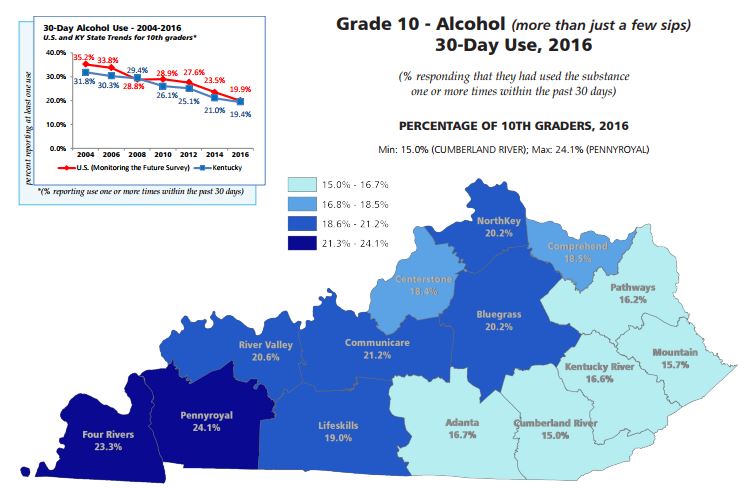
Other good news: Alcohol use among Kentucky sophomores continues to drop, although it continues to be the controlled substance they most often use. In 2016, 19.4 percent reported drinking alcohol in the 30 days prior to the survey, down from 21 percent in 2014.

Alcohol use among 10th graders is higher in Western Kentucky. The Pennyroyal region (Caldwell, Christian, Crittenden, Hopkins, Lyon, Muhlenberg, Todd and  Trigg counties) had the highest rate, 24.1 percent, followed by 23 percent in the Four Rivers region (Ballard, Calloway, Carlisle, Fulton, Graves, Hickman, Livingston, Marshall and McCracken counties).

Those western regions also had the highest rates for binge drinking, defined as drinking five or more drinks in a row at one or more times in the two weeks prior to the survey. In Four Rivers it  was 13.2 percent, in the Pennyroyal 12.4 percent.

Statewide in 2016, the rate for binge drinking was 10.4 percent, down from 12 percent in 2014. The poll found that almost 10 percent of the 10th graders in the 2016 survey had gone to school drunk or high at least one time in the year prior to the survey.

Marijuana use among Kentucky sophomores has been declining since 2010, but pot remains the most widely used illegal substance by this age group. The poll found 11.3 percent said they had used marijuana one or more times within the 30 days prior to the survey. The Pennyroyal region, at 14.7 percent, had the highest rate.

The rate of Kentucky 10th graders who abused prescription drugs (using them without a prescription) 30 days prior to the survey dropped to 2.7 percent in 2016, from 3.6 percent in 2014. The Pennyroyal region, which had the highest rate for this measure in 2016, was almost double this rate at 4.8 percent.

Overall, sophomores' use of heroin, cocaine, methamphetamines and ecstasy dropped slightly from 2014 to 2016. Fewer than 1 percent of the state's 10th graders reported using any of the drugs last year.

Saturday, May 6, 2017

National survey finds many Americans can't identify mental-health problems, and even some who do are unfamiliar with treatment

By Melissa Patrick
Kentucky Health News

Fewer than half of Americans recognize symptoms of anxiety, and many don't know what to do about it, even when they recognize them. And most don't know that prescription drug abuse is a treatable problem.

These were just some of the findings in a federally funded study conducted by Michigan State University that looked at mental-health literacy around four major issues: anxiety, depression, alcohol abuse and prescription drug abuse. It's timely, since May is Mental Health Awareness Month.

Sheila Schuster
"I think that Kentucky has a poor level of health literacy, period, and I would say probably, as the case is nationally, also a poor understanding of mental-health issues," Sheila Schuster, of the Kentucky Mental Health Coalition, said in a telephone interview. She noted that often, Kentucky adults and children alike, tend to use the catch-all phrase "my nerves are bad" to describe any state of poor mental health.

Participants in the study were asked to read short stories about each of the four issues and then asked questions about the stories. Nearly 4,600 people participated in the national, web-based survey.

It found that 54 percent of the participants were not able to recognize the symptoms of anxiety, while 46 percent could. Those who recognized the symptoms were more likely to recommend professional help over self-help strategies, and were also less likely to feel stigma.

Stigma about anxiety remains strong, with 63 percent of the respondents having some level of stigma toward anxiety and 73 percent of them reporting that this stigma exists in their communities.

Anxiety symptoms include restlessness, fatigue, worry, difficulty in concentration, muscle aches, and changes in sleeping patterns.

The study also looked at depression. Nearly one in five Kentucky adults at some time in their life have been told by a health-care provider that they are depressed, according to polling by the federal Behavioral Risk Factor Surveillance System. Nationally, 16 million adults reported they had a "major depressive episode" in 2015.

Symptoms of depression include difficulty concentrating, fatigue, hopelessness, insomnia, overeating, undereating, muscle aches and sadness.

Study participants were better able to identify depression than anxiety, with 69 percent of them correctly identifying the condition, half again as much as the percentage who could identify anxiety. Again, those who recognize the symptoms of depression were much more likely to recommend professional help than those who didn't recognize the symptoms.

A recent Kentucky Health Issues Poll found that nearly half of Kentucky adults know someone who has a serious problem with depression and nearly 70 percent of those polled said they knew who to contact for services for treatment.

Asked about stigma from depression, 62 percent of the respondents expressed some level of stigma about the condition and 71 reported some stigma in their communities.

"Stigma toward people with depression is a huge barrier to treatment, as individuals do not discuss their depressive symptoms, and are therefore unable to get the help they need. Almost 60 percent of individuals who have depressive symptoms do not seek treatment," says the report.

Schuster, a retired clinical child psychologist, said fear of being labeled and fear of stigma often keeps individuals from seeking treatment for any kind of mental health care.

"We see that in the local communities, small-town communities where people are reluctant to be seen going into the community mental health center," she said. "If it was just a doctor's office building or a health center where services were co-located, where you could get physical and mental health services, people would probably be more likely to go in."

The study also looked at alcohol abuse and prescription-drug misuse.

More than three out of five respondents (63 percent) were able to identify alcohol abuse, which affects almost 16 million Americans; 37 percent were not able to identify it.

Two-thirds of those who correctly identified alcohol abuse recommended self-help strategies instead of recommending professional help, suggesting that many might not be aware that professional help exists for this condition.

About half (51 percent) of respondents who couldn't identify alcohol abuse recommended professional help, while 35 percent of this group recommended self-help strategies.

Symptoms of alcohol abuse include spending a great deal of time obtaining and using alcohol; failing to fulfill obligations at work, home or school due to alcohol use; and continuing to use alcohol despite its negative impact.

Prescription drug abuse is a huge problem in Kentucky. In the survey, 68 percent could correctly identify it, but nearly one-third couldn't.

Signs of prescription drug abuse include taking higher doses than prescribed, excessive mood swings, changes in sleeping patterns, poor decision-making and seeking prescriptions from more than one doctor.

And like alcohol abuse, those who recognized prescription drug misuse were much more likely to recommend self-help strategies than professional help, whereas those who did not identify the misuse were more likely to recommend professional help than self-help.

"Nearly eight in 10 people don’t recognize prescription drug abuse as a treatable problem," says the release.

"I'm not sure that people really understand what an addiction is, as opposed to thinking well, they just made a bad choice or they aren't right with God, or those kinds of things," Schuster said.

Individual and community stigma for alcohol abuse and prescription drug misuse was about the same, 77 percent for individuals and 80 percent and 82 percent respectively for communities.

"There is more talk about the addiction issues than there has been, so in some ways there is a lot less stigma about say, that person has an opiate addiction or is on heroin," Shuster said. "I'm not sure it's any better on the mental-health side. . . . If you see people who are agitated, very anxious or very depressed, I think people tend to shy away from them. They don't want to engage with them. They don't want to talk about it. So, I'm not so sure that that is any better than it has been."

Mark Skidmore, one of the researchers, said the survey aims to give health officials and policymakers a better understanding of where to target education and prevention efforts for these major societal issues. The study is funded by the U.S. Department of Agriculture and the Substance Abuse and Mental Health Services Administration.

Schuster said parents need to start talking to young children about how they react to things and help them learn how to better define their emotions. "We really need to educate our kids as much in health topics, both physical and mental health, as we do on pure education topics," she said.

"It would be really helpful if we developed a curriculum where we [encourage] people to ask questions about their mental health, their spiritual health if you will, their behavioral health as well as about their physical health. . . . [to have a] pretty simple check-list of things to at least acquaint people with some of their symptoms" so they would better know when to get help.

Most primary-care physicians and nurse practitioners, don't ask patients, "How are things with you? What's going on in your life? What kind of stress are you under? How are things now compared to six months ago? What is your outlook for the future?" Schuster said. "I don't think they are taking the time to look at that, and yet we know that I think it's 80 percent of the doctor visits are for symptoms that are much more psychological than organic in nature. We need to focus on the whole person."

Sunday, March 26, 2017

59 percent of Ky. adults have experienced at least one adverse childhood experience, linked to physical and mental health issues

Robert Wood Johnson Foundation illustration
By Melissa Patrick
Kentucky Health News

Many health-care providers have started looking at adverse childhood experiences when assessing their patients' poor health because ACEs have been linked to risky health behaviors, chronic health conditions, low life potential and early death, and because 59 percent of Kentucky adults were exposed to at least one such experience as a child.

"There are things that happen to us early that make a huge difference in what happens to us as we get older," Dr. Connie White, senior deputy commissioner for the Kentucky Department of Public Health, said at a March 22 meeting in Frankfort to prioritize the state's top health issues.

ACEs are "potentially traumatic events that can have negative, lasting effects on a person's health and well-being, including early death," the department says. They include: physical abuse, sexual abuse, emotional abuse, physical neglect, emotional neglect, a mother being treated violently, parental separation or divorce, substance misuse within the household, mental illness in the household, and having an incarcerated household member.

White said it is important for children to live in a secure and nurturing environment during the first two years of their life because this is when brains are "hard-wired" for social-emotional development. But she said it is just as important for children to grow up in an environment that is free of traumatic events.

"It's like building a house," she said. "There is a foundation, and if you don't start out with a very good foundation you are going to have a very unstable house."

White said children who grow up with ACEs often struggle academically and behaviorally.

"These children have impaired memory, they have an inability to concentrate, it's hard for them to stay seated, it's hard for them to follow directions, they are constantly on edge, they are easily provoked and they are impulsive because of the toxic stress they have at home," she said. "So these are children that are hard to deal with and I think the folks in our judicial system see these children all the time."

At least one program in the state is working to inform educators on how to deal with ACEs. The Louisville program, called the "Bounce Coalition," provides training on ACEs and resiliency to school staff and out-of-school activity providers in two Jefferson County public schools and will soon expand to three more and more than 500 YMCA programs this spring. This work, funded by a grant from the Foundation for a Healthy Kentucky, is expected to evolve into a state model for addressing ACEs.

Research shows that the impacts of ACEs don't end in childhood. The original ACE study, conducted by the Centers for Disease Control and Prevention and Kaiser Permanente, found a clear scientific link between many types of childhood adversity and the adult onset of physical disease and mental health disorders.

The report said that as the number of ACEs increases, so does the risk for things like alcohol abuse, chronic disease, poor work performance, financial stress, domestic violence, suicide and poor academic achievement, to name a few. It also found that people with six or more ACEs died nearly 20 years earlier than those without ACEs.

Kentucky just started surveying for ACEs on its 2015 Behavioral Risk Factor Survey. The poll found that 59 percent of Kentucky adults had experienced one or more ACEs, 64 percent had two or more and 17.5 percent had experienced four or more, higher than any other state that surveys for ACEs.

Kentucky's survey found similar results as the original national study, showing that the more ACEs a Kentucky adult had, the more likely he or she was to have smoked cigarettes, use and abuse alcohol use, bear or father children in their teens, attempt suicide during adolescence, have chronic depression as an adult, have impaired work performance, and have many chronic diseases.

"So this is an issue that I think we all need to be cognizant of so that we are not asking people what's wrong with you, but we start to think what happened to you and how did you get where you are right now," White said, noting that it is never too late for a person to learn how to be more resilient.

She added: "We can't go back and fix what's happened, but we can work on trying to figure out where people are coming from and how we can help them be better."

Sunday, May 10, 2015

Kentucky had biggest increases in binge drinking, heavy drinking and any drinking from 2005 to 2012, first county-level study shows

By Melissa Patrick
Kentucky Health News

Kentucky has a relatively small percentage of drinkers compared to the rest of the nation, but it appears it is leading the nation in the increases in the percentage of people who are drinking any alcohol, drinking heavily and binge drinking, especially among women, according to a new analysis of county-level drinking patterns in the U.S.

The study took a look at any drinking, heavy drinking and binge drinking at a state and county level and found that Kentucky leads the nation in the percentage of increase in all three categories. Kentucky showed a 17.6 percent increase in any drinking, compared to no national increase; a 60.8 percent increase in heavy drinking, compared to 17.2 percent nationally; and a 29 percent increase in binge drinking, compared to 8.9 percent nationwide, between 2005 and 2012.


"It is surprising that there has been such a big increase in Kentucky in more people drinking," Ty Borders, professor of health management and policy at the University of Kentucky, said in an interview. "I'm not sure why that would be, especially because it was the only state that had this really big increase in drinking and risky drinking. ... It just really doesn't make sense."

Borders was perplexed at these outcomes, especially for the "any drinking" category, saying that because there is a greater percentage of persons who are members of religious affiliations that forbid drinking in the Southeast, people in this region tend to drink less. He expressed more confidence in the state and national estimates than the county-level estimates because of the often low response rates generated by the Behavioral Risk Factor Surveillance System on which the county estimates are based, but he said, "This is the best we have at the county level." The system is a continuous national poll by the federal Centers for Disease Control and Prevention.

Allen Brenzel, medical director for the state Department for Behavioral Health, Developmental and Intellectual Disabilities, emphasized in an interview that while Kentucky is well below the national alcohol abuse averages, this report shows an "alarming trend, regarding women particularly."

“It really does show that we need to be careful to not become so preoccupied with prescription drug abuse and opiate abuse,” he said. “We need to realize that alcohol is still a major issue when we see trends like this, we need to rebuild our education, prevention and treatment efforts.”

Borders agreed. "If you think about the overall burden on the health of the population, alcohol is still the top in terms of the effect it has on our health status and other downstream factors such as loss work productivity and also health-care costs," he said. "A lot of attention has been focused on obesity and illicit drug use, but alcohol misuse really remains a very big public health concern and it should be at the forefront of issues that we are discussing."

Brenzel said that while the BRFSS data is “more intended to be used across states and across regions of the country,” which makes it “a little bit challenging to break it down specifically” to counties, this data does show a statewide “absolute increase from the 2005 levels.”

He also said that this report conflicted slightly with a recent state report that shows a consistent decline in alcohol use and abuse in both boys and girls during the same time period. “Typically, what we see is that trends in children are usually reflected later in trends in adults,” he said.

Brenzel offered several possible reasons for the increases found in the report, but said it would take a while to “drill down” the specifics. He suggested one thing to investigate regarding the increases shown in women is whether it has become more socially acceptable in Kentucky for women to drink, especially with the increased marketing of liquor to women.

He suggested that the increased number of Kentuckians who are in the active military might have influenced the increases shown in this study, saying studies have shown that if a family has someone actively in the military, it tends to have higher drinking rates. He also noted that the socioeconomic strains that occurred between 2005 and 2012 could have also influenced these increases.

The study, "Drinking patterns in U.S. counties from 2002 to 2012," by the Institute on Health Metrics and Evaluation at the University of Washington, was published in the American Journal of Public Health and is the first study to track trends in alcohol use at the county level.

It defined "any drinking" as one drink in the past 30 days, "heavy drinking" as more than one drink a day for women and two drinks per day for men, and "binge drinking" as at least five drinks for men and four for women on a single occasion during the previous 30 days.

The data are adjusted for age, and the county figures reflect statistical modeling to compensate for small sample sizes. Click here for an interactive map of the data, which shows the possible ranges of percentages, reflecting the poll's error margin.

Drinking in Kentucky

The study found that nationwide, Kentucky showed the greatest increase in drinking, with a 17.6 percent (possible range of 10.6 to 25) increase between 2005 and 2012. No other state was even close; Tennessee ranked second at 11.3 percent and Louisiana was third at 9.8 percent. Nationally, there was no percentage increase in drinking during this time frame.

Kentucky women led the nation in increased drinking, at 21.9 percent, with Tennessee women at 17 percent. Kentucky men also led the nation in this category with an increase of 14.6 percent, followed by Louisiana at 9 percent and Tennessee at 7.3 percent.

In 2012, 43.1 percent of Kentuckians drank at least one drink per month, including 36 percent of women and 50.4 percent of men. Nationwide, 56 percent of Americans have at least one drink a month.

Heavy drinking in Kentucky

Kentucky also showed the nation's largest increase in heavy drinking, up 60.8 percent (possible range 39 to 89.5) between 2005 and 2012. Once again, no other state was close. South Dakota came in at 46.5 percent, Nebraska 45 percent, Kansas 44.5 percent and Washington, D.C., 42.2 percent. Nationally, the increase in heavy drinking was 17.2 percent.

Kentucky's increase was driven largely by women, who showed a 68.2 percent increase in heavy drinking. Nebraska (63.8 percent) and Oklahoma's (60.1 percent) women had the next largest increases in this category. Kentucky men also led the nation in this category with a 57.6 percent increase in heavy drinking, followed by Washington, D.C., at 52.1 percent. Other states were nowhere close to these numbers.

In 2012, 7.2 percent of Kentuckians self-reported as heavy drinkers, including 4.6 percent of women and 10 percent of men. Nationwide, 8.2 percent of Americans identify as a heavy drinker.

Heavy drinking is a risk factor for long-term health effects like cancers, liver damage and heart disease, according to the study.

Binge drinking in Kentucky

Kentucky also led the nation in increased binge drinking, up 29 percent (possible range 17.9 to 42.7) between 2005 and 2012, compared to 8.9 percent nationally. Washington, D.C, up 21.4 percent, and Maryland, up 20.8 percent, were next in the rankings for increased binge drinking.

This increase in Kentucky was also driven by women, with 51.4 percent more of them binge drinking between 2005 and 2012, compared to 17.5 percent nationally. This was far ahead of the next two state leading this category, Maryland women at 34.7 percent and Vermont women at 32.3 percent. Men in Kentucky increased their binge drinking by 20.7 percent, followed by Washington, D.C., at 17.9 percent and Kansas at 17.6 percent. Other states were not close.

In 2012, 15.1 percent of Kentuckians self-reported as binge drinkers, compared to 18.3 percent nationally, including 9.5 percent of Kentucky women and 21 percent of Kentucky men.

Binge drinking is commonly linked to higher risk for serious bodily harm like car crashes, injuries and alcohol poisoning and acute organ damage, says the study.

Nationwide, women showed a much faster escalation in binge drinking than men, with rates rising 17.5 percent between 2005 and 2012; men, on the other hand, saw rates of binge drinking increase 4.9 percent, according to the release.

“We are seeing some very alarming trends in alcohol overconsumption, especially among women,” Dr. Ali Mokdad, a lead author of the study and professor at the Institute for Health Metrics and Evaluation, said in a press release. “We also can’t ignore the fact that in many U.S. counties a quarter of the people, or more, are binge drinkers.”

County data

This report is the first to track trends in alcohol use at the county level, and while the confidence level for the county data are lower than the state data, the report found that every Kentucky county experienced increases in rates of drinking since 2005, with Lawrence County recording the largest increase in drinking at 43.5 percent (possible range 21.4 to 67.8).

Kenton County posted the highest levels of heavy drinking in 2012 (13.1 percent, with a possible range of 10.2 to 16.4), and Bracken County experienced the fastest rise in heavy drinking between 2005 and 2012, increasing 94 percent (possible range 42 to 188.8).

Pike County experienced the largest increase in binge drinking for women, climbing 90 percent (possible range 45.9 to 166.6), says the release.

Campbell County had the highest percentage of binge-drinking residents (27.3 percent with a possible range of 23.9 to 31.8), and Lawrence County recorded the fastest increase in rates of binge drinking, rising 52.8 from 2005 to 2012 (possible range 24 to 88.8).

Kentucky Health News is an independent news service of the Institute for Rural Journalism and Community Issues, based in the School of Journalism and Telecommunications at the University of Kentucky, with support from the Foundation for a Healthy Kentucky.

Thursday, April 2, 2015

Polling shows Kentucky ranks third in share of residents, 24.5 percent, who say they take mood-altering drugs every day

Kentucky is the place to be for mood-altering drugs. The state ranked third in a Gallup Organization study that asked 450 adults in each state how often they use drugs and medications to affect their mood or relax them, Christopher Ingraham reports for The Washington Post. West Virginia led, with 28.1 percent of respondents saying they use mood-altering drugs every day, Rhode Island was second at 25.9 percent, but Kentucky was not far behind at 24.5 percent.

Nationally, 18.9 percent of respondents said they take drugs almost every day, while 62.2 percent said they never do, 13.1 percent said they rarely do and 5 percent said they sometimes do.

The way the question was worded allows for errors, Ingraham writes. The question asked about drugs and medications, but didn't specify which ones, and didn't mention alcohol or tobacco. That left interpretation of the question up to individual respondents.

A recent National Survey of Drug Use and Health said that at least 71 percent of American adults drank in the past year, and 56 percent drank in the past month, which if true, could raise the rates in most states, if respondents were to consider alcohol a mood-altering drug. (Read more) (To view this interactive Post map click here)

Thursday, July 18, 2013

Study shows talking with college students about binge drinking makes them think about it

College students who hear warnings about binge drinking from family or friends are more likely to be concerned about their own alcohol use, compared to those who don't hear this advice, a new study indicates.

The study found that students who were not distressed about their binge drinking had not heard concern expressed to them about their alcohol consumption.

“On the other hand, when a friend or family member expressed concerns to a student about her or his excessive drinking, it can help the student reflect on their alcohol consumption and begin to take steps to reduce it,” said lead researcher Jeffrey Hayes, professor of counseling psychology in Penn State's College of Education, in a news release.

Despite the negative consequences of binge drinking, about 80 percent of college students drink alcohol, and about half of those who drink engage in binge drinking, says the National Institute on Alcohol Abuse and Alcoholism. Hayes said more than half of college students who sought counseling reported drinking alcohol at a level considered to be “hazardous” by the World Health Organization.

As a psychologist, Hayes often hears about the negative effects of binge drinking on students' academic performance and emotional and physical well-being. "I am aware of and concerned about the ingrained culture of binge drinking among adolescents," he said in the release.

Results of this study can help inform professionals who work with college students to encourage student engagement through outreach programs, and it also raises awareness for family and friends of those who may abuse alcohol, said Hayes. (Read more)

Tuesday, June 25, 2013

Kids Count report shows where children in your county and school district rank, in a huge number of measures

Conditions have improved slightly for Kentucky children, especially in education and health, and the state's overall well-being ranking has gone up one spot, from 35th to 34th in the nation. But economic conditions for young Kentuckians have slipped since last year, says the Kids Count report released Monday by the Annie E. Casey Foundation.

The annual report measures how the country and its 50 states are doing according to four measures of child well-being – education, health, economic well-being, and family and community. How well Kentucky's children score in each domain paints a picture of Kentucky's future.

One of the many data sets available by county and school district
The report includes a wide range of data for every county and school district. The data include current and five-year rates of child poverty; median family income and median household income; infant mortality rate; child death rate; teen death rate; child abuse and neglect cases; foster care cases; births to mothers who are teenagers, who smoke, who are not high-school graduates, and who get early and regular prenatal care; pre-term births; low-weight births; newborns breastfed when they leave the hospital; early childhood obesity, number and percentage of child-support collections; asthma hospitalizations; recreational facilities; number and percentage of children receiving food stamps, Medicaid, child-care subsidies, Supplemental Security Income, and benefits from the Women, Infants and Children nutrition program; the number and percentage eligible for reduced-price meals at school; the number and percentage in publicly funded preschool; the hourly wage needed to pay fair-market rent and the percentage of renters unable to afford such rent; juvenile justice data; percentage of students ready for college and careers; and the six-year college graduation rate.

Statewide, the report shows that Kentucky has made gains in education, and the state ranks 28th on this measure. Since 2005, more children are attending preschool, more fourth-graders are proficient in reading and more eighth-graders are proficient in math, says the report.

Kentucky has also improved in many health measures. There are fewer low birth-weight babies, fewer children without health insurance and fewer teens who abuse alcohol or drugs. Medical coverage should only continue to improve as the state expands Medicaid coverage to households at 138 percent of the poverty line. However, youth advocates say gains in education and health may not be maintained if more children continue to live in poverty.

Unfortunately, Kentucky children continue to struggle economically, weighing in at 32nd in the nation. The report says 37 percent of Kentucky children have parents who lack stable employment, up from 33 percent last year, and 32 percent of children live in households that are burdened by housing costs, up from 27 percent.

The state's lowest ranking is 38th, on the family and community measure. Its constituents: More than 27 percent of children live below the poverty line, compared to the national average of 23 percent, and the number of children in single-parent families has increased from 31 percent in 2006 to 36 percent in 2011. On the bright side, teen births declined during that period.

With the hard work of child advocates, community agencies, educators and policymakers, the report shows progress has been made to improve children's well-being, but there is still much to be done. Click here for Kentucky's profile or here to go to the data center.