Showing posts with label violence. Show all posts

Monday, July 1, 2024

Your Local Epidemiologist says gun violence is public-health issue

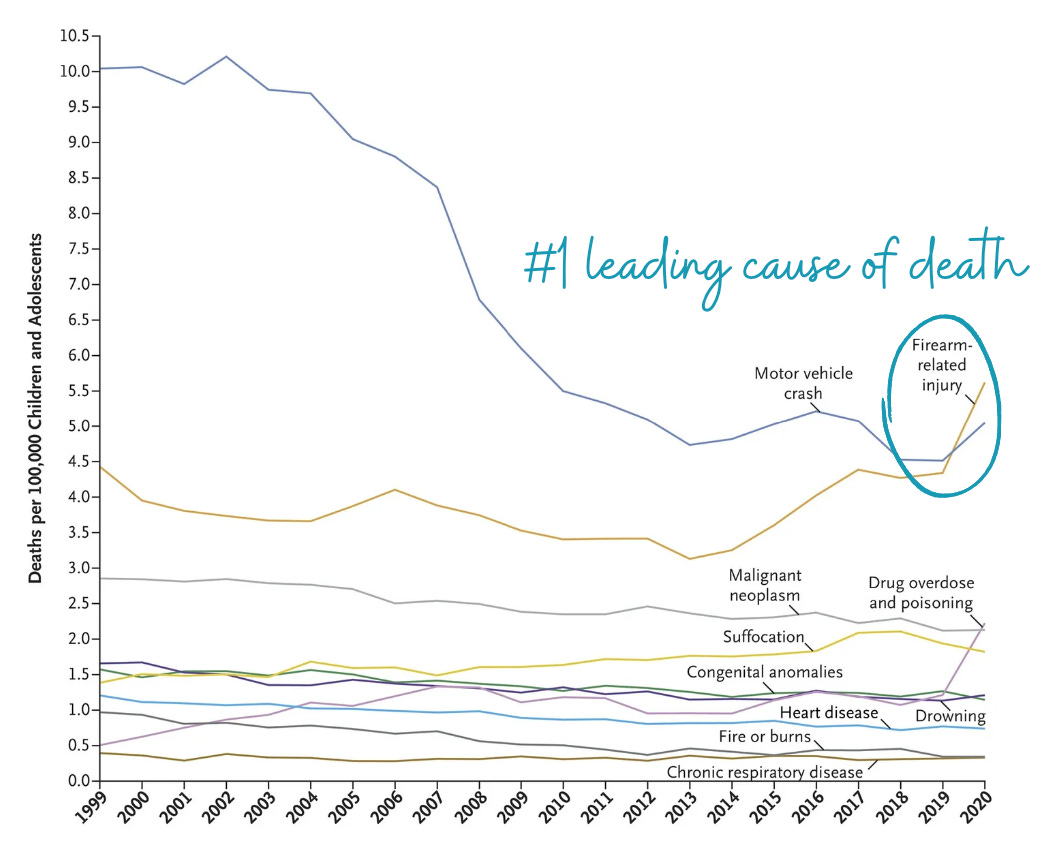
Graph from New England Journal of Medicine; Annotated by Your Local Epidemiologist
OPINION By Katelyn Jetelina
Your Local Epidemiologist

On June 24, U.S. Surgeon General Vivek Murthy declared gun violence a public-health crisis. Many narratives immediately pushed back that this isn’t public health’s lane.

Let me say this loud and clear: Gun violence is absolutely in the purview of public health. And until society accepts it as such, we will continue to lose tens of thousands of Americans annually, leaving behind massive ripples in the community. Thankfully, momentum is changing.

What is public health? It’s broader than you might think. Public health—also called population health—came into the limelight with Covid-19, but it’s much broader than a pandemic or infectious diseases. It is the science of protecting and improving the health of people and their communities.

Public health is everywhere—think seatbelts, non-smoking areas, vaccines, airbags, clean drinking water, cleaner indoor air, food security, and cancer prevention. Experts are in health departments, nonprofits, government agencies, academic institutions, and the private sector. That’s because public health is most effective when combining science, education, policy, advocacy, and innovation.

Epidemiology, one subset of public health, is charged with finding patterns: Who is impacted? What predicts certain health outcomes? Because if it’s predictable, it’s preventable.

Violence epidemiology was born out of a case study a few decades ago, which showed that clusters of cholera in Bangladesh mirrored clusters of gun violence in Chicago. This meant gun violence wasn’t random; certain factors predispose a person or community. The field has grown to study suicide, child abuse, domestic violence, and, yes, gun violence.

Gun violence patterns—who are being impacted, where, and why—have slowly emerged, providing hints about tangible and effective public health solutions. For example:
  • Firearm injuries are the leading cause of death in children. It surpassed motor vehicle crashes in 2020 for the first time.
  • 2 out of 5 homes have at least one firearm.
  • 4.6 million kids live with unlocked, loaded gun.
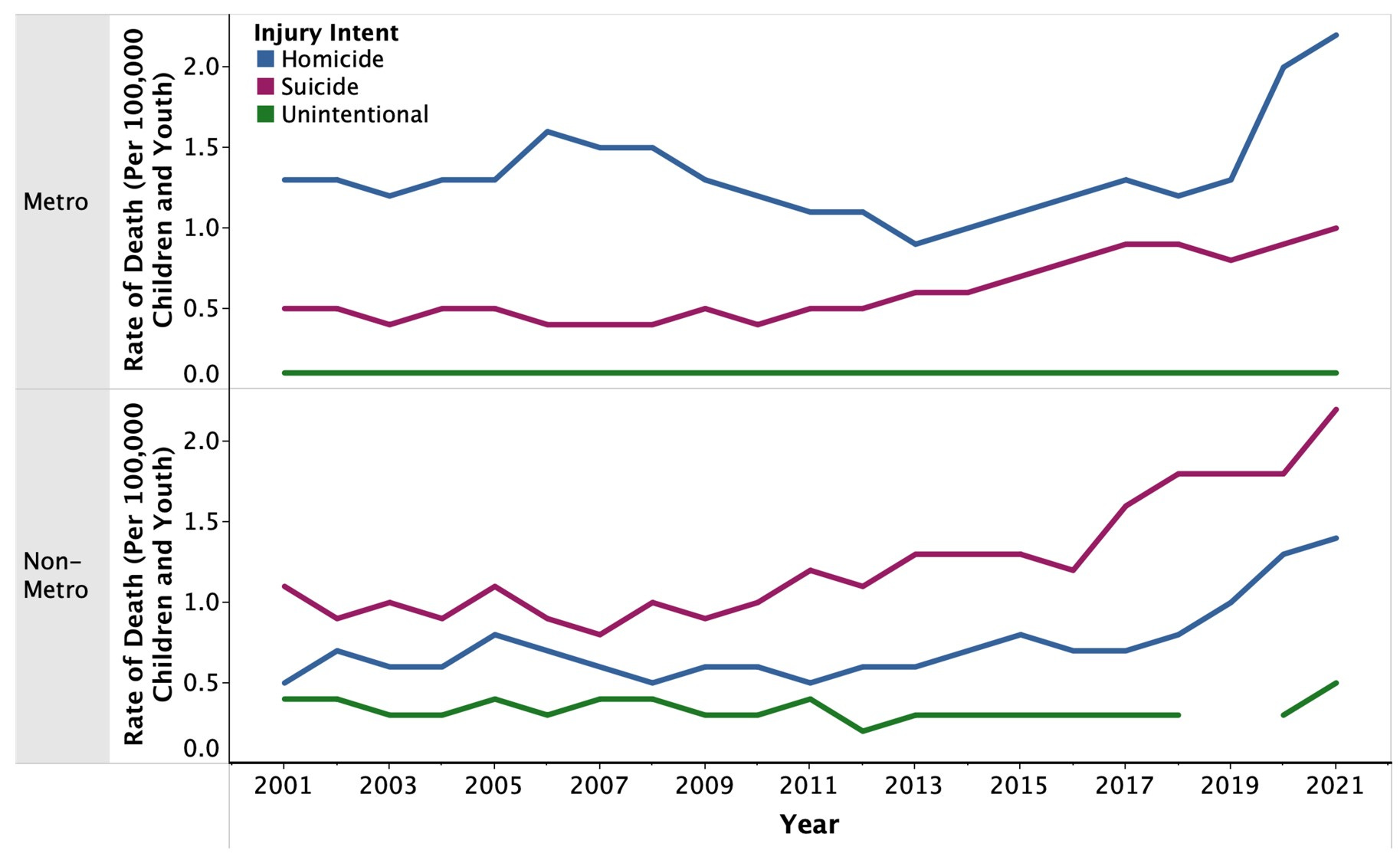
  • 1 in 3 youth suicides and unintentional deaths can be prevented by securing guns.
  • 8 out of 10 children that used a firearm say it belonged to a family member.
These patterns suggest safe storage and education for parents, for example, could (and are) move the needle.

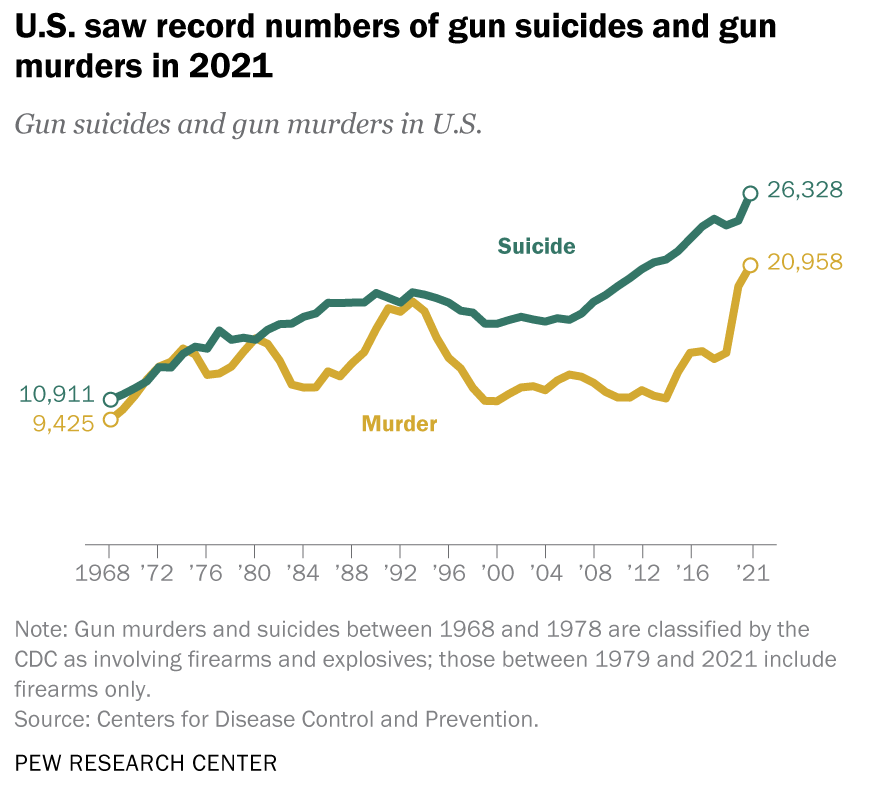
Suicides account for most gun deaths, followed by homicides. This is why some states have passed bipartisan legislation, like red-flag laws, to temporarily remove firearms from people who have been deemed a threat to themselves. It’s estimated one suicide is prevented for every 10–20 red flag orders issued.

Cause and risk are not uniform. Gun injuries and deaths differ by race/ethnicity, physical location, age, and many other factors. This suggests who and how we engage with matters to make an impact.

There are ripple effects. A single neighborhood murder can impact as many as 200 people in a community. Randomized control studies have shown that community-level interventions, like replacing vacant spaces with green spaces, break cycles of violence.

Finding answers has been a slow crawl. Although we’ve found some patterns, we’ve only scraped the surface. Progress has been plagued by an unfortunate series of events.

Rewind to 1993. A famous study published in the New England Journal of Medicine found that having a gun in the home increased the risk of homicide in the home. This set off a political domino effect, and three years later, Congress inserted the Dickey Amendment into the CDC spending bill. The provision stated, “None of the funds made available for injury prevention and control at the Centers for Disease Control and Prevention may be used to advocate or promote gun control.” The language was unclear; the epidemiologist on the 1993 study famously said, “Precisely what was or was not permitted under the clause was unclear. However, no federal employee was willing to risk his or her career or the agency's funding to find out. Extramural support for firearm injury-prevention research quickly dried up.”

This set gun violence research back decades, as it was completely reliant on nonprofits and philanthropy support. This is helpful but not enough to match the scope of the problem.

But, momentum is shifting. We see this from several angles:
  • Engagement from the bottom up. A plethora of public-health experts have partnered with groups directly impacted by gun violence. For example, working with gun owners and gun ranges to curb suicide or communities (see Cure Violence) to build solutions.
  • Funding for research. In 2020 —for the first time in 25 years—our federal budget included $25 million for the CDC and NIH to research reducing gun-related deaths and injuries. This is a start, but to be clear, it’s estimated that we need $1.4 billion to curb this epidemic. (For context, NIH gets $6.56 billion allocated for cancer research.)
  • State and federal initiatives. For example, the Office for Violence Prevention was established in 2023 to focus on key legislative actions. You may be surprised to hear that many policies have bipartisan support. Earlier this month, the office hosted 160 hospital executives and leaders to discuss the importance of using health system data to better understand patterns.
Gun violence is absolutely in the public-health lane. This is what we do. We’ve been able to do unimaginable things and save millions of lives by approaching problems with a public-health lens, like cigarettes and motor-vehicle crashes. Public health can help reduce gun violence in the U.S., and we will. But only at the speed at which society recognizes and supports it.

Sunday, August 13, 2023

Health-care workers are more likely than law-enforcement officers to have injuries and illnesses that keep them away from work

Axios graphic
Kentucky Health News

"Health-care workers are increasingly being assaulted or shot on the job, making hospitals and clinics among the most dangerous workplaces in America," report Tina Reed and Jason Millman of Axios. 

They report that health-care workforce violence was a problem long before the pandemic, and then pandemic stressors such as backlash against public health measures and inadequate staffing have made matters worse.

In fact, "Data shows American health-care workers now suffer more nonfatal injuries from workplace violence than workers in any other profession, including law enforcement," according to  The Associated PressAnd all of this can result in disrupted patient care and "alarming levels of burnout among the pandemic-fatigued health care workforce." 

"It used to be people had a respect for what was done in hospitals and the people who worked in those hospitals. That's not there anymore," National Nurses United Vice President Cokie Giles told Axios. 

Axios reports that "about three in four nonfatal workplace violence injuries involved workers in health care and social work in 2020, the most recent year for which statistics are available. And, "the frequency of injuries from workplace violence in health care has risen almost every year since 2011, reaching 10.4 per 10,000 full-time workers in 2018, up 62% from 6.4 per 10,000 in 2011, per the Bureau of Labor Statistics." 

Reed and Millman cite several examples that suggest that this trend has continued throughout the pandemic, with an increasing number of assaults involving guns. 

They also note a recent survey of health-care workers from Premier and the federal Agency for Healthcare Research and Quality that found 40% of health-care workers experienced workplace violence in the last two years.

Axios notes that hospitals are stepping up their efforts to "identify security risks, training staff on violence prevention and calling in counselors to de-escalate tense situations" and are beginning to invest in technology to help detect guns entering the building. Further, The authors write, there are ongoing efforts in Congress and statehouses to make health-care settings safer.

Saturday, June 10, 2023

OPINION: Criminologists say baseless anti-transgender claims fuel adoption of harmful laws in Kentucky and other states

By Henry Fradell and Alexis Rowland
Republished from The Conversation

It has been seven years since North Carolina made headlines for enacting a “bathroom bill” — legislation intended to prevent transgender people from using restrooms that align with their gender identity. After boycotts threatened to cost the state more than $3.7 billion, legislators repealed the law in 2017. Since then, however, religious and political conservatives have successfully spread an anti-trans moral panic, or irrational fear, across the United States.

As far back as 2001, Republican lawmakers proposed the first of what are now nearly 900 anti-LGBTQ+ bills. More than 500 of these were introduced in 49 state legislatures and the U.S. Congress during the first five months of 2023. To date, at least 79 have passed.

Many of these laws have been  written and financed by a group of far-right interest groups, including the Alliance Defending Freedom, the Family Research Council, the American Principles Project and Liberty Counsel.

These groups claim the laws protect cisgender women and girls – whose gender identity matches the sex they were assigned at birth – from violent trans people who are often depicted in movies and other media.

But as criminologists, we know these claims are without merit. No reliable data supports the argument that transgender people commit violent crimes at higher rates than cisgender men and women. In fact, transgender people are more than four times as likely to be the victim of a crime as cisgender people.

In the last year, at least 18 states including Kentucky have enacted laws that limit medically age-appropriate gender-affirming health care for trans minors, with similar bills pending in 14 more states. And Florida’s barrage of anti-LGBTQ+ regulations even prohibits the mere discussion of sexuality and gender identity in schools through the 12th grade. Journalist Adam Rhodes called these efforts a “centrally coordinated attack on transgender existence.”

We believe these laws and bills illustrate the increasingly hostile legislative landscape for LGBTQ+ people despite polls showing that most people in the United States want trans people to be protected from discrimination in public spaces on the basis of their gender.

What the data show

A variety of myths, false narratives, bad science, misconceptions and outright misrepresentations undergird anti-trans laws. The reality, however, is that trans-exclusionary laws do not protect cisgender women and girls from harassment or violence. Rather, they result in dramatic increases in violent victimization for transgender and gender-nonconforming adults and children.

When laws permit transgender people to access sex-segregated spaces in accordance with their gender identities, crime rates do not increase. There is no association between trans-inclusive policies and more crime. As one of us wrote in a recent paper, this is likely because, just like cisgender folks, “transgender people use locker rooms and restrooms to change clothes and go to the bathroom,” not for sexual gratification or predatory reasons.

Conversely, when trans people are forced by law to use sex-segregated spaces that align with the sex assigned to them at birth instead of their gender identity, two important facts should be noted.

First, no studies show that violent crime rates against cisgender women and girls in such spaces decrease. In other words, cisgender women and girls are no safer than they would be in the absence of anti-trans laws. Certainly, the possibility exists that a cisgender man might pose as a woman to go into certain spaces under false pretenses. But that same possibility remains regardless of whether transgender people are lawfully permitted in those spaces.

Second, trans people are significantly more likely to be victimized in sex-segregated spaces than are cisgender people. For instance, while incarcerated in facilities designated for men, trans women are nine to 13 times as likely to be sexually assaulted as the men with whom they are boarded.

In women’s prisons, correctional staff are responsible for 41% of women’s sexual victimization, with cisgender women committing the balance of nearly all prisoner-on-prisoner violence. Similarly, trans boys and girls who are barred from using the washrooms and locker rooms that align with their gender identity are respectively between 26% to 149% more likely to be sexually victimized in the locations they are forced to use than cisgender youths.

In society at large, between 84% and 90% of all crimes of sexual violence are perpetrated by someone the victim knows, not a stranger lurking in the shadows – or the showers or restroom stalls. But trans and nonbinary people feel very unsafe in bathrooms and locker rooms, though others experience relative safety there. In fact, the largest study of its kind found that upward of 75% of trans men and 64% of trans women reported that they routinely avoid public restrooms to minimize their chances of being harassed or assaulted.

Lies drive harm

Because criminological data does not support trans-exclusionary laws or policies, advocates of anti-trans laws often resort to lies, flawed anecdotal evidence, or what fact-checkers have called “extreme cherry-picking” to support their position.

For instance, one of us documented how isolated news stories, often from notoriously transphobic tabloids, conflate the actions of sexual predators with the “dangerousness” of trans women. Although there are undeniably examples of actual transgender people committing crimes, even deeply troubling ones, they are not evidence of any behavioral trends among the broader class of trans people. No such data exist.

We believe the spate of anti-trans proposals represents a textbook example of crime-control theater – an unnecessary, ineffective and harmful legislative response to unfounded fearmongering.

Anti-trans laws are not just baseless. They’re hurtful and damaging, especially to LGBTQ+ teenagers. Recent polls indicate that more than 60% of these people experience deteriorating mental health — including depression, anxiety and suicidal thoughts – as a result of laws and policies aimed at restricting their personhood.

The criminological research is clear that anti-trans laws do not help the people they are claimed to protect. In fact, these laws inflict harm on people who are even more vulnerable.

Henry Fradella is a professor in the School of Criminology and Criminal Justice at Arizona State University, where he also holds a law-school appointment . He is the author, co-author, or editor of 13 books, including
LGBTQ+ Issues in Criminology and Criminal Justice. Alexis Rowland is a Ph.D. student in criminology, law and society at the University of California, Irvine.

Tuesday, May 9, 2023

More Kentucky youth received emergency care for self-harm in 2021 than in 2020, reversing decline in youths' intentional injuries

Ky. Injury Prevention Research Ctr. graph, adapted by Ky. Health News
By Melissa Patrick
Kentucky Health News

Fewer young people in Kentucky got emergency care in the first year of the pandemic for intentional injuries, but in the second year, the number rose, mainly due to a 15 percent increase in cases where youth, mostly girls, harmed themselves.

That's according to a report from the Kentucky Injury Prevention and Research Center on intentional injury-related emergency department visits among Kentuckians aged 10 to 24. It says people in this age group, which it calls youth, have an increased risk for these injuries that often require medical care. 

Intentional injuries are violence-related injuries, whether they be directed toward oneself, called self-harm or intentional injury in this report; or directed toward others, which this report refers to as assault.

The researchers found that from 2016 to 2021, Kentucky resident youth made 40,579 emergency-department visits for intentional injuries, amounting to about 6,763 visits per year. It notes that the median cost of an ED visit for self-harm injuries was $2,577 and for assault injuries was $1,644.

In those years, most of the intentional injury-related ED visits occurred in people aged 15 to 24, followed by those 10 to 14, the report says. And when it comes to self-harm, an overwhelming number of those ED visits, or 71%, involved girls or women. 

Slightly more male youths, 52%, visited EDs as a result of assault. Most self-harm injuries (58%) and assault injuries (63%) were among youth living in metropolitan areas.

Most injuries were among white youth, 84% for self-harm and 71% for assault. For Blacks, the numbers were 11% and 24%, respectively.  

The report also breaks down injury-related ED visits by the nature of the injury. The top two self-harm injuries in 2016-21 were drug poisoning, 50.3%, and cut or pierce, 31.5%. The top two assault injuries were striking by or against, 68%, and child or adult abuse, 10.7%. Only 2.1% of the ED visits for assault injuries were related to firearms. 

Among self-harm injuries, the most common types were poisoning (52%), open wounds (22%), and superficial injuries or contusions (11%). The most common types of assault injuries were superficial or contusion (30%), open wound (18%), other effects of external causes (15%), and fractures (13%).

The report also found that most Kentucky youth ED visits for injuries related to intentional harm were discharged to home or to self-care: 48.4% of those admitted for self-harm and 93.8% of those admitted for assault. It said 13.5% of the self-harm patients were discharged to an inpatient facility and 34.2% were discharged to a health-care facility.
The ED visit rate for youth self-harm injuries varied by region in Kentucky from 181 per 100,000 people in the Buffalo Trace Area Development District to 333.7 per 100,000 in the Kentucky River ADD. The Green River ADD had the second highest rate, at 305 per 100,000. 

The ED visit rate for youth assault injuries ranged from 385.4 per 100,000 in the Barren River ADD to 718.3 in the Kentucky River ADD. Two other ADDs were among the highest rates for this measure, KIPDA, at 705.2 per 100,000 and Green River, at 565.6 per 100,000.

Graph by Kentucky Injury Prevention Research Center; for a larger version, click on it.

Friday, June 10, 2022

UK HealthCare spending $5 million on security upgrades, setting new policies amid gun violence at health facilities in other states

Screenshot from UK Police website, adapted by Kentucky Health News
The University of Kentucky is bolstering security at health-care campuses "in response to increasing reports of violence taking place across the nation in health-care settings," a news release said Friday.

UK said its police began using handheld metal detectors on all patients and visitors entering emergency departments in April 2021, followed by installation of fixed metal detectors in July 2021. Other recent measures include having at least one police officer at each of the emergency departments around the clock.

The release said UK will spend $5 million on health-care safety, including:
  • Addition of electronic access control to all perimeter doors to restrict public access as well as replacement and modernization of aged entryways.
  • Utilization of emerging technology to enhance threat detection and expanding panic alarms and lockdown capabilities.
  • Increased security camera coverage to improve situational awareness.
  • Addition of UK Blue emergency towers to walkways where staff and patients travel frequently.
  • Enhancement of exterior lighting to improve visibility around UK HealthCare facilities.
At a virtual forum for UK HealthCare employees, Executive Vice President for Health Affairs Mark Newman and UK Police Chief Joe Monroe discussed their efforts to improve the safety and security of employees, patients and visitors.

“We also are researching better ways to make UK HealthCare a weapons-free location through screening technology and looking at strategic efforts to increase dedicated police presence on the UK HealthCare campus,” Monroe said.

The moves were announced in the wake of the June 1 killings of four people at a Tulsa hospital by man who blamed his doctor for pain after back surgery and also killed himself, but the news release said UK Police have worked for a year with a security consultant on the first phase of a continuing security review "with an initial focus on enhancing perimeter security and fortifying the emergency departments at UK Chandler Hospital and UK Good Samaritan Hospital," the news release said.

"Hospital trauma departments are on the front lines whenever there's a mass shooting, but when those spaces are targeted, staff must mobilize to not only protect their patients but themselves," Axios Vitals reports. "And yet, efforts to fortify health facilities could also conflict with their traditional roles as community resources and safe spaces.

Axios Vitals notes that "From 2010 to 2020, shootings resulted in 39 deaths at health-care facilities accredited by the Joint Commission. From 2000 to 2011, researchers found there were 154 hospital-related shootings in the U.S. A survey from the American College of Emergency Physicians in 2018 concluded that nearly half of emergency- room doctors have been assaulted at work."

Wednesday, March 25, 2015

Heroin bill finally passes and is signed into law; Naloxone program put into motion; dating-violence bill sent to Beshear

By Melissa Patrick
Kentucky Health News

The long-negotiated bill to tackle Kentucky's heroin-overdose epidemic passed in the final hours of the 2015 legislative session.

Almost immediately after the heroin bill passed the Senate, a bill to offer immediate civil protections to dating partners who are victims of dating violence was passed after being held in the chamber since February 13 -- likely because Democratic Rep. John Tilley of Hopkinsville, chair of the House Judiciary Committee, was the original sponsor of both bills.

Tilley told reporters that the passage of the two bills meant it had been a successful session.

Gov. Steve Beshear signed the heroin legislation, Senate Bill 192, into law Wednesday, March 25, less than 12 hours after it passed, so that its emergency clause could put it into effect immediately. The dating violence bill, House Bill 8, has been delivered for his signature.

"Senate Bill 192 is tough on traffickers who bring these deadly drugs into our communities, but compassionate toward those who report overdoses or who admit they need help for their addiction," Beshear said in a release. "I applaud our legislators for putting aside partisan interests for the greater good of all Kentuckians who have been affected by this devastating drug."

The bill passed the Democrat-controlled House 100-0 and the Republican-controlled Senate 34-4. Republican senators John Schickel of Union, Joe Bowen of Owensboro, Chris Girdler of Somerset and Paul Hornback of Shelbyville voted against it.

The stickiest issues were a needle-exchange program, which many senators opposed, and tough new penalties for drug traffickers, which Tilley and many House members said would not be effective. The new law allows needle-exchange programs of approved by local governments, and the tough penalties, but allows the judge to be lenient in sentencing if the defendant is an addict.

The bill also allocates money for drug treatment programs; includes a "good Samaritan" provision that allows a person to seek medical help for an overdose victim and stay with them without fear of being charged; access for addicts and their families to the drug Naloxone, a drug that reverses the effects of an overdose; and allows the Department of Corrections to provide an approved medication to inmates to prevent a relapse in their addiction.

"The bill includes provisions that are important to law enforcement and me: increasing penalties for large volume traffickers, expanding access to treatment, and getting heroin overdose reversal kits into the hands of our first responders. I know this legislation will save lives," Attorney General Jack Conway said in a news release.

Hornback argued that "forced rehab doesn't usually work," providing addicts with Naloxone and free needles simply enables them and the bill does not allow addicts any "consequences for their actions."

He said that while he knows there are people dying from heroin overdoses,"I didn't make that decision for them and I for one, and a lot of my constituents are tired of paying for people's bad decisions and that is what this (bill) does."

Tilley said in an interview after the vote that needle exchange programs are proven to work, will save taxpayers money and are absolutely necessary to "stem the tide of two tidal-waves that are headed Kentucky's way: HIV and Hepatitis C and Hepatitis B."

"The cost of treating someone with HIV is $350,000. The cost of treating someone with Hepatitis C is $85,000. The budget now had a $55 million hit just with the explosion of Hepatitis C last year. We can't afford that in Kentucky," he said. Advocates say the programs can be a gateway to treatment and rehabilitation.

Meanwhile, Conway and first lady Jane Beshear announced that funding for Naloxone kits would be made available to the hospitals in Kentucky with the highest rates of heroin overdose deaths. The kits will be provided free to every treated and discharged overdose victim at the pilot-project hospitals.

They made the announcement at the University of Louisville, which treated 588 people in 2013 for heroin overdoses, a news release said. In 2013, the latest data available, 230 of the 722 autopsied overdose deaths, or 32 percent, were caused by heroin, according to the Kentucky Office of Drug Control Policy.

Tilley and Republican Sen. Whitney Westerfield, also of Hopkinsville, "forged a friendship that allowed the two men to work out differences on a pair of high profile bills fraught with political pitfalls," Adam Beam reports for The Associated Press. "Westerfield, a former prosecutor, is running for attorney general against the son of Democratic Gov. Steve Beshear, giving Democrats all the reason in the world not to work with him."

The AP notes that Republican Sen. Chris McDaniel wrote the first draft of the heroin bill that passed the Senate in January, but it omits McDaniel's other role: candidate for lieutenant governor on a slate headed by Agriculture Commissioner James Comer. As the Senate prepared to give the final bill final passage, Republican Floor Leader Damon Thayer accused the House of not passing McDaniel's bill because of his candidacy.
Read more here: http://www.kentucky.com/2015/03/25/3767938_political-compromises-brokered.html?rh=1#storylink=cpy

Tuesday, September 10, 2013

Caregivers of Alzheimer's patients suffer, sometimes to death

Jim Crabtree


It's common to hear about diseases like Alzheimer's drastically affecting the lives of those who have it, often causing severe struggles and hardships. What you may not hear much about is how caregivers of people with Alzheimer's can also suffer deeply and greatly.

Jim Crabtree was actually relieved to find out that his wife and mother had been shot and killed by his father who then shot and killed himself, Linda Carroll of NBC News reports. (Today show photo: Crabtree with his wife, Rita)

"Crabtree had been struggling" to care for his 62-year old wife, who had been diagnosed with Alzheimer's six years before, and his elderly parents: a father with dementia and a mother with crippling arthritis.

Crabtree said he felt stretched thin with the responsibility of caring for his family and that by killing them, his father actually got rid of the burdens they caused him all at once, Carroll reports.

"Although rare, there are other murder-suicide cases involving caregivers and their charges. It’s a sign of how stressful the job is," Linda Ercoli, director of geriatric psychology at the Semel Institute at the University of California, Los Angeles said in the story.

The Alzheimer's Association has created a test for caregivers to check their stress levels. 

Carroll describes how caregivers' emotions can range from helplessness to anger when they don't understand that certain annoying behaviors by their ill patients could be symptoms of the disease. Because of high emotions that can arise in a home with Alzheimer's patients, Ercoli explains that violence isn't uncommon. Studies have found that 5 percent of caregivers have been violent with their patients and 16 percent of patients have been violent with their caregivers.

Caregivers at first get a certain satisfaction from taking care of others, but as the disease progresses, they tend to suffer from deep depression, anxiety or other disorders, Ercoli explains. Also, Carroll adds, caregivers sometimes face the risk of becoming physically sick themselves. 

Experts say that caregivers should reach out more to each other for support. “People don’t say, ‘I survived Alzheimer’s’,” Crabtree said. “We are the survivors. I survived caregiving.”

Wednesday, November 14, 2012

No-Hit zones in place in pediatric wards of Kosair and U of L children's hospitals

Health professionals and other employees at Kosair Children's Hospital and the University of Louisville pediatrics unit were given an unusual tool this week when it was announced that their facilities are now No-Hit Zones. A program developed to maintain a calm, safe and caring environment for children and their parents, the No-Hit Zone initiative works to educate staffers on how to keep everyone on the ward safe from those who would lose their tempers while everyone around them is already in a stressful situation.

The policy is quite clear. No adult shall hit another adult. No adult shall hit a child. No child can hit an adult. And no child can hit another child while in the hospital environment.

The Kosair Children's, Kosair Children's-Brownsboro and U of L hospitals are now among only 30 children’s hospitals nationwide to implement the No-Hit Zone program. The Louisville effort has been led by Erin Frazier, M.D., FAAP, associate professor of pediatrics at the Uof L Children & Youth Project, and the Kosair Children’s Hospital Child Abuse Task Force, which Dr. Frazier chairs.

To learn about the No-Hit Zone, go here.

Monday, June 11, 2012

New law will allow officers to make arrests in emergency-room assaults that they do not witness


Emergency-room workers who treat individuals under the influence of drugs or alcohol will have greater legal protection, and those who misbehave in ERs will have less protection, under a law that will take effect next month.

The measure, sponsored by Sen. John Schickel, R-Union, will allow peace officers to make an arrest or issue a citation for a fourth-degree assault that occurs in a hospital emergency room, even if the officer didn’t witness the crime, as long as the officer has probable cause to believe the offense occurred.

“Hospital emergency personnel treat individuals in the worst of conditions – and sometimes that means putting themselves at risk, if a patient comes in intoxicated or high,” Gov. Steve Beshear said at a ceremonial signing of the bill today.  “This law gives medical staff the security of knowing that an offender will be held accountable for an assault that takes place when they’re brought in for care.”

Under current law, a hospital worker has to swear out a warrant alleging assault. Fourth-degree assault is a Class A misdemeanor, punishable by up to a year in jail.

Monday, July 25, 2011

Workshop Aug. 4-5 will help health groups with policy, programs

A two-day workshop intended to help health coalitions and organizations make progress at the policy level and implement evidence-based programs will begin Aug. 4.

On the first day, speaker Monte Roulier of Community Initiatives will speak about the art and science of building health and whole communities. On the second day, speakers from the Centers for Disease Control and Prevention will demonstrate how to use The Community Guide, a free resource that offers guidance on what programs and policies are evidence-based for obesity, mental health, asthma, tobacco, substance abuse, violence and other health issues.

The workshop is part of the "Health for a Change: Ignite — Unite — Act" series, a program of the Foundation for a Healthy Kentucky. It starts at 10 a.m. Aug. 4 and ends at 4 p.m. Aug. 5. at the Hurstbourne Place Office Building in Louisville. To register, click here.