Showing posts with label prescription drugs. Show all posts

Tuesday, February 13, 2024

Attorney General Coleman sues Kroger over opioid dispensing

Attorney General Russell Coleman has sued the Kroger Co. for its role in the opioid epidemic in Kentucky. 

The lawsuit, filed in state court in Bullitt County, alleges that the Cincinnati-based grocery chain, the nation's largest, bought more than 4 billion morphine-milligram equivalents of opioids for Kentucky from 2006 to 2019, and during that time distributed almost 194 million hydrocodone pills to its Kentucky pharmacies while failing to effectively monitor for suspicious opioid orders.

"Kroger's 100-plus pharmacies in the state were responsible for over 11% of all opioid pills dispensed in Kentucky, totaling hundreds of millions of doses flooding into communities without any reasonable safeguards," a news release from Coleman's office said.

Russell Coleman
“For more than a decade, Kroger flooded Kentucky with an almost unthinkable number of opioid pills that directly led to addiction, pain and death,” Coleman said in the release. “Kroger, which families have trusted for so long, knowingly made these dangerous and highly addictive substances all too accessible. Worst of all, Kroger never created a formal system, a training or even a set of guidelines to report suspicious activity or abuse. The scourge of addiction that has plowed through graduating classes, work forces and entire families is the devastating result.”

"Despite clear red flags, Kroger did not report a single suspicious prescription in the Commonwealth between 2007-2014," the release says. "No state was harder hit by the opioid epidemic than Kentucky, and the consequences have caused suffering and grief for many families across the commonwealth."

Previous attorneys general have sued other opioid retailers and won multi-million-dollar settlements, which the legislature is funneling through local governments and a commission overseen by the attorney general to mitigate the opioid epidemic.

Wednesday, January 31, 2024

Whipsawed by the system, dozens of independent pharmacies closed in Kentucky last year, and more are expected to follow suit

“No one can withstand this onslaught,” independent pharmacist Rosemary Smith of Beattyville told the Lexington Herald-Leader of the factors causing stores like hers to close. (H-L photo by Silas Walker)
Kentucky Health News

In the past year, at least 67 independent pharmacies have closed in Kentucky, and more are expected to close because of a recent change in the system that favors big pharmacy chains. 

So reports Alex Acquisto of the Lexington Herald-Leader, in a significant story for rural Kentucky. 

"Pharmacists are often the first – and most accessible – health-care-provider point of contact in their communities, particularly in rural parts of Kentucky," Acquisto writes. "Independent pharmacies in Kentucky filled more than half of all prescriptions statewide and before 2023’s closures, independents operated in all but one of the state’s 120 counties."

That's according to Rosemary Smith, who owns six pharmacies across Eastern Kentucky with her husband, Luther, and is co-founder of the Kentucky Independent Pharmacists Alliance. KIPA is seeking help from the Kentucky General Assembly, which has previously tried to insulate independent pharmacists from the middlemen between insurance companies and pharmacies, pharmacy benefit managers.

The sponsor of earlier bills aimed at PBMs, Sen. Max Wise, R-Campbellsville, told Acquisto that he will probably file a bill similar to the recent “commercial pharmacy PBM reform” bills in Tennessee and West Virginia. The Tennessee law "gives independent pharmacies greater control over the PBM contracts they agree to, including by mandating those groups reimburse no less than the actual cost for a prescription drug," Acquisto reports. "That is an aspect not currently mandated by law in Kentucky."

The system

Acquisto explains how it got this way: "Each time an independent pharmacist fills a patient’s prescription, how that pharmacy is reimbursed by insurance companies — and what amount in fees are levied for filling it — is decided by a somewhat arbitrary and complex tangle of decisions by entities outside a hometown pharmacy’s control. This lack of control and contractual obligation to pay every fee levied has paved the way for independents to be financially gouged from multiple angles: Low or break-even reimbursement rates set by insurance companies often blunts a pharmacy’s ability to make a profit on every prescription they fill."

Pharmacy benefit managers charge pharmacies direct and indirect remuneration fees. "Federal regulations have historically dictated these fees be collected retroactively, up to six months after a prescription is filled. But that changed Jan. 1, when DIR fees began to be collected at the point of sale," Acquisto reports. "Pharmacists told the Herald-Leader they expect this temporary overlap, where DIR fees from as far back as June 2023 continue to be retroactively deducted as new fees are levied on prescriptions filled currently, will inevitably force more closures."

“This increase in DIR fees has resulted in many independent pharmacies being left with little to no capital funds to survive 2024,” Maysville druggists Dr. Michael Berry and Elizabeth Berry wrote in a Dec. 31 email to Chiquita Brooks-LaSure, adminstrator of the Centers for Medicare and Medicaid Services. “Most independent pharmacies have been on life support for the last several years. We are witnessing the initial stages of an industry in collapse.”

Wednesday, November 15, 2023

Walgreens to pay state $102 million to settle opioid claims

Attorney General Daniel Cameron said Wednesday that Walgreens and its subsidiaries have agreed to pay a $102 million settlement to the state for business practices that worsened the opioid epidemic.

Walgreens will pay the money over 15 years, and has agreed to monitor, report, and share data about suspicious activity related to opioid prescriptions, under the settlement in Boone Circuit Court.

“This settlement has been a long time coming,” Cameron said in a press release. “And while nothing can truly fix what the opioid epidemic has stolen from us, this money is a glimmer of hope for Kentucky—real dollars for real recovery.”

Under state law, half of opioid settlements with drug manufacturers, distributors and retailers go to cities and counties, and half go to the state, where the money is spent by a commission staffed by the Office of the Attorney General. Cameron, who lost the governor's race to Gov. Andy Beshear, will be succeded as attorney general Jan. 1 by another Republican, former U.S. Attorney Russell Coleman.

Beshear filed the lawsuit against Walgreens when he was attorney general.

Thursday, October 5, 2023

Medicaid change that saved money being used for expanded benefits has also been a lifeline for many independent pharmacies

Joel Thornbury gets a flu shot at his Pikeville pharmacy.
By Deborah Yetter
Kentucky Lantern

Pharmacist Joel Thornbury said his role is far more than filling prescriptions at the Nova Pharmacy he owns in Pikeville; he’s a readily accessible source of health services and advice in his community.

“When you call me, you get me,” said Thornbury, a third-generation pharmacist for more than 30 years. “I see you on the street. I’m not some big corporation.”

And Thornbury said his job has become far more manageable, following the state’s decision in 2020 to eliminate multiple corporate middlemen that previously managed the state’s Medicaid prescription drug business and took a cut of the proceeds.

“It’s phenomenal,” Thornbury said of the state’s decision to cut out the brokers known as pharmacy benefit managers. PBMs are private entities that work as subcontractors to health plans and decide how much to pay pharmacies and which drugs to cover.

“You just make my life easier and cut down on the number of people I have to talk within the insurance industry,” Thornbury said.

What’s more, it’s saving the state money — a lot of money — by putting Medicaid prescription management under single vendor, Medicaid officials recently told a state legislative committee. And that has enabled expansion of Medicaid benefits, though that has been in a political wrangle.

Savings since the change took effect in 2021 amount to about $283 million through 2022, $56.6 million of that in state money, officials told the committee. The rest is savings to the federal government, which pays most of the costs of the federal-state health plan that covers one in three Kentuckians.

Medicaid, with annual expenditures of about $15 billion, is Kentucky’s largest health plan and a major source of income for health providers including hospitals, doctors and pharmacies. It spends about $1.2 billion a year on prescription drugs.

The elimination of outside PBMs brought dire warnings of soaring costs from companies that previously managed Medicaid’s prescription drug business and claimed to keep down expenses. But a state analysis found the opposite, state Medicaid officials Veronica Judy-Cecil and Steve Bechtel told the legislative Health Services Committee on Sept. 27.

The state has plowed some of its savings back into this year’s expansion of Medicaid dental, vision and hearing benefits for adults, Cecil said. Advocates have said the expanded benefits, especially in dental care, are sorely needed in a state that ranks 49th in oral health.

But the expansion has been controversial with Republicans who control the legislature and say Gov. Andy Beshear, a Democrat, exceeded his authority by enacting them.

Max Wise (Photo by Ryan C. Hermens, Lexington Herald-Leader)
However, legislators recently passed up a chance to start repealing the expansion, and they are delighted with the savings that resulted from they legislation they enacted to abolish their role.

“Today’s a great day for the Commonwealth of Kentucky,” said Sen. Max Wise, R-Campbellsville, during the legislative committee meeting. Wise sponsored Senate Bill 50, the 2020 law that ended Medicaid work for the six PBMs.

“SB 50 truly saved jobs,” Wise said. “It kept a lot of pharmacies open.”

Committee co-chair Sen. Steve Meredith, R-Leitchfield, who has been highly critical of the PBMs’ role in Medicaid, recalled warnings from national insurance companies that previously held the contracts, including Caremark, an affiliate of the CVS drugstore giant. Many PBMs are affiliated with pharmacy chains.

Caremark, after the bill won final passage in 2020, issued a statement warning eliminating PBMs would cost Kentucky millions of dollars in increased prescription drug expenses.

“It’s going to cost our Medicaid program more?” Meredith said, recalling the warning. “Obviously, that’s not the case.”

Benjamin Mudd, executive director of the Kentucky Pharmacists Association, said the changes have been enormously popular with the state’s pharmacists.

“I think it’s been a phenomenal experience for everyone involved except maybe the PBMs,” Mudd said. “I would say Senate Bill 50 has undoubtedly kept some pharmacies from closing in our state.”

‘Squeeze and buy’

Independent community pharmacists became increasingly critical of PBMs in the years since 2011 when the state switched most of its Medicaid business to outside managed-care organizations, or MCOs — mostly subsidiaries of private insurance companies — to handle Medicaid claims.

In turn, the MCOs hired PBMs as subcontractors to manage pharmacy benefits.

That led to vocal complaints from pharmacists that aggressive cost-cutting by PBMs were threatening their business. Meanwhile, PBMs charged higher rates to state Medicaid programs and kept the difference as profit, a practice known as “spread pricing,” critics told Kentucky lawmakers.

Another problem: Because Kentucky currently contracts with six MCOs, pharmacists had to deal with six separate PBMs for reimbursement and six lists of drugs they would cover.

Thornbury's pharmacy in Pikeville (Photos provided)
That added to frustration, extra work and costs, said pharmacists including Pikeville’s Thornbury, who said the extra layers of seeking approval and payment for drugs was maddening.

“It’s a gigantic shell game,” he said.

Pharmacies foundering financially were often met with offers from pharmacy chains to buy their business. It especially hurt small, community pharmacies, the owners said.

“I just call it ‘squeeze and buy,’” Rosemary Smith, an independent pharmacist from Eastern Kentucky told legislators in 2018. “They are trying to put us out of business.”

About 500 of Kentucky’s 1,300-plus drugstores are independently owned.

Meanwhile, lawmakers found it deeply frustrating that state Medicaid officials had virtually no control over the PBMs because they reported to the MCOs that hired them rather than the state.

Complaints, mostly from their hometown pharmacists, resonated with lawmakers even as PBMs were facing scrutiny and new restrictions in other state Medicaid programs including West Virginia and Ohio.

After several years of investigations and review, the General Assembly enacted Wise’s SB 50, which eliminated the role of PBMs as subcontractors in the state Medicaid program.

Instead, it directed the state to hire a single PBM to report to the state Medicaid program, giving it more control over reimbursement to pharmacists and ability to more quickly work out any problems, questions or delays.

“It’s much easier for us to work through a single entity,” Thornbury said. “I call one location. If I have a problem, I call one person.”

The change also created one list of approved drugs, meaning pharmacists now can determine immediately which drugs are approved for all Medicaid members. And it eliminated the “spread pricing” critics said enriched PBMs at pharmacists’ expense.

‘Smooth transition’

Judy-Cecil, the Medicaid deputy commissioner, said Kentucky launched its new system in July 2021 and hired MedImpact, an independent PBM not affiliated with any pharmacy chain, to do the work.

Benjamin Mudd
“I believe it was a very smooth transition,” she said. The Medicaid department expects to release a report soon with more details on the impact of the changes and savings.

Another benefit to pharmacists: SB 50 set a base reimbursement model in which pharmacists get a $10.64 dispensing fee plus the costs of the medication.

Previously, pharmacists had no such guarantee and could end up barely breaking even or losing money on prescriptions they dispensed, Mudd said.

“Stores that were facing closure or were right on the fence. . . that little bump may have helped them stay open,” Mudd said.

That doesn’t mean the outlook is rosy for pharmacists, Mudd and others said.

They are still facing cost pressures from commercial insurance and Medicare. And a handful have closed or sold their businesses, Mudd said.

But changes of the last two years offered a much-needed lifeline, he said.

“Without a doubt, a much larger number of pharmacies would have closed if it weren’t for Senate Bill 50,” he said.

Meanwhile, lawmakers say they will continue to examine the role of PBMs in other health coverage, including the state employee health plan.

And Meredith, a former hospital CEO who has long complained the state’s six MCOs are too many — adding to complication, cost and confusion — threw out this idea:

“If we went from six PBMs to one and we save money, do you think there’s any potential to save money if we have fewer MCOs?” he asked. “Just a rhetorical question.”

Sunday, August 13, 2023

Demon Copperhead author and Ky. native Barbara Kingsolver talks about the opioid epidemic and Appalachia's difficulty with it

Barbara Kingsolver (Facebook photo)
Barbara Kingsolver says she intended her Pulitzer Prize-winning novel Demon Copperhead to be her "great Appalachian novel" that told the story of how the opioid epidemic has ravaged the region, and its impact on children. 

Ezra Klein of The New York Times interviewed Kingsolver, who grew up in Nicholas County, for his podcast, "The Ezra Klein Show." The Times transcribed the interview. It is wide-ranging, but a big chunk has her telling Klein how the opioid epidemic has impacted a whole generation of children who have become orphans and are being raised by grandparents and the foster system — and getting the bulk of their social services at school.
 
"We have a generation of orphans coming up through our schools," Kingsolver said, adding later, "There’s so many more kids in need than there are social networks to catch them — but the caseworkers are so overloaded and so pathetically underpaid. . . . This is something that I think the world needs to know about, this country — voters — need to know about. We need to know how this epidemic has left a generation of innocents that nobody’s taking decent care of. . . . These kids have been left behind. Our burdened public school systems are being asked to raise these kids." 

Klein and Kingsolver also talked about how Central Appalachia was targeted by Purdue Pharma with a drug that was so addictive and with doctors who were told otherwise. "This was done to them," Kingsolver said of her neighbors in southwest Virginia and southeastern Kentucky. "Nobody wants to be addicted."

Winner of the 2023 Pulitzer for fiction
Kingsolver also talked about the stigma associated with addiction and how people have been brainwashed to think it is a moral failing, instead of the brain disease that it is. 

"We have been trained, culturally trained, to think of addiction in this way, as a personal failing that needs to be punished. Incarceration does not cure addiction any more than it cures cancer. Addiction is a disease," she said. "It’s impossible to describe how terrible this disease is, not just the dope sickness of it but the fact that your entire life has to become just a really difficult, hard work in process of, every morning, getting your means, getting your fix, getting through another day. And nobody wants to live like that." 

Kingsolver told Klein that she hopes her novel will help people have more compassion and think of people with addiction as having a disease and to get rid of the idea that you don't treat a person with addiction until they "hit bottom." 

"That’s how we treat the disease of addiction. And it’s incredibly inhumane. And effective treatment will only happen after we switch over from putting this in the hands of the police and the prisons to medical workers who can meet addicted people where they live and offer them the first steps of clean needles and fentanyl test strips so that they won’t die in the weeks that it will take for them logistically, physically, emotionally, to get to the beginnings of treatment," she said. 

And to those who maintain a moral objection to such "harm reduction" programs, she said, "It’s as if people feel that addicted people deserve to die. Imagine if we looked at any other disease that way."

Saturday, July 29, 2023

U.S. Senate panel OKs bill to rein in pharmacy benefit managers; Kentucky pharmacist applauds similar efforts by House members

By Melissa Patrick
Kentucky Health News

At least one Kentucky pharmacist is applauding the latest efforts to rein in pharmacy benefit managers.

PBMs are middlemen that negotiate drug prices with drug manufacturers and pharmacies. They also design prescription-drug benefits for health plans.  

Taylor Williams
"Fortunately, lawmakers are hearing our concerns loud and clear," Taylor Williams, a second-generation pharmacist from Hazard and an executive fellow with the Kentucky Pharmacists Association, wrote in an op-ed submitted to  Kentucky Health News and other publications.

"Congressman Brett Guthrie, chair of the Health Subcommittee on House Energy and Commerce, and Congressman James Comer, chair of the house Oversight Committee, are working hard to rein in PBMs’ profit-driven role in our healthcare system and ensure that patients can afford the prescriptions they rely on," she wrote.

Williams submitted the op-ed on the same day the Senate Finance Committee advanced a bipartisan bill to change how PBMs interact with federal prescription-drug programs as a way to help lower costs.  It is called the Modernizing and Ensuring PBM Accountability Act. 

The Hill reports, "While other committees have also passed PBM reform bills, the Finance Committee has jurisdiction over Medicare and Medicaid, which make up a large portion of U.S. health spending. Still, all the separate bills in the House and Senate will need to be combined into one floor-friendly package." 

Among other things, the Senate bill includes provisions that would delink PBMs' compensation from drug prices, which would remove an incentive for PBMs to favor higher-priced drugs. It would also add new transparency and reporting requirements and ban spread pricing, in which a PBM keeps the difference between what it bills Medicaid for medications and what it pays the pharmacy to dispense the drug. Click here for a summary of the Act. 

Kentucky lawmakers have been working on PBM issues for years, most recently passing 2020 Senate Bill 50 that among other things, prohibits spread pricing. A 2019 state analysis found PBMs made $123 million through spread pricing in Kentucky.

SB 50 also required the state to hire a single PBM to manage Kentucky Medicaid's prescription-drug business of more than $1 billion a year. Kentucky has saved at least $38 million from this move. 

This year, companion PBM bills were introduced in the state House and Senate, but neither got a hearing.

PBMs argue that they lower costs for consumers because they negotiate for lower drug costs and pass the savings onto to the insurance plans. 

Williams said she recently met with Kentucky's congressional delegation in Washington to share her concerns about PBMs and their impact on Kentucky's independent pharmacies and the patients they serve. 

"Our profession is facing serious challenges because of largely unknown middlemen in the drug pricing system called pharmacy benefit managers," she wrote. "If we don’t do something about them soon, the local community pharmacies that people trust may become a thing of the past. . . . Without much needed reform, PBMs will continue to find new ways to increase their profit margins at the expense of patients, providers and taxpayers. Even worse, it could leave Kentuckians without a local, trusted health-care advisor as many community pharmacies will be forced to close their doors." 

Friday, March 10, 2023

Bill to let advanced-practice registered nurses prescribe controlled substances on their own after four years passes, at long last

Image from Kentucky Association of Nurse Practitioners and Nurse Midwives shows the bill's House manager, Rep. Russell Webber, a Shepherdsville Republican, speaking on the House floor.

By Melissa Patrick
Kentucky Health News

A bill to create a path for Kentucky's advanced-practice registered nurses to prescribe controlled substances independently has finally passed and is on its way to the governor's desk. 

After seven years of debates and months of negotiations with the powerful Kentucky Medical Association, Sen. Julie Raque Adams, a Republican from Louisville, was able to broker a compromise between the association and the Kentucky Association of Nurse Practitioners and Nurse Midwives. 

To cheers, the House passed Senate Bill 94 by a vote of 92-1, with the only dissenting vote coming from Rep. Kim King, R-Harrodsburg. 

Beth Partin, president of the APRN association, called the passage of this bill "momentous." 

"This means that APRNs will be able to improve access to care. We'll be able to help more people," she said, later adding, "I think it means that more nurse practitioners and nurse midwives will open practices in rural areas."  

Further, she said it means that APRNs won't have to pay "lots of money" to a collaborating physician "to sign the paper" that allows them to have a Drug Enforcement Agency number, which is needed if they want to open a practice. 

"You have to have a DEA number to order certain supplies like flu vaccine and oxygen and things like that. . . . So even if you didn't prescribe scheduled drugs, you still had to have that in order to establish your practice to get get the supplies you need," she said.

Jill York, executive director of the APRN association, said the passage of SB 94 could help about 3,000 veteran APRNs, who are working under a cooperative agreement that allows them to prescribe controlled substances and could begin the process of not working under such a contract, called a Collaborative Agreement for Prescriptive Authority for Controlled Substances, or CAPA-CS.

"They will be able to move toward independence from that agreement if they would like to," she said. "And it opens a lot of opportunity and a lot of doors for APRNs who might want to open their own practice somewhere in Kentucky." 

Partin, who has been involved with legislative work for 30 years and served on the negotiation team for the bill, praised the negotiation efforts between her association and the KMA, calling them respectful, professional and thoughtful. Further, she said there was a spirit of compromise and that everyone left their egos at the door. 

"I'm hopeful that that will carry over into the future because we share a lot of common interests," she said. 

Kentucky APRNs have been able to prescribe controlled substances since 2006 under agreements with with a physician. They are allowed to prescribe a 72-hour supply of a Schedule II drug, the highest class of controlled substance that can be prescribed, and SB 94 would not change that.

With the passage of the bill, an APRN who wants to prescribe controlled substances independently must work under an agreement for four years, have regular meetings with their collaborating physician while working under the agreement, undergo a license review by the Kentucky Board of Nursing, maintain a U.S. Drug Enforcement Administration registration and a master account in the Kentucky All-Schedule Prescription Electronic Reporting system.

The bill would establish the Controlled Substances Prescribing Council in the Office of the Inspector General at the Cabinet for Health and Family Services, which will meet at least quarterly to discuss the safe and appropriate prescribing and dispensing of controlled substances.

Rep. Russell Webber, R-Shepherdsville, who carried the bill in the House, praised the bill for its safeguards that protect Kentuckians from the overprescribing of controlled substances as he asked for passage of the bill. 

"Now is the opportunity to pass good solid policy that will give us assurance that controlled substance prescribing and dispensing is being reviewed with transparency and accountability while also increasing access to quality health care," he said. "I congratulate the physicians and the nurse practitioners for their hard work to make this agreement happen and for bringing us a solid, well-thought-out bill." 

Thursday, March 2, 2023

Comer says his panel will investigate pharmacy benefit managers

Rep. James Comer chairs the Oversight Committee.
As chair of the House Oversight and Accountability Committee, Republican U.S. Rep. James Comer of Kentucky's First District is launching an investigation into pharmacy benefit managers and how they affect health-care costs. 

PBMs manage prescription-drug benefits for public and commercial insurers, acting as middlemen between them and drug companies. Comer said PBMs drive up drug prices, an assertion the industry disputes.

Comer, R-Frankfort and Tompkinsville, is asking the three largest PBMs, CVS Caremark, Express Scripts and OptumRx, to provide "documents, communications, and information related to their practices that are distorting the pharmaceutical market and limiting high-quality care for patients" by March 15.

When The Washington Post asked the companies for comment, they handed off to the Pharmaceutical Care Management Association, their main lobby. It issued a statement saying, “While we appreciate — and share — the committee’s concern around drug pricing and existing gaps in affordability, we strongly urge members of the committee and Congress to stay focused on real solutions that are proven to reduce prescription-drug costs.” It said they “have a proven track record of reducing prescription-drug costs in federal programs.”

Comer is also seeking information from the Office of Personnel Management, the Centers for Medicare and Medicaid Services and the Defense Health Agency to determine PBMs’ impact on federal health-care programs.

One of Comer's political allies, state Sen. Max Wise, R-Campbellsville, until recently led efforts in the state legislature to more tightly regulate PBMs.

Friday, December 16, 2022

Rep. Guthrie, in line to head health panel, says priorities include Medicare oversight, Covid-19 origins and price transparency

U.S. Rep. Brett Guthrie, R-2nd District (C-SPAN screenshot)
U.S. Rep. Brett Guthrie of Bowling Green discussed several health issues that Republicans will focus on when they take over the House during an interview with Caitlin Owens of Axios, including price transparency, investigations into the origin of Covid-19 and oversight of the Medicare drug-negotiation provision in the Inflation Reduction Act. 

Guthrie, a Republican who represents the Second District, is in line to lead the health subcommittee of the House Energy and Commerce Committee when the new Congress convenes next month. 

Asked about the evolution of the GOP's health agenda since the days when the party wanted to "repeal and replace" the Affordable Care Act of 2010, Guthrie said there are still things that need to be done with the ACA, noting that the Inflation Reduction Act recently "took $288 billion out of Medicare . . . and put it into subsidies for the Affordable Care Act." 

Actually, $288 billion was not literally removed from Medicare to pay for the ACA subsidies that were increased as part of the Inflation Reduction Act. Instead, the Congressional Budget Office estimated that provisions in the Act to lower prescription-drug costs in Medicare and reduce drug spending by the federal government would reduce the federal budget by $288 billion over 10 years.

Asked about this, Guthrie's office explained in an e-mail that under budget reconciliation rules, new spending cannot be added to the deficit without it being offset. The cost of the enhanced ACA subsidies was only $33 billion, but his office said, "Rep. Guthrie was making the argument, given the score and the reconciliation rules, that these savings from Medicare are being used to offset other parts of the Inflation Reduction Act, including ACA subsidies."

Guthrie's office said he introduced an amendment to the Act to not allow the savings from Medicare to be used to "pay for or offset any program, activity or expenditure that is not with respect to the Medicare program under such title," but the amendment was not considered. 

In the Dec. 7 Axios interview, Guthrie said of the ACA, "It's not sustainable.  . . . Prices keep going up, we subsidize it and it's pricing people out of the marketplace, which still needs to be addressed."

Guthrie said another priority for his subcommittee will be oversight of the implementation of the provisions in the Inflation Reduction Act that authorize Medicare to negotiate prices with drug manufacturers.

He said that the worst thing that can happen in the negotiations is that they will reduce innovation by drug makers, noting that one company has already announced it will not do a third-phase study of a new drug because of concerns about pricing going forward.

"We want more innovation, not less," Guthrie said. "And I'm afraid that's where we're going." 

The CBO estimates that the drug pricing and negotiation provisions in the Act "will have a very modest impact on the number of new drugs coming to market in the U.S. over the next 30 years; 13 fewer out of 1,300 or a reduction of 1%," reports the Kaiser Family Foundation.

Guthrie said Republicans will also focus on price transparency, calling it a bipartisan issue that has not yet been resolved. The Trump administration required hospitals to disclose the rates they privately negotiate with insurers and also provide online, searchable rates for 300 common services. 

"I think we need to make sure that information is out there," Guthrie said. "We need to expose if the price is right, then that's what the price is, but my guess is there seems to be a lot of steps in the supply chain of health care and we're not sure of the value of every step." 

Guthrie also said it will be important to investigate where Covid-19 originated as a way to prepare for future pandemics. "The purpose is to lead to legislation or information that we need to move forward," he said. "One of my biggest concerns as we look at what's moving forward is bringing trust back into our institutions. . . . We need to know that the groups that are supposed to put forth science are putting forth science in the public sphere so the policy makers can make decisions in the public and have confidence." 

As an example, he pointed to White House medical adviser Dr. Anthony Fauci's early dismissal of the idea that the virus came from a lab in China, even though "We now know that it probably did come from there." That is a matter of opinion, and the stated view of most experts is that the virus originated naturally.

Guthrie is co-chair of the Republican Healthy Future Task Force, which has put together a list of proposals that seeks to improve health-care choices for workers and small business owners, promotes innovation and transparency and lowers costs and increases options through competition. 

Inside Health Policy, reporting on its own interview with Guthrie, says that "If tapped as chair, he would focus on medical-product innovation, price transparency and health-agency oversight, including looking into FDA’s use of emergency use authorizations to ascertain lessons for future pandemics and the agency’s response to the infant-formula shortage to improve its handling of ongoing drug-supply issues."

Friday, November 18, 2022

Provisional drug overdose data shows hopeful trend in Ky. and the nation, with numbers dropping in each of last three months

By Melissa Patrick
Kentucky Health News

Preliminary data suggests that drug-overdose deaths are declining in Kentucky and the nation. 

The Centers for Disease Control and Prevention's latest provisional overdose death data for the first six months of this year showed a 5.5% year-to-year increase in the number of predicted overdose deaths in the 12-month period ending June 2022, but the latest numbers are promising. 

Predicted provisional counts represent estimates of the number of deaths, with adjustments for incomplete reporting that always occurs. 

After reaching a high of 110,202 estimated U.S. overdose deaths in the 12 months ending in March, that number declined for each of the following three months. In the 12-month period ending in June, it had dropped to an estimated 107,582, down 2.4% from March. 

Centers for Disease Control and Prevention graph; click to enlarge
In Kentucky, the provisional report shows that there has been a steady, though slight, decrease in the number of estimated overdose deaths in all but one of the 12-month periods since September 2021.

The year-to-year decline in predicted overdose deaths from the 12 months ended June 2021 was 13, a decrease of 0.6%. 

But just like the rest of the nation, there has been a decrease in overdose deaths in the last three months, dropping from an estimated total of 2,372 in the 12 months ended in March to 2,299 in the 12 months ended in June. That 3% drop is slightly higher than the national average. 

"Today's data continue to show a hopeful trend of a decrease in overdose deaths," but more work is needed for "expanding care for substance use disorder, making naloxone more accessible and dismantling drug trafficking operations," Dr. Rahul Gupta, director of the White House Office of National Drug Control Policy, said in a statement. 

Centers for Disease Control and Prevention graphic; click to enlarge
The report also includes data about drug-overdose deaths by drug or class of drugs. In Kentucky, it shows that in the 12-month period that ended in June 2022, natural opioids were involved in 1,830 of the reported deaths and synthetic opioids such as fentanyl were involved in 1,673 of them. 

People who are struggling with drug abuse or who are concerned about a family member's substance use can search for treatment providers at www.findhelpnowky.org.

Monday, November 14, 2022

Time for pharmacy-benefit managers to 'share the savings' in prescription-drug costs, crusaders against diabetes write

OPINION By George Huntley and Stewart Perry

George Huntley of Indianapolis is CEO of the Diabetes Leadership Council and the Diabetes Patient Advocacy Coalition. He has lived with Type 1 Diabetes for 39 years. Lexington insurance agent Stewart Perry is a lifelong patient advocate living with Type 2 diabetes and a founding member of the Diabetes Leadership Council.

American health-care innovation has saved countless lives. Whether it’s a new vaccine to prevent serious illness, or a breakthrough treatment to help someone manage a previously debilitating chronic disease, we owe a lot to those researchers and scientists in white lab coats.

But what if they toiled away in the lab to make that new medicine and no one could access or afford it? And what if the reason was because some unknown middleman was dictating the cost and skimming vast sums of money off the top to pad their bottom line?

While we’d like to think that no one would stand for such a thing, this is unfortunately what happens every day in our modern health-care system.

It should be a lot simpler. Scientists develop a medicine, physicians determine when to prescribe it, pharmacists dispense it, and a patient takes it to manage their health. But somehow it became commonplace for an insurance company to dictate which medicines a patient can take—and for a pharmacy benefit manager, or PBM, to determine how much they pay for it. And we’re supposed to believe they do this to help businesses and individuals save money.

Because of these unfair practices, tens of millions of Americans struggle at the pharmacy counter. And with worsening inflation on all the other necessities of life, this situation is only getting worse. In fact, the Kaiser Family Foundation found that 30 percent of patients don't take their prescriptions as prescribed due to cost—and instead, choose to cut pills, skip doses or not fill prescriptions at all.

If you’re still not convinced, consider this: in recent years, the net prices of drugs—the list price, minus rebates and other discounts and reductions—have been going down. This should translate to lower costs for patients, but we’re seeing the opposite. Patients are spending more on prescription medications, even though PBMs and insurers are hauling in more savings.

Not surprisingly, PBMs and insurers are working hard to protect the complex web they’ve created to snare as much money as possible and increase their profits. But legislators at the state and federal levels are continuing to fight on patients’ behalf—and thanks to their efforts, we’re moving in the right direction.

In 2020, the Kentucky General Assembly passed groundbreaking legislation to rein in PBMs’ involvement in the state’s Medicaid program by creating a single drug formulary, managed by one PBM. Cutting out multiple unnecessary PBMs is expected to save taxpayers hundreds of millions of dollars a year, while ensuring patients can more easily access the medications they need to manage their health.

Of course, additional work remains to ensure patients are not bearing the brunt of PBMs’ unfair practices. That’s why a large and growing group of patient advocates and health-care providers are encouraging legislators to focus on patients over PBM profits—and are calling for legislation that would require middlemen to share manufacturer rebates directly with patients at the point of sale.

PBMs and insurers negotiate with drug manufacturers to get lower prices on prescription medicines. In theory, these savings should be passed along to patients to reduce their out-of-pocket costs. In reality, the system allows PBMs and insurers—massive, billion-dollar corporations—to keep the rebates, while continuing to charge patients higher prices for their medications.

“Share the savings” legislation would put an end to this unfair practice—and could save Americans living with chronic diseases hundreds or even thousands of dollars per year. That’s more money in the pockets of Kentuckians where it belongs.

PBMs and insurers defending the status quo argue that premiums will rise sharply if these rebates are shared with patients. And they also falsely claim that it will increase the costs for our businesses as well. But actuarial studies show that's not true, including a 2022 study from Milliman that projects an increase in premiums of less than 1 percent—and that's not even counting the savings from reduced hospitalizations that would result from patients taking their medications as prescribed.

The truth is that patients can't afford not to share in these rebates. And that’s why it’s time for PBMs to start sharing the savings.

Sunday, August 7, 2022

Senate passes bill to limit Medicare drug costs, keep Obamacare discounts; Ky. senators vote no, citing tax increases, inflation

Kentucky Health News

Senate Democrats passed a bill Sunday titled the Inflation Reduction Act, which would allow Medicare to negotiate with drug manufacturers to lower prices, as well as limiting out-of-pocket drug costs for Medicare beneficiaries and continuing pandemic-lowered rates for federally subsidized health insurance.

Mitch McConnell and Rand Paul of Kentucky joined all other Republican senators in voting against the bill, which would also pay for several measures to combat climate change. It passed the Senate on Vice President Kamala Harris's tie-breaking vote and is expected to pass the House this week.

The bill targets climate change mainly through tax credits for electric vehicles, and would be paid for with "substantial tax increases, mostly on large corporations, including establishing a 15 percent corporate minimum tax and imposing a new tax on company stock buybacks," The New York Times reports. It also aims to boost tax revenue by boosting the payroll of the Internal Revenue Service.

Republicans said the economy is in recession, so it is no time to raise taxes, and cited official estimates that the bill would have little economic impact. McConnell said in a press release that Democrats' "response to the runaway inflation they’ve created is a bill that experts say will not meaningfully cut inflation at all. The American people are clear about their priorities. Environmental regulation is a 3% issue. Americans want solutions for inflation, crime, and the border."

Florida Sen. Rick Scott said on CBS's "Face the Nation" that because drug companies will have less money for research, "there will be lifesaving drugs that seniors will not get." Told that the Congressional Budget Office estimates that only 1% of drugs would be so affected, Scott said a viewer's grandmother might be in the 1%.

Those provisions would not take effect until 2026 and would apply to only 10 drugs, but would include more drugs in later years.

The bill would put a $2,000 annual cap on seniors' out-of-pocket costs for prescription drugs, and would guarantee that they could get vaccines without charge. Medicare patients would pay no more than $35 a month for insulin; the bill would have set the same limit for private insurance plans, but Republicans forced removal of that, based on the parliamentary rules governing the bill.

People on federally subsidized health insurance, known as Obamacare, would get three more years of the discounts that Democrats pushed into law last year and that would otherwise expire this fall, just before the annual enrollment period for Obamacare policies, held by about 90,000 Kentuckians.

Saturday, June 11, 2022

Pharmacy benefit managers' group ranked No. 7 in spending for lobbying the General Assembly, after laying out $53,634 for ads

Commonwealth Fund flow chart, amended by Kentucky Health News to include patients and employers
By Al Cross
Kentucky Health News

The lobbying organization for pharmacy benefit managers, the middlemen between insurance companies and drug manufacturers, spent $86,168 in its successful effort to defeat a bill in the recent legislative session that would have reined them in. They prevailed over pharmacists with the help of insurers, who argued that the bill would raise costs.

The Pharmaceutical Care Management Association ranked seventh in spending by lobbying interests in the session that ended in mid-April, mainly because it spent tens of thousands of dollars in television commercials attacking the bill. The ads started the day the bill overwhelmingly passed the House, where a pharmacist-legislator was the sponsor. PCMA said it spent a total of $53,634 on TV, internet and newspaper ads.

The bill got nowhere in the Senate, where President Robert Stivers said "When it got here, we started getting, from business sector and provider sector, various questions and comments about what the overall cost would be to various plans."

Tom Stephens, executive director of the Kentucky Association of Health Plans, cited a state Department of Insurance statement that a family of four would have paid up to $167 more a year for coverage if the bill had passed.

House Bill 457 would have ensured that patients could pick their pharmacy, instead of being required to use one affiliated with a pharmacy benefit manager; increase transparency between insurers and PBMs; and ban PBMs from retroactively denying a pharmacy claim after adjudication, commonly referred to as "clawing back." It passed the House 88-3.

The Federal Trade Commission voted Tuesday to investigate how pharmacy benefit managers affect the cost of prescription drugs and consumers' access to the drugs.

Several other health-care interests, or lobbying groups with interests in health care, were big spenders on lobbying the session, according to their post-session reports. The Kentucky Chamber of Commerce was again No. 1, spending $183,949; the Kentucky Hospital Association was second with $149,046. Third and fourth were the American Civil Liberties Union of Kentucky, whose issues include abortion rights, $128,258, and Altria Client Services (Philip Morris Cos.), $126,793. Insurer Anthem Inc. ranked 10th by spending $70,597.

Other big health spenders were the Kentucky Medical Association, 16th, at $54,044, and HCA Healthcare, 22nd at $48,832. The state Legislative Ethics Commission’s searchable register of lobbyists, employers and lobbying expenses is online at http://apps.klec.ky.gov/searchregister.asp.

Thursday, May 26, 2022

Generics are usually cheaper, but can also cost more than brand names, due to rebate deals between insurers and drug makers

By Wendell Potter

I’m not in the habit of wishing bad things to happen to anybody, but last week, when I was at the pharmacy counter, I was wishing every member of Congress would have to experience the same insanity I was experiencing. If they did, they just might do something to fix the growing crisis they helped create when they passed the so-called “Medicare Modernization Act” (MMA) in 2003.

Wendell Potter
Some background: A few days prior, I had a follow-up visit with my pulmonologist. My primary-care doctor had referred me to her some time ago when I developed a cough and laryngitis that would not go away. She prescribed a Symbicort inhaler, which despite the fact that I pay good money every month for a Medicare Part D drug plan, requires me to pay $606 out of my own pocket for a three-month supply.

During my follow-up visit, I asked her if there was a generic inhaler that would be cheaper. It turns out that there is: fluticasone propionate-salmeteroL. It isn’t a generic version of Symbicort but of a similar inhaler called Wixela Inhub. She wrote me a scrip for the generic version of the inhaler and I took it to my local Rite Aid last night.

We’ve been led to believe that generics cost us less than brand-name drugs. While it is true that the list price of generics is typically cheaper, often much cheaper, than brand-name drugs, in the illogical world of U.S. health care, you can wind up paying more out of pocket for a generic than a brand-name drug, as I found out.

You also need to know that Medicare drug plans often don’t provide any coverage for cheaper generics, thanks to secretive rebate deals, allowed if not enabled by the MMA, that insurance companies and their pharmacy benefit managers cut with drug makers. Major parts of the MMA were written by lobbyists for insurance and drug companies to ensure big profits, and those lobbyists worked overtime when the bill was being voted on to get the bill passed as they wrote it. I know this because I was at Cigna when Congress passed that bill in the middle of the night after many hours of arm-twisting by said lobbyists. One of my jobs back then was to provide Cigna’s government affairs team with talking points.

Turns out that my drug plan (marketed by WellCare, whose tagline is, “Beyond Healthcare. A Better You”) provides no coverage whatsoever for the generic inhaler my pulmonologist prescribed.

After hearing from many other folks that Medicare Part D drug plans often provide skimpy coverage for drugs they needed, I enrolled in GoodRx, which provides significant discounts for many medications. GoodRx compares drug prices and tracks down coupons that can yield significant savings. What I have come to realize is that my out-of-pocket obligation is often considerably less if I use GoodRx instead of my WellCare plan. When I was told I would have to pay the full retail price of the generic inhaler under my WellCare plan, I asked the pharmacist what the GoodRx cost would be. She told me a one-month supply of the generic would cost $102.17. I could save $20.01 per unit if I paid $286.50 for a three-month supply.
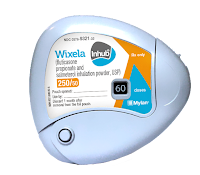
The Wixela Inhub inhaler

Just as I was about to go with the GoodRx deal, it occurred to the pharmacist to see if my plan would cover the brand-name version of the same medication. Lo and behold, WellCare does indeed cover Wixela, just not the generic. That’s undoubtedly because of the deal WellCare struck with Mylan Pharmaceutical, which makes Wixela. If I went with Wixela, I would have to pay $47 out-of-pocket for a one-month supply (but no discount for a three-month supply), which is $55.17 per unit cheaper than the GoodRx generic price.

This all took some time, as you can imagine. Meanwhile, the line behind me grew longer and longer. I cannot imagine what it is like to be a pharmacist these days.

I’m fortunate that I can afford to pay $141 for a three-month supply of Wixela, and even, albeit reluctantly, $606 for three months worth of Symbicort. Many Americans are not so fortunate. In fact, millions of us with insurance–both public, like Medicare, and private, including employer-sponsored coverage–walk away from the pharmacy counter without our often life-saving drugs because of what our insurance plans make us pay out of pocket.

Many people of course don’t have a clue that they might be able to get their medications at a lower price without using their insurance card, either through outfits like GoodRx or by using manufacturers’ coupons.

And many of us, especially those of us dealing with cancer, multiple sclerosis or other life-threatening chronic conditions, often have to spend thousands of dollars out of our own pockets before our coverage kicks in for even the drugs our insurance plans will cover. This is why so many of us with insurance get buried under mountains of debt and feel we have no alternative other than to beg for money on GoFundMe or file for bankruptcy.

Back to that so-called Medicare Modernization Act of 2003. Not only did it make the Part D drug benefit nearly impossible to figure out because of the ever-changing list of medications insurance plans will or will not cover, but it also prohibited Medicare from negotiating with drug companies for lower prices as the Veterans Administration program can do.

In Nation on the Take, the book I co-authored with Nick Penniman of Issue One, I cited the MMA as an example of how well-funded special interests are almost always able to call the shots in Washington. Here’s a paragraph from the book that provides a hint of how that industry-backed bill got across the finish line: "When asked why he thought House leaders had scheduled the vote long after most Americans had gone to bed, Rep. Dan Burton (R-Ind.), who voted against the bill, said: 'A lot of shenanigans were going on that night [that] they didn’t want on national television.' Among the shenanigans, reportedly sanctioned by House leaders: freezing C-SPAN cameras and allowing lobbyists on the House floor as the vote was being taken."

Those shenanigans have led to the financial ruin and premature death of countless Americans. But year after year, Congress has looked the other way. To change that, more than 50 organizations and businesses have come together in a coalition to demand that lawmakers take action to address what has become not only a national disgrace but a growing crisis.

The good news is that just after a few months, the Lower Out of Pockets NOW coalition is being noticed by members of Congress on both sides of the political aisle. We are determined to hold our lawmakers accountable. Some members are even talking about forming a caucus within Congress to explore solutions. You can be sure I will keep you posted at Tarbell.org.

Thursday, April 28, 2022

OPINION: Insurers say killing bill hospitals, pharmacists backed against pharmacy benefit managers saved Kentuckians money

By Tom Stephens
Executive Director, Kentucky Association of Health Care Plans

Pocketbook issues were front and center in this most recent session of the Kentucky General Assembly as runaway inflation at the national level continues to outpace wage gains. Lawmakers and the governor worked to ease inflationary burdens for working families by offering relief on hefty vehicle property tax increases caused by a pandemic surge in used car values. The General Assembly also moved to lower the personal income tax to keep more dollars in taxpayer wallets.

Tom Stephens
There were encouraging policy moves in health care as well. One driver of cost increases are government health-benefit mandates, which can add as much as 5 percent to coverage premiums. Kentucky has more healthcare mandates than the national average, but with a few exceptions, legislators largely resisted pressure from powerful lobbying groups to add more in 2022. This was a big win for Kentucky businesses and employees.

One group, the Kentucky Pharmacists Association, worked with an independent pharmacist in the General Assembly to introduce HB 203, a lengthy mandate bill that would have added a minimum $10.64 dispensing fee (5 times the current rate) to Kentuckians’ prescription drugs. The legislation also would have ended quality-driven, pay-for-performance contracts, significantly limiting the ability of companies and health plans to negotiate better pharmacy prices for their employees and members. This would have created a guaranteed payday for high-cost pharmacists. To further tip the scales in their favor, a pharmacist-controlled board would have been established to set future policies on prescription drugs.

As part of their legislative strategy, the pharmacists worked to broaden support for HB 203 and ratchet up pressure by allowing lobbyists for certain hospital systems to insert monopolistic provisions on specialty drugs (medications administered by a provider through injection or infusion typically, in a hospital outpatient setting or a provider’s office). This measure effectively banned a successful innovation known as “white bagging” or “alternate sourcing,” whereby health plans and businesses fight hospital price gouging by using specialty pharmacies to safely distribute these drugs.

Sensing a growing concern over the costs and complexity of the bill, proponents quickly pulled HB 203 before an official Kentucky Department of Insurance cost assessment could be posted. A Pharmaceutical Care Management Association analysis estimated that HB 203 would have increased prescription drug costs by a staggering $5 billion over the next decade. (Editor's note: PCMA lobbies for pharmacy benefit managers, firms that are middlemen between insurance and drug companies, determining what drugs are offered, at what price, and how much pharmacists are paid.)

Immediately upon withdrawing HB 203, a slightly revised bill, HB 457, was introduced. It also drew heavy opposition from multiple Kentucky employers, including the Kentucky Association of Manufacturers, General Electric, Mercer and dozens of other Kentucky employers. The Kentucky Association of Health Underwriters rang the alarm: “This bill does nothing to address the cost of prescription drugs, it’s going to do the opposite.” The Kentucky Association of Health Plans pointed to the negative impacts by reminding legislators that the Department of Insurance statement showed a family of four would have paid up to $167 more a year for health coverage.

Fortunately for Kentucky businesses and individuals, HB 457 was not enacted into law. Senate President Robert Stivers illuminated HB 457’s potential effects in an end-of-session press conference when he said, “we started getting, from the business sector and the provider sector, comments and questions about what the overall cost would be to various plans because it would have cost impact on various health insurance plans, including potential fiscal impact to the state employees’ health plan.”

Kentucky businesses would be wise to stay vigilant and continue to raise their voices against expensive health care mandates and disruptions in the healthcare marketplace through legislation that does not have broad support from all stakeholders.

KAHP Executive Director Tom Stephens can be reached at tom@kahp.org.

Sunday, February 13, 2022

Proposed new CDC guidelines for treating pain would encourage use of non-opioid therapies first, avoid one-size-fits-all approach

Centers for Disease Control and Prevention map, adapted by Ky. Health News, shows opioid-prescribing rates in counties that ranked highest and those surrounded or nearly surrounded by them.
By Melissa Patrick
Kentucky Health News

The Centers for Disease Control and Prevention has proposed new guidelines that would move away from a one-size-fits-all approach to managing pain, to one that encourages doctors to use their best judgment when prescribing opioid painkillers and encourage them to use "non-opioid therapies" first.

The guidelines are especially important in Kentucky, a smaller-than-average state that ranks fifth in the nation for opioid prescriptions and saw an increase of 49% in overdose deaths in 2020, the last year reported. 

In addition to prioritizing non-opioid therapies such as ibuprofen and other non-steroidal anti-inflammatory drugs, the proposed guidance drops previous recommended limits for dosing and encourages the use of immediate-release opioids, as opposed to long-acting ones, when possible.

It also offers extensive guidance for how to treat acute and chronic pain and how doctors should address patients who test positive for illicit substances.

"This clinical-practice guideline provides recommendations only," the proposal says. "It does not replace clinical judgment and individualized, patient-centered decision-making."

The guidelines, which are still in draft form, would update the 2016 CDC Guideline for Prescribing Opioids for Chronic Pain, which were designed to slow the prescribing of opioids like OxyContin, which fueled the opioid epidemic.

Synthetic opioids like the rarely prescribed fentanyl and its analogues in the illegal drug supply now fuel most of the drug-overdose deaths in Kentucky, but the state ranks high in opioid prescriptions. Stroudwater Associates reported that Kentucky had the fifth highest opioid prescribing rate in the nation in 2020, with Perry, McCracken, Clark, Owsley, Whitley, Bell, Floyd, Pike, Clay and Fayette counties making up the top 10. Stroudwater is a health-care consultancy that says it focuses on rural and community hospitals, health-care systems and large physician groups.

The new CDC guidance was prompted by unintended consequences of the 2016 recommendations, which created barriers for care of people with chronic or severe pain, many of whom relied on opioid doses far higher than the recommended amount. The 2016 guidance also resulted in some people who no longer had access to these painkillers switching to heroin, and some physicians stopped caring for pain patients for fear of criminal and civil penalties.

The report on the guidelines adds that other misapplications of the 2016 rules included extension of them to patients not covered in the guidelines, like those with cancer or palliative care; the abrupt discontinuation of the drugs in some patients; duration limits by insurers and pharmacies; and patient dismissal and abandonment.

"These actions are not consistent with the 2016 CDC Guideline and have contributed to patient harm, including untreated and undertreated pain, serious withdrawal symptoms, worsening pain outcomes, psychological distress, overdose, and suicidal ideation and behavior," the report says.  It notes that many states have passed laws based on the 2016 guidance, even though the rules were meant to "support, not supplant, individualized, patient-centered care." 

The Kentucky General Assembly has passed several opioid-control laws in recent years, including one to limit opioid prescriptions for acute pain to a three-day supply, with exemptions. 

The new guidelines recognize the dangers associated with opioids, but also recognize their value in treating pain. It offers 12 recommendations for clinicians who are prescribing opioids for adult outpatients with pain. They do not apply to patients suffering pain from cancer or sickle-cell disease, or those in end-of-life or palliative care.   

The report says the recommendations are "based on a systematic review of the available scientific evidence while considering benefits and harms; patients’, caregivers’, and clinicians’ values and preferences; and resource allocation."

The first guideline recommends that providers use non-opioid alternatives whenever possible, stating, "Clinicians should only consider opioid therapy for acute pain if benefits are anticipated to outweigh risks to the patient." 

Non-opioid treatments include things like over-the-counter medications like ibuprofen and acetaminophen; prescription medications like gabapentin; physical therapy; massage, and acupuncture. 

After weighing the benefits and the risk of using an opioid to treat pain, the draft guidance says the provider is encouraged to start with the lowest effective dose and to prescribe them for only as long as the patient is experiencing "pain severe enough to require opioids." 

The report says, "It is imperative that people with pain receive the most appropriate and effective pain treatment with careful consideration of the benefits and risks of all treatment options."

It also discourages clinicians from abruptly discontinuing opioids in patients already receiving high doses of the drugs, or dismissing such patients from their care; and urges them to ensure appropriate care if the patients has an opioid-use disorder.

The CDC is seeking public comment on these changes through April 11. “This comment period provides another critical opportunity for diverse audiences to offer their perspective on the draft clinical practice guideline. We want to hear many voices from the public, including people living with pain and the health care providers who help their patients manage pain," Christopher M. Jones, director for the National Center for Injury Prevention and Control, said in a news release.

He added, "The ultimate goal of this clinical practice guideline is to help people set and achieve their personal goals to reduce their pain and improve their function and quality of life. Getting feedback from the public is essential to achieving this goal." 

Submit your comments at https://www.federalregister.gov/public-inspection/2022-02802/proposed-2022-clinical-practice-guideline-for-prescribing-opioidsexternal icon.