Showing posts with label county health. Show all posts

Saturday, May 21, 2022

Appalachian counties continue to dominate lowest level of County Health Rankings in Ky.; most counties moved at least 10 notches

By Melissa Patrick
Kentucky Health News

The annual County Health Rankings & Roadmaps report, showing how the health status of every county in the United States compares to that of every other county in the state, has been released.

Many Kentucky counties showed little change, but 76 of the state's 120 counties shifted up or down by at least 10 notches in the rankings, which essentially measure of how long and how well we live. 

The rankings measure health outcomes, gauged by life expectancy and measures of quality of life; and health factors, such as access to physicians and areas to exercise, tobacco use, children living in poverty, violent crime, long commutes and other environmental factors. The report is issued by the Robert Wood Johnson Foundation and the University of Wisconsin Population Health Institute.

The rankings are meant to be viewed more as a general categorization of a county's health status, rather than making specific comparisons with counties that are relatively close in the rankings. Because the differences in rankings for most counties are so small that they are statistically insignificant, the researchers have placed counties in four groups of 30 counties each, called quartiles (each with one-fourth of the total of 120 counties). 

The bottom quartile for both health outcomes and health actors in Kentucky continues to be made up of almost entirely Appalachian counties. The exceptions for health outcomes are Carroll County, between Louisville and Cincinnati, and Fulton County, at the state's western tip. The relatively poor county is the only non-Appalachian county in the bottom quartile for health factors. 

In health outcomes, Fulton County moved down 17 spots from last year's report to rank 116th. Owsley County ranks 117th, followed by Perry County, which dropped 22 spots from last year's ranking, and Wolfe and Breathitt counties. The last four counties form a cluster.

Oldham and Boone, two of Kentucky's wealthiest counties, continue to be the top two in health outcomes, as they have been since 2011. No. 3, Scott County, has ranked between fifth and eighth since 2011. Campbell County in Northern Kentucky ranked fourth for the second year in a row and Calloway County, home of Murray, ranked fifth after moving up 19 notches from last year's rankings. 

Oldham and Boone are also the top two counties for health factors, and have been since 2015. They have been in the top five since 2011. Woodford, Campbell and Fayette counties are ranked third, fourth and fifth, respectively, for the second year in a row. 

The bottom five counties for health factors are Breathitt, Lee, Clay, Harlan and McCreary, all in Appalachian Kentucky.

Some big changes in health outcomes

Altogether, 26 Kentucky counties improved more than 10 notches in health outcomes from last year, and 13 of them improved by more than 20 places; 27 of them dropped more than 10, and 12 of those dropped by more than 20. 

Edmonson County improved the most for health outcomes, with a 50-notch jump up to No. 31 and the second quartile. However, its No. 81 rank last year was not typical for the county, which had been in the second quartile for health outcomes most years since 2011, so its latest rank is a return to form.

Several counties showed big improvements that moved them into the first quartile for health outcomes. Graves County improved 29 notches, to No. 28 from No. 57; Carlisle moved up to 20th from 45th; and Livingston moved up to 26th from 46th. 

Breckinridge County also saw a 37-notch gain (to 35th from 72nd) in outcomes that moved it into the second quartile.

Because the rankings are relative, county to county, they tend to have about as many drops as gains. Bracken County saw the greatest drop in health outcomes, 46 notches, to 81st from 35th. Clark County had the second greatest drop for outcomes (30th to 70th), moving from the first quartile to the third.   

Two Appalachian coalfield counties also saw big drops in outcomes, which moved them into the bottom quartile. Johnson fell to 96th from 71st, and Whitley dropped to 100th from 67th.  

Some big changes in health factors

Twelve Kentucky counties improved more than 10 notches for health factors, with three improving by more than 20. Eleven counties fell more than 10 notches; only one moved down by more than 20.

Livingston and Crittenden counties showed the most improvement for health factors. The adjoining counties in West Kentucky each moved up 24 slots into the second quartile. Livingston moved to 46th from 70th and Crittenden moved to 54th from 78th.  

Allen County's 17-notch improvement in health factors moved it into the 55th from 72nd, and into the second quartile. Simpson County moved into the first quartile by rising to 29th from 39th.  

McLean County had by far the biggest drop in health factors, falling 24 notches to 80th from 56th, which moved it down to the third quartile. Gallatin County fell to 65th from 53rd and Montgomery County fell to 62nd from 46th, both moving to the third quartile. Henry County dropped to 38th from 25th, moving it to the second quartile.

The report challenges Kentucky counties to take this data and turn it into action. Evidence-based resources to do that can be found in the "Take Action To Improve Health" section of its website. Here are the rankings (click image to enlarge):

Thursday, May 19, 2022

CDC says McCracken Co. has high level of virus transmission; most West Ky. counties, 33 total in state, have medium levels

Centers for Disease Control and Prevention map shows 34 counties with elevated risk of Covid-19.
By Melissa Patrick
Kentucky Health News

McCracken County and its seat of Paducah are red on the Centers for Disease Control and Prevention's latest national Covid-19 risk map, indicating a high level of coronavirus transmission. Thirty-three Kentucky counties, most in the west, are yellow, indicating a medium level of transmission.

Those counties are Hickman, Carlisle, Ballard, Graves, Marshall, Trigg, Lyon, Livingston, Christian, Caldwell, Crittenden, Todd, Muhlenberg, Hopkins, Webster, Union, Henderson, Simpson, Clinton, Cumberland, Hardin, Jefferson, Oldham, Henry, Shelby, Woodford, Fayette, Menifee, Martin, Lawrence, Boyd, Carter, and Greenup. 

This is the first time since the April 1 weekly report that Kentucky has had a red county on the map, and the yellow counties more than doubled in this week's report; last week Kentucky had only 12 yellow counties. West Virginia has a cluster of red counties, including Kanawha County, site of Charleston.

Because of McCracken County's high level of virus transmission, the CDC recommends that everyone there should wear masks in indoor public spaces. Kentucky's state guidelines also recommend limiting indoor in-person gatherings, limiting the size of gatherings, and encouraging social distancing. 

The CDC says people in yellow counties who are immunocompromised, or at high risk for severe illness from the virus, should talk to a health-care provider about whether they need to wear a mask or take other precautions. 

State Public Health Commissioner Steven Stack encouraged Kentuckians to use the CDC risk map to determine the level of Covid-19 precautions that are needed in their community, rather than the state's daily seven-day infection rate map that is updated on Mondays. The Kycovid.ky.gov site posts the CDC's color-coded map on Friday mornings, along with community level guidance for each color.

Stack said the CDC map is a better guide to managing risk because the agency's weekly ratings are based on new virus cases, Covid-19 hospitalizations and the percentage of staffed inpatient beds occupied by Covid-19 patients, instead of just cases per 100,000 people in each county.

"The composite map is the one that really shows you what your risk is, if you're likely to get exposed," he said. 

The CDC says 9.2% of counties and county equivalents in the U.S. have a high level of Covid-19 transmission, up from 4.25% last week; 15% have a medium level, up from 14% last week; and 76% have a low level of transmission, down from 82% last week.

Friday, March 25, 2022

CDC rates fewer Ky. counties at high risk from virus, but levels in some have increased and state's risk level is still relatively high

State version of CDC map, with additional label by Kentucky Health News
Kentucky Health News

Kentucky as a whole is at lower risk from the coronavirus than it was a week ago, according to the Centers for Disease Control and Prevention. But about the same number of counties are rated at low risk, and the risk ratings increased in a few counties.

On Thursday the CDC listed 10 counties as high-risk. In those places, it still advises masks to be worn in indoor public spaces. The number is fewer than half the 24 listed last week, but two counties, Casey and Powell, moved from medium risk to high risk.

The 52 counties rated at medium risk included Ballard, McCracken, Carlisle and Hickman, in far Western Kentucky, which moved up from low risk.

The CDC says residents in medium-risk counties who are immuno-compromised or at high risk for severe illness should talk to a health-care provider about "additional precautions, such as wearing masks or respirators indoors in public. If you live with or have social contact with someone at high risk for severe illness, consider testing yourself for infection before you get together and wearing a mask when indoors with them."

CDC map, adapted by Kentucky Health News
The number of counties rated at low risk declined from 59 to 58. The ratings are based on new coronavirus cases, Covid-19 hospitalizations and the percentage of staffed inpatient beds occupied by Covid patients.

Kentucky remains one of the higher-risk states, according to the CDC's national map.

Friday, May 15, 2020

County Health Rankings continue to show largest shifts in the middle rankings, familiar names at the top and bottom

The chart next to the map shows the spread of health outcomes scores (ranks) for each county (green circles) in Kentucky. It shows the size of the gap between ranked counties, is most cases small.
By Melissa Patrick
Kentucky Health News

The latest County Health Rankings report for Kentucky shows little change in the top and bottom quarters of the standings, with most of the bigger shifts among counties in the middle.

The rankings measure health outcomes, gauged by life expectancy and measures of quality of life; and health factors, such as access to physicians and areas to exercise, tobacco use, children living in poverty, violent crime, long commutes and other environmental factors. The report is issued by the Robert Wood Johnson Foundation and the University of Wisconsin Population Health Institute.

Because the shifts in rankings for most counties are so small that they are statistically insignificant, the researchers have placed counties in four groups of 30 counties each, called quartiles. The rankings are meant to be viewed more as a general categorization of a county's health status, rather than making specific comparisons with counties that are relatively close in the rankings.

Top of snapshot for Adair County, first in Kentucky's alphabetical list
The report's website has a snapshot of data for each county that includes county-level data for each of the measures.

In health outcomes, 17 of the 120 counties moved up at least 10 notches since last year, and another 14 moved down at least 10. In health factors, 13 counties improved and 10 dropped at least 10 notches.

The bottom quartile for both health outcomes and factors continues to be made up almost entirely of Appalachian counties. The only exception for health outcomes is Fulton County, a poor county in the Mississippi Delta at the state's western tip. The exceptions for health factors are Fulton County and Grayson County, in west-central Kentucky.

Oldham and Boone, two of Kentucky's wealthiest counties, continue to be the top two in health outcomes, as they have been since 2011. No. 3, Spencer County, has ranked either third or fourth since 2016. Woodford County ranked fourth this year, moving up from the 14th spot in last year's rankings and Fayette County ranked fifth, moving up from 10th.

Oldham and Boone are also the top two counties in health factors, and have been since 2015. They have been in the top five since 2011. Woodford, Campbell and Scott are ranked third, fourth, and fifth, respectively, for the second year in a row.

Breathitt, Owsley and Perry counties, in that order, hold the bottom three spots for health outcomes again this year, followed by Clay and Floyd. All are in the East Kentucky Coalfield. The bottom five counties for health factors are Clay, Owsley, Wolfe, Breathitt and McCreary, all in the coalfield.

Some counties show big changes

Green County was the only county to move at least 10 slots to put it in the top quartile for health outcomes. It rose 13 notches, to 27th. The last time it was in the top quartile was in 2017, when it ranked 19th.

Taylor and Mason counties saw the greatest gains in health outcomes this year, both moving up 19 places. Taylor moved up to 38th, from 57th; and Mason moved up to 46th, from 65th.

Two counties dropped more than 10 slots to land them into the bottom quartile for health outcomes. Russell, is now 93rd, down from 77th last year; and Elliott is 101st, down from 81st.

Crittenden County saw the greatest drop in health outcomes this year, falling 26 notches, to 64th from last year's 38th spot. It also dropped 16 slots in health factors, to 88th.

Todd and Christian counties also saw big drops in outcomes, each falling 19 spots. Todd moved to 65th, from 46th; and Christian moved to 70th, from 51st.

Changes in health factors

Henry County was the only county to move at least 10 spots into the top quartile for health factors, moving up 11 notches into 27th. No county shifted by 10 or more spots into the bottom quartile for health factors.

McLean County saw the greatest gain in health factors, moving up 18 notches to 38th, from 56th last year. It moved down 16 slots in outcomes, to 89th, from 73rd.

Map shows the health-factor quartile for each county; column at right 
shows the size of the gaps between ranked counties is small.
Four counties moved up 15 spots in health factors, including Bracken, to 45th; Metcalfe, to 66th; Trigg, to 32nd; and Boyd, to 44th.

Owen County saw the biggest drop in health factors, falling 26 spots, to 60th from last year's 34th spot. It moved down four spots for outcomes, to 39th.

Marion County also showed a big drop in health factors, moving down 20 spots to 55th, from 35th. It moved down four slots for outcomes, to 54th.

The report challenges Kentucky counties to take this data and turn it into action, and offers resources to do that on the "Take Action To Improve Health" section of its website. The report says it "illustrates what we currently know when it comes to what is keeping people healthy or making them sick and shows what we can do to create healthier places to live, learn, work and play."

Tuesday, March 19, 2019

County Health Rankings show a few big shifts, and at least one county where local action appears to have made a difference

By Melissa Patrick
Kentucky Health News

Some Kentucky counties that are actively working to improve their community health made significant gains in the latest County Health Rankings issued by the Robert Wood Johnson Foundation and the University of Wisconsin Population Health Institute.

The rankings measure health outcomes, gauged by life expectancy and measures of quality of life; and health factors, such as access to physicians and areas to exercise, tobacco use, children living in poverty, violent crime, long commutes and other environmental factors.

Clinton County, in Appalachian Southern Kentucky,  moved up 30 notches in health outcomes, to 64th from 94th among Kentucky's 120 counties. Pendleton County, in Northern Kentucky, went up 31 slots, to 25th from 56th. Lyon County, in Western Kentucky, rose to eighth from 38th.

Clinton County has ranked in the bottom fourth of counties for health factors and outcomes for many years. It moved up only five slots, to 90th, for health factors, but its big gain in outcomes was significant.

The improvements could be an indication that the efforts of the Clinton County Healthy Hometown Coalition that was created in 2013 are beginning to pay off. The coalition, which was created with the help of a grant from the Foundation for a Healthy Kentucky, has largely focused on efforts to improve the health of the county's children, such as building walking paths and playgrounds as well as working to increase physical activity and nutrition programs in the schools, which banned tobacco.

"The Clinton County coalition is a great example of community coming together to identify a significant local health issue and develop a comprehensive plan to make actual, measurable improvements," said Ben Chandler, president and CEO of the foundation. "Members represent a broad cross-section of the community. That's essential to developing and implementing programs that address the myriad factors that affect health."


Most counties' changes were insignificant; the rankings compare a state's counties against each other without national comparisons, so when one moves up, another moves down.

In health outcomes, 19 counties moved up at least 10 notches since last year, and another 14 moved down by at least 10. In health factors, about 12 counties improved at least 10 notches and 11 dropped by at least 10.

Because the shifts in the rankings for most counties are so small that they are statistically insignificant, the researchers have placed counties in four groups of 30 counties, called "quartiles."  The rankings are meant to be viewed more as a general categorization of a county's health status, rather making specific comparisons with counties that are relatively close in the rankings.

The bottom quartile for both health outcomes and factors continues to be almost entirely Appalachian. The only exceptions for health outcomes are Fulton County, in the Mississippi Delta at the state's western tip, and Carroll County, between Louisville and Cincinnati. The exceptions for health factors are Fulton County and Grayson County, in west-central Kentucky.

Oldham and Boone, two of Kentucky's wealthiest counties, continue to be the top two for health outcomes, as they have been since the rankings began in 2011. No. 3 Shelby County, which borders Oldham, has been in the top five since 2013. Adjoining Spencer County is ranked fourth. Calloway County (Murray) in Western Kentucky took the fifth spot this year, replacing Bullitt County, which dropped to No. 9.

Oldham and Boone are also the top two counties in health factors, and have been since 2015. They have been in the top five since 2011. Woodford, Campbell and Scott are currently ranked third, fourth and fifth, respectively.

Owsley, Perry, Breathitt, Bell and McCreary counties, in that order, are the bottom five in outcomes. All are in the Eastern Kentucky Coalfield. Wolfe County, which has been in the bottom bunch since 2016, moved to No. 113, an insignificant change. The bottom five counties for health factors are Clay, Owsley, Harlan, Lee and Wolfe, all in the eastern coalfield.

Some counties show big changes

Several counties moved up more than 10 notches to make it into the top quartile for health outcomes. Hickman County, the only Kentucky county that borders Fulton County, moved up 26 slots to rank 17th. Edmonson County moved up 15, to rank 18th; Logan moved up 18, to 22nd; and McCracken (Paducah) moved up 21, to 26th.

Two counties dropped more than 10 slots to land them into the bottom quartile for health outcomes: Lewis is now 92nd, down from 74th last year, and Wayne is 91st, down from 77.

Two counties moved up more than 10 slots to make it into the top quartile for health factors: Bourbon, which moved to 28th from 51st, and Caldwell, which moved to 29th from 56th.

Carter County was the only one to drop more than 10 slots to fall into the bottom quartile for health factors, to 97th from 76th.

Livingston County saw the greatest drop in health outcomes this year, falling 42 notches, to 76th from last year's 55th. It also dropped 25 slots in health factors, to 65th.

McLean County also saw a big drop in outcomes, falling 38 slots to 73rd. It dropped 21 slots in factors, to 56th.

Tiny Robertson County saw the greatest improvement in health factors, moving to a 36th from 75th last year. However, it saw an eight-notch drop in health outcomes, to 96th.

Bracken County, after dropping 43 notches for health outcomes in last year's rankings, dropped yet another five slots to rank 103rd. And while it has hovered between 32nd and 43rd for health factors since 2014, it dropped 27 slots in this year's rankings, to 60th.

Another county that saw big drops in both outcomes and factors is Carlisle, just north of Hickman on the Mississippi. It had a 29-notch drop in outcomes, to 52nd, and a 14-notch drop in factors, to 41st. From 2014 to 2018, Carlisle had ranked between 21st and 27th for health factors.

For a table of counties with big changes, click here.

The report charges Kentucky counties to take this data and turn it into action, and offers specific strategies to do so on the "Take Action to Improve Health" section of its website. These strategies include, among other things, a link to evidence-informed policies and programs that are proven to work locally in the "What Works for Health" section.

Further, the measures in the rankings offer journalists a unique opportunity to see what is going on in their communities when it comes to health -- both good or bad. And many Kentucky newspapers do just that.

In 2017, an analysis by researchers at the Institute for Rural Journalism and Community Issues at the University of Kentucky found that 31 papers in 30 counties published 36 separate articles about the rankings in the five weeks after the rankings were released in late March. The researchers examined 106 of the approximately 140 paid-circulation newspapers outside Kentucky's three major urban areas, covering 115 of the state's 120 counties.

Wednesday, July 25, 2018

Seven counties in Southern Kentucky stand out as 'Bright Spots' in study, pointing the way to healthier communities

By Melissa Patrick
Kentucky Health News

Nine counties in Appalachian Kentucky have been recognized as "bright spots" when it comes to health, and seven of them adjoin in Southern Kentucky: Green, Adair, Russell, Wayne, McCreary, Pulaski and Lincoln. The other two counties were Lewis and Morgan.

"The Bright Spots project offers hope and a path forward to a healthier Appalachian Kentucky," Ben Chandler, president and CEO of the Foundation for a Healthy Kentucky, said in a news release. "Congratulations to the hardworking leaders in the nine Kentucky counties that have formed strong, cross-sector coalitions to address pressing health issues in their communities."

The study, which looked for Appalachian counties that had better than expected health outcomes given their resources, analyzed 19 health indicators in each of the 420 Appalachian counties and identified 42 as Bright Spots.

The goal of the research was to to identify successful activities, programs and policies that other struggling communities could replicate. A report is scheduled to be released later this year to identify them. The study was sponsored by the foundation, the Appalachian Regional Commission and the Robert Wood Johnson Foundation.

All the adjoining Bright Spots counties except Lincoln are served by the Lake Cumberland District Health Department. Its health education director, Tracy Aaron, told Kentucky Health News that improving the district's health has been a group effort, and each county has a health coalition made up of numerous organizations, agencies and individuals that meets monthly to choose what health issues they want to address and to then create plans to work on them.

"Our communities are rural and have limited resources, so we all work together to identify and leverage resources," she said in an e-mail. "Many times we may facilitate the discussion around health and improving the health of the community, but we are very fortunate to have dedicated organizations and individuals [working with us] as we continue to improve the health of people that live in Lake Cumberland."

McCreary and Wayne counties were part of a 10-county case study that took a deeper dive into what they were doing to improve the heath of their citizens, despite their many challenges. Both of these counties were named "Healthy Kentucky Policy Champions" by the foundation, citing the stuidies.

"What's happening in Wayne and McCreary counties is changing our understanding of what is possible for health in these and other Appalachian counties," Chandler said in the release announcing the awards. "They show us that there's always somewhere to start when working to improve health, and that dedicated individuals volunteering and working together with a few focused community leaders can change health outcomes for the better."

The report says Wayne County was one of three in the 10 case studies that stood out "for both the range of outcomes that were better than expected and the extent to which the outcomes exceeded expectations." The county performed better than expected on 16 of the 19 measured health outcomes, falling short in the areas of obesity, physically bad days and opioid prescriptions.

Cover page of report section on Wayne County
The Wayne County Health Department, part of the district health department, and the local office of the Cooperative Extension Service play "critical roles in improving community health," the report said.

It noted the department's program to increase access to healthy, local foods; its diabetes education work; and its strong HANDS (Health Access Nurturing Development Services) program, a voluntary home-visitation program for new and expectant parents, which the researchers say could be partly responsible for lower-than-expected rates of infant mortality and low birth weight.

"Wayne County’s strong community partnerships and social connections, integration of health services, and focus on healthy foods, are likely contributing to the better-than-expected health outcomes," the report says.

The county performed 36 percent better than expected for poisoning deaths, including drug overdoses; 34 percent better than expected for stroke deaths, 30 percent better than expected for heart disease hospitalization; 26 percent better than expected for the percentage of Medicare patients with depression; and 25 percent better than expected for years of potential life lost.

For example, the study found that 35.2 people per 100,000 in Wayne County actually died from a stroke, but when using a statistical model that factored in barriers to good health, the predicted stroke-death rate was 53.7 per 100,000. (The county's population is about 21,000.)

Cover page of report section on McCreary County
McCreary County, which has about 18,000 people, performed better than expected on 14 of the 19 measured health outcomes. It fell short in mentally bad days, suicide, diabetes, physically bad days and opioid prescriptions.

The report says the county has strong local volunteer organizations and emergency medical services, and a library that connects residents to health and social services.

Researchers found that the county performed 40 percent better than expected for injury deaths, 37 percent better than expected for stroke deaths; 34 percent better than expected for poisoning deaths; 19 percent better than expected for percentage of Medicare enrollees with depression; and 15 percent better than expected for years of potential life lost.

The report adds that local practices contributing to the overall health in McCreary County include intra-county cooperation and resource sharing, sustainable, community-focused nonprofit organizations, a strong integration of health services and systems, a shared value for health in the community and community engagement and dedicated local leaders.

Among other things, the report notes a strong health education program run by the district health department, which gives school-age children information on reproductive health, tobacco-use cessation and risky-behavior prevention. It also provides a health consultant for children and supports preventive initiatives like farmers' markets and smoke-free restaurants.

Among the other four Lake Cumberland counties named Bright Spots:

  • Adair was 41 percent better than expected for poisoning and overdose deaths; 36 percent better than expected for unintentional injury deaths; and 26 percent better than expected for deaths from chronic obstructive pulmonary disease.
  • Green scored 34 percent better than expected for poisoning and overdose deaths, and 31 percent better than expected for both years of potential life lost and opioid prescriptions as a percentage of Part D Medicare claims.
  • Russell was 36 percent better than expected for heart-disease hospitalizations; 33 percent better than expected for opioid prescriptions as a percentage of Part D Medicare claims; and 18 percent better than expected for diabetes.
  • Pulaski scored 39 percent better than expected for poisoning and overdose deaths; 26 percent better than expected for unintentional injury deaths; and 20 percent better than expected for stroke deaths.

The researchers report that while the counties in the case studies offered individual approaches to address their local health challenges, there were common themes, including: community leaders engagement, cross-sector collaborations, resource sharing, a commitment from local health care providers, active faith communities and grassroots initiatives to combat substance abuse.

In addition to a community of people with a shared value for health, the report says the Bright Spot communities also benefited from "anchor institutions," like schools, businesses, churches and hospitals that worked together to improve the health of their communities.

"The Bright Spots research is a roadmap for struggling Appalachian communities, showing how building strong coalitions and focusing resources in particular on reducing teen births and smoking, increasing physical activity and treating and preventing substance abuse can have an outsized impact on improving local health," Chandler said. "It also is a call to action for policy makers, funders and advocates to support laws and programs that are proven effective in addressing these issues."

The 10 case studies are at https://www.healthy-ky.org/res/images/resources/BrightSpotsCaseStudiesJuly2018.pdf. Data for all 420 Appalachian counties are at https://www.arc.gov/research/researchreportdetails.asp?REPORT_ID=144. The data can be mapped at https://healthinappalachia.org/.

This is the second report in the "Creating a Culture of Health in Appalachia: Disparities and Bright Spots" research initiative. The first report focused on health disparities in the region.

Tuesday, June 19, 2018

Clinton County's obesity rate falls after years of foundation-funded program for improvement of the community's health

Five years ago, the Foundation for a Healthy Kentucky gave the Clinton County schools the first installment of a $400,000 grant to help improve the county's health status, with emphasis on children. Now, in the last year of the grant, foundation and school officials say it has helped children achieve a healthier weight and reduced the county's overall obesity rate.

"The obesity rate in Clinton County has improved so much that we no longer qualify for a CDC grant we had been receiving for the past three years, and using collaboratively with the Healthy Hometown Coalition," Dr. Paula Little, assistant superintendent of schools, chair of the coalition and a director of the foundation said in a foundation press release.

Little said she didn't know the rate, just that it had fallen below the 40 percent required for the grant from the Centers for Disease Control and Prevention's High Obesity Program, which through the University of Kentucky promotes healthy eating and active living in Clinton and five other counties: Elliott, Letcher, Lewis, Logan and Martin.

Albany Mayor Nicky Smith, vice-chair of the Clinton County coalition, said "We have seen positive changes in community activity and awareness of health issues. I feel that our children have benefited from improvements in healthy eating and physical activity that they will carry with them throughout their lives."

The coalition has spent grant money on "walking paths, playgrounds and other spaces to provide more places where children can be physically active," said the press release, which has a complete list of grant activities. "The coalition has increased physical education and added programs in the schools to increase classroom movement, expanded nutrition programs, and supported policy changes to ensure increased physical activity and better nutrition for area students."

"The Clinton County coalition is a great example of a community coming together to identify a significant local health issue and develop a comprehensive plan to make an actual, measurable improvement," said Ben Chandler, president and CEO of the foundation.

The Clinton County grant was one of seven in the foundation's $3 million "Investing in Kentucky's Future" program, focused on children. "We'll be taking what Clinton County and the other six IKF grantee communities have learned and sharing it all over the state," Chandler said, "so other local health coalitions can implement in their own areas what has proven successful here."

Wednesday, March 28, 2018

County-by-county figures on Medicaid enrollment updated

Counties in bold are some that will be represented by
attendees at KHN's Friday health reporting workshop.
How many people in your county are beneficiaries of the federal-state Medicaid program? How many of them are on Medicaid, thanks to its 2014 expansion under the Patient Protection and Affordable Care Act, and thus most affected by changes coming in the program?

The figures are in this spreadsheet, downloadable from Kentucky Health News, which obtains the data from the Cabinet for Health and Family Services, under the state Open Records Act. The data are for January 2018; the previous spreadsheet was for June 2017.

Monday, March 19, 2018

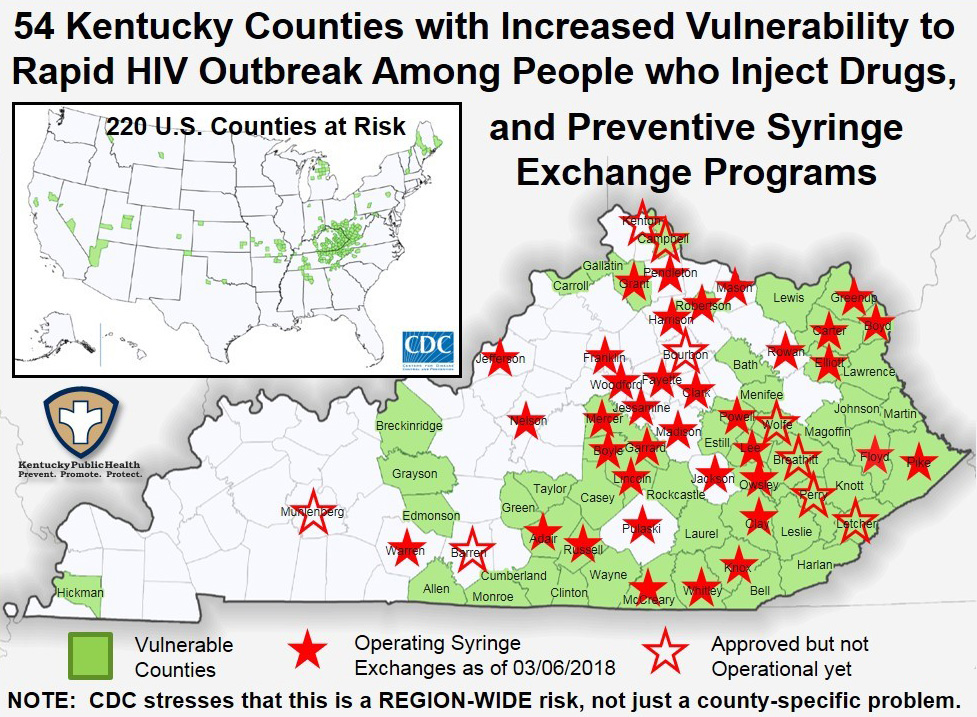
State leads nation in local syringe exchanges; still lacking in most counties judged vulnerable to disease outbreaks from IV drug use

By Al Cross
Kentucky Health News

Kentucky has long ranked high among the states in the number of counties. Now it leads the nation in the number of local syringe-exchange programs, according to the state Cabinet for Health and Family Services. But most of the counties deemed most vulnerable to outbreaks of HIV or hepatitis C due to intravenous drug use have not approved exchanges.

Forty-five of the state's 120 counties have approved syringe exchanges "in an effort to link people to treatment and improve overall public health," the cabinet says in a report on a recent syringe-exchange summit held by its Department for Public Health and the Kentucky Office of Drug Control Policy. The summit included people from counties without exchanges, to "help them, support them, encourage them in getting a syringe-exchange program going," said Dr. Ardis Hoven, the department's medical consultant.

"It's not just about the needle," Hoven said. "It's about folks getting tested for HIV and hepatitis C; it's about getting folks into care if they're positive for HIV or hepatitis C. It's also about getting those individuals with substance-abuse disorder into treatment . . . and we know that happens five times more frequently if they're engaged in a syringe-exchange program."

State Justice and Public Safety Secretary John Tilley said the exchanges are a better alternative than arrest and prosecution. "There's nothing more devastating than continuing to use a criminal-justice hammer to address a public-health nightmare," he said. "You exacerbate the problems the individual already has . . . When you entangle somebody in the criminal-justice system, you increase the likelihood that they'll not recover."

In 2016 the federal Centers for Disease Control and Prevention listed 220 U.S. counties most at risk to outbreaks of HIV or hepatitis C as a result of intravenous drug use. Of those counties, 54 are in Kentucky, and 26 of them have approved syringe exchanges. Approval is required by the county health board, fiscal court and legislative body of the city where the exchange is to be located. Here's a map from the cabinet:

Thursday, March 15, 2018

County Health Rankings show movement among some counties; rankings are blunt instruments meant to spur local action

By Melissa Patrick
Kentucky Health News

The latest County Health Rankings report for Kentucky shows little change among the top and bottom quarters of the standings, but a good deal of movement among counties in the middle -- in both directions.

The rankings look at health outcomes, gauged by life expectancy and measures of quality of life; and health factors, such as access to physicians and areas to exercise, tobacco use, children living in poverty, violent crime, long commutes and other environmental factors.

The rankings compare a state's counties against each other without comparison to national data, so when one county moves up, another moves down.

In health outcomes, 18 of the state's 120 counties moved up at least 10 notches since last year, and another 18 moved down by at least 10 slots. In health factors, about 10 counties improved at least 10 notches and 11 dropped by at least 10.

Most counties showed some shift in the rankings, but the differences may be so small they they are statistically insignificant. So, the University of Wisconsin Population Health Institute emphasizes a county's quarter (statistically, a "quartile" of 30 counties) as the best overall indicator of its health status. The rankings should be viewed more as a general categorization of a county's health status than to make specific comparisons with counties that are relatively close in the rankings.

The bottom quartile for both health outcomes and factors continues to be almost entirely Appalachian counties, with the only exceptions being Fulton County, in the Mississippi Delta at the state's western tip, which falls into the bottom quartile for both measures. In northern Kentucky, Bracken County was in the bottom quartile for outcomes, and Carroll County was in the bottom for health factors.

Oldham and Boone, two of Kentucky's wealthiest counties, continue to be the top two for health outcomes, as they have been since the rankings began in 2011. No. 3 Shelby County, which borders Oldham, has been in the top five since 2013. Adjoining Spencer County is ranked fourth. It adjoins Bullitt County, which ranked fifth. All of these counties are either in or near major metropolitan areas, which typically have better access to medical care as well as higher incomes.

Bullitt has shown considerable improvement recently. It jumped to sixth in outcomes 2016, from 27th in 2015, and was in the top 10 last year.

Breathitt, Wolfe and Owsley counties, in that order, have been the bottom three in outcomes for the past three years. Leslie and Perry counties make up the rest of the bottom five this year. All are in the East Kentucky Coalfield.

Oldham and Boone are also the top two counties in health factors, and have been since 2015. They have been in the top five since 2011. Woodford, Campbell and Spencer are currently ranked third, fourth and fifth, respectively.

The bottom five counties for health factors are Clay, Harlan, Knox, Leslie and McCreary, all in the eastern coalfield.

A few counties show big changes

Since 2011, some counties have seen big improvements in their rankings, while others have declined and others seem to bounce back and forth, perhaps because they are small and thus more likely to have their rankings changed from year to year.

Hickman is an example of how a county's rankings can fluctuate, and why it's important to look at multi-year trends. Last year, the Mississippi River county ranked 23rd in outcomes, up 53 spots from the initial 2011 report -- but it fell 20 notches this year, to 43rd. Its health-factor ranking also fell 20 places, to 57th, after improving to 23rd in 2016.

Henderson County also saw a surge of improvement in both of last year's rankings, only to drop back to some of its lowest rankings in outcomes and factors this year. The northwestern county dropped 31 outcome spots, to 70th from 39th last year, and 15 factor spots, to 55th from last year's 40th.

One of this year's success stories is Garrard County, which saw a 25-notch jump in outcomes, moving to 39th from 64th last year -- its worst ranking for this measure since the rankings began. The southern Bluegrass county also saw an improvement in its health-factor ranking, to 38th from 54th last year. It had ranked between 51st and 65th in health factors since 2013.

Christian County improved 22 notches in factors and and 18 places in outcomes over last year.

Bracken saw the greatest drop in health outcomes this year, falling 43 notches to 98th from last year's 55th. Nevertheless, it showed an improvement of 10 notches in the health-factor ranking, to 33rd.

Metcalfe County dropped 30 notches in outcomes, and 18 places in factors; Webster dropped 24 spots in outcomes and 13 spots in factors.

The report charges Kentucky counties to take this data and turn it into action, and offers specific strategies to do so on its What Works for Health website. Some of the suggestions include ways to invest in education, ways to improve employment along with improved family and social supports, ways to increase access to comprehensive sex education in both schools and communities and ways to increase social connections in communities.

The report also reminds counties to look at the health outcomes and health factors in their communities related to the racial and ethnic backgrounds of their residents, noting that these numbers are often masked when we only look at the differences based on place. For example, the report notes that 14 percent of babies born to black mothers in Kentucky are born with a low birthweight, compared to 8 percent of babies born to white mothers or 7 percent born to Hispanic mothers.

Click here to view an interactive map of your county's rankings, with details for each measurement.

Sunday, December 17, 2017

HIV outbreak in Appalachian Ky. 'just a matter of time;' majority of counties CDC calls most vulnerable have no syringe exchange

An outbreak of the human immunodeficiency virus, which leads to AIDS, is “just a matter of time” in Appalachian Kentucky because of conditions in the region and the lack of syringe exchanges for intravenous drug users in most vulnerable counties.

Dr. Jennifer Havens
That's what Dr. Jennifer Havens, an epidemiologist at the University of Kentucky, told the Courier Journal's Laura Ungar for a story updating the county-by-county threat first identified by the federal Centers for Disease Control and Prevention in 2016.

Using "statistics tied to injecting drugs, such as overdose deaths, prescription-opioid sales, low income and unemployment," Ungar notes, the CDC identified 220 counties in the U.S. that were most vulnerable to outbreaks of HIV or hepatitis C, a liver infection that can also be spread by needle sharing.

Kentucky has 54 of those counties, mostly in Eastern and Southern Kentucky, but 30 of them "haven’t given the go-ahead for needle exchanges," Ungar reports. "And programs approved in the vulnerable counties of Wolfe, Perry and Letcher have yet to open." Ungar's story has a national, interactive map with the ranking of each county.

Ungar adds, "Elizabeth Turner, director of the district health department covering those counties, said they’ve managed to partly fund Wolfe’s exchange but are having trouble buying needles because some of the grant money can’t be used for them. She explained the situation to a state health official this week, she said, and was told Kentucky just received harm reduction funds that will be sent out to counties, including Wolfe. Although this money also can't be used for needles, Turner is hopeful it could offset other expenses," freeing up money to buy syringes.

"HIV has been found across Appalachia, though known rates so far are lower than in urban Kentucky, where testing is more common," Ungar reports. "April Young, a University of Kentucky assistant professor of epidemiology, said less HIV testing in Eastern Kentucky means the disease could be spreading silently."

As evidence of that, "Researchers point to an explosion of HIV’s widely-accepted harbinger: the potentially deadly liver disease hepatitis C," Ungar notes. "Like HIV, 'hep C' can be spread by sharing needles. And it’s easier to contract, so it’s not uncommon to have both diseases. . . . Havens’ long-term study of Eastern Kentucky drug users found that once they start shooting up, most get hep C within a year. . . . From 2008 to 2015, Kentucky had the nation's highest rate of new, acute hep C infections, with 1,089 cases. Another 38,000 Kentuckians live with chronic hep C. "

Meanwhile, “People have forgotten about HIV. … But it’s becoming clear you have the stage set for a major increase in these infections (in places) we’ve basically ignored,” Dr. Paul Volberding, director of the AIDS Research Institute at the University of California-San Francisco, told Ungar. “Whenever we have an infectious disease and we turn our back, it bites us.”

Ungar writes, “Many believe the solution begins with fighting addiction in each family, school and community. But the sheer scope of the drug scourge dwarfs grassroots efforts."

Saturday, August 19, 2017

Where does your county rank in painkiller prescriptions per person? Here are the numbers, and possible reasons for them

Kentucky Health News reported in July about a Centers for Disease Control and Prevention report showing ranges of painkillers sold per person in each county in 2015 and whether there had been an increase or decrease since 2010. At the time, the individual county data wasn't available, but now it is.

The CDC report calculated the rate of "morphine equivalent doses" sold at retail pharmacies in 2010 and 2015 in each county and whether there had been an increase or decrease, if the change was greater than or equal to 10 percent. Counties with changes of less than 10 percent were labeled "stable."

Morphine equivalent doses, in milligrams, are determined by a calculation that allows health-care providers to understand how potent one opioid is compared to another.

The report found that painkiller prescriptions had declined statewide, but increased or remained high in many counties from 2010 to 2015.

Opioid doses per person decreased in 71 counties, increased in 19, and were considered stable in 24. Six counties didn't have enough data to show a trend. The report does not account for people who fill their prescription in one county but live in another.

On the 2015 map, the counties are shaded by quartiles, each representing one-fourth of the total range. Here's a table of the top quartile, showing the 30 Kentucky counties with the most doses per person of opioid painkillers in 2015. Click here for a spreadsheet that gives figures for all counties.
Click here to download the full data set.
The report gives partial credit for the decline to the Kentucky All Schedule Prescription Electronic Reporting (KASPER) system, which went from voluntary to mandatory during the period.

The report says, "The substantial variation in opioid prescribing observed at the county level suggests inconsistent practice patterns and a lack of consensus about appropriate opioid use, and demonstrates the need for better application of guidance and standards around opioid prescribing practices."

It says counties with higher amounts of opioids tended to have "a larger percentage of non-Hispanic whites; higher rates of uninsured and Medicaid enrollment, lower educational attainment; higher rates of unemployment; micropolitan status [counties with towns of 10,000 to 50,000]; more dentists and physicians per capita; a higher prevalence of diagnosed diabetes, arthritis, and disability; and higher suicide rates."

The data for the study came from the Quintiles IMS Transactional Data Warehouse. It does not include prescriptions dispensed directly by prescribers.

Saturday, August 12, 2017

Kentucky newspapers showed much more interest this year in the County Health Rankings, no matter if they were good or bad

By Elizabeth Spencer and Al Cross
Institute for Rural Journalism and Community Issues
University of Kentucky School of Journalism and Media

More Kentucky newspapers are writing about their communities' health, even when it presents an unfavorable picture, when measured by coverage of the annual County Health Rankings.

Kentucky papers reported on the rankings at a record rate in 2017, according to an analysis by researchers at the University of Kentucky's Institute for Rural Journalism and Community Issues.

The researchers examined 106 of the approximately 140 paid-circulation newspapers outside Kentucky's three major urban areas, covering 115 of the state's 120 counties. They found that 31 papers in 30 counties published 36 separate articles about the rankings in the five weeks after the rankings were released in late March. That was many more than in previous years.

Williamsburg Mayor Roddy Harrison led a one-mile walk to
promote health. (Photo: Corbin Times-Tribune, Angela Turner)
Not only did more papers report the rankings, there was no discernible difference in the likelihood of publication in healthier or unhealthier counties, unlike most previous years.

In the first few years of the rankings, residents of highly ranked Kentucky counties were much more likely to read that news in their local paper, while such stories in poorly ranked counties were scarce.

That pattern disappeared two years ago, but recurred in 2016, when relatively few Kentucky papers published stories about the rankings. This year, with a much larger sample, there was a strikingly even distribution of stories, with as many in poorly ranked counties as highly ranked ones.

That indicates that newspapers in lower-ranked counties have seen a need to inform citizens about their communities' lower health status, and to at least implicitly suggest a need for their readers to consider their health behaviors.

The County Health Rankings and Roadmaps is a program at the University of Wisconsin Population Health Institute and funded by the Robert Wood Johnson Foundation. The rankings are based on health outcomes, such as statistics on disease and death; factors that affect health, such as health behaviors like smoking, as well as social and economic factors; and local policies and programs, such as clinical care and the physical environment.

The rankings compare counties within each state, not nationwide. Communities can use the comparisons to identify problems that individuals, community organizations and local leaders need to address.

Research details

The main source for the latest research was the archive of printed Kentucky newspapers at the University of Kentucky. Papers unavailable in the archive were searched online. Not all Kentucky papers could be searched, because some newspapers do not have websites. Not all the published articles may have been found, because some papers that have websites do not place news articles there, and some that do greatly limit their online publication of stories that are not locally generated.

Because the Institute for Rural Journalism focuses on rural news media, the study did not include newspapers in Kentucky's five most urban counties: Jefferson, Fayette, Kenton, Campbell and Boone.

Researchers found 36 County Health Rankings articles in 31 newspapers. In one county, two papers had a CHR story. In three counties, the newspaper published more than one story, including an editorial in The News-Enterprise of Elizabethtown.

The Corbin Times-Tribune, which covers Whitley and Knox counties and part of southern Laurel County, did a three-part series on the rankings, one of which promoted a community walk held by the Whitley County Health Department. The county ranked 107th in health outcomes and 87th in health factors. Knox County ranked 102nd and 115th, respectively.

Analysis of the coverage included whether or not the paper framed the story with a county-specific localization of the data. Of the total sample, 89 percent included some form of localization, but two of those stories were localized only by the headline. Thirty-one percent of the stories included a comment from a local authority on health factors and outcomes. Only 11 percent quoted a community member.

Newspaper staff members wrote 69 percent of the stories. One-fourth of the coverage used the Kentucky Health News story, which focused on the rise in Kentucky's premature death rate. KHN is an independent news service of the Institute for Rural Journalism, funded by the Foundation for a Healthy Kentucky.

Overall, 34 percent of the sampled papers published a story about the County Health Rankings. The publication frequency for 2016 rate was only 7.6 percent.

In 2015, the publication rate was 24.53 percent, and in 2014, it was 18.52 percent. In those years, Rural Journalism researchers examined one-third of all papers in the state, drawing a random sample from those available in the printed archive.

The research also examined whether the stories described the rankings and the county's health status in a positive or negative light. Not surprisingly, 16 had a positive framing, 16 had a negative framing, and 11 percent (four) of the stories offered a more balanced perspective. While some stories reflected celebration of an improved ranking, there are still serious health issues in every county.

Because the differences among closely ranked counties are small, maps with the rankings separate them into quartiles, or fourths. An online interactive map gives the individual rankings, and clicking on a county gives a detailed breakdown of the factors contributing to the rankings, as well as its recent trend.

Sunday, July 16, 2017

Opioid painkiller prescriptions are down statewide, but remain high, and some counties' rates increased from 2010 to 2015

The number of Kentucky prescriptions for opioid painkillers has gone down since 2010, but "several counties remained near the top nationally in 2015," Bill Estep reports for the Lexington Herald-Leader, on a study by the federal Centers for Disease Control and Prevention.


The opioid-prescription rate declined in 74 of the state's 120 counties, reports Melissa Healy of the Los Angeles Times, but it increased in at least 19 counties.
The CDC report "found big differences among counties in the amount of opioids prescribed per person. The per-capita amount prescribed in the top counties averaged six times the amount in the lowest counties, the report said. Some Kentucky counties were in the top category nationally," Estep reports.

"Some of that difference could be explained by having a large number of people with conditions such as arthritis, but that would account for only a fraction of the disparity, the report said. The variations suggest 'inconsistent practice patterns' and a lack of consensus about appropriate opioid use, and shows the need for better use of guidance and standards on prescribing the powerful medication, the CDC said."

While the national rate went down, it went up in more than half of U.S. counties, showing a worsening of the opioid epidemic in rural areas. And the overall rate was still three times as it was in 1999, reflecting how OxyContin and other prescription opioids became more commonly prescribed, and abused.

“There’s still a lot of pills out there,” Van Ingram, head of the Kentucky Office of Drug Control Policy, told Estep, who notes, "Overdose deaths have not gone down in Kentucky, even as deaths from oxycodone and hydrocodone have tapered off. Rising abuse of heroin and a far more powerful drug called fentanyl — which also are opioids — has caused even more deaths." Heroin is illegal and fentanyl is rarely prescribed.

Friday, May 19, 2017

Second town in tobacco-loving Grayson County goes smoke-free; local Population Health Committee's efforts helped

Clarkson, in Grayson County (Wikipedia map)
By Melissa Patrick
Kentucky Health News

Two of the three towns in Grayson County now have smoke-free ordinances, partly as a result of a campaign led by the CEO of the local hospital.

Clarkson, with an estimated population of 900, became the second city in the county of 26,000 to enact a city-wide smoking ban. Leitchfield, the county seat, population 6,900, became smoke-free Jan. 1.

The Clarkson City Commission approved the ordinance by a 3-2 vote at a special called meeting May 1, Theresa Armstrong reports for the Grayson County News-Gazette.

Twin Lakes Regional Medical Center CEO Wayne Meriwether, a smoke-free advocate who leads a local Population Health Committee, said in a telephone interview that Clarkson's ordinance will take effect immediately and is stronger than Leitchfield's ordinance because it not only includes all public places, as Leitchfield's does, but also workplaces.

“Those commissioners that were in favor of it . . . wanted to send a message that their community was progressive and that they wanted to do what was in the best health interest of their community. So they took a strong stance on it,” Meriwether said.

Clarkson Commissioner Ed Schott voiced concern at the meeting about the distance smokers must stand from an establishment's door under the ordinance, Armstrong reports. “The front porch of the funeral home is not 15 feet from the door in any direction, and, at the ball field, the concession stand is not 15 feet away,” Schott said. “I would like us to remove this restriction from the ordinance.”

Schott and Mayor Bonnie Henderson, at the March 13 meeting, told the commissioners that the general consensus of the city's local businesses was that most of them were already smoke-free, but didn't want a law telling them how to run their businesses, Armstrong reported in March.

Despite these concerns, the ordinance passed. Schott, who originally supported the ordinance, and Henderson, who had always opposed it, voted against it; Commissioners Bob Vincent, Joyce Bell and Kay Gibson voted in favor of it.

The Population Health Committee, which is made up of representatives from the hospital, local schools, the health department, city government, local industries and other interested citizens, has led smoke-free efforts in Grayson County, where tobacco was once the main cash crop and its heritage remains strong. The county's estimated smoking rate is 34 percent; the state rate is 27 percent.

Initially the committee worked to pass a countywide ban, but that effort died last year for lack of a second reading in the Grayson County Fiscal Court, despite strong local support and a survey that found 82 percent of the people in the county wanted it.

Meriwether said the committee decided to advocate for smoke-free laws "community by community" after the county-ban failed. Caneyville, estimated population 620, is the only incorporated community left in Grayson that hasn't passed a ban.

“That's been the goal all along: Leitchfield, Clarkson and then Caneyville,” Meriwether said. “That would be the biggest part of our county, if we can get all three communities to have ordinances.”

He added, “We have their packets all ready!” The committee has prepared information packets that include facts about the dangers of second-hand-smoke and the results from the countywide survey.

Hospital CEO Wayne Meriwether and Ellen Hahn, director
of the Kentucky Center for Smoke-Free Policy (UKNow photo)
Leitchfield and Meriwether were recently honored at the Kentucky Center for Smoke-Free Policy's annual conference for their efforts in promoting smoke-free workplaces.

Leitchfield city leaders were presented with the "Smoke-Free Indoor Air Endeavor" award and Meriwether was honored with the "2017 Lee T. Todd, Jr. Smoke-free Hero" award for his advocacy of smoke-free ordinances and getting rural hospitals to push for them, reports the News-Gazette.

“I was really happy to see Leitchfield was recognized," he said. "It took a lot of courage for them to be the first one and their city council took some heat, but they did the right thing and they listened to their constituents that wanted it, which was the majority of them.

“And I appreciated getting an award, but that really should go to all of our Population Health Committee members and others that advocated for the ordinance -- a lot of people did.” he said.

Meriwether said his interest in the subject was spurred by concern for children. “We moved from Leitchfield from Henderson, Kentucky, about five years ago. . . . Henderson went smoke-free about 10 to 12 years ago and my children had, didn't remember any place where people smoke. The first restaurant we went to when we moved to Leitchfield, we walked in, and my daughter said, 'What's that smell?' And I said, well, they allow smoking in here. And she said, 'I didn't think anyplace allowed smoking.'

“The point is, in just a few years you can make such a difference and change so many lives. So my kids were never exposed to cigarettes, they weren't allowed anyplace, and so they both grew up as nonsmokers. And that is the kind of effect an ordinance can have.”

The Population Health Committee came out of the hospital's Community Health Needs Assessment, which is required every three years under the Patient Protection and Affordable Care Act.

In addition to its smoke-free advocacy work, the committee actively works on initiatives around nutrition and obesity, increasing opportunities for physical activity and improving community awareness about health and wellness.

"We felt like it was a responsibility for us to try to make a difference," Meriwether said of the committee. "I think it is a real model for hospitals to follow to try to make a difference in the communities that they serve."

He stressed the importance of community partnerships to improve the health of its citizens.

"We may have initiated the committee," he said. "but it takes a lot of people to make a difference."

Sunday, May 7, 2017

Kentucky's food insecurity declines slightly, but remains high in southeast; in 3 counties, rate among children is above 30 percent

Dots are food bank locations. For an interactive map with county data, click here.
The percentage of Kentuckians with an insecure food supply has declined slightly but remains ahead of the national average, with several counties well above the average, according to the latest measurement by Feeding America, which calls itself the nation's largest domestic hunger-relief organization.

Food insecurity by county in Kentucky and nearby states:
light green is up to the national average of 14 percent;
the darkest counties have rates of 30 percent or higher.
The latest calculations, for 2015, showed Kentucky's rate at 16 percent, down slightly from 17 percent in 2014, but still ahead of the national average of 14 percent. The rates ranged from 8 percent in Oldham County to 23 percent in Wolfe County.

The measurements use data from the census, the Bureau of Labor Statistics, food-price data and analysis from Nielsen, and information from the U.S. Department of Agriculture, which defines food insecurity as "lack of access, at times, to enough food for an active, healthy life for all household members and limited or uncertain availability of nutritionally adequate foods. Food-insecure households are not necessarily food insecure all the time. Food insecurity may reflect a household’s need to make trade-offs between important basic needs, such as housing or medical bills, and purchasing nutritionally adequate foods."

Southeastern Kentucky's Fifth District has the highest food insecurity rate among the state’s six congressional districts, at 19.2 percent, said a news release from the Kentucky Association of Food Banks. "Children are at a higher risk of food insecurity; 20 percent of Kentucky’s children are food-insecure," the release says. "Three Kentucky counties have childhood food-insecurity rates of 30 percent or higher: Wolfe (32.4 percent); Magoffin (30.7 percent); and Clay (30.2 percent). This represents a decrease from the previous year, when 11 Kentucky counties had childhood food-insecurity rates of 30 percent or higher."

More than a fourth of Kentuckians (27.3 percent) in food-insecure households have incomes above 185 percent of the poverty line, "making them likely ineligible for most federal nutrition assistance programs," the release says.

“Though far too many Kentuckians continue to struggle to put healthful food on the table, we are encouraged by the movement in the right direction on hunger in Kentucky,” said Tamara Sandberg, executive director of the food-bank association. “Kentucky is a leader in the nation for our strong public-private partnerships, such as the Kentucky Department of Agriculture Commissioner Ryan Quarles’s hunger initiative and the Kentucky Legal Food Frenzy sponsored by Attorney General Andy Beshear. We are committed to implementing creative solutions to the problem of hunger until the day when no Kentuckian has to go to bed hungry.”