Events, trends, issues, ideas and independent journalism about health care and health in Kentucky, from the Institute for Rural Journalism at the University of Kentucky
Wednesday, July 17, 2024
As part of resetting its relationship with rural hospitals, UK will not build a new hospital at interstate junction in southeast Lexington
Saturday, June 29, 2024
Louisville Circuit Judge Brian Edwards rejects Jewish women's religious challenge to Kentucky's near-total ban on abortions
Kentucky Lantern
Jefferson Circuit Judge Brian Edwards has ruled against a lawsuit by three Jewish women challenging Kentucky’s abortion ban on religious grounds.
![]() |
| Circuit Judge Brian Edwards |
“Individuals cannot manufacture standing merely by inflicting harm on themselves based on their fears of hypothetical future harm that is not certainly impending,” Edwards wrote. Therefore, “Plaintiffs have failed to demonstrate the existence of a justiciable controversy as defined by generations of case law.”
The ruling came more than a month after the judge heard oral arguments, which heavily focused on in vitro fertilization (IVF) and the extent to which it overlaps with the state’s abortion ban.
One of the plaintiffs has nine frozen embryos that she’s paying thousands of dollars annually to preserve, just as Kentucky lawmakers are split on what protections exist for IVF in the state.
![]() |
| Jessica Kalb, Sarah Baron and Lisa Sobel are the plaintiffs. (Kentucky Lantern photo by Sarah Ladd) |
Benjamin Potash, one of the lawyers for the plaintiffs, told the Lantern that the decision “makes numerous obvious errors,” such as basing part of the ruling on a reading of Roe v. Wade, which established a federal right to abortion but was overturned in 2022 by the U.S. Supreme Court.
Assistant Attorney General Lindsey Keiser defended the law on May 13 for the Attorney General Russell Coleman, who praised Friday’s decision “to uphold Kentucky law.”
“Most importantly, the court eliminates any notion that access to IVF services in our commonwealth is at risk,” Coleman said in a statement. “Today’s opinion is a welcome reassurance to the many Kentuckians seeking to become parents.”
Potash said the judge’s decision is “disappointing” and said “we look forward to review by higher courts.”
“After 13 months of waiting, we received a nine-page decision that we feel fails to comport with the law,” he said. “Our nation is waiting for a judiciary brave enough to do what the law and our traditions require.”
Wednesday, June 12, 2024
Southern Baptist Convention opposes in vitro fertilization, passing resolution offered by head of denomination's Louisville seminary
![]() |
| Southern Baptist Theological Seminary President Albert Mohler spoke in a YouTube video on May 23. |
Kentucky Health News
The Southern Baptist Convention voted Wednesday to oppose the use of in vitro fertilization, in which many human embryos are created outside the body but only one or a few are implanted in the uterus.
The resolution, adopted at the denomination's annual meeting in Indianapolis, was offered by R. Albert Mohler Jr., president of the Southern Baptist Theological Seminary, and Andrew T. Walker, an associate professor of Christian ethics and public theology at the Louisville school.
The resolution is not binding on any church or member. It asks Southern Baptists “to reaffirm the unconditional value and right to life of every human being, including those in an embryonic stage, and to only utilize reproductive technologies consistent with that affirmation, especially in the number of embryos generated in the IVF process.”
Megan Messerly of Politico reports, "As evangelicals become more educated on the issue, they are largely falling into two camps: those who believe that IVF can be practiced ethically if no embryos are destroyed, and those who like Mohler and Walker believe IVF is inherently unethical because it separates conception from the act of sex between husband and wife. Walker, acknowledging the former view, noted the resolution was 'drafted to pass.' A last-minute amendment sought to make clear that IVF is permissible in some circumstances, but failed."
At a Monday luncheon "hosted by a new conservative Christian advocacy group with Southern Baptist ties, Mohler compared the nascent evangelical conversation around in vitro fertilization to the years after the Roe v. Wade decision, when Catholics led the anti-abortion movement and evangelicals were less attuned to the issue," Graham reports, quoting him: “We had to learn after 1973 as evangelicals. We had to learn how to get this issue right.”
Thursday, May 16, 2024
15% fewer med-school grads applied for residencies in Kentucky this year; med-school association attributes that to abortion ban
![]() |
| Photo by Phallin Ooi, Creative Commons |
Kentucky Public Radio
The study found that U.S. medical students were less likely to put in an application in states with abortion bans in place. The state's near-total abortion ban only allows exceptions if the mother is in imminent risk of death or permanent injury to a life-sustaining organ.
Dr. Atul Grover, executive director of the AAMS Research and Action Institute, found that 15% fewer U.S. medical students applied to residency programs in Kentucky during the last academic year compared to the 2022-23 school year. That’s 1,050 fewer applicants across specialties.
In OB-GYN programs, there was an even sharper 23% decline, Grover said. “We do see these trends across specialties, though,” he said. “People get a little jittery around the idea that the state government is going to come in and tell you what is not appropriate care for a patient when you know otherwise.”
Grover noted that medical students overall applied to fewer schools, meaning students got pickier in where they applied. That accounts for some of the decrease in applications across states, but the remaining deficit, he said, is cause for concern — particularly to states with abortion bans.
“Health-care shortages, across specialties, across a lot of states, are already being felt by patients,” Grover said. “If I think about Kentucky, Alabama, Mississippi, these are states that already have trouble attracting and recruiting, retaining physicians.”
Kentucky hospitals are already dealing with an “acute shortage” of health care workers, with nearly 13,000 job vacancies in hospitals at the end of 2022, says the Kentucky Hospital Association.
Grover said medical-residency application numbers are one of the fastest ways to measure where doctors are moving or interested in moving. Other metrics are harder and take longer to track. Residents have a tendency to stay in the state where they train.
Grover said lawmakers should understand the full implications of abortion bans, especially in a state that already suffers from several physician shortages, including in women and reproductive health fields. According to the U.S. Health Resources and Services Administration, more than half of Kentucky’s 120 counties didn’t have a single OB-GYN specialist in 2022-23.
Louisville pediatrician Dr. Michelle Elisburg said many doctors entering residency are in their mid-to-late 20s, and may be considering having children themselves. The bans may keep those women or their partners from considering moving to the state either.
“You wouldn't come if you're a young woman and know that if something happens to you, you might die because they aren't gonna let you get the health care you need,” Elisburg said. “That's where you are going to lose the doctors.”
She said the bans keep students from receiving all the training they need to provide abortion care or require them travel out of state to get it. “If there's such a ban, that restricts the kind of training that people are able to do,” she said. “They're not going to want to come to a state where they can't be completely trained in all the techniques in their field.”
Blair Wooten, who attended the University of Louisville medical school, said the state’s abortion ban was one of the reasons she decided to leave the state. She ended up going to a program in Ohio for the last year. She said abortion medical training “is paramount to me. It's something I want to be in my practice.”
Wooten is moving to a residency program in Indiana, which has its own abortion ban, but that program gives students the opportunity to receive abortion training in a Detroit-based program, which eased some of her fears — and clinics in Ohio are just a few hours drive away.
Wooten said she’s not sure if she’d consider setting up a practice in a state without abortion access. She said the inability to immediately provide the care she believes is necessary would be painful, but she also wants to provide services in health care deserts.
“Family planning is something I want to be a big part of my practice, so I usually say, ‘No’,” Wooten said. “But I'm also keenly aware that people need resources in every place, especially places that are maybe a little more hostile. And they need providers who care and can help them even with limited resources.”
Wednesday, May 1, 2024
Does Ky. law protect in vitro fertilization? Depends on who's asked
![]() |
| State Rep. Lindsey Burke, D-Lexington, whose son was born through in vitro fertilization, said state law doesn't protect the procedure. (LRC photo) |
Kentucky Lantern
None of the bills to explicitly protect in vitro fertilization in Kentucky got a hearing this legislative session, making them effectively dead on arrival.
With roughly eight months until the next session, some lawmakers and attorneys disagree on what protections exist for IVF under current Kentucky law.
Republican Sen. Whitney Westerfield — who has children thanks to IVF — believes there is an appetite in the General Assembly to pass specific IVF protections. The failure to do so, he said, was probably “a function of time.”
Westerfield filed a bill to protect the process on the filing deadline for Senate bills. His House and Senate colleagues who filed similar bills also did so right before or on the filing deadlines.
The issue, he noted, wasn’t on “anybody’s radar” until an Alabama Supreme Court decision — which came down right before the deadline to file Kentucky bills — seemingly complicated the treatment.
‘They should always be preserved’
Westerfield and his wife, Amanda, are expecting triplets this summer. The three, as well as their 6-year-old son, were adopted as embryos — the result of someone going through IVF and donating eggs. The Westerfields also have a daughter who joined their family as a “traditional domestic adoption.” They have another embryo they are paying around $500 annually to preserve.
“I think they should always be preserved,” Westerfield said. “But I also understand not everybody holds that view. My son is one of those that was preserved, thankfully. These boys that are on the way were preserved.”
The Westerfields chose to have children this way because, had they gone through IVF themselves, “We were worried that we might have more than we could try to transfer on our own,” Westerfield said.
“We didn’t want to have so many left over that we couldn’t … bring to full-term birth ourselves and give a home to. And then you worry about making sure they end up in a home somewhere because we don’t want them destroyed. Not everybody wants to adopt an embryo and be pregnant. Some people do, thankfully.”
Even though the legislature didn’t pass the IVF-specific bills this year, it did pass House Bill 159, which Gov. Andy Beshear then signed into law. It gives health-care providers immunity from criminal charges for medical mistakes.
On the day HB 159 passed the Senate, Westerfield said he believed it would protect IVF by default because it broadly protects “providers.”
The law states: “A health-care provider providing health services shall be immune from criminal liability for any harm or damages alleged to arise from an act or omission relating to the provision of health services.”
Westerfield, who is also a lawyer, said this is “more comprehensive” than what he proposed to specifically protect IVF. “It covered everything mine covered and then some,” he said.
Ben Potash, a lawyer representing three Jewish women who are suing over Kentucky’s abortion law, believes HB 159 does not protect IVF since discarding extra eggs in the IVF process is a willful act.
HB 159 says “Nothing … limits any liability for gross negligence or wanton, willful, malicious, or intentional misconduct.”
‘No one really knows what the law is’
Potash believes the two topics — abortion and IVF — are too closely related to be separated. Going through IVF in Kentucky right now is “precarious,” he said. “No one really knows what the law is.”
Kentucky Attorney General Russell Coleman has called IVF “an incredible blessing for so many seeking to become parents,” and said “The plain language of Kentucky’s laws makes it clear that neither IVF nor the disposal of embryos created through IVF and not yet implanted are prohibited.”
But Potash says, “Making it civil, secular law that life begins at conception introduces all kinds of complications to IVF, to motherhood in general, to parenthood in general.”
Kentucky’s “Human Life Protection Act” — the trigger law that went into effect after the U.S. Supreme Court overturned Roe v. Wade in 2022 — states that an embryo is an “unborn human being” from egg fertilization to birth.
The 1973 Roe v. Wade decision established abortion as a constitutional right. Once that federal protection was gone, Kentucky’s law updated to all but ban abortion entirely, except in rare and life-threatening situations.
Judith Daar, dean of Northern Kentucky University’s Chase College of Law and a legal expert on reproductive assistance, said that while “Many states have language in their statutes regarding abortion that declare life begins at conception or fertilization,” those laws also link abortion to pregnancy, which “is defined as an attachment of the embryo inside the mom.”
That is the case in Kentucky. The law states that “‘pregnant’ means the human female reproductive condition of having a living unborn human being within her body throughout the entire embryonic and fetal stages.”
“To the extent that all the abortion laws tether and condition the conduct on the existence of a pregnancy, then IVF really does escape application of the abortion laws, at least in the preimplantation stage when the embryos are still in the laboratory,” Daar explained. “That is not, per se, a pregnancy because it doesn’t meet the definition of the attachment of the embryo into the uterus.”
Because of this, Daar said, Kentucky doesn’t necessarily need to pass an explicit bill on IVF at this time: “There’s nothing that I’m aware of … that suggests that any aspect of IVF practice is illegal under Kentucky law.”
The IVF process
Dr. Sigal Klipstein, chair of the Ethics Committee of the American Society for Reproductive Medicine, said people need IVF for many reasons. Some seek it because of infertility — a man has little to no sperm or a woman does not ovulate, for example. Same-sex couples may undergo IVF as a way to have biological children, she said, or uncoupled people may seek that service for themselves.
“In a typical IVF cycle, a woman might take about 10 days of injections,” Klipstein explained. These are “little, under the skin injections, kind of like insulin needles.”
“They sort of bypass the system,” she said. “So instead of having enough hormone to release one egg, you might release five or 10 or 20 eggs.”
A final shot at the end of those 10 days triggers ovulation, Klipstein said. The patient then undergoes anesthesia and eggs are removed with a needle that enters through the vagina under ultrasound guidance.
Eggs are then mixed with sperm in a lab and grown for five to six days. The best one is then implanted into the uterus.
Usually, there are extra eggs leftover, Klipstein said. They can be donated, stored, discarded, or be placed in the uterus during a time that won’t result in pregnancy. This is called “compassionate transfer,” Klipstein explained. In this process, “you’re sort of more physiologically, more naturally, allowing the embryos to reabsorb into the body.”
Potash said the “routine” extra eggs make the process complicated if they are considered human beings by law. The Alabama Supreme Court set the precedent for that complication when it ruled in mid February that frozen embryos are children.
“It’s unrealistic and cost prohibitive, as well as I think a little cruel,” Potash said, “to make those mothers keep those fertilized ova on ice, essentially, forever.”
Klipstein agreed, and asked: What happens if someone stops paying or a storage facility closes? “Do you require them to have more babies than they want? I mean, I don’t think you can compel someone to get pregnant against their will to prevent them from discarding those embryos.”
“It would be nice if we had one embryo for one baby, and we could do it as a one to one ratio,” she added. “But, you know, medicine doesn’t work that way. And IVF doesn’t work that way.”
Westerfield has a different perspective. “It’s hard for me to imagine someone going into that process without an awareness of the cost,” he said.
IVF can cost between $15,000 and $30,000 per cycle, according to a 2023 article in Forbes. Storage can cost from $350 to $600 per year as well, the magazine reported.
He and his wife wouldn’t have adopted as many embryos as they did, he said, “if we thought we couldn’t afford to keep this one on ice, frozen.”
“We wouldn’t have done more than what we could transfer at a time,” he said. “We wouldn’t have adopted three; we would have adopted one or maybe two.”
Sen. Cassie Chambers Armstrong, D-Louisville, filed one of several unsuccessful bills to protect IVF this session. She said she is “disappointed” that no specific protections passed.
It might be plausible, she said, that HB 159 “does provide protection to IVF.” But, she said: “I don’t think that it’s decisive.”
The new law deals with criminal and not civil prosecution. That makes it unlikely to be applied to IVF, NKU’s Daar said.
“Instances of physicians acting in a criminal manner in the IVF setting is virtually non-existent,” Daar said. “I’m not saying it never happens, but it’s very, very rare. So a bill that generalizes criminal immunity … would not have a tremendous impact, if any impact, on IVF because that conduct just doesn’t occur.”
For now, Chambers Armstrong is particularly worried about how providers view the law. She wants to spend the interim talking to those people ahead of the next session.
“If IVF providers feel as though they have protection and this bill gives that to them, they will continue to offer services,” she said. “If they are concerned that they’re going to be subject to criminal liability for just doing their jobs, I’m worried that we’re going to see a chilling of making those services available.”
Meanwhile, she does think the state should “repeal … language that people believe could give embryos rights,” she said. But: “I don’t believe this General Assembly is going to do that anytime soon. I hope that people are correct when they say that we can provide some level of protection to IVF with those statutes on the books.”
Rep. Daniel Grossberg, D-Louisville, said the legislature has left “women and medical professionals” in “limbo”. He filed one of the unsuccessful bills to protect the process, and the only one in the House.
“The message that (this) sends,” he said, “is that women in Kentucky don’t have control over their reproductive choices.”
‘Let’s be proactive’
Rep. Lindsey Burke, D-Lexington, has openly discussed her journey with assault, infertility, IVF, miscarriage and abortion. She told the Lantern she doesn’t believe IVF is truly protected under current law.
“As long as fetal personhood is enshrined in Kentucky law, IVF is at risk,” said Burke, who is an attorney and mother of a son whom she had after undergoing IVF.
She is also paying $100 per month to store an embryo, as she hopes for another child someday.
Burke would like to file legislation to get “better insurance coverage for reproductive care” next year. She went into debt around $60,000 to have her son, she said. And: “I don’t think that anybody should have to do that.”
Chambers Armstrong, who is also a lawyer, said “I’m not sure that we’re going to get an answer as to whether this bill provides the type of protection for IVF that we’re hoping (for) unless and until it is challenged in court and we get a decision from the court.” But she doesn’t want to wait on litigation.
“Let’s be proactive. Let’s go ahead and pass a law that is very clear that it’s protecting IVF services and make sure that folks know that they can continue to receive the care that they have been seeking,” Chambers Armstrong said.
That must wait until at least 2025.
Tuesday, April 30, 2024
Legislative lobbying reports for last session rank pharmacy-benefit managers fifth, hospitals sixth, Altria 11th, Anthem 17th, docs 18th
![]() |
| The legislature meets in the Kentucky State Capitol. |
The trade association for pharmacy benefit managers, which act as middlemen between drug and health-insurance companies, was the fifth largest reported spender on lobbying the state legislature in the first three months of the year, according to a compilation by the Kentucky Legislative Ethics Commission.
The Pharmaceutical Care Management Association reported spending $94,694 on lobbying the General Assembly from January through March. The session began Jan. 2 and was over for most purposes by the end of March.
On March 28, the legislature gave final passage to Senate Bill 188, which is intended to keep the state's independent pharmacies from closing. It sets dispensing fees, bans PBMs from forcing patients to get their drugs through mail order, and keeps them from steering patients to pharmacies that they own. The PBMs argued that the law will cause insurance premiums to increase and its mandates in the bill won't allow businesses to gain from savings PBMs offer.The law, sponsored by Sen. Max Wise, R-Campbellsville, also prohibits a PBM from reimbursing a pharmacy that it owns at a higher rate than a community pharmacy, or from keeping a community pharmacy from filling a 90-day prescription for a maintenance drug. And PBM will not be able to penalize a community pharmacy from sharing information with a patient on the cheapest option to pay for their medications.
Monday, March 11, 2024
Poll: 12% of U.S. voters say abortion is their top voting issue
About one in eight voters said in a national poll last month that abortion will be the most important issue influencing their votes this year, and most opposed the 16-week abortion ban that former president Donald Trump has reportedly discussed endorsing.
Most voters who say abortion is the most important issue to their vote say abortion should be legal in all cases. "This is a significant shift from elections prior to the Supreme Court’s decision to overturn Roe v. Wade, when abortion voters were largely those who identified as pro-life," says the Kaiser Family Foundation, which sponsored the poll.
The national poll found Americans largely supportive of abortion rights. Examples include:
- 66% support a federal guarantee of abortion rights.
- 86% of adults, including large majorities of Democrats, independents, and Republicans, said they would allow abortion in pregnancy-related emergencies such as miscarriages.
- More tahn 60% oppose making it a crime for health-care providers to mail abortion pills to patients in states where abortion is prohibited, and policies that prohibit clinics that receive federal funds from providing abortions or referring patients to abortion providers.
"Many voters, especially Democrats, see the 2024 election as a high-stakes election for determining the future of access to abortion and contraception," the pollsters said. Half of voters say they think the elections for president, Congress, and state legislatures will have a 'major impact' on access to abortion." That view is driven by Democratic voters (about two-thirds) and those who say abortion is their most important voting issue (about 70%).
Friday, March 1, 2024
As doctors plead for end to state abortion ban, legislators file bills to protect in vitro fertilization from court rulings like Alabama's
![]() |
| Dr. Virginia Stokes, an obstetrician-gynecologist, said she’s treated many conditions that required abortion to prevent sepsis and preserve patients’ fertility. (Kentucky Lantern photo by Sarah Ladd) |
In response to a ruling from the Alabama Supreme Court stating that frozen embryos are children, Kentucky state senators from both parties have filed bills aimed at protecting access to in vitro fertilization in Kentucky.
Republican Sen. Whitney Westerfield of Christian County, a staunch opponent of abortion, filed a bill Wednesday saying that any facility or “procedure related to in vitro fertilization shall not be liable” for damages “to a patient or patient’s surviving spouse or partner resulting from the loss of a human embryo, except in cases of negligence or wanton, willful, malicious or intentional misconduct.”
It also protects health care providers “performing any procedure” related to IVF from criminal charges. The day before, Sen. Cassie Chambers Armstrong, a Louisville Democrat, filed a similar bill. The Alabama Legislature passed similar legislation Thursday.
IVF is used to treat infertility, and can help other people trying to get pregnant to do so, according to the Mayo Clinic. About 2 percent of U.S. births are results of the procedure. It sometimes involves freezing embryos for future attempts at insemination; damage to frozen embryos at a fertility clinic prompted the lawsuit that led to the Alabana ruling.
Westerfield’s filing comes as he and his wife are expecting triplets, which he announced in January. He said at that time in a Senate floor speech that they adopted and transferred embryos for the pregnancy. His 6-year-old son is an “embryo adoption” baby, he said.
Fitzgerald was joined in the Capitol Annex by Democratic lawmakers, other medical providers and a second-year medical student in Frankfort to discuss the letter written by the Kentucky Physicians for Reproductive Freedom and signed by 280 providers.
They detailed the complex nature of medical decisions that lead to abortions and slammed lawmakers for restricting their ability to provide that care.
Dr. Nancy Newman, a board-certified obstetrician, said she would not now come to the state because of a “culture of fear that our legislature has created” in which providers have to decide between jail time and what their patients need. “How do you practice medicine in a culture of fear? I don’t think you can.”
Dr. Michelle Elisburg, a Louisville pediatrician, told the story of a 14-year-old patient who was raped by a 60-year-old landlord and got pregnant.
“She had the baby and then dropped out of high school to get a job” to support herself and her child, Elisburg said. “Now both mother and child have multiple risk factors for poor health, educational and vocational outcomes, requiring more financial assistance from the state.”
Elisburg said that as a Jewish physician, she’s governed not only by the Hippocratic oath to do no harm, but also a faith-based oath to act in the best interest of her patients: “As a physician in Kentucky, I am now being forced to make impossible choices that put my professional ethics and my faith in direct conflict with the law.”
Urooj Nasim, who attends the University of Louisville medical school and said she spoke only for herself, said abortion bans may keep her and her classmates from getting the hands-on training they need to become obstetrician-gyneciogists and tackle Kentucky’s high rates of maternal mortality.
“In order to make the best calls for the patients of my future, I need to receive high quality training and all of the tools and procedures available,” Nasim said. “And in a state where physicians live in fear of being prosecuted for delivering standard care, that is just not possible.”
The American College of Obstetricians and Gynecologists says “In states with abortion bans, medical students and residents are not able to receive the hands-on training they need in order to provide patients with comprehensive care.”
Nasim, who was born in St. Louis and lived in Somerset until she was 8, told the Lantern she is “undecided” on her specialty path but was “moved by that patient population” when she worked with an obstetrician previously.
“I’m a very … mission-driven medical student,” she said. “I really want to help patients with a lot of the social factors that affect their health. And OB is a really great specialty to do that in.”
The Thursday letter is the latest in a long line of efforts to protest Kentucky’s tight abortion bans.
In 2022, Kentucky voters defeated a constitutional amendment that would have keptt courts from finding a right to an abortion in the state constitution.
In late 2023, a Kentucky woman sued for the right to access abortion and end an unwanted pregnancy, but dropped the lawsuit when the fetus lost cardiac activity.
Republicans and Democrats have filed bills seeking to loosen or undo Kentucky’s abortion bans, to no avail.
Several anti-abortion lawmakers have focused their efforts during the 2024 session on making Kentucky a safer place to give birth and codifying support for expectant parents.
This week state Rep. Ken Fleming, R-Louisville, filed a bill seeking rape and incest exceptions to Kentucky’s abortion bans — but only in the fist six weeks of pregnancy
Newman, an obstetrician, said “Most women don’t even know that they’re pregnant by six weeks,” an in case of assault, “The victim likely may not even tell anyone before six weeks.”
Dr. Virginia Stokes, a board-certified obstetrician-gynecologist, said she’s treated many conditions in her tenure as a physician that required abortion — placenta previa, first and second trimester ectopic pregnancies, preterm rupture of membranes, cancer, sepsis and more.
A lack of early interventions, she said, can cause “total body sepsis and death due to the sepsis. And if death is avoided, there is a frequent loss of fertility due to disruption of the uterus.”
“The fetus will not survive if the mother doesn’t survive,” Stokes said.
In such cases she’s treated, she said, these are “gut wrenching decisions with no choice to be made” involving “very much wanted and cherished pregnancies.”
“There are lots of really bad things that can happen between six and 12 weeks,” Stokes added. “and we need to have permission to take care of those patients.”
“I am pro-life,” Stokes said. “I am for saving the life of these women who have these early pregnancy complications that require, unfortunately, a cessation of the pregnancy …. As an OB-GYN, my first priority is the life of my female patient. Please don’t tie my hands.”
Friday, January 19, 2024
Bipartisan 'momnibus' bill aims to improve health of mothers, kids
![]() |
| State Rep. Kim Moser, a Republican from Taylor Mill in Northern Kentucky, spoke with other female legislators at a press conference Wednesday to announce their "Momnibus" bill. (Legislative photo) |
"Addressing Kentucky's high maternal mortality rate and saving mothers and babies is obviously a priority for all of us," Moser said at a Wednesday press conference. Kentucky had the nation's sixth highest maternal death rate, 38.4 deaths per 100,000 live births, from 2018 through 2021. The national rate for that period was 23.5 per 100,000.
Moser, a mother of five who was a neonatal intensive-care nurse, spoke from her own experiences: “I’ve really worked with mothers and babies and sick newborns, in their newborn phase, oftentimes through their first year, and I was able to really see some of the reasons for poor health disparities, especially in our poor areas of our state.”
Citing the advocacy group Every Mother Counts, Moser said “The leading causes of maternal death in the U.S. [are] lack of access to health care, including a shortage of caregivers, a lack of insurance, inadequate postpartum supports and certainly socioeconomic disparities, including the stress of racism and discrimination.” In Kentucky, she added, the risks are greater because of the prevalence of heart disease and diabetes.
HB 10 would:
- Add pregnancy to the list of "qualifying life events" that allow people to get health-insurance coverage outside normal enrolment, which could encourage more prenatal care.
- Create the Lifeline for Moms Psychiatry Access Program, for which Kentucky has received a $750,000 grant. Moser said she will also ask for an appropriation in the state budget “to make sure that’s a sustainable program.” It would be required to operate a hotline from 8 a.m. to 5 p.m. Mondays through Fridays.
- Expand the HANDS (Health Access Nurturing Development Services) home-visitation program for new and expectant parents to include breastfeeding counseling and assistance, education on safe sleep, as well as expanding the program to include telehealth, which Moser said she believes will help “reach moms in underserved areas or areas where she may have a transportation issue.”
- Require the Cabinet for Health and Family Services to study and make recommendations about the role of doulas, who provide assistance with the birth experience.
- Strengthen an advisory council that provides policy guidance to increase collaboration, improve data collection, and suggest additional improvements.
Some Kentucky Republican legislators began paying more attention to such issues after the U.S. Supreme Court eliminated the federal right to abortion, activating a state "trigger law" that bans abortion except to save the mother's life or prevent permnent damage to a life-sustaining organ.
"The wide gulf between abortion-rights and anti-abortion lawmakers was felt when Moser invited Addia Wuchner, executive director of the Kentucky Right to Life Association, to speak at the end of the press conference," reports Rebecca Grapevine of the Courier Journal. "That prompted most of the assembled Democratic lawmakers . . . to quietly walk out of the room."
![]() |
| State Rep. Sarah Stalker |
Information for this story was also provided by the Kentucky Lantern.
Friday, December 22, 2023
Beshear wants lawmakers to be empathetic on controversial issues like abortion; sees better health for Ky. as possible legacy
![]() |
| Gov. Andy Beshear during his interview with Kentucky Health News in the Capitol's State Reception Room |
Kentucky Health News
In an interview Wednesday with Kentucky Health News, Gov. Andy Beshear said he would be pleased if one of his legacies as governor was improving the health of Kentuckians, and looked forward to the upcoming legislative session.
Beshear acknowledged that if Kentucky has clearly improved its health status when his term ends in 2027, he would have to share that legacy with his father, Steve Beshear, who expanded Medicaid coverage in Kentucky to 600,000 people when he was governor from 2007 through 2015.
"I'd love for both Beshears to be remembered for that," he said.Beshear's comments came after he was asked why he thought Kentucky showed a slight upward trend in the latest America's Health Rankings by the United Health Foundation.
The foundation ranks Kentucky 41st for overall health, up from 43rd in the last two rankings (2022 and 2019; the rankings were not made in 2020 and 2021 due to the pandemic). The state was 45th in 2018, 42nd in 2017, 45th in 2016, 44th in 2015 and 47th in 2014.
Beshear said increasing access to health care has been key to improving the health of Kentuckians, not only as a way to improve the quality of their lives, but as a way to improve the state's workforce.
"I believe that we are doing better, and that we will do better for a couple of reasons," he said. "First, especially coming out of the pandemic, we are seeing expansion of health-care access all over Kentucky."
As examples, he pointed to the first hospital being built in West Louisville in 150 years, the expansion of the Bullitt County hospital and the new clinic that Morehead-based St. Claire HealthCare is building in Morgan County. He said health-care systems are "recognizing that the overall health of our people is a shared responsibility."
Other examples, "especially over the last four years," he said, are "the leaps we have made in treating addiction, especially the number of treatment beds." He said Kentucky has the most treatment beds per person in the country, and that has improved the overall health of Kentuckians.
"That's a big start towards getting people healthy," he said.
Beshear agreed that his father's 2014 expansion of Medicaid to people who earn up to 138 percent of the federal poverty level, under the 2010 Patient Protection and Affordable Care Act, has played a key role in improving access to care. He noted that his administration has extended post-birth Medicaid coverage from 60 days to 12 months, and expanded dental, vision and hearing benefits.
Outcome-based payments? Looking forward, Beshear said it will be important to find a way to use "significant dollars" to incentivize and reimburse Medicaid providers who have good patient outcomes, as opposed to the current model of reimbursing them only for the care they provide.
"How do we create the best platform and structure to make this happen?" he pondered. "And that's going to be what we're looking at, really closely. . . . Again, if we can move towards a model where we reward outcomes, I think we can do significantly better."
Beshear also spoke about the importance of preventive screenings as a way to improve health outcomes, pointing to Lt. Gov. Jacqueline Coleman's experience as an example of their importance. Coleman recently underwent a double mastectomy after concerns were raised during a routine physical examination.
"That shows just how critical and important that is," he said.
Legislative issues: When it comes to controversial health issues, like "red-flag" laws or abortion, Beshear said it's important to approach these topics from a place of "basic human empathy" where people can find common ground.
Beshear said he supports a red-flag law, which allows temporary confiscation of an individual's firearms if a judge finds that person is a risk to themselves or to others. A bipartisan bill to enact a version of the law is planned for introduction in the General Assembly session that begins Tuesday, Jan. 2.
But first, the governor said, he would like to stop the auctioning of murder weapons to the highest bidder. He said his support for such laws has grown stronger since the loss of a close friend, Tommy Elliott, in a mass shooting at the Old National Bank in downtown Louisville.
"I know what it's like to lose a very close friend in a mass shooting," he said. "I know what it feels like to have someone who you love and care about murdered and taken from you."
Beshear said it is imperative for the legislatuire to add rape and incest exceptions to the state's near-abortion ban, along with an exception for non-viable pregnancies.
"There are kids right now that have been raped and impregnated by family members that don't have any options," he said. "Hadley said it right, she wasn't the first and she wasn't the last. There are Hadleys out there right now and they deserve better."
Hadley Duvall, who was sexually abused by her stepfather for years and became pregnant at age 12 and eventually miscarried, appeared in an ad for Besehear's re-election campaign where she said, “To tell a 12-year-old girl she must have the baby of her stepfather who raped her is unthinkable.”
Beshear's Republican opponent, Attorney General Daniel Cameron, responded to that attack by asking Beshear in a debate and afterward how far into a pregnancy a woman should be allowed to get an abortion.
In his campaign and in the interview, Beshear wouldn't say, and turned the tables: "I believe in access, but that's not what we're going to see from this General Assembly," he told Kentucky Health News. "I believe in access with reasonable restrictions. That's not where we are. We are at zero access."
In the interview and several others this month, the Democratic governor said he thinks he and Republicans who run the legislature can have a more cooperative relationship because he can't seek re-election in 2027.
"This is the period of time when we can get these things done and not to be seen as a benefit or a detriment, politically," he said. "And I'm already seeing a little difference in tone, and that's everyone. . . . I think we're seeing just a different tone and willingness to talk or to . . . talk differently."
Thursday, December 14, 2023
Travel for abortions, mainly from states like Kentucky, has doubled following Supreme Court decision, and can pose many difficulties
Your Local Epidemiologist
This week, Kate Cox got an abortion, but had to leave Texas, where she lives, to get it. She joined more than 9.3 million Americans who got a legal abortion in the past 10 years, of which 8,300 (0.9%) got one after 20 weeks of gestation. (Texas and Kentucky have similar, near-total bans on abortion.—Editor.)
I’ve seen many on social media wonder: What’s the big deal? She found the health care she needed after all; and this cross-state journey is rare, right?
Forced abortion travel has doubled following the U.S. Supreme Court's Dobbs ruling. And if you’re one of the lucky few who can travel, this journey isn’t without very real challenges that may not be apparent to the unseen eye.
The journey for an abortion looks very different depending on who you are. In general, though, many challenges could be prevented if we, as a society, accepted abortion as health care.
First, many people’s journeys stop before they begin. It can take a lot of cash—plane tickets, rental car, hotel rooms, food, and procedure. This adds up to about $10,000 to $30,000. As you can imagine, many people can’t afford this, and often, insurance doesn’t cover it. Half of all abortion seekers live below the federal poverty level—an income of less than $13,000 a year. This is especially true for adolescents and teens (who make up a big number of later abortion patients), undocumented people, and parents.
If they make the journey, it’s not without other hard realities:
- Pain meds are available. For those later in pregnancy, though, it doesn’t do much. You may not have access to an epidural, depending on the state’s regulations, because you’re at an outpatient clinic. This is unimaginable pain—in all senses of the word.
- Your partner can’t be there to support you during labor, like hold your hand, or coach you through pain. You can’t have a phone, either. Tight security is required at abortion clinics. In the same vein, you walk past protesters yelling at you every morning and every night for a week. You wish, with all your heart, you could enjoy the same level of ignorance.
- Recovering in a hotel room means a cold, unfamiliar place. Without your slippers, without your bed, without your cat, and without access to the comfort food you crave. All you want to be is at home.
- The journey means needing time off from work and getting your Family Medical Leave Act form signed by a physician in another state. All you hope is that your employer won’t ask questions because you don’t have any energy to explain.
- The journey may include carrying the baby’s ashes on an airplane. This requires holding back a flood of emotions in public—exhaustion, grief, anxiety, pain, a strong desire for privacy.
- People who have abortions are no more likely to struggle with mental health than the people who do not—in fact, not getting a needed abortion has been found to increase anxiety and depression in the first 12 months. But there are emotional costs in needing to travel, and much of that is driven by stigma and ostracization of abortion care. Also, recognizing when you need help (remember you don’t have a follow-up appointment with your OB) and finding the right clinician or therapist, given the unique circumstances and the trust required, is hard.
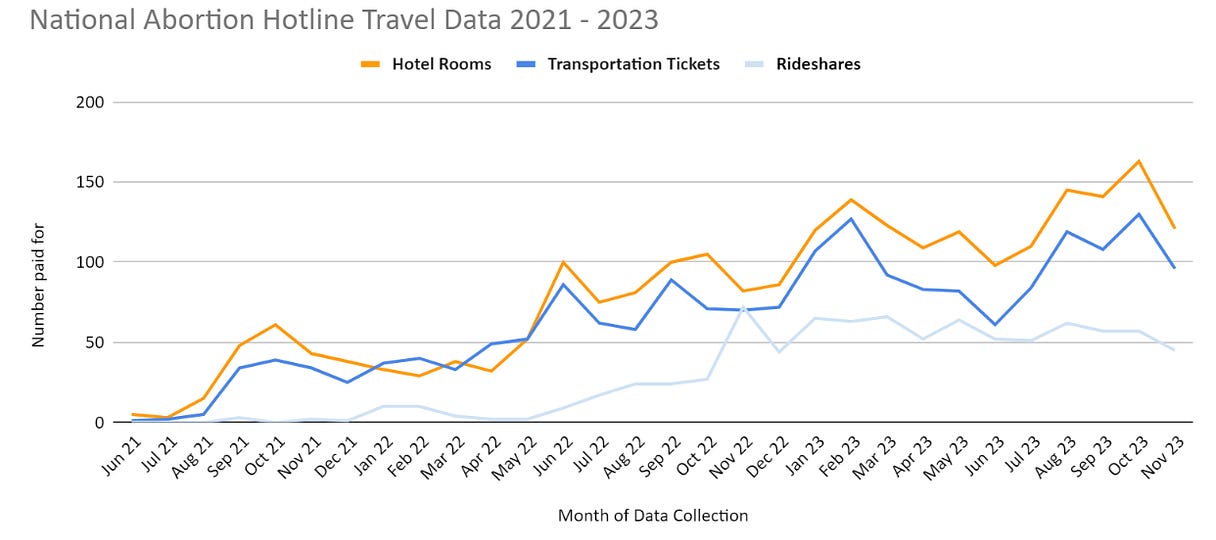
This journey is becoming more common. Before Dobbs, 1 in 10 women having abortions had to travel. Now the rate has doubled, to 1 in 5. We see increased travel from many angles. While the number of abortions across states has greatly shifted post-Dobbs, the national average hasn’t budged.
![]() |
| Map from National Abortion Federation, based on data from its National Abortion Hotline |
This speaks to why we see increases in self-managed abortion (i.e., medication abortion). It’s also why colleagues in Latin America, for example, have been supporting people to self-manage with pills up to 24 weeks of pregnancy, which is safe and effective.
An increasing number of women are traveling out of state for reproductive health care. This journey isn’t without very real obstacles. The most tragic part is much of the associated trauma is preventable if we had access to local health care.
It may be hard to understand, but it’s harder for people to live through. Trust women. Listen to their stories. Trust their voices. It is, after all, their lives and their livelihoods.