Showing posts with label controlled substances. Show all posts

Thursday, April 20, 2023

Annual overdose deaths in Kentucky fell for first time in four years

By Melissa Patrick
Kentucky Health News

For the first year since 2018, Kentucky saw a drop in drug overdose deaths last year.  

Provisional data gathered by the Kentucky Injury Prevention and Research Center shows that 2,127 Kentuckians died of overdose in 2022, 5 percent less than the 2021 figure of 2,257. 

"I think it's important that we note that because it ought to give us at least hope," Gov. Andy Beshear said at his weekly news conference Thursday. "Hope that progress is possible, hope that we can see fewer deaths next year than we saw this year, hope that we can get more people better and back with their families, back in society, back in a good job." 

Dana Quesinberry, co-principal investigator for surveillance of the Kentucky Drug Overdose Data to Action Program, said "We're really optimistic about this finding" because it could be an early signal that the state's prevention and intervention efforts are having an effect. It could also reflect the increased avaialbilty of Narcan (naloxone), which can stop an overdose by blocking action of the opioid(s).

"While this news is encouraging, there's still a lot of work to be done," Quisenberry said. "And we really hope that this early signal will . . . strengthen our resolve to address substance-use issues, including the diagnosis and treatment of substance-use disorders and continue to support Kentuckians . . . in their recovery and our joint recovery as we move forward." 

Beshear was asked if he expected the new availability of medical marijuana to certain people to further reduce OD deaths, "Well, I certainly hope that the medical marijuana program, or what's allowed under my executive order, is resulting in fewer people having to take opioids," he said. "So if we can take another step to decrease people's uses of opioids, if they can treat pain instead with medical marijuana, yes, I do believe that it will result in fewer opioid deaths." 

Kentucky lawmakers passed a bill to legalize medical marijuana for people meeting certain qualifications in 2025 on the last day of the 2023 legislative session, and Beshear quickly signed it into law. Last year, Beshear issued an order to use  his pardon power to allow people with 21 specified medical conditions and a doctor's certificate to possess up to eight ounces of marijuana bought legally in another state. (Illinois is the only adjoining state where non-residents can legally buy cannabis now.)

The legislature also passed a law to decriminalize possession of fentanyl test strips, which are used to detect the synthetic opioid that contributed to 73% of Kentucky's 2021 drug overdose deaths. 

Monday, June 13, 2022

Drug overdose deaths in Kentucky rose nearly 15% last year; fentanyl involved in 73% of deaths, methamphetamine in 48%

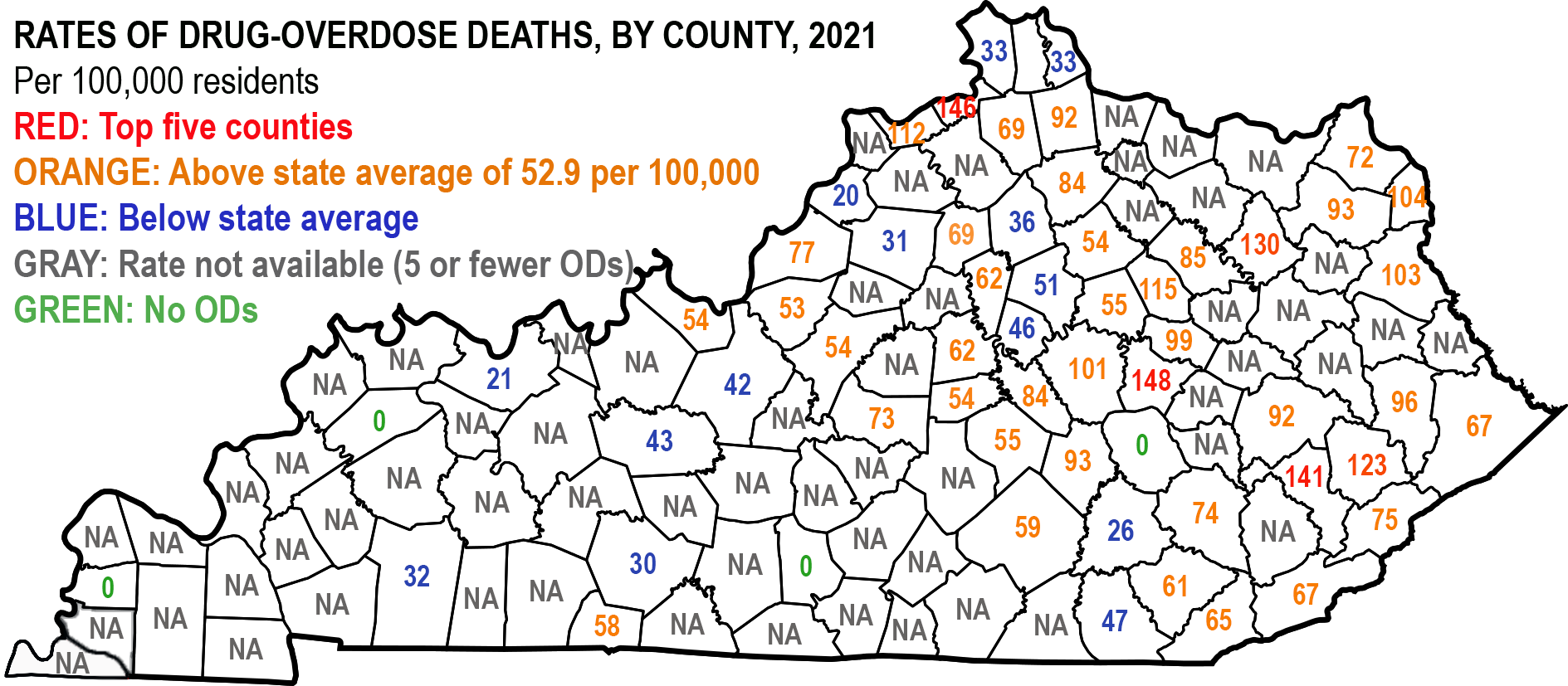
Kentucky Health News map from state data; click on it to enlarge (see note on table below)
By Melissa Patrick
Kentucky Health News

Drug-overdose deaths in Kentucky rose 14.6 percent in Kentucky in 2021, according to the state's annual report released Monday.

“The drug epidemic is not a Kentucky issue or political issue, but a nationwide issue that is affecting everyone and every state,” Van Ingram, executive director of the state Office of Drug Control Policy, said in a news release. “Our focus over this next year will be on increasing access to clinical care for those suffering from an addiction and offering more harm reduction measures.”

The state recorded 2,250 overdose deaths in 2021. That was 286 more OD deaths than the 1,964 reported in 2020, when the increase from the previous year was 54%.

The Covid-19 pandemic hit in 2020, disrupting lives and drug treatment, so it got most of the blame for that year's big increase. But the powerful opioid fentanyl was also becoming more prevalent, creating a "perfect storm" that is still being felt, Ingram said on KET's "Kentucky Tonight" Monday night. He told The Associated Press, “We’ve never seen one drug this prevalent in the toxicology reports of overdose fatalities.”

Estill County had the highest rate of fatal overdoses in 2021, 148 per 100,000 residents (adjusted for age of the population). It was followed by Gallatin, 146; Perry, 142; Rowan, 131; and Knott, 123. The report cautions that counties with fewer than 20 OD deaths per year, as was the case in all but Estill, Perry and Rowan, are unstable and should be interpreted with caution.

Kentucky Health News table, from state data; yellow counties
had fewer than 20 overdose deaths, so their rates are less reliable; 
rates were not released for those with fewer than 10 OD deaths.
The report does not give rates for counties with fewer than 10 overdose deaths, nor the actual number of OD deaths in counties with 5 or fewer. The number of counties with 10 or more OD deaths rose to 57 in 2021 from 44 in 2020. 

Jefferson County, the state's most populous, again had the most resident overdose deaths of any county, 569. That was an increase of 11% from the 512 recorded in 2020. The county's OD-death rate was 77 per 100,000, well above the statewide rate of 52.9 per 100,000.

Toxicology reports show that fentanyl was involved in 1,639 of the overdose deaths, or about 73% of them. That was an increase of 16% from the 1,413 overdose deaths involving fentanyl in 2020.

Methamphetamine was found in 1,075 of the overdose victims, or about 48%. This is an increase of 33% from the 809 OD deaths involving methamphetamine in 2020. 

Heroin was involved in 93 of the 2021 overdose deaths, a decrease from 191 in 2020. Also seeing decreases from the prior year were morphine, detected in 309 cases; acetyl fentanyl (256);  and alprazolam (211), among others. 

Oxycodone saw a slight decrease from the prior year, having been identified in 198 drug overdose deaths in 2021, down from 201 cases in 2020. 

Some of the drugs that saw increases from the prior year's toxicology reports were amphetamines, in 945 cases; gabapentin (503); THC (476); cocaine (300); hydrocodone (199); tramadol (129) and diazepam (85). 

The age group in which Kentucky overdose deaths are most common continues to be 35 to 44. Next is 45-54, which ranked third in the 2020 report and traded places with the 25-34 range in this year's report. Ranking fourth were the 55-64-year-olds. 

Over many years, Kentucky has supported programs, legislation and research to battle substance-use disorder, along with funding support.

State Sen. Ralph Alvarado, R-Winchester
"This problem is like a bucket with fifty holes in it," state Sen. Ralph Alvarado, R-Winchester and a physician, said on "Kentucky Tonight," adding that it's a problem that must be addressed by all elements of society, not just government.

But progress has been made, with measures such as harm-reduction programs that include syringe exchanges, House Minority Leader Joni Jenkins of Shively said: "We can't even quantify how many lives we've saved."

The state has more syringe exchanges than any other. "We may be ground zero for this problem, but we've been ground zero for a lot of national solutions," said Tim Robinson, a recovering addict who is CEO of Addiction Recovery Care, a chain of treatment centers that try to lead drug users to careers. He said addiction often seems "daunting and hopeless" because it usually take several attempts to kick the habit, "but recovery's possible. I see it every day."

Tim Robinson, CEO, Addiction Recovery Care
Robinson said so much treatment is available in Kentucky now that "It's almost treatment on demand," but the state needs more mental-health professionals. He said methamphetamine use is harder to treat because there is no medication-assisted treatment for it, as there is for opioid use, and it can cause a psychosis that makes users difficult to evaluate when they come to treatment.

Jenkins promoted the concept of "recovery ready communities" put into law by the legislature last year. An advisory council is working with Ingram's office and Volunteers of America to develop a program for cities and counties to apply for certification by offering transportation, support groups, recovering meetings and employment services at no cost to residents seeking treatment for a drug or alcohol addiction, Gov. Andy Beshear said in a news release.

VOA President & CEO Jennifer Hancock said in the release, “We are committed to being an inclusive and collaborative leader as we create a framework that will both standardize and customize what it means to be recovery ready for every Kentucky community. Recovery Ready Communities truly has the potential to transform how Kentucky approaches the public health crisis of our generation, so it was with a sense of urgency, accountability and passion that we applied. Our team is ready to get started, inspired by the work and cannot wait to bring this initiative to life.”

Beshear said, “Here in the commonwealth, we have been fighting a long battle against the opioid epidemic. This public-health crisis has torn families apart and taken the lives of far too many Kentuckians, far too soon. Every day we must work together to fund recovery programs and treatment options so that we can continue to address this scourge and get our people the help they need.”

Data for the report was compiled with data from the state medical examiner's office, the Kentucky Injury Prevention & Research Center, and the Kentucky Office of Vital Statistics.

People who are struggling with drug abuse or who are concerned about a family member's substance use can search for treatment providers at www.findhelpnowky.org. The KY Help Call Center (1-833-859-4357) also provides information on treatment options an open slots among treatment providers. The Kentucky State Police has also launched the Angel Initiative, which allows anyone with a substance-use disorder seeking treatment to visit a KSP post where they are directed to treatment.

Monday, June 6, 2022

Madison County OD deaths up 27%, twice the state gain; coroner says he has told one mother about deaths of three of her children

A preliminary federal report shows drug overdose deaths in Kentucky rose 13.55% in 2021, to an estimated 2,391 deaths. It also shows that again, opioids and synthetic opioids, such as fentanyl, were the two main contributors.

Coroner Jimmy Cornelison
(Madison County website photo)
County figures will be released in the annual state report in a few weeks, but county coroners keep a running count, and they can tell the story of how such deaths impact a community. Madison County Coroner Jimmy Cornelison told Lexington's WKYT-TV a bit of that story.

Cornelison told reporter Jeremy Tombs that he knocks on the doors of families to tell them they’ve lost loved ones.

“I’ve done a family where I did three children in that same family,” he said. “Three times I hugged that mother; three times.” 

Madison County saw 75 people die from a drug overdose in 2021, up 27 percent from the 59 OD deaths recorded in 2020, WKYT reports. Cornelison added that these numbers don't show the full scale of the problem.

He told Tombs that one problem is that Madison County, is along Interstate 75, “so you can hop on, hop off. Stop in Richmond and sell your goods, meet somebody in a parking lot and be gone in 10 minutes.”

Cornelison said that while he didn't see a way out of this worsening situation, it's important to not give up on people who have a drug problem. “We have to invest in these folks. Number one invest in keeping them clean,” he said. “Find them something to do, get them a job.”

First responders help curb overdose deaths by carrying Narcan, a drug that blocks the effect of opioids. Cornelison told WKYT that his county's overdose death numbers would likely be one-third higher if it weren’t for the pre-hospital care some people receive.

People who are struggling with drug abuse or who are concerned about a family member's substance use can search for treatment providers at www.findhelpnowky.org.

Commission named to award grants from state's half of $483 million opioid settlement; local governments will get the other half

By Al Cross
Kentucky Health News

Attorney General Daniel Cameron has appointed the 11 people who will oversee the state's half of the $483 million settlement it made as part of a national agreement with opioid manufacturers and distributors.

The Opioid Abatement Advisory Commission will meet twice a year to approve awards from the settlement fund and will have an executive director, W. Bryan Hubbard, appointed by Cameron from his staff.

Bryan Hubbard
Hubbard, a lawyer, has overseen Cameron's Medicaid fraud unit. In the Matt Bevin administration, he ran the state agency that handles Social Security disability and child-support enforcement.

“Bryan has dedicated his career to the welfare of Kentucky families and children, and he intimately understands the ripple effects of the opioid crisis in the commonwealth,” Cameron said. “I know that he will guide the work of the commission with a steady hand and ensure that the settlement funds are distributed to meaningful opioid abatement initiatives.”

Hubbard will be a member of the commission "representing victims of the opioid crisis," as described in the 2021 law creating the commission. The members mandated by the law are Cameron, who will serve as chair; state Treasurer Allison Ball, and Cabinet for Health and Family Services Secretary Eric Friedlander, who works for Gov. Andy Beshear, a fellow Democrat. The others are Republicans (Cameron is running to unseat Beshear in 2023) and so is Rep. Danny Bentley of Russell, appointed as a non-voting member by House Speaker David Osborne. The other non-voting member, appointed by Senate President Robert Stivers, is Karen Kelly, district director for U.S. Rep. Harold "Hal" Rogers, R-Somerset, and former director of his Operation UNITE anti-drug initiative.

The other members, filling seats specified by the law, are state Office of Drug Control Policy Director Van Ingram, representing the drug treatment and prevention community; Vic Brown of London, deputy director of the Appalachian High Intensity Drug Trafficking Area, representing law enforcement; Jason Roop of Campbellsville University, representing victims of the opioid crisis; Karen Butcher of Georgetown, representing citizens at large; Simmons College of Kentucky Vice President Von Purdy of Louisville, representing citizens at large; and Dr. Sharon Walsh, representing the HEALing Communities Study at the University of Kentucky, which appointed her.

The release said the commission will hold its first meeting "in the coming days" and establish a framework for distributing funds. The other half of the settlement will go to local governments and be distributed "in accordance with an agreement reached among them," the law says. "If no such agreement is reached, the money shall be paid to a trustee appointed jointly by the Kentucky Association of Counties and the Kentucky League of Cities for distribution of the funds."

The $483 million coming to Kentucky is part of a $26 billion settlement states made with Cardinal Health, McKesson Corp., AmerisourceBergen and Johnson & Johnson.

Sunday, March 13, 2022

House passes bill to allow APRNs to prescribe controlled substances after a four-year collaborative agreement with doctor

American Association of Nurse Practitioners map, adapted by Kentucky Health News
By Melissa Patrick

Kentucky Health News

A bill to create a path for Kentucky's advanced practice registered nurses to prescribe controlled substances independently has passed the state House with only eight members voting against it. 

“We are always talking about encouraging folks to enter the health-care field; we hear discussion about a shortage of nurses that we have,” Rep. Russell Webber said while presenting the bill on the House floor. “This bill will help with that.”

House Bill 354, sponsored by Webber, would allow an APRN to prescribe controlled substances without a collaborative agreement with a physician, after practicing under such an agreement for four years and getting approval from the Kentucky Board of Nursing.

If the board decides an APRN is abusing this authority, it can require them to go back under a collaborative agreement, or it can take further action.

The latest version of the bill would hold independently prescribing APRNs to the same standard of care as other prescribers, and create a Controlled Substance Prescribing Review Panel to monitor them.

"This component adds teeth to this bill. It adds strength," said Webber, a Shepherdsville Republican. "It  may very well help us get to the bottom of some problems that are existing out there, if they are existing, but the data will certainly be worthwhile for us to have. Problems that may surface will be worthwhile for us to know."

Rep. Russell Webber

Webber was alluding to the implicit contention of the doctors' lobby, the Kentucky Medical Association, that APRNs haven't been responsible enough with their prescribing of Schedule II drugs, those with high potential for abuse, to prescribe them independently.

In Kentucky, APRNs have been able to prescribe controlled substances since 2006 under a "collaborative agreement for prescriptive authority-controlled substances," or CAPA-CS. They are allowed to prescribe a 72-hour supply of a Schedule II drug; HB 354 wouldn't change that.

The bill's primary co-sponsor, Rep. Patti Minter, a Democrat from Bowling Green, told the House that it is needed to increase health-care access in a state that has only 57 percent of the primary-care practitioners it needs and 25% of needed mental-health personnel. 

"Nurse practitioners are for many people the primary-care providers," Minter said. "They're the family doctors of the community."

Rep. Jerry Miller, R-Eastwood, said the bill would improve access to health care. "This is a good bill for the people," he said. "It may not be a good bill for the doctors, but it's a good bill for the people of Kentucky." 

House health committee Chair Kim Moser, R-Taylor Mill, a former nurse and a doctor's wife, voted no. Moser said she liked the amendments because "It's critical that all prescribers play by the same rules" but cautioned, "The only thing that we are doing by passing this bill is increasing controlled substances."

The House voted against suspending its rules to let Moser offer a floor amendment to reinstate the requirement that an APRN be licensed to practice for a year before being prescribing controlled substances, to obtain a registration certificate from the Drug Enforcement Administration and pass each component of the federal licensing exam in three attempts, just as physicians must do before prescribing controlled substances. 

Rep. Mary Lou Marzian, D-Louisville, a nurse, said the bill is needed because APRNs need a DEA number to order some diabetic and psychiatric medication, durable medical equipment, and flu and antibiotic shots.

APRNs were allowed to prescribe controlled substances without a collaborative agreement in the pandemic through an executive order that the General Assembly approved, but that ended in January when lawmakers extended the state of emergency but did not extend the APRNs' expanded authority.

Dueling numbers

A before-and-after comparison by the Kentucky Association of Nurse Practitioners & Nurse-Midwives, said there were "no significant differences in the average number of opioid prescriptions by APRNs without the CAPA-CS in place" before the emergency order was implemented and the seven quarters it was in place. Similar findings were also noted for dentists and physicians. 

The data came from the state's Kentucky All Schedule Prescription Electronic Reporting system. Other KASPER data provided by the APRN association shows that the average number of Schedule II prescriptions per APRN prescriber dropped 34.9% between 2015 and 2021. 

Webber said, "Nurse practitioners were not writing prescriptions hand over fist for controlled substances and flooding the state with opioids." 

The KMA disputed those figures before the House Licensing, Occupations and Administrative Regulations Committee on March 9.

Cory Meadows, KMA's deputy executive vice president and director of advocacy, said "We have KASPER numbers that show that they are consistently up, way up over the course of a lot of years."

KASPER data provided by the KMA, comparing the total number of prescriptions for Schedule II opioids prescribed by APRNs shows an increase in all but one year since since 2011, the year before lawmakers passed what is called the "pill-mill bill" that placed restrictions on opioid prescribing.

There are some discrepancies, many of them slight, in the year-to-year numbers provided to Kentucky Health News by the two organizations, and they measure different things. 

For example, the APRN group provided the average number of Schedule II opioid prescriptions per the number of prescribers since 2015 and for seven recent quarters, while the KMA provided year-to-year percentage changes for the total number of such prescriptions. 

KMA data shows that Schedule II opioid prescribing by APRNs went up 8.2% between 2020 and 2021, years that the CAPA-CS were no longer required, under the executive order.

The APRN data shows that the average number of Schedule II opioid prescriptions per APRN dropped from 100.68 in 2020 to 99.28 in 2021 and that their quarterly average in 2021 was 25 prescriptions. The average was 50 for physicians and 22 for dentists.

The bill passed the House 84-8 and moves to the Senate, where it will be carried by Sen. Julie Raque Adams, R-Louisville. 

The "no" votes were all Republican: Moser, Joe Fischer of Fort Thomas, Kim King of Harrodsburg, Mathew Koch of Paris, Adam Koenig of Erlanger, Sal Santoro of Union, Nancy Tate of Brandenburg and Killian Timoney of Lexington.

Sunday, January 16, 2022

13% more Kentuckians used prescription drugs for mental health in October than in January, as the pandemic added to stresses

Quote Wizard map, adapted by Ky. Health News, shows increases in adjoining states and Southeast.
By Melissa Patrick
Kentucky Health News

Kentucky is one of 28 states that saw an increase of more than 10 percent in the number of adults taking prescription mental-health medications last year, which is largely attributed to the prolonged impact of the pandemic, according to an analysis of Centers for Disease Control and Prevention data. 

"Covid-19 hasn’t just affected people’s physical health. The pandemic has also had a profound and prolonged impact on people’s mental health. Over the last year, more and more people have reached out for help dealing with stress, anxiety or depression," says the report from Quote Wizard, based on Pulse survey data from the Centers for Disease Control and Prevention from January 2021 to Oct. 15, 2021.

The figures show that 29% of Kentucky adults are taking prescription mental-health medications. That amounts to about 1 million people, 13% more than in January 2021.

Kentucky's rate of increase was less than the national increase of 20%, but the percentage of Kentucky adults taking prescription mental-health drugs remains above the national rate of 24%.  

Sheila Schuster, a psychologist and executive director of the Kentucky Mental Health Coalition, said she was "delighted" to see more Kentuckians seeking mental-health care, especially during the pandemic, when every age group is struggling with issues that exacerbate anxiety and depression. 

"I think Covid has had potentially devastating effects on the mental health of all ages in Kentucky," Schuster said. "So I'm delighted actually to see that there has been an increase in contact with mental-health providers. . . . You know, we really want people to reach out, to get some help before things get into a state of multiple, serious mental-health concerns."  

Schuster pointed out some challenges brought on by the pandemic: feelings of not being in control, economic uncertainty, social isolation, remote learning challenges, a shutdown of peer-support services for people with substance-use disorder, and an uptick in domestic violence. Add to that, she said, the racial tension sparked by the Breonna Taylor case in Louisville and the natural disasters that have plagued several other parts of Kentucky. 

"Some people are really dealing with what must feel to them like an unbearable amount of stress and grief and loss compounded with this anxiety and depression so, you know, our message has been over and over to reach out for help," she said. 

What is often most effective, particularly for more serious stages of depression or anxiety, Schuster said, is a combination of talk therapy with some medication. To that end, she said the Kentucky Mental Health Coalition, Mental Health America Kentucky and the Kentucky Psychological Association have been writing op-eds and holding public forums to alert people that what they are feeling is not unusual and to encourage them to reach out for some additional help if they need it. 

"I think actually we're going to be seeing the aftermath of Covid for the next four or five years," she said.  

MHA Kentucky Executive Director Marcie Timmerman said MHA has seen a significant increase of interest in mental health and wellness during the pandemic, noting a 265% increase in voluntary mental-health screenings from 2019 to 2021, with 4,770 screenings in 2019 and 17,419 in 2021.

"It makes sense to me, with the increase in talking about mental health that has accompanied Covid-19, that we see an increase in forms of treatment like medications," Timmerman said. 

MHA ranked Kentucky 23rd for prevalence of mental-health illness in 2021, based on six mental-health measures that included both youth and adults. 

Timmerman encouraged Kentuckians to keep talking to their health-care providers about their mental health, and reminded providers to remember "that prescriptions are most effective when paired with therapy."

Schuster added that other than your family doctor, ministers, friends who use mental health care, professional mental-health organizations, like MHA, and community mental-health centers, which serve every Kentucky county, are also good resources to help you find mental health care providers in your area. 

The report notes that most insurance plans cover some form of mental-health care, including Medicare and all Affordable Care Act plans. 

Sunday, August 15, 2021

Former governor's nonprofit gets another big federal grant for its residential housing program to treat substance-use disorder

Numbered counties in red: 2, Cumberland; 3, Clinton; 10, Robertson; 13, Menifee.
A not-for-profit organization headed by former Gov. Ernie Fletcher, who was a doctor before he got into politics, is getting $3,333,333 in federal funds to support its treatment of substance-use disorder through residential housing following the Recovery Kentucky model he initiated as governor.

The grant from the Rural Communities Opioid Response Program of the Department of Health and Human Services was announced by Senate Republican Leader Mitch McConnell, who helped Fletcher get a $6.6 million grant to start the Fletcher Group Rural Center of Excellence two years ago. At that time, a McConnell press release said the center would serve 101 rural counties in eight states, 47 of them in Kentucky.

According to its website, the group now serves 10 states: Kentucky, Ohio, Tennessee, West Virginia, Georgia, Mississippi, Washington, Oregon, Idaho and Montana. It says the 2019 grant totaled $10.4 million, and the group got two other grants that year: $1.6 million from the Appalachian Regional Commission and $250,000 from the Kentucky Opioid Response Effort.

“Driven by the isolation caused by the coronavirus pandemic and the flood of dangerous fentanyl coming across our borders, this past year the commonwealth suffered one of the worst spikes in overdose deaths in the nation, McConnell said in the latest release. “With the targeted prevention, treatment, and enforcement programs at organizations like the Fletcher Group, Kentucky’s rural communities will be empowered to fight addiction and put an end to this crisis.”

Fletcher said in the release, “We thank Senator McConnell for his long-standing and steadfast support for addiction services and recovery housing for those with substance use disorders. . . . Recovery housing has successfully demonstrated positive long-term outcomes for high-risk individuals dealing with addiction.”

Tuesday, August 3, 2021

Drug overdose deaths in Kentucky rose 49% in 2020; fentanyl and methamphetamine remained the biggest drivers of death


By Melissa Patrick

Kentucky Health News

Drug-overdose deaths in Kentucky rose 49% in 2020, according to the state's latest annual report

“In addition to the stress caused by the pandemic, we believe the increase in overdose deaths for 2020 is due to a rise in illicit fentanyl and its analogues within the drug supply. The problem is also exacerbated by the widespread availability of potent, inexpensive methamphetamine,” Van Ingram, Executive Director of the Kentucky Office of Drug Control Policy, said in a news release. 

The state recorded 1,964 overdose deaths in 2020, the highest number recorded to date. That was 648 more than in 2019, when 1.316 were recorded. It is also 498 more overdose deaths than in 2017, when the state recorded its last record high for overdose deaths, 1,566. 

Knott County had the highest rate of fatal overdoses in 2020, 122 per 100,000 residents. It was followed by Clark, 104; Bourbon, 98.4; Henry, 88; and Garrard, 82.3. The report cautions that counties with fewer than 20 overdose deaths per year, as was the case in all but Clark County, are unstable and should be interpreted with caution. 

The report does not give rates for counties with fewer than 10 overdose deaths, so the report only includes 44 counties. That's up from 2019, when 29 counties had 10 or more overdose deaths, and up from 23 in 2018. 

Jefferson County, the state's most populous county, had the most resident overdose deaths of any county, 512, which was an increase from 319 in 2019. 

Ky. Health News table, from state data; yellow counties
had fewer than 20 OD deaths, so rates are less reliable;
rates were not released for those with fewer than 10.
Toxicology reports show that fentanyl was involved in 1,393 of the overdose autopsies, or approximately 71% of all overdose deaths for the year. Acetylfentanyl, another version of the drug, was found in 502 of the cases. 

Heroin was involved in 191 of the 2020 overdose deaths, an increase from 166 in 2019. Also seeing increases from the prior year were morphine, detected in 504 cases; alprazolam, 237 cases; gabapentin, 390 cases; methamphetamine, 801 cases; and oxycodone, 198 cases. 

The age group in which Kentucky overdose deaths are most common continues to be 35-44. Next is 25-34, which ranked third in the 2019 report and traded places with the 45-54s in this year's report.

“Deaths attributed to overdose in 2020 are a somber reminder that the opioid epidemic continues to deeply impact our commonwealth  . . . Opioid response is complex and our success will be dependent on our willingness to unite in a shared responsibility to end the stigma and discrimination against substance use disorders and build an equitable system of care that engages and empowers individuals and their families to lead healthy, fulfilling lives," Health Secretary Eric Friedlander said in the release.

Data for the report was compiled with data from the Kentucky Office of the Medical Examiner, the Kentucky Injury Prevention & Research Center, and the Kentucky Office of Vital Statistics.

People who are struggling with drug abuse or who are concerned about a family member's substance use can search for treatment providers at www.findhelpnowky.org. The KY Help Call Center (1-833-859-4357) also provides information on treatment options an open slots among treatment providers. The Kentucky State Police has also launched the Angel Initiative, which allows anyone with a substance-use disorder seeking treatment to visit a KSP post where they are directed to treatment. 

Sunday, May 3, 2020

Virus creates perfect storm for those with substance-use disorder, but opens the door to online recovery tools that could persist

By Melissa Patrick
Kentucky Health News

Economic struggles and social isolation are well-known triggers for people with substance-use disorders, so the coronavirus pandemic has created a perfect storm for them. But the isolation has prompted an influx of online recovery services that addiction experts hope will continue long after the virus subsides.

Image from Alcohol.org
"Some really great things that are going to come out of this situation is that for folks who really face transportation barriers, especially out in those rural communities, if we allow, continue to have this space for virtual connection, we can really create some better connections with those people to get them the supports that they need," Tara Moseley, program manager at Young People in Recovery said on "Coronavirus: A Kentucky Update," a weekly Kentucky Education Television program hosted by Dr. Wayne Tuckson.

The shift to online care is an opportunity for those who are seeking recovery, but are hesitant to attend an in-person meeting, said Sarah Bell, lead peer specialist at Beyond Birth, a University of Kentucky outpatient substance-use-disorder recovery program serving mothers in recovery.

"I think it is a great time to for anyone who might be exploring getting sober, but they don't want to walk into a meeting in their town," Bell told KET. "There are all these virtual meetings now, which I think is really helping to break down the stigma of people who feel like they might want to stop using a substance."

Addiction experts have long called for more access to online addiction treatment, including the ability to prescribe medications online for opioid-use disorder. About 40 percent of U.S. counties don't have a health-care who is approved to prescribe buprenorphine, an active ingredient in Suboxone, the preferred drug in medication-assisted treatment for substance-use disorder, according to a federal report.

Online prescribing is possible only because the pandemic prompted the federal government to suspend a law that required patients to have an in-person visit with a physician before such a prescription, Phil Galewitz reports for Kaiser Health News. 

The new rules also allow people who are in treatment for addiction and are considered “stable” to take home a 28-day supply of methadone, and those "less than stable" to have a 14-day supply. Beforehand, methadone could only be administered in an opioid treatment program. Advocates say compliance with the new guidelines has been inconsistent, reports Stat, the medicine-and-science publication of The Boston Globe.

Virus creates perfect storm for relapse 

Since mid-March, all non-life-sustaining, in-person businesses in Kentucky have been closed, public schools have ceased all in-person classes, and Kentuckians have been asked to practice social distancing and be "healthy at home" to slow the spread of the coronavirus. Such measures, while saving lives, have wreaked havoc on the economy and thrown people with addictions into a tailspin as in-person recovery supports have shuttered.

"Research shows that job loss is associated with increased depression, anxiety, distress, and low self-esteem and may lead to higher rates of substance use disorder and suicide," according to a recent poll for the Kaiser Family Foundation, which notes, "A broad body of research links social isolation and loneliness to both poor mental and physical health."

The poll found that 45 percent of U.S. adults said their mental health has been hurt by worry and stress over the virus.

U.S. Department of Labor report shows that Kentucky (except tourism-dependent Hawaii) leads the nation in percentage of workforce that has claimed unemployment benefits. The Louisville Courier Journal reports that about 590,000 Kentuckians, or about 29% of the state's workforce, have submitted new jobless claims in the past six weeks.

"Quarantine and stuff, it causes anxiety, and anxiety is a trigger for a lot of people," Rebekah Bowman, women's group leader at Celebrate Recovery, a faith-driven, 12-step recovery program, said on the KET show.  "And sometimes the alienation, that's a trigger for some people. And the hopelessness of it, some people just get to feeling like it's never going to end."

Alex Acquisto of the Lexington Herald-Leader has reported in detail on this topic, telling the stories of Kentuckians who are working to stay sober while being asked to isolate. One is Jaden Korse, 23, who told her that he normally attends at least three recovery meetings a week.

“For a lot of people, me included, prior to relapse, isolation is sort of a trait you’ll see,” Korse said.  “It’s weird to forcibly be put into that, [since] it was something many of us would do in active addiction.”

Drug use continues

Rob Sanders, commonwealth's attorney in Kenton County, told columnist Salena Zito that even though arrests are down dramatically in his county, he didn't think drug use was.

“I would estimate that we normally would get 20 to 30 felony drug-possession arrests per week in this county,” he said. “Right now we’re averaging five or six, maybe. Short of crashing into a police car, you are very hard-pressed to get yourself arrested for drug possession . . . I don’t think the drug users have stopped using just because of the coronavirus. I suspect there’s a lot of rampant drug use right now and there’s just a lot less police intervention. I’m not faulting the police, because I wouldn’t want them to have any more interaction with strangers than they absolutely had to, but their proactive policing is way down.”

Sanders isn't likely far off in his assumption, since illicit drugs continue to flood into the state, news reports in the past month indicate.

In the past month: WKYT reported May 2 about nine straight days of methamphetamine seizures in Whitley County; WYMT reported April 9 about a meth bust in Johnson County; The Daily Independent of Ashland reported April 7 about a seizure of more than a pound of heroin in Boyd County, an amount the sheriff said was almost unheard of locally.

Meanwhile, drugs continued to reach users. The Richmond Register reported April 24 that the Madison County EMS saw 75% more overdose calls April 1-23 than during the same period 2019.

Paul Brethen, co-founder of SoberBuddy and a certified addiction specialist for more than 20 years, told Dawne Gee of Louisville's WAVE-TV that he believes the supply and distribution of most drugs was being altered because borders closed because of the pandemic: "Drug dealers to keep business going are cutting the heroin and cocaine with fentanyl," which could lead to more overdoses.

Drug shortages can also lead to overdoses, because users will substitute drugs they’re less familiar with, or change their habits, making dosing less reliable and potentially causing a spike in overdoses,
Daniel Ciccarone, a medical professor at the University of California-San Franciscotold Lois Parshley of National Geographic. Ciccarone fears that the pandemic may usher in a fifth wave of the opioid crisis.

Help is still available.

"A big part of recovery is telling on yourself; you are going to always have thoughts about picking up a drink or a drug," Bell, of Beyond Birth, said on KET. "If you say it out loud, and talk to someone else about it, it's going to take a lot of that power away. The more you kind of try to sit in isolation and stuff it and stop thinking about it, or think that you're wrong or guilty for thinking about it, it's going to be a lot tougher to  kind of make it through that craving."

Here is a list of free online meeting options, as well as platforms where individuals can interact virtually with others in recovery, provided to Operation Unite by James Carroll, director of the White House Office of National Drug Control Policy. Kentucky also offers a website to connect Kentuckians to addiction treatment, findhelpnowky.org.

Friday, January 31, 2020

Bill to let physician assistants prescribe passes first hurdle; Ky. is only state where they can't, causing health-care access issues

By Melissa Patrick
Kentucky Health News

FRANKFORT, Ky. -- A bill to allow physician assistants to prescribe highly regulated drugs, a step advocates say is needed to improve health-care access in rural Kentucky, is finally moving through the legislature.

L-R: Andrew Rutherford, Rep. Steve Sheldon, Laurie Garner
"Kentucky is the last state in the U.S. where PAs don't have some form of controlled-substance delegation. The other 49 states have it already," said the bill's main sponsor, Rep. Steve Sheldon, R-Bowling Green. "And no state has ever reduced or rescinded the authority that has been given."

House Bill 135 would allow "modified prescriptive authority" of controlled substances in Schedules II, III, IV, and V after the PA has been licensed and has practiced for one year.

It passed the House Health and Family Services Committee Jan. 30 with a committee substitute. This was the fourth time the legislation had been filed, and the first time it had been brought up in committee for a vote.

Leaders of the Kentucky Academy of Physician Assistants urged passage of the bill, explaining that under the current system a supervising physician has to sign off on any controlled substance prescription written by a PA. They said this results in decreased access to care, delays in care, poor prescribing transparency, and ultimately results in Kentucky PAs moving to other states.

"Our graduating PA students are leaving the state of Kentucky to practice in other states where they have less restrictions and more job opportunities," said Laurie Garner, president of KAPA. "By passing this bill we will keep our best and our brightest in our state rather than seeing them leave for better opportunities elsewhere."

She also offered an example of how the system results in delayed care, noting that because she is often the only provider at her clinic, her patients who need a controlled substance prescription or a refill must wait until the supervising physician is able to co-sign for it, and often end up canceling appointments when she can't immediately help them.

Andrew Rutherford, vice-president of KAPA, said the bill would increase transparency, since drugs would be ordered under the PAs' Drug Enforcement Administration numbers instead of their supervising physicians' numbers.

"It will also allow PAs to be accountable for the controlled medications that they prescribe, based on their treatment plans," he said. "Currently a supervising physician signs off on all these prescriptions and this is falsely inflating many physicians' prescribing numbers."

The bill includes several restrictions, including only allowing PAs to prescribe a three-day supply of Schedule II drugs, with no refills. Schedule II and III non-narcotic substances would be limited to a 30-day supply with no refill; and Schedule IV and V drugs would be limited to the original prescription, with refills to not exceed a six-month supply.

It also carves out several Schedule IV drugs that can only be written as a 30-day supply without any refills, including: diazepam (Valium), lorazepam (Ativan), alprazolam (Xanax) and carisoprodol (Soma).

Administration of the program would fall under the Kentucky Board of Medical Licensure, and a PA's license to prescribe such drugs would need to be renewed every two years. The measure also includes new rules around continuing education requirements, including a number of required hours related to controlled substances.

Under the regulation, PAs would still have to work under the supervision of a medical doctor and that physician would be allowed to limit which controlled substances their PAs can prescribe, or if they want to participate in the program.

Wednesday, January 29, 2020

U.S. House passes Senate bill to maintain anti-fentanyl laws

The U.S. House passed a Senate bill Wednesday to keep deadly fentanyl and similar opioids listed as some of the most dangerous drugs, and President Trump is expected to sign it Friday, the day before the listings would expire.

The legislation would keep fentanyl compounds as Schedule I substances under the law governing the Drug Enforcement Administration, "giving law enforcement the tools they need to bring drug dealers to justice," said a press release from Rep. Hal Rogers, R-Somerset.

"Fentanyl, a synthetic opioid that is 50 to 100 times stronger than heroin, continues to be the most lethal drug for Kentucky causing nearly 800 overdose deaths in 2018 alone," said a press release from U.S. Sen. Mitch McConnell, the Senate majority leader. The Senate passed the bill Jan. 16.

The federal Centers for Disease Control and Prevention says the U.S. had more than 28,000 deaths involving synthetic opioids (other than methadone, which is used to treat addiction) in 2017, more deaths than from any other type of opioid.

Tuesday, January 28, 2020

Albany pharmacist who led U.S. in dispensing opioids pleads guilty to federal charges, pays $200K and faces 15-month term

Shearer Drug in July 2019 (Washington Post photo / Michael Williamson)
Albany pharmacist Kent Shearer, whose drug store dispensed more opioids than any other in the United States from 2006 through 2012, has pleaded guilty to three counts of illegal distribution of controlled substances, the U.S. Justice Department announced Jan. 28.

The U.S. attorney for the Western District of Kentucky filed the charges in a criminal information on Jan. 10, but Shearer had been under investigation for a long time, after Clinton County Coroner Steve Talbott called police because of the number of drug overdoses in the county. Michael Cummings, a physician who had his office in the same building as Shearer is serving 30 months in prison on 13 counts of illegal prescribing.

Two charges said that between August 2011 and June 2014, and in 2015, the store dispensed hydrocodone "for patient J.Y., even though Shearer knew that the prescriptions were not written for a legitimate medical purpose. Shearer knew J.Y. was doctor shopping to obtain prescriptions for the same medications from multiple doctors, and because the . . . cough medicine . . . Dr. Michael Cummings prescribed to J.Y. had been prescribed for far longer than recommended in prescription guidelines." One of the charges said "Shearer filled prescriptions early on multiple occasions."

Clinton County (Wikipedia map)
The other charge said that between August 2011 and April 2015, the store dispensed alprazolam, commonly known as Xanax, for the same patient though he "knew that the prescriptions were not written for a legitimate medical purpose. Shearer knew J.Y. was doctor shopping to obtain prescriptions for the same medications from multiple doctors, and because Shearer filled prescriptions early on multiple occasions."

Prosecutors said they would seek a sentence of 15 months in prison followed by three years of supervised release, and Shearer "has agreed to forfeit a $200,000 monetary judgment to the United States" on or before the sentencing date of May 14, 2020. He has sold his business to another local pharmacy, the Clinton County News reports.

Sunday, November 3, 2019

Register by Friday, Nov. 8, for Covering Substance Abuse and Recovery: A Workshop for Journalists, in Ashland Nov. 15

Friday, Nov. 8 is the deadline to register for Covering Substance Abuse and Recovery: A Workshop for Journalists, to be held in Ashland, Ky., on Nov. 15. Space is limited; details and registration are here.

The workshop has been designed with rural journalists in mind, because research at Oak Ridge Associated Universities has found that the stigma still attached to drug abuse keeps people from seeking help. “The increasing news media reports of opioid-related overdoses and crimes has led many to overlook the fact that prevention programs are working and that many people are entering treatment and living in active recovery,” ORAU said in a report on its study.

It also said local news media could help by reporting more success stories from people in recovery. "We think stigma also discourages some news outlets from reporting on substance abuse and recovery, and that’s why we’re holding this workshop," said Al Cross, director of the Institute for Rural Journalism and Community Issues, which publishes Kentucky Health News.

"We have a national-quality lineup of reporters who have won Pulitzer Prizes for their coverage, a weekly newspaper editor-publisher who has tackled the subject head-on, a recovering addict who writes a newspaper column about his experiences, and several experts on the subject," Cross told editors in an email this week. "We don’t know of another such workshop having been held anywhere, and we want you to be part of it."

The workshop will be held at the Marriott Delta Downtown, 1441 Winchester Ave., from 8:30 a.m. to 5 p.m. Nov. 15. Early arrivals will have an informal gathering at the hotel the night before.

Cross wrote, "As we planned this workshop, I thought of one of the best-known lines from the play Death of a Salesman: 'He's not the finest character that ever lived. But he's a human being, and a terrible thing is happening to him. So attention must be paid. He's not to be allowed to fall into his grave like an old dog. Attention, attention must finally be paid to such a person.' Let's pay attention to these people and their problem, and help solve it."

Wednesday, July 6, 2016

Feds ease access to most common drug against opioid addiction

Photo from thefix.com
By Danielle Ray and Al Cross
Kentucky Health News

Federal drug rules will soon loosen so that doctors can accommodate nearly triple the number of patients they can treat with the most common drug used to fight opioid addiction.

Under the regulation, which takes effect Aug. 5, doctors who are authorized to prescribe buprenorphine, commonly sold under the brand name Suboxone, can go from having a maximum of 100 patients on the drug to 275.

The Department of Health and Human Services estimates between 10,000 and 90,000 new patients will be able to get buprenorphine in the first year as a result. Another 2,000 to 15,000 new patients should be able to get the treatment in subsequent years, Jayne O'Donnell reports in USA Today.

HHS also wants to eliminate potential financial incentives for doctors who prescribe opioids out of fear that patients will give them low marks in patient-experience surveys if they have pain after procedures.

Federal regulators are pushing Congress for about $1 billion in funding to increase treatment options across the country for the drug epidemic. They say it would get more doctors trained in buprenorphine, particularly in rural areas short of physicians who can prescribe the drug, White House Drug Policy Director Michael Botticelli told reporters. HHS Secretary Sylvia Burwell said the money is needed to combat the epidemic.

House and Senate conferees are debating the Comprehensive Addiction and Recovery Act, which would improve treatment for addiction and overdoses and reform prescribe practices. The House version has no new money while the Senate version has $920 million and Democrats have vowed not to sign a report without significant funding, Botticelli said. The Senate version has bipartisan support and could be a re-election vehicle for some Republican senators and their leader, Mitch McConnell of Kentucky.

Kana Enomoto, principal deputy administrator of HHS's Substance Abuse and Mental Health Services Administration, said current drug law requires some limit on buprenorphine patuents. Many of those who commented on the proposed rule warned about the risk of the drug being diverted for illegal uses, she said.

Experts have cited this limit as a barrier to treatment for what is known as "opioid use disorder." Opioids are controlled substances used to treat pain. The rule aims to increase access to medication-assisted treatment and therapy for tens of thousands of people with opioid-use disorders, while preventing diversion, HHS says.

In another anti-opioid move, the Department of Veterans Affairs will require prescribers and pharmacists to check state prescription-drug monitoring databases before prescribing or dispensing opioids for pain. HHS is also launching more than a dozen new scientific studies on opioid misuse and pain treatment and seeking feedback to improve prescriber education programs.

Saturday, June 20, 2015

Three doctors, nine others in western half of Kentucky are indicted in the largest-ever federal 'takedown' of Medicaid fraud

Former Dr. Fred Gott of Bowling Green was arrested.
(Photo: Miranda Pederson, Bowling Green Daily News)
Twelve people in the western half of Kentucky, including three doctors, have been charged with Medicaid fraud in what the federal government calls its biggest-ever "takedown" of the problem, Andrew Wolfson of The Courier-Journal reports.

The indictments allege "a half-dozen schemes involving nearly $8 million in alleged fraudulent billings," Wolfson writes. "The offenses include $5 million in false billings for muscle-relaxant injections that were never delivered to patients, as well as a staged car wreck in which three people allegedly conspired to get controlled substances and fraudulent reimbursements."

In another case, Wolfson reports, "a medical practice that treated car wreck patients is accused of using the DEA numbers of nurse practitioners to order hydrocodone for herself and falsely billing it to an insurance company. Nationally, the sweep resulted in charges against 243 people, including 46 doctors, nurses and other licensed medical professionals."

John Kuhn, acting U.S. attorney for the Western District of Kentucky, told Wolfson that about $1 billion of annual Medicare and Medicaid expenses are fraudulent. Medicare is the federal health-insurance program for people over 65; Medicaid is the federal-state program for the poor and disabled.

Former Dr. Fred Gott of Bowling Green, a 63-year-old cardiologist, was charged with "conspiracy to dispense controlled substances, health care fraud and money laundering," Deborah Highland reports for the Bowling Green Daily News. "The Bowling Green-Warren County Drug Task Force opened an investigation into Gott’s practices after Warren County Coroner Kevin Kirby alerted the task force about drug overdose deaths involving Gott’s patients, task force director Tommy Loving said."

Wednesday, April 23, 2014

At National Prescription Drug Abuse Summit, Beshear cites Kentucky's successes

Gov. Steve Beshear told attendees at the 2014 National Prescription Drug Abuse Summit in Atlanta on Wednesday about the progress Kentucky has made in the last two years in its battle to combat abuse of prescription drugs.

"Prescription drug abuse was wasting away the future of Kentucky... and collectively, as a state, we decided it was past time to take aggressive action," Beshear said.

Two years ago, Beshear attended the summit  and described a plan; what Kentucky was going to do about prescription drug abuse. Since then, not only has Kentucky implemented an aggressive, strategic plan, it has data showing significant progress.

The plan included increased monitoring of prescriptions, tighter regulations for painkillers, closing pain clinics that did not meet tougher requirements, collecting and disposing of leftover drugs and educating prescribers and the public about the dangerous, addictive nature of these drugs.

The state also set up an electronic prescription drug monitoring system, called KASPER and increased coordination among health regulators and law enforcement both inside Kentucky and with other states.

As for the progress, the evidence is in the numbers. From August 2012 to July 2013, Kentucky saw an 8.5 percent drop in the prescription of controlled substances, Beshear reported, adding that there must have been " a lot of unnecessary prescribing going on."

He also noted the closure of 36 pain clinics that did not meet the new requirements: "They packed up and left, essentially in the dark of the night."

Beshear reported the third area of improvement as less reported abuse of prescription drugs by teen-agers, based on every-other-year surveys of Kentucky 10th graders by Kentucky Incentives for Prevention.

In 2008, 19.3 percent of 10th graders said they had used prescription drugs for non-medical purposes at some point in their lives. In 2012, that number had dropped to 10.4 percent. In 2008, 14.1 percent said they had illegally used prescription drugs in the last month; in 2012, that number dropped to 7.6 percent.

Getting rid of old, unused drugs, whose presence in medicine cabinets can lead to abuse and theft, has also been a strategy of success in Kentucky, Beshear said. He said 172 permanent drop-off sites have been established, with at least one site in 110 of Kentucky's 120 counties.

Beshear also stressed the importance of educating both prescribers and the public. Kentucky's medical community has access to a free, on-line education program and students in Kentucky participate in Keep Kentucky Kids Safe program which has reached 40,000 students so far.

The governor said increased availability of substance abuse treatment is important, and mentioned his expansion of Medicaid under federal health reform. "Access to treatment is at an all-time high in Kentucky, thanks to expanded Medicaid programs and the Affordable Care Act," he said. "There are many addicts who want to get clean, and we’re helping them." For a copy of the speech, click here.

Tuesday, July 23, 2013

As prescription painkillers become harder to get and abuse, heroin replaces them in Eastern and Southern Kentucky

Heroin use, which has been a problem in Northern and then Central Kentucky after the state began cracking down on prescription painkillers last year, has been spreading to the Southern and Eastern parts of the state. Heroin is becoming more popular throughout Kentucky because it is cheaper and easier to get than prescription painkillers, specifically opioid medications, reports Valarie Honeycutt Spears of the Lexington Herald-Leader.

While an 80-milligram OxyContin costs between $60 to $100 a pill on the black market, heroin costs $45 to $60 for a multiple-dose supply, reports The Partnership at Drugfree.org.  With national and state efforts to curb prescription drug abuse, including the reformulation of OxyContin that makes the drug more difficult to crush and snort, heroin can also be easier to obtain and abuse.

As drug users turn from prescription drugs to heroin to get their high, Northern Kentucky and major cities like Lexington and Louisville are struggling to address the problem, says an Operation UNITE press release. Operation UNITE is a regional anti-drug coalition fighting substance abuse in Southern and Eastern Kentucky counties (map).

Most Southern and Eastern Kentucky counties are just beginning to see the signs of heroin use, says the release. Dan Smoot, CEO of Operation Unite, told Spears that heroin’s spread throughout Kentucky was inevitable. “We knew it was coming. We just didn’t know when it would hit,” he said.

Rowan County was hit before most Eastern Kentucky counties, said Smoot; the most recent example of increased heroin use occurred July 9, when Operation UNITE agents arrested a known prescription drug trafficker attempting to bring a large quantity of heroin into Beattyville, says the release.

Uncertainty about what heroin users are actually getting makes the drug especially dangerous, says Paul Hays, law-enforcement director for Operation UNITE. “You don’t know the purity of the heroin,” he said in the release. “Dealers will often ‘cut’ the drug with other substances in order to boost their profits. There’s no way the public knows what they’re shooting up.”

This increased risk can be deadly, and although there's no evidence of an increase in heroin overdose deaths in Eastern Kentucky, a task force has been created to address this fatal problem in Lexington. There have been 29 heroin overdose deaths in Fayette County so far this year, seven more than the amount of overdose deaths in all opf 2012, Fayette Coroner Gary Ginn told the newspaper.

Read more here: http://www.kentucky.com/2013/07/22/2726235/heroin-problem-surfaces-in-southern.html#storylink=cpy

Wednesday, May 15, 2013

Could Medicare Part D be an inadvertent enabler of prescription drug abuse?

UPDATE, Jan. 7: Medicare proposes giving itself authority to ban abusive prescribers, ProPublica reports.

By Molly Burchett
Kentucky Health News

An examination of the Medicare Part D program that Congress established a decade ago, dedicating billions of dollars to subsidizing prescription drug purchases for 35 million elderly and disabled Americans, uncovers the program's risky lack of oversight -- and suggests that it might be contributing to Kentucky's prescription-drug abuse epidemic.

An analysis of Medicare prescription records by ProPublica, an independent, nonprofit newsroom, found that the program has failed to properly monitor safety, ProPublica's Tracy Weber, Charles Ornstein and Jennifer LaFleur write in The Washington Post. And despite their findings that many providers prescribe antipsychotics, narcotics and other drugs known to be dangerous for older adults, Medicare officials told them it's not their job to monitor for unsafe prescribing or to stop doctors with criminal histories.

The largely unchecked prescribing habits of Medicare providers and the increased availability of prescription drugs suggests that Part D has inadvertently enabled prescription drug abuse, by making drugs available for abuse by Medicare patients, their friends, acquaintances and family members, particularly teenagers. A 2010 national survey by the U.S. Department of Health and Human Services found that 65 percent of teens who report that they have abused prescription medicine got them from friends, family and acquaintances rather than illegal drug dealers.

In Kentucky, drug overdose, mostly from prescription drugs, is the leading cause of death, and the widespread availability of drugs and easy access to drugs are some reasons for this trend, says the 2012 combined report from the Kentucky Justice & Public Safety Cabinet. In addition to taking the lives of loved ones, drug overdose takes a huge financial toll on the state, and a recent study shows that the Medicare program bankrolls the single largest percentage of drug overdose inpatient hospitalizations.

Inpatient hospitalizations for drug overdoses by percentage of total charges,
among Kentucky residents treated in Kentucky acute-care hospitals, 2010
Medicare alone was billed for 30 percent of all inpatient hospitalizations for drug overdoses in Kentucky from 2000 through 2010, totaling over $440.7 million, says a report by the Kentucky Injury Prevention Research Center. During those 11 years, the number of unintentional drug-overdose hospitalizations of Medicare beneficiaries increased 222 percent.

The fact that almost a third of overdose hospitalizations involve Medicare patients is concerning, said Van Ingram, executive director for the Kentucky Office of Drug Control Policy. In addition to these alarming statistics, Medicare and Medicaid incurred nearly $4 million worth of charges for drug-overdose visits to emergency rooms in 2010, which represents 41 percent of the total charges, says the KIPRC report. Also, during the period from 2008 to 2010, the number of unintentional Medicare drug-overdose emergency visits increased almost 44 percent.

Among prescription drugs, opiates and similar narcotics are most likely to be abused and most likely to lead to death. Since Medicare Part D began covering prescription drugs in 2006, drug overdose deaths involving opiates have increased almost 80 percent in Kentucky, says the KIPRC report.

ProPublica's Prescriber Checkup database shows that 30 percent of Medicare Part D patients have filled at least one narcotic prescription. The most common drug provided by Part D in Kentucky is hydrocodone-aceteminophen, which is an opiate painkiller known commercially as Lortab, Lorcet or Vicodin. Part D paid more than $12.6 million on 958,933 claims for hydrocodone-aceteminophen from 2007 to 2010.

Medicare officials told ProPublica that the government isn't responsible for monitoring these types of prescriptions because that is the duty of private health plans administering the program. Yet, health plans aren't given the tools to do so, the reporters write, and no one party has been slated the task of ensuring safe medication-use. This complacent mentality suggests Medicare officials, who also say it's not the providers' duty to "prevent inappropriate prescribing for individual patients," could be passively contributing to the drug-safety issue of prescription medications covered by Part D.

In addition to indicating that providers should not industriously discourage dangerous prescription drug usage, ProPublica’s examination of Part D data showcases numerous examples of Medicare officials failing to act against providers with troubled prescribing backgrounds. Such examination initiates a worthwhile discussion about the program's role in encouraging, or well, at least not actively combating, prescription drug abuse. Click here to visit Kentucky's Medicare Part D Prescriber Checkup. Individual doctors can be looked up.

Monday, January 28, 2013

Prescription-painkiller epidemic is spurred by societal shift, experts say: People think every problem has a pill for an answer

By Molly Burchett
Kentucky Health News

The prescription-painkiller epidemic stems partly from an evolution of society's views toward pain and how to deal with it, said experts at "The Different Faces of Substance Abuse" conference in Lexington Jan. 23-24.

"The entire society's viewpoint of pain and the management of pain has completed shifted," said Dr. Ryan Stanton, an emergency physician and conference panelist.

Pain is considered the fifth vital sign, after temperature, pulse, blood pressure and respiratory rate, but it is the only sign that is subjective, which complicates the problem, said Stanton, because patient satisfaction is associated with the amount of drugs the provider prescribes. If an emergency-room doctor suggests exercise to combat back pain, he said the patient's reaction might be, "You might as well ask a man to deliver a baby."

The substance-abuse problem shouldn't be laid at the feet of prescribers because patients think there is a pill out there for every problem when sometimes the answer is non-prescription ibubrofen and an ice pack, said Van Ingram, executive director of the state Office of Drug Control Policy.

"This is a complicated issue," Ingram said. "It's easy to be against heroin, and it's easy to be against cocaine. But prescription opioids are things that many people need to live and need to improve their quality of life at the end of life."

Patients need to understand how much a doctor can or should do, said Dr. Helen Davis, conference panelist and chair of the Gov. Steve Beshear's KASPER Advisory Council. "Patients come in to the doctor's office expecting a silver bullet . . . but when looking at pain, the goal isn't to make the patient pain-free," she said. "The goal is to reduce the pain enough that they can have systematic and functional relief to go about their daily living."

Davis said doctors and nurses must change their culture to become more collaborative with the patient to address the non-pharmacological management of pain. There are some things that are the responsibility of the provider and there are some things that are the patients', families' and communities' responsibility, she said, adding that all professionals must look at their interdisciplinary responsibility to the people of the state.

Kentucky Health News is an independent service of the Institute for Rural Journalism and Community Issues in the School of Journalism and Telecommunications at the University of Kentucky, with support from the Foundation for a Healthy Kentucky.