Showing posts with label radon. Show all posts

Sunday, January 28, 2024

You can test your home for invisible radon gas, leading cause of lung cancer among never-smokers; Kentucky has many hotspots

By Stacy Stanifer
University of Kentucky

January is National Radon Action Month, making it a great time to prioritize the health of those in your household by testing for the presence of radon gas. Radon is the second leading cause of lung cancer in the U.S., and the leading cause of lung cancer among never-smokers.

Radon is a radioactive gas that comes from the natural decay of uranium found in rocks and dirt in the earth. When radon under a home leaks in through openings in the ground, it can build up to dangerous levels inside. The longer a person is exposed to high levels of radon, the greater the risk of developing lung cancer later in life. 

For this reason, it is important to act now to not only reduce your exposure, but also children’s exposure to radon.

State radon map shows cancer risk is based mainly on geology.
Radon may be present inside any building or home, without regard to its location or type of foundation (slab, crawl space, or basement). Radon risk potential across Kentucky is variable, yet it is recommended that all homes be tested for radon. 

Despite the risk, only 13 of every 10,000 homes in Kentucky test for radon annually. Radon can’t be seen, tasted, or smelled and causes no immediate symptoms — so it’s easy for radon to go unnoticed. The only way to know if you have a radon problem is to test your home. 

The good news: Radon tests are simple to use and inexpensive or often free.

The Kentucky Radon Program provides radon test kits free of charge to Kentucky residents. You can request a free test kit by completing the form on the Free Radon Test Kit Offer website. You can also request a free kit from your local health department if it is on the radon program list. 

In addition, those with library cards from the Christian, Logan, Pulaksi or Rowan county libraries can borrow a digital radon detector. The detector kits are being made available for checkout through the Radon on the RADAR project, which aims to increase access to affordable home radon testing by partnering with public libraries.

Follow the instructions that are included with the kit. Depending on the type of test, it may take just a few days or several months to finish the test. If your test results show a radon level of 4 picocuries per liter (pCi/L) or higher, it is recommended that you take action to lower radon inside your home.

Your home should be tested:
  • if it’s never been tested or radon levels are unknown, and then every two years.
  • if you are preparing to buy or sell.
  • before and after any home renovations, including after making repairs to reduce radon levels.
  • before making any lifestyle changes in the home that would cause someone to spend more time in the basement or lower level (like converting a basement to a bedroom).
Finding out that your home has high radon levels can be alarming, but you can make your home safer. Radon-reduction repairs can be done with the help of a certified radon mitigation contractor. The National Radon Proficiency Program offers an online resource to find a contractor near you. Planning to build a new home this year? Ask you contractor about using radon-resistant new construction techniques to minimize radon entry in the home.

Home radon testing is easy. Making the choice to test your home this January is a healthy resolution you can keep.

Stacy Stanifer is a member of BREATHE at the UK College of Nursing and a member of the UK Markey Cancer Center’s Cancer Prevention and Control Research Program. BREATHE is an acronym for Bridging Research Efforts and Advocacy Toward Healthy Environments. 

Wednesday, May 31, 2023

Invisible radon gas is the No. 2 cause of lung cancer in Kentucky but only 0.13% of houses in the state have been tested for it

Radon potential is measured in becquerels per cubic meter; a becquerel is one radioactive decay per second. Generally, the rate depends on the geology of a location and how much uranium and thorium are in the rocks, but levels in individual buildings vary depending on construction and exact location.
Three of every seven buildings in Kentucky have elevated levels of a colorless, odorless gas that is a significant cause of lung cancer, reports Bill Estep of the Lexington Herald-Leader. That rate of 42% is six times the national rate of 7%, according to the Kentucky Association of Radon Professionals.

But only 13 of every 10,000 houses in Kentucky have been tested for radon, says Ellen Hahn, a professor in the University of Kentucky nursing professor who runs BREATHE, which stands for Bridging Research Efforts and Advocacy Toward Healthier Environments.

Kentucky has the nation's highest age-adjusted rate of lung cancer, mainly because it has the nation's second-highest smoking rate, but some people who have never smoked or have little exposure to indoor tobacco smoke get lung cancer. Radon is the No. 2 cause of lung cancer, and a combination of radon and smoking create an even higher risk of the disease, Estep reports.

Lindi Campbell (Breath of Hope KY photo)
"Lindi Campbell, 58, was fit, active and had never smoked, but had to have two lobes of her right lung removed in December 2017 as a result of developing lung cancer. Campbell said she grew up in Lexington in a house where she was exposed to secondhand cigarette smoke and radon," Estep reports. "After she was diagnosed with cancer, she had her childhood home tested. The results showed a radon level that was the equivalent of smoking 40 cigarettes a day, she said."

Campbell is president of Breath of Hope KY, which tries to raise awareness about lung cancer, reduce stigma surrounding it, and raise money for research.

Radon is a product of the natural decay of uranium and thorium, another radioactive element. "As it breaks down, it releases radioactive particles that can be inhaled and damage lung tissue over time," Estep notes. Newer homes are more likely to have a buildup because are more tightly sealed.

Estep offers ways to take action to protect yourself: "Radon information is available through several sources, including BREATHE; the Kentucky Geological Survey; the Kentucky Radon Program; the U.S. Environmental Protection Agency; and the American Lung Association. Health officials also recommend testing your home."

“Everyone needs to test,” Hahn said. “There’s no risk-free level of radon.”

"Free test kits are available at many county health departments, and people can also request a kit through the Kentucky Radon Program," Estep reports. "People in Pulaski, Rowan, Logan and Christian counties can check out test kits at public libraries, with a valid library card, as part of an on-going study by BREATHE. People can also buy test kits at home-improvement stores or online. Companies that install systems to pull radon out of homes can also test for the gas."

And how much do those systems cost? "Tracy Howard said it cost $1,300 to have Alpha Radon Remediation install an exhaust system in the basement of her house in Stanford on May 24," Estep writes. "Howard got a free test kit from the local health department and the results showed a radon level of 4.2, just over the limit at which the EPA recommends installing a system to reduce the radon level. Howard, a nurse who works from home to do remote patient monitoring, shares the house with her husband and their daughter and 4-year-old grandson. She wanted to reduce their risk of exposure to the cancer-causing substance. To her, it was worth $1,300 to accomplish that."

“I know how dangerous it is,” Howard told Estep. “Consider the cost of installing the system vs. the cost of getting lung cancer later in life.”

Sunday, November 28, 2021

Ky. ranks first in lung-cancer cases, and low in survival and early diagnosis, but prevention, screening and treatment are easier now

At 89 cases per 100,000 residents, Kentucky is No. 1 in the rate of new lung cancer cases. The national rate is 58. (Map from the American Lung Association 2021 State of Lung Cancer report)

By Melissa Patrick
Kentucky Health News

Lung Cancer Awareness Month falls in November, but in Kentucky the promotion of prevention and early detection of lung cancer is needed all year because the state leads the nation in lung-cancer cases and has a death rate from the disease that is 50 percent higher than the national average.

A year-long multimedia campaign, led by the Kentucky Medical Association, the Kentucky Foundation for Medical Care and the Anthem Foundation, aims to do just that. The Breathe Better Kentucky campaign is designed to educate Kentuckians on lung-health issues and encourage them to schedule appointments to discuss any symptoms, risk factors, or screening tests that they might be eligible for.

"For patients who have small, early-stage lung cancer, early detection is critical to successful treatment, as the cure rate can be as high as 80 to 90 percent when caught in the beginning stages," Dr. Neal Moser, Dr. Shawn Jones and Dr. Jeff Reynolds wrote in the Northern Kentucky Tribune. 

Far too few Kentuckians know lung cancer has become easier to prevent, find and treat, Dr. Timothy Mullett, medical director of the University of Kentucky's Markey Cancer Center Affiliate & Research Network.

At a news conference about Lung Cancer Awareness Month, Mullett said he was frustrated about that, partly because "the burden of lung cancer on the people in Kentucky is unequaled." 

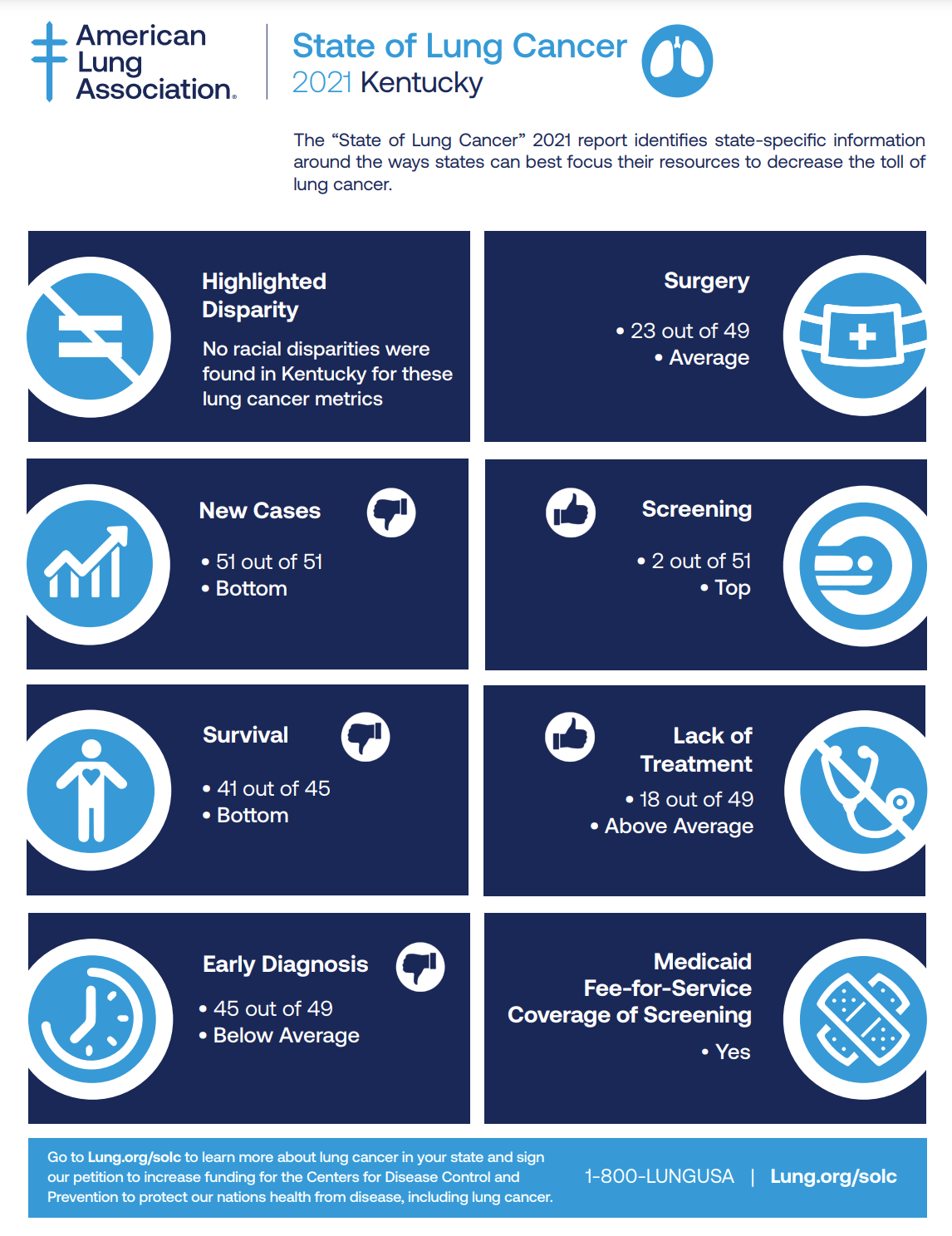
American Lung Association graphic; for a larger version, click on it.
The fourth annual American Lung Association State of Lung Cancer report places Kentucky among the worst five states for smoking, new cases, early diagnosis and survival.

The report ranks Kentucky second in screening, perhaps driven by its high case rate, but says it's worse than average in the percentage of lung-cancer patients (19%) not receiving treatment. It ranks 18th for this measure. 

The national rate for lack of treatment is 21%. The report adds that over the last five years, the percent of cases receiving no treatment in Kentucky increased by 10%. 

One of the best ways to prevent lung cancer is to prevent it and that involves helping the 23.4% of smokers in Kentucky to quit. Smoking is the number one cause of lung cancer, causing about 90% of cases, according to the American Lung Association. Kentucky ranks 2nd in the nation for smoking, following behind West Virginia. 

The state Department for Public Health offers a service called Quit Now Kentucky to help Kentuckians of all ages quit smoking. To learn more go to QuitNowKentucky.org, text QUITKY to 797979 or call 1-800-QUIT-NOW.

The only recommended screening test for lung cancer is low-dose computed tomography, also called a low-dose CT scan, according to the Centers for disease Control and Prevention. 

Annual CT scans are recommended for adults ages 50 to 80 who have smoked at least 20 "pack-years" (a pack-year amounting to one pack of cigarettes a day for a year, or an equivalent amount, such as half a pack a day for two years) and either still smokes or has quit within the last 15 years.

Map shows potential of indoor radon accumulation; click to enlarge.
The second leading cause of lung cancer is exposure to radon, an invisible gas that comes from bedrock. You cannot see, taste or smell it, so the only way to know the concentration of it in your home is to test for it. Concentrations of radon in and under homes are high in many parts of Kentucky.

Some local health departments, as well as the Kentucky Radon Program, offer free short-term radon test kits to Kentucky residents. If elevated levels of radon are detected, radon mitigation systems can be installed to reduce it. 

It's also important to know that there is an even higher risk of lung cancer for people who smoke and also have radon exposure. According to the UK College of Nursing, the lifetime risk of radon-induced lung cancer is 62 per 1,000 ever-smokers compared to seven per 1,000 never-smokers. Because of this, people who smoke or use vape products should smoke outside, says the college's BREATHE (Bridging Research Efforts and Advocacy Toward Healthy Environments) project.

Other causes of lung cancer include exposure to certain hazardous chemicals, pollution, and genetics. 

Symptoms of lung cancer are coughing that gets worse or doesn't go away, chest pain, shortness of breath, wheezing, coughing up blood, feeling very tired all of the time or weight loss with no known cause, according to the CDC.

Friday, January 15, 2021

As pandemic keeps us at home more, risk of lung cancer from radon gas increases; tests are available; it's Radon Action Month

Radon gas comes from rocks, so this geological map suggests risk levels, but there are other factors such as construction and ventilation. For details and more about the map, click here.
By Stacy R. Stanifer

This year alone, approximately 4,890 Kentuckians will be diagnosed with lung cancer, yet the disease remains highly preventable.

While nearly 80 percent of lung cancers are caused by tobacco smoke, exposure to radon gas is the second leading cause of lung cancer, accounting for approximately 21,000 cases of lung cancer each year in the U.S.

Radon gas exposure is an invisible threat to your health, and you cannot taste or smell it. While the naturally occurring gas is present at low levels in outdoor air, our greatest risk of exposure is in the home, where the gas enters and becomes trapped, and where we spend most of our time.

Given the global pandemic and the recommended public health guidelines, individuals and families are spending more time than ever at home. With January being National Radon Action Month, there is no better time than now to create a healthy home.

Thankfully, there is something you can do to lower your risk of exposure to dangerous radon gas. Because you cannot see, taste, or smell radon gas, the only way to know the concentration of radon in your home is to test for it. Some local health departments, as well as the Kentucky Radon Program, offer free short-term radon test kits to Kentucky residents.

When elevated radon levels are found, radon mitigation systems can be installed by certified radon mitigation professionals. In many cases these systems can reduce radon levels in homes by up to 99%.

While we are all doing our part to “Stay Healthy at Home,” we urge you to test your home for radon, and if the concentrations are high, fix or mitigate your home. Exposure to radon can be dangerous to anyone, regardless of the presence or absence of other risk factors for lung cancer.

If you haven’t tested your home for radon, National Radon Action Month is the perfect time to take action and request a free radon test kit from your local health department or the Kentucky Radon Program. Then, test your home, know your level, and take action if your home radon concentration is at or above 4.0 pCi/L. If anyone in your home uses tobacco or vape products, ask them not to use the products inside (and at least 25 feet away from entryways, windows, and building vents).

Breathing radon is dangerous for everyone but even more harmful when also exposed to tobacco smoke or e-cigarette aerosol. What better way to “Stay Healthy at Home” than with the peace of mind knowing that you are protecting you and your family from the second leading cause of lung cancer by testing for radon?

Stacy R. Stanifer, Ph.D., APRN, AOCNS, is an assistant professor in the University of Kentucky College of Nursing. Contact her at Srecke0@uky.edu or 859-323-6874.