Showing posts with label data. Show all posts

Sunday, May 28, 2023

New Kentucky website provides data, maps and charts on how the environment affects human health, county by county

The website's address is Healthtracking.ky.gov.
The state Department for Public Health has launched a new resource for tracking a variety of topics that affect health in Kentucky. 

The website Healthtracking.ky.gov not only includes information and data about how the environment affects human health in a number of ways, but also presents data in map, chart or table formats for subcategories in each topic area. 

For example, under the category of heart disease and stroke, the site also provides information about the age-adjusted rate of hospitalization for heart attacks in each county, the crude rate of hospitalizations for heart attack in each county, and the number of hospitalizations for heart attack in each county. 

Other topics include: air quality, asthma, birth defects, cancer, childhood lead poisoning, chronic obstructive pulmonary disease (COPD), carbon-monoxide poisoning, climate and weather, drinking water, heat-related illness, radon (a naturally occuring, cancer-causing gas) and reproductive and birth outcomes. 

Data on the new site comes from several counrse, including the Centers for Disease Control and Prevention, the Environmental Protection Agency, the Kentucky Cancer Registry, state and local Health Departments and many others. Data can be examined at a state or county level.

The site also offers online maps with information about local health departments, prescription assistance, social vulnerability, and community vulnerability to Covid-19. It is managed by the health department's Environmental Public Health Tracking Program.

Thursday, April 13, 2023

Catholic Health Initiatives hospitals in Kentucky suffer data breach, say 'no evidence that this information has been misused'

By Melissa Patrick
Kentucky Health News

Kentucky is one of 13 states with hospitals that have been affected by a ransomware attack on the CommonSpirit health-care system, which is the parent organization of Catholic Health Initiatives in Kentucky. 

Mary Branham, spokesperson for CHI Saint Joseph Health, said in an email that it started the notification process about this data breach in December, even as the review of the files was ongoing. 

"We have completed the review and identified additional current and past CommonSpirit locations associated with the data," Branham wrote. "Beginning in April 2023, we issued our last anticipated notification to potentially impacted individuals." 

According to an April 6 CommonSpirit update, these Kentucky facilities were included in the ransomware event:  Flaget Memorial Hospital, Bardstown; Saint Joseph Hospital, Lexington, Nicholasville; Saint Joseph Health Community Pharmacy, Lexington; Saint Joseph Berea; Saint Joseph East, Lexington; Saint Joseph London; Saint Joseph Mount Sterling; Saint Joseph Mount Sterling Outpatient Rehab; Saint Joseph Mount Sterling Outpatient Rehab, Flemingsburg; Continuing Care Hospital, Lexington; and CHI Saint Joseph Medical Groups in Central and Eastern Kentucky, as well as Jewish Hospital in Louisville and Saint Joseph Martin in Floyd County, which were formerly part of CHI. 

CommonSpirit, which has more than 1,000 care sites and 140 hospitals in 21 states, said the ransomware attack was detected Oct. 2 and an investigation determined an unauthorized third party gained access to the network between Sept. 16 and Oct. 3. The party obtained copies of some data, including two file-share servers containing information on individuals going back several years. 

Information in those files included "demographics such as name, address, date of birth, phone number(s), email address, as well as medical information such as dates of service, medical record number, health-care provider’s name, diagnosis/treatment information, medical billing/claims information, patient’s facility associated account/encounter number, and health insurance information," the update said. "For a small number of individuals, Social Security number was also involved."

Branham said, "We immediately took steps to secure the network, which included proactively taking certain systems offline, and began an extensive investigation with the assistance of leading external cybersecurity specialists and law enforcement. . . . We have no evidence that this information has been misused."

That said, the CommonSpirit update advises ongoing caution: “Though CommonSpirit has no evidence that the information has been misused as a result of this event, it is always prudent to review health care statements for accuracy and report any services or charges that were not incurred to the provider or insurance carrier.”

According to CommonSpirit’s most recent quarterly financial statement, the data breach cost the organization about $150 million, which includes lost revenues from the interruption to business and costs to remedy the issue, Modern HealthCare reports. It also reports that the  U.S. Department of Health & Human Services Office for Civil Rights reported that more than 623,700 people were affected.

Wednesday, September 30, 2020

Anthem settles states' lawsuit over data breach that affected 2.3 million Kentuckians; state will get more than $1.9 million

Image from CoreRecon.com
Kentucky will get $1,929,942 from Anthem Inc. as part of a 43-state settlement for a data security breach that "compromised the personal information of 78.8 million Americans," said a news release from Attorney General Daniel Cameron.

Anthem, the state's leading health insurer, "also agreed to a series of data security and adequate governance provisions designed to strengthen its practices," the release said. "Attorney General Cameron’s Division of Consumer Protection served on the executive committee of the multi-state team and was a leader in the investigation."

In February 2015, Anthem disclosed that its data systems had been infiltrated a year earlier. "The attackers gained access to Anthem’s data warehouse and harvested names, dates of birth, Social Security numbers, health-care identification numbers, home addresses, email addresses, phone numbers, and employment information," the release said. "The personal information of 2,305,612 Kentuckians was compromised."

The release said the settlement requires Anthem to:
  • Stop making statements about the extent to which it protects the privacy and security of personal information.
  • Implement a comprehensive information-security program, including principles of "zero trust" architecture, regular security reporting to its board of directors, and prompt notice of significant security events to the CEO.
  • Execute specific security requirements concerning segmentation, logging and monitoring, anti-virus maintenance, access controls and two-factor authentication, encryption, risk assessments, penetration testing, and employee training, among other requirements.
  • Get third-party security assessments and audits for three years, and make its risk assessments available to a third-party assessor.
Soon after its disclosure, Anthem offered an initial two years of credit monitoring to all affected customers, at the request of the Connecticut attorney general.

Anthem then settled a class-action lawsuit by creating a $115 million fund "to pay for additional credit monitoring, cash payments of up to $50, and reimbursement for out-of-pocket losses for affected consumers," the release said. "The deadlines for consumers to submit claims under that settlement have since passed."

Thursday, August 31, 2017

2017 Data! Forum, "Using Data to Foster Health Innovation," to be held Oct. 23 in Erlanger; event is free, but registration required

The Foundation for a Healthy Kentucky and Interact for Health are hosting the 2017 Data! Forum to help communities better harness data to improve health. This year's theme is "Using Data to Foster Health Innovation."

Attendance is free, but registration is required. The forum will run from 9:30 a.m. to 4 p.m. Oct. 23 at the St. Elizabeth Training and Education Center, 3861 Olympic Blvd., Erlanger. Click here to register.

"Information from claims and other health data has tremendous potential to improve community health, especially when used to design interventions at the front end, before people become chronically ill," Ben Chandler, president and CEO of the foundation, said in the news release.

The morning keynote speaker, Aaron Truchil, director of analytics and informatics at the Camden Coalition of Healthcare Providers in New Jersey, will discuss how the coalition uses data to identify "super-utilizers" of health care, and their approach to "whole-person care."

Afternoon keynote speakers include Ohio and Kentucky's medical directors of Medicaid, Barbara Sears and Dr. Gilbert C. Liu, respectively, who will share how their state's Medicaid programs use data to improve health.

The forum is intended for non-profit and philanthropic organizations, entrepreneurs, hospitals, health departments, community planners, health advocates and researchers, says the release.

For more information, contact Rachelle Seger at rseger@healthy-ky.org or call 877-326-2583.

Saturday, December 12, 2015

Baptist Health joins national network that combines data to help patients get the best cancer care

Baptist Health has joined a national network that facilitates the sharing of health information with other hospitals in its network to improve and personalize cancer treatments, all while keeping its patient close to home, according to a Guardian Research Network news release.

With the addition of four new healthcare systems, including Baptist Health, GRN will now encompass 76 hospitals in nine states. By 2020, it expects to include one million patients with full clinical, imaging, laboratory and significant molecular profiles.

“Baptist Health is excited about the opportunity to be a member of the Guardian Research Network," Timothy Jahn, chief clinical officer of Baptist Health, said in the release. "Participation in GRN offers Baptist cancer patients a personalized approach to the care and treatment of their disease in their own communities,”

GRN collects data from "hundreds of thousands of patients'" electronic medical records and stores it so that they can evaluate and analyze it, which results in "bringing cutting-edge therapies specifically targeted to each patient's cancer" says the release.

Following strict HIPAA privacy regulations, GRN uses this data to identify patients who are eligible for clinical trials.

"This rapid patient-to-trial identification process will significantly reduce the time it takes to enroll a patient in the most advanced clinical trials available," says the release.

Wednesday, August 12, 2015

Patient portals at Leitchfield hospital are breached in cyber attack; officials say it did not involve any data in state system

By Melissa Patrick
Kentucky Health News

Twin Lakes Regional Medical Center's patient portals were the target of a sophisticated cyber attack earlier this year, which may have breached protected patient health information, reports The Record, a Leitchfield newspaper.

The cyber attack was made on one of the Kentucky Health Information Exchange's patient portal vendors, NoMoreClipboard. KHIE patient portals are secure, online websites that give patients access to their personal health information.

"The NoMoreClipboard breach only affected one hospital, Twin Lakes," Beth Fisher, spokeswoman for the Cabinet for Health and Family Services, said in an e-mail. "The breach affected the patient portal maintained by NoMoreClipboard, not KHIE. No information from KHIE was breached or accessed."

KHIE provides a common electronic information infrastructure that supports the exchange of electronic health information among healthcare providers and organizations throughout Kentucky. It contracts with many different vendors to provide this service.

The security notice from NoMoreClipbard said the data that might have been compromised are: an individuals’ name, home address, Social Security number, username, password, spousal information (name and potentially date of birth), security question and answer, email address, date of birth, health information, and health insurance policy information. The newspaper says that no financial or credit card information was compromised because this information is not collected or stored.

The hospital made the announcement on July 27 and asked patients to not call the hospital "since the breach did not involve any information stored by the hospital or by any local doctor's office," the newspaper writes.

As of July 30, the hospital could not determine the number of people affected by the breach, but said "It should be kept to a minimum since the system was only recently put into place," the newspaper reports.

NoMoreClipboard began contacting affected individuals on June 2, according to the online security notice. It has also established a confidential, toll-free hotline to answer any questions. The hotline is available Monday through Friday, 8 a.m. to 8 p.m. CDT and can be reached at 866-328-1987.

NoMoreClipboard is offering credit monitoring and identity protection services to affected individuals, free of charge, for the next 24 months. Click here to see the security notice sent to its clients.

Wednesday, June 10, 2015

Newspapers' data analysis finds that Kentucky's seniors on Medicare are among the sickest in U.S.; local data available

Red counties are over 21%. For map with data, click here.
The top 10 Kentucky counties with the highest percentage of seniors on Medicare who have six or more chronic conditions are also in the nation's top 50 for sick seniors, according to government data analyzed by USA Today and The Courier-Journal. Nine of the top 10 counties are in Appalachia.

"That's not surprising," Fran Feltner, director of the University of Kentucky Center of Excellence in Rural Health, told The C-J's Laura Ungar. "And when you're having breathing problems, high blood pressure problems and other problems, to me it seems like you're waging a daily battle against the chronic diseases. It's hard to fight the battle ... and as you get older, it's harder."

The top 10 Kentucky counties ranked by percentage of the 65-and-older Medicare population with six or more chronic conditions are Clay, 27.1 percent; Breathitt, 26.3 percent; Johnson, 26.2 percent; Knott, 25.1 percent; Perry, 24.6 percent; Letcher, 24.2 percent; Bell, 24 percent; Floyd, 23.8 percent; Wolfe, 23.7 percent; and Taylor, 23.6 percent. Taylor County (Campbellsville) is not in Appalachia but borders three non-coal Appalachian counties.

Beve Cotton (C-J photo by Mark Mahan)
Beve Cotton, 81 and with a long list of chronic diseases, is one of those seniors. He lives in Manchester, the seat of Clay County, which ranks 12th among more than 3,100 counties nationally for the percentage of seniors on Medicare with six or more chronic conditions, Ungar reports.

"I'm a mess," said Cotton, who gets around in a power chair and wears a full set of dentures after losing all his teeth. "I'm not able to do things. I'm an accomplished cook, but I can't do that anymore ... I can't drive. My legs don't cooperate. ... It's very hard."

Ungar reports that Clay County, population 21,147, has many of the factors that combine to cause poor health.: "Nearly 38 percent of residents live below the poverty level, compared with a state average of 19 percent, according to the Census Bureau. Median household income is about $22,000 a year, about half the state average.Access to health care, especially specialists, is limited, and there are few well-stocked grocery stores or safe places to exercise. Smoking and obesity rates are sky-high."

Carmen Webb, who directs the senior center in Manchester, told Ungar that many seniors struggle with being able to afford staples, let alone healthy food and also the high cost of transportation, making it difficult to get to doctors appointments to manage their illnesses.

Cotton, who grew up in Manchester, told Ungar that he depends on others for rides, frequently to doctors' appointments, including many at the Veterans Affairs Medical Center in Lexington, about 100 miles away. Webb noted that public transportation in the area costs $1.50 per mile.

Feltner added that many seniors in the area don't know how to prevent chronic disease, some have fatalistic attitudes and because many of them are on multiple medications, they face the dangers of drug interactions and side effects, Ungar reports.

Experts say that such high levels of illness hurts communities, "hastening a downward economic spiral locally and requiring huge portions of Medicare budgets," Ungar writes. It also overtaxes the medical communities in rural counties even thinner.

"These patients need to be seen frequently by doctors, and they need much longer visits. ... These folks need intense care," Dr. Michael Karpf, executive vice president for health affairs at UK, told Ungar. "Given the shortage of primary care in Appalachia, this kind of patient just exacerbates that shortage."

"The real issue is prevention — weight control, exercise, food habits," Karpf said. "But it's hard. Fast food is cheaper than wholesome, healthy food, and (the way people eat) is partly cultural. Those things are hard to change. It's a generational process."


Monday, February 16, 2015

'Medicaid Dashboard' gives county-by-county details on 375,000 who joined program, what screenings they got, what they found

The expansion of the federal-state Medicaid program under federal health reform marks the biggest change in Kentucky health care since Medicare began in the mid-1960s. Almost 400,000 people have joined the program, raising its rolls to more than one-fourth of the state's population. This is an important story in almost every county, and the state has the data to tell it.

As part of the $141,000 study of the first year of Medicaid expansion, Deloitte Consulting created for the state and its citizens a "Medicaid Dashboard" that gives detailed information about the newly eligible Medicaid enrollees in every county, by age, gender and chronic health conditions, along with information about payments to health-care providers in each county. Here's a partial screenshot, with one county highlighted:
And here's an example of how data from that county can be broken down by age and gender:
In addition to these data, and detailed information about payments to providers, the dashboard also reveals how many new Medicaid enrollees have been diagnosed with what chronic conditions, and what screenings and other preventive services they have received. This can also be broken down by county. For the dashboard, go here.
The data are only for people who were made eligible for Medicaid by the expansion, which raised the income limit to 138 percent of the federal poverty line, from 69 percent. The data do not include several thousand people who had been eligible for Medicaid under the old limit but did not enroll until the limit was raised.

Sunday, February 8, 2015

At least 14 counties had vaccination rates in 2011-12 below level experts say is needed to protect kindergartners from measles

As concern about the spread of measles from lack of vaccination grows, many Kentucky counties probably have vaccination rates below the minimum that experts say is needed to create "herd immunity" and prevent spread of the highly contagious disease among students in kindergarten.

At least 14 Kentucky counties had measles vaccination rates below 90 percent in the 2011-12 school year, according to state data analyzed by USA Today, in a survey of states that track vaccination rates and make them public. The Courier-Journal published the Kentucky figures in an online database.

The counties under 90 percent were Bath (89%), Boyle (83%), Bullitt (88%), Christian (89%), Harlan (88%), Jefferson (86%), Laurel (85%), Lawrence (88%), Lee (80%), Nelson (82%), Robertson (88%), Rowan (86%), Taylor (82%) and Webster (86%). Data from several counties was not available. For the database with county-by-county figures, click here.

The statewide vaccination rate was 93 percent, pulled down by a rate of 86 percent in Jefferson County, the state's most populous. The lowest rates were 80 percent in Lee County and 82 percent in Nelson and Taylor counties.

Jefferson County officials told The Courier-Journal that the county's rate rose above 90 percent in the last two to three years. Bullitt County school-health coordinator Lesa Bodine told the Louisville newspaper that her data show 94.3 percent of the county's kindergarten students "have been properly immunized," The C-J's Darla Carter reports. "However, she said there are some parents who choose not to immunize their children. She also noted that there can be a delay in receiving proof of vaccination because a child has, for example, transferred from another county or state."

Like many states, Kentucky allows parents to exempt their children from required vaccinations for medical or religious reasons. Measles outbreaks in other states have been blamed at least partly on parents who still believe discredited reports that vaccines cause autism or other disorders. Generally, the stricter the laws, the higher the vaccination rate, Stateline reports. Here's a Stateline map showing how states differ:

Friday, December 5, 2014

U of L plans to create statewide health institute with $4 million, three-year grant from KentuckyOne Health hospital firm

The University of Louisville is creating an institute to improve Kentucky's health through research, education and advocacy of health policies.

KentuckyOne Health is giving the university $4 million over three years to establish the Commonwealth Institute of Kentucky in U of L's School of Public Health and Information Sciences. Dean Craig Blakely said the institute will work in western Louisville but also on statewide issues, focusing on data gathering and analysis.

"Kentucky has the nation's highest rates of cancer deaths and smoking, and ranks among the top for cardiovascular disease, obesity, prescription drug abuse and other health problems," Laura Ungar notes for The Courier-Journal. "And certain neighborhoods, regions and populations suffer disproportionately, with even higher rates."

Thursday, February 13, 2014

In wide-ranging interview, secretary says her state health cabinet is a national leader in guarding the privacy of electronic data

Despite concerns elsewhere about the privacy of personal health information, Kentucky's top health official says her agency is one of the best in the nation at protecting and managing such data.

Audrey Tayse Haynes, secretary of the Cabinet for Health and Family Services, talked about information technology and privacy in an interview with Mark Green, editor of The Lane Report, a Lexington-based business publication. She credited her cabinet's information-technology department and its good record on privacy.

Secretary Audrey Haynes
"We have an extraordinary IT department at this cabinet," Haynes said. "They really are stellar. I’ve worked at national organizations, in the federal government, and of course at the state level, and we have as good an IT department, if not better, than any I’ve seen. That gives us in-house expertise and also, obviously, they can contract for further expertise."

She added, "This cabinet has a long history of maintaining people’s private information because of Medicaid and food stamps and many other programs that we run here. Last year millions of dollars were collected for Kentucky’s kids through court-ordered child support that runs through this cabinet. We have very strict requirements, both at the federal and state levels, and we take privacy very seriously. Our IT department and others plan for it, and we’re alert to it all the time."

Haynes said Kentucky is also a national leader in helping health-care providers share electronic health records, through the Kentucky Health Information Exchange, with more than 2,000 participating and getting more than $144 million in federal incentive payments. The information exchange "is nationally recognized as being in the forefront for the exchange of health information records," Haynes said. "We are one of the most progressive in the nation."

She noted that the cabinet also runs KASPER (the Kentucky All Schedule Prescription Electronic Reporting) system, which doctors and medical professionals check before prescribing controlled substances to prevent drug abuse. A 2012 law cracking down on prescription painkillers required prescribers to use the system, and it now has more than 24,700 users, Haynes said. "KASPER is a very complex system to maintain," she said, "but it is keeping Kentucky at the forefront nationally as far as helping to curb the prescription drug problem in our state.

Green and Haynes touched on many subjects in the interview, which as published runs almost 3,000 words. She said the state's health-insurance exchange, Kynect, has been successful also because of its executive director, Carrie Banahan, who "has a long history of experience with insurance, with Medicaid and with management. That’s critical. And we made it not just Carrie’s project but a Cabinet project. Then we were able to get a great company that was very committed to the success of this in Deloitte" Consulting, which built the system. "Finally, we kept it simple. We knew we could make improvements as the months and years went on. We didn’t try to be too fancy right out of the gate. We knew that it needed to work well when it was launched – that was more important than making it the fanciest online system right away."

Haynes concluded, "When I came back from Washington, D.C., to take this job, people who know me and know this cabinet were very surprised, but I’ve never regretted it. I believe in public service as well as in the role of the private sector, and this has been a dream job for me because I’ve had an opportunity to work making good policy. I’ve had some pretty neat dream jobs in my career, but this is certainly going to be the topper. Few of us ever have an opportunity to say that we have done something that can truly have an impact and be part of something that’s going to have an impact for many, many years. I think about that all the time. I wouldn’t want to be anywhere else." (Read more)

Sunday, May 5, 2013

Oral health care for the poor in Kentucky suffers under managed care as dentists leave Medicaid; how about your county?

Kentucky's serious oral-health problems are getting worse because fewer dentists are participating in the Medicaid program -- a result of "new paperwork issues compounding Medicaid's reputation" for low payments to providers, Laura Ungar reports for The Courier-Journal.

Ungar's source for that is Dr. Raynor Mullins of the College of Dentistry at the University of Kentucky, who told her that only 700 to 800 of the state's nearly 2,500 dentists, about 30 percent, accept Medicaid patients.

That makes now seem like a good time for journalists to ask their local dentists if they accept Medicaid -- and if not, why not; and if so, whether they are considering dropping it.

Ungar notes that 28 of Kentucky's 120 counties are deemed not to have enough dentists to serve the local population. Most if not all of them are rural. You can find out which counties are under-served by physical, dental or mental health providers at this federal Health Resources and Services Administration website.

Tuesday, September 6, 2011

UK Hospital gets below average marks on patient satisfaction, infections; data on your local hospital are available online

Despite $900 million being invested in expanding the University of Kentucky Chandler Hospital, its patients at do not seem all that happy with the care they receive there.

In an op-ed piece in the Lexington Herald-Leader, Dr. Kevin Kavanagh of Somerset highlights the results of a survey on patients' hospital experiences. That survey ranked UK's hospital below state and national averages in nine of 10 measures. "Especially disturbing, only 66 percent said they would definitely recommend the institution, and only 56 percent stated their room and bathroom were 'always clean'," writes Kavanagh, chairman of Health Watch USA.

The UK hospital also did not fare well when it came to its assessment by the Centers for Medicare and Medicaid Services on hospital-acquired conditions. "UK had the highest reported rate of deadly vascular catheter infections in the state," Kavanagh writes. "UK also had an unacceptably high rate of falls and deep bed ulcers. These latter conditions should be zero."

Kavanagh concluded, "If there are quality problems at UK, it is of paramount importance that they are corrected since not only current patients are at risk but also the quality of the training experience of our future clinicians, which can affect care for years to come." (Read more)

Newspapers can access information about their area hospitals by clicking here. Viewers can choose up to three hospitals and see how they compare to one another in categories like: how well nurses communicate with patients; how quiet the areas around patients are; if patients would recommend the hospital; and if patients always received help as soon as it was wanted.

Newspapers can also see the results of the CMS assessment on hospital-acquired conditions for their area hospitals by clicking here and downloading the Hospital-Acquired Condition Rates zip file (scroll down to Kentucky hospitals). The file contains data on eight hospital-acquired conditions reported between Oct. 1, 2008 and June 30, 2010. Among the conditions reported are air embolism; blood incompatibility; catheter-associated infections; falls and trauma; foreign objects left in the body after surgery; pressure ulcers; uncontrolled blood sugar levels; and urinary tract infections.

Wednesday, August 10, 2011

Kentucky Rural Health Assn. gives first newspaper writing awards; Kentucky Health News writer wins for previous work

Tara Kaprowy, the chief writer for Kentucky Health News, won one of the first awards given by the Kentucky Rural Health Association for newspaper writing.

Kaprowy won the prise for best series in a non-daily newspaper for her five-part series in The Sentinel-Echo of London titled “How Healthy Are We?” The August 2010 series examined how Laurel County compared to state and national averages for tobacco use, obesity, access to health care, and so on.

Ivy Brashear, formerly of The Hazard Herald, won prize for best story in a non-daily paper for her April 6, 2011, article, “Health study has Perry near the bottom,” about a Population Health Institute study that ranked Perry’s health status as 115th among the state's 120 counties. There were no daily entries; each winner received a plaque and $100 prize.

These types of reports can be done by any news outlet in Kentucky, because plenty of data are available on sites such as http://www.kyhealthfacts.org/. For a look at Kaprowy's series, go here.

Thursday, July 14, 2011

Website helps journalists, community planners, other Kentuckians in search of county-specific health data

A treasure trove of health data about every county in Kentucky is available to journalists and community planners looking to draw a statistical picture of their area. That was the message of a webinar hosted by the Foundation for a Healthy Kentucky Wednesday.

"We really hope the information we have on kentuckyhealthfacts.org will start a conversation," said Sarah Walsh of the foundation's "Local Data for Local Action" Initiative.

The website features a map of the state that is broken down by county. By clicking on a county, a plethora of information pops up, including information on a county's:
• demographics, such as graduation rates and per capita personal income;
• social and behavioral indicators, such as lack of physical activity and prevalence of smoking and obesity;
• health outcomes, such as infectious disease rates, motor vehicle deaths and premature death rates;
• access to care, such as flu vaccination rates, and number of available health care providers and physicians;
• maternal and child health, such as infant mortality, teen birth rates and low birthweight rates;
• senior health, such as the percentage of the senior population in a community.

The data can be compared to the rest of the state, the rest of the country or other counties, and users can create tables, bar graphs, line graphs or maps suitable for publication. "There's a lot of information here," Walsh said. (Graph created online shows obesity declining in Laurel and Pulaski counties after three years of increase, but still rising in Knox County and holding steadier in Rockcastle County. Up to six counties can be placed in one such graphic.)

The site is especially valuable to journalists, said Al Cross, director of the Institute for Rural Journalism and Community Issues at the University of Kentucky. "These are the hard facts that local news media need to report as they hold up a mirror to their communities and help them address community problems," Cross said. "In most Kentucky counties, one or more facets of health are a community problem. They need more attention." Kentucky Health News is a service of the institute, funded by the foundation.

Much of the data come from the Centers for Disease Control and Prevention's Behavioral Risk Factor Surveillance Survey, a nationwide, random telephone poll that is conducted each year. Because there may not be enough survey responses from residents in some counties, much of the data on the site have been developed by looking at three or four counties that are near each other and demographically similar, which Walsh said makes the data more "stable and robust." Statisticians have reconfigured the data so that they are all based on a population of 100,000 people, enough to have confidence in the percentages.

While encouraging community planners to use the site, Walsh said the Kentucky Cancer Registry website is "one of the best in the nation" and has cancer-specific data that may not be available on kentuckyhealthfacts.org. She also pointed listeners to the Kids Count website, an Annie E. Casey Foundation-funded project that has statewide data specific to children.

What surfers won't find, however, are Kentucky numbers on the childhood obesity or childhood diabetes. "Different school districts and communities are collecting data but in different ways and at different ages," she said, adding those disparities make comparison analysis difficult. A bill to make schools collect and report body-mass-index data failed in the last session of the General Assembly.

The goal of Wednesday's webinar was to disseminate information so community planners can identify and address health needs in their area. "At the foundation we take a lot of inspiration from the words of Arthur Ashe, 'Start where you are. Use what you have. Do what you can'," Walsh said. "We believe communities can do a lot to change their health status." The webinar was part of the foundation's "Health for a Change: Ignite — Unite — Act" initiative and was the first in an ongoing series. The next session, July 27, will focus on how to plan a community health needs assessment. For more information about the series, click here.

Thursday, April 28, 2011

More county-specific health data are available, painting detailed pictures of your local area's health

Five years' worth of county-specific data are now available for many types of health indicators on the Kentucky Health Facts website. The site features data on demographics, social and behavioral indicators, health outcomes, access to care, and maternal and child health, much of which can be useful to journalists all over Kentucky.

The Health Outcomes category, for example, looks at a county's premature-death rate, motor-vehicle deaths, prevalence of asthma, diabetes prevalence and cancer deaths. The Maternal and Child Health category looks at adequacy of prenatal care, infant mortality rates, teen birth rates and prevalence of youth who smoke cigarettes. It compares that data to the rest of the state and nation.

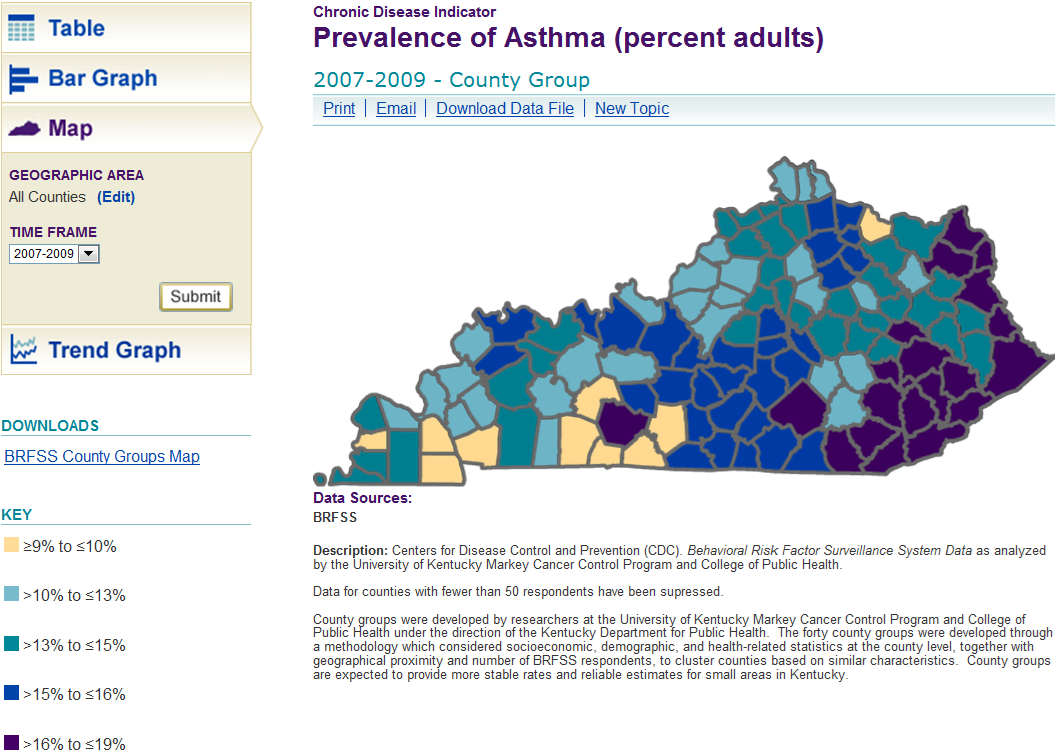
The data paint a detailed picture of what is happening in a specific area. One interesting nugget in the newly updated data on asthma show that in Warren County (Bowling Green), the percentage of adults with the respiratory condition has nearly doubled from 10 percent in 2003-05 to 19 percent in 2007-09. Here is the county asthma map:
The data come from the Centers for Disease Control and Prevention's Behavioral Risk Factor Surveillance System, which is the world's largest ongoing telephone health survey. It has tracked health conditions and risk behaviors in the United States on an annual basis since 1984.

The data can be viewed by going to www.kentuckyhealthfacts.org or by clicking here. Kentucky Health Facts is a service of the Foundation for a Healthy Kentucky.

Tuesday, April 19, 2011

High use of meds earns Louisville bad name for allergies, which are becoming more common as pollination periods expand

Louisville is the second worst American city for spring allergy sufferers, based on use of allergy medicine, says the Asthma and Allergy Foundation of America. Though the city has only an average pollen score and an average number of board-certified allergists, it has an above average number of patients who use allergy medicine, the Spring Allergy Capitals 2011 survey concluded.

Only Knoxville, Tenn., ranked higher than Louisville. Charlotte, N.C., came in third, followed by Jackson, Miss., and Chattanooga, Tenn. "The worst cities are always in the South, where the temperatures are warmer and the plant life flowers earliest," Dr. Joseph Leija, an allergist who performs the Gottlieb Allergy Count, told research-reporting service Newswise.

Louisville ranked second last year as well, first in 2009, and 21st in 2008. In the past nine years the survey has been conducted, pollen concentrations have increased. "There's a lot of evidence that trees, grasses and weeds are pollinating more, said Mike Tringale, vice president for external affairs at the foundation. There is also evidence that the pollination season is lengthening, starting 10 to 15 days sooner and lasting 10 to 15 days longer.

As a result, more people are suffering. "Allergy prevalence has more than doubled in the past 30 years," Tringale said. "No one is really sure why. One of the leading theories is global warming." Today, between 12 to 14 percent of people have nasal allergies.

As for why some cities are affected more than others, Tringale said he didn't have an answer. Researchers will be looking at patterns and correlations next year in time for the 10th year of the study.

The study looked at the number of prescriptions that are written and refilled for all allergy medications, "whether eye drops, nasal sprays or oral pills," Tringale said. It also looked at all of the over-the-counter versions of allergy medicines that are sold at pharmacy counters, which account for about 20 percent of all over-the-counter sales. Medications sold at regular check-out aisles and at grocery stores were not accounted for, nor were medicines sold at Walmart. "Walmart doesn't give out data," Tringale said. Though Tringale acknowledged the low percentage of OTC sales tracked is a weakness of the study, he said it was done in this way "to standardize the data between cities."

Pollen counts were collected weekly "from thousands of different stations," Tringale said. The American Board of Medical Specialties provided the data regarding the number of board-certified allergists. (Read more)

Friday, April 1, 2011

Kentucky continues to lead nation in cancer death rate

Though cancer deaths rates are falling nationwide, Kentucky continues to rank worst in the country for its number of cancer deaths, The Courier-Journal's Laura Ungar has determined. (C-J graphic shows rates for the nation, Kentucky and Indiana, the southern part of which the Louisville newspaper serves.)

Ungar's analysis stems from Thursday's release of the Annual Report to the Nation on the Status of Cancer, which concluded cancer death rates declined about 1.6 percent each year between 2003 and 2007 nationwide. Kentucky's death rate declined an average of 0.7 percent each of those years.

The state had a cancer death rate of 213.7 per 100,000 residents in 2007, which translates to about 9,700 Kentuckians dying each year from cancer. In 2007, Kentucky had a lung cancer death rate 50 percent higher than the national average, ranking it highest in the nation. It also ranked eighth highest in brain and other nervous-system cancers and higher than average for colorectal, prostate and breast cancer death rates.

Lung cancer is the most deadly cancer in the country, though researchers found, for the first time, a decrease in the number of women who die from lung cancer nationwide. The decline comes "more than a decade after deaths began dropping in men," Ungar reports.

Doctors are hoping to make more strides in battling the disease in the years to come. Thomas Tucker, director of the Kentucky Cancer Registry, told Ungar that smoking bans, higher cigarette taxes and anti-smoking messages should help drive down lung cancer rates. There has also been progress in the percentage of Kentuckians who are getting colonoscopies, a screening for colon cancer. Though more Kentuckians died of colorectal cancer than any other state in 2007, the rate has declined since. (Read more)

Wednesday, March 30, 2011

County health rankings in Kentucky show few changes, but ranks are less important than the trove of data they reflect

By Tara Kaprowy
Kentucky Health News

The health evaluation tool that calls itself "the annual check-up of over 3,000 counties in the nation" was released today, showing little change from last year in how Kentucky counties compare when it comes to factors like obesity, smoking rates and mortality. But the data provide plenty of fresh angles for stories about the health status of individual counties and regions.

The County Health Rankings for Kentucky, which are compiled by the University of Wisconsin Population Health Institute in collaboration with the Robert Wood Johnson Foundation, ranked Appalachian counties at the bottom and Central Kentucky counties in the Lexington and Louisville markets at the top. The far western portion of the state ranked lower as well.

The rankings fall into two categories: health outcomes and health factors. Health outcomes, left, include factors such as premature death rates, low birthweight and how many days of the past 30 that someone said they felt bad physically or mentally. Boone, Oldham and Calloway counties ranked first, second and third in health outcomes category, and Wolfe, Martin and Owsley were at the bottom.

In health factors, right, Woodford, Boone and Fayette counties were first, second and third, and Jackson, Clay and McCreary at the bottom of the list. Health factors include the percentage of adults who smoke, are obese or drink excessively; and assess a county's health care landscape: the number of primary-care providers and what percentage of adults are uninsured, for example. Social and economic factors in this ranking include unemployment rates, high-school graduation rates, percentage of children in poverty, pollution rates, access to healthy food and the number of recreational facilities. (The last item replaced the number of liquor stores. "Some of the data were not available for the availability of alcohol and it was difficult to interpret," said Dr. Patrick Remington, project director and associate dean for public health at the University of Wisconsin. The change could have affected the rankings, because Kentucky has many "dry" counties and liquor stores often cluster in "wet" counties adjacent to dry ones.)

Interestingly, the rankings between the two categories vary considerably. Fayette County, for example, ranked third in the health factors list but 10th in the health outcomes assessment. McCracken County was listed eleventh in the health factors list but 45th in health outcomes.

Though Appalachian counties in Kentucky, West Virginia and Tennessee generally ranked very low, there was one very bright spot: Morgan County, which ranked 23rd in health outcomes despite being surrounded by counties that were down in the 100s. It also ranked high last year.

While the rankings didn't change drastically from last year, there was some deviation downward in the Southern Kentucky, including Adair, Clinton, Cumberland and Wayne counties. But Shawn Crabtree, executive director of the Lake Cumberland District Health Department, didn't see much reason for concern. "Naturally, the rank of counties are going to go up and down each time," he said. "I don't know that the communities are any sicker or that anyone is doing anything any different."

Crabtree said it is important to remember the assessment is ranking one county against another, not making a comment on if counties are getting healthier or not. "That's not to say our area isn't an unhealthy area; it is," he said. "That doesn't mean we don't need to improve; we do."

Also, statistical data from counties with small populations can greatly affect rankings. "That number is a little bit volatile," Remington said of certain disease numbers. "It's not a survey, it's the actual experience of what happened." He added, "When you present a statistic for an entire community, you realize it's an average. This is like a screening test. It tells people in a community where the problem areas are, but it really doesn't make the diagnosis."
 
Researchers assembled the snapshot county portraits with information from several sources, including the Behavioral Risk Factor Surveillance System, a random telephone survey by the Centers for Disease Control and Prevention. They also used data from the National Center for Education Statistics, the National Center for Health Statistics and the Census Bureau's American Community Survey and Small Area Income and Poverty Estimates. For a complete list of sources, click here.

Given the number of sources used and the conclusions drawn, researchers hope the data will spur community interest and, ultimately change. In a conference call with reporters, Mayor Joe Reardon of Kansas City, Kan., said, "It was a call to action for me personally and a wake-up call for our community."

Feds say they will post data on performance of dialysis centers

"Federal regulators say they are moving to make once-confidential data about the performance of kidney dialysis clinics more readily available to the public," reports Robin Fields of ProPublica, the nonprofit, investigative news group that posted the data online in December. (ProPublica map locates Kentucky dialysis facilities with dark blue dots; gray areas are lakes and national forests)

Last year, a ProPublica investigation showed inferior care and little oversight in some facilities. Officials with the Centers for Medicare and Medicaid Services told Sen. Charles Grassley, R-Iowa, they are now making public their statistical compilations on the country's 5,000 dialysis clinics. This has never been done before, though CMS "has used public money to collect and analyze the data in the reports for more than a decade," Fields reports. CMS is planning on posting the reports on Medicare's Dialysis Facility Compare website. ProPublica has already posted those reports, which can be viewed by clicking here.

ProPublica's investigation reviewed eight years of inspection records for more than 1,500 clinics and "turned up hundreds of lapses in care, some of which led to patient injuries and death," Fields reports. It also found hundreds of clinics had not been inspected for five years or more, though they are supposed to be checked every three years. Upon learning of the investigation, Grassley asked CMS about what it was doing to improve things.

CMS officials conceded that inspections were inadequate in more than a third of the states. Tougher standards had reportedly been implemented to make the inspections more comprehensive; they are apparently needed. In the past two fiscal years, 15 percent of facilities inspected had "deficiencies serious enough to warrant termination from the Medicare program if left uncorrected," Fields said. (Read more)